“During the whole year (536) the sun gave forth its light without brightness, like the moon, and it seemed extremely like the sun in eclipse, for the beams it emitted were not clear nor like those it usually makes.” -Procopius, Byzantine historian on the “dust-veil” of 536
Welcome to another article by the Byzantium Blogger! This month, I have just finished 3 extremely long, complex, but interesting articles on all the Byzantine emperors and their personalities and with so much information and stories about them and their actions, I had to make not one article on it but 3! Now that I’m done with the 3-part series on the Byzantine personality through the emperors’ lives, it’s time to move to another topic which will be on Disasters in Byzantine history, which are mostly acts of God. After writing such a long scholarly series on the emperors, it’s time for a break and for this, I will here an article less serious and focus more on Byzantine historical trivia. This article will once again be based on the book A Cabinet of Byzantine Curiosities by Anthony Kaldellis and specifically on Chapter XVII which is “Disasters- Mostly Acts of God”. When it comes to natural disasters, they are considered as “Acts of God” and therefore are events that cannot be foreseen and in legal terms these are called Fortuitous Events and these unforeseen disasters I will write about in this article include tsunamis, earthquakes, floods, extreme weather events or the “dust-veil”, plague, ice, and fire. Meanwhile many of these events were acts of God like earthquakes, floods, and tsunamis but some fortuitous events can be acts of man as well like fire and plague in the sense of not being able to control it. The quote I used above is from the 6th century Byzantine historian Procopius who discusses what the extreme weather events of the year 536 when the sun was blocked by a thick layer of ash known as the “dust-veil”. This article will be written in a chronological form of disasters from the beginning to end of Byzantine history which is from the foundation of Constantinople in 330 to the fall of it in 1453 covering the 1st, 2nd, and 3rd ages of Byzantium, also it will only stick to these kinds of events in Byzantine history and not on these kinds of events that happened in the Roman Empire before Byzantium such as the Eruption of Vesuvius and the destruction of Pompeii in 79AD; and each paragraph will be made per year of the disaster. This article will feature specific highlighted years which had a major disaster in Byzantine history and will not cover every natural disaster in Byzantine history as it will be too much to write about, also all the disasters I will mention here are those that had only taken place within the Byzantine (Eastern Roman) Empire between 330 and 1453, which means that if a location was no longer under Byzantine control but faced some of these natural disasters, it will not be mentioned. Also, the article will continue what was discussed the last time which was on the personalities of the emperors as it will mention who the reigning emperor was during the time of these disasters as well as in some parts how these emperors based on their personalities dealt with these disasters. In the last 3-part series I wrote, I have discovered that the personalities of the emperors do affect the turn of events in Byzantine history, now since I am writing about natural disasters, these events also did a more major rile in turning Byzantine history itself and both the articles on the imperial personalities and this one would be something I write to learn more about the turn of events in Byzantine history, as the final year ender article will be the “Turning Points in Byzantine History” and will be mostly based on the information of this one and the past 3 as the personalities and disasters did in fact play a big role in the changing of Byzantium’s history itself. Apparently, the Byzantine Empire who’s reign saw the most natural disasters was Justinian I the Great (r. 527-565) and many of the disasters that will be featured here took place during his reign, also because his reign was the most recorded by Byzantine historians such as Procopius as well as it was the most eventful reign out of all the Byzantine emperors. During Justinian I’s reign, the Byzantine Empire faced extreme weather events, a massive plague, a large flood, 2 tsunamis, and 3 major earthquakes but earthquakes on the other hand were the most common disaster in the Byzantine Empire as the empire itself was located in an area which is Anatolia and the Mediterranean that is prone to earthquakes. In fact, Constantinople, for all its greatness in architecture had one major flaw, which was that it was located in an active seismic zone, meanwhile other parts and major cities of the empire including Antioch and many parts of Asia Minor were in active seismic zones too. In Byzantine history, earthquakes were one of the major factors for turning points in their history not because it destroyed cities but affected people forcing them to migrate as seen with a major earthquake in 1354 which destroyed most of the Gallipoli Peninsula in Thrace forcing people to move out allowing the Ottomans from Asia Minor to make their first move into Europe, thus beginning their conquest of the Balkans and the Byzantine Empire itself. The Byzantine people were however superstitious and many of them judged these disasters to be God’s way of punishing them, and some emperors even took action on these disasters by using them as a way to repent such as Leo III in 726 after the eruption of Thera seeing this as the reason for icons to be banned as he saw that the icons had no power to stop these calamities from happening, therefore the Iconoclast movement began. The other disaster most common in the Middle Ages was plague and throughout Byzantine history, there were 2 major devastating recorded plagues first being the Plague of Justinian from 541-542 and the Black Death in the 1340’s and both created such a decline in population and a weakening of the empire and its resources, meanwhile both these plagues too have mysterious origins coming all the way as far as from China. Now since Byzantine history went a long way and changed itself so much that things were no longer the way they were in the 6th century in the 14th century but one thing that never changed for the Byzantines were natural disasters, but at least they at times knew how to prepare for them. Anyway, let’s begin with the article featuring key years of natural disasters having some bizarre stories about them!
Byzantine Imperial flag and symbolsMap of the Byzantine Empire at its greatest extent, 555 during the reign of Justinian I“A Cabinet of Byzantine Curiosities” by Anthony Kaldellis
Note: This article’s information comes from various Byzantine historians from the ear of the Byzantine Empire (330-1453). Facts come from A Cabinet of Byzantine Curiosities by Anthony Kaldellis
Nicomedia (known as Izmit today) was a major city of the Eastern Roman Empire in Asia Minor located in the region of Bithynia just along the Sea of Marmara on the Asian side very close to Constantinople. Before the transfer of the Roman Empire’s capital to Constantnople and the founding of the Byzantine Empire, Nicomedia was the center of the persecutions of Christians beginning in 303 under the emperor Diocletian (r. 284-305). In 358, the 2nd Byzantine emperor Constantius II (r. 337-361), the son of the empire’s founder Constantine I the Great (r. 306-337) proposed to hold a Church council at the cathedral in Nicomedia, although Constantius II was an Arian in belief and probably wanted to hold the council to make Arian Christianity the religion of the empire. However, on August 24, 358 which some days before the council could be held, a massive earthquake struck the city at dawn destroying almost everything, including the cathedral. Since the city was built on a slop descending to the sea, houses built along the slope tumbled down crushing each other creating a cascade. The Byzantine historian at that time Ammianus Marcellinus describes the devastation of the earthquake, as when the sun rose the damage was so bad that houses tumbled down on top of each other, people were crushed by the damage, others buried up to the neck in the debris, and some were skewered on sharp points and beams. Worse than this, the damage trapped people in their homes leaving them to starve to death, including the governor Aristainetos. The semi-Arian bishop Cecropius too was found dead from the earthquake, although surprisingly the number of the deaths from this earthquake was only 15 and one of the people killed apart from the bishop and governor was the Persian soldier/ philosopher Arsacius who previously predicted the event but was ridiculed, though after the earthquake, strangely he was found dead in his tower which remained undamaged. This earthquake was held to be an act of divine judgment by Arian opponents believing that God caused this earthquake to punish the Arian heretics, which included the bishop. After the earthquake that brought so much destruction, Nicomedia would eventually be rebuilt but in a smaller scale until in the 6th century when Justinian I built it at the level of an imperial city again.
Byzantine era Nicomedia
Emperor Constantius II of Byzantium (r. 337-361), son of Constantine I
Persecution of Christians in Nicomedia under Diocletian, 303
365- Earthquake and Tsunami of Crete
On July 21, 365, a massive earthquake occurred with its epicenter at the large island of Crete in the Eastern Mediterranean and the effects of it were so strong it reached as far as Sothern Greece, Northern Libya and Egypt, Cyprus, Sicily, and Southern Spain. Modern geologists say that this earthquake had a magnitude of 8.5 or above as it was so strong enough to trigger a tsunami that devasted Crete and went as far as Alexandria in the south killing thousands and pushing ships 3km inland. The massive tsunami and its aftermath that came from the powerful earthquake of Crete is described in detail by the same historian Ammianus Marcellinus who writes that the sea was pulled back from its bed exposing numerous sea animals stuck in the land where ships were also left stranded, also underwater valleys and mountains were seen for the first time by the people and as the sea was pushed back, the people ran to this “new land” to scavenge the ships that were stuck and to collect sea creatures but soon enough, the sea came back at them killing all of them as it rushed quickly into the land. When the tsunami hit the land, thousands were killed by drowning in the sea water, cities were flooded by the water, and ships were carried inland and were even stranded above buildings from the tsunami’s effects. The earthquake’s epicenter may have been in the middle of the sea but it was so strong that it created a tsunami powerful enough to destroy nearly all the towns in Crete and permanently lift parts of the island out of the water, and today the effects can still be seen with some parts that were submerged no longer buried underwater including sea caves that were lifted by 9m.
Meanwhile, the tsunami caused by the earthquake did not only hit Crete, it travelled south directed towards Alexandria, the largest city of Byzantine Egypt. According to a later legend written in the Chronicle of the 7th century Egyptian Coptic bishop John of Nikiu, the powerful and energetic bishop of Alexandria who was strong opponent against Arianism and Church Father, St. Athanasius (296-373) faced the sea charging towards the city with a Bible in his hand and said “Oh God, you never lie, and you promised after the flood of Noah that you will not again bring a flood of waters upon the earth” and with the help of Athanasius, the water of the tsunami stopped and the city was saved, though many parts of the coast of North Africa were devastated by the tsunami at the same level of damage as Crete, but at least Alexandria was saved. However, even if the earthquake and tsunami took place in 365 during the reign of the Byzantine emperor Valentinian I (364-375), some Christian authors predate the event by 2 years to 363 as a way to interpret the tsunami as God’s anger against the emperor Julian the Apostate (r. 361-363) for rejecting Christianity and returning to Paganism. Meanwhile, the Pagan writer and philosopher Libanius who was a fan of Julian included this event as one of the events caused by the earth to mourn Julian’s passing, as in June of 363 Julian was killed in battle against the Sassanid Persians. From 366 up to the late 6th century, July 21 would be commemorated by the Byzantines as “The Day of Horror”.
Map of the range of the Earthquake and Tsunami of Crete, 365Summary of the Crete and Alexandria earthquake and tsunami, 365
Ship carried above a building in a modern day tsunami
Rocks in Crete formed from the 364 tsunami
Harbor in Crete destroyed by the 365 earthquake and tsunami
Lighthouse of Alexandria affected by the Tsunami
Map of the tsunami’s devastation in Libya, North Africa
St. Athanasius, bishop of Alexandria
Emperor Julian the Apostate (r. 361-363)
Libanius (314-394), Greek philosopher
525- Flood of Edessa
Now fast-forward to the early 6th century and in 525 during the reign of Emperor Justin I (518-527)- the uncle and predecessor of Justinian I the Great- the Daisan (or Skirtos) River in Southeast Asia Minor which is a tributary of the River Euphrates flooded so suddenly at an extreme level that the waters of the river poured through the doors of a bathhouse and drowned those bathing in it. According to the Chronicle of John Malalas, within a couple of hours the flood filled up the entire city and since the city was surrounded by walls, the flood turned it into a lake until the water’s pressure made the walls collapse releasing the flood to the plains outside, and as the flood subsided and the city was being rebuilt, the Shroud of Turin also known as the Image of Edessa or Mandylion was allegedly discovered hidden in a wall hidden above one of the gates as a cloth with the facial features of a man believed to be Christ. This event became known as “The Anger”, which was God’s anger.
Daisan River, near Edessa
Image of Edessa or the Mandylion
Greek/ Byzantine ruins of Edessa
526- Earthquake of Antioch
Just one year after the great flood of Edessa and still during the reign of the aging Justin I who started life as a simple peasant, a massive earthquake struck the city of Antioch in Byzantine Syria which is today in southern Turkey and was one of the Byzantine Empire’s major cities in the first age of its history before the city was lost later on to the Arabs and later to the Crusaders. This powerful earthquake with a magnitude of about 7 struck Antioch sometime between May 20 and 29 of 526 at mid-morning killing about 250,000 people and afterwards it created a fire destroying most of the city’s already fallen buildings. As it turns out, Antioch is located in a major earthquake prone zone as it is right where the Eastern Anatolian Fault and Dead Sea Transform intersect, where the Anatolian, Arabian, and African plates border each other. One of the many killed in the great Antioch earthquake was the Patriarch of Antioch Euphrasios who’s house apparently was located above a tanners’ workshop and because of the earthquake, the house collapsed and according to the Chronicle of Dionysios of Tel-Mahre, he died falling straight into a vat of boiling pitch in which he was cooked in, his body was then melted from hit only leaving his head untouched so at least a part of his body was found. The buildings destroyed by the earthquake included Constantine’s the Great’s octagonal church on the city’s island along the Orontes River and the great church too was destroyed but from the fire after the earthquake, while only houses along the mountain slopes survived. Meanwhile at Constantinople, when the emperor aged Justin I heard of it, he panicked but sent money and people to reconstruct the city as well as had the church rebuilt and appointed a new patriarch who was a military leader named Ephraim, who is actually known as St. Ephraim of Antioch. Antioch however still suffered 18 more months of aftershocks and in November of 528, another major earthquake hit the city but killing less this time. Then to appease divine anger, the city of Antioch was renamed “The City of God” or Theopolis in Greek.
Overview of Roman era Antioch
Map of Roman/ Byzantine Antioch
Diagram of Constantine the Great’s Domus Aurea in Antioch
Remains of ancient Antioch
Location of Antioch (red circle) at the intersection of the East Anatolian Fault and Dead Sea Transform, between the Arabian, Anatolian, and African platesSummary of the Antioch Earthquake, 526Modern day Antioch (Antakya, Turkey)
Tanning vats of boiling pitch
People boiling in tanners’ pitch
Byzantine Emperor Justin I (r. 518-527), former member of the Excubitors
St. Ephraim, Patriarch of Antioch (527-545)
Chronicle of Dionysios of Tel Mahre
535-537- The Dust-Veil
It is said that the worst year to be alive was 536 not so much because of constant invasions but because of strange extreme weather events that caused a drop in temperatures creating crop shortages and famines that lasted the whole year. This strange case of extreme weather events was recorded by the Byzantine court historian Procopius of Caesarea (500-570) who documented the reign of Emperor Justinian I (also known as Flavius Petrus Sabbatius), Justin I’s nephew. Although from 535-536, Justinian I’s reign was strong and a golden age was on its way for the Byzantine Empire, but this did not stop nature from getting in the way as Procopius described the whole year of 536 with the sun not giving its usual brightness, instead only giving its light at the same level of brightness of the moon as the sun’s beams were not clear because of the fog that covered the sky. For the entire year of 536, it may have looked like the sun was eclipsed, but in fact there was no eclipse, it was just that a thick layer of a dust-like fog- which was actually ash- that covered the sky and the causes of this back in time of the Byzantines were unclear making many believe it was supernatural, as this thick fog which blocked the sun resulted it crop failures as the crops did not get enough sunlight. In fact, not only Procopius writes about this event, sources all the way to Ireland and China mention it as well, which means places as far as Ireland and China experienced this “dust-veil” as well. In Ireland, the Gaelic chronicles only mention that beginning 536 because of a thick fog preventing the sun to shine strong, there was a failure of bread up to 539 while in China it was recorded that temperatures dropped so low that snow fell in August of 536 creating crop failures and a delay in harvest. The dry fog extended throughout China, the Middle East, and Europe as well and even as far as Peru, drought affected the Pre-Inca Moche civilization there. The causes of this “dust-veil” are either the impact of a meteor on earth or more possibly because of a series of volcanic eruptions all over the world. Volcanic eruptions are the more the credible source for this weather event because the darkening of the sky was most likely caused by the ashes from these volcanoes that drifted really far making this kind of event a “volcanic winter”. Just recently, evidence for this event have been proven; first in 1816, this kind of event happened again as this year was known to be “a year without summer” and it was discovered that the cause of it was the ashes created by the eruption of Mt. Tambora in the island of Sumbawa in Indonesia, then in 1984 it was discovered that the Rabaul Volcano in the island of New Britain near Papua New Guinea erupted sometime in the 530’s, then in 1999 it was suggested that the volcano of Krakatoa in Indonesia erupted sometime between 535 and 536, in 2010 it was discovered that a massive volcanic eruption happened at the Ilopango caldera in El Salvador at around the same time which made it suggested in 2015 that a volcanic eruption in Central America was a major cause for the dust-veil, and lastly in 2018 it was suggested that the most possible cause of this event was a volcanic eruption in Iceland that also took place in 536. Although in 2009 it was suggested that multiple meteor impacts in Greenland created the haze in the sky as the air grew cold possibly because of the cold debris from space. It is seems very unusual that volcanic eruption taking place in lands far away that no Roman has ever known of before caused the sky of the Eastern Roman Empire and lands around it to darken, but this is possible because the ash that erupted out of these volcanoes were very thick and because of the speed and strength of the wind, the ashes could be carried as far as possible, also probably because there was a chain reaction of volcanoes in that year, the sun was able to be covered by a blanket of ash for an entire year. The Byzantines were superstitious about this event also because they had no idea where these far away volcanoes were and their eruptions were not recorded or discovered up to the modern day. This event where the temperature dropped because of the ash covering the sky became known as a Little Ice Age in the early Middle Ages and since this event caused many crop failures in Europe, this could have been one of the causes for the Norsemen to start migrating out of Scandinavia, for the Mongols to start migrating west, for the civilization of Teotihuacan in Mexico to collapse, and also for the Gupta Empire in India to collapse. For Byzantium, modern historians suggested that these extreme weather events from 535-537 caused the great plague of 541-542 and for the Arabs to begin their conquests in the 7th century beginning their attacks on Byzantium as crops grew short in their region. Nevertheless, the Byzantines still moved on with their lives despite having the whole year of 536 with the sun dimmed as the general Belisarius began the Roman reconquest of Italy that year, and it was here where Procopius wrote about these events, also the Hagia Sophia cathedral at Constantinople was being completed at this time. This had turned out to be the most severe and short-term episodes of cooling in the Northern Hemisphere in the last 2000 years and since the Byzantines among others didn’t understand it was because of volcanic eruptions from far away that they had no idea of it, they thought that these events were supernatural and could have been the end of the world itself.
Procopius’ description of the “dust-veil”
Sky blocking the sun during the “dust-veil”
Ash filled sky during the dust-veil (modern image)
Little Ice Age during the Middle Ages
Emperor Justinian I the Great (r. 527-565)
Procopius of Caesarea, Byzantine historian (500-570)
Flavius Belisarius, Byzantine general (500-565)
Recent ash eruption of the Krakatoa Volcano, Indonesia
Recent ash eruption of the Rabaul Volcano, New Britain, Papua New Guinea
Ilopango Caldera, El Salvador
Recent ash volcanic eruption in Iceland
Meteor impact in Greenland
Remains of Teotihuacan, Mexico
Remains of the Gupta Empire, India
Arab armies begin attacking the Byzantine Empire, 629
541-542- The Plague of Justinian
Following the extreme weather conditions or “dust-veil” of 535-537, a massive plague struck the Byzantine Empire beginning 541 in Egypt and in 542 it hit Constantinople itself very badly. The plague was said to have started in Egypt coming from merchant ships but the bacteria of this plague known as Yersinia Pestis transmitted by fleas carried by small animals such as rats came from the Tian Shan mountain range at the border of China, Kyrgyzstan, and Kazakhstan and travelled by both land and sea. The same historian Procopius of Caesarea who described the “dust-veil” also describes the plague and its symptoms in death; the symptoms for this plague included it being started with a light fever that did not do so much harm but if it continued to develop it would cause people to start falling into a deep coma or develop an acute dementia causing them to run in fear, and because of developing a mental illness these people start throwing themselves into water. Doctors of that time on the other hand were not familiar with the symptoms of the plague but many doctors weren’t affected as well because the disease was not transmitted from person to person, rather from fleas carried by animals such as rats to persons; meanwhile the most odd thing about this plague happened to pregnant women as 3 were still able to give birth despite having the plague but their babies died but one woman died while giving birth but the baby survived. As the plague hit Constantinople in 542, the mortality rate went from 5,000 to 10,000 a day, mass graves were created across the Golden Horn at the district of Pera but when the winds blew south the stench reached the city, groups had also searched homes to find any corpse they would see and would sometimes even find parents died while their children still alive and babies were even seen suckling the breasts of their dead mothers which apparently shows that the plague kills people that quick, and also people put on name-tags so they could be identified if they died away from home. Since the death rate grew so high and the mass graves could no longer fit them, bodies were stored inside forts all the way until the corpses reached the ceiling, but 4 months after the plague arrived in Constantinople, it subsided although killing up to 25-50 million people all over the Byzantine Empire and those who survived it still remained strong and could speak well except being unable to articulate some indistinct words. Among the people who were contracted by the plague but survived was the emperor Justinian I himself as he was probably inspecting the dead outside and the fleas probably transmitted the disease to him, the plague then almost killed Justinian but surprisingly he survived it after waking up from a long coma. Justinian’s wife, the empress Theodora however managed to not be affected by the plague and while the emperor fell into a coma, she ran the empire but in the east, the generals already believed the emperor to be dead so they made their move to take the throne but it failed as Justinian recovered but his full recovery still took some time. Other than Theodora, the historian Procopius, the generals Belisarius and Narses, and the finance minister John of Cappadocia did not contract the plague but one of the most notable people to die from it happened to be the jurist Tribonian who famously made the Codex of Justinian back in 529; another survivor who contracted the plague other than the emperor was the church lawyer and historian Euagrios who was still a child at elementary school at that time. Meanwhile, another contemporary historian of Procopius, John of Ephesus writes a more emotional story of the plague which is different from Procopius’ precise details as John of Ephesus describes the horrors caused by it such as scenes of corpses slit open in the streets leaking puss everywhere, ships drifting at sea with dead crews, houses with inhabitants rotting in their beds, villages where only one child survived, herds that ran off to the wild with no one to look after them as these people were killed by the plague too, and highways that were deserted. John of Ephesus also writes that a rumor went around Constantinople that monks were causing the plague, so people would flee from them on sight. This plague though lasting for less than a year killed people so quick that 13-26% of the world’s population was killed and not only was the Byzantine Empire affected, the Sassanid Persian Empire was heavily affected as well and since both empire were hit by the plague, the war between the two that was supposed to happen did not push through. This plague had also spread so quick across the Mediterranean affecting almost every place under Byzantine control including North Africa and Italy which have been recently reconquered but since the plague hit them, Byzantine control all of a sudden went out of control and for the next years after the plague, Justinian had to put everything back together again in a way repeating his hard-worked reconquest of Italy. Soon enough the empire was stable again as the plague subsided but this though happened to be the first continental scale plague to strike as plagues before that were smaller, the next large scale plague as big as this to happen would be the Black Death some 800 years later in the 14th century when Byzantium was already weakened. Because of the “dust-veil” that happened a few years before the plague, the wind carrying volcanic ashes may have affected the fleas causing them to fly out of control due to the absence of the sun which makes the fleas live and breathe more due to colder air. Overall Justinian I’s reign may have accomplished so much for the Byzantines, but it was met with the worst disasters.
Map of the spread of the Plague of Justinian, 541-542
Tian Shan Mountains, Central Asia, said to be the source of the plague
Yersinia Pestis, plague flea
Plague symptoms, swelling hand
The Plague hits Constantinople, 542 (from Total War: Attila)
Medieval painting of Justinian’s Plague, 542
The dead from the Black Death
Plague of Justinian, 542
Emperor Justinian I and Empress Theodora in purple robes
The Secret History and Wars by Procopius
A house during the 542 Plague in Constantinople
Medieval manuscript of Evagrius Scholasticus
Monks and priests during Justinian’s Plague
Map of the Byzantine Empire next to the Sassanid Empire and the Rashidun Arab Caliphate, early 7th century
547-548- Flooding of the Nile
Only 6 years after the great plague hit Constantinople and a decade after the “dust-veil”, the Byzantine Empire faced another great natural disaster, this time it was the flooding of the Nile from 547 to 548. Egypt was probably the richest and most important province for the Byzantines as it produced the most grain despite being a dry dessert land but with the many tributaries of the Nile River, it was fertile. In 547, the Nile flooded more than it usually did in some places along it and as it flooded, the waters refused to recede up to 548 destroying many crops and causing a famine. The people of Egypt thought that the famine caused by the waters no receding was a bad omen but the historian Procopius comes back again and says that when people do not understand the present they like to find portents regarding the future and when they worry themselves to death about things that confuse them, they make groundless predictions about what will happen. Procopius would rather think about the present rather than what is to come and for him the flooding of the Nile and swamping of land had only become a great misfortune in present time but afterwards nothing bad happened anymore there.
Procopius of Caesarea (500-570), Historian of Justinian I’s reign
The Nile River, Egypt
Flooding of the Nile, modern day
Topview of the Nile Delta, Egypt
Last Byzantine garrison in Egypt, 7th century
551- Earthquake and Tsunami of Beirut
In 551, with Justinian I still reigning as emperor, though his empress Theodora had already been dead since 548, another great disaster struck within the empire, this time it was the massive earthquake and tsunami at Beirut in Byzantine Phoenicia (today Lebanon). The earthquake took place on July 9, 551 off the coast of Beirut which in Byzantine times was called Berytus with a magnitude of 7.5 but the bigger devastation did not come from the earthquake, rather from the tsunami. This earthquake could be felt all the way from Alexandria in the south to Antioch in the north but the coastal cities of Lebanon such as Tyre and Tripoli suffered the most but in Beirut alone, it was reported that about 30,000 people died from the earthquake and tsunami. Beirut was also where one of the 3 major law academies up by Justinian were found but because of the earthquake and tsunami, the academy had to be moved to Sidon. Meanwhile, at the time the Beirut earthquake happened, the historian and lawyer Agathias was still studying at Alexandria and there he heard of the disaster and when returning to Constantinople also in 551, he passed by the island of Kos in the Aegean Sea and apparently the devastation of the earthquake and tsunami reached there. In Kos, Agathias writes in his Histories that he found the city at Kos in a pile of rubble, broken pillars and beams were sticking out everywhere, haggard people were scavenging the ruins, and the tsunami from the sea also contaminated the city’s water supply.
Map of the seismic zone of Beirut, Lebanon
Roman/ Byzantine remains of Beirut (Berytus)
Histories of Agathias
City in the island of Kos, Greece
Roman/ Byzantine era Berytus (Beirut)
552- Tsunami of Boeotia
Only a year after the 551 earthquake and tsunami of Beirut, the reign of Justinian I saw a strong tsunami that flooded parts of the region of Boeotia in Central Greece. According to the same historian Procopius, as the waters from flood caused by the tsunami receded, certain unfamiliar sea creatures were left behind in the muck and the locals with their first instinct decided to grill them but when the fire touched these creatures which were probably sea cucumbers, they dissolved into a gross smelly liquid.
Location of Boeotia in Greece (red)
Region of Boeotia in Assassin’s Creed Odyssey
Sea and land in Boeotia, Greece
557- Earthquake of Constantinople
Constantinople was at a major earthquake zone and this was one of the city’s flaws; Constantine the Great chose Constantinople then Byzantium to be his capital in 324 seeing that it was in a perfect location that would be hard for enemies to invade but he did not see its major flaw that it was built in an area that was an active earthquake zone. After the plague of 542, the next major disaster Constantinople saw also within Justinian I’s reign was the major earthquake of 557, though earlier in 533 there was another major earthquake but it did not have any real casualties then in 540, 545, 547, 551, and 555, Justinian’s reign saw minor earthquakes in these years. In 557, there were 2 earthquakes that struck the city, one in April and the other in October but both had no real damage, however it was the earthquake that hit the city on the night of December 14, 557 that hit the capital very bad almost destroying it. Historians including John Malalas, Theophanes the Confessor, and Agathias again record this event and according to the Chronicle of Agathias, many people were asleep when the earthquake struck but when they felt it they ran out their houses refusing to return as their roofs would fall on them, although the only ones who didn’t run outside were those seeking refuge inside the churches, but since the city was so built up there were only a few open spaces where people could be safe but even though they were there, there was cold rain falling from the sky as winter had started. This earthquake had a magnitude of 6.4 and brought damage to many buildings that debris started falling on people as there wasn’t so much empty space around the city anymore, but at the end there were not that much casualties from the earthquake, and the only senator to die from it was the corrupt Anatolios as his bedroom walls were lined with sculpted marble panels and because of the earthquake it fell on him killing him in his sleep. Many people then believed the earthquake was sent to punish the unpopular Anatolios for his corrupt life but Agathias thinking more scientifically said that the earthquake did not distinguish between good and bad people but as the earthquake ceased by dawn of December 15, people were overjoyed. It was not mentioned though what the now 75-year-old Justinian himself- now that his wife Theodora had been long dead- was doing when the earthquake struck except in response to it afterwards, he went into a period of mourning for the city refusing to wear his crown for 40 days in respect for the people and also he made sure they helped each other. Agathias also mentions there was a short-lived positive effect on the people’s attitude from the earthquake that was very rare in Constantinople in which all the people were caring for each other, the wealthy turned to charity, doubtful people began to pray again, and even the most vicious people turned to virtue all probably as an act of repentance because of the fear of God’s wrath but soon enough, Agathias mentions they returned to their old ways. The major damages caused by this earthquake was the weakening of the dome of the Hagia Sophia which soon fully collapsed in May 558, the capital’s Walls of Theodosius II too were severely damaged that in 559, the Huns raiding into the city were able to pass through the cracks. This was probably the last major disaster in Justinian I’s reign but despite facing so many disasters in his long reign, the Byzantine Empire managed to survive and grow again and Justinian himself never gave up and continued to strongly lead his people in times of disasters as after the earthquake, despite at an old age, Justinian made sure the city and the Hagia Sophia’s dome was rebuilt into the way it once was. Even up to his old age, Justinian never gave up on his imperial ambitions to make Byzantium the world power it should be and despite facing so many natural disasters throughout his reign, Justinian was persistent to make sure everything will go back to normal, he then died in 565 8 years after this major earthquake.
Artwork of the Earthquake of Constantinople on December 14, 557
Manuscript depicting Agathias (right) and Justinian I (left)
6th century Constantinople
Earthquake damage in the Walls of Theodosius II
Walls of Theodosius II
People during the 557 Constantinople Earthquake seeking refuge
Dome of the Hagia Sophia
Hagia Sophia dome interior
Mosaic of the old Justinian I
726- Eruption of Thera
Fast-forward to 726, the golden age of Byzantium saw under the reign of Justinian I in 6th century which also saw many natural disaster was long over, now the second age of the Byzantine Empire had begun, 22 years of anarchy with a change of emperor 7 times made it grow very exhausted; now Byzantium was no longer controlling the rich provinces of Egypt and Syria as those had fallen to the massive invading Arab armies in the 6th century, and even Constantinople itself became a dangerous position having survived to Arab sieges that almost succeeded. In 726, Byzantium was under the emperor Leo III the Isaurian (r. 717-741), the former Strategos or general of the Anatolic Theme who had brought order back after 22 years of anarchy successfully defeated a major Arab siege of Constantinople in 718 but on July 15, 726, disaster struck as deep beneath the Aegean Sea, a large volcanic eruption coming from the caldera of the island of Thera (now Santorini, Greece) forced boiling lava and stones as big as hills to burst out from under the sea being so strong enough to create the new volcanic island of Nea Kameni between Thera and Therasia. Back in around 1500BC, this same volcano of Thera erupted which caused the destruction of the Minoan civilization in Crete but this way long before Byzantine times, as in the era of the Byzantine Empire, this was the only time the underwater volcano of Thera erupted and in this article this will the first of the second age disasters that took place. The effects of the volcanic eruption lasted for about 45 days with the ashes covering the sky just like the “dust-veil” of 536 except not lasting that long, but when the superstitious emperor Leo III saw the ashes darkening the sky, he thought of it as a warning from God against the use of icons. Leo III was originally a Syrian and being from there, he was exposed to the ideas of the Arabs and their belief in not using any forms of images for worship and as emperor, he wanted to impose this belief on the Byzantines. Seeing that the people’s closeness to icons and veneration of them did not do anything to protect Byzantium against the constant invasions of the Arabs and the ash cloud from the volcano of Thera, Leo III saw it as the right time to ban the veneration of icons and beginning 730, the first Iconoclast movement of the Byzantine Empire began resulting in the destruction of icons all over the empire. After the banning of icons, the Byzantines started winning wars against the Arabs taking back most of the lands they lost, Leo III chose to continue his policy in outlawing the veneration of icons.
Map of the islands of the Thera Caldera in the Aegean Sea
Overview of the Thera islands, Greece
Volcanic ash eruption of Thera in Ancient Greek times
Island of Thera (Santorini) today
Volcanic eruption of Thera, 726 recreation
Leo III the Isaurian (r. 717-741), originally Konon
Byzantine Iconoclasm under Leo III
763-764- Extreme Winter Weather Conditions
Also, within the 8th century, another natural disaster struck the Byzantine Empire, and in fact Constantinople itself, this was the extreme weather conditions of the winter of 763 to 764. During this extremely cold winter, temperatures in the Black Sea area dropped so low that icebergs floated all the way down to the Bosporus and struck the seawalls of Constantinople shaking houses that were built along them. The ice grew so bad that it even grew higher than the walls itself; this is recorded in the Chronicle of the Iconodule St. Theophanes the Confessor who actually witnessed this event himself remembering that at that time when he was a child, he and 30 playmates went out to climb and play on the ice. When this natural disaster struck, the reigning emperor was Constantine V (r. 741-775), the son of Leo III who was an event stronger supporter of Iconoclasm that he event went as far as killing and torturing monks who supported the veneration of icons, although nothing is said about how Constantine V dealt with the ice that struck and froze the Bosporus.
Iceberg floating at the Black Sea
Seawalls of Constantinople
Constantinople seawalls with the Hagia Sophia behind
St. Theophanes the Confessor, Byzantine monk and chronicler (758-817)
Chronicle of St. Theophanes the Confessor
Emperor Constantine V (r. 741-42/ 743-775), son of Leo III
927-928- Extreme Winter Weather Conditions
The next time Constantinople experienced brutal winter weather conditions was at the winter of 927-928, which was mentioned in the Chronicle of Theophanes Continuatus that the winter was so bitter that the ground froze for 120 days killing the crops causing what was known as “the worst famine in Byzantine history”. The famine caused by the winter caused so many deaths that there was more dead than the living could bury and snow fell so heavily in Constantinople itself. Fortunately, the Byzantine Empire at this time had an energetic, creative, and thoughtful but also an unsophisticated and power-hungry emperor who began from nothing which was Romanos I Lekapenos (r. 920-944) from the Macedonian Dynasty and to deal with the harsh winter, he had the porticos of the capital boarded up so that the snow and cold air could not easily reach the homeless and poor living beneath them as the city’s streets were partly protected by porticos made out of the protruding upper floors of houses. The emperor also made charity programs for those affected by the winter by inviting the poor to eat in the palace coming in small groups.
Extreme winter in Constantinople (Ottoman era)
Byzantine style porticos, Bologna
Byzantine era house
Romanos I Lekapenos (r. 920-944), of Armenian descent
Constantinople reconstructed under Romanos I
Chronicle of Theophanes Continuatus
Late 10th century- Floods Outside Constantinople
According to this History of Leo the Deacon, sometime in the late 10th century, though not giving an exact date but probably during the early reign of Basil II (r. 976-1025) from the Macedonian Dynasty, huge waves caused by gales toppled a seaside column in the Eutropios District south of Chalcedon across the Bosporus from Constantinople. Above the column toppled by the waves lived a stylite saint whose name isn’t mentioned but when the column was knocked down, Leo the Deacon mentions that the saint fell into the waves and died from drowning.
Byzantine Stylite saints above columns
Byzantine columns along the Bosporus
Illustration of modern Kadikoy District (formerly Chalcedon across Constantinople)
History of Leo the Deacon
Emperor Basil II of Byzantium (r. 976-1025)
1063- Earthquake of Constantinople
In 1063, during the ineffective reign of the emperor Constantine X Doukas (r. 1059-1067), a powerful earthquake struck Constantinople on September 23 which is recorded by the politician, monk, and philosopher Michael Psellos. Here, Michael Psellos writes about himself showing an example of how he was strong enough to lecture priests and monks that earthquakes have nothing to do with divine wrath. Michael Psellos was a well-educated scholar who believed in science and that divine nature was entirely outside the universe, meaning that what caused the earthquake was the natural movement of the earth’s crust. Psellos though believed that disasters such as earthquakes was a way for God to remind people, they must repent but he warned the monks and priests that the churches seem to draw a greater measure on divine wrath and had offered no protection during the earthquake itself. If Constantinople though was still under Byzantine control in the 16th century, it would face a major devastating earthquake in 1509, which destroyed a lot of Constantinople which was at that time the Ottoman Empire’s capital. On the other hand, other Byzantine authors, especially from the first age of Byzantine history call earthquakes “mysteries of God’s love for mankind” as some earthquakes revealed pregnant women having given birth to healthy babies when removed from the rubble after being trapped beneath it for 20-30 days.
Illustration of a Constantinople earthquake
Earthquake damage in Constantinople
Chronicle of Michael Psellos
Constantine X Doukas (r. 1059-1067), 1st Doukas emperor
Chronicler Michael Psellos (left) and Emperor Michael VII (right)
1203- Fire of Constantinople
This now will be the first disaster to be an act of man on this list and also the first one from Byzantium’s third age to be mentioned, which was a massive fire that travelled swiftly through Constantinople when the army of the 4th Crusade launched their attack on the city in 1203. Before 1203, the 4th Crusade was launched in Venice with the young Byzantine price Alexios Angelos asking for the help of Venice and the crusader army to force his uncle, the weak emperor Alexios III Angelos (r. 1195-1203) out of power and to put him in power. When the ships of Venice and the Latin army of the 4th Crusade arrived at Constantinople to attack it, they set fire to the city. In Constantinople, the main paved street was called the Mese which was 25m wide having colonnades, porches, and shops on either side and above it was porticos created by the protruding upper floors of the houses. When the Crusaders burned the city as they attacked it, the Byzantine historian Niketas Choniates records that the flames from the Crusaders’ attack travelled swiftly along the rafters of the porticos resembling “rivers of fire” and since most of Constantinople’s porticos were connected, it was a chain reaction of fire that spread all over city. While the attack was happening, the emperor Alexios III cowardly fled the city and the young Alexios IV was put in the throne together with his blinded and deposed father, the ex-emperor Isaac II Angelos (r. 1185-1195) who was Alexios III’s younger brother. However, Alexios IV was not able to keep his promise to pay the debts he owes to the Crusaders as the empire did not have that much funds, so he melted down icons to create coins, but the people of the city turned against him starting a revolution that deposed and executed him and his father in January of 1204, and since the Byzantines did not yet fully pay of their debt, the Crusaders sacked the city and captured it in April of 1204.
Top view of the Mese street in Byzantine era Constantinople
Attack of the 4th Crusade on Constantinople
Byzantine portico rafter
Venetians attack Constantinople’s walls, 1203
Fire burns Constantinople painting
The Mese, Constantinople
4th Crusade launched in Venice
Niketas Choniates, chronicler of the 12th century and the 4th Crusade
Alexios IV Angelos (r. 1203-1204), son of Isaac II
Alexios III Angelos (r. 1195-1203)
Emperor Isaac II Angelos (r. 1185-1195/ 1203-1204)
1347- Black Death Plague
The next large-scale plague epidemic after the Plague of Justinian from 541-542 was the Black Death from 1347-1351 devasting not only Europe but Central Asia and North Africa as well and at the end killing about 200 million people in every place combined. The scale of disaster of the Black Death was just as large as the Plague of Justinian some 800 years before it but the death toll of the 14th century Black Death was much higher killing millions as it reached farther compared to Justinian’s plague as the Black Death itself spread all across Europe, also it was more devastating than 542 Plague because the Black Death lasted for about 4 years. If the Plague of Justinian which swept across the Mediterranean affecting both the Byzantine and Sassanid Persian Empires originated from fleas in Central Asia, the Black Death had also started somewhere in the same area, although not in the Tian Shan Mountains of Central Asia but in the Eurasian Steppes in today’s Russia and travelled so quick through ships affecting all the ports they pass from the Crimea, to Constantinople, to Greece, to Egypt, to Italy, to France and reaching as far as Spain, Germany, England, Scandinavia, and the Baltics. The cause of the Black Death was the same as Justinian’s Plague, it started from fleas in Central Asia except that in the 14th century, climate changed in Asia making the land more dry causing the fleas to escape through mammals such as rats which ended up travelling the Silk Route and boarding the merchant ships docked at the Crimea which was split between the control of Genoa and the offshoot Byzantine Empire of Trebizond. In 1347, the plague travelled by boat from the Crimea and from there made a landfall into the ports of Europe, first at Constantinople when at that time, the Byzantine Empire thought at least being returned to Constantinople after taking it back from the Latins in 1261, had already been so impoverished, weakened, and reduced in size after a deadly civil war fought from 1341-1347 between the imperial family faction supporting the young emperor John V Palaiologos, the son of the late emperor Andronikos III (r. 1328-1341) and John Kantakouzenos who was a friend and high ranking minister of the late emperor. However, in 1347 John VI Kantakouzenos won the civil war and was crowned senior emperor but his reign began bad as Black Death hit Constantinople and many ports of the Byzantine Empire, although at least it did not affect the rest of the inland parts of the empire as it was the merchants and their goods containing the fleas only got off at the ports. On the other hand, there is not really any much details described on how the Black Death hit the Byzantine Empire except that it heavily affected the major ports of the empire, especially the port of Constantinople and killed many but it is not said how many were killed by the Black Death in Constantinople or the Byzantine Empire itself, except that it was one of the disasters the emperor John VI faced during his reign. The impact of the Black Death epidemic happened to be stronger in Western Europe after the ships arrived in Sicily on October of 1347 rapidly spreading across Southern Italy and on January of 1348, the plague hit Genoa as the ships dock there and from the fleas quickly spread infesting on people bringing the death rate up to the thousands. From Genoa it rapidly spread to France, Germany, and England and only in 1351 did the plague subside. The death rate in Western Europe from the plague was extremely high as 75-80% of the population of France and Spain combined was killed while in Germany and England it was only about 20% but in Egypt which was under the Mamluk Sultanate, 40% of the population too was killed. The symptoms of this plague were the same as the ones during the Plague of Justinian, except that doctors were already familiar with it but the plague’s impact was too strong and as it spread too fast, the death toll was too large that it left Europe depopulated for the next decades. Meanwhile in Byzantium, the Black Death did not seem to affect it much as in the next years things went as usual but disaster struck again in March of 1354 when a powerful earthquake hit the Peninsula of Gallipoli in Thrace which is at the entrance to Europe right across the Dardanelles Strait from Asia Minor and because of this earthquake, almost all villages and towns in this part were destroyed forcing the Byzantine Greeks living there to flee inland giving the perfect opportunity for the Ottomans from Asia Minor to seize the area making their first conquest into Europe. Meanwhile, the emperor John VI tried to pay off the Ottoman sultan Orhan to back away but Orhan refused saying that he deserves it as he helped John VI take the throne back in 1347. By December of 1354, John VI was deposed from power as the young emperor and heir to the Palaiologos Dynasty John V returned to power with the help of Genoese pirates, John VI then retired and became a monk.
Map of the Black Death’s spread across Europe, 1347-1350
Medieval painting of Black Death
Genoese ships containing the Plague
Ship crews affected with the Plague
Black Death Plague in Byzantium, 1347
Byzantine fresco of the Black Death, 1347
Black Death devastates France
Black Death devastates England
Genoese war ship
Gallipoli Peninsula, Thrace, occupied by the Ottomans in 1354
Andronikos III Palaiologos, Byzantine emperor (r. 1328-1341)
John VI Kantakouzenos, Byzantine emperor (r. 1347-1354)
John V Palaiologos (r. 1341-1347/ 1354-1376/ 1379-1391)
Ottoman Sultan Orhan (r. 1324-1362)
Before reaching this article’s conclusion, one more thing I have to mention in Constantinople is the large column at the Forum of Constantine which had a colossal statue of Constantine the Great as the god Apollo above it and the column was regarded as a kind of talisman of the city since it experienced almost every disaster that struck the empire. Out of all the landmarks in Constantinople, the porphyry Column of Constantine survived the whole history of Constantinople even predating the Hagia Sophia as the column was built ever since the city’s inauguration in 330 and till today even if Constantinople has been under the Ottomans for centuries since 1453, the column still survives. This column was burned by the great fires of 464 and the one caused by the Nika Riot in 532, though both fires left the porphyry of the column blackened and in need of reinforcements using ugly iron bands. After the Nika Riot’s damage during Justinian I’s reign, these iron bands were already wrapped around the column and because of an earthquake, though it is not dated, the spear of the statue fell and embedded itself in the forum’s pavement. In 1097 during the reign of Alexios I Komnenos (1081-1118), the column was struck by lightning according to the History of Michael Attaleiates; then in 1106 according to the daughter of Alexios I and historian Anna Komnene, the statue of Constantine the Great was toppled by a powerful gale squashing a number of people in the ground; and afterwards the statue was replaced by a tall cross by the emperor Manuel I Komnenos (r. 1143-1180). The column survived the attack of the 4th Crusade in 1204 where the Crusaders melted the other statues surrounding it, the occupation of the Latins afterwards, the return of the Byzantines from 1261 to 1453, and even under the occupation of the Ottomans up to the 20th century, although when the Ottomans took Constantinople in 1453, the cross was removed from the column. Today, this column still survives even if the forum around it is gone, though the column remains shorter today but still 35m high and still having the metal bands around them. Today the column is best known as the “Burned Column” as it still looks burned but on the other hand still intact, though in Turkish this column is called Çemberlitas meaning “stone with hoops” and today this column is very visible and an easy location to reach as it is in the entrance to Istanbul’s Grand Bazaar.
At the time of the Byzantine Empire, the column was at the center of one of the capital’s major squares, the Forum of Constantine founded by Constantine the Great himself as one of the landmarks he inaugurated when he founded the city in 330. When it was built, the column was 50m tall made up of 7-11 large porphyry blocks and below it was stored important relics both of Christian and Pagan origins such as items used in Christ’s life and important relics from Ancient Greece and Rome, and most importantly above the column, the Nails of the Crucifixion and a piece of wood from the True Cross were held within the orb of Constantine’s statue until it fell in the 12th century. In the 10th century, an apocalyptic vision offers a sad image of the End Times where Constantinople would be flooded except for the tip of Constantine’s Column as it bore the Nails of the Crucifixion, although even with the nails gone this kind of flooding did not take place, or it hadn’t happened yet. Today, the column is one of the few remaining intact Byzantine landmarks in Constantinople (Istanbul) and one of the most important examples of Roman art and architecture in the city, also it is one of the oldest landmarks in the city being older than the Hagia Sophia itself and still stands to this day. The Byzantines too have calculated that the world was created in what we call today 5508BC and believed that the world would end 7000 years after its creation which would be the year 1492. However, the Byzantine Empire fell in 1453 but if it still lived on for 39 more years, their prediction would have been right. The end of the world prediction for the Byzantines may have been the year they believed their empire would end, but their end came earlier than they expected, but if 1492 was marked as the year the world would end, it could have also meant the year when an old era would die and a new one would be born. True enough, 1492 was when the Middle Ages had died out and the Renaissance grew and was also the same year when the Genoese Christopher Columbus sailed across the Atlantic and discovered the New World, making the discovery of a new continent a big moment of change for the world’s history.
Forum of Constantine, Byzantine Constantinople
Evolution of the Column of Constantine I
Porphyry column and statue of Constantine the Great as Apollo
Remains of Constantine’s Column today with the iron bands
Column of Constantine during the 12th century after Manuel I’s reign
Column of Constantine in today’s Istanbul
Anna Komnene (1083-1153), historian and daughter of Alexios I
Emperor Alexios I Komnenos (r. 1081-1118)
Emperor Manuel I Komnenos (r. 1143-1180)
Nika Riots, 532
Roman Civilization, 753BC-1453
Sultan Mehmed II enters, 1453
1453, farewell to Byzantium
1492 the “end times” for the Byzantines and Columbus’ discovery of America
Alright, so this is about it for this article. Now since the Byzantine Empire’s history spanned such a long time having 3 eras, it was bound to face so many natural disasters, most especially earthquakes. The location of the Eastern Roman (Byzantine) Empire itself was in an area of great seismic activity, and for all the greatness of its imperial cities like Constantinople, Antioch, and Alexandria, being in an active earthquake zone was their major flaw. Meanwhile, other than earthquakes floods and fires were common disasters in the Middle Ages and even to this day these are still common. However the big difference between disasters back then in the time of the Byzantines and in this day is the way we see it, back then many saw earthquakes, floods, eruptions, and disease as an omen or even a sign that the world is ending, but now with more scientific evidence behind them, there is not much to be scared of about them anymore. Out of all the 90+ Byzantine emperors, the emperor whose reign was marked by the most natural disasters was Justinian I (r. 527-565), though being Byzantium’s greatest ruler, he knew how to handle these disasters and survived all of it including the mysterious “dust-veil” of 536, the Plague of 542 which even affected him, and the major earthquake of Constantinople in 557. Justinian I did not give up even if being hit by the plague, and yet he survived and lived all the way till old age and was never overthrown; now if this were a weaker emperor like Alexios III (r. 1195-1203), he would have given up and as the Crusaders attacked Constantinople and burned it in 1203, he did nothing to help and instead fled. Also, why many disasters happened during Justinian’s reign was because there was a lot recorded about it by historians like Procopius and Agathias who described them in detail. The next centuries of Byzantine history too faced many natural disasters but historians did not describe them as much as the historians of Justinian’s time did. It so happened that one of the rarest weather events in the past 2000 years which was the 536 “dust-veil” happened during the time of the Byzantine Empire where volcanic ash from far away which was only proven later blocked the sun’s light creating a darkness in the light and the Byzantine empire too faced the greatest plague epidemics in history, which was the Plague of Justinian from 541-542 and the Black Death in 1347 but Byzantium survived them both, although these plagues brought many consequences to the empire; the Plague of Justinian weakened Byzantine control in their newly conquered provinces and the Black Death weakened the Empire by killing off many allowing the Ottomans to start making their move into Europe beginning the conquest of the Byzantine Empire itself. Although, if the Byzantine Empire lived up to the 16th century, Byzantine Constantinople would face yet another great disaster, which was the 1509 earthquake, though at that time Constantinople was still an imperial city but under new management, by the Ottomans. Even if the Byzantine Empire is long gone now, there are at least some structures of it that remain intact which is not only the Hagia Sophia but the Burnt Column of Constantine in Constantinople which has been there ever since the capital was founded by Constantine the Great in 330. Now one thing I learned in writing this article, is that the personalities of the emperors, which I discussed last time also do have an impact on the aftermath of these disasters, such as that skilled rulers like Justinian I would know how to handle these disasters while superstitious ones like Leo III (r. 717-741) would think of it as an omen and a time of repentance. The Byzantine Empire lived for more than a thousand years and has changed so much going from the imperial Roman to a medieval Orthodox Greek state, but no matter how much language, fashion, art, and culture has changed in the empire, the one thing that did not change were natural disasters and its effect. Even today, natural disasters and their effects are no different from back then and yet many of these events remain still unforeseen, and the only difference between that time and ours is the way we see them, especially with science to prove it, there is less to worry about unlike back then when nothing could prove where the ashes came from in 536, which then creates total fear and anxiety among people. Now this concludes my article on natural disasters in Byzantine history and together with my previous articles on the Byzantine emperors and their personalities, this will be one of the articles that will lead up to the ultimate year ender article of this year which are turning points in Byzantine history, and after this I will take a break for a bit on writing articles as for the past 2 months, I have just written a bit too much. Now, this is it… thanks for viewing everyone!
“Present your shield, swords, arrows, and spears to them, imagining that you are a hunting party after wild boars, so that the impious may learn that they are dealing not with dumb animals but with their lords and masters, the descendants of the Greeks and the Romans.” -Final Speech of Constantine XI Palaiologos, 1453
Part3- Personalities of the Byzantine emperors from Andronikos I Komnenos to Constantine XI Palaiologos (12th to 15th centuries)
Welcome back to another article from the Byzantium Blogger! Now I have arrived in the third a final part of this 3-part series on the lives and personalities of the Byzantine emperors from the founding of the empire in 330 to its end in 1453. Since there are so many emperors, each having interesting stories and personalities, I have decided to make a total of 3 articles, otherwise it would take days to read all 90+ emperors. It was also very fitting to make 3 articles on the emperors in chronological orders since the 1,100 year history of the Byzantine Empire is divided into 3 periods, the first being its time of greatness as it succeeded the Roman Empire but slowly transitioned into a medieval Greek state, then the second age where Byzantium was weakened but once again grew to be a world power but collapsed and was revived again, then finally the third and last age of Byzantium shows a time when Byzantium would no longer be as powerful as it once was anymore. After all, even all the way to its last days in the 15th century, the Byzantine Empire was still the Roman Empire continued, except that it hadn’t had Rome in centuries, and could hardly be seen as the Roman Empire anymore as the Byzantine state had evolved to become so Greek. This quote I mentioned above from the final speech of the last emperor Constantine XI at the final siege shows how the Byzantines all the way in the 15th century had not forgotten their Greek and Roman past. In the first article, I have discussed Byzantium in its first age when it began as Constantinople was founded by the first Byzantine emperor Constantine I the Great in 330 and from then on it faced nothing but success for a long period of time. The first age of Byzantium also saw it as the short-lived global power of the 6th century under the reign of Emperor Justinian I (r. 527-565), but after his death the overly large borders from Spain to Armenia and Ukraine to Egypt became too hard to manage and vulnerable to rise of new enemy threats, most especially the Arabs. Now in Byzantium’s second age which began in late 7th century, the empire had evolved so much as the Latin and language and Roman customs were replaced with Greek and was no longer the power it was as it had to constantly fight to protect itself but as time passed, it managed to turn away the Arab threat and begin expanding again, thus starting a new age of greatness under the Macedonian Dynasty (867-1057). The era of the Macedonian Dynasty had a complete set of emperors from cultured intellectuals to tough warriors who’s reigns made Byzantium grow both in military and cultural power and during the reign of Basil II the Bulgar-Slayer (976-1025), the Byzantine Empire was once again in its fullest territorial extent having complete control of the Balkans after the defeat of the Bulgarian Empire which had troubled the Byzantines for a few centuries, but Basil II’s empire was still not as large as the empire of Justinian I. Thanks to all the efforts of the previous emperors of the Macedonian Dynasty, Byzantium grew to be the dominant medieval power both militarily and culturally, that after defeating the Bulgarian Empire, other kingdoms chose not to fight Byzantium anymore in fear that they will be crushed too, meanwhile the glory of Byzantium became well known around the known world all the way as far as to Scandinavia. However, after the death of Basil II, the empire once again plunged into a time of collapse with the rule of weak and useless emperors only either caring about keeping themselves in power or scholarly interests when it was a bad time for that especially since a new deadly threat arose, the nomadic Seljuk Turks coming in from the east already taking most of Asia Minor. The 11th century was the most eventful one in Byzantine history first starting with an age of imperial prestige after Basil II annexed the empire to a great extent thus its culture spread all over Europe, then it went through a period of internal instability under his successors, the final separation between the Eastern Orthodox and Roman Catholic Churches in 1054, the severe defeat of the Byzantines at Manzikert in 1071 which ended the power of the once feared Byzantine army, then the rise of the Normans and loss of Byzantine control of Italy, and finally another age of restored greatness under the emperor Alexios I Komnenos beginning 1081, and by the end of the 11th century the beginning of the Crusades and the rise of the Crusader States in the Middle East. From 1081 to 1180, the Byzantine Empire was ruled by 3 consecutive great emperors all from the Komnenos family, Alexios I (r. 1081-1118), John II (r. 1118-1143), and Manuel I (r. 1143-1180) and their reigns together put an end to the Seljuk, Pecheneg, and Norman threat, reestablished diplomacy with the west, and saved Byzantium from near collapse making it again the dominant power in the Eastern Mediterranean. However, after Manuel I’s death in 1180, due to his ambitious rule and constant spending on campaigns, the empire was again bankrupt but still large in size, though all it would take are a few not only idiotic but idiotic and evil emperors combined to bring Byzantium into a nightmare. The third age of Byzantium officially begins when Constantinople fell to the 4th Crusade in 1204 but the events in the prior to that since the death of Manuel I would begin a chain reaction leading to the third age and decline of Byzantium. Following Manuel I’s death, all it took to ruin the state was the despotic rule of the sadistic emperor Andronikos I (1183-1185), followed by the corrupt and mismanaged rule of Isaac II Angelos (1185-1195) who was overthrown by his brother Alexios III (1195-1203) only making things worse, then followed by the takeover by Isaac II’s son Alexios IV who did even worse coming to power with the help of the 4th Crusade and by promising them so much, he could not pay them off that he too was overthrown and without the payment they needed, then the Crusaders turned to sacking the city which the army and emperor’s court abandoned when hope was lost. Now all it took was a bunch of emperors lacking in courage and political skill for the capital to fall in 1204, then the empire broke up into many states, though the worst would be over as the legitimate one exiled at Nicaea would grow to be the most powerful of the successor states and in 1261 would be able to recapture Constantinople and reestablish the Byzantine Empire. For about 2 centuries, the Byzantine Empire would live on ruled by the Palaiologos Dynasty, its last dynasty but it would not see much greatness and success anymore the way it used to, instead only a greatness in art and culture. The last few centuries of Byzantium would have only a few great and ambitious emperors like John III Vatatzes (r. 1222-1254), Michael VIII Palaiologos (r. 1261-1382), and Andronikos III Palaiologos (r. 1328-1341), as well more interesting figures including the last emperor Constantine XI Palaiologos (r. 1449-1453), and fascinating stories of emperors going around Europe themselves to ask for alliances but mostly failing in them, but also crazier stories of sons overthrowing their fathers for selfish reasons. Now in Byzantium’s third age, the story of Byzantium’s medieval empire continues and gets even crazier, but still it lasted all the way up to the Renaissance in the 15th century. The third age of Byzantine history still continues many things that were present in the 2nd age such as the fashion, Greek language, Themes, and Varangian Guards but also at the third age, the Normans, Crusaders, and Turks would still be there in and off being enemies and allies of the Byzantines. Much worse at the third age, the Byzantine Empire itself even back in Constantinople would continue to even decrease in its economy and power by fighting chronic civil wars allowing their neighbours Serbia and a new Bulgarian Empire to expand, but other than this, the new inevitable power would be the Ottomans starting small in Asia Minor but growing large very quickly. The last few centuries for Byzantium would see things even get crazier but for the worse as a new threat, the Ottomans would rise and would be inevitable for the Byzantines. At the end however with Constantinople completely surrounded by the Ottomans and Byzantium still ended tragically in 1453 but at least not shamefully as the last emperor Constantine XI chose the suicide mission of fighting to the death no matter how great the odds were.This article will be another very long one as there is just so much information about the Byzantine emperors, but to make it fun I would include a lot of memes and many pop culture references on the emperors and their personalities. The third age of Byzantine history would then turn out to be the most devastating one defeats as it did not see a golden age anymore like during Justinian I’s reign in the first age and Basil II’s reign in the second, instead the third age would see Constantinople fall twice, first to the Crusaders in 1204 temporarily and finally to the Ottomans in 1453. In this third psychological related article on the emperors, things will get even crazier and the empire even more unstable due to the weak rule of many emperors. Though here I will also more focus on the emperors and decisions based on personality rather than the happenings of their time and it too will be a rather personal one as its information is subjective and based on my thoughts about these emperors. This will be more again of a narrative article and won’t explain too much on family relations as that was already done in the Complete Genealogy of the Emperors article while basic facts on the emperors were in one on The 94 Emperors. Now let’s begin with the last of the 3 part series with the last emperors of Byzantium in its third age from Andronikos I Komnenos to the last emperor, Constantine XI and the fall of Constantinople!
Byzantine Imperial flag and symbolsByzantine emperors personalities alignment- left to right, top to bottom: Alexios I, Theodosius II, Constantine XI, Constantine I, Constantine VII, John II, Justinian I, Nikephoros II, Basil II
Recap The 11 Personalities of the Byzantine Emperors: The Visionary, The Practical and Strategic Ruler, The Soldier, The Morally Good Ruler, The Scholar, The Fun-Loving Ruler, The Religious Ruler, The Troubled Ruler, The Usurper, The Evil or Scheming Ruler, The Useless Ruler
Note: This article’s information is mostly opinionated based on my opinions of these emperors. Names of BYZANTINE EMPERORS including previous ones from the last article will be in BOLD letters.
How to evaluate the Byzantine emperorsByzantium personifiedPersonalities of the 6 emperors Justinian I, Basil II, Constantine XI, Manuel I, Alexios IV, and Nikephoros II simplified
Andronikos I Komnenos, Isaac II and the Angelos Dynasty- The Start of the Decline
In the last article, I have left of with the years of the Komnenos emperors beginning with Alexios I in 1081 saw Byzantium rise up to greatness again, defeating the Seljuk threat and making alliances with other powers. Byzantium though had still been large in borders when Alexios I came to power in 1081, but with the Seljuks rising, it was on the verge of destruction but thanks to the efforts of the 3 Komnenos emperors, the Seljuks were subdued and Byzantium’s borders and stability grew again, even if the Crusaders appeared and formed their own states in the Middle East. This greatness even continued more during the reign of Alexios I’s grandson Manuel I (r. 1143-1180) but his 37 years in power spent with ambitious and sometimes unrealistic campaigns began to dry out the empire’s economy, but Byzantium was still recognized by the Crusader states, the Seljuks, and Hungary as superior to them. When Manuel I died in 1180, the empire was inherited by his 11-year old only son Alexios II (r. 1180-1183) under the regency of his mother, the Norman princess Maria of Antioch. The empire the young emperor inherited was still quite large, though no longer having control of Italy, but still strong control of Asia Minor and the entire Balkans but since he was too young, he couldn’t manage it himself, neither could his mother, so in 1182 Manuel’s cousin Andronikos returning from exile seized the throne and made himself co-emperor. The empress Maria of Antioch was unpopular among the people as she was a westerner and they suspected her of being a spy, so when Andronikos came in to power, his goal was to rid of all the western influences in the empire Manuel brought about. Andronikos, a man of about 6ft 5 in height was a skilled politician and general but also a decadent womanizer and in 1153 after he was discovered to plot against the emperor his cousin, he was imprisoned though he managed to escape in 1165 fleeing to various courts in Europe and the Middle East. In his time in exile, Andronikos faced many dangers including being a captive of the Vlachs and in Antioch seducing a princess, though his bad behavior would get him kicked out again. In 1182, after living a life of an adventurous con-man and rogue, Andronikos returned to Constantinople already in his 60’s but still very tall, fit, and looking like he hadn’t aged and he turned out to be popular among the nationalistic people as he was a true Byzantine and openly anti-western. The moment he arrived, he did what he was good at, which was violence and masterminded the massacre of Constantinople’s Latin inhabitants resulting in killing thousands of Italian merchants to finish them off from controlling the empire’s economy, though this proved worse for the westerners leading to more tensions with Venice. Andronikos’ streak of violence did not end here and when determined to get rid of his cousin’s legacy, he moved to wipe out any trace of western culture in the empire which included forcing the young emperor to sign the order for his mother, the empress’ execution. Shortly after the empress Maria of Antioch was executed in prison, Andronikos ordered the death of the 14-year-old emperor himself in 1183, the young emperor Alexios II was then strangled by a bowstring and his body dumped into the Bosporus. Andronikos I Komnenos was then crowned emperor in 1183 and even though in his 60’s, he married the late emperor’s 12-year-old wife Agnes of France, but Andronikos continued being worse in his official reign officiating a totalitarian reign where he was suspicious of anyone who said thing against him, and with anyone he was suspicious of, he sadistically tortured them himself. The people began to hate him for not fulfilling the promised he made and the nobility hated him more as he tried to destroy their power over the land. 1185 would be a terrible year for the Byzantines as the Normans of Sicily carried out a sacking of its second city, Thessalonike in revenge for the emperors massacre of the Latins in 1182 and back in Constantinople things were even worse as the nobles already came up with a conspiracy to overthrow the emperor and replace him with one of the nobles, Andronikos’ relative Isaac Angelos. When the emperor knew of the plot, he had one of his agents arrest Isaac Angelos but Isaac in response to it escaped his house and killed the agent himself by decapitating him with one blow of his sword. Isaac hid inside the Hagia Sophia but convinced the people that Andronikos was the real enemy and he needed to be overthrown, and in only a matter of time, the people rallied to the cause of the young Isaac Angelos who was crowned Emperor Isaac II Angelos on the night of September 11, 1185 and Andronikos I was declared deposed. When Andronikos heard of the news, he lost all hope and attempted to flee to Cyprus with his 12-year-old wife and a mistress but failed as he ran into the mob who then handed him over to Isaac who then refused to let him go and turned him back to the mob who continuously beat the old emperor to death. Andronikos died the way he lived his sadistic life as he was slowly tortured to death by the mob who cut off his hands, gouged an eye out, threw hot water on his face, and beat him to the point where his face was no longer noticeable, at the end he was stabbed to death by 2 Latin soldiers as an act of revenge. Andronikos I being a mentally unstable person from years of exile was not sure on who his policies favored as he hated the rich and did nothing to help people, really, he was just anti-western and totalitarian, and his reign started the crack down of the Byzantine state and a series of corrupt and idiotic emperors as his successor Isaac II was no better in any way; Andronikos’ grandsons though would continue the rule of the Komnenos family in Byzantine Trebizond.
Isaac II Angelos who came into power in 1185 was not any better as he failed to deliver the promises he made to people to restore a stable rule as he really had no ambitions to make Byzantium great, instead he failed to use his power as the only thing in his mind to resolve problems was to increase the tax, which then made him unpopular shortly after he came in. In the same disastrous year of 1185, Isaac II broke the promise made by Basil II centuries earlier in keeping tax for Bulgaria low as Isaac put up the tax for the Bulgarians and their produce in order to raise money for his upcoming wedding with the Hungarian princess Margaret; although the Bulgarian nobles particularly the Asen brothers Theodor and Ivan opposed this useless tax and led a massive uprising from the city of Tarnovo deep within Bulgaria, and at the end of 1185 Bulgaria once again after almost 2 centuries separated from Byzantium undoing Basil II’s great work, becoming their own empire once again. The second Bulgarian Empire wouldn’t be as large as the first one was, but back in Byzantium Isaac faced a new problem as even though he drove away the Normans from Greece, the 3rd Crusade was launched after Jerusalem fell again to the Muslims in 1187, and because of this, European armies would have to pass through the empire. Fortunately, the king of France Philippe II Auguste and the king of England Richard I the Lionheart passed the sea route to get to the Holy Land but the German Holy Roman emperor Frederick I Barbarossa took the land route passing through Byzantium, in which made Isaac suspect the Germans would invade Byzantium. Isaac, who was suspicious of westerners the way Andronikos I was made things worse for the Crusaders as he made Byzantium ally with the Saracen sultan Saladin which didn’t result in anything good, instead it made people especially the west give a negative image of him as a Saracen-phile and a suspicious coward. Isaac also chose to not aid the German crusaders, and in 1190 the Holy Roman emperor Frederick Barbarossa drowned and died at a river in Asia Minor making the west blame Isaac for causing Frederick’s death. With the 3rd Crusade no longer a problem, Isaac II spent the 1190’s once again focusing on retaking Bulgaria for the Byzantines but who preparing for a large attack, Isaac went out hunting with his son and during his absence, his older brother Alexios took advantage of situation and had the army crown him emperor. When Isaac returned from his hunt, the soldiers arrested him and his son, blinded Isaac and both him and his son were put in prison while his older brother was crowned Emperor Alexios III Angelos. In his first reign from 1185 to 1195, to make it short, Isaac II was nothing better for all he did was increase taxes that led the Bulgarians to declare their independence, mismanaged the economy by spending on these useless projects, failed to improve the army thus making it weak allowing the Normans to take many parts of Greece, and to anyone else he didn’t like, he felt suspicious towards them that he even threw Frederick Barbarossa’s German diplomats into prison. Other than that, Isaac II did not end the totalitarian rule Andronikos I brought, instead he continued it and while the empire already started suffering, he lived a lavish life surrounded by mistresses and slaves. History though may have an unfair treatment to him calling him the worst Byzantine emperor, but he was still a wicked one who did not deserve the Byzantine throne.
From 1195 to 1203, Alexios III ruled Byzantium turning out to be much worse than his already corrupt younger brother as Alexios did not care to execute his duties as he was plainly the jealous older brother who thought he had the right to be emperor, which was probably the only reason he had his younger brother blinded. Isaac II had already spent his reign in decadence being surrounded by entertainment and slaves, selling off positions at the court, putting the tax so high in order to build new palaces for him and to enjoy feasts at his court but Alexios III was worse as he did not give a damn to improve the army, he cut down the number of ships in the navy without even bothering to repair the existing ships, and worse he discontinued his brother’s attack on Bulgaria allowing them to start raiding into the empire while Alexios III spent money on lavish buildings and parties, neglecting the army to uselessness, and letting the navy to rot. In the Christmas of 1196, the new German Holy Roman emperor Heinrich VI, the son of Frederick Barbarossa forced Alexios to pay a tribute of 5,000 gold coins or else face invasion so to actually pay it, Alexios did not care to loot the gold from the tombs of previous emperors and melt away the valuables of the church to pay off the Germans but fortunately Heinrich VI died and the money didn’t need to be paid off anymore. Though beginning as a tough warlike man, Alexios III at his reign became soft, continued to mismanage the economy and the state, continued selling off offices to people so easily, and as the historian Niketas Choniates wrties, Alexios III did not carry to read the documents he signed even if it would mean moving the mountains to the sea. At least Isaac II had some political skill and awareness to threats whereas his older brother Alexios III had none and much worse, he was a coward as when the army of the 4th Crusade supporting his nephew also named Alexios arrived at Constantinople in 1203, Alexios III did nothing to help the defense of the city, instead he fled abandoning the throne, though he would still not give up to gain it back as he went around seeking alliances.
Now the next emperor Alexios IV Angelos would be very much similar to his father Isaac II and uncle Alexios III still having the same political ineptness, little care for the Byzantine people, and only the interest in being emperor. The young Alexios IV was imprisoned with his father in 1195 but managed to escape in 1201 with the help of Pisan merchants fleeing to the west to get the help of its kingdoms to put him in power by attacking Constantinople and deposing his uncle. In his personality, the young Alexios IV was not the nationalist Byzantine his father and uncle were, rather he did not care much about the imperial traditions instead identifying with the west as an ally of the Crusaders. However, the 4th Crusade was already launched in Venice by the vengeful doge Enrico Dandolo, an old enemy of the Byzantines who was blinded back in 1171 when Manuel I declared war on Venice, now Dandolo wanted his revenge on the Byzantines ignoring the pope’s reason to start the Crusade which was to retake Jerusalem once more. Alexios IV while at the court of Swabia in Germany urged the Crusader leaders to sail to Constantinople to put him in power and without thinking and realizing his empire had been so weakened, the young Alexios over-promised the Crusader armies with the unification of the Eastern and Western Churches, 200,000 silver marks, and military aid for the Crusaders in their wars in the east. In 1203, Alexios IV Angelos gained the throne with the help of the Crusaders after ousting his uncle while his father the blind Isaac II was released from prison and made co-emperor with his son, though 8 years in prison deformed Isaac disabling him from running the empire, so the son did much of the work. Coming in to the city, Alexios IV was resented by the people who threw stones at him and ruling, he was still much worse as he promised the Crusaders too much and could not pay them off resulting in him melting down church relics again to pay them as he did not care about their value. Because of his pro-western ideas, melting down important icons and relics to pay off his debts, submitting to the Crusaders’ wishes, and even allowing the Orthodox and Catholic Churches to unite with the Orthodox submitting to Rome, Alexios IV was more unpopular than ever for he did not give a damn at all for Byzantium’s proud traditions instead only for his claim to throne, and because he was so unpopular, the people now loyal to the finance minister Alexios Doukas Mourtzouphlos turned against him. Only some months after Alexios IV came into power, a massive revolution was led by Mourtzouplos who was loyal to Alexios III who previously persuaded the young emperor to no longer pay back the Crusaders; meanwhile even Alexios IV’s Crusader allies started to go against him too for not paying off his debts yet, then Alexios IV and his father became so unpopular that they had to barricade themselves in the palace but in January of 1204, Alexios Doukas now leading the palace coup deposed the 2 rulers, threw them back in prison, and had the young Alexios IV executed once again using a bowstring, meanwhile when hearing of his son’s death, the blind Isaac II died of grief and shock. The rebel leader was crowned Alexios V and he refused to honor the agreement to pay the Crusaders but at least he tried better to repair the walls and lead the already weakened army and the last remaining Varangian Guards to fight off the invading Crusader army, though when lacking the funds to pay off the Varangian units, they fled. The Crusades had then resolved to sack Constantinople as their overdue to pay the Doge of Venice Enrico Dandolo for using his ships had increased over the months and in April of 1204, the Crusaders managed to break into Constantinople and sack the city for days, burning churches, killing almost half the population, and looting almost everything including the tomb of Justinian I. Before Constantinople was asked by the Crusaders, the emperor Alexios V fled once again like a coward leaving the city defenceless fleeing to be aided by the deposed Alexios III, Alexios V however married the former emperor’s daughter but when falling out with Alexios III, Alexios V was blinded, captured by the Crusaders, and in December of 1204 by Dandolo’s orders was thrown off the Column of Theodosius in Constantinople which had already been taken by the Latins as their new capital. The 19 years from 1185 to 1204 of Byzantium ruled by the incompetent Angelos emperors saw the hard work of the Komnenian Restoration undone, the greatness of Justinian I and Basil II a long time ago disappear, and worse their short-term plans resulted in betraying Byzantium to the 4th Crusade which sacked Constantinople temporarily destroying the Byzantine Empire. The 3 Angelos emperors Isaac II, Alexios III, and Alexios IV with Andronikos I before them are probably the worst emperors Byzantium had together with Phocas (r. 602-610) as they did not really care much about making the empire a strong one but if they did, they only cared about being in power even if it meant unpopular moves done without thinking things through such as high taxes, over-promising the Crusaders, and throwing away money without thinking. The total disaster Byzantium faced at the 4th Crusade all begins with Andronikos I’s rise to power and his massacre of the capital’s Latin inhabitants leading to a chain reaction of disasters with Isaac II already wicked and corrupt to begin with as emperor doing nothing better but failing to manage the army and economy, while his older brother was even worse that he did not care to blind his brother Isaac II and son-in-law Alexios V all in the name of power. Meanwhile the short reigned Alexios IV is a tragic story, but he deserved his tragic end as without even thinking about how weak and in debt his empire was, he promised the Crusaders so much without knowing it would create such hated from the people only to put him self in power, therefore Alexios IV is the synonym for someone who out of desperation promises so much but cannot keep up to his promises. On the other hand, the Crusaders too cannot be trusted for they expected Alexios IV to actually pay off the amount he said, but surely these Western Crusaders were greedy and overall wanted their hold on Byzantine lands. Now mostly because of the brutality of Andronikos I’s massacre of the Latins and the weak minded rules of the Angelos emperors, the 4th Crusade justified their attack on Constantinople while Alexios IV with his failed promises betrayed Byzantium to the 4th Crusade to sack Constantinople, then they established their newly formed Latin Empire in there while the Byzantines fleeing in exile built their own states, thus Alexios V would have been the last Byzantine emperor if the Byzantines of Nicaea had not taken Constantinople back 57 years later.
The Byzantine Empire of Manuel I Komnenos, 1180
Emperor Manuel I Komnenos (r. 1143-1180)
Maria of Antioch, empress and wife of Manuel I
Emperor Alexios II Komnenos (r. 1180-1183), son of Manuel II and Maria of Antioch
Modern concept art of Andronikos Komnenos as a rogue
Agnes of France, wife of Alexios II and later of Andronikos I
Komnenos Family crest
Andronikos I Komnenos (r. 1183-1185), cousin of Manuel I
Massacre of the Latins in Constantinople, 1182
Meme of the Massacre of the Latins
Meme of Andronikos I’s good looks
Meme of the Komnenian Restoration and the aftermath of it
Isaac Angelos’ rise to power, 1185
Meme of Andronikos I and his stain on the Byzantine Empire
Execution of Andronikos I in the Constantinople Hippodrome, 1185
Byzantine Thessaloniki
Norman soldiers
Angelos family crest
Isaac II Angelos proclaimed emperor, 1185
Emperor Isaac II Angelos (r. 1185-1195/ 1203-1204)
Isaac II Angelos (r. 1185-1195/ 1203-1204), father of Alexios IV
Isaac II in his 1st reign
Uprising of 1185, birth of the 2nd Bulgarian Empire in Tarnovo
2nd Bulgarian Empire seal
Theodor-Petar II Asen, 1st tsar of the 2nd Bulgarian Empire (r. 1185-1197)
The 3rd Crusade (1189-1192)
Richard I the Lionheart, King of England (1189-1199)
The crusader king Philippe II Auguste, King of France (1180-1223)
Holy Roman Emperor Frederick I Barbarossa drowns in Asia Minor, 1190
Saladin, Sultan of Egypt and Syria (r. 1174-1193)
Route of the 3rd Crusade
Siege and Fall of Jerusalem, 1187
Alexios III orders the blinding of his younger brother Isaac II
Alexios III Angelos (r. 1195-1203)
Alexios III Angelos (r. 1195-1202), older brother of Isaac II
Enrico Dandolo launches the 4th Crusade, 1203
Niketas Choniates, chronicler of the 12th century and the 4th Crusade
Holy Roman Emperor Heinrich VI (r. 1191-1197), son of Frederick I
Byzantine Empire under the Angelos Dynasty before the 4th Crusade (1185-1204)
Alexios IV Angelos (r. 1203-1204), son of Isaac II
4th Crusade summary meme
Enrico Danadolo, Doge of Venice during the 4th Crusade
Alexios IV asks the help of the Crusaders, 1202
Leaders of the 4th Crusade cartoon
Route of the 4th Crusade, Venice to ConstantinopleSummary of Alexios III Angelos’ reignSummary of Alexios IV Angelos’ reignSummary of Alexios V’s reign
Alexios IV meme
Betray of Venice in the 4th Crusade meme
How to describe Alexios IV
4th Crusade captures Constantinople, 1204
Republic of Venice seal
Emperor Alexios V confronts Doge Enrico Dandolo
Alexios V has Alexios IV killed, 1204
Crusaders besiege Constantinople, 1203
Alexios V Doukas Mourtzouphlos (r. 1204)
Doge Enrico Dandolo leads the Venetian fleet in attacking Constantinople, 1203
Lego Alexios V thrown off the Column of Theodosius, 1204
John III Doukas Vatatzes and the Emperors of Nicaea
The chain reaction of the reigns of violent, brainless, uncreative, and corrupt emperors from the death of Manuel I in 1180 to the fall of Constantinople to the 4th Crusade in 1204 would at one point eventually come to an end not with the fall of the capital but with Byzantium starting over again. The Byzantine Empire however ever since 1204 was divided, the 4th Crusade captured Constantinople and established the Latin Empire there while most of Greece fell to Latin rule, though some parts of the old empire including Epirus, Nicaea, and Trebizond would still be ruled by Byzantines. First of all, Alexios and David Komnenos, the grandsons of the former emperor Andronikos I who was killed by the mob in 1185 established a separate Byzantine Empire at Trebizond along the Black Sea in 1204. On the other hand in Western Greece, a new Byzantine power would arise formed by Michael Angelos, a cousin of the emperors Isaac II and Alexios III and like his cousins, he was equally as brutal and anti-western as he crucified Latin priests to scare of his Latin enemies but at least he had more political skill than his cousins. It then seems like political weakness and greed for power was part of the traits of the Byzantine Angelos family as a whole, thus making them the worst dynasty in Byzantine history, but the dynasty that ruled the newly established Byzantine Empire at Nicaea since 1204, which was the Laskaris Dynasty was the complete opposite of the Angelos. The Angelos emperors with their greed for power ended up in betraying Byzantium to the Crusaders, though because the imperial family was so large, the empire survived as the Laskaris family ruling Nicaea was still related to the Angelos family as the first exiled emperor Theodore I was married to a daughter of Alexios III. When Constantinople was under siege in 1204, the army proclaimed Theodore Laskaris or possibly his brother Constantine as the new emperor but fearing Constantinople was no longer safe, the Laskaris family along with many Byzantine people fled to the nearby city of Nicaea in Asia Minor establishing an exiled empire there in 1204, though whatever happened to Constantine was unclear as is brother Theodore from then on became the official emperor. The reign of Theodore I from 1204 to 1222 would once again see Byzantium be saved and start rebuilding itself again in exile, though most of his reign was spent fighting off the Latin Empire in preventing them from attacking Nicaea and also at war with the successor of the Seljuks, the Sultanate of Rum deep in Asia Minor. Theodore I began his reign recalling the Byzantine army scattered in the east who were not present in the city at the time of the 4th Crusade back to Nicaea to defend themselves against the Latins but fortunately, the Latins were defeated by the Bulgarians in 1205 allowing Byzantine rule to grow again even if away from the capital as weak as allowing them to be strong enough against the Seljuks of Rum. Theodore I Laskaris was once again a savior emperor for the Byzantines who began to put things back together from the mess the Angelos emperors and the 4th Crusade brought, though he also exiled the former emperor Alexios III to a monastery where he died in 1211 after taking sides with the Seljuks in battle against Nicaea to claim the Nicaean throne but was defeated. In 1222 Theodore I died after once again a much longer reign spent constantly fighting for Byzantium to still exist after a period of ruin.
Now Theodore I’s successor, his son-in-law John III Doukas Vatatzes (r. 1222-1254) would be once again another great ruler to return to the Byzantine throne ever since Manuel I Komnenos some 40 years before, and as emperor, John III’s reign would bring nothing but success all the way to the point of being able to take back Constantinople. With John III, the Byzantines even if in exile would have another brilliant, energetic, ambitious economist, diplomat, and soldier emperor who was at the same time a just and merciful ruler with a modern mind giving him the nickname “John the Merciful”, he had also been the last virtuous and charitable emperor since John II Komnenos a hundred years earlier. John became Theodore I’s successor after marrying his daughter Irene Laskarina but to the Laskaris family, John was seen as nothing more than an opportunistic general who coveted the throne, although Theodore I saw that his brothers would be unfit so instead John inherited the throne and his reign already began with success as Theodore spent his reign to make Nicaea stable and able to match the Latins. John however still had to fight his uncles-in-law who opposed him by allying with the Latins but at the Battle of Poimonenon in 1224, the Latins were defeated by the forces of Nicaea and there was no more opposition to John’s rule, which meant from there on Nicaea would slowly start weakening the rule of the Latins over former Byzantine lands. John had been already a successful general before being emperor but other than that, he was a skilled diplomat who in 1235 concluded an alliance with the 2nd Bulgarian Empire by marrying his only son and successor Theodore II to the Elena, the daughter of the Bulgarian tsar Ivan Asen II, this alliance was made to gain support to retake Constantinople, but due to strength of the same walls, John III and the Bulgarians failed to retake Constantinople from the Latins in 1235 as both leaders couldn’t decide who the city would fall to among them. John III had also successfully taken back Thessalonike for the Byzantines but during his reign the biggest threat would come from far away, this was the Mongols but thanks to this, the sultan of Turks in Asia Minor sought help from Nicaea against the Mongols; though John prepared the army of Nicaea to fight off the Mongols, the Mongols, turned out to never attack the Byzantines instead weakening the Turks. As an economist, John III strengthened Nicaea’s agriculture as it was located in fertile land along a lake, in fact John even grew his own produce to set an example for the people, and he too banned Nicaea from importing foreign goods proving that even the Byzantines had been in exile, they were still able to make themselves rich. Lastly, as a merciful and charismatic ruler, he sponsored the building of schools and literary centers as well as scholars, was charitable to the poor, and in person was a gentleman scholar who loved reading. John III however only had one child, his son and successor Theodore II as his wife Irene Laskarina who was also as virtuous as her husband died in 1239 from injuries caused by falling off her horse, John III would later marry the German princess Anna of Hohenstaufen, the daughter of the Holy Roman emperor Frederick II but together they had no children, and in 1254 John’s death in the town of Nymphaion was sudden but already possible as he lived his life suffering from epilepsy. John III died having fulfilled a reign of constant success for the exiled Byzantines even if not taking back Constantinople, had already taken back Thrace and Macedonia surrounding Constantinople and if John lived a bit longer, he would see it taken back for the Byzantines. Another achievement of John III was that he was the first emperor to recognize Byzantium as a Greek empire and no longer a Roman one, he was then given many titles for his successful rule such as “the Father of the Greeks”, “the Eagle of Nicaea”, and for his victories he was even compared to the 4th century BC Alexander the Great of Macedonia. John III would however be the last of this kind of over-achieving emperor who was all in all a brilliant general, a skilled economist and farmer emperor, charismatic politician, and a modern minded advocate of justice and charity who was merciful to people he condemned for crimes, and a successful diplomat who made peaceful relations with Bulgaria, the Papacy, the Holy Roman Empire, and the Seljuk Sultanate of Rum. Because of his victories, merciful rule, and public works he did for his people, John III was very popular to many and even decades after his death, the Byzantines remained loyalists to the Laskaris family even if they had disappeared, in fact John III Vatatzes is even recognised as a saint in his hometown of Didymoteichon in Thracian Greece. However, among all the Byzantine rulers John III may be forgotten but he is surely the underrated but successful ruler no one knows about.
John III’s only son and successor Theodore II Laskaris (r. 1254-1258) though ruling short was also popular among the people though wasn’t as over achieving as his father as he wasn’t much of a skilled general, instead he was a scholarly and philosophical emperor. Theodore as the only son of John III growing up in Nicaea was educated in the most scholarly of ways by George Akropolites and Nikephoros Blemmydes, who were both scholars sponsored by John III. Theodore was said to be born the same day his father came to power in 1222 and in 1235 the young Theodore was married to Elena Asenina of Bulgaria and when Theodore II came to power in 1254, he already had 5 children but only one son, his successor John IV. Theodore II’s reign was mostly spent continuing his father’s successes even going as far as to take back parts of Albania but he wasn’t able to achieve much as he was more of an introverted scholar and like his father, he also suffered epilepsy. Part of Theodore II’s character was appointing commoners like his childhood friend George Mouzalon into powerful positions at the court, though this policy caused opposition to him from the nobility, especially the powerful Michael Palaiologos. Theodore II had died unexpectedly in 1258 only 4 years after his father died, most probably from the epilepsy that ran through his family or possibly from poisoning. The last Laskaris emperor would be Theodore II’s son John IV Laskaris (r. 1258-1261) who was only a child, though the Laskaris Dynasty that ruled Nicaea would possibly be the only one in Byzantine history to be one of constant success and little corruption, possibly because they ruled an empire that was much smaller and easier to manage.
Map of the partition of the Byzantine Empire after the 4th Crusade of 1204, includes the Latin Empire, Empire of Nicaea, Empire of Trebizond, Seljuk Sultanates of Rum, Despotate of Epirus, and Latin States of Greece
Map of the Empire of Trebizond, founded in 1204
Empire of Nicaea flag (Laskaris Family crest)
Empire of Trebizond flag
Despotate of Epirus flag, founded by an Angelos family member
Latin Empire flag
Theodore I Laskaris, 1st Byzantine Emperor of Nicaea (r. 1205-1221)
Byzantine Empire of Nicaea map
Nicaea (today’s Iznik, Turkey)
Lake Iznik, the lake of Nicaea
Nicaean army with the decapitated head of Seljuk Sultan Kaykhusraw I, 1211
Emperor John III Doukas Vatatzes of Nicaea (r. 1222-1254)
Byzantines of Nicaea clash with the Latins and Alexios and Isaac Laskaris at the Battle of Poimonenon, 1224
House of Vatatzes coat of arms
Battle of Antioch on the Meander, 1211, defeat of the Seljuks to Nicaea
John III Vatatzes and his wife Irene Laskarina, daughter of Theodore I
John III Doukas Vatatzes, Emperor of Nicaea
Imperial eagle of the Seljuks of Rum
Ivan Asen II, Tsar of Bulgaria (r. 1218-1241)
Empire of Nicaea army
Mongol cavalry warriors, 13th century
Division of Byzantium meme
Empire of Nicaea meme
Empire of Trebizond meme
Portrait, Icon, and Coin of Emperor John III Doukas Vatatzes of Nicaea (r. 1222-1254)
Marriage of the young Theodore II and Elena Asenina with John III and Irene Laskarina behind
Anna of Hohenstaufen, daughter of Holy Roman Emperor Frederick II and wife of John III
St. John III Doukas Vatatzes icon
Alexander the Great in Byzantine art
Didymoteichon, Greece, birthplace of John III
Theodore II Laskaris (r. 1254-1258), Emperor of Nicaea, son of John III Vatatzes
Byzantine image of Theodore II Laskaris (r. 1254-1258)
George Akropolites, Byzantine historian 1217-1282
Elena Asenina of Bulgaria and her son John IV Laskaris
Lego figure of Elena Asenina of Bulgaria, daughter of Ivan II and wife of Theodore II
Michael VIII Palaiologos- The Restoration of Byzantium
The Laskaris Dynasty that ruled an exiled Byzantium did nothing more but increase the power of the exiled Byzantine Empire at Nicaea up to the point when they were able to be a power in the Balkans in Asia Minor able to completely surround the weak Latin Empire to Constantinople alone. By 1258, even if the Empire of Nicaea was a stable and successful state, the death of Theodore II brought in an unstable succession as his son John IV Laskaris was still a child and initially was supposed to rule under the regency of Theodore II’s friend, a commoner named George Mouzalon, but this was opposed by the nobility so during the funeral of Theodore II in August of 1258 at the same church his father John III was buried in, George Mouzalon entered to pay respects but when he arrived everyone was forced to evacuate as a mob was on the rise outside. However, the mob never came in and George was trapped inside surrounded by soldiers who killed him as he tried to hide behind the late emperor’s tomb, now who could have been behind this murder? The only person that was powerful and scheming enough was the noble Michael Palaiologos who could have even poisoned Theodore II; Michael came from the military aristocratic Palaiologos family, and in 1259 he stepped in as regent for the young John IV, not really to protect the boy but to increase his own interests in order to take back Constantinople and be the real emperor himself. Like John III before him, Michael VIII Palaiologos (r. 1261-1282) would be another over-achieving ambitious emperor except Michael had none of John III’s charismatic, popular, and virtuous personality, instead Michael was cold and ruthlessly ambitious like Basil I the Macedonian 400 years before him (r. 867-886) and if anything, Michael Palaiologos was the original mafia lord, very much like Michael Corleone from the Godfather movies who he even shares the same name with. Michael Palaiologos did not really have a good childhood though, he father who was a general died when Michael was young and his mother was never really there, so he and his younger brother John were brought up by their older sister. Early in life, Michael already showed some signs of his ambitions when he plotted against John III to take the throne and when caught he had to prove his innocence to the emperor by holding a red-hot iron though between 1256 and 1258 Michael disappeared from Nicaea to command the Christian mercenaries fighting for the Seljuk sultan of Rum Kykaus II. Now back in 1259, Michael became John IV’s co-emperor and since John IV being too young was too useless to run the show, Michael did everything and planned every move for his complete rise to power, and first he sent an army commanded by his brother John and his general Alexios Strategopoulos to fight off the Latins in Greece at the Battle of Pelagonia in which the Latins were defeated and most of Greece was returned to the Byzantines, this had also been the last appearance of the Varangian Guards. Michael’s next move was to make an alliance with the Italian maritime Republic of Genoa to provide them ships and in 1260, he attempted to take back Constantinople but just like John III 25 years ago, he failed. However, he would try again in 1261 and thanks to the efforts of the general Alexios Strategopoulos, the Byzantines were able to once again reclaim the imperial city on July 25, 1261. Before Alexios broke into the city only with a small army of a few Byzantines but mostly with Cuman and Armenian mercenaries, Michael ordered him to go to the village of Selymbria to obtain information on Latins and fortunately, the main Latin army left the city to raid an island belonging to Nicaea at the Black Sea and using the moment to his advantage, Alexios was able to infiltrate the walls at night by passing underneath defeat the weak remaining soldiers of the Latins within the city and before the sun rose up, the weak and broke Latin emperor Baldwin II fled the city with the help of the Venetians. In August of 1261, Michael entered Constantinople for the first time in his life and was crowned the restored emperor of Byzantium, but of course Michael’s successes would mostly not be possible if not for his general Alexios Strategopoulos who he made a Caesar. Now with Michael as the restored Byzantine emperor in Constantinople, his next move was to remove John IV Laskaris in Nicaea who posed a threat to him, so in John’s 11th birthday on Christmas Day of 1261, he had one of his agents pretend to give the young John IV a gift but when John fell for it, he was blinded and sent away to monastery in order to not be a threat to Michael’s power. Michael had once again done one of the most ruthless acts but he tried to keep the blinding of John Laskaris a secret but when discovered by the patriarch of Constantinople in 1262, Michael was excommunicated until this patriarch died and was replaced in 1268 by another one. Meanwhile, Michael VIII still brought success by restoring the Byzantines to their old capital after 57 years since the city fell to the 4th Crusade; in fact, within these 57 years of being exiled in Nicaea, 2 generations of Byzantines including the emperor and Alexios had never seen the city itself. However, when the Byzantines returned there, it was left in ruin so Michael’s first project was to rebuilt the ruined city back into the great it was before the 4th Crusade partially destroyed it and killed half of its inhabitants. However, the Byzantine Empire Michael VIII recovered was no longer as large as it once was under Basil II or the Komnenian emperors as it no longer had most of the Balkans as that had already fallen to Bulgaria, the army was lesser in number and power, and the navy decreased to only 80 ships, so instead Michael focused his attention to make Byzantium powerful in art and culture. Michael VIII was also practical as emperor and did not see the need to fight wars for conquest anymore so instead he turned to diplomacy with both the Turks and the western kingdoms and his greatest success too was sealing a permanent trade alliance with Genoa allowing them to own ports in Constantinople and all over the empire, although not having to fight wars so much anymore, whatever happened to Alexios after the reconquest of 1261 is unknown except that he was sent to fight off the Byzantines of Epirus and Turks in Asia Minor afterwards. In 1274, Michael VIII attempted to unite the Churches of Byzantium and Rome at the Council of Lyon but this was opposed especially by the Byzantine people and Michael’s efforts here failed so now Michael’s next move was to stop the plot of the Latins led by the French king of Sicily, Charles I of Anjou, the brother of St. Louis IX the king of France in reclaiming the Latin Empire by invading the Balkans. Through his skills in diplomacy, Michael VIII was able to ally with the king of Hungary, the sultan of Egypt, King Peter III of Aragon, and even the Mongols of Iran to stop Charles I of Anjou’s invasion backed by the pope, the exiled Baldwin II, Serbia, and Bulgaria. Later on, in 1281, Michael further indirectly weakened Charles I’s rule in Sicily by spending vast amounts of money to make the people of Sicily rise up against Charles and with the help of Aragon, the rule of Charles was ended in Sicily, thus the Latins would no longer pose a threat to Byzantium. The reasons for Michael VIII’s death in December of 1282 in a village in Thrace remain unknown but because of him, Byzantine rule was restored in Constantinople and his family, the Palaiologi would remain the one to rule Byzantium till its fall in 1453, thus his family was the last one to rule the Byzantine Empire. By the time the Byzantine was restored in 1261, it was no longer the great empire it was under Basil II and the Komnenos emperors but only in equal in power to its neighbors, Serbia and Bulgaria and Michael VIII himself did not see the need to conquer anymore so instead he used diplomacy as the best solution and to keep the empire still significant, he focused his attention on building monasteries and churches decorated with the finest art of his day, thus this period of a growth in Byzantine art and culture was known as the “Palaiologan Renaissance”. However, Michael VIII as emperor focused the attention of the Byzantine army on defending Europe and the Balkans too much as his army was left with limited resources that he left the frontiers in Asia Minor neglected and slowly abandoned by the army that before his death, the Turks started raiding into Byzantine Asia Minor again, but at least Michael VIII did his best in restore Byzantium’s power again for the last time, repopulating and rebuilding the capital, and starting a long dynasty of emperors. Michael VIII’s reputation would however be a mixed one as he was ruthlessly scheming emperor part of the smart and evil emperors as he would do anything no matter how vicious his deeds were such as when he blinded John Laskaris to gain full control of the throne and how he paid off people to start a rebellion, but at the same time he was not all that evil as he did what was best for Byzantium and not just for himself. After Michael’s death, he would be succeeded by his son Andronikos II who’s rule would turn to be much worse and useless, although the blind adult monk John IV Laskaris comes back to the picture in 1290 when Andronikos II as emperor visits him in the monastery he was sent to. Michael VIII for me is the perfect example of what the Byzantine personality is, all in all cold, scheming, ruthless, would do anything to achieve their goals but at the same time smart and ambitious, a skilled diplomat, a reformer, and someone who knows what is best for the people, although Michael VIII would never become the popular emperor John III was as the loyalties of the people were still with the ever popular Laskaris emperors that once ruled Nicaea. And no matter how brutal the deeds of Michael VIII were, he still restored Byzantium, drove away the Latins’ presence, and brought in a new age of art and culture.
Map of the Restored Byzantine (Eastern Roman) Empire, 1261
Emperor Michael VIII Palaiologos (r. 1261-1282)
Palaiologos Family crest
Flag of Byzantine Constantinople (Byzantine-Genoese cross-over)
Michael VIII crushes the Latin Empire, 1261
Goerge Mouzalon, 1st regent of John IV, died 1258
John IV Laskaris (r. 1258-1261), last Byzantine Emperor of Nicaea, son of Theodore II and Elena Asenina
Triumphal procession of co-emperor Michael VIII Palaiologos
John IV Laskaris (r. 1258-1261) Lego figure, son of Theodore II
Lego figure of Michael VIII Palaiologos
Alexios Strategopoulos, Byzantine general from Nicaea
Battle of Pelagonia, 1259- victory of the Nicaea Byzantines over the Latins
13th century Varangian Guard
Byzantine Christian mercenaries in the army of the Seljuk Sultan of Rum
Byzantine Reconquest of Constantinople, 1261
Lego figure of Latin Emperor Baldwin II Courtenay (r. 1228-1261)
Lego depiction of the Latin occupation of Constantinople
Selymbria (Silivri), near Constantinople
Meme of Michael VIII’s excommunication
Blinding of John IV Laskaris, Christmas 1261
Coronation of Michael VIII in the Hagia Sophia, August 1261
Michael VIII Palaiologos, the restored Byzantine emperor
Michael VIII enters Constantinople, August 1261
Family of Michael VIII (right), his son Constantine (centre), and wife Theodora (right)
Palaiologi eagle symbol
Flag of the Republic of Genoa
2nd Council of Lyon, 1272-1274
Byzantine frescos of the Palaiologan Renaissance
Byzantine mosaic art from the Palaiologan Renaissance in Chora
Charles I of Anjou, King of Sicily (1266-1285), brother of Louis IX
The Byzantine Empire still managed to return in the 2nd half of the 13th century but it was no longer the power in the Mediterranean it once was, instead a second-rate power in Europe equal to that of the 2nd Bulgarian Empire and Serbia. At least by the late 13th century, the age of the Crusades and their states have passed but Byzantium wasn’t anywhere far from danger as the Latin states were still around in Greece, the Turks in Asia Minor were getting more powerful, and hatred between the Latins and Byzantines and vice-versa was still strong. Michael VIII Palaiologos was at least able to restore Byzantium to some significance but by his death in 1282, Byzantine control mostly existed in Balkan Europe while Asia Minor, once the heartland of the empire was left in decay and forsaken by the Byzantines, even the former capital of Nicaea where the Byzantines based themselves while exiled was left to rot. Meanwhile, the break-away Byzantine Empire all the way in Trebizond along the southeast corner of the Black Sea flourished and so did the Despotate of Epirus in Greece. The gradual decline of the newly restored Byzantine Empire would begin right when Michael VIII’s son and successor Andronikos II Palaiologos (r. 1282-1328) came into power. Andronikos, born when the Byzantines were still at Nicaea in 1259 was the first son of Michael VIII and his wife Theodora, the grandniece of the emperor John III Doukas Vatatzes and at only 2 years old, Andronikos was named co-emperor by his father when Constantinople was retaken in 1261. The young Andronikos’ claim to the throne was possibly one of the reasons Michael VIII had the young emperor John IV blinded so that Andronikos won’t have any rival, as well as for the Palaiologos family to establish a dynasty; although in 1290 Andronikos having become emperor visited the blinded adult John IV at the monastery he was sent to in Nicomedia to apologize for what his late father did. Early in his reign, Andronikos II was already a weak ruler as when faced with economic difficulty, the only solution he had to solve this problem was to dissolve his father’s successful fleet of 80 ships to 20 ships selling off or dismantling the rest to make money which meant from then on, the Byzantines had to pay Genoa or even Venice for naval assistance. Andronikos II did not really inherit his father’s talent in politics or diplomacy although he still also thought of using diplomacy of resolving many issues with the west and other powers but for him this meant marrying off almost all his relatives to western and other foreign rulers including the Mongols, but this did not make Byzantium stronger in any way. In fairness to Andronikos II, he was a pious Christian ruler and continued the artistic and cultural legacy of his father by promoting the arts, the same way the Medici rulers exercised their power in Florence a century later, but Andronikos turned to have too many children including illegitimate ones and took patronizing the arts, monks, and intellectuals too much that the army was neglected and worse, Byzantine control in Asia Minor slipped out as Osman, the sultan of Seljuk Rum united the Turkic tribes that had settled there in 1299 creating the a new and inevitable threat to the Byzantines. This new power that arose in Asia Minor would later be the Ottoman Empire named after, Osman their founder and when Andronikos II knew of this new threat, he did not respond by once again improving the Byzantine army, re-assembling the Cataphracts, or calling back the Varangian Guards, instead he did what a weak ruler would do, he hired a large group of mercenaries known as the Great Catalan Company in 1302 made up of undisciplined and poorly armed Aragonese mercenaries led by the Italian general Roger de Flor. This plan although being successful to weaken an invasion of the Ottoman Turks ended up being a failure for the Byzantines as these mercenaries demanded more pay than the emperor was able to pay for continued services so the discontent mercenaries turned to pillaging and burning villages in Thrace and Macedonia. The emperor however still managed to put an end to the rebellious Catalans- who were even worse than their Turkish enemies- by sending his son and co-emperor Michael IX and his Alan mercenaries to assassinate Roger de Flor and in 1205, the troublemaking Italian general was killed, though the Catalans would still not go home and in 1308 they captured Athens from the existing Latin duchy there and made it their own, and following Roger de Flor’s assassinations the Catalans had revenge and battled Michael IX and his forces defeating and almost killing him, and much worse a Catalan soldier even whipped and slashed his face as he lay dying. One of Andronikos II’s other few successes was establishing the rule of the Palaiologos family in the small Italian state of Montferrat by appointing his son Theodore as its ruler, although the Palaiologos family all the way there would soon enough lose touch with their Byzantine Greek roots and Andronikos’ 2nd wife and mother of Theodore, Irene of Montferrat grew estranged with her husband probably because of his poor decisions as emperor making her live alone in Thessalonike. Andronikos II had at least saw the last flowering of Byzantine art, architecture, and learning during his reign but it was the wrong time to care about these as the Turks, Serbia, and Bulgaria could have threatened the empire at any time; Andronikos II’s reign was very much useless and only focused on cultural matters like that of Arcadius (r. 395-408) except Arcadius’ reign had no consequences. Andronikos II’s real personality remains unclear except that his rule was a weak one politically and economically while his son with his first wife Michael IX was only co-emperor as he died in 1320 before his father did being the only co-emperor in the Palaiologos line to predecease their father. Michael IX meanwhile would be one of the last tough warriors in Byzantine history as he bravely chose to fight off the traitorous Catalans even if it meant making personal sacrifices; although a brave soldier with high endurance Michael IX died of a broken heart in 1320 at Thessalonike after learning that his daughter died and younger son was murdered possibly by orders of his older son also named Andronikos.
Now the grandson also named Andronikos was born on March 25, 1297 the same day his grandfather Andronikos II was born 38 years earlier but when growing up, the young Andronikos lived a dissolute life with his friends, the young nobles of Constantinople and their gangs. Basically, the young half-Byzantine half-Armenian Andronikos Palaiologos, son of Michael IX and Rita of Cilician Armenia was the stereotypical young selfish jerk and womanizer, and someone who cared less for others, even his family. One night in 1320, he suspected one of his mistresses in having an affair so he ordered guards armed with bows to fire at any man who visits that house and as it turned out, it was Andronikos’ younger brother Manuel that was shot and killed, this accidental murder then caused their father Michael IX to die of grief when hearing of it and when the emperor, the old Andronikos heard of it, he excluded his grandson from succession. The young Andronikos as it seems did not feel sad for causing his brother and father’s deaths and instead when hearing that he was excluded, on Easter of 1321 he gathered the young nobles and assembled an army of young gangs in Thrace- like how it was in Renaissance Italy- and rose up against the old emperor beginning a civil war that would last until 1328. As it turned out, the young Andronikos was popular and many backed him especially since the young population had grown tired of the old emperor’s weakness in running the empire seeing the young Andronikos as a savior who would end the misery and make the empire great again. When the emperor saw how popular his grandson was, he declared him co-emperor in 1322 as an attempt to make peace but this did not last as both rulers were suspicious of each other leading to the old Andronikos seeking an alliance with Serbia and the young one seeking an alliance with Bulgaria. The young Andronikos who had more support especially with the help of his military genius friend John Kantakouzenos won the war in 1328 resulting in deposing the old Andronikos II who retired to a monastery where he died in 1332. Andronikos II, after a long reign years marked by disaster after disaster and a life of pleasure died miserably as a monk in 1332, with first wife dead, his second wife leaving him, a son grandson, and granddaughter dead, a son who set off to rule another land never to come back, and a grandson who declared war on him. Now with the young Andronikos III Palaiologos coming into power in 1328, the future for what was left of Byzantium looked bright again with another military man with great ambitions of conquest on the throne willing to retake lands that were lost to the Latins and Turks. Andronikos III however failed to recapture Nicaea from the Ottomans but was able to regain Chios, Phocaea, and Lesbos from the Latins and in 1333 he was able to restore Byzantine control to Thessaly in Greece, then in 1338 his greatest success came when he was able to seize the Despotate of Epirus from Nikephoros II Orsini, Byzantine control of it would remain until the new Serbian emperor Stefan IV Dušan annexed it in 1347. Andronikos III however due to his active, impatient, and sometimes insensitive personality was more of a man of war spending his reign fighting wars to make Byzantium great and stable again, making him 14th century Byzantium’s Emperor Nikephoros II Phokas (r. 963-969), but in his free time Andronikos enjoyed hunting leaving behind the administration of the state to the scholarly John Kantakouzenos who was skilled politician and general as well. As emperor, Andronikos III would however change in personality from his younger selfish character to a responsible ruler who brought reform to the Roman judicial system of the empire and other than that he was caring to his Italian wife Anna of Savoy and for his children with her. The reign of Andronikos III at the end proved out be effective for the Byzantines as they once again established themselves as a dominant force in the Balkans but Andronikos’ death came too soon as later in his life as he suffered chronic malaria and on June of 1341 he died at Constantinople at only 44 without naming his successor as his eldest son John was still too young. Andronikos III died as the last emperor with great military ambitions able to make Byzantium something quite strong again in a time of decline, he too was an active ruler compared to his weak-minded grandfather, and his court had able administrators. Andronikos III’s active reign in fact was one cause for Byzantium to still survive for another century as he left the dying empire his grandfather left behind a more stable one with an army reformed, and in some ways, if Andronikos III did not take the throne, Byzantium would have fallen earlier. For me, Andronikos III is an underrated ruler of Byzantium who deserves more attention to as he was the last emperor who attempted in making a powerful Byzantine state but his actions could have also caused the decline of the empire by spending too much on war. At first, Andronikos III may be an unlikable, selfish, and arrogant character who caused his brother and father’s death and you wished he would die off earlier but becoming emperor, his character changed becoming an active, responsible, and just ruler that you will come to like. Therefore Andronikos III is a Byzantine fan favourite and one of my favourites as well and his story shows a great example of character development that deserves a Netflix series on.
Palaiologos family seal
Emperor Andronikos II Palaiologos (r. 1282-1328)
Lego Michael VIII and wife Theodora Vatatzaina in Lego
Byzantine Emperor Andronikos II Palaiologos (r. 1282-1328)
Coin of Andronikos II and co-emperor Michael IX
Michael IX Palaiologos, co-emperor (1295-1320) and son of Andronikos II
Andronikos II icon
Signature of Andronikos II using purple ink
Arrival of the Grand Catalan Company in Constantinople, 1303
Roger de Flor, Italian mercenary leader, died 1305
Catalan Almogavar mercenary unit with his weapons, 14th century
Roger de Flor, leader of the Catalan army
A ship of the weakened 14th century Byzantine navy
Osman I (r. 1299-1324), founder of the Ottoman Empire in 1299
Theodore I Palaiologos, Marquess of Montferrat (r. 1306-1338), son of Andronikos II
Cartoon of Andronikos II and Irene of Montferrat
Coat of Arms of the Montferrat Palaiologi
Irene Aleramici of Montferrat, 2nd wife of Andronikos II and mother of Theodore I
Location of Montferrat in Piedmont, Italy
Byzantine Empire (purple) under Andronikos II, 1307
Palaiologan Renaissance Byzantine art
Mt. Athos monasteries
Fresco of Andronikos II (left) and his grandson Andronikos III (right) as co-emperors
Andronikos III Palaiologos, annexed Epirus to Byzantium in 1337
14th century Byzantine archer guards
Andronikos III Palaiologos’ civil war against his grandfather Andronikos II, 1321-1328
Andronikos III Palaiologos, Byzantine Emperor (1328-1341)
Flag of the Serbian Empire
Flag of the 2nd Bulgarian Empire (1185-1396)
Warriors of the East Roman Empire (Byzantine Empire). Hand colored wood engraving, published c. 1880.
Emperor Nikephoros II Phokas (r. 963-969)
Andronikos III Palaiologos, the last of the energetic emperors
Late Byzantine army
Early Ottoman army
Early Ottoman Empire in Asia Minor by Osman’s death in 1324
John VI Kantakouzenos and John V Palaiologos
The Byzantine Empire did see some stability and success restored in some ways with the reign of the rather complex emperor Andronikos III Palaiologos (1328-1341) but his death in 1341 came too soon, he in fact hadn’t named an official successor. The most possible person to succeed Andronikos if not his 9-year-old son John was his close friend and closest advisor, John Kantakouzenos who was a man of great political and scholarly ability; the emperor’s son was possibly even named after the older John. John Kantakouzenos, who has a very lengthy last name was born to Byzantine nobility in 1292 but was raised as an only child as his father died before his birth but when grown up, he became the sort of lackey but also close friend of the young Andronikos III helping him usurp the throne by fighting and winning the civil war against the latter’s grandfather, the emperor Andronikos II (r. 1282-1328). Andronikos III’s son also named John meanwhile was born in 1332 at the city of Didymoteichon in Thrace which at that time was his father’s base of operations in his campaigns against the Bulgarians. When Andronikos III suddenly died in June 1341, the Grand Domestic (Megas Domestikos in Greek) John Kantakouzenos who took care most of the empire’s administration for the emperor had in fact no ambitions to become emperor and before that was offered by Andronikos III the title of co-emperor which he refused many times, and on the emperor’s death, Kantakouzenos still remained loyal as always to the young John and his mother, the emperor’s widow the Italian Anna of Savoy. Despite being not named his father’s heir, the young John V Palaiologos was made emperor in 1341 while Kantakouzenos as the Grand Domestic remained his regent, but the boy’s mother and empress Anna of Savoy together with the patriarch of Constantinople John Kalekas, and the general Alexios Apokaukos suspected Kantakouzenos of treason and hiding the fact that the late emperor chose him as his successor. A month after the emperor’s death, John Kantakouzenos left the capital to deal with a Serbian invasion and using this as an advantage, the empress and her supporters legitimized the young John’s claim to throne, thus Kantakouzenos was declared a public enemy, though in October of 1341 Kantakouzenos’ supporters proclaimed him emperor, thus another civil war broke out lasting for 6 more years undoing the progress Andronikos III made. In this civil war, the aristocrats of the Greek countryside backed Kantakouzenos’ claim while the people of the cities together with naval aid from the Italians backed the young John V and his Italian mother. John Kantakouzenos thought his side in the war would be the one to win but the governor of Thessalonike, a powerful ally of his was deposed by the anti-aristocratic revolution of the Zealots led by a relative of the imperial Palaiologos family that seized the city for themselves in 1342 supporting the young emperor. With no strong ally left, Kantakouzenos asked for the support of the Serbian king and later emperor Stefan IV Dušan in exchange for large amounts of land in Greece though Kantakouzenos broke his word and Dušan gained nothing making him switch sides with the Byzantine imperial family and their supporters, Bulgaria too eventually took sides with the imperial family. However, the war would end in the favor of Kantakouzenos after making an alliance with the 2nd Ottoman sultan Orhan, the son of Osman allowing the Ottomans to take Byzantine Greeks as hostages for their army of Janissaries, and in 1347 Kantakouzenos entered Constantinople in victory being crowned Emperor John VI Kantakouzenos. The civil war between 1341 and 1347 was much worse than the first one from 1321 to 1328 as the second one brought more destruction to the empire from its enemies who took sides in the conflict and began the arrival of the Ottomans in Europe, at the end however, John VI became the first emperor in the Palaiologos Dynasty to come from outside though he married his daughter Helena to John V to be part of the ruling family, just how Romanos I Lekapenos, Nikephoros II Phokas, and John I Tzimiskes did back in the days of the 10th century Macedonian Dynasty. The tide went worse for the side of John V when Stefan IV Dušan backed out seeing the alliance useless and the rather unpopular general Alexios Apokaukos was killed and decapitated by prisoners in the new prison he built for them. John VI however made peace with the young John V but John VI would rule as senior emperor while John V was brought down to the rank of co-emperor but the empress still ruled as regent and would plot slowly to remove John VI from power. John VI’s reign from 1347 to 1354 although was one marked by disasters, an economy weakened from the civil war of the 1340’s and from Andronikos III’s campaigns, the plague of Black Death which affected many ports of the empire in 1347 except for Constantinople, and the loss of Epirus, most of Greece, and Albania to Stefan Dušan’s Serbia, and even if John VI was overall an adept politician and capable administrator, the problems the empire faced were beyond his power. Though a usurper, John VI was a reluctant emperor who wasn’t really selfish or power hungry after all, he was if not a ruler, a great scholar of political and theological fields; in his life John VI wrote a 4-volume history of his family and the imperial family, and was a supporter of the mystical tradition of Hesychasm that his success was making Hesychasm part of Orthodox doctrine at a council in 1351. John VI although would meet a tragic end when the young co-emperor John V who at many times got into fight’s with John VI’s son Matthew was supported by Genoese pirates led by Francesco Gattilusio stormed Constantinople in December of 1254, ousting John VI out of power and making John V the legitimate senior emperor again.
John VI was then exiled by John V to a monastery to live his life as a monk until his death in 1383; on the other hand, it is quite unclear if John V was the same ambitious ruler his father was or if he had no idea of what to do when in power but in one way or another, John V was one of Byzantium’s weakest rulers who stayed in power on and off for 39 years of total disaster ever since he came in to power in 1341. John V would have ruled a total of 50 years from 1341 to his death in 1391 but because of John VI’s victory in the civil war, John V lost the throne for 7 years until 1354 then would lose it again for 3 years from 1376 to 1379 and finally would lose it for 5 months in 1390. John V’s second official reign in 1354 began with the Ottomans gaining their first territory in Europe at Gallipoli and would advance more quickly than expected so fearing the threat of the Ottomans, John V had to seek alliance from Byzantium’s old enemy, the Latins or western kingdoms of Europe, meanwhile John V also married his sister to Francesco Gattilusio as well as giving him Lesbos for his service in putting him back in power. John first travelled to Hungary to ask for the alliance of their king Louis I the Great but when John remained seated on his horse out of carelessness when first meeting Louis I, the Hungarian king refused to give alliance to the Byzantines unless they converted to Catholicism, which John refused. This incident when John V met King Louis I of Hungary shows that Byzantium had already started being recognized as an inferior and insignificant power to European kingdoms, though Louis I probably misinterpreted John’s action as arrogance as John probably forgot he was supposed to get off his horse. Still desperate for an alliance, John V even went to Rome himself proposing an alliance to unite the Roman and Byzantine Churches again where the Byzantines would submit to the pope and already willing to do it, John V when meeting Pope Urban V in 1369 converted to Catholicism himself, but still the move to end the Schism since 1054 failed. Worse for John V, he was held under arrest in Venice on the way back to Constantinople for not paying his debts to them, so to be released his mother Anna of Savoy stepped into action once more selling off the empire’s crowned jewels to fully pay off the debts. Seeing that there was no more solution to stop the Ottoman threat, John V only returning to the capital in 1371 was forced to surrender the Byzantine Empire itself as a vassal of the Ottomans recognizing suzerainty of the sultan Murad I and would from then on have to pay tribute to them or else be attacked. Now with John V paying off almost the entire empire’s treasury to Venice and ceding islands to them for his return home from Italy and afterwards accepting the Ottomans as overlords, his eldest son and co-emperor also named Andronikos, named after his grandfather rose up against his father with the support of Genoa in 1373 but failed. As the Ottoman sultan Murad I and his powerful army backed the emperor, John V under the sultan’s orders was forced to partially blind his rebellious son who’s rebellion failed; Andronikos with his wife Keratsa of Bulgaria and young son also named John were then put in prison until the Genoese freed them in 1376 and with the help of Genoa, Andronikos IV took Constantinople therefore imprisoning his father and younger brothers Manuel and Theodore. John V lost the throne for a second time and this time worse as he and his sons were imprisoned for the next 3 years; even worse, the mentally unstable Andronikos IV moved to imprison his mother Helena Kantakouzene and his already aged grandfather, the former emperor John Kantakouzenos. Andronikos IV however did not do better as emperor as he was plainly an usurper who despised his father for his weakness thinking he would rule better but instead, all he did was be a puppet of the Genoese and in 1379 when John V escaped prison with the help of Venice, Andronikos IV was overthrown and his father put back in power. In 1381, John V would reconcile with his rebellious son giving him a second chance and making him co-emperor again, though in 1385 before Andronikos IV could rebel against his father again, he died in Selymbria. There is not much detail though about John V’s 3rd reign except that after Andronikos IV’s death in 1385, he named his second son Manuel as his heir but as part of the alliance with the Ottomans, Manuel was forced to be a hostage to them and in 1390, John V’s grandson, Andronikos’ only son also named John briefly usurped the throne from his grandfather- like what his great-grandfather Andronikos III did earlier that century- for a few months forcing the old emperor to flee to the court of Murad I’s son, the new Ottoman sultan Bayezid I. The grandson became Emperor John VII for 5 months in 1390 usurping the throne possibly as a way to avenge his deceased father blaming his grandfather who he hated for causing his death. John V was however restored to power for the 4th time late in 1390 with the help of the Ottomans though he still had to continue in obeying all of the sultan’s orders one of them was to raze down the Golden Gate of Constantinople’s walls which he had just repaired or else his son Manuel would be blinded. John however fulfilled the sultan’s orders but because of this humiliation as well as living an entire life seeing nothing but constant disaster, John V gave up and lost the will to live dying of shame in February of 1391 at age 58, being in power on and off since he was 9. John V beat the record of being the only Byzantine emperor to be kicked out of power 3 times and rule for 4 terms as Zeno (r. 474-475/ 476-491), Constantine V (r. 741-742/ 743-775), and Constantine VII (r. 913-920/ 945-959) were only deposed once and were in power for 2 terms only while Justinian II (r. 685-695/ 705-711) and Isaac II (r. 1185-1195/ 1203-1204) were deposed twice but at their second deposition were executed whereas John V at least died naturally at the end of his 4th and last reign. John V’s 4 terms in power were at the most all disastrous, his reign beginning with the devastating 1341-47 Civil War saw the beginning of Byzantium’s collapse and by the end of it, the Byzantine Empire was reduced to Constantinople completely surrounded by the Ottomans while the only other parts still held by the Byzantines were the Peloponnese in Southern Greece and some Aegean islands, the economy too had grown very weak, and Byzantine prestige was gone as Europe now saw them as an inferior backwater in the Balkans. In personality, John V was a weak ruler lacking his father, Andronikos III’s forcefulness instead easily submitting himself and his empire to anyone who could be of help including the pope, Hungary, Venice, Genoa, and the Ottomans even if it would cost him and his empire so much. However, despite having a weak mind leading to a soft rule allowing himself to be pushed around by others, John V was still a good person without any bad intentions and on the positive side he was able to negotiate with Venice and the pope as he probably was fluent in Italian for being half-Italian because of his mother. Overall John V did not really care for the interests of his people as he was willing to convert the empire to Catholicism and follow the orders of the Ottoman sultan, really he was more interested in keeping himself in power as his weak decisions in making Byzantium a vassal of the Ottomans caused a lot of suffering for the people when taxes had to be paid as tribute to them. John V began his reign as a child as a promising one with the support of his mother in the civil war but as he grew old, he was bad at decision making and could not even protect himself from being usurped by his son and grandson. For me, the long-haired and big-bearded John V is the best example of the weak and troubled Byzantine emperor who however a good person was mentally unstable and made bad decisions that forever weakened the empire and in about 60 years after his death, the Byzantine Empire would fall. John V lived a lifetime of disaster followed by disaster leaving him to die broken and humiliated but his son and successor Manuel II was in many ways better and more competent.
14th century Byzantine fashion
Anna of Savoy, wife of Andronikos III, mother of John V
Young John Kantakouzenos as Megas Domestikos
Alexios Apokaukos, Byzantine Megas Domestikos
John VI Kantakouzenos, Byzantine emperor (r. 1347-1354)
Imperial army under John V and Anna of Savoy, 1341-47 Civil War
Byzantine army of the 1341-1347 civil war
Byzantine Thessaloniki, 14th century
Prison of Alexios Apokaukos
Stefan IV Uroš Dušan, King of Serbia (r. 1331-1346), emperor (1346-1355)
Byzantine fresco of the Black Death, 1347
Ottoman Sultan Orhan (r. 1324-1362)
Byzantine Hesychasm
Black Death Plague in Byzantium, 1347
Ottoman Janissaries 14th century
John VI Kantakouzenos over the Hesychasm Council, 1351
John Kantakouzenos as emperor and monk, died 1383
Retired John Kantakouzenos as the monk Joseph
John VI Kantakouzenos, the reluctant emperor
Mosaic sketch of a young John V Palaiologos
Helena Kantakouzene, daughter of John VI and wife of John V
John V Palaiologos, Byzantine Emperor (r. 1341-1347/ 1354-1376/ 1379-1391)Byzantine Empire (blue) and the Balkans, 1350
Lesbos Gattilusio family crest
King Louis I of Hungary (r. 1342-1382)
Lesbos, under the Gattilusio family since 1355
Pope Urban V
John V bows down before Pope Urban V in Rome, 1369
Late Byzantine round crown
Flag of the Republic of Venice
Medieval Venetian ship
Andronikos IV Palaiologos (r. 1376-1379), son of John V
Ottoman Sultan Murad I (r. 1362-1389)
Genoese war ship
Keratsa-Maria Shishman of Bulgaria, wife of Andronikos IV, daughter of Ivan Alexander
John V Palaiologos, son of Andronikos III and Anna of Savoy
John V, Andronikos IV, and the Ottomans meme
John VII Palaiologos (r. 1390) and Regent of Constantinople (1399-1403)
By the end of the 14th century, John V Palaiologos’ long disastrous reign left the Byzantine Empire completely weak and a vassal of the Ottomans and by the time of John’s death in 1391 the Ottomans had already defeated the once powerful Empire of Serbia at the Battle of Kosovo in 1389, and had already completely surrounded Constantinople on all sides. John V’s eldest son Andronikos IV was rebellious overthrowing his father from 1376 to 1379, he was exiled to Selymbria but still remaining co-emperor, but in 1385 he suddenly died. Now the person who would be left to succeed John V was his second and more competent son Manuel who had been made co-emperor by his father since 1373 after Andronikos first rebelled. Manuel, born in 1350 grew up to be a well-educated politician inheriting the skills of both his capable grandfathers Andronikos III and John VI Kantakouzenos but because the Ottomans helped put John V back in power in 1379 after being imprisoned by Andronikos, he had to return the favor by sending Manuel who had also been released as a hostage to the sultan’s court. Being in the service of the Ottomans, Manuel had no choice but to help them successfully seize Philadelphia, the last Byzantine possession in Asia Minor but in 1391 when hearing of his father’s death from a nervous breakdown, Manuel fled the Ottoman court and rushed back to Constantinople to secure his position on the throne. Now Manuel II Palaiologos (r. 1391-1425) was crowned Byzantine emperor but the empire he gained was reduced and defenseless and no match at all to the Ottoman threat. Even at a desperate time like this, Manuel chose not to continue his father’s weak leadership and decided that Byzantium would no longer be a vassal of the Ottomans. As emperor, Manuel remained true to the Byzantine people and its beliefs, refused to be pushed around, and still saw some obtainable solutions to drive away the inevitably powerful Ottomans by asking for an alliance with Western Europe possibly to once again bring back the Crusades, just like what Alexios I did 3 centuries earlier. Because Manuel II refused to pay tribute to the Ottomans, the sultan Bayezid I did what had to be done and laid siege to Constantinople beginning in 1394 and in around this time, the west woke up as the king of Hungary Sigismund launched once again a massive Crusade of various European powers against the Ottomans but this failed when the Crusade was defeated at the Battle of Nicopolis in 1396, afterwards the 2nd Bulgarian Empire that had existed for about 2 centuries completely fell to the Ottomans while the remaining Serbian states became Ottoman vassals. By 1399, the Ottomans still continued in besieging the city so in a daring act, Manuel left the city on a diplomatic mission around Europe leaving his nephew, the former emperor John VII Palaiologos (r. 1390) to take care of the city, at this time Manuel and his nephew were already at peace as Manuel entrusted him with the responsibility as the acting emperor. Instead of submitting to the Ottomans the way his father did, Manuel did what his father failed to do so with 40 men, he travelled all the way to England making his the only Byzantine emperor to ever set foot in England; the last Roman emperor to have ever set foot that far was Constantine I the Great as he was proclaimed emperor there in 306. In Christmas of 1400, Manuel was welcomed in the court of King Henry IV at Eltham Palace and a joust took place in honor of his visit, though Manuel spent more time at the court of the king of France Charles VI in the Louvre; the English however saw the fashion and the hairstyles of Manuel and his Byzantine men as something so old school for the 15th century when Europe was beginning to modernize as the once advanced Byzantine civilization had become so left behind in time. The other courts Manuel visited to strengthen Byzantine relations with were that of the King of Germany Sigismund, Queen Margaret I of Denmark, and King Martin of Aragon and while travelling for about 4 years across Europe, the Ottomans besieging Constantinople worried Manuel while he was gone, and worse France and England did not care to aid him as both were fighting the Hundred-Years’-War with each other. Although Manuel returned home empty-handed in 1403, Henry IV of England at least gave him money to upgrade Constantinople’s defences, however Constantinople fortunately was saved as in 1402 when the powerful Mongol army of Timur (Tamerlane), the ruler of Samarkand defeated the Ottomans at the Battle of Ankara keeping the sultan Bayezid imprisoned in a cage thus giving the time to allow Constantinople to recover enough for another attack in the future. John VII surrendered imperial power back to his uncle and during the time Ottoman power was weakened following 1402, Manuel used the time to strengthen the defenses across Greece, also made peace with the new Ottoman sultan Mehmed I, and later on Manuel again weakened the Ottomans by supporting the rebel Mustafa against the new sultan Murad II, although when Murad was able to put down the revolt he unsuccessfully besieged Constantinople again in 1422. The last years of Manuel’s reign was shared with his eldest son and co-emperor John and at this time Manuel travelled to Hungary to ask for an alliance again but the same king Sigismund who Manuel met before disagreed to it thinking it was useless as the Ottomans defeated the crusade he set up in 1396. Manuel II died on July 21, 1425 at 75, 2 days after he abdicated from power retiring as a monk with the name Matthew, in fact to some this emperor is considered a saint. Manuel II however shows an example of a practical and optimistic problem-solving emperor in the time when Byzantium was already in a hopeless situation as he chose to make great sacrifices in making alliances with far away kingdoms rather than shamefully submitting to the will of the Ottomans, although some luck saved him and his reign allowing Byzantium to survive to the 15th century. Manuel was also a learned scholar and theologian who wrote down many works including theological books and religious poetry, although he is also a controversial figure as in 1391 he argued with a Persian scholar saying that the teachings of Islam and the Prophet Muhammad are only evil and inhuman, this quote from the emperor was quote by Pope Benedict XVI in 2006 at Regensburg saying he quoted it from Manuel II himself. Other than being anti-Muslim, particularly anti-Ottoman and a true Byzantine Christian, Manuel II was as skilled diplomat and statesman though he married his much younger Serbian wife Helena Dragaš later in life and they had 10 children though only his 6 sons were named, his eldest son John succeeded him as emperor while his 4th son Constantine would be the last Byzantine emperor.
Manuel II was succeeded by his eldest son and co-emperor John VIII Palaiologos (r. 1425-1448), born in 1392 who beginning 1416 was already the more effective ruler of the empire as his father started growing old and weak and in 1424, John together with his father the emperor without any choice had shamefully to sign a peace treaty with the Ottomans to once again make Byzantium pay tribute to them as the west being so focused in fighting each other could not aid Byzantium. Before becoming emperor in 1425, John VIII had supervised the Byzantine defense of Constantinople against to failed Ottoman siege of 1422 but also had to acknowledge the loss of Thessalonike which his younger brother Andronikos, its ruler no longer able to handle it surrendered it to Venice and by 1430 the Ottomans took control of it. John VIII’s reign as the second to the last Byzantine emperor was however in some ways useless as he did not have his father’s forceful personality but rather the weak personality of his grandfather John V of whom he was named after, John VIII was willing to actually submit the empire and the Byzantine Church to the Roman Catholic Church to gain the support of the west against the Ottomans. However, John VIII was not overall useless and weak as he really had no choice in saving his empire as the west had powerful armies while Byzantium was so reduced and their neighbors Serbia and Bulgaria had already fallen to the Ottomans. While Western Europe was at conflict with each other including a rivalry in the Papacy, a Church council in the 1430’s was called for in Italy to resolve these problems, and John VIII desperate for the help of the west travelled to Italy to attend the Council of Florence in 1439 with a delegation of 700 Byzantines including the patriarch of Constantinople Joseph II and the philosopher George Gemistos Plethon. At the end, the council resolved in uniting the Churches but as John returned to Constantinople, the union he signed with the west created such opposition to the people that riots broke out and John himself became an unpopular ruler. The people of Constantinople still have not gotten over their old hated for the Western Latins since the time of 4th Crusade 2 centuries ago and they would in fact rather allow themselves to fall the Ottomans rather than submit to the pope, which is why the grand admiral of this time Loukas Notaras quote “I would rather see a Turkish turban in the midst of the city than the Latin mitre”. John VIII’s legacy is seen through his depictions as a figure in paintings of early Renaissance Italian art as during the time he visited Italy for the Church Council, he was included in the artworks of Gozzoli, Pierro della Francesca, Pisanello a figure in their painting posing in as a character in the painting’s story. During his visit to Italy, John VIII probably met the powerful Medici family of Florence, at this time Byzantine scholars like Plethon also introduced Byzantine knowledge of Greek philosophy to Italy with the support of the ruler of Florence Cosimo de Medici enabling the start of the Florentine Renaissance of learning. The remaining years of John VIII’s rule were spent at least upgrading the defenses of Constantinople though when he died in 1448 at 55 an unpopular ruler, the Byzantine Empire at least still survived though he would be the last emperor to die of natural causes. John VIII though being weak, desperate, and lacking in patriotism at least did his all he could do to gain support as he was aware of the Ottoman threat and wanted to wake up the rest of Europe to it making him still a responsible and not a cowardly ruler as he cared for Byzantium’s future even if it meant destroying its culture and Orthodoxy. Overall John VIII made some sense as emperor but unlike his father he was pro-Western and not a true Byzantine as he willed to submit the Orthodox Church to Rome for more protection making him in more ways like his grandfather John V who he was named after, except John VIII did not fail as hard as his grandfather did. John VIII died without producing any children despite being married 3 times, he was then the last Roman emperor to have an empress consort and as he outlived all 3 wives by his death in 1448, he named his younger brother Constantine as his successor, though his other younger and inept brother Demetrios opposed this and tried to claim the throne for himself. John VIII’s younger brother would not be crowned until early in 1449, so in the meantime between his death and the coronation of Constantine, their aged mother Helena Dragaš acted as regent taking control of the capital before she was able to secure Constantine’s claim to the throne with the intervention of Murad II.
Manuel II Palaiologos and his wife Helena Dragaš with their children including John VIII (left), Byzantine eagles on the robes of the 2 children Theodore and Andronikos (centre)
Manuel II Palaiologos (r. 1391-1425), son of John V
Controversial quote of Manuel II
Manuel II on the news meme
Emperor Manuel II Palaiologos (r. 1391-1425), son of John V
Renaissance painting of Manuel II
1394, Bayezid I’s siege of Constantinople
Timur (Tamerlane) Mongol ruler of Samarkand (1369-1405)
Sultan Bayezid I captured by Timur and the Mongols after the Battle of Ankara, 1402
Ruins of Philadelphia, Turkey
Bayezid I in a cage, 1402
Sigismund, King of Hungary (1387-1437), Holy Roman Emperor (1433-1437)
Crusade of Nicopolis, 1396 aftermath, defeat of the Crusaders
Bayezid I, prisoner at Timur’s court in Samarkand
Battle of Nicopolis, Hungarian Crusade against the Ottomans in Bulgaria, 1396
Ottoman depiction of the Battle of Nicopolis
Manuel II meets King Henry IV of England in England, 1400
King Henry IV of England (r. 1399-1413)
Eltham Palace, England
King Charles VI of France (r. 1380-1422)
Emperor Manuel II Palaiologos (r. 1391-1425), son of John V
Ottoman Sultan Mehmed I (r. 1413-1421)
Palaiologos eagle
Manuscript of Manuel II, his wife Helena Dragaš and their 1st 3 children
Byzantium lasting to the 15th century
Despot Theodore II Palaiologos (right), his father Emperor Manuel II (center), and brother John VIII (left)
Florentine portrait of John VIII Palaiologos (r. 1425-1448)
John VIII Palaiologos (r. 1425-1448), son of Manuel II and Helena Dragaš
Clear image of Manuel II’s family, left to right: the young John VIII, Manuel II, Theodore, Andronikos, and Helena Dragas
John VIII drawing
John VIII Palaiologos (r. 1425-1448), son of Manuel II
Council of Florence, 1439
Patriarch Joseph II of Constantinople
George Gemistos Plethon, Byzantine philosopher (1360-1454), native of Mystras
Cosimo de Medici (1389-1464), ruler of Florence
Renaissance drawing of the Byzantine delegation in Florence
John VIII (far left) in a painting by Piero della Francesca
Medal of John VIII Palaiologos
Maria Komnene of Trebizond, 3rd wife of John VIII
Byzantine hat variants with John VIII (D)
Sophia Palaiologina of Montferrat, 2nd wife of John VIII and great-granddaughter of Theodore I of Montferrat
Remains of the Byzantine Empire (purple) surrounded by the Ottomans, 1450
Constantine XI was the oldest surviving son of Manuel II after his older brother John VIII’s death, the second son Theodore II despot of Morea died in 1448, the third son Andronikos died back in 1429 of his leprosy, and the 2 youngest brothers Demetrios and Thomas were younger and given control over the Morea when Constantine was officially crowned emperor in 1449. Constantine XI Dragases Palaiologos (r. 1449-1453) would be the last of everything, not only the last Roman and Byzantine emperor combined but the last courageous emperor with a strong personality; he was born in 1405 as the 4th son of Manuel II and Helena Dragaš, and ironically as the last emperor he shared the same name as Byzantium’s first emperor, Constantine the Great; though Constantine XI was not named after the empire’s founder, rather he was named after his maternal grandfather the Serbian magnate Konstantin Dragaš, and being close to his mother, Constantine chose to use the name “Dragases” in his imperial title. If the last emperor Constantine XI was a brave soldier and close to his mother like the first emperor Constantine the Great, Constantine XI’s mother Helena Dragas (born 1372) also ironically sharing the same name as Constantine the Great’s mother St. Helena was also as virtuous that in fact after Helena’s death in 1450, she became ironically venerated as St. Hypomone as she lived the rest of her life virtuous and after Manuel II’s death in 1425 became a nun. Before becoming emperor, Constantine became despot of the last other Byzantine territory of the Morea in Southern Greece based in Mystras and was also a student of the famous philosopher Plethon, and a successful general who despite Byzantium being so limited in the army reconstructed the Hexamilion Wall to secure the Peloponnese at the narrow Isthmus of Corinth and recaptured the entire Peloponnese from the Latins including Latin states were vassals of the Ottomans. As a response to Constantine’s conquests, the sultan Murad II sent armies against the Morea not to conquer it but to teach Constantine a lesson to not mess with the Ottoman vassals, though as a successful general, Constantine and his youngest brother Thomas secured Mystras from Ottoman attacks but failed to secure the Hexamilion wall allowing the Ottomans to break in forcing Constantine like all the other states there to be a vassal of the Ottomans. When becoming emperor, Constantine was unmarried and had no children, although previously in 1428 he married Theodora Tocco of Epirus but she died in 1429, then in 1441 he married Caterina Gattilusio of Lesbos who also died in 1442 before he sailed to Lesbos to bring her to the Morea. In 1449, the sultan Murad II decided that Constantine should be John VIII’s successor though Constantine was not crowned emperor in Constantinople as he was for the union with the Western Church and so was the patriarch at that time and this would cause tensions with the people, so he was quietly crowned at Mystras early in 1449 before turning 44 in February and by March he sailed to Constantinople from Greece using a Catalan ship as the Byzantines no longer had money for strong ships. Constantine XI began his reign looking for a possible wife from any foreign kingdom as he was very desperate for an alliance against the Ottomans and to produce an heir, although many declined his request no longer seeing any assets in Byzantium, which would then mean Constantine ruled the rest of his reign without any empress, his mother Helena Dragaš then died in 1450 as the last one to use the title of “Roman empress”. In 1451, the collapse of the Byzantine Empire was inevitable as Sultan Murad II died and his ambitious young son Mehmed II who succeeded him had a lifelong obsession of capturing Constantinople for the Ottomans once and for all as well as crushing all the other states in the Balkans putting them under Ottoman rule. When Constantine attempted to start a civil war in the Ottoman Empire by releasing a captive from Constantinople who was a contender to the Ottoman throne, Mehmed when learning this considered Constantine to have broken the truce with the Ottomans leading Mehmed to gather up forces and make preparations for the siege; meanwhile Constantine started raising money and troops and repaired the old 5th century walls of Theodosius II but he couldn’t finish in doing these tasks as the population of the city had dropped by a lot and the empire was already so poor that Constantine could not afford the super-powered cannon and services of its creator, the Hungarian engineer Orban, instead Orban offered his services to Mehmed who accepted it; if Constantine had actually saved up enough money to accept Orban’s services, then it is possible that Byzantium would survive for much longer. For aid against the Ottomans, Constantine turned to diplomacy in asking the Roman Church to reaffirm the union his brother signed in 1439 to now successfully unite both Churches to fight off the Ottomans, however the people opposed this again and this is when the grand admiral said the famous quote that he’d rather see Byzantium fall to the Ottomans. Constantine was willing to unite both churches too but only because he was desperate to fight off the Turks and save his empire, but in his heart, he was still a true Byzantine true to Orthodoxy. By December of 1452, some support came when the Venetians, Genoese, and other Italians sent troops to defend Constantinople where the Genoese army would be led by the successful general Giovanni Giustiniani Longo. Before the final siege began in April of 1453, Mehmed made an offer that if Constantine surrendered Constantinople to him he would be spared and returned to rule to Morea but here Constantine’s true personality was shown as he declined Mehmed’s offer saying that would rather fight for his people to the death rather than lose the throne and see his people enslaved. About 900 years before this, the empress Theodora told her husband the emperor Justinian I that she would rather die in power than lose it when almost overthrown by the 532 Nika Riot, now Constantine XI said the same as well but not for selfish reasons as when he declined Mehmed’s offer, he proved that he was like no other Byzantine ruler as a Byzantine emperor of his time having an empire so weakened would choose to surrender to the Ottomans while Constantine XI chose a more honorable end. With an army of at the most 80,000 men, Mehmed II began the ultimate siege of Constantinople while the Byzantines and Latin forces combined only had about 8,000 and since the walls spanned so large, the troops were outnumbered to defend it allowing the Ottomans to easily surround it, although what saved the city was the great chain over the harbor preventing enemy ships from entering it but when Ottomans came up with a solution to roll their ships over land, they successfully attacked the defending navy. Meanwhile, Mehmed used Orban’s cannon to break through the walls, and the 1000 year old walls of Theodosius II which successfully defended the city from enemy sieges over the centuries was no match for the strength of this cannon, though these walls were strong enough to take at least 20 days for the cannon to make a breach through it. The defending commanders Giustiniani and the grand admiral Loukas Notaras still succeeded in defending the city for days but by the Tuesday of May 29, 1453 the Ottomans though having numerous casualties were still no match at all for the defenders and through the hole widened from the cannon’s attack earlier and a gate left unlocked, the Ottomans managed to break in. The night before the Ottomans broke in, the last Christian Mass would be held at the Hagia Sophia and Constantine still brave, made a final inspiring speech wrapping up the entirety of Byzantine history altogether and a last stand charging against the Ottomans never to be seen again. The last moments of Constantine’s life were not recorded, though he most likely died except that his body was never found so legend says an angel took him away from battle and turned him to marble making the surviving generations of Byzantines believe he will come back again to liberate Constantinople from the Ottomans. The end for Byzantium was thus a sad one but at least a heroic one as the last emperor seeing that the end was to come chose not to see what was left of his empire surrender out of shame, instead he wanted to put up a fight to see a dramatic and courageous end to the 1,100 year Byzantine Empire. From May 29, 1453 Constantinople became the new capital of the Ottoman Empire, the Hagia Sophia became a mosque and surprisingly justice came to the Byzantines when the Ottomans threw away the bones of the Venetian Doge Enrico Dandolo buried in the Hagia Sophia who ordered the 1204 sack of Constantinople mistaking him as a saint. But unlike the Latins who conquered Constantinople in 1204 leaving it a dump and improving nothing, surprisingly Mehmed II was amazed with what he saw that he did the opposite choosing to rebuild the city with the churches replaced by mosques but still keeping the architecture the Byzantines had used as this style impressed him and for the next centuries, it seemed like Constantinople even grew larger and grander. The Byzantines though still survived after the fall of the capital as the remaining Despotate of Morea fell to the Ottomans by 1460, the offshoot Empire of Trebizond ruled by the Komnenos family fell in 1461, and the Despotate of Epirus which was not so Byzantine anymore by that time fell by 1479, although a branch of the Palaiologos family continued to rule the small Italian state of Montferrat until the next century but in the imperial family itself, Constantine’s younger brothers Demetrios and Thomas survived after being exiled by the Ottomans following their conquest of the Morea. The 2 brothers however did not help in defending Constantinople in 1453 as their troops and money were depleted from the previous Ottoman attacks but through Thomas, Byzantium’s legacy would move on to Russia as his daughter and Constantine XI’s niece Zoe married the prince of Moscow Ivan III. Constantine XI being the last emperor was the last courageous and energetic ruler who spent his life fighting the Ottomans that by time of the ultimate siege, he knew his enemy well enough that they were no match and his move to choose to sacrifice himself for his empire rather than surrendering proves he was truly a courageous daredevil when at the same time being so desperate and troubled as he knew it would be better to die before he sees defeat or complete surrender to the enemy. Constantine XI’s courageous last stand willing to sacrifice himself shows that he was not like any of the soft rulers of his family, the Palaiologi who would rather accept defeat or like Alexios III who cowardly fled the city in 1203 when the Crusaders arrived, instead he was someone so heroic that no one had seen before since the glorious days of Greece and Rome when rulers were brave enough to make a last stand in battle. Constantine overall had great public speaking skills, was a wise administrator, a successful general but at the same time he was brave, virtuous, prudent, and disciplined, and responsible and because of all his good traits, at least the Byzantine Empire ended well with a good emperor and not a weak one. Constantine XI died not only the last Byzantine emperor since Constantine the Great more than 1,100 years before him but the last Roman emperor since Augustus Caesar who came to power in 27BC. Now the biggest irony was the last Byzantine emperor shared the same name as the first one which was Constantine, his mother and the last empress shared the same name as the first emperor’s mother which was Helena, and the general who fought alongside Constantine XI ironically had the last name Giustiniani which was Italian for Justinian. The story of the fall of Constantinople in 1453 became well known around the world and is one of the few stories people know about the Byzantines while Constantine XI is one of the very few Byzantine emperors who’s named will be remembered as he did something no others would do in choosing to fight to the death and because of his great sacrifice, he is a saint together with both his parents, though his sainthood still remains unofficial as he was not completely a martyr who died for his faith but rather for his empire, but nevertheless he is the type of heroic leader who would make the most out of the worst situations to look up to even at this day.
Constantine XI Palaiologos’ choice to stay behind and defend the capital
Helena Dragaš, wife of Manuel II and the last Roman empress
Constantine the Great and his mother, St. Helena
Konstantin Dejanović Dragaš of Serbia, and his family including daughter Helena Dragaš
Constantine XI, crowned the last Byzantine emperor in 1449
Caterina Gattilusio, wife of Constantine XI but not empress (died in 1442, before Constantine XI was crowned)
Coat of Arms of the Byzantine Morea Despotate
Soldiers in Byzantine Morea, 15th century
Remains of Byzantine Mystras in Laconia
Hexamilion Wall, Greece
Action figure of Constantine XI in battle
Constantine XI, Despot of Morea (1443-1448) before being emperor
Constantine XI Palaiologos, the last Byzantine emperor (r. 1449-1453), son of Manuel II and Helena Dragas
Meme of Constantine XI and Giovanni Giustiniani
Constantine XI in armor icon
Constantine XI Palaiologos (r. 1448-1453), last emperor of Byzantium, last Roman emperor
Ottoman Sultan Murad II (r. 1421-1444/ 1446-1451), father of Mehmed II
The massive cannon of Orban used by the Ottomans
Ottoman Sultan Mehmed II the Conqueror (r. 1451-1481), first Ottoman sultan in Constantinople
Emperor Theodosius II (r. 408-450), son of Arcadius
Walls of Theodosius II
Constantine XI Dragases Palaiologos (r. 1449-1453), last Byzantine emperor
Giovanni Giustiniani Longo, Genoese general in the 1453 fall of Constantinople
Loukas Notaras, last Byzantine grand admiral
Meme of Loukas Notaras’ choice of the turban over the mitre
The defending generals of Constantinople with Constantine XI, Giustiniani, and Notaras (center 3)
Map of the Final Siege of Constantinople, 1453 including the units of the Latins, Byzantines, and Ottomans and their generals
Last moments of Constantine XI defending the walls against the Ottomans
Latin depiction of the 1453 Siege of Constantinople
Ottoman ships dragged across land behind Constantinople, 1453
Final siege of Constantinople by the Ottomans, 1453
Byzantine army defending Constantinople, 1453
Meme of Constantine XI facing Mehmed II’s demand of surrender
Aftermath of Nika Riot, 532
Ottoman army and Janissaries break into Constantinople, May 29, 1453
Sultan Mehmed II enters, 1453
Meme of Constantine XI leaving a gate open
Constantine XI leads the final charge in Constantinople, 1453
Constantine XI, the marble emperor
Eagle of Constantine XI in Mystras
The first Roman emperor Augustus Caesar (left) and last Roman emperor Constantine XI (right)
Stamp of Constantine XI
Constantine XI joins the ghosts of Augustus Caesar (left) and Constantine the Great (right)
Statue of Constantine XI in Athens
Demetrios II Palaiologos, Despot of Morea (1449-1460)
Thomas Palaiologos, Despot of Morea (1449-1460), son of Manuel II and Helena Dragas
Zoe “Sophia” Palaiologina, daughter of Thomas Palaiologos and wife of Ivan III of Moscow
Grand Prince Ivan III of Moscow (r. 1462-1505)
Meme of Constantine XI and Mehmed II
Meme of Constantine XI as the last Roman emperor
Roman Civilization, 753BC-1453
Constantinople if Mehmed had not taken it?
Constantine XI in a living room
Constantine XI (Feb 8, 1453- May 29, 1453)
Mehmed II with Constantinople as the new Ottoman capital
Mosaic of Mehmed II and the Patriarch of Constantinople
1453, farewell to Byzantium
The Hagia Sophia today
Constantine XI (right) in a Greek independence poster, 1830’sIn memory of Constantine XI PalaiologosFarewell to 11 centuries of Byzantine emperors and personalities (330-1453)
Well, this is it, 2 weeks of writing this 3 part series on the personalities of the Byzantine emperors is all over! Now, Constantine XI’s final speech before the fall of the city truly did wrap up Byzantine history as whole as when he said by heart, he did not forget to mention how powerful Byzantium once was and how even up to the 15th century they still stayed true to their Greek and Roman roots. At the final siege, the Byzantine army even with the support of their Latin allies were outnumbered and exhausted but at least still put up a good fight showing that they still not easy enemies. The walls of Constantinople have successfully protected the city over the centuries from the attacks of the Avars and Sassanid Persians in 626, against the Arabs in 678 and 718, against the Rus in 941, and against the Ottomans in 1402 and 1422 and the only time the city was successfully breached other than the final siege in 1453 was by the 4th Crusade in 1204 and if you count it, the Reconquest by the Byzantines in 1261. But in 1453, there was no other way Byzantium could have survived unless they had enough money to afford the massive cannon. However, like all things, the Byzantine Empire, in fact Roman Empire itself had to end somewhere but still, it fortunately survived all the way to the end of the Middle Ages in the 15th century. The Byzantine Empire beginning in the days of the old Roman Empire as I could say lived too long, had too many emperors, and has seen so many things that it had lived through the entirety of the Middle Ages from the last years of the Roman Empire all the way to the passing of the Middle Ages into the age of the Renaissance and of discovery. In the Middle Ages while Europe was left behind in culture and civilisation, Byzantium stood as the superior European and Mediterranean civilisation and Constantinople as the grand ecumenopolis of the medieval world- the way the planet Coruscant is in Star Wars– but by the 14th and 15th centuries, Byzantium and Constantinople’s time as the leading civilisation came to pass as nothing can remain the world power that long. With the power of Byzantine civilisation dying by the late Middle Ages, it was time for the the rest of Europe to emerge especially since the Renaissance in the arts and sciences was slowly growing and a couple of decades after the fall of Constantinople, the new age of discovery was born and new sea routes and oceans would be discovered, and so to were the American continents. It was during the first age of Byzantium from the founding of Constantinople by Constantine the Great in 330, to its zenith during the reign of Justinian I in the 6th century, up until the rise of the Arabs in the 7th and 8th centuries when Byzantium had been the dominant cultural and political power. However by the 9th century as Byzantium’s second age had already begun, it was time for Western Europe to start emerging with the formation of the Holy Roman Empire under Charlemagne in 800 and the rise of many kingdoms. However, the 2nd age of Byzantium was still a great time for them with the successful reigns of the Macedonian emperors from 867 to 1057 as it was the time when the Byzantine army grew invincible and were able to defeat their long time enemies, the Arabs and Bulgars. However, the second age saw many defeats as well with the quick rise but also quick fall fo the Seljuk Empire in Asia Minor and the rise of the Normans in the west, but the second age still ended well for Byzantium when it remained a dominant power again with the reigns of the Komnenos emperors. Although after 1180, this is when things would completely go downhill for Byzantium and all it would take to trigger this was the sadistic and totalitarian 2 year reign of Andronikos I (1183-1185), the weak and corrupt reign of Isaac II (1185-1195), the brainless and destructive reign of Alexios III (1195-1203), and lastly the extreme promises made by the emperor Alexios IV to the Crusaders which weren’t fulfilled. This whole chain reaction of tragic events for Byzantium would lead to one big tragedy, the betrayal to the 4th Crusade and the capture of Constantinople by the 4th Crusade of 1204. Though, Constantinople temporarily fell in 1204, Byzantine civilisation survived and when Constantinople was taken back in 1261, Byzantium would still try at times to once again be powerful but it would never have another golden age again. After 1261, the Byzantine Empire having been so reduced would not become a dominant power anymore except a regional one in the Balkans but at least there were still some emperors like Michael VIII Palaiologos (r. 1261-1282) and Andronikos III Palaiologos (r. 1328-1341) who at least made the effort to try making Byzantium powerful again for the last time. Now it was during the long and intermittent reign of John V Palaiologos between 1341 and 1391 when Byzantium suffered the most as this was when the Black Death plague struck and the power of the Ottomans from Asia Minor quickly expanded leading Byzantium to once and for all be fully reduced to Constantinople itself and few other parts not connected by land to the capital. Now during the reigns of the last emperors Manuel II, John VIII, and Constantine XI between 1391 and 1453, Byzantium was nothing else but desperate especially since both Serbia and Bulgaria which could be a great help to them fell to the Ottomans, and for defence the Byzantines had no other choice but to turn to the Latins or Westerners in which the hatred from the 4th Crusade was still strong, their old enemies for help even if it would mean submitting to the Church of Rome. At the end, both Latins and Byzantines united against a common enemy, the Ottomans but the Ottomans still won.
After doing these 3 articles, there was a lot I have learned about the Byzantine emperors and their personalities and the most important thing I learned is that it is not easy to judge a Byzantine emperor as they are complex people who may have done terrible things or made terrible decisions but at the end, many of them became effectual rulers. First of all the first Byzantine emperor Constantine I the Great (r. 306-337) may have systematically killed so many political enemies including family members during his reign but at the end he left behind an orderly new Roman Empire out of the chaotic world he had to overcome but more than that he established the presence of Christianity over the empire and Constantinople as the new capital. With an emperor like Zeno (r. 474-491), you can tell that race does not matter as even though he was a nobody chieftain from the mountains, he became an effective emperor keeping Byzantium alive even if the western half of the Roman world collapsed and fell to Barbarians. With an emperor like Justinian I (r. 527-565), it shows that someone who came from humble origins can dream so big and at the end his dreams succeeded and the Byzantine Empire was more powerful than ever but only for a short time. After Justinian I, many emperors’ names have faded out but a lot of these emperors like Heraclius (r. 610-641), Constans II (r. 641-668), and Constantine IV (r. 668-685) are underrated rulers who were great and successful strategists who’s thinking eventually saved the empire from an early collapse. Now with Iconoclast emperors like Constantine V (r. 741-775) are people who remain to be judged too much for bad things they did but behind all Constantine V’s ruthless campaigns against icons, he was at least a great strategist and general who kept the Byzantine Empire stable after long periods of disaster. Meanwhile rulers like Irene (r. 797-802) may have been great achievements as she was Byzantium’s first full female ruler and restored the veneration of icons but other than that, she once again brought great disaster to the empire. Now onto the Macedonian emperors in Byzantium’s second age which I wrote in my last article, and from them this is where I truly see how complicated the Byzantine personality is especially since many of these emperors were usurping generals who come out as power hungry and insensitive at first but at the end they ruled effectively bringing greatness to Byzantium again. Another thing interesting about Byzantine emperors is that some of them came from humble origins being uneducated, but despite this a lot of these emperors turned out to be effective rulers. However from the 11th century onwards, no more emperors would come from nothing, instead they would all come from the military aristocracy including the Komnenos, Doukas, Angelos, Laskaris, and Palaiologos emperors but many ruled effectively. But in Byzantium’s third age from 1180 up to the 4th Crusade in 1204, these rulers would be the worst kinds history with more bad than good about them but at least the reigns of these weak and corrupt emperors did not last long enough, and once Constantinople fell in 1204, Byzantium was reborn and given a strong and wise ruler who would put things back together again, this one was John III Doukas Vatatzes (r. 1222-1254). This successful ruler of Nicaea even though not ruling the actual Byzantine Empire himself was one of Byzantium’s and in fact medieval history’s forgotten great rulers as John III was a kind of merciful dictator who was although a strict disciplinarian, he was just and well loved by his people. After him, the rule of the Palaiologos emperors would begin when Constantinople was taken back in 1261 and the first ruler of this dynasty, Michael VIII Palaiologos for me is the the true example of what the Byzantine personality really is as he was a smart and strategic emperor who was so ruthlessly ambitious that he blinded his 11-year old rival emperor John IV Laskaris to gain power for himself but at the end, Michael VIII’s intentions were overall good for the empire and its people as wanted to see Byzantium once again be the dominant power in the Balkans. The successors of Michael VIII would however be either too soft like his son Andronikos II (r. 1282-1328) or John V (r. 1341-1391) or too energetic like Andronikos III (r. 1328-1341). However out of the Palaiologos emperors, Andronikos III remains to be my favourite as he still saw the potential for Byzantium to rise again for the last time but also because he is an underrated Byzantine fan favourite and an excellent example of character development from a selfish usurper to a successful military emperor. The next emperors like John V is a true example of a weak and troubled ruler who though had no bad intentions but was faced with the worst events though his successor Manuel II (r. 1391-1425) shows a good example of someone who could still solve problems in the most straightened times, while John VIII (r. 1425-1448) shows someone who was so desperate that he would do anything to keep his empire saved. Constantine XI meanwhile for me is a true hero and his role in the final siege is an inspirational one even up to this day. In 1453, Constantine XI when given the choice to surrender chose to fight to the death and this shows that Byzantium deserved a heroic ending. Now with Constantine XI, at least Byzantium ended with a courageous ruler and not a coward meaning the Byzantine Empire which had to at one point end, ended well. Constantine XI died with his empire so weakened and everyone gone, but at the final battle, all of Byzantium’s rulers since Constantine the Great and centuries of history were with him in spirit and even if he remains quite obscure today, Constantine XI deserves his place as one of history’s greatest heroes. And now I complete this extremely long article with both sadness that the Byzantine Empire had come to an end but with relief as I am done after weeks of writing. Up next, I will teak a break from long articles as I will write a more trivial one on natural disasters in Byzantine history. After all, this 3 part article series was made to be a prelude to the ultimate one for this year, which are the Turning Points of Byzantine history. Anyway, this is it… thanks for viewing!
Welcome back to another Byzantium Blogger article! Just recently I have discussed the Byzantine Empire’s character through the personalities of the emperors from its first emperor Constantine I the Great (r. 306-337) down to Theophilos (r. 829-842), now I am here with the continuation and 2nd part of this 3-part series, which will be discussing more imperial personalities starting from the mid-point in Byzantine history down to the beginning of its third and final age. In this article I will go through in detail the personalities of the emperors from Basil I the Macedonian (r. 867-886) down to the Byzantine emperor Manuel I Komnenos (r. 1143-1180) and in the middle will discuss more interesting people and turning point events of the Byzantine Empire during the second age of Byzantine history. From part1 of this 3-part series, the biggest thing I learned especially about the Byzantine emperors is that their personalities affect their decisions, thus their decisions affect the empire’s course of history itself whether for bad or for good. This quote I mentioned above by the 12th century Byzantine historian Anna Komnene who will be mentioned later, explains exactly the situation of Byzantium in its second age where barbarians which the Byzantines call the westerners have the personality of being hard to trust as they don’t keep promises, which is what they say of the Byzantines as well. Now as I continue with the emperors from the 9th to 12th centuries, the same principles apply, their personalities still do affect the Byzantine Empire itself. First of all, before going through the characters, here’s a short recap of the last article. The Byzantine Empire itself was basically the Roman Empire continued but no longer based in Rome, instead in the new imperial city “Constantinople” founded by the first Byzantine emperor Constantine the Great, who behind it all is the greatest of the Byzantine emperors as he jump started everything and laid the foundations of Byzantium itself which were both the new city in a new location which was in the east and more importantly establishing Christianity as the empire’s state religion, which would be the force that will define the empire throughout the rest of its existence. When the empire really became the Eastern Roman or Byzantine Empire was when it as formally divided from the west following the death of Emperor Theodosius I in 395 leaving the western half to decay quickly while the east was nothing more but successful, although to actually keep it stable it needed strong, forceful, and smart rulers like Zeno (r. 474-491) and Anastasius I (r. 491-518) which would enable it to actually become a world power but all it needed for this was the will of one ambitious emperor, Justinian I the Great (r. 527-565). Justinian did make the Byzantine Empire a world power and left behind a great legacy but his dreams too did have its consequences as the borders grew too big and too expensive to defend that the emperor Maurice (r. 582-602) could no longer pay the army leading to his overthrow and the first period of stability under the destructive emperor Phocas (r. 602-610) until he was overthrown by Heraclius (r. 610-641) who returned stability but still, the empire would not be the world power anymore as it was no match to its new enemies, the Arabs. From the 7th century onwards, Byzantium would have to fight their wars on the defensive side as it was under constant invasions on all sides; however, they managed to face it off despite times of instability brought about by delusional rulers like Justinian II (r. 685-695/ 705-711) who thought of making the empire great again but failed to and worse short-lived usurper generals who became emperors failed even more. In its history, Byzantium had 3 ages, the first age from its founding in 330 to the first deposition of Justinian II in 685 was Byzantium’s glory days of empire when the empire was basically still the Roman Empire continued transitioning from Roman to Greek. After 685 on the other hand, Byzantium went through a 22-year anarchy period with a change of emperor 7 times marking the beginning of the second age or the age when the empire now had to fight for its own survival but good for them, they still had able rulers like Leo III (r. 717-741) and Constantine V (r. 741-775) who despite instituting the controversial Iconoclast movement successfully defended the empire against invaders and restored stability. At this time, the empire had a mix of stable and unstable period which of course were changed due to the personalities of its rulers. The second age of Byzantium from 685 all the way to 1204 would be full of ups and downs first from fighting for survival, to a long period of greatness of conquest and a renaissance of culture during the years of the glorious Macedonian Dynasty (867-1056), then another period of decline as the Seljuks being a new and much powerful threat to the empire was born, and then before the empire could descend into total destruction another age of revival came during the Komnenos Dynasty (1081-1185). The new age of greatness for Byzantium in the 10th and 11th centuries were brought by brilliant rulers from the Macedonian Dynasty of complex personalities including great generals and cultured intellectual emperors, unlike in Justinian I’s reign when the the empire became so great and powerful all in one reign of a single brilliant ruler. Byzantium would once again be at its largest extent and at a new golden age of power culminating in the reign of Basil II “the Bulgar-Slayer” (976-1025) but his death in 1025 marked the start of a new age of collapse of the Byzantine Empire due to the succeeding emperors only caring about their position in power leading to the empire falling apart before them as the new threat of the Nomadic Seljuks, Pechenegs, and Normans began raiding into the empire. However, from 1081 onwards, Byzantium would experience another revival of power with the reigns of the emperors of the Komnenos Dynasty, this period would then be known as the “Komnenian Restoration”. Even if Byzantium’s history progresses to the 12th century, it was still after all the Roman Empire except during Byzantium’s second age, its old Roman traditions were already a thing of the distant past and the empire itself became more Greek than ever. However, after 1180 things would start going downhill again and 1204 would mark Byzantium’s temporary end and the beginning of the 3rd age of Byzantine history which would last until the empire’s end in 1453 would be nothing more than the period of the empire’s slow decline in power but only a time of greatness in the arts. Now, let’s move on the continuing on with the next set of emperors and their personalities from Byzantium’s second age once more with fascinating and capable rulers like Basil I the Macedonian, Nikephoros II (r. 963-969), John I (r. 969-976), Basil II, Alexios I (r. 1081-1118), John II (r. 1118-1143), and Manuel I (r. 1143-1180), as well as scholarly emperors like Constantine VII (r. 913-959), troubled ones like Michael VII (r. 1067-1078), and of course a lot more brainless rulers like Constantine VIII (r. 1025-1028), and usurping generals like Romanos I (r. 920-944) and Isaac I (r. 1057-1059). The second age of Byzantium thus would be one with crazier emperors and their stories, more dynastic changes, more usurping generals, more emperors coming from humble origins, more religious conflicts, more powerful female rulers behind the throne, more serious defeats, but also more glories and victories. The second age of Byzantine history for me is even more colourful and exciting than first one especially because of the long-lived Macedonian Dynasty filled with complex personalities and of course its story told through the colourful and detailed Byzantine comics by John Skylitzes. This article will be another very long one as there is just so much information about the Byzantine emperors, but to make it fun I would include a lot of memes and many pop culture references on the emperors and their personalities. In this second psychological related article on the emperors, things will just get much crazier like it is in the Game of Thrones series, but I will also more focus on the emperors and decisions based on personality rather than the happenings of their time and it too will be a rather personal one as its information is subjective and based on my thoughts about these emperors. This will be more again of a narrative article and won’t explain too much on family relations as that was already done in theComplete Genealogy of the Emperorsarticle while basic facts on the emperors were in one onThe 94 Emperors. Now let’s begin first with Basil I and the beginning of Byzantium’s new golden age!
Byzantine Imperial flag and symbolsByzantine emperors personalities alignment- left to right, top to bottom: Alexios I, Theodosius II, Constantine XI, Constantine I, Constantine VII, John II, Justinian I, Nikephoros II, Basil II
Recap The 11 Personalities of the Byzantine Emperors: The Visionary, The Practical and Strategic Ruler, The Soldier, The Morally Good Ruler, The Scholar, The Fun-Loving Ruler, The Religious Ruler, The Troubled Ruler, The Usurper, The Evil or Scheming Ruler, The Useless Ruler
Note: This article’s information is mostly opinionated based on my opinions of these emperors. Names of BYZANTINE EMPERORS including previous ones from the last article will be in BOLD letters.
How to evaluate the Byzantine emperorsThe Byzantine personality describedPersonalities of the 6 emperors Justinian I, Basil II, Constantine XI, Manuel I, Alexios IV, and Nikephoros II simplified
Basil I, Michael III, the Amorian and Macedonian Dynasty
The 9th century began rough for Byzantium as even though Iconoclasm was temporarily put to an end as the empress Irene (r. 797-802) was deposed for agreeing to unite with the new empire of Charlemagne in the west and Byzantium faced more defeat and rebellions as well as the revival of Iconoclasm. In 820, stability resumed when then Amorian Dynasty was founded by Michael II (r. 820-829) while his son and successor Theophilos (r. 829-842) was a capable ruler who innovated the weakened empire. Following Theophilos’ death, his son Michael III was only a child so his mother, the empress Theodora ruled in his place for the meantime and in 843 once and for all put an end to Iconoclasm. Like Irene more than 50 years, ago the empress Theodora ended Iconoclasm while ruling for her underaged son, but like Irene as well, Theodora was exiled to a monastery when Michael grew up and became the effective ruler. Michael III (r. 842-867) was similar to Irene’s son Constantine VI (r. 780-797) as both wanted to get rid of their mothers’ influence, though Constantine VI failed at it and Michael III succeeded. As emperor, Michael III was rather a useless pleasure-loving emperor who only wanted to enjoy life while left running the empire to his favorites that he appointed such as his uncle Bardas, Theodora’s brother. It was said about Michael III that “he was not a great ruler but there was greatness in his time” as luckily the people he appointed to run his empire were able administrators and military commanders, though at this time, Byzantium was still not safe from the threats of the Arabs in the east, the Bulgars in the north and the new enemy, the raiding Rus of Kiev in the far north. In this time, one of the great people of influence in Byzantium was the St. Photios, the patriarch of Constantinople who during Michael III’s reign was an innovative theologian and diplomat who saw the solution to make peace with their enemies, the Rus and Slavs by converting them to Christianity by teaching it in their own native languages. The patriarch Photios undertook this task by sending 2 great missionaries, the Greek brothers St. Cyril (Constantine) and St. Methodios who knew the Slavic languages and to educate them more, Cyril created a new alphabet which would later be the Cyrillic alphabet still used in most Slavic countries today. Rather than Bardas, Photios, and the saints Cyril and Methodius, another great person in Michael III’s reign was a highly unlikely Armenian peasant from the Macedonian Theme named Basil, a man large in size and probably more than 6ft and in profession a horse tamer. Basil was born back in 811 as a peasant born in poverty but this did not stop him from rising to power as rulers before him like Justin I (r. 518-527) and his nephew Justinian I the Great (r. 527-565) and Leo III (r. 717-741) too had humble origins but made their way up to rule the empire. Basil in his early years lived as a captive of the Bulgar khans who invaded Byzantine land, but Basil managed to slip out and go to Constantinople to look for work, though things only happened to him out of luck mainly because it was his height, large build, and strength that impressed Michael III and his court. Basil only came into Constantinople in around 856 and not young anymore but luckily made his way up very quick after he impressed the court in being able to tame an untamable horse and out plain strength took town a man instantly in a wrestling match. Basil however was uneducated and illiterate but he possessed a thirst for power and the skill to be the favorites of people in power, first he became a favorite to the emperor’s uncle, the Caesar Bardas and then of the emperor himself. Once at the court, Basil’s hunger for power already began to grow first by suspecting Bardas was plotting to get rid of his nephew the emperor, which made Basil inform Michael making the emperor execute his uncle using Basil himself. To get even closer to the emperor, Michael married his mistress Eudokia Ingerina, a descendant of the dynasty of Heraclius (r. 610-641) to Basil as a way to keep her close but soon enough, Michael out of his personality of having favorites ended up sidelining Basil and chose another favorite, but Basil wouldn’t stop in his quest for power that he had already plotted Michael’s assassination before he is replaced. On the night of September 23, 867 Basil and conspirators sealed Michael in his bedroom while an assassin inside killed the emperor by cutting off his hands then stabbing him; thus the uneducated but scheming peasant Basil was crowned Emperor Basil I, the first of the Macedonian Dynasty. Michael III died with a negative image of himself being called “the drunkard” as he was mostly the type of emperor who didn’t care about the world but only about his image and used his power to do anything he liked. Basil I on the other hand was whole different person as he began poor but rose up to power from evil actions, although he was the real Machiavellian ruler, he would be a great ruler who knew what was best for the empire even if it meant plotting and killing people like Michael III would bring ruin. As emperor, Basil I though illiterate would be considered “the new Justinian the great” for bringing back the greatness of victory in war against the Arabs, diplomacy with the Holy Roman Empire, and beginning a new codification of Byzantine laws, he too was a respected emperor and unlike his predecessor was a serious Christian who dedicated his rule to Christ. Under Basil I, the great Byzantine age including the patriarch Photios who was deposed in 886 would return in 877 and continue to grow the influence of Byzantium, though Basil after the death of his first son Constantine with his first wife had grown suspicious of plots against his life even going as far as to accusing his son Leo who he hated for possibly being too much of a nerd- and not a warrior like him- on plotting against him resulting in Basil out of his bad temper to put Leo in jail and threatening to blind him, only a few years later he was released. Leo was actually rumored to be the son of Michael III and his mistress Eudokia who married Basil, though this fact remains unsolved and Leo happened to be loved by the people and his teacher, the patriarch Photios persuaded Basil to release him prison and by Basil’s death in 886, Leo succeeded him. 4 years after his wife’s death, Basil died after a fever caused by a hunting accident where a deer dragged him 16 miles across the woods by its antlers grabbing his belt, but when he released by someone, he suspected that his son Leo arranged for his assassination through that person and before Basil died at age 75, he had the person who rescued him executed. Basil I was overall an unusual but inspiring rags to riches story from an illiterate peasant to a great ruler and as emperor he was a champion WWE wrestler, a ruler in the level of Justinian I, a master horseman, and a scheming mafia boss put together in one person that I can easily imagine in appearance. Basil’s story is seen through the Madrid Skylitzes though overall, in his reign he hadn’t accomplished much but it had still started a new long-lasting golden age and dynasty for Byzantium, yet his accomplishments were not bad for someone who began as an obscure peasant and not even a general or an influential court person. His son and successor Leo VI (r. 886-912) was very different from his father as he was an intellectual emperor who wrote many books including continuing his father’s work of codifying the laws, though his parentage is confusing as he when coming into power relocated the tomb of Michael III back into Constantinople, which could really answer the question if Michael was really Leo’s father, meaning could the Macedonian Dynasty not really be the Macedonian Dynasty?
The court of Emperor Basil I the Macedonian (r. 867-886)
Emperor Michael III the Drunkard (r. 842-867), son of Theophilos and Theodora
Coin of Michael III
Murder of the Caesar Bardas by Basil the Macedonian, 866
St. Photios, Patriarch of Constantinople (858-867/ 877-886)
Patriarch Photios in the Madrid Skylitzes
St. Cyril and St. Methods, apostles to the Slavs
St. Photios baptises the Bulgarians
Michael III (right) making Basil I (left) his co-emperor
Basil the Macedonian, co-emperor of Michael III (866-867)
Coin of Basil I, his wife Eudokia Ingerina, and first son Constantine
Emperor Basil I in the Madrid Skylitzes
Emperor Basil I the Macedonian (r. 867-886), founder of the Macedonian Dynasty
Basil I the Macedonian
Basil I before becoming emperor defeats a wrestler in combat
Basil I on a hunt with his son Leo
Empress Eudokia Ingerina, wife of Basil I and lover of Michael III, of Germanic and Heraclian Dynasty descent
Basil I orders Leo released from prison
Leo VI early in his reign
Leo VI orders Michael III’s tomb moved, 886
Constantine VII, Leo VI, Alexander, and the Lekpenos Family
Basil I’ successor Leo VI known as “the Wise” was not at all the strong and scheming man his father was, he was an intellectual philosopher who spent his years reading and writing several books and as the second ruler of the Macedonian Dynasty (despite his unclear parentage whether Michael III was his father or not?), he began the Byzantine Renaissance of words, which had already started with his father before despite his illiteracy, meanwhile as Leo succeeded his father emperor, his younger brother Stephen was appointed patriarch of Constantinople by their father, Basil I. Not only because of his intense intellectual personality, is he called “the wise” but because of making the right decisions for the good of the empire and the succession of the dynasty which included having to be married 4 times in order to produce an heir. Leo VI was actually unlucky with his marriages, the first wife Theophano who his father married him too only for connections was hated by him but she died in 897, the second one died in 899, and the third one died in 901 and none of them produced a male heir; Leo VI’s marriage story is similar to that of Henry VIII of England (r. 1509-1547) in producing an heir and with Leo VI, marrying for a fourth time was seen as controversial, but for the good of the empire he saw that he had to marry his mistress Zoe Karbonopsina which made the patriarch Nikolaos Mystikos go as far as excommunicating Leo though Leo fired him and replaced with his friend Euthymios I, which enabled his 4th marriage. As emperor, Leo continued in updating the laws of Byzantium including the Codex Justinianus of Justinian I and creating new law codes known as novelsand despite not being a skilled military commander himself, he wrote a book on battle strategies named Tactica but other than this he was also a poet and as part of his laws, Leo encouraged everyone to own a bow for protection. Leo VI though succeeded in bribing the Magyars to win his war against the Bulgars though his wars against the Bulgar tsar Simeon I (r. 893-927) ended unsuccessfully with loss of Byzantine land and in 904 the Arab fleet sacked Thessalonica; nevertheless Leo VI was a wise and practical ruler who was more renowned for his erudition rather than military and political success. Leo VI died in 912 finally having a son and heir, Constantine VII born in 905, but since his son was too young to rule, Leo’s younger brother Alexander came to power following Leo’s death.
Alexander who only ruled for a year (912-913) as the 3rd of the Macedonian Dynasty happened to be one of the worst though most obscure emperors; he was however considered a fully legitimate son of Basil I as he was born after Michael III’s death but all his life he had hated his older brother Leo especially for being sidelined during Leo’s reign so when coming in to power, the first thing Alexander did was to have revenge on his dead brother by firing the people Leo appointed including the patriarch Euthymios I once again putting the deposed patriarch Nikolaos Mystikos back in power as way to ruin Leo’s legacy, meanwhile the empress Zoe and her and Leo’s son Constantine were put in a nunnery. Alexander as a vengeful ruler was very much like Claudius in Hamlet and Scar in The Lion King who hated his brother and as ruler he was nothing better than a lazy drunk who even planned to castrate or execute the young Constantine VII to prevent him from the succession, ignored the conflicts created by the Arabs, provoked a new war with Bulgaria by refusing to pay tribute to Tsar Simeon, and was even said to make Pagan sacrifices to a statue of a boar in the Hippodrome. In 913, only 1 year into power, Alexander died from exhaustion after playing Polo which he loved playing and since he had no children, he had no choice but to name Constantine VII the rightful heir to the empire. Surprisingly, the quite obscure emperor Alexander who only ruled for a year has a full mosaic of himself in the Hagia Sophia. Constantine VII Porphyrogennetos meaning “the purple born” was the only emperor to use this title even if many others were born in the purple room of the palace but his title was used to legitimize his claim to the throne, however he was only a boy when becoming full time emperor in 913 so he reigned with his mother the empress Zoe and the patriarch Nikolaos Mystikos as his regents and in 919, the admiral Romanos Lekapenos stepped in as his regent after Constantine married his daughter Helena Lekapene. As a way to protect the young Constantine VII from being deposed by the general Leo Phokas the elder, Romanos Lekapenos crowned himself the senior emperor in 920 putting Constantine VII down in rank to co-emperor.
Now Romanos I Lekapenos (r. 920-944) is another puzzling figure as like Basil I he was an Armenian of humble origins but rose up to power by being an admiral and by marrying his daughter to the emperor, he became part of the imperial family and emperor himself, however coming from a humble background his ways were unsophisticated, he lacked education, and did care about being proper that he did not know how the imperial system worked that thinking he could put all his family members in power, he did just that. Romanos I would have ended the Macedonian Dynasty which just began as he had made his sons Christopher, Constantine, and Stephanos co-emperors over Constantine VII and named his eldest son Christopher his successor, though in 931 he died and Constantine VII now had more chance to come back as the others sons Constantine and Stephanos were unfit, meanwhile Romanos I’s other son Theophylact was appointed patriarch despite being only 16 but as patriarch, he did not care about his duties and religious matters and only cared about horses that he even missed the Easter Mass when one of his horses gave birth. Despite Romanos I being a usurper lacking in manners and using his reign as his “family’s business”, he was the type of successful military leader Byzantium had not seen in a long time and a diplomatic emperor who in 927 he ended the war with the First Bulgarian Empire and in campaigning against the Arab Caliphate in the east, Romanos I appointed the brilliant general John Kourkouas who after winning several victories starting pushing the Arabs out of Asia Minor, thus starting the new age of conquest. Romanos I despite having success in his reign met a tragic end as his sons Constantine and Stephanos overthrew him and sent him to a monastery in December of 944 as they feared he would not make them his successor and instead return Constantine VII to power. Surprisingly, shortly after in January of the next year, the brothers were deposed by a revolution in favor of Constantine VII after only a few weeks in power, the brothers were then sent to become monks in the same monastery as their father and Constantine VII who was rumored to be dead came back to power as sole emperor at 39; the ruling Lekapenos brothers had opposed Constantine VII but other members of the Lekapenos family including Romanos I’s daughter and wife of Constantine Helena, the patriarch Theophylact, and the chamberlain Basil who was Romanos’ illegitimate son backed Constantine VII.
Now Constantine VII Porphyrogennetos is a lovable figure, though a shy introverted person who during the 24 years his father-in-law ran the show successfully, he had a quiet youth as the complete nerd with an unpleasant appearance but still very sophisticated spending it studying, reading, and writing books as he was sidelined to the bottom of the co-emperors while Romanos I’s sons ranked higher than him. When becoming senior emperor in 945, he was not like a lot of other emperors, he never really had a greed for power, his only greed was for knowledge, and like his father Leo VI both were the first scholarly emperors in a long time to sit on the Byzantine throne. Though being an intellectual, Constantine VII was also arrogant in his views resenting his father-in-law and predecessor Romanos I and his sons in the book he wrote as illiterate and unsophisticated people who don’t deserve to run the empire, this mostly because Constantine VII was put aside by them and his character was opposite of the Lekapenos men. Most of his reign was spent with more diplomacy than conquest that he made relations with the Caliph of Cordoba in Spain and with the court of the Holy Roman emperor in Germany; the Holy Roman emperor even sent the bishop Liutprand of Cremona to make a report on the Byzantine court where he saw Constantine VII on this throne rise up from a sort of mechanism and a gold tree that produced music. More importantly Constantine VII was a brilliant emperor who wrote several volumes of works including his most famous De Administrando Imperio which focuses on dealing with foreigners and their traits in both war and peace, it also describes the cultures of other people outside the empire as well as about the Themes of the empire; surprisingly he knew all this information he wrote despite not having gone to those faraway places himself, but probably he ordered his diplomats to report their discoveries in great detail; these works he made were instruction manuals for running the empire dedicated to his son and successor Romanos II. Constantine VII, the renaissance man was a writer, historian, geographer, anthropologist, painter, and sculptor who brought in the golden age of learning but he mostly dedicated his reign to knowledge while it was his energetic wife Helena Lekapene that was the power behind him who dealt with the court and generals; she was very the same as what Theodora was to Justinian I but Constantine VII was not energetic and forceful like Justinian as he was more of a deep thinker like Julian (r. 361-363) except Constantine VII had no intention to revolutionize the empire and its ideas the way Julian did; more or less Constantine VII was the Byzantine version of the scholarly Roman emperor Claudius I (r. 41-54AD) who dedicated his life to scholarly interests. Later in his reign, Constantine encountered Olga, the queen regent of the Kievan Rus who was baptized in Constantinople, though Constantine fell in love with her, Olga said she couldn’t marry him as he made him her godfather saying that a goddaughter and cannot marry her godfather, although from this visit, Olga returned to Kiev as a Christian and began Christianizing the people there. Constantine VII died suddenly in 959 allegedly being poisoned by his daughter-in-law Theophano, the wife of his son Romanos but Constantine VII died leaving behind a legacy of a golden age of art literature being a patron of the arts and learning and will be best remembered for his soft but extremely intelligent personality that had marked his reign’s successes. When his son Romanos II became sole emperor in 959 while still young, he inherited an organized court, a detailed imperial instruction manual, and a stable empire ready for conquest which his father left behind, although the problem only was that Romanos II lacked his father’s wisdom and intellect and was rather a fun-loving young man who spent his time at parties, but the bigger problem was his wife Theophano, a woman of low birth, and a daughter of the innkeeper Krateros in Laconia; Romanos met her there and took this innkeeper as his wife against his father’s wishes. It was said that Theophano who had poisoned Constantine VII later poisoned her husband Romanos II in 963. Romanos II’s reign was spent mostly having fun while his advisor the eunuch Joseph Bringas ran court affairs, but his reign despite him being idle was a successful one as there had been no disasters but instead victories, such as the reconquest of Crete from the Arabs in 961 by the general Nikephoros Phokas.
Emperor Leo VI the Wise (r. 886-912), questionable son of Basil I or Michael III
Leo VI and his first wife Theophano
Coin of Leo VI
Mosaic of Leo VI the Wise
Tactica of Emperor Leo VI
Stephen I, Patriarch of Constantinople (886-893)
Leo VI the Wise (r. 886-912)
Leo VI (left) and Patriarch Nikolaos Mystikos (right)
Patriarch Euthymios I installed, Madrid Skylitzes
Coin of Leo VI and Constantine VII
Empress Zoe Karbonopsina, 4th wife of Leo VI
Byzantine emperor Alexander (r. 912-913), son of Basil I and brother of Leo VI
Alexander dismisses Patriarch Euthymios I
Coin of Emperor Alexander
Tsar Simeon of Bulgaria on the iron throne (r. 893-927)
Byzantine Polo (Tzykanion) played outside the Great Palace
Constantine VII as emperor before 920
Coin of Constantine VII and his mother Zoe Karbonopsina
Coronation of the young Constantine VII in 913
Romanos I Lekapenos (r. 920-944), of Armenian descent
Romanos I in Constantinople
Coin of Emperor Romanos I Lekapenos with the names of his co-emperors his sons Christopher, Constantine, Stephen, and son-in-law Constantine VII
Romanos I coin with sons Stephen and Constantine Lekapenos
Coin of Romanos I and his son co-emperor Christopher
Romanos I has Leo Phokas blinded, 919
Myrelaion church, Constantinople
Renovation of Constantinople under Romanos I
Helena Lekapene, daughter of Romanos I and wife of Constantine VII
Theophylact Lekapenos, Patriarch of Constantinople (933-956), son of Romanos I
John Kourkouas’ Byzantine reconquest of Melitene, 934
Constantine VII Porphyrogennetos writing DAI
Emperor Constantine VII Porphyrogennetos (r. 913-920/ 945-959)
Coin of Constantine VII and his son Romanos II
Gold solidus of Constantine VII
Throne room and imperial court of Constantine VII
Mechanical throne and lions of Constantine VII
Roman Emperor Claudius I (r. 41-54AD)
Emperor Julian the Apostate (r. 361-363)
Baptism of Princess Olga of Kiev in Constantinople
De Administrando Imperio (DAI) by Constantine VII
Constantine VII Porphyrogennetos and his wife Helena Lekapene, daughter of Romanos I
Sculpture of Constantine VII crowned by Christ
Death of Constantine VII, 959
Romanos II (r. 959-963)
Chalice of the partying emperor Romanos II
Death of Romanos II, 963
Nikephoros II Phokas, John I Tzimiskes, and Theophano
Starting with the reign of Romanos I Lekapenos (920-944), the Byzantine Empire’s tide of war changed from fighting to defend themselves which they did for centuries to now fighting to conquer new lands, most which had been lost to the Arabs and Bulgars. One general who became emperor to bring the glorious age of conquest back to Byzantium- like how it was in the time of Justinian I in the 6th century- was the general Nikephoros Phokas, born in 912 in Cappadocia to the powerful Phokas military family; Nikephoros’ father Bardas was a successful of general who was still energetic in leading the army when already in his 80’s. Nikephoros Phokas would be the greatest general Byzantium saw in the 10th century and the greatest general Byzantium had ever since Justinian I’s general Belisarius in the 6th century, Nikephoros too would be Byzantium’s version of the Roman general Germanicus in skill but not in charm. Nikephoros’ greatest success as a general was the Reconquest of Crete in 961 from the Arab Emirate based in it while Romanos II was the Byzantine emperor; here Nikephoros succeeded where many had failed which was in capturing the capital, Chandax that has been the capital of the Emirate based there. Nikephoros in recapturing Crete used both his strategies in war and brutal tactics such as catapulting heads of the people’s dead relatives to scare those inside, but here out of fun, he also catapulted a donkey into the city. Following the conquest of Crete, Nikephoros and his brother Leo successfully crushed the Arabs in the east going as far as to conquer Aleppo in Syria from the Emirate of Sayf al-Dawla in 962; for his victories against the Arabs and his brutality in killing them, Nikephoros was given the title “the white death of the Saracens”. In March of 963, when Aleppo had already been taken by the Byzantines, the emperor Romanos II unexpectedly died at only 26 probably from excessive drinking but it was said his wife Theophano poisoned him; Theophano who originally the Laconian Greek innkeeper’s daughter was already known to be scheming and ambitious and would do anything for her own gain. Since Theophano could not rule alone, their sons Basil and Constantine were still too young, and the most powerful person in the court, Joseph Bringas was a eunuch, a strong man needed to rule the empire and the right person for the job was Nikephoros. In August 963, Nikephoros II Phokas was crowned emperor after beating the eunuch Bringas in a street fight, Nikephoros then married Theophano becoming the senior emperor and the second person since Romanos I from outside the Macedonian imperial family to become emperor, but his marriage to Theophano made him a family member as well, and being part of the family he made an oath to protect the young co-emperors Basil and Constantine. As emperor, Nikephoros II was a great one only because of his military ability but other than his personality as a soldier, strategist, and brilliant general, he lacked charm, was negative in thinking, cold to people, was unattractive, and as I could imagine had a unsophisticated country accent. Nikephoros II when marrying Theophano was already over 50 but surprisingly his father was still alive and made a Caesar, Theophano however was much younger only in her 20’s but despite coming from humble origins, she was skilled at scheming. During his reign, Nikephoros II failed in defending Sicily from the Arab conquest but still successfully took back Cyprus from the Arabs in 965 but in the north, things went worse as the war with the Bulgars returned. Nikephoros II had also failed at diplomacy especially with the Holy Roman emperor Otto I; Otto I sent the bishop Liutprand of Cremona back to Constantinople giving a negative image of the emperor calling him only the “emperor of the Greeks” and not of “the Romans”, however Nikephoros replied calling Otto only “king” and not “emperor”, Liutprand also described Nikephoros as a deformed and disgusting monster, probably as a racial slur to the Byzantines; in return, Nikephoros had Liutprand’s silks he was going to take back confiscated when he left Constantinople. Nikephoros was however a religious man who established the monasteries of Mt. Athos with his friend the monk Athanasios of Trebizond but when it came to dealing with the Church, Nikephoros had never really been at friendly terms as he made laws limiting the Church from owning properties thinking that the Church should not possess wealth. Surprisingly because of helping found the monastic community of Mt. Athos, Nikephoros II is considered a saint there, also he was seriously Christian that he chose to live his life in a more ascetic than lavish way and he honoured his oath to protect the young co-emperors and not usurp them. As emperor, despite his great victories, Nikephoros remained unpopular with the people who even threw stones at him as he passed Constantinople’s main street, this was because he made taxes so high only for the war effort. In fact he even fell out with his nephew the general John Tzimiskes and other generals and in December of 969, John led the conspiracy to assassinate the emperor also with the support of the empress Theophano, who became John’s lover. On the night of December 10/11, 969 while the emperor was asleep, John and his assassins sneaked into his bedroom and finished off Nikephoros II and right after, John I Tzimiskes was crowned. Nikephoros II Phokas died miserably and violently the way he lived his life, though despite being a successful general, his personality was only that of a soldier lacking the charm and reason a good emperor needs, although because of Nikephoros’ life of war, the Muslim Arabs were once and for all driven away and no longer a threat to the Byzantines. Nikephoros in his life lived up to his name which in Greek meant “bringer of victory” but overall, the military and war was his only strength though at the end, but despite his conflicted personality, he still brought glory back to Byzantium in fully bringing back successful reconquests.
John I Tzimiskes (r. 969-976), the nephew of Nikephoros shared many traits with his uncle as a successful general but ruled much better as emperor. John I had after killing his uncle personally who he fell out with came to power just like in Macbeth where Macbeth kills the king and becomes king, though with John I as he came to power, he had to do what needed to be done and acting on the advice of the patriarch, he banished his lover and the ex-emperor’s widow Theophano while he still kept the oat of Nikephoros and Theophano’s sons still stayed and ruled as co-emperors; John then had to marry Theodora, the sister of Romanos II and daughter of Constantine VII to become part of the imperial family. As emperor, John I was still very much like his predecessor except much younger, had more charms, and listened to the people more that he made laws that protected the poor against the landowners, yet John I was also a strong and skilled horseman despite his short height who could jump from horse to horse while at a full-speed gallop. John I had also continued Byzantium’s successes in war by capturing Antioch being the first Byzantine emperor since Heraclius in the 7th century to go that far east while being emperor and in the north he was able to start the Byzantine conquest of Bulgaria by allying with the Rus’ prince Sviatoslav I in fighting against the Bulgars. With the west, John’s diplomacy was better than that of his uncle that he pushed through with the marriage alliance his uncle rejected of his relative also named Theophano to the new emperor Otto II of the Holy Roman Empire; this marriage then introduced the fork to the west. In his short reign from 969-976, John I spent most of it in battle both with the Bulgarians and again in the east against the Arabs and coming back to Constantinople in 976 he suddenly died from a sickness, though it was said his chamberlain the eunuch Basil Lekapenos, the illegitimate son of Romanos I poisoned him. John I Tzimiskes however died having a short but fulfilling reign with a personality of a skilled commander and popular politician combined; upon his death, John’s personal wealth was distributed among the sick and poor, the main street of Thessaloniki in Greece today called Tsimiski is named after him.
Meme of the “white death” Nikephoros IIDrawings of 10th century Byzantine figures: Bardas Skleros, John Tzimiskes, Constantine VII, Romanos II, Theophano, and Basil II
Greek stamp of Nikephoros II from 1961
Meme of Nikephoros II’s conquest of Crete
Nikephoros Phokas’ Siege of Chandax in 961, Madrid Skylitzes
Lego figures of Leo Phokas (left) and his brother Nikephoros II Phokas (right)
Lego figure of Byzantine general Nikephoros Phokas
The real and Lego Nikephoros Phokas
Emperor Nikephoros II Phokas (r. 963-969)
Byzantine Cataphracts in Nikephoros II’s conquest of Cilicia
Flavius Belisarius, Byzantine general (500-565)
Germanicus, Roman general (15BC-19AD)
Defeat of Joseph Bringas by Nikephoros II in Lego
Death of Romanos II in Lego, 963
Nikephoros II’s Siege of Chandax, 961
Emperor Nikephoros II Phokas (r. 963-969)
Nikephoros II Phokas (r. 963-969), the warrior emperor
Cyprus stamp with Nikephoros II Phokas
The Emir of Aleppo Sayf Al-Dawla in the Madrid Skylitzes
St. Athanasios the Athonite, founder of Mt. Athos monastic community
St. Nikephoros II Phokas
Great Lavra Monastery, Mt. Athos, founded by Nikephoros II
Meme of Liutprand’s visit to Nikephoros II’s court
John Tzimiskes assassinates Nikephoros II, December 11, 969
Theophano, Byzantine empress, wife of Romanos II then of Nikephoros II, exiled to Princes’ Islands
Emperor John I Tzimiskes (r. 969-976)
Emperor John I Tzimiskes leads his soldiers in battle
Holy Roman Emperor Otto I the Great (r. 962-973)
Otto II, Holy Roman Emperor (r. 973-983)
Holy Roman Empire flag
Theophano wife of Otto II, a relative of Nikephoros II and John I
Prince Sviatoslav of Kiev meets Emperor John I Tzimiskes
Lego John Tzimiskes leads the assassination of Nikephoros II
The consecutive reigns of the emperors Nikephoros II Phokas (963-969) and John I Tzimiskes (969-976) and Romanos I before them (920-944) saw the Macedonian Dynasty of the Byzantine Empire become only ceremonial as the empire became ruled by usurping generals not from the family but when Basil II now old enough came to power in 976 as senior emperor following the death of his regent John I, the rule of a member of the Macedonian Dynasty founded by Basil I (r. 867-886) returned and the Byzantine Empire and thanks to the efforts of the previous emperors since Basil I, had become once again a powerful state in both militarily and culturally. Basil II (r. 976-1025), the eldest son of Emperor Romanos II and Theophano born in 958, named after his great-great grandfather and the founder of the dynasty on the other hand as emperor would not only keep it this way but expand it even more making Byzantium reach its height of power in its second age, at the same time making Byzantium once again the leading power of Medieval Europe. He too would be Byzantium’s longest reigning emperor, and if not the longest reigning Roman emperor. After such a long time, another visionary like Justinian I in the 6th century would come back to the Byzantine throne, and this emperor was Basil II who once again dreamed of making Byzantium a world power but when he inherited the empire, it was left in a mess which he had to solve. The first thing he had to do was to banish the influential and scheming eunuch chamberlain Basil Lekapenos who had been in power for 42 years then Basil’s authority remained challenged by the rebel general Bardas Phokas who had a claim to throne and was already starting a civil war to claim the empire for himself. Even earlier in his reign, Basil knew diplomacy and could bend foreign rulers to his will first by making peace with the Fatimid Arabs as he saw no need to fight them anymore then Vladimir I, grand prince of Kiev who was seen as a threat to the Byzantines but for an alliance to put down the rebellion of Bardas Phokas, Basil II married his younger sister Anna Porphyrogenita to Vladimir in 988 and in return the Kievan Rus sent Basil II an army of 6,000 large and strong men which then became known as the Varangian Guards. It was said that Grand Prince Vladimir only converted to Christianity to marry Anna as it was considered a great achievement to marry a Byzantine but she at first did not want to marry Vladimir and travel all the way to the unknown north but they still married and this marriage both benefited the empires of the Byzantines and Kievan Rus, for the Byzantines the Varangian Guard unit came in to solve its conflicts and for Kiev, this marriage began the people’s conversion to Christianity falling under the Byzantine sphere of influence. With the arrival of the strong and loyal Rus and Scandinavian Varangian units, Basil was able to crush the rebellion of Bardas Phokas against him in 989; it was even said that when seeing the massive number of these massive guardsmen wielding large axes, Bardas Phokas died of a heart attack during the battle. 2 years later, the other rebel general Bardas Skleros was submitted to Basil and from this point, Basil’s life and personality changed from being a young pleasure loving person like his father Romanos II to becoming a strategic warrior emperor as when seeing these victories, he knew more awaited him in life but it meant constantly having to be there all the time with his army, seldom being in the imperial palace in Constantinople, and not marrying anyone his entire life. In the next years of his reign beginning the 990’s, Basil II worked continuously on his conquests of the Bulgarian Empire which at first failed but due to years of experience in leading his troops as he began with not much skill in warfare compared to his 2 predecessors, he started to succeed in the battlefield. Basil II’s greatest military success came in 1014 when he with the help of the Varangian Guards again defeated the Bulgar army at the Battle of Kleidion which ended decades of constant conflict between the Byzantines and Bulgarians and when winning the battle, Basil had the 15,000 Bulgarian prisoners of war blinded leaving 1 out of every 100 with one eye to lead his group back home. When the Bulgarian tsar Samuil in Ohrid saw his men return blinded, he died of a heart attack, just like Bardas Skleros and by 1018, the entire Bulgarian Empire fell under Byzantine control, thus Basil II was given the title “the Bulgar-Slayer” or Boulgaroktonos in Greek for once and for all ending Byzantium’s almost 4 century conflicts with the Bulgarians that began during the reign of Constantine IV in 681 when parts of the Byzantine Balkans were ceded to the first Bulgarian ruler Asparukh. Basil II when conquering the entire Bulgarian Empire toured the new lands he reconquered and promised to keep the taxes for the Bulgarians low so they would remain loyal to Byzantium; Basil II then made the Balkan kingdoms of Croatia and Serbia client kingdoms of Byzantium, used diplomacy to cede many Armenian and Georgian states to Byzantium for protection by making their rulers adopt him as their successor, and Byzantine hold of Southern Italy was strengthened. Basil II died in 1025 leaving Byzantium once again another strong and stable empire once again large in size spanning west to east from Italy to Armenia, north to south from the Danube River and Cherson in the Crimea to Syria, and having the entire Balkans, although Basil II’s empire would not be as large as Justinian I’s 500 years before him, it was still left a rich one with a full treasury due to Basil’s apparent skill in money, and meanwhile others would choose to no longer attack Byzantium again after seeing what happened to Bulgaria, instead other powers ended up recognising Byzantine supremacy. Basil II’s appearance and very complex personality in a nutshell is described by the Byzantine historian Michael Psellos (1017-1078) describing Basil as short and wide in stature but despite his height, he had a powerful personality as a disciplinarian and commander who although not being an articulate speaker, he was respected and feared by his troops and in battle he had to ability to notice everything around him including soldiers who would charge out heroically and for these kinds of soldiers, Basil did not reward them but instead punish them by kicking them out of the army as for him, the most important thing for his soldiers was to always stay in formation. Overall, Basil II was at most the ambitious military and visionary emperor but only with the singular goal of making his empire great through military conquests as he had the gift of commanding men but as a person he was quite lonely not only because he never married but spent most of his life in the battlefield not knowing what the good life was. Basil though began life living in pleasure but as emperor, but when finishing the civil war with Bardas Phokas in 989, he quickly saw that he had a singular goal and devotion, which was to make the Byzantine Empire great again as it was already on an upswing of greatness; Basil II as emperor was also another odd one for not living the life most emperors did in their palaces with good food, parties, and expensive clothes but instead, Basil chose to most of the time wear military gear to be seen as an equal with his soldiers, eat ordinary food just like the soldiers did, and as emperor he cared more for the interests of the poor and limited the power of the rich and powerful landowners. On the other hand, Basil II was quite an uncultured man who did not care much about literature, art, and the intellectuals for someone in his time, the Macedonian Renaissance of Byzantine culture but since culture has already been promoted by his grandfather Constantine VII before him, Basil saw that the need was to make Byzantium more of a military power. To put it short, Basil II was similar to his predecessors Nikephoros II and John I for being a great commander in war but was nothing like his fun-loving father and intellectual grandfather but was definitely Byzantium’s “new Justinian” for his big dreams of expanding the empire and for his victories in battle though Basil’s dreams were only in military strength unlike Justinian who dreamt of making Byzantium great in everything; Basil too was Byzantium’s version of Alexander the Great of Macedonia in the 4th century BC. Like Justinian I who left behind a large empire at his death, Basil II at his death on December 15, 1025 in Constantinople left behind another large empire which would shortly after become too problematic to manage that Byzantium’s new age of greatness would only be short-lived. Long after his death, Basil II would still be one of the most famous Byzantine, if not medieval rulers especially since in Greece he is still remembered as a Great War hero while in Bulgaria he is a total villain, but for me he is a character that showed a lot of character development and a surprisingly effective rule during his long reign as emperor. Basil II though did live up to the first Basil and in fact did much even living up to the level of Justinian the Great himself; Basil II too had no direct heir so the only successor he had to the throne was his younger brother Constantine VIII (r. 1025-1028), but his reign did not have the greatness of his brother. Basil II died the longest ruler in Byzantine history ruling for 49 years but if included his 16 years as co-emperor, his reign had a total of 65 years. Basil II’s reign saw the culmination of the entire cultural and military revival brought by the previous emperors of the Macedonian Dynasty since Basil I and by the time of Basil II’s death in 1025, the influence of Byzantium was so strong again that it’s greatness was talked about all the way in Scandinavia by members of the Varangian Guard that returned home.
Constantine VIII, Zoe, Romanos III, Theodora, the Paphlagonians, and Constantine IX
Basil II’s death in 1025 did not start the continuation of a new golden age he left behind but the start of the empire’s decline in the 11th century beginning right after Basil’s death and the ascension of his younger brother Constantine VIII as emperor as Basil had no children of his own just like Justinian 5 centuries before. Constantine, born in 960 spent most of his life living in pleasure and entertainment enjoying hunting and riding but had been co-emperor almost his entirely life ever since he was crowned by his father Romanos II in 962, then he had remained co-emperor during the reigns of Nikephoros II, John I, and his brother Basil II and only in 1025 when Constantine was already old dying, he became the sole ruler of the empire. As emperor however, Constantine remained his old lazy and debauched self, his personality was overall inherited from his father and he none of his brother’s great military and administrative skills, the only trait he shared with his brother was his cruelty, as Basil blinded his Bulgarian prisoners of war, Constantine blinded anyone who he thought was challenging him. The greatness Basil II left behind was ruined the moment Constantine VIII came into power the same way the empire was left behind in 565 after Justinian I’s death to his nephew Justin II (r. 565-574), except that Justin II still tried to keep the large empire stable but it drove him mad at the end, Constantine VIII however did not care to leave his brother’s great work of the new large empire he built in decay. While having an empire so large but stable and rich to govern, Constantine VIII did not care and remained feasting and partying, and at the end his uselessness and cruelty to those who opposed made him lose friends, thus only ruling for 3 years, Constantine VIII died in 1028 an unpopular ruler who undid his brother’s great legacy. Basil II died a popular ruler who made the empire large and great again with the entire Balkans under their control and Byzantium once again superior to other powers but his brother Constantine VIII’s short reign had begun undoing all this greatness that was so hard to achieve. Before his death, Constantine VIII who had no sons forced the nobleman Romanos Argyros to marry his daughter Zoe, Romanos was given the ultimatum to divorce his wife and marry Zoe or be blinded which was the common punishment for anyone the emperor didn’t like, Romanos then chose the first option, married Zoe and after Constantine’s death on November 11, 1028, Romanos III became emperor.
As emperor, Romanos III (r. 1028-1034) was already quite old, had good intentions though but failed to execute them, but had no military commanding experience at all as he was overall a noble who’s only profession before was a judge. Romanos III as emperor intended to live up to the Roman emperors Marcus Aurelius in being a philosopher king and Trajan in being a warrior but in a military campaign the emperor launched against the Arab Mirdasids east of Aleppo in 1030, he failed very bad and worse than this, he spend the empire’s money on useless projects in repairing churches and monasteries. Zoe, the emperor’s wife and co-ruler was in fact never married until she was 50 to Romanos III, although back in 1002 she was chosen by the Holy Roman emperor Otto III as his wife and with the approval of her uncle Basil II, she departed for Germany but when the ship reached Bari in Italy, she found out Otto III had died forcing her to return and wait till 1028 to be married. The marriage of Zoe and Romanos III did not last though as Zoe fell in love with a Paphlagonian court servant named Michael and on the same day Romanos III died, April 11, 1034, Michael and Zoe were married. Romanos III was found dying in his bath, most probably being poisoned by Zoe and Michael, though the chronicler Michael Psellos says the people who found the dying emperor strangled him but the drawings of John Skylitzes shows that Romanos was drowned on Michael’s orders. Despite their large age gap where Zoe was over 50 and Michael in his 20’s, they were still married and Michael who began out as a peasant later becoming a money changer before he gained a job at the imperial court was crowned Emperor Michael IV in 1034 but his marriage to Zoe was still an unsuccessful one as Michael excluded her from running the empire confining her to the palace while the energetic and ambitious Michael ran the show. Michael IV had many ambitions especially in reforming the army and was a skillful planner which was not bad for someone uneducated and of low birth, however the only thing that hindered him from fulfilling his ambitions was his sickness, epilepsy and to continue his work, Michael left running the empire to his brother the court eunuch John. The only success of Michael IV’s reign was putting down a Bulgarian revolt in 1041 once again using the Varangian Guard mercenaries including the future king of Norway Harald Hardrada who was one of them but shortly after this victory, Michael’s epilepsy grew worse and on December of that year he died as a monk naming his nephew also named Michael who was only 5 years younger than him as his successor. In his reign, Michael IV was another nobody who came to power out of luck and falling in love but when in power despite ruling quite well, he was another person who used his power to appoint people of his lower-class family to positions of power such as his nephew. The nephew, Michael V came to power in 1041 while his father Stephanos who originally a caulker was made an admiral by Michael IV and at this point, power from the Macedonian Dynasty shifted to a Paphlagonian family that came from nothing. Michael V had been adopted by Zoe as her step-son but in 1042 wanting to rule alone, the power-hungry young man Michael V banished Zoe to a nunnery but a day later, a mob rose up against him demanding Zoe to be put back as turns Zoe happened to be popular. Zoe was in fact put back into power on April 20, 1042 and Michael V fled to a monastery where later he was arrested and blinded later dying on August 24, 1042. The Paphlagonians Michael IV and V were then the last Byzantine rulers to rise to power coming from humble origins.
For the next 2 months, from April to June of 1042, Zoe and her sister Theodora, the last survivors of the Macedonian Dynasty ran the empire, though Theodora would remain the power behind Zoe until Zoe married her former lover, the much younger nobleman Constantine Monomachos who in June was then crowned the official emperor while Zoe and Theodora were co-rulers. Constantine IX (r. 1042-1055) as it turns out was another competent ruler but still not a member of the ruling dynasty; however during his reign, he was more of an intellectual who favored scholars over the army but while living a life of pleasure, the empire was once again threatened externally, in the east by the Seljuks raiding from Central Asia and the Balkans raided by the Pechenegs while 2 generals rebelled against him. Constantine IX had then turned out to be a troubled ruler who faced countless problems and his greatest failures were wasting the imperial treasury by paying off an Arab commander 500,000 gold coins but worse than this, the Great Schism between the Byzantine and Roman Churches took place in 1054 marking the final separation of both churches, thus the pope in Rome refused to aid Constantine in fighting the invading Normans in Italy. Zoe had died back in 1050 and 5 years later in 1055, Constantine IX himself died leaving Zoe’s sister Theodora as the last of the Macedonian Dynasty therefore becoming the sole ruler of the empire for 1 year from 1055 to her death the next year. After Zoe’s death in 1050, Theodora retired until Constantine IX’s death in 1055 when she had to return to power though opposed by the army; for the 1 year she reigned, Theodora was the 2nd woman to rule Byzantium alone since Irene (r. 797-802), though being opposed by many, Theodora despite being already 76 tried to rule strong but on August 31, 1056, she unexpectedly died without any heir, thus the Macedonian Dynasty ended but at least its last ruler was from the family. Nothing much can be said about Theodora’s short reign but before dying, she appointed the finance minister as her successor who was then crowned Michael VI Bringas in 1056 but as it turns out, this non-dynastic emperor was a weak one who could barely hold his power when the military aristocracy who opposed him and Theodora before him rose up, and seeing no chance to hold the throne, Michael VI was convinced to abdicate by the patriarch Michael Keroularios only a year later in 1057; the throne was then taken by the rebel general Isaac I Komnenos. To put it short, the rulers who came after Basil II’s death in 1025 were all mostly weak and power-hungry ones who did not care to continue Basil II’s legacy of a maginificent empire but only to fight among themselves. Only Constantine VIII, Zoe, and Theodora were the remaining members of the Macedonian Dynasty founded by Basil I left running the empire while those ruling with Zoe: Romanos III, Michael IV, Michael V, and Constantine IX were another set of outsiders that joined into the ruling family. The Macedonian Dynasty ending in 1056 turned out to be the 2nd longest dynasty in the Byzantine Empire and the end of this dynasty saw the empire beginning its decline.
Mosaic of Emperor Constantine IX Monomachos (left) and Empress Zoe (right) surrounding Christ, Hagia Sophia
Gold solidus of Constantine VIII (r. 1025-1028)
Emperor Constantine VIII (r. 1025-1028), brother, co-emperor, and successor of Basil II
Constantine VIII orders the blinding of Nikephoros Komnenos, 1026
Coin of Basil II and Constantine VIII
Meme of Constantine VIII’s mismanagement of Basil II’s Byzantium
Coin of Romanos III Argyros
Arab captives before Romanos III, Madrid Skylitzes
Emperor Romanos III Argyros (r. 1028-1034), 1st husband of Zoe, former Byzantine senator
Empress Zoe (Co-ruler 1028-1050), daughter of Constantine VIII
Death of Romanos III Argyros at his bath, 1034
Wedding of Zoe and Michael the Paphlagonian, 1034
Michael IV orders Romanos III’s death, Manasses Chronicle
Emperor Michael IV the Paphlagonian (r. 1034-1041), 2nd husband of Zoe
Coin of Emperor Michael IV
Emperor Michael IV the Paphlagonian (r. 1034-1041)
Michael IV and Varangians against Bulgarians, 1041
Harald III Hardrada, Varangian Guard and King of Norway (1046-1066)
Death of Michael IV as monk, 1041
Michael V (r. 1041-1042), adopted son of Zoe, native of Paphlagonia
Coin of Emperor Michael V Kalaphates
Michael V seized by the mob, 1042
Co-empresses Zoe (left) and Theodora (right), daughters of Constantine VIII
Coin of Zoe and Theodora
Crown of Constantine IX with co-rulers Empress Zoe (left) and Empress Theodora (right)
Emperor Constantine IX Monomachos (r. 1042-1055), 3rd husband of Zoe
Empress Zoe Porphyrogenita
Great Schism of the East and West Churches, 1054
Coronation of Constantine IX, 1042
Coin of Constantine IX
Empress Theodora Porphyrogenita (r. 1055-1056), the last Macedonian
Coin of Empress Theodora
Michael VI Bringas (r. 1056-1057), successor of Theodora
Isaac I Komnenos, Romanos IV, and the Doukas Dynasty
The long-lived Macedonian Dynasty ended in 1056 and Byzantium was left in a state of near collapse as the previous emperors did not care much to preserve the borders of the large empire Basil II left behind at his death in 1025. However, one man came to the rescue to return effectiveness to the empire, he was Isaac I Komnenos who was proclaimed emperor by his army in June of 1057 and with the abdication of the defenseless non-dynastic emperor Michael VI Bringas who only ruled for a year, Isaac I was crowned in Constantinople as the first member of the military Komnenos family to rule the empire. Isaac was the son of the general Manuel Erotikos Komnenos, a general of Emperor Basil II, though he died when Isaac was still young, so Isaac was raised under the care of Basil II and grew up to be a powerful general commanding the armies in the east during the from 1042 to 1057. After coming to power by leading a massive military uprising, he proved to be another capable ruler who resolved the empire’s problems by practical means and not ambitious conquests and projects. The more practical problems he did to restore the empire’s financial stability ruined by his predecessor Constantine IX (r. 1042-1055) were however met with opposition especially by the Church as Isaac I planned to tax the Church and confiscate their property to fill the empire’s treasury. The person who put him in power, the patriarch Michael Keroularios turned out to be the one to oppose him and in 1058, the patriarch then was arrested and exiled but before a synod was made to depose him, he died. In terms of war and diplomacy, Isaac I was more successful especially in making a treaty with the Hungarians to not attack the northern border and in the summer of 1059, the Pecheneg threat was put down, meanwhile the eastern borders remained unthreatened. Isaac I too was a hunting enthusiast but during a hunt in 1059, he suddenly fell ill with a fever lasting for days which made him fear his near death, the chronicler Michael Psellos who was still at court then convinced Isaac to abdicate due to his health, which he did. Once Isaac abdicated in November of 1059, he passed the throne not to any of his sons but to his friend, the general Constantine Doukas while Isaac retired to a monastery living his life until his death only a year later as a simple monk. The history of Byzantium under weak minded emperor under the influence of powerful eunuchs from Basil II’s death in 1025 to the ascension of Isaac I in 1057 is recorded by the chronicler Michael Psellos who ends with Isaac I’s reign saying he brought an end to the weak inept rules and brought back a strong rule but due to his condition, thus strong rule couldn’t continue and weak emperors returned once more.
Isaac I’s successorConstantine X was one of the generals who helped Isaac take the throne in 1057 but Constantine X was nothing like the practical military man his predecessor was, although a general Constantine was more interested in and addicted to endless debates of philosophy and theology and as emperor he was another scholar type but unlike Constantine VII more than a century earlier, he did not rule well. As emperor all Constantine X did was appoint his 2 sons and brother as co-emperors, undo Isaac I’s policy returning property and wealth back to the Church as his interests in theology made him favor the Church, and when coming to defending the empire, Constantine did not care much and seeing the empire’s eastern borders in a hopeless situation, he disbanded an army of 50,000 Armenian troops right when the Seljuks from Central Asia led by Alp Arslan began raiding Byzantine territory, thus Constantine X became unpopular among the army including those who supported him and Isaac I. Constantine X who already old and bad in health when coming into power in 1059 died in 1067 remaining one of Byzantium’s worst and most useless rulers not because he didn’t have a brain but because his brain was elsewhere constantly debating on theology, and the worst part was that he was a successful general earlier on but when he became emperor it seemed like he stopped caring anymore and his ignorance in running the empire led not just the Seljuks to raid into Asia Minor but most of Southern Italy except for Bari to fall to the Normans led by Robert Guiscard. Upon his death, Constantine X’s son Michael VII Doukas was already old enough but being not interested in politics, he was seen as unfit; meanwhile Constantine X’s wife Eudokia pledged to her dying husband that she would not marry anyone again but since the empire was in a dire situation, it needed a strong ruler and that person happened to be the general Romanos Diogenes who Eudokia put in prison for aspiring to take the throne. At the beginning of 1068, Eudokia married Romanos who was immediately crowned Emperor Romanos IV Diogenes but his rise to power was heavily opposed by the Doukas family, particularly by Constantine X’s brother John. Romanos IV (r. 1068-1071) was overall just another usurping general who aspired to take the throne but to prove he was up no good he declared his intentions of becoming emperor to put an end to the new Seljuk threat in Asia Minor. Romanos IV however despite being a successful general before was not a military strategist and did not care to restore the army Constantine X disbanded, instead he relied too much on foreign mercenaries and did not care to discipline his troops; rather he was an impatient commander who only wanted to crush the Seljuks thinking they weren’t as much of a threat. Meanwhile, Romanos IV still remained unpopular at Constantinople for refusing to do projects in improving the city as he rather dedicated his reign as a military man like Nikephoros II a century earlier in dealing with the enemy. In 1071, Romanos having raised a large but undisciplined army marched east to Eastern Anatolia to battle Alp Arslan’s army, though thinking the Seljuks would advance from the west bank of Lake Van, he placed a division there but the Seljuks came from the north, wiped out that division and soon enough he confronted the large Seljuk army of Alp Arslan in Manzikert on August 25, 1071. Although Alp Arslan proposed peace with the Byzantines, Romanos wanting a victory refused the offer, thus the large decisive battle began lasting the whole day. At the end, Romanos was wrong, the Seljuks were in fact no match for the no longerfeared Byzantine army despite it still having the Varangian Guards, andRomanos still continued to fight on even with his horse being killed but with an injured hand disabling him from wielding a sword, he was then captured by the Seljuk Turks and brought before their leader, Alp Arslan. At first Alp Arslan only thought the person brought to him was only one of the soldiers so he stepped on his neck but when finding out he was the emperor, Alp Arslan being mistaken started treating him like a king. The battle ended with a heavy defeat for the Byzantines but the emperor Romanos and Alp Arslan strangely became friends and made a peace treaty which made Romanos surrender most of the eastern provinces and a large amount of gold coins to the Seljuk Turks while the Byzantines will be left unharmed. Back in Byzantine Italy, things were even worse as Bari itself fell to the Normans making the Byzantines lose total control over Italy and back in Constantinople, the ruling Doukas family thinking Romanos was dead restored Michael VII to power. Early in 1072 however, the Doukas family found out Romanos IV had survived the Battle of Manzikert and was on his way to take back the throne but when the forces of Romanos Diogenes and the Doukas family met at battle, Romanos was defeated having to surrender the imperial purple, and when promised to be spared, the emperor Michael VII’s uncle John Doukas broke the promise and blinded Romanos who died a few days later from his wounds as he had no medical assistance. Romanos IV died shamefully, first he was defeated by the Seljuks who he aimed to crush, then again defeated by his own people. Despite Romanos IV’s lack of thinking and discipline in his army, he was heroic and courageous but clearly only desired victory for fame but at the end he failed it dying unpopular as he lived, his own impatient personality in running the empire especially at war would have shamed Basil II.
If Romanos IV was unpopular among the Byzantines, his co-emperor and successor Michael VII Doukas(r. 1071-1078) was much worse; first of all, he became senior emperor in 1071 when his step-father Romanos was thought to be dead. Michael VII as emperor was very much like his father Constantine X who cared only about academic pursuits and theological matters not giving a damn at all about finance that army continued to be poorly financed, and worse the Nomadic Seljuks after the death of Alp Arslan continued overrunning Byzantine territory in Asia Minor. Michael VII, though an intellectual person, his mind was always absent focusing on his studies while his uncle John, the chronicler Michael Psellos who was still alive, and the financer Nikephoritzes basically ran the empire for him. Michael VII was plainly blind to the empire collapsing around him being oblivious to the growing Seljuk and Norman threat, usurpers rebelling against him, and the currency being devalued by a quarter which gave Michael the nickname Parapinakes meaning “minus a quarter in Greek”. The worst thing about him was that he allowed the Seljuks to take most of Asia Minor after he asked them for their help to fight off a rebellious mercenary. Although despite being ignorant as emperor, Michael VII had one achievement which was sending an embassy to the Song Empire of China in 1078 which arrived all the way in 1081 being the last emperor since Constans II in 643 to send a Byzantine embassy all the way to China. Although in the same year Michael VII sent the embassy, the generals Nikephoros Bryennios and Nikephoros Botaneiates revolted against him, thus Michael VII resigned the throne in order to not be deposed, then afterwards Botaneiates took Michael’s wife Maria of Alania, married her, and was crowned Emperor Nikephoros III in 1078. Michael VII who was never really interested in being emperor retired to monastery and it was said that his ignorance and inexperience only made him fit to be a bishop, a true enough he later became the bishop of Ephesus. Nikephoros III, the general who took over was already 76 when crowned emperor- despite looking young in the manuscripts- and when ruling the empire, he was another useless one who faced several rebellions against him and ironically his reign ended the same way Michael VII’s did as Nikephoros resigned from power in 1081 retiring to a monastery where he died later the same year. Nikephoros III was successfully overthrown by the young general Alexios Komnenos, a nephew of the former emperor Isaac I Komnenos. Now these 24 years between the ascension of Isaac I Komnenos and Alexios I Komnenos were one of the most eventful for Byzantium by first having a capable ruler who suddenly resigned due to sickness passing the throne to a weak incompetent ruler who was succeeded by an aspiring general who failed to achieve his goals, then to another weak emperor not interested to rule, then to another old and weak minded ruler, and finally to another young and brilliant general. These 24 years had also seen Byzantium’s rapid decline with the Nomadic Seljuk Turks who had just recently converted to Islam quickly gain control over Asia Minor with force while the Normans kicked the Byzantines completely out of Italy. With Byzantium now really on the verge of collapse, this young general Alexios Komnenos who came to power in 1081 would once again be another savior of the empire from complete collapse who would not just save it but bring back another golden age.
Isaac I Komnenos (r. 1057-1059), 1st Komnenos emperor
Coin of Isaac I Komnenos
Patriarch Michael I Keroularios of Constantinople, usurper in 1040
Patriarch Michael Keroularios in the Madrid Skylitzes
Varangian Guard units of Isaac I
Constantine X Doukas (r. 1059-1067), 1st Doukas emperor
Empress Eudokia Makrembolitissa, wife of Constantine X and later of Romanos IV
Gold solidus of Constantine X Doukas
Doukas Family crest
Imperial symbol of the Great Seljuk Empire
Romanos IV Diogenes (r. 1068-1071), native of Cappadocia
Emperor Romanos IV Diogenes captured by Alp Arslan, 1071
Byzantines lose to the Seljuks in Manzikert, 1071
Battle of Manzikert (1071), collapse of the Byzantine Themes in Asia Minor to the Seljuks
Meme of Romanos IV before Manzikert
Aftermath of the Battle of Manzikert, 1071
Alp Arslan, Sultan of the Seljuk Empire (r. 1063-1072)
Romanos IV defeated and captured at Manzikert, 1071
Battle of Manzikert, 1071
Michael VII Doukas (r. 1071-1078)
Coin of Emperor Michael VII Doukas (center) and his bothers Andronikos (left) and Constantius (right)
Flag of the Song Empire of China
Constantine Doukas, co-emperor and son of Michael VII and Maria of Alania
Chronicler Michael Psellos (left) and Emperor Michael VII (right)
Emperor Nikephoros III Botaneiates (r. 1078-1081) and wife Empress Maria of Alania, former wife of Michael VII
Nikephoros III (r. 1078-1081) and his wife Maria of Alania, former wife of Michael VII
Nikephoros III Botaneiates with Romanos IV (left) and Eudokia Makrembolitissa (right)
In the second half of the 11th century, the Byzantine Empire was already in total decline; the empire enlarged and stabilized by Basil II earlier that century was overrun by the Seljuk Turks in the east, the Normans completely took control of Italy and the Balkans were constantly raided by the Nomadic Pechenegs, meanwhile many emperors after Basil II’s death in 1025 onwards were weak rulers leaving the once feared and invincible army of the Byzantine Empire in a state of decay and the economy reduced, now all it would take to save Byzantium, though still large but already at the point of suddenly collapsing was the general turned emperor Alexios I Komnenos (r. 1081-1118). An energetic, hyperactive, innovative, and courageous ruler, the young Alexios Komnenos came into power in 1081 after leading the final rebellion in a series of rebellions to overthrow the old emperor Nikephoros III who Alexios served before as general. Alexios was not the first of the Komnenos emperors, his uncle Isaac I (r. 1057-1059) was the first of the dynasty but Alexios brought his family back to power, continued to do what his uncle failed to do, and started its dynastic succession which would rule Byzantium for a hundred years and for the next 2 centuries, it would rule the extension of the Byzantine Empire at Trebizond. Alexios before becoming emperor was born in 1056, the 6th of 8 children of Isaac I’s younger brother John Komnenos and Anna Dalassene and a successful soldier who subdued the rebellious western mercenaries and captured its leader in 1074 then in 1081, Alexios led a massive rebellion against Nikephoros III surprisingly supported by Nikephoros III’s wife Maria of Alania and on April 1, 1081 Alexios I came into power. Alexios’ mission was then clear when he took the throne, he intended to once again bring back the old glory of the empire of Basil II’s time and to restore stability in the system from its weak previous rulers who left the empire in ruin. To restore Byzantium’s old glory, Alexios I had to do it step by step first by fighting off the Normans who began invading the Western Balkans or Albania, then the Pechenegs in the north, and finally the more serious threat the Seljuks in Asia Minor then he would move on the reform the state’s economy itself, though having to spend most of his early reign campaigning against the empire’s enemies, Alexios left running court in Constantinople to his mother, Anna Dalassene. Alexios was at most a military man and strategist while court matters wasn’t his strength, and with came to running the court, his mother was the dominant force behind his rule the same way the empress Livia of the 1st century Roman Empire was the power behind her son the emperor Tiberius, although Alexios would never try to get rid of his mother’s influence but in fact give her and not his wife the title of Augusta, in fact it was Alexios’ influential mother that helped him take the throne in 1081. The same year he became emperor, once all internal threats were put down, Alexios I marched to Dyrrachion in today’s Albania to fight off the Norman invaders led by Robert Guiscard but at his battle despite having the Varangian Guards mostly Anglo-Saxons from England desiring revenge against their Norman conquerors lost the battle, Alexios when escaping the battle fought the Normans himself for his life. The Normans would be defeated and driven away from the Balkans a fee years later but Alexios at this point learned from his mistake that leading an offensive would no longer be the perfect solution for a Byzantine victory, so instead he resorted to making alliances or bribing others to fight off his enemies which was put into action in the war against the Pechenegs in 1091 where Alexios bribed the Cumans to ally with the Byzantines and at the end they won against the Pechenegs in the Balkans. Now with the Normans and Pechenegs subdued, Alexios was ready to face the Seljuks, the bigger threat and the Byzantine army he was left with was no match against the massive numbers of the Seljuks that they were only able to reclaim the coastal areas of Asia Minor, Alexios then had a brilliant but risky solution in mind in order to fight the Seljuks, this was to ask the kingdoms of Western Europe for mercenaries even though the Byzantium and the west were no longer in friendly terms ever since the Church Schism of 1054. When Alexios I sought aid from the west in 1095, Pope Urban II upon receiving the emperor’s report called for the First Crusade at the Council of Clermont, here the first group crusaders mostly made up of peasants from all over Europe led by a monk named Peter the Hermit began to march east and when arriving at Constantinople, Alexios was shocked to see the army that came before him as he plainly asked for mercenaries and not hordes of armed peasants. For the west, their intention for starting this crusade movement was not to help Alexios I recover lost territory from the Seljuks but to take back Jerusalem for the Christians which had fallen to the Muslim Seljuks cutting of Christian pilgrimage. With the arrival of Peter the Hermit and the People’s Crusade at Constantinople, Alexios who expected an army of knights just ordered Peter and his peasant army to go onto Asia Minor and fight the Seljuks at their own risk, and true enough they were heavily defeated. In 1096, the arrival of the real Crusade led by the princes of Europe arrived and one by one met the emperor who also sent them off one by one to Asia Minor together with his own army to make sure they return the lands they recaptured back to the Byzantines. The leaders here included Godfrey of Bouillon, Raymond IV of Toulouse, and Bohemond of Taranto the son of Alexios’ old enemy, the Norman Robert Guiscard although for the sake of fighting the Seljuks, the Norman Bohemond forgot about their old hatred, and at the end many of the lands of Asia Minor were brought back to Byzantium but as the Crusaders progressed further south and east, they claimed the lands they captured from the Seljuks for themselves including Antioch which Bohemond made as his own state and later in 1099, Jerusalem was taken with Godfrey of Bouillon making it his kingdom. Despite Alexios’ failure in bringing back many lost lands to the Byzantines which instead fell to the greedy Crusaders, he succeeded in weakening the once powerful Seljuk threat allowing Byzantium to prosper once again. For his ability in regaining old territories and driving away the enemies that threatened the empire and reforming the army that had been in decay, Alexios I was a popular ruler and also a pious Christian but in his later years, his persecution of Paulician and Bogomil heretics which made him even burn the Bogomil heretic leader on a stake even though sparing the rest made him unpopular. Although, aside from his conquests, Alexios succeeded in diplomacy, both in bribing others to his cause and once again restoring friendly relations with the west, which even included giving Venice an important trade position in Constantinople. Overall, Alexios I was someone who could have had ADHD for he was so active during his reign working 24/7 in restoring the empire’s old greatness, he too was courageous in battle, smart in diplomacy, but more importantly an innovator who knew the best solutions to adapt to especially in a time of being seriously challenged, he knew how to count on people even if they were enemies but he knew that he could use his enemies against his other enemies. The courageous and brilliant personality of Alexios I however is not very accurate as he was portrayed this way in the 500 page book, The Alexiad written by his daughter Anna Komnene who despite writing every single detail about her father and his reign gave him the opinionated impression of him as a heroic character, though under the personalities of the emperors, Alexios I falls under the practical soldier emperor, and not so much the visionary one. The way he wanted to appear in his daughter’s works on him shows his rather arrogant personality wanting to his image to look as good as possible but other than that, Alexios’ pride can be seen in creating new non-existing titles for members of family thinking the best solution for stability was to have many children and an extended family that would run the empire. Alexios I died in 1118 after going through a long sickness which made him weak while he had to watch his wife Irene Doukaina and daughter Anna Komnene argue on who should take the throne as Anna planned to put her and her husband Nikephoros Bryennios the Younger in power. True enough, Alexios I wasn’t much of a great court administrator as he left that job to his mother earlier in his reign, but Alexios I succeeded more in managing the army and fighting wars and he was never happier than in the battlefield with his army due to his upbringing as a soldier. Alexios I’s military and diplomatic successes brought in a new age called the “Komnenian Restoration” saving Byzantium from near collapse and making it the power in Eastern Europe and the Mediterranean once again but as a great capable emperor, Alexios I was more like Basil II for his military abilities and not so much like Justinian as he did not really succeed in promoting art and culture. At Alexios I’s death, the empire though being stable again no longer had control of Italy but its hold on the Balkans was still large as well as still holding onto Bulgaria, the Crimea, though their hold on Asia Minor was reduced compared to before as the deeper parts were never recovered from the Seljuks, although his successors would still focus on taking them back. His legacy is seen not only in The Alexiad but in how he made the imperial family so large that it ended conflicts among the nobility for a time, but more than that since his children and grandchildren would marry other members of the nobility, the Byzantine imperial dynasties from him onwards would be related to each other, with Alexios I as the progenitor of almost all the succeeding emperors till the final days of Byzantium.
Map of the Byzantine Empire under Alexios I Komnenos during the Komnenian Restoration, 1081
Emperor Alexios I Komnenos (r. 1081-1118)
Komnenos Family crest
Alexios I Komnenos (r. 1081-1118)
Alexios I Komnenos as a Byzantine general “Megas Domestikos”
Anglo-Saxons join the Varangian Guard under Emperor Alexios I
Anna Dalassene, mother of Alexios I and Augusta
Alexios I in Constantinople
Emperor Alexios I Komnenos at 24
Alexios I fights Normans at the Battle of Dyrrhachion, 1081
Fresco of Alexios I as a general
Duke Robert Guiscard, Norman conqueror of Southern Italy
Summary of Alexios I Komnenos
Normans advance at the Battle of Dyrrachion, 1081
Battle of Dyrrachion map
Byzantines battle the Pechenegs at Levounion, 1091
Pecheneg warriors
Cuman warrior
Council of Clermont, 1095
Peter the Hermit leads the People’s Crusade from France
Pope Urban II (1088-1099)
The People’s Crusade
Alexios I meets the People’s Crusade in Constantinople
Alexios I meets the leaders of the 1st Crusade in Constantinople
Godfrey de Bouillon, 1st Crusade leader and Ruler of Jerusalem (1099-1100)
Bohemond of Taranto, son of Robert Guiscard and Prince of Antioch (r. 1098-1111)
1st Crusade captures Jerusalem, 1099
Medieval manuscript of the Siege of Jerusalem, 1099
Emperor Alexios I Komnenos (r. 1081-1118)
Burning of the Bogomil heresy leader
Bogomil heretics
Irene Doukaina, wife of Alexios I
Anna Komnene (1083-1153), historian and daughter of Alexios I
Following the death of Alexios I Komnenos in 1118, the era of stability known as the “Komnenian Restoration” was continued through his son and successor John II Komnenos (r. 1118-1143); this emperor can be described as nothing more than the “perfect human” for he was a skilled politician and general, a virtuous, pious and just ruler, and overall the perfect example of the rare morally good emperor especially in the Byzantine Empire where many emperors were power-hungry and violent. John II’s rise to power however was not anything virtuous for he by the urging of his supporters broke into his father’s room and stole his signet ring as he lay dying, afterwards John was proclaimed emperor. John II was born in 1087 in the purple room of the palace, named after his paternal grandfather, he was born his father was at the early part of his reign and in 1092 was crowned co-emperor, although before Alexios I’s death, his eldest child and John’s older sister Anna Komnene backed herself to claim the throne as she was the eldest but John had more supporters and without his father naming him his successor, he was made emperor. John then ruled as a virtuous and charitable ruler even if he stole his father’s signet ring but when it came to dealing with his sister Anna who plotted against him, he tried to banish her and confiscate her property and give it to his friend who refused, so instead John just decided to reconcile with her but Anna from then on retired from public life and spent the rest of her life writing her famous 500 page work The Alexiad on the ruler of her father. Anna was overall plainly the scholarly Byzantine person who had extensive knowledge in Classical Greek, Roman, and Byzantine philosophy and literature, her husband the general Nikephoros Bryennios had the same character too, but Anna was more dedicated to scholarly interests that she dedicated her life till her death in 1153 to it. John on the other hand spent his reign continuing his father’s military success against the Seljuk Turks in Asia Minor and was able to conquer more lost Byzantine lands from them to the point of forcing the Seljuks to fight on the defensive side but other than that John was a pious Christian, even more than his already pious parents were setting himself an example of the perfect Christian ruler as he tried to live his life at court as simply as possible eating simple food and lecturing the people of his court living lavish lives to start living simply to set themselves a better example for the people. For his setting an example of good morals, he was called “John the Good” as well as “John the Beautiful”, although his second title is quite misleading as he was described looking quite unattractive, short with eyes, hair, and skin complexion so dark that he would be called “the Moor”; he was married to the Hungarian Piroska renamed Irene from the royal house of Arpad and daughter of the king of Hungary St. Ladislaus I, together they had 8 children, the eldest Alexios was his co-emperor. As emperor, John II had also continued the practice of Justinian I in appointing people to powerful positions at court not because of connections or being related to the imperial family but because of loyalty and skill. The rest of John II’s reign from the 1120’s onwards was mostly spent away from Constantinople campaigning first against the Pechenegs in the Balkans and finishing off their threat completely in 1122 then moving north he was able to keep the Hungarians in check from invading the Byzantine borders, and afterwards moving to the east to campaign against the Seljuks in which he succeeded in taking back more lands from them but also used the fight against them as an example of what a Christian ruler would do, which was to fight for their faith against their Muslim enemies. John II tried to get the new Crusader Kingdoms established in the Middle East to join him in his fight but they refused and instead when John was besieging the city of Shaizar, he did all the work as his Crusader allies backed out and stayed at their camp being lazy. John however took the city but at the end, he planned his attack on the newly formed principality of Antioch to reclaim it from the Crusaders who’s alliance with him was broken, but before he launched an offensive in 1143, he died a few days after he accidentally stabbed himself with poisoned arrows while on a hunt in Cilicia in Asia Minor. In his reign, John II succeeded in diplomatic relations with the Holy Roman Empire, strengthening Byzantine rule in Serbia, but failed in keeping close ties with Venice as he cut most of the trade privileges his father gave Venice but still, John II’s greatest success was continuing his father’s legacy of restoring the empire’s greatness especially in once again making the army once again a feared, disciplined, and invincible force. John II despite being more obscure than his father Alexios I and son and successor Manuel I, happens to be the greatest of Komnenos emperors as his father only started the period of greatness, but John II with his good moral character continued the greatness his father brought. As a person, John II was one of the very few moral Byzantine emperors who at the same time a successful general being the Byzantine version of the Roman emperor Marcus Aurelius (r. 161-180), never really mutilated any of his enemies, was loyal to his wife, a frugal spender but overall a strict disciplinarian who was conscious of his people especially the army’s morals and would punish those who charged out in battle heroically by flogging including his son Manuel. His frugality in spending left the empire’s treasury rich at his death and his reign was nothing more but successful because his goals of conquest were realistic and were wisely planned by him, thus making him live and die a popular ruler. Before John II’s unexpected but slow death in 1143, his eldest son and co-emperor Alexios died a year before, thus he named his youngest son Manuel his successor as he was both a good soldier and close to the army.
Mosaic of Emperor John II Komnenos (left) and Empress Irene of Hungary (right) surrounding Mary and Christ, Hagia Sophia
Emperor John II Komnenos (r. 1118-1143), son of Alexios I Komnenos
Anna Komnene, Byzantine historian princess, older sister of John II
Coin of John II
Drawing of Emperor John II the Good
Drawing of John II on his horse
Emperor John II Komnenos and his wife Empress Irene of Hungary
St. Ladislaus I, King of Hungary (1077-1095), father of Irene
Empress Piroska “Irene” of Hungary, daughter of Ladislaus I
House of Arpad (Hungary) coat of arms
Manuscript of John II and his son and co-emperor Alexios
Alexios, Co-emperor and son of John II (r. 1122-1142)
Pantokrator Monastery, Constantinople, project of John II
The third and last of the 3 consecutive great emperors of the Komnenian Restoration was Manuel I Komnenos (r. 1143-1180), the son and successor of John II who would be the last Byzantine emperor to dream at large imperial scale of conquest. Manuel, born in 1118 the same year his father became emperor, was the youngest of John II and Irene of Hungary’s 8 children meaning it was unlikely for him to succeed his father but since his oldest brother Alexios the co-emperor died before their father did in 1143 and so did the other brother Andronikos, while the other brother wasn’t seen as fit to rule by their father and as John II was dying from the poisoned arrow he accidentally stabbed himself with, he named Manuel his successor as he was with him most of the time in his campaigns and had proven to be a skilled soldier. Once Manuel I was made emperor all the way in the wilds of Cilicia, he returned to Constantinople to fully gain the title and he began his reign seeing himself as the new Basil II who ruled a hundred years earlier and possibly even the new Justinian I who ruled 600 years before. To make himself the new Basil II and Justinian I, Manuel focused his reign on continuing his father’s conquests in the east not only on the Seljuks but on the Crusader kingdoms itself known as Outremer, and first he made the Norman principality of Antioch submit to his protection against their Muslim enemies then in 1147 he moved on to his reconquest of Southern Italy from the Normans who had taken it in 1071. Manuel I was only able to recapture the city of Bari in Southern Italy for only a short time but he still proposed an alliance with the pope in Rome possible for union between the 2 Churches which however failed. It was during the earlier part of Manuel I’s reign (the 1140’s) that the Second Crusade was launched to take back Edessa from the Muslims but failed but also at this time the new kingdom of Portugal was officially established once the same Second Crusade captured Lisbon from the Moors in 1147. Although losing at Italy, Manuel’s ambitions for military victories did not end, so first he continued in preserving Byzantine rule in the Balkans- which Basil II strongly established a century before- by making the Serbian state of Rascia a vassal of Byzantium and then moving on to making war with Hungary which ended in success partially with the help of the Russian principalities Manuel made an alliance with. Hungary did not fully fall to Byzantium, instead it just ceded most of its possessions in the Balkans including Bosnia and Transylvania; Hungary then made peace with Byzantium no longer become a threat again. With Hungary taken care of, Manuel moved on to do something no Byzantine emperor since the 7th century dreamt of doing, which was conquering Egypt that had not been held by the Byzantines since the 7th century and together with the Crusader Kingdom of Jerusalem who also dreamt of conquering Egypt, Manuel launched a daring invasion of Egypt held by the Arab Fatimid Caliphate. This invasion of Egypt lasted for 15 years (1154-1169) and ended in failure for both the Byzantines and Crusaders leaving Manuel to abandon this great dream of his and once again focus on fighting off the Seljuks in Asia Minor in which he partially succeeded but at the end his arrogance led him to not fully end the Seljuk presence in Asia Minor. In his foreign policy with Italy, Manuel I started to favor the newly risen maritime republics of Genoa and Pisa over Venice, the old ally of Byzantium thus leading to the war with Venice in 1171 which started with Manuel confiscating Venetian property all over the empire, burning Venetian ships and warehouses, and arresting thousands of Venetians all over the empire in a single day, from then on Byzantium and Venice became enemies. As emperor, Manuel I was an odd one, though being popular among the army and a gifted general, his reputation among the Byzantine people was mixed as he was pro-western, married a western wife the Norman princess Maria of Antioch, and was fond of western court culture that he introduced jousting as a sport in Constantinople which even participated in himself turning off the Byzantine people. Manuel I ruled a long reign of 37 years dying in 1180 at the age of 61 still leaving behind a large and stable empire, although when he came into power in 1143 the empire was already strong and ready to fight for conquest thanks to the efforts of his grandfather Alexios I and father John II but when Manuel inherited it, he thought of nothing better but to keep expanding which at end heavily drained the empire’s treasury. Otherwise, Manuel I had his father’s ability in commanding the army and drive for conquests but lacked some of his father’s virtue as Manuel was a rather arrogant and overconfident ruler like Justinian I thinking he could conquer anyone he wished, yet at the same time Manuel lacked his father’s practical thinking by having unrealistic goals such as his failed conquest of Egypt which he did not carefully plan. Nevertheless, Manuel I was mostly a highly energetic, ambitious, and passionate ruler not a delusional one like Justinian II (r. 685-695/ 705-711) as he still planned his moves and his empire was stable enough for an age of conquest unlike in Justinian II’s time when Byzantium was weak, Manuel was then overall just like his father and grandfather who’s mission was to make the empire great except that Manuel dreamt much bigger than them. By the time Manuel I died in 1180, Byzantium was once again the power in the Eastern Mediterranean recognized as superior by the Crusader Kingdoms of Outremer, Hungary, and the Seljuks while Byzantium still had full control of the Balkans, though his endless campaigns still led the empire’s treasury to be dry. True enough, he deserves his title “Manuel I the Great” as he achieved so much despite doing it unrealistically but more than that, he was the last of Byzantium’s visionary emperors to dream very big especially in conquests and alliances the way Justinian I did centuries ago. To me, I am quite confused between Manuel I and his father John II possibly because of their similar appearances, but still both father and son would be the last emperors of Byzantium to be able to successfully run an empire this large and powerful as after Manuel’s death, the revived age of Byzantine glory would once again fade away once again returning to an age of anarchy and constant threats from all sides. The destruction after Manuel I’s death was primarily caused by his cousin Andronikos I who took the throne in 1185 and the following weak ruled Angelos Dynasty, and if Manuel could have thought better, he could have just assassinated his cousin and exiled the whole trouble making Angelos family, therefore Byzantium would have still remained strong. The successors of Manuel I and the aftermath of his reign will be featured in the next article.
Emperor Manuel I Komnenos and his wife Empress Maria of Antioch
Emperor Manuel I Komnenos (r. 1143-1180)
Manuel I Komnenos, Byzantine emperor (r. 1143-1180)
Emperor Manuel I Komnenos (r. 1143-1180)
2nd Crusade passes Constantinople, 1146
Coin of Manuel I
The 2nd Crusade, during Manuel I’s reign
2nd Crusade knights
Siege of Lisbon from the Moors, 2nd Crusade, 1147
First flag of the Kingdom of Portugal
2nd Crusade Siege of Damascus, 1148
The Crusader States (Outremer) before the 2nd CrusadeMap of the Routes of the 2nd Crusade, 1147-1149
12th century Byzantine army
Kingdom of Jerusalem army
Crusader Kingdom of Jerusalem flag
White flag of the Abbasid Caliphate of Egypt
Failed Byzantine-Crusader invasion of Fatimid Egypt, 1154
Kingdom of Hungary army
12th century Hungary flag
Medieval Venetian ship
Maria of Antioch and Manuel I drawing
Jousting, introduced by Manuel I to Byzantium
Republic of Venice seal
Prince of Antioch Reynald de Chatillon submits to Manuel I, 1159
Meme of Manuel I Komnenos’s defeat to the Turks
The Byzantine Empire of Manuel I (purple), in 1180
Now it is time I conclude this very long part 2 of the personalities of the Byzantine emperors. Part 1 of this 3-part series has taught me so much that all it takes to change the history of the empire was the personality of its emperors such as Justinian I and his big dreams which did make Byzantium a world power and Justinian II’s delusions which led to a weakened empire. Now in part2, the same principles apply in Byzantium’s second age and many Byzantine emperors had the same personalities as they did in part either resulting in making the empire great again or turning it into a ruined state. First of all, when Byzantium was again on the verge of collapse at the beginning of the 9th century, it had out of the blue been saved by the strong rules of Michael II and Theophilos of the Amorian Dynasty but its 3rd ruler Michael III was a weak one who did not care, though he appointed capable people who did focus on once again expanding Byzantine territory and influence. Things would change for the better when Basil I who came from nothing became emperor in 867 despite coming to power through murder as he started a new age of expansion allowing the empire to prosper which allowed emperors like Leo VI and Constantine VII to continue with their scholarly pursuits. Now, the second age of Byzantine history shows a completely different story from the first age, although even at the 9th century, Byzantium was still more or less the Roman Empire that still lived on but it has changed so much from the days of Constantine and Justinian the Great when it was still the imperial power the Roman Empire was. At the beginning of the 2nd, age by the late 7th century, the Byzantine Empire became more Greek and more Orthodox, Latin was no longer in use, customs became Greek, and so did the empire get so reduced in size. The first age of Byzantium has shown a lot of capable, active, and innovative rulers like Constantine the Great, Theodosius I and II, Zeno, Justinian I, Maurice, and Heraclius which is why Byzantium’s longest existing golden age was at their first age. Meanwhile the second age wasn’t all too bad for Byzantium as it had a mix of the same kind of capable and energetic rulers like Basil I, Romanos I, Nikephoros II, John I, Basil II, Alexios I, John II, and Manuel I but it also had a lot more weak rulers like Alexander, Constantine VIII, Romanos III, Constantine X, and Michael VII. If the first age of Byzantium was full of interesting figures with a mix of great and crazy emperors, the second age has shown more complex emperors from extremely scholarly ones like Constantine VII and Leo VI to tough military men like Nikephoros II, John I, Basil II, Isaac I, Romanos IV, and Alexios I, to fun and pleasure loving emperors like Alexander, Romanos II, and Constantine VIII, to absent minded ones like Constantine X and Michael VII, and not mentions others who came started out from nothing and made it to becoming emperor like Basil I, Romanos I, and Michael IV and V, although after the Paphlagonians Michael IV and V in the 11th century, there would be no more Byzantine emperors coming from humble origins as all those after this point came from specific dynasties originating as landed nobles already. For me the second age of Byzantium is one with the most interesting events whereas the first age only had a lot of happening within the empire such as the conquests of Justinian I and the start of the long bitter wars with Arabs and Bulgars while Byzantium’s second age from the 8th century onwards had a lot more happening inside and out. The second age was one full of ups and downs, challenges and successes, interesting emperors, a new age of reconquest and rebirth of culture, enemies coming from all sides, and of course the creation of the Themes, new military units, the Varangian Guards, and of course crazy happenings such as simple people all of sudden rising to great ranks of power which can only happen in Byzantium. It was in Byzantium’s second age when the Byzantine Empire itself became one of many other powers as the Holy Roman Empire rose up with the coronation of Charlemagne in 800, the Bulgarian Empire grew stronger but was eventually crushed, the Seljuk Turk Empire grew very quick, and by the end of the 11th century the Crusades came and formed their own states. From the second age, I could say my favourite emperors are Constantine VII (r. 913-959) as he was for me the ultimate scholarly and cultured emperor, Nikephoros II (r. 963-969) even if reigning quick was able to start bringing victories again for Byzantium, Basil II (r. 976-1025) as he once again made Byzantium the powerful empire it once was after his stunning and unthinkable conquest of Bulgaria but also because he beat the record for being the longest ruling Byzantine if not Roman ruler, and Manuel I Komnenos (r. 1143-1180) as he would be once again another visionary who Byzantium had not seen in a long time dreaming of conquests the way Justinian I did before. Now the second age too has some underrated but surprisingly great emperors like the virtuous military man John II Komnenos (r. 1118-1143) and Romanos I Lekapenos (r. 920-944) who though started out as a nobody and with all his lack of manners and decency turned out to start the path in making the empire great again. In the second age, Byzantium did once again become a world power recognised as the superior power by other states once it conquered and absorbed the entire Bulgarian Empire which was during the reign of Basil II early in the 11th century. It was during the long reign of Basil II when all the works of the Macedonian emperors came together making the Byzantine Empire recognised as the medieval superpower but unfortunately, this prestige lasted short as all it took were incompetent and useless rulers like Constantine VIII and the last Macedonian emperors to undo all the work of Basil II and his predecessors. Now the 11th century was definitely the most significant and eventful century for the Byzantines as it began with an age of greatness with the Byzantine Empire so large after the conquest of Bulgaria in 1018, then all of a sudden this century saw the start of a period of collapse when weak rulers started ruling the empire only interested in power while court eunuchs ran the empire itself, then the final separation of the Eastern and Western Churches in 1054, the start of the new and powerful Seljuk threat, the ultimate turning point and the end of the Byzantine army’s power after the crushing defeat at Manzikert in 1071, and finally once again the greatness of the empire restored at the end of the century with the coming of the Komnenian Dynasty but also the start of a new growing power, the Crusades. As the 11th century ended, Byzantium which had still remained large in size became stable and the dominant Eastern Mediterranean power again but with the arrival of the Crusades, it’s position won’t be so safe anymore but at least the Seljuk threat was quickly subdued and with the Crusaders, new alliances could be formed but they weren’t all so effective. Of course, Byzantium had only been a world power once which was in the 6th century during Justinian I’s reign and after that it would still be a dominant power from Basil II’s to Manuel I’s time but would no longer be equivalent to that of the Roman Empire power from which Byzantium came from. Now after the death of Manuel I in 1180, things will change by so much again for Byzantium, though after all it still remains the extension of the Roman Empire even after all these centuries. Shortly after 1180, things go totally downhill again with another set of not just weak but evil and idiotic rulers leading to the quick collapse of the Byzantine state, the rise of the new enemies, and the ultimate turning point, the fall of Constantinople to the 4th Crusade. The third age then begins at the time of the 4th Crusade when the age of decline of the Byzantine Empire begins having once again more weak but at least still some strong rulers but of course, it’s end would already be imminent. Alright, so this is all for the second age of Byzantium and its rulers, the story will now continue in part 3 of this article, where I will discuss more about Byzantium in its third and final age, the age of decline. This has definitely been such a long read, but at least it’s over… until next time, thanks for viewing!
Welcome back again to another article from the Byzantium Blogger! The last few articles I wrote were quite heavy reads on geography, economics, and politics of the Byzantine Empire as well as other countries or kingdoms that have succeeded Byzantium at the time when the Byzantine Empire was declining as well as after its fall in 1453. This time, I will do a more interesting narrative article on the personality of the Byzantine Empire itself told through the stories of its emperors and other notable Byzantines, which was an article I’ve always wanted to do. The adjective “byzantine” meaning complicated surely describes the extremely complex personality of the Byzantine Empire itself which lasted for over 1,100 years being known to us as a weird, mysterious, violent, but an advanced civilization in the Middle Ages that has developed a strong culture that influenced others around them as they formed into their own states. This quote above by John Green, the author of The Fault in Our Stars shows that the word “byzantine” means that things do have interestingly strange things the way the Byzantine Empire did. Highly educated and literate, violent, scheming, practical, religious, ambitious, and arrogant are words that usually describe the Byzantine people and their empire but other than that, the Byzantines had excelled in many things including science, religious doctrine, military tactics, and defending their empire’s borders, but aside from being successful in successes, they were also successful in starting rebellions, overthrowing emperors beginning a new dynasty that will soon enough disappear, making high taxes to use them for useless projects, and make alliances that will only be dissolved. The best way to discuss the personality of the Byzantines and the empire itself is to go through lives of all its emperors who were not only racially mixed in blood but had very complex personalities, and the decisions these emperors made coming from their personalities would severely affect the empire as a whole and change the course of its history. Overall, Byzantine rulers were known to be power-hungry and violent people who would stop at nothing to gain ultimate power including assassinating, mutilating, and blinding rivals but this did not mean they were all that evil as some like Justinian I, Basil II, and Alexios I would use all this power to make the empire great but many others would use this power all for their own personal gain or just be plainly useless in ruling leaving the empire in a ruined state. Talking about the personality of the empire through the lives of the emperors is very subjective because many of these emperors did evil things but good resulted from their actions in the end, and some emperors especially those who have been deposed or the Iconoclast emperors were made to look evil by propaganda as it is always said “history is written by the victor”. After all, the west or the “Latins” had always seen the Byzantines as either cowards or “soft people” as well as sneaky trouble makers while the Byzantines arrogantly saw the westerners as uneducated barbarians. Byzantium truly had a strong culture in arts, sciences, medicine, theology, and warfare as well as an imperial capital so grand but having a strong culture made them feel superior looking down on everyone else but despite feeling this way, they were not invincible as they were always under the constant threat of enemy invasions for centuries and the power-hungry nature of the Byzantines- especially generals- wanting to take the throne only led to more disaster for them. Despite the power-hungry personality of the Byzantines, they also came up with practical solutions such as creating the Thematic System that would help preserve their borders and this successfully kept the empire from falling for centuries. This article will go through the lives and stories mainly of the emperors Constantine I, Julian, Theodosius I, Zeno, Justinian I and his wife Theodora, Maurice, Phocas, Heraclius, Justinian II, Leo III, Constantine V, Irene, Theophilos, Basil I, Constantine VII, Nikephoros II, Basil II, Zoe, Michael VII, Alexios I, John II, Manuel I, Isaac II, John III, Michael VIII, Andronikos III, John V, and Constantine XI as well as the emperors between these mentioned and other famous Byzantine people to fully assess what the Byzantine personality really was. However, this article on personalities will only end with the 9th century emperor Theophilos as it will be too long and difficult to put every emperor and the personalities in one article, the rest of the emperors and their personalities will be featured in the next 2 articles of this 3-part series. From Constantine the Great to Theophilos, this article will go through the first and second ages of Byzantine history; the first age being Byzantium’s transition from the Roman Empire to a Greek state which ends with the overthrow of Justinian II in 695, following this is the Byzantine second age where the empire becomes more of a Greek medieval empire. At the end, my conclusion will overall sum up what the Byzantine personality is which is not just one but a lot of personalities put together. This article will be one based mostly on my opinions of the emperors and their rules but also because descriptions of them by historians tend to be opinionated, although this would be more of a personal and narrative article compared to the encyclopedic ones I previously did. This article will be different from the one of the 94 Emperors I made before as this will be more on personality than facts and different from the Complete Genealogy as this won’t mention much about their relations to each other. A lot of the information on these emperors and their lives I would be using here come from the channel Eastern Roman History which features many topics of the Byzantine Empire but also from the 12 Byzantine Rulerspodcasts of Lars Brownworth which gives detailed information on the lives of these rulers. Before I move on to the part about the emperors’ lives, I will give a short description of the 11 different personalities different Byzantine emperors possessed as well as the alignment chart of the Byzantine emperors. In this article, I will make it a more fun and easier read with a couple of memes relating to Byzantium.
Byzantine Imperial flag and symbolsThe Byzantine emperors, left to right: Constantine I, Justinian I, Nikephoros II, John I, Basil II, Constantine IX, Manuel I, John VIII, Constantine XI
Note: This article’s information is mostly opinionated and mostly based on my opinion of these emperors. Names of BYZANTINE EMPERORS will be in BOLD letters.
Byzantine personalities alignment- left to right, top to bottom: Alexios I, Theodosius II, Constantine XI, Constantine I, Constantine VII, John II, Justinian I, Nikephoros II, Basil IIHow to rate the Byzantine emperors (Good- John II Komnenos, Underrated- John I Tzimiskes, Overrated- Justinian I, Neutral- Alexios I Komnenos, Overhated- Constantine V, Underhated- Andronikos I, Bad- Phocas)How to see the Byzantine personality
The 11 Personalities:
The Visionary- These include Byzantines (particularly emperors) who dreamed at a large imperial scale that no others would, built grand buildings, executed projects and conquests no one would have ever done, and envisioned a great future for the empire, however their dreams may have been achieved but did not last long. Only very few emperors dreamed this big which include Constantine and Justinian the Great, Basil II the “Bulgar Slayer”, and Manuel I Komnenos as they had the motivation to do so.
Ravenna- Emperor Justinian I and his men
The Strategic or Practical Rulers- Rulers who did their best to keep the empire strong and stable in the protection of its borders or in making alliances but did not dream in a large imperial scale. Rather, these emperors like Theodosius II, Heraclius, Theophilos, Leo VI, and Alexios I did their best to keep the empire strong at a realistic scale but did not think about growing it to a world power the way Justinian I did. Other Byzantines such as the patriarch Photios had this personality as well that helped bring up the strength of the empire too.
Emperor Heraclius after the Battle of Nineveh, 627
The Soldier- These were emperors who possessed great skills in battle, unique strategies, or were plainly soldiers by profession and did their best to keep the empire a strong one by defending the borders and keeping the enemies away by winning in constant wars. A lot of these emperors were all in all military men who lacked in being refined; these include the emperors Valentinian I, Nikephoros II, John I, Isaac I, and Romanos IV but a lot of Byzantines who weren’t emperors like Belisarius and Narses were great generals too.
Emperor Nikephoros II Phokas (r. 963-969), the ideal soldier emperor
Good Rulers- Very few Byzantine emperors were good and virtuous rulers who ruled their subjects well, did not do brutal actions to oppress their subjects, and were well loved by the people; these include only Tiberius II, John II, and John III.
Mosaic of Emperor John II Komnenos (left) and his wife Empress Irene of Hungary (right)
Scholars- Byzantium was the ideal society for educated men and scholars with great knowledge in history, geography, theology, and science and a lot of them were emperors such as Leo VI, Constantine VII, and John VI who were the “true neutral” types. Byzantium had many known scholars and writers most of them being saints too.
The scholar emperor Constantine VII Porphyrogennetos writing DAI
Fun-Loving Rulers- Having a rich empire made many emperors love parties and decadence but this could have also ruined their image making them look like they did not care about their empire. This type of person includes the emperors Michael III, Alexander, and Romanos II, but at the time of the empire’s decline, emperors could no longer afford to be decadent or else it would mean the empire’s extinction.
Court of Emperor Michael III the Drunkard (r. 842-867)
Religious Rulers- Byzantium was an empire where the Church stayed powerful and many Byzantine rulers were serious Christians wanting to keep the faith strong against heresies but many were also religiously fanatical in acts considered heretical like Iconoclasm. Emperors who were zealously active in keeping the Orthodox faith strong were Theodosius I and Marcian while those who were fanatical in the Iconoclast movement that raged throughout the empire were Leo III and Constantine V.
Summary of the reign of Theodosius I (379-395)
Troubled Rulers- Many emperors have faced desperate situations when the empire was in serious trouble and they would anything to handle them even though they were met with failure in the end but some managed to think of good solutions to keep the empire stable in times of trouble but some remained unpopular despite doing a lot for the empire’s survival. Some troubled emperors like John V and John VIII were so desperate that they would do anything to save their empire, some like Constans II and Zeno were troubled in their reign but managed to break out of it by creating solutions, while the last emperor Constantine XI Palaiologos was also heavily troubled but he chose to end the situation by fighting to the death.
Constantine XI at the Siege of 1453
Usurpers- A lot of Byzantines desired power and many of them were generals who started rebellions to gain the throne which would mean overthrowing the previous emperor and executing their families. A lot of these emperors usually had a horrible personality only wanting power and at the end many failed to use them while only a few of these usurpers succeeded; these usurpers include Basiliscus, Phocas, Leontios, Leo V, Romanos I, Michael IV, and Andronikos III as well as the original rulers of the Tetrarchy before Byzantium started.
Execution of Emperor Maurice by the usurper Phocas, 602
Evil and Scheming Rulers- It would be difficult and misleading to judge someone as evil but historians describe some Byzantine rulers as evil people who plotted to gain the throne through murder and deceit but usually resulting in success for them and the empire as a whole like Basil I and Michael VIII while some with their evil deeds like Phocas and Irene only ended in failure. Other evil emperors were known to be weak and violent “evil and idiotic” rulers like Andronikos I, Isaac II, Alexios III, and Alexios IV who’s reign only led to failure in the Byzantine state; others of this type were emperors but influential people known to have done crazy or evil things.
Rise of Emperor Isaac II Angelos, 1185
Useless Rulers- It is also quite harsh to call someone useless but a lot of Byzantine emperors did not do much to protect or strengthen their empire but rather focused more on more useless things like building palaces and monasteries or were too focused on religious doctrine failing in checking the borders which had mostly led to failure in the empire; the useless rulers of Byzantium include Arcadius, Constantine VIII, Romanos III, and Andronikos II while other were only useless because they ruled too quick or were too young and did not have much impact like Leo II, Staurakios, Theodora, Alexios II and John IV.
The court of Emperor Arcadius (r. 395-408)
Constantine I the Great, Tetrarchs, and Constantinian Dynasty
Where else to start discussing the imperial personality of Byzantium but with the empire’s founder, the Roman emperor Constantine I known as “the great” who was one of the few rulers in history who has left behind a great impact in civilization itself. Constantine the Great (r. 306-337) was a popular and energetic ruler, successful general, a visionary, and a reformer who envisioned his empire as the first Christian empire and a new city to be the new capital of the Roman Empire and because of him, the Byzantine Empire was born and the new capital of the Roman Empire built, named “Constantinople” after him. Before Constantine I, the Roman world was in chaos with an empire so large it had to be divided into 4 parts with 4 emperors, this system became the Tetrarchy established by the Roman emperor Diocletian (r. 284-305) which at the end was not successful and led to more civil wars as it was ruled by ambitious and greedy rulers wanting to claim the empire after Diocletian abdicated in 305. The succeeding emperors Maximian, Maxentius, Constantius I, Severus II, Galerius, Maximinus Daia, Licinius, and Constantine all fought for power but at the end, Constantine won and became sole ruler of the empire in 324. Constantine was born as Flavius Valerius Constantius in today’s Nis in Serbia in 272- where its airport is named after him- and before becoming emperor in 306, he was only a staff officer in the army of his father, the senior Roman emperor Constantius I Chlorus (r. 305-306) of the west, who was an Illyrian and unlike the other Tetrarchs, Constantius I was not as greedy and ambitious to take the whole empire for himself or persecute Christians the way Diocletian and Galerius did as he was more focused on fighting wars in Britain against the Picts but was also dying from a sickness that made him very pale giving him the nickname “Chlorus”. Before dying in 306, Constantius I recommended to his army that his son Constantine be made senior emperor or Augustus and they did creating shock and more wars between the rulers of the divided Roman Empire. To be the full ruler of the empire, Constantine had to fight all his rivals: Maximian, Maxentius, and Licinus and he succeeded first at winning the whole Western Empire in 312 after defeating his brother-in-law Maxentius at the Battle of Milvian Bridge where he was killed and in 324; Constantine gained the east as well after defeating his other brother-in-law Licinius who he later executed after promising to spare him. Other than being a strategic general against his enemies, which were his own people, Constantine the Great did more after receiving the vision of the Cross before winning the Battle of Milvian Bridge; particularly beginning the toleration of Christianity with the Edict of Milan in 313 and in 325 set up the First Council of Nicaea where the statement of Christian doctrine was made and would still be used up to this day- the Nicene Creed- but Constantine only became a Christian before he died in 337. His greatest achievement had happened to be transforming the small town of Byzantium along the Bosporus Sea into Constantinople, the new imperial capital and in only a few years, this town was made into a great imperial capital of the new Roman Empire. Constantine if not a great visionary who made Christianity his empire’s religion and built the “New Rome” was an arrogant and ambitious man who was that proud of himself naming the new imperial city after him, named his sons Constantine, Constantius, and Constans and his daughter Constantia, while he also planned to have himself buried surrounded by the relics of the 12 Apostles, which he was, except not all the Apostles’ relics were found. True enough he deserves to be called “the great” because of the lasting effect of moving the imperial capital to the east wherein the Roman Empire would survive for more than a thousand years and because of his decision to make Christianity the state’s religion; it was just that behind all his greatness, he, like the Roman emperor Nero (r. 54-68AD) did not care to kill his family members including his son Crispus and wife Fausta- who was suffocated in a hot steam bath- but unlike Nero, Constantine did not care to do these killings as long as it was for the good of the state. In Constantine’s reign, other influential people included his mother St. Helena who helped in strengthening Christianity and found the true cross itself, Arius who as a revolutionary started the revolutionary Arian Heresy which tore the Christian faith apart yet Constantine did not succeed in resolving it, and the energetic Athanasius the bishop of Alexandria who strongly defended the Christian belief of the Trinity against the teachings of Arianism. At the end, Constantine the Great was the late and Eastern Roman version of the first Roman emperor Augustus Caesar (r. 27BC-14AD) as he had an effective and energetic rule fighting many civil wars making the Roman Empire, now based in the east a stable one, though after his death 337, conflict would return when his sons fought each other again for control of the empire. Constantine I’s legacy however would be very great as he made Christianity the religion that would be Byzantium’s binding force- though he was not overall religious himself- but he would be looked up to by the Byzantines in the next centuries that in fact 10 other Byzantine emperors were named after him, also Constantine the Great is considered a saint in the Orthodox Church despite his murderous acts. As a Roman emperor and the first Byzantine emperor, Constantine I if in a movie, comic, or series is a heroic character who achieved but to achieve his goals, he had to do evil things making him more like an anti-hero.
Graphic map of the Roman Empire in the Tetrarchy (293-324)Constantine I the Great, the first Byzantine emperor (r. 324-337, reign as sole ruler of the empire)The original Roman Tetrarchy- Maximian, Diocletian, Constantius I Chlorus, and Galerius
Emperor Constantine I the Great (r. 306-337)
Constantine the Great and his mother, St. Helena
Colossal statue of Constantine I
Constantius I appoints his son Constantine as his successor, 306
Emperor Constantine I the Great (r. 306-337)
The Edict of Milan, 313
The First Council of Nicaea, 325
St. Constantine the Great in Byzantine Loros
Maxentius, rival emperor of Constantine I in the west (r. 306-312), son of Maximian
Constantius I Chlorus, father of Constantine the Great
Licinius I, co-emperor and brother-in-law of Constantine I (r. 308-324)
Death of Empress Fausta in the bath, 326
Constantine orders Arian books burned
Constantine I’s vision before the Battle of the Milvian Bridge, 312
Arius of Alexandria, founder of Arianism
St. Athanasius, bishop of Alexandria
St. Helena, mother of Constantine I finds the Holy Cross
Baptism of Constantine I, 337
Church of the Holy Apostles, burial site of Constantine I in Constantinople
Yoda meme of the founding of Constantinople “the New Rome”Constantine the Great Airport in Nis, Serbia, birthplace of Constantine
After the death of Constantine the Great in 337, the empire was once again divided, now by the rule of his 3 sons Constantine II (r. 337-340), Constantius II (r. 337-361), and Constans I (r. 337-350) where they fought each other for full control. First, the eldest son Constantine II being the least known of the 3 sons I could say was quite useless as he was given the westernmost provinces of Spain, Gaul, and Britain and did not do much in his 3 year rule except for picking on his youngest brother Constans I by marching an army into Italy where he was ambushed in battle, by Constans I’s army, thus never becoming a Byzantine emperor himself. Constans I the youngest son who ruled the central provinces of Italy, Pannonia, and North Africa was a strong supporter of the Orthodox Christian faith and the bishop Athanasius but his personal life which was his said “homosexuality” and liking for his barbarian bodyguards scandalized his army leading to his assassination in 350. At this point, Constantius II, the middle son of Constantine I was the sole ruler of the Roman empire based in the new Capital, Constantinople which at this point became equal in status as an imperial city to Rome but he was someone difficult in personality for he is mostly described as an evil ruler who was very paranoid and jealous of others that like his father, he would have anyone including family members who were a threat to him executed; Constantius II was also ironically an Arian Christian. Constantius II however was faced with multiple threats in the empire’s borders such as the Alemanni and Franks in the west and the Sassanid Persians in the east which made Constantius II appoint his cousin, Julian his co-emperor in west while he faced the Persians in the east. Julian, the nephew of Constantine the Great was another complex person who is a mix of the visionary and scholar emperor but despite being his cousin’s co-emperor because there was no more male heir left in the family, he hated his cousin Constantius II for being the person behind the murder of his father and Constantine I’s half-brother, Julius Constantius back in 337 who Constantius II falsely accused of poisoning Constantine I, thus the soldiers rushed to his house and killed him. Julian though being misjudged by later especially Christian historians as the “Anti-Christ” is the type of person to feel sorry for because his mother died shortly after giving birth to him and as a child, his father was murdered in front of him making him orphaned and sent away to Asia Minor to be educated. Julian grew up as the awkward and shy but intellectual person who loved Greek philosophy that he called himself a philosopher and because of his love for philosophy and his strong belief in them, he remained untraditional by having a beard while the rest of his family didn’t and he rejected Christianity in which he was born to and when he became sole emperor in 361 after the death of Constantius II, he thought about restoring Paganism as the empire’s religion believing that the new faith of Christianity especially because of the conflicts between Orthodox and Arian Christians will lead to destroying the empire. Julian for renouncing Christianity was given the nickname “the Apostate” but he believed this would be necessary in once again making the empire stable instead of becoming more decadent; Julian who opposed the decadence of the empire did not desire much to be emperor but rather stick to his scholarly work such as the books he would write while he also favoured the Jews over Christians as he even planned to built their temple in Jerusalem the Romans destroyed centuries before. However, he became emperor and as a ruler he was another visionary but not a practical one as when he became emperor his personality changed, now believing he was invincible thinking his plans will work, but his dreams would only leas to his end. Thinking he could end the Persian threat by defeating them, he marched to Ctesiphon, the capital of the Sassanid Persian Empire but in June of 363, he was killed in battle and before dying admitted that Christianity has won and will be the state’s religion saying “thou has conquered o Galilean”. Julian died a tragic hero who ruled a short reign and never achieved his dream, but at least his death proved he was not as invincible as he thought he was and that his uncle Constantine the Great’s vision to make Christianity the faith of the empire was not undone. Julian died the last member of the short-lived Constantinian Dynasty, the only Pagan Byzantine emperor, and last Pagan Roman emperor; he was succeeded by his general, Jovian (r. 363-364) who reversed Julian’s plans and brought back Christianity. Julian for me is an emperor to look up to for not only was he an odd and left out person but he was a visionary with good intentions as he would have ended the bloody conflicts of Christianity even though rejecting the faith itself. He is overall an underrated ruler who deserve a better image and a longer life but his plans would still not work as the many in the empire had already become Christians.
Coronation of Julian in Paris, 360
Emperor Constantius II of Byzantium (r. 337-361), son of Constantine I
Coin of Constantius II
Drawing of Constantius II, son of Constantine I
Constantine II, son of Constantine I and emperor of the west (r. 337-340)
Constans I (r. 337-350), son of Constantine I
Julian and his wife Helena, daughter of Constantine I
Meme of Julian’s plans
Julian the Apostate drawing
Emperor Julian the Apostate (r. 361-363)
Non-dynastic Emperor Jovian (r. 363-64)
Emperor Julian the Apostate
Battle of Ctesiphon, 363
Death of Julian in Battle of Ctesiphon, 363
Theodosius I, Valentinian, and Theodosian Dynasties
In 363, Julian died as the last Pagan emperor with his dream of restoring Paganism as Christianity only grew stronger with the next emperors but Christianity was still divided between the Orthodox faith and other heretical faiths such as Arianism. Jovian, Julian’s successor only ruled for a few months until his mysterious death in early 364, after which the general Valentinian was elected emperor by the army. Valentinian I (r. 364-375) is considered the “last great western emperor” and the greatest early Byzantine “soldier emperor” as he more or less a soldier in person. Valentinian I was known to be against the rich and focused on helping the lower classes where his family rose from; at the same time, he was also a skilled soldier and administrator who successfully won battles against the Alemanni, Sarmatians, and saved Roman Britain from falling to the Picts, Scots, and Saxons but he was also known for his extremely bad temper and low tolerance for disappointments that his death in 375 was caused by a blood vessel that exploded in his head out of anger. Valentinian I spent most of his reign ruling the west while his brother Valens (r. 364-378) was left to rule the east and like his brother, Valens was another effective soldier emperor, also as brutal, but a serious Christian too like his brother, although Valens was more paranoid about people plotting against him that he invented new methods of torture but on the other hand, he also supported the ordinary people of the empire the way his brother did and built many structures for the benefit of the people such as the massive aqueduct in Constantinople named after him. Valens was killed in the Battle of Adrianopolis against the Goths in 378 and for 1 year the Eastern Empire was in chaos, until Valentinian I’s son Gratian (r. 375-383) who ruled at the west appointed his brother-in-law Theodosius as emperor of the east in 379.
Theodosius I (r. 379-395) who came from Roman Spain was a successful general but more importantly best known as the first most serious Christian emperor who made Nicene Christianity the official religion of the empire in 380, began outlawing Paganism, allowed the destruction of many important Greek and Roman Pagan temples, and put an end to the centuries old Olympic Games of Greece in 393. Despite being a devoted Christian, his actions in slaughtering the rebellious population of Thessalonica for killing the Gothic garrison did not stop Theodosius from being banned from the cathedral in Milan by the bishop St. Ambrose who excommunicated Theodosius for some months. In 392, Theodosius I ruled the whole empire himself after the death of Gratian’s brother Valentinian II (r. 383-392) and in 395, Theodosius I died as the last emperor of the full Roman Empire north to south from Britain to Egypt, west to east from Portugal to Mesopotamia; ironically, the bishop of Milan Ambrose praised Theodosius for his piety and suppression of Paganism. Theodosius I’s death effectively separated the empire between east and west where the east ruled by his older son Arcadius (r. 395-408) became the stronger Byzantine or Eastern Roman Empire and the west ruled by the younger son Honorius (r. 395-423) would begin its rapid decline. Despite the east being strong and stable, its first ruler, Arcadius after the division unlike his father was a weak ruler one who was dominated by powerful people of his court such as his wife Aelia Eudoxia, the Gothic commander Gainas, the Praetorian Prefects Rufinus and Anthemius, the eunuch Eutropius, and the Patriarch of Constantinople St. John Chrysostom known for his speeches against Eudoxia and the elites of Constantinople and his ambitious plans to reform Byzantine society which failed as the empress banished him in 403. As emperor, Arcadius did not care much about what was happening around him such as the controversial speeches of the patriarch John Chrysostom, he also did not care to stop invasions or stop his generals from starting a war with the western empire but rather his mind was always elsewhere and focused more on being a pious Christian; although Arcadius was not a bad and corrupt ruler, he basically did not do much as the biggest achievement he had was only a new Forum in Constantinople which he had built. If the eastern emperor Arcadius was a weak and ineffective ruler, his younger brother Honorius who ruled the west from Ravenna starting at age 10 was much worse, absent minded, and mentally unstable that when Rome was sacked by the Visigoths in 410, he thought when hearing that Rome had “perished” he thought it was his rooster named Rome that had died causing him grief; like his brother his rule was dominated by other powerful people like the barbarian general Stilicho.
Back in the east, Arcadius died young in 408 and was succeeded by his young son Theodosius II (r. 408-450) who grew up to be a more effective ruler unlike his father and more like his grandfather, Theodosius I and ruled the empire strongly for 42 years. Theodosius II was best known for constructing the impregnable double walls of Constantinople that proved to be the most successful structure in defending the city for centuries; he was also known for being the first Byzantine emperor to codify Roman laws but when it came to signing documents, he was lazy and careless signing any without reading including one his sister Pulcheria placed to test him which was to sell his wife into slavery, and when he signed it, Pulcheria scolded him for being so careless. Theodosius II would be one of Byzantium’s most strategic and practical emperors for his works such as constructing the walls and he ruled a long reign until his death from a riding accident in 450, his sister Pulcheria temporarily succeeded him as ruler of Byzantium from his death in July of 450 till when she married the soldier and politician Marcian in November who then became the official ruling emperor. As a couple, Marcian and Pulcheria were serious Christians as well that Pulcheria considered to be one of the few good and virtuous rulers would spend a lot of time helping the poor of Constantinople and all her life till her death in 453 despite marrying remained a virgin; Marcian on the other hand was a practical and strategic ruler like Theodosius II but put an end to Theodosius II’s policy in paying off Attila and his Huns, instead Marcian launched expeditions were succeeded in driving out the Huns. Marcian had also settled many barbarian tribes into Roman territory and updated Orthodox Christian doctrine by setting up the Council of Chalcedon in 451 and after his death in 457, Marcian remained a popular ruler and good example of a capable one that people would shout “reign like Marcian!” when future emperors were crowned; Theodosius I, Theodosius II, Pulcheria, and Marcian are considered as saints as well.
Emperor Theodosius I (center) with Arcadius (left) and Honorius (right)
Emperor Valentinian I (r. 364-375), emperor of the west
Emperor Gratian, son of Valentinian I (r. 375-383)
Emperor Valentinian II, son of Valentinian I (r. 383-392)
Emperor Theodosius I (center) with Arcadius (left)
Emperor Theodosius I (r. 379-395), last emperor of the united Roman Empire
Theodosius I banned from Milan’s cathedral by St. Ambrose the bishop
Empress Aelia Eudoxia, wife of Arcadius
St. John Chrysostom, Patriarch of Constantinople
Emperor Arcadius and Empress Eudoxia
Forum of Arcadius
Arcadius, Emperor of the East (r. 395-408), son of Theodosius I
Honorius, Western Roman emperor (395-423), brother of Arcadius
Flavius Stilicho, general and regent of Honorius
Meme of the Barbarian invasions and Honorius with his roosters
Emperor Theodosius II (r. 408-450), son of Arcadius
Walls of Theodosius II
Signature of Theodosius II on papyrus
Emperor Marcian (r. 450-457), last Theodosian emperor in the east
Empress Pulcheria, sister of Theodosius II and wife of Marcian
Empress St. Pulcheria, sister of Theodosius II and wife of Marcian
Emperor Marcian and Empress Pulcheria at the Council of Chalcedon, 451
Emperor Theodosius II (r. 409-450)
Diagram of Theodosius II’s walls of Constantinople
Zeno, the Isaurians, and the Leonid Dynasty
In the 5th century, as the Western Roman Empire was collapsing, the east remained strong but its emperors were under the influence of powerful Barbarian generals, particularly the Goth Aspar who had a strong influence over the reign of Theodosius II, then made Marcian emperor in 450 following Theodosius II’s death, and after Marcian’s death in 457, Aspar still influential made one of his army officers named Leo emperor. Leo I, though a low-ranking poorly educated Thracian officer in the Byzantine army, he became emperor but had strong commonsense especially that he did not want to rule under the influence of a Gothic commander who was not even emperor but behind the scenes was the king-maker. To break free from being a puppet of Aspar, he promoted the Isaurian mountain tribes from Asia Minor as his new loyal bodyguards instead of the ambitious Goths and to do this he married his daughter Ariadne to the Isaurian leader Tarasis Kodisa renamed Zeno and in 471, Leo I using the Isaurians had Aspar with his son assassinated breaking free from Gothic influence and ruling on his own decisions as a capable ruler with the support of the Isaurians. Leo I knew he didn’t want to be a puppet of anyone so he decided ruling on this own was better, however he was old and died early in 474 succeeded by his grandson Leo II, the son of Zeno and Ariadne but Leo II was too young to sign official documents and manage an empire so large making him useless so his father was appointed as co-emperor to do official business while the young Leo II still had much to learn though later that year, he was said to have died leaving his father to succeed him.
Zeno had become emperor later in 474 but because of his barbarian origins- despite settling conflicts with the Vandals- he was unpopular among many citizens of Constantinople and especially hated by his mother-in-law and Leo I’s wife Verina and her brother Basiliscus while early in 475, Basiliscus took the throne for himself forcing Zeno, his wife, and other Isaurians to flee to Isauria leaving Constantinople in the middle of the night. Basiliscus- who’s name is synonymous with a reptile fits him- turned out to be an incompetent and weak-minded usurper who previously failed to recapture Carthage from the Vandals in 468 and as emperor, he did nothing to improve the empire except allowing the people to kill any Isaurian left out of anger. Basiliscus sent an army commanded by the Isaurian general Illus to chase Zeno but instead of capturing him, he defected to Zeno’s side and in 476 they marched back to Constantinople and overthrew Basiliscus while Zeno was put back in power and Basiliscus banished to Cappadocia. Zeno back in power was still unpopular and in 479 he would have been overthrown another time, this time by the usurper Marcian, the grandson of the emperor Marcian but Zeno was saved again by Illus, although Illus was someone who could not be trusted as he betrayed Basiliscus for Zeno and for Zeno was paranoid Illus will betray him for power and from 484-488 Illus true enough as he could not be trusted and was not loyal to anyone but himself started his rebellion against Zeno who then had him executed. In Zeno’s 2nd reign, he however failed to send aid to the last Western Roman emperor Romulus Augustus and his father Orestes in Ravenna in 476 as Zeno had just gotten back to power but when Odoacer overthrew the last emperor, he congratulated Zeno for his return to power and Zeno recognized him as a patrician and King of Italy. Zeno ruled a total of 17 years and 2 months but even at the end of it, he still remained unpopular which shows the racism of the people of Constantinople as they disliked being under the rule of someone foreign and of barbarian origin especially an Isaurian as these people were historically known to the Romans as savage bandits, but despite being so unlikeable by the people, Zeno did a lot for Byzantium especially in helping it survive and keep it stable by bribing the barbarians to stay west instead of attacking the east as the west had already fallen. Legend says that Zeno was buried alive but the truth could be that he died from epilepsy and shortly after his death in 491, his widow Ariadne married the Illyrian (Albanian) native finance minister Anastasius who succeeded Zeno. Anastasius I Dicorus (r. 491-518)- his nickname coming from the fact of his eyes having a different color from the other- was a whole different person compared to Zeno as he was what the people called an “Orthodox and Roman emperor” and not one of barbarian origins and unlike Zeno, he though not very popular but he was the “economist emperor” with the adept skill in money. Anastasius I though a strategic ruler who reformed the tax system was also a frugal and an old one too who did not spend much on projects but this made the empire very rich by the time he died in 518 at the age of 87 but childless. The story of Zeno, how he came from a barbarian mountain tribe, succeeded his son as emperor, and struggled to remain in power while facing so many plots against him is one of the most interesting and unique stories of rulers from around the world, and is one that deserves to be made a movie or series about. If a movie or series were to be made, Zeno is the type of underrated and underdog hero, his successor Anastasius more or less an old man with great economic abilities, while Aspar, Basiliscus, Verina, and Illus are nothing more than power-hungry villains who would end up failing to use their power.
Leo I, Emperor of the East (r. 457-474)
Leo I and his grandson Leo II (r. 474)
Emperor Zeno solidus
Empress Ariadne ivory frieze
Aspar, the Gothic general
Meme relating to Leo I
Solidus of Leo I the Thracian
Empress Verina and her attendants
The Isaurian Tarasis Kodisa chieftain, renamed Zeno
Emperor Basiliscus (left) r. 475-476
Emperor Zeno the Isaurian (r. 474-475/ 476-491)
King Odoacer of Italy (r. 476-493) in Ravenna
Solidus of Basiliscus (r. 475-476)
Basiliscus reptile
Isaurian men concept art
Emperor Zeno on his throne
Meme of the Western Roman Empire and Zeno
Odoacer deposes Romulus Augustus in Ravenna, 476
Theodoric kills Odoacer in Ravenna, 493
Emperor Anastasius I Dicorus (r. 491-518), 2nd husband of Ariadne
Albanian stamp of Anastasius I, an Albanian Illyrian native
Ivory frieze of Anastasius I
Justinian I the Great, Theodora, and the Justinian Dynasty
With the reigns of Zeno and Anastasius I, the empire had become both stable and rich and all it took to make it a world power was the will of a single man and the people he appointed. When Anastasius I died childless, it happened by chance that the commander of the palace guards, Justin who originally was an Illyrian peasant succeeded him as emperor. Justin I (r. 518-527) was already old when becoming emperor but his rise to power only happened out of chance as Anastasius had no direct heir; although Justin I was illiterate, he had a strategic mind in making alliances and bribing his way to power and to continue in making the empire rich, he also did not spend much in projects the way his predecessor did. Now, Justin I’s nephew and successor Justinian I “the Great” would have not become emperor if not for his uncle and with Justin I’s death in 527, Justinian the Great was crowned emperor. Justinian was born Flavius Petrus Sabbatius to the same peasant family of his uncle in 482 during the reign of Zeno in today’s Republic of Macedonia but was educated at a young age in Constantinople where his dreams of making the Roman Empire great again was born. Justinian I was a one of a kind character in history who began as a nobody, although his uncle Justin I was the original nobody but through good education, the passion for learning, and great skills in putting things together, Flavius Petrus Sabbatius would change the course of history by becoming emperor. Justinian I can be considered the greatest Byzantine emperor because he did everything any powerful and extraordinary ruler could do in one reign such as completely codifying Roman laws into more understandable books, constructing the Hagia Sophia which would be the grandest and largest church for centuries, building landmarks and cities all over the empire, successfully reconquering the lost Western Roman provinces of Italy, North Africa, and Spain, introducing silk production to Byzantium from silk worms smuggled from China, making an “eternal peace” with the Sassanid Persian Empire, and sending explorers and diplomats to the far parts of Asia, Europe, and Africa no Roman has ever been to before. Justinian I was an overall energetic and ambitious person who worked hard and persistently making him known as “the emperor who never sleeps”, he also had great vision and appointed people to positions not because of their social status but because of their great talents, and would do anything to make the Byzantine Empire a world power despite resulting in many lives lost. However, Justinian I’s choices for people he appointed were not popular among people such as psychopath John the Cappadocian who was appointed as the finance minister despite torturing people at his basement for not paying taxes and the lawman Tribonian who was corrupt and accepted any kind of bribes; these choices of people led to the Nika Riots in 532 where two rival teams similar to how two rival football teams would unit against one person, which was Justinian and it almost got him killed, but because of his wife Theodora’s decision to not flee, Justinian remained in power after he ordered the deaths of 30,000 protesters. Having the rioters killed and many as well in the Reconquests of Africa and Italy, Justinian seemed not to care much about human life but at the end, everything he did no matter how bloody made his empire powerful. Behind Justinian, his wife Theodora who came from Cyprus originated as a comedy performer had strong influence over him and in crucial decisions, some of them were vital to the empire such as when she urged him to kill the protesters of the Nika Riot rather than choosing to flee Constantinople but some of Theodora’s actions though would be disastrous for the empire such as plotting to get rid of the great general Belisarius out of jealously; nevertheless, Justinian would not refuse to listen to Theodora and her advices despite it leading to disaster. The reign of Justinian I (527-565) was successful not only because of him and Theodora but also because it had the best of people who did their part in making Byzantium a world power such as the generals Belisarius who like the Roman general Scipio and Germanicus before him was known for his natural gift in commanding men successfully reconquered North Africa for the Romans from the Vandals and most of Italy from the Ostrogoths and the eunuch Narses who was a skilled politician and soldier put the rest of Italy under Byzantine control in 552, Anthemius of Tralles and Isidore of Miletus who were the architects of the legendary Hagia Sophia, Procopius who wrote the detailed history of his reign, Tribonian who codified the laws, and other successful generals as well such as Mundus, Charsios, Godilas, and Liberius. On the other hand, it was thanks to the stability left behind by Zeno, the full treasury left behind by Anastasius I, Justinian’s visions of a rebuilt Roman Empire were enabled but this was a short lasting golden age of the Byzantine Empire, which would be the only time the Byzantines would have complete hold of the Mediterranean Sea. Justinian’s reign saw so many glorious days of reconquest and the building of architectural wonders but disastrous times too such as the extreme weather conditions or the “dust-veil” from 535-536, the Great Plague of 542 which even affected and almost killed him, several earthquakes within the empire, a couple of riots, the death of Theodora in 548, and the partial collapse of the dome of the Hagia Sophia in 553 and 557. Despite Theodora’s early death in 548, Justinian managed to still rule strong even with depression as it was after Theodora’s death when the whole of Italy and Southern Spain were reconquered and embassies were sent to the farther parts of the world and despite Justinian already growing old in age, he still stayed the same continuing his mission known as Renovatio Imperii even if it had become too difficult to achieve, especially after the impact of the 542 plague. Other than Theodora, important figures of Justinian’s reign including Belisarius, John the Cappadocian, Tribonian, and Procopius died leaving only the elderly Narses to outlive him. After his death his 565 at age 83, Justinian I left the Byzantine Empire at its largest extent, north to south from the Alps and the Crimea to Egypt, west to east from Spain to Mesopotamia but it did not bring in a new golden age but instead would be the last time the Byzantine Empire would be an empire so large as these large borders would become so hard and expensive to manage. Justinian I however left behind a great legacy for Byzantium and for the world today as well not just through the legendary Church of the Hagia Sophia and other landmarks in Constantinople and the empire but with his codification of laws known as the Corpus Juris Civilis. Like Constantine the Great, Justinian the Great dreamed at a large imperial scale and in fact dreamed much bigger than Constantine, although Justinian died before seeing the greatest dreams he achieved become ineffective and fall apart and like Constantine, Justinian played an important part in strengthening the Orthodox Christian Church and its doctrines together with Christianizing people as far as Russia and Nubia in Africa being a serious Christian ruler as well and after his death recognized as a saint despite actually being inclined to the heretical beliefs of Monophysites in his last years. Despite endless deaths caused by his wars for imperial expansion and persecutions of heretics as well as pride in naming new cities and official titles after him, he is still Byzantium’s greatest ruler, thus can be considered a saint for using his conquests as a way to spread Christianity; in fact centuries after his death, when the 4th Crusade army looted his tomb, his body was left uncorrupted. No other ruler in the Byzantine Empire would have the same great dreams and ambitions he did, neither did any other Byzantine ruler achieve this much and aside from him, there was only one other Byzantine ruler named Justinian. In history, other rulers who had the same dreams and accomplishments as well as persistence who could match Justinian were Suleiman I the Magnificent of the Ottoman Empire (r. 1520-1566), Stefan IV Dušan the Mighty of Serbia (r. 1331-1355), and Ivan IV the Terrible the first Tsar of Russia (r. 1547-1584), although Ivan despite his achievements was nicknamed “the terrible” for his brutality and military failures. Justinian the Great may have been unpopular early in his reign for his high taxes but after he proved Byzantium’s military might in his wars, he became popular among the people, although Justinian would become more popular and even loved as a Byzantine hero long after his death after leaving a legacy of greatness the Byzantines would be proud of. Justinian I’s successor, his nephew Justin II (r. 565-574) was the first ruler to be crowned in the new magnificent Hagia Sophia but as emperor, he failed to live up to his uncle’s greatness and failing to run an empire so large, he descended into madness later into his reign. If a movie or series were to be made about Justinian and his reign, it would be a high budget epic one as his reign was equally a high-budget epic period in history.
Imperial court of Justinian I and Theodora
Emperor Justin I (r. 518-527, left) and his nephew Justinian I (right)
Flavius Petrus Sabbatius, aka. Justinian I
Cartoon sketch of Justinian
Justinian and Theodora, Extra Credits
Tauresium, Macedonia, birthplace of Justinian
Justinian I’s mission in lifePositive and negative effects of Justinian I’s reign
Emperor Justinian I the Great (r. 527-565)
Empress Theodora, wife of Justinian I
Influence of Theodora on Justinian during the Nika Riot
Justinian, Theodora, and Belisarius
Hagia Sophia, Constantinople
Emperor Justinian I and Empress Theodora in purple robes
Code of Laws by Justinian I
Cartoon of Justinian I and his code of laws
Mosaic of the old Justinian I
Column with Justinian I’s equestrian statue
Aftermath of Nika Riot, 532
The Justinianic Plague, 542
Nestorian monks introduce Chinese silkworms to Justinian I
Meme of Justinian’s discovery of Chinese silkworms
Narses “The Hammer of the Goths”, Byzantine eunuch general (478-573)
Procopius of Caesarea, Byzantine historian (500-570)
Architects of the legendary Hagia Sophia, Anthemius of Tralles and Isidore of Miletus
Tribonian, the codifier of the laws (485-542)
Flavius Belisarius, Byzantine general (500-565)
John the Cappadocian, the finance man (490-548)
Belisarius’ lack of funds meme
Narses’ Byzantine forces defeat the Ostrogoths, 553
Belisarius and his army attack Rome, 537
Statue of Justinian in his homeland (today’s North Macedonia)
Making of the Hagia Sophia mosaics, 6th century
Rennovatio Imperii summarised
Justinian’s accomplishments
St. Justinian the Great
Mosaic of Justinian in the Hagia Sophia
Ivan IV the Terrible, Tsar of Russia (1547-1584), Russia’s Justinian
Stefan IV Uroš Dušan, King of Serbia (r. 1331-1346), emperor (1346-1355)
Sultan Suleiman I the Magnificent (r. 1520-1566), Ottoman Empire’s Justinian
Greatest extent of the Byzantine Empire, under Justinian I in 555
The death of Justinian I in 565 did not start a new golden age for Byzantium, it only began the slow decline of the short-lived era of greatness Justinian brought as his ambitious projects and reconquests led to near bankruptcy. Justin II who succeeded his uncle Justinian I was constantly under the pressure to live up to his uncle in running the empire but failed; the Lombards began their invasions in Italy while the Bulgars started raiding in the northeast, while the “eternal peace” with Persia had been broken due to lack of funds to pay them tribute. Justin II came to power unofficially not being named as his uncle’s successor but used the moment of his uncle’s death to take the throne with the support of the army and senate. Thinking he would be able to run the massive empire his uncle left, the pressure of managing it and financing a large army to defend its borders became too much for him that it would start his slow descent into madness. In 574, his mental breakdown disabled him from running the empire alone so he abdicated and adopted Tiberius, the commander of the palace guard naming him his successor; although despite his growing insanity, Justin II was still able to impress the Turkic tribes with the silks Byzantium had produced ever since the silkworms were smuggled from China back in his uncle’s reign. When no longer fit to rule beginning 572, Justin II was said to bite people in his court, run around making the noises of wild animals, and had even tried to throw himself out of the window; his wife, the empress Sophia had to bar his windows so he wouldn’t jump, and to be calmed, Justin II had to have organ music constantly playing while he sat in a rocking throne, he would later die in 578 from a failed operation dying as the last Latin speaking emperor while his adopted son Tiberius II ruled effectively. Tiberius II Constantine (r. 574-582), the first Greek speaking emperor was a capable ruler, a skilled general and minister of war, but more importantly a good ruler according to Edward Gibbon as he was just to his subjects that he did not enslave his captives, he managed money well, and was a pious Christian too. Tiberius II though remains to be one of Byzantium’s most underrated rulers but was among the very few good and just Byzantine emperors who was popular among the people as well but he had to adopt the name Constantine in his title because his name Tiberius meant something negative to the Romans of Byzantium as it was the name of the unpopular and tyrannical 2nd Roman emperor (r. 14-37AD), the successor of Augustus. Despite him being a good and merciful emperor, Tiberius II’s reign wasn’t really significant and he did not manage the economy well; at his death in 582, Tiberius had no sons, so instead he was succeeded by his son-in-law the Cappadocian general Maurice who was married to his daughter Constantia.
Maurice (r. 582-602) as it turns out was another capable and practical ruler who managed the large empire Justinian I left behind well by establishing the 2 Exarchates or semi-autonomous regions ruled by a viceroy known as an exarch, where one was based in Ravenna in Italy and the other in Carthage in Africa as the emperor was all the way east in Constantinople. Maurice’s greatest skill was in warfare and battle strategy and is known to have written a battle strategy manual called Strategikon which discusses how the battle tactics of the empires’ enemies and how to combat them and was praised by armies for centuries as a perfect example of combined arms theory until World War II, although it was said to have only been commissioned by Maurice while its real author is his brother Peter. As emperor, Maurice successfully campaigned against Sassanid Persia and made peace with them after helping Chosores II become its emperor in 591, but the lack of funds to defend all of Byzantium’s borders caused Maurice to be unpopular especially among the army as he cut their payment. Maurice’s flaw was his strong faith in judgement and despite keeping Byzantium’s borders intact, he still made his soldiers constantly fight to defend the Danube borders against the raiding Avar and Slav armies without paying them as funds went short. Without the funds to pay the soldiers, Maurice still ordered them to stay for winter in the Danube frontiers to continue the fight which led the already exhausted and unpaid soldiers led by the centurion Phocas to mutiny against the emperor and on November 27, 602 before winter came, Phocas and his army had marched to Constantinople in a massive rebellion and overthrew Maurice; Maurice was first forced to see his 6 sons beheaded in front of him before he was beheaded himself dying as the last ruler of Justinian’s dynasty and the 55-year-old Phocas was proclaimed emperor; the bodies were then tossed into the Bosporus. Maurice surely knew how to run the large empire well that his decisions especially the ones regarding constant war were effective in defending the empire but had been unpopular among his army as it resulting in them not being paid as lack of payment is one of the main reasons why soldiers start mutinies. Maurice’s story shows that he really had no choice but to protect the empire’s borders even if the empire was running out of funds to pay the army, his decisions were beneficial for the empire’s survival but not beneficial for the morale of the army; the story of Maurice rather more or less shows the consequences of Justinian I’s ambitions in enlarging the empire.
Phocas, the successor of Maurice meanwhile turned to be so much worse as his execution of Maurice and his family gave reason for the Persian king Chosroes II who was married to Maurice’s daughter Maria to start a war with the Byzantines for killing the man who put him in the throne. As emperor, Phocas is considered the real villainous, destructive, sadistic, and tyrannical emperor who at his reign mostly focused on finishing off the surviving members of Maurice’s family and executing those who he saw as traitors or those only disloyal to him including burning alive a general who defected to the Persians. Phocas who began as a commoner only at the rank of centurion made the shocking move of overthrowing and killing an emperor, becoming emperor who ruled much worse abusing his power, appointing members of his family replacing the previous experienced commanders and officials with family members as only loyalty not skill mattered to Phocas. When it came to external threats such as the Lombards invading Italy, the Slavs invading the Balkans, and the Persians in the east, Phocas did nothing to prevent them instead focusing on wiping out anyone who was a threat to his power. At the end, Phocas became unpopular and a massive rebellion led by the Exarch of Africa Heraclius the Elder, his son Heraclius, and Phocas’ son-in-law Priscus was directed against Phocas and succeeded in overthrowing him on October 5, 610. In the end of Phocas’ reign, due to Phocas’ tyranny and failure to run state, the Persians conquered almost the entire Asia Minor until reaching the Bosporus right across Constantinople as the emperor was too busy quelling the rebellion of Heraclius while the Balkans were lost to the Slavs and Avars. Even if Phocas remained an unpopular tyrant in the east, the west including Pope Gregory I in Rome saw Phocas as a liberator from Maurice’s rule.
Solidus of Justin II
Rocking throne
Golden cross of Justin II
Chinese silkworm, introduced by Justinian I
Emperor Justin II (r. 565-578), nephew of Justinian I
Tiberius, 2nd Emperor of Rome (14-37AD)
Emperor Tiberius II Constantine (r. 574-582) coin
Emperor Tiberius II Constantine (r. 578-582), stepson of Justin II and Sophia
Sketch of Emperor Maurice
Coin of Maurice, his wife Constantia the daughter of Tiberius II, and son Theodosius
Soldius of Emperor Maurice
Emperor Maurice (r. 582-602), native Greek of Cappadocia
Strategikon of Emperor Maurice
Byzantine Exarchate of Ravenna (dark red), Byzantine Empire (pink)
Byzantine Exarchate of Africa (red)
Emperor Phocas (r. 602-610)
Execution of Emperor Maurice and his sons by Phocas, 602
Khosrow II, Sassanid king (591-628)
Phocas, centurion who became emperor
Pope St. Gregory I the Great
Column of Phocas in Rome
Heraclius and the Heraclian Dynasty
The 8-year reign of the tyrannical Phocas (602-610) brought so much ruin to the Byzantine Empire that one man, Phocas’ successor Heraclius had to fix all mess his predecessor made. After marching into Constantinople in October of 610, Heraclius the son of the Exarch of Africa Heraclius the Elder overthrew the usurper unpopular Phocas, executed him displaying his body parts in public, and Heraclius was crowned emperor; when he overthrew Phocas, Heraclius said to him “Is this how you have ruled wretch?” and Phocas replied “and will you rule better?”. Phocas’ reputation however was made to look evil through Heraclius’ reign as history is always written by the victor but still, Heraclius came in as a much more capable ruler who brought order back and once he came into power, he however focused on driving out the Persians in Asia Minor only 12 years later in 622 to gain more military experience but when experienced enough he was able to march deep into the Persian heartland. Heraclius having not much military experience turned out to be an able commander and in 627, his armies defeated the Persians at the Battle of Nineveh and in 628, the Persian Shah Chosroes II, the mentally unstable bitter enemy of Byzantium was executed thus the war with the Zoroastrian Persians ever since 602 was put an end together with centuries of conflict between the Romans and Persians dating back to the Battle of Carrhae in 53BC, and the relic of the true cross which the Persians had stolen was returned to Jerusalem by Heraclius. Heraclius’ victory was brought also by his strong diplomatic skill in turning the shah’s brother-in-law the general Shahrbaraz against him and paying the Turkic tribes to attack the Persians. Meanwhile, as Heraclius was fighting in the east, Constantinople was besieged by the Persian armies combined with the Avars and Slavs in 626 but the walls built by Theodosius II 2 centuries earlier and divine intervention successfully spared the city from falling; Heraclius then returned victorious and the empire once again stable. Though returning stability and reconquering lands in the east lost to the Persians, Heraclius’ reign met a tragic end with a new inevitable enemy quickly rising, the Arabs who quickly captured Byzantine lands in the Levant beginning in the 630s. As early as 629, the Islamic Arab armies of the Prophet Muhammad raided into Byzantine territory in the Middle East but were at first defeated by the Byzantines, though in 637, the Byzantines were heavily defeated at the Battle of Yarmouk beginning the rise of Islam in the Middle East and their conquests of Egypt and Syria. Fighting the massive armies of the Muslim Arabs was nothing familiar to the Byzantines as the military manual or Strategikon of Maurice mentioned nothing about the Arabs and their tactics so to not make the same mistake Maurice did in persistently defending the borders despite running out of funds, Heraclius made the crucial decision of abandoning Egypt and Syria for it would be too expensive to fund the armies defending it as the Arabs were too powerful. Heraclius was overall a smart and capable ruler who knew how to make the right decisions and more importantly knew how to adapt to changes when his empire was severely challenged especially when the rich provinces of Egypt and Syria were lost to the Arab Rashidun Caliphate, but with what was left of the Byzantine Empire, Heraclius did not see it as a complete loss but something to make a solution of which was to continue minimize the provinces in order to recruit locally and defend the borders against the Arabs while for the economy, despite losing Egypt, he still saw that Thrace would be good enough to provide grain for its people but grain would no longer be free anymore. Like Maurice, Heraclius was a practical ruler in defending and stabilizing the empire but not a visionary like Justinian who thought about conquering lands as far as possible as Byzantium’s resources were diminished and the empire weakened from the war with the Persians; Heraclius made diplomatic relations with the new settlers of the Balkans, the Slavic Serbs and Croats although his flaws included his phobia for water that in his later years he did not want to see the water of the Bosporus, not being able to unite Orthodox Christianity with other new heresies by promoting a compromised doctrine called Monothelistism which was also seen as heretical, and marrying his niece Martina. Nevertheless, Heraclius adapted to changes well by laying the foundations to the Thematic System that would defend the empire and changing the official language of the empire from Latin to Greek which would from then on remain the official language, and by the time of his death in 641, the Roman Empire had become more Greek; as a matter of fact, Heraclius is mentioned in the Quran as the emperor of the Romans and the Prophet Muhammad even sent him a letter. Heraclius would be remembered as one of the greatest Byzantine emperors for ending the centuries long conflict with the Persians, although Heraclius may have lived too long as it would be better of his he died after victory over the Persians, instead he lived long enough to see the Arabs threatened his empire. The end of Heraclius’ reign in 641 saw a major turning point for the empire as it had been weakened enough from the war with Persians to not be able to resist the massive invasion of the Arabs, thus Byzantium was forever minimised in size and no longer the great empire it began as. The empire was left stable and less corrupt when Heraclius died in 641 but his death created a succession crisis between his popular son and successor Constantine III and Heraklonas, Constantine’s half-brother and Heraclius’ son with Martina. Constantine III however ruled for only 3 months while it was said that the scheming empress Martina poisoned him, although it was actually tuberculosis that killed him but Martina got things her way and her son Heraklonas was made emperor, though he was useless and in September of 641, Heraklonas and Martina were deposed by the army loyal to Constantine III who installed Constantine III’s son the 11-year-old Constans II as emperor while Heraklonas who’s nose was cut off was exiled to Rhodes where he died the same year and Martina’s tongue cut off as she was exiled to Rhodes as well.
Heraclius overthrows Phocas with the help of the senate, 610
Emperor Heraclius (r. 610-641), son of the Exarch of Africa Heraclius the Elder
Meme of Phocas’ deposition by Heraclius
Coronation of Heraclius, 610
Emperor Heraclius and Byzantine guard units (Palatini)
Emperor Heraclius (r. 610-641)
Heraclius returns the True Cross to Jerusalem, 630
Chosroes II, Sassanid Persian Shah (591-628)
Beheading of King Chosroes II, 628
Avars with Persians besiege Constantinople, 626
Heraclius and Byzantines winning the war against Persia
Romans defeated by the Parthian Persians at the Battle of Carrhae, 53BC
Sassanid Persian cataphracts
Byzantines drive Persians out of Constantinople, 626
Shahrbaraz, Persian general and later shah (630)
Byzantine defeat to the Arabs at the Battle of Yarmouk, 636
Arab armies begin attacking the Byzantine Empire, 629
Letter of Muhammad to Heraclius
Thracian grain
The unknown Serb Archon leads the Slavs into Serbia, 7th century
Last Byzantine garrison in Egypt, 7th century
Empress Martina, 2nd wife of Heraclius
Coin of Heraclius and Constantine III
Heraklonas, son of Heraclius and Martina (r. 641)
Cartoon of Constantine III, son of Heraclius and Fabia Eudokia (r. 641)
Gold solidus of Heraclius and sons Constantine III and Heraklonas
Remains of the Byzantine Empire, 641 (orange)
Constans II, Constantine IV, and Justinian II the “Slit-Nosed”
With the succession crisis of 641 over Heraclius’ death over, the young Constans II, the grandson of Heraclius became emperor and inherited an already reduced Byzantine Empire vulnerable to Arab invasions in the east and in the state of perpetual war against Islam. Constans II however would grow up being an effective ruler of the empire and in around 659 when he was old enough, he took part in fully reorganizing the empire’s structure in creating Themes or much smaller provinces as a more effective form in defending the Eastern borders from the Arabs and the northern borders from the Slavs. Constans II was another practical ruler but was unsuccessful in battle compared to his grandfather as in 654, the Byzantine fleet was defeated at the Battle of the Masts off the coast of Asia Minor by the Arab fleet of the Rashidun Caliphate. Earlier in his reign however, the young Constans II despite having a weakened empire did the impossible by sending an embassy all the way to the imperial court of the Chinese Tang emperor Taizong in 643 probably to ask for an alliance against the Arabs. As an adult, Constans II knew how to run his empire well but was in constant fear that the Arabs who he could not defeat would besiege Constantinople causing the emperor in 663 to permanently leave the capital thinking about moving it to Syracuse in Sicily as Constantinople was in a dangerous position according to him. However, his plan failed and before he could move the capital, in September of 668, while at his bath, Constans II was assassinated by a soap dish wielded by his slave; Constans II thus died a smart ruler but his decisions had cost him his life. Before Constans II would be succeeded by his son Constantine IV, the Armenian noble usurper Mizizios who plotted the emperor’s death was proclaimed emperor in Sicily by the army against his will, and with the arrival of the young Constantine IV weeks later, Mizizios and Constans II’s murderers were executed.
Constantine IV (r. 668-685) now would be another successful yet underrated Byzantine emperor but overall a practical yet a “savior” emperor for successfully defeating an Arab invasion of Constantinople. From 674-678, the armies of the Arab Umayyad Caliphate were laying siege on Constantinople but with Constantine IV’s strategic thinking and having a powerful secret weapon known as “Greek Fire” made for the first time by the engineer Kallinikos, the besieging Arab fleet was burned by this new powerful flammable naval weapon and Constantinople was thus saved from total destruction. Like his great-grandfather Heraclius, Constantine IV was a strategic ruler but unlike his great-grandfather who failed to unite Orthodox Christianity and Monophysite heresies by promoting Monothelitism, Constantine IV successfully ended the Monothelitism controversy by organizing an Ecumenical Council in Constantinople from 680-681. Where Constantine IV failed on the other hand was in stopping the Bulgars from invading the Eastern Balkans where he had to cede this land to the Bulgar Khan Asparukh recognizing the creation of the First Bulgarian Empire. Constantine IV died at only 33 of dysentery in 685 but after death he became considered a saint for ending a religious controversy and saving Constantinople; a full mosaic of him with a bowl hairstyle, his brothers, and son and successor Justinian II can be found at the Church of Sant’Apollinare in Classe in Ravenna, Italy. Constantine IV’ son and successor Justinian II ruled twice from 685-695 and from 705-711 and at his birth was named Justinian by his father seeing that he would be as great as Justinian I was and upon becoming emperor at age 16; Justinian II took his namesake so seriously believing that he could live up to the greatness of Justinian the Great just like in the new Star Wars Trilogy where Kylo Ren always thought he could live up to his grandfather Darth Vader but failed, Justinian II was then despite his name not the second Justinian. Justinian II shared many traits with the first Justinian as both were ambitious, serious Christians, and dreamed at a large imperial scale but the difference with Justinian II was that with Byzantium’s limited resources and enemy threats on all sides, it could no longer expand the way Justinian I did before when resources were unlimited. In his first reign, Justinian II was nothing more but a delusional visionary believing he could live up to Justinian I but could by doing so many ambitious projects such as planning new conquests against the Arabs, Slavs, and Bulgars but failing in it. To put it short, Justinian II lacked in practical thinking the way his father and grandfather did and his personality was mostly based on passion and arrogance in wanting to be the best and making Byzantium strong again and he would arrest anyone who brought defeat to the Byzantines in battle even going as far as planning to arrest Pope Sergius I in Rome in 692 for not agreeing unite the Roman Church with Constantinople, but this plan of arrest failed. On the other hand, Justinian II was a pious ruler who started introducing the image of Christ in the coinage as well as introducing the new imperial fashion of the loros or wrap-around robe replacing the tunic and cape, but he was also so fixated in building grand palaces and churches that he imposed high taxes on his people making him unpopular thus making many enemies. In 695, people of the Anatolic Theme led by the Strategos Leontios, the people of Constantinople, the army, the palace guards, and the patriarch deposed him and cut off his nose sending him into exile all the way in Byzantine Cherson, north of the Black Sea.
Leontios who was made emperor in 695 was a successful general and Strategos as well as an Isaurian but after leading the army to defeat against the Arabs in 692, Justinian II had him imprisoned but after being released, he led the rebellion against the emperor and won becoming the emperor himself, although his reign would not be that disastrous except it would mark the beginning of the 22-year period of anarchy and 7 revolutions and the stability brought by Heraclius was thus broken, and the second age of Byzantine history began. In 698, the Umayyad Arabs captured Byzantine Carthage which had been under them since the reign of Justinian I (527-565), Leontios responded by sending a fleet to take it back but this mission failed and the Byzantines completely lost Africa for good. Since Africa had been lost, the army fearing punishment by the emperor Leontios proclaimed the commander Apsimar who was of Germanic descent as the new emperor renamed Tiberius III in Crete and back in Constantinople, Leontios was overthrown and sent to a monastery; Leontios however happened to be quite popular except that it was his only failed reconquest of Carthage would lead to an uprising deposing him. Tiberius III’s rule wasn’t much of a disaster and he was not an ambitious or cruel ruler as he did not anymore attempt to retake Africa and was more focused on fighting against the Umayyads in the east; the only bold move he did was deposing Leontios in 698, though Tiberius III would be overthrown in 705 surprisingly by Justinian II who had returned. While Leontios and Tiberius III ruled, Justinian II while exiled in Cherson in the Crimea became difficult to handle by the people that the governor plotted to arrest him causing him to flee to Khazaria where he married a Khazar princess and then back to Constantinople and by 705 with the help of the Bulgarian khan Tervel, Justinian II daringly returned to Constantinople through the aqueduct and after deposing Tiberius III was proclaimed emperor again despite having his nose cut off and replaced with a fake metal one having the nickname Rhinotmetos or “the slit-nosed”. When taking back the throne, Justinian II immediately had the noses of the previous emperors Leontios and Tiberius III cut off as an act of revenge before both were executed and Khan Tervel was given the title of Caesar for his help. Back in power, Justinian II still remained his hard-headed self not learning from his mistakes and still continued to plan wars against the Arabs that would only end in failure while also, he returned to power at the wrong time when Byzantium was already at the state of anarchy and loyalty of the people wasn’t with a single person. Justinian II at his 2nd reign, still thinking he could live up to Justinian I even renamed his new Khazar wife Theodora after Justinian I’s famous empress but to the people he was even more unpopular as he returned to power while the people including the pope in Rome still hated him for being tyrannical in his first reign. Because of his unpopularity, rebellions rose against him and the most successful one by Bardanes, the Strategos of Cherson who took Constantinople in December of 711 while the emperor was absent, killed the emperor’s young son and co-emperor and was proclaimed Emperor Philippikos while Justinian II returned only to deposed for a second time, and this time beheaded. Justinian II overall was someone of great ambition and skill as he resettled areas of the empire to balance population but he took his idolizing of Justinian I for who he was named after too seriously that all he thought about was living up to him while it was not possible especially in his time when the Byzantine Empire grew unstable, short of funds, and threatened on all sides by enemies. Justinian II never really cared about reality and instead followed his passions too seriously that he grew too increasingly tyrannical making him not another version of the original Justinian. Like Zeno, Justinian II returned to power after being overthrown but Justinian II’s fate was more tragic as his first reign ended with his nose being cut off and his second one ending with his execution. To make it short, Justinian II put his ambitions over listening to his people and the dire situation of the empire which led to his downfall twice. At the end, the slit-nosed emperor was nothing more than a failed visionary who can be an ideal movie villain with his slit-nose as his prominent feature and origin story for villainy, but his death marked the end of the line of Heraclius.
Mosaic of Constantine IV, (center left) with his brothers Heraclius and Tiberius (2nd and 3rd on the left), and his son Justinian II (leftmost)Original Themes from 659 under Emperor Constans II
Coin of Mizizios, Komes of Opsikion and usurper (668-669)
Coin of Emperor Constans II (r. 641-668)
Emperor Constans II (r. 641-668), said to have created the Theme system
Death of Constans II in his bath, 668
Byzantine ambassadors of Constans II at the court of Emperor Taizong in China
Battle of the Masts, 654, Byzantine defeat to the Arabs
First use of Greek fire, 674-78 Arab Siege of Constantinople
Greek Fire used against the Rus fleet’s invasion, 941, Madrid Skylitzes
Detailed coin of Emperor Constantine IV
Constantine IV at the Council of Constantinople, 680-81
Khan Asparukh of Bulgaria (r. 681-700), 1st ruler of the Bulgarian Empire
Emperor Constantine IV (r. 668-685), son of Constans II
Byzantines surrender to the Bulgar king Asparukh, 681
Justinian II in his 1st reign (685-695) with his nose still intact
Justinian II Rhinotmetos (r. 685-695/ 705-711)
Justinian II deposed and nose mutilated, 695
Coin of Justinian II featuring Christ
Pope Sergius I, pope during Justinian II’s 1st reign
Emperor Leontios (r. 695-98), of Isaurian descent
Tiberius III Apsimar, Byzantine emperor (r. 698-705), of Germanic descent
Byzantine Cherson, Justinian II’s exile place 695-705
Justinian II, not the “Second Justinian” (r. 705-711), second reign with a cut-off nose
Emperor Justinian II (r. 685-695/ 705-711) with mutilated nose
Theodora of Khazaria, 2nd wife of Justinian II
Justinian II makes Bulgar Khan Tervel a Caesar, 705
Rebellion of Bardanes and 2nd overthrow of Justinian II, 711
Remains of the Byzantine Empire after Justinian II’s death, 705
Leo III, Constantine V, and the Isaurian Dynasty
Following Justinian II’s second deposition late in 711, the empire was now in a state of ruin, heavily reduced, and likely to be ended by the Arabs and worse, the Strategos Philippikos Bardanes who took over as emperor after deposing Justinian II for the second time was another unsuccessful, violent, and useless usurper who not just finished off Justinian II’s family but failed to stop the Arabs from marching further into Asia Minor, tried to restore the doctrines of Monothelitism which had been banned earlier, and in 713 the soldiers of Opsician and Thracian Themes rebelled against him, deposed, and blinded him sending him off to a monastery where he died shortly after. The army replaced Philippikos as emperor with his secretary Artemius who was renamed Anastasius II and reigning as emperor he was a more competent one who repaired the walls of Constantinople and restocked the food supply in order to prepare for an upcoming Arab siege but the same army of the Opsician Theme grew unhappy with the new emperor and rebelled against him, and without having someone in mind as a new leader, appointed a random tax collector as the successor to the empire, though this random tax collector refused and tried to hide but when he was found, the troops proclaimed him Emperor Theodosius III in 715 thus forcing Anastasius II to step down. Nothing much can be said about Theodosius III’s reign from 715-717 but that it was only 2 years like the 2 others before him and he was not up for the job that a large rebellion of the Anatolic Theme led by its Strategos Leo the Isaurian and the Armeniac Theme led by its Strategos Artavasdos marched into Constantinople making Theodosius gladly step down passing the throne to Leo the Isaurian who was proclaimed Emperor Leo III (r. 717-741) and he came in as emperor right in time for the massive Arab siege of 717-718.
Leo III was another emperor of low birth, he was an Isaurian born as Konon in Byzantine Syria in 685 and the first recording of him was as a young shepherd encountered by Justinian II in Thrace in 705 while on his way to regain the throne in Constantinople. Since Konon provided the army of the emperor with sheep to eat and was fluent in Arabic, Justinian II put him under his service as a spy and later on sometime between 713 and 715, Konon was appointed as the Strategos of the Anatolic Theme by Anastasius II. In July of 717, some months after Konon became Emperor Leo III, the Umayyad Arabs laid siege again to Constantinople and this siege lasted an entire year but thankfully the walls were strengthened and the food supply restocked by Anastasius II; meanwhile during the period of the siege Leo III faced rebellion in Sicily but this was put down, though Sardinia and Corsica slipped out of Byzantine control, but the Byzantines still successfully defended their walls against the Arabs forcing them to flee and as the Arabs fled, the Byzantine navy destroyed the Arab fleet once again with Greek Fire but salvation came for the Byzantines when their old ally, the Bulgarian khan Tervel rode chased the remaning Arab land army making them abandon the siege. With Leo III, Constantinople was again saved and at peace with the new Bulgarian Empire while the Arabs were chased away, Leo however would not be like the previous emperors and instead declared his mission to start a new dynasty which would restore stability as he crowned his infant son Constantine V his co-emperor. Leo III would best be known for instituting a new code of laws that merged Roman Law with Biblical Law but more importantly for first instituting Iconoclasm in 726 which was his policy to ban the veneration of icons the Byzantines so loved. Leo III who came from the east came to hate the icons believing them as useless and as a symbol of the rich but also because he was exposed to Islamic teachings that forbade icons and he also blamed the veneration of icons for being the cause of Byzantium’s constant defeats making many ordinary people especially soldiers agreed with this policy to ban icons but the women and educated people opposed Leo’s policy. Leo III’s reason to start Iconoclasm was also that the Church hadn’t made up its mind yet if icons were forbidden or not but for Leo it was a violation of the second commandment and when this movement officially began in 730, icons and images were ripped off from churches and destroyed. This new policy of Leo III led many to rebel especially the western provinces that in Italy, the new settlement in the Venetian Lagoon declared independence from Byzantium becoming the Republic of Venice which elected Orso Ipato as its first doge or ruler, though the new Republic of Venice was still recognized by Leo III as they agreed to be political allies with the Byzantines. Leo III was overall a controversial figure as he was a great emperor who successfully defended Constantinople from the 2nd Arab Siege and restored stability after 22 years of anarchy but he also instituted the policy of Iconoclasm believing it would keep the empire strong, but it only led to tearing the empire apart.
At Leo III’s death in 741, he was succeeded without violence by his son Constantine V who was even more of an Iconoclast than his father but still a capable military leader and strategist but 1 year into his reign he was overthrown by his father’s old ally, the Strategos Artavasdos who was married to Leo III’s daughter and Constantine V’s older sister Anna making him a family member as well and from the Isaurian Dynasty as well. The Armenian Artavasdos usurped Constantine V most likely out of his greed for power but he also thought Leo III as his old friend promised him the throne and that Constantine V due to his medical condition of leprosy or epilepsy was not fit to rule. Like Zeno, Constantine V was deposed 1 year into his reign and forced to flee and regroup with an army but from 742-743, Artavasdos ruled abandoning Iconoclasm though his rule ended quick when Constantine V regained the throne in 743 defeating Artavasdos’ forces in battle and with Constantine back in power, Artavasdos and his 2 sons, Constantine’s nephews were blinded in public and sent to the Chora Monastery where they died. Constantine V came back to power again as the 3rd Byzantine ruler to return to power after being overthrown and reversed Artavasdos’ policies making Iconoclasm even stronger making his policies even more Iconoclast than that of his father that had all images removed from churches and replaced with simple crosses, while hearing the word “saint” made him so angry that he banned the use of the word and renamed churches, and to monks who opposed him he would have their beards oiled and lit up executing them that way. To make it short, Constantine V was the Byzantine Hitler as Constantine V carried out the holocaust on icons. Constantine V on the other hand was an effective ruler as he reorganized and limited the size of the Themes to prevent rebellion and successfully fought off the Arabs and Bulgars taking back a lot of lost parts in Asia Minor too while spending most of his reign away from the capital campaigning, but he still failed to keep Byzantine Italy protected leaving Ravenna to fall to the Lombards in 751. The biggest failure of Constantine V’s reign happens to be his strong devotion to his father’s Iconoclast policy leading to extreme religious fanaticism which was even stronger than the one of Theodosius I back in the late 4th century as Constantine V ended up persecuting countless monks while his Iconoclast policies had also created opposition to Byzantine rule from people in Italy who were mostly Catholics under the Roman Church. Constantine V ruled long until he died of sickness while campaigning against the Bulgars in 775 but when Iconoclasm was condemned after his death, writers portrayed him as an evil monster- like Byzantium’s Darth Vader and Hitler- taking pleasure in destroying icons as well as calling him Kopronymos meaning “shit-named” for they considered him a shitty person. Constantine V may have been a villain emperor for ruining Byzantium’s culture of icon art and veneration but his efforts in restoring the empire to military greatness and his abilities in war make him a great military emperor despite suffering chronic sickness. Both Leo III and his son Constantine V were exactly the same in personality as they were both talented statesmen and generals but fanatical in religious policy that would shake the empire and tear it apart except that the son was a stronger Iconoclast fanatic who didn’t care to attack monasteries for opposing him. The usurper Artavasdos on the other hand was much more different for he was nothing more but power hungry but was more relaxed when it came to Iconoclasm but he still would have allowed it to happen as he tolerated the people’s destruction of icons.
Leo III the Isaurian (r. 717-741), originally Konon
Leo III the Isaurian, originally Konon
Coin of Emperor Leo III
Bulgarian Khan Tervel and his army save Constantinople from an Arab invasion, 718
Greek Fire against the Arab Fleet, 2nd Arab Siege of Constantinople, 717-718, Byzantine victory
Iconoclasm under Leo III
Byzantine Iconoclasm under Leo III
Orso Ipato, first elected Doge of Venice (726)
Seal of Orso Ipato
Coin of Emperor Artavasdos (r. 742-743)
Leo III Anatolian campaigns
Leo III and Umayyad Caliph Walid I
Map of the original Opsician Theme
Artavasdos (r. 742-743), blinded by Constantine V
Constantine V Kopronymos (r. 741-775)
Constantine V, the Iconoclast emperor
Emperor Constantine V (r. 741-42/ 743-775), son of Leo III
Constantine V’s Iconoclasm
Iconoclast art under Constantine V
Destruction of icons under Constantine V
Summary of Constantine V’s Iconoclast reign
Irene, the Isaurian, and Nikephorian Dynasties
Shortly after the death of the fanatical Iconoclast emperor Constantine V in 775, the veneration of icons would once again return due to the will of a woman ruler named Irene, Constantine V’s daughter-in-law. Constantine V was succeeded by Leo IV, the eldest of his 6 sons; Leo IV was nicknamed “the Khazar” as his mother was the Khazar princess Tzitzak while his younger brothers were his father’s sons with other wives. Leo IV was however another Iconoclast but not a serious one as he was not really an energetic and zealous ruler like his father and grandfather, not because he did not care but when he came to the throne he was already dying from tuberculosis and 5 years later in 780, he died. Leo IV at least during his 5 year reign managed to drive the Abbasids raiders in most parts of Asia Minor and dealt with the plot of his younger half-brothers the Caesars Nikephoros and Christopher to take the throne despite suffering from sickness. Leo IV’s 5 younger half-brothers saw Leo’s sickness as an advantage to take the throne but at his death, he was succeeded by his only son Constantine VI who only 9 years old ruled with his mother, Irene Sarantapechaina of Athens as his regent. Irene of Athens was chosen as Leo IV’s wife by his father Constantine V but ironically while Irene was the regent empress, she organized the 2nd Council of Nicaea in 787 that effectively brought back the veneration of icons ending Leo III’s Iconoclast policy. When Constantine VI matured in 790, he ruled on his own but as a useless and arrogant ruler while his mother constantly tried to get herself to rule with him but he kept on refusing believing he would rule effectively but he didn’t as he was defeated in battle both by the Arabs and Bulgars. Constantine VI was one emperor with a horrible personality as he always bragged that he would be an effective ruler and skilled general but when at battle against the Bulgars, he once fled like a coward when his army was at the point of defeat, he was focused on crushing rebellions against him and once blinding a rebellious general, and he was also disloyal to his wife Maria of Amnia divorcing her only for not producing a male heir while he preferred another woman. Constantine VI was so unpopular with the army that they moved to make his uncle the Caesar Nikephoros emperor but Constantine countered this act by having his uncle blinded and the tongues cut off for the other 4 uncles to disqualify them from the throne. For being a petty ruler blind to power and focused only on punishing people who opposed him, the people shouted insults at him including calling him a coward and in 797, his mother who he banished returned with the support of the army and in a coup, she arrested and overthrew him, then blinded him in the room where he was born; the blinding had been so bad that it was said Constantine VI died shortly after.
Irene of Athens, the mother of Constantine VI then became the sole ruler of the empire and the first female ruler who would be a more capable ruler but still didn’t do any better as she was bad with money that she promised to pay the Arabs a large amount of money for peace despite the empire already being bankrupt. Irene had also been unpopular with the people as they were horrified with what she did in blinding her son even if he was hated but this blinding was already considered bizarre for the Byzantines though the people hated her more for agreeing to a marriage with the newly crowned emperor in the west, Charlemagne. At this point, the pope in Rome no longer trusted the Byzantines for their arrogance as well as being horrified for their destruction of icons so for protection against the Lombards, he turned to the Franks and crowned their king as the restored Roman emperor of the west in 800 for bringing back security but to the Byzantines, this move was shocking as they were no longer the only full empire in the world and more so that the pope had crowned a barbarian as “Roman emperor”, though to Charlemagne and the west, the Byzantine Empire then was not a legitimate empire as it was ruled by a woman. Marrying Charlemagne would’ve reunited the east and west just as it was in the time of the Roman Empire but the people of Constantinople opposed it as they did not want a barbarian like Charlemagne to rule them, leading to a revolution against Irene. In 802, the people declared Irene deposed and she was replaced as ruler by the finance minister Nikephoros “Genikos”, thus discontinuing the proposed alliance with the new Holy Roman Empire and Charlemagne.
When Nikephoros I came to power on October 31, 802, Irene was exiled to Lesbos where she died a year later while the empire was left in another period of instability even if it had regained some old territories, though the new emperor would do the best he could to reorganize the empire. Nikephoros I was at least better at managing the economy as a finance person but he failed at making peace with Charlemagne and the west resulting in the loss of Byzantine Balkan territories, but he still did not care about the matter of Iconoclasm continuing Irene’s policy of allowing icons to continue being venerated. The Bulgarians however troubled Nikephoros more than the Arabs so in 811, he marched into Bulgaria, sacked their capital which was Pliska, and almost succeeded in ending the Bulgarian Empire by capturing many citizens going as far as torturing children, massacring thousands, and burning down towns. The mysterious Bulgarian khan Krum however offered to make peace with Nikephoros but as Nikephoros was determined to end the Bulgarian Empire as he was so close to capturing all of it, he led his army to a mountain pass but on July 26, 811 Nikephoros and his army were ambushed by the Bulgarians and Nikephoros was killed there, his skull was then taken to be used by the Krum as his drinking cup. Nikephoros I was succeeded by his son Staurakios who ruled for only 3 months barely accomplishing anything so in October of 811 he had to abdicate due to being paralysed in the battle that killed his father. Staurakios was succeeded by his brother-in-law Michael I but was a weak ruler defeated in battle in 813 against the Bulgars again and as a rebellion by the Strategos of the Anatolic Theme was starting, Michael I chose to abdicate rather than let the rebels depose him. Back to Irene, she was unfortunately a weak and power hungry ruler who did not know how to run the empire well compared to her predecessors Leo III and Constantine V and was bad at money but on the positive side she ruled better than her useless, power hungry, and bloodthirsty son Constantine VI that her greatest achievement was not being the first female Byzantine ruler but restoring the veneration of icons. Irene who ruled for 22 years both as regent and full ruler was the last of the Isaurian Dynasty while the new dynasty that took over, the Nikephorian was first ruled by a more able politician and energetic general but was brutal when it came to attacking his enemies, his son however would be useless only because we was seriously injured, then Michael I was rather another unfit ruler who did not have the courage to face opposition against him. However, in the dynasty of Nikephoros I, Irene’s efforts in putting down Iconoclasm continued; Iconoclasm was only dormant until 815 when Michael I’s successor Leo V instituted a second but less intense phase of it.
Constantine VI at the 2nd Council of Nicaea
Constantine VI (r. 780-797) and his mother Irene of Athens
Leo IV the Khazar (r. 775-780), son of Constantine V and the Khazar Tzitzak
Leo IV and his son Constantine VI
Constantine VI (r. 780-797), son of Leo IV and Irene
Constantine VI, blinded by his mother
Empress Irene and the restoration of icons
Empress Irene of Athens (r. 797-802), wife of Leo IV
Meme of Charlemagne and Irene
Iconoclasm meme
Pope Leo III crowns Charlemagne Holy Roman Emperor in 800
Empress Irene and son Constantine VI at the 787 Council of Nicaea
Medieval chronicle of Empress Irene and Charlemagne
Charlemagne, Holy Roman Emperor (800-814)
Empress Irene and Charlemagne meme
Pax Nicephori
Bulgar khan Krum and the skull of Nikephoros I
Emperor Nikephoros I (r. 802-811)
Ambush of Nikephoros I in Bulgaria, 811
Staurakios (r. 811), son of Nikephoros I
Khan Krum (r. 803-814) leading the Bulgarian horsemen in battle
Bulgarian Khan Krum drinks from the skull of Nikephoros I
Following the deposition of Irene in 802, the Byzantine Empire changed dynasty to a new one that could have promised stability but its first emperor Nikephoros I was killed in battle, succeeded by his paralysed son Staurakios who had to abdicate, who was succeeded by his brother-in-law Michael I who did not have the courage to face opposition so he resigned allowing the rebel general Leo the Armenian to be crowned emperor in 813. The short-lived Iconodule Nikephorian Dynasty was another failed one that promised success ending with a non-dynastic usurper becoming emperor and once again restoring Iconoclasm. The new emperor Leo V who was the Strategos or general of the Anatolic Theme coming from Armenian descent was a strong supporter of the policies of the late emperor Constantine V and in 815 blaming Byzantium’s defeats to the Bulgars on the restoration of icon veneration declared the second Iconoclast movement the moment Leo V ended the fighting with Bulgaria. This second movement was however not as intense as the first one as Leo V only went as far as to confiscate the properties of monasteries including its icons and treasures to raise funds unlike under Constantine V where monks were tortured and executed. As emperor, Leo V was an able ruler appointing experienced generals such as Michael of Amorion and Thomas the Slav, although growing suspicious of Michael thinking he would start rebellion against him, the emperor had Michael jailed. With Michael jailed, Leo V prepared for his execution but Leo’s wife made him postpone it to after Christmas giving time for Michael in jail to plot Leo’s death. During the Christmas Eve Mass of 820, the assassins dressed up as the choir charged at Leo killing him leaving the palace church’s doors barred so that the guards won’t stop them and help Leo; the emperor’s body was then dumped into the snow as the assassins rushed to the prison to crown Michael the new emperor. With the key kept hidden by one of Leo V’s men, the assassins could not free Michael from the chains on his legs so he was crowned Michael II in the dawn of Christmas Day of 820 while still having the chains on him until morning when a blacksmith could forge a new key.
Leo V would have succeeded in ruling but he met his end being assassinated on the orders of his friend who he fell out with, though Michael II as emperor would however still continue Leo V’s Iconoclast policies but still keeping it more moderate but as emperor, Michael II began the short-lived Amorian or Phrygian Dynasty and another period of stability. As a soldier, Michael II was skilled in handling war that we was able to crush the long rebellion of his old friend Thomas the Slav presenting himself as a champion of the poor who posed as the late emperor Constantine VI who was already said to be dead from the blinding he received; Michael II’s failures however would be losing Crete and parts of Sicily to the Arabs. Michael II with his first wife Thekla who died in 823 only had one child, the next emperor Theophilos though Michael would later marry Euphrosyne of the Isaurian Dynasty, the daughter of the late Constantine VI and granddaughter of Irene. Michael II’s rule was however not popular for his Iconoclast policies but he was still a practical ruler in times of trouble though by later sources, he is depicted as poorly educated and ignorant; he only ruled for less than 9 years dying in 829. The young Theophilos became emperor in the same year and his stepmother Euphrosyne arranged a bride-show for him featuring one woman per theme where he would have to choose one; Theophilos at first went for the later famous poet Kassia but turned her down for her rebuttal to him thus choosing another woman named Theodora. As emperor, Theophilos proved to be a good judge charging those who were responsible for Leo V’s death but was still a strong Iconoclast who went as far as torturing Iconodule poets by tattooing their faces with poems against them and burning the hands of the icon painter Lazarus Zographos, although Theodora convinced her husband the emperor to release the painter from prison before his death. While Theophilos stuck to making the empire Iconoclast, Theodora secretly venerated icons and when caught she made up an excuse to her husband that she was playing with dolls. Theophilos was however a competent and innovative emperor who made Cherson above the Black Sea a Theme, build hospitals that would last centuries, personally lead military campaigns against the Arabs and Bulgars who became enemies again, and most importantly commissioned the mathematician Leo to make a beacon lighting system across the Themes to send word to Constantinople if any Theme was in danger, similar to the beacons from The Return of the King in the Lord of the Rings Trilogy. Theophilos was another great and smart Byzantine ruler continuing a period of stability but died young in 842 due to his failing health while his son Michael III who succeeded him was only 2 making Theodora rule for him as his regent. As soon as Theodora ruled as regent for her young son, she organised a Church council in 843 that had once and for all put an end to Iconoclasm and restore the veneration of icons for eternity. Ironically, icon veneration was once again restored by a woman as regent for her young son the same way Irene did 56 years earlier and for her efforts in restoring icon veneration, the empress Theodora is considered a saint, though ending Iconoclasm would be her only contribution to Byzantium. When Theodora’s son Michael III was old enough, Byzantium was once again a stable empire ready to expand and spread its culture, though Michael III himself was a useless and decadent ruler known as “the drunkard” who ended up being assassinated by his own protector, Basil the Macedonian who then became emperor in 867 starting the glorious Macedonian Dynasty. I will end this long article with Michael III and in my next one, I will move on to Basil I and start of the new golden age.
Leo V the Armenian, Byzantine emperor (r. 813-820)
Court of the Iconoclast Emperor Leo V
Coin of Leo V
Gold solidus of Michael II the Amorian
Coronation of Michael II with the chains on his legs, 820
Assassination of Leo V, Christmas 820
Emperor Michael II the Amorian (r. 820-829), known as “the Stammerer”
Rebellion of Thomas the Slav against Michael II
Court of Emperor Theophilos in the Madrid Skylitzes
Sample Byzantine beacon
Operating a Byzantine beacon
Bride show for Emperor Theophilos, arranged by Empress Euphrosyne
Map of the Byzantine beacons created by Theophilos
Emperor Theophilos (r. 829-842), son of Michael II
Empress Theodora, wife of Theophilos, mother of Michael III
Iconodule poets Theophanes and Theodore, persecuted by Theophilos
Icon painter Lazarus Zographos before Theophilos
Coin of Theophilos
Empress Theodora, wife of Theophilos
St. Theodora the empress and restorer of icon veneration
Restoration of icons, Empress Theodora and the young Michael III on the upper-left
Now after so much words, I’ve arrived at the conclusion! However, this is not yet the end as I will have a part 2 and 3 of this article featuring the next emperors from where I left of, which was with Michael III and from this point, stories of the Byzantine Empire will get even more twisted yet the Byzantine Empire would become more successful than was for the last few centuries. If some emperors from Byzantium’s foundation in 330 up to where I left of in the 9th century had some crazy stories including a centurion who overthrew an emperor, becoming one, then being overthrown; one killed in his bath, one who’s nose was cut off, some who zealously campaigned on destroying icons, and one female ruler who though she could do better but ended up deposed; the next centuries of Byzantium, more crazy stories are bound to happen when sons would overthrow their fathers and more people coming from nothing rise to the throne. Byzantium’s history had 3 ages and in the first age, the empire was more less the continuation of the Roman Empire but undergoing transition from the Classical Age to the Middle Ages and at this time, mostly all emperors were great military leaders and administrators except for a few useless and delusional ones like Arcadius, Phocas, and Justinian II. However, when Byzantium reached its second period, after the first deposition of Justinian II in 695, a time of trouble and anarchy entered and when stability resumed with Leo III, the Byzantine Empire became much weirder and more “byzantine” to describe it especially with the Iconoclast movement going on while rulers had started to become more focused on keeping their power rather than expanding the empire, nevertheless the second age of Byzantine history was the time when the empire constantly was aware against threats and strongly fought on the defensive side, though by the 10th and 11th centuries, the tide for Byzantium would change and the empire would once again begin an age of conquests thanks to the efforts of many capable military emperors that would appear in the next articles. Out of the emperors from Constantine the Great to Theophilos, of course I have to say Justinian I the Great is my top pick as no other emperor dreamed as big as him and accomplished so much all in one reign but of course, behind it all, Constantine the Great is the greatest of the Byzantine emperors, because without him, the empire would not come to exist especially if he hadn’t moved the Roman Empire east. For a personal favorite though and a character I could relate to, it is Julian the Apostate, though being odd and controversial he had good intentions and was wise enough to see that Christianity, though being the empire’s binding force would be also its cause of destruction meaning it shouldn’t be the state religion, but at least he still tolerated it and even with him as a Pagan emperor ruling longer, Christianity would still survive; though it’s quite unfair that Byzantine historians had negatively portrayed him only because he was an odd person; he however met a tragic end but his dreams still cost him his life. Like Julian, many others emperors especially those who were deposed were made to look even worse than they actually were to strengthen the rule of the new emperor; these rulers include the emperors Phocas and the Iconoclasts Leo III, Constantine V, Leo V, and Michael II, although Phocas and Basiliscus were surely destructive rulers who would have made things worse, at least the Iconoclast emperors were not all that bad as despite their actions, they were still strong rulers and able commanders in war. Meanwhile, the early rulers like Valentinian I, Valens, Theodosius I and II, and Leo I were nothing more but practical soldier emperors while only Arcadius was a useless one but still no consequences came from his reign as his son was a strong ruler but Zeno was a different person altogether as he was also seen negatively only because of his foreign origins, but putting his race aside, he made a great emperor who helped Byzantium survive while his successor Anastasius I did even better in making the empire rich enough for Justinian to make it a world power. Justinian I’s great ambitions and conquests would have its consequences too as funds ran short and borders collapsed causing his successor Justin II to go insane and Maurice to have no more funds to pay his troops starting a period of disaster; Maurice however knew how to manage the empire well except that funds were not always unlimited especially with an empire so big. Heraclius on the other hand was more of a saviour emperor who brought Byzantium back to stability from the destruction Phocas made though Byzantium would not be great again especially since the Arabs had risen and became a constant threat, but Heraclius’ descendants like Constans II and Constantine IV were strong rulers who despite being unknown these days were actually the unknown saviours of Byzantium. Justinian II meanwhile was a tragedy for he thought he could bring greatness back but at his time it was just too impossible, thus his end was tragic and Byzantium went through a period of anarchy, but thanks to Leo III and the Isaurian Dynasty, stability was brought back when Constantinople was saved again from another siege, though things would also become worse with the destruction of icons, meaning a possible end to the meaning of Byzantine culture. Following them, Irene was someone with good intentions but failed to use them as she mismanaged the empire but after she was deposed, things would actually not become worse but start getting better by the reign of Theophilos in the 9th century. As I continue the story on the next emperors, things will both be much better when energetic and capable rulers come to the throne but also much worse for Byzantium as later rulers would see running the empire like running a family business while others had either horrible personalities or were just brainless thus leading to the empire’s decline but at the end, the Church would remain Byzantium’s strongest institution that lasted longer than all the dynasties. After all, since the personalities of the emperors affect their decisions, thus affect the empire as whole, which is why studying the emperors’ personalities are important as this is usually what changed the course of Byzantine history. Since there are more than 90 emperors, I have to continue the rest in the next 2 articles and yet this one has been so long, especially since I had to describe each of the 11 personalities and the earlier Byzantine rulers strangely have more information about them while the later one have much less. Anyway, this is all for part one the personalities of the Byzantine emperors, I hope you all enjoyed despite a long read and goodbye! thanks for viewing!
“In the international and religious conflict of the Byzantine and Saracen empires, peace was without confidence, and war without mercy.” -Edward Gibbon, English historian (1737-1794)
Welcome once again back to another article by the Byzantium Blogger! The last 2 articles I published were sure extremely long but hopefully insightful and informative covering not only Byzantine history but the histories of other countries that had been influenced by Byzantium, had once been part of Byzantium, or in some ways succeeded the Byzantine state itself and by having to explain how Byzantium made its mark on each country as well as making it an article on geography, these 2 previous articles had to be very long. This article, like the last 2 will be another one with a focus on both Byzantine history and geography as this one will be a geographical, cultural, and historical guide to the many military-administered provinces of the Byzantine Empire known as the Themes which were created from the 7th century onwards. This will be another very long one but not as long and will be more evenly spaced compared to the last one as it will cover all the Themes in Byzantine history which number up to more than 40 in total. The rest of this article will give short descriptions of all the themes throughout the empire’s history, places and modern countries controlled by them, the story of how these themes formed from the previous provinces of the Eastern Roman Empire and collapsed due to major conflicts, themes created out of them, the people and army that lived in them, significance in Byzantine history, its geography, famous Byzantines that came from them, and pictures of places found in them today but also to keep it simple, I won’t go too much on its local economy, exact number of soldiers, net worth, and politics unless they had a great influence on Byzantium as a whole. The quote above by the English historian Edward Gibbon refers to the situation of the Byzantine Empire from the 7th century onwards especially with the constant wars with the Arabs that made the reduced Byzantine Empire adapt to a new system of creating smaller military controlled provinces called the Themes. Take note that this article will be labelled in bullet form starting with the original Themes (labelled in Roman numerals I-VI) and below them the Themes that formed from them while additional Themes will be in bullet points as well with a short description and the maps showing their location.
Byzantine Imperial flag and symbols
Note: This article is about the Themes or provinces of the Byzantine Empire and the word “Theme” in this article will always have the letter “T” capitalised to differentiate it from the word “theme”. The original Themes will be labelled in Roman numerals with Themes mentioned under them while the ones formed on their own will not be labelled with any numbers. I will also be using the Latinized names for the Themes rather than their actual Greek names.
To give a brief history to the Themes of the Byzantine Empire, Byzantium initially began with a large territory when it became the Eastern half of the Roman Empire in 395 while the Western half of the Roman Empire (Western Roman Empire) gradually declined eventually losing everything they held in 476. The east however managed to survive the all of the west and even expanded farther in territory by reconquering the lost western Roman provinces. During the reign of Justinian I (527-565), the Byzantines based in Constantinople reached the point where their empire was at its greatest extent controlling the whole Mediterranean and including Italy, Southern Spain, North Africa known the Maghreb, Egypt, Palestine, Syria, Asia Minor (Turkey), Greece, the Balkans (Southeastern Europe), and the Crimea in the north of the Black Sea (Ukraine). The large Byzantine Empire of Justinian I was administered by having large territories of land divided into provinces, still keeping the Roman Provincial System of having a governor administering large territories then called a Diocese of land together with a general commanding the armies stationed there, though after Justinian I’s death, this system became too hard for the emperors ruling at Constantinople that 2 semi-autonomous larger provinces known as Exarchates were created by the emperor Maurice (r. 582-602) governed by an Exarch who was acted as a junior emperor; the 2 Exarchates controlled by an exarch were Italy based in Ravenna and Africa based in Carthage. The empire in its greatest extent however did not last long and in less than a century after Justinian I’s death in 565, Byzantium had quickly lost its territories during the reign of Heraclius (610-641); at this point, even if Byzantium’s long-time mortal enemy, the Sassanid Persian Empire had been defeated, a new threat which were the Arabs that have risen so quickly from the Arabian Peninsula took over Egypt and the areas of the Middle East once controlled by Byzantium threatening to attack Constantinople itself while at Italy, the Lombards have been threatening the empire, and in Greece, the Slavs and Avars have had constant raids taking away most of imperial territory. With the main empire severely reduced to Greece and Asia Minor losing the rich and populous parts which were Syria and Egypt to the Arabs by the death of Emperor Heraclius in 641- although still having the Exarchates of Italy and Africa- the empire had to adopt a new governing system for what was left of it. This new system the empire has created was the Thematic System where provinces were reduced in size and so was the army and these smaller provinces called the Themes had to be created to make recruitment of soldier’s easier and to concentrate them in a smaller area in order to protect its new eastern borders- the Taurus Mountains of Asia Minor- against the invading Arabs. Since Asia Minor became the empire’s heartland, the Byzantine emperors of the 7th century created the first 4 Themes (Thema in Greek) there which were namely the Opsician, Anatolic, Armeniac, and Cibyrrhaeot Themes. These Themes however would be further divided into smaller Themes by the end of the 7th century with a total of 13 Themes, and by the 10th century when Byzantium had returned again to a golden age of military power, the empire was further divided into 29 Themes from the existing ones with some only being frontier military provinces to further defend the empire, and by the 11th century after the Byzantines conquered new lands, the empire had a total of 38 Themes, although in the whole history of Byzantium there were more than 40 Themes as some fell and rose at different times. The major turning point that would be the collapse of many of the empire’s Themes in Asia Minor (Asian Turkey) was the Battle of Manzikert in 1071 where the Seljuk Turks defeated the Byzantines at battle and took over almost the entire Asia Minor while in 1204, the empire itself met its temporary end to the 4th Crusade putting an end to the Themes as the empire was divided, although it was restored in 1261 but never recovered its old glory and size again until its final fall in 1453. The Themes were said to be created by the emperor Constans II (r. 641-668) as early as he began his reign as he adapted to the change of the empire’s shrunken borders but saw that Constantinople was in a critical position of being invaded making him flee to Sicily until he was assassinated there, thus keeping the capital at Constantinople. The Themes were created by the army and named after the army units depending on their ethnicities as well as the ethnicities of the people living in them while the Themes were governed by a general called a Strategos, once the Magister Militum of the early empire and he was responsible for recruiting his army from the farmers and locals which would become the Thematic army known as the Tagmata and stronger units would be the elite cavalry known as the Cataphracts (Kataphraktoi in Greek) as well as being responsible for levying taxes from this area as the empire had grown smaller and taxes were needed to be collected from more concentrated areas. What was different however compared to the times of the Roman Empire was that the provinces back then did not contain that much people but during the times of the Byzantines, populations grew within the empire especially because of migrations and regions such as those in Greece and Asia Minor became densely populated that smaller provinces had to be created to administer a growing population. This system Byzantium had in managing their territories had been similar to the way it was in Western Europe which was the Feudal system except that unlike in Western Europe where nobles owned the land, in Byzantium it was still the empire that owned the land and Strategos that controlled it as well as the soldiers were only assigned there to protect it while its citizens had to provide for them. The Themes of the empire also had to provide resources for the empire itself aside from soldiers; which meant that the richer themes having mines and fertile land provided more and were more powerful while those that didn’t have much remained small. The Strategos that had had controlled a Theme would sometimes begin to grow so powerful that he’d could start a rebellion to overthrow the emperor or raise an army to fight the other Themes, so the solution emperors came up with to reduce the power of the Strategos and his army was to divide the larger original Themes creating smaller ones so that its leader won’t be too powerful to start a rebellion. By the 10th, 11th, and 12th centuries, new Byzantine conquests had created much smaller Themes to serve as frontier states but were small in size that they only used as military bases to further protect the empires borders, especially in the east which was where all these little and insignificant Themes were formed. It was during this time when Byzantium was beginning the Theme System which would alst a long time that they would start becoming more Greek putting behind their Roman heritage and systems in the past as they had already started speaking Greek rather than Latin which they had. These Themes on the other hand were effective enough to keep the Byzantine Empire running for centuries as it saved it from its near collapse in the 7th and 8th centuries.
The Byzantine Empire at its greatest extent (555), during the reign of Justinian IThe Byzantine Empire reduced in the 7th century, exarchates of Italy and Africa encircled in blackOriginal Byzantine Themes in Asia Minor + the Thracesian ThemeThe Themes of Asia Minor in 8th centuryThe Themes of Asia Minor in the 10th centuryByzantine Empire’s extent in 1025 with all its Themes
Strategos (Plural: Strategoi), commander of a Theme
Battle of Manzikert (1071), collapse of the Byzantine Themes in Asia Minor to the Seljuks
Akritai, Byzantine infantry border guards of the Themes
Emperor Constans II (r. 641-668), said to have created the Theme system
A Cataphract cavalry unit
Imperial symbol of the Great Seljuk Empire
Byzantium war flag (national flag, Palaiologos Dynasty)
Military units from the Themes
The Tagmata in the Madrid Skylitzes
1204- The 4th Crusade, temporary fall of Constantinople
Present countries under the area of the original Themes: Turkey, Greece, Bulgaria, Armenia, Italy
I. The Anatolic Theme
Location the Anatolic Theme
One of the first Themes or military-civilian provinces of the Byzantine Empire to be formed back in the 7th century was the Anatolic Theme (Anatolikon in Greece) which at first controlled a large part of central and western Asia Minor- also known as Anatolia (today’s Turkey)- from the Aegean Sea in the west to the heart of Anatolia down to the southern Mediterranean coast. This Theme at first controlled the Anatolian regions of Lycaonia, Pisidia, Isauria, parts of Cappadocia in the east, and most of Phrygia in its west while its capital was Amorion in Phryigia. The date of creation of the Anatolic Theme is relatively unknown but as it was one of the first, it was created in around 669 at the beginning of the reign of Constantine IV (r. 668-685) and formed by the army of the east commanded by the Magister Militum per Orientem fleeing into Asia Minor from Arab attacks in the east, the Magister Militum then became the Theme’s military governor renamed the Strategos, its people on the other hand mainly consisted of Byzantine Greeks, Syrians, and Armenians. Over the centuries, the Anatolic Theme would be constantly attacked by Arab raids from the east but its fall in 1078 was not to the Arabs but to the Central Asian Seljuk Turks who defeated the Byzantines earlier at Manzikert in 1071. Its geography consisted of fertile lands in the west, lakes, rivers, and rocky mountains while its other main cities included Iconium, Tyana, Sozopolis, and Akroinon which were all inland cities; in the 10th century, an Arab geographer describes the Anatolic Theme as the largest of the Byzantine provinces having an army of 15,000 men and 34 fortresses. Notable people who were the Strategoi or generals of this Theme were the usurping emperors Leontios (r. 695-698), Leo III the Isaurian (r. 717-741) who began the Isaurian Dynasty, and Leo V the Armenian (r. 813-820), those 3 weren’t exactly born here, although the emperor Michael II (r. 820-829) was from the city of Amorion as he was called “the Amorian”, meanwhile the Palaiologos imperial family (1261-1453) is to have originated in this Theme. The Anatolic Theme was a long lasting one and only 2 Themes formed out of it, the Themes of Cappadocia and the Thracesians.
Ankara, formerly Ancyra in the Anatolic Theme
Ruins of Amorion, capital of the Anatolic Theme
Byzantine illuminated manuscript of Iconium
Emperor Leontios (r. 695-98), of Isaurian descent
Leo III the Isaurian (r. 717-741), originally Konon
Emperor Leo V the Armenian (r. 813-820), former Anatolic Strategos
Formed from the Anatolic Theme:
Theme of Cappadocia
Location of Cappadocia in Asia Minor
Formed from the Anatolic and Armeniac Themes by 830 during the reign of Emperor Theophilos the Amorian (r. 829-842) was the Theme of Cappadocia made to strengthen the empire’s eastern borders against more Arab raids. The Theme of Cappadocia was not so large and bordered at the northwest by the Bucellaian Theme, northeast by the Halys River and across it the Charsianon Theme, west by the Anatolic Theme, and south by the Taurus Mountains, the empire’s border with the Arab Caliphates. The Cappadocian Theme was named after the area it was in, the rocky region of Cappadocia known for ancient churches within the caves of the rock formations, it was once a Roman province with the same name and its inhabitants were Byzantine Greeks, Armenians, Syrians, and a few Arabs that settled in; the region too has many rivers and lakes such as Lake Tuz. From here came the powerful military Phokas family where Emperor Nikephoros II (r. 963-969) was from; many men of the Phokas and Maleinos families that lived here controlled the province as its Strategoi. Even before Cappadocia was a Theme, many famous Byzantines came from here including the 6th century finance minister John the Cappadocian and the emperor Maurice (r. 582-602), and it is said the imperial Laskaris family that ruled Nicaea from 1204-1261 originated here as well. The Theme’s capital was at first the Fortress of Koron until it was moved to the city of Tyana and this Theme only fell sometime in the 1070s to the Seljuks.
Diagram of the underground city below Göreme, Cappadocia
Emperor Nikephoros II Phokas (r. 963-969)
Cappadocia, birthplace of Nikephoros II
Lake Tuz when pink, near Cappadocia
Underground city church art, Cappadocia
Emperor Maurice (r. 582-602), native Greek of Cappadocia
Thracesian Theme
Location of the Thracesian Theme
Sometime in the early 8th century, the western portion of the Anatolic Theme along the Aegean coast separated to form the Thracesian Theme, which is named after the Thracian Army units that founded it despite it being located in Western Asia Minor and not Thrace, although it is said that its name came from the Thracian population here that settled ever since the 6th century BC when this was still under the Ancient Greek Kingdom of Lydia. By the start of the 10th century, the Aegean islands of the coast of Asia Minor including Ephesus and Smyrna became part of the Theme of Samos while the Thracesian Theme remained controlling the inland parts east of Ephesus which included the regions of Lydia, Northern Caria, and Phrygia while consisting of the cities of Sardis which was once the ancient capital of Lydia, Pergamon known for the ancient library, Hierapolis known for its hot springs and white mineral formations while the capital was more inland at Chonae. This Theme may have been a backwater location but had a strong army of 6,000 up to 10,000, was the place said to where the Angelos imperial family (1185-1294) originated in and in one story, it was here in 1038 in the Thracesian Theme where a soldier of the Nordic Varangian Guard unit tried to abduct a woman who grab his sword and killed him; its ships were at the sea controlled by the Samos Theme. This Theme was one of those that remained strong despite falling to the Seljuks for only 1 year (1078-1079) and retaken by the Byzantines, falling under the Empire of Nicaea from 1204-1261, but finally falling to the rising Ottomans in the 1330s being one of the last parts of Asia Minor under Byzantine control and one of the longest surviving Themes.
Sardis, former capital of ancient Lydia
Amphitheatre at Pergamon
Pactolus River, source of gold and silver in Lydia, Asia Minor
Hot springs at Hierapolis
Byzantine depiction of Chonae
Woman from the Thracesian Theme kills a Varangian, Madrid Skylitzes
II. The Armeniac Theme
Location of the Armeniac Theme, 750
The next of the 4 original Themes to be created in Asia Minor during the 7th century was the Armeniac Theme (Thema Armeniakon in Greek) created out of the old province called Armenia Minor; in fact the Armeniac Theme was said to have formed even as early as 629 when the emperor Heraclius was campaigning against the Sassanid Persian Empire. By the 660’s, the Armeniac Theme was officially established by the remnant Eastern Roman armies of northeastern Asia Minor under the command of the Magister Militum per Armeniae who then became its Strategos; the name of the Theme comes from the region of Armenian it was built it, the name of the army unit stationed in Armenia, and the Armenian people that lived in this part, which were a majority population. The Armeniac Theme where the army settled originally consisted of a large region of Asia Minor including the northern mountainous and Black Sea coastal regions of Pontus and Paphlagonia and the northern parts of inland Cappadocia while the capital where the Strategos based himself was the city of Amaseia (now Amasya in Turkey) and its eastern edge was the northeast border of the empire. This Theme had grown to be a powerful frontier province rich in minerals and by the 9th century had 17 fortresses and an army of 9,000 men which was still less compared to the Anatolic Theme, though the Armeniac had controlled a navy in the Black Sea; it was also in the 9th century when the large Armeniac Theme was broken up into a part of the Cappadocian Theme and the Themes of Chaldia, Charsianon, Koloneia, and Paphlagonia while the Theme of Sebasteia formed out of it in the 10th century. In this Theme, a notable Strategos was Artavasdos who became emperor for a year (742-743) while coming from Byzantine Armenia were the 6th century general Narses and the emperor Leo V (r. 813-820) while the emperors Heraclius (r. 610-641), Basil I (r. 867-886), Romanos I Lekapenos (r. 920-944), and John I Tzimiskes (r. 969-976) were of Armenian descent. The Armeniac Theme, though reduced in size to the cities of Amaseia, Gangra, Euchaita, and Sinope in Northeast Anatolia, this Theme survived until it fell to Frankish mercenaries in 1073 following Byzantium’s defeat in Manzikert (1071) to the Seljuks who then took over this Theme shortly after leaving only a few coastal areas to be recovered by the Byzantines.
Amasya, Turkey- former capital of the Armeniac Theme
Armenian people, majority population of the Armeniac Theme
Location of the Theme of Chaldia with the Armeniac Theme reduced (left), 950
Part of the Themes that formed out of the larger Armeniac Theme in the 9th century was the Theme of Chaldia in the northeast corner of Asia Minor along the Black Sea, formed sometime between 820 and 840; it was named after the Chaldoi which were the people that lived here. Its capital where the Strategos was based in was the city of Trebizond which was in the coastal lowlands along the Black Sea as behind it and throughout the region were the high mountains known as the Pontic Alps; to the east of this Theme was already the border with Armenia and Lazica and to its south was the remaining Armeniac Theme. This Theme despite its relatively small size, an army of about only 4,000, 6 fortresses, and few settlements was rich in minerals such as silver from the mountains and had a mixed population of Byzantine Greeks, Armenians, Goergians or the Laz, and Pontic Greeks; although it also had a separatist tradition being an autonomous Theme from the Byzantine Empire under the Gabras family from 1095-1098 and from 1126-1140. This Theme evolved into the independent Empire of Trebizond ruled by the Komnenos Dynasty formed in 1204 as a remnant Byzantine state after the 4th Crusade captured Constantinople and this empire would live on until 1461 as the 2nd but not so powerful Byzantine Empire, though still getting rich from trade but still met its end to the Ottomans in 1461, 8 years after Constantinople did.
Walls of Byzantine Trebizond, Chaldia
The Pontic Alps, near Trebizond
Pontic Greek people
Komnenos Family crest
Empire of Trebizond flag
Map of the Empire of Trebizond (1204-1461)
Theme of Charsianon
Location of the Theme of Charsianon, 950
Once a part of the large Armeniac Theme, this part of northeast Asia Minor, north of Cappadocia was contested between the Arabs and the Byzantine Armeniac Theme until sometime between 863 and 873 when it became a Theme itself from its growing population and army. This Theme became known as the Charsianon Theme as it was first based in the Fortress of Charsianon, allegedly named after the 6th century emperor Justinian I’s general Charsios but eventually the capital was moved from this fort south to the city of Caesarea (now Kayseri, Turkey). This Theme shared many borders such as with Cappadocia in the south and the remains of the Armeniac Theme in the north while in it was fertile land along the River Halys; it also had a medium sized army of 4,000 men and 4 other fortresses. The land area of this Theme was in fact large that the aristocratic Argyros and Maleinos clans set up their estates there and by 1045, Armenians have settled in including their deposed king Gagik II leading to friction with the local Greek population. This Theme like a lot came to an end in 1071 when the Seljuks captured it following Manzikert.
Kayseri, Turkey (formerly Caesarea)
Halys River
Byzantine castle walls of Kayseri Castle
Remains of Charsianon Fortress
Gagik II, last Bagratid king of Armenia (r. 1042-1045)
Theme of Koloneia
Location of the Theme of Koloneia, 950
The Theme of Koloneia was one of the smaller and more obscure Themes formed out of the Armeniac Theme as it also had a relatively obscure location in the northeast of Asia Minor, south of the Theme of Chaldia on the other side of the Pontic Mountains also within the region known as Armenia. Information about this Theme is mentioned in the De Administrando Imperio (DAI) by Emperor Constantine VII (r. 913-959) which mentions there were 16 unnamed fortresses here while its capital was also named Koloneia along the River Lykos and its cities were Satala, Nicopolis, and Neocaesarea. This land-locked Theme was formed sometime before 863 from the Armeniac Theme and fell also to the Seljuks in 1071.
Pontic Mountains, northern border of the Koloneia Theme
Remains of Byzantine Salata, Turkey
De Administrando Imperio (DAI) by Constantine VII
Theme of Paphlagonia
Location of the Theme of Paphlagonia, 950
The Theme of Paphlagonia in Northern Asia Minor is said to have either formed from the Armeniac or Bucellarian Theme, but most likely from the Armeniac Theme in around 820. This Theme consisted of the northern coastal area of Asia Minor along the Black Sea together with hilly and mountainous regions inland; its capital was the inland city of Gangra but this was only where the Strategos and his main army were as more activity happened in the coast such as in Amastris. The Theme had an army of 5000 soldiers as well as 5 forts and control of the navy; it was also where the emperor Michael IV the Paphlagonian (r. 1034-1041) and his nephew Michael V (r. 1041-1042) came from as well as where the Komnenos family were given large estates leading to their rise to power before ruling the empire. The Theme was eventually lost to the Seljuks also in 1071 but the coast was returned to Byzantine control in the 1130s by Emperor John II Komnenos, then after Constantinople fell to the 4th Crusade in 1204, Paphlagonia became under the Byzantine Empire of Trebizond as part of the territory of David Megas Komnenos in 1204 until taken by the Byzantines of Nicaea in 1214 and from then till 1380 it was under Byzantine control until falling to the Ottomans.
Amasra, Turkey along the Black Sea (formerly Amastris, Paphlagonia)
Çankiri, Turkey (formerly Gangra, Paphlagonia)
Ship of the Byzantine navy sample
Emperor Michael IV the Paphlagonian (r. 1034-1041), 2nd husband of Zoe
Michael V (r. 1041-1042), adopted son of Zoe, native of Paphlagonia
Theme of Sebasteia
Location of the Theme of Sebasteia, 950
Formed in around 911 from the large Armeniac Theme during the reign of Emperor Leo VI the Wise of the Macedonian Dynasty, the Theme of Sebasteia remains relatively unknown except that its capital was the city of Sebasteia (now Sivas in Turkey) and was found the east of Asia Minor according to the DAI of Leo VI’s son Constantine VII. This small Theme was bordered to the north by the Armeniac and Koloneia Themes, west by the Charsianon Theme, and south by the empire’s border and in this Theme was the northern Euphrates River. Also, in the 10th century, many Armenians migrated into this Theme from the east and by 1021, this Theme was ceded from Byzantium to the Armenian Kingdom of Vaspurakan and was only conquered by the Seljuks in 1090.
Upper Euphrates River in Turkey
Sivas, Turkey (formerly Sebasteia)
Leo VI the Wise (r. 886-912)
III. The Opsician Theme
Greater extent of the Opsician Theme before 750
The largest and most prestigious of the first 4 Themes to form in Asia Minor in the 7th century was the Opsician Theme (Opsikion in Greek) as it was the Theme closest to Constantinople, the capital and had large amount of fertile land, lakes, and rivers. The Opsician Theme was formed sometime between 640 and 660 being one of the first Themes and originally consisted of the entire northwest of Asia Minor stretching from the Dardanelles Strait in the west to the Halys River in the east while also having the Black Sea to the north and in the northwest the Sea of Marmara, the Theme’s capital was Ancyra (today Ankara, the capital of Turkey). The Theme’s Greek name Opsikion comes from the Latin word Obsequium meaning “retinue” as this Theme was formed when the emperor’s retinue army units from Constantinople were settled here to defend Asia Minor from Arab raids, meanwhile the general that controlled this Theme did not use the title Strategos but instead, Komes (meaning count in Greek) for unknown reasons, and in 668, the Komes Mizizios of this Theme usurped Sicily after the assassination of Emperor Constans II, though Mizizios himself was executed and Constans II’s son Constantine IV became full emperor back in Constantinople. During both reigns of Constantine IV’s son Justinian II (685-695 and 705-711), the Opsician Theme was his powerbase where he had also Slavs from Thrace to strengthen his army; this Theme being one of the richest and most powerful originally had an army of 18,000 men that had supported many rebellions including the rise of Emperor Anastasius II in 713 and the rise of Leo III in 717; while it was also used as the base for the usurpation of the general Artavasdos against Constantine V from 741-742 and at this time also opposed the Iconoclast policies of the Isaurian emperors starting many revolts against them which failed. During the next reign of Constantine V (743-775), he reduced the size of the Opsician Theme to limit its power by creating the Bucellarian and Optimatoi Themes out of it- also parts of the Paphlagonian, Cappadocian, and Charsianon Themes were formed from it- while in the remaining Opsician Theme, the emperor created a strong Iconoclastic Tagmata guard regiment. By the 9th century, the new capital of the smaller Opsician Theme was Nicaea though according to the DAI of the 10th century emperor Constantine VII, the Theme still held the region of Mysia in Northwest Asia Minor and its many major cities including Abydos, Cyzicus, Parion, and Lampsacus along the south coast of the Marmara Sea. This Theme survived for a much longer time, even surviving the 4th Crusade of 1204 as it was incorporated to the exiled Byzantine Empire of Nicaea but in 1234 was dissolved when parts of it were taken by the Latins of Constantinople until it was brought back under the Byzantines for a short time until its eventual fall to the Ottomans in the 14th century.
Nicaea (today’s Iznik, Turkey)
Byzantine walls of the Ankara Castle
Landscape of the Dardanelles Strait and peninsula
Lapseki, Turkey along the Dardanelles (formerly Lampsacus)
Byzantine retinue army (Opsikion)
Empire of Nicaea flag (Laskaris Family crest)
Coin of Mizizios, Komes of Opsikion and usurper (668-669)
Artavasdos, Byzantine Emperor (742-743)
Emperor Constantine V (r. 741-42/ 743-775), son of Leo III
Anastasius II (r. 713-715)
Tagmata Guard of Constantine V
Formed from the Opsician Theme:
The Bucellarian Theme
Location of the Bucellarian Theme next to the reduced Opsician Theme (left), 950
Sometime after 743 when Emperor Constantine V returned to power, the Bucellarian Theme was created out of the larger original Opsician Theme to reduce the power of the latter. This new Theme was named after the old Roman cavalry force known as the Bucellarii which had become bodyguard units for the Byzantine emperors as well; the Strategos in Theme from the 8th century was then based once again in Ancyra, the former capital of the larger Opsician Theme which became this Theme’s capital and even though not so large in size, the Theme had an army of 8,000 and a small fleet assembled in its small Black Sea coastal area. The Bucellarian Theme stretched from Ancyra in the rocky but fertile plateau region of Galatia in the south to a small part of the Black Sea in north while in the west it was bordered by the remaining Opsician Theme, to the south by the Anatolic and Cappadocian Themes, and to the east by the Themes of Charsianon and Paphlagonia. By the 9th century, this Theme had been reduced in size as its northern coastal areas ceded to the Paphlagonian Theme making the Bucellarian only have 2 towns but 13 fortresses. This Theme however managed to survive until falling to the Seljuk Turks in the 1070s following the Battle of Manzikert (1071).
Bucellarii cavalryman, predecessor of the Cataphracts
Ruins in Galatia, formerly in the Bucellarian Theme
Landscape of Galatia, Turkey
Optimates Theme
Location of the Optimates Theme opposite Constantinople and north of the original Opsician Theme, 950
The Latin word Optimates (Optimatoi in Greek) were an elite force of the early Eastern Roman (Byzantine) army created in 575 by the emperor Tiberius II (r. 574-582) as a cavalry force of the central reserve army. In the mid-8th century when Emperor Constantine V reduced the power of the large Opsician Theme, the Optimates Theme was created out of it wherein the best units of the Byzantine army, the Optimatoi were stationed in as this area was located very close to Constantinople, just right across the Bosporus and Marmara Seas in northwest Asia Minor. This Optimatoi Theme was however small in size occupying only the Asia Minor region of Bithynia and the Peninsula opposite Constantinople but it had control of the Gulf of Nicomedia in the Sea of Marmara and the Black Sea to the north, its capital meanwhile was the port city of Nicomedia (today’s Izmit) which was very close to Constantinople while the other cities of this Theme were Chalcedon and Chrysopolis found right across the Bosporus from Constantinople. This Theme had the reserve army of the empire but its general (Strategos) held the lowest rank of all the empire’s provincial generals. The Optimatoi Theme survived the Seljuk raids in the 11th century and lasted until the Latins of the 4th Crusade captured it in 1204, though in 1240 the emperor at Nicaea, John III Doukas Vatatzes reclaimed it and it remained under the Byzantines until falling to the rising Ottomans in the early 14th century.
Tagmata army units outside Constantinople
Elite Byzantine Tagmata soldier
Emperor Tiberius II Constantine (r. 574-582) coin
Uskudar, Asian side of Istanbul (formerly Chrysopolis)
Constantinople from the Asian side
Nicomedia, capital of Diocletian
Izmit, Turkey (formerly Nicomedia)
Emperor John III Doukas Vatatzes of Nicaea (r. 1222-1254)
IV. Theme of the Cibyrrhaeots
Location of the Cibyrrhaeots Theme along the Mediterranean, 750
One out of the original Byzantine Themes of Asia Minor was a naval Theme as the rest were land army controlled, this one that was a naval Theme was the Theme of the Cibyrrhaeots (Thema Kibyrrhaioton in Greek). This Theme was first in control of the Karabisianoi, the main Byzantine naval forces and only in around 720 did the main naval force create the Cibyrrhaeot Theme. This Theme originally consisted of the southwest and south coasts of Asia Minor (Mediterranean Turkey) along the Aegean and Mediterranean Seas including the regions of Caria, Lycia, Pamphilia, and parts of Isauria stretching from south of the city of Miletus to the Isaurian Mountains while at the Aegean on the west; this Theme held the Dodecanese Islands and Rhodes, the Theme’s capital was at Attaleia (today’s Antalya, Turkey), overall covering parts of today’s Greece and Turkey including the city of Halicarnassus (Bodrum, Turkey) in Caria. This Theme had a lot of ports, a fleet larger than its army, naval fortresses and bases, and fertile land but because of its geographical position, it was a prime target for raids from the Arab fleets which devastated it and depopulated the countryside many times. This Theme being the naval power of Byzantium provided ships for Byzantine conquests such as in the 911 Cretan expedition where the Theme sent 31 warships with 6,000 oarsmen and 760 marines. With Arab threats lessening, this Theme however lost its importance causing it to be divided into the Themes of the Aegean Sea, Samos, and Seleucia by the late 9th and early 10th centuries. This Theme was partly occupied by the Seljuks in the 1070s but was only dissolved by Emperor Manuel I Komnenos (r. 1143-1180) sometime after the 1150s.
Karabisianoi, Byzantine naval forces
Byzantine Dromon (warship)
Greek Fire fired from Byzantine ships
Byzantine fleet from the naval Themes
Byzantine Navy in the Madrid Skylitzes attacks Arab fleet
Antalya, Turkey (formerly Byzantine Attaleia)
Bodrum, Turkey (formerly Halicarnassus)
Remains of Miletus, Turkey
Byzantine fortifications of Antalya
Foothills of the Isaurian Mountains, Southern Turkey
Formed from the Cibyrrhaeots Theme:
Aegean Sea Theme
Location of the Aegean Sea Theme
The actual Theme of the Byzantine Empire that controlled the navy and most of their sea territory, which was the Aegean Sea was the Theme of the Aegean Sea (Thema tou Aigaiou Pelagos in Greek) formed by the Byzantine navy in 843 from the Theme of the Cibyrrhaeots which previously had control of the Aegean. The Theme’s capital was Mytilene in Lesbos, the seat of the Strategos but the navy was scattered throughout the islands of the Greek archipelagos in the Aegean Sea including the Sporades and Cyclades; part of this Theme were the islands of Skyros, Lemnos, Lesbos, Chios, and Naxos while Rhodes, Samos, and Euboea were not in this Theme. This Theme however extended all the way north to the entrance of the Dardanelles Strait from the Aegean and in the 10th century it was recorded to have 2,610 oarsmen and 400 marines. The Aegean Sea Theme survived as the major naval supply controlling the middle of the Aegean until 1204 when its islands were divided among the Latin leaders of the 4th Crusade as their territories. The Byzantines were however able to take back control of some of them after 1261 but in 1355, a couple of islands including Lesbos were given to the Genoese Gattilusi family as a Byzantine vassal state.
Mytilene, Lesbos- once the capital of the Aegean Theme
Lemnos, Greece- formerly under the Aegean Theme
Skyros, Greece- formerly under the Aegean Theme
Chios, Greece- formerly under the Aegean Theme
Naxos, Greece- formerly under the Aegean Theme
Lesbos Gattilusio family crest
Theme of Samos
Location of the Theme of Samos
Formed before 899 from the Theme of the Cibyrrhaeots, the Theme of Samos was another Theme of the empire providing its naval supply including sailors which the 10th century emperor Constantine VII records was the major resource of this Theme rather than soldiers. The Theme of Samos was located in the Western coast of Asia Minor (Turkey) in the region of Ionia including the cities of Ephesus and Smyrna which was its capital as well as the Greek islands of Kos and Samos, where the name comes from. Its borders however are not defined as it said that the mainland parts of the Theme belonged to the Thracesian Theme while the Samos Theme consisted of the coast and islands. This Theme was however overshadowed in power by the Thracesian one but it lasted until the 4th Crusade divided the area among the Latin leaders in 1204.
Island of Kos from Assassin’s Creed Odyssey
Remains of Ancient Smyrna, Turkey
Samos Island, Greece
Remains of the city of Ephesus
Emperor Constantine VII Porphyrogennetos (r. 913-920/ 945-959)
Theme of Seleucia
Location of the Theme of Seleucia
Seleucia was once an important city in the region of Pamphylia in the southern coast of Asia Minor across Cyprus which in the 8th century fell under the control of the Cibyrrhaeots Theme but in around 927 became its own Theme also a naval Theme being a main supply of warships and despite its size was said to have 10 fortresses and an army of 5,000 in which 500 were cavalry, the capital was of course at Seleucia. This Theme was relatively small in size sandwiched by the Anatolic, Cibyrrhaeots, and Cappadocian Themes with the Mediterranean at the south making it another prime target for Arab fleet raids, although it could be possible that this Theme had administered the regions of Antioch and Aleppo when recaptured by the Byzantines in the 960s. This Theme fell to the Seljuks in the 1070s but was recaptured by the Byzantines in around 1100 until falling to the new Kingdom of Cilician Armenia in 1180.
Ruins of Pamphylia, Turkey
Flag of the Kingdom of Cilician Armenia
Ruins of Seleucia in Pamphylia
V. Theme of Thrace
Location of the original Thracian Theme
Now onto the original Themes in Europe, and one of the first here to be formed at the same time with the other Themes of Asia Minor was the Theme of Thrace (Thema Thrakes in Greek), created in around 681 around the imperial capital. It is said that the Theme of Thrace was at first was under the command of the Opsician Theme right across it from the Bosporus, although it most likely had its own command as it was a region being enough itself. This Theme was created by Emperor Constantine IV as a defense for Constantinople against the new Bulgar threat which started with the Turkic Bulgar hordes descending into the Balkans; most of it happened to be flat and fertile land compared to the landscapes of Asia Minor. The imperial capital, Constantinople happened to be the capital of the Theme but the one administering the Theme and its army was not the emperor himself but a Strategos as well. This Theme was heavily fortified with 10 forts but only an army of 5,000, though it had the Anastasian Wall which was the first line of defense for Constantinople 64km west of it spanning from the Black Sea to the Sea of Marmara; this Theme today consists of of European Turkey and Southern Bulgaria (Thrace) and its other settlements aside from the imperial capital were the cities of Adrianopolis, Mosynopolis, Bergule, Mesembria, and Selymbria. This Theme’s borders were not defined because of constant Bulgar raids over the years which later caused the Theme to reduce in size with the Theme of Makedonia created in the western part of it, and it was here where the capital of the Thracian Theme was moved to Bergule (also called Arcadiopolis) in European Turkey while Constantinople remained in this Theme too. People living in this Theme were mostly Byzantine Greeks and since the capital was here, it had a large mix of ethnicities but the original people from this Theme were the Thracian people, also it is said that imperial Komnenos family originated here. This Theme eventually decreased in power and by the 11th century it had joined again with the Makedonian Theme but incorporated into it and its end came in 1204 falling to the 4th Crusade, although it would eventually be held by Byzantium again until 1453.
Anastasian Wall “Great Wall of Thrace”, built between
Sea fortress of Mesembria (now Nessebar, Bulgaria)
Selymbria along the Marmara north coast (Silivri, Turkey)
Constantinople, capital of the Byzantine Empire and the “Queen of Cities”
Thracians, original people of Bulgaria
Byzantines surrender to the Bulgar king Asparukh, 681
Emperor Constantine IV (r. 668-685), son of Constans II
Formed from the Thracian Theme:
Theme of Makedonia
Location of the Theme of Makedonia next to the reduced Theme of Thrace, (right), 900
Created out of the Theme of Thrace sometime in the 790s or 800 by Empress Irene (r. 797-802), the new Theme of Makedonia (Thema Makedonias in Greek) consisted of the western part of the Thracian Theme in today’s European Turkey, Northeast Greece, and Southern Bulgaria. The Theme’s name actually happens to have no connection at all to the Greek region of Makedonia and did not even include parts of today’s Republic of Macedonia as the Theme was located in Thrace but had also controlled parts of Greek Makedonia and people in it or its army units were Macedonian Greeks. This Theme was created as a border Theme to further protect Constantinople from Bulgar and Avar raids from the north; when created its capital was the large city of Adrianopolis (today’s Edirne, Turkey) and the Strategos based in it commanded an army of 5,000 together with Tagmatic units. The Theme’s borders in north were undefined until the later part of the 10th century when the emperors John I Tzimiskes (r. 969-976) and Basil II (r. 976-1025) conquered lands north of it creating borders with the new Themes they created while the south of this Theme were both the Marmara and Aegean Seas connected to each other by the Dardanelles Strait and the other cities of the Theme were Didymoteicho, Mosynopolis, Ainos, and Maronia. The emperor Basil I the Macedonian (r. 867-886) came from this Theme born here in 811 and the Macedonian Dynasty which he founded was named after this Theme even if this Theme was located in Thrace, not Makedonia. In around the 11th century, this Theme once again merged with Thrace though the Makedonian one being the one ruling the Theme of Thrace from which it came from and Adrianopolis still being its capital while its fall came in 1204 to the 4th Crusade.
Adrianopolis (now Edirne, Turkey), capital of the Macedonian Theme
Ainos (now Enez, Turkey)
Empress Irene of Athens (r. 797-802), wife of Leo IV
Emperor Basil I the Macedonian (r. 867-886), founder of the Macedonian Dynasty
Didymoteicho, Greece
Theme of Strymon
Location of the Theme of Strymon
The Theme of Strymon was not formed from the original Thracian Theme but from the Theme of Makedonia that formed from Thrace. This smaller Theme was created in around the 840s as a place to station a fraction of the army from the Makedonian Theme to guard the Byzantium by blocking the mountain passes of the Rhodope Mountains in the north from Bulgar, Slav, and Avar raids. The Strymon Theme was a small but strategically important one as it not only controlled the mountain passes but had the Roman highway of the Via Egnatia that connected Makedonia and Thrace; this small piece of land in Northern Greece was bordered by the Strymon River in the west where its name is derived from, the Nestos River in the east, the Rhodope Mountains in the north, and the Aegean Sea in the south. Today, this Theme is located in the narrow northeast Greece while its capital was the city of Serres in Greek Macedonia and the people living in it were Macedonian Greeks but mostly Slavs who settled in the area. The Theme of Strymon continued to exist though with border changes until the 4th Crusade took it in 1204 putting it under the Kingdom of Thessalonica which was captured in 1246 by the Empire of Nicaea putting it later back in Byzantine control until it was permanently dissolved in 1345 by the invasion of Stefan IV Dušan’s Serbian Empire while the 1341-1347 Byzantine Civil War was happening.
Serres, Greece- former capital of the Strymon Theme
Strymon River
Nestos River
Rhodope Mountains, Greece
Stefan IV Uroš Dušan, King of Serbia (r. 1331-1346), emperor (1346-1355)
VI. Theme of Hellas
Location of the original Theme of Hellas (red)
As early as the first reign of Justinian II (685-695), the historically significant mainland of Greece too was made into one of the empire’s original Themes, which was the Theme of Hellas (Thema Hellados in Greek) and in the 7th and 8th centuries, this Theme covered a large amount of land encompassing almost the entire Greek mainland from the Pindus Mountains and the plains of Thessaly in the north to the Peloponnese Peninsula in the south including islands close to the Greek mainland like Euboea while its capital was at Thebes in Boeotia. This Theme was created to strengthen the protection of Byzantine controlled Greece from Slavic raids coming from the north, which had previously taken most of Greece until this Theme was created to block of the Slavs, however its borders in the north were not defined because of the constant Slavic raids. The Theme of Hellas originally consisting of a large landmass had varied landscapes including coastal areas, mountains, plains, lakes, and hills which is basically the landscape of Greece- in which you can see in the game Assassin’s Creed Odyssey how it looked like in the ancient days. The Theme of Hellas was highly and densely populated as it had many cities including Athens, had an army large in number, and by having the sea it controlled a large fleet, however by the beginning of 10th century, the Theme of Hellas was reduced to the east of central Greece with Thebes still as its capital and near it the iconic Monastery of Hosios Loukas but still including flat and fertile Thessaly, hilly Boeotia, rocky Attica, and the island of Euboea as well as Athens while the Themes of the Peloponnese, Nicopolis, and Cephallenia were created out of it. This Theme had faced countless enemy raids over the years by Slavs, Arabs, Bulgars, and Normans but it still remained highly populated and prosperous according to 12th century Spanish-Jewish traveler Benjamin of Tuleda and Sicilian-Arab geographer Al-Idrisi. The end of this Theme came with the 4th Crusade in 1204 after diving the land creating the Latin Duchy of Athens and Venetian controlled Euboea.
City of Thebes from AC Odyssey, former capital of the Hellas Theme
Sea and land in Boeotia, Greece
Monastery of Hosios Loukas, Boeotia
Euboea Island, Greece
Thessalian Plain, Greece
Athens from AC Odyssey
Byzantine depiction of Athens
Byzantine church in Athens
Slavic warriors, 7th century
Benjamin of Tuleda (1130-1173)
Formed from the Theme of Hellas:
Theme of Cephallenia
Location of the Theme of Cephallenia in the Ionian Sea, including the Island of Kythira (south)
The islands in the Ionian Sea, off the west coast of mainland Greece became its own Theme, the Theme of Cephallenia or Cephalonia (Thema Kephalonias in Greek) by the mid-8th century but was only recognized as a full Theme with a Strategos during the reign of Emperor Leo VI the Wise (886-912). This Theme was basically a maritime Theme used as a Byzantine naval base in the Ionian Sea as well as to keep the ships travelling from Byzantine held Italy to Greece and vice-versa safe from Arab pirates. This Theme basically held the islands of Corfu (Kerkyra in Greek), Lefkada, Cephalonia, Ithaca, Zakynthos while the capital was at Cephalonia; although this Theme primarily controlled the Ionian Islands, the island of Kythira all the way below the Peloponnese was controlled by this Theme. This Theme’s army wasn’t so large only having 2,000 but its navy was stronger while its islands were usually used as places of exile for political prisoners. Byzantine control of this Theme came to an end in 1185 when it was captured by the Norman armies of Sicily under their king, William II (r. 1166-1189), although only Corfu was recaptured by the Byzantines in 1191 but the rest had been lost.
Zakynthos (Zante) Island, Ionian Sea Greece
Corfu (Kerkyra) Island, Ionian Sea Greece
Ithaca, Ionian Sea Greece
Kythira Island, Southern Greece
Cephalonia, Greece, capital of the Cephallenia Theme
William II, Norman King of Sicily (1166-1189)
Norman warship
Norman knights
Theme of Langobardia
Map of the Byzantine Themes of Southern Italy (Langobardia encircled)
Meanwhile in Italy, the Byzantines for a long time held most of the peninsula controlled by the Exarchate based in Ravenna which however fell to the Lombards in 751 forcing the Byzantines to retreat to Southern Italy. Once the Byzantines were left with Southern Italy, the eastern Peninsula or the region of Apulia was formed into the Theme of Langobardia in around 891 from the armies of the Theme of Cephallenia across the Ionian Sea in order to protect Byzantine Italy from the raids of the Arab fleets. The Theme’s name comes from the Lombard people who had settled here and beyond this Theme. The Theme’s capital was Bari (Barion in Greek) while it also controlled the Apulia region and the cities of Taranto, Brindisi, Otranto, and Gallipoli but this Theme did not last that long as it was joined with the neighboring Themes of Lucania and Calabria to form the Catepanate of Italy in 965.
Bari (Barion), former capital of the Langobardia Theme and Catepanate of Italy
Taranto, Apulia, Italy
Houses in Apulia
Taranto, Apulia, Italy
Ionian coast of Apulia
Theme of Nicopolis
Location of the Theme of Nicopolis formed from the Hellas Theme, 900
While the Theme of Cephallenia controlled the Ionian Islands across the western coast of Greece, the Theme of Nicopolis controlled the western part of central Greece which includes the regions of Epirus and Aetolia. The Theme of Nicopolis was established sometime after 886 from the larger Theme of Hellas while the Strategos of this new Theme was based in Naupaktos, the capital along the Gulf of Corinth. This Theme was created to strengthen the protection of Greece especially from Bulgar raids from the north during the late 9th century; this Theme’s north border was however undefined but could be the Albanian-Greek border and it was bordered by the Ionian Sea in the west, the Pindus Mountains in the east, and the Gulf of Corinth in the south while its other cities included Arta and Actia Nicopolis where the Theme’s name came from; this was also where the historic Battle of Actium (31BC) during the end of the Roman Republic. This Theme’s army was however small only consisting of 1,000 men in the 10th century but its fall only came in 1204 to the 4th Crusade but in 1205, it became the core area of the new Byzantine State known as the Despotate of Epirus with Arta as its capital.
Nafpaktos, Greece- capital of the Theme of Nicopolis
Actium, Greece, once under the Despotate of Epirus
Pindus Mountains near Arta
Despotate of Epirus flag, founded by an Angelos family member
Battle of Actium (31BC)
Theme of the Peloponnese
Map of Peloponnesian Greece and its regions
To further strengthen Greece, the original Byzantine Theme of Hellas created the Theme of the Peloponnese in the large southern peninsula of Greece known as the Peloponnese in around 800 by establishing military units there after this area was freed from Slavic occupation. The Peloponnese consists of varied landscapes including fertile plains, swamps, mountains, and coastal areas and this Theme was large enough to control the Peloponnesian Greek regions of Corinth, Argos, Achaea, Arcadia, Elis, Messenia, and Laconia. The Theme’s capital was at Corinth, which was an important Ancient Greek and Roman port city in the northern coast of the Peloponnese along the Gulf of Corinth while other cities it controlled were Argos, Patras in the north coast, and Sparta in the southeast although it was controlled by a strong Byzantine Greek army and had many fortresses built over Ancient Greek ones, Slavs were also a major population here. The Peloponnese remained strongly under Byzantine control as it had also controlled the navy and it only fell in 1204 when the Latins divided the empire among themselves after the 4th Crusade whereas the Peloponnese fell to the Duchy of Achaea and with Byzantium restored later on, the Byzantine Despotate of Morea controlled based in the new city of Mystras near Sparta brought back Byzantine control to the Peloponnese.
Ancient city of Sparta, near Mystras
Olympia, Elis, part of the Peloponnesian Theme
Corinth, once the capital of the Peloponnesian Theme
Arcadia, part of the Peloponnesian Theme
Patras in Achaea, Peloponnesian Greece
Remains of Byzantine Mystras in Laconia
Rock peninsula fortress of Monemvasia, last of the Byzantine holdouts
Themes Created as New Territories
Present countries under the area of the Themes created as new territories of Byzantium: Ukraine, Croatia, Albania, Montenegro, Malta
The Anatolic, Armeniac, Opsician, Cibyrrhaeot, Thracian, and Hellas Themes were the original Themes of the Byzantine Empire and under them several Themes were formed as I have mentioned. However in the 8th, 9th and 10th centuries, there were 9 other Themes that were not created from the territory of other Themes but rather by the expanding territory of the Byzantine Empire taken by conquests or by newly formed army units.
Theme of Cherson
Location of Byzantine Cherson (Crimea), 1025
The peninsula known as the Crimea north of the Black Sea, now part of Ukraine and Russia had once been under Roman and Byzantine control, though not the entire peninsula until it fell to Khazar control in the early 8th century. Shortly before it fell to the Khazars of Russia, the deposed Byzantine emperor Justinian II who’s nose was cut off was exiled here in 695 and from here he gathered strength to take back the throne in 705 but back in Cherson, the general Philippikos Bardanes who Justinian II exiled to Cherson raised his rebellion there to successfully overthrow Justinian II again in 711 and ruling until being overthrown in 713. Shortly after however, the area fell to the Khazars until taken back in the 830s by Emperor Theophilos who had interest in the northern coast of the Black Sea for relations with the Khazars and to establish a Byzantine naval base to protect the Black Sea against raiders from the north. Cherson remained an important buffer zone and diplomatic center between the Byzantines and the people in the north from the Khazars, to the Kievan Rus, to the Pechenegs and also here, the city of Cherson which was the capital was a thriving Byzantine trade and port city. The Theme however was only the southern coast of the Crimea including a few other settlements which includes today’s Kerch and Yalta where you can still find some Byzantine era fortresses and under the Byzantines, Cherson was a powerful Theme despite its distant location as it for a long time minted its own coins as it was for a long time the only provincial mint outside Constantinople. The Theme of Cherson was absorbed into the Empire of Trebizond which formed in 1204 from the aftermath of the 4th Crusade; this has then been the Byzantine Empire’s northernmost location.
Emperor Justinian II (r. 685-695/ 705-711) with mutilated nose
Emperor Philippikos Bardanes (r. 711-713)
Khazar horsemen
Emperor Theophilos (r. 829-842), son of Michael II
Byzantine walls of the fortress at Kerch, Crimea
Byzantine ruins in Cherson, Crimea
Fortress at Yalta facing the Black Sea
Crimea- Map of the Principality of Theodoro in the Crimea (green) beside Genoese colonies (red)
Theme of Crete
Location of Crete in 900 before recaptured by the Byzantines
The large island of Crete, which was once home to the ancient Minoan civilization in the Mediterranean south of Greece and north of Egypt had been a Roman province joined with Cyrenaica in North Africa before falling under the eastern half of the Roman Empire or the Byzantine Empire in 395. For many centuries, Crete remained under Byzantine rule but there is not much record of early Byzantine Crete until the conquest of the Arabs from Muslim Spain in the 820s. Once the large groups of exiles from Muslim Andalusia in Spain occupied Crete, the Byzantines have had many failed attempts to take it back while the occupiers made the city of Chandax their capital turning Crete into an emirate. The Emirate of Crete however did not last very long as in 961, the Byzantine general, Nikephoros Phokas who later became emperor successfully stormed Chandax with a huge army and restored Crete to Byzantine rule. Once again under Byzantine rule, Crete became its own Theme with a Strategos based in Chandax (today’s Heraklion) which remained as its capital while being in the middle of the Mediterranean it controlled a strong navy. The Theme primarily consisted of the dry and rocky island of Crete and possibly the island of Thera (Santorini) which was close but the second period of Byzantine rule was a relatively peaceful time; the Byzantines here at this time carried out missions in converting the former Muslim population to Christianity and reconverting the Greeks that had been Christian long before. The Byzantines would permanently lose Crete in 1205 to Venice when the 4th Crusade divided the regions of Greece among Latin powers.
Soldiers of the Arab Emirate of Crete
Medieval Chandax (Candia), Crete
Byzantine church in Crete
Minoan Civilisation ruins in Crete
Venetian fort in Heraklion, Crete
Lego figure of Byzantine general Nikephoros Phokas
Byzantine Siege of Chandax from the Arabs
Theme of Dalmatia
Byzantine Theme of Dalmatia (encircled in black)
The Dalmatian Coast along the Adriatic Sea in Croatia had once been the Roman province of Dalmatia controlling Croatia and Bosnia until falling to the Ostrogoth Kingdom in 476 but was recaptured and added to the Eastern Roman Empire (Byzantine Empire) by Emperor Justinian I in the 530s. However, because of Slavic raids from the east, most of Byzantine territory in Croatia and Bosnia were lost limiting their control only to the islands off the coast and the coastal cities of Spalatum (Split), Ragusium (Dubrovnik), and Jadera (Zadar). In around 800, the first Holy Roman emperor Charlemagne seized Dalmatia but restored it to Byzantium in 812 to make peace with them but it was only in the 870s where Dalamtia was made into a Byzantine Theme under Emperor Basil I the Macedonian to strengthen Byzantine hold in the northern Adriatic, the Theme’s capital had then been in Zadar which the Byzantines called Idassa. The Byzantine army and navy however only held on to the coastal areas of Dalmatia and its islands as most of the land was lost to the new Croat Kingdom and the Serb principality of Dioklea. In the 1060s, Byzantine control collapsed in Dalmatia being too difficult to defend against invaders which limited Byzantine control to the southern part of it while the north fell to the Kingdom of Hungary; however the Byzantines would for a while restore their hold in Dalmatia during the reign of Manuel I Komnenos (1143-1180) but after his death, the Dalmatian coast fell to Venetian control while the inland parts fell to the rising Serbian kingdom.
Medieval Ragusa (Dubrovnik, Croatia)
Zadar, Croatia (Byzantine Idassa)
Split, Croatia (Spalatum) along the Dalmatian Coast
Theme of Dyrrhachion
Location of the Theme of Dyrrhachion, 1045
Now to Albania, the Adriatic coast of it and some inland parts reaching up to today’s Montenegro as well fell under the control of the Byzantine Theme of Dyrrhachion sometime during the reign of Emperor Nikephoros I (802-811) to protect the Byzantine cities along the coast of Albania from the expansion of the First Bulgarian Empire in the east. By 900, this Theme was located north of the Theme of Nicopolis and south of the Theme of Dalamtia, bordered in the east by the Serb principality of Dioklea and parts of the First Bulgarian Empire including the city of Ohrid while this Theme mainly consisted of mountainous and fertile Albania together with the coast where its capital, the port city of Dyrrhachion (Durres, Albania) is located, which was the birthplace of the early Byzantine emperor Anastasius I Dicorus (r. 491-518) sometime in the 430s. This Theme was inhabited by Byzantine Greeks and the local Albanian (Illyrian) tribes and had a key role in Byzantine history playing a key role in the Byzantine-Norman Wars as it was where the Battle of Dyrrachion in 1081 took place which resulted in the loss of Albania to the Normans until Emperor Alexios I Komnenos took it back for Byzantium in 1084. Byzantine rule in Albania (Theme of Dyrrhachion) ended in 1205 when Dyrrhachion surrendered to the Venetians following the 4th Crusade.
Durres, Albania- formerly Dyrrhachion
Illyrian (Albanian) tribe warrior
Battle of Dyrrhachion, 1081- Byzantine defeat to the Normans
Bunkers at the Albanian countryside
Emperor Anastasius I Dicorus (r. 491-518), 2nd husband of Ariadne
Theme of Lykandos
Location of the Lykandos Theme, 950
In the eastern edge of Asia Minor along the empire’s mountain borders, the new Theme of Lykandos was created in 903 by Emperor Leo VI the Wise to continue guarding the eastern Antitaurus Mountains border from Arab invasions. This Theme was however small in size and only important militarily as a frontier zone between the Byzantine Empire and the Emirate of Syria while most of its inhabitants were soldiers and its capital was the Fortress of Lykandos; the Theme’s location is in today’s Eastern Turkey. The Theme of Lykandos survived up to the 1070s when this area along with many others in Asia Minor fell to the Seljuks.
Anti-Taurus Mountains, near Lykandos in Asia Minor
Theme of Mesopotamia
Location of the Theme of Mesopotamia in Asia Minor, 950
The Theme of Mesopotamia’s name is confusing as it was not located in the ancient region of Mesopotamia between the Euphrates and Tigris Rivers in Iraq where the first civilizations began and had also been a Roman province for a time but in an area not too distant from it in Eastern Turkey; its name came from its location between the Murat and Cimisgezek Rivers as “Mesopotamia” means “the land between rivers” in Greek. This Theme was created sometime between 899 and 911 during the reign of Leo VI the Wise, formed out of land from the former Armenian principality of Takis and in exchange for this land in Eastern Asia Minor; the Armenian prince was given estates in the other Themes in Asia Minor. This small Theme was based in the city of Kamacha (now Kemah, Turkey), had an army strong enough to defend the border, and had a large Armenian population. This Theme had also met its end to the Seljuks in the 1070s. This area is also where the district of Agel is located, the place said to have been the origin for the name of the Angelos Dynasty (1185-1204).
Cimisgezek River, Turkey
Murat River, Turkey
Kemah, Erzican, Turkey (formerly Kamacha)
Theme of Phasiane
Location of the Theme of Phasiane (Derzene, encircled in black), 1025
In the late 10th century, a region in Northeast Asia Minor bordering with Armenia known as Phasiane or Basiani ceded to the Byzantine Empire after centuries of Armenian rule following the death of an Armenian noble. Back in the 3rd century, this land was contested between the Roman and Sassanid Persian Empires but once it came under Byzantine rule under Emperor Basil II (r. 976-1025), it was organized into a Theme until joining into the larger Theme of Iberia organized by Basil II in 1001 to serve as a buffer state between Byzantium and the Kingdom of Georgia during times of war between them. The Theme of Phasiane’s capital was at Arsamosata near the Upper Euphrates River and the Aras River that broders Turkey and Armenia, many of its inhabitants were Armenians as well. In 1048, this Theme’s armies together the Georgian armies successfully defeated one of the early raids of the Central Asian Seljuk Turks but in the 1070s it still fell to the Seljuks though sometime later reclaimed not by Byzantium but by the Georgian kingdom.
Emperor Basil II (r. 976-1025)
Eastern Roman map of Iberia (Georgia)
Kingdom of Georgia flag
Theme of Sicily
Map of Byzantine Sicily before the Arab Conquest of 902
Before the Reconquest of Italy in the 530s by the general Belisarius under Emperor Justinian I, Sicily was under the Ostrogothic Kingdom but with Byzantine control established, the island of Sicily was placed under the control of a military governor. In the 660s, when Constantinople was in the threat of being invaded by the Arab fleet, the emperor Constans II (r. 641-668), fled to Sicily and never returned to Constantinople thinking about moving the capital to Syracuse until he was assassinated in his bath in 668 and afterwards Constantinople still remained the capital. After this emperor’s death however, the Byzantines still held Sicily and by the 680s organized it into a smaller Theme to protect Italy from Arab raids coming from the sea. The Theme of Sicily (Thema Sikelias in Greek) had its capital in Syracuse and consisted of the entire island of Sicily and Malta and having other important cities such as Katàne (Catania), Tavromenion (Taormina), Panormos (Palermo), Argrigento, and Marsala and had a population of Greeks and Italians. With the Byzantines, Sicily prospered and many Byzantine landmarks including churches with mosaics were built but by 878, Syracuse fell to the Arabs and by 902, the Arabs captured Taormina ending Byzantine rule in Sicily, thus its Strategos moved to Calabria in the mainland where the Sicilian Theme was transferred to, although the Byzantines would later have many failed attempts to take back Sicily from the Arab Emirate, which later fell to the Normans in 1071.
Syracuse, Byzantine capital of Sicily
Emperor Constans II, assassinated in his bath in Syracuse
Byzantine mosaics in Monreale, Sicily
Amphitheatre of Taormina, Sicily
Mix of Byzantine, Arab, and Norman architecture in Sicily
Arab Conquest of Sicily, 902
Norman Conquest of Byzantine Italy, 1071
Theme of Thessalonica
Location of the Theme of Thessalonica, 900
Thessalonike in the northern Greek region of Makedonia was the Byzantine Empire’s 2nd most important city after Constantinople and had once been the capital of the Roman province of Macedonia then in the early 800s, the city and the region around it became its own Byzantine Theme to enhance Greece’s defense from the Bulgars, based in the city of Thessalonike itself. The Theme was bordered in the north by the Rhodope Mountains as a natural barrier against Bulgar invasions, the Theme of Hellas to the west and the River Strymon to east in which across it was the Theme of Strymon while the southern border of this Theme was the Aegean Sea. This Theme includes today’s region of Makedonia in Greece where the city of Pella, once the capital of Alexander the Great’s Macedonian Empire (4th century BC) and the 3 peninsulas of Chalcidice where the monasteries of Mt. Athos were built in the 10th century. The Theme of Thessalonica was an important Theme but it was lost to the 4th Crusade in 1204 becoming the Kingdom of Thessalonica until it was captured by the Despotate of Epirus in 1224, then by the Empire of Nicaea in 1246 returning it to Byzantine rule, and then becoming Byzantine despotate in 1402 until surrendering to Venice in 1423 and finally falling to the Ottomans in 1430.
Byzantine Thessaloniki
Mt. Athos monastery community, Greek Macedonia
Pella, former capital of the Macedonian Empire, Greece
Beach in the Chlakidike, Greek Macedonia
Latin Kingdom of Thessalonica seal
Newer Themes
Present countries under the area of the Themes created as newer territories of Byzantium: Georgia, Cyprus, Republic of Macedonia, Kosovo, Serbia, Bosnia
After the 10th century, continuous conquests by the Byzantine Empire and additional need for protection from external threats made the empire create both large Themes and small frontier Themes in the Balkans, Italy, and Asia Minor from the 10th to 13th centuries. Many of these Themes were very small in size and only used as military bases to protect the borders and information about them is very limited.
Artze- In the 970s, the Byzantines created the minor Theme based in the city of Artze in Eastern Asia Minor after additional minor conquests but in 979 was ceded to the Georgian principality of Tao but after its king’s death in 1000, it returned to Byzantine control ending up in the Catepanate of Iberia, though the city of Artze was destroyed by the Seljuks in 1049.
Erzurum, Eastern Turkey (near Artze)
Asmosaton- A minor Theme created in the eastern border of Asia Minor by the Byzantine army in 938 which survived until falling to the Seljuks in the 1050s. (no related picture or map for this Theme).
Bulgaria- Following the defeat of the First Bulgarian Empire in 1018 by Emperor Basil II, what was once the empire of the Bulgarians was organized into one large Byzantine Theme (Thema Boulgarias in Greek) administered in the city of Skopje in today’s Republic of Macedonia- near the birthplace of Emperor Justinian I in 482- while today’s Bulgaria only happened to be part of this Theme which covered a vast amount of land bordered in the south by the Greek Themes of Thrace, Makedonia, Strymon, and Thessalonike, north by the Danube River, stretching east to today’s Bulgaria, and west to the Themes along the Adriatic Coast ;it includes today’s Bulgaria, Republic of Macedonia, Kosovo, and Southern Serbia. In Byzantine Bulgaria, the Bulgarian patriarchate was reduced to an archbishopric based in Ohrid and the power of the Bulgarian aristocracy was limited and replaced by the Byzantine government. This Theme lasted through the 11th and 12th centuries but had faced many raids by the Cumans and Pechenegs while its end came in 1185 when the Asen brothers led the Bulgarian people to a large rebellion against the Byzantine emperor Isaac II Angelos (r. 1185-1195), thus declaring Bulgaria’s independence from Byzantium and the 2nd Bulgarian Empire.
Location of the Theme of Bulgaria (encircled in red), 1025
Skopje, Republic of Macedonia, former capital of the Bulgarian Theme/ Serbian Empire
Basil II over his Bulgarian captives in the Menologion
Ohrid, Republic of Macedonia and former Bulgarian capital 997-1018
Flag of the 1st Bulgarian Empire (681-1018)
Emperor Justinian I (r. 527-565), born Flavius Petrus Sabbatius
Calabria and Lucania- Once Sicily fell to the Arabs in 902, the Byzantine Theme there was moved to the Peninsula of Calabria in mainland Italy where the its Strategos was based in Rhegion (Reggio Calabria) across the strait from Sicily. While Calabria became its own Theme, the land north of it and south of Apulia known as Basilicata became the Theme of Lucania in 968 which included Tursi, the Theme’s capital and the city of Matera while its inhabitants were both Byzantine Greeks and Lombards. Even though Lucania, Calabria, and Langobardia (Apulia) were its own Themes, they had been administered by the larger Catepanate of Italy based in Bari which fell to the Normans in 1071.
Map of the Themes of Calabria and Lucania in the Catepanate of Italy (yellow)
Reggio Calabria, Italy- former capital of the Theme of Calabria after the fall of Sicily, 902
Cliffs and beaches of Calabria
Matera, Basilicata, Italy
Tursi, former capital of the Theme of Lucania (Basilicata)
Normans invade Italy, 1071
Charpezikon- This had only been created as a minor Theme in 949 based in a fortress with the same name Located in Eastern Asia Minor east of the Euphrates River and only had been a small frontier Theme with a garrison of only 905 men. (no related picture or map for this Theme).
Chavzizin- After 940, a minor Theme with the name Chavzizin which was probably an Armenian name was established in the Bingöl Dag Mountains of Eastern Asia Minor which does not have much record about its borders, army, inhabitants, and when it fell, although it most likely fell to the Seljuks in the 1070s.
Bingöl Dag Mountains, Turkey- location of the Chavzizin Theme
Chozanon- Around the city of Hozat in Eastern Asia Minor, the Byzantines sometime in the 950s established the Theme of Chozanon based in this city as base for their additional army in Asia Minor, its fall however is not recorded.
Area of Hozat, location of the Chozanon Theme in Turkey
Cyprus- When the Roman Empire was divided in 395, Cyprus in the Eastern Mediterranena fell to the Eastern half which became the Byzantine Empire and from 688, the island of Cyprus was an Arab-Byzantine Condominium where both Arabs and Byzantines shared their rule over it. In 965 however, the Byzantine army led by the general Niketas Chalkoutzes under Emperor Nikephoros II Phokas took the entire island for themselves establishing it as a Theme in which its capital was Leukosia, now Nicosia which is Cyprus’ capital. In 1185, the governor of this Theme, Isaac Komnenos rebelled to claim the empire for himself but in 1191 he surrendered the island to King Richard I the Lionheart of England or else be invaded by the Crusaders, but in 1192, control of Cyprus passed from Richard the Lionheart to the French Crusader Guy de Lusignan establishing his kingdom there.
Map of Byzantine-Arab controlled Cyprus, before 965
Byzantine church art in Cyprus
Byzantine church in Cyprus
Nicosia, capital of Cyprus (formerly Leukosia)
Isaac Komnenos surrenders Cyprus to Richard I of England, 1191
Guy de Lusignan, King of Cyprus (r. 1192-1194)
Derzene- This was only a minor Theme used as an army base formed in around 952 which had only consisted of the surroundings of the town of Tercan in the arid northeast of Asia Minor while the Theme itself was administered by the Theme of Chaldia based in Trebizond along the Black Sea.
Location of the Derzene in Theme in Eastern Asia Minor
Tercan, Turkey- location of Derzene
Edessa- In 1032, Byzantine territory extended to Southeast Asia Minor creating a few new Themes including the small frontier Theme of Edessa based in the ancient city of Edessa itself today near Turkey’s border with Syria situated in a fertile valley of the Taurus Mountains. Edessa had once been under Byzantine rule until 638 when it fell to the Islamic Rashidun Caliphate but in 1032 taken back by the Byzantines until it fell to the Seljuks in 1086.
Location of Edessa in Asia Minor
Greek/ Byzantine ruins of Edessa
Byzantine siege of Edessa from the Arabs, 1032
Hexapolis- In the 970s, the minor Theme of Hexapolis in Eastern Asia Minor was created as a frontier Theme between the Themes of Lykandos and Melitene; its name means “6 villages” as it was built on 6 villages, though there is not much record about this Theme and when it fell.
Possible location of the Theme of Hexapolis (encircled in black)
Iberia- Having the same name as the peninsula of Spain and Portugal, the region between Turkey and Georgia was known as Iberia which had been under the Georgian kingdom until annexed to Byzantium by Emperor Basil II 1001. This Theme occupied a small part of northeast Asia Minor and was based in the city of Theodosiopolis but was only under the Byzantine control of the Catepanate of Iberia until falling to the Seljuks in 1074 and afterwards was absorbed into the Bagratid Georgian kingdom.
Location of the Theme of Iberia in Eastern Asia Minor
Maeander- When the exiled Byzantine Empire of Nicaea was created in 1204 from the aftermath of the 4th Crusade, a minor Theme was created by them also in 1204 along the Meander River in Western Asia Minor but was shortly after absorbed into the surviving Thracesian Theme which was under Nicaea.
Meander River, Western Turkey- location of the Meander Theme
Manzikert- Part of the territory annexed from the Georgian kingdom to Basil II’s Byzantium in 1000 was the area around Lake Van in Eastern Asia Minor in which was organized into the small frontier Theme of Manzikert based in the city of Manzikert. In 1071, the decisive Battle of Manzikert happened outside the city where the Byzantine army of Emperor Romanos IV Diogenes lost to the invading Seljuk Army of Alp Arslan, afterwards this was the first theme to fall to the Seljuks and the rest in Asia Minor followed after this.
Location of the Manzikert Theme in Eastern Asia Minor (encircled in black)
Emperor Romanos IV Diogenes captured by Alp Arslan, 1071
Battle of Manzikert, Byzantine loss to the Seljuks 1071
Melitene- When Byzantine territory expanded to the southeast of Asia Minor, a new Theme was created around the city of Melitene in 970 under Emperor John I Tzimiskes as a frontier Theme. There is not much record about this Theme and when it fell but today, Melitene is the city of Malatya in Turkey.
Location of Melitene in Eastern Asia Minor
Malatya, Turkey (formerly Melitene)
Byzantine siege of Melitene, 934 in the Madrid Skylitzes
Mylasa and Melanoudion- Before 1143, the Theme of Mysala and Melanoudion was created after Emperor John II Komnenos (r. 1118-1143) recaptured territories in Asia Minor taken by the Seljuks earlier built on the are where the Cibyrrhaeot Theme existed before, which was the region of Caria in Asia Minor along the Aegean Sea. Originally it was called the Theme of Mylasa based in the city of Milas and it occupied the part of the region of Caria along the Meander River and it was later joined with the island of Kos in the Aegean off the coast of Asia Minor. In 1204, this Theme remained under the control of the Empire of Nicaea but its capital was moved to Melanoudion and remained a Byzantine Theme until its fall to the Ottomans sometime during the reign of Andronikos II Palaiologos (1282-1328).
Milas, Turkey (formerly Mylasa), region of Caria
Emperor John II Komnenos (r. 1118-1143)
Map of the region of Caria in Western Asia Minor
Neokastra- According to the historian Niketas Chonaites, the emperor Manuel I Komnenos created the new Theme of Neokastra sometime between 1162 and 1173 in the northern part of the Thracesian Theme in northwest Asia Minor- the area of today’s Pergamon and Adramyttion- to further strengthen the region. Its name means “new fortress in Greek” and as a result of 1204, this Theme remained under the control of the exiled Byzantine Empire of Nicaea.
Location of the Neokastra Theme in Western Asia Minor along the Aegean
Byzantine ruins of Adramyttion
Emperor Manuel I Komnenos (r. 1143-1180)
Paristrion- In the 970s, the emperor John I Tzimiskes conquered a part of Bulgaria along the south banks of the Danube and probably created the Theme of Paristrion around this time based in today’s Silistra in Bulgaria, then called Dorostolon. This Theme would be located in the northernmost part of the empire along the Danube borders once the Bulgarian Empire was defeated and the Bulgarian Theme established in 1018. After 1018, this would be a large Theme stretching north from the Danube south to Thrace and bordered by the Black Sea in the east and the Theme of Bulgaria in the west. This Theme however was a prime target for the Cuman and Pecheneg armies and by the late 12th century, and in 1185, the rebellion of the Asen brothers began in this Theme at the city of Tarnovo which led to Bulgaria’s separation from Byzantium and the birth of the 2nd Bulgarian Empire.
Location of the Theme of Paristrion in the Balkans
Uprising of 1185, birth of the 2nd Bulgarian Empire in Tarnovo
Emperor John I Tzimiskes (r. 969-976)
Pecheneg warriors
Cuman warrior
Samosata- In the southern part of today’s Turkey near the border with Syria was once the ancient city of Samosata dating back to the 3rd century BC which today, its ruins were taken over by the Ataturk Dam but a small town nearby called Samsat took the place of the ancient city. In 958, Samosata became the seat of the frontier Theme with the same name where its Strategos was based in after Byzantine conquest of the area from the Arabs. There is not much record though on the Theme of Samosata and the Byzantine history of it as well as when it fell.
Location of Samosata in Eastern Asia Minor
Ataturk Dam, present day Samosata
Ruins of Samosata
Sirmium- Serbia had once been under Byzantine in the early days of the empire but had only become a Theme called the Theme of Sirmium after the conquest of the First Bulgarian Empire in 1018, which made the emperor Basil II create a Theme with the city of Sirmium in Serbia as the capital. This Theme was a large one covering most of today’s Serbia, Bosnia, and Kosovo including the cities of Belgrade and Nis which was the birthplace of Byzantium’s first emperor Constantine the Great in 272. This Theme existed with its neighboring Serbian principalities but its collapse came in 1071 when Byzantium faced the disaster at Manzikert allowing the Hungarian Kingdom to take advantage of the situation and take over this Theme which returned to Byzantine control in the 12th century but this period was short as the Serbian states would emerge form its own principality in this region dissolving the Theme.
Fortress of Nis, Serbia
Reconstruction of Roman/ Byzantine Sirmium
Constantine I the Great, the first Byzantine emperor (324-337), founder of Constantinople
Taron- Sometime around 966, the small Theme of Taron was created as an additional base for the army somewhere east of Lake Van in Eastern Asia Minor, although there is not much record about this Theme except that it was one of the first to fall to the Seljuks in 1071 due to its proximity to Manzikert.
Location of the Theme of Taron, Eastern Asia Minor
Tephrike- Now the town of Divrigi in the Sivas Province of Eastern Turkey, the stronghold of Tephrike was in Byzantine times a stronghold for the Paulician heretics who separated from the empire until the fortress was taken from them by the Byzantine army in the late 9th century where the army made it their base. In around the 930s, the area around the fortress which was renamed Leontokome became a Theme which survived until being conquered by the Seljuks in 1071.
Location of the Theme of Tephrike
Inside the Tephrike Fortress
Tephrike (Divrigi) Fortress, Turkey
Vaasprakania- Now to the last Theme in this article which was located in the east of Lake Van in Eastern Turkey which until 1021 belonged to the small Armenian kingdom of Vaspurakan until its king ceded his realm to the Byzantines in around 1021. This area east of Lake Van was governed as a Byzantine Theme for only 50 years until the Seljuks captured it following Manzikert.
Armenian church overlooking Lake Van
Armenian woman of Vasprakania
Location of the Theme of Vaspurakan
Great reforms are usually created from great challenges, and in the case of Byzantium in the 7th century, this great period of a large scale imperial challenge created an ultimate reform which was to minimise the empire’s size and provinces to be able to be administered in an easier way. The 7th century saw a major turning point for the Byzantine Empire as it suddenly came to the point when its borders rapidly decreased from controlling borders as far as the Sahara Dessert in North Africa and the Middle East in the east, its borders shrunk to the eastern edges of Asia Minor losing many of the old provinces, thus minimising the control of the army to smaller areas. During the reign of Justinian I, the Byzantine Empire reached its maximum extent all the way to Spain in the west but the massive size of the empire only became to expensive and difficult to maintain, thus causing in the overthrow and execution of the emperor Maurice in 602 for not paying the army to constantly defend the borders, and this overthrow resulted in the beginning of Byzantium’s decline as invaders came in from all sides. The reign of Heraclius (610-641) however made Byzantium powerful again after ending the centuries long war with the Sassanid Persian Empire in 628 but the end was still a tragic one as the Arabs from the south came in massive numbers quickly taking away Byzantium’s wealthiest and most populous eastern provinces such as Egypt and Syria, thus reducing the borders of Byzantium all the way up to the point of laying siege to Constantinople, the capital. The one person who can be thanked for saving Byzantium from an earlier collapse in the emperor Constans II (r. 641-668) who despite being paranoid of an Arab invasion of Constantinople resulting in fleeing to Sicily attempting to move the capital there only to be assassinated by a slave wielding a soap dish, he saw the right solution that would evenly distribute the army by creating smaller provinces that would recruit and locally and tax a smaller area to fill the imperial treasury with the absence of the former wealthy provinces that had fallen and had never again been reclaimed by the Byzantines. Constans II still remains one of the more obscure Byzantine emperors but his legacy of creating the Theme system was one that lasted for centuries and helped the empire live much longer; although it was not entirely the emperor himself that created this system but his generals and this system could have even been proposed back in the reign of Heraclius, Constans II’s grandfather. Whatever the origins story of the Themes were, this system proved to be effective and despite being troublesome in rivalling with each other, or worse making alliances to support one another in overthrowing the ruling emperor at Constantinople, the division of land into military controlled provinces helped prevent the borders from falling with the presence of fortresses along the borders, and yet even helped strengthen the military of the empire, that by the 10th century, its borders once again expanded up to the point of once again becoming a powerful empire controlling Asia Minor, the Balkans, the Eastern Mediterranean, and Southern Italy. These Themes however would not exist for a long time in its original size as changes in the economy, need for more armies, or the decrease of power for generals cause the original Themes to be divided and decrease in size while new conquests led to the creation of new Themes. Byzantium would however never be as powerful and large as it was in the 6th century with Justinian I as emperor but it still survived for 8 more centuries because it never gave up it protecting itself, and establishing the Themes was a major way Byzantium had in securing the empire from constant invasions from all directions. By 1025, the Byzantine Empire had almost 40 Themes as it was once again large in size and a powerful force, thanks to the emperor Basil II (r. 976-1025), but after his death, a period of increased decline once again took place and many Themes were lost, especially those in Asia Minor which collapsed after the Seljuk Turks from Central Asia defeated the Byzantines at Manzikert in 1071 leading to the conquest of most of Asia Minor. The Byzantines still managed to rebuild itself with reconquests under the Komnenos emperors (1081-1185), but this golden age again did last as one fatal event changed everything, the 4th Crusade of 1204 which divided Greece among the Latin conquered forcing the Byzantines into exile until they were able to overcome the Latins and regain their empire in 1261, but no longer having the old glory they once had. At this time, the Theme system would come to its total collapse as the empire was reduced only to Constantinople, some islands, and parts of Greece which were too small to be controlled as military provinces, thus the population having been reduced as well. Like every empire, Byzantium did not last forever as it fell to the Ottomans in 1453 but because of its alertness to invaders and strategic decisions, the empire lasted for 1,100 years. Having existed that long also meant that many things had changes from the way they were in the times of Constantine the Great and Justinian as Byzantium still remained as the continued Roman Empire but they no longer spoke Latin but instead Greek, names had become Greek, and fashion and customs had become more eastern while Byzantium also chose to remain the way they were when they were still advanced compared to the rest of Europe in the time when Europe had become more modern, thus making the Byzantines become backwards and the opposite of what they were before. Anyway, the Themes and their stories show how Byzantium managed their empire and adapted to new systems when things had changed as population in those areas began to grow in number compared to how it was in the time of the Roman Empire and how they managed to change the organisation of their armies and taxes in order to keep the empire growing. This Theme system of Byzantium is quite similar to Feudalism in Western Europe except that in the Byzantine Empire, powerful landlords did not control the Themes but instead the generals and their armies who did not inherit the land from their fathers but were appointed by the emperors to protect it while people living in them were required to support the army with the resources they could produce as well as be trained as soldiers despite being farmers or ordinary people as invasion could happen at any time. The creation of the Themes then had signalled the beginning of the Byzantine medieval era as it had transitioned from a Roman state that was large and divided into large provinces controlled by large armies to smaller states controlled by smaller armies just like how it was in medieval Western Europe. The Themes however were in many ways managed properly wherein it had a specific number of soldiers and a central armoury that made their weapons and armor. The Themes at first in Asia Minor had overtime been established everywhere in the Byzantine Empire and each Theme had a number of historically significant locations, natural landmarks, and a variety of people and races living in them which overall made the Byzantine Empire a diverse one. In the early 11th century, when Byzantium’s territory was very large, the Themes existed east to west from Italy to Armenia, north to south from the Crime to Crete as well as in the Balkans, Asia Minor, and along the Aegean, Ionian, Adriatic, and Black Seas which means that Themes all had diverse landscapes, languages, people, architecture, armies, and interesting histories found in each. Anyway, this will be it for my article on Themes and it sure has been a long one because there’s just so much to explain about Themes, and yet this does not even explain everything! Talking about the Theme’s economy, political structure, and history of survival would be another story but this has been basically about each Theme’s history, borders, and places within the These Themes as well as modern countries that were once part of it. It’s hard to get a clear image of what the Theme’s looked like as most of the forts and structures are in ruins nowadays but to see a similar image of it, Assassin’s Creed Odyssey shows how the military stationed themselves in specific region in different forts, though this game is set in Ancient Greece, it still shows something similar to the arrangement of the military in regions just like how it was in Byzantium. Up next, I will do a more intriguing narrative article on the Byzantine imperial personality through the personalities of the emperors, and then soon enough based on this article about the Themes and the changes of systems in Byzantine history, a major article of the turning points of Byzantine history. For now, this is it and I hope it was good read… thanks for viewing!
Places that succeeded Byzantium physically, politically, and culturally: Latin Empire, Empire of Nicaea, Empire of Trebizond, Despotate of Epirus, Despotate of Morea, March of Montferrat, Vassals of Lesbos and Ainos, Grand Duchy of Moscow (includes the history of Byzantium, Renaissance Italy, and Russia)
“It’s sad to see what became of the Byzantines from powerful empire to divided states. No more strong armies, no more Cataphracts, no more Varangian Guards.” -Georgios Doukas, Summer of 1261 movie (2019)
Welcome back to the Byzantium Blogger, and now here’s part2 of the previous extremely long article! In part1 of the 2-part series of “15 Byzantine Related States”, I have only mentioned 7 of them which were the Western Roman Empire, Exarchates of Italy and Africa, Republic of Venice, Kingdom of Cilician Armenia, Serbian Empire, Bosnian Kingdom, and the 2 Bulgarian Empires which were located in lands that were once part of the Byzantine Empire but have grown out of it and were culturally influenced by Byzantium. The next of the 15 Byzantine related states in this article (8-15) will not only be separate kingdoms formed from the Byzantine Empire or crossed each other’s paths being influenced by Byzantium, the mother culture but on Byzantium as the mother culture itself and the states that Byzantium itself broke into during the declining years of the Byzantine Empire. The Byzantine Empire itself lasted for 1,100 years (330-1453) but in its final centuries, beginning with the 4th Crusade and capture of Constantinople in 1204 by the Crusaders, the Byzantine Empire temporarily fell apart with Greece and all remaining areas once under the Byzantine Empire divided among the western occupiers and surviving Byzantine Greeks. The Byzantines after their capital fell in 1204 did not ever think they would take it back again, so they did their best to restart everything their empire did in the small states they held on to until chance came in 1261 when one of the remnant states took back the capital. The next 8 of the 15 states in this 2-part series on Byzantine related and successor states will be the Latin Empire, Empire of Nicaea, Empire of Trebizond, Despotate of Epirus, Despotate of Morea, the vassal state of Lesbos, the March of Montferrat, and lastly the Grand Duchy of Moscow, predecessor of the Russian Empire. The Latin Empire was an empire of a different people but formed by the Crusaders on Byzantine soil after conquering the Byzantine Empire in 1204 although the power of the Latins in Constantinople was weak as the real Latin power lied with the other powers the Latins formed in Greece while the Empire of Nicaea and Despotate of Epirus were the fragments of the Byzantine Empire in the aftermath of the 1204 4th Crusade, though Nicaea would be the actual Byzantium itself in exile and would later restore the empire while Epirus did not have the status of being an empire on its own. The Empire of Trebizond on the other hand is a stranger story as it was an offshoot of the actual Byzantine Empire and existed as a second Byzantine Empire while the main empire resumed to power in 1261; the Despotate of Morea meanwhile was a province of the main empire but like Trebizond it outlived the main empire for a few years while Lesbos was a state ruled by a foreign power but given to them by the Byzantines and Montferrat is an even stranger story as it was not a Byzantine state itself but a western feudal state ruled by a branch of the Byzantine imperial Palaiologos family. The Byzantine Empire however even after being restored did not last long as Constantinople fell to the Ottomans in 1453 but it wasn’t really the end of it as its fragment states still survived it and its culture outlived in, although where the Byzantine culture and identity went to after 1453 is debatable, but the most possible place to be Byzantium’s successor was the Russian principality of Moscow because Moscow itself started Russia to be an empire that subconsciously continued a lot of the imperial traditions the Byzantines had. Of course, this article will not include the Ottoman Empire even if it succeeded the Byzantine Empire after capturing Constantinople and adopting Byzantine culture and architecture, but because they did not grow out of Byzantine soil but by conquering its lands, the Ottomans will not be included here. The last part of this article however will be something more different from what I usually write about as it will have a focus on the history of Russia and the origins of its empire, but really more about how Byzantium’s traditions went all the way to Russia, thus enabling them to call themselves Byzantium’s successor. Anyway, the main point of this article is not to discuss places once under Byzantium that have been influenced by its culture or how the Byzantines saw foreign lands and its people but basically “where did Byzantium go?” after both times the empire was destroyed- 1204 and 1453- and how these fragment states kept the Byzantine identity even after the main empire itself fell but also about some lands ad modern day countries that made these states and notable Byzantine era personalities that came from there. After all, the Byzantine Empire was more or less the Roman Empire continued in the Middle Ages without being based in Rome and speaking Greek instead of Latin; 1453 happens to be the real end of the Roman Empire but just as Byzantium continued the Roman legacy, the fragment states of Byzantium as well as the Russian Empire which lived for even more centuries continuing Byzantium’s legacy, thus the Roman legacy itself. Of course, this will be another VERY LONG ARTICLE, and possibly the longest I have written so far that it could take days to read! This article happens to be very long because it both focuses on the topics of history and geography, but also I did not want to leave any information out. Before beginning the article, please don’t forget to watch the movie “Summer of 1261” from my channel on the link below on the story of how Byzantium was restored in 1261.
Byzantine Imperial flag and symbolsMap of the Division of the Byzantine Empire after the 4th Crusade of 1204Meme of “Where Byzantium went?”Map of the Byzantine Empire restored in 1261 (yellow)Byzantine Empire defeated by the Ottoman Empire (red) in 14531453, farewell to Byzantium
Note: This article is based on intensive research of the histories of various countries, some portions of these histories may be opinionated.
VIII. Latin Empire and the Frankokratia (1204-1261)
Latin Empire flag
The 4th Crusade of 1204 was one of the major turning points in Byzantine history leaving the empire in ruin for 57 years. After the 4th Crusade launched in 1204 faced financial problems, the crusaders while outside Constantinople after previously placing Alexios IV Angelos with his father, the ex-emperor Isaac II in the Byzantine throne, turned against them and carried out a bloody and unexpected sacking of the city in April of 1204. The major armies that attacked and sacked Constantinople were the French and Venetian Crusaders and in May of 1204, with the Crusaders victorious, they established a new empire, the Latin Empire with Constantinople as its capital and Baldwin IX, Count of Flanders was crowned the first Latin emperor Baldwin I. The Byzantines became scattered, the main empire itself fled to the city of Nicaea where they built their empire there while 2 other break-away Byzantine states formed in Trebizond and Epirus. This empire based in Constantinople’s actual name was Imperium Romaniae or “Empire of Romania”, also meaning “Roman Empire” as this was also a successor of the Roman Empire despite having 2 others empire in their time calling themselves that, the Byzantine Empire (now exiled to Nicaea) and the Holy Roman Empire in Germany. This empire is best known as the Latin Empire because to the Byzantine Greeks, Latin was the language of their Church, the Western Catholic Church, and that the “Latins” were what the westerners were known to the Byzantines, although the name of the entire domain and the period of the occupation of these Latins was called the Frankokratia in Greek, meaning “Rule of the Franks”. The Latin Empire itself was barely an empire as it only contained Constantinople and its surrounding region known as Thrace which was big enough as it includes today’s European Turkey as well as parts of Greece and Bulgaria including the part of Asian Turkey across the Sea of Marmara when it was established in 1204, although they would quickly lose hold of these territories. In October of 1204, the Latin Empire divided the rest of Byzantine territory they conquered creating their vassal kingdoms; these kingdoms and states included the Kingdom of Thessalonica in Northern Greece based in Thessalonike ruled by the Marquess of Montferrat, the Principality of Achaea founded in 1205 consisting of the Peloponnese or Southern Greece based in Mystras ruled by the French Count of Villehardouin, the Duchy of Athens first ruled by a Burgundian knight from the La Roche family in 1205, and the Duchy of Philippopolis based in today’s Plovdiv in Bulgaria which only lasted until 1230 after falling to the 2nd Bulgarian Empire. Venice on the other hand gained 3/8 of the territory the Latins conquered and ruled them independently as colonies of Venice’s empire rather than vassal states of the Latin Empire; the territories taken by Venice included the islands Crete, Euboea (Negroponte), Lemnos, as well as the Ionian islands of Cephalonia, Corfu, and the port of Dyrrhachion in today’s Albania, all of which solidified Venice as a maritime empire. The entire Frankokratia ruled by the Latins included smaller duchies and principalities such as the Duchy of the Naxos Archipelago, County of Salona, and the Marquisate of Bodonitsa ruled by powerful families of Italy which they would hold on to even until the 15th century and beyond until losing them to the Ottomans long after the fall of the Byzantine Empire in 1453. The Latin Empire in Constantinople however would not be the Latin superpower in the old Byzantine world as the happening was more on the powerful ones were the states the Latins formed in Greece part of the Frankokratia but the empire in Constantinople was initially successful especially when facing their enemy, the Byzantines Empire of Nicaea in Asia Minor defeating them easily in battle but the challenge for the Latins was the 2nd Bulgarian Empire ruled by Tsar Kaloyan to the north of them. In the Battle of Adrianopolis in 1205, the Latin army was crushed by the Bulgarian forces of Kaloyan and their Cuman allies, Louis I Count of Blois who was the general of the Latin army was killed here, and the emperor Baldwin I was captured, imprisoned, executed, and his skull turned to a drinking cup, which was a Bulgarian tradition. From then on, the Latin Empire would constantly face defeats both by the powerful Bulgarian army and by the remnant Byzantines of Epirus and Nicaea like in 1224, when the Kingdom of Thessalonica was lost to the Byzantines of Epirus and in 1235, to the emperor at Nicaea John III Doukas Vatatzes (r. 1222-1254) who formed an alliance with Bulgaria overpowering the Latins to the point of laying siege to Constantinople, which however failed. It was only in 1247 when the Byzantines of Nicaea had fully encircled Constantinople for the Latins while the rule of the Latins over most of Greece was put to an end after the Battle of Pelagonia in 1259. The Latins in Constantinople meanwhile were not as progressive as the Byzantines were that the “Queen of Cities” (Constantinople) was left in despair becoming a dump; damage in Constantinople’s buildings broken down by the Crusaders’ attack in 1204 were not repaired, garbage was left in the once elegant streets, ruined churches were turned to horse stables, and the Hagia Sophia itself became a dump. Meanwhile, about half of Constantinople’s population was reduced when the Crusaders sacked the city in 1204 and during the years of Latin occupation, population in Constantinople and the empire drooped and so did the economy as many Byzantines fled to Nicaea, Epirus, or Trebizond to escape Latin occupation. With the arrival of the Latin occupiers, society in the former Byzantine Empire had also changed with the western feudal system being introduced as lands were ruled over by feudal lords under the Latin emperor just like how things were in the west instead of the Byzantine Empire’s system of the Themes run by generals and as for the Church, the Byzantine Orthodox Church in the Latin Empire was replaced by the Roman Catholic Church, Catholic bishops replaced the Orthodox ones, the religious orders of the Cistercians, Franciscans, and Dominicans were brought into the empire, and many Orthodox churches were transformed into Catholic ones with Western style architecture incorporated in them, but the Orthodox Church of the Greeks still survived, though their bishops were lesser in power to the Catholic ones. As for language and culture, Greek culture and language still flourished in other parts of Latin controlled places but the Latins on the other hand made French the official language of their territories in Greece; it was in Greece however and not in Constantinople where the Latins made more progress and integrated with the local Greek people. The Latin emperors after Baldwin I were mostly incompetent and didn’t know how handle economic problems or enemies attacking on all sides compared to the visionary, strategic, and intellectual emperors of the Byzantines and during their reigns, the empire’s economy plunged as the empire’s only main source of wealth was selling the relics of the Byzantine Empire to Western Europe, that which in fact the last Latin emperor, Baldwin II (r. 1228-1261) had to sell the Crown of Thorns to the King of France, the saint Louis IX (r. 1226-1270). Constantinople though had tons of relics before the 4th Crusade but after the sack of the city in 1204, many of these relics including important treasures such as the 4 Horses of the Hippodrome were taken as loot to Western Europe, though many important relics were sold later on to continue financing the empire. In only 57 years after its foundation, the Latin Empire had grown so weak and was gone in 1261, as the army of the Byzantines in Nicaea took advantage of the situation when the already weak army of the Latins left Constantinople to raid an island of Nicaea in the Black Sea managed to sneak into the capital and over 1 night was able to send the Latins away in fear, the emperor Baldwin II too fled the city leaving behind his crown and sword. In August of 1261, the Byzantines regained Constantinople with Michael VIII crowned as the restored Byzantine emperor, although the successors of Baldwin II beginning with his son Philip I until James of Beaux in the 14th century would hold the title of Latin emperor even though in exile and not in power. Even though losing Constantinople, the Latins still controlled small parts of Greece; the Principality of Achaea though defeated in 1261 still lasted until 1432 holding on to very few parts of Southern Greece, Athens was still ruled by the Burgundians until falling to the Catalan Company in 1308 until Ottoman occupation in 1458, while Venice on the other hand being independent ruled its colonies in Greece until the last of them fell to the Ottomans as late as the 17th century. The 4th Crusade of 1204 was indeed a turning point as it was from then when western powers began their hold on former Byzantine territories and even with the Byzantine Empire gone, thy would still make their mark in these parts of Greece and the Balkans. The Latin Empire’s story shows how Western Europe had reached their point of rising to global power leading the Byzantines to their gradual collapse, although the Latins themselves could not hold on to Constantinople being weakened on all sides in such a short period of time. The 4th Crusade was then the beginning of the end for Byzantium as even though the Byzantines regained their capital in 1204, the damage of the Latins was so severe that Byzantium would never recover again.
Map of the states after the 4th Crusade (Frankokratia includes: Latin Empire (light yellow), Vassal Kingdom of Thessalonica and Principality of Achaea (yellow), Duchy of Athens (dark yellow), Duchy of Naxos (beige), and Venetian territories (green)Route of the 4th Crusade, Venice to Constantinople
Baldwin I of Flanders captures Constantinople, 1204
Louis de Blois and the French forces of the 4th Crusade enter Constantinople
Crusaders besiege Constantinople, 1203
4th Crusade captures Constantinople, 1204
Leaders of the 4th Crusade join together (Boniface I of Montferrat raises his flag)
Flag of the Republic of Venice
Latin Empire seal (1204-1261)
Latin Empire coat-of-arms (painted)
Latin Kingdom of Thessalonica seal
Latin Principality of Achaea seal
Duchy of Athens seal
Duchy of Naxos seal
Duchy of Philippopolis seal
Leaders of the 4th Crusade cartoon
Baldwin I (Count Baldwin IX of Flanders), First Latin emperor (r. 1204-1205)
Enrico Danadolo, Doge of Venice during the 4th Crusade
Latin knight from Achaea
Louis I Count of Blois Lego figure, 4th Crusade leader
Latin Leaders of the 4th Crusade in Lego: Baldwin of Flanders, Louis de Blois, and Hendrik of Flanders
Map of all Venetian possessions
4 Bronze Horses of Venice from the 4th Crusade
Porphyry statue of the 4 Original Tetrarchs in Venice
Division of Byzantium (the pizza) among the westerners and other powers
Medieval Venetian ship
Battle of Adrianopolis, 1205- Latins vs 2nd Bulgarian Empire
Battle of Adrianople, 1205 in Lego
Tsar Kaloyan of Bulgaria (r. 1197-1207), younger brother of Theodor and Ivan Asen
Bulgarian skull cup
Baldwin I captured at the Battle of Adrianopolis, 1205
Prison tower of Baldwin I in Tarnovo, Bulgaria
Flag of the 2nd Bulgarian Empire (1185-1396)
Army of the Latin Empire
A western style castle, remains of the Frankokratia in Greece
Lego depiction of the Latin occupation of Constantinople
Battle of Pelagonia, 1259- victory of the Nicaea Byzantines over the Latins
Lego figure of Latin Emperor Baldwin II Courtenay (r. 1228-1261)
Latin Empire and the French coat oaf arms
St. Louis IX, King of France (r. 1226-1270)
Crown of Thorns relic, sold by Baldwin II to France
Lego depiction of the court of Baldwin II in Constantinople
Latin crusader knight
Medieval illustration of the Latin court
Seal of Philip I, Baldwin II’s son and Latin emperor in exile
Byzantines of Nicaea clash with the Latins and Alexios and Isaac Laskaris at the Battle of Poimonenon, 1224
Artwork of the Summer of 1261- The Recapture of Constantinople from the Latins
IX. Empire of Nicaea (1204-1261)- “Where Byzantium went to Temporarily”
Empire of Nicaea flag (Laskaris Family crest)
1204 could have been the end of the Byzantine Empire, but even though the Latins had taken over Constantinople and established the Latin Empire, the Byzantine people survived, the imperial family was big, and remnant Byzantine states were established. When the Crusaders attacked Constantinople in April 1204, the last Byzantine emperor for the time being, Alexios V Doukas (r. 1204) who had overthrown the Angelos imperial family fled the city only to return to be executed by the Latin leaders by having him thrown off a column. However, as the Frankish and Venetian Crusaders were attacking the city, the Byzantine army defending it unofficially proclaimed Constantine Laskaris as their new emperor. The Laskaris family was a Byzantine noble family and Constantine’s brother Theodore was the son-in-law of the former Byzantine emperor Alexios III Angelos (r. 1195-1203), although the Laskaris family though it wouldn’t be safe to stay in Constantinople so they chose to fled to nearby Nicaea where they would settle in and rebuild what was lost. The Empire of Nicaea then was the legitimate Byzantine Empire itself while in exile as its first emperor was elected in Constantinople and it was the aim of the Nicaean Empire to regain its strength and one day recapture Constantinople and in my opinion they were the legitimate Byzantine Empire in exile as its first emperor was elected in Constantinople but chose to leave it and 57 years later recaptured the capital and thus restoring Byzantium. The Laskaris family chose Nicaea in Northwest Asia Minor to be their base while Constantinople was taken by the Latins as it was not too far away from the old capital that in fact it would take a short boat ride and less than a day to travel between both cities. The Empire of Nicaea as it turns out was the largest and most powerful of the 3 Byzantine remnant states- next to Epirus and Trebizond- as it would later on control the most territory out of the 3 having most of western Asia Minor (Turkey), was able to build up a strong army, and its capital which was Nicaea having been the same city where 2 important Church councils were held (one in 325 and the other in 787) grew to become an important intellectual and cultural center for the Byzantine Greeks becoming like a “New Constantinople” especially since Constantinople’s patriarch had also moved there. Even though the Nicaeans had long aimed to regain Constantinople, they still did their best to make their city and empire grow rich and powerful and unlike the Latin Empire that did not do any progress to Constantinople, Nicaea had competent and wise emperors that made the empire rich through agriculture as Nicaea was beside a lake and surrounded by fertile land. The first of the Byzantine Nicaean emperors to be crowned was Theodore I Laskaris who as a fun fact was the 2nd Byzantine emperor after Anastasius I (r. 491-518) to have eyes different in color from one another, the brother of Constantine Laskaris who assumed the title of emperor in 1205 after his brother’s death but was only officially crowned in 1208. The Empire of Nicaea under Theodore I was in a lot of pressure first from attacks by the Latin Empire in which they at first lost to and then from the Seljuk Turks in Asia Minor to the east but with the Byzantine forces away in the east when Constantinople was attacked in 1204 were recalled to Nicaea, the empire was able to rebuild what was lost while Theodore I had also salvaged all he could of the old imperial system of Constantinople. It was during the time when the Byzantines were at exile in Nicaea that they had realized their cultural identity as Greeks and not Romans as they built-up Nicaea to be a new homeland for the Greek people. Theodore I was succeeded at his death in 1222 by his son-in-law John III Doukas Vatatzes who would rule for 32 years, the longest reigning Nicaean ruler and during his reign, the Empire of Nicaea had quickly expanded even crossing over into Europe and surrounding the Latin Empire’s territory only to Constantinople. Only after the heavy defeat of the Latins to the Bulgarians at the Battle of Adrianopolis in 1205 was there hope for the Byzanties at Nicaea to survive and expand and luckily with the Mongols who had worried John III defeating the Seljuk armies in 1242, Nicaea was free from Seljuk threats in Asia Minor, and the Mongols would disappear from the scene. John III was a capable ruler despite coming from another noble family (Vatatzes) as he was a skilled general and as emperor, he married his son Theodore to Elena Asenina, the daughter of the Bulgarian tsar Ivan Asen II (r. 1218-1241) to conclude an alliance with the 2nd Bulgarian Empire in which Nicaea was able to surround Constantinople but failed to take it back. John III also made an alliance with the Holy Roman Empire by marrying a daughter of the Holy Roman emperor Frederick II Hohenstaufen (r. 1220-1245) as his second wife despite her being a Latin but aside from this, Nicaea grew rich and powerful under John III and was able to recapture most of Northern Greece from both the Latins and their Byzantine rival, Epirus. John III would have lived to see Constantinople regained in 1261 but he died in 1254 passing the empire to his son Theodore II who was also a capable ruler but also met a sudden death in 1258 passing the empire to his 7-year-old son John IV Laskaris; John III although would later be made a saint. During Theodore II’s reign, Nicaea had grown to be strong and stable compared to the weak and dying Latin Empire and the Empire of Trebizond which was too small and not strong enough to be called an empire itself, though Epirus remained a stronger rival for Nicaea. John IV Laskaris was still too young, so he ruled beginning 1259 under the regency of his scheming co-emperor, Michael Palaiologos who was a descendant of the previous imperial families and John IV’s relative. At this time, more than 50 years had passed since the Byzantines lost Constantinople and only the old people were alive to see the old capital as 2 generations born at this time haven’t seen it, although in terms of the army, Nicaea had the strongest of the 3 Byzantine states and had at the most 20,000 soldiers in the army, which was still small compared to the old Byzantine army. Nicaea was practically strong enough to recapture Constantinople after defeating the Latin Principality of Achaea at the Battle of Pelagonia in 1258 but all they needed was the right moment to strike and the city was theirs again. Luckily in July of 1261, Michael Palaiologos’ general Alexios Strategopoulos found the right opportunity when finding out from spies that the main Latin army left Constantinople to raid an island belonging to Nicaea in the Black Sea and using this moment, Alexios with a relatively small army of less than 1,000 including Cuman and Armenian mercenaries infiltrated the city and recaptured it overnight forcing the last Latin emperor, Baldwin II to flee the city as the Byzantines gained their victory. In August of 1261, Michael was crowned the restored Byzantine emperor Michael VIII Palaiolgos but to consolidate his claim to the throne, Michael VIII overthrew the boy emperor John IV in Nicaea by blinding him and sending him away to live the rest of his life in a monastery. With Michael VIII as emperor, Constantinople once again became the Byzantine capital and it was repopulated, renovated from the 4th Crusade’s damage, and a Renaissance in Byzantine Greek culture was brought in during this period known as the Palaiologan Renaissance, although Nicaea lost its old prestige as its wealth together with other cities’ wealth were taken to rebuild Constantinople, but all lands retaken by Nicaea ceded to the restored Byzantium. Michael VIII ruled until his death in 1282 and Byzantium would once again be significant but not as powerful as it once was anymore and the Byzantines of Epirus and Trebizond however chose not to unite with the restored empire. Nicaea would fall to Ottomans in the 14th century long before Constantinople did but still remained a city renamed “Iznik” which is known for its colourful ceramic tiles and there you can still see remains of the Byzantine era, although sadly there are barely an images these days depicting life in Byzantine Nicaea. The Empire of Nicaea then shows the story of how Byzantium survived after the 4th Crusade as the most powerful of the rump states and it shows that the Byzantines still had hope to one day return and rule the Greek world as they once did. True enough Nicaea did take back Constantinople after only 57 with a stable dynasty of only 4 emperors; here then, they are the actual legitimate Byzantine Empire in exile as they have also kept the numbering system of the Byzantine for the emperors for the emperors in exile there (as historians label it).
The Empire of Nicaea in 1243 (purple)Iznik, Turkey (formerly Byzantine Nicaea)
Alexios III Angelos (r. 1195-1203)
Icon of Theodore I Laskaris (r. 1205-1222)
Anna Angelina, daughter of Alexios III and wife Theodore I
Remains of the Hagia Sophia in Nicaea
Byzantine ruins of Nicaea
Interiors of Nicaea’s Hagia Sophia
Ruins of a Byzantine church in the lake of Nicaea
Lake Iznik, the lake of Nicaea
Battle of Antioch on the Meander, 1211, defeat of the Seljuks to Nicaea
Nicaean army with the decapitated head of Seljuk Sultan Kaykhusraw I, 1211
Cavalry army of the Empire of Nicaea
Army of the Seljuk Sultanate of Rum
Imperial eagle of the Seljuks of Rum
Theodore I Laskaris, 1st Byzantine Emperor of Nicaea (r. 1205-1221)
John III Vatatzes and his wife Irene Laskarina, daughter of Theodore I
Emperor John III Doukas Vatatzes of Nicaea (r. 1222-1254)
House of Vatatzes coat of arms
Coin of John III
John III Doukas Vatatzes, Emperor of Nicaea
Theodore II Laskaris (r. 1254-1258), Emperor of Nicaea, son of John III Vatatzes
Marriage of the young Theodore II and Elena Asenina with John III and Irene Laskarina behind
Anna of Hohenstaufen, daughter of Holy Roman Emperor Frederick II and wife of John III
Byzantine gate of Nicaea
Byzantine image of Theodore II Laskaris (r. 1254-1258)
Lego figure of Elena Asenina of Bulgaria, daughter of Ivan II and wife of Theodore II
John IV Laskaris (r. 1258-1261), last Byzantine Emperor of Nicaea, son of Theodore II and Elena Asenina
John IV Laskaris (r. 1258-1261) Lego figure, son of Theodore II
John IV Laskaris, Emperor of Nicaea (1258-1261) in Lego
Emperor Michael VIII Palaiologos (r. 1261-1282)
Lego figure of Michael VIII Palaiologos
Michael VIII assembles his army at Nicaea
Michael VIII with Cuman mercenaries (left) and Armenian mercenaries (right)
Alexios Strategopoulos, Byzantine general from Nicaea
Byzantine mosaic art from the Palaiologan Renaissance in Chora
Coronation of Michael VIII in Constantinople, August 1261
Iznik ceramic tile
X. Empire of Trebizond (1204-1461)- “The Alternate Byzantium”
Empire of Trebizond flag
In the declining years of the Byzantine Empire, there happened not only to be one sole Byzantine Empire but a second although unofficial Byzantine Empire, which was the Empire of Trebizond, also known as the Trapezuntine Empire. This empire was basically a rump state of the Byzantine Empire after its temporary collapse in 1204 but lived for more than 200 years even living side-by-side with the main Byzantine Empire as the 2nd Byzantine Empire of the same people, language, and traditions but survived the main one by 8 years, although unlike the main Byzantine Empire Trebizond was not really interested in growing its power by conquering lands and was in fact too small to call itself an empire. The Empire of Trebizond only consisted of small amounts of land including the northeast corner of Asia Minor along the Black Sea where its capital, Trebizond (today’s Trabzon, Turkey) is located, a part of the northwest Black Sea coast of Asia Minor and Cherson in the Crimea (in today’s Ukraine), north of the Black Sea which had for a long time been under Byzantine control. The city of Trebizond itself in the northeast corner of Anatolia was an important trading city for the Greeks, Romans, and Byzantines and was even the capital of the Byzantine theme of Chaldia but it had its own separatist identity wanting to be independent from the Byzantine Empire, though still keeping Byzantine traditions, the Greek language, and Orthodoxy. Trebizond may have been a far frontier city for the Byzantines being located miles away from the capital but it was an important trading port with people around the Black Sea including Russians, Armenians, Georgians known as the Laz, and Pontic Greeks who then made up the population of Trebizond. It had also been a trading route with the east while the Pontic Mountains behind the city produced silver that made the city rich, at the same time these mountains provided protection for the city against invaders. The empire itself was founded in 1204, the same year the Crusaders of the 4th Crusade sacked and took over Constantinople, although the Empire of Trebizond was founded weeks before the Crusaders’ infamous sack. The brothers Alexios and David Komnenos, grandsons of the deposed Byzantine emperor Andronikos I Komnenos (r. 1183-1185) when finding out that the Crusaders would attack Constantinople using the right moment declared Trebizond and surrounding areas to be free from Byzantine rule in order to not be annexed to the Crusader states. However, despite being free from Byzantine rule, Trebizond’s new empire itself was ruled by Byzantine people who were also members of the former Byzantine imperial Komnenos Dynasty, but for the brothers, establishing their empire needed the support of Queen Tamar of Georgia (r. 1184-1213) their maternal aunt and her armies, and with their empire formed, Georgia became a close ally of theirs. Separating from the Byzantines and making their own empire was probably a way for the Komnenos brothers to get back at the Angelos Dynasty of Byzantium for dethroning and executing their grandfather and blinding their father, though these brothers would rule together though David, the younger brother who ruled the territory at Paphlagonia would die earlier in 1212 as Alexios ruled as Emperor Alexios I using the title Megas Komnenos meaning “Grand Komnenos” in Greek as a way to prove he is emperor, though he died quite young in 1222 only to have his sons and successors fight over imperial succession. The 13th century however was a golden age for Trebizond as it grew extremely wealthy despite the empire being small in size since after the destruction of Baghdad by the Mongols in 1258, the Silk Route which once passed there was diverted north passing through Trebizond and with the silk trade among the others, the city grew rich and in fact Marco Polo even passed through Byzantine Trebizond in 1295 on his way back from China. Under the empire, the city of Trebizond was an artistic and intellectual center where many cultural heritage sites were built including the Church of the Hagia Sophia known for its impressive frescos while the Sumela Monastery in the mountains built all the way back in 386 during the reign of Theodosius I was rebuilt and expanded during the reign of Alexios III Megas Komnenos (1349-1390), who was best known as Trebizond’s most recorded ruler and one of the greatest for his projects in developing the empire culturally. Trade is what really made Trebizond grow and like in Constantinople, the Genoese and Venetians used the city’s harbor and so did Russian and Georgian traders from neighboring lands; meanwhile with its government system, these emperors patterned it almost exactly as it was in Constantinople. Succession of the imperial family on the other hand in Trebizond was in fact more confusing than it was in the main Byzantine Empire as here, many emperors ruled quick and fighting among family members was so common that an empire this small even underwent several civil wars but its ruling dynasty remained unchanged in its more than 200 years of existence, which was the same Komnenos Dynasty that ruled Byzantium on and off first from 1057-1059 with Isaac I and again in 1081 with Alexios I who’s dynasty would rule the empire unchanged until 1185 when Andronikos I was deposed but still, after some years the same dynasty continued in this new empire. When Constantinople was taken back by the Byzantines from the Latins in 1261 Trebizond chose not to unite with them as it was already comfortable running its own empire that was like Byzantium but it still made alliances with the main empire itself, mostly through marriages; the restored Byzantine emperor Michael VIII Palaiologos’ daughter Eudokia was married to the Trebizond emperor John II (r. 1280-1297), later on Byzantine emperor Andronikos III’s daughter Irene was married to the Trebizond emperor Basil (r. 1332-1340), and much later Maria Komnene, the daughter of Trebizond emperor Alexios IV (r. 1417-1429) was married to Byzantine emperor John VIII. In the later part of the 14th century, despite Trebizond growing in trade, the empire had faced serious external threats including the Ottomans who have grown to be a power in Asia Minor and were already surrounding them as well as other Muslim and Mongol states around them but the emperors married off their daughters to them to secure alliances, meanwhile the empire’s hold on their northern region, which was the Crimea including the city of Cherson above the Black Sea was not strong that administration of it was ended up done by the noble Gabras family instead of the emperors. Also, Genoa would end up taking some parts of Byzantine Crimea making it their colonies and a new principality was even formed there some time in the 14th century, the Principality of Theodoro, which was an offshoot of Trebizond that had already been an offshoot of Byzantium. Although this empire had been declining and Trebizond having been once no less than a trading city, the intellectual culture of it continued to grow and here chivalrous poems were made about the deeds of their emperors. It was the alliances however through marriages with neighboring Muslim states and the Kingdom of Georgia that kept the Empire of Trebizond alive despite being so small that it even outlived the main Byzantine Empire itself which had fallen to the Ottomans in 1453. The Empire of Trebizond however would not last as the armies of the Ottoman sultan Mehmed II the Conqueror (r. 1451-1481) were too powerful and like the Byzantine Empire, Trebizond’s territory had shrunk so much in size that it only contained the city and its outskirts. In 1461, its last emperor David Megas Komnenos (r. 1459-1461) surrendered to Mehmed II thus marking the real end of Byzantine rule and Trebizond became the capital of the Ottoman Eyalet of Trebizond, although the last Byzantine linked state to fall to the Ottomans was the Principality of Theodoro in the Crimea in 1475. The Empire of Trebizond overall shows the story that even some Byzantines too wanted to be independent from Constantinople and rule an empire of their own in a different location and true enough this empire was successful. Trebizond meanwhile acted independent that its emperors did not use their numbers in accordance with that of the Byzantines but starting from scratch, although they were full Byzantines themselves too with the same language and traditions but unlike the Empire of Nicaea which realized their Greek identity, the Byzantines of Trebizond still kept Byzantium’s Roman identity even though its population was mixed having Byzantine and Pontic Greeks, Armenians, Russians, Georgians or the Laz, Alans, and more; and with the rule of the Komnenos Dynasty here, it can be said that the Komnenid Dynasty was Byzantium’s longest ruling one as it even survived the fall of Constantinople in 1453. Despite centuries of Ottoman rule since 1461, you can still the Trebizond’s shadowed Byzantine heritage in the Hagia Sophia and the Sumela Monastery, but other than this, this empire chose a perfect location having the mountains on one side and the sea on the other while outside it, a beautiful countryside. Trebizond, now called Trabzon is still an impressive city by the Black Sea and its surrounding area produces tea and hazelnuts as it did during Byzantine times and as a fun fact these hazelnuts are exported to England to be used in the Cadbury chocolate bars.
The late 12th and early 13th century was the period wherein many states broke away and became independent from the Byzantine Empire starting with Bulgaria forming its 2nd empire in 1185 after separating from Byzantium and after the 4th Crusade of 1204, Nicaea and Trebizond were established as new Byzantine Empires. The third offshoot Byzantine state to be established was Epirus in 1205 by the Byzantine noble Michael I Komnenos Doukas, who’s real name was Michael Angelos, the cousin of the Angelos emperors Isaac II (r. 1185-1195/ 1203-1204) and Alexios III (r. 1195-1203), only using his titles Komnenos and Doukas as it was inherited from his father who was descended from both ruling families of the empire before. The rulers of the new state of Epirus since Michael would however not be able to have the title of empire and Epirus itself had never become an empire. The new Byzantine state of Epirus was located in the west coast of Greece from present day Albania down to Naupaktos at the mouth of the Gulf of Corinth to the Ionian Sea while the capital was at the coastal city of Arta in Western Greece protected by the Pindus Mountains. Before forming this state, Michael I served briefly in the forces of the 4th Crusade leader and vassal king of Thessalonica Boniface of Montferrat but after suddenly escaping from the Latin forces, he fled to Epirus, became its Byzantine governor and rebelled against Boniface gaining independence with the help of local Albanian tribes (Illyrians) from this area. Like Nicaea and Trebizond, many Byzantine refugees from Constantinople fled to Arta and the rest of Epirus in Western Greece, although Michael I was not considered a legitimate successor to the Byzantine Empire by the patriarch exiled in Nicaea making Michael cut ties with the patriarch, thus Epirus would not be considered a legitimate Byzantine successor state and not an empire like Trebizond or Nicaea. Michael on the other hand, with Epirus in a dangerous position surrounded by Latin states including Venetian possessions had to make alliances with them for protection against other enemy Latin states or the 2nd Bulgarian Empire in the north, although for Michael the mountains were already a perfect form of defense. Michael I was however brutal to his enemies that he even crucified Latin priests, he was though assassinated in 1215 and succeeded by his half-brother Theodore Komnenos Doukas who was successful enough to capture Ohrid while also capturing and executing the Latin emperor Peter II of Courtenay (r. 1216-1217) and by 1224, Epirus was able to take Thessalonike its Latin occupiers and from there, Theodore was able to capture Adrianopolis in Thrace which was already close to Constantinople, Theodore was then crowned emperor of Thessalonike in 1227 to legitimize his claim as Byzantine emperor, which still happened to be unsuccessful. Epirus meanwhile like Nicaea was focused on retaking Constantinople and restoring the Byzantine Empire while Trebizond was too far away to care about it, although Theodore who was already emperor in Thessalonike failed to capture Constantinople and was defeated and captured by the Bulgarians in 1230, making Michael I’s son Michael II come to power in Epirus. Epirus however would lose Thessalonike to the Empire of Nicaea when their emperor John III Doukas Vatatzes captured it from them in 1246, though Michael II in 1249 was given the title Despot which is Greek for “lord” rather than emperor. The despots of Epirus then began to build up Arta, the despotate’s capital as an intellectual and cultural center with the construction of various monasteries and churches filled with impressive Byzantine art such as the churches of Kato Panagia and Panagia Paregoritissa with 5 domes; meanwhile the famous monasteries of Meteora above high rock formations found in northwest Greece were built in the territory of the Despotate of Epirus in the early 14th century by monks of the area that have originally came from Mt. Athos in the northeast of Greece. The succeeding despots of Epirus after Michael II including his son and successor Nikephoros I (r. 1266-1297) continued to make Arta and Epirus a new Byzantium and intellectual and artistic center for scholars and monks as they knew they had no more chance to recapture Constantinople as their armies were not as strong as that of Nicaea which already recaptured Constantinople in 1261, making Epirus have no more chance to gain back the old capital unless they went to war with Nicaea, which they did a couple of times. In the late 13th and early 14th centuries, Epirus was in a dangerous state as it was facing invasions from the ambitious French kingdom of Naples and Sicily, the powerful Italian families of Tocco and Acciajuoli, the Republic of Venice, and the Catalan mercenaries and despite Byzantium having been restored, Epirus was not successful enough to hold out against its enemies as they had previously broken alliances many times and did not have much diplomatic skill as the Empire of Trebizond had. The Despotate of Epirus however in the 14th century did not fall to any of their Italian or Latin enemies but instead ironically first to the main Byzantine Empire being annexed by their emperor Andronikos III Palaiologos from 1338-1347 then to the growing Serbian Empire of Stefan IV Dušan in 1347. Dušan, the emperor of Serbia of the Nemanjić Dynasty saw this moment as the Byzantine Empire was in a civil war between the young emperor John V Palaiologos and his father-in-law John VI Kantakouzenos and with this opportunity, the Serbians succeeded in taking Epirus in order to take most of Greece from the Byzantines as Byzantium was weak; Dušan then appointed his brother to be governor of Epirus. However, after Dušan’s death in 1355, the former despot of Epirus, Nikephoros II Orsini- who was in blood both Italian and Byzantine- came back to power in 1356 but in 1359 was killed in battle by the rebel Albanian tribes who would gain independence from Epirus and begin their small states in the mountainous region of Albania, one of these would become the state ruled by the Albanian hero Gjergj Kastrioti “Skanderbeg” from 1443-1468. After 1359, the Serbian Nemanjić Dynasty would return to power but instead of ruining the state, they helped Epirus grow again, then in 1385, power from the Serbians shifted to the Italian Buondelmonti family when the widow of the Serbian ruler Thomas II (died. 1384) married the Italian nobleman Esau de’ Buondelmonti took over Epirus but his dynasty lasted only until 1411 after the death of his son when power shifted to the Italian Tocco Dynasty, beginning with Carlo I (r. 1411-1429), who was not directly from Italy but from the Italian controlled island of Cephalonia and a relative of the previous Orsini Dynasty. The last ruler of Epirus, Leonardo III (r. 1448-1479) was also of the Tocco Dynasty and when the Ottoman Turks invaded Epirus in 1479 overpowering the weak Epirote army, Arta fell to them and the last despot Leonardo III fled to Italy, thus ending the Byzantine rump state of Epirus. The end of Epirus in 1479, though happening long after Constantinople, Morea, and Trebizond fell does not really mark the real end of the Byzantine Empire because Epirus themselves were not legitimately acknowledged as a successor Byzantine Empire but instead as a separate state that still kept Byzantine traditions but due to its western position was heavily influenced by western ideas and customs in its later years being ruled by Italians rather than Byzantine Greeks. Overall, Epirus began off still being very Byzantine in traditions but over the years because of invasions and western influences, they had to adapt which led to the identity of this state being a big mix of cultures as the Serbians even ruled at one point; but true enough, the Epirote state was one of mixed ethnicities including Byzantine Greeks, Albanians (Illyrians), Vlachs, Serbs, Latins (Franks), Italians, and more. Today however, this part of the Balkans is something underrated as it is full of Byzantine heritage sites that remain as well especially impressive art in churches and monasteries in Greece and scenic coastal cities and towns in the Western Greek and Albanian coasts like Nafpaktos, Actium, Cephalonia, Parga, Sarande, and Vlore with structures from the time of the despotate.
Largest extent of the Despotate of Epirus (green)
Monogram of Michael Komnenos Doukas (aka Michael I Angelos), first ruler of Epirus (1205-1215), cousin of Isaac II and Alexios III
Isaac II Angelos (r. 1185-1195/ 1202-1204)
Alexios III Angelos (r. 1195-1202), older brother of Isaac II
Angelos family crest
Epirus, Greece
Fortress in Arta
Pindus Mountains near Arta
Illyrian Albanian tribesman, people of Epirus
Illyrian (Albanian) tribe warrior
Vlachs, people of Epirus
Theodore I Komnenos Doukas, Despot of Epirus (1215-1230) and Emperor of Thessalonica (1224-1230)
Thessalonica, captured by Theodore I from the Latins
Coin of Despot Michael II (r. 1230-1268)
Despot Nikephoros I (r. 1268-1297)
Army of the Despotate of Epirus
13th century Church of Parigoritissa, Arta
14th century Church of St. Basilios of the Agora, Arta
Monastery of Kato Panagia, Arta
Interiors of the Parigoritissa church
Monastery in Meteora, built under the Despotate of Epirus
Andronikos III Palaiologos (r. 1328-1341), annexed Epirus (1338-1347)
Despot Nikephoros II of Epirus (r. 1335-1338/ 1356-1359)
Seal of the Orsini Dynasty of Epirus
Stefan IV Uroš Dušan, King of Serbia (r. 1331-1346), emperor (1346-1355)
Coat of Arms of the Serbian Kingdom/ Empire (Nemanjić Dynasty)
Simeon Uroš, half-brother of Stefan Dušsan, controlled Epirus (1355-1356)
Serbian Empire of Stefan IV Dušan in 1355, controlling Epirus (encircled in black)
Despot Thomas II (r. 1366-1384)
Seal of House Buondelmonti (1385-1411)
Seal of House Tocco (1411-1479)
Despot Carlo I (r. 1411-1429)
Leonardo III Tocco (r. 1460-1479), last Despot of Epirus
Skanderbeg (Gjergj Kastrioti), ruler of Albania (1443-1468)
Seal of House Kastrioti, basis for the flag of Albania
Map of the Albanian principalities
Coat of arms of the Albanian principalities
Castle of Skanderbeg, Albania
Nafpaktos, Greece- capital of the Theme of Nicopolis
Actium, Greece, once under the Despotate of Epirus
Cephalonia, Greece, capital of the Cephallenia Theme
Parga, Greece, once under the Despotate of Epirus
Sarande, Albania, once under the Despotate of Epirus
Vlore, Albania, once under the Despotate of Epirus
XII. Despotate of Morea (1349-1460)
Coat of Arms of the Morea Despotate
Like Epirus, the Morea in Southern Greece became a Byzantine Despotate and not an empire itself but Morea unlike Epirus was a province of the late empire, although I am putting it in this article as a Byzantine remnant state because it both survived the fall of the Byzantine Empire in 1453 by 7 years and did its best to preserve Byzantine culture in Greece. When Byzantium temporarily fell in 1204 to the Latins, the 3 Byzantine successor states of Nicaea, Epirus, and Trebizond were created and each of them did the best they could to bring back the glory of Byzantium in their empires as neither of the 3 knew when they would ever retake Constantinople. However, out of luck in 1261, Nicaea took back Constantinople and the Byzantine Empire was restored with the Palaiologos Dynasty ruling it but before taking back the city, the armies of Nicaea led by the generals John Palaiologos and Alexios Strategopoulos crushed the Latin army heavily at the Battle of Pelagonia in September of 1259, thus capturing William Villehardouin who surrendered the southern Greek region of Laconia to the Byzantines. When the Latins ruled the south of Greece (the Peloponnese since 1205), the city of Mystras was already built before by the Latins who occupied it as part of the Frankokratia, which meant that the Byzantines made it their base in the Peloponnese, now that William had built his castle there. The Peloponnese was then known in the late Middle Ages to the Latins, Byzantines, and Ottomans as the Morea as it produced mulberries (called murus or morea) which was an essential ingredient in making silk and during the time of the Latins, the Morea unlike Latin Constantinople progressed in the construction of landmarks while having a mixed population of Greeks and Latins (Franks) and later people of Greek and Frankish blood known as Gasmoules. One of the best known sources on the Morea under the Latins and Byzantines is the Chronicle of the Morea written probably by a Gasmoule about the Frankish occupation of the area and how their systems were introduced to the Greeks and the entire book was written in 4 languages which are Greek, French, Italian, and Aragonese, 1 for each part which shows that Greek and Western culture can merge together despite both having been enemies. Fast-forward to the 1260’s, when the Byzantines had already taken Southern Greece from the Frankish Principality of Achaea, they formed the imperial province of the Morea with Mystras as its capital under Constantinople and dedicated to St. Demetrios; the Latins were then pushed out from the region around Mystras known as Laconia to the northern parts of the Peloponnese which were Arcadia, Achaea, Elis, and Corinth. Mystras which would become an important Byzantine stronghold and cultural center was built on the slopes of Mount Taygetos near the site of the ancient city of Sparta, the bishop from Sparta had then moved to Mystras and up to 1349, the Morea was in full control of the emperors, although from 1316-1322, Andronikos Asen, a nephew of the emperor Andronikos II Palaiologos (r. 1282-1328) was put in charge of the province of the Morea as its overseer. The title of Despot or “lord” of the Morea was only created in 1349 by the emperor John VI Kantakouzenos (r. 1347-1354) for his son Manuel as an appendage; Manuel Kantakouzenos then became the first Despot of the Morea from 1349 to his death in 1380 where he was succeeded by his brother Matthew who after his death in 1383 was succeeded by his son Demetrios I though he was overthrown the same year by the ruling Palaiologos family. In 1383, the power in the Morea shifted from the Kantakouzenos to the imperial Palaiologos family as the emperor then, John V appointed his son Theodore I as despot of the Morea, and as its ruler he was a capable one strengthening the province by building up the army, making alliances including the Ottomans, and inviting Albanian mercenaries into his army. At this time, the Morea and Mystras did not only become a base for the stronger part of the late Byzantine army but like what Byzantine Trebizond, Nicaea, and Epirus had become, an important intellectual and cultural center of this era known as the “Palaiologan Renaissance” with many churches and monasteries constructed and Mystras had also been the place where the philosopher George Gemistos Plethon (1360-1454) lived most of his life inspired by Ancient Greek philosophy which he would use to help start the Renaissance in Italy sometime in the 1430s. It was also because of Morea’s mixed heritage of Greek and Frankish and many languages including Greek, Italian, and French being spoken that the place became a cultural center in Greece. After the death of the despot Theodore I in 1407, he was succeeded by his nephew Theodore II Palaiologos who was the son of the emperor Manuel II (r. 1391-1425), an older brother of Theodore I; although Theodore II ruled long, he surrendered his title and domain to his younger brother Constantine in 1443 in exchange for ruling Selymbria closer to Constantinople. Constantine Palaiologos was the despot of the Morea from 1443 until he was crowned the last Byzantine emperor Constantine XI in 1448 after the death of the emperor, his older brother John VIII. As the ruler of the Morea while his brother was emperor and the Ottomans already surrounding Constantinople, Constantine successfully defended Mystras against Ottoman raids such as in 1446, most likely because Mystras was in a strategic position on the mountain slopes, although Constantine was still forced to pay tribute to the Ottoman Sultan Murad II. With Constantine XI becoming emperor, the Latins of Achaea had already been driven out from Greece back in 1432 making the Byzantines already control the rest of the Peloponnese except for a small peninsula in the region of Messenia in the southwest Peloponnese which would still be under Venice and Argos which was under the Latin Duchy of Athens; although in 1450, the Byzantines divided the Peloponnese making a joint rule of Constantine’s younger brothers Demetrios and Thomas as despots of the Morea. Demetrios II would rule the eastern half of the Peloponnese with Mystras as his capital and the younger brother Thomas would rule the western half with Glarentza in the northwest corner of the Peloponnese as his capital. Both brothers however were not that capable as rulers as they failed to pay tribute to the Ottoman sultan who had attacked their lands, which weakened the army of the Morea causing them to not send any aid to defend Constantinople against the Ottomans in 1453. Constantinople fell to the Ottomans in 1453 and the last emperor where the last emperor Constantine XI was killed, although even with the capital gone, Byzantine power still survived in other places including the Morea but there was no more emperor in charge. In the next few years, the Morea as well could hold out against the Ottomans’ military power and in 1460, the Ottoman conqueror of Constantinople, Sultan Mehmed II himself came to the Morea and capturing it from the Byzantines making Demetrios II a prisoner of the Ottomans while Thomas fled to Italy using the title of Byzantine ruler in exile. With the Ottomans taking over Mystras and the Morea, the Byzantines still held on to a few holdouts for a short period of time such as the rocky peninsula fortress of Monemvasia, the Mani Peninsula in the south of Laconia, and the Salmeniko Castle in Achaea. Most Byzantine holdouts would however fall to the Ottomans or to Venice by 1461, the same year Trebizond fell to the Ottomans marking the real end of the rule of the Byzantines. In the Morea today, despite centuries of Ottoman rule and being abandoned in 1832, many Byzantine cultural heritage sites are still preserved, most especially Mystras which is a UNESCO world heritage site where you can see the ruins of the Byzantine palace, the fortress built by the Latins during their occupation, and late-Byzantine era churches and monasteries with impressive frescos, some showing images of the Palaiologos and Kantakouzenos family members that ruled the Morea. The Despotate of Morea overall shows how despite Constantinople was already weak and surrounded by its enemy, the Ottomans, the Byzantines still held a large amount of land in the south of Greece, which was the Morea where the Byzantine culture still lived on and yet Morea still managed to outlive the empire itself by a few years.
Map of the Peloponnese (Southern Greece) and its regions
William Villehardouin, Prince of Achaea (1246-1278)
Figures reenacting the Battle of Pelagonia, 1259
William Villehardouin’s Castle, Mystras
Mulberries, product of the Morea
Latin Principality of Achaea seal
Remains of Mystras in the Morea, once the capital of the Despotate
Church frescos in Mystras
Church of Peribleptos interiors, Mystras
Chronicle of the Morea
Byzantine churches of Mystras
Late Byzantine era monastery in Mystras
Map of the sites in Mystras
Mystras, capital of the Despotate of Morea, surrendered to Mehmed II in 1460
Ancient city of Sparta, near Mystras
Byzantine Emperor John VI Kantakouzenos (r. 1347-1354)
George Gemistos Plethon, Byzantine philosopher (1360-1454), native of Mystras
Fresco of Despot Theodore I Palaiologos as a ruler and monk
Despot Theodore II Palaiologos (right), his father Emperor Manuel II (center), and brother John VIII (left)
Soldiers in Byzantine Morea, 15th century
Constantine XI, Despot of Morea (1443-1448) before being emperor
Ottoman Sultan Murad II (r. 1421-1444/ 1446-1451), father of Mehmed II
The warrior despot and emperor, Constantine XI Palaiologos
Map of the Desperate of Morea in 1450 divided between Demetrios (pink) and Thomas (purple) Palaiologos15th century- the last Byzantine territories (pink)
Glarentza, capital of Thomas Palaiologos in the Morea
Seal of Demetrios II Palaiologos, last Despot of Morea (1449-1460)
Thomas Palaiologos, Despot of Morea (1449-1460), son of Manuel II and Helena Dragas
Rock peninsula fortress of Monemvasia, last of the Byzantine holdouts
Mani Peninsula, Laconia, last of the Byzantine hideouts
Salmeniko Castle, last Byzantine stronghold in Greece, surrendered to Mehmed II in 1460
XIII. March of Montferrat (961-1574)- “Byzantium’s Possible Successor”
Coat of Arms of Montferrat with the Palaiologos eagle (upper-left) and emblem (lower-right)
Unlike Epirus, Trebizond, Nicaea, and the Morea which were extensions of the Byzantine Empire both politically and culturally, the more obscure March of Montferrat (Marchesato del Monferrato in Italian) all the way in Northern Italy is a more unusual case, as it was purely a western state culturally and politically but at one point in history was ruled by a branch of the Byzantine imperial family. Cases like this when a branch of a ruling family rules another kingdom out of inheritance but ruling separately happened a couple of times in the history of Europe like with a branch of the Habsburg family of the Holy Roman Empire came to rule Spain in the 16th century while the main one ruled the Holy Roman Empire in Germany; and this same case happened again in Spain at the beginning of the 18th century when the Habsburg Dynasty died and was replaced by the Bourbon Dynasty that ruled France while a branch of it came to rule Spain. Now the big question is that how did a small-time feudal state deep in the foothills of the Alps in Northern Italy become one of the possible successor Byzantine states and the “Third Rome”? This was because from 1306-1533, a branch of the Palaiologos Dynasty that ruled Byzantium came to Montferrat and established its rule there, although nothing would really change as Montferrat remained culturally and politically western, Italian remained spoken instead of Greek, and no Byzantine landmarks were made, therefore you can hardly find any Byzantine traces in this small state in Northern Italy except for the Byzantine emblems on their coat of arms. Montferrat, a small area in the north of Italy (in today’s region of Piedmont) known for its rolling hills and vineyards would be a very unlikely place for the Byzantine Empire all the way in the east to be interested in for its position is the map is too insignificant for conquerors. However, despite Montferrat being quite an obscure small part of Italy to many of us, it had actually played an important role in medieval history as an active power despite being a small state under the Holy Roman Empire. Italy had been under Byzantine rule from Constantinople in the 6th century under Emperor Justinian I (r. 527-565) and up to 1071, Byzantine controlled the south of Italy, but the northwest part of Italy known as Piedmont was mostly obscure in the early Middle Ages until the Frankish knight William I established the March of Montferrat sometime before 933 after crossing the Alps from France to Italy. In 961, the German Otto I- who became Holy Roman emperor in 962- invaded Italy thus making Montferrat a Margraviate of the Holy Roman Empire; Aleramo, the son of William I already in power was still kept in power as the first marquess (margrave) of Montferrat, and for siding with Otto I, he was given a much larger territory extending all the way south to the Ligurian Sea. The descendants of Aleramo would form the Aleramici Dynasty that would rule Montferrat for almost 4 centuries, although most of the early rulers of Montferrat were relatively obscure and so was Montferrat itself where nothing really happened until the 12th century when its rulers took part in the Crusades and later in the faction of the Ghibellines in the power struggle for Italy against the Guelphs. In 1204, Montferrat would make contact with Byzantium when its Marquess Boniface I (r. 1192-1207) led a division in the 4th Crusade that sacked Constantinople and in the aftermath of it, Boniface I was made the first king of the Latin vassal kingdom of Thessalonica and after his death in 1207, his older son William IV succeeded him as marquess of Montferrat while his younger son Demetrios succeeded him as king of Thessalonica but this kingdom would eventually be taken back by the Byzantines. The rule of the Aleramici Dynasty over Montferrat came to an end in 1305 when its last ruler John I (r. 1292-1305) died without any heir as he had no children, although his sister Yolande (renamed Irene) was the 2nd wife of the 2nd restored Byzantine emperor Andronikos II Palaiologos and together they had children. Theodore, the second son of Andronikos II and Irene of Montferrat was half-Greek, half-Italian and being a nephew of the last Aleramici marquess of Montferrat, he was appointed to claim the March of Montferrat, so in 1306, he left Constantinople and sailed to Genoa, Byzantium’s ally state where married Argentina Spinola, a magnate’s daughter to back his claim on Montferrat in the north; at this point, Casale Monferrato would become the march’s capital. For Andronikos II, succession for Byzantine emperor was not a problem as he already had a son, Michael IX from his first wife who was already his co-emperor while Theodore I began the rule of a branch of the imperial family all the way in Montferrat even being acknowledged by the Holy Roman emperor as its ruler. Despite Theodore having a Byzantine background and in fact the son of the reigning emperor, he did not leave any Byzantine traces behind in Montferrat except for adding his family’s seal to the state’s coat of arms, but left behind no Byzantine style churches or monasteries with dark and colorful frescos in his march the way many Byzantine rulers would do ruling other parts in the east. In his rule in Montferrat from 1306 to his death in 1338, the only piece of legacy Theodore I left behind that was Byzantine related was a military manual he wrote in Greek; most likely, when he settled in Montferrat, he converted to Catholicism forgetting his Byzantine heritage and the Orthodox faith and restarting his life as a western feudal lord. Theodore I would not be heard of that much anymore after he settled in Montferrat, at his death he was succeeded by his son, John II and at his death, no Byzantine traces were left behind leaving things in Montferrat to be as they always were, being a feudal state and speaking Italian. The Palaiologos family would rule Montferrat until 1533, long after Constantinople and the Byzantine Empire itself fell but the Palaiologi there would barely make any contact with their relatives ruling the already weakening Byzantine Empire except in 1421, Theodore I’s great-granddaughter Sophia was married to the future emperor John VIII (r. 1425-1448) who was her relative, though both were not content with their marriage and in 1426, Sophia fled Constantinople back to Montferrat and would never marry again. The succeeding Palaiologos rulers of would only be Greek in their family name since over the years, intermarriages with other Italian states and with the French nobility made the heritage of the Palaiologi mixed and ever since Theodore I came to power in 1306, they no longer dressed up the way Byzantines did, instead wearing western medieval clothes. When Constantinople was under siege by the Ottomans, it was not ever said if the emperor’s relatives in Montferrat came to his aid as their march had grown smaller in size and importance and in fact, the March of Montferrat and its Palaiologos rulers were never even considered legitimate successors to the Byzantine Empire after Byzantium’s collapse in 1453. With all the Byzantine powers disappearing in the late 15th century as well as the imperial family, the last remnants of the imperial at Montferrat did not seem to care about the issue anymore as they have become more Italian in identity letting go of their Greek heritage. The year that really marked the end of the Palaiologos family in power was 1533 when John George, the last ruler of the dynasty once again died without an heir and at his death, Montferrat was taken over by the Spanish under the Holy Roman emperor Charles V of Habsburg until he restored its independence in 1536 giving the territory to the Federico II, Duke of Mantua from the House of Gonzaga- the husband of Margaret Palaiologina of Montferrat- which would bring Montferrat to a prosperous time by joint rule with Mantua, enough to elevate it from a march to a duchy in 1574. In Montferrat however at this day, you would hardly see any trace of its Byzantine heritage but instead medieval and Renaissance Italian landmarks and vast vineyards; this is possibly because when the Byzantine Palaiolgos family came to rule it, they quickly adapted becoming more Italian in identity changing their clothes and hairstyles to that of the west and later on adapting to the Italian Renaissance leaving their Byzantine heritage as a thing of the past as they have gradually become too small of a power to care about the world. Montferrat shows the very unlikely story of how a small state without much importance in Northern Italy could be called a successor state of the Byzantine Empire and the “Third Rome” all because a member of the Byzantine imperial family came to rule even if not incorporating this state with his family’s empire, though sadly there is not much record of Montferrat under the Palaiologos Dynasty and images depicting life under them, so it is hard to tell if they actually brought in Greek culture or not, but just by seeing what it is, it it’s still hard to see Byzantium’s trace there.
The big question of what can be called the “Third Rome”? The Russian, Habsburg, Ottoman Empires of the obscure March of Montferrat?Location of Montferrat in Italy (encircles in black)Location of Montferrat in Piedmont (encircled in black)The hills and vineyards of Montferrat, Piedmont, Italy- hardly an Byzantine traces?
William I, founder of Montferrat (10th cent)
Aleramo, Marquess of Montferrat (962-991), founder of the Aleramici Dynasty
Aleramici Dynasty of Montferrat coat of arms
Holy Roman Emperor Otto I the Great (r. 962-973)
Kingdom of Thessalonica, controlled by Montferrat under the Latin Empire (1204-1224)
Conflict between the Guelphs and Ghibellines, medieval Italy, beginning 1125
Top view of Casale Monferrato, capital of Montferrat
Streets of Casale Monferrato, capital of Montferrat region
Irene Aleramici of Montferrat, 2nd wife of Andronikos II and mother of Theodore I
Byzantine Emperor Andronikos II Palaiologos (r. 1282-1328)
Theodore I Palaiologos, Marquess of Montferrat (r. 1306-1338), son of Andronikos II
Coat of Arms of the Montferrat Palaiologi
Michael IX Palaiologos, co-emperor (1295-1320) and son of Andronikos II
Manuscript image of Emperor John VIII Palaiologos
Sophia Palaiologina of Montferrat, 2nd wife of John VIII and great-granddaughter of Theodore I of Montferrat
John VIII Palaiologos (r. 1425-1448), son of Manuel II and Helena Dragas
15th century fresco of the daughters of William VIII Palaiologos in western fashion
William IX Palaiologos, Marquess of Montferrat (1494-1518)
Margaret Paleologa, wife of Federico II Gonzaga and daughter of William IX in western Renaissance fashion
Boniface IV Palaiologos, Marquess of Montferrat (1518-1530), son of William IX
John George, Marquess of Montferrat (1530-1533), the last Palaiologos of Montferrat
Charles V, Holy Roman Emperor (1519-1556), occupied Montferrat (1533-1536)
Federico II Gonzaga, Duke of Mantua and Montferrat (1536-1540)
Coat of Arms of Federico II’s domains including the Palaiologos seal (lower-right)
XIV. Vassals of Lesbos and Ainos (1355-1462)- “Territory of Genoese Pirates”
Flag of the Republic of Genoa, a major ally of the Byzantines
In the 14th century, Byzantium had gradually been diminished in power and territory but it still did not stop them from giving land to their closest western ally, the Republic of Genoa in Italy making their small territory of Lesbos and Ainos their vassal states to strengthen their relations with Genoa as their trade and naval partners. While the rest of Europe was advancing in the 14th century, Byzantium was left behind in the sense that their army and navy grew smaller in size and have not been updating militarily by still continuing to wear their old fashioned plated armor while the rest of Europe had knights in steel-plated armor. For the navy on the other hand, when the Byzantines regained Constantinople in 1261, they were only left with 80 ships in the reign of Michael VIII Palaiologos (1261-1282) which were later reduced to 10 during the disastrous reign of his son Andronikos II (1282-1328), though during the reign of Andronikos III (1328-1341) the grandson of Andronikos II, he was able to strengthen Byzantium’s hold on Greece but with Andronikos III’s sudden death in 1341, he was succeeded by his 9-year-old son John V who at the beginning of his reign was in a power struggle with his father’s general, John Kantakouzenos who had the claim to the throne as well starting a civil war between the 2 of them. In 1347, the destructive civil war is won by John Kantakouzenos defeating the young emperor’s regents making him be crowned the senior emperor John VI while John V was brought down to co-emperor. However in 1354, while John V as co-emperor was living in the island of Tenedos in the Aegean Sea, the Genoese pirate Francesco Gattilusio arrived there promising to help John V regain the throne and on December of that year, they headed to Constantinople pretending they needed assistance as they were shipwrecked but when being allowed to enter, the 500 armed men from Francesco’s crew stormed the city and started a riot, and with the help of Genoa, Venice, and Serbia, John VI resigned from power retiring to a monastery in Greece. John V, now 22 at this time came back as the senior emperor of Byzantium and for Francesco’s help, John V married him to his sister, Maria Palaiologina. For marrying John V’s sister, Francesco in 1355 was promised with an even bigger gift, which was the title of “Archon of Lesbos” with the island under his control and the city of Mytilene as his stronghold. In 1376, Francesco’s brother Niccolò Gattilusio gained Ainos (modern day Enez in European Turkey) as his territory but both Lesbos and Ainos would be in joint rule by the Gattilusio family as vassals of the Byzantine Empire though at the same time as one of the states of the Frankokratia as mentioned earlier as the Genoese were westerners possessing former Byzantine lands. The Republic of Genoa where the Gattilusio family came from emerged as a maritime power as early as 1005 but not born from Byzantine soil, but still becoming a naval empire by the 12th century together with Venice and Pisa but during the reign of Manuel I Komnenos in Byzantium (1143-1180), Genoa was a more preferred ally to the Byzantines causing ties with Venice to be cut and when the Byzantines regained Constantinople in 1261, Genoa was given the district of Pera across the Golden Horn in Constantinople as a reward for helping the Byzantines; the Genoese here built the famous Galata Tower in 1348. With the Gattilusio family on the other hand, it was a different story as they were originally pirates and adventures, and yet the emperor of Byzantium gave them this territories rather than to the government of the Republic of Genoa itself, but still the empire was in desperate need of allies, and this move was necessary. At this time, the west continuously refused to help Byzantium in giving them aid against the Ottoman threat unless the Byzantines converted to Catholicism, which John V did in 1369, though despite the refusal of the west to help, Genoa still would be there for the Byzantines. Francesco I would die in 1384 still holding on to his territory, although in the earthquake of the same year, his wife, the emperor’s sister and their 2 eldest sons died which left him to be succeeded by his youngest son Francesco II- who survived after falling into the castle’s vineyard- as lord of Lesbos. The possessions of the Gattilusi eventually included the Aegean islands of Imbros, Samothrace, Lemnos, and Thassos together with Lesbos and Ainos while Byzantine territory shrunk to only Constantinople and its surroundings and the Morea in Southern Greece. The Gattilusi on the other hand grew rich from the trade of alum from their islands and for continued alliances, the Byzantine imperial family married their family members a couple of times; first John V’s sister Maria was married to Francesco I, the first lord of Lesbos, then Irene Gattilusio the daughter of Francesco II was married to the Byzantine emperor John VII (r. 1390) who was a grandson of John V, and lastly Francesco II’s granddaughter Caterina was married to the last Byzantine emperor Constantine XI, though she would die in 1442 before he became emperor. Francesco II was succeeded after his death in 1404 by his eldest son Jacopo who died in 1428 without any sons making him be succeeded by his younger brother Dorino I. It was during Dorino I’s rule in Lesbos when the Ottomans captured Constantinople in 1453 where his son-in-law, Constantine XI had vanished; Dorino I’s daughter Caterina was married to Constantine XI in Lesbos when he wasn’t yet emperor, though she died in 1442 of a sickness without ever leaving Lesbos and producing any children while Constantine XI himself was in a desperate situation to marry again to produce an heir but his attempts to marry again were unsuccessful and he died in the final siege without an heir to Byzantium. Even if Constantinople had fallen to the Ottomans in 1453, Morea in 1460, Trebizond in 1461, the Genoese still having their hold on Ainos until 1456 eventually lost Lesbos and other islands in 1462 when the fleet of Sultan Mehmed II overpowered Lesbos allowing the Ottomans to take Mytilene and then capturing and later executing its last ruler with a bowstring, Niccolò, a son of Dorino I in Constantinople the same year. The Genoese power in the Aegean then came to end and the Ottomans would quickly over the next years gain full control of Greece and the Balkans but Genoa itself as a maritime empire would still hold on to colonies in the Mediterranean for the next 3 centuries. These possessions that the Genoese Gattilusio family had in the Aegean seems to be quite a mystery, and new knowledge for me; although these lands cannot be considered Byzantine successor states as they for one not ruled by Byzantine people but by a Genoese family, however this family gained these lands as a gift from the Byzantine emperor, which can be said that it was the Byzantine Empire that laid the foundations of these island colonies in the area of the weakened Byzantium. Why I decided to put the lands of the Gattilusi in this article was because it is barely written about and remains a great mystery as there is also not much record about them, but true enough they played an important part being a great naval support for the weakened Byzantine Empire in its last years.
Possessions of the Genoese Gattilusio family- Lesbos and Ainos (encircled in black), 15th century
Andronikos III Palaiologos, the last of the energetic emperors
John V Palaiologos (r. 1341-1347/ 1354-1376/ 1379-1391)
John VI Kantakouzenos, Byzantine emperor (r. 1347-1354)
Mytilene, Lesbos- former stronghold of the Genoese Gattilusio family, given by Emperor John V in 1355
District of Pera, Constantinople with the Galata Tower built by the Genoese
14th century Genoese navy
A ship of the weakened 14th century Byzantine navy
Lesbos Gattilusio family crest
John V converts to Catholicism in Rome
Mosaic sketch of a young John V Palaiologos
Tends, Turkey- John V’s residence as co-emperor
Coin of Francesco I Gattilusio, Lord of Lesbos (1355-1384)
Palaiologos Family crest
Lesbos, under the Gattilusio family since 1355
Seal of the Gattilusio family with the Palaiologos imperial symbols above
Coin of Francesco II, Lord of Lesbos (1384-1404)
Gattilusio Fortress, Mytilene
Left to right: seals of the Palaiologos family (first 2 from left) and Gattilusio (right), found in the fortress gate at Mytilene
Gattilusi Tower, Samothrace
A church in Enez, Turkey (formerly Ainos)
Ainos (now Enez, Turkey)
Gattilusi Fortress, Ainos
Coin of Jacopo Gattilusio, Lord of Lesbos (1404-1428), son of Francesco II
Fashion of the Genoese Gattilusi
Coin of Dorino I Gattilusio, Lord of Lesbos (1428-1455), son of Francesco II
Irene Gattilusio, wife of John VII, daughter of Francesco II of Lesbos
John VII Palaiologos (r. 1390) and Regent of Constantinople (1399-1403)
Constantine XI, crowned the last Byzantine emperor in 1449
Caterina Gattilusio, wife of Constantine XI but not empress (died in 1442, before Constantine XI was crowned)
Constantine XI Dragases Palaiologos (r. 1449-1453), last Byzantine emperor
Constantine XI leads the final charge in Constantinople, 1453
Giovanni Giustiniani Longo, Genoese general in the 1453 fall of Constantinople
Niccolò Gattilusio, last Lord of Lesbos, executed in 1462
A bowstring, used by the Ottomans to kill Niccolò Gattilusio in 1462
Ottoman Sultan Mehmed II the Conqueror (r. 1451-1481), first Ottoman sultan in Constantinople
Thassos, Greece- former island possession of the Gattilusi
Lemnos, Greece- formerly under the Aegean Theme
Imbros, Turkey- former island possession of the Gattilusi
XV. Grand Duchy of Muscow (1283-1547)- “The Spiritual Successor of Byzantium?”
Grand Duchy of Muscow coat of arms
With the fall of the Byzantine Empire in 1453, the big question is where Byzantine culture went and what state could call themselves the successors of Byzantium as the Ottomans had taken over all the surviving Byzantine states around Constantinople first with Morea falling to them in 1460, the Empire of Trebizond in 1461, and the Despotate of Epirus in 1479 while on the other hand, the March of Montferrat all the way in Italy was still ruled by a branch of the Palaiologos family of Byzantium but they were too far away and have already integrated into the society of Italy to care about what was happening in Byzantium. The place that can be said to be Byzantium’s successor state, therefore the “Third Rome” is the Grand Duchy of Moscow known as Muscovy, which would later transition into the Russian Empire because after the fall of Constantinople, many Byzantines fled north to Moscow and continued to influence their culture on the people there. In fact, even long before Constantinople fell, as early as the time of Byzantium’s Macedonian Dynasty in the 10th century was Byzantine culture and the faith of Christian Orthodoxy introduced to the lands of the Rus (which includes today’s Russia, Ukraine, and Belarus) ruled by Kiev. The empire of the Kievan Rus stretched from the Baltic Sea down to the Black Sea nearing Byzantine lands; if the Roman Empire was the empire that gave birth to countries of Italy, Spain, and France in the west, the empire of Kiev was the like the Roman Empire of Eastern Europe that gave birth to today’s Russia, Ukraine, and Belarus. Byzantium bringing in Christianity to the Rus also constructed churches and monasteries there in Byzantine art and architecture while the same time they also introduced Byzantine intellectual culture, coinage, and of course the hybrid Greek and Slavic Cyrillic alphabet to the Rus; the Rus of Kiev on the other hand gave Byzantium their fierce Varangian Guards and military alliance when Kiev’s prince Vladimir married the Byzantine princess Anna, the sister of Emperor Basil II in 988, the same year the Rus were Christianized. The Rus people were both Slavs and descendants of Vikings and when Kiev ruled its empire, its presence was strong but with the rising power of the Mongols, the empire of Kiev collapsed in 1240 being broken up into many Russian states in which some were vassals of the Mongol empire established in Russia known as the Golden Horde. The more famous states that came from the Kievan Rus were the Novgorod Republic (1136-1478) and the Principality of Vladimir-Suzdal (1157-1331) in which Moscow was once part of. Moscow began out as an unimportant trading post with a timber fort in the Moskva River until it was made into a principality sometime in the late 13th century by St. Daniil, the youngest son of the Russian hero St. Alexander Nevsky, prince of Novgorod (1236-1240), prince of Kiev (1246-1263), and prince of Vladimir (1252-1263) famous for defending Russia against German and Swedish invaders. The late Middle Ages in Russia is another interesting story and at this time, while Byzantium was declining in its power, Moscow was growing in territory despite facing constant threat from the Mongols and Turkic Tatars which they paid off by taxing other princes, though Moscow would grow culturally as an ecclesiastical and artistic center in Russia; one of the best known medieval artists of Russia, Andrei Rublev was from 14th century Moscow and was best known for his Byzantine inspired icons, the 1969 movie using his name tells his story and shows life in medieval Russia. The rulers of Moscow were all from the Rurikid Dynasty, a branch of the dynasty that ruled Kiev centuries before and ruling Moscow they used the title of “Grand Prince” and over the years, they expanded Moscow not just in territory but by building up the city in order to rival with the other Russian states in terms of structures and cultural importance. By 1448, Moscow’s Church had been independent from the Patriarchate of Constantinople, thus the entire church of Russia and during the reign of Moscow’s grand prince Ivan III (1462-1505), Moscow became a regional power uniting the principalities of Novgorod and Tver, well, then forcing smaller states to unite with him as well as defeating the Golden Horde in 1480 after refusing to pay tribute to them; Ivan III was then the first to be called “ruler of all Russia”. Ivan III was also known as “the great” for laying the foundations of the Russian Empire by centralizing its power in Moscow and in 1472, he married the Byzantine princess Zoe “Sophia” Palaiologina, the daughter of the last Despot of Morea Thomas Palaiologos, the younger brother of the last emperor Constantine XI; the marriage of Zoe to Ivan III was the second time a Byzantine princess married a Russian ruler, the first being Anna of the Macedonian Dynasty to Vladimir of Kiev in 988. With the marriage of Ivan III to Zoe, not only was the Byzantine imperial eagle was adopted as the seal of Moscow and Russia but the intellectual, religious, and court life brought into Russia as Constantinople’s culture had already become very much Islamic from the Ottomans. Because of this marriage, Moscow was given the status of being called the “successor of the Byzantine Empire”, the “New Constantinople”, and the “Third Rome” as Moscow even grew to be an empire itself adopting Byzantine imperial and cultural traditions such as the power of the Orthodox Church and the emperor’s power over it that Ivan III like many Byzantine emperors built many ornate churches such as the Church of the Formation in Moscow. The son of Ivan III and Zoe, Vasily III ruled from 1505 to 1533 although he continued his father’s successes, his reign was uneventful compared to that of his father and his son, Ivan IV known as “the Terrible” who came to power too young after his father’s death in 1533 but when he came of age to be officially crowned in 1547, Ivan IV was not only crowned as Grand Prince of Moscow but as “Tsar of Russia” as he already inherited an empire, which in fact rulers of Europe acknowledged his claim as “emperor”; “tsar” being the Slavic word for “caesar” which had previously been used before by rulers of Serbia and Bulgaria. Ivan IV the Terrible, Russia’s first tsar was very much like a lot of Byzantine emperors especially like Justinian I 1,000 years before him as Ivan fought many wars and conquered lads as far as Kazan and Siberia in the east but lost heavily in the west to the Swedish and Polish in the Livonian War, added people of different ethnicities to his empire, codified laws, limited the power of the feudal lords or Boyars, introduced to Moscow the printing press and a musical conservatory, promoted academics and learning that ordinary people were taught to read and write, made alliances with other European powers, and built many churches in which his most famous one was St. Basil’s Cathedral in Moscow; if Justinian I built the Hagia Sophia in Constantinople, Ivan IV built the architectural wonder of St. Basil’s. Overall, Ivan the Terrible was all the Byzantine emperors put into one person as like the emperors of Byzantium before him, he was brutal to his enemies, tortured many who opposed him, and established a secret bodyguard spy unit known as the Oprichniki that had ended up killing about 4,500 in their purges against his political enemies, which is why his title “the Terrible” is given to him. Ivan the Terrible died in 1584 of a stroke while playing chess and was succeeded by his unfit son Fyodor I who died in 1598 without any heir putting an end to the centuries long Rurikid Dynasty putting Russia into a succession crisis similar to that in the Byzantine Empire known as the “Time of Troubles”. As the Rurikid Dynasty came to an end, the rule of Russia’s new tsar Boris Godunov (1598-1605) was challenged by many imposters and usurpers, civil wars, a famine killing millions from 1601-1603, and from 1610-1612 the Polish occupation; the crisis only ended when the young Mikhail I Romanov was elected and crowned tsar in 1613 bringing back stability. Starting with the reign of Mikhail I (1613-1645), Russia had already become a powerful empire stretching all the way east to the Pacific Ocean and the long uninterrupted Romanov Dynasty that would rule Russia until 1917 began, his grandson was Tsar Peter I the Great (r. 1682-1725) who westernized Russia and made it a global superpower. Just like Rome, Moscow was not built in a day as it started as a small settlement along the Moskva River and over centuries grew into an empire that eventually became the Russian Empire that would rule 1/6 of the entire world with 11 timezones which is why Moscow can call itself the “Third Rome” as Constantinople was the “Second Rome”. When the Byzantine Empire fell in 1453, there was no direct successor state that physically succeeded it, although the closest to actually succeed it but directly and overtime was the Grand Duchy of Moscow as it would become an empire and as it was an empire, it still kept many of its Byzantine traditions and religion that had been introduced to Russia overtime. The Russians were not overall exact copies of the Byzantines as they were different people, spoke Russian instead of Greek but used an alphabet inspired by the Greek one (Cyrillic), wore thick fur cloaks over silk rather than Byzantine silks, and had different church traditions from the Byzantines but in running the empire, many traditions the Russians kept including the bureaucracy, having co-emperors, the imperial costumes and crowns, succession crises, and absolute imperial power came from the Byzantines. Here at last, not only the marriage of a descendant of the Byzantine imperial Palaiologos family to a ruler of Moscow made Russia the spiritual successor of the Byzantines, but with all the traditions of empire introduced to them over the years that were kept all the way to the modern age that in fact 20th century political scientists say that totalitarian evils and dysfunctions of Russia’s Soviet Union were attributed to Russia’s Byzantine origins. Civilization came many centuries ago to Russia by the Kievan Rus but it was the culture of the Byzantines that made Russia into an empire. When going to Russia, you will most definitely see how they succeeded Byzantium culturally in many ways especially when entering churches like St. Basil’s and seeing its dark but colorful interiors filled with gold, frescos, and icons, something that Byzantium did before Russia was born.
Anna Porphyrogenita, wife of Prince Vladimir, sister of Basil II and Constantine VIII
Varangian Guards, a gift from Scandinavia to Byzantium
Flag of the Republic of Novgorod, founded in 1136
Territorial extent of Novgorod
Life in Medieval Novgorod
Today’s Vladimir-Suzdal, Russia
Medieval army of Russia
Empire of the Golden Horde
Mongol Golden Horde horsemen
Russian cavalry (left) against the Mongol cavalry (right)
St. Alexander Nevsky, Prince of Novgorod (r. 1238-1263)
Alexander Nevsky defeats the Teutonic Knights, Battle of Lake Peipus in 1242
Foundation of Moscow, 13th century
St. Daniil, first prince of Moscow and son of Alexander Nevsky, died in 1303 as a monk
Russian church architecture, inspired by the Byzantine style
Rurikid Dynasty princes of Russia
Icon of the Holy Trinity by Andrei Rublev
St. Andrei Rublev, 14th century Muscovite icon painter
Grand Prince Ivan III of Moscow (r. 1462-1505)
Zoe “Sophia” Palaiologina, daughter of Thomas Palaiologos and wife of Ivan III of Moscow
Byzantine imperial eagle, adopted by Ivan the Great
Ivan III the Great refuses to pay tribute to the Mongols
Moscow’s territory under Ivan the Great
Grand Prince Vasily III of Moscow (r. 1505-1533), son of Ivan III and Zoe
Ivan IV, the first Tsar of Russia
Ivan IV the Terrible, Tsar of Russia (1547-1584), Russia’s Justinian
Print printed in Ivan the Terrible’s Russia
Ivan the Terrible defeats the Tatars at Kazan
St. Basil’s Cathedral in Moscow, built in 1561 under Ivan the Terrible
St. Basil’s Byzantine style interiors
Byzantine style icons in St. Basil’s
Byzantine style frescos in St. Basil’s
Oprichnik units of Ivan
Oprichnik guard hands over a prisoner to Ivan the Terrible
Russians at the Livonian War (1558-1583)
Russian army during Ivan the Terrible’s reign
Death of Ivan the Terrible in 1584
Feodor I, 2nd Tsar of Russia (1584-1598), son of Ivan the Terrible
Boris Godunov, Tsar of Russia (1598-1605)
Time of Troubles in Moscow
Polish forces occupy Moscow
Time of Troubles civil war
Mikhail Romanov, Tsar of Russia (1613-1645), founder of the Romanov Dynasty
Mikhail elected Tsar of Russia, 1613
Peter I the Great, Tsar of Russia (1682-1725), grandson of Mikhail
Romanov empire coat of arms
Flag of the Russian Empire
Fullest extent of the Russian Empire, 1866
Now at last we’ve come to the conclusion! After all, both 1204 and 1453 were very decisive years, not just for the Byzantines but for almost the whole world in fact. Because of the events of 1204, particularly the 4th Crusade that captured Constantinople and divided up the Byzantine Empire, the Byzantines now in exile rebuilt themselves and spread their culture to the parts they were cast away to such as in Trebizond, Asia Minor and many parts of Greece. Because of the 4th Crusade, the culture of the Latins (westerners) came to Greece with their own states being built there but the Byzantines on the other hand still held on and despite their empire weakening continued to grow their culture. The Byzantines would however regain their capital in 1261 but their empire would never recover again into the medieval military superpower it once was during the time of Justinian in the 6th century and the Macedonian Dynasty from the 9th to 11th centuries, so instead its rulers from its last ruling Palaiologos Dynasty chose to make the restored Byzantium instead a cultural power and dedicated their time to constructing churches and commissioning art. The last years of Byzantium were no longer glorious ones as their empire had been divided with in fact Trebizond being Byzantium’s lesser twin empire and the Despotates of Morea and Epirus in Greece acting on their own while Constantinople itself had been gradually surrounded by the Ottomans who were growing their new empire. 1453 however would be the real turning point as Constantinople fell and so did its last emperor, Constantine XI but the Byzantine states of Epirus, Morea, and Trebizond only survived it for a few years. Morea and Trebizond meanwhile were truly Byzantine in culture and identity but Morea was not anymore ruled by the emperor and Trebizond was a break-away empire with its own emperor from a different dynasty, the Komnenid while Epirus on the other even lasting longer after 1453 had been growing out of its Byzantine heritage under a long period of being ruled by Italians. On the other hand, Montferrat could have been a successor to Byzantium but it was only ruled by a branch of the imperial Palaiologos family that by the time Constantinople fell in 1453, they had already left their Byzantine heritage in the past after having been blended in to Italian society as their rulers had never claimed themselves as the heirs to Byzantium and back in the Aegean, the Genoese Gattilusi could also not claim the empire as they were not Byzantines themselves. The question now is “where did Byzantium go to” and who can call themselves the “Third Rome”? The state that can call themselves the “Third Rome” is debatable as no one is officially called that the way the Byzantine Empire is called “The Second Rome”. 3 great empires in early-modern history; the Ottoman, Habsburg, and Russian Empires call themselves that but if not these empires, the small obscure March of Montferrat can be called this as well. Montferrat in northwest Italy was in fact still ruled by the Palaiologos family when Constantinople fell in 1453 but it cannot be called the Third Rome as it was only a feudal state too small to care what was happening in the world and even being ruled by the Byzantine imperial family, they have chosen to be their own and not a vassal or extension of the Byzantine Empire and in fact have already become more Italian leaving their Byzantine heritage in the past. Out of the 3 great empires that claim to be the “Third Rome”, first of all the Ottoman Empire despite basing themselves in Constantinople after 1453 was of a different culture and only adapted the imperial ideas of Rome and Byzantium later on, the Habsburg Empire or Holy Roman Empire barely had any connections to Byzantium and was not born from the Roman Empire the way Byzantium was, while Russia on the other hand is an unlikely choice for Byzantium’s successor as it was too far away in the north but had many political and cultural links to the Byzantines, making them already the best choice for the claim as Byzantium’s successor and the “Third Rome”. After all, one empire cannot call itself the “Third Rome” without having passed through the Second Rome first and Moscow which grew to be the Russian Empire did pass through it as it was culturally built up by Byzantium that today you can still see traces of Byzantium in Russia by seeing the art in churches inspired by Byzantine art and back then, its imperial customs and court life were in fact based on that of the Byzantines. True enough, Russia can be called the “New Byzantium” and the “Third Rome” because like the Roman and Byzantine Empires, Russia fought many wars to extend its territory and at the end, like Rome and Byzantium had powerful, capable, and brutal rulers like Ivan the Terrible, while the Russian Empire ruled a land so big it covered almost the entire northern hemisphere, had 11 time zones, and controlled 3 continents (Europe, Asia, and North America) and Moscow itself was even called “The New Constantinople”. Now this concludes not just this article, but the previous one as well that mentioned 7 states where Byzantium lived on; however the last one was mainly states that took in Byzantine culture while this one from 8 to 15 were states that literally succeeded Byzantium. Russia however, should have been in the previous article but since it has the claim to be the “Third Rome” and Byzantium’s successor, I added it here. After all, it was because of doing the complete Byzantine genealogy that made me want to write about other Byzantine states after seeing the imperial family members in the genealogy end up in Nicaea, Epirus, Trebizond, Morea, Serbia, Bulgaria, Montferrat, and Moscow. At first, I thought this article would be a much shorter one to write compared to the previous one, but because the histories of these states, especially Russia are so interesting it ended up becoming longer! Also, I decided to make it a very long because this one would be the article where I would mention the late history of Byzantium and the Palaiologos Dynasty and also the unknown history of Montferrat and the Gattilusi family that provided a big support for the weak Byzantium. This article has in fact covered so much land beyond Byzantium and many notable Byzantine rulers like John III Doukas Vatatzes, Michael VIII Palaiologos, Theodore I of Montferrat, and the last emperor Constantine XI as well as notable foreign rulers like Tamar of Georgia, Stefan Dušan of Serbia, Mehmed II of the Ottoman Empire, as well as Ivan the Terrible and the Romanovs of Russia. Now this is the end of the article and before finishing I have to say that doing this gave me an interest in the history of Russia that later on I would articles on both the Byzantine and Russian empires. Well then, up next would be a much shorter article on a guide to the themes of the Byzantine Empire, now thank you all for reading this very long article… until next time!!
Places formed physically and culturally from Byzantium: Western Roman Empire, Exarchates of Italy and Africa, Republic of Venice, Cilician Armenia, Serbian Empire, Bosnian Kingdom, First and Second Bulgarian Empires (includes the history of Rome, Byzantium, Venice, Armenia, Serbia, and Bulgaria)
“I can tell you that this city mastered the entire universe; she placed beneath her feet Pontus, Armenia, Paphlagonia, the Amazon Lands, Cappadocia… Spain up to Cadiz, Libya, Mauritania, Ethiopia, Beledes, Scude, Numidia, Africa, and Egypt.” -final speech of Emperor Constantine XI, 1453
Welcome back to another article by the Byzantium Blogger! My last article was a special edition feature on the new fresco series I completed at the bathroom, which was that break from Byzantine history overload. Now however, I am back with another historical Byzantine article, not only about the Byzantine Empire but of the lesser known history, lesser known that of Byzantium, of the countries once part of it. Now for this article, I will focus on a topic I always wanted to write about, which are various states outside the Byzantine Empire but still have affiliations to it. Here, this article will cover 15 different states and regions that either were once under Roman-Byzantine control until becoming independent, have cultural connections to the Byzantine Empire, is a break-away rump-state of the empire, or has a connection to the empire through the imperial bloodline, but in one way or another, these 15 states have a direct connection to Byzantium even if they are separate states that had been ruled by different rulers. These 15 Byzantine related states will include legitimate Roman states such the western half of the Roman Empire after the division of the east and west in 395 and the Byzantine Exarchates of Italy and Africa. Other than these, it will also include the Republic of Venice as well as the Bulgarian and Serbian Empires, the Kingdom of Bosnia, and the Kingdom of Cilician Armenia which were once on Byzantine soil but broke away from it, although Serbia and Bulgaria had been influenced heavily by the Byzantines despite separating from their empire. Meanwhile other Medieval kingdoms such as France, England, or Hungary will not appear here as they have not formed out of Byzantium despite having some imperial marriages with each other. The Holy Roman Empire will not be included here as it was not created directly from the Roman Empire despite its name; neither will the Crusader kingdoms in the Middle East, early medieval Barbarian kingdoms, the Sassanid Persian Empire, Arab caliphates and emirates, the Turkish sultanates, Italian duchies, nor the Papal States will be mentioned here as they have no direct connections to Byzantium even if they were or were not formed from Byzantine soil despite several interactions with each other, also the Republic of Genoa will be excluded from this article too despite being a close ally of the empire because Genoa unlike Venice did not start up from Byzantine land. The Ottoman Empire too will be excluded even though it succeeded the Byzantine Empire, because it was not established within the Byzantine Empire but from conquering former Byzantine lands and when it took Constantinople in 1453, the Ottoman Empire was already fully functional. Ever since doing the complete genealogy of the Byzantine emperors and discovering all the empires and kingdoms the Byzantines married into, doing another article on related Byzantines states which I have discovered from making an article came up in my head and urged me to write about it. Now, here I am writing this article on my new discoveries from my recent project, although this article may not cover all the states Byzantium was affiliated with in terms of being a fragment of it, but here I would do my best to cover the most important states that were born out of Byzantium. However, since mentioning all 15 states in one article will be too much and too long, I will cut it short to 7 states that have been born from and influenced by the Byzantine Empire while the remaining 8 will be featured in the next article coming in a few days. This article may be similar to the 2 part series I wrote on Byzantine views on the world around them, however this one is not so much on how the Byzantines viewed other powers around them but how states around Byzantium formed and were influenced by the Byzantines by having cultural cultural and political connections. Doing this article had also made me discover so many new things about the lands and history around Byzantium, particularly Serbia and Bosnia in which their medieval history is underrated and not as talked about much like the Byzantine Empire but are still equally as interesting as Byzantine history is and studying their unknown histories will help understanding the situation of these countries today. Anyway, with Byzantium’s 1,100-year existence, new states were definitely born out of it and influenced culturally and politically by Byzantium. This article will feature the interesting yet lesser-known stories of the formations of various kingdoms of Europe and nearby which do have some Byzantine origins, both being “byzantine” being confusing and from the Byzantine Empire itself.
Byzantine Imperial flag and symbolsByzantine Empire at its greatest extent, 555
Note: This article is based on intensive research of the histories of various countries, some portions on these histories may be opinionated.
Warning: THIS IS A VERY LONG ARTICLE!!
Other Byzantine Articles from the Byzantium Blogger:
The first state to open this article will be the Western Roman Empire, which is not to be confused with the Holy Roman Empire in Western Europe that formed in 800 but the western half of the Roman Empire that was created in 395 where the eastern half of the empire became the Byzantine Empire itself. Back in 286, the Roman emperor Diocletian started the system known as the Tetrarchy dividing the empire between east and west with a separate ruler or Augustus and in 293 the eastern and western halves were divided into quarters where the senior emperor or Augustus rules one quarter and the junior emperor or Caesar rules the other one. This system turned out to be a complete disaster and the empire was united again by Constantine the Great (r. 306-337) after fighting for complete control, though after his death things became worse again with rulers fighting for full control of the massive Roman Empire that was too large to control. Finally, with the death of Emperor Theodosius I on January 17, 395- who had died having once again control of the complete Roman Empire- made the final division of east and west between his sons Arcadius (r. 395-408) who got the east and Honorius (r. 395-423) who got the west. The Eastern Empire would continue to grow and survive as it had the richer and more significant parts of the old empire while the Western Empire with the less important parts of the Roman world, a weakening army, and economy gradually declined not even lasting 100 years since the formal east-west division of 395. Although when it began in 395, the Western Empire still had Italy, Hispania (Spain and Portugal), Gaul (France), Britain, Western Germany, Pannonia (Austria, Slovenia, Hungary), Dalmatia (Croatia), and the western part of North Africa including Carthage which had long been under Roman control. In the west, the capital however was not Rome ever since the days of the first Tetrarchy at the end of the 3rd century, instead the empire was first based in Mediolanum (Milan) until Honorius moved it to the swampy city of Ravenna in 402 and here, the capital continued to grow as a cultural center of Christian art as seen in the church mosaics despite the empire under severe pressure from barbarians from both outside and inside. In both the east and west, barbarian generals have had growing influence over the imperial courts, the east however was able to manage it but, in the west, imperial territory had been swiftly being taken over by barbarians. In 455, the Theodosian Dynasty which had founded the eastern and western empires came to an end with the assassination of Valentinian III (r. 425-455) which then led to a succession of non-dynastic emperors who had mostly been puppets of the eastern emperors (Byzantine emperors), particularly Leo I (r. 457-474) until the last western emperor was overthrown in 476. Meanwhile, outside the empire, the Huns from the far east have pressured the barbarian tribes of Europe to live within the Roman Empire leading to them breaking away and forming kingdoms of the their own such as the Burgundian Kingdom in France formed in 411, the Visigoth Kingdom in Spain formed in 418, and the Vandal Kingdom in North Africa formed in 435. Britain however was abandoned by the Romans in 410, the same year the Visigoths- crossing over the Rhine earlier- led by Alaric sacked Rome, taking Honorius’ sister Galla Placidia as a hostage, and taking over parts of Southern Italy for a time before establishing their kingdom in Spain. The Vandals on the other hand coming from Europe arrived in Spain and crossed over to North Africa where they would build a navy that would carry out a more severe sack of Rome in 455 led by their king, Geiseric. Ravenna, the capital meanwhile had continued to remain untouched until 476 when the Ostrogoths led by the Heruli Odoacer deposed the last western emperor, the 16-year-old Romulus Augustus after the Battle of Ravenna. Romulus although was emperor for only less than a year (475-476) coming into power after his father, the rebellious general Flavius Orestes of barbarian descent deposed the emperor Julius Nepos, thus crowning his son emperor. Julius Nepos was exiled to Split in today’s Croatia where he would be emperor in exile until his death in 480 while Orestes was killed in the Battle of Ravenna from 2-4 September of 476 ending with Romulus surrendering to Odoacer and his army. Odoacer, having overthrown the last emperor was backed by the Roman senate as King of Italy in which he would also pay tribute to the eastern emperor Zeno (r. 474-491). However, in 493 Odoacer was assassinated by the Ostrogoth Theodoric who was backed by the eastern empire as king of the Ostrogoth Kingdom of Italy.
The division of Eastern (purple) and Western (red) Roman Empires, 395
Division of the Roman Empire in the Tetrarchy (293-324)
The original Roman Tetrarchy- Maximian, Diocletian, Constantius I Chlorus, and Galerius
Emperor Theodosius I (center) with sons Arcadius (left) and Honorius (right)
Western Roman Empire Christian mosaics from the 5th century
Ravenna, capital of the Western Roman Empire, 402-476
Mediolanum (Milan), capital of Maximian
Map of the Western Roman Empire during the reign of Honorius (395-423)
Western Roman Emperor Honorius (r. 395-423), son of Theodosius I
Empress Galla Placidia, daughter of Theodosius I, half-sister of Arcadius and Honorius
Valentinian III (r. 425-455), last Theodosian emperor in the west
Western Roman cavalryman kills a barbarian
Western Roman army, Rome II: Total War
Western Roman legionnaire
Map of the Barbarian invasions into the Roman Empire
Leo I, Emperor of the East (r. 457-474)
Zeno, Emperor of the East (r. 474-491)
King Odoacer of Italy (r. 476-493) in Ravenna
Visigoths sack Rome, 410Vandals sack Rome, 455
476- remains of the Western Empire (purple), Eastern Empire (red)
Odoacer deposes Romulus Augustus in Ravenna, 476
Western Roman Empire flag (Chi-Rho and Alpha/Omega symbols in red background)
Julius Neops, Western Roman Emperor (r. 474-475), de jure emperor in Dalmatia (475-480)
Flavius Orestes, Roman general and father of Romulus Augustus
The last Western Roman emperor Romulus Augustus surrendered to Odoacer and his Herul army
The east on the other hand was spared from barbarian attacks as they had the money and resources to pay them off while the west’s economy had declined as Roman authority over Western Europe weakened. When in its 81-year existence, the Western Roman Empire continued strongly practicing the Nicene Christianity ever since Paganism was suppressed during the reign of Theodosius I (379-495). Latin was official language of the western empire was widely spoken just as Greek was in the east, although regional languages were spoken in the west as well and the Roman senate still continued to have a part in governing the state. After the Western Roman Empire met its end in 476, the Visigoths would continue to rule Spain until 721 when they were overthrown by the Moors from North Africa, France would be transformed into the Kingdom of the Franks by Clovis I in 481, the Alemanni would rule Germany until 911, Britain would turn into small kingdoms ruled by the Saxons from Scandinavia in the next decades, and the Vandals in North Africa would be defeated in 534 while the Ostrogoths in Italy finished off in 553 by the Eastern Roman (Byzantine) reconquests of Justinian I (r. 527-565). During Justinian I’s reign, his generals Belisarius and Narses would recapture most of the lost western parts of the Roman Empire- although only retaking the Western Mediterranean- but the Byzantines from Constantinople were still able to retake all of Italy, North Africa including Carthage, and Southern Spain for the Romans. Roman rule in these parts of the west however would not last very long as by the 7th century, Roman control had completely slipped out of the west and a period of chaos known as the “Dark Ages” came in. However, in 800, a new empire was formed with its emperor, the Frankish king Charlemagne crowned by the pope in Rome as the first Holy Roman Emperor, although this empire was only formed then and has no connection to the old Roman Empire the way Byzantium in the east did, except that its first emperor was crowned by the pope in Rome. To many, the fall of the Western Roman Empire in 476 is marked as the end of the Roman Empire as a whole, but really the Roman Empire met its ultimate end when Constantinople fell to the Ottomans in 1453.
Theodoric the Great, King of Ostrogoth Italy (r. 493-526)
Theodoric kills Odoacer in Ravenna, 493
Ostrogoth Kingdom flag
Rulers of Italy from Ravenna- Odoacer (left) and Theodoric the Great (right)
Mausoleum of Theodoric
Geiseric, King of the Vandals (428-477)
Vandal Kingdom of North Africa, based in Carthage
Vandals arrive and invade North Africa, 439
Map of the Visigoth Kingdom in Spain and France after 476
Visigoth warriors
Visigoth architecture in Spain
Clovis I, first king of the Frankish Kingdom (r. 481-511)
Flag of the Frankish Kingdom (Francia)
Conquests of the Franks under Clovis I
Map of the kingdoms after the fall of the Western Roman Empire
Alemanni tribe flag
Alemanni tribe
Flag of the Saxon Kingdom of Wessex
Anglo-Saxon people in Britain
Map of Saxon England, 6th century
Charlemagne, Holy Roman Emperor (800-814)
Coat of Arms of Charlemagne as Holy Roman Emperor of the Germans and as King of France
Map of Charlemagne’s Holy Roman Empire, 800
II. The Exarchates of Italy (584-751) and Africa (585-698)
Byzantine Exarchate of Ravenna (dark red), Byzantine Empire (pink)
When the Western Roman Empire fell in 476, its capital which was Ravenna in northeast Italy became the seat of the new Italian Kingdom under Odoacer (476-493) and Theodoric (493-526). In the east on the other hand, Justinian I began his reign in 527 and would soon enough launch his ultimate conquest of retaking the western provinces of the Roman Empire that had previously fallen to the barbarians such as the Ostrogoths and Vandals. In 534, the Byzantine general Belisarius defeated the Vandal Kingdom of North Africa establishing Byzantine rule there, after capturing its capital which was Carthage and in 540, Belisarius captured Ravenna from the Ostrogoths restoring Roman control and making it the seat of the provincial governor. Although the war between the Byzantines and Goths in Italy was finished with the Byzantines under the general Narses victorious in 553, Italy would soon enough face a new threat in 568- 3 years after Justinian I’s death- when the Germanic Lombards began to invade Italy from the north. The solution to this problem as it turned out was the same old thing the Roman emperors of the past did, which was to divide the empire. In this case however, the Byzantine emperor Maurice (r. 582-602) in 584 created the 2 Exarchates: one based in Italy and the other in North Africa where its ruler or exarch (basically a viceroy) will act as if he’s the emperor but still answers to the emperor in Constantinople as the emperor was too busy managing an empire so large and the east already had its own problems. Why I will include the exarchates in this article is because they were semi-autonomous and both acted as their own “Byzantine Empires” in the far parts of the empire where the exarch is the acting ruler or viceroy. The ruler of these exarchates was the Exarch (exarchos in Greek meaning regional lord), which is also used as a term for religious leaders of a certain area in the Eastern Christian Churches. The Exarchate in Italy was based in Ravenna, the former capital of the Western Romans and Ostrogoths and here the Byzantines had already improved the city with additional churches and impressive mosaics such as the ones in San Vitale. The rule of the exarch of Italy extended to the rest of the Italian Peninsula, Sicily, Sardinia, Corsica, and modern-day coastal Croatia and Slovenia but by 590, the Lombards have already taken most of Italy leaving only Ravenna down to Rome- where the pope was based in- via a narrow strip of land, the Ligurian Coast, Calabria, Venetia, Sicily, Sardinia and Corsica, and the Dalmatian Coast under the exarchate. The exarchate in Italy would begin to lose its power starting in 727 when the people of Ravenna- probably inspired by the pope in Rome- rebelled against the Iconoclast policies of the Byzantine emperor Leo III (r. 717-741). The exarchate would finally fall in 751 when the last exarch Eutychius was defeated and killed in battle with the Lombard king Aistulf capturing Ravenna without the Byzantine emperor Constantine V (r. 741-775), thus pushing the Byzantines to the south of Italy where they would continue to rule it as the Catepanate of Italy based in Bari until the 11th century. The Lombards would not hold Ravenna for long as the Franks captured it in 756 passing on the land to the Papacy where it would be theirs for the next centuries to come.
Last of Byzantine territory in Italy (orange), 8th century
Map of the Reconquest of Italy by Justinian I’s generals
Emperor Justinian I the Great (r. 527-565)
Flavius Belisarius, Byzantine general (500-565)
Narses “The Hammer of the Goths”, Byzantine eunuch general (478-573)
Belisarius and his army attack Rome, 537
Basilica di San Vitale, Ravenna, built after the Byzantine Reconquest of 540
Belisarius commands the Byzantines in North Africa, 533-534
The Byzantine mosaics at San Vitale, Ravenna
Emperor Maurice (r. 582-602), native Greek of Cappadocia
Exarch Eleutherius of Ravenna (left), usurper against Heraclius 619
Byzantine Ravenna surrenders to the Lombards, 751
Aistulf, King of the Lombards (749)
The Lombards of Italy
Lombard coinage
Byzantine Catepanate of Bari (Southern Italy)
The Papal States, est. 754
Papal States flag
In this part of North Africa known as the Maghreb, the situation was the same; first of all, the Vandals took over this part of North Africa from the Romans in 435 and built their kingdom based in Carthage, once the ancient capital of the maritime Carthaginian Republic, the rival of the Roman Republic. However, in 534 the Byzantine general Belisarius under Emperor Justinian I recaptures North Africa for the Romans but despite driving away the Vandals, the local Berber tribes happened to be posing a threat for the Byzantines. Just like in Italy where the emperor in Constantinople could not handle the situation himself, the same emperor, Maurice in 585 created the 2nd Exarchate, which was Africa and based in Carthage. Since Roman authority wasn’t so strong in this part and the emperor was all the way in the east, the exarchate’s main mission in North Africa was to strengthen the army’s presence to fight of the Berber tribes from the Sahara Desert. The Exarchate of Africa covered a much larger amount of land than the one of Italy; the one in Africa included modern day Tunisia, coastal Libya and Algeria, coastal Morocco and Gibraltar, the Balearic Islands, and the south of Spain including the cities of Huelva, Cadiz, Malaga, and Cartagena although the Byzantines would end up losing control of Spain in 624. The name of the first Exarch of Africa is unknown but the most notable one was the Armenian Heraclius the Elder ruling from 598-610 who was the father of the Byzantine emperor Heraclius (r. 610-641) who set sail from Carthage to Constantinople to overthrow the emperor Phokas (r. 602-610) and found the Heraclian Dynasty which would rule Byzantium until 711. The Exarchate of Africa on the other hand did not last as long as the one in Italy as by the end of the 7th century, the Arab Muslims who had rapidly been sweeping across the Middle East and North Africa constantly defeating the Byzantines would raid into Byzantine territory in North Africa. In 698, with Carthage under siege by the Arabs of the Umayyad Caliphate, the Byzantines commanded by the exarch John the Patrician and the general and to-be emperor Tiberius III with the help of Visigoth soldiers from their kingdom in Spain were unable to defend the city leaving Carthage to fall to the Arabs, thus ending the Byzantine Exarchate of Africa. Years later, the Arabs would make their way into Spain and eventually conquer most of it from the Visigoths.
Republic of Carthage, 3rd century BC
Flag of the Republic of Carthage
Map of the Maghreb (North-west Africa)
Byzantine Carthage, capital of the Exarchate of Africa
Byzantine Carthage, lost to the Arabs in 698
Belisarius leads the Byzantine Army in North Africa against the Vandals
Ruins of Carthage, Tunisia
Soldiers of the Umayyad Caliphate, Arabs and Berbers
Berber tribal warriors
Army of the Umayyad Calipahte invades Byzantine North Africa
Emperor Heraclius (r. 610-641)
Heraclius’ troops depose Phokas, 610
Emperor Phokas, the centurion usurper (r. 602-610)
What many do not know is that the famous Republic of Venice that would become a Mediterranean power and its own powerful republic in Renaissance Italy ruling the waters as well as the birthplace of Marco Polo, Titian, Paolo Veronese, Andrea Palladio, Vivaldi, and Giacomo Casanova was born out of the Byzantine Empire. With their fashion styles in the Middle Ages, red and gold flag, and architecture of the Venetians like the Basilica San Marco in Venice, you can already tell that the Byzantines have influenced them a lot. In the 5th century, Germanic barbarian tribes continuously raided into Roman imperial territory in Northern Italy causing the people (Romans from Italy) to find a safe haven, which were the islands of the lagoon where Venice is found today so that the barbarians would not reach them. Fast-forward to the 6th century, the Byzantines have retaken Italy from the Ostrogoths and the Lagoon of Venice falls under their rule under the Exarchate of Italy (once again under Roman rule). The Republic of Venice- known as Serenìsima Repùblica Vèneta in the Venetian language- is traditionally said to be founded in 697 but it was in 726 when the people elected Venice’s first ruler known as the Doge, from the Latin word Dux or “leader”; this system of electing tis leader would remain for the rest of Venice’s existence in the next thousand years instead of having imperial dynasties like how Byzantium did. In 726, the Byzantine emperor Leo III the Isaurian declared the movement of Iconoclasm which was an empire-wide campaign against the veneration of religious icons, which many people of the eastern provinces of the empire agreed to, but in Venice as well as in most parts of the west, this movement was unacceptable which led the people of Venice to rebel against Leo III’s rule by electing their own leader, Orso Ipato who would be the Doge of the Venetian Republic. Leo III in Constantinople however would accept the position of Orso Ipato and the independence of Venice as long as Venice would support Byzantine campaigns in Italy despite the Iconoclast policies of Byzantium. Venice however would continue to be Byzantium’s naval ally for the next centuries to come helping in the wars of the Byzantine emperors such as Basil II the Bulgar Slayer (r. 976-1025) and Alexios I Komnenos (r. 1081-1118) against the Normans in Italy despite Venice being Catholic and Byzantium being Orthodox; Venice also provided the crusaders from Western Europe with ships to reach the Holy Land, brought in spices to Europe through trade in Constantinople, and through relations with the Byzantines introduced the fork to Europe. Good terms between Venice and the Byzantines would come to its end during the reign of Manuel I Komnenos (1143-1180) when the trading influence of Venice was getting too powerful within Byzantines seas making Venice extremely rich and Byzantium suspicious of them leading the Byzantines to rather prefer the other Italian naval power of Genoa as their ally. In 1171, the Venetians in the Byzantine Empire were arrested and imprisoned in the same day as the Byzantines envied their growing influence though this led to even more war between them; some powerful Venetians including the future Doge Enrico Dandolo were blinded causing Venice’s desire for revenge against the Byzantines. In 1204, the Venetians have their revenge when Dandolo now the doge orders the fleet to send the army of the 4th Crusade to Constantinople in which they sack and massacre the people while the Venetians take precious loot from Constantinople to Venice. Once the Latin Empire is established by the crusaders in Constantinople, Venice takes parts of Greece including the islands of Crete and Euboea, at this point Venice grows into a naval empire in the Mediterranean with overseas colonies. In the late Middle Ages, Venice had become an empire in the Mediterranean having several islands including Cyprus as well as parts of the Dalmatian coast in Croatia and inland region next to them in Italy; this was also the same time when Marco Polo from Venice travelled the Silk Route to China. Venice and Byzantium were still bitter enemies though but Venice grew even richer now with the silk trade with Asia but at some points Venice and Byzantium would ally themselves despite differences when at war with the Ottomans. Venice in fact helped the last Byzantine emperor Constantine XI defend Constantinople in 1453 from the final siege by the Ottomans, although it was unsuccessful as the Byzantine Empire came to its end but Venice continued to hold on to its territory in Crete and other islands which would eventually fall to the Ottomans all the way in the 17th century. By the 16th century, the new empires of Spain and Portugal discovered new sea routes to trade with the New World and Asia leading to Venice’s naval decline although in 1571, the Venetian navy assisting the Spanish were able to defeat the fleet of the Ottomans at the Battle of Lepanto. The Venetians though would not be an invincible force as they once were after suffering defeats by the Ottomans and in 1797, the Republic of Venice was dissolved and its remaining territory in Italy and the Dalmatian Coast divided between the French Empire of Napoleon I and the Habsburg Austrian Empire in which the city itself fell to. The story of the Republic of Venice is an interesting one since it was one-of-a-kind in the Middle Ages where it was a republic where a council elected its leader when kings ruled everyhwere but also because trade and commerce combined with a strong army and navy made Venice powerful the same way the Republic of Carthage rose to power in the ancient days; while also Venice had a language of their own which was like Italian but not Italian itself. And just like the Byzantine Empire, the Republic of Venice was another empire that lasted also for 1,100 years making both empires live parallel lives and just like how Byzantium declined in military powers becoming too focused in art and culture, Venice declined that same way too.
Map of all territory the Republic of Venice had in its history
Republic of Venice seal
The Venetian winged lion
Byzantine inspired mosaics, Basilica San Marco based on the Church of the Holy Apostles
Byzantine style mosaics in the San Marco dome, Venice
Venetian silks
Basilica San Marco, Venice, built in Byzantine style, 1063
The fork, introduced by the Byzantines through Venice
Medieval Venetian fashion
Byzantine inspired Venetian architecture
Canals of Venice
Venetian nobility fashion
The original 5th century Venice, Torcello
Orso Ipato, first elected Doge of Venice (726)
Seal of Orso Ipato
Leo III the Isaurian (r. 717-741), originally Konon
Manuscript depicting Byzantine Iconoclasm
Illustration of Medieval Venice
Medieval Venetian ship
Colored illustration of Medieval Venice
Ships in Venice
Venetian soldiers
Venetian merchants in Byzantium
Seal of John II Komnenos (r. 1118-1143) in Venice
Emperor Manuel I Komnenos (r. 1143-1180)
Aerial view of the Venetian lagoon
Porphyry statue of the 4 Original Tetrarchs in Venice
Route of the 4th Crusade, Venice to Constantinople
4 Bronze Horses of Venice from the 4th Crusade
Enrico Danadolo, Doge of Venice during the 4th Crusade
Venice, Pillars of Acre from Constantinople
4th Crusade captures Constantinople, 1204
Division of the Byzantine Empire after 1204, Venice (green) holds Crete, Cephalonia, Corfu, Rhodes, and EuboeaMap of the Republic of Genoa and its possessions (red)
Venetian fort in Heraklion, Crete
Venetian castle tower in Euboea, Greece
Venetian fort in Cyprus
Venetian architecture in Dubrovnik, Croatia
Venetian architecture in Split, Croatia
Marco Polo (1254-1324), Venetian explorer
Marco Polo’s Silk Route map, Venice to China
Venetian merchant ships
Battle of Lepanto, Western Greek coast, 1571, Venice and Spain against the Ottomans
1797, Venice absorbed into Austria-Hungary
Renaissance Venice, Assassin’s Creed
Venetian territory in Italy and Croatia
IV. Kingdom of Cilician Armenia (1080-1375)
Kingdom of Armenian Cilicia flag
One of history’s best kept secrets was the Kingdom of Armenia in Cilicia also known as Lesser Armenia which had existed beside the Byzantine Empire when it still ruled and the Crusader kingdoms of the Middle East, true enough this kingdom was also born out of the Byzantine Empire keeping Byzantine traditions. Ever since the Byzantine Empire (Eastern Roman Empire) began in the 4th century, Armenians had already been living in Asia Minor and in fact had a kingdom of their own for centuries, best known as the Kingdom of Armenia in the northeast of Asia Minor (today’s Turkey) and north of Iran. For a long time, Armenians were successful in the Byzantine Empire becoming Greek in culture but still Armenian in ethnicity with most of them being powerful commanders in the army; famous Byzantine-Armenians include the 6th century general Narses, Emperor Heraclius (r. 610-641) who was half-Armenian, and the emperors Leo V (r. 813-820), Basil I (r. 867-886), Romanos I Lekapenos (r. 920-944), and John I Tzimiskes (r. 969-976) who were of Armenian descent. Despite Armenians living in the Byzantine Empire, they once had a small Christian kingdom of their own dating back in the 4th century and rebuilt in the late 9th century with very old and massive stone cathedrals in the eastern border of the Byzantine Empire which capital was Ani known as the “city of 1,001 churches” and ruled by the Bagratid Dynasty which would eventually rule Georgia later on. In 1045, the Bagratid Dynasty of Armenia collapsed and their kingdom was dissolved when the Byzantines overthrew their last king Gagik II. Ani fell into the control of the Byzantine emperor, then Constantine IX (r. 1042-1055) only for a short time as most of their lands in Asia Minor were lost to the Seljuk Turks after the Battle of Manzikert in 1071; meanwhile, Gagik II was put to death by Byzantine orders in 1079 after his previous murder of the Byzantine Archbishop of Caesarea by using the archbishop’s dog to kill its master. In the next year, the Armenians would turn out to re-establish a kingdom of their own once again but in a different location, which was the region of Cilicia in the southern coast of Asia Minor, in today’s Southern Turkey and Northern Syria where Tarsus was their capital. The Armenians would form their own state there because many Armenians have lived in this part but also, they did not want to submit to Byzantine rule as they had different Church traditions from that of the Byzantine Orthodox Church. Another reason for the Armenians to establish a new state was to flee from the invading Seljuk Turks that had just defeated the Byzantine army in Manzikert in 1071, and forming their own state meant that the Armenians could protect themselves from Seljuk raids without support from the Byzantines. The first lord of the independent Cilician Armenia was Roupen or Ruben I (r. 1080-1095), a relative of the last Bagratid Armenian king Gagik II, although Ruben did not have the full authority of a king but as a lord or prince of the region instead, his dynastic successors had the same authority as him too. Cilician Armenia would remain as a principality until 1198 when their lord Leon II, also from the dynasty of Ruben was crowned king, and previously with the recognition of both the Holy Roman emperor Heinrich VI (r. 1191-1197) and the Byzantine emperor Alexios III Angelos (r. 1195-1202), Cilician Armenia became a kingdom with the capital moved to Sis. This Armenian kingdom maintained closer ties to the Westerners than to the Byzantines as they were right next to the Crusader kingdoms in the Middle East and to face against the Muslim threats, particularly from the Mamluks of Egypt and Syria, the Armenians allied themselves with the Mongols. The Kingdom of Cilician Armenia had a change of dynasty in 1252 when Isabella, the daughter of Leon II from the dynasty of Ruben died being succeeded by her husband Hethum I beginning the Hethumid Dynasty which ended with the death of Leon V in 1341 without any heir which made the nobles elect his cousin Constantine II from the French royal House of Lusignan in Cyprus as the new king of the Armenians. The western Lusignan Dynasty would be the last to rule Cilician Armenia as the kingdom fell to the Mamluks in 1375; the Byzantines would outlive them for less than a century but the Ottomans would eventually conquer this region as well. The Armenian kingdom in Cilicia still remains a mystery and an intriguing mix of cultures as they spoke Armenian and kept their old Armenian traditions but also had some Greek traditions from Byzantine influences as this kingdom was born from the Byzantine Empire and even many aspects of Western European culture such as fashion, armor, knights, and the use of French names and titles which were introduced to them by the neighboring Crusader kingdoms and the brief reign of the French Lusignan Dynasty.
Map of Cilician Armenia (Lesser Armenia) at its greatest extent
Symbol of the Armenian Bagratid Dynasty
Map of old Armenia beside the Byzantine Empire
Armenian church architecture
Narses “The Hammer of the Goths”, Byzantine eunuch general (478-573)
Emperor Heraclius, half Armenian
Emperor Leo V the Armenian (r. 813-820), former Anatolic Strategos
Romanos I Lekapenos (r. 920-944), of Armenian descent
Emperor Basil I the Macedonian (r. 867-886), founder of the Macedonian Dynasty
Emperor John I Tzimiskes (r. 969-976)
Ani, old Armenian capital
Gagik II surrenders to Constantine IX, Madrid Skylitzes
Remains of on of the 1,001 churches of Ani
Gagik II, last Bagratid king of Armenia (r. 1042-1045)
Emperor Constantine IX Monomachos (r. 1042-1055), 3rd husband of Zoe
Imperial symbol of the Great Seljuk Empire
Seljuk Turk soldiers
Battle of Manzikert, 1071
Tarsus, new capital of the Armenians, Cilicia (today’s Turkey)
Armenian church interiors
Armenian alphabet
Ruben I, 1st Lord of Cilician Armenia (1080-1095)
Sis, capital of the Kingdom of Lesser Armenia
Leon II, king of Armenia (1198-1219)
Alexios III Angelos (r. 1195-1203)
Holy Roman Emperor Heinrich VI (r. 1191-1197), son of Frederick I
Mamluk Sultanate army
Medieval illustration of the Mamluks
Mongol cavalry warriors, 13th century
Queen Isabella of Armenia (r. 1219-1252)
King Hethum I of Armenia (seated), r. 1252-1270
King of Armenia Constantine II of Lusignan (seated), r. 1342-1344
House of Lusignan coat-of-arms
Fashion of Cilician Armenia
Cilician Armenian knight in western style armor
Cilician Armenian soldiers
Life in Cilician Armenia
Illustration of the Armenian cavalry army
Cilician Armenian knights, Medieval Total War
V. The Serbian Monarchy (626-1371)
Flag of the Serbian Empire
Just like the Republic of Venice and the Kingdom of Cilician Armenia, Serbia was one power that was born out of the Byzantine Empire by choosing to be independent from it and like Cilician Armenia, Serbia chose to be ruled by a monarchy instead of a republic. It was quoted by the Secretary General for European Affairs Dimitrios K. Katsoudas in 2007 “Greece and Serbia are two countries linked by ancient and inextricable bonds; our relationship is lost in the depths of time; Serbian culture and religion were greatly influenced by our common routes in the great civilisation of Byzantium”. The origins of the Serbian kingdom are shrouded in mystery, although long before the Slavs came in, Serbia was where Constantine the Great, the first Byzantine emperor was born in 272. The Byzantine emperor Constantine VII Porphyrogennetos (r. 913-959) mentions in his book De Administrando Imperio (DAI) that the Serbs formed their state as early as before 626 when an unknown prince known to the Greeks as the “Serbian Archon” led his people- the Slavs from Northwestern Europe- into the land which would be Serbia, north of Byzantine Macedonia and east of the Adriatic Coast and that the land was given to them by the Byzantine emperor Heraclius (r. 610-641) in the condition that the Serbs pay tribute to Byzantium. This book also says that the name of the people “Serbs” comes from the Latin word servus meaning “slaves”. The monarchs after the legendary founder known as the Serbian Archon remain unknown in names and reigning years up until Višeslav, the Archon’s descendant who ruled in 780, although during the early Middle Ages, Serbia wasn’t united but a group of different small states like Raška and Duklja, similar to the map of medieval Germany. Many of Serbia’s cultural influences including the faith of Orthodoxy and church architecture were introduced to them by the Byzantines; as a matter of fact, succession in the Serbian monarchy was also confusing and bloody like how it was with the Byzantines, possibly this was part of the culture introduced to them. For the next centuries, Serbia always faced threats from both the Byzantines and Bulgarian Empires being annexed by the Bulgarians from 924-927 and by the Byzantines under Emperor John I Tzimiskes from 969-976. The Serbs were not happy being under the control of the Byzantines so to keep the Serbs from rebelling, the Byzantine emperor Basil II (r. 976-1025) made Serbia a vassal state that would have their own rulers but in exchange their rulers would support the Byzantine Empire, the Byzantine emperors too could intervene in the political affairs of Serbia and appoint its rulers as Serbia was practically under Byzantine rule. In 1166, the Serbs had gained their full independence from Byzantium as the Serb noble Stefan Nemanja was crowned grand prince beginning the ruling Nemanjić Dynasty of Serbia, which would make Serbia allies with Hungary while Bulgaria would continue to attack them. Stefan Nemanja despite founding a strong dynasty would retire and die as a monk while his son also named Stefan was crowned King of Serbia while the succeeding kings such as Stefan Uroš I, Stefan Dragutin, and Stefan Milutin would make Serbia into a power in the Balkans while Byzantine power was declining. In 1331, the prince Stefan Dušan, rebelled against and overthrew his father, the incompetent King Stefan Uroš III Dečanski and was crowned Stefan Uroš IV Dušan who in 1346 was crowned emperor with Serbia reaching the status of an empire after conquering parts of Greece and Albania from the Byzantines after helping the army of the young emperor John V Palaiologos win the civil war of 1343-1347 against the usurping emperor John VI Kantakouzenos, who the Serbs previously aided from 1341-1343. Stefan Dušan was Serbia’s version of Byzantium’s Justinian I for creating a code of laws for Serbia and Basil II for conquering lands, he was a tall and strong man and he planned to march into Byzantine lands not to conquer it but to save it from falling apart from civil war, although the Byzantine distrusted the Serbs and preferred to hire Ottoman mercenaries to help them instead. During the reign of the warrior emperor Stefan IV Dušan the Mighty, Skopje in today’s Republic of Macedonia was the seat of power, the Church of Serbia was also elevated to the status of a patriarchate like Constantinople, a strong army having units with either western style knight’s armor and Byzantine style plated armor were able to protect his empire but his empire still could not resist the Black Death Plague and by his death in 1355, the Ottomans had already set foot into the Balkans despite the Serbians holding the north of Greece, all of Albania, and today’s Republic of Macedonia, Serbia, Montenegro, and Kosovo with Belgrade as its northern border. Dušan’s son and successor Stefan Uroš V was a weak ruler and died childless in 1371 causing the Serbian Empire was dissolved and divided into 6 Magnate Provinces ruled by 6 families: the Lazarević, Mrnjavčević, Dejanović, Branković, Balšić, and Crnojević. In 1389, the Serbs were heavily defeated by the Ottomans at the Battle of Kosovo- despite the Ottoman Sultan Murad I being assassinated by a Serb- and these Serbian provinces became vassals of the Ottoman Empire which had already gained control of parts of the Balkans. The last empress of Byzantium, Helena Dragaš who was the wife of Emperor Manuel II Palaiologos (r. 1391-1455) and mother of John VIII (r. 1425-1448) and Constantine XI (r. 1449-1453) was from the Magnate House of Dejanović and a daughter of the magnate Konstantin Dejanović who allied with the Ottomans in war but was killed by the Wallachians in the Battle of Rovine in 1395. Serbia from 1456 would be under Ottoman control despite Ottoman defeat at the Battle of Belgrade; the people would become rebellious against the Ottomans as well as with the rule of the Empire of Austria-Hungary later on, which they hated too and it was this hate that led to the outbreak of World War I in 1914 ending in 1918 where Serbia fell under the Yugoslav Kingdom which turned into a republic which died in 2003 with Serbia and Montenegro combined being the last republic in Yugoslavia as the rest separated. To give a brief overview of Serbia, it is one country with a very complicated history shrouded in mystery but at the same time pressured by outsiders including the Bulgarians, Byzantines, Ottomans, and Austrians which is why its people throughout its history had a strong sense of independence making them warlike. Why the Serbian kingdom/ empire is featured in this article is not because it was a land born out Byzantium when it was given to the Serb Slavs by the emperor Heraclius but because it was heavily influenced by Byzantium that the church architecture, art, fashion, beards, and even blinding among other traditions except for their alphabet (in which they used Cyrillic) of medieval Serbia was based on that of the Byzantines, had many marriages between its royal families and the Byzantine imperial families, and was the birthplace of the Byzantine Empire’s founder Constantine I the Great among other Roman emperors of his time.
Byzantine Empire in 1025, Serbia encircled in black
Emperor Heraclius (r. 610-641)
The unknown Serb Archon leads the Slavs into Serbia, 7th century
Slavic warriors, 7th century
Constantine VII Porphyrogennetos writing DAI
De Administrando Imperio (DAI) by Constantine VII
Serbia and the Balkans according to DAI
Višeslav, Prince of Serbia, 8th century
Constantine I the Great, the first Byzantine emperor (324-337), founder of Constantinople
Serbian church architecture (1196), based on Byzantine architecture
Byzantine-Serbian architecture
Visoki Dečani Monastery, Kosovo
Serbian art depicting their nobility’s fashion, inspired by Byzantium
Serbian medieval fashion for men
Serbian medieval fashion for noblewomen
Fortress in the Serbian countryside
Serbian church interiors
Stefan Nemanja, Grand Prince of Serbia (r. 1166-1196), founder of the Nemanjić Dynasty
Stefan the First Crowned, First King of Serbia (r. 1217-1228)
Stefan Uroš I, King of Serbia (1243-1276)
Stefan Dragutin, King of Serbia (1276-1282)
Stefan II Milutin, King of Serbia (1282-1321)
Stefan III Dečanski, King of Serbia (1322-1331), son of Stefan II Milutin
Map of the Serbian Empire at its height in 1355 under Stefan Dušan
Stefan IV Uroš Dušan, King of Serbia (r. 1331-1346), emperor (1346-1355)
Coronation of Dušan as Tsar of Serbia, 1346
Statue of Dušan in Skopje
Dušan with his wife Helena and son Stefan Uroš V
Stefan Uroš V the Weak, Serbian Emperor (r. 1355-1371), son of Stefan IV Dusan
Coat of Arms of the Serbian Kingdom/ Empire (Nemanjić Dynasty)
Medieval Belgrade diagram
Skopje, Republic of Macedonia, former capital of the Bulgarian Theme/ Serbian Empire
John V Palaiologos (r. 1341-1347/ 1354-1376/ 1379-1391)
John VI Kantakouzenos, Byzantine emperor (r. 1347-1354)
Serbian soldiers during Dušan’s reign
Medieval Serbian knight in western armor
Medieval Serbian army, mix of western and Byzantine uniforms
Serbian knights against Ottomans in the Battle of Kosovo, 1389
Medieval Belgrade
Magnate House Lazarević coat of arms
Magnate House Balšić coat of arms
Magnate House Crnojević coat of arms
Magnate House Branković coat of arms
Serbian Magnate House Dejanović coat arms
Magnate House Mrnjavčević coat of arms
Battle of Kosovo Field in 1389, Serbs against Ottomans
Ottoman Sultan Murad I (r. 1362-1389)
Battle of Rovine in 1395, Serbs and Ottomans against Walachia
Konstantin Dejanović Dragaš of Serbia, and his family including daughter Helena Dragaš
Helena Dragaš, wife of Manuel II and the last Roman empress
Manuel II Palaiologos and his wife Helena Dragaš with their children including John VIII (left), Byzantine eagles on the robes of the 2 children Theodore and Andronikos (centre)
Constantine XI Palaiologos, the last Byzantine emperor (r. 1449-1453), son of Manuel II and Helena Dragas
Ottoman illustration of the Battle of Belgrade, 1456
Serbia against Austria-Hungary during World War I
Serbian Army, World War I
Map of 20th century Yugoslavian Republic with Serbia
Flag of the Kingdom of Bosnia (strangely using the French colors)
Like its neighboring Serbia, Bosnia’s early history too is shrouded in mystery but it also has some Byzantine origins as it was part of the land in the Western Balkans that the Byzantines (Romans) reconquered from barbarians during the reign of Justinian I (527-565). As for Bosnia, it was believed in the war during the 1990’s that the country it is today was nothing but an extension of Serbia and Croatia and their people but even if its people are the same Slavs of the area, they have grown culturally different over the centuries. There is a lack of evidence though about how different the people of Bosnia were from those of Croatia and Serbia except that before the Ottomans conquered it in 1463 introducing Islam, the people were either practicing Roman Catholicism as the Croats did and Eastern Orthodoxy as the Serbs did. A known fact is that the lands of Bosnia, Serbia, and Croatia were once under Byzantine rule and it is mentioned in the De Administrando Imperio (DAI) of Constantine VII that Bosnia was known as the “little land” being originally a land-locked state, DAI is actually one of the only sources on the medieval history of Bosnia which describes the land. Serbia had already become an independent state from Byzantine rule since the 7th century but by the early 11th century, Basil II annexed the whole Balkans into the Byzantine Empire after defeating the Bulgarian Empire in 1018, although Serbia with Bosnia included would remain having its own ruler under Byzantine protection. The first time Bosnia would become an independent state was from 1082-1101 ruled by a duke until Bosnia was annexed by the Serbian Kingdom in 1101, then in 1136 it was annexed by the Kingdom of Hungary with the future Hungarian king Ladislaus II of the House of Arpad holding the title of Duke of Bosnia until the title was passed down to the Bosnian Borić who would use the title of Ban which was a Slavic title for a person of nobility. Bosnia then became a Banate or vassal state of the Hungarian kingdom until being claimed again by the Byzantine Empire under Emperor Manuel I Komnenos in 1167. In 1180 though, the Banate of Bosnia would be revived with Ban Kulin coming into power first as a vassal of the Byzantines until 1183 then of the Hungarians till his death in 1204. After the death of Kulin, the Bosnian Banate had become independent but still pressured with invasion by Hungary until Hungary was defeated by the Mongol Invasion of 1241-42 leading to Bosnia emerging in power under the Kotromanić Dynasty of bans which would even win some battles over the neighbouring Serbian kingdom. The most successful of the Bosnian bans was Stefan Tvrtko I Kotromanić who was crowned the first King of Bosnia in 1377 and during his reign Bosnia grew rich as it produced 1/5 of Europe’s silver together with neighboring Serbia and Bosnia’s cities became important trading centers. The Kingdom of Bosnia was also at its greatest extent during Tvrtko I’s reign from 1377 to 1391 having a lot of land in the Balkans reaching all the way to the Adriatic Coast or Dalmatian Coast of today’s Croatia even having control of the cities of Split in Croatia and Kotor in Montenegro, although the Bosnian kingdom’s land area was still not as large as the Serbian or Byzantine Empires in that time making Tvrtko I not so much a big name as Serbia’s Stefan Dušan and had up to 3 capitals instead of one. The somewhat “golden age” of Bosnia did not last long enough since after the death of Tvrtko I in 1391, the kingdom’s power gradually declined and in 1463, the Ottoman Sultan Mehmed II the Conqueror who had captured Constantinople ending the Byzantine Empire 10 years earlier was able to invade Bosnia where he met little resistance from Stefan II Tomašević, the last Bosnian king who would be captured and beheaded ending the Bosnian kingdom and the establishment of Ottoman rule there. Serbia and most of the Balkans had already fallen to Ottoman rule earlier but by 1482, the Ottomans had already occupied the entire Bosnia beginning the country’s conversion into Islam. The short-lived Bosnian kingdom remains a mystery at the same a place where cultures mix as in the Middle Ages people were either practicing Catholicism or Orthodoxy that the Bosnian Church had some mixed beliefs between 2 religions that both the pope in Rome and the patriarch in Constantinople accused their beliefs of being linked to the Bogomil heretics but its rulers were however Catholic and their culture was a mix between eastern and western, although mostly western sharing the same cultural elements as Hungary and Croatia. On the other hand, both Bosnia and Serbia were mysterious medieval kingdoms as they were deep within the Balkans in a land covered with beautiful countryside, hills, mountains, rivers, and cliffs that had been continuously occupied by many powers for centuries. For Bosnia’s part, it was even more interesting because of the mix of cultures still seen today as a Bosnian city is where you could find a Catholic and Orthodox church beside a Muslim mosque. Other than this, Bosnia’s royal flag uses the same gold fleur-de-lys on a blue background like the French royal flag does even though they have no connection to each other, it’s just that Bosnia’s royal flag uses its national flower.
Bosnia (encircled in black) during Justinian I’s Byzantine Empire, 6th century
De Administrando Imperio (DAI) by Constantine VII
Medieval seal of Bosnia
Medieval Bosnian artwork
Medieval Bosnian Banate
Medieval graves in Bosnia
Medieval castle in Bosnia
Castle in Pocitelj, Bosnia
Bosnian countryside with the remains of medieval Bobovac
King Ladislaus II of Hungary and Duke of Bosnia (1137-1154)
Borić, Ban of Bosnia (1154-1163)
Manuel I Komnenos, Byzantine emperor (r. 1143-1180)
Bosnian silver
Kulin, Ban of Bosnia (1180-1204)
House of Arpad (Hungary) coat of arms
Tvrtko I Kotromanić, 1st King of Bosnia (r. 1377-1391)
Coat of Arms of House Kotromanic
Statue of King Tvrtko I
Kingdom of Bosnia at its greatest extent during the reign of Tvrtko I (1377-1391)
The Dalmatian Coast of Croatia, once under Bosnian rule
Split, Croatia (Spalatum) along the Dalmatian Coast
Kotor, Montenegro once under Bosnian rule
Visoko, a former capital of the Bosnian Kingdom
Burning of the Bosnian Bogomil heretics, Middle Ages
Jajce, former capital of the Bosnian Kingdom
Stefan II Tomašević, last king of Bosnia (r. 1461-1463)
Ottoman Sultan Mehmed II the Conqueror (r. 1451-1481), first Ottoman sultan in Constantinople
Bosnia (1463) and the Balkans under Ottoman rule
Bosnian 1990s war simplified
Catholic church beside Orthodox church, beside Muslim mosque in modern Bosnia
VII. Bulgarian Empires (681-1018/ 1185-1396)
Flag of the 1st Bulgarian Empire (681-1018)
Flag of the 2nd Bulgarian Empire (1185-1396)
Like Serbia and Bosnia, Bulgaria was another power that emerged in Byzantine soil in the Balkans. What is today’s Bulgaria was once Thrace, a territory of the Roman and Byzantine Empires but the Bulgars who settled in these lands did not originate in today’s Bulgaria but from the Ural Mountains in Central Asia (today’s Russia). The Turkic people known as the Bulgars arrived in the Steppes north of the Caspian and Black Seas as early as the 2nd century BC and in 632, the Bulgar leader known as the Khan established his Steppe Empire in today’s Russia and Ukraine surrounding the inland Azov Sea, although this empire would be destroyed shortly after in 670 by the Khazar Empire causing the Bulgars to break into groups where one fled east to where the Volga and Kama Rivers met establishing their own state lasting until it was destroyed by the Mongols in 1241 while the other group fled southwest into the Balkans where they made contact with the Byzantines. When the Bulgars arrived in the Balkans, back then Moesia (today’s Bulgaria), the land had already been occupied by Slavic tribes and the Thracians, who were the natives of the land and in 681, the Bulgars led by Asparukh allied with the Slavs defeated the Byzantines ending the 2-year-war which resulted with the Byzantine emperor Constantine IV (r. 668-685) allowing the Bulgarians to form their own empire north of Byzantine territory with Asparukh as its khan or emperor. The Bulgars had however integrated with the Slavic population, intermarried, and adopted their language which became the Bulgarian language spoken today, although Bulgarian remains quite different from other Slavic languages due to the Turkic origins of the Bulgars. The Bulgars at times were bitter enemies of the Byzantines but also at times close allies such as in 705 when the Bulgarian khan Tervel, the son of Asparukh helped Byzantine Emperor Justinian II regain the throne in which Justinian II gave the title of Caesar to Tervel for his help, making him the first foreigner to receive that title from the Byzantines. Tervel would once again come to the aid of Byzantium in 718 when he helped Emperor Leo III save Constantinople from a massive Arab invasion. Relations between Byzantines and the First Bulgarian Empire however would not always be too good as Bulgarian territory kept on expanding during the 8th and 9th centuries putting pressure on the Byzantines and Constantinople itself which was in Thrace. During the reign of the Bulgarian khan Krum (803-814), the Bulgarian Empire had reached from the Tatra Mountains in Slovakia to the Danube and Dnieper Rivers all the way down to Adrianopolis in Thrace which provoked the Byzantine emperor Nikephoros I (r. 802-811) to go to war with Bulgaria; the Byzantines however were able to reach the Bulgarian capital, Pliška in 811 almost defeating Krum’s army but in a following battle, Nikephoros I and his army were trapped and defeated. Nikephoros I was then killed and it was said that his skull was used by Khan Krum as his drinking cup, a tradition the Steppe people did with their enemies they killed. The Bulgarian Golden Age though would come long After Krum’s reign when Orthodox Christianity was adopted as the empire’s religion and so was the Cyrillic alphabet in the 860s which made Bulgaria develop into a cultural and literary center as well as one of Europe’s 3 most powerful empires next to Byzantium and the Frankish Empire (Carolingian Empire). This Golden Age happened during the reign of Simeon I the Great (893-927) when the Bulgarian Empire covered today’s Romania, Bulgaria, Macedonia, Serbia, Albania, as well as parts of Greece and Hungary with Preslav this time as the capital as Byzantine land was pushed down to Southern Greece and Asia Minor. Simeon I was in fact had an army strong enough to take Constantinople that he was crowned Tsar of Bulgarians which meant Caesar or emperor in the Slavic languages, as his empire as well as the Bulgarian Church was equal to that in status to Byzantium; however Simeon I and his successors were having on-and-off conflicts with the Byzantine rulers of the Macedonian Dynasty who were their contemporaries such as Leo VI the Wise (r. 886-912), Alexander (r. 912-913), Romanos I Lekapenos (r. 920-944), and Nikephoros II Phokas (r. 963-969) but at times both empires would be at peace with each other. The tide of war against the Bulgarians changed into the favor of the Byzantines when the Byzantine emperor Nikephoros II Phokas turned the Kievan Rus against the Bulgars in 969 followed by the defeat of the Bulgarians at Arcadiopolis by Emperor John I Tzimiskes in 970. The Bulgarians would however still remain a powerful empire for the next years and Byzantium’s bitter enemy until Byzantine Emperor Basil II (r. 976-1025) completely turned the tide against the Bulgarians at the Battle of Kleidion in 1014 where Byzantium’s army defeated the Bulgarians and taking 15,000 Bulgarian prisoners, blinding them except for 1 in every group of 100 who would lead them back home. When seeing his people blinded, it is said that the Bulgarian tsar Samuil in Ohrid, the capital died of a heart attack and 4 years later in 1018, Basil II with his newly gained title “The Bulgar-Slayer” (Boulgaroktonos in Greek) and the Byzantines had occupied Ohrid bringing the end to the Bulgarian Empire. The Bulgarian Empire may have ended but Ohrid still remained a cultural center for the Byzantines, though the Bulgarians themselves agreed to live under Byzantine rule for the next almost 2 centuries to come.
Map of the Bulgarian Migrations from Old Bulgaria
Map of the Old Bulgarian state, Above the Azov Sea
Azov Sea Steppes
Original Bulgarian horsemen
Ural Mountains, Russia, possible original land of the Bulgars
Caspian Steppes, Central Asia
Original Bulgarian warriors
Khazar horsemen
Flag of the Khazar Khaganate
Slavs work the land in the Balkans
Thracians, original people of Bulgaria
Byzantines surrender to the Bulgar king Asparukh, 681
Emperor Constantine IV (r. 668-685), son of Constans II
Justinian II Rhinotmetos (r. 685-695/ 705-711)
Khan Tervel (r. 700-721), given the title of “Caesar” by Justinian II
Bulgarian Khan Tervel and his army save Constantinople from an Arab invasion, 718
Khan Krum (r. 803-814) leading the Bulgarian horsemen in battle
Bulgarian Khan Krum drinks from the skull of Nikephoros I
Emperor Nikephoros I (r. 802-811)
Byzantine Cataphracts chase away Bulgarians, Madrid Skylitzes
Khan Omurtag (r. 814-831) with his army, Madrid Skylitzes
Remains of Pliška, Bulgarian Empire capital (681-893)
Remains of Preslav, Bulgarian capital (893-972)
Bulgarian jewellery from Preslav
Cyrillic alphabet, used in the Bulgarian language
Bulgarian church architecture, inspired by the Byzantines
Rila Monastery, Bulgaria, built during the time of the 1st Bulgarian Empire
Bulgarian church art, Rila Monastery
Greatest extent of the First Bulgarian Empire during the reign of Simeon I (893-927)
Tsar Simeon of Bulgaria on the iron throne (r. 893-927)
Tsar Simeon in the Madrid Skylitzes
Bulgarian Army during the reign of Simeon
Court of Tsar Simeon
Menologion, Illuminated Byzantine manuscript
Emperor Nikephoros II Phokas (r. 963-969)
Varangians- Viking mercenaries
Byzantines beat the Bulgarians at Kleidion, 1014
Basil II the Bulgar Slayer (r. 976-1025) on his horse
Basil II over his Bulgarian captives in the Menologion
Basil II blinds Bulgarian captives after winning the Battle of Kleidion, 1014
Basil II victorious at Kleidion, 1014
Tsar Samuil (r. 997-1014)
Basil II enters Ohrid, capital of the 1st Bulgarian Empire, 1018
Ohrid, Republic of Macedonia and former Bulgarian capital 997-1018
Tsar Samuil’s Fortress, Ohrid
Byzantine gains from Bulgaria (bordered with blue), original Bulgarian Empire (orange)
From 1018 to 1185, Bulgaria was under a period of Byzantine rule interrupted only twice, although Byzantium was going through the crisis of the 11th century and it was only in 1185 out a small issue that led Bulgaria to once again be its own empire. In 1185, the newly crowned Byzantine emperor Isaac II Angelos levied a new tax only to raise money for his wedding with Margaret of Hungary, the daughter of King Bela III, though this tax fell heavy on the Bulgarian people. The brothers Theodor, Ivan, and Kaloyan of the noble Asen clan went to the emperor in Thrace to ask for an estate to be granted to them in order to generate money needed to pay the tax but the emperor refused to give it to them leading to the brothers starting an uprising in which the Bulgarian people agreed to. Unlike the first Bulgarian Empire which ended in 1018 defeated by Basil II, the second Bulgarian Empire was really born out of the Byzantine Empire by uprising and its aim was to bring back the glory of the first empire that the Byzantines defeated. The Asen brothers convinced the people that God had decided to free the Bulgarians from Byzantine rule by taking the Icon of St. Demetrios saying it had miraculously flew from Thessalonike to the new church the brothers built in Tarnovo tricking the people that the saint now favors them, and the people joined them in the uprising in which they raided Byzantine cities in Bulgaria including the old capital, Preslav and with the uprising successful, Theodor Asen was crowned as the restored Bulgarian Tsar Petar II and the Second Bulgarian Empire was established with Tarnovo as its capital. Petar II Asen reigned until his death in 1197 and from 1187-1196 he had a joint rule with his brother Ivan Asen I, though Ivan was murdered in 1196 and Petar the next year. The first years of this Bulgarian Empire faced several conflicts against Byzantium and their rulers Isaac II who ruled until he was overthrown by his brother Alexios III in 1195, who still continued to go to war against the Bulgarians. Conflicts between the Bulgarians and the Byzantines were halted when the army of the 4th Crusade sacked Constantinople in 1204; here Kaloyan, the younger Asen brother who came to the throne was offered by the Crusaders to ally with them but he refused and in 1205 with the Latins establishing their empire in Constantinople, Kaloyan defeated them at the Battle of Adrianopolis capturing the first Latin emperor Baldwin I, executing him, and once again doing the ancient Steppe tradition of using his skull as a drinking cup. The Bulgarians would still be enemies with the exiled Byzantines in Nicaea but at times they also made peace with each other through imperial marriages; such as the marriage of Ivan Asen II’s daughter Elena to the future Nicaean emperor Theodore II Laskaris (r. 1254-1258), the son of the emperor John III Vatatzes (r. 1222-1254) and later on with the Byzantine Empire restored in 1261, Emperor Michael VIII Palaiologos’ daughter Irene was married to Bulgarian Tsar Ivan Asen III (r. 1279-1280), and Andronikos IV Palaiologos a later emperor (r. 1376-1379) was married to Keratsa-Maria, a daughter of Tsar Ivan Alexander (r. 1331-1371) of the Shishman Dynasty. Bulgaria’s 2nd Empire however did not become as powerful as the first one, although during its height of power during the reign of Ivan Asen II (r. 1218-1241), the empire stretched from the Black Sea to the Adriatic Coast in Albania, although Albania would be lost to the Serbian kingdom. The Bulgarians then would not really be harassed by the Byzantines as they were before as the Byzantines had their own problems to face including civil wars over succession rather than the Latins occupying Constantinople. For the Bulgarians, the Asen Dynasty came to an end in 1280 when Ivan III was overthrown and fled to Constantinople while the short-lived Teter Dynasty took over in Bulgaria, which was when the Bulgarians helped the Byzantines at one point with Tsar George Teter II supporting the army of Andronikos III Palaiologos in the civil war against his grandfather Andronikos II (r. 1282-1328) supported by the Serbians, at the end Andronikos III won the war and became Byzantine emperor in 1328 overthrowing his grandfather. Within their empire, the Bulgarians brought a Renaissance in art and culture just as the first empire did and when it came to fashion, the Bulgarians nobility dressed the same way the Byzantines did while the rulers wore the same Byzantine imperial robes, crowns, and had the same beards but still spoke Bulgarian and used the Cyrillic alphabet instead of the Greek one. The last ruling dynasty of the empire was the Shishman Dynasty reigning for 1323 until the fall of the empire in 1396; in its last years, Bulgaria was weakened by Serbia’s growing imperial power under Stefan Dušan, the Black Death Plague, and the arrival of the Ottomans in Europe. After the death of Tsar Ivan Alexander in 1371, the empire was divided between his sons Ivan Shishman who ruled at Tarnovo until 1395 and Ivan Sratsimir who ruled at Vidin until 1396. In 1396, following the loss of the European Crusader army led by Hungary to the Ottomans at the Battle of Nicopolis, the Second Bulgarian Empire fell when the Ottomans took Vidin while its last ruler Constantine II, Sratsimir’s son was an exiled ruler in Serbia. The monarchy in Bulgaria would be restored almost 5 centuries later in 1879 when Bulgaria became free from Ottoman occupation and the Russian tsar Alexander II appointed his nephew Alexander to be Prince of Bulgaria despite having no possible Bulgarian blood who would be succeeded by Ferdinand I who would become the restored Tsar of Bulgaria in 1908. The last tsar of modern Bulgaria was Simeon II who ruled as a child from 1943-1946 when the monarchy was abolished but when returning to Bulgaria, Simeon II was prime minister from 2001-2005. Both Bulgarian Empires as it turns out lived within the span 1,100 year span of the Byzantine Empire showing how long the Byzantine Empire actually lasted that an empire grew beside them and died out, was revived and collapsed all while Byzantium was still a functioning empire- except when it fell to the 4th Crusade- although shortly after the 2nd Bulgarian Empire fell, the Byzantine Empire fell to the Ottomans too. The first Bulgarian Empire shows how outsiders could adjust and adapt to the land they settled in and take in the culture of their neighbours like Byzantium while the second Bulgarian Empire shows a strong sense of nationalism but also how much Byzantine culture had influenced Bulgaria in art, fashion, philosophy, religion, and architecture. Byzantium and Bulgaria may have been constantly against each other for centuries but at the same time, Byzantium has had a strong impact on the Bulgarians turning them from nomadic steppe people to cultured intellectuals.
Bulgaria (encircled in black) under the Byzantine Empire (1018-1185)Map of the 2nd Bulgarian Empire at its height (1241-1256)
Uprising of 1185, birth of the 2nd Bulgarian Empire in Tarnovo
Monument of the Asen Dynasty, Tarnovo
Tarnovo, Bulgaria- capital of the 2nd Bulgarian Empire
Icon of St. Demetrios
Church of St. Demetrios, Tarnovo
Theodor-Petar II Asen, 1st tsar of the 2nd Bulgarian Empire (r. 1185-1197)
Ivan Asen I of Bulgaria (r. 1187-1196), joint ruler with his brother
Isaac II Angelos (r. 1185-1195/ 1202-1204)
Tsar Kaloyan of Bulgaria (r. 1197-1207), younger brother of Theodor and Ivan Asen
2nd Bulgarian Empire seal
Battle of Adrianople, Kaloyan defeats the Latin Empire, 1205
Prison tower of Baldwin I in Tarnovo, Bulgaria
Army of the 2nd Bulgarian Empire
Ivan Asen II, Tsar of Bulgaria (r. 1218-1241)
Theodore II Laskaris (r. 1254-1258), Emperor of Nicaea, son of John III Vatatzes
Lego figure of Elena Asenina of Bulgaria, daughter of Ivan II and wife of Theodore II
Ivan III Asen of Bulgaria and his wife Irene Palaiologina, daughter of Michael VIII
Byzantine Civil War of 1321-1328 between Andronikos III and Andronikos II
2nd Empire Bulgarian art depicting Byzantine inspired fashion
2nd Empire Bulgarian royal fashion
2nd Empire royal Bulgarian court
Fashion based on Bulgarian art
2nd Empire Bulgarian women’s fashion
Shishman Dynasty coat of arms
Tsar Ivan Alexander and his family
Tsar Ivan Shishman of Bulgaria (r. 1371-1395)
Tsar Ivan Sratsimir of Bulgaria (r. 1371-1396)
Keratsa-Maria Shishman of Bulgaria, wife of Andronikos IV, daughter of Ivan Alexander
Andronikos IV Palaiologos (r. 1376-1379), son of John V
Battle of Nicopolis, Hungarian Crusade against the Ottomans in Bulgaria, 1396
1396- Ottoman invasion of Bulgaria
Nicopolis, 1396- victory for the Ottomans, 1396
Royal Bulgarian coat of arms (modern)
Alexander, Prince of Bulgaria (1879-1886)
Tsar Ferdinand I of Bulgaria (r. 1908-1918)
Young Simeon II, Tsar of Bulgaria (1943-1946)
Present-day Simeon II, Prime Minister of Bulgaria (2001-2005)
Well, now this concludes part1 of Byzantine related and influenced states that lived at different times from each other, but despite its extremely long content, this is just part 1 as in a few days part 2 will come out. Why this article was a very long one is because there is so much to discuss when it comes to kingdoms and empires that have Byzantine routes and have been born out of Byzantium sharing their cultural and political life despite some of these lands being far away from Constantinople. In fact there were so many things I learned about and have never heard of before until I did research for this article; like I had never known that Serbia was for a time a strong empire under Stefan Dušan that could have defeated and made Byzantium its partner state (like Poland and Lithuania), or that the famous Republic of Venice was born from an uprising against unpopular Byzantine imperial policy and so was the 2nd Bulgarian Empire, and also that the Bulgarians originally came from the Steppes and migrated into the Balkans to be influenced by the Byzantines to turn into civilised and intellectual people from Nomadic warriors. The kingdoms and empires show very moving stories like how the beginning of the Western Roman Empire in 395 was the beginning of its end, that the story of the Byzantine Exarchates show that Byzantine power would not last long enough even back in the early centuries of Byzantium, and that Venice lived parallel lives with Byzantium lasting also for 1,100 years. On the other hand, the states of Serbia and Bulgaria formed on its own but copy-pasted almost every cultural aspect from the Byzantines especially the fashion, art, church architecture, beards, politics, and traditions as Byzantium was their mother-culture, just like how America copied Britain culturally, except that the Bulgarians and Serbians chose to speak their own languages rather than the Greek of the Byzantines. Meanwhile Bosnia and Cilician Armenia show stories of states that formed by its own people but have beforehand been under Byzantine rule and had subconsciously been culturally influenced by Byzantium while at the same time had been influenced by Western Europe too. For me, Bosnia and Serbia turn out to be interesting places during the Middle Ages that aren’t as talked about as much as the Byzantine Empire but it was there where Western European and Byzantine cultures met while Bulgaria was where Byzantine culture was extended too, and a particular person who deserves a future write-up is the first Serbian emperor Stefan Dušan. Out of the 7 states mentioned here, 5; the Western Roman Empire, the Exarchates, Cilician Armenia, Serbia, and the 2 Bulgarian Empires would die out before the Byzantine Empire did in 1453, as Bosnia would soon enough fall to the Ottomans too leaving Venice the only one mentioned here to survive for the next centuries. Anyway, no matter how far these states were from Constantinople today, back then the Byzantine Empire linked countries such as Greece to Serbia, or Bulgaria to Italy which are now far apart these days but still, these countries still have traces of Byzantine culture. Before finishing off, I’d like to say that this article required intensive research especially to get historical facts right and was also a very lengthy one as each part had to mention the histories of various countries and how Byzantium made its mark on them. Luckily, with the help of videos from Kings and Generals among others as well as the book “Eastern Europe” by Tomek Janowski, I was able to find some good amount of information I need. Well, as this article was basically about countries/ empires born out of Byzantium and had been culturally influenced by it and not another one about how Byzantines saw foreign lands, the next one I will post in a few days will be more about “where did Byzantium go” by featuring several states that were formed out of Byzantium during its decline. Now, this concludes A VERY LONG ARTICLE… so stay tuned for part 2 of this! Thanks for viewing!
A break from all the previous Byzantine related articles but still with with mentions on Byzantium.
Hello and welcome back to another article from The Byzantium Blogger! This one will be another special edition article, although this one as the first one in a long time to not be Byzantine history related. This article will once again cover another kind of masterpiece I created, which are those frescos found in my bathroom, which I have returned to working on. For some years, I have been painting the walls of my bathroom with different patterns based on art forms from different parts of the world, and now with Byzantine history as the new hobby in my life, I decided to erase some of the old art I made some years ago and paint over them Byzantine art and symbols. As I said this article will not really be Byzantine history related, but still it will also cover a bit of Byzantium as I made Byzantine related art in the bathroom tiles. Like the Complete Byzantine Genealogy article, this one will be another special edition piece because it will focus more on a personal project I did and how I did it rather than a historical research. This article will not only cover the finished product, which are the painted tiles but the process of doing it and where I got the ideas from. Before beginning, I will have to say that this article will no longer be a very long one like those I made before.
Complete panorama of the bathroom tile frescos
Full window in warm color (2015)
The stained-glass window made in 2013, lower-right portion made in 2015
The lower-right portion based on the Sainte-Chapelle window
First of all, I began painting my bathroom as early as 2012, but the art from 7 years ago may have been unplanned and unrefined doodles and patterns. However, in the next year I updated the art with a more systematic style based on medieval frescos including the detailed stained-glass window which is still up and still with its 2013 art, except for the lower-right corner with the French style stained glass dating back to 2015, which I wrote about back in that year. 2013 brought an update to the bathroom-fresco hall but both 2014 and 2015 also brought in new changes to the hall such as the first Roman-Byzantine flags and Dutch style blue-and-white tiles as part of the yearly restoration program in the bathroom. However, in both 2016 and 2017, work was halted in the bathroom and no updates were made within those 2 years but 2018, on the other hand was when work in the bathroom resumed with more ideas for art coming into my mind. Last year brought a major restoration project to my bathroom with additions of Portuguese style tiles, a replica of the famous Japanese art known as “The Great Wave”, and various 2 color combinations. Now in 2019, this year, last year’s work was continued even more with an extension to last year’s work which filled in all the empty spaces in the bathroom and with added Byzantine symbols and other patterns. Now let’s begin with the Byzantine symbols and inspired art. Since June of this year, I have been slowly drawing and afterwards painting the Byzantine coats-of-arms on my tiles lining the whole lower portion of the southern wall of the bathroom. These Byzantine symbols were based on the heraldry or coat-of-arms of different Byzantine families or states during the time of the Byzantine Empire (330-1453), although most of these crests only appeared in the latter part of Byzantine history from the 11th to 15th centuries. From right to left, the Byzantine crests begin with the seal of the Doukas family (imperial dynasty from 1059-1081) on the tile clinging on to the door area, which is as simple as a white cross on a blue background. The next tile to the left is a variant of the classic Byzantine imperial banner of the tetra-grammatic cross of the Palaiologos Dynasty (1261-1453) with the 4 yellow Beta symbols opposite from each other and separated with a yellow cross, except in this tile it uses a purple instead of red background. The next tile features the famous double-headed Byzantine eagle, though this one is yellow over a green background with 2 stars, one above each head- this one is the flag of the exiled Byzantine Empire in Nicaea (1204-1261) or more specifically the coat-of-arms of the Laskaris-Vatatzes family that ruled it in the years when the crusaders and the Latin Empire took over Constantinople. Next to it then is the coat-of-arms of the Latin Empire which ruled Constantinople from 1204 when the 4th Crusade captured it from the Byzantines up until the Byzantines retook the city in 1261; this symbol though was only attributed to the western Latin Emperor Philip I of Courtenay who held the title from 1273-83 after the Latin Empire fell and like the Byzantine flag shows a yellow cross over a red background but on the 4 spaces instead of Beta symbols it uses 4 encircled crosses with 4 additional small crosses in the corners making it have a total of 16 corner crosses. Next to this is another classic imperial double-headed eagle which is in this case a black-outlined one over a yellow background, the imperial banner of the Komnenos Dynasty which ruled Byzantium from 1081-1185 and later ruled the independent Byzantine Empire of Trebizond from 1204-1460. Next to it then is the famous yellow double-headed eagle crowned but this time on a purple background and at the center of the eagle is a circle with the purple monogram of the Palaiologos imperial family which actually depicts the Greek letters for PALG or the acronym for Palaiologos. On the tile next to this is another common Byzantine symbol, the famous Chi-Rho appearing as PX which is Greek for the first letters of Christ’s name (CHR) seen as yellow over a red background with the Alpha (A) and Omega symbols on opposite sides of the PX; this was however not only used as a Byzantine imperial symbol but also for the Western Roman Empire that ruled at the same time as Byzantium being the Eastern Roman Empire from 395 until the west fell in 476 leaving the east to survive as the remaining Roman Empire. The next one happens to be a cross-over tile back with the Byzantine tetra grammatic cross and the 4 yellow Beta symbols over red, except here there are 2 of these squares with the 4 Betas on opposite sides from each other while 2 squares opposite from each other feature the red cross over a white background which is the flag of the Italian Republic of Genoa, a great ally of the Byzantines. The 2nd to the last tile to the left depicts the famous double-headed eagle of Byzantium but this time the yellow one in the original background and also with the Palaiologos monogram at the center; these yellow double-headed eagles were not only used in imperial flags but as patterns in the robes of emperors as well especially during the Palaiologos period in the last years of their empire; although the Palaiologos family continued ruling the small state of Montferrat in Italy even after the fall of the Byzantine Empire. Last in the row is a single tetra grammatic yellow cross in a red background, this happens to be what is called Byzantium’s national flag which is actually only depicted in the 14th century Castilian Book of Knowledge of All Kingdoms or Libro del Conosçimiento de todos los regnos in Spanish; here the 4 Beta symbols opposite of each other most probably means “King of kings ruling over the kings” in Greek, although in my depiction they may not look too much like Bs but like firesteels. This is it for the bottom row of Byzantine flags, though above the red tile with the double-headed eagle is the royal standard of the Persian Sassanid Empire which was Byzantium’s imperial enemy from its earliest days up until the Sassanids were defeated in 628 by the Byzantine emperor Heraclius. This Persian royal standard known as Derafsh Kaviani depicts a yellow-golden flower like symbol over a purple background surrounded by red; this symbol is not very well-known these days but the standard of the President of Tajikistan uses a similar version of it. To the left of the Sassanid flag is the famous Spartan shield symbol of the red Lambda (L) over black surrounded by red and next to it is the gold and dark blue symbol of the Cult of Kosmos from Assassin’s Creed Odyssey (2018) in 5th century BC Greece. Next to the symbol of Kosmos is another Byzantine cross-over with the same red squares, yellow crosses, and 4 Betas opposite each other but opposite them are the 2 white crosses over blue or the symbol of the Doukas Dynasty; this symbol was also used for Byzantium’s Despotate of Morea in Greece in the last years of Byzantium while the blue part with the white cross in my theory would evolve into the blue and white of the flag of Greece. Now the last but possibly most impressive replica of Byzantine art I made in the bathroom is the one based on the ceiling of the 5th century Mausoleum of the Western Roman empress Galla Placidia in Ravenna, Italy after having seen it, although mine is made with acrylic paint and not mosaics and in the wall instead of in the ceiling. Of course, I did not paint the entire space to look like the mausoleum’s ceiling but only a portion of the wall using 4 tiles all connected each other with one large dark blue background supposed to represent the night sky while the 5 colorful circles in alternating pattern supposed to represent stars and in the middle of them are what are supposed to be flowers. This part out of all the frescos turns out to be one of the most difficult to paint as it requires a steady hand to fill in the smallest corners but of course, the difficulty of painting this replica is nothing compared to making a tiled mosaic of it.
4 painted tiles- Byzantine symbols (lower), Sassanid symbol (upper-right), and Cult of Kosmos symbol (upper-left)
Byzantine symbols cross-over
Byzantine-Genoese symbols cross-over
Spartan Hoplite shield symbol (left) and Cult of Kosmos symbol (right)
Byzantine double-headed eagle (Palaiologos family emblem)
Byzantine double-headed eagle with a purple background
Tetra-grammatic cross, national flag of Byzantium
Purple variant of the tetra-grammatic cross
Komnenos family double-headed eagle in a yellow background
Empire of Nicaea flag (Laskaris-Vatatzes seal)
Latin Empire coat-of-arms (painted)
Western Roman Empire flag (Chi-Rho and Alpha/Omega symbols in red background)
Doukas imperial family seal
Tile of the Sassanid flag (Derafsh Kaviani)
Byzantine imperial symbols over the red background (2015)
Flag of the Sassanid Empire (Derafsh Kaviani)
Coat of Arms of the Byzantine Morea Despotate
Palaiologi eagle symbol
Palaiologos family seal
House of Vatatzes coat of arms
Purple variant of the Byzantine eagle
Byzantine (Eastern Roman) flag with the Chi-Rho
Palaiologos Family crest
Komnenos Family crest
Western Roman Empire flag
Doukas Family crest
Byzantium war flag (national flag, Palaiologos Dynasty)
Flag of Byzantine Constantinople (Byzantine-Genoese cross-over)
Latin Empire flag
Derafsh Kaviani variant
Symbol of the Cult of Kosmos (AC Odyssey)
Presidential flag of Tajikistan with the Derafsh Kaviani
Manuel II Palaiologos and his wife Helena Dragaš with their children including John VIII (left), Byzantine eagles on the robes of the 2 children Theodore and Andronikos (centre)
Book of Knowledge of all Kingdoms
4 tiles in the bathroom inspired by the ceiling mosaics of the Mausoleum of Galla Placidia (2019)
Original Star-sky mosaic patterns, Mausoleum of Galla Placidia
Western Roman Empire Christian mosaics from the 5th century
Another form of art I worked a lot on in the bathroom, though mostly in last year’s restoration project were Azulejo inspired tiles. Azulejo is a form of Portuguese and Spanish painted tiles, usually blue and white in pattern although other colors are added to it as well while its actual purpose was to control temperature inside buildings aside from adding design elements. The art form of the painted Azulejo tiles common in Spain and Portugal originates with the Arabs who ruled the Iberian Peninsula for most of the Middle Ages, and coincidently this form of art was made to imitate the Roman and Byzantine mosaics. In my bathroom on the other hand, the Azulejo style tiles are basically simple alternating patterns and do not depict characters of stories like those in the walls of buildings, churches, restaurants, schools, and even bathrooms all over Portugal, although the simple designs I have were also based on the tile designs in Portugal. Surprisingly, only a small part of the Azulejo inspired tiles have the classic blue and white pattern, one part having blue and white alternating right triangles crossing each other. The style of the alternating colored right triangles was based on the backgrounds used in the flags of Portuguese cities that are district capitals without the coat of arms on them. The samples of the alternating right triangles I have in my bathroom made last year other than the 3 blue and white triangles (based on the flag of the city of Braga in Portugal) are 6 green and white based on the flags of Porto and Vila Real, 4 blue and yellows based on the flag of Bragança, 2 purple and yellow based on the flag of Coimbra, 2 red and yellows based on the flags of Évora and Viseu, and 2 of the red and white pattern based on the flags of Faro, Aveiro, Guarda, Leiria, and Santarém. In this year’s addition to the alternating colored triangles I added 3 purple and white ones based on the flag of Setúbal, and another 3 blue and red ones which does not exist as a background for the flags of the Portuguese cities. Aside from the alternating right triangles, I also made another Azulejo style geometric pattern of alternating parallelograms and diamonds with different colors which are simply tessellations found in different parts of the bathroom. One tile uses alternating blue and white vertical parallelograms with light blue diamonds above them, 1 tile using red, pink, and white, 1 using purple, lavender, and white, 2 tiles combined with black, gray, and white, and lastly 2 combined tiles at the bottom portion of the east wall with a combination of dark green, light green, and white. Other than the tessellations and the right triangles are 3 blue and yellow alternating crosses where the blue sides are opposite to each other the yellow opposite to each other found right above the toilet on the northern wall. A major work of art in my bathroom from the Portuguese inspired series is a set of 4 tiles on the eastern walls combined with one large diamond at the center containing a green-compass like object and red and white backgrounds while outside the diamond is a vast green background with 4 squares, one per each corner. This work of art in the bathroom is one of the most recognizable pieces as it is one of the largest and even if being an azulejo inspired one, it barely contains any blue except for 2 parts in the 4 squares per corner. An enlarged version of the pattern on the 4 squares is seen in one tile in the southern wall where 2 squares of a blue diamond on a black background are opposite to each other while a yellow decagon/ circular object on a white background are also opposite to each other.
Portuguese Azulejo designs
Azulejos covering an entire space
Blue and white Azulejos
Azulejos with hints of yellow
Azulejo covered church walls in Porto, Portugal
Sample of Portuguese style art in the bathroom- The Green Compass and Red Diamond (2018)
Portuguese city flag of Braga- blue and white
Flag of Coimbra- purple and yellow
Flag of Porto- green and white
Flag of Bragança- blue and yellow
Flag of Setúbal- purple and white
Flag of Évora- red and yellow
Portuguese red and white city flag
Alternating blue diamonds and black/ yellow decagons pattern
Purple and yellow and red and yellow right triangle patterns (below)/ blue and yellow cross-overs (above)
Green and blue right triangle patterns
Purple and white right triangle patterns
Blue and yellow right triangle patterns
Red and white right triangle patterns and red, pink, and white quadrilateral tessellations
Red and blue right triangle patterns
Outlining of the tile frescos
Black, gray, and white quadrilateral tessellations
Dark green, light green, and white quadrilateral tessellations
Dark blue, light blue, and white quadrilateral tessellations
Purple, lavender, and white quadrilateral tessellations
Now onto the last art series I have in the bathroom both made last year (2018) and this year (2019), these are some more Portuguese, Byzantine, and other art inspired by other parts of the world. One of the largest series in the bathroom is on the right edge of the northern wall made last year featuring 9 squares of red and white patterns with alternating blue and white in the middle and within them symbols representing the 8 courses of a school a long, long time ago in a galaxy far, far away- these 8 courses are music management (the musical note), entrepreneurship (the money bag), marketing (the graph), film (the film reel), multimedia arts (the camera), theatre arts (the masks), computer science (the atom), and information technology (the cable), while the tile representing the 9th course which is fashion (the sewing kit) is found on a separate space to left of the panel and not connected to it as this tile was only made this year but having the same patterns as last year’s work. In the middle of the panel of the 9 courses is the tile of the former shower knob which now has a blue, white, and gold classic Portuguese Azulejo style pattern surrounding the knob in a form of a flower. Below this panel is a series of 6 tiles all connected to each other with the same dark blue background dotted with golden stars while the faucet at the center of it is surrounded by one large golden star; this portion was inspired by the central ceiling of the Mausoleum of Galla Placidia in Ravenna, Italy. Extra art works I have in the bathroom include a tile with the French national football team logo (the rooster on a blue background) with 2 French flags made to commemorate the victory of France in last year’s world cup and beside this is a tile depicting a replica of the famous Japanese woodblock print “The Great Wave off Kanagawa” by Hokusai made from 1829-1832. Another thing this year I experimented on in the bathroom was the black and white patterns and here a set of 2 tiles on the southern wall features a central part consisting of a black and white chessboard and surrounding it are white columns lined with black as well as black and white stripes; this portion was inspired by an altar in the Basilica of San Domenico in Bologna, Italy. Meanwhile on the right corner connecting the south and west walls is a type of medieval ceiling design I decided to paint on the corner tiles which have red diamonds in the middle separated with the blue outer wedges by a gold border which has some extensions overlapping into the red and blue areas; this design was inspired by a ceiling in the church of Saint-Pierre-le-Jeune in Strasbourg, France. Last but not the least is the final piece I just finished today (August 31, 2019) before September begins, which was inspired by the marble floor patterns in the church of Sta. Prassede in Rome. This art in the eastern wall of my bathroom is also somewhat Byzantine in style but it appears much simpler and minimalist in color just with a large maroon square in the middle, a diamond with black and white checkers and a gold border going around 4 circles in each of the 4 corners in alternating dark green and maroon colors. As this was the last to be finished it was also one the most tiring to paint because of its large size and large quantity of paint that had to be used to fill in the spaces despite using limited colors. The black and white checkered board around the large central maroon square was difficult in the way of making it precise but at the same the finished product of the checker board is not very even. The outer part of the 4 tiles were much easier except in aligning the circles and surrounding gold lining but at the end, the finished product I can say looks satisfying enough but is still not an exact replica of the marble floor of Sta. Prassede.
The wall of 8 Courses- red and white style Azulejos with a classic blue one in the middle where the knob is
Medieval red and blue corner tile patterns
Red and green corner tile patterns
Ceiling of Sainte-Pierre-le-Jeune, Strasbourg
Black and white combinations in the bathroom
The process of painting
Black and white checkered altar in the Basilica of San Domenico, Bologna
Tile with the “Great Wave off Kanagawa”
Original “Great Wave off Kanagawa”
Tile of the fashion course
The former faucet surrounded by gold stars in a dark blue background (2019), inspired by the Mausoleum of Galla Placidia
Remains of the 2012 tile art
The sink, used as the palette for the tile paintings
Mosaic ceiling of the Mausoleum of Galla Placidia, Ravenna
Making of the final piece of the restoration
Marble floor of Sta. Prassede, Rome
The finished square (2019)- inspired by the marble floor of Sta. Prassede in Rome and the last piece in the bathroom’s restoration project
Before I conclude the article, I just want to say that painting a bathroom seems fun but the process of doing it is very tiring, requires so much water that the sink becomes the painting palette, paint getting all over your hands, and it will hurt your body a lot, especially if the bathroom is very tight like in this case my bathroom which is just a simple box. However, even a room so small and plain such as my bathroom can have the potential to be a different world of all kinds of art forms that could even rival the most decorated Byzantine church or Renaissance/ Baroque palace, however I haven’t gone that far yet. Also it was not that easy to just start painting and fill up all the tiles as it took so much inspiration, which in my case came from the fascinating art and symbols of the Byzantine Empire and the geometric patterns of the Portuguese Azulejos to actually carry out the restoration project for my bathroom. After all, it took years to perfect the bathroom and since 2012 I have been working on it but over the years, the art just kept on developing in more systematic patterns rather than random pop-ups as it originally was. It takes a lot of ideas and inspiration, and even travelling to other countries (for these kinds of ideas) to make quality art on the tiles, which is why from 2016-2017, no new art was made in the bathroom but in 2018 the tide turned and the restoration of the bathroom came once again up until its final completion this year. As for August 31, 2019 the final full restoration phase is completed now where the Portuguese and Byzantine worlds meet as their art forms are seen together in the same room, but of course this not really the end as in the near future I might have new ideas and will want to put them into restoring them by painting over the remaining original 2012 tiles- although some of the original tiles were still kept for legacy purposes. The latest restoration process actually took place in the span of 2 years but in 2 phases which were related to each other in producing the same forms of art; the first phase taking place from July to October in 2018 and the second one from May to August of 2019 which saw the completion of it. Now with the restoration project of this year completed, almost the entire bathroom is covered in different art forms making the area at last no longer an ordinary bathroom but a gallery itself as it not only has painted tiles but a hand-painted stained-glass window while on the other hand the shower as the primary purpose of the bathroom is no longer in use leaving only the sink and the toilet as the only working parts of the bathroom. Anyway, this is all for now from the Byzantium Blogger as a buffer article or break from all the Byzantine history related ones, even though this still had Byzantine related things, but still this hopefully would be a good break from the previous Byzantine related articles which I will go back to next time. Well, up next will be another intense researched topic on the “Byzantine Personality”, but still, thanks for viewing!
“Going through all the emperors of the Byzantine Empire is the same as driving through the small unfamiliar roads to get to a far away destination without a big highway leading there.” -Powee Celdran, reflections on the Byzantine Genealogy project
Welcome back to another article by the Byzantium Blogger! This article will be our 2nd special edition article after the “Ravenna Mosaics and What to Expect”. Unlike the previous special edition article, this is not a travel documentation but a personal project which I have made tracing the lineage of all the Byzantine dynasties and how they are connected to each other. Before reading everything, I am warning you readers that this will be an EXTREMELY LONG ARTICLE but hopefully and enjoyable one. First of all, a few days ago I posted this genealogy on the Roman and Byzantine HistoryFB page and it was an overnight hit, and I would like to thank Brilliant Byzantine Memesand Byzantine Military Historyfor sharing the genealogy even if it so impossible to read for some especially because it was so large to fit into one photo but at least the complete genealogy was able to fit within one large sheet, now this article will explain in detail with more close-up pictures of the genealogy. In this article, I will show the massive chart I made where I connected the dots resulting with all the dynasties of the Byzantine rulers in one way or another all related to each other. The Byzantine Empire ruled for over 1,100 years (330-1453) and had over 90 emperors which would make you think that because their history was long, the imperial families may not be linked to one another unless all emperors of Byzantium came from the same unbroken dynasty. True enough, the Byzantine Empire was not like the Ottoman Empire where all their emperors came from one unbroken dynasty, rather for the Byzantines, a dynasty rose up out of nowhere and was dissolved usually in less than a century. The popular saying “From rags to riches and back again” very much attributes to the Byzantine Empire because sometimes people with a simple background rise up to becoming emperor and forming a dynasty which would come to its end after 3 generations in less than a century. This system where dynasties were never stable in Byzantium and emperors always being overthrown by generals beginning a new dynasty shows that their predecessors, the Romans still continued in them with their dynastic systems with the survival of the Eastern Roman Empire, which was Byzantium. Overall, there were 15 dynasties in the history of Byzantium, the longest ones being the Macedonian and Palaiologos lasting for nearly 200 years while the shortest ones being the Valentinian Dynasty only being 14 years and Nikephorian only being 11 years. Even though the imperial dynasties of Byzantium rose up through different means without being directly related to the previous ones, these dynasties were still indirectly related to each other. The word “byzantine” meaning overall confusing is very much the best way to describe Byzantium’s genealogy as it goes through one complete maze with dead ends to get from the first to the last emperor. The chart I made will show the family trees of the extended families of the emperor to point out how the previous dynasty or other dynasties before them are related to them, even though very indirectly related such as by marriage to a cousin or in-law of the emperor. Other than showing how the dynasties were linked to each other indirectly, the chart I made and this article will also point out to where these Byzantine imperial descendants ended up in as well as other dynasties in Europe and the world around them that were linked to the Byzantine imperial families through marriage. Some Byzantine princesses from the imperial families happened to be married into various ruling families across Europe but many women from these dynasties in Europe were married into Byzantine imperial families too integrating foreign blood into the empire while Byzantine blood was also at some points integrated into other dynasties. Some of my findings in the genealogy chart I made are very surprising, especially since some of the most well-known ruling families in Europe had some familiar connections to Byzantium and even more surprising that some famous rulers of Europe turn out to be descended from an imperial dynasty in Byzantium. One of the most recognizable rulers to be a direct descendant of the Byzantine Empire is Ivan IV Terrible, the 1st Tsar of Russia. The genealogy chart I made begins with Constantine the Great’s dynasty or the Constantinian Dynasty of the Roman Empire going all the way down and ending with the 1st Tsar of Russia. The chart as well as this article will cover the complete lineage of 47 generations all the way back from the Imperial Rome down to the Renaissance era (4th to 16th centuries). With so many names and intersecting lines, the whole genealogy of the emperors is very confusing that it took so much hard work to connect the dots but at the end, the results aside from being confusing are also fascinating especially when finding out that so many emperors were married to their cousins or nieces and some generational gaps are too big or too small, but also some people happen to be from the same generation as others who can be a generation below them, which is a result of how big the extended families were. Since this article is more of a personal project I worked on with extensive research and with the help of so many videos and podcasts, rather than a research on topic in Byzantine history, it will be a special edition article; also note that this was based on extensive research on all the dynasties. You may all think this article may be similar to the one I did before on the “94 Emperors”, but this one will mention only the relations and not facts on the emperors and their lives. Meanwhile, in the fragmented pictures of the complete genealogy, take note that names of Byzantine emperors will be in bold letters and underlined in purple while foreign rulers are underlined in dark green; also several coats of arms of Byzantine and other royal families were added to the chart, but also the familial lines may look confusing so look carefully.
Byzantine Imperial flag and symbolsThe complete genealogy of Byzantine dynasties (4th to 16th centuries)
Note: This article is based on my intensive research while the genealogy chart is based on multiple drafts. Names of Byzantine emperors will be in bold letters.
Warning: THIS IS A VERY LONG ARTICLE!!
The Guide to the Complete Byzantine Genealogy (note: ? in names are used for unnamed siblings, children, or spouses)
Other Related Articles from The Byzantium Blogger:
Constantinian, Valentinian, and Theodosian Dynasties (305-457)
Flag and seal of the Roman Empire
Roman-Byzantine crossover flag
Alright, so the whole genealogy of the Byzantine emperors I’ve worked will begin no earlier than the beginning of the 4th century as this was the point when the Roman Empire fell into the confusion of the Tetrarchy and the shift of the imperial capital to Constantinople in the east. Of course, the whole genealogy does not go all the way back to Augustus, the first Roman emperor (r. 27BC-14AD) as it will be too long and the lineage of the Roman emperors were not direct having many dead ends. The first name and ruler to be mentioned in the whole genealogy is the Roman Emperor Constantius I Chlorus (r. 305-306) who began as a soldier from the province of Dardania in the Balkans and became the first Caesar in the west of the Roman Tetrarchy in 293 and eventually emperor or Augustus for only 1 year from 305 to his death in 306; together with Diocletian, Maximian, and Galerius, Constantius I was one of the original tetrarchs. Constantius I was first married to Helena until 293 with whom he had a son, Constantine I the Great (r. 306-337) who started out as a staff officer eventually became the first Byzantine emperor in 324. In his 2nd marriage with Theodora, Constantius I’s children were Julius Constantius who was married to Basilina, Constantia who was married to Licinius the co-emperor and rival of Constantine the Great from 308-313 in the west and in 313-324 in the east. Meanwhile Constantine I with his 1st wife Minervina had 1 son named Crispus who was eventually executed in 326 and with his 2nd wife Fausta, he had 5 children which will be mentioned. Fausta was the daughter of Maximian the emperor in the west until 310 and his wife Eutropia as well as the sister of Maxentius, Constantine’s rival in the west defeated in 312, though in 326 Fausta was also executed by Constantine. Constantine I’s and Fausta’s sons include Constantine II who was only a Caesar in the west and co-emperor (337-340) with his brothers Constans I (emperor, 337-350) and Constantius II (r. 337-361) who was the actual emperor in the east and 2nd Byzantine emperor after his father. Constantine I’s daughter Helena named after her grandmother was married to her cousin Julian, the son of Constantine I’s half-brother Julius Constantius and the Greek Basilina; Julian known as “the Apostate” whose older brother Gallus was a Caesar from 351-54 with Constantius II was chosen as his cousin’s successor after his death in 361 until his own death in 363 as the only Pagan Byzantine emperor and died without any successor leaving Jovian, his general to succeed him until his death in 364 where he was succeeded by Valentinian I, another general who began the Valentinian Dynasty. Valentinian I (r. 364-375), son of the soldier Gratian the Elder from modern day Croatia ruled the full Roman Empire for a few weeks until he took the western half which he ruled until his death in 375 while the eastern half was ruled by his brother Valens until his death in battle in 378. Valentinian I’s son Gratian ruled the western empire as Augustus or senior-emperor from 375-383, first with his uncle Valens until his death in 378, then emperor of the full empire from 378-79 and then with his younger half-brother Valentinian II; Gratian was eventually assassinated in 383 but as it turns out he was married to Constantia, the daughter of Constantius II and granddaughter of Constantine I. On the other hand, Valentinian I’s 2nd wife was Justina, another granddaughter of Constantine I being the daughter of another daughter of his with a man named Justus. With Justina, Valentinian I’s children was the Western Emperor Valentinian II and Flavia Galla who was married to Theodosius I a Spanish-Roman general, who was appointed emperor in the east in 379 ruling together with his brothers-in-law Gratian until 383 and Valentinian II until 392 after which Theodosius I the Great became the sole ruler of the Roman Empire with the Valentinian Dynasty ending and the Theodosian taking over it. Theodosius would eventually die in 395 dividing the empire east and west between his sons Arcadius and Honorius; Arcadius and Honorius were Theodosius’ sons with his first wife Aelia Flacilla who also came from Spain while Galla Placidia was his daughter with his 2nd wife Galla. After 395, the Roman Empire was completely divided between east and west even if both east and west were at first ruled by the same dynasty, the Theodosian; at the east the empire continued on but in the west, Roman authority declined. In the west, Honorius was emperor until his death in 323 but at the earlier part of his reign, his regent was the general Stilicho, his father-in-law. Honorius’ half-sister Galla Placidia, the wife of the western emperor Constantius III was the regent of her son Valentinian III who later ruled the west until 455 ending the Theodosian Dynasty there. Meanwhile in the east, the Theodosian dynasty didn’t also last long, Arcadius was emperor from 395 until his death in 408 and succeeded by the child Theodosius II, his son with his Romanized Frankish wife Aelia Eudoxia. Theodosius II ruled for a long time until his death in 450 and was married to the Greek Aelia Eudocia but together they had no sons and only one daughter, Licinia who was married to the western emperor Valentinian III. With no male heir, Theodosius II was succeeded by his brother-in-law Marcian– who of course does not come from Mars- the husband of the empress Pulcheria, Theodosius II’s sister but together they also had no children, thus the Theodosian line ended in 457.
The Constantinian Dynasty and the Tetrarchs- Diocletian to JulianThe Constantinian Dynasty in my genealogy
Augustus Caesar (Octavian) first emperor of the Roman Empire (r. 27BC-14AD)
Livia Augusta, wife of Augustus and first Roman empress
The original Roman Tetrarchy- Maximian, Diocletian, Constantius I Chlorus, and Galerius
Fausta, wife of Constantine I and sister of Maxentius
Constantine I the Great, the first Byzantine emperor (324-337), founder of Constantinople
Maxentius, rival emperor of Constantine I in the west
Emperor Constantine I the Great (r. 306-337)
Constantine the Great and his mother, St. Helena
Constantius I Chlorus, father of Constantine the Great
Licinius I, co-emperor and brother-in-law of Constantine I (r. 308-324)
Drawing of Constantius II, son of Constantine I
Constantine II, son of Constantine I and emperor of the west (r. 337-340)
Constans I (r. 337-350), son of Constantine I
Julian and his wife Helena, daughter of Constantine I
Emperor Julian the Apostate (r. 361-363)
Coin of Gallus Caesar, Julian’s brother
Non-dynastic Emperor Jovian (r. 363-64)
Emperor Valentinian I (r. 364-375), emperor of the west
The Houses of Constantine, Valentinian, and Theodosius (correction: Arcadius was emperor in the east, Honorius in the west)Constantanian, Valentinian, and Theodosian family links encircled in black (correction: Honorius was the son of Theodosius I and Aelia Flacilla, not with Galla)
Marina Severa, 1st wife of Valentinian I
Emperor Gratian, son of Valentinian I (r. 375-383)
Emperor Valentinian II, son of Valentinian I (r. 383-392)
Seal of Theodosius I (centre) and his sons Arcadius (left) and Honorius (right)Roman Empire divided between east and west, 395
Emperor Theodosius I (r. 379-395), last emperor of the united Roman Empire
Western Roman Emperor Honorius (r. 395-423), son of Theodosius I
Arcadius, Emperor of the East (r. 395-408), son of Theodosius I
Flavius Stilicho, Magister Militum of Emperor Honorius
Empress Galla Placidia, daughter of Theodosius I, half-sister of Arcadius and Honorius
Valentinian III (r. 425-455), last Theodosian emperor in the west
Eastern Roman Empire flag
Western Roman Empire flag
Aelia Eudocia, wife of Theodosius II
Aelia Eudoxia, wife of Arcadius, of Frankish and Roman descent
Emperor Theodosius II (r. 408-450), son of Arcadius
Empress Pulcheria, sister of Theodosius II and wife of Marcian
Emperor Marcian (r. 450-457), last Theodosian emperor in the east
Leonid and Justinian Dynasties (457-610)
After 395, the Roman Empire was fully divided with the east becoming the Byzantine Empire based in Constantinople and the west with its capital in Ravenna gradually declining in power. The Theodosian Dynasty ended with the death of Marcian in 457 and unlike the previous 3 dynasties (Constantinian, Valentinian, and Theodosian) which were directly connected to each other through marriage, the Leonid Dynasty which followed the Theodosian has no direct relation to it as Marcian was succeeded by the Thracian military commander Leo I who ruled until 474; he was married to Verina and had 2 daughters, Ariadne and Leontia, the latter being married to another Marcian which shows how the Theodosian dynasty is indirectly related to the Leonid as Marcian, the husband of Leo I’s daughter Leontia was a daughter of the western emperor Anthemius (r. 467-472) and Marcia Euphemia, the daughter of the eastern emperor Marcian in a previous marriage, before Pulcheria. Leo I’s other daughter Ariadne was married to the Isaurian military leader Tarasis Kodisa renamed Zeno and had one son, who became Emperor Leo II in 474 after the death of his grandfather. It is not clear if the 7-year-old Leo II really died by the end of the year but he was still succeeded by his father and co-emperor Zeno who would be overthrown a year later by Basiliscus, the brother of Leo I’s wife Verina. In 476, Zeno would return to power overthrowing Basiliscus while at the same time the Western Roman Empire collapsed replaced by the Ostrogoth Kingdom based in Ravenna. After Zeno’s death in 491, his wife Ariadne married Anastasius I Dicorus, who became the next emperor although Ariadne would die ahead of him in 515 as Anastasius died at the very old age of 87 in 518 without any direct male heirs. As Anastasius had no heirs, the commander of his palace guard force or Excubitors, the Illyrian peasant Justin I was chosen to succeeded him. Justin I was also very old and at his death in 527 also without a son was succeeded by his nephew Justinian I the Great. Justinian I, being Byzantium’s most influential emperor was born Flavius Petrus Sabbatius, a peasant in modern day Republic of Macedonia to Vigilantia, Justin I’s sister and Sabbatius but rose up to power becoming emperor at age 44. Justinian I was married to the Greek-Cypriot Theodora, the daughter of Acacius, a circus performer and bear trainer, although before marrying Justinian, little known to us was that Theodora had another husband who probably died earlier and with him, they had a daughter also named Theodora. The daughter of Theodora with the same name was married to Anastasius, the son of Magna, a daughter of Flavius Paulus, the brother of the previous emperor Anastasius I which shows an indirect link from the Leonid to the Justinian Dynasty. However, Justinian I and Theodora had no children and the empress Theodora died in 548 several years before Justinian’s death in 565 and here, Justinian I without any sons made his nephew Justin II– the son of his sister Vigilantia and Dulcidius. Also, the great generals of this time, Belisarius and Narses do not happen to be in the dynasty as they had no marriage connections to it. Justin II was married to Sophia who happened to be the niece of Empress Theodora being either the daughter of Theodora’s older sister Comito or younger sister Anastasia. Justin II also had no sons or direct male heirs so instead he adopted his friend, the commander of the palace guard who was the same age as him as his son who succeeded him as Tiberius II Constantine after Justin II’s abdication in 574. Unlike the previous emperors, Tiberius II had a child, although a daughter named Constantia who was married to the general Maurice who succeeded Tiberius II as emperor in 582 after the latter’s death. Maurice the Cappadocian, son of the senator Paul had a brother named Peter who was married to Anastasia Aerobinda, the daughter of Aerobindus, who was the son of Theodora, the lesser-known daughter of Empress Theodora and Anastasius, the grandnephew of the emperor Anastasius I. Maurice was emperor from 582 until he was overthrown by the military commander and rebel Phokas in 602 ending the Justinian Dynasty, although his daughter with Constantia named Maria or Maryam was married to the Sassanid Persian king Chosroes II (r. 591-628). The period of the Justinian Dynasty was a golden age for Byzantium but it was not at all a dynasty of direct hereditary succession rather one by adoptions and marriages.
Indirect link from the Theodosian to Leonid Dynasties by the marriage of Marcian and Leontia (encircled in black) and from the Leonid to Justinian Dynasty by the marriage of Anastasius and Theodora (encircled in black)
Illustration of Emperor Zeno (r. 474-491)
Empress Ariadne ivory frieze
Leo I and his grandson Leo II (r. 474)
Emperor Leo I the Thracian (r. 457-474)
Solidus of Basiliscus (r. 475-476)
Theodoric kills Odoacer in Ravenna, 493
Ostrogoth Kingdom flag
Zeno, Emperor of the East (r. 474-491)
Ivory frieze of Anastasius I
Emperor Anastasius I Dicorus (r. 491-518), 2nd husband of Ariadne
Emperor Justin I (r. 518-527, left) and his nephew Justinian I (right)
Emperor Justinian I the Great (r. 527-565)
Mosaic of the old Justinian I
Byzantium during Justinian I’s reign
Emperor Justinian I and Empress Theodora in purple robes
Empress Theodora mosaic in Ravenna, her sister Comito or daughter Theodora may be one of the ladies on the right
Emperor Justin II (r. 565-578), nephew of Justinian I
Emperor Tiberius II Constantine (r. 574-582) coin
Emperor Maurice (r. 582-602), native Greek of Cappadocia
Emperor Phokas, the centurion usurper (r. 602-610)
Phocas has Maurice executed, 602
The Justinian family tree, no hereditary successions in emperors (correction: Maurice and Peter were sons of the senator Paul)
Heraclian Dynasty and the 20-years’-Anarchy (610-717)
Byzantium (orange) in 641, “Year of the 4 Emperors”
After the takeover of Phokas in 602 ending the Justinian Dynasty, Byzantium was on the verge of collapsing with the ongoing war against the Sassanid Persians and invading Avars and Slavs in the north. To resolve the conflict, it had to take another takeover from a more capable emperor, which was Heraclius (r. 610-641) who overthrew Phokas in 610 and was crowned emperor beginning the new Heraclian Dynasty. At this point, the history of the empire would have a complete cultural shift which will be seen in my genealogy as Greek replaced Latin as the official language, which also meant that the names would gradually change from Latin to Greek, and the titles for emperors were no longer the Roman Imperator or Augustus but the Greek Basileios. Heraclius was the son of the Byzantine Exarch of Africa, the Armenian Heraclius the Elder and his wife Epiphania; the younger Heraclius was married at the time of his coronation to Fabia Eudokia having the next emperor Constantine III (r. 641) as their son. The first wife however died in 612 so the emperor took his niece Martina, the daughter of his sister Maria and her husband Martinus as his wife and together their children were Heraklonas who was emperor also in 641 and another one named Theodosius who was a deaf-mute. It was through Heraclius’ son Theodosius that the Justinian Dynasty had a very distant indirect connection to the Heraclian which even went through the Sassanid Dynasty of Persia. In this case, Maria the daughter of Emperor Maurice and Constantia was married to the Sassanid Persian king Chosroes II who’s sister was married to the general Shahrbaraz who would become king in 630 and the daughter of Shahrbaraz and the former king’s sister named Nike was married to Heraclius’ son Theodosius. Now to continue the line of Heraclius, his older son Constantine III who was married to his 2nd cousin Gregoria- the daughter of Niketas who was Heraclius’ cousin and son of the elder Heraclius’ brother Gregoras- followed his father as emperor in 641 but died probably poisoned by Martina a few months later to make her son and the former’s half-brother Heraklonas emperor who was eventually deposed by Constantine III’s supporters making the latter’s son Constans II emperor. Constans II, the son of Constantine III and Gregoria began his rule as a child in 641 as the last emperor in the “Year of the 4 Emperors” (641) until his assassination in 668, after which he was succeeded by his son with his wife Fausta, Constantine IV after having to fight to gain the throne. The children of Constantine IV and his wife Anastasia were another Heraclius and the next emperor Justinian II who ruled after his father’s death in 685 until he was deposed in 695 beginning the 20-years’-Anarchy taken over by Leontios who was overthrown by Tiberius III in 698. Justinian II who was previously married to Eudokia had one daughter named Anastasia but when he returned to power in 705, he came in with his new wife, a Khazar this time who he renamed Theodora and together their son Tiberius was made co-emperor. Justinian II always thought he would live up to Justinian I to who he was named after that he even renamed his wife Theodora but at the end Justinian II was overthrown again and executed in 711 by Philippikos Bardanes who would also end up killing the young co-emperor Tiberius, thus ending the Heraclian Dynasty. Although Philippikos would only rule for 2 years after being overthrown by Anastasius II in 713 who was then replaced by the reluctant Theodosius III in 715. However, the line of Heraclius was not fully dissolved as their descendants lived on through the line of Emperor Heraclius’ sister Maria whose unnamed son would be the direct ancestor to the 9th century empress Eudokia Ingerina, the wife of Emperor Basil I 8 generations later.
The Heraclian Dynasty genealogyIndirect connection from the Justinian to Heraclian Dynasties through the Persian Sassanid Dynasty encircled in black, ending with the marriage of Heraclius’ son Theodosius to Nike, a daughter of the Persian king Shahrbaraz
Chosroes II, Sassanid Persian Shah (591-628)
Flag of the Sassanid Empire (Derafsh Kaviani)
Shahrbaraz, Persian general and later shah (630)
Coronation of Heraclius, 610
Emperor Heraclius, half Armenian
Empress Fabia Eudokia, 1st wife of Heraclius
Empress Martina, 2nd wife of Heraclius
Emperor Heraclius (r. 610-641)
Cartoon of Constantine III, son of Heraclius and Fabia Eudokia (r. 641)
Heraklonas, son of Heraclius and Martina (r. 641)
Emperor Constans II (r. 641-668), said to have created the Theme system
Coin of Heraclius and Constantine III
Heraclian bloodline simplified
Empress Anastasia, wife of Constantine IV and mother of Justinian II
Justinian II Rhinotmetos (r. 685-695/ 705-711)
Emperor Constantine IV (r. 668-685), son of Constans II
Justinian II deposed and nose mutilated, 695
Theodora of Khazaria, 2nd wife of Justinian II
Mosaic of Emperor Constantine IV (center-left) with his brothers Heraclius (2nd left) and Tiberius (3rd left) and Constantine IV’s son Justinian II (leftmost) in Sant’Apollinare in Classe, Ravenna
Emperor Leontios (r. 695-98), of Isaurian descent
Emperor Tiberius III Apsimar (698-705)
Emperor Philippikos Bardanes (r. 711-713)
Anastasius II (r. 713-715)
Isaurian, Nikephorian, and Amorian Dynasties (717-867)
Byzantium after Justinian II’s death, 711
Byzantium under the Nikephorians, 802
Byzantium under the Amorians, 842
In my genealogy chart, one thing that may look so misleading are the generation levels of the Isaurian emperors being at the same place as the Heraclian ones such as Emperor Leo III (r. 717-741) being in the same generation level as Constantine IV (r. 668-685) even if they lived around 50 years apart from each other. The reason why it is quite a mess in this part is to keep the 9 generations from Heraclius to Eudokia Ingerina, the wife of the 1st Macedonian emperor Basil I in line with the other generations of emperors. Anyway, this confusion where people of the same generation lived at different time periods for each other was just to keep the table synchronized, it could also mean that the descendants of Heraclius’ sister Maria beginning with Andreas had children at a much older age while Byzantine emperors usually had children at a younger age. Following the 20-years’-Anarchy, Leo III the Isaurian claimed the throne in 717 once again restoring stability and founding the Isaurian Dynasty. There was no way that the Isaurian and Heraclian dynasties were connected as Justinian II and all those from the line of Heraclius were finished off in 20-years’-Anarchy while the descendants of Maria have been married off to other families thus changing their names, which is probably why they were not identified as part of the imperial family then. Leo III’s children with his wife Maria were the next emperor Constantine V and Anna who was married to the Armenian usurper Artavasdos who ousted Constantine V from power from 742 to Constantine V’s return in 743. Constantine V was married to the Khazar princess Tzitzak with who his son was the next emperor Leo IV (r. 775-780). Leo IV was married to Irene of the Sarantapechos family of Athens and their son was Constantine VI (r. 780-797). Irene at first was regent for her son but when he was old enough becoming a weak ruler, Irene seized the throne by blinding Constantine VI and was proclaimed the first full-time female ruler of Byzantium not as “empress” but “emperor”. It was during Irene’s reign from 797-802 when Charlemagne was crowned the Roman emperor in the west but in 802, Irene herself was overthrown by the finance minister Nikephoros I beginning the Nikephorian dynasty. The Nikephorian Dynasty has one but a very indirect link to the previous Isaurian one as Nikephoros I’s son Staurakios was married to Theophano, a relative probably 1st cousin but not a sister of Empress Irene. After Nikephoros I died in battle in 811, Staurakios became emperor for only a few months abdicating and passing the throne to his brother-in-law Michael I Rangabe, the husband of Staurakios’ sister Prokopia and the son of the admiral Theophylaktos. Michael I only ruled until 813 when he was overthrown by the general Leo V the Armenian ending the short-lived Nikephorian Dynasty. Leo V who came from no dynasty himself was overthrown in 820 by Michael II of Phrygia beginning the new but also short-lived Amorian Dynasty which was at least was one of hereditary succession. The Amorian Dynasty shows quite a direct link to the Isaurian Dynasty before them as Michael II’s 2nd wife was Euphrosyne, the daughter of Irene and Leo IV’s son Constantine VI. Although the Isaurian blood does not flow through the Amorian emperors because Michael II’s son and successor Theophilos (r. 829-842) was his son with his 1st wife Thekla and the Isaurian Euphrosyne was only his stepmother. Theophilos was married to Theodora and their son was the last Amorian emperor Michael III (r. 842-867) known as “the drunkard” while their daughter Anna known in the Arab world as Narjis was married to Hasan Al-Askari, the Imam of Samara in Iraq. Michael III’s mistress at last was Eudokia Ingerina, the descendant of Heraclius’ line through Heraclius’ sister Maria, although Eudokia was not married to Michael but to the much older Macedonian peasant of Armenian descent, Basil who assassinated the emperor Michael and was then proclaimed Emperor Basil I beginning the long-lived Macedonian Dynasty.
Genealogy of the Isaurians, Nikephorians and Amorians; link from the Isaurian to Nikephorian by the marriage of Theophano to Staurakios (encircled in red) and from the Isaurian to Amorian by the marriage of Euphrosyne to Michael II (encircled in red)
Emperor Constantine V (r. 741-42/ 743-775), son of Leo III
Leo III the Isaurian (r. 717-741), originally Konon
Artavasdos (r. 742-743), blinded by Constantine V
Leo IV the Khazar (r. 775-780), son of Constantine V and the Khazar Tzitzak
Constantine VI his mother Irene at the 2nd Council of Nicaea, 787
Leo IV and his son Constantine VI
Flag of the Khazar Khaganate
Constantine VI (r. 780-797), son of Leo IV and Irene
Empress Irene of Athens (r. 797-802), wife of Leo IV
Medieval chronicle of Empress Irene and Charlemagne
Emperor Nikephoros I (r. 802-811)
Staurakios (r. 811), son of Nikephoros I
Michael I Rangabe (r. 811-813)
Emperor Leo V the Armenian (r. 813-820), former Anatolic Strategos
Emperor Michael II the Amorian (r. 820-829), known as “the Stammerer”
Empress Euphrosyne, 2nd wife of Michael II
Emperor Theophilos (r. 829-842), son of Michael II
Empress Theodora, wife of Theophilos, mother of Michael III
Arabic inscription of Anna/ Narjis, daughter of Theophilos and Theodora
Restoration of icons, Empress Theodora and the young Michael III on the upper-left
Emperor Michael III (r. 842-867), son of Theophilos and Theodora
Macedonian Dynasty (867-1057)
The Macedonian Dynasty ruled Byzantium for almost 200 years but it still had many gaps wherein some of its rulers were not directly from the dynasty but married into it. This dynasty begins with Basil I from the Theme of Macedonia who made his way from peasant to emperor by assassinating Michael III of the Amorian Dynasty to take the throne; although it is said the Basil’s ancestors were not all peasants as a genealogy made for him in his time traces his ancestry to the Arsacid kings of Armenia in the 1st century. The other previous dynasties the Macedonians have a link to is the Heraclian in which Eudokia Ingerina, the wife of Basil I is descended from and the Amorian since Eudokia was Michael III’s mistress. After Basil I’s death in 886, he was succeeded by his son Leo VI the Wise (r. 886-912) who is disputed to not be his son but the son of Michael III “the Drunkard” while Eudokia was his mistress as Leo VI was born in 866 when Michael III was still alive. If the rumor was actually true, then Leo VI and all his descendants which we all know as the Macedonian emperors would actually still be part of the Amorian Dynasty as they are descended from Michael III. However, Leo VI’s younger brother and successor Alexander (r. 912-913) and their other brother the Patriarch of Constantinople Stephen I are sure to be the sons of Basil I and Eudokia, which also means if the rumor of Leo VI’s paternity was true, then the Macedonian emperors would have only been Basil I and Alexander. Leo VI was a strong ruler who had quite a long reign but his marriages were a disaster and only his 4th one to Zoe Karbonopsina produced him a son and heir, the future Constantine VII Porphyrogennetos, but after Leo’s death in 912, his brother Alexander took the throne for a year and after his eventual death, he was succeeded by his young nephew Constantine VII. Since Constantine VII was too young, he ruled with many regents until the admiral Romanos Lekapenos who’s background was that of an Armenian peasant took over from the young Constantine VII putting him aside while Romanos I Lekapenos made himself senior emperor from 920-944. With Romanos I, there was an overlap in the dynasty with the Lekapenos family in power for a while but the Macedonian Dynasty still stayed alive with Constantine VII only as co-emperor while married to Romanos I’s daughter Helena. Romanos I’s children with his wife Theodora included the co-emperor Christopher (921-931) whose daughter Maria was later married to Tsar Peter I of Bulgaria, then the Patriarch of Constantinople Theophylaktos (933-956), a daughter named Agathe married to Romanos Argyros, and the 2 brothers Stephen and Constantine who overthrew their father in 944 but were overthrown by Constantine VII in early 945. Romanos I’s efforts to establish his own dynasty failed as he was overthrown and so were his son while his daughter Helena supported her husband Constantine VII against her own family and so did Romanos’ son the patriarch Theophylaktos and his other son with a Scythian mistress named Basil who became the chief court eunuch for the next emperors. Constantine VII ruled again until his death in 959 and was succeeded by his son Romanos II who was named after his maternal grandfather Romanos I. With Helena, Constantine VII’s named children included the next emperor Romanos II (r. 959-963) and Theodora who was married to the later emperor John I Tzimiskes (r. 969-976). Romanos II was first married to the Italian princess Bertha renamed Eudokia then to Theophano who was said to be the Laconian Greek innkeeper Craterus’ daughter but after Romanos II’s death in 963- which said he was poisoned by Theophano- his widow was then married to the general Nikephoros II Phokas who was emperor from 963-969 succeeding Romanos II as the latter’s children were too young. Another interesting fact here is that Nikephoros II and his successor John I were related to each other; Nikephoros II, the son of Bardas Phokas had an unnamed sister married to a man named Kourkouas and their son was John I Tzimiskes. Meanwhile Nikephoros II’s brother Leo Phokas was the father of the rebel Bardas Phokas and of Sophia who was married to a man named Skleros whose daughter named Theophano married the Holy Roman emperor Otto II (r. 973-983) thus introducing the fork and other Byzantine luxuries to Germany and their son was the Holy Roman emperor Otto III (r. 996-1002). While the Phokas family showed a far related link from the Byzantine imperial family to the Ottonian ruling family in Germany, the Macedonian Dynasty had an even more direct link to the Rurik Dynasty of the Kievan Rus as the daughter of Emperor Romanos II and Theophano, Anna was married to Grand Prince Vladimir of Kiev (r. 980-1015), the son of Grand Prince Sviatoslav I (r. 945-972) and Malusha, although Anna was one of Vladimir’s many wives but together, Vladimir and Anna’s children were Boris and Gleb. Anna’s older brothers were the emperors Basil II “the Bulgar-Slayer” who succeeded John I in 976 and ruled as the longest Byzantine ruler until his death in 1025 and the other one was Constantine VIII (r. 1025-1028) but was co-emperor for a much longer period under his brother’s reign. Surprisingly Basil II was never married having no children so he was succeeded by his brother who was married to a certain Helena but only had daughters and no sons. Before Constantine VIII died in 1028, he married his daughter Zoe Porphyrogenita- who was previously supposed to marry Holy Roman Emperor Otto III- to Romanos III Argyros who came next as emperor, Romanos III was the grandson of Romanos I’s daughter Agathe who married into the Argyros noble family. Zoe however was not a full-time empress like Irene but only at the level of co-emperor first with Romanos III until his assassination in 1034 where Zoe married the Paphlagonian Michael IV who reigned as emperor from 1034 to 1041. Through Michael IV who also began as a peasant in Asia Minor until working at the imperial court, the Paphlagonian family was incorporated into the ruling Macedonian family. Michael IV’s nephew was adopted by Zoe and after Michael IV’s death in 1041, his nephew Michael V became emperor until his own death in 1042, here for 2 months Zoe and her sister Theodora would be joint rulers of the empire until Zoe’s marriage to Constantine IX Monomachos (r. 1042-1055) that same year. Zoe eventually died in 1050 while Constantine IX died in 1055 leaving Zoe’s sister Theodora Porphyrogenita to be Byzantium’s 2nd full time female ruler since Irene, though Theodora died a year later (1056) passing the throne to Michael VI Bringas, and here the long-lived Macedonian Dynasty came to an end.
Genealogy of the Macedonians, Basil I, the Lekapenos family, and the lineage of Empress Eudokia Ingerina traced back to Heraclius’ sister’s descendants (encircled in red)The Macedonian Dynasty and related families (Phokas, Lekapenos, Pahlagonians, and Rurik); Nikephoros II is the son of Bardas Phokas making him a generation older than Romanos II and Theophano, despite being on the same line as themRelation of the Phokas family to the Ottonian family of the Holy Roman Empire by the marriage of Theophano Sklerina, granddaughter of Leo Phokas to Emperor Otto II (encircled in blue)The Macedonian Dynasty simplifiedByzantium in 1025 (red) under Basil II of the Macedonian Dynasty
Emperor Basil I the Macedonian (r. 867-886), founder of the Macedonian Dynasty
Flag of the Armenian Arsacid Dynasty
Empress Eudokia Ingerina, wife of Basil I and lover of Michael III, of Germanic and Heraclian Dynasty descent
Emperor Basil I, Madrid Skylitzes
Leo VI the Wise (r. 886-912)
Emperor Alexander (r. 912-913), brother of Leo VI
Empress Zoe Karbonopsina, 4th wife of Leo VI
Stephen I, Patriarch of Constantinople (886-893)
Romanos I Lekapenos (r. 920-944), of Armenian descent
Coin of Emperor Romanos I and his sons co-emperors Christoper, Stephen, Constantine, and Constantine VII
Romanos I in Constantinople
Cartoon of Basil Lekapenos (right) and John I Tzimiskes (left)
Tsar Peter I of Bulgaria (r. 927-969), married to Romanos I’s granddaughter
Flag of the 1st Bulgarian Empire (681-1018)
Theophylact Lekapenos, Patriarch of Constantinople (933-956), son of Romanos I
Emperor Constantine VII Porphyrogennetos (r. 913-920/ 945-959)
Helena Lekapene, daughter of Romanos I and wife of Constantine VII
Ivory carving of Romanos II (left) and his 1st wife Bertha-Eudokia (right)
Coin of Constantine VII and his son Romanos II
Emperor Nikephoros II Phokas (r. 963-969)
Lego figures of Leo Phokas (left) and his brother Nikephoros II Phokas (right)
Theophano, Byzantine empress, wife of Romanos II then of Nikephoros II, exiled to Princes’ Islands
Emperor John I Tzimiskes leads his soldiers in battle
Empress Theodora, daughter of Constantine VII and wife of John I
Prince Sviatoslav of Kiev meets Emperor John I Tzimiskes
Emperor John I Tzimiskes (r. 969-976)
Theophano wife of Otto II, a relative of Nikephoros II and John I
Otto II, Holy Roman Emperor (r. 973-983)
Otto III, Holy Roman Emperor (r. 996-1002), son of Otto II and Theophano
Holy Roman Empire flag, 10th century
Bardas Phokas, rebel general and usurping emperor (971/ 987-989)
Emperor Constantine VIII (r. 1025-1028), brother, co-emperor, and successor of Basil II
Basil II the Bulgar Slayer in his Menologion
Emperor Basil II and the Varangians
Porphyra the musical
Seal of Basil II the Bulgar Slayer and Alexander the Great
Anna Porphyrogenita, wife of Prince Vladimir, sister of Basil II and Constantine VIII
Prince Vladimir the Great of Kiev (r. 980-1015)
Seal of the Kievan Rus
Boris and Gleb, sons of Vladimir I and Anna
Basil II from the musical “Porphyra”
Empress Zoe Porphyrogenita
Emperor Constantine IX Monomachos (r. 1042-1055), 3rd husband of Zoe
Emperor Romanos III Argyros (r. 1028-1034), 1st husband of Zoe, former Byzantine senator
Emperor Michael IV the Paphlagonian (r. 1034-1041), 2nd husband of Zoe
Michael V (r. 1041-1042), adopted son of Zoe, native of Paphlagonia
Empress Theodora Porphyrogenita (r. 1055-1056), the last Macedonian
Coin of Empress Theodora
Michael VI Bringas (r. 1056-1057), successor of Theodora
The dynasties following the long-lived Macedonian Dynasty which are namely the Doukas, Komnenos, Angelos, Laskaris, and lastly the Palaiologos are now apparently more directly related to each other. In 1057, the non-dynastic emperor Michael VI who succeeded the last Macedonian ruler Theodora was overthrown by Isaac I Komnenos, the 1st Komnenos emperor whose wife was Catherine, the daughter of the last Bulgarian Tsar Ivan Vladislav (r. 1015-1018); although in 1059, Isaac I abdicated and passed the title of emperor to his general Constantine X Doukas, the first ruler of the Doukas dynasty. Constantine X was the son of the Paphlagonian noble Andronikos Doukas whose other children included John Doukas who would usurp the throne in 1174 and Sophia who was married to Isaac I’s father Manuel Komnenos. Constantine X (r. 1059-1067) was married to Eudokia Makrembolitissa and together their son was the future emperor Michael VII (r. 1071-1078); after Constantine X’s death in 1067, his wife was regent for their young son for 1 year until marrying the next emperor Romanos IV Diogenes (r. 1068-1071). Romanos IV was a general from Cappadocia and the son of Constantine Diogenes and a daughter of Vasileios Argyros, a brother of Romanos III, a member of the Macedonian Dynasty and the 1st husband of the empress Zoe; Romanos IV’s relation to the Argyros family shows a slight relation from the Doukas to the previous Macedonian Dynasty. Michael VII, the son of Constantine X would become emperor in 1071 was married to Maria of Alania and their son Constantine was co-emperor; although Michael VII resigned from power in 1078 to be overthrown by the general Nikephoros III Botaneiates (r. 1078-1081) who then married Michael VII’s wife while Michael went into exile in a monastery later becoming the Metropolitan of Ephesus. Nikephoros III would be overthrown in 1081 by the general Alexios Komnenos, the son of John Komnenos and Anna Dalassene; John Komnenos was the younger brother of Isaac I. Alexios I (r. 1081-1118) was the 2nd Komnenid emperor after his uncle and the first one to start the dynasty, he was married to Irene Doukaina, the daughter of Andronikos, a son of Constantine X Doukas’ brother John Doukas, thus showing the direct link from the Doukas to Komnenos dynasties; Alexios I too would not only be the father of the Komnenos bloodline but the progenitor of the succeeding dynasties as well. The children of Alexios I and Irene Doukaina I would name here include the historian Anna Komnene married to Nikephoros Bryennios, Theodora married to the general Constantine Angelos, another son named Isaac, and the next emperor John II Komnenos known as “John the Good or Beautiful” (r. 1118-1143) who was married to Irene of Hungary originally Piroska from the Arpad ruling family of Hungary. Irene would be the first member of the House of Arpad to be married into a Byzantine imperial family and with John II their children I would name include the co-emperor Alexios (r. 1122-1142), another son of Isaac who would have many children, and the youngest of their children was John II’s heir Manuel I Komnenos (r. 1143-1180). John II’s son Isaac was bypassed by his father and not made emperor but his daughters would marry into other foreign rulers of their day; first Maria married to Stephen IV of Hungary also from the House of Arpad, then Theodora to the crusader king Baldwin II of Jerusalem, and Eudokia to the William VIII Lord of Montpellier whose daughter Maria was married to King Peter II of Aragon in 1204; meanwhile Isaac’s other daughter Irene was married to Doukas Kamateros and their son was Isaac Komnenos, the usurper Byzantine Emperor of Cyrpus from 1184 to 1191. The emperor Manuel I on the other hand was first married to the German Bertha of Sulzbach and after her death to Maria from the crusader kingdom of Antioch, showing now that the Komnenos rulers preferred to marry western women, the son of Manuel I and Maria was the young emperor Alexios II (r. 1180-1183). Alexios II would be married to the 12-year-old Agnes of France, daughter of King Louis VII of France (r. 1137-1180) from the House of Capet. Alexios II though was usurped and executed by the old Andronikos I Komnenos– cousin of Manuel I and son of Alexios I’s son Isaac- who would marry the young widowed Agnes but in 1185 would be executed by his relative Isaac Angelos. Andronikos reign would end after only 2 years and was taken over by Isaac II Angelos (r. 1185-1195) who would start the short-lived Angelos Dynasty; Isaac II was the son of Andronikos Angelos who was the son of Constantine Angelos and Theodora Komnene, the daughter of Alexios I. On the other hand, prior to marrying the young Agnes of France, Andronikos I in a previous marriage had a son named Manuel who would be married to Rusudan of Georgia, a sister of the Georgian queen Tamar the Great (r. 1184-1213); Manuel and Rusudan’s sons were Alexios I Megas Komnenos and his brother David who founded the separatist Byzantine Empire of Trebizond in 1204. The Komnenos Dynasty would never return to ruling Byzantium instead ruling their own empire in which the dynasty would not be dissolved until Trebizond’s fall in 1461.
Genealogy of the Doukas and Komnenos dynasties (Theodora, daughter of Alexios I is not visible here as she is all the way in the left); marriages from the Doukids to Komnenids encircled in purple (correction: Theodora Komnene was married to Baldwin III or Jerusalem, not Baldwin II). Also, Isaac I and John Komnenos were sons of Manuel Komnenos but not with Sophia DoukainaLink from the Macedonian Dynasty/ Lekapenos family to the Argyros family by the marriage of Agathe, daughter of Romanos I to Romanos Argyros (encircled in purple) and from the Argyros family to the Diogenes family by the marriage of a daughter of Vasileios Argyros to Constantine Diogenes (encircled in purple); link from the Diogenes to Doukas family by the marriage of Romanos IV to Eudokia Makrembolitissa
Constantine X Doukas (r. 1059-1067), 1st Doukas emperor
Empress Eudokia Makrembolitissa, wife of Constantine X and later of Romanos IV
Romanos IV Diogenes (r. 1068-1071), native of Cappadocia
Isaac I Komnenos (r. 1057-1059), 1st Komnenos emperor
Gold solidus of Constantine X Doukas
Michael VII Doukas (r. 1071-1078)
Emperor Nikephoros III Botaneiates (r. 1078-1081) and wife Empress Maria of Alania, former wife of Michael VII
Constantine Doukas, co-emperor and son of Michael VII and Maria of Alania
Alexios I Komnenos (r. 1081-1118), progenitor of the succeeding Byzantine dynasties
Theodora Komnene, daughter of Alexios I and wife of Constantine Angelos, grandmother of emperors Isaac II and Alexios III
Anna Komnene (1083-1153), historian and daughter of Alexios I
Irene Doukaina, wife of Alexios I
Isaac Komnenos, son of Alexios I
Alexios I Komnenos (r. 1081-1118)
Emperor John II Komnenos (r. 1118-1143)
Empress Irene of Hungary, wife of John II
Co-emperor Alexios (r. 1122-1142), son of John II and Irene of Hungary
Coat of arms of Antioch
Emperor Manuel I Komnenos (r. 1143-1180) and wife Empress Maria of Antioch
Kingdom of Aragon coat of arms
Peter II of Aragon (r. 1196-1213)
Maria of Montpellier, great-granddaughter of John II and wife of Peter II of Aragon
King Baldwin III of Jerusalem (r. 1143-1163), husband of Theodora Komnene
Kingdom of Jerusalem coat of arms
House of Arpad (Hungary) coat of arms
Alexios II Komnenos (r. 1180-1183), son of Manuel I and Maria of Antioch
Andronikos I Komnenos (r. 1183-1185), cousin of Manuel I
Agnes of France, wife of Alexios II and later of Andronikos I
King Louis VII of France (r. 1137-1180), father of Agnes
Coat of Arms of the House of Capet, France
Queen Tamar of Georgia (r. 1184-1213)
Kingdom of Georgia flag
Alexios I Megas Komnenos, Emperor of Trebizond (r. 1204-1222)
Seal of the Empire of Trebizond
Empire of Trebizond flag
Angelos and Laskaris Dynasties (1185-1261)
Angelos family crest
Empire of Nicaea flag (Laskaris Family crest)
The Komnenos Dynasty was dissolved in Byzantium but when ruling the successor state of Trebizond, it was an unbroken line with direct hereditary succession. In the actual Byzantine Empire, Isaac II began the Angelos Dynasty in 1185 but at the same time Bulgaria separated from Byzantium and declared a new Bulgarian Empire under the Asen Dynasty and Isaac was overthrown by his older brother Alexios III Angelos in 1195; Isaac and Alexios’ eldest brother John would be the father of Michael I Doukas Komnenos, the first of the despots of the Byzantine successor state of Epirus in 1205 which is located in today’s Albania and northwest Greece. Alexios III would be overthrown in 1202 with Isaac II returning to the throne with the help of the army of the 4th Crusade; however, Isaac II was blinded and could not handle ruling by himself so instead he ruled with his son Alexios IV from Isaac II’s first marriage as he was later married to Margaret of Hungary, another member of the House of Arpad when he ascended the throne in 1185. Alexios IV and his father Isaac II ended up as usual being overthrown, this time by Alexios V Doukas in 1204, who despite his last name was not from the Byzantine imperial Doukas family more than a century before him. Alexios V would be married to Alexios III’s daughter Eudokia, though when the 4th Crusade took over Constantinople in April 1204, Alexios V fled but was later executed in December of that year. Even with the Byzantine Empire going in exile, there was still no chance for it to be dissolved as the extended family grew very large. Alexios III and Euphrosyne’s other daughter Irene was married to Alexios from the Palaiologos family while their other daughter Anna was married to Theodore I Laskaris (r. 1205-1222), the 1st ruler of the exiled Byzantine Empire in Nicaea connecting the Angelos and Laskaris families. Theodore I and his brother Constantine, the unofficial first Nicaean emperor were sons of the lesser known Byzantine noble Manuel Laskaris; meanwhile Theodore I with Alexios III’s daughter Anna had 3 daughters I would name here including Maria married to King Bela IV of Hungary also from the House of Arpad, Sophia married to the Duke of Austria Frederick II of House Babenberg, and Irene Laskarina married to Theodore I’s successor John III Doukas Vatatzes. After Theodore I Laskaris’ death in 1222, his son-in-law John III Doukas Vatatzes son of Basil Vatatzes succeeded him, which turned the ruling family from the Laskaris to the Vatatzes, although the ruling family still kept Laskaris as their official name. Irene Laskarina would die ahead of John III who would later be married to the German Anna of Hohenstaufen, the daughter of Holy Roman Emperor Frederick II and at his death in 1254, John III was succeeded by his son Theodore II (r. 1254-1258) using Laskaris for his family name; John III would later on become a saint. Theodore was married to the Bulgarian princess Elena Asenina, the daughter of the Bulgarian emperor Ivan Asen II and their son was the young John IV Laskaris (r. 1258-1261), the last ruler of Nicaea. With Constantinople retaken for the Byzantines in 1261, Michael VIII Palaiologos was crowned as the restored Byzantine emperor putting away John IV by having him blinded. Michael VIII came from the noble family of Palaiologos, he was the son of Theodora and Andronikos, the son of Alexios Palaiologos and Irene, the daughter of Alexios III Angelos while Michael VIII’s wife also named Theodora was a grandniece of John III as she was the daughter of John Vatatzes, the son of John III’s brother Isaac Doukas Vatatzes. Meanwhile, Theodore I Laskaris’ daughter Maria and King Bela IV of Hungary’s son King Stefan V of Hungary was married to Elizabeth the Cuman and their daughter Anna would later be the wife of Andronikos II Palaiologos, Michael VIII’s son and successor.
Genealogy of the Angelos and Laskaris Dynasties; marriage of Theodore I Laskaris and Anna (encircled in purple) links the Angelos and Laskaris familiesGenealogy of the Angelos Dynasty; marriage of Constantine Angelos to Theodora, daughter of Alexios I Komnenos links the Komnenos and Angelos familiesMarriage of Irene, daughter of Theodore I Laskaris to John III (encircled in purple) links the Laskaris to Vatatzes families; Theodora, wife of Michael VIII Palaiologos (encircled in pink) is a daughter of John Vatatzes, nephew of John III despite moved up by 1 generation to match with Michael VIIIByzantium in 1185, transition year from the Komnenos to Angelos DynastyMap of Byzantium’s division after the 4th Crusade
Isaac II Angelos (r. 1185-1195/ 1202-1204)
Alexios III Angelos (r. 1195-1202), older brother of Isaac II
Alexios IV Angelos (r. 1203-1204), son of Isaac II
Alexios V Doukas Mourtzouphlos (r. 1204)
Constantine Laskaris, claimant emperor of Byzantium (r. 1204-1205), brother of Theodore I Laskaris
Eudokia Angelina, daughter of Alexios III and wife of Alexios V
Anna Angelina, daughter of Alexios III and wife Theodore I
Despotate of Epirus flag, founded by an Angelos family member
Latin Empire flag
Theodore I Laskaris, 1st Byzantine Emperor of Nicaea (r. 1205-1221)
Irene Laskarina, daughter of Theodore I and wife of John III
Emperor John III Doukas Vatatzes of Nicaea (r. 1222-1254)
King Bela IV of Hungary (r. 1235-1270), rebuilder of Hungary from the Mongol invasions
Maria Laskarina, wife of Bela IV and daughter of Theodore I
House of Babenberg coat of arms
Frederick II Babenberg, Duke of Austria (r. 1230-1246)
Sophia Laskarina, wife of Frederick II and daughter of Theodore I
House of Vatatzes coat of arms
Anna of Hohenstaufen, daughter of Holy Roman Emperor Frederick II and wife of John III
Marriage of the young Theodore II and Elena Asenina with John III and Irene Laskarina behind
Theodore II Laskaris (r. 1254-1258), Emperor of Nicaea, son of John III Vatatzes
John IV Laskaris (r. 1258-1261), last Byzantine Emperor of Nicaea, son of Theodore II and Elena Asenina
Elena Asenina of Bulgaria and her son John IV Laskaris
Palaiologos Dynasty (1261-1453)
Palaiologos coat of arms
The first emperor of the Palaiologos Dynasty, Michael VIII (r. 1261-1282) had the blood of 3 other Byzantine imperial families, the Doukas, Komnenos, and Angelos aside from Palaiologos. Michael VIII too was related to the previous emperor in Nicaea, John IV Laskaris as the Byzantine emperor Alexios III Angelos (r. 1195-1202) was Michael’s great-grandfather and John IV’s great-great grandfather and also Michael was married to Theodora, the grandniece of John III Doukas Vatatzes, who was John IV’s paternal grandfather, thus linking the Vatatzes and Laskaris families to the Palaiologos. The Laskaris family despite John IV being deposed would live on with some members having powerful positions around the empire, though by the 15th century, some of the Laskaris members would flee to Italy, eventually settling in Nice in today’s Southern France. Now with the Palaiologos bloodline, things get even more complicated, more “byzantine”. With Theodora, Michael VIII’s children I would include are his heir the emperor Andronikos II Palaiologos (r. 1282-1328), Constantine whose son John the ruler of Thessalonike was married to the daughter of the statesman Theodore Metochites, Eudokia who was married to Trebizond emperor John II Megas Komnenos (r. 1280-1297), and Irene Palaiologina who would marry the Bulgarian tsar Ivan Asen III (r. 1279-1280) whose son Andronikos Asen was the ruler of Morea and daughter Maria was married to the leader of the Grand Catalan Company, the Italian Roger de Flor. Andronikos II meanwhile was first married to Anna of Hungary, another member of the Arpad Dynasty and their son was his co-emperor Michael IX (r. 1295-1320) but after Anna’s death, Andronikos II married Irene of Montferrat and their children were Simonis married to King Stefan Uroš II Milutin of Serbia (r. 1282-1321), and Theodore I who would be the marquess of Montferrat in Piedmont (northwest) Italy creating a branch of the family that would rule a part in Italy. Michael IX however did not live to become emperor himself as he died in 1320 before his father but his cousin, John the ruler of Thessalonike’s daughter Maria would marry Serbian king Stefan Uroš III Dečanski, the son of Stefan II with his first wife Jelena, thus the Palaiologos blood would descend through the Serbian nobility while a great-granddaughter (Helena Dragaš) of this Serbian king would later marry a Palaiologos emperor less than a century later. Andronikos II would be overthrown in 1328 by his grandson Andronikos III Palaiologos, the son of Michael IX and Rita of Armenia, the daughter of the Armenian king Levon II (r. 1270-1289); Andronikos III was allegedly said to have caused the death of his brother and father and before overthrowing his grandfather, he married Anna of Savoy, the daughter of the count Amadeus V of Savoy (r. 1285-1323) and in 1332, their son who would be Emperor John V was born, and after him their next son Michael, as well as a daughter named Maria who would be married to the 1st Genoese lord of Lesbos Francesco I Gattilusio; although Andronikos III had an illegitimate daughter named Irene who would marry Basil, the Komnenos emperor of Trebizond (r. 1332-1340). It would be too much to mention all the emperors of Trebizond here and their genealogy, but at least I am mentioning some of them, especially those who have marriages to the main Byzantine imperial family. Andronikos III died suddenly in 1341 and his son John V was only 9, so his mother Anna of Savoy ruled as one of his regents, although a civil war broke out with the nobility supporting the aristocrat John Kantakouzenos, the close friend and financial and military advisor of Andronikos III. In 1347, John Kantakouzenos was crowned as the senior emperor John VI while John V was brought down to co-emperor; John VI was from the noble Kantakouzenos family although as he was an only child, it was said that his father Michael died before he was born in 1292. John VI’s wife was Irene Asenina, the daughter of the ruler of Morea Andronikos Asen making her also related to the Palaiologi; the children of John VI and Irene included Matthew who was co-emperor from 1353-1357, Theodora who would be married to the 2nd Ottoman sultan Orhan (r. 1324-1362), and Helena who was the wife of John V. The Kantakouzenos family would then blend in with the ruling Palaiologos as well as with the Turkish Ottoman Dynasty with Theodora’s marriage to Orhan, the son of the founder of the Ottoman Empire, Osman; although Orhan who was much older than Theodora had other wives and his son and successor Murad I (r. 1362-1389) was his son with another Byzantine woman named Nilufer. At this point, the Ottomans would already rapidly grow stronger and make their way into Europe as well as have direct hereditary succession while in Byzantium things were more confusing as John V Palaiologos was in and out of power several times, even after his return to power as full-time emperor in 1354. With Helena Kantakouzene, John V’s sons would include Andronikos IV– emperor from 1376-1379 overthrowing his father, then Theodore I lord of Morea (1383-1407), and Manuel who would be John V’s actual successor after the latter’s death in 1391. Andronikos IV was married to the Bulgarian princess Keratsa-Maria from the new dynasty of Shishman of the 2nd Bulgarian Empire and their son was John VII who was emperor for a few months in 1390 overthrowing his grandfather who would eventually come back but die shortly after. Manuel II Palaiologos (r. 1391-1425) succeeded his father and was married to the Serbian princess Helena Dragaš who is actually a relative of his and a generation younger than him as she was born in 1372; Helena was the daughter of the Serbian prince Konstantin Dejanović who was the 6th generation descendant of Michael VIII Palaiologos through his son Constantine, as I have mentioned earlier. With Manuel II absent from Constantinople from 1399-1403, John VII now married to Irene Gattilusio- the daughter of Francesco II of Lesbos, son of Francesco I- would return again though appointed in charge of the capital, this time John VII’s young son Andronikos V would be co-emperor with his father and Manuel II from 1403 until his early death in 1407, although John VII is said to have died in 1408 of unknown reasons. Manuel II’s children with Helena Dragaš were born much later on (1390’s-1400’s) but were still John VII’s cousins despite being 20-30 years younger than him. Manuel and Helena’s children whose names are recorded were all male and their eldest was Manuel II’s successor and 2nd to the last Byzantine emperor John VIII Palaiologos (r. 1425-1448), Andronikos who was lord (despot) of Thessalonike from 1408-1423, Theodore II who was despot of Morea from 1407-1443, Constantine XI named after his maternal grandfather who was at first despot of Morea and from 1449-1453 the last Byzantine emperor, and lastly the brothers Demetrios and Thomas who were the last despots of Morea. John VIII before becoming emperor was married to the Russian princess and Anna of Moscow, the daughter of Prince Vasily I of the Rurik Dynasty from 1414 to her death in 1417; then while he was crowned emperor, John was married to his distant cousin Sophia of Montferrat who was also a Palaiologos being the great-granddaughter of Emperor Andronikos II’s son Count Theodore I of Montferrat although she was married to John only until 1426, while John’s 3rd and final wife was Maria Komnene of Trebizond who died in 1439 and with all 3 wives, John VIII had no children to succeed him. John VIII’s final wife Maria Komnene was the daughter of the Trebizond emperor Alexios IV (r. 1417-1429) and the sister of the Trebizond emperors John IV (r. 1429-1460) and David Megas Komnenos (r. 1460-1461) who would be the last of their emperors; Maria, John IV, and David were 8th generation descendants of Alexios I Megas Komnenos, the first ruler of Trebizond in 1204. Maria and John VIII however had no children and she died in 1439, while John VIII without an heir died in 1448 passing the throne to his younger brother Constantine XI, who was crowned the last Byzantine emperor in 1449. For the meantime before Constantine XI’s coronation, their mother Helena Dragaš who already in old age would be the regent of the empire being the last of the Roman empresses ever since Livia Augusta, the wife of the 1st Roman emperor Augustus (r. 27BC-14AD). Constantine XI’s wife was Caterina Gattilusio, the niece of John VII’s wife Irene Gattilusio and daughter of the lord of Lesbos Dorino I, who was a son of Francesco II of Lesbos and related to the Palaiologos family, although Caterina died when Constantine XI was still despot of Morea before becoming emperor and together, just like John VIII, they had no children. Constantine XI- the last of the emperors had the same name as the first Byzantine emperor- would die as the last of the Roman emperors in the final siege of Constantinople in 1453 without any sons, neither did his brother Demetrios the despot of Morea have children, although their youngest brother Thomas married to the Genoese Caterina Zaccaria had 3 children: Andreas, Manuel, and Zoe. Constantinople would then become the capital of the Ottoman Empire beginning 1453 under Sultan Mehmed II, the great-great-great-grandson of Orhan and would continue the unbroken line of the Ottoman sultans. Meanwhile, Constantine XI’s nephews Andreas and Manuel were born after Constantinople fell and lived most of their life in Italy and would never reconquer the old capital as their sister Zoe (renamed Sophia) would be married to the Grand Prince of Moscow Ivan III of the Rurik Dynasty in 1472. Ivan III and Sophia’s son, the Grand Prince of Moscow Vasily III (r. 1505-1533) whose son was Ivan IV who was Grand Prince of Moscow (1533-1547) until becoming the first Tsar of Russia in 1547 as Ivan the Terrible. The Palaiologos bloodline had then been integrated into the Rurik Dynasty of Russia, which would form the Russian Empire in 1547 with Ivan IV as the first Russian tsar, but the Rurik Dynasty would end with his son Fyodor I in 1598 starting the succession crisis in Russia. The continuation of the bloodline through the tsars of Russia would be another story for another time but more importantly, as the first tsars of Russia had Palaiologos blood, Moscow had the right to call their city the “New Constantinople” and the successors of Byzantium.
Complete Palaiologos family genealogy (including Komnenos, Angelos, Laskaris families)Palaiologos family from Michael IX to Constantine IX (correction: Simonis and Theodore I of Montferrat were the children of Andronikos II wife his 2nd wife Irene of Montferrat while Michael IX is his son with Anna of Hungary)Genealogy of the Komnenid emperors of Trebizond dating back to Alexios I KomnenosGenealogy of the Ottoman sultans and the Kantakouzenos familyGenealogy of Manuel II Palaiologos and his children down to Ivan IV of Moscow, including Palaiologos Montferrat branch starting with Theodore I and the Serbian branch starting with Stefan Dečanski (correction: Stefan Dečanski is the son of Stefan II Uroš Milutin with his first wife)Byzantine Empire (yellow) after the Reconquest of Constantinople in 1261
Palaiologi eagle symbol
Family of Michael VIII (right), his son Constantine (centre), and wife Theodora (right)
Emperor Michael VIII Palaiologos (r. 1261-1282)
Lego poster of Michael VIII Palaiologos
Theodora Vatatzaina, wife of Michael VIII lego figure
Flag of the 2nd Bulgarian Empire (1185-1396)
Ivan III Asen of Bulgaria and his wife Irene Palaiologina, daughter of Michael VIII
Theodore Metochites, father-in-law of John Palaiologos
Eudokia Palaiologina, daughter of Michael VIII and Trebizond empress
Map of the Byzantine Empire of Trebizond
Byzantine Emperor Andronikos II Palaiologos (r. 1282-1328)
Anna Arpad of Hungary, 1st wife of Andronikos II
Cartoon of Andronikos II and Irene of Montferrat
Roger de Flor, Italian mercenary leader, died 1305
Stefan II Uroš Milutin, King of Serbia (1282-1321)
Simonis, wife of Stefan II Milutin and daughter of Andronikos II
Laskaris family eagle in the Laskaris Palace in Nice, France
Coat of Arms of the Serbian Kingdom/ Empire (Nemanjić Dynasty)
Michael IX Palaiologos, co-emperor (1295-1320) and son of Andronikos II
Theodore I Palaiologos, Marquess of Montferrat (r. 1306-1338), son of Andronikos II
Coat of Arms of the Palaiologos Montferrat branch
Levon II, King of Armenia (1270-1289)
Rita of Armenia, daughter of Levon II and wife of Michael IX
Andronikos III Palaiologos (r. 1328-1341), annexed Epirus (1338-1347)
Anna of Savoy, wife of Andronikos III, mother of John V
John VI Kantakouzenos, Byzantine emperor (r. 1347-1354)
House of Savoy coat of arms
Andronikos III Palaiologos, annexed Epirus to Byzantium in 1337
John V Palaiologos, son of Andronikos III and Anna of Savoy
Irene Palaiologina, daughter of Andronikos III and Empress of Trebizond (1340-1341)
Count Amadeus V of Savoy (r. 1285-1323), father of Anna of Savoy
John V Palaiologos (r. 1341-1347/ 1354-1376/ 1379-1391)
Lesbos Gattilusio family crest
Lesbos, under the Gattilusio family since 1355
Irene Asenina, wife of John VI Kantakouzenos
Theodora Kantakouzene, daughter of John VI and wife of Sultan Orhan
Ottoman Sultan Orhan (r. 1324-1362)
Helena Kantakouzene, daughter of John VI and wife of John V
Stefan III Dečanski, King of Serbia (1322-1331), son of Stefan II Milutin
Coat of Arms of the Byzantine Morea Despotate
Mistras, capital of Byzantine Morea
Map of the Despotate of Morea in 1450 divided between Demetrios and Thomas Palaiologos
Andronikos IV Palaiologos (r. 1376-1379), son of John V
Keratsa-Maria Shishman of Bulgaria, wife of Andronikos IV, daughter of Ivan Alexander
Bulgarian Shishman Dynasty coat of arms
Manuel II Palaiologos (r. 1391-1425), son of John V
Manuscript of Manuel II, his wife Helena Dragaš and their 1st 3 children
Clear image of Manuel II’s family, left to right: the young John VIII, Manuel II, Theodore, Andronikos, and Helena Dragas
Manuel II as Augustus
Konstantin Dejanović Dragaš of Serbia, and his family including daughter Helena Dragaš
Helena Dragaš, wife of Manuel II and the last Roman empress
John VII Palaiologos (r. 1390) and Regent of Constantinople (1399-1403)
Irene Gattilusio, wife of John VII, daughter of Francesco II of Lesbos
Palaiologos eagle
John VIII Palaiologos (r. 1425-1448), son of Manuel II and Helena Dragaš
Sophia Palaiologina of Montferrat, 2nd wife of John VIII and great-granddaughter of Theodore I of Montferrat
Maria Komnene of Trebizond, 3rd wife of John VIII
Constantine XI Dragases Palaiologos (r. 1449-1453), last Byzantine emperor
Constantine XI Palaiologos, the last Byzantine emperor (r. 1449-1453), son of Manuel II and Helena Dragas
Ottoman Sultan Mehmed II the Conqueror (r. 1451-1481), first Ottoman sultan in Constantinople
Byzantine army defending Constantinople, 1453
Constantine XI, Despot of Morea (1443-1448) before being emperor
David Megas Komnenos (behind), last Emperor of Trebizond (r. 1460-1461)
Thomas Palaiologos, Despot of Morea (1449-1460), son of Manuel II and Helena Dragas
Manuel Palaiologos (1455-1512), son of Thomas Palaiologos
Seal of Demetrios II Palaiologos, last Despot of Morea (1449-1460)
Palaiologos family seal
Zoe “Sophia” Palaiologina, daughter of Thomas Palaiologos and wife of Ivan III of Moscow
Grand Prince Ivan III of Moscow (r. 1462-1505)
Grand Prince Vasily III of Moscow (r. 1505-1533), son of Ivan III and Zoe
Grand Prince Ivan IV the Terrible of Moscow (1533-1547) and 1st Russian Tsar (1547-1584)
Muscovy coat of arms
Now this completes the long and very confusing genealogy of all the Byzantine emperors and related families from Constantine the Great’s father in the early 4th century all the way down to Ivan the Terrible of Moscow in the 16th century. Of course, it would already be going over what I’m supposed to have done if I mentioned the genealogy of the Roman emperors prior to Constantine the Great all the way back to the first emperor, Augustus or the line of Ivan the Terrible and the rest of the tsars in Russia. While working on this project, I have made so many new discoveries that I have never read about in books or websites such as which other royal families in Europe the Byzantines had married or that at one point the Byzantine imperial family did not only rule the empire but had a branch ruling different places such as the Empire of Trebizond and Montferrat all the way in Italy. At the end, all the dynasties of the Byzantine Empire were related to each other in an indirect way similar to passing numerous small side streets to get to a faraway destination rather than by the main highways as I have quoted at the beginning of the article. At the earlier part of Byzantium’s history, the first 3 ruling families of Constantine, Valentinian, and Theodosius were all related to each other in one big dynasty but from the Theodosian Dynasty to the Leonid, there is only an indirect link same thing with the last Leonid emperor Anastasius I to Justinian’s dynasty, and from the Justinian to the Heraclian even a more indirect link. The succeeding dynasties of the Isaurians, Nikephorians, and Amorians would also be indirectly linked to each other but would have to connection to the Heraclian, although the Heraclian Dynasty would make a far connection to the Macedonian Dynasty bypassing the 3 dynasties between them. However, from the Macedonian Dynasty, there would be no direct link to the succeeding Doukas Dynasty but from the Doukas to Komnenos there would be one and from the Komnenos Dynasty to the succeeding Angelos, Laskaris, and Palaiologos, the families would once again all be connected to each other making one big dynasty again. Because the last 4 dynasties of Byzantium were now all directly related to each other, Alexios I would be the ancestor to almost all the Byzantine emperors after him including the emperors of Trebizond; and because of this, the Palaiologos emperors would use Doukas Angelos Komnenos Palaiologos as their complete last name. It was also from that point when the Komnenos Dynasty rules Byzantium that more Byzantine princesses would be married to foreign rulers all over Europe, more than it was before and also when more Byzantine emperors would marry foreign princesses. It then turns out that 19 Byzantine emperors had foreign wives, 7 succeeded the former emperor’s widow, 9 succeeded their father/brother-in-laws, 5 succeeded their children or son-in-laws, 9 succeeded their siblings, 10 succeeded their uncles or step-fathers, only 2 were adopted successors, 14 seized the throne creating a new dynasty, while 9 were non-dynastic take-overs, and lastly 28 of the emperors were sons who succeeded their fathers and 2 succeeded their grandfathers. On the other hand, Byzantium had 13 co-emperors or unofficial emperors mentioned here, 9 empress regents, and about 13 foreign rulers were married to Byzantine imperial princesses.
Also, because not much was recorded in the earlier centuries of Byzantium, names of the relatives of earlier rulers were unclear and so were familial relations but from doing this genealogy, another discovery I made is that from the reign of Heraclius (610-641) that the names would completely change from Roman to Greek and up until the fall of the empire would people’s names be Greek. After all, Byzantium’s 1,100 years of history would definitely be a factor for not having an unbroken line of emperors such as with the Ottoman sultans and emperors of Japan but also this was because commoners could rise up and take over the throne, but despite lasting for 1,100 years, all the emperors and dynasties from Constantine I to Constantine XI- except for the non-dynastic ones would be related indirectly like a maze without any dead ends unlike in Imperial Rome where the indirect dynastic links would come to a dead end at some points. Doing this whole project was quite tiring and confusing especially when the lines interest but I hope the guide to the genealogy helped you understand it. At the end however, this is one project I will never forget especially because I made many new discoveries on Byzantium from it. And because of doing this genealogy, I conclude that the best way to understand more about Byzantium is by seeing how all its rulers were in one way or another related to each other. Well, this is all for now for this special edition article, and possibly the longest one I made, so I hope you all learned something and kept reading despite its extraordinary long length. Up next, my upcoming article will be another special edition piece on the new frescos I made in my bathroom walls, which will be somewhat a break from all my Byzantine articles even if some of the artworks are Byzantine related. Anyway, thanks for viewing!
“We must always prefer peace and refrain from war whenever possible.” –Tactica of Emperor Leo VI the Wise
Welcome back to another article by the Byzantium Blogger! It’s been some time since I last posted an article, well now here’s a new one and it should not be as long as the previous ones I wrote. This article will be generally about warfare in the Byzantine world, how the Byzantines reacted to war, and how they managed their empire through warfare, but as well as some interesting stories set during war in Byzantine times. In previous articles, I have already written quite a lot about Byzantine armies, their weapons, uniforms, army units, battle formations, and more but this time, I will focus more on the Byzantine battle tactics, strategies, skills in battle, and alternative methods to war such as espionage and brining off enemies to stay away from Byzantine territory. To many, the Byzantine Empire is thought of as an unwarlike empire focused more on the arts, court life, and religion, however in reality, the Byzantines were actually unwarlike compared to other European kingdoms in their time but the Byzantines were only warlike when it came to defending their empire where they would do all they can to strengthen their armies to fortify their borders as their empire constantly faced attacks from the Arabs in the south, Turks and previously Persians in the east, Bulgars and Slavs in the north, and Normans as well as other westerners in the west and sometimes the enemy would at times be able to besiege Constantinople, the capital itself. When Byzantium began as the Eastern Roman Empire after it has been separated from the Western Roman world, it was much more powerful than the western half and rich enough for emperors to bribe invaders to not attack Roman territory, then during the reign of Justinian I in the 6th century, the Byzantines were at their height of military strength able to reconquer the entire Mediterranean. However, in the years after Justinian I, Byzantium began to decline in power and began to fight wars on the defensive side to protect their empire from countless invasions. It was only in the 10th century when Byzantium was under the rule of the Macedonian Dynasty with formidable generals such as Nikephoros Phokas that it once again changed its tide of war going back to the offensive and expanded its borders once again first by pushing out the Arabs to the south and east and later reconquering the Balkans from the Bulgars. Although after a short moment of success, Byzantium’s power once again declined in the 11th century with the conquests of the Turks and Normans until it was able to regain some of its power during the time of the 1st Crusade in the end of the 11th century but it so happened that it was the 4th Crusade that temporarily dismembered the Byzantine Empire in the early 13th century that brought about Byzantium’s decline. In the last 2 centuries its existence, Byzantium once again fought wars to defend itself primarily from the Ottoman Turks but this time being even more desperate for foreign alliances. The Byzantines usually fought wars not only using their own recruited soldiers known as the Themata and Tagmata from the provinces or Themes but also by hiring foreign mercenaries, mostly barbarians who were stronger warriors but poor in strategy compared to them, but still the Byzantines had to impress these mercenaries well enough to show they weren’t cowards. The Byzantine Empire lasted for about 1,100 years which meant that they had to fight wars in which new strategies and weapons were developed in order to exist that long but during its course of a millennium and one century, the Byzantines fought about 120 civil wars- even when they were on the threat of being invaded- on average one every 10 years and 1/6 of these civil wars succeeded in overthrowing an emperor and sometimes changing a dynasty. The famous phrase “If you desire peace, prepare for war” strongly relates to the Byzantines as it has also been written down as early as the 5th century in the military manual De re Militari by Vegetius, and a thousand years later, the scholar Cardinal Bessarion wrote in his Encomium of Trebizond, “He is most at peace who is best prepared for war” as they still believed wars were only to be fought when necessary. The Orthodox Church of Byzantium on the other hand did not think highly of war unless it was a holy war in which soldiers would be forgiven of their sins and would advise soldiers to abstain from communion for 3 years. This article is once again mostly based on the book A Cabinet of Byzantine Curiosities by Anthony Kaldellis on the chapter War-by any means but some parts of it as well from another book entitled Streams of Gold, Rivers of Blood also by Kaldellis which is about warfare in Byzantium and the events of the 10th and 11th centuries from their short time as a world power to another period of decline. This article will once again be written in different categories about different aspects of warfare but will mostly focus on the insider part of Byzantine warfare. Also, this article which is mostly about surprising and strange stories in the times of war during Byzantine history, there will be some videos linked from different channels that will discuss in detail about different wars in Byzantine history.
Byzantine Imperial flag and symbolsMap of the Byzantine Themes in 1025Byzantine battle tactics from the Madrid Skylitzes
“A Cabinet of Byzantine Curiosities” by Anthony Kaldellis
“Streams of Gold, Rivers of Blood” by Anthony Kaldellis
Byzantium war flag (national flag, Palaiologos Dynasty)
Flag of Byzantine Constantinople (Byzantine-Genoese cross-over)
Note: This article’s information comes from various Byzantine historians from the era of the Byzantine Empire (330-1453).
WARNING: This article contains some bloody information.
The Byzantines usually would only fight wars only when necessary, but really, they fought wars all the time because of constant invading enemies. However, many Byzantine emperors were smart enough to choose paying off potential invaders to avoid battle which despite paying off a lot of money was still more cost-effective because wars cost a lot more not just for paying soldiers and supplying them with food and weapons but also for the costs of rebuilding war damage on cities and farms. The Byzantine Empire was much richer than other kingdoms around them and they would use this money to pay barbarian tribes and smaller kingdoms for protection against more powerful enemies, but these acts led some to accuse emperors of being “soft on barbarians”. In the 5th century, when barbarians took over land that was once part of the Western Roman Empire, including Italy, the Eastern Roman (Byzantine) Emperor Zeno (r. 474-491) chose to pay off these barbarians to avoid them from attacking the Eastern Roman Empire and focus on the west instead. Later on, emperors had also preferred to pay their enemy’s neighbor to attack them from behind, thus slowing down their invasion on Byzantine territory, and here are some examples of this situation. First, during the 540s, Emperor Justinian I (r. 527-565) and the Byzantines were at war with the people known as the Gepids in the Northern Balkans, but to make things easier for Byzantium, Justinian paid off the Lombards of Northern Italy turning them against the Gepids resulting in the defeat of the Gepids. Meanwhile, Justinian also fought off the invading Kutrigur Huns by paying off the Utigur Huns to fight the Kutrigurs. Later on, in the 7th century, Emperor Heraclius (r. 610-641) when campaigning against the Sassanid Persian Empire turned the Central Asian Turkic tribes against the Persians as a way to make sure the tide turns on the side of Byzantium, and eventually Byzantium won the war against Persia. In 895, with Byzantium at war with the Bulgars in the north, Emperor Leo VI the Wise (r. 886-912) bribed the Magyars of Hungary in the north to strike against the Bulgars, thus ending in a victory for Byzantium. Later on, Emperor Nikephoros II Phokas (r. 963-969) while also facing war against the Bulgars in the north invited the Rus led by their prince, Sviatoslav I to attack the Bulgars from the north ending in success for the Rus and Byzantium. Then later on, in 1091, Emperor Alexios I Komnenos (r. 1081-1118) when at war with the Pechenegs in the north used the Nomadic people known as the Cumans against the Pechenegs ending in another victory for Byzantium. Apparently, the tactic of using the support of the enemy’s neighbor did help in winning wars for the Byzantines but this was not the case with later emperors using the Franks from the west to fight the Turks in the time of the crusades and using Turks to fight the Franks when trying to regain Constantinople from the Latin Empire in the 13th century as this ended up with the Franks and Turks turning on the Byzantines and taking land from them.
Map of Barbarian invasions into the Roman Empire
Emperor Zeno solidus
King Odoacer of Italy (r. 476-493) in Ravenna
Byzantine gold coins
Lombard warrior
Byzantine soldiers fight against the Gepids
Byzantine army under Tiberius II against the Sassanid Persians
Hun kills a Byzantine soldier
Medieval illustration of the Huns
Renaissance painting of the Byzantine-Sassanid War (602-628)
Emperor Heraclius in the Byzantine-Sassanid War
Huns defeated by Germanic tribes at the Battle of Nedao, 454
Sassanid Persian commander
Army of the Bulgarian Empire
Magyar (Hungarian) warrior
The army of Kievan Rus
Cuman warriors
Pecheneg warriors
4th Crusade German knight
Ottoman Turkish army, 15th century
Another thing the Byzantines used to make things go their way in times of war were spies, in fact they had spies everywhere adding a bit of the “Cold War” element long before the actual Cold War between the USA and Soviet Union happened. Spies were used as a way to obtain information from the enemy to let the Byzantines know the enemy’s weakness. According to the Secret History by Procopius, the Byzantines had spies disguised as merchants in order to enter the palace of the Persians and while inside they would carefully investigate everything and then would reveal all the secrets of the Persians including the layout of the palace to Byzantine magistrates when they returned. When the Sassanid Persians overran most of the eastern parts of the Byzantine Empire, which was Asia Minor, according to the chronicler St. Theophanes the Confessor, the Persian general Shahrbaraz was suspected by their king, Chosroes II for being disloyal causing the king to place an order to kill this general. The letter ordering the general’s death however fell into Byzantine hands, thus the Byzantines revealed the king’s plot to kill him making Shahrbaraz switch sides to Emperor Heraclius. Shahrbaraz then later changed the contents of the letter marking 400 other Persian commanders marked for dead by Chosroes II, thus summoning these commanders to Constantinople where they would eventually change sides, thus depriving the Persian king of strong commanders. Shahrbaraz would eventually become the Sassanid king in 630, 2 years after the execution of Chosroes II. In the 9th century, the Byzantines came up with a military manual devoted to spies saying that their spies should work with associates in foreign lands and pose as merchants working in a public place or better off be the same race as the enemy but a friend to the Byzantines, must be fluent in the language of the enemy and know their customs very well, but must definitely should avoid being seen by the Byzantine prisoners kept by the enemy. This policy on spies according to the chronicler Leo the Deacon was thus in a way put into action in 970 when Emperor John I Tzimiskes (r. 969-976) in his war against the Rus sent bilingual Byzantines dressed as the Rus to the enemy’s military camp in order to uncover their plans in which they reported back to the emperor. However, there was one case where a Byzantine defected to the enemy, which was the secretary Antoninus working for the Roman governor of Mesopotamia- who according to the soldier-writer Ammianus Marcellinus- after being in debt sold their state secrets to the Sassanid Persians but to not be noticed he bought a farm beside the Tigris River where his servants would swim across it and deliver the secrets to the Persians, then one night he and his entire household swam over and defected.
Cold War cartoon
Secret History of Procopius, translated by Anthony Kaldellis
Persian Palace at Ctesiphon
Byzantine merchants/ spies
Shahrbaraz, Persian general and later shah (630)
Chosroes II, Sassanid Persian Shah (591-628)
Emperor Heraclius and Byzantine guard units (Palatini)
Another thing the Byzantines were good at to make things go their way in war was subterfuge or deception which made them basically what can be called “assholes”. In fact, the westerners when referring to the Byzantines thought of them as cowards because they would rather use deception as a means of gaining victory over their enemy rather than fighting with courage. According to the Histories of Agathias, Byzantine generals like Narses in the 6th century would fake violent methods by pretending to do them as a way to threaten the enemy. During the Justinian’s war to recapture Italy from previous invaders, the eunuch general Narses known as the “Hammer of the Goths” besieged the city of Lucca brought out his hostages from the city- being the city’s most prominent men- outside the walls but before executing them as the people watched from the walls, Narses offered that they would be spared as long as the city would surrender to Byzantium, which it did, and they were spared. The Byzantines would later use deception after ending the war with the Bulgarian Empire in 1018 where the Bulgars fell under Byzantine rule but one of their nobles named Ivats still resisted and during a function he held on August 15 of that year, the Byzantine general and governor of Ohrid, Daphnomeles pretended to go to it to discuss peace terms from Emperor Basil II the Bulgar-Slayer so the 2 talked in private but as they spoke, Daphnomeles pinned down Ivats and blinded him. Ivats was then hidden in the 2nd floor of his mansion where Daphnomeles would address the angry crowd to come into terms with Basil II saying that what he did was nothing personal but just imperial orders and at this moment the 35-year war between Byzantium and Bulgaria came to an end. Many years after the war with Bulgaria came to an end, according to the Alexiad by Anna Komnene, the general and future emperor Alexios Komnenos had arrested the Norman mercenary Roussel de Bailleul and pretended to blind him making the captured mercenary scream so that his allies in Asia Minor would not free him. Since the Norman was thought to be blind, no one came to his rescue and when he reached Constantinople, his bloody bandages were removed from his eyes.
Histories of Agathias
Narses “The Hammer of the Goths”, Byzantine eunuch general (478-573)
Narses’ Byzantine forces defeat the Ostrogoths, 553
Byzantine generals Belisarius and Nurses argue
Walled city of Lucca, Italy
Byzantine-Bulgarian Wars
Byzantine style blinding, Madrid Skylitzes
Basil II the Bulgar Slayer in his Menologion
A scene from the Alexiad
Alexios I Komnenos as a Byzantine general “Megas Domestikos”
Discipline and Caution in the Army
When in war, the Byzantine army was very strategic and exercised a great deal of caution in order to succeed in their campaigns, but also in order to be a successful and formidable army, their soldiers too had to be disciplined, meaning their generals had to be tough and ruthless to their own men and not just to the enemy. For the Byzantines, strategy was the most important part of battle and at most times they avoided heading out into battle heroically like what most barbarians did, rather they thought victory was better obtained through diplomacy or bribing the enemy but if they had to fight, generals were instructed to use delaying tactics against the enemy as well as ambushes and harassment. If a soldier or commander rushed into battle ahead of everyone, they would be punished; in fact, even Manuel I Komnenos (r. 1143-1180) before becoming emperor was flogged by his father, Emperor John II Komnenos (r. 1118-1143) for rushing out before everyone else did. According to Leo the Deacon, during the campaign of Emperor Nikephoros II Phokas and his brother Leo against Tarsus from 964-65, he saw a soldier drop his shield out of exhaustion from the rough terrain; the emperor then summoned the soldier and his captain to his presence and berated them both. Nikephoros ordered the captain to flog the soldier, cut off his nose, and parade him through the camp but the next day he saw that the captain didn’t follow his orders so the emperor himself imposed the same punishment on the captain which was carried out in front of him. On the other hand, the military manual of Nikephoros II Phokas advised generals to not only avoid an enemy force of superior strength but also one of equal strength unless the one of equal strength has already been defeated 3 times. Avoiding stronger enemies showed that the Byzantines were cautious when it came to heading into battle but it also meant delay for them as the enemy could become even stronger as they prepare. Another Byzantine strategy in battle was to avoid attacking neighboring states engaged in a civil war for they will make peace and join together against the attacker. According to the Strategikon or military manual of Emperor Maurice (r. 582-602) written in 600, high ranking officers such as generals should be stationed in safe positions rather than in front so they would not be killed when charging against the enemy, for this will demoralize the soldiers. This military manual also says that “bravery” for the Byzantines in battle did not mean charging out heroically but staying in formation and keeping the standard safe, otherwise it will mean defeat. This system of staying in formation in battle the Byzantine army had was adopted from the battle strategies of their predecessor, the Roman legions where they went to battle in defensive positions rather than the Western medieval knights who would charge into battle heroically. The army of the Byzantines in size on the other hand compared to the size of the Roman legions before them was much smaller making it easier to manage the formations and for commanders to notice everything that happens. According to the Chronographia of Michael Psellos, the emperor Basil II the Bulgar-Slayer (r. 976-1025) known to be the greatest Byzantine conqueror would always be there to inspect his troops in battle no matter what. Basil II made sure that his troops always remained loyal to him and that commanders won’t turn against him, so he had to be in battle at all times. Basil II knew very well how to manage his army as he noticed everything that went on at camp and during battle; mostly he made sure that all soldiers stayed within formation and if a soldier would rush out heroically, he would not reward them for their courage but instead punish them by discharging them from the army.
Byzantine (East Roman) Magister Militum
Byzantine Excubitor officer
Byzantine soldier holding the battle standard
Byzantine standard bearer (left) and Cataphract (right)
Cataphract cavalry, elite forces with different weapon types
Fully armed and armoured Varangian
Byzantine battle formation
Cataphract wedge formation
Emperor John II Komnenos (r. 1118-1143)
Emperor Manuel I Komnenos (r. 1143-1180)
Emperor Nikephoros II Phokas (r. 963-969)
Lego figure of Byzantine general Nikephoros Phokas
Lego figures of Leo Phokas (left) and his brother Nikephoros II Phokas (right)
Byzantine Cataphracts in Nikephoros II’s conquest of Cilicia
Cataphract formation charges at the Arab army
Byzantine shield with the Chi-Rho
Byzantine flagellation
Justinian II’s nose mutilation, 695
Drawing of one of the many Byzantine civil wars
Byzantine soldiers in phalanx formation
Late Roman phalanx formation
Emperor Basil II leading the army
Basil II the Bulgar Slayer (r. 976-1025) on his horse
Michael Psellos (left) and Emperor Michael VII (right)
Spies were one of Byzantium’s most effective weapons in war, but if not for their spies they also had some of the most powerful weapons of their time including liquid fire known as Greek Fire as well as heavy armored horsemen known as Cataphracts and massive foreign soldiers or Varangian Guards. In the Byzantine Empire, the state monopolized the manufacture of weapons by law, which meant that all weapons for the army were made equally and were mass produced by the state as it was part of the law of Emperor Justinian I which also said that selling weapons to barbarians or outsiders was forbidden for the manufacture of their weapons were a state secret just as Greek Fire was. The code of laws of Justinian does not allow private citizens to carry weapons except for small knives and clubs for domestic use such as hunting but weapons of war such as swords, axes, maces, and spears could not be carried by private citizens for they could use it against others when they become violent. Soldiers on the other hand- particularly the Limitanei in charge of guarding cities- when not war were only allowed to carry one sword with them for defense and also to make sure citizens paid their taxes. However, people of the empire have complained about this law because what if barbarians would attack them, and yet they have nothing strong enough to defend them. At the end of the 9th century, Emperor Leo VI the Wise altered this law saying that he wanted everyone in country towns and villages to at least have a bow as a means to protect themselves from wild animals or invaders. On the other hand, the Byzantines were very skilled with weapons in more crafty ways as it has been told in some stories. In one story from the Chronicle of John Malalas, when the Huns invaded the Balkans in 528 and defeated the Byzantine generals under Justinian I and lassoed them but Godilas, one of the generals managed to escape being captured by the lasso by using his sword to cut the rope and run away escaping while the others were captured. Several years later in 548, when the province of Carthage was taken over by the Vandal rebel Gontharis, some pro-imperial conspirators loyal to Justinian I planned to assassinate the rebel leader at a banquet he held. Artasires, one of the conspirators used the defensive strategy of placing arrows inside the sleeve of his tunic which he used to stab Gontharis and while the guards tried to strike Artasires, he deflected their blows with the arrows kept inside his tunic which he later used to kill the guards. In another story, depicted in the drawings of John Skylitzes, a priest named Themel in Asia Minor defended himself against the Saracens attacking his village only by using a single semantron, the large wooden stick used to ring the bells. Apparently, Byzantines such as Themel the priest were quick thinking when it came to finding means to defend themselves, though Themel ended up killing a lot more Saracens and routing the rest, which made his bishop not forgive him for this act of violence, so he fled to the Arabs, converted to Islam, and eventually led raiding parties into Byzantine territory.
Byzantine weapon set part1
Byzantine weapon set part2
Emperor Justinian I the Great (r. 527-565)
Code of Laws by Justinian I
Late Roman/ Early Byzantine Limitanei soldiers
Byzantine archers and bows during a siege, Madrid Skylitzes
Leo VI the Wise (r. 886-912)
Tactica of Emperor Leo VI
Byzantine bow and arrow
Byzantine archer
Greek Fire gun recreation
Eastern Roman soldiers
Hun horse archer with a lasso
Scythian “Wonder Woman” with a lasso
Themel the priest kills Saracens with a Semantron, Madrid SkylitzesByzantine era Carthage
An Arab Saracen soldier attacks a Byzantine Cataphract
Arab soldiers of the Umayyad Caliphate
If some Byzantines were apparently skilled in handling weapons whether they did or did not have proper training, other Byzantines managed to fight bravely in battle and surviving the course of it when fatally wounded. During the Siege of Rome from the Goths in 537 as documented by Procopius- part of Justinian I’s wars to recapture Italy- 2 soldiers survived till the end of battle despite having serious injuries. The first one was Koutilas who was struck in the middle of his head by a javelin but kept on pursuing with it on his head until the Goths were cleared from the city. The second one was Arzes, one of the guards of the general Belisarius who was hit with an arrow in his head which went all the way behind his neck did not show weakness and continued to ride on. The rest of the army was amazed to see how both soldiers could continue to ride despite their wounds. In the same Siege of Rome in 537, Procopius also documents that another soldier named Traianos was shot in the head by a Goth with an arrow and that the arrow’s tip completely disappeared into his head while the rest of it fell out. Only 4 years later did the arrow’s tip begin protruding out of his head, and 3 years after in 544, the arrow’s head would finally fall off, but it is unclear whether Traianos survived or not. Also during this siege- the same one where Belisarius created the ship mills- according also to Procopius, one of Belisarius’ soldiers fell into a hole that once stored grain and did not dare to call for help as the Goths were all over and would capture him, although the next day a Goth soldier fell in as well. Both soldiers agreed that they would call for help pledging to save each other’s life if it was his own people who found them. At the end, they were both rescued by the Goths and the Byzantine soldier was spared returning to his unit. Several years later in 586, during the Roman-Persian wars of Emperor Maurice, a Byzantine unit saw one of their soldiers dying from his wounds caused by Persian arrows that penetrated his helmet and his skull making his head all pierced with arrows while 2 spears struck his left and right side and before dying, all he wanted to know was that if their side had won.
Flavius Belisarius, Byzantine general (500-565)
Procopius of Caesarea, Byzantine historian (500-570)
Wars by Procopius
Map of Justinian I’s wars in Italy
Byzantine legions arrive in North Africa, 533
Belisarius and his army attack Rome, 537
Goth soldiers
Ship Mill illustration
Arrow stuck in the head (Skyrim)
Late Roman/ Early Byzantine ridge helmet
Byzantine-Sassanid War
Emperor Maurice (r. 582-602), native Greek of Cappadocia
In the 1,100-year history of Byzantium, emperors did as well have some time spent fighting in wars, some had the great skill fighting in it themselves, and 4 of these emperors died in battle. First, Emperor Julian was fatally wounded in the Battle of Ctesiphon against the Sassanid Persians in 363 dying shortly afterwards. Just a few years later, the emperor Valens was killed in the Battle of Adrianople by the Goths and his body was never found. In 811, in the Battle of Pliska against the Bulgarians, Emperor Nikephoros I was killed and his skull was turned into the drinking cup of the Bulgarian khan, Krum. Lastly, at the Siege of Constantinople in 1453, the last Byzantine emperor Constantine XI died in battle against the Ottomans and like Valens, his body was never found, some say he didn’t actually die but just disappeared from battle. Many emperors of the Macedonian Dynasty ruling from 867-1056 were great soldiers and military leaders including Nikephoros II Phokas, John I Tzimiskes, and Basil II the Bulgar Slayer. Before becoming emperor in 963, Nikephoros Phokas as a general during the Byzantine siege of Arab held Chandax in Crete from 960-61, he used other tactics to scare off his enemy, first by catapulting a lame but living donkey into the city, and then catapulting the heads of decapitated Arabs from the countryside to scare of the townspeople as they would notice their relatives’ heads. John I Tzimiskes (r. 969-976), who was emperor after Nikephoros II, according to the chronicler Leo the Deacon, despite being short was strong enough to leap from horse to horse while the horses were running, he could also shoot an arrow through a ring, and strike a leather ball into a cup without damaging it as he was riding at full speed. The emperor who apparently had great skill in battle was Alexios I Komnenos (r. 1081-1118) according to the Alexiad by his daughter Anna Komnene, during the Battle of Dyrrachion on October 18, 1081 was defeated by the Norman forces of Robert Guiscard but was able to escape battle with his life even if being surrounded by the enemy. Alexios was able to defend himself by severing the arm of one assailant and then leaning back against his horse’s saddle as one Norman tried to strike his head which only cut the strap of his helmet, then as they threw spears at him, he leaped up to a rock and jumped to his horse making his escape. 10 years later, Alexios I defeated and nearly wiped out the northern horse-riding barbarians known as the Pechenegs- known as Scythians to the Byzantines- in the Northern Balkans on the last day of April leading to the famous saying among the Constantinopolitans: “But for one day, the Scythians didn’t see the month of May”. In the 13th century, the philosopher Nikephoros Blemmydes questions the usefulness of war related games like Polo which trainers of the sport believe that the sport made soldiers more dexterous, but aside from Polo, trainers believed that the Byzantine version of the Ancient Greek game Askoliasmos helped in increasing soldiers’ balance as they had to jump around standing on inflated sacks with only one leg.
Emperor Julian the Apostate (r. 361-363)
Death of Julian in Battle of Ctesiphon, 363
Death of Valens by the Goths at Adrianople, 378
Emperor Nikephoros I (r. 802-811)
Battle of Pliska, 811
Bulgarian Khan Krum drinks from the skull of Nikephoros I
Constantine XI Palaiologos, the last Byzantine emperor (r. 1449-1453), son of Manuel II and Helena Dragas
Byzantine army defending Constantinople, 1453
Nikephoros Phokas’ Siege of Chandax in 961, Madrid Skylitzes
Byzantines attack Arab held Chandax in Crete, 961
Emperor Nikephoros II Phokas (r. 963-969)
Byzantine siege weapons
Emperor John I Tzimiskes (r. 969-976)
Byzantine Polo (Tzykanion) played outside the Great Palace
Ancient Greek game of Askoliasmos
Byzantines face off Normans at the Battle of Dyrrachion, October 18, 1081
The Alexiad by Anna Komnene
Alexios I Komnenos (r. 1081-1118)
Battle of Dyrrachion map
Byzantine illustration of the Pechenegs
Varangian Guard attacks a Pecheneg
When Luck or the Supernatural Saves the Day
When it came to war, the Byzantines excelled in more sophisticated ways of fighting including strategy, defensive techniques, espionage, and intimidation to turn the tide of wars towards them. However, there were times when the odds were impossible with the enemy being too large in number and strength which meant that only a great stroke of luck or divine intervention could save the day. In 626, when Constantinople was besieged by the Persians, Avars, and Slavs combined and the odds for success for Byzantium were very low, suddenly they were saved by a miracle, which the Byzantines claim that the Mother of God known to them as Theotokos came to their aid sinking the Slavic ships, using invisible swords, and throwing fire from above, which is why they honor her as their “chief general”. Meanwhile, the walls of Constantinople, known as the Walls of Theodosius built in the 5thcentury itself were very difficult to breach that in 626, the combined armies were not able to make their way in; in fact, the first time it was not breached until the 4th Crusade of 1204. The only way possibly to sneak into the walls was through the aqueduct that cut through it, which was used in 705 for the slit-nosed emperor Justinian II to sneak into the city and reclaim the throne. When the walls were breached for the first time in 1204 by an invading army being the western crusaders of the 4th Crusade, they nearly destroyed the whole city and killed about half the population before making it the capital of their newly established Latin Empire. Although 57 years later in 1261, it happened by luck that the Byzantines in exile from the Empire of Nicaea were able to recapture Constantinople restoring the Byzantine Empire. The Empire of Nicaea however had actually had advantage over the weakened Latin Empire before they were able to recapture their old capital, but what really helped in the summer of 1261 was that the main Latin army of the city departed on a raid in the Black Sea leaving the city defenseless as was told to Alexios Strategopoulos, the Byzantine general from Nicaea sent by the co-emperor Michael VIII Palaiologos. With the right opportunity, Alexios and his men including Cuman mercenaries sneaked into the walls and attacked the Latins from inside, in one night successfully driving them out as the Latin emperor Baldwin II was evacuated by a Venetian fleet. The Byzantines regained their empire and Constantinople as their capital but it did not last long as by 1394, the empire had only been reduced to Constantinople, the Morea and small parts of Greece, and islands as most of their land has been captured by the Ottoman Turks. The Ottoman sultan Bayezid I blockaded Constantinople for 8 years ready to end the Byzantine Empire once and for all until the tide turned to the Byzantine’s side out of luck preventing an earlier Ottoman victory. In 1402, while Emperor Manuel II Palaiologos (r. 1391-1425) was away in Europe, the Mongols of Timur appeared out of the blue and crushed Bayezid’s Ottoman army at the Battle of Ankara, thus capturing the sultan and putting him in a cage giving 50 more years for Byzantium to live. Eventually, the Byzantine Empire would come to its end on May 29, 1453 as the Ottomans grew stronger again enough to once more breach the walls of Constantinople- with the help of a massive cannon- and nothing would save them this time.
Avars and Slavs attack Constantinople’s walls
Persians amassed outside the walls
Avars with Persians besiege Constantinople, 626
Scene of the Mother of God saving Constantinople
Walls of Theodosius II
Justinian II Rhinotmetos (r. 685-695/ 705-711)
Aqueduct of Valens, Constantinople
1204- The 4th Crusade, temporary fall of Constantinople
Crusaders besiege Constantinople, 1203
Meme of Byzantium’s late history
Alexios Strategopoulos, Byzantine general made Caesar by Michael VIII
Emperor Michael VIII Palaiologos (r. 1261-1282)
Empire of Nicaea flag (Laskaris Family crest)
The Reconquest of Constantinople from the Latin Empire, 1261Byzantine Empire (yellow) restored in 1261
1394, Bayezid I’s siege of Constantinople
Ottoman Sultan Bayezid I (r. 1389-1402)
Bayezid I in a cage, 1402
The last years of Byzantium
Medieval illustration of the 1453 Siege of Constantinople
The massive cannon of Orban used by the Ottomans
Meme of the 1453 siege
Final siege of Constantinople by the Ottomans, 1453
Living through 1,100 years, the Byzantines underwent constant wars in order to survive and going through a millennium of war, they developed new strategies to defend themselves. The Byzantines lived in a time where the numbers of soldiers in battle decreased in size but when small scale invasions were common, which meant army sizes had to be minimized. It was part of Byzantine war strategy to make sure they don’t go against an enemy larger than them in number, which means they need a lot of time to gather up strength. However, as Byzantine imperial territory shrunk, less men could be recruited in the army which meant the Byzantines had to find other way to turn the tide of war in their favor, which included espionage, intimidation, and bribing other people to help them fight their enemy. Overall, strategy was the most important element in the development of the Byzantine army especially because their enemies fought differently, mostly with courage and swiftly charging while the armies of Byzantium fought more defensively and most all had to stay in formation. Their defensive tactics and strategy in battle are one of the many things the Byzantines inherited from their predecessors, the Romans even if Roman uniforms, weapons, and formations evolved in Byzantine times but their courage and precision came from the Romans before them. Although even continuing Roman tactics in war, the armies of the Byzantine army were no match to the superpower of the Roman legions leaving them to be a cheap rip-off of the classic. The Byzantines being more peaceful people in their time just as the emperor Leo VI said in his Tactica, did not always think fighting in hot war was the best idea, rather they preferred the “Cold War” methods of making threats against the enemy or attacking through assassination giving the enemy the impression that the Byzantines were weak that way for not choosing to fight with courage the way they do. Where the Byzantines were really skilled at was defensive warfare as for centuries since the war with the Sassanid Persians in the beginning of the 7th century up until the Macedonian emperors of the 10thcentury, the Byzantium was always fighting on the defensive side until they were able to push off their enemies and turned to the offensive side with the help of strategist emperors like Nikephoros II Phokas and Basil II the Bulgar Slayer. Many may think the Byzantines were just mostly people of art and philosophy but really, their intellectual nature made them skilled in using creative ways to defend themselves such as the conspirator in Carthage and Themel the priest and in battle, soldiers showed great discipline and endurance such as the soldiers who survived great wounds. Discipline was another thing that made the Byzantine army powerful because this way soldiers were obedient to their commanders or face harsh punishment but at many times, commanders were rebellious enough to want the throne for themselves and overthrow the emperor. The well-organized legal code of Byzantium too put discipline in the army by not allowing soldiers to use heavy weapons when patrolling cities for they could mutiny with them. Using formations in battle as well as other means to gain victory shows that Byzantium had a different approach to war as Medieval Western Europe did as the west basically preferred offensive tactics over defensive ones. With the changing of warfare over the centuries, the Byzantines were able to adapt by developing their tactics until the final centuries when the army of Byzantium never improved and foreign mercenaries became more common but the development of their tactics was one way their empire lasted for more than 1000 years. This chapter from “A Cabinet of Byzantine Curiosities” by Anthony Kaldellis about war has taught me a lot especially that warfare in Byzantium was not all about colorful armies, mounted Cataphracts, massive sized Varangian Guards, and advanced weapons such as Greek Fire which I always thought of before when the Byzantine army comes to my mind. Behind all that, the secret weapon of the Byzantine army to success was discipline and strategy which was what the point of this article was about, to show a different and hidden side to Byzantine warfare. Now, I guess this has been a very long article for all of you, but I hope you learned a lot more about Byzantine warfare… well then, thanks for viewing!


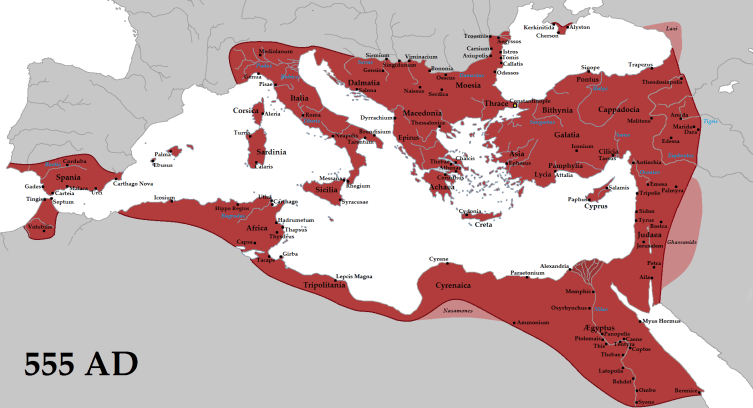


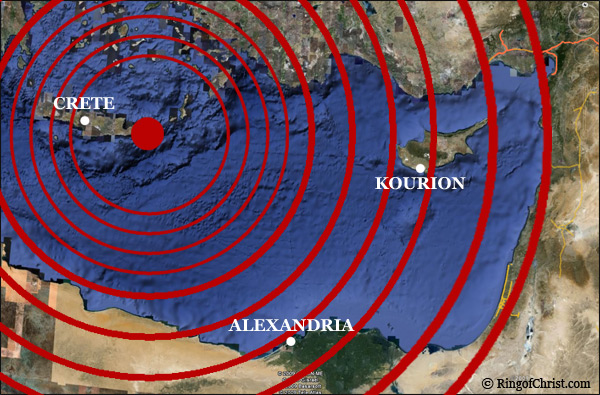
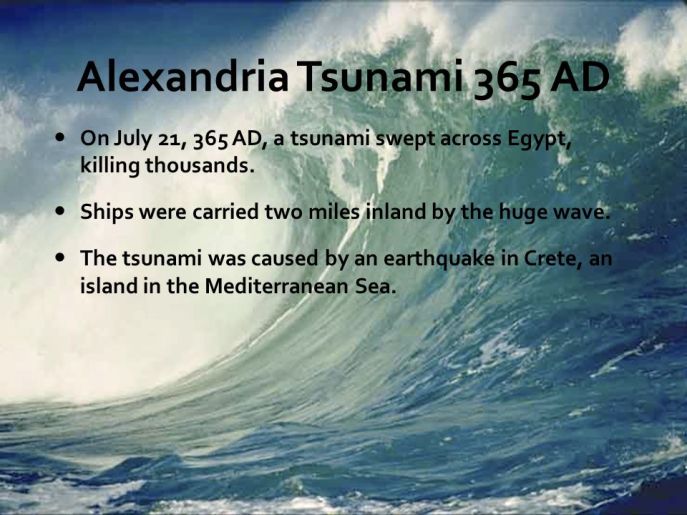


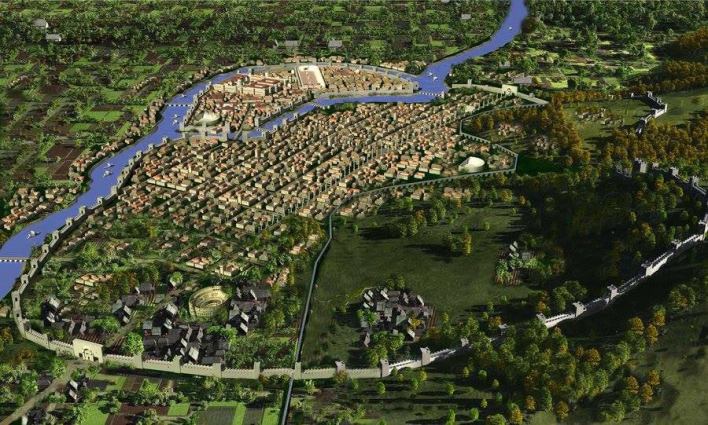


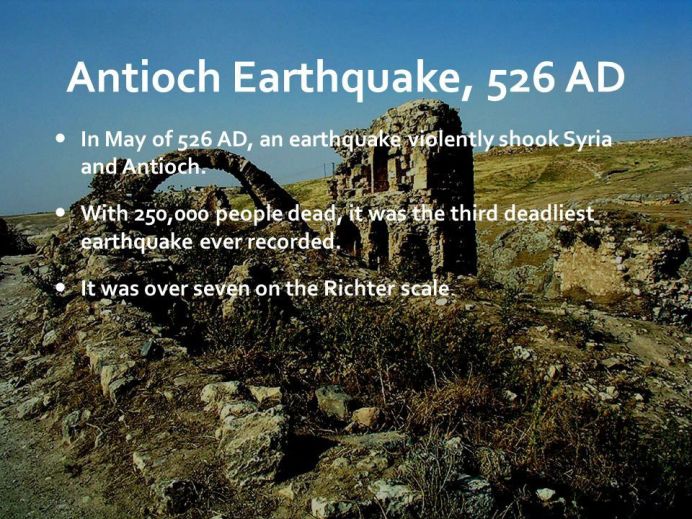


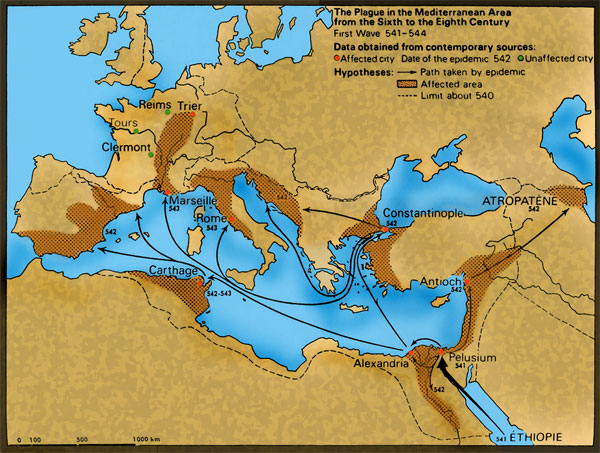


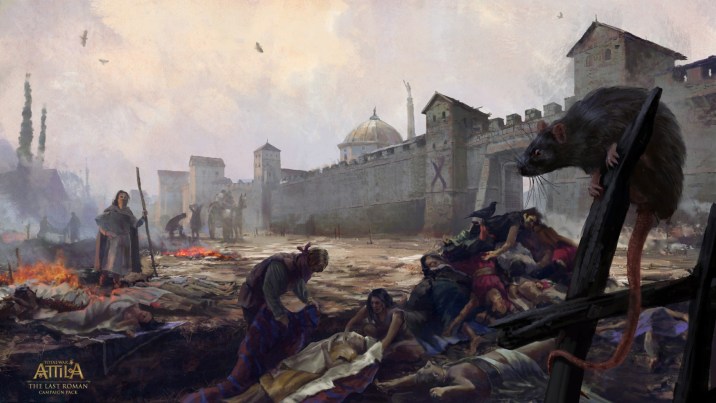


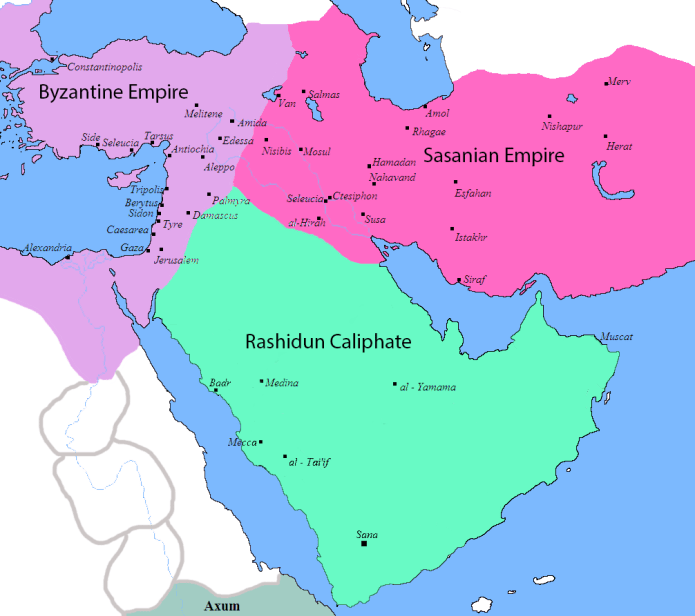


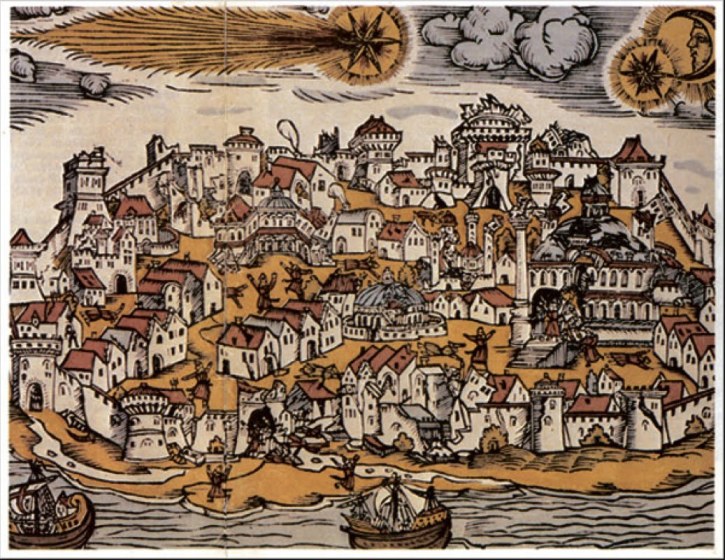


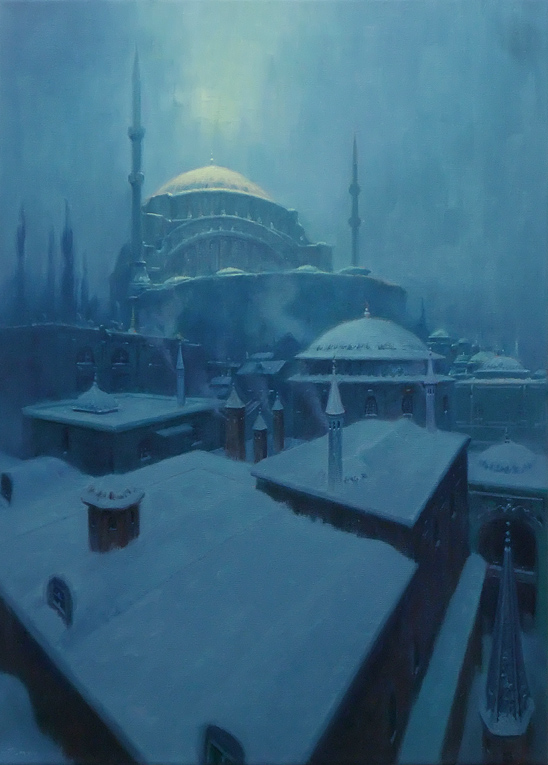


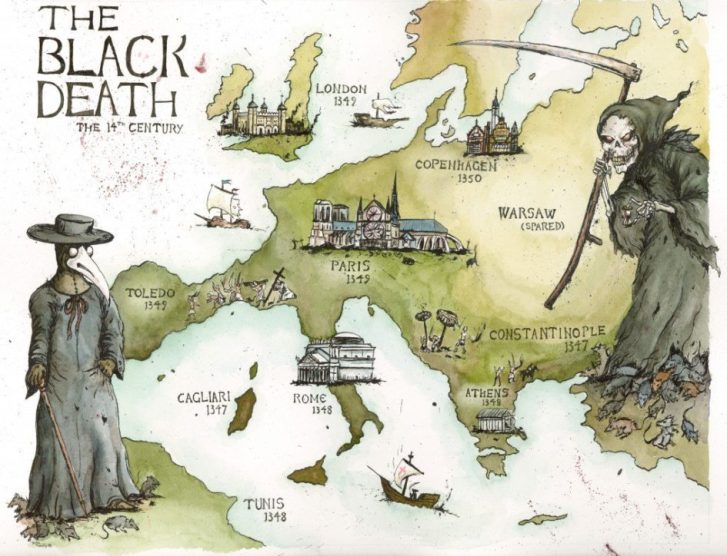


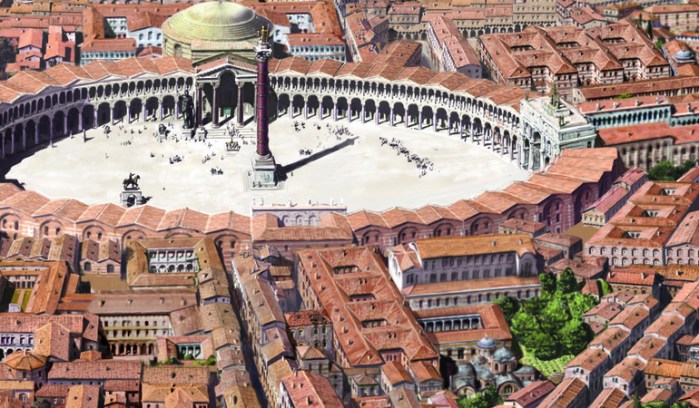



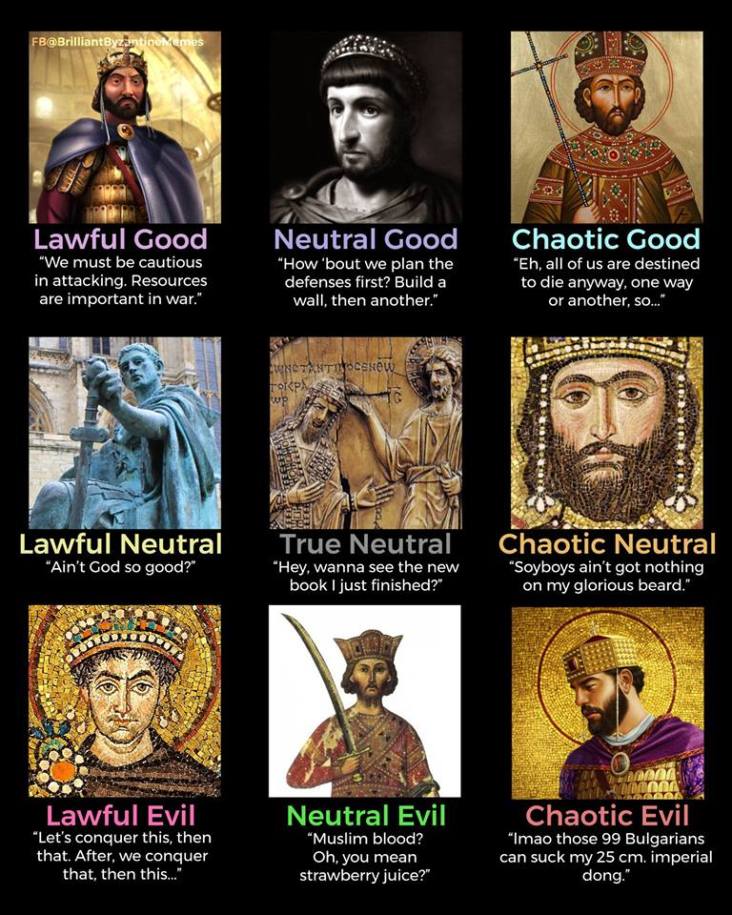
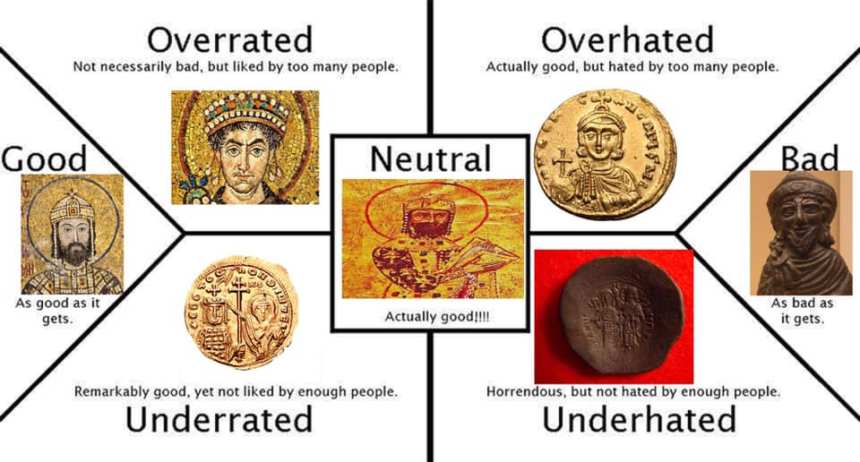
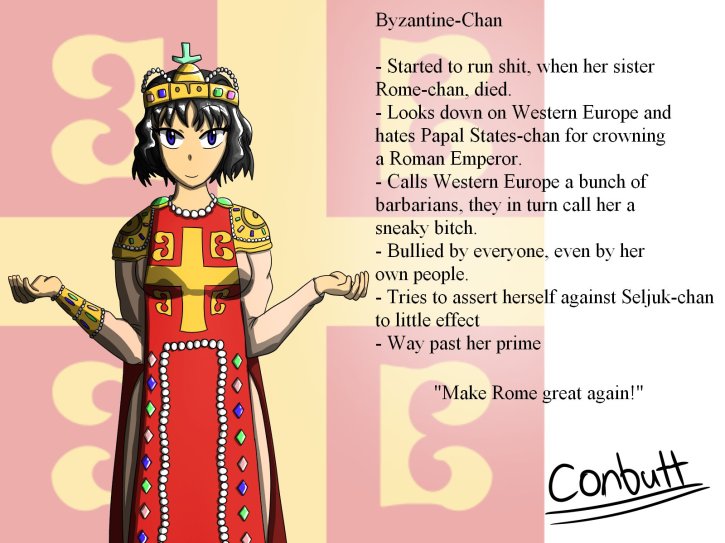
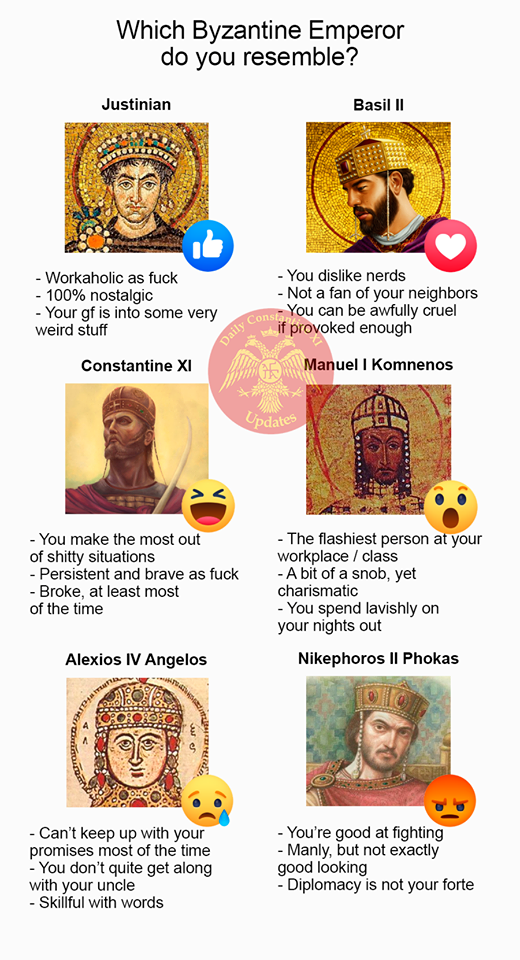

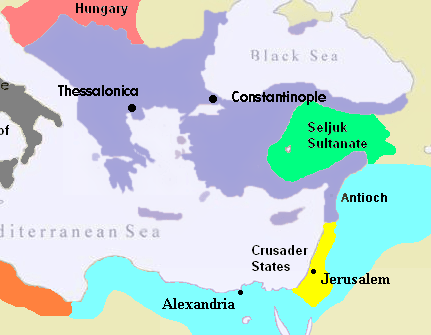


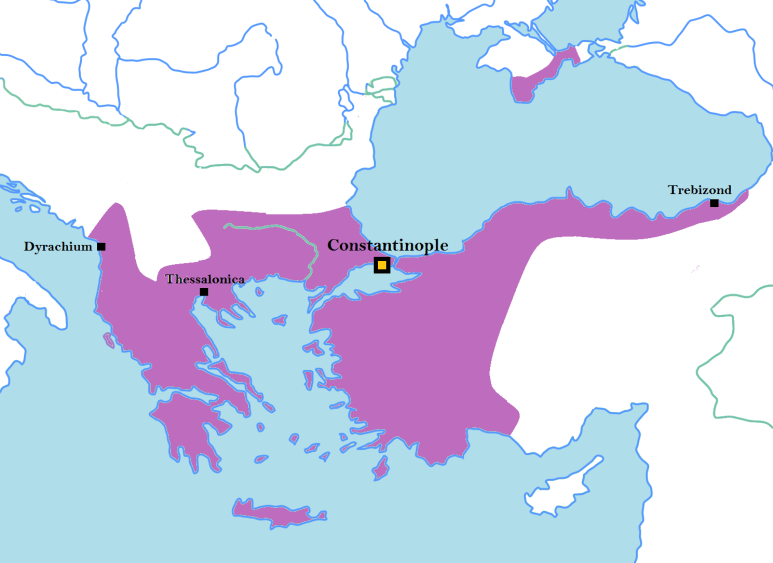


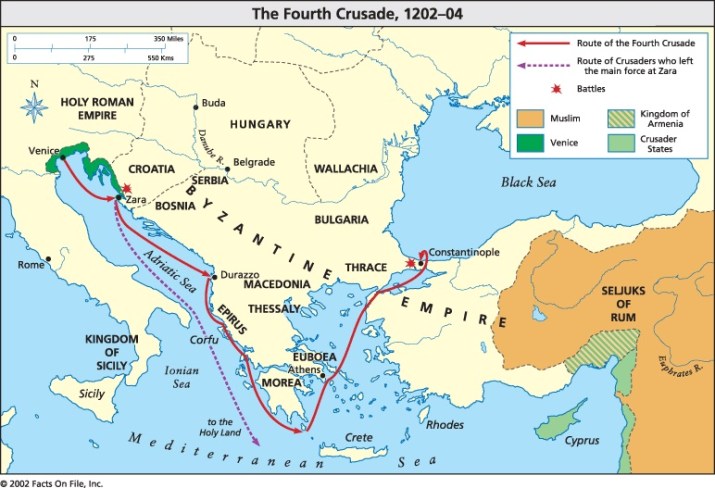
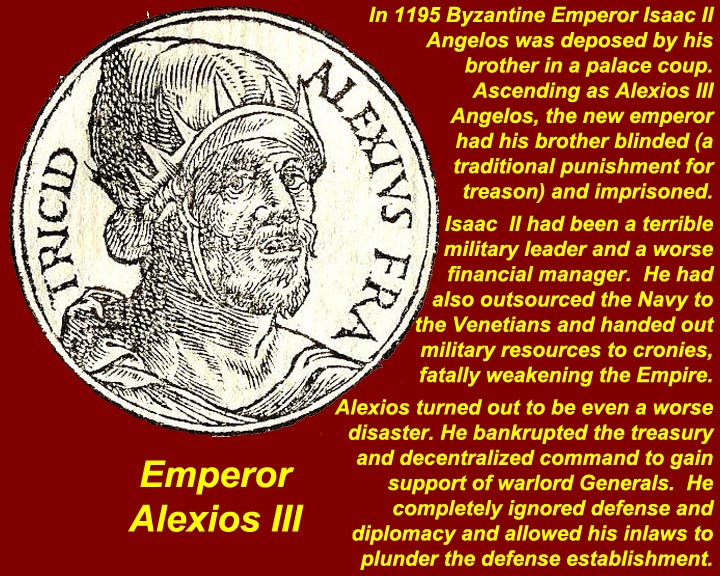
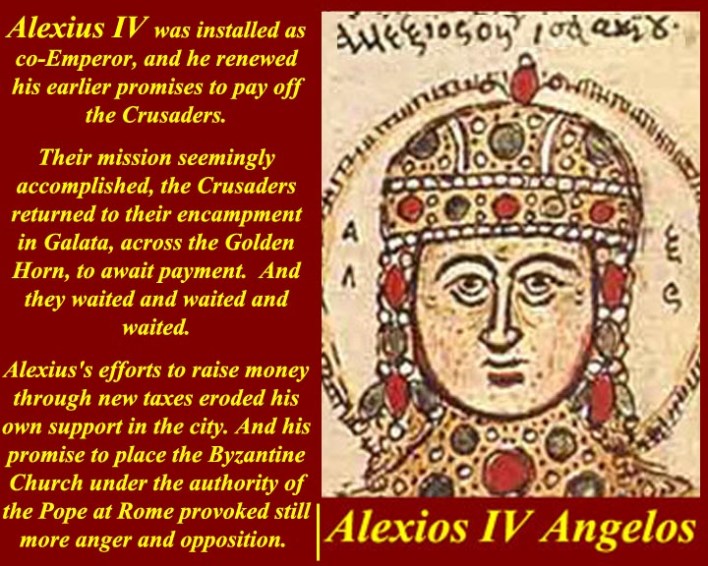
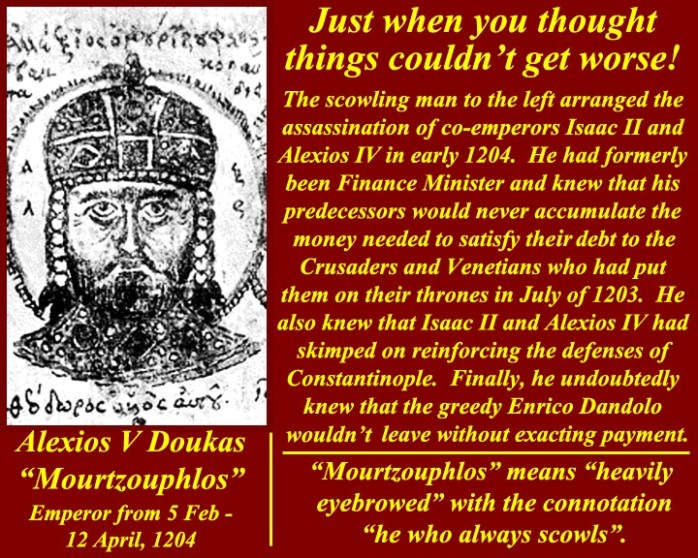


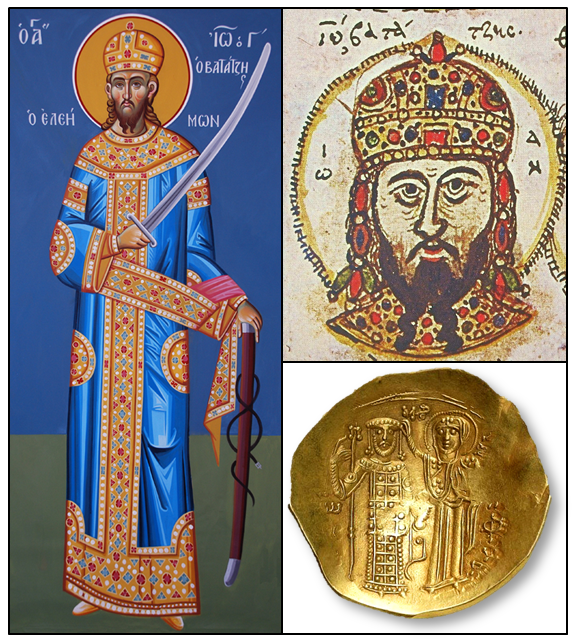


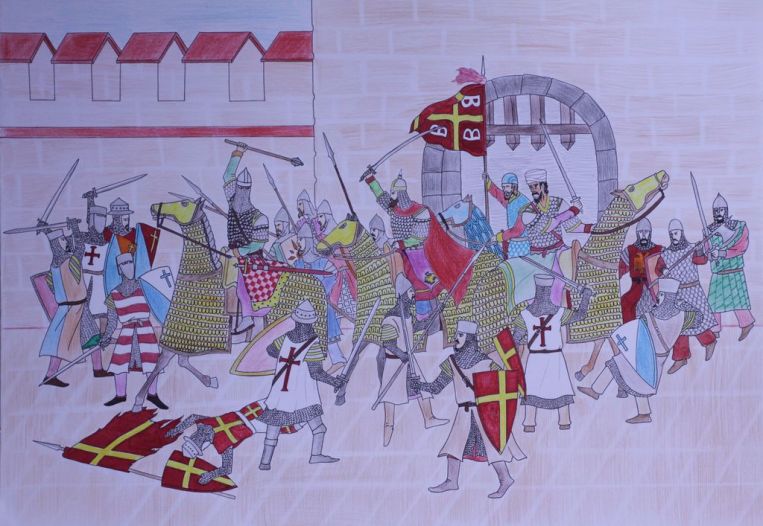


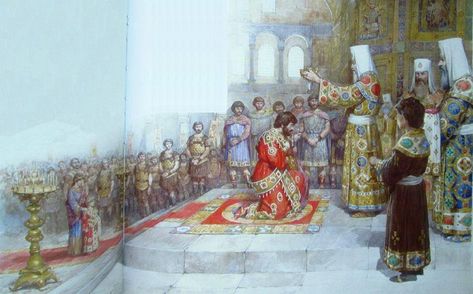


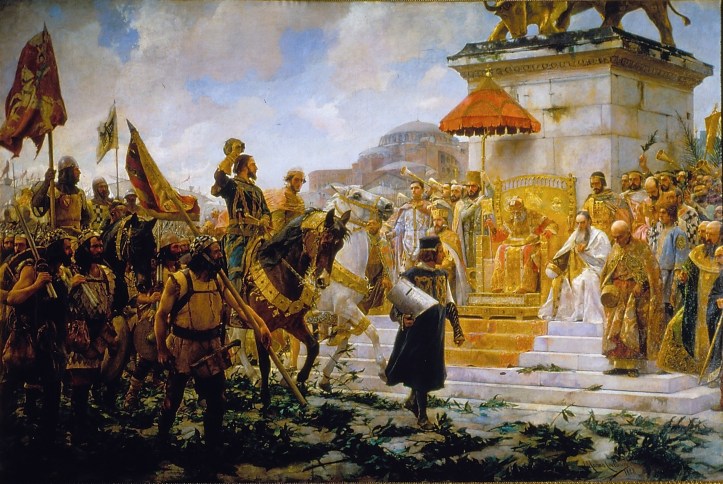


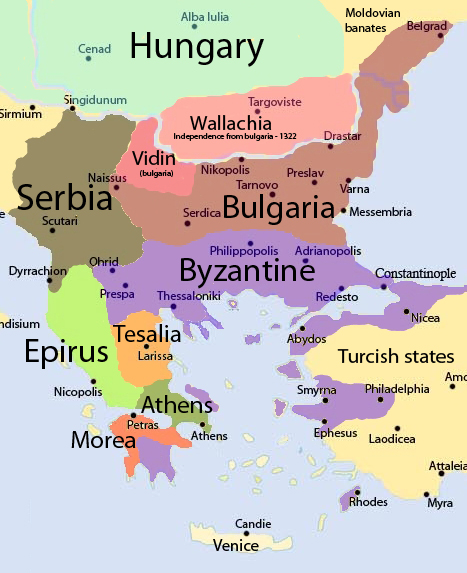


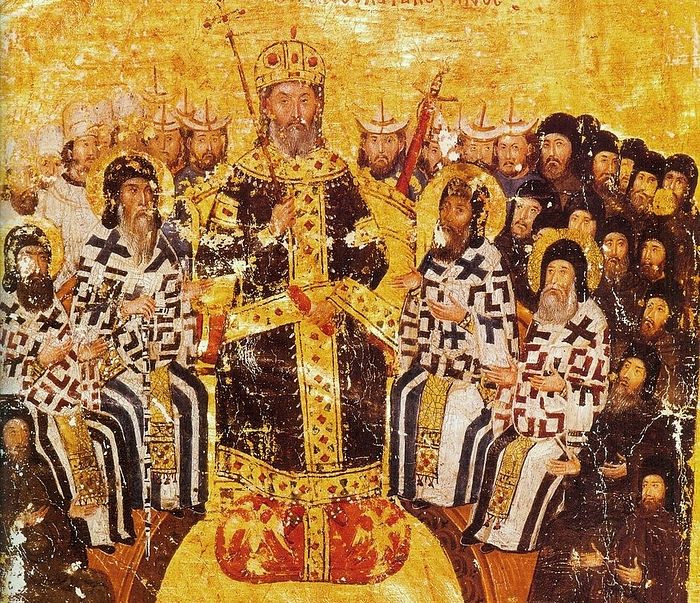


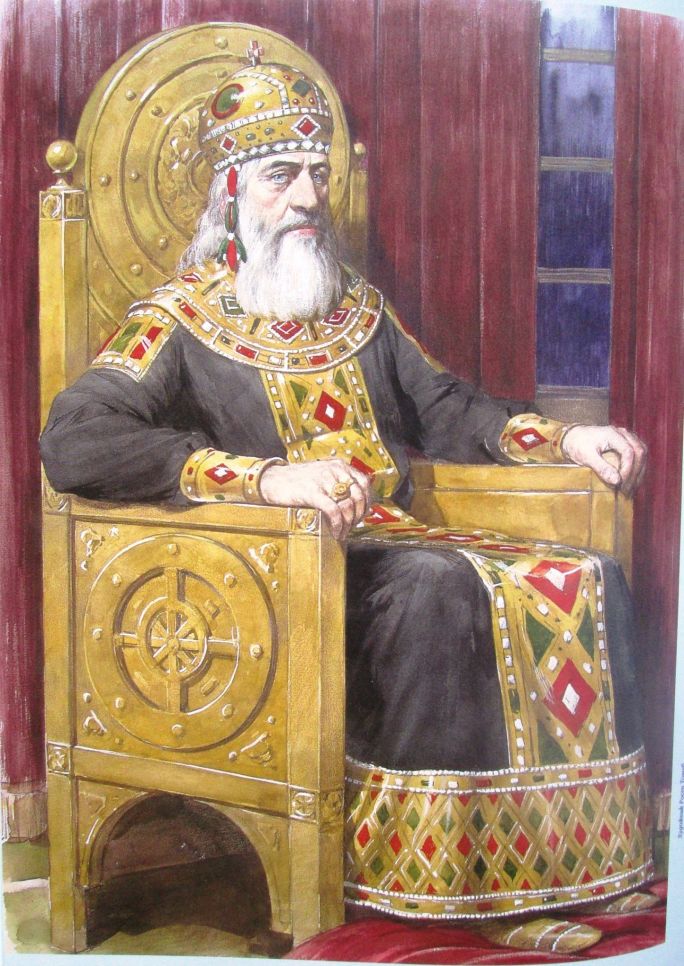


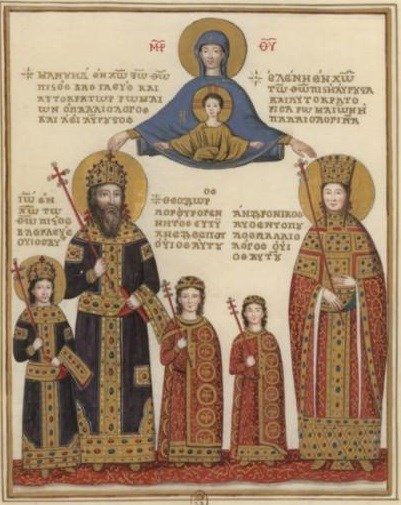


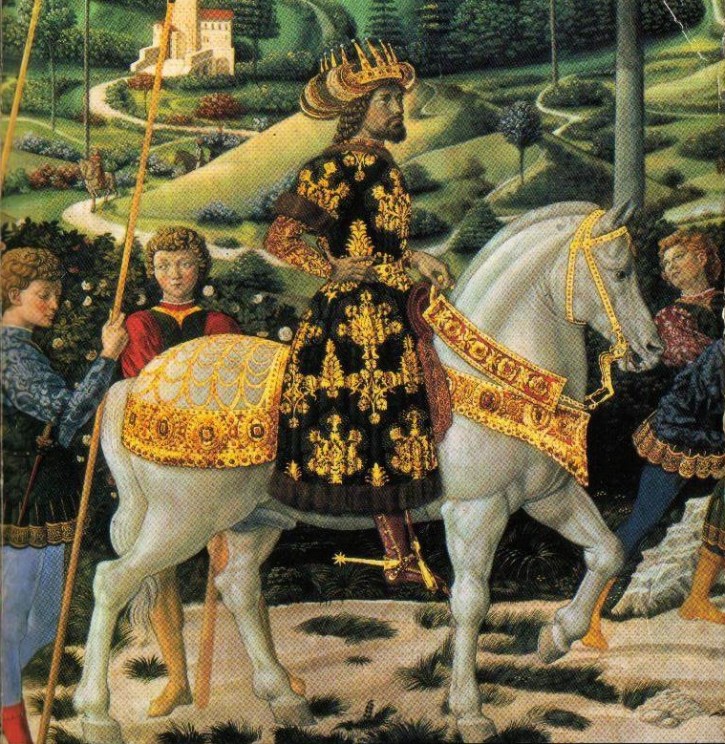


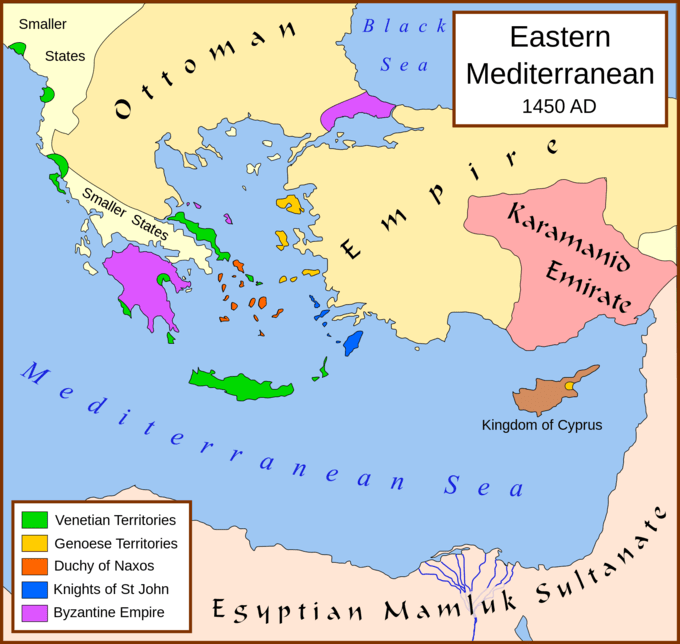
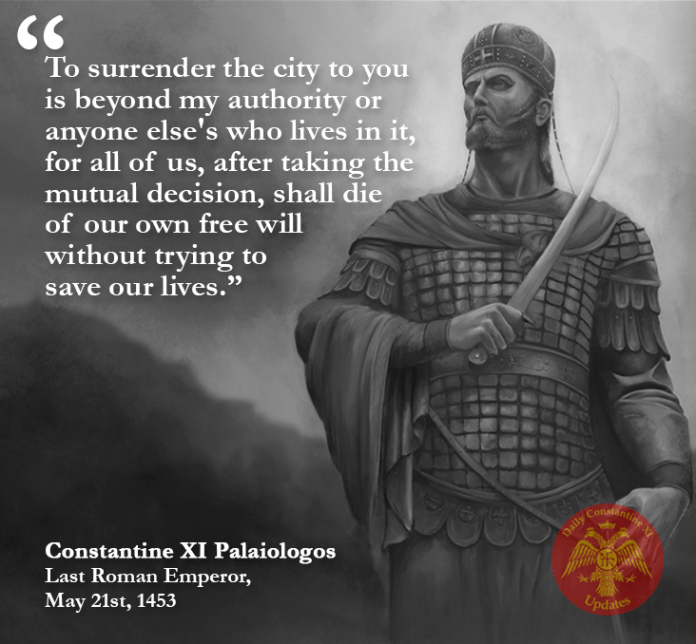


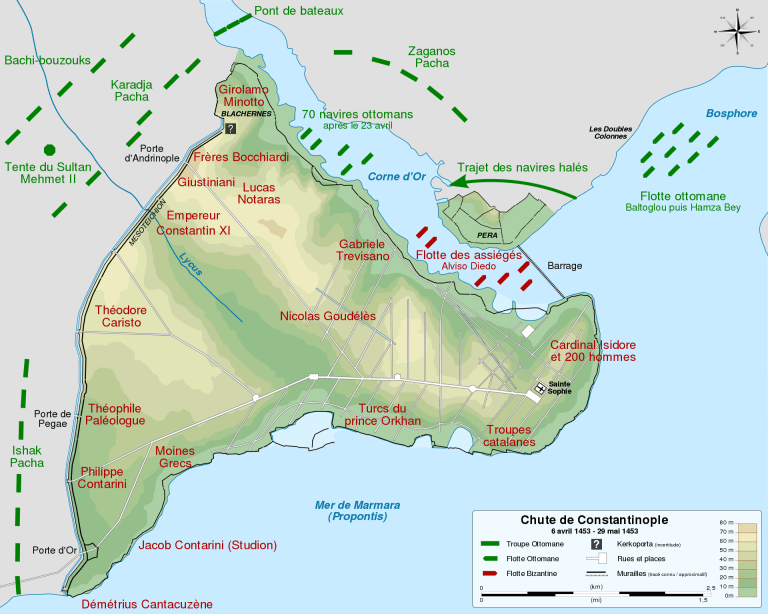


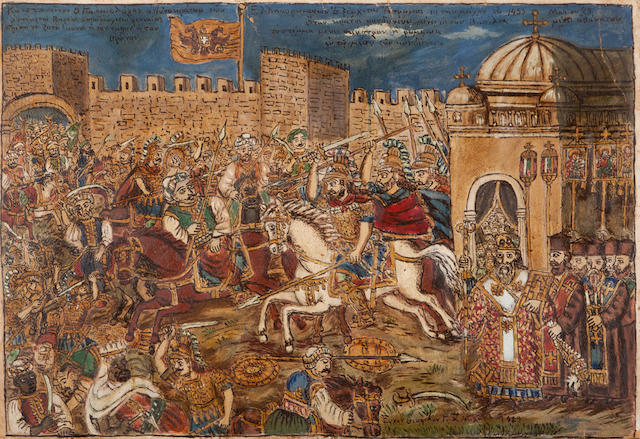



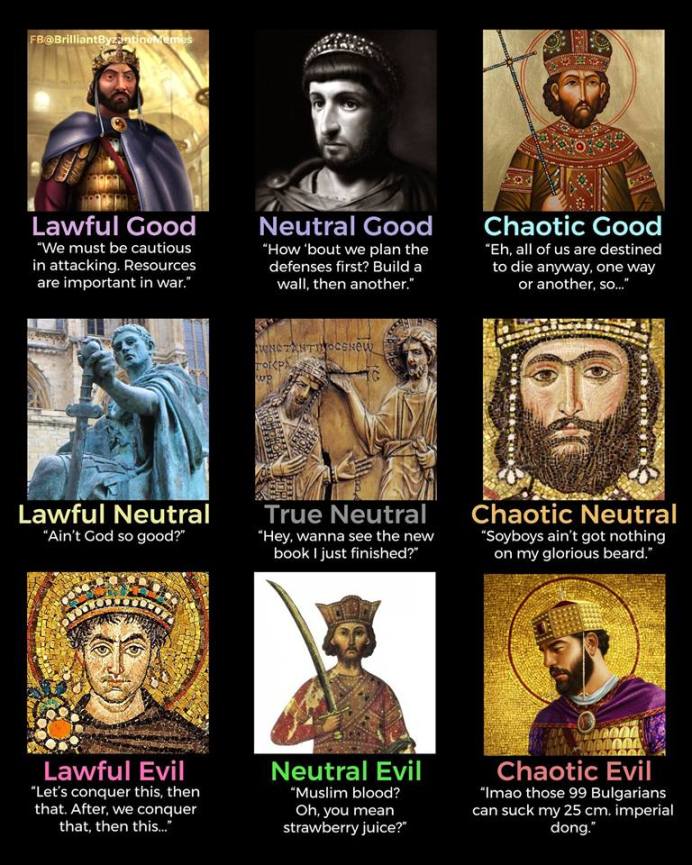

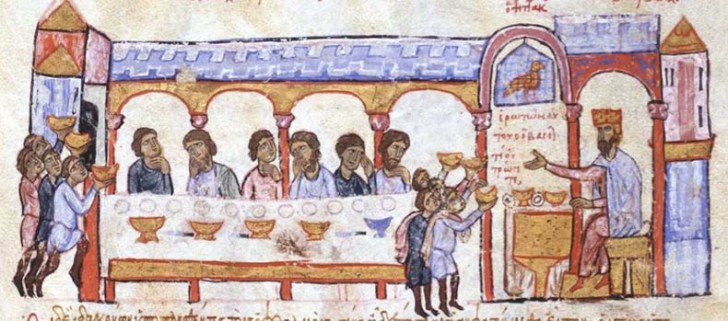


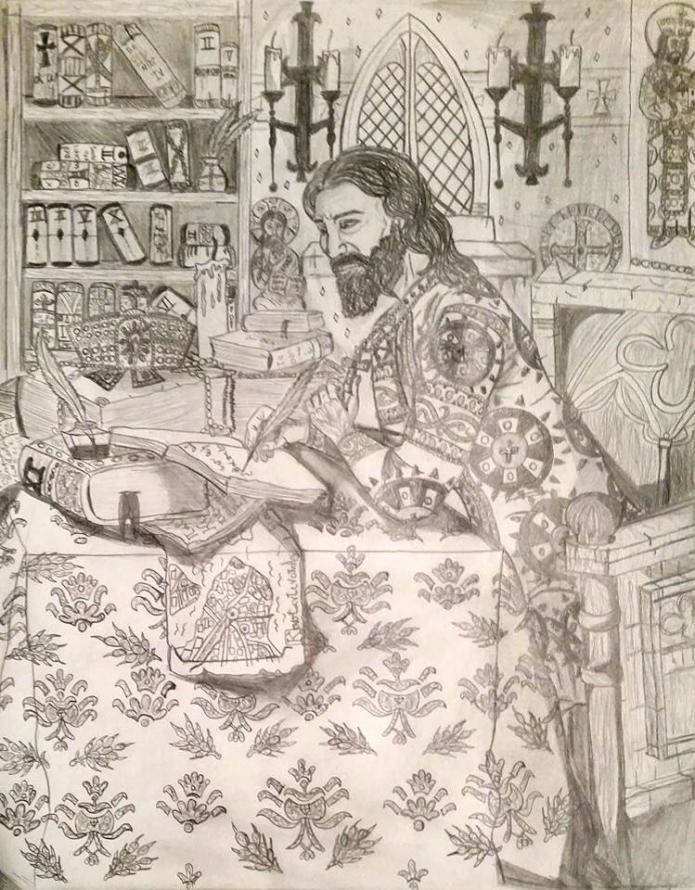


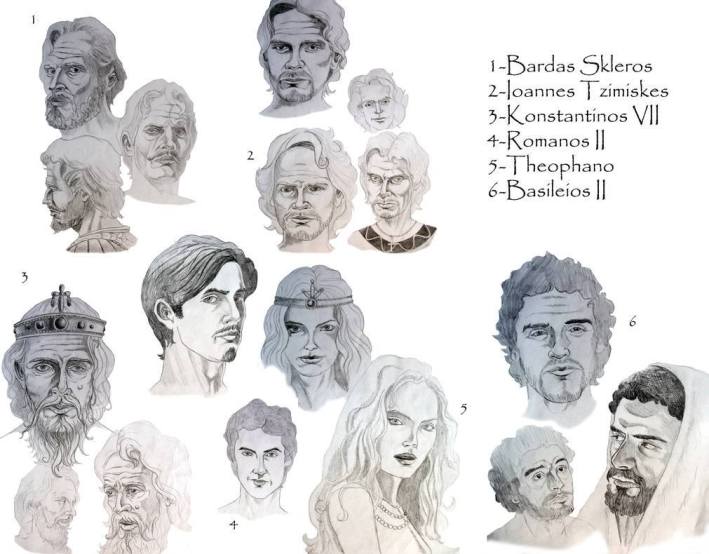


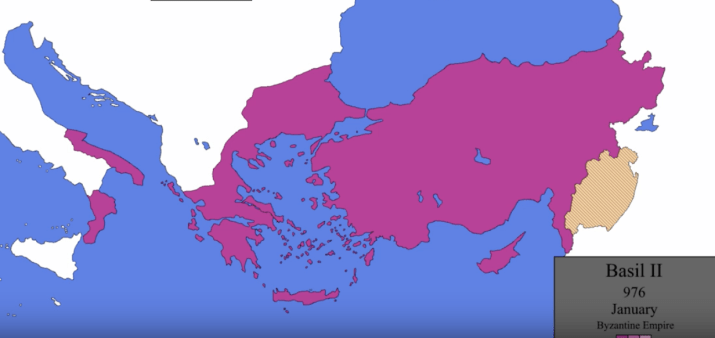


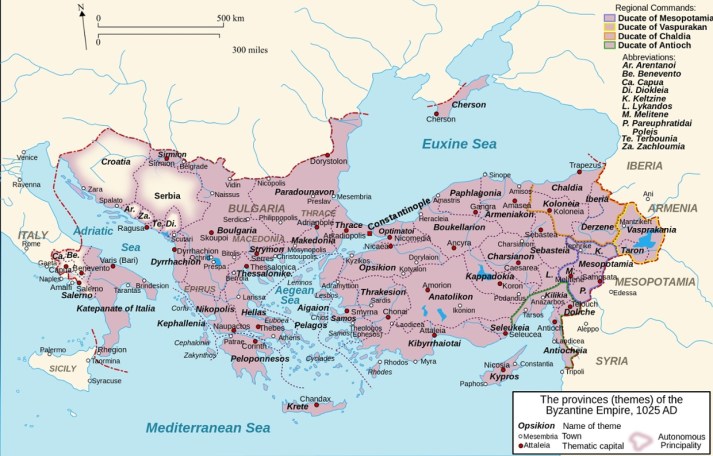
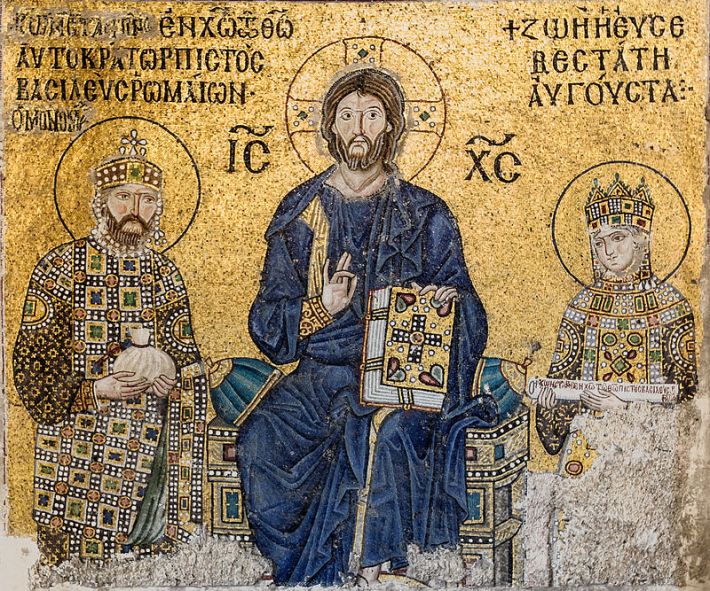


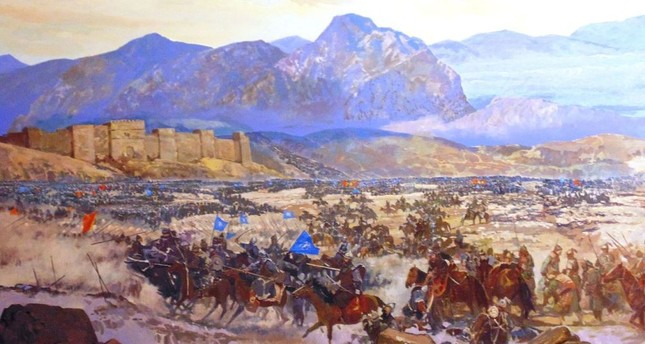


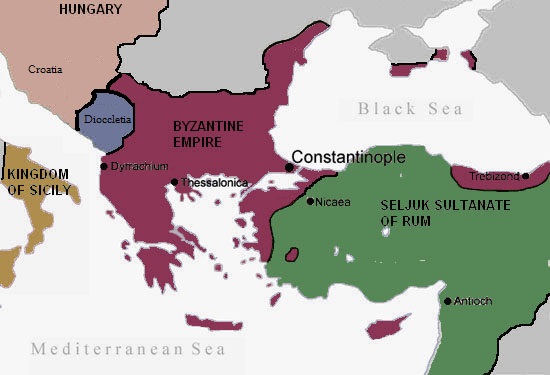
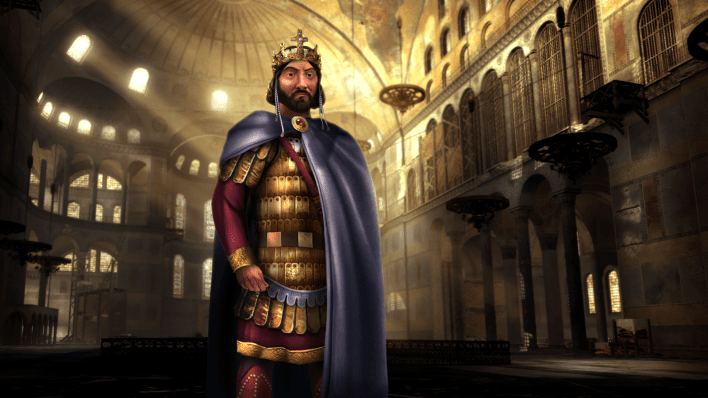


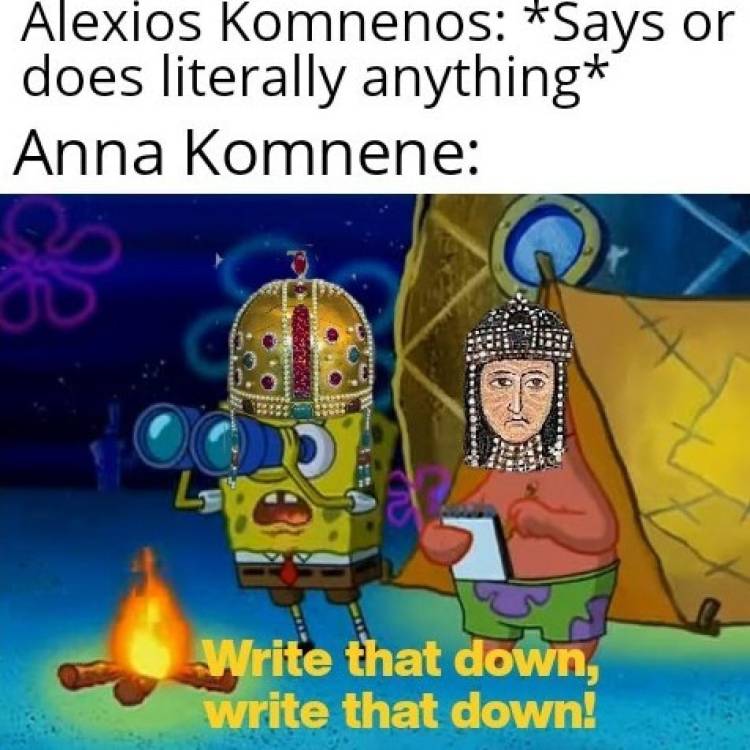
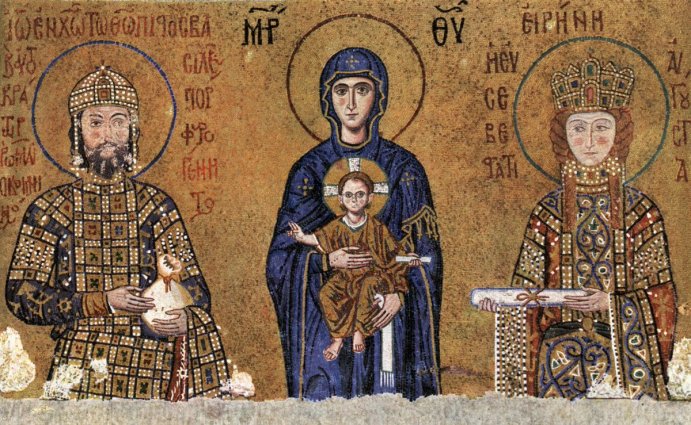


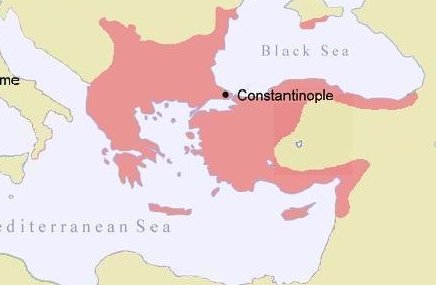
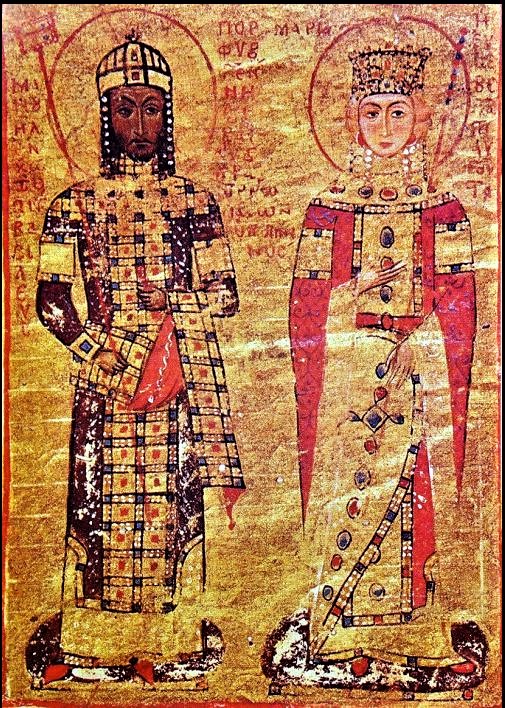


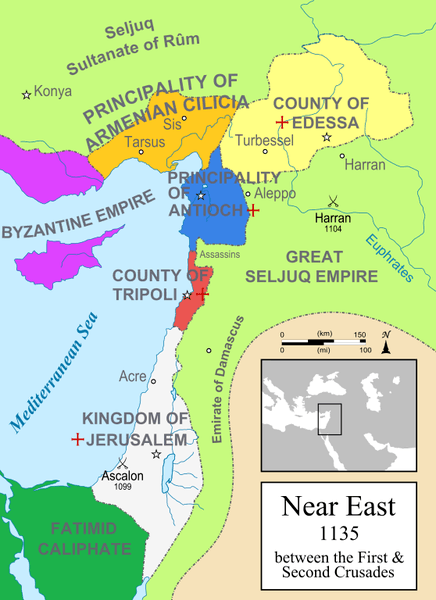
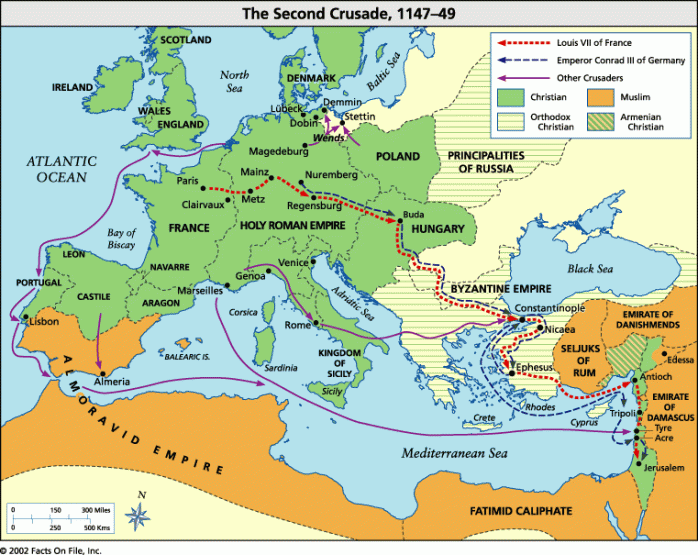


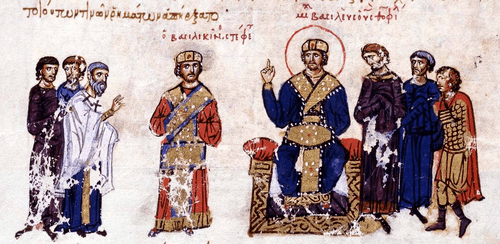


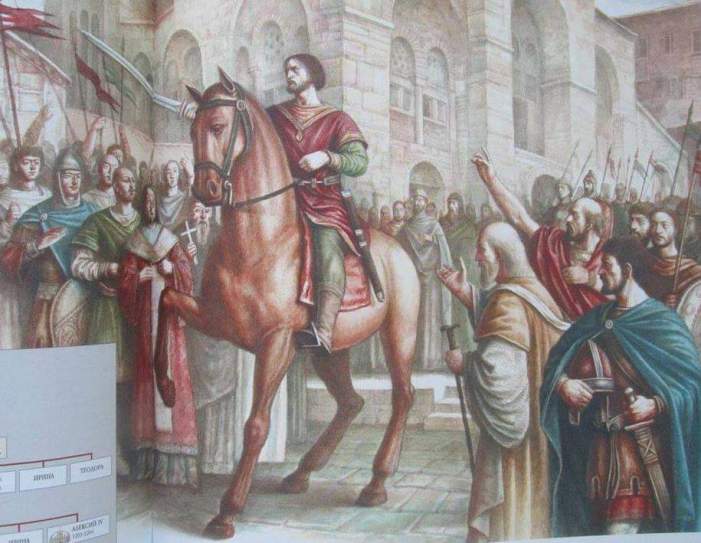
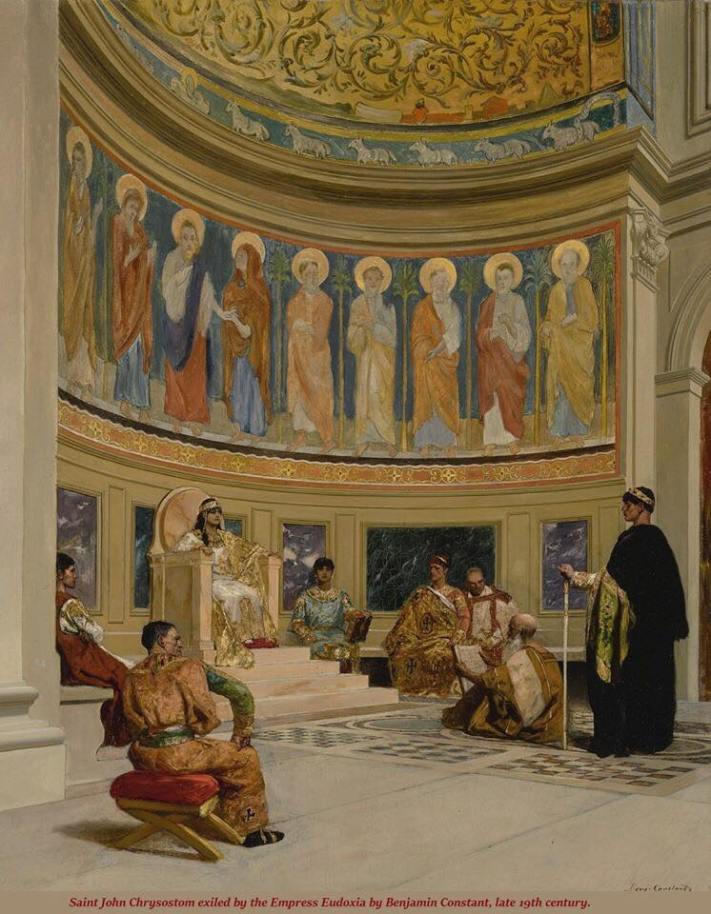


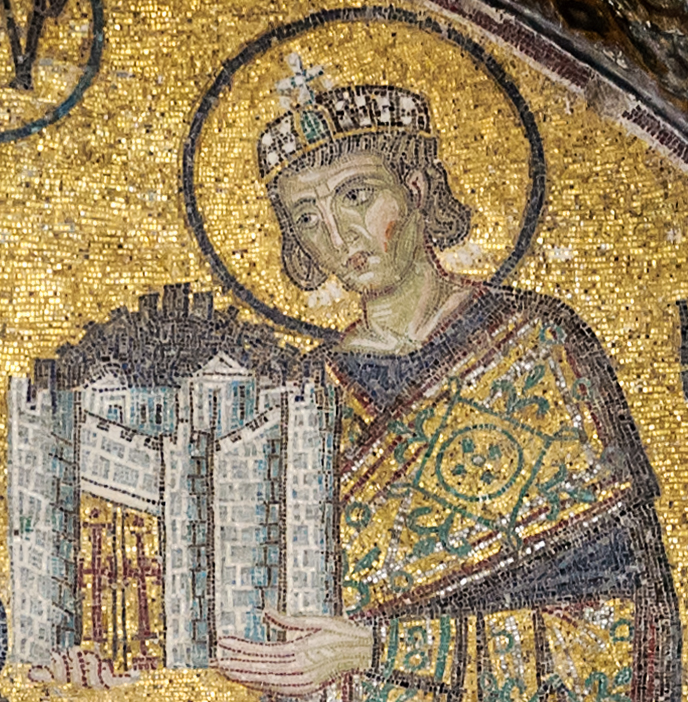






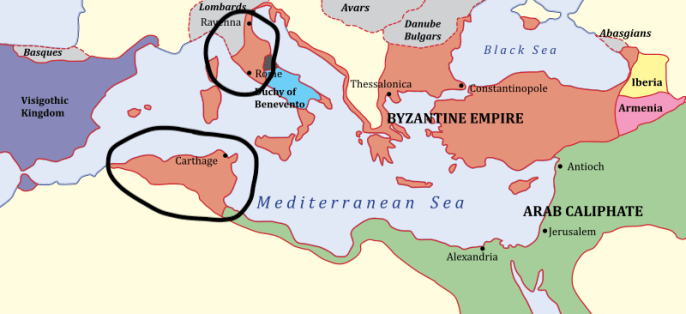

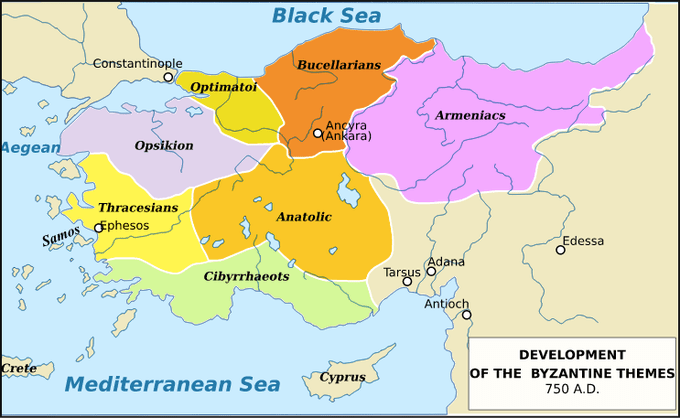
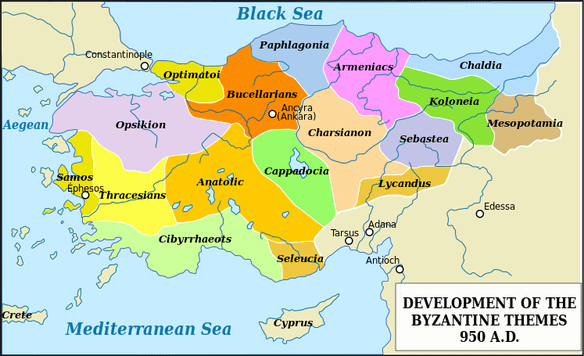
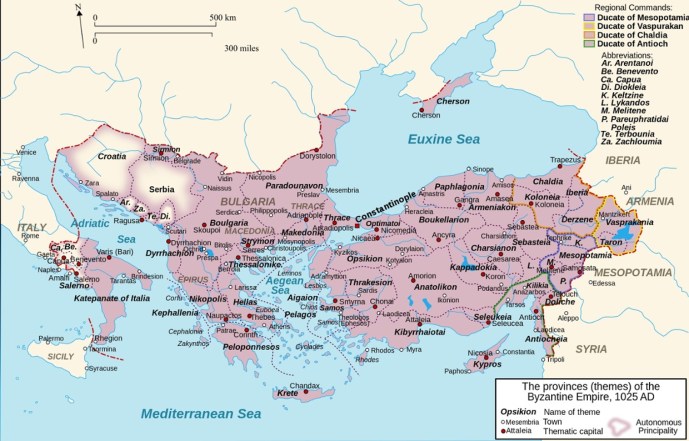


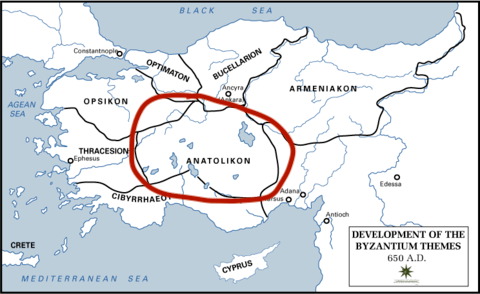


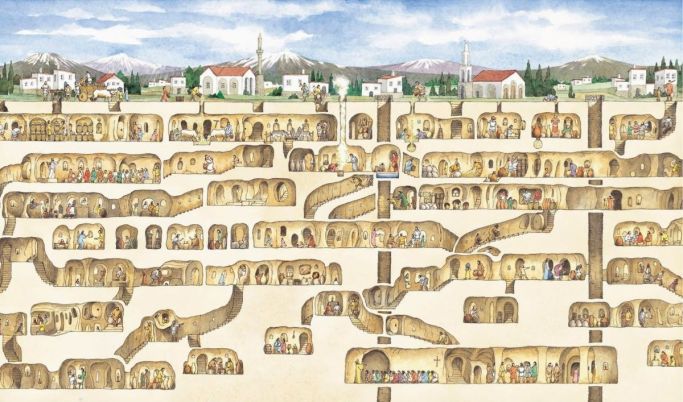


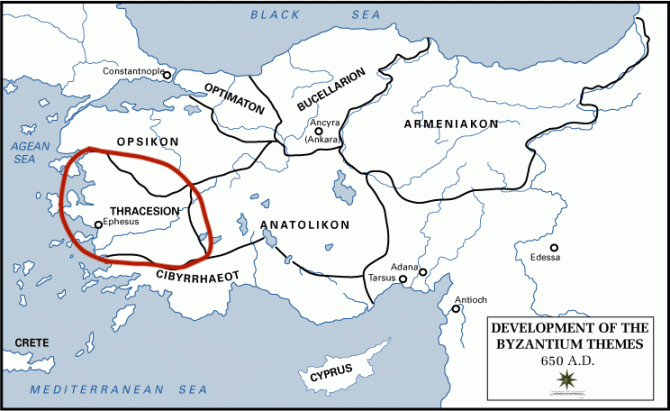








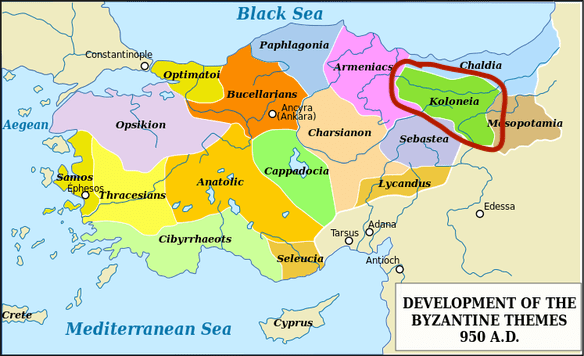


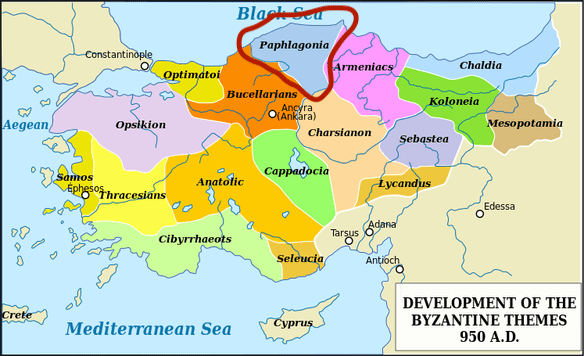


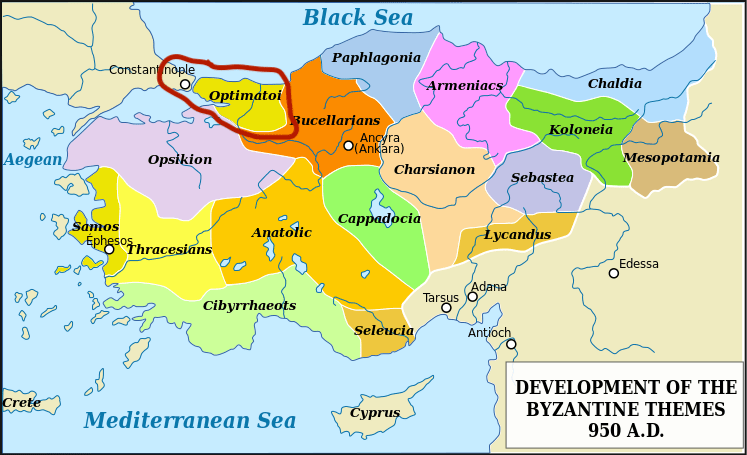


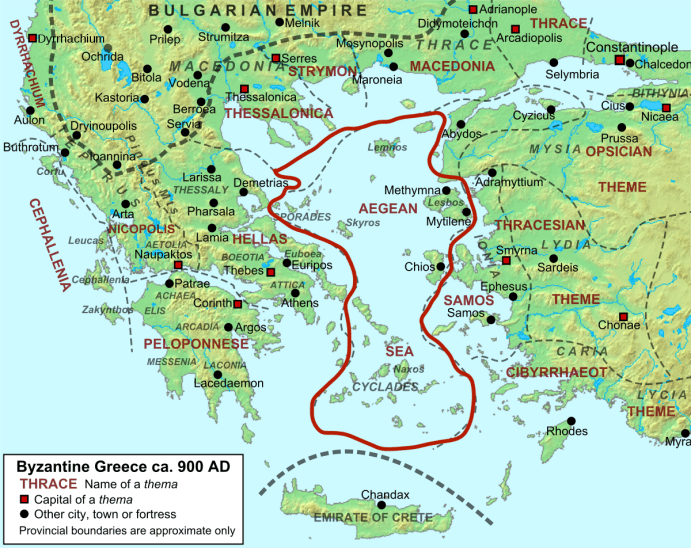


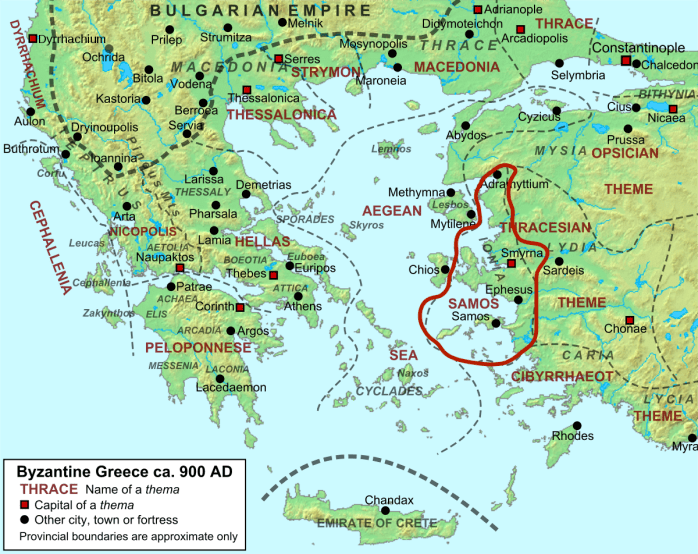


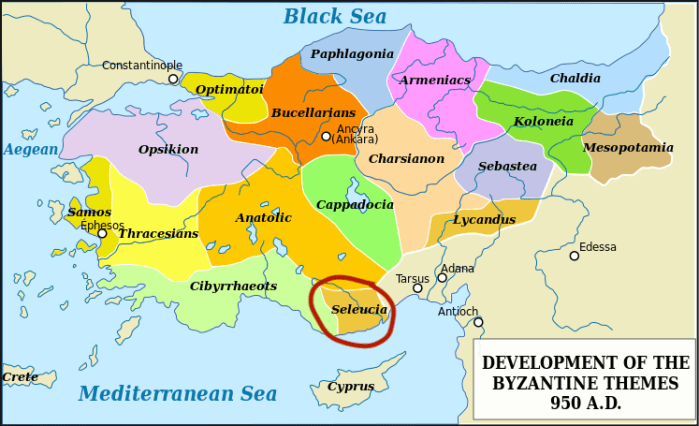


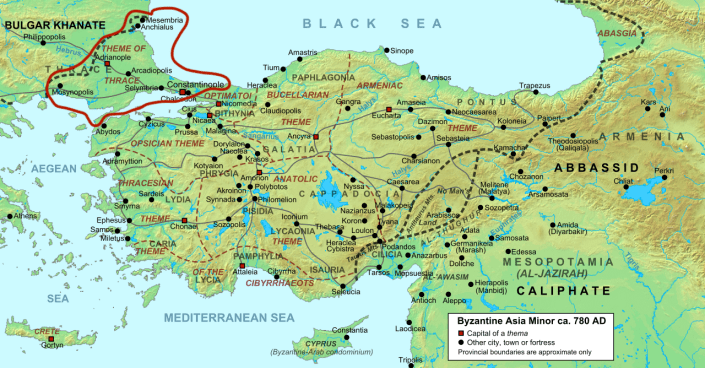


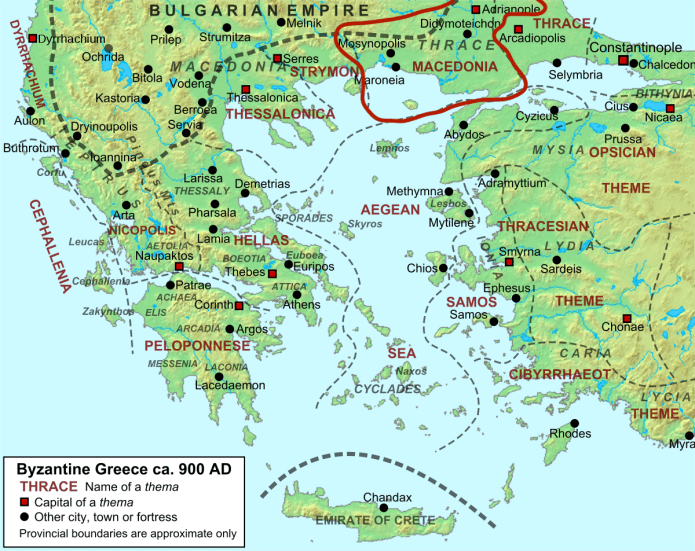






















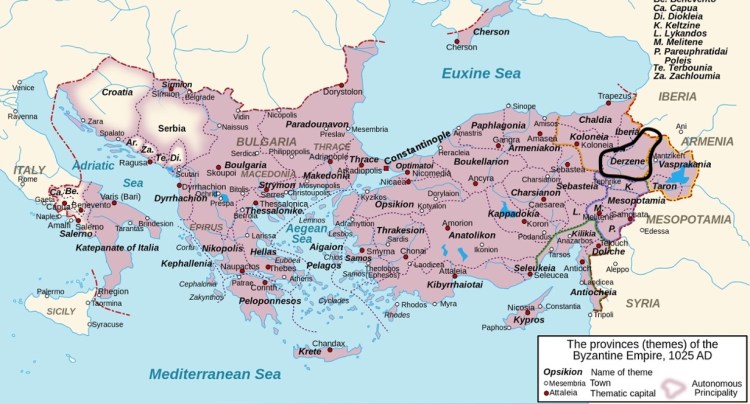


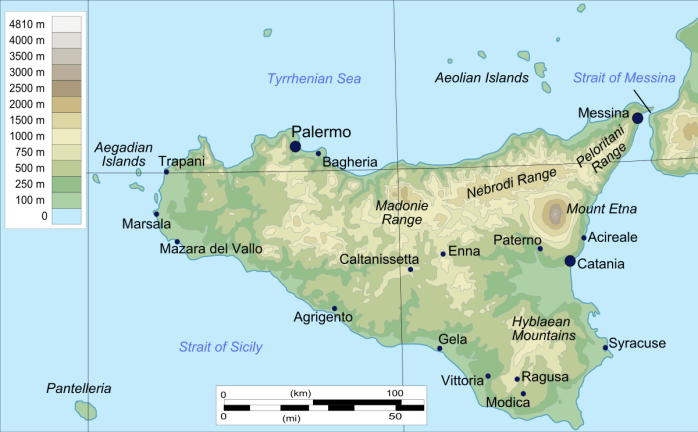


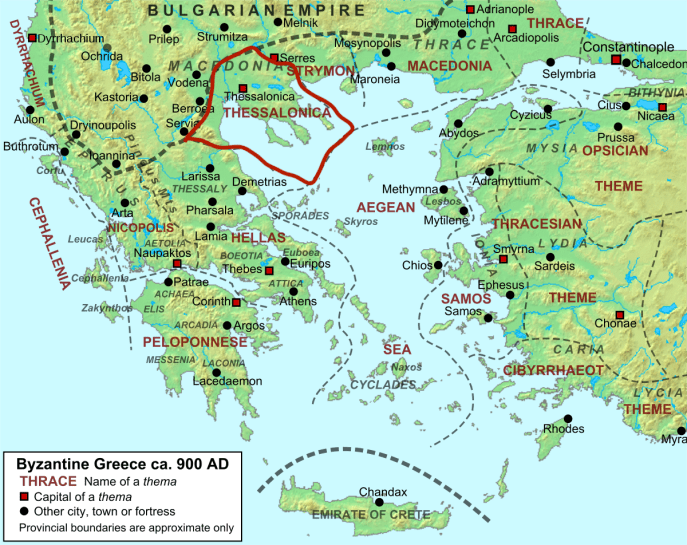


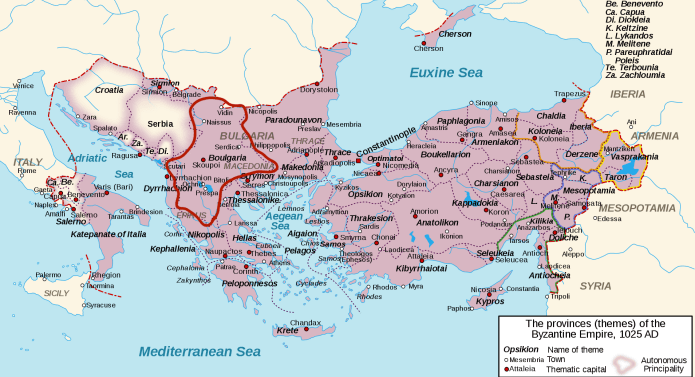


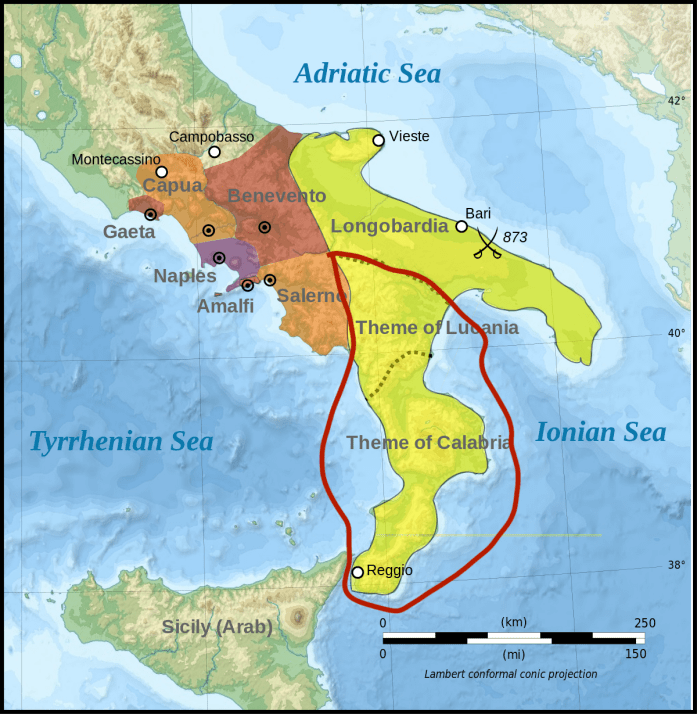


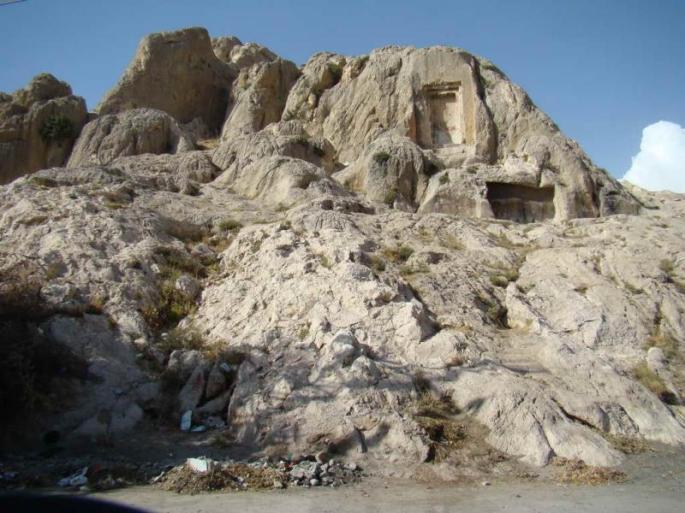






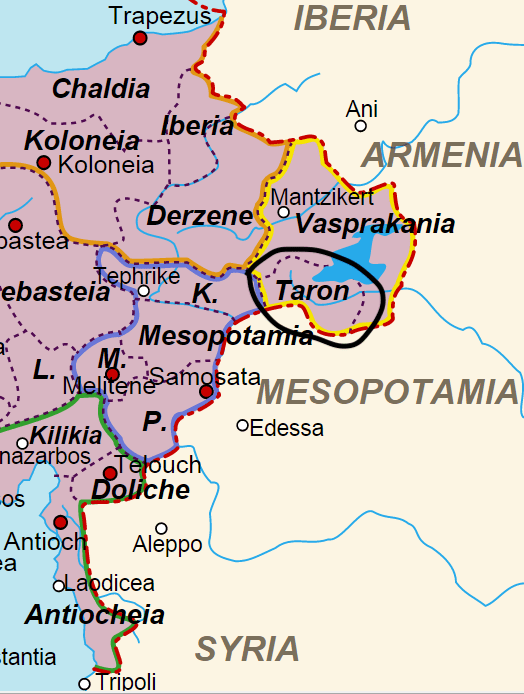


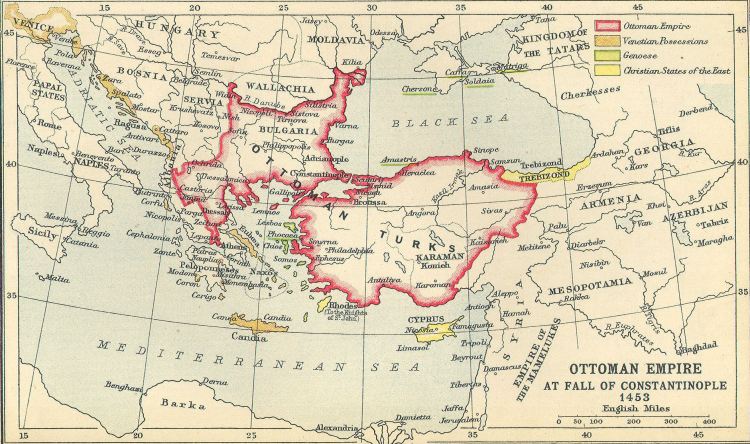


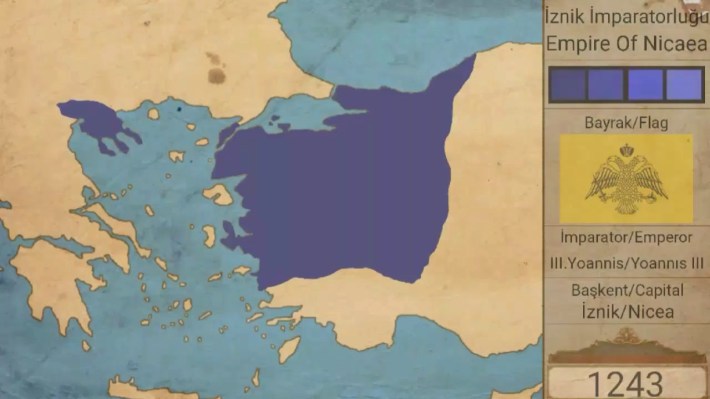
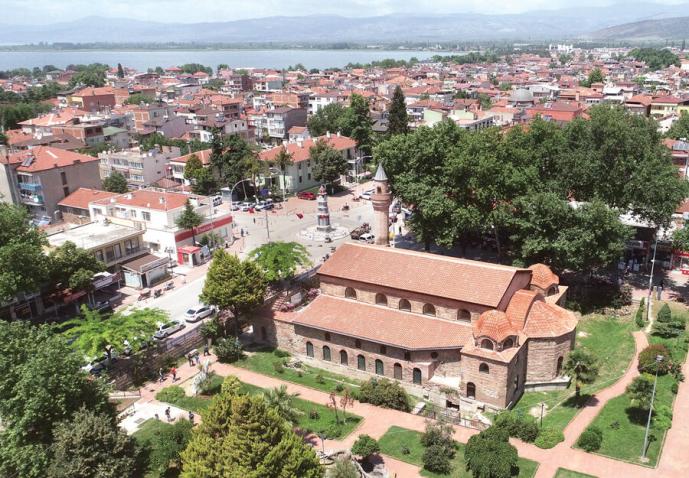


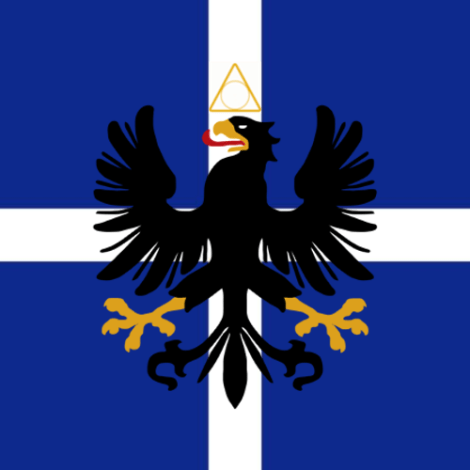
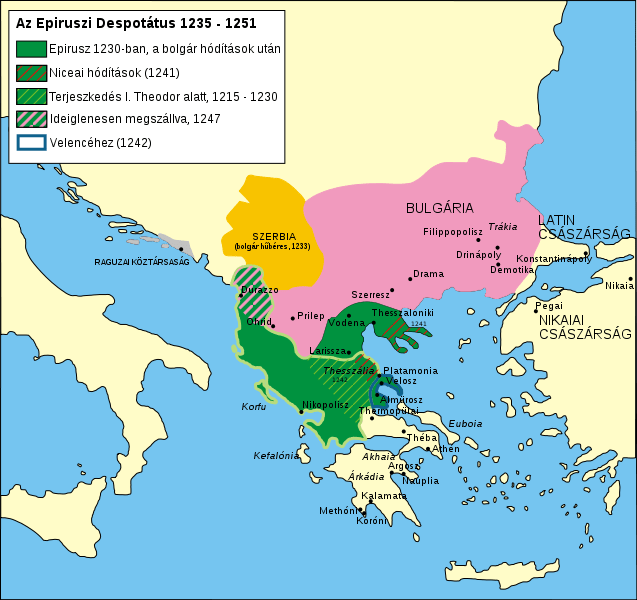




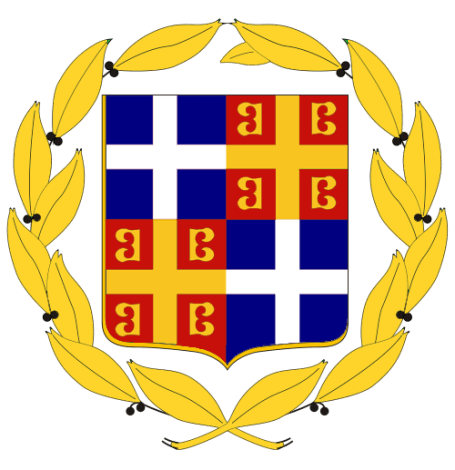




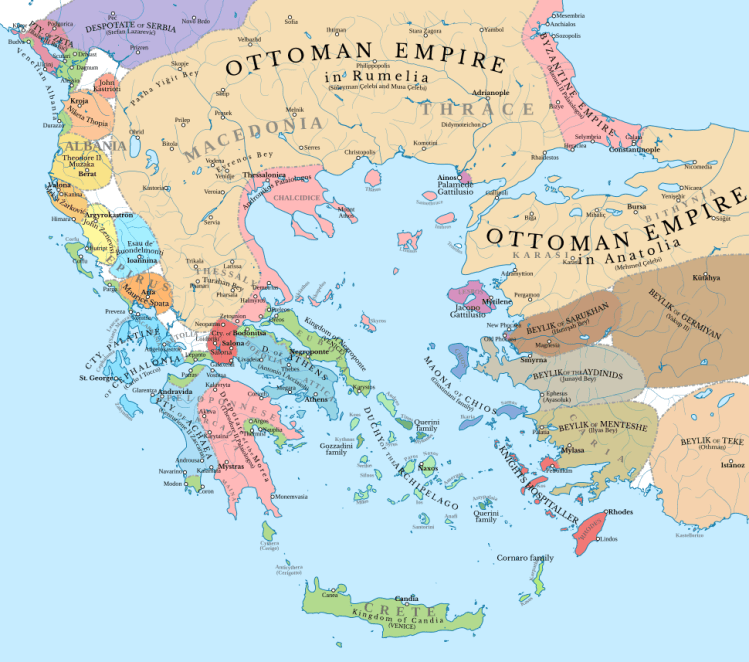




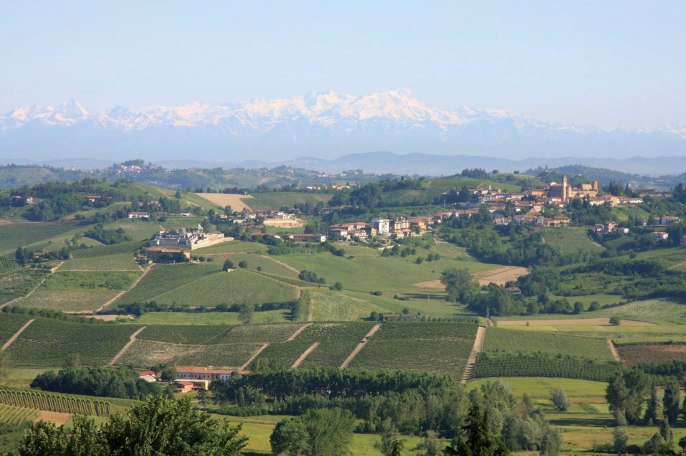




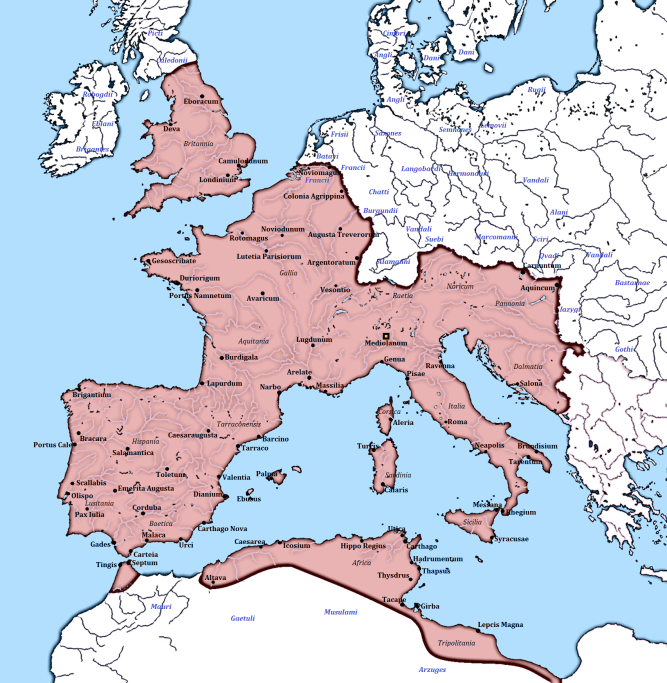


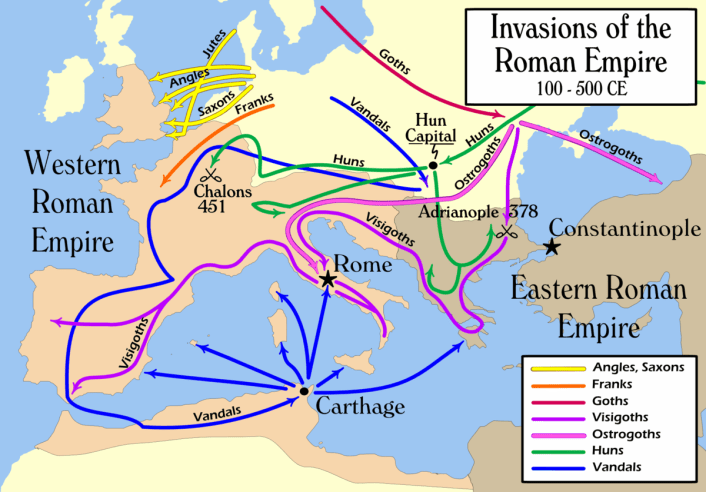


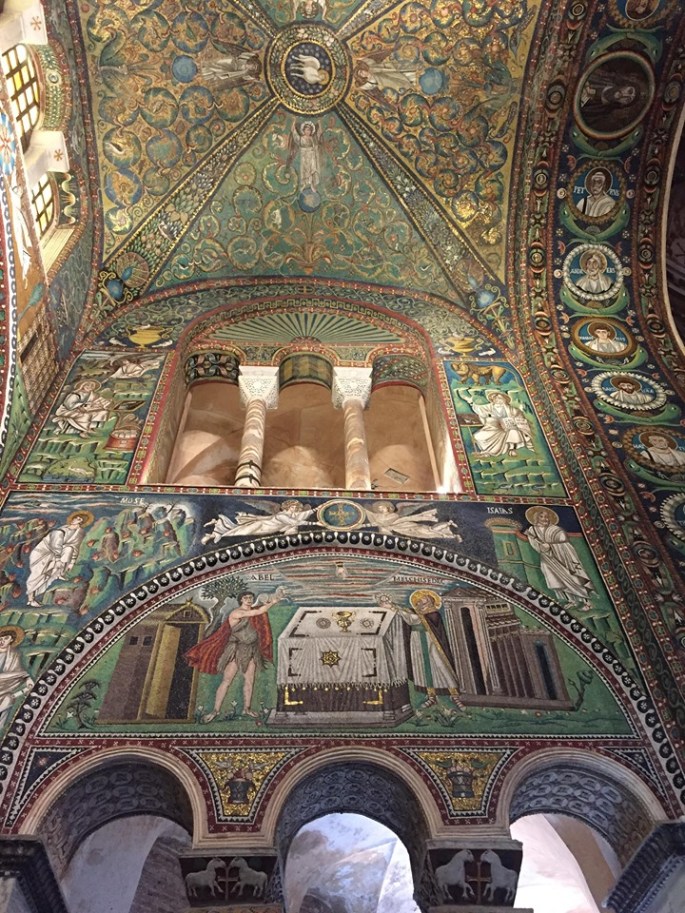


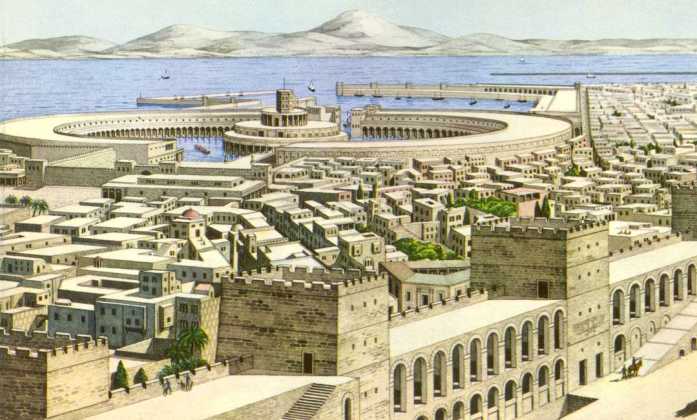


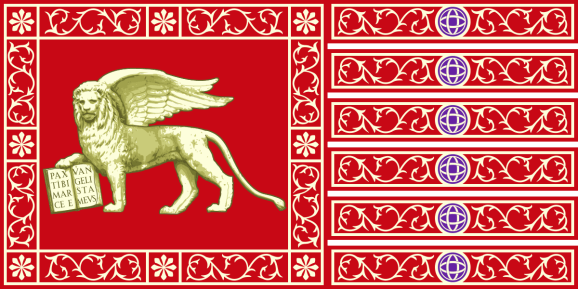


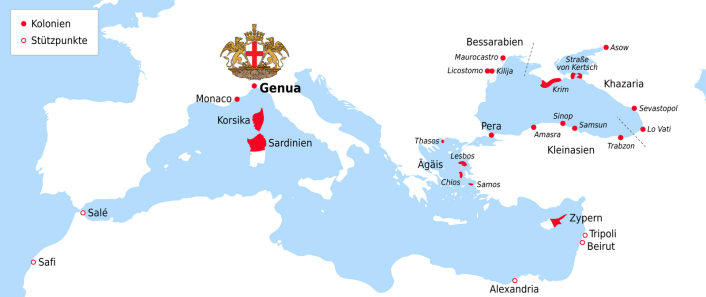


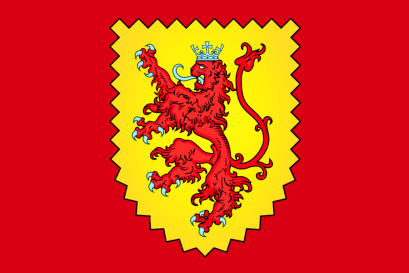


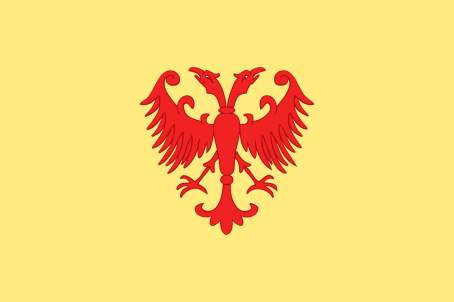
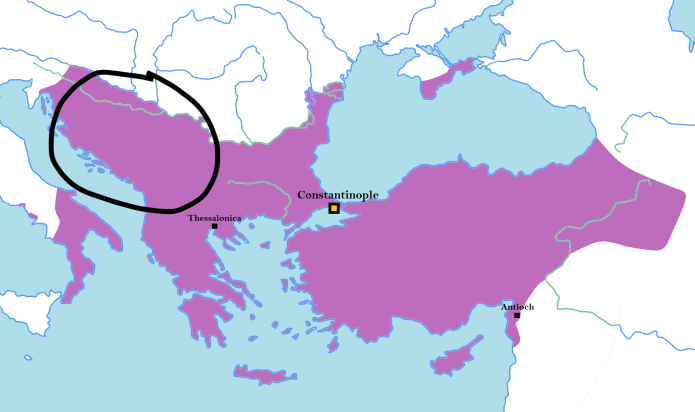


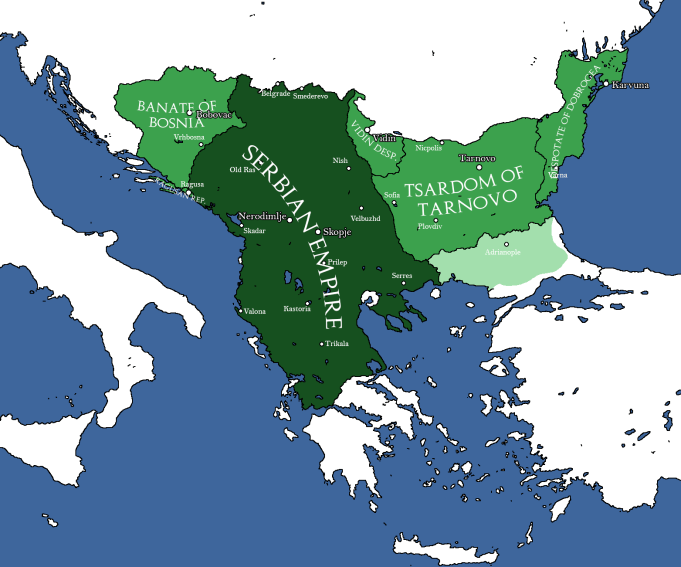


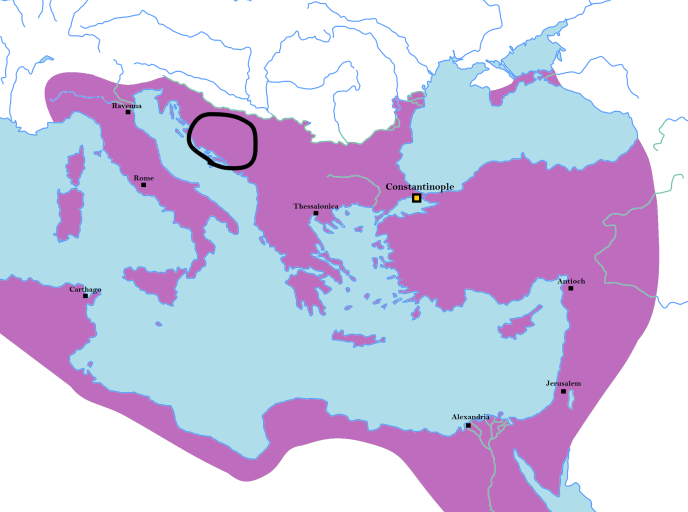




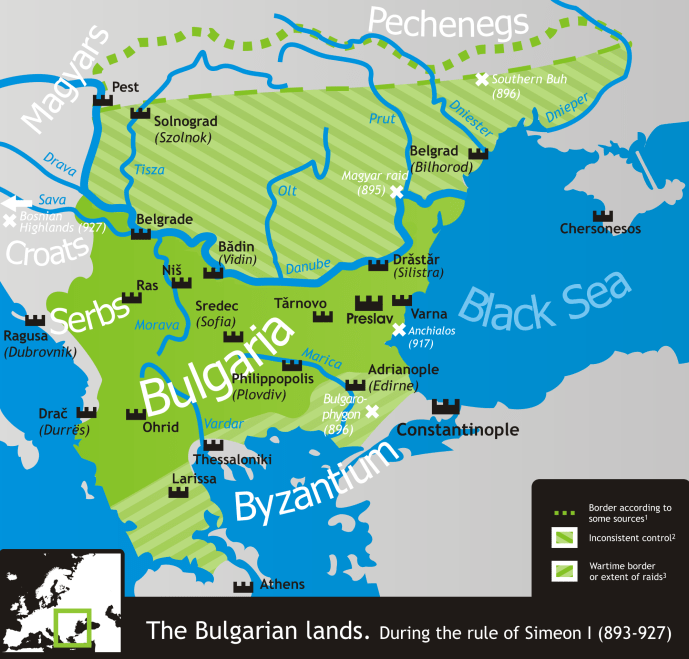


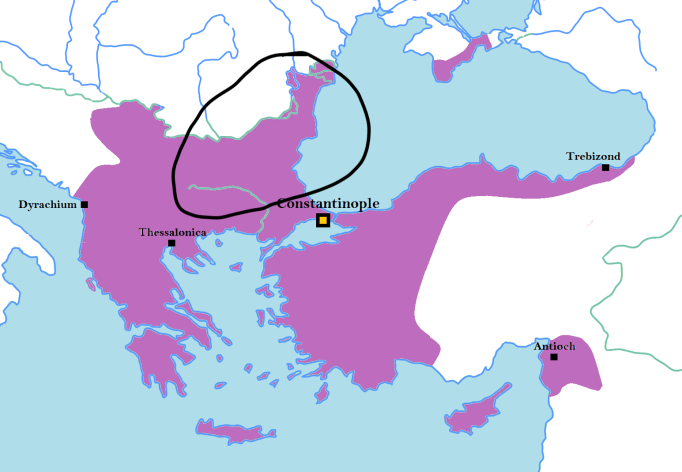


 symbols on opposite sides of the PX; this was however not only used as a Byzantine imperial symbol but also for the Western Roman Empire that ruled at the same time as Byzantium being the Eastern Roman Empire from 395 until the west fell in 476 leaving the east to survive as the remaining Roman Empire. The next one happens to be a cross-over tile back with the Byzantine tetra grammatic cross and the 4 yellow Beta symbols over red, except here there are 2 of these squares with the 4 Betas on opposite sides from each other while 2 squares opposite from each other feature the red cross over a white background which is the flag of the Italian Republic of Genoa, a great ally of the Byzantines. The 2nd to the last tile to the left depicts the famous double-headed eagle of Byzantium but this time the yellow one in the original background and also with the Palaiologos monogram at the center; these yellow double-headed eagles were not only used in imperial flags but as patterns in the robes of emperors as well especially during the Palaiologos period in the last years of their empire; although the Palaiologos family continued ruling the small state of Montferrat in Italy even after the fall of the Byzantine Empire. Last in the row is a single tetra grammatic yellow cross in a red background, this happens to be what is called Byzantium’s national flag which is actually only depicted in the 14th century Castilian Book of Knowledge of All Kingdoms or Libro del Conosçimiento de todos los regnos in Spanish; here the 4 Beta symbols opposite of each other most probably means “King of kings ruling over the kings” in Greek, although in my depiction they may not look too much like Bs but like firesteels. This is it for the bottom row of Byzantine flags, though above the red tile with the double-headed eagle is the royal standard of the Persian Sassanid Empire which was Byzantium’s imperial enemy from its earliest days up until the Sassanids were defeated in 628 by the Byzantine emperor Heraclius. This Persian royal standard known as Derafsh Kaviani depicts a yellow-golden flower like symbol over a purple background surrounded by red; this symbol is not very well-known these days but the standard of the President of Tajikistan uses a similar version of it. To the left of the Sassanid flag is the famous Spartan shield symbol of the red Lambda (L) over black surrounded by red and next to it is the gold and dark blue symbol of the Cult of Kosmos from Assassin’s Creed Odyssey (2018) in 5th century BC Greece. Next to the symbol of Kosmos is another Byzantine cross-over with the same red squares, yellow crosses, and 4 Betas opposite each other but opposite them are the 2 white crosses over blue or the symbol of the Doukas Dynasty; this symbol was also used for Byzantium’s Despotate of Morea in Greece in the last years of Byzantium while the blue part with the white cross in my theory would evolve into the blue and white of the flag of Greece. Now the last but possibly most impressive replica of Byzantine art I made in the bathroom is the one based on the ceiling of the 5th century Mausoleum of the Western Roman empress Galla Placidia in Ravenna, Italy after having seen it, although mine is made with acrylic paint and not mosaics and in the wall instead of in the ceiling. Of course, I did not paint the entire space to look like the mausoleum’s ceiling but only a portion of the wall using 4 tiles all connected each other with one large dark blue background supposed to represent the night sky while the 5 colorful circles in alternating pattern supposed to represent stars and in the middle of them are what are supposed to be flowers. This part out of all the frescos turns out to be one of the most difficult to paint as it requires a steady hand to fill in the smallest corners but of course, the difficulty of painting this replica is nothing compared to making a tiled mosaic of it.




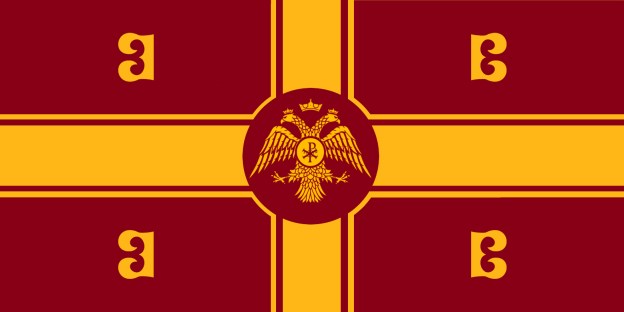
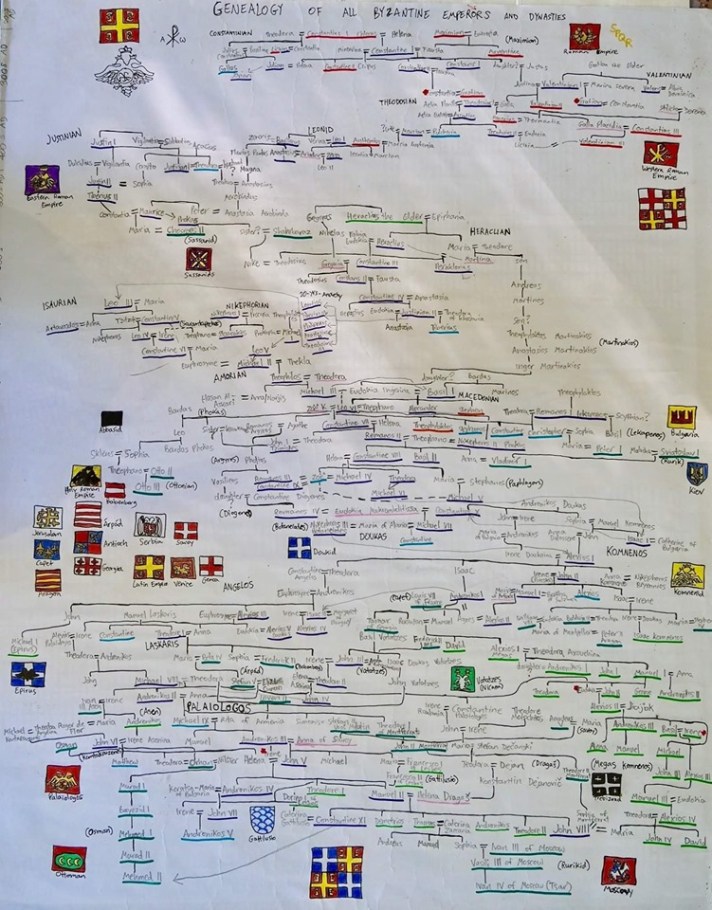


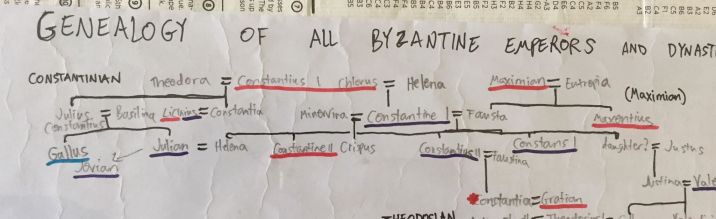


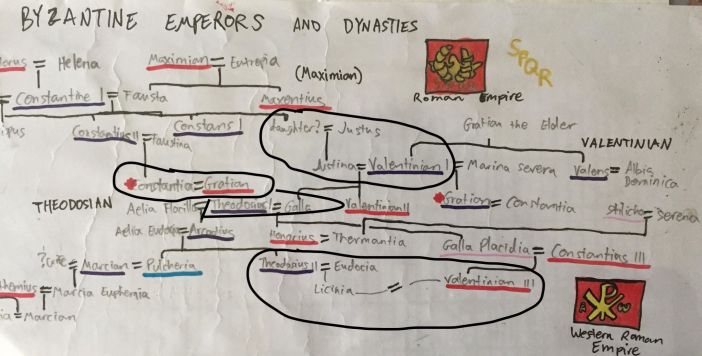


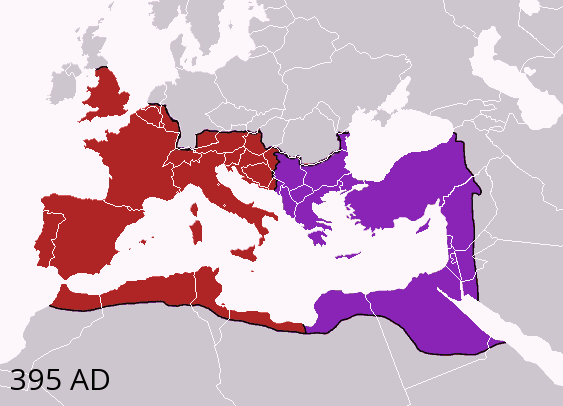


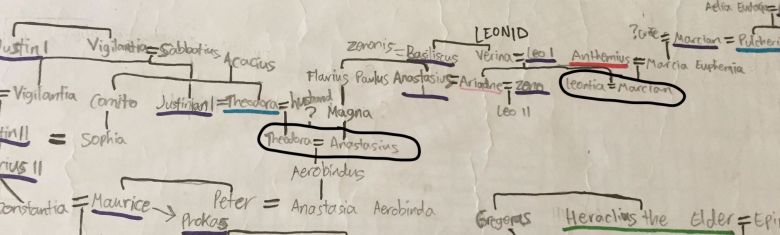


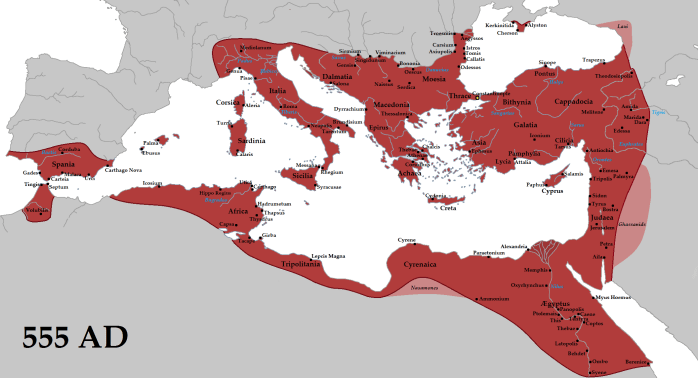


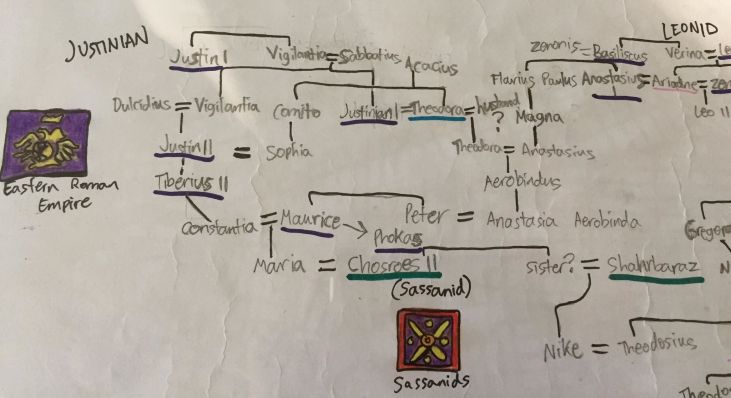
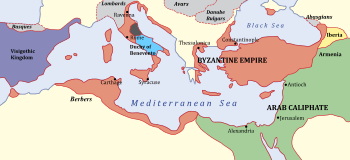
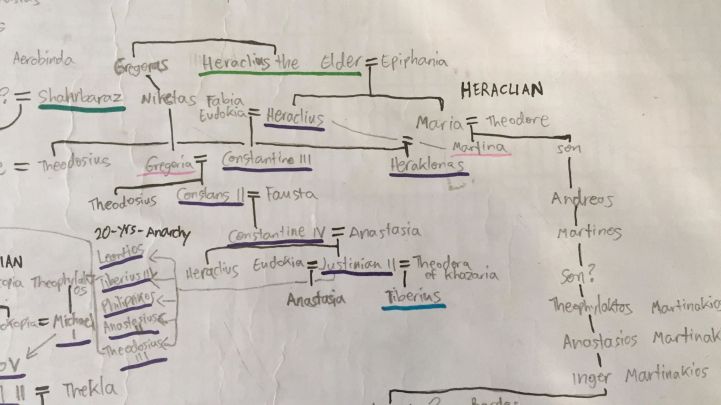


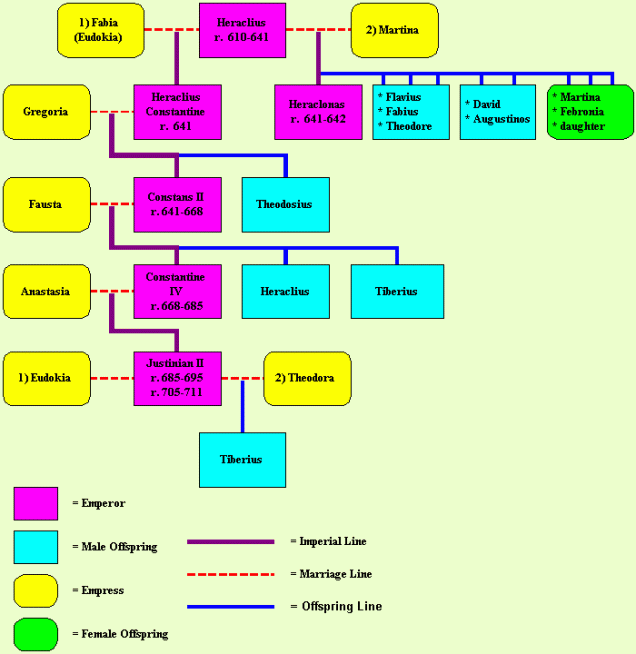


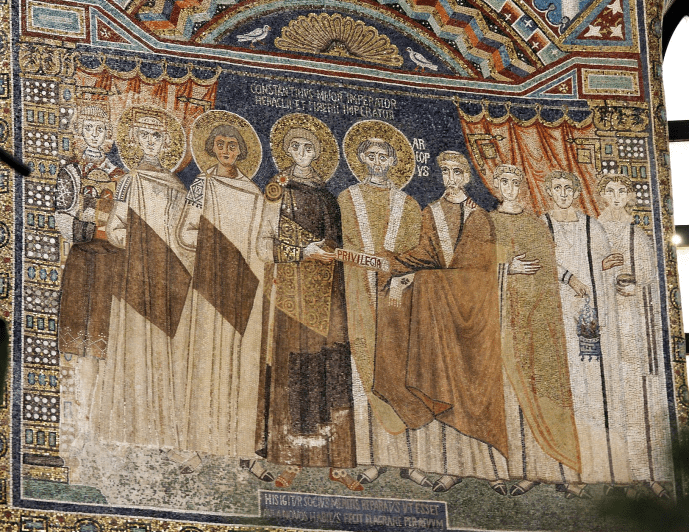


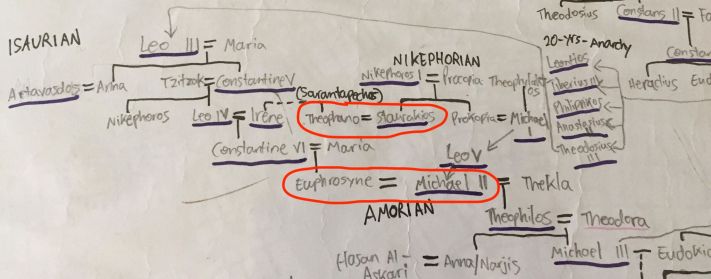


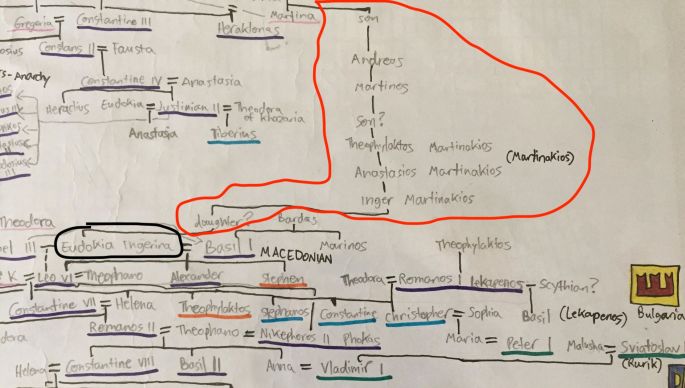
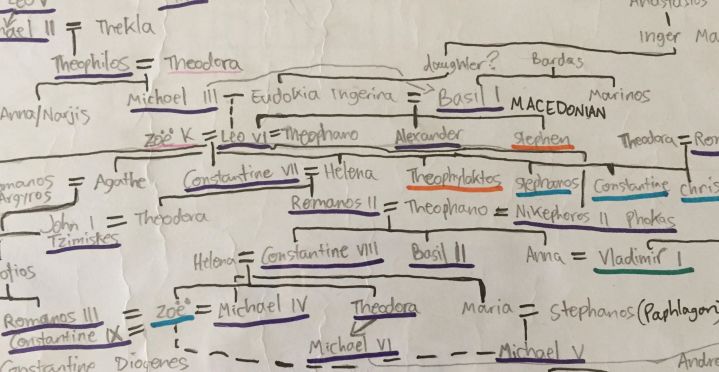
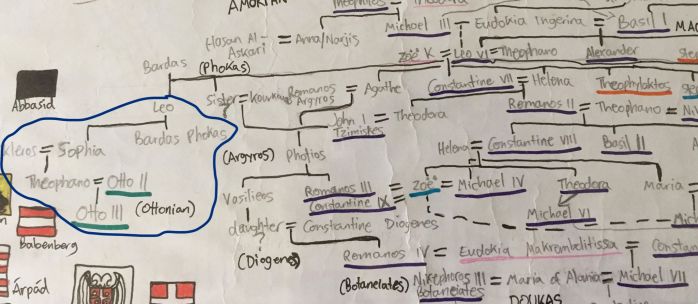
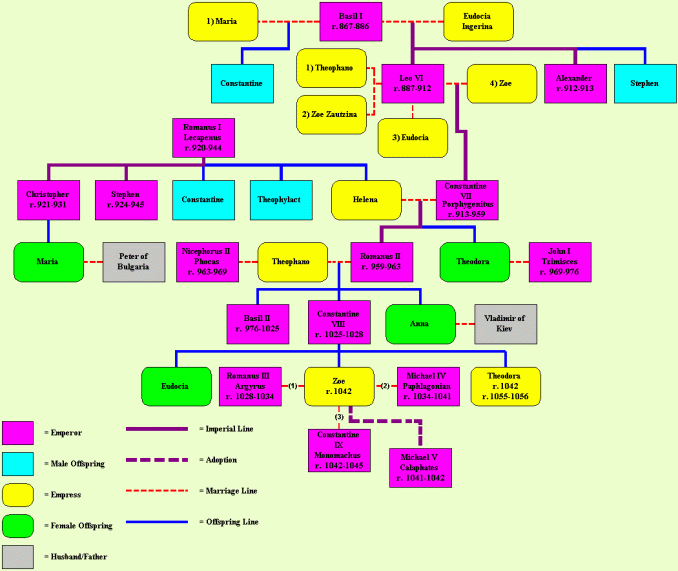
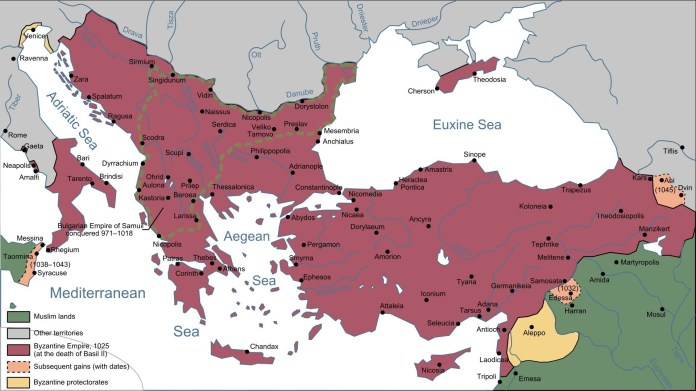


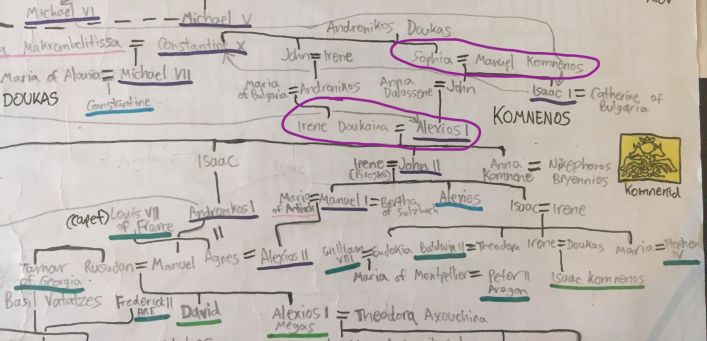


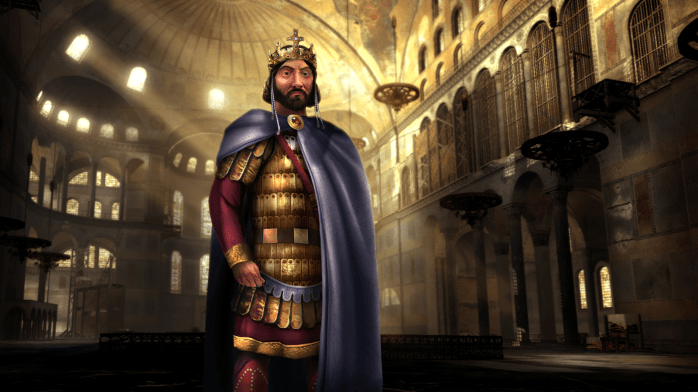


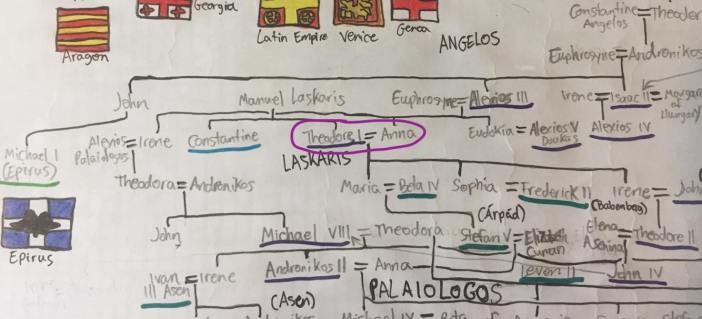
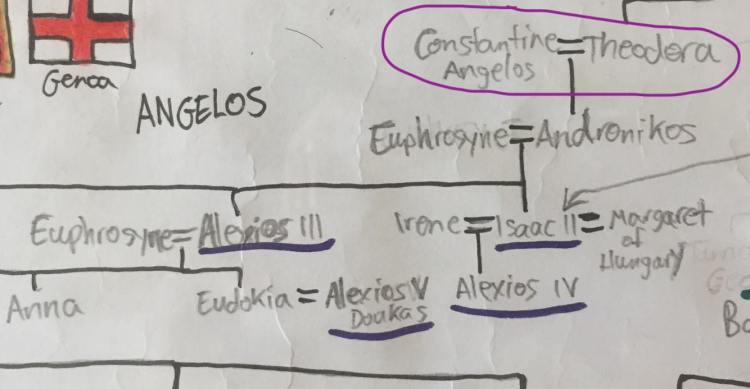
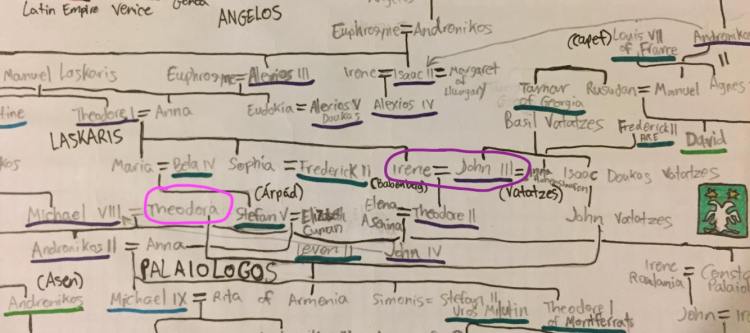
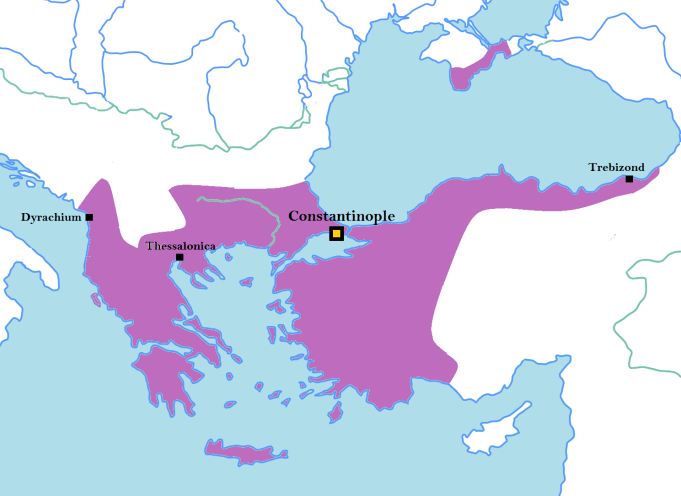
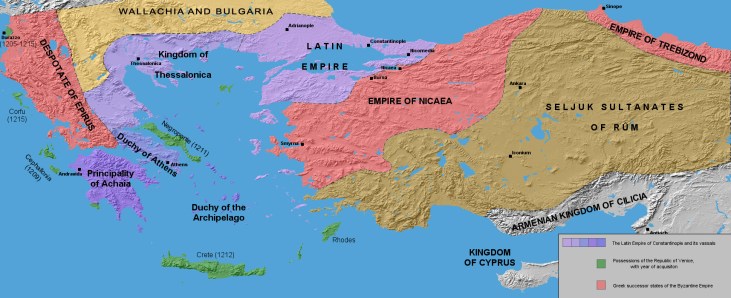


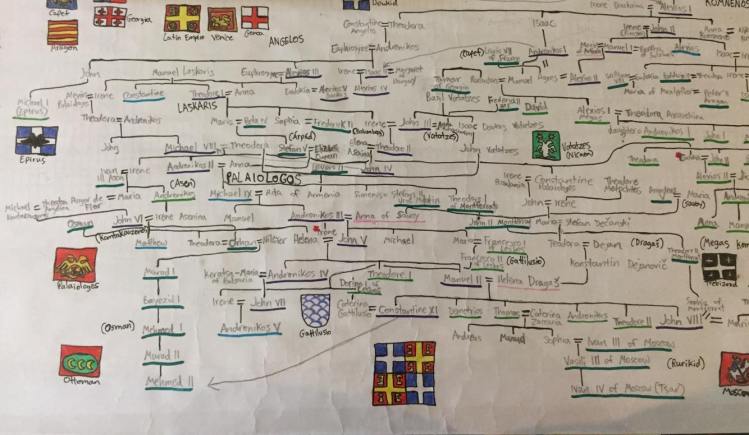
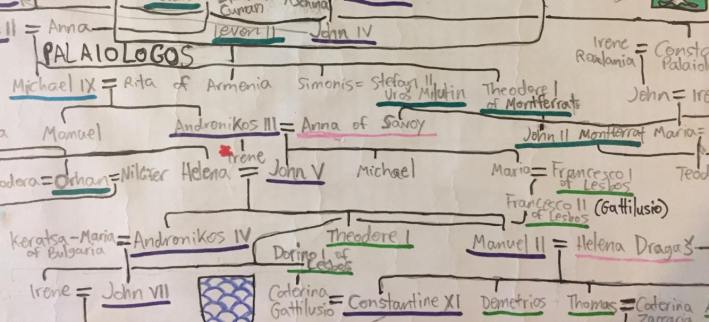
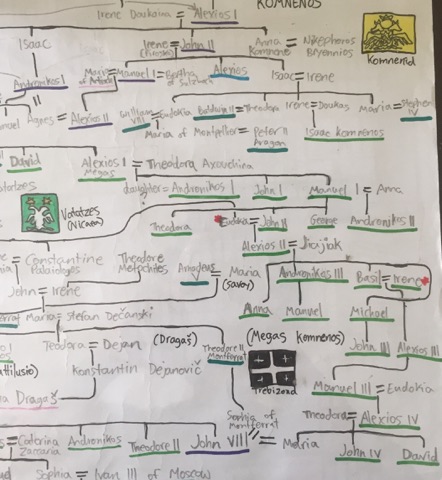
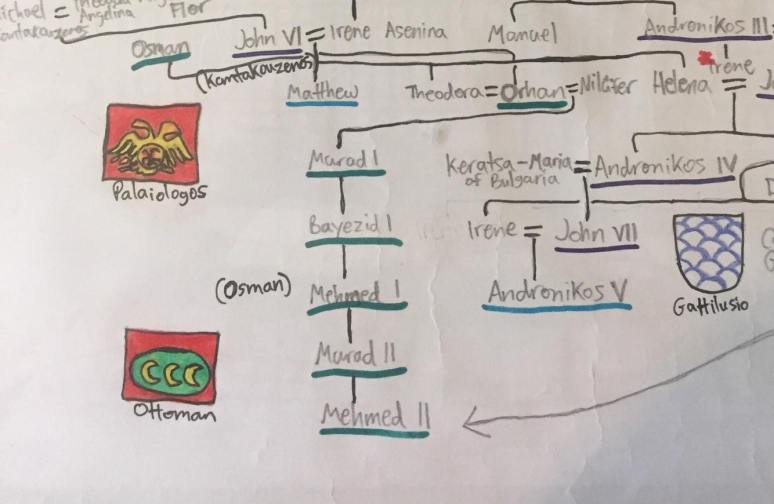
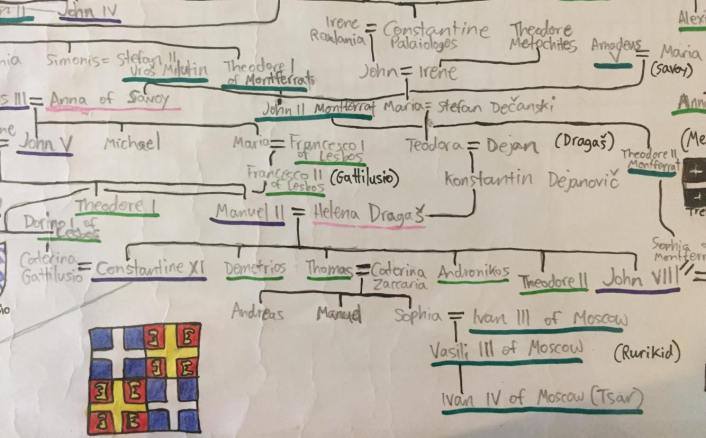
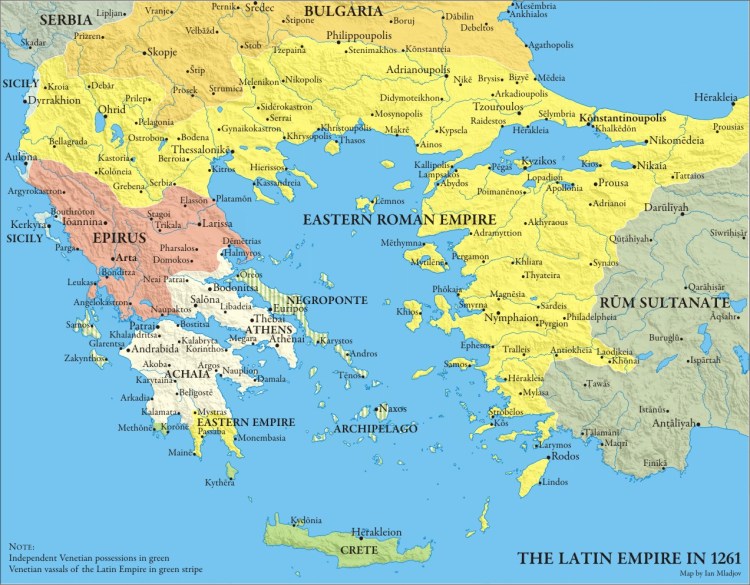



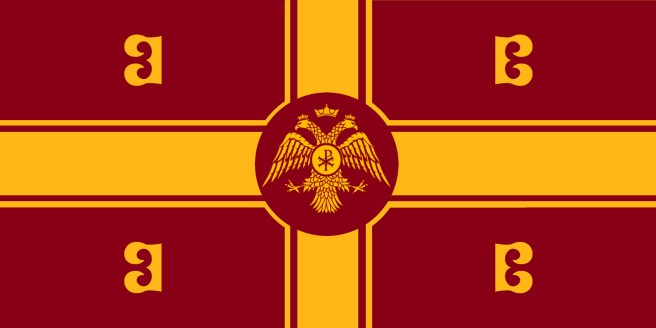
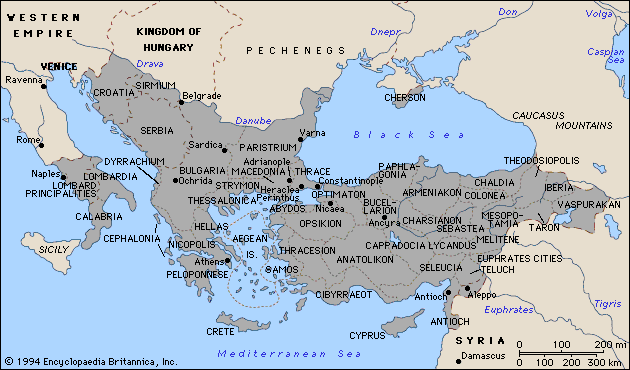
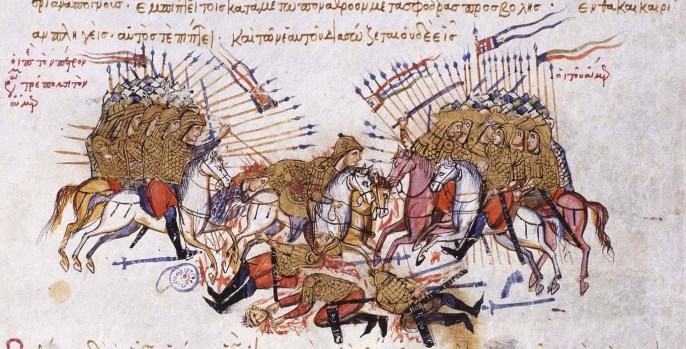


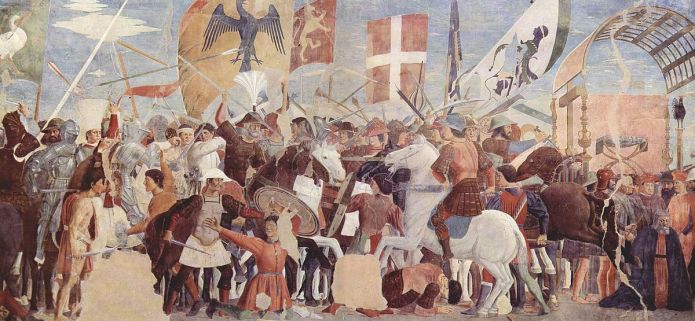


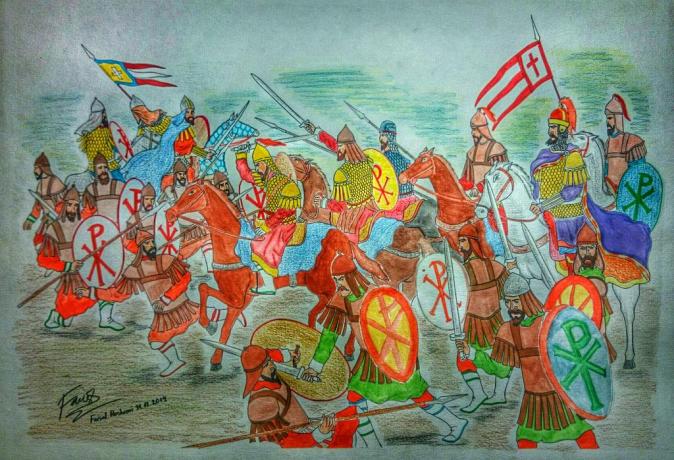


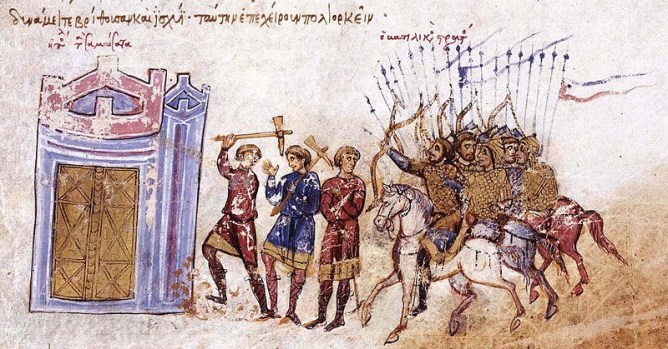


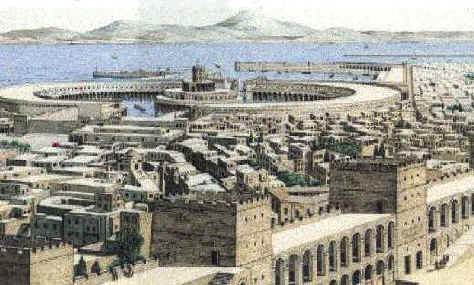


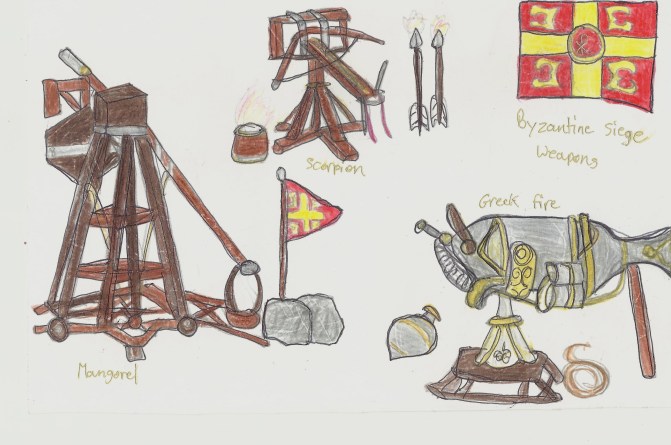


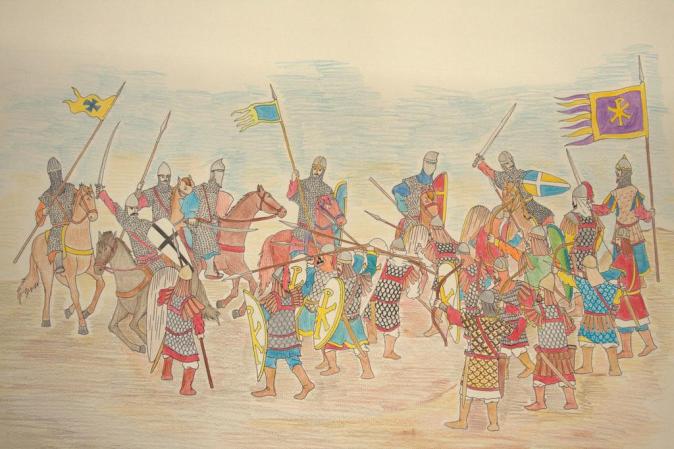


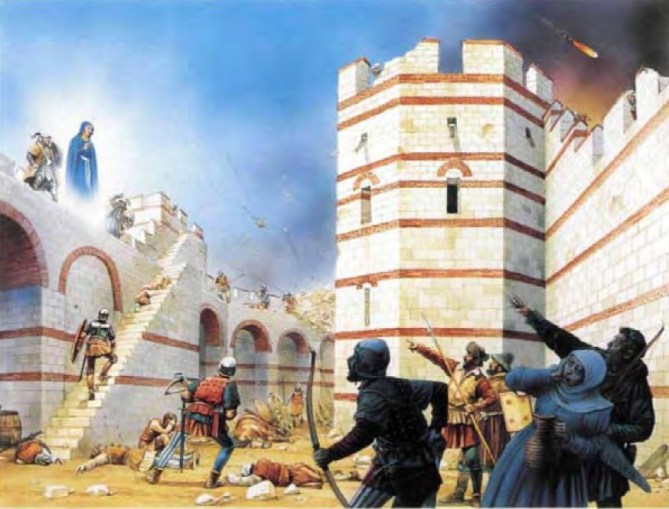


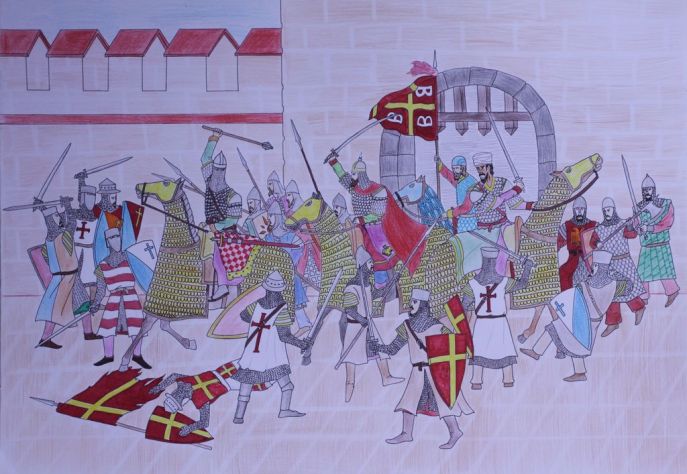


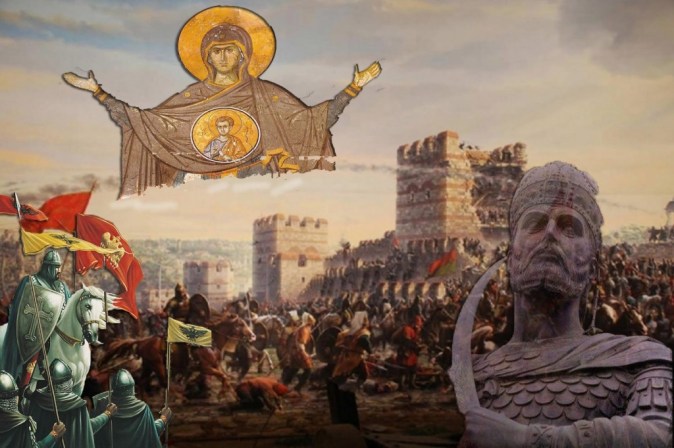
 The Byzantium Blogger