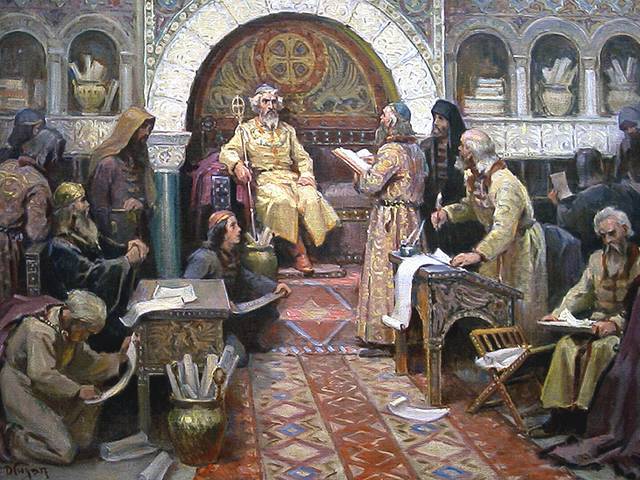
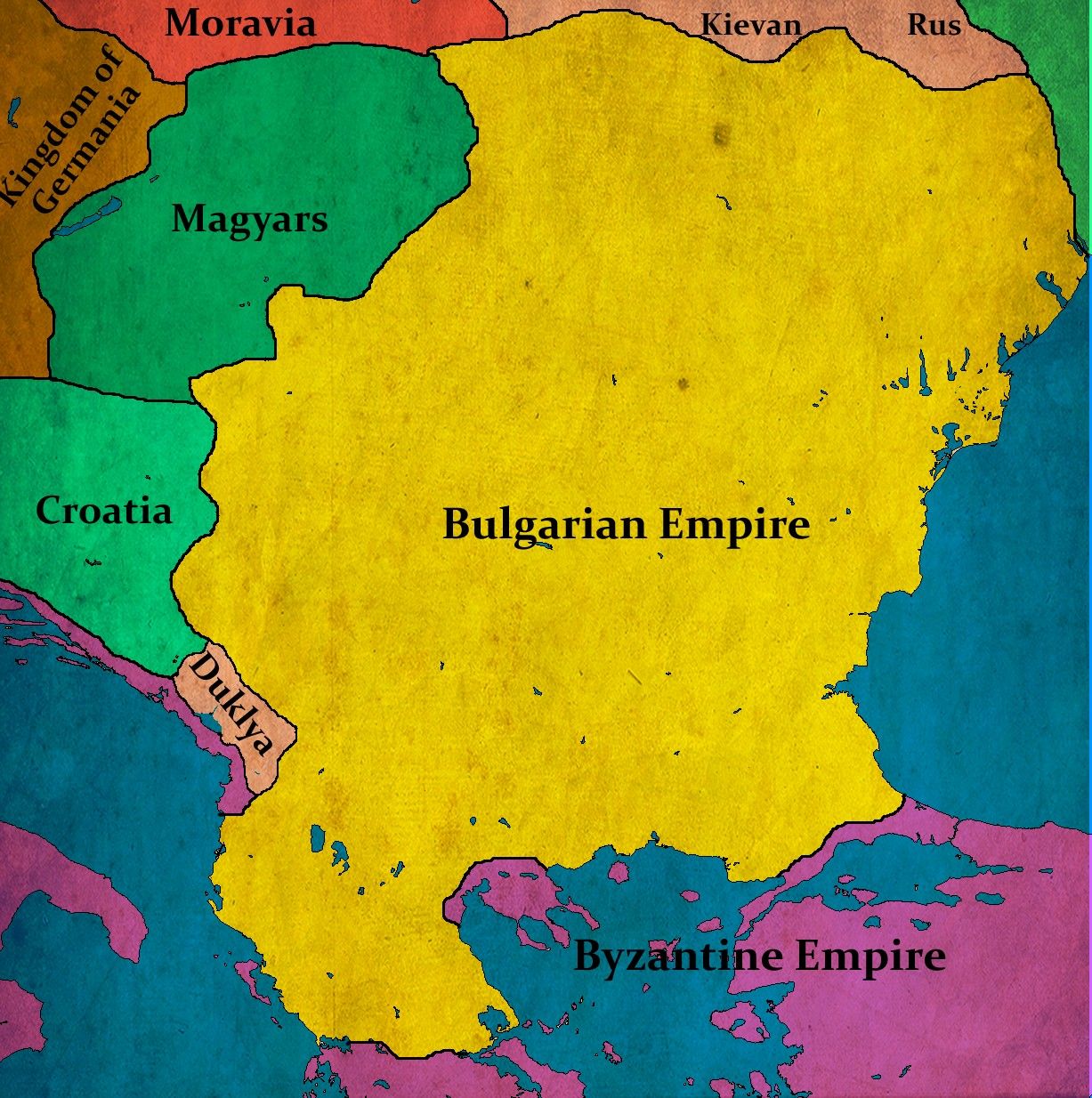
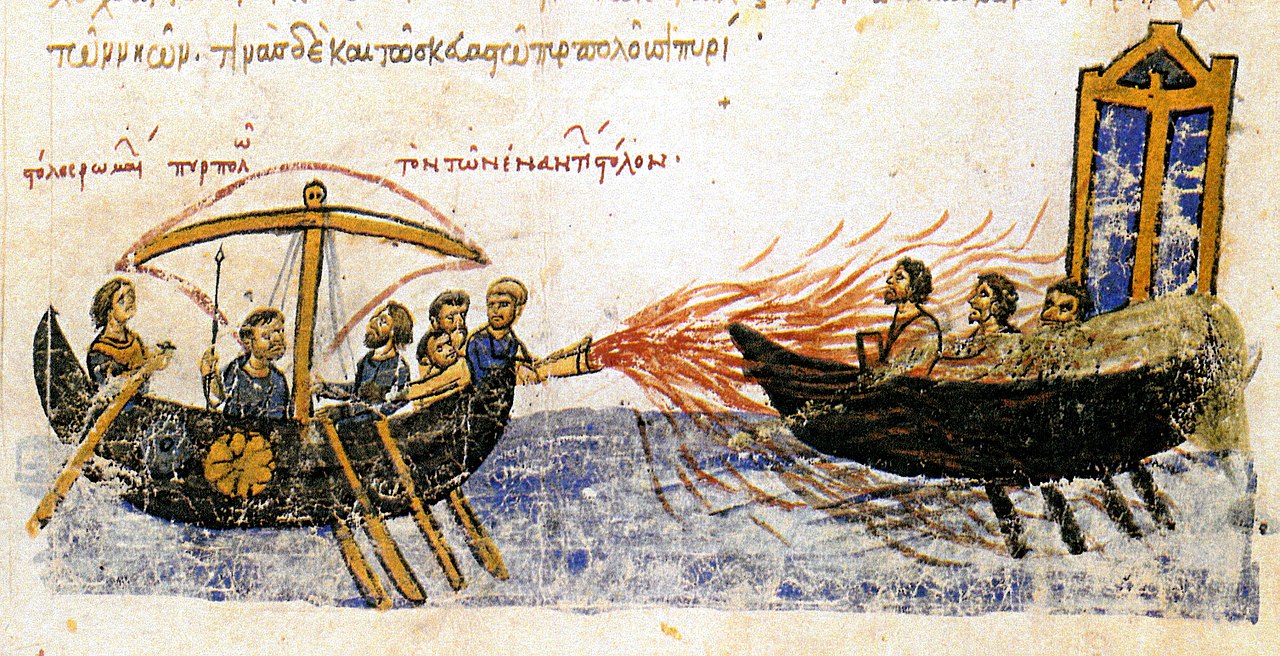
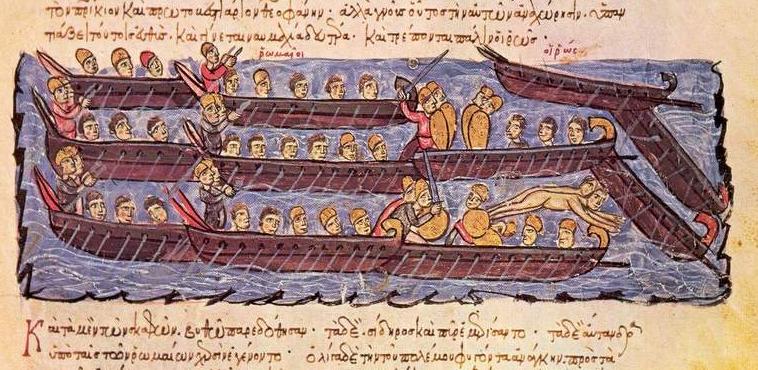
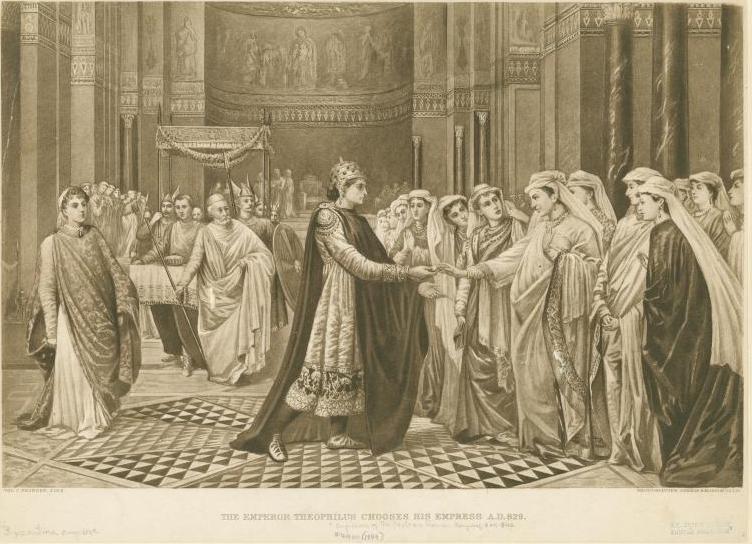
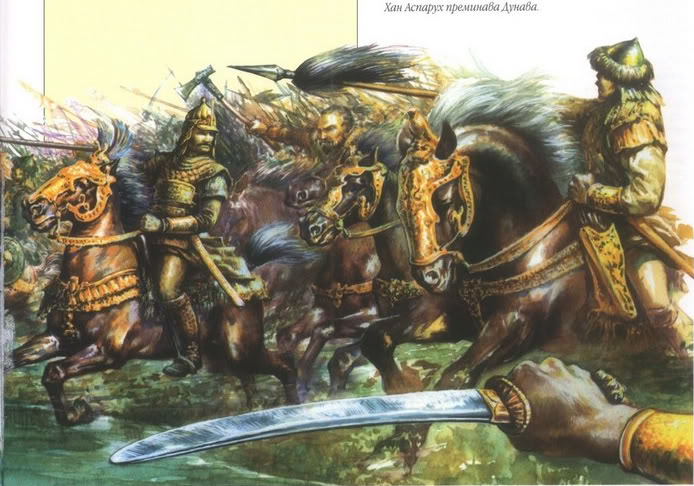
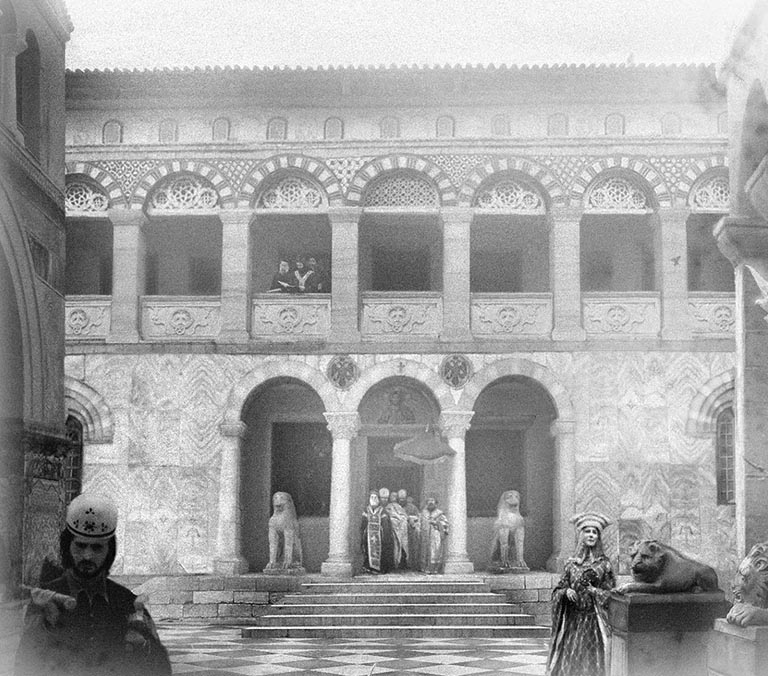
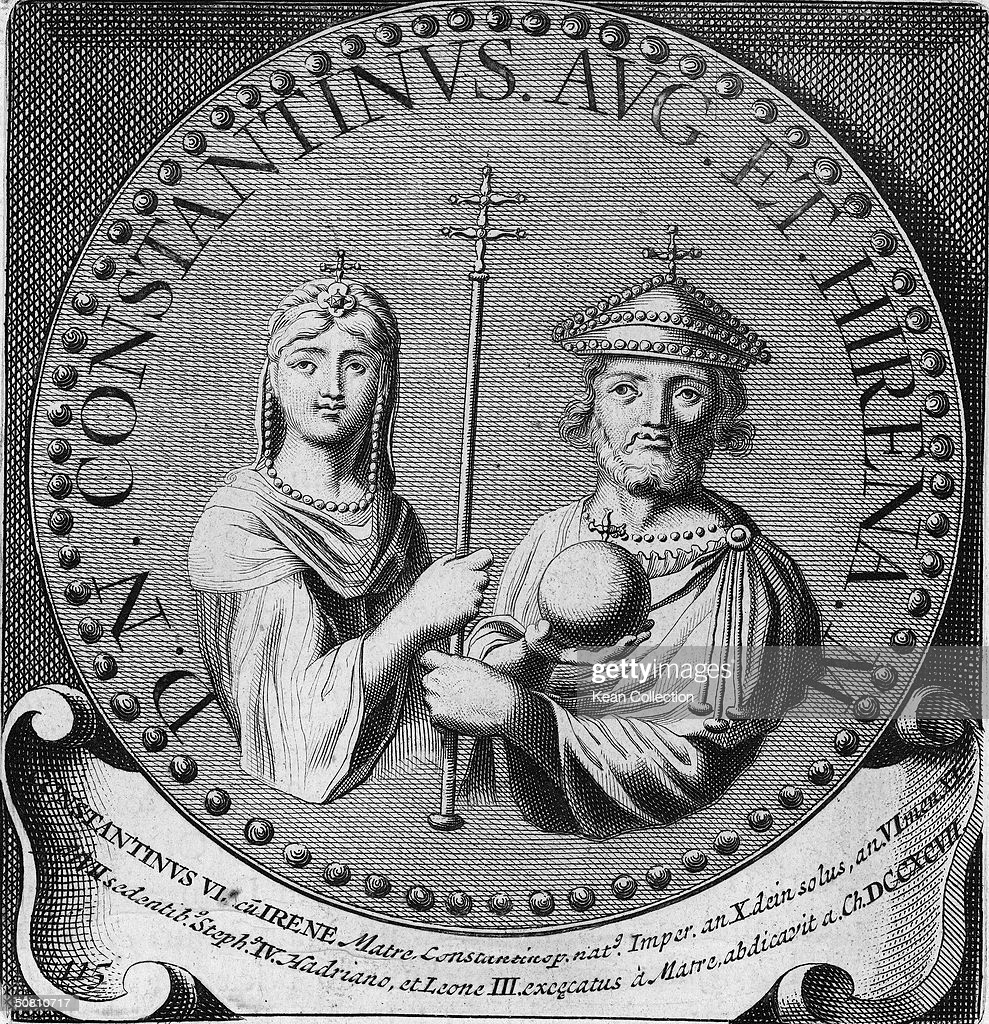
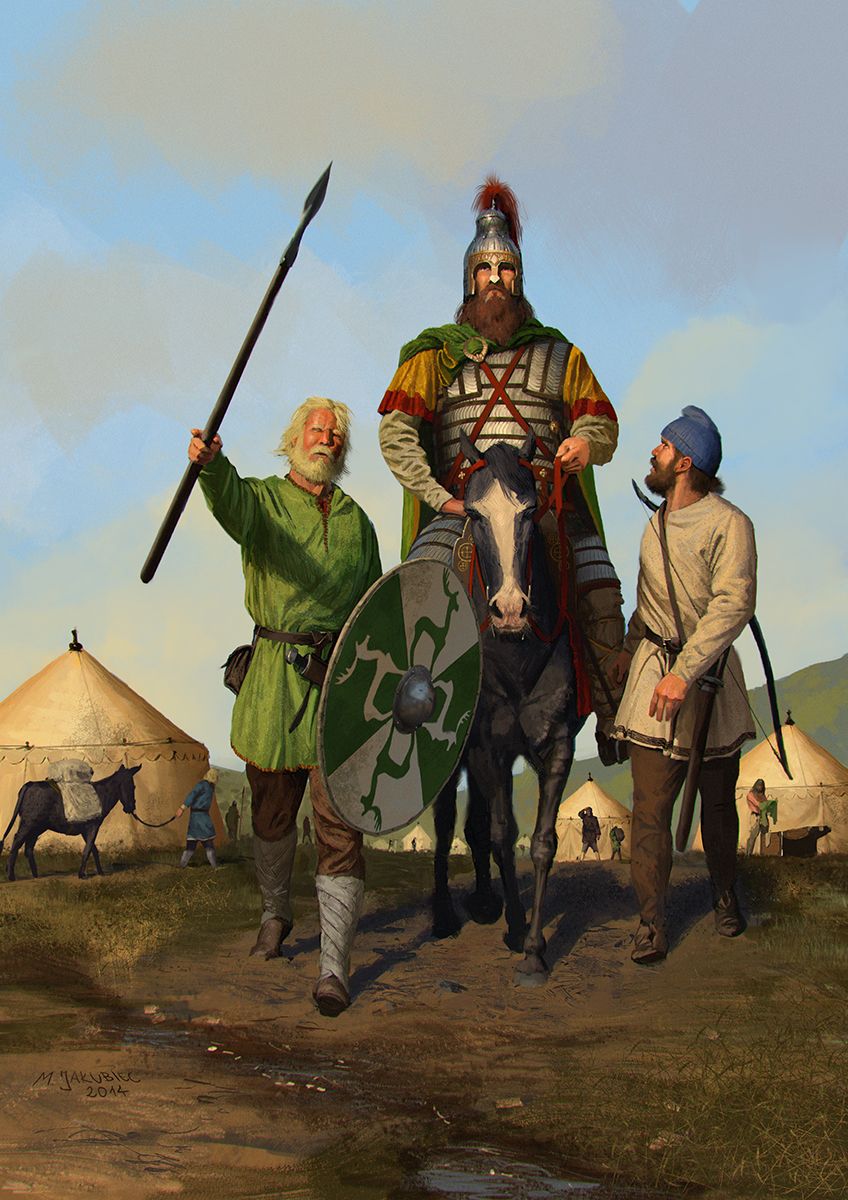
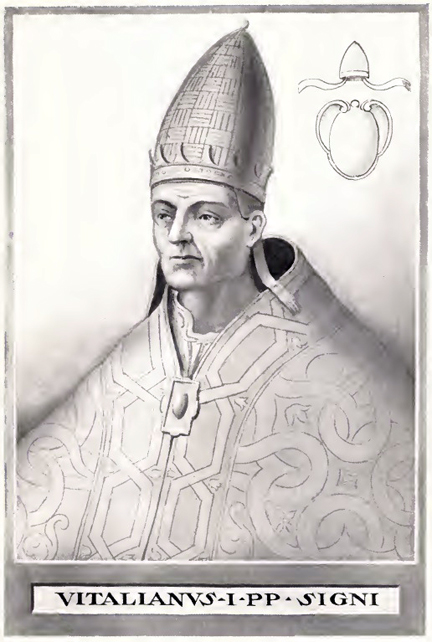
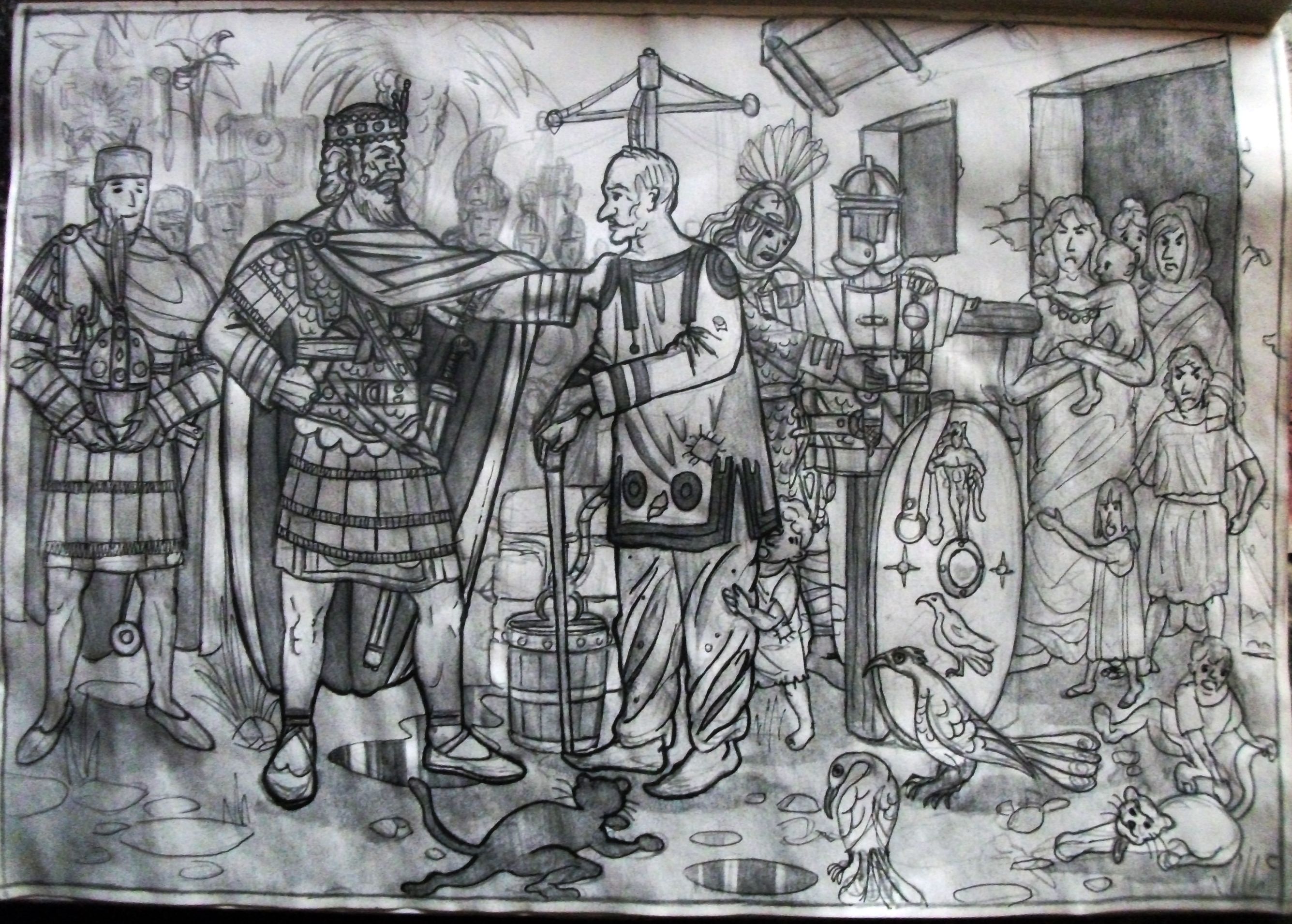
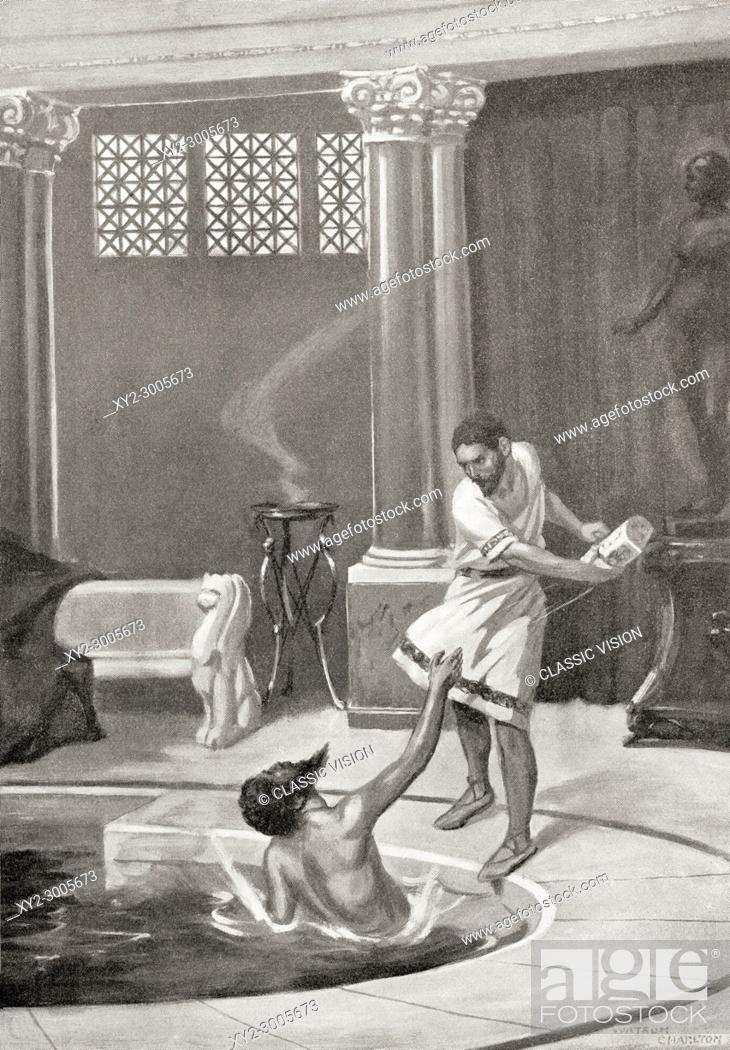
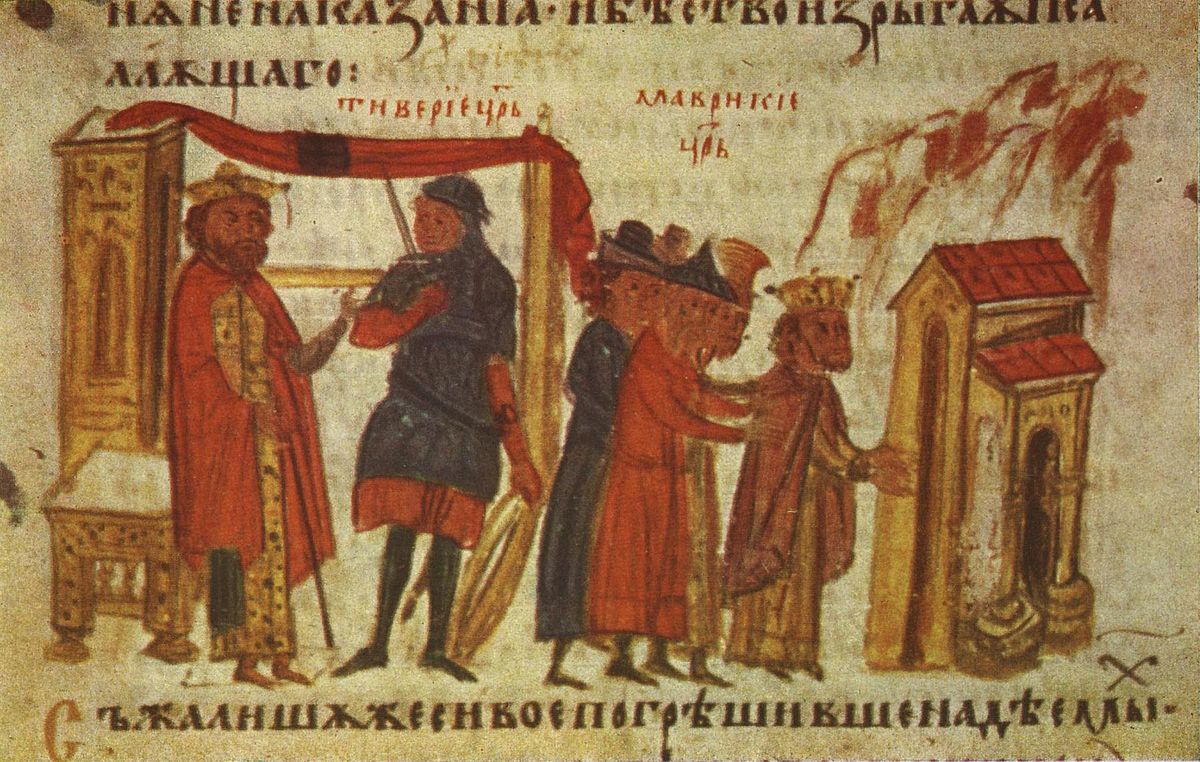
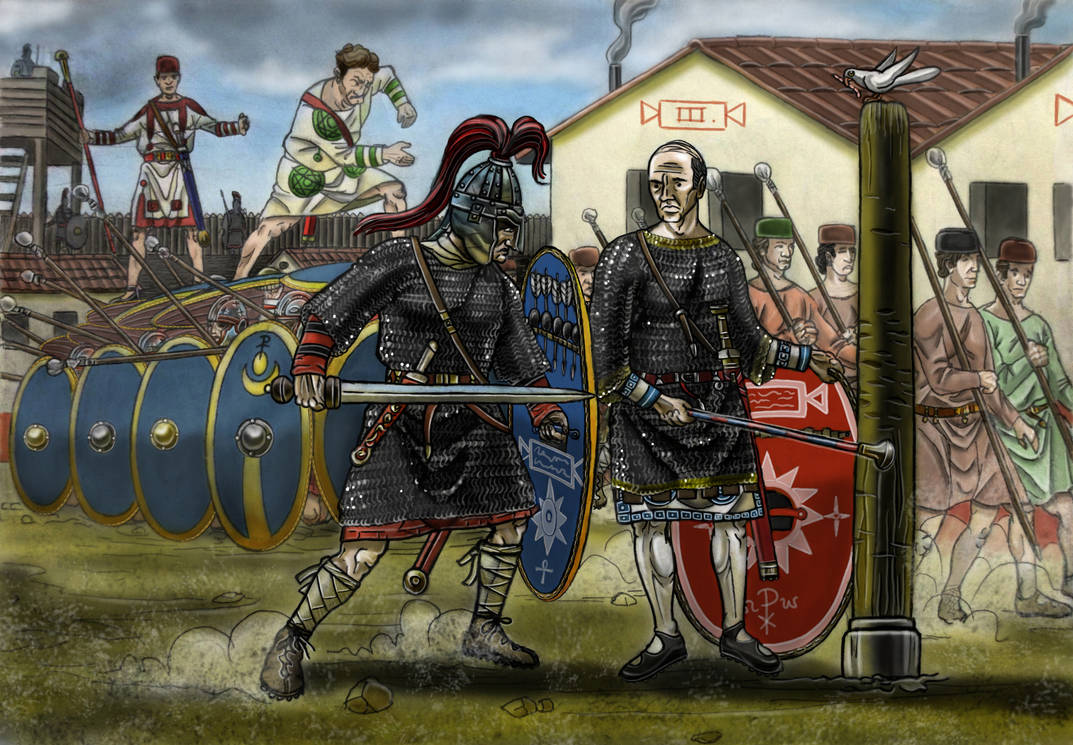
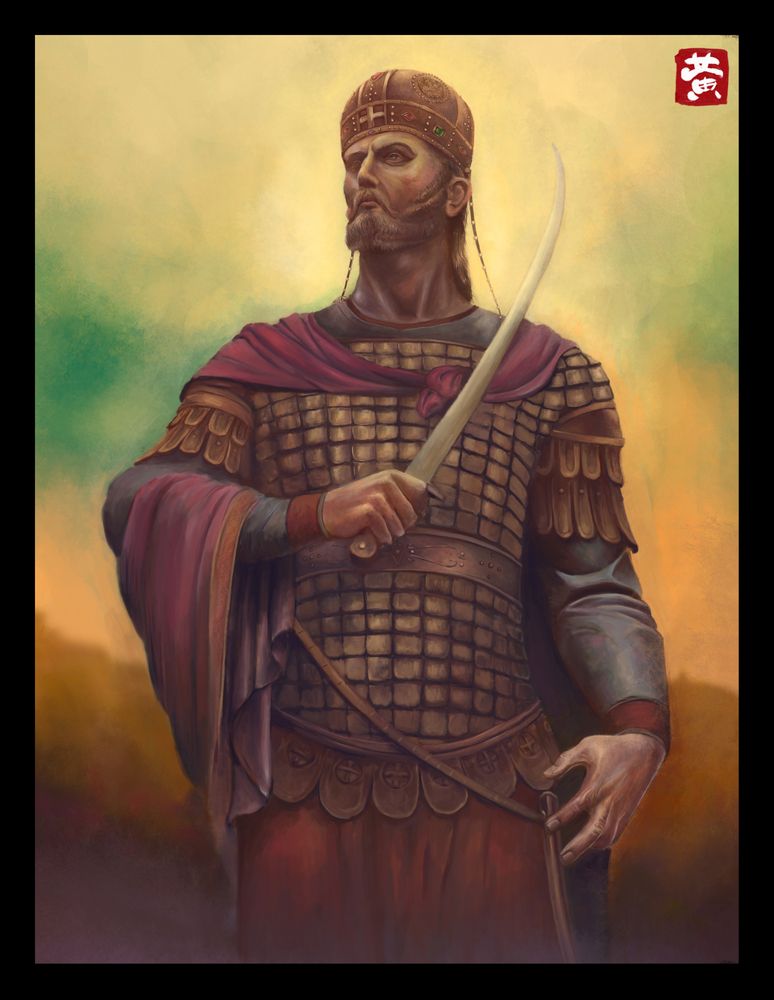
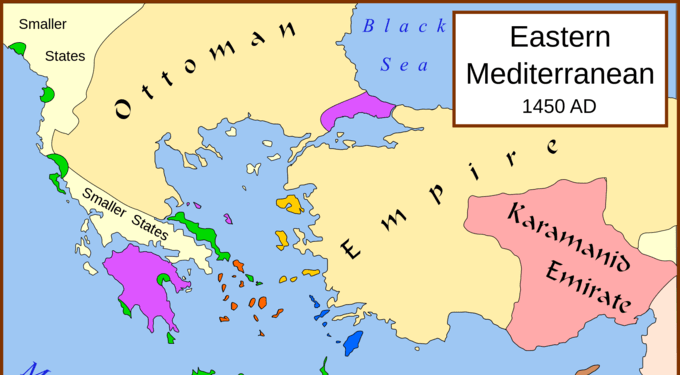
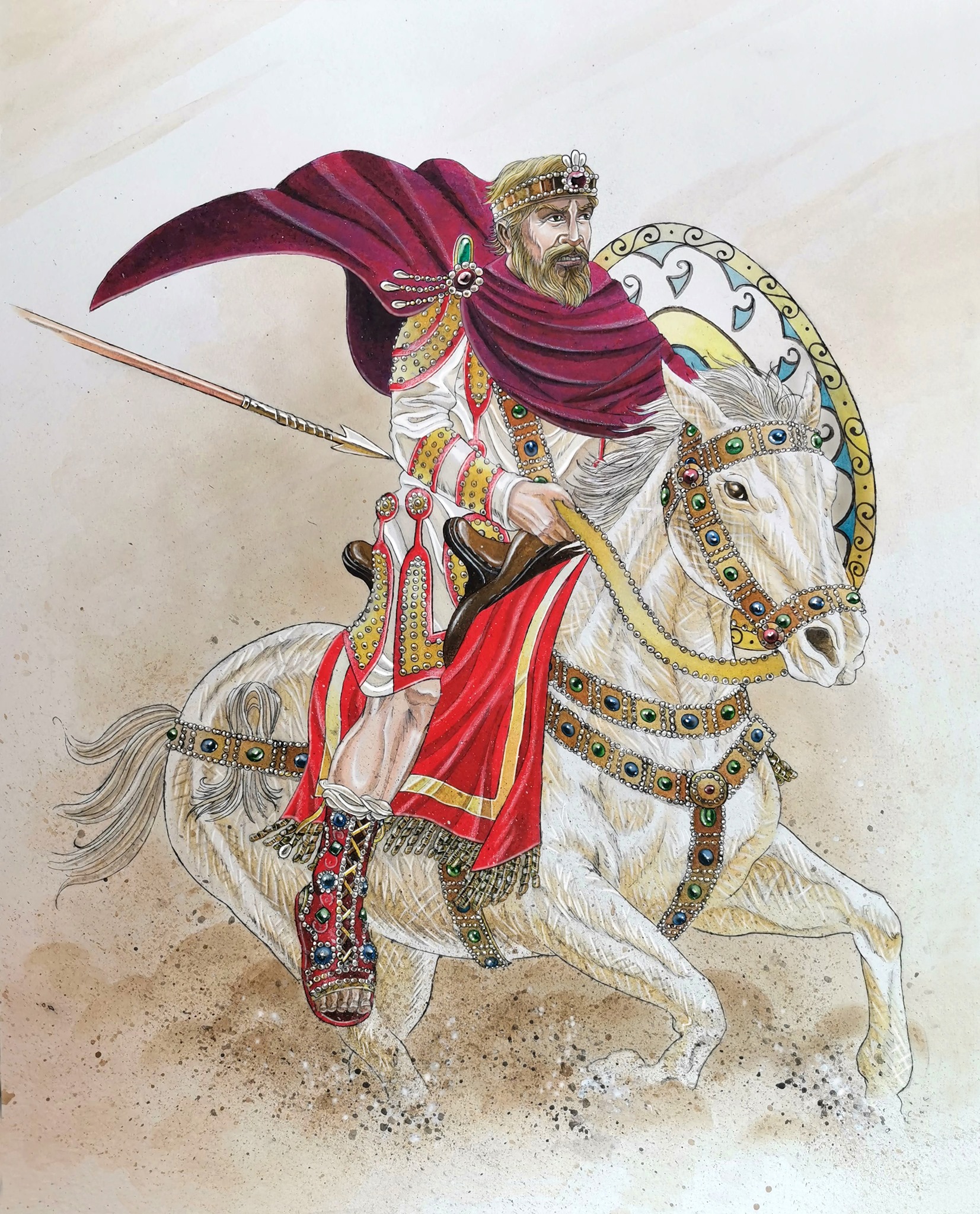
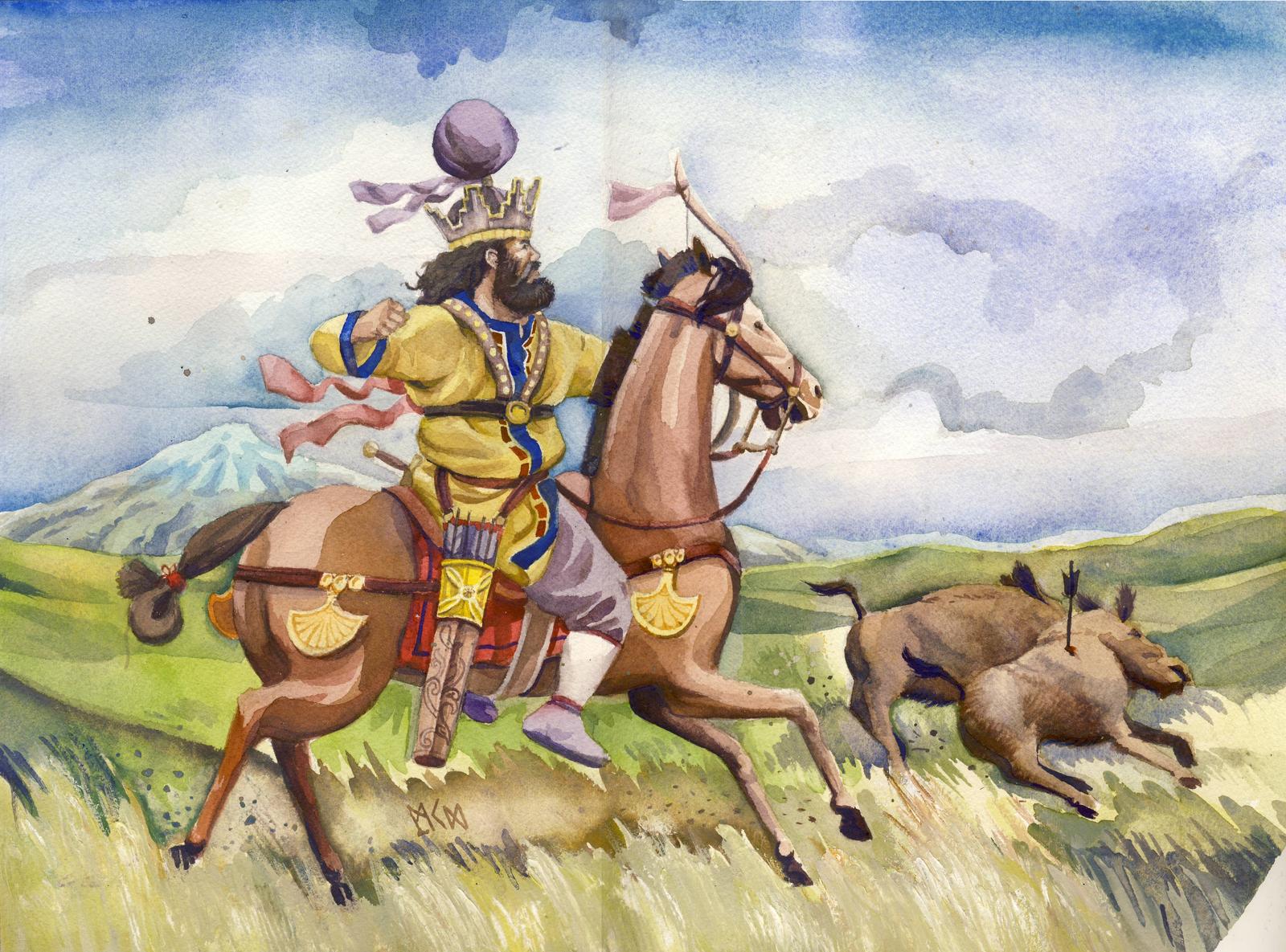
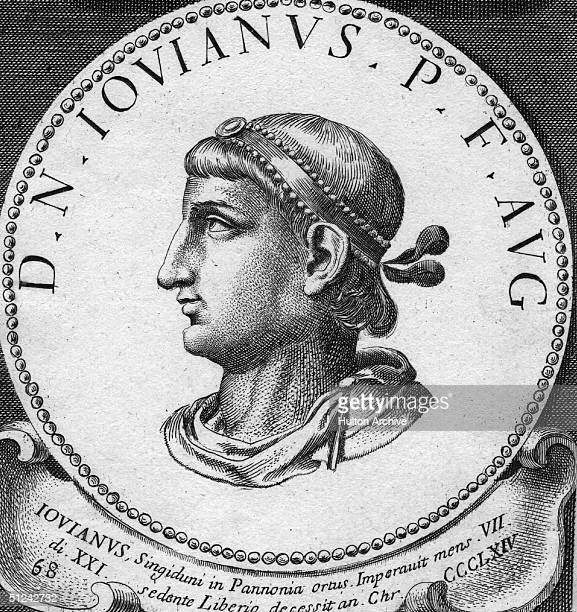
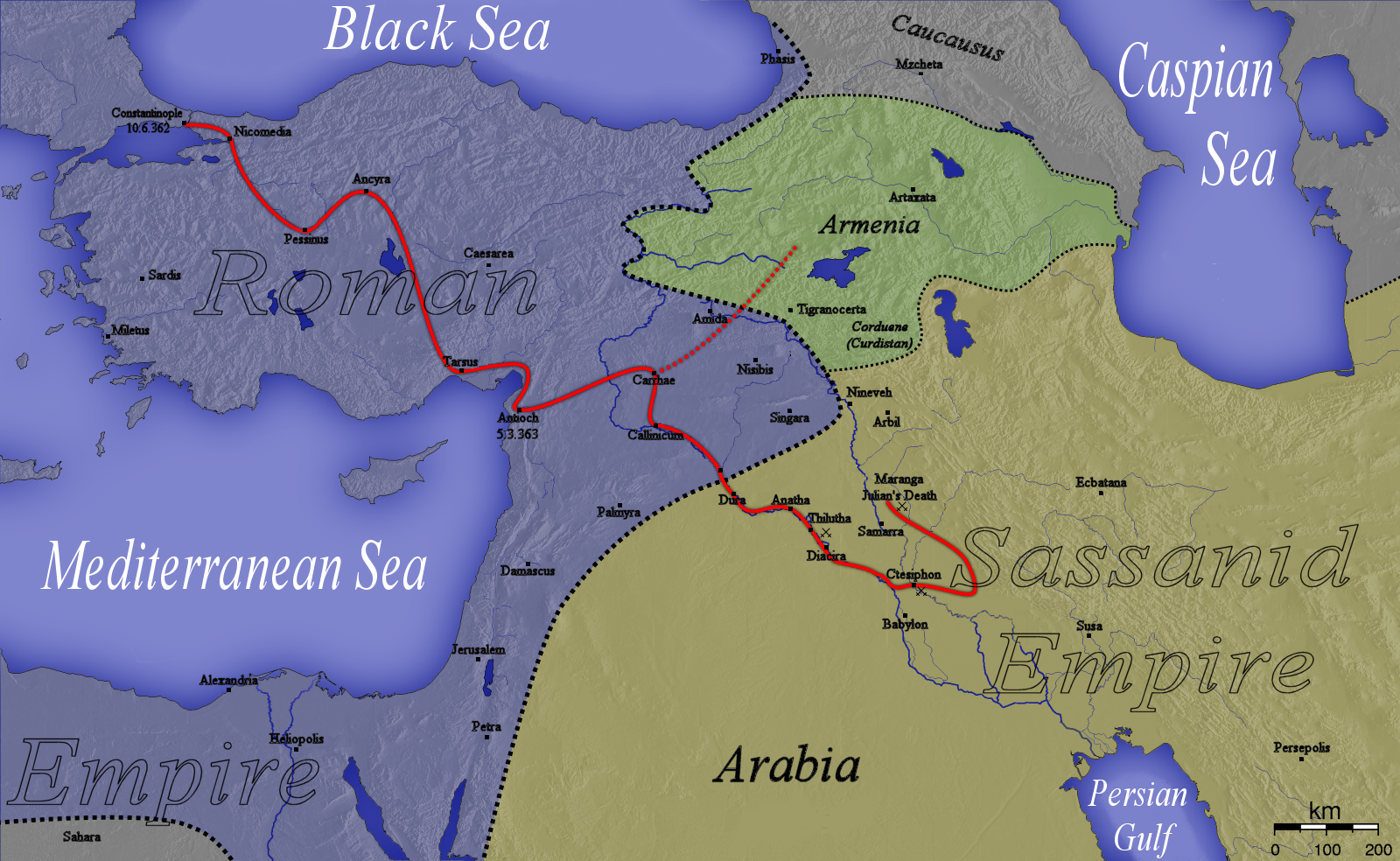
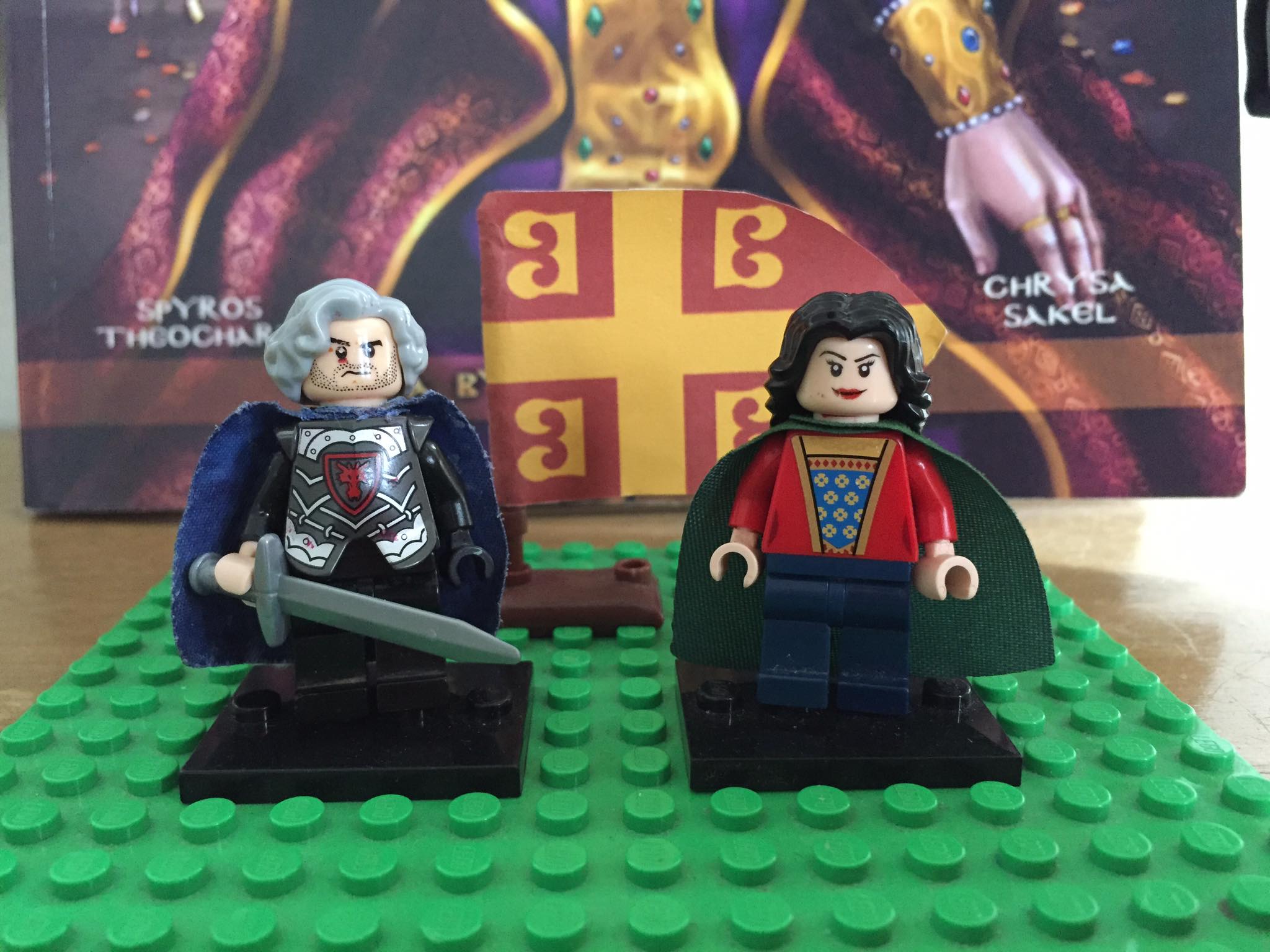
Byzantine Alternate History Chapter VII- A Retelling of the Bizarre Byzantine Renaissance and the Macedonian (Amorian) Dynasty

Posted by Powee Celdran

DISCLAIMER: Although this is mostly a work of fiction, it is largely based on true events and characters. It seeks to alter the course of actual events that transpired in the 9th and 10th centuries AD. This story will begin with events that happened in real history but will become fictional as it progresses.

Previous Story: Byzantine Alternate History Chapter VI- 9th Century

Look, I’m giving you these rules, so that you will not leave the best advices and the public interest in the light of past experiments and filtered information.” -Constantine VII Porphyrogennetos, De Administrando Imperio
Palaiologos_Dynasty_emblem1

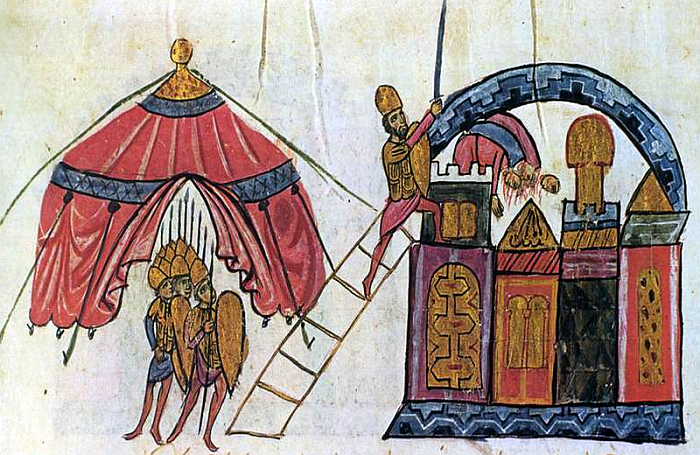
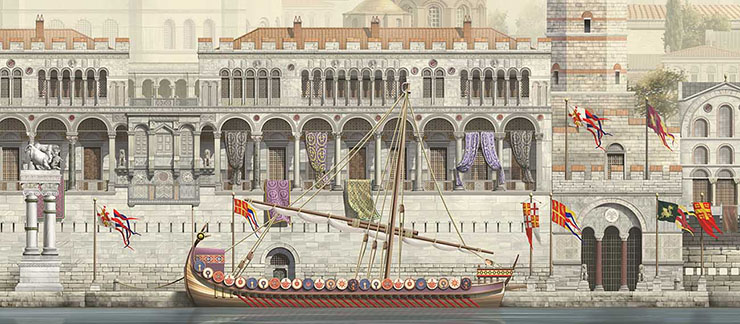
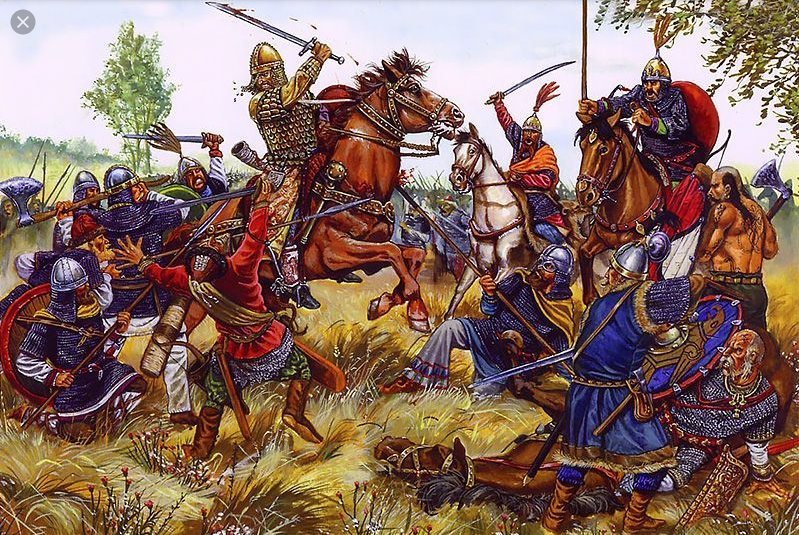
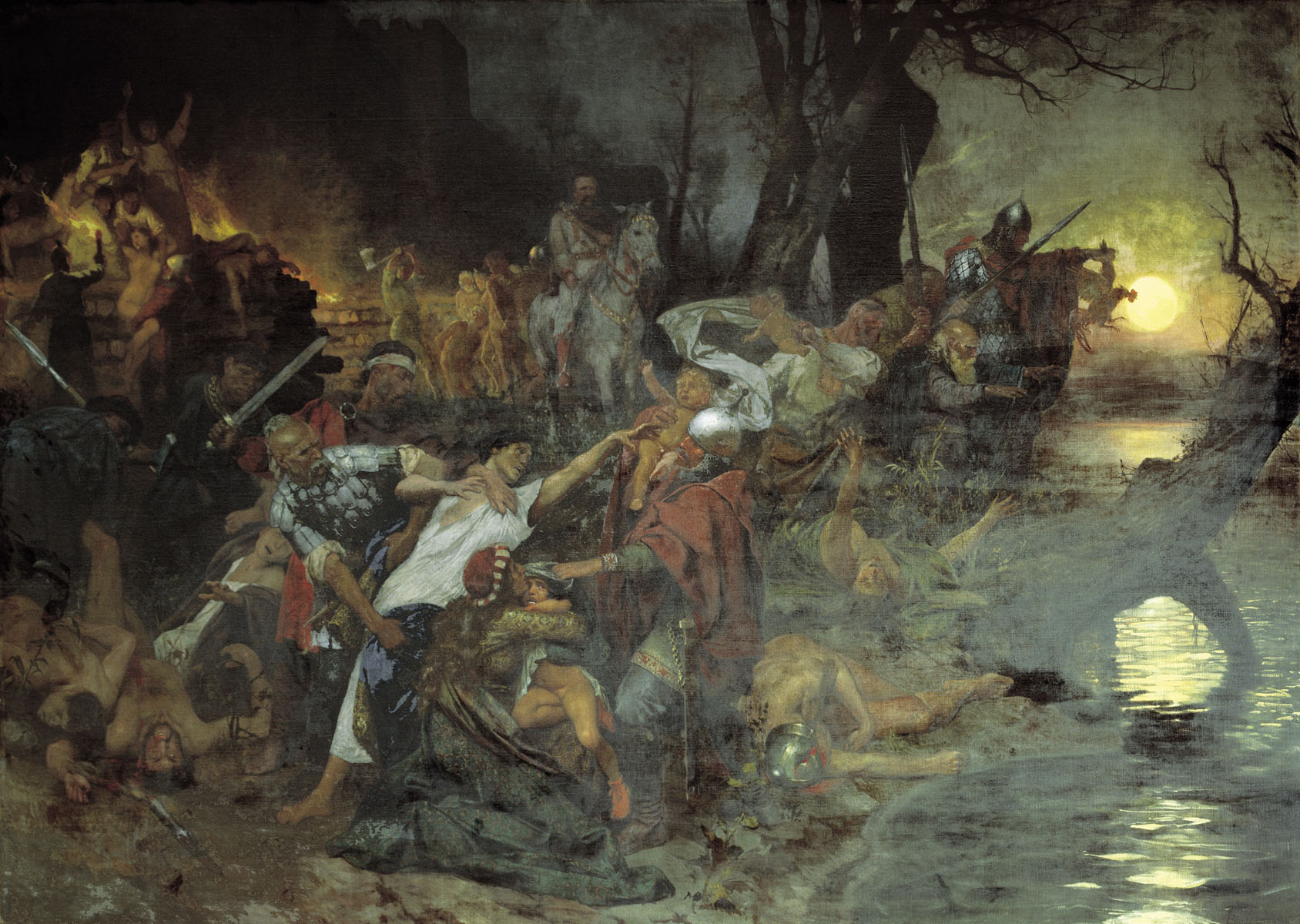
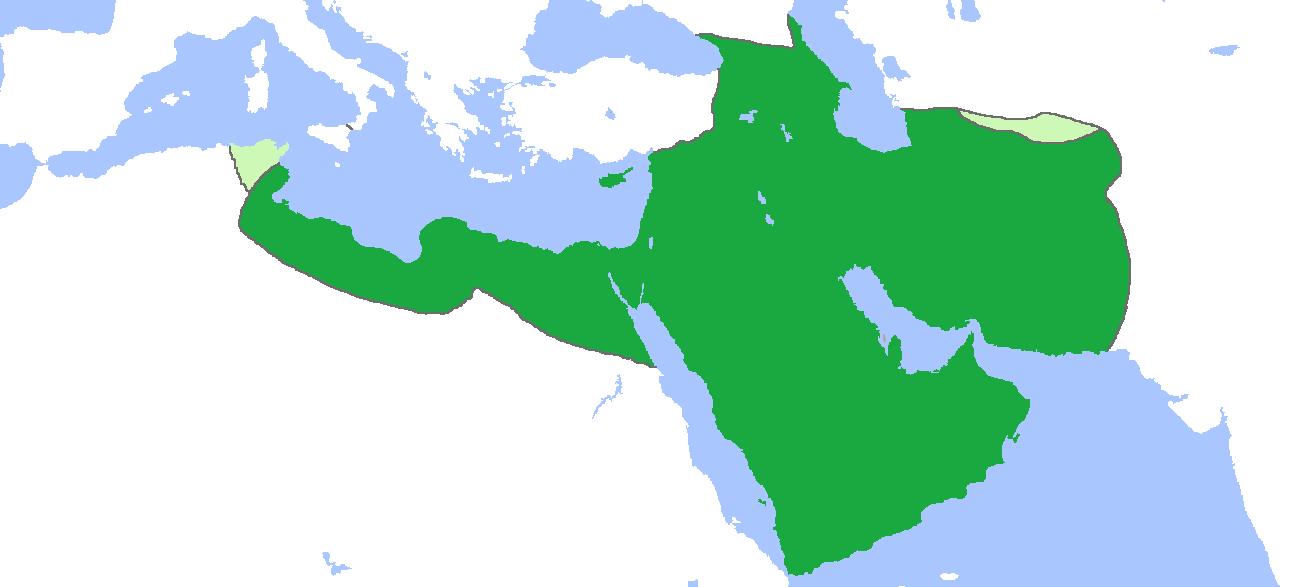
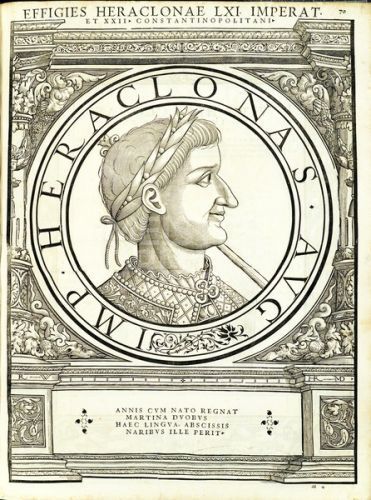
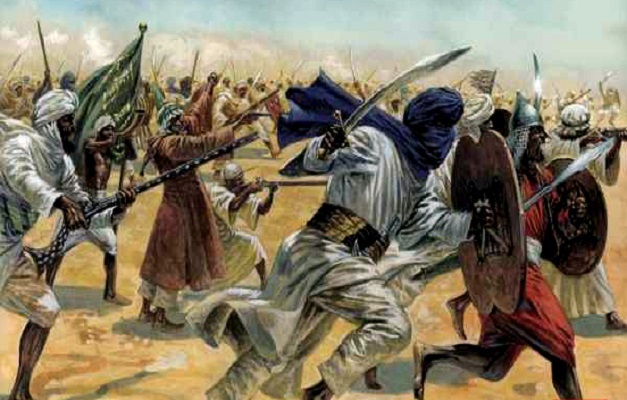
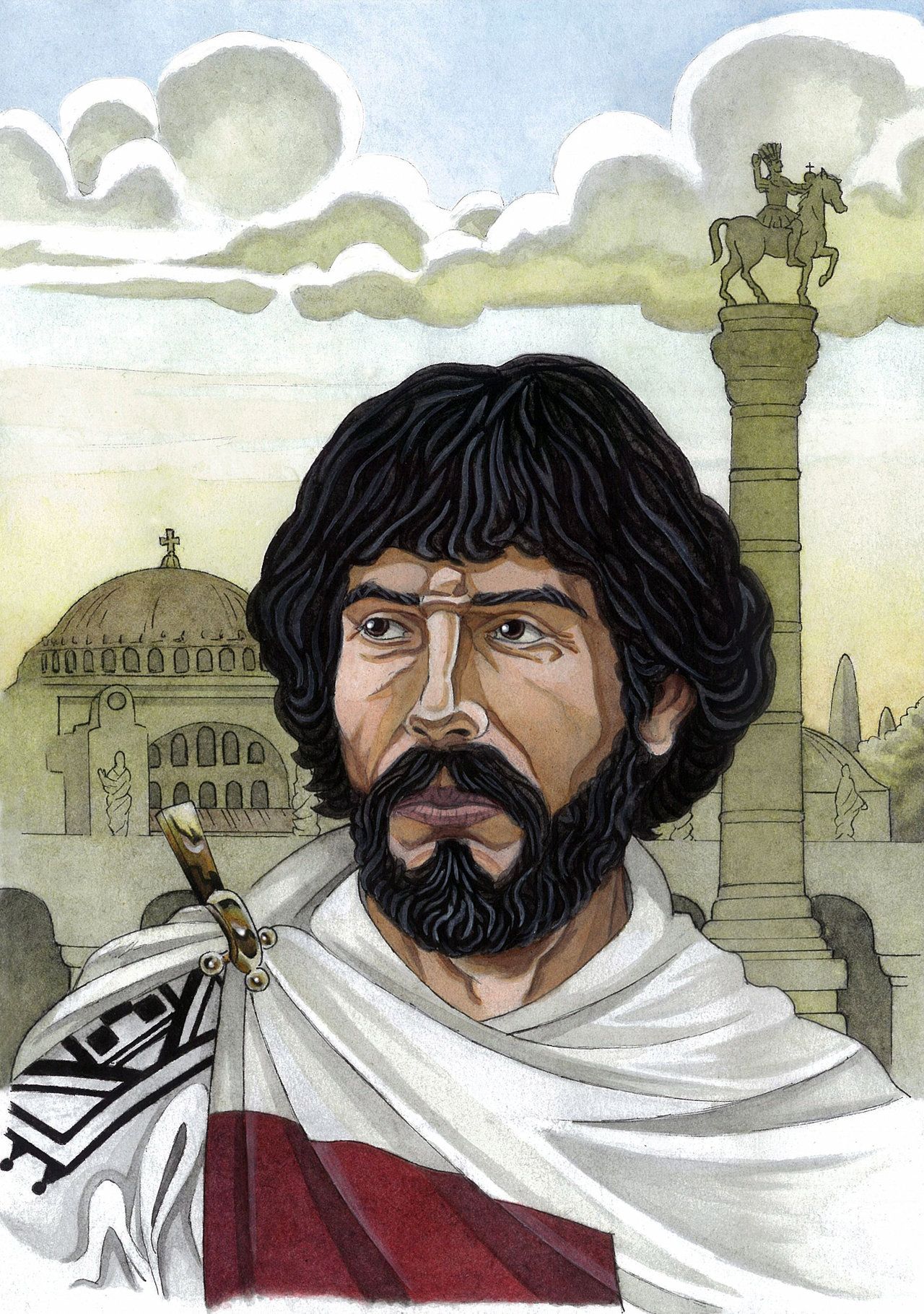
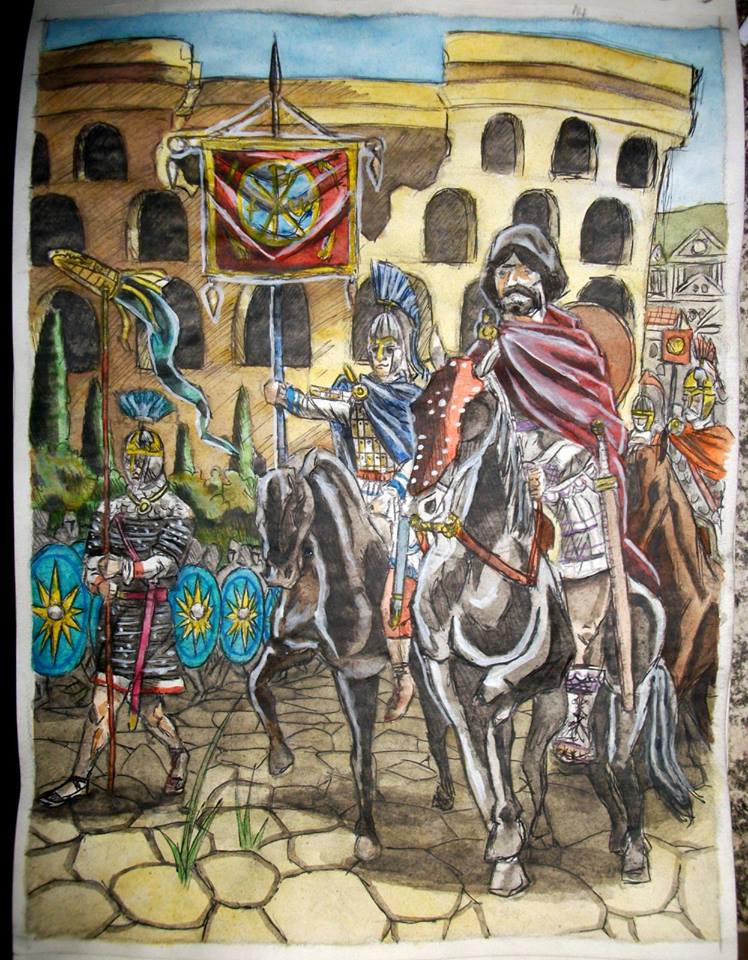
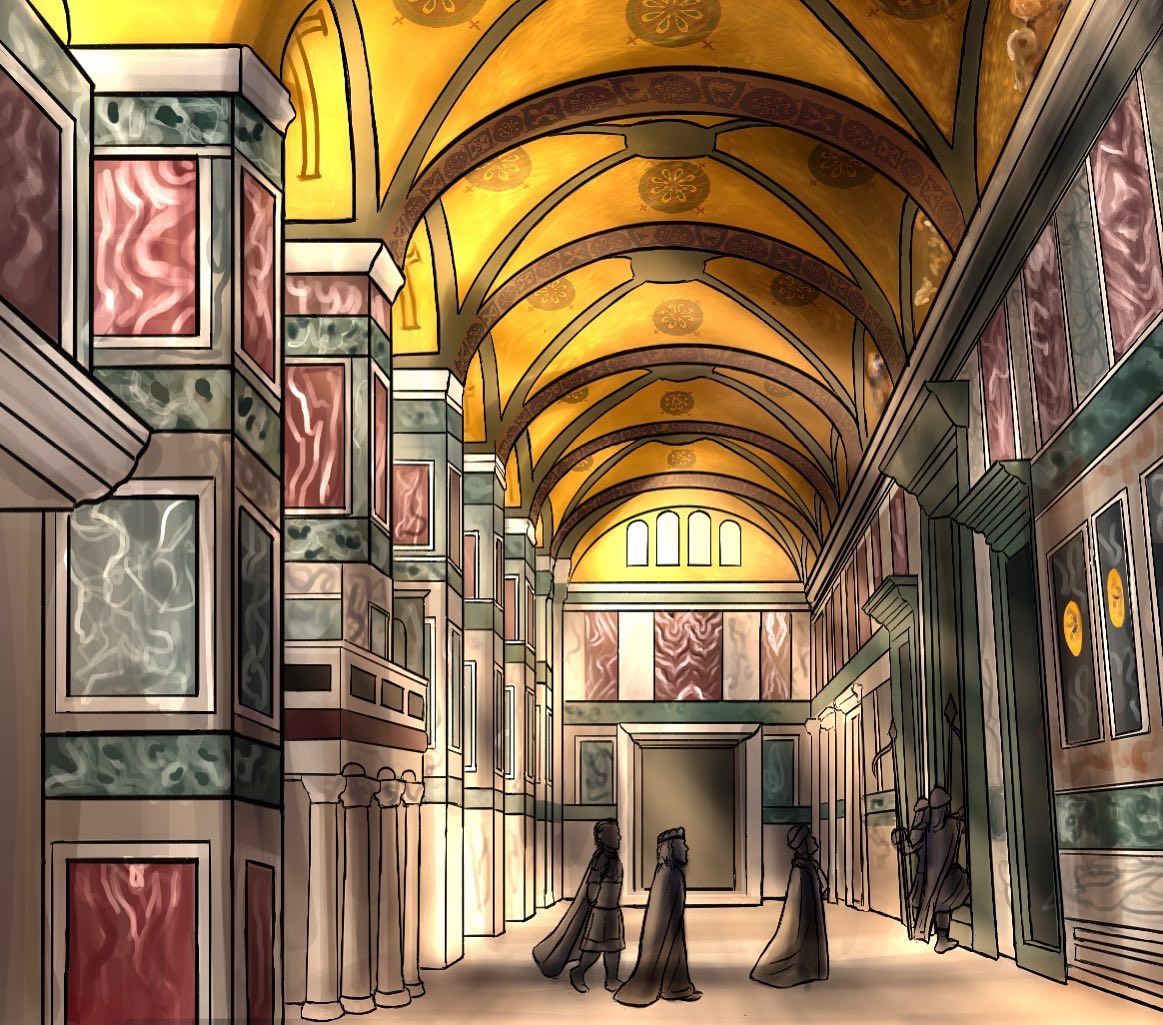
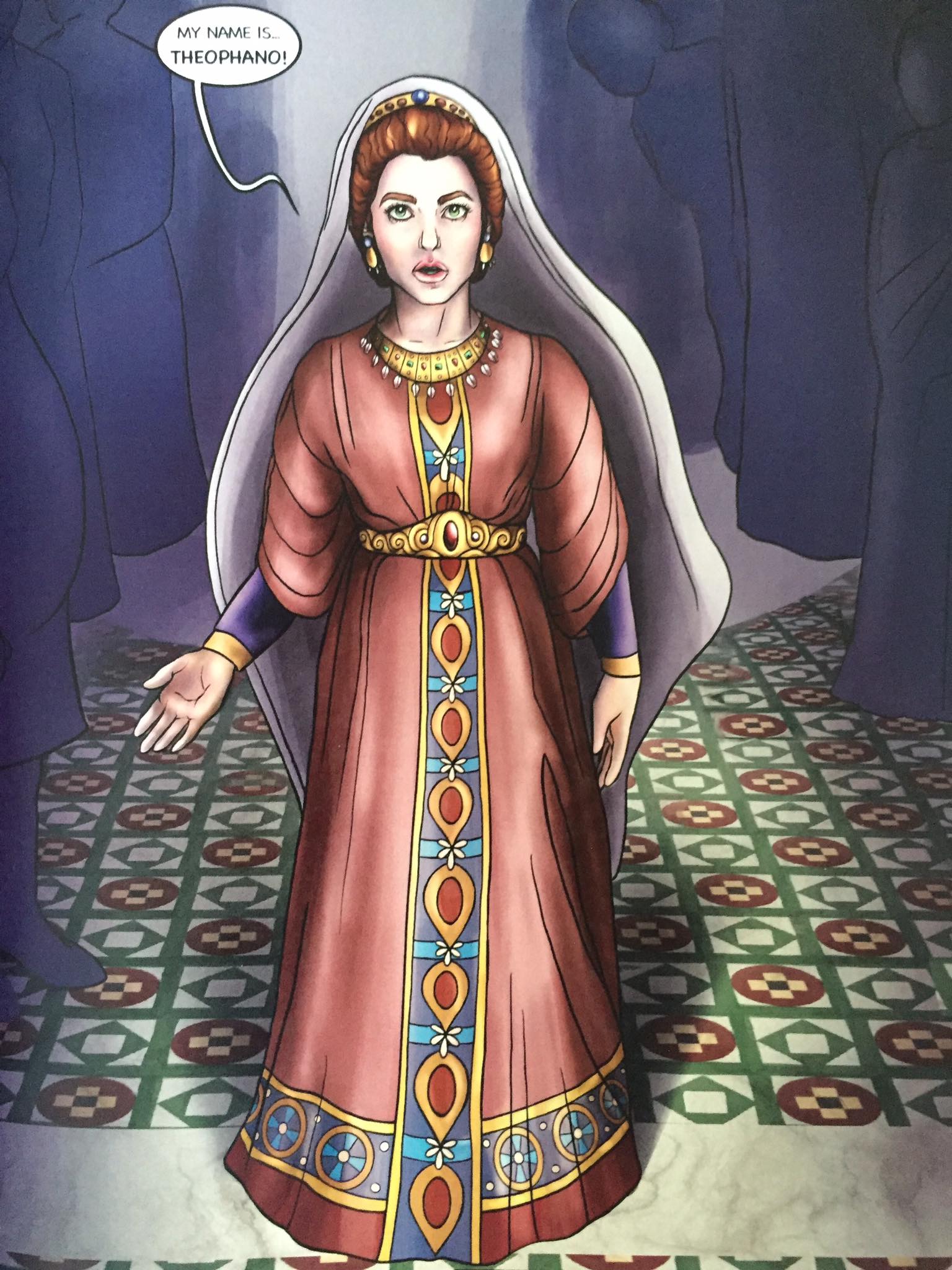
Welcome to the 7th chapter of the Byzantine Alternate History series by the Byzantium Blogger! Now before I begin this very lengthy article that will span more than a hundred years, I just have to say that I can’t believe I have now reached this far in my series basically being more than halfway through the 1,100-year history of Byzantium, truly a milestone indeed! Last time, in chapter VI of this 12-part series, I discussed a possible and highly popular what if scenario of the Byzantine empress Irene of Athens actually marrying the rising star of the time, the Frankish emperor Charlemagne in 802 which could have happened but never did. The previous story too talked about one large united Frankish-Roman Empire as a result of this said marriage that would be a European superpower like the Roman Empire of old and would be powerful enough to turn the tide against the Byzantine Empire’s two mortal enemies and greatest threats being the Arab Abbasid Caliphate in the east and the Bulgarian Empire in the north. Though this marriage would have been necessary only in reversing all of the Byzantines’ economic and military setbacks in the short-term, but in the long-term this union of both Byzantine (Eastern Roman) and Carolingian Frankish Empires would only be rather confusing as both halves of the empire (eastern and western) were of different cultures and religions to put it short, and the succession system would be even more complicated. Now since the alternate history scenarios featured per chapter in this series do not continue with each other, the said fictional marriage from the last chapter and the union of the two empires would not continue here, and again as each story in this series is a stand-alone, this chapter would again begin discussing real historical events which will have a twist as it progresses. True enough, this marriage between Irene and Charlemagne was not that necessary in order to reverse all of Byzantium’s setbacks, as about a century after this marriage was supposed to happen, Byzantium was long done with its dystopian-like Dark Ages period that the past 3 chapters were set in, and was now in its second golden age- the first one being in the 6th century under Emperor Justinian I the Great (r. 527-565)- and now here out of Dark Ages, the Byzantine Empire as the 9th century ends became a cultural and military power in Eastern Europe and the Mediterranean, and together with the Frankish and Bulgarian Empires, one of the 3 major powers of early medieval Europe as a whole. For almost 3 centuries, the Byzantine Empire plunged into a dark age where the empire rapidly lost a great amount of territory and was under attack by enemies on all sides forcing them to fight for centuries on the defensive whether against the Arab powers from the east or the Bulgars from the north, but in the second half of the 9th century, things would all of a sudden change for the Byzantines. The turn of the tide for the Byzantines in the latter 9th century however did not come out of the blue, rather it mostly happened because of the luck of having good geography as in the east, the powerful Abbasid Caliphate being too large to govern started dissolving with its authority becoming decentralized into smaller states or Emirates, and in the west the same thing too happened to the powerful Carolingian Frankish Empire of Charlemagne as part of Frankish tradition was to divide the empire among a ruler’s successors, thus these situations would give an advantage for Byzantium in the middle to rise again. The 9th century would see the Byzantine Empire slowly rise again into a dominant world power, while the 10th century which would be this story’s main focus would see the Byzantine Empire literally in its second golden age of cultural and military power that other powers would grow to respect and fear it, but despite the great power and influence the Byzantines would gain here, they were still far from being an undefeatable force, as they would still face some military defeats to the Arabs and Bulgars while their imperial authority would still be challenged by the Western world again in a “Cold War” like situation. Now since this series features one chapter per century, this one would primarily be set in the 10th century with Byzantium again reaching its peak of power and influence, but between the previous chapter and this one, there will be a massive time jump as the last chapter was set in the very early part of the 9th century. Despite the massive time jump here of over 100 years, there will still be a lot mentioned about the 9th century in this story’s background as the 9th century had a very crucial role in Byzantine history especially in shaping the second golden age in the 10th century as the 9th century saw the Dark Ages of the Byzantine Empire end, as well as the pointless issue of Iconoclasm or the breaking of icons, the dissolution of the Abbasid Caliphate in the east which allowed the Byzantines to turn the tide of war to the offensive against them, the spread of Orthodox Christianity from Byzantium to the Balkans wherein the Bulgars would finally become Christian, and the rise of the most colorful dynasty in Byzantine history which was the Macedonian Dynasty founded by Basil I the Macedonian in 867 in a rather violent away, and again Basil I was another of the Byzantine emperors who came from humble origins who would go from a peasant, to a stable boy and wrestler, to a bodyguard, and finally become the sole emperor founding a dynasty that would last for over 200 years till the mid 11th century, but the big question is if this Macedonian Dynasty really existed as Basil I’s son and successor was Leo VI who continued the dynasty through his descendants was believed to not be his son but the son of the last emperor of the Amorian Dynasty Michael III who Basil killed, and this story now will exactly do that in discussing the possibility of the Macedonian Dynasty not really existing but in fact still being the Amorian Dynasty of the 9th century. This dynasty whether you would stick to it being the Macedonian or go with the possibility of it being the Amorian Dynasty continued would feature colorful rulers whether they were from the bloodline of Basil I or were powerful generals from the wealthy landed aristocracy that married into it, and these colorful characters of this powerful dynasty from the 9th to 10th centuries in chronological order would include its founder being a wrestler of low birth who became emperor, a serious scholar, a vengeful drunk, an unlikely admiral with a great ability in ruling, an intellectual snob obsessed with court rituals, a fun-loving party-boy, a highly skilled but ruthless general without much political and diplomatic skills, and an overall perfect mix of a soldier and diplomat emperor. The 10th century then would be forever remembered for these characters but also because it was very action-packed and featured a lot of the political struggles and extravagance Byzantium would be remembered for and henceforth the word “byzantine” meaning complicated. At the same time, I also have to admit that the 10th century under the Macedonian Dynasty is my favorite period in Byzantine history and was the particular period that got me so into Byzantine history. This period too is one of the most popular- next of course to Justinian I’s reign in the 6th century- in the history of Byzantium that recently, a graphic novel Theophano: Byzantine Tale, which I also made an article about before, was set in this era with its lead character being Empress Theophano who shares the story’s title name, and Theophano too was one of the major players of the 10th century Byzantine golden age who comes in the middle and latter part of the century being as the novel suggested a woman of low birth who married into the imperial family first to the fun-loving party-boy emperor mentioned above which was Romanos II (r. 959-963) who was from the direct bloodline of the Macedonian (Amorian) Dynasty, and afterwards following his sudden death she would be married to the highly skilled but ruthless general mentioned above which was Nikephoros II Phokas (r. 963-969) who after marrying Theophano would become emperor. Basically, no matter how small Theophano’s part in the bigger picture would look like, she did indeed play a major role in continuing the Macedonian Dynasty by giving birth to two sons who would be emperors later on being Basil II (r. 976-1025) and Constantine VIII (r. 1025-1028), and it was Theophano who also served as a link between all the influential people of this era, while at the same time being an ambitious woman which was something quite unheard of then, she also gets some bad reputation as a seductress and murderer that the poisoning and death of her father-in-law Constantine VII in 959 and of her husband Romanos II in 963, and also for plotting the successful assassination of her second husband Nikephoros II in 969 are all attributed to her. The big twist for this story then would be in its latter half, where if Theophano who in real history only came into the imperial family by chance never got the chance to do so, how different would the history of Byzantium in the 10th century be if Theophano simply did not come into the picture and just lived a simple life away from the politics of the imperial family?     
95t3yr5xvfyy
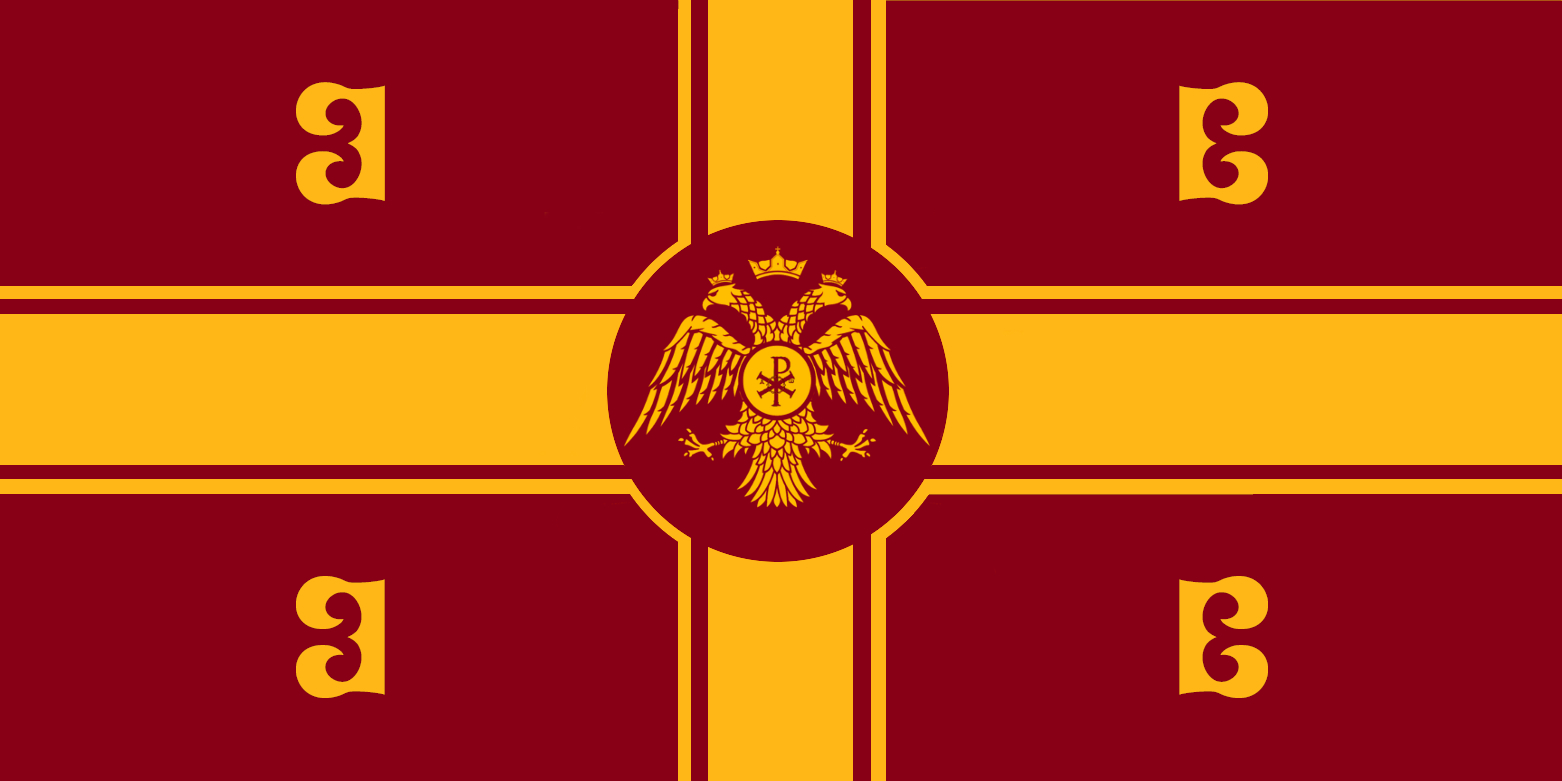
Flag of the Byzantine Empire

Follow me, the Byzantium Blogger on Social Media:

Instagram: @byzantine_time_traveller

Facebook: Byzantine Time Traveller

Youtube: No Budget Films

Twitter: @ByzantineTime

Deviantart: Byzantium-blogger55

Art Station: Powee Celdran Porphyrogennetos

Patreon: Byzantine Time Traveller

Note: Since this story is set in the 9th and 10th centuries after the fall of the Western Roman Empire, the Byzantine characters will be referred to as Byzantines, not Romans.  
78280655_124846375627221_139711283229360128_n
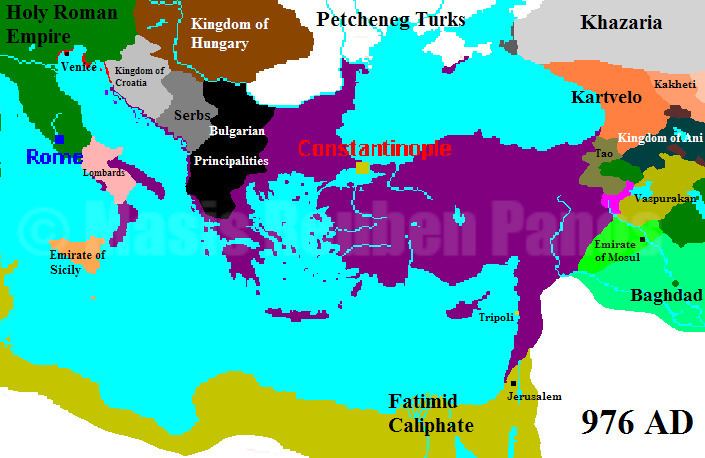
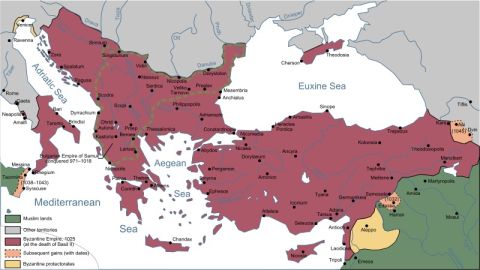
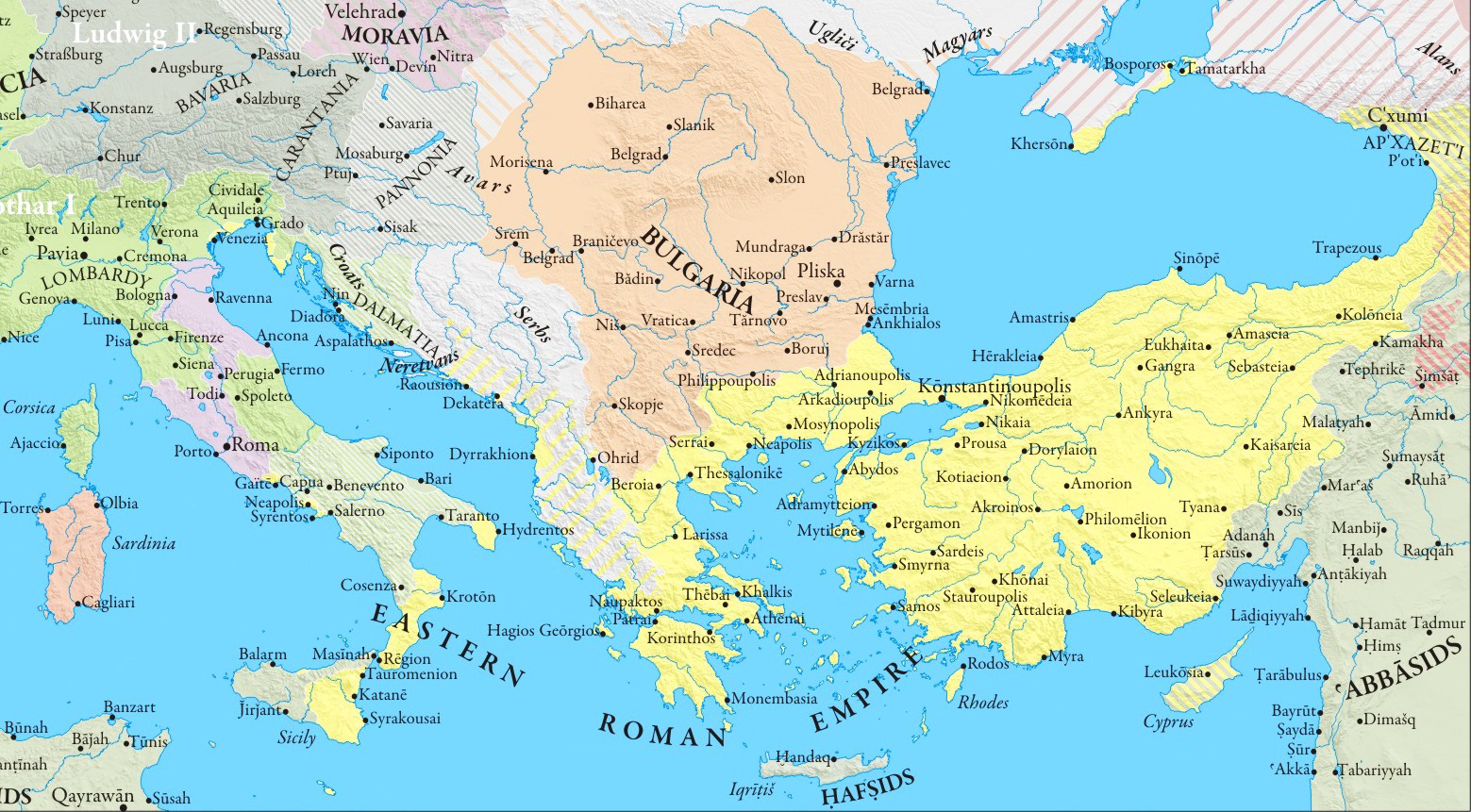
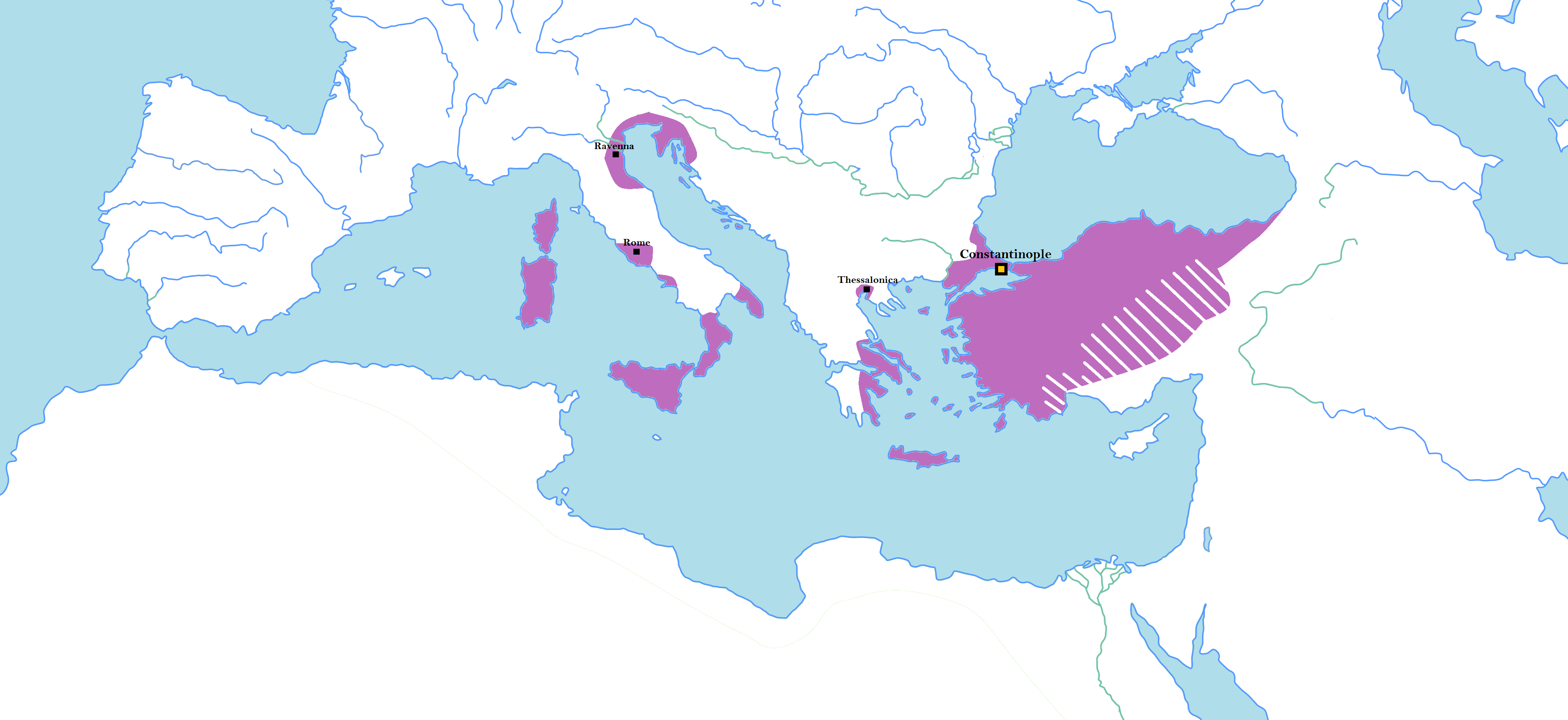
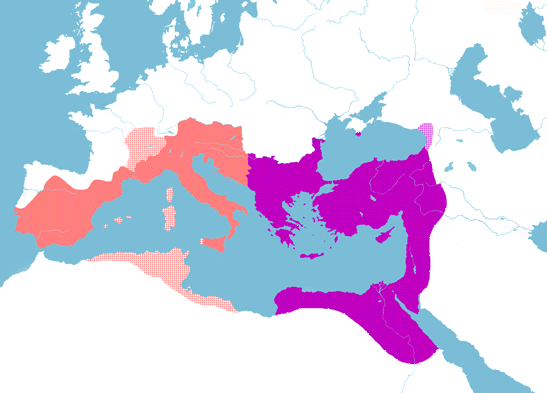
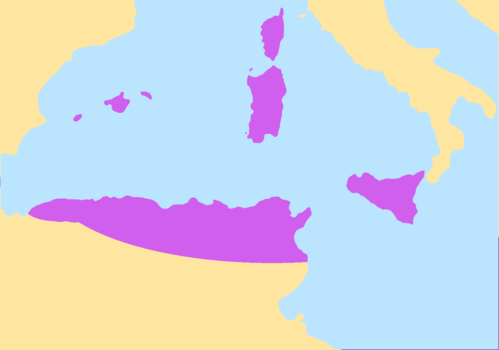
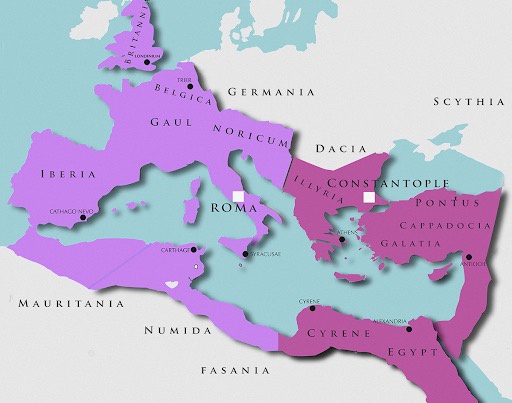
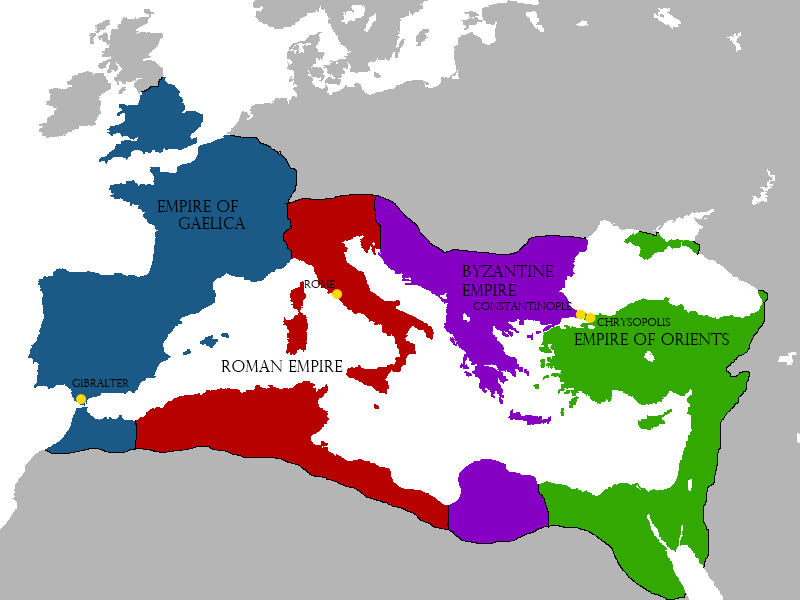
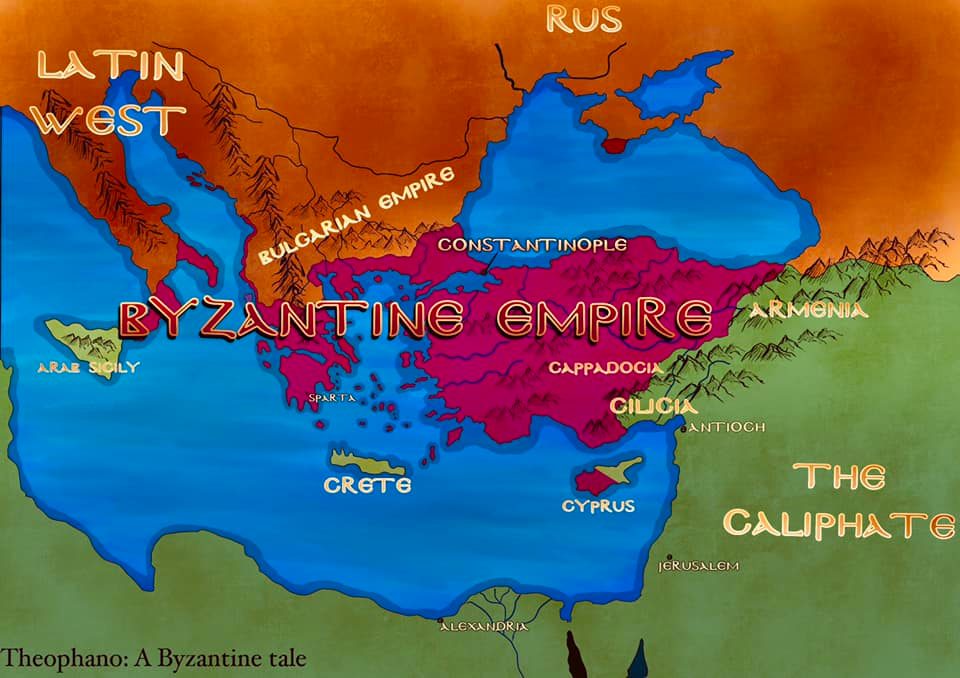
Map of the 10th century Byzantine Empire (purple), from Byzantine Tales

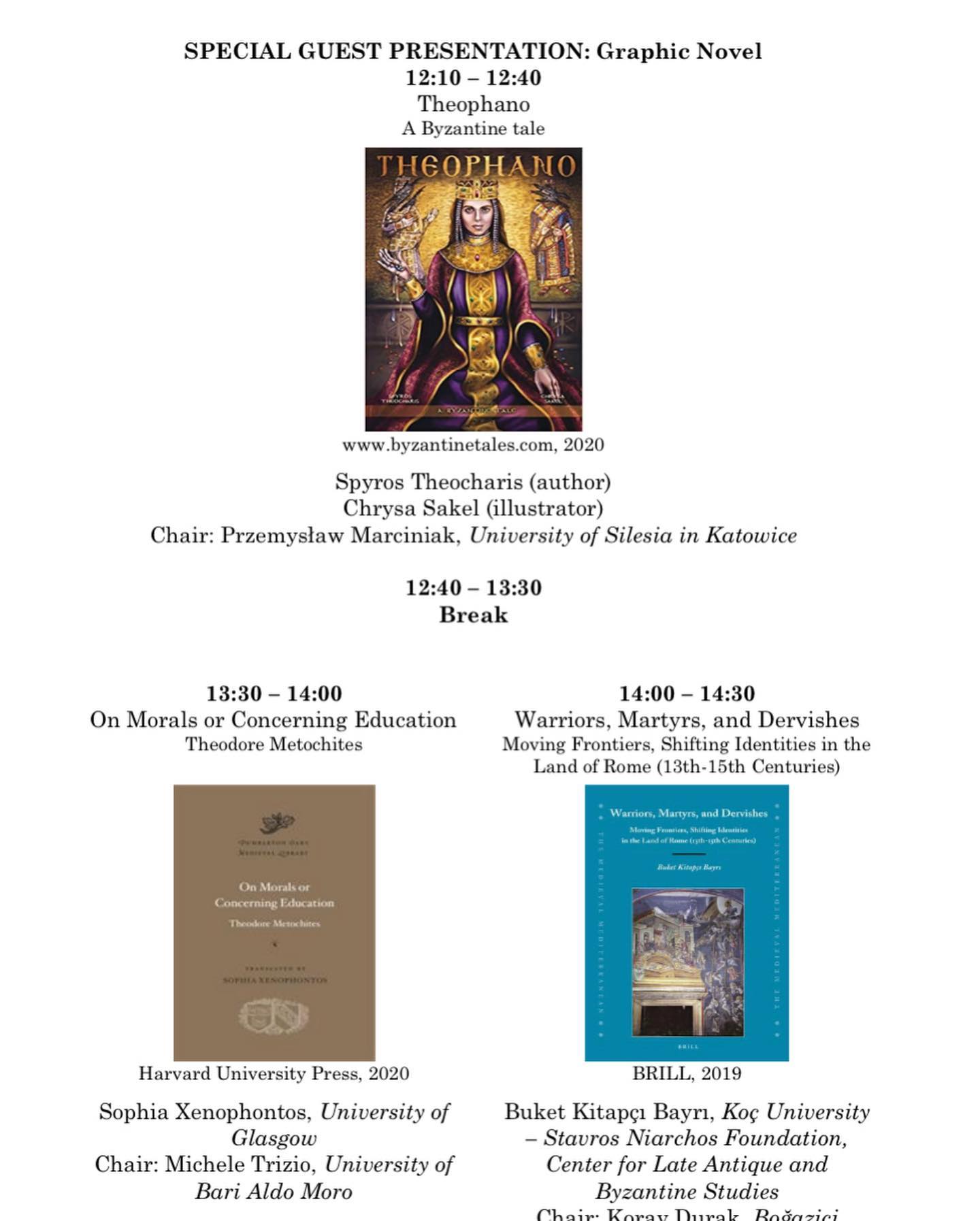
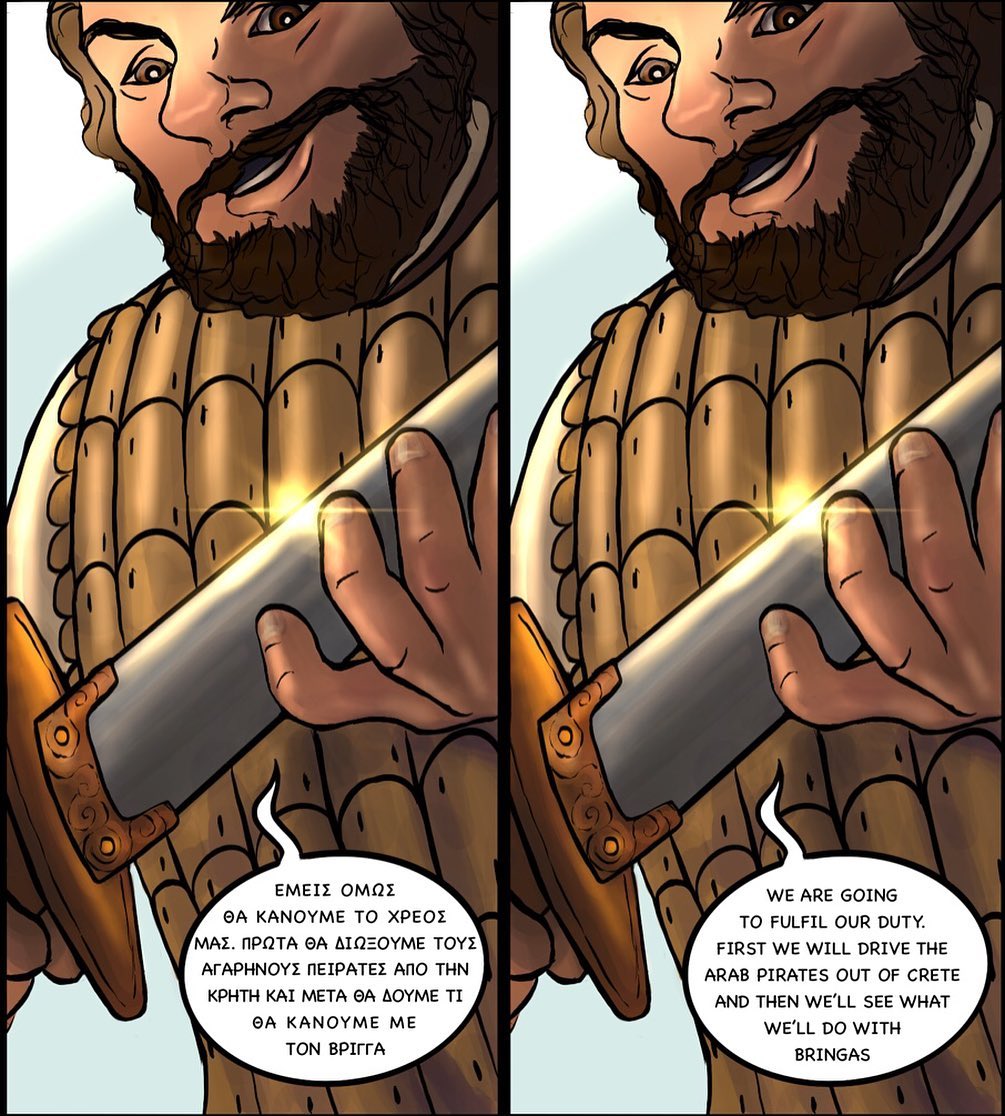
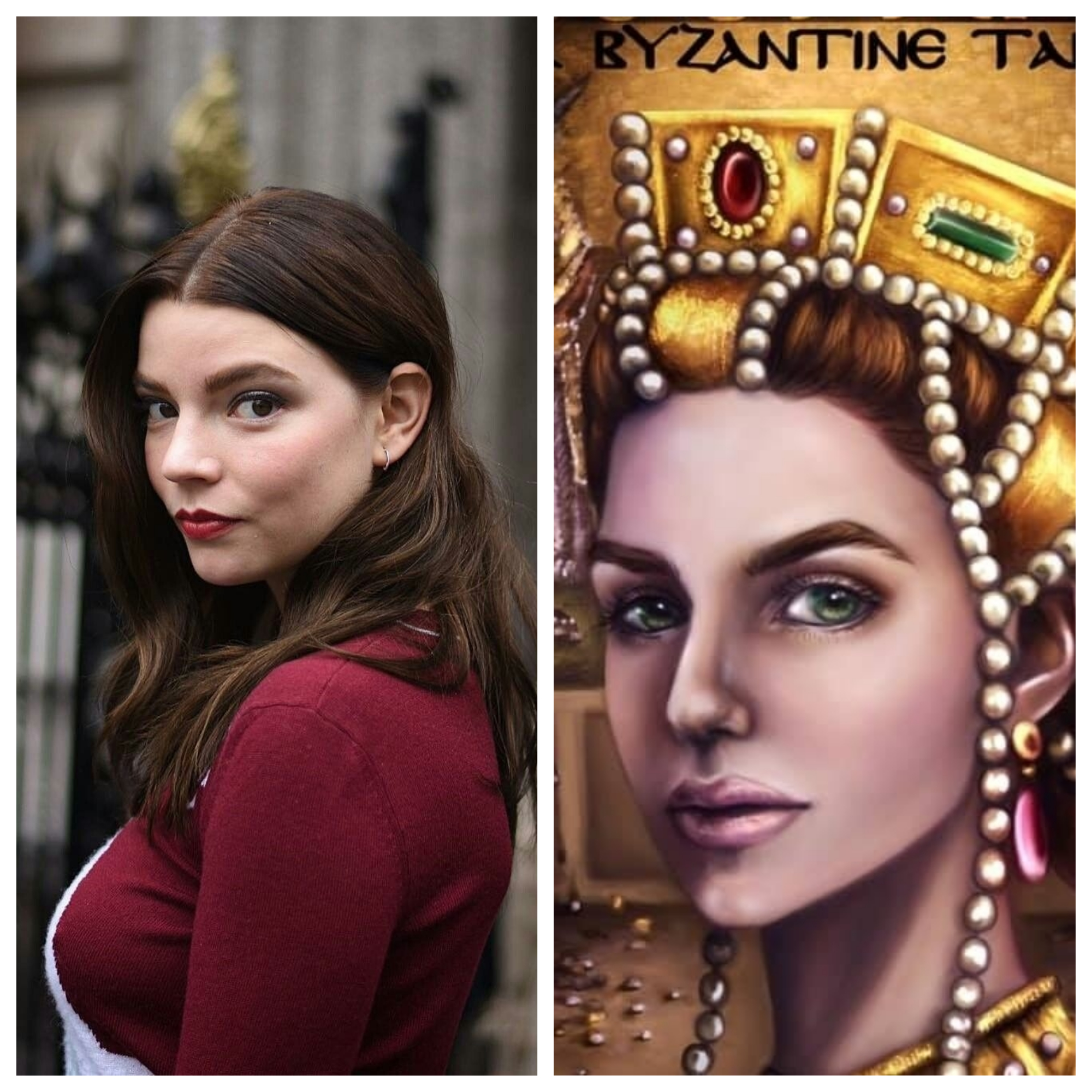
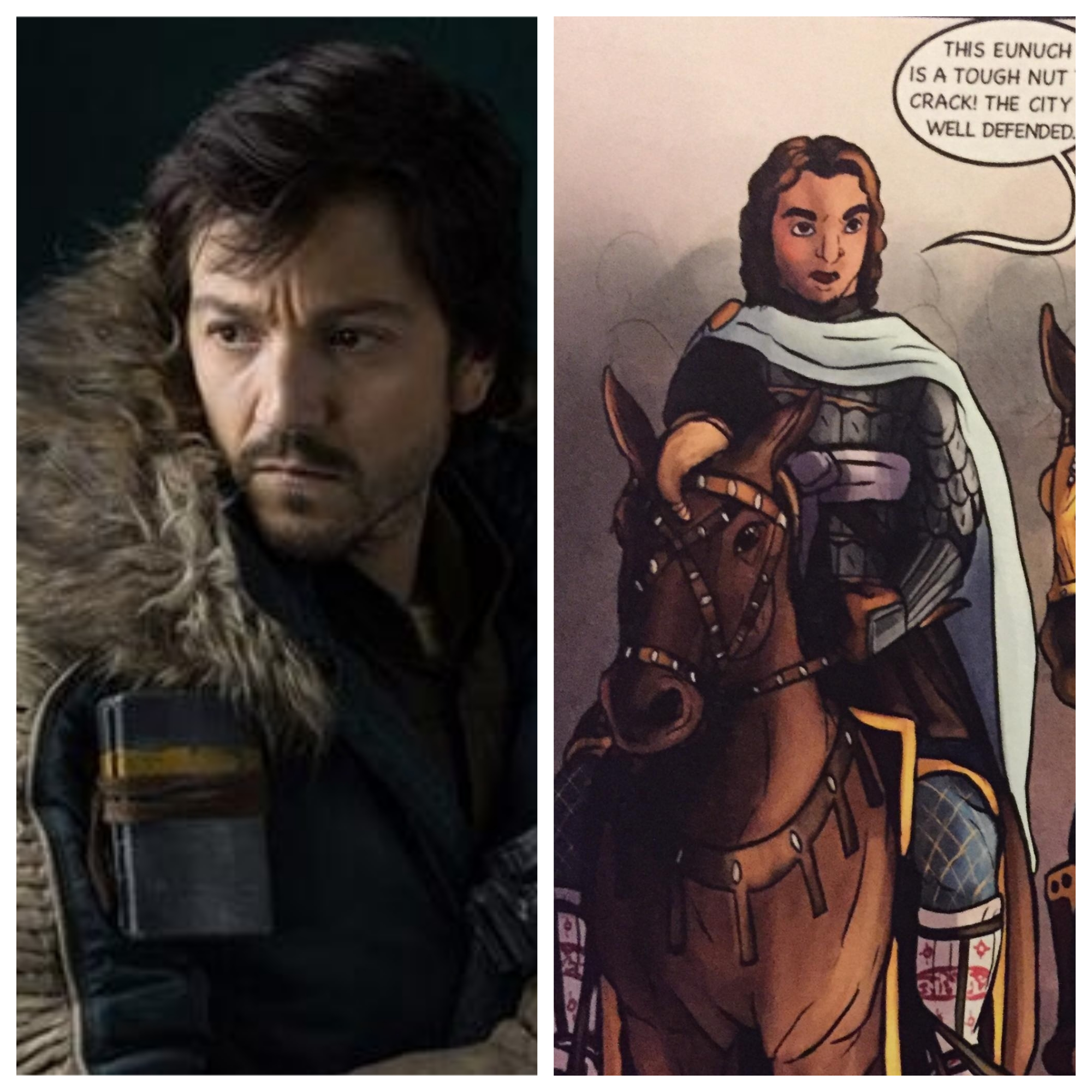
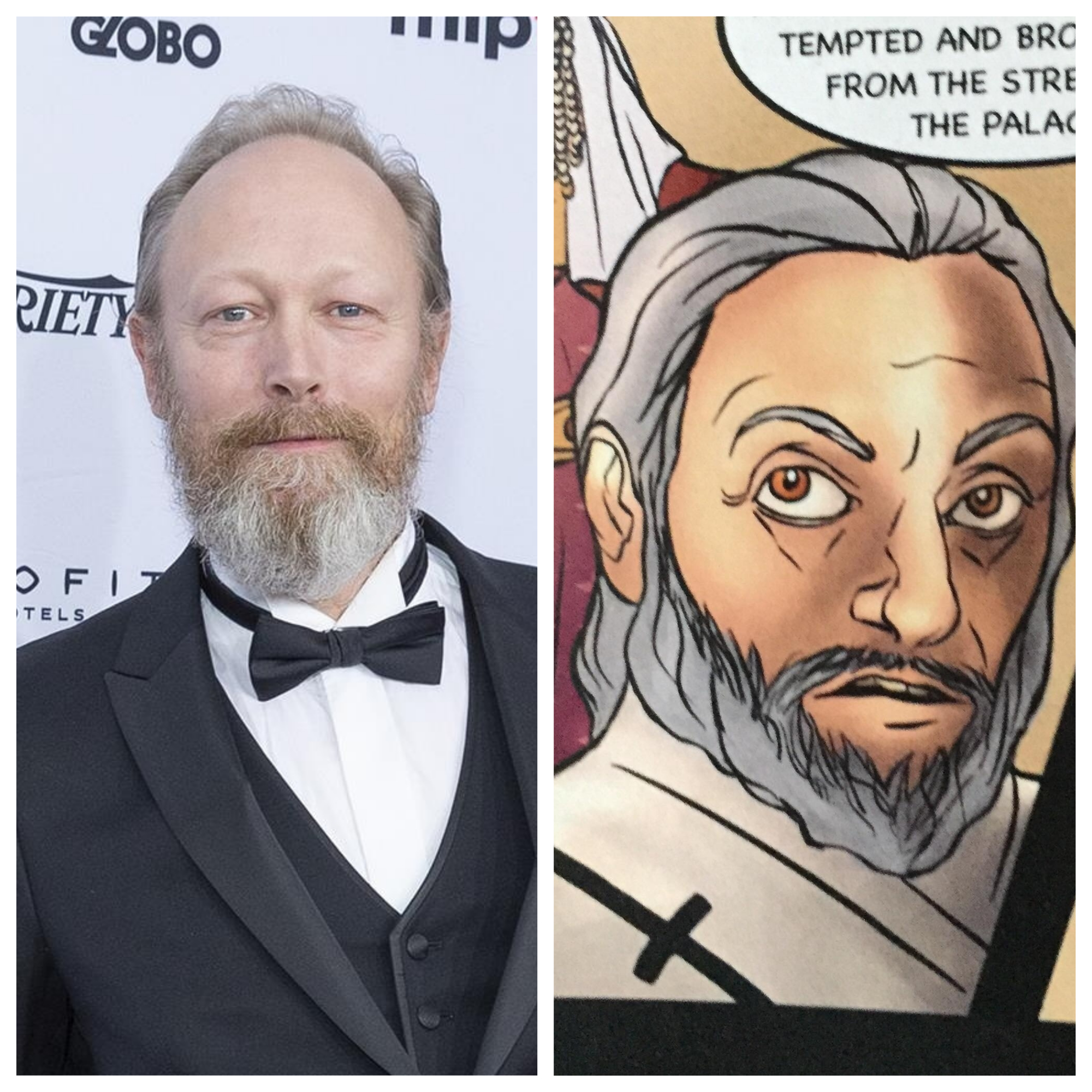
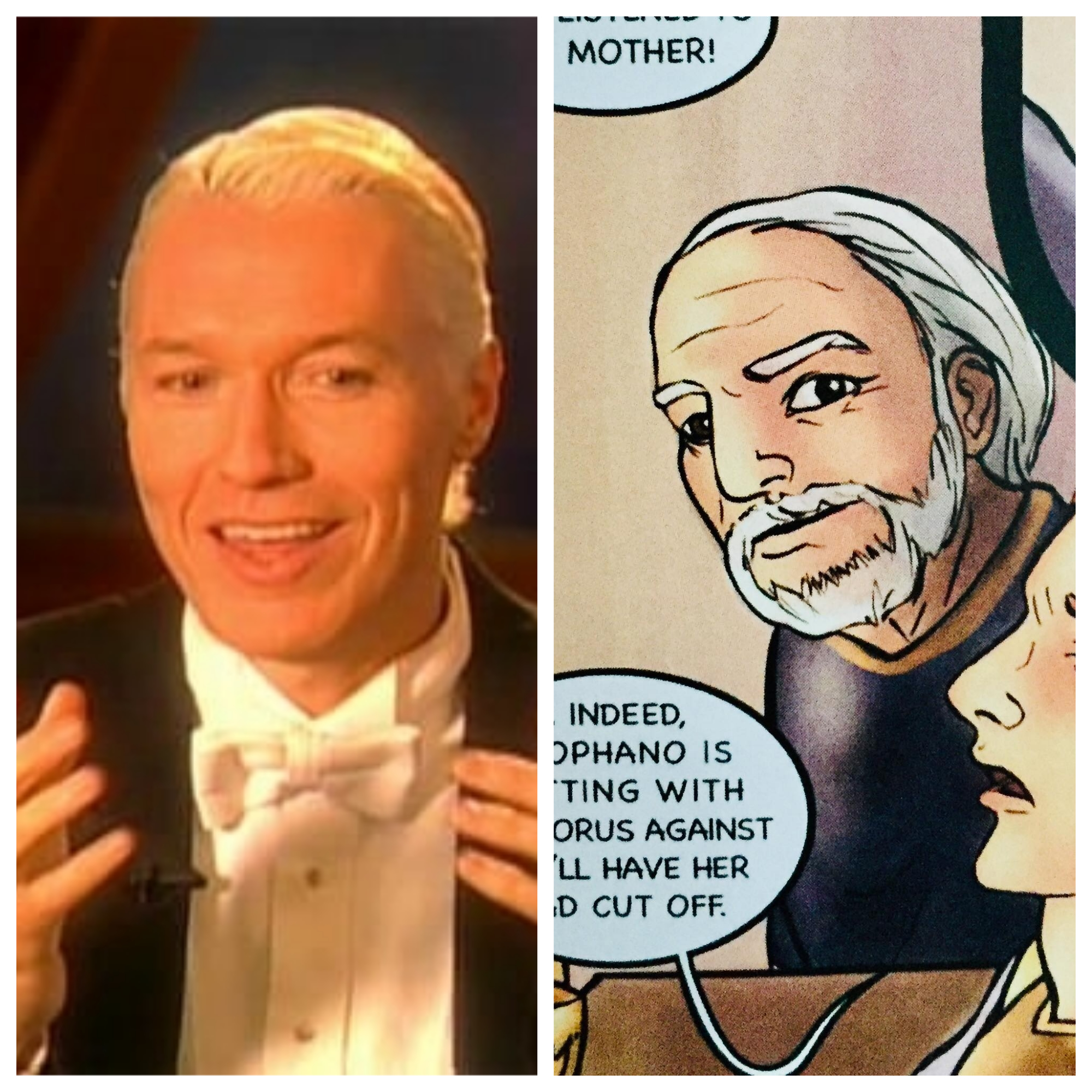
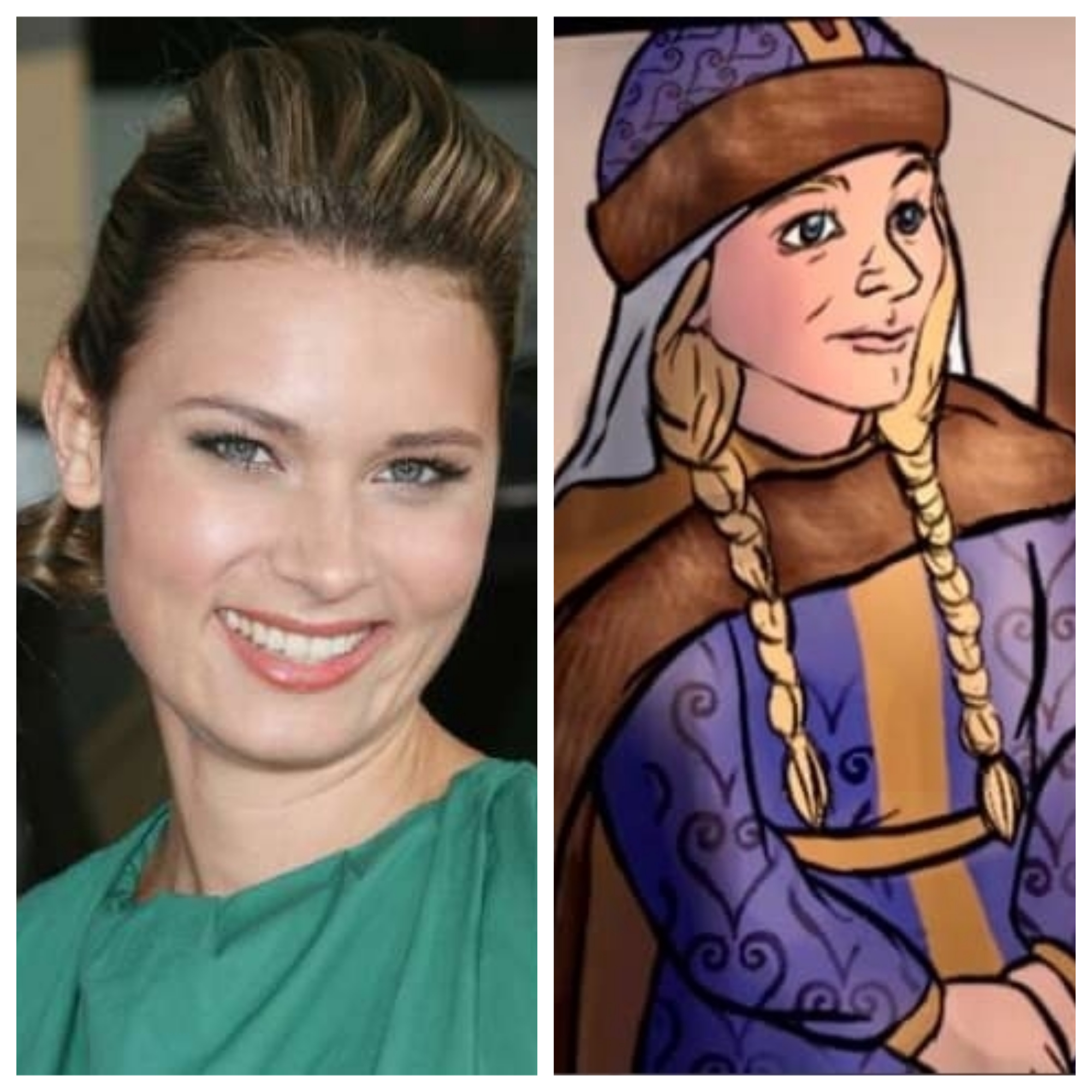
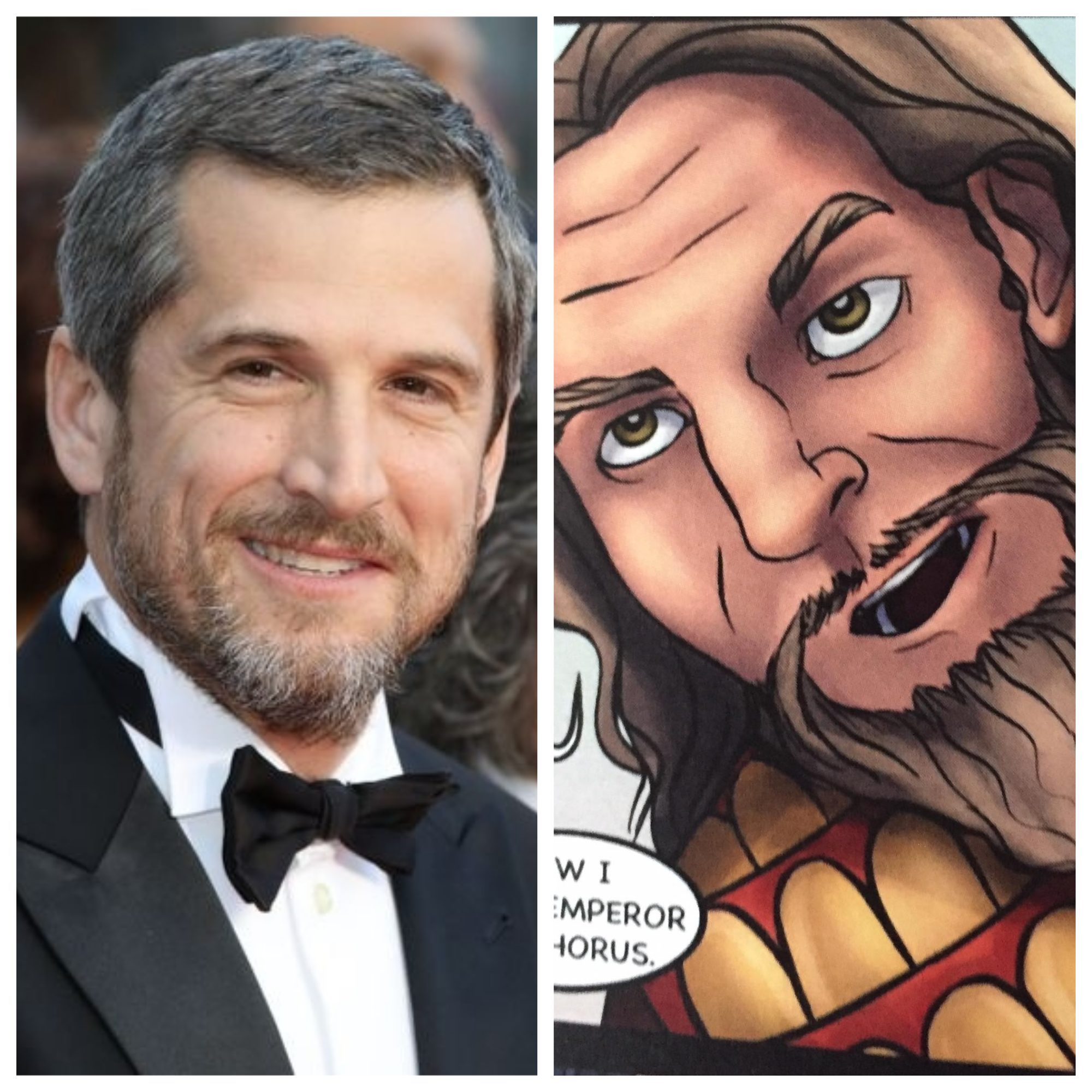
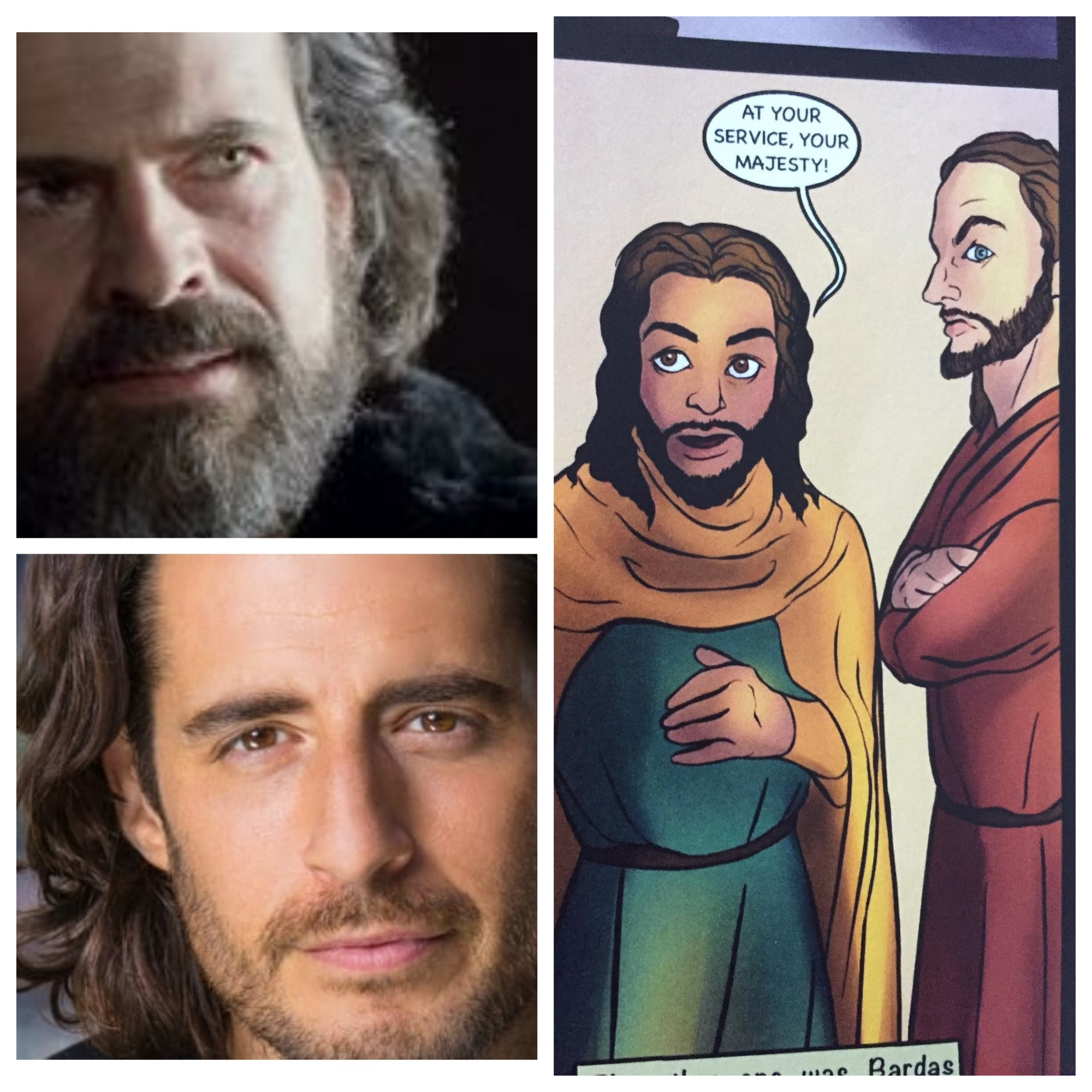
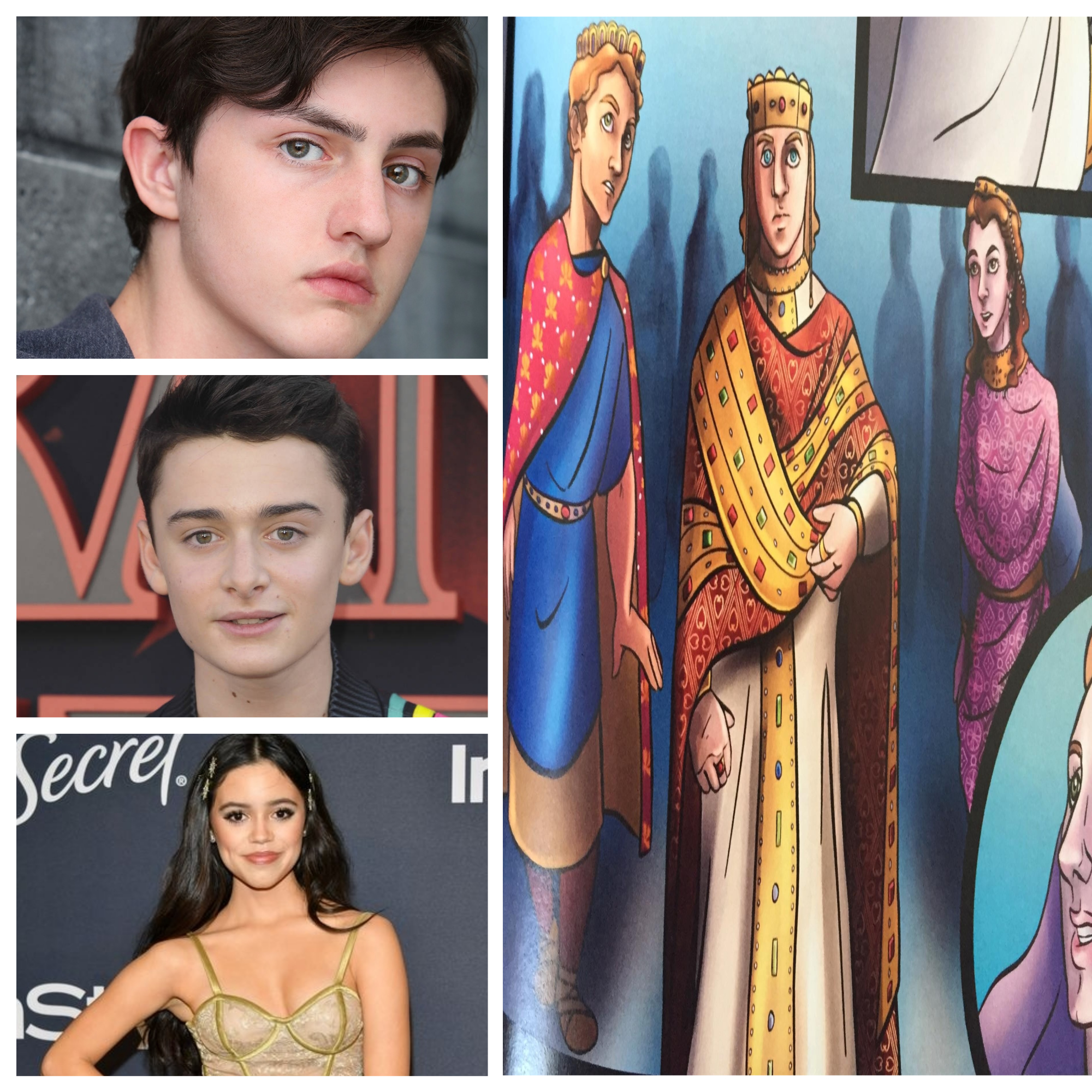
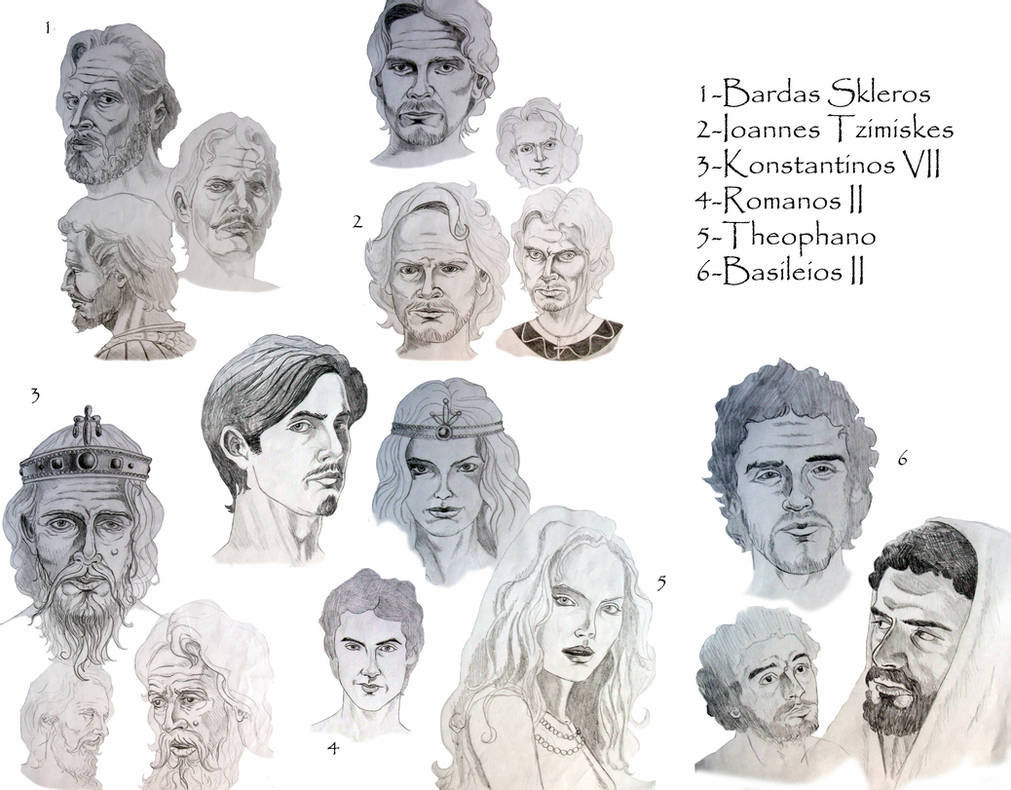
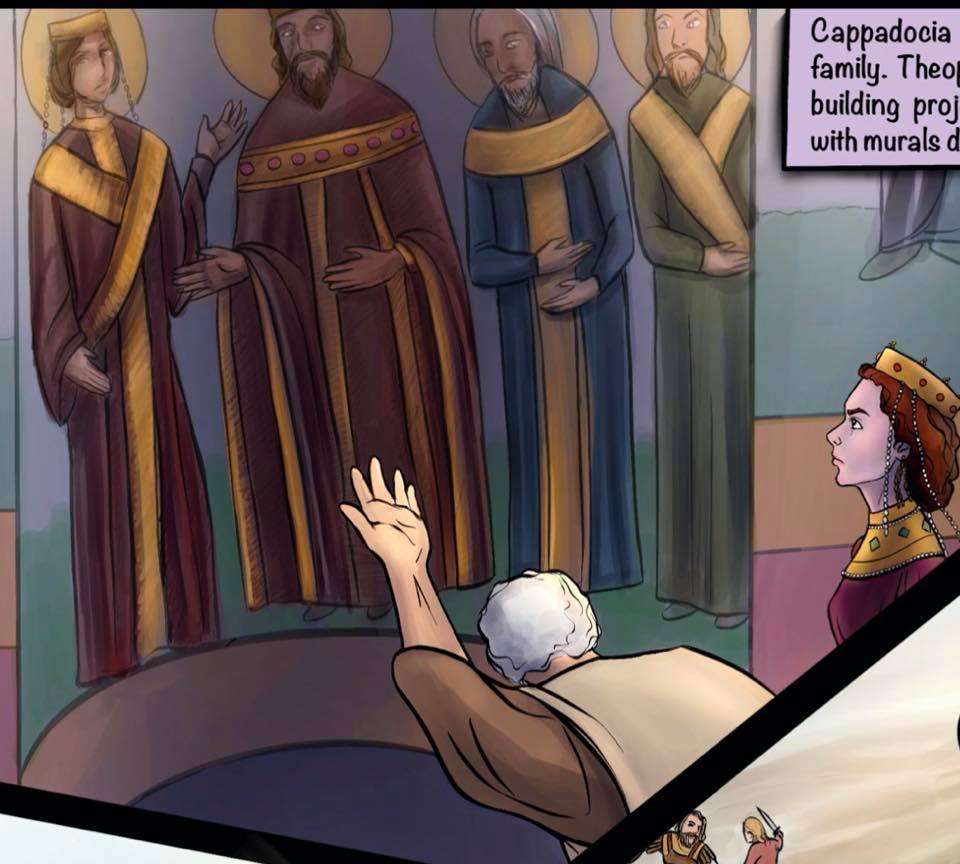
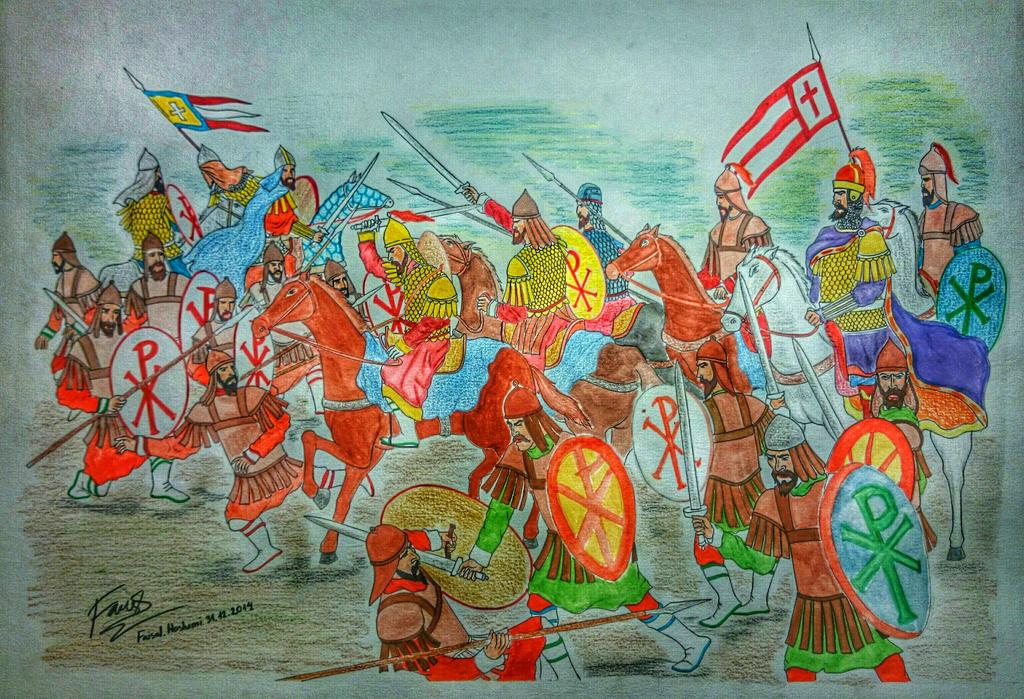
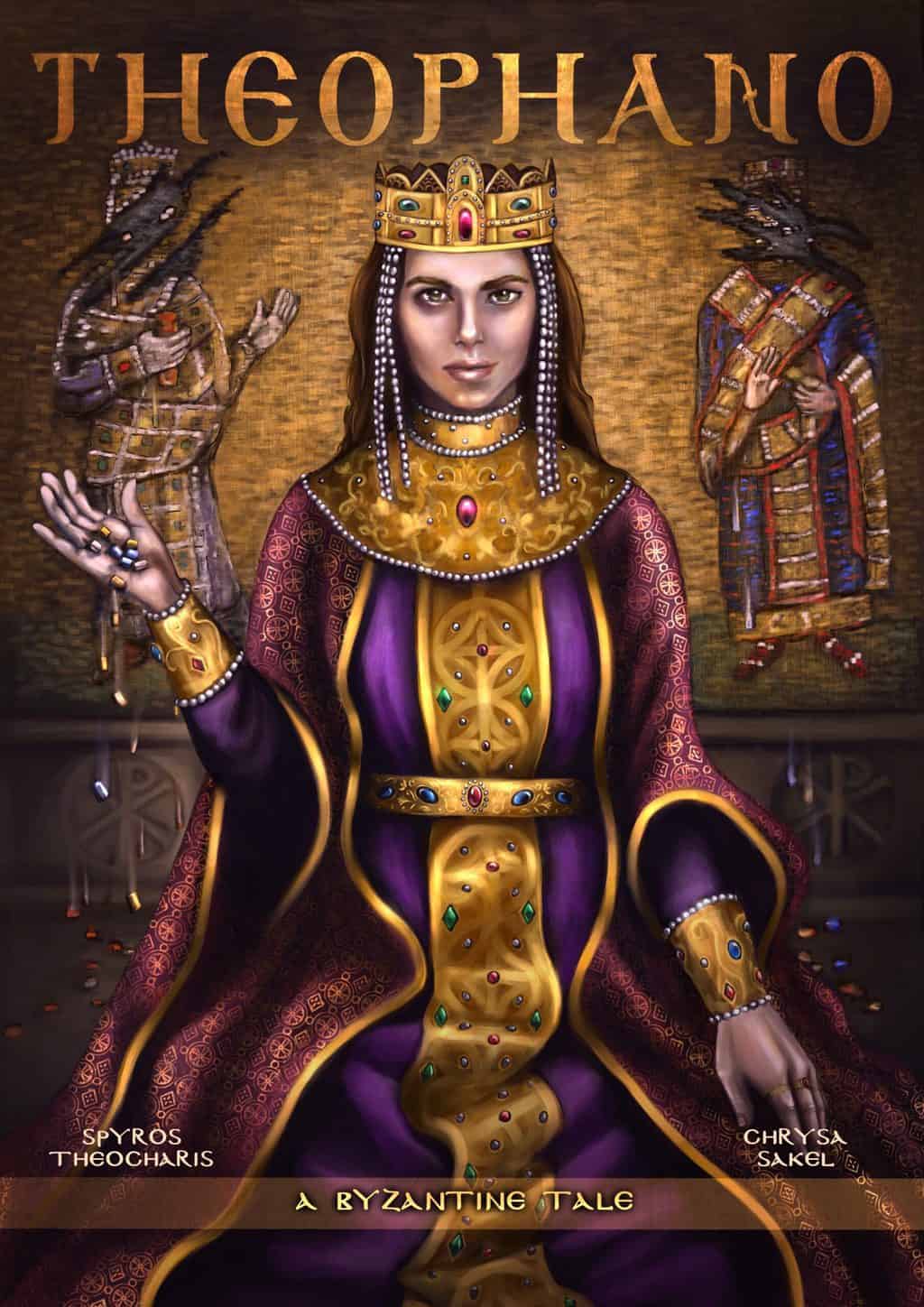
For this story, I am back again to basically writing it alone except that the major inspiration for this story’s alternate history plot is from the recent Byzantine era graphic novel Theophano: A Byzantine Tale (Instagram: @byzantine_tales/ Facebook: Byzantine Tales) by Spyros Theocharis (Instagram: @spyrosem) which I read very early this year and highly enjoyed that I even made an article reviewing the novel which included a fan casting for the Byzantine era characters for a potential film and a historical analysis of it, which I made before I even began doing this Byzantine Alternate History series.
IMG_2218-scaled
Theophano: A Byzantine Tale graphic novel

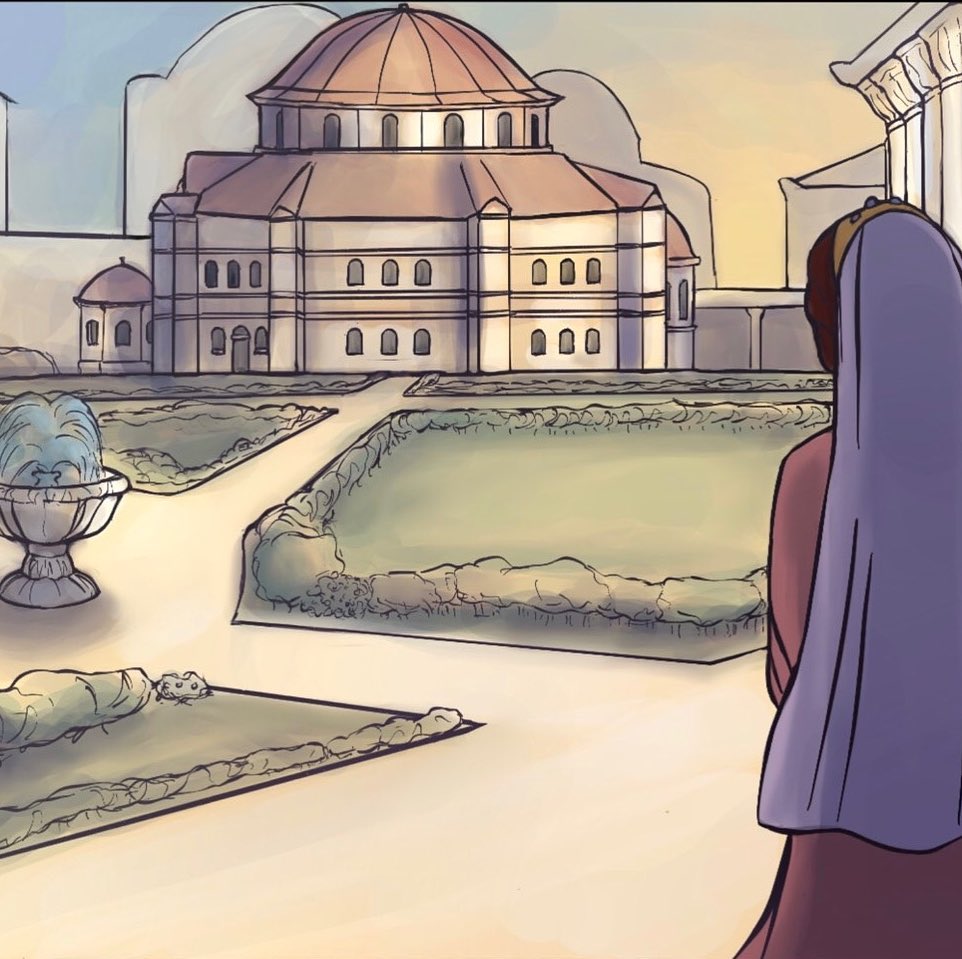
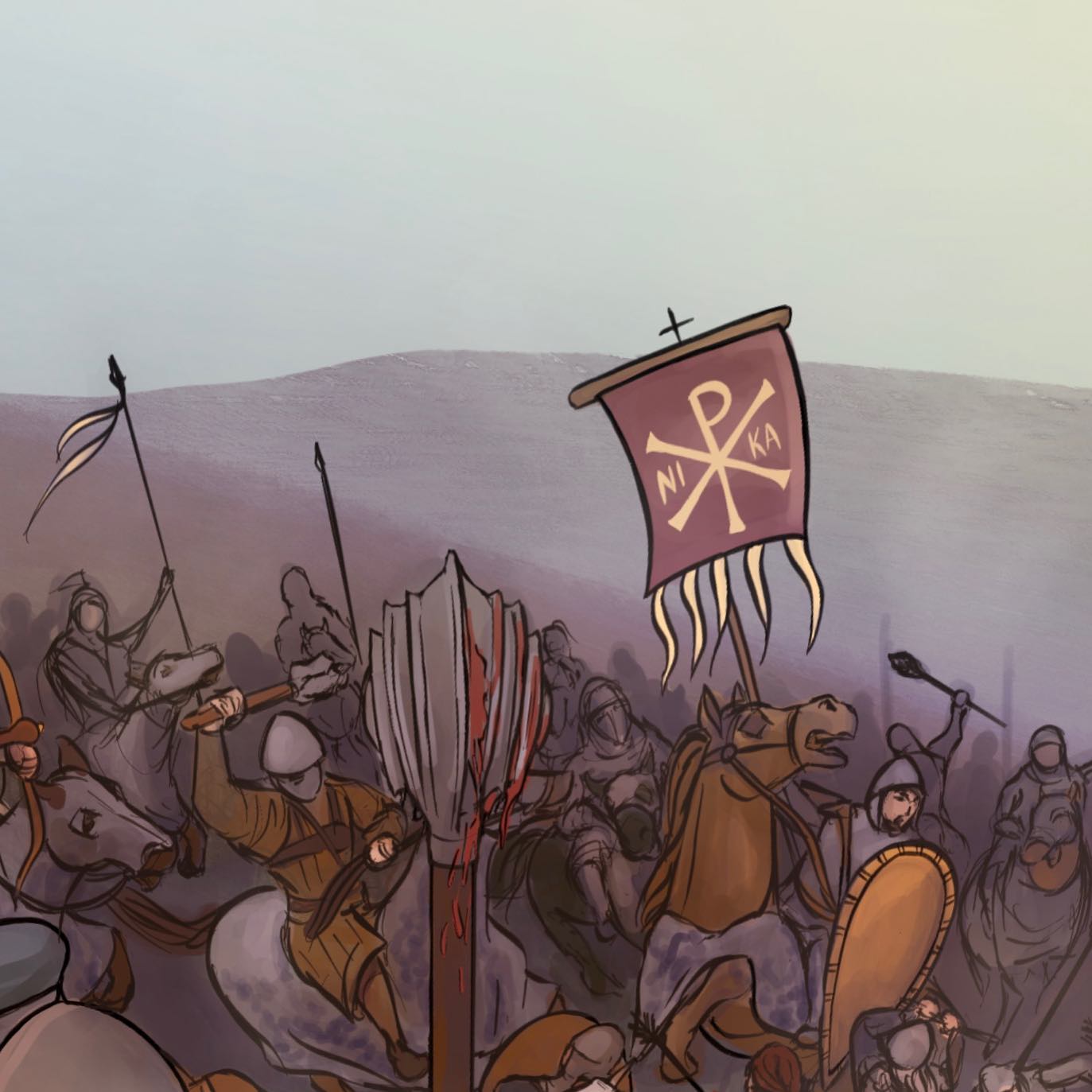
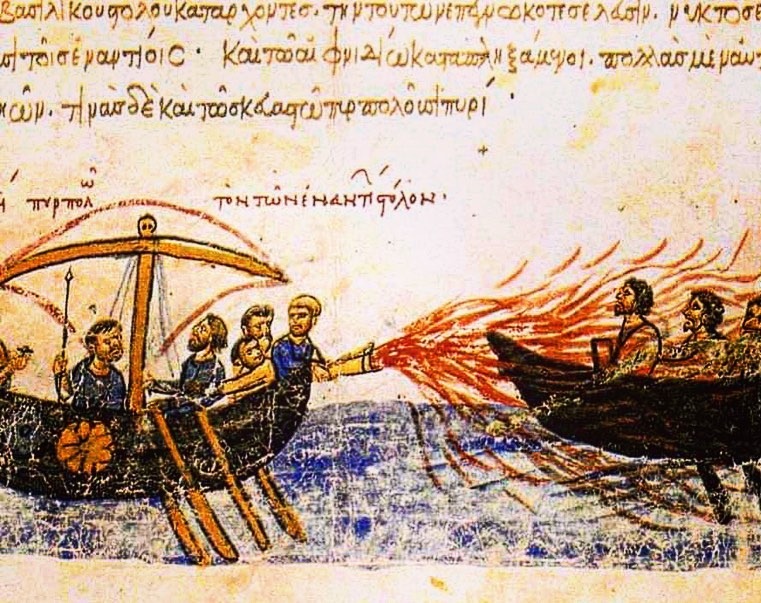
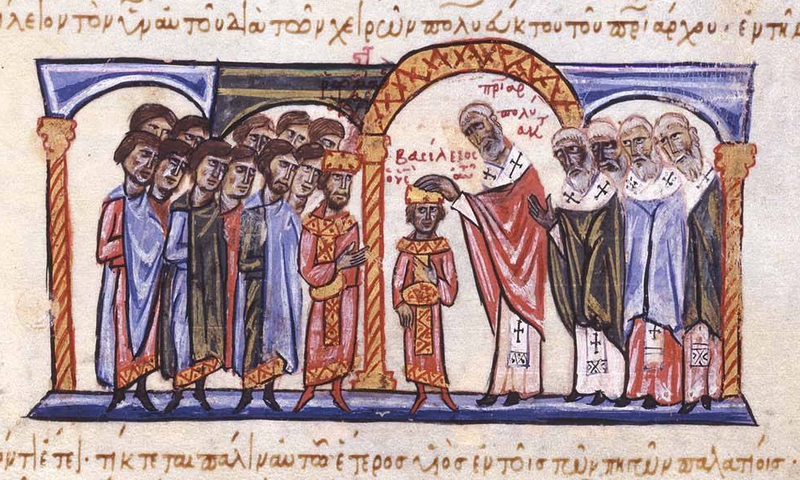
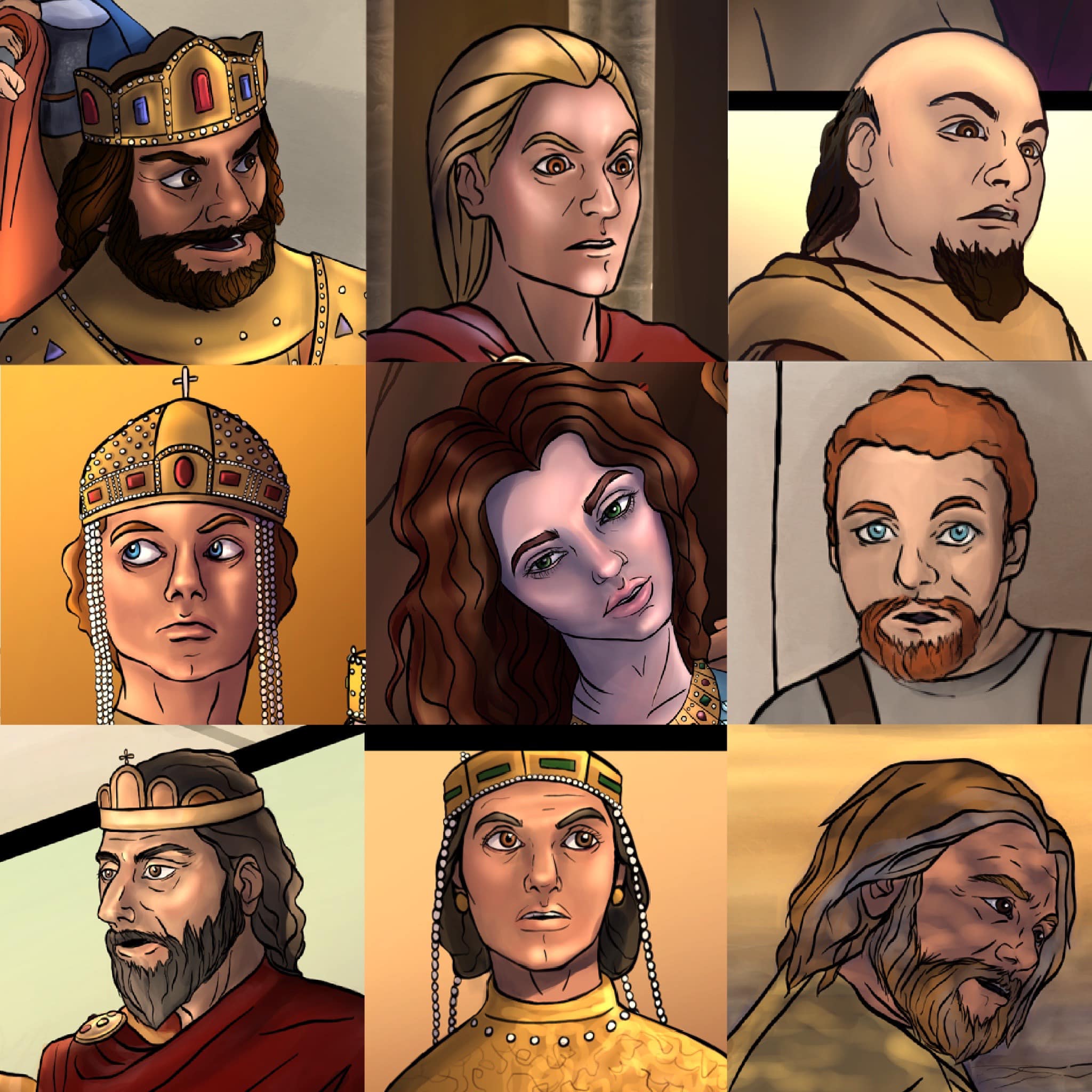
Now don’t get me wrong here as I did indeed totally enjoy the graphic novel and its plot, and because I enjoyed it and it has intrigued me a lot, I ended up involving its plot into my fan fiction series except without its lead character Theophano for the sake of experimenting which I usually do in this series, and for me this was also what I thought would be the best alternate history topic to feature for the 10th century. For those who do not know about this novel and want to know more about the real history of 10th century Byzantium, you can check their website linked here and order a copy of it, but for those who already know the story and want to see a different side of it without its lead character, this story here being chapter VII of my Byzantine Alternate History series will be exactly that. As I mentioned earlier, the Macedonian Dynasty era or Byzantine Renaissance from 867 to the end of the 10th century is my favorite era in all of Byzantine history as it was also the first era in Byzantine history that I read about 2 years ago which then suddenly got me so passionate about Byzantium, and although I already knew about Byzantium before by learning about Justinian I’s era in school, it was this particular period of Byzantium’s second golden age which I discovered by myself that got me so into Byzantine history, therefore this story that I am writing here will be an extra special one for me. The Theophano graphic novel too was a very great story basically because it was set in my favorite timeline in Byzantine history featuring some of Byzantium’s most colorful historical figures and intrigues coming to life, though despite Theophano taken out the picture thus altering the course of the said graphic novel’s plot, the well-made illustrations for the novel by Chrysa Sakel (Instagram: @chrysasakel) would still appear here as a visual guide to 10th century Byzantium and so would be the valuable primary visual source of this era the Madrid Skylitzes in which these illustrations would frequently appear here as well as its counterpart the Russian Primary Chronicle, and so would the artworks from various artists I know online that create Byzantine fan art including Ediacar, Amelianvs, Spatharokandidatos, Akitku, HistoryGold777, Ancientcitylullaby, FaisalHashemi, Marwan Musa, Oznerol-1516, and Justinianusthegreat. Now back to this story’s style, it will be very much like chapter III of this series which focused on Justinian I’s reign in terms of storytelling as like chapter III, this one will go with the flow of real history meaning that there would not be so much side stories, or more personal touches, or entirely fictional or highly embellished scenarios as the other chapters did, rather this chapter would be straight to the point sticking to historical events going in the same flow as they did in reality for the sake of conveniency as this chapter will cover more than a hundred years of story, but along the way there will be a number of changes to the narrative and the most significant one first being the Macedonian Dynasty actually being the Amorian Dynasty continued, and again in the latter half of this story when the character of Theophano herself is removed from the plot. In real history, Theophano came into the imperial family by chance when Romanos II as the imperial heir to his father Constantine VII chose her to be his wife, though it is still speculated whether Theophano (originally Anastaso) was simply a commoner from Greece and a daughter of an innkeeper who was rumored for her exceptional beauty that the imperial heir Romanos chose her to be his wife or that she came from a minor noble family, but the graphic novel goes with the first theory, and when married she gets herself involved in the toxic schemes of the imperial court. This story however will have a different take on Theophano by making it seem like she did not exist at all, and so the big plot twist here would be that Romanos II simply never heard about her, therefore he would never marry, but the rest of the story will simply follow the events of real history which means Romanos II like in reality would die in 963 very young after only 4 years in power and would still be succeeded by the Nikephoros II Phokas as emperor, except here he would not marry Theophano as she wouldn’t even be around and like in real history he would still be assassinated in 969 by his general John Tzimiskes wherein this story would end. At first, it may seem like Theophano did not really have any significant role, but later on she would as her son Basil II would become the sole emperor of Byzantium following the death of John I Tzimiskes in 976 and as emperor, Basil II would begin with a rough start but at the end would achieve the impossible of conquering the entire Bulgarian Empire thus becoming one of Byzantium’s greatest conquering emperors known as “Basil II the Bulgar-Slayer” making the Byzantine Empire be once again at its greatest extent of territory, but this would only be achieved in the next century. Since this story’s main plotline is only limited to the 10th century, while it was only in the early 11th century in real history when Byzantium reached its peak of power and influence covering a vast amount of territory again after the conquest of the entire Balkans, this story will squeeze in the full Byzantine conquest of the Bulgarian Empire into the 10th century before it ends as a way to give this chapter a dramatic conclusion, and therefore this means that Basil II was not really necessary for the conquest of Bulgaria as any other competent soldier emperor could have done it too, therefore I would also say Theophano’s part was not really of any significance considering her being Basil II’s mother. On the other hand, there was a lot of research put into this story and rewriting the course of Byzantine history, and I would have to thank the Youtube channels that feature Byzantine history in detail which are as usual Kings and Generals, Eastern Roman History, History Time, and Thersites the Historian, and of course my ultimate source the highly comprehensive History of Byzantium Podcast by Robin Pierson, and at the same time my Lego films from my channel No Budget Films set in this era will be featured here as well.  
Screenshot (865)
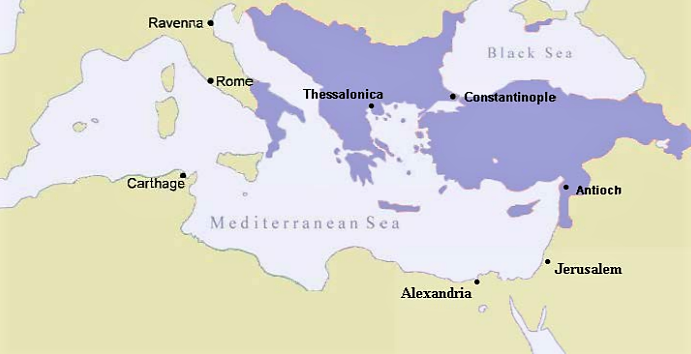
Map of the Byzantine Empire (purple) at its medieval apogee, beginning of the 11th century

Watch this video below to learn more about the Byzantine emperors from the Macedonian Dynasty (from Hellenic History Series).


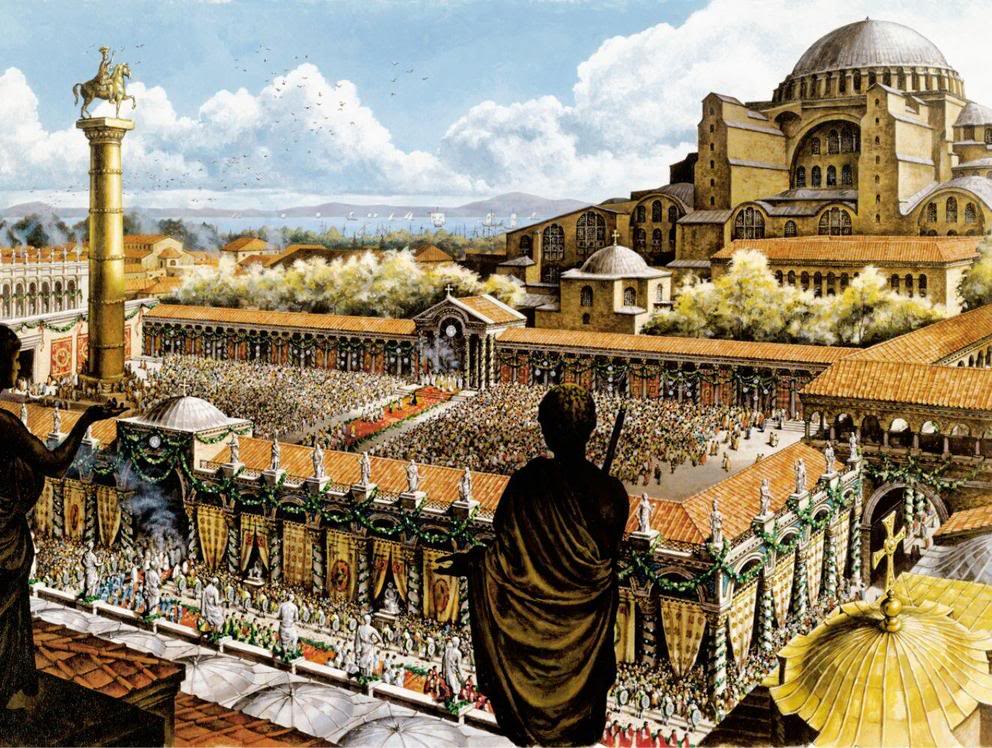
Before beginning the main part of the story itself, there is still some more I have to say about why the 10th century under the Macedonian Dynasty is my favorite period in the history of Byzantium, and this is not only because it is fascinating with colorful characters and that it was the first part of Byzantine history that I fully read about which got me into it, but it is rather also because it was THE century of the Byzantine Empire. Now what I meant about the 10th century being “the century” of Byzantium is that it was the century Byzantium would be remembered for, or basically its golden age the same way the Renaissance in the 15th century was for Italy, the 16th century for Spain, the era of Napoleon in the early 19th century for France, and the Victorian Era and Industrial Revolution in the 19th century for England which means for Byzantium it was its most eventful era, not necessarily meaning everything went their way but rather so much had happened with so many colorful characters and events, therefore making this era known as the “Byzantine Renaissance”, though on the other hand this era too happens to be quite insider being mostly only known to Byzantine history enthusiasts. For Byzantium, the 6th century under Justinian I the Great could also be considered Byzantium’s great moment, but then it did not last that long and it was also only under one emperor, and on the other hand, Byzantium was still a Roman superpower unlike here in this chapter set in the 10th century, the eventful era for the empire was not under just one emperor but a whole dynasty of colorful rulers and here too Byzantium was growing into its height of power and influence as a culturally and linguistically Greek empire in the Middle Ages but of course still the Roman Empire (Basileia ton Rhomaion in Greek) in name. This chapter will exactly show how Byzantium was the cultural and military power of the 10th century as the extensive military conquests would feature heavily here wherein the powerful Byzantine army did not just fight to defend their borders anymore but gain the upper hand to launch attacks deep into Arab territory in the Middle East where the Byzantines had not ventured to in the past 3 centuries therefore regaining a large amount of lands they lost in the past, while at the same time Constantinople as the imperial capital was the “desire of the world” with advanced technology and imperial extravagance in art and architecture while the empire itself had a very organized ruling system despite all the civil wars, ambitious aristocratic generals, court intrigues, scheming eunuchs, and corruption behind it all, though all of this combined whether good or bad would still make Byzantium what it really is. Of course, what also made the 10th century a very interesting time were the colorful yet checkered rulers of Byzantium including the usurping and not so well-educated admiral Romanos I Lekapenos (r. 920-944), the highly cultured intellectual Constantine VII Porphyrogennetos (r. 945-959), the tough and ruthless military emperor Nikephoros II Phokas (r. 963-969), and the more or less perfect soldier-diplomat emperor John I Tzimiskes (r. 969-976) who all had a part in shaping the golden age of the Byzantine Empire, thus all these characters will be featured heavily here. Now the word “Renaissance” means a “rebirth of something” and for Byzantium the 10th century would see its rebirth or rather revival as a superpower after almost 3 centuries of being in the dark having to fight for its survival, and to set the stage for the main storyline of the 10th century, this chapter will go back to Byzantium in the 9th century under the Amorian Dynasty (820-867) where the dystopian-like Byzantine Dark Ages ended and its Renaissance began. The Amorian era would be discussed in this story’s background to discuss how the Byzantine Renaissance began with the turning of the tide of war against the Arabs to the offensive as well as to give a background to the bloody politics of the Byzantine court. It was also in the time of the Amorian Dynasty particularly in the reign of its last emperor Michael III (842-867) when the unlikely founder of the Macedonian Dynasty Basil I rose to power and it was he who killed Michael III and began the Macedonian Dynasty but as mentioned earlier, when looking into the matter carefully, it seems like the Macedonian Dynasty never really happened except for Basil I’s reign (867-886) as his son and successor Leo VI (r. 886-912) is said to have been the illegitimate son of Michael III the Amorian, and true enough even historians sometimes agree to this meaning that the well-known Macedonian Dynasty that ruled for almost 2 centuries until 1056 was actually not the Macedonian Dynasty but the Amorian Dynasty continued. For the sake conveniency however, historians still refer to Leo VI as Basil I’s son and part of the Macedonian Dynasty and so are his descendants, but this story for the sake of creating a plot twist will go with the speculation of Leo VI being actually Michael III’s son and not Basil I’s, so the Dynasty here despite being known as the Macedonian Dynasty is actually the Amorian Dynasty continued, therefore this story will refer to Leo VI not as Basil I’s son as well as not a Macedonian but an Amorian and so would his descendants. In this chapter, the story of Byzantium will get even more exciting yet crazy as it will cover a lot of interesting events including a long war against the Bulgarian Empire under its tsar Simeon (r. 893-897), the continued war against the Arabs except this time with the Byzantines finally gaining the upper hand, religious debates and controversies still continuing, the spread of Orthodox Christianity from Byzantium to the Balkans, endless court politics and rivalries with the eunuchs involved, ambitious generals setting their eyes on the throne, and the tensions with Western Europe again brewing in the same old “Cold War” situation as before and here despite Charlemagne from the previous chapter gone, there will be a new Frankish ruler like him to challenge the authority of Byzantium which would be the first Holy Roman emperor Otto I the Great (r. 962-973). On the other hand, this chapter will also cover Byzantium’s northern neighbor the Bulgarian Empire a lot, as well as new people from the north coming in to the picture either to help or harm the Byzantines and these will include the nomadic Magyars and Pechenegs, as well as the Rus or Norsemen that would establish the Kievan Rus’ Empire in what would be medieval Russia. Now since this chapter will cover a long amount of time spanning more than a hundred years, it would be told in a fast-paced action-packed documentary style which at some points would be something like a mockumentary in tone as this chapter would somewhat be a parody to the Theophano graphic novel, therefore would have in some parts a sarcastic tone as we skim through the years and events.
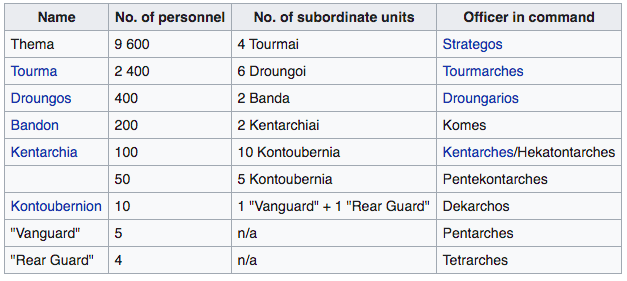
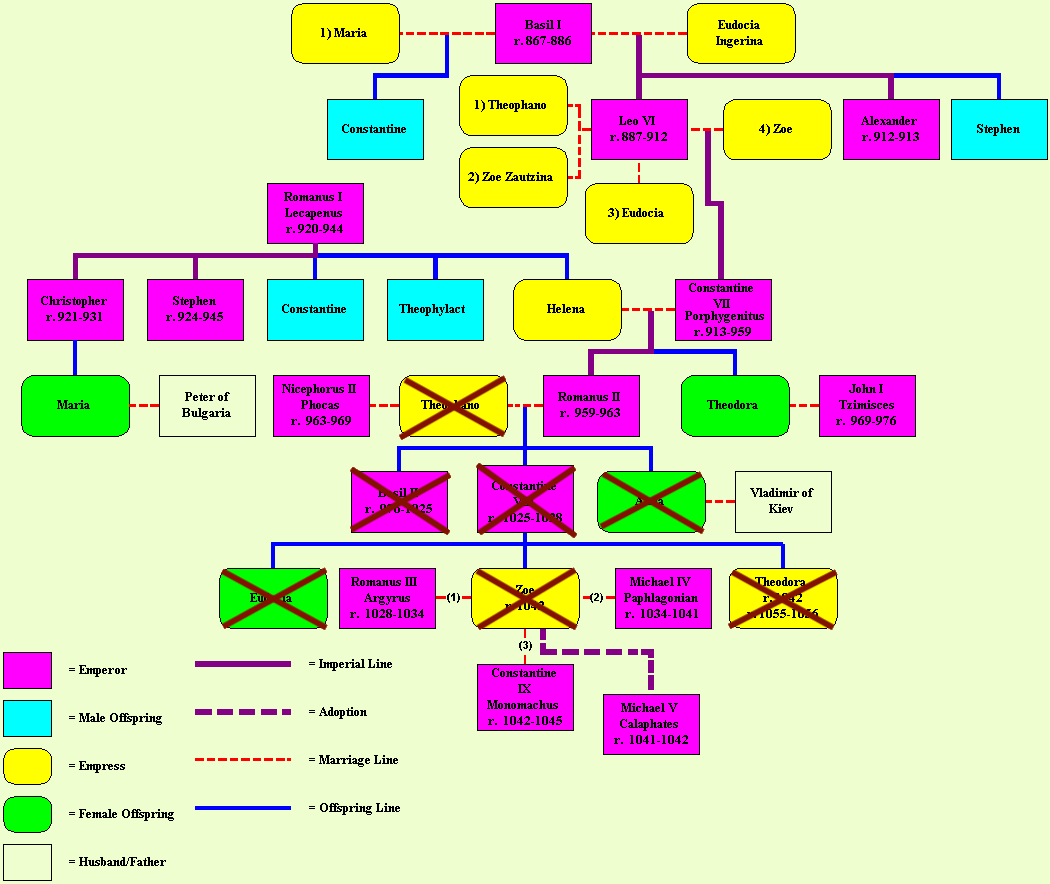
Screen Shot 2021-04-17 at 12.05.00 AM
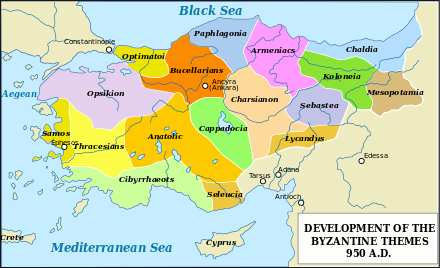
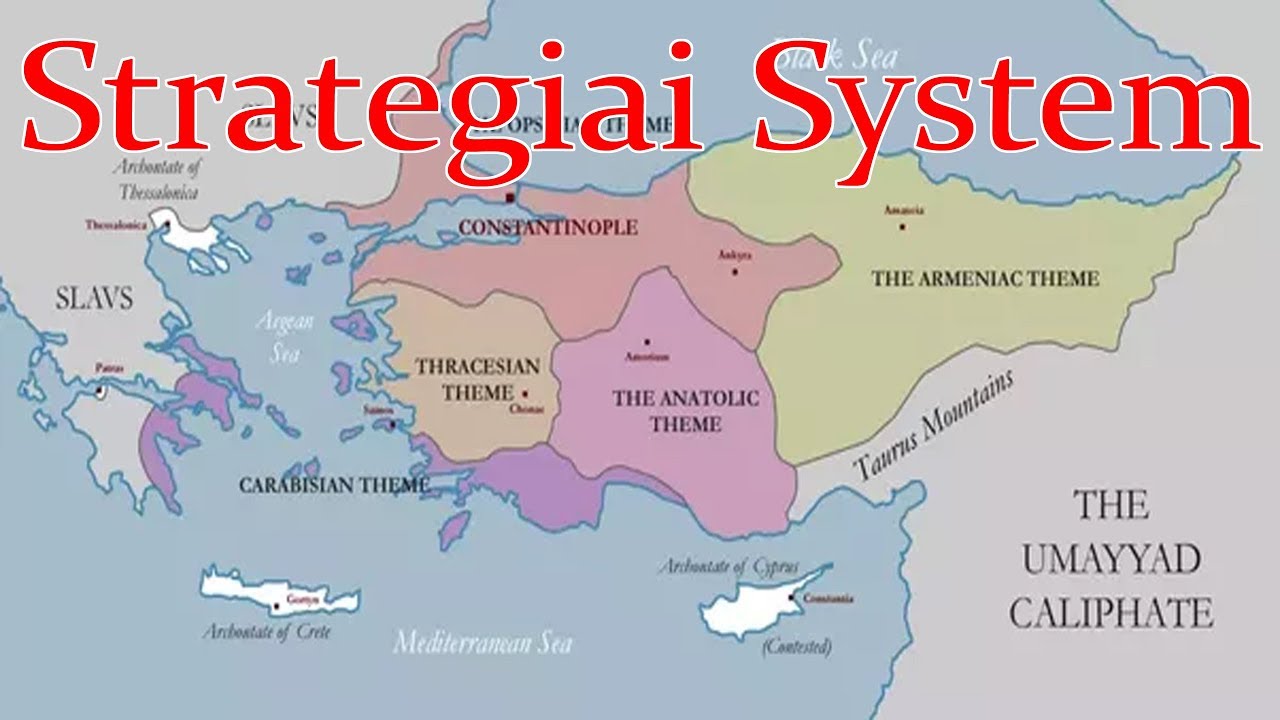
Guide to the Thematic System of the Byzantine army (from Wikipedia); this article contains a lot of terms of Byzantine army units
mace
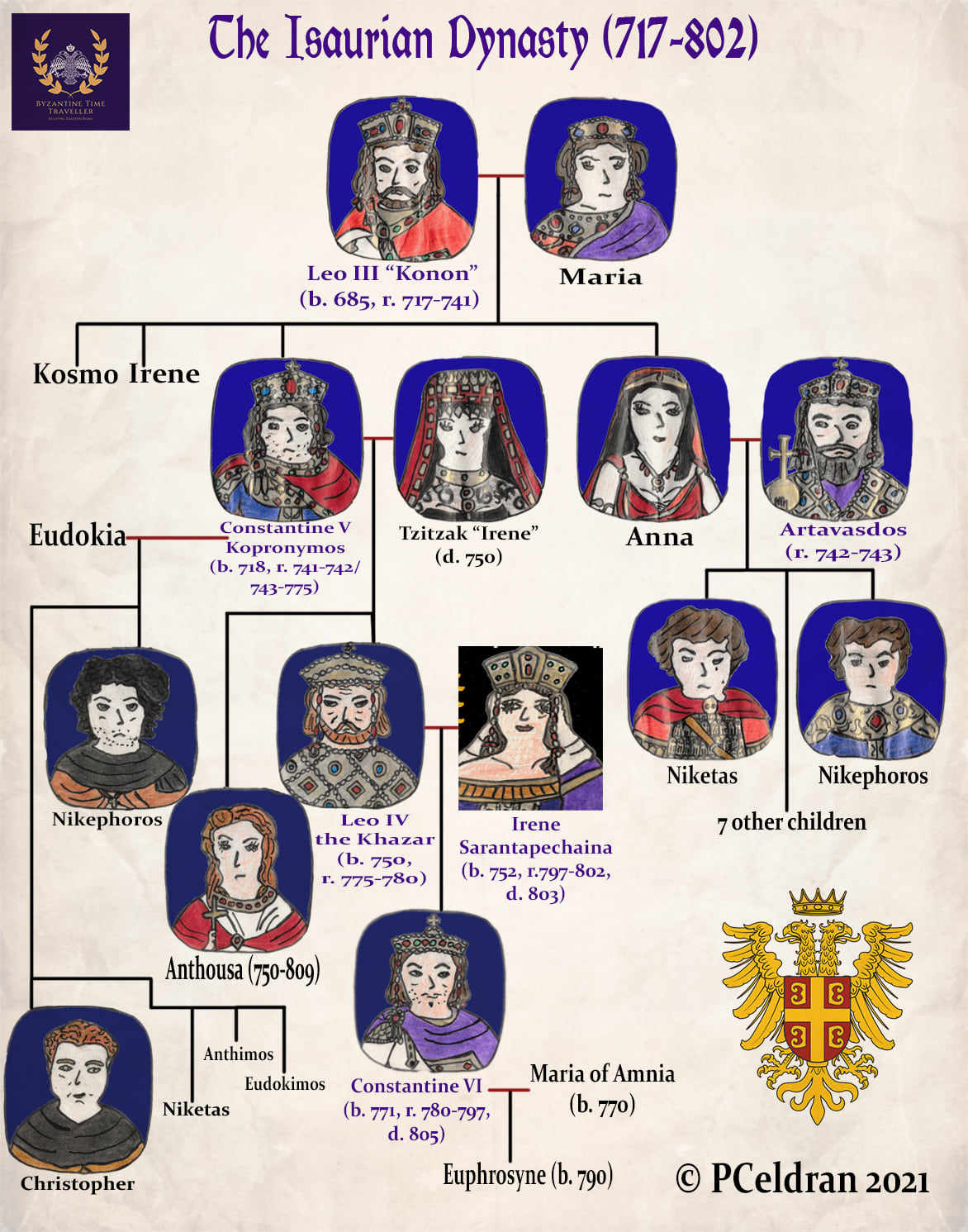
Genealogy of the Macedonian (Amorian) Dynasty of the Byzantine Empire (867-1056), without Theophano and her descendants (crossed out in red) in this story’s case

Related Articles from The Byzantium Blogger:

Byzantine Alternate History Chapter VI- What if Charlemagne and Irene Married and United their Empires?

A Review/ Analysis/ and Fan-Casting for Theophano: A Byzantine Tale

Byzantine Alternate History Chapter III- Justinian I the Great Saves his Empire from the Plague and Joins his Campaigns

Around the World in the Byzantine Era Part I (300-1000AD)

12 Turning Points in Byzantine History

A Guide to the Themes of the Byzantine Empire

Lesser Known and Would be Byzantine Emperors (695-1453)

All Sieges of Constantinople

Ethnic Origins of the Byzantine Emperors

10 Inventions from the Byzantine Empire


The Major Players of this Story’s Byzantine Renaissance Epic:

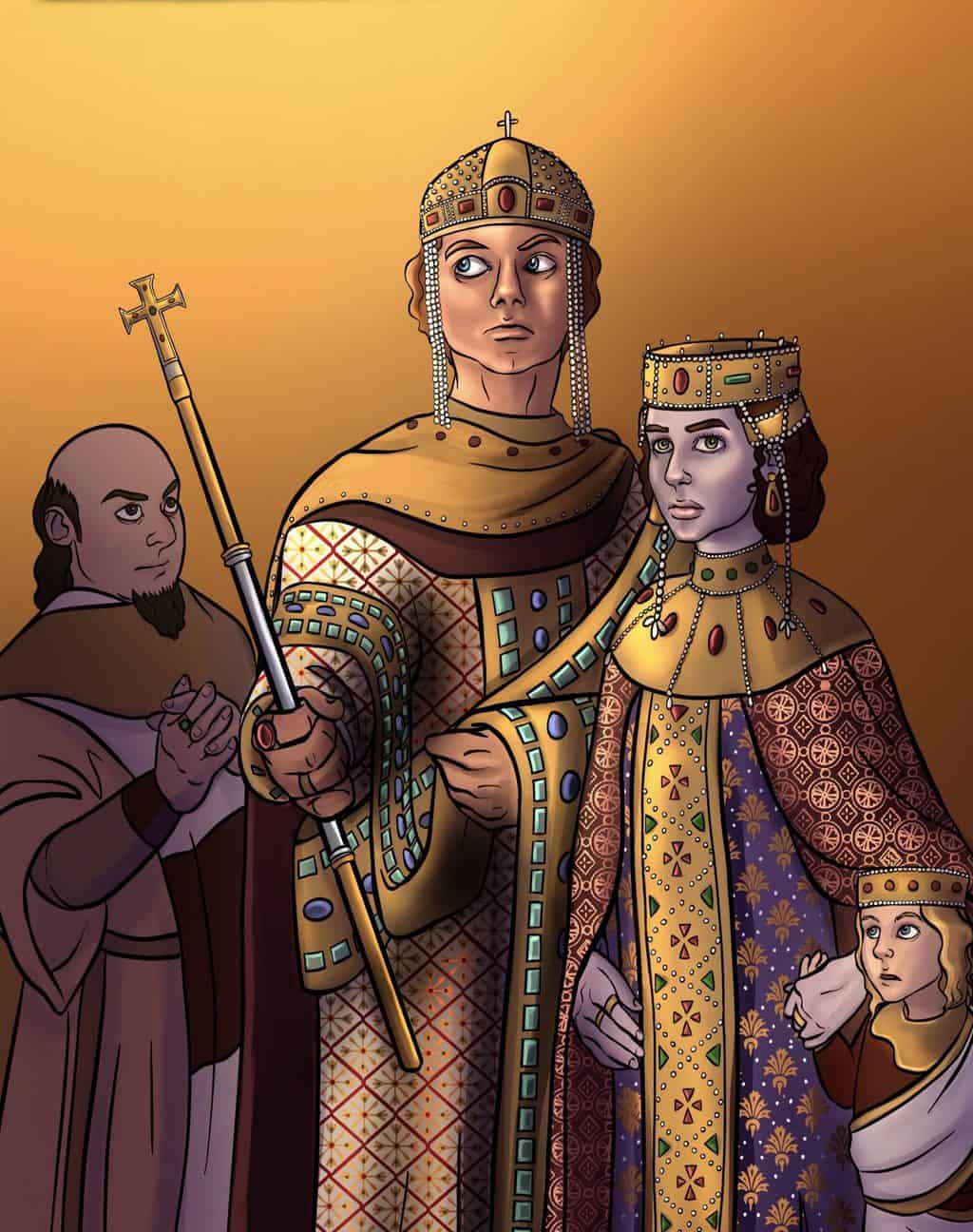
Emperor Leo VI “the Wise”- Byzantine emperor (886-912); image found in the main story itself

Zoe Karbonopsina- Byzantine empress and empress-regent, wife of Leo VI; image found in the main story itself

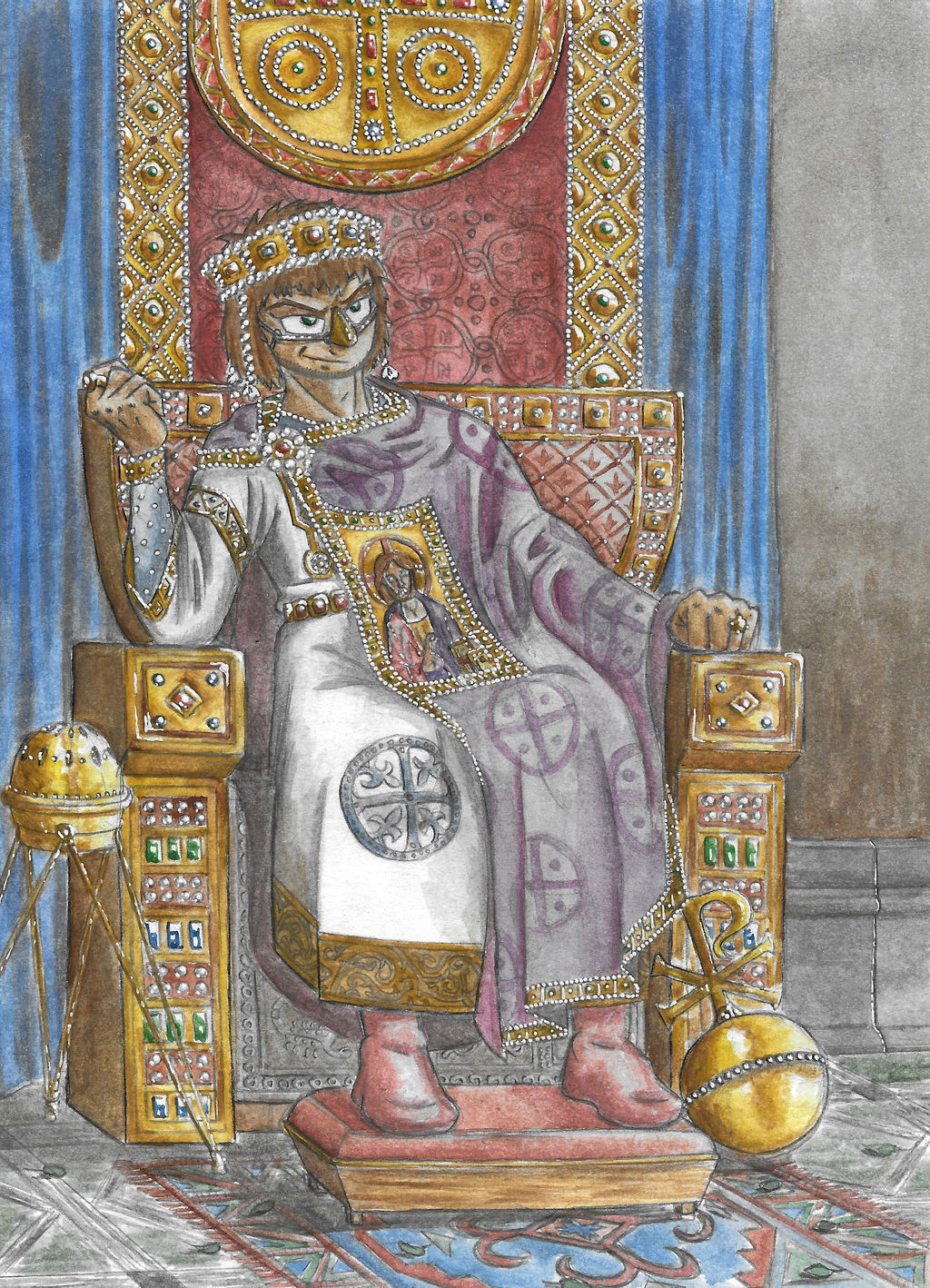
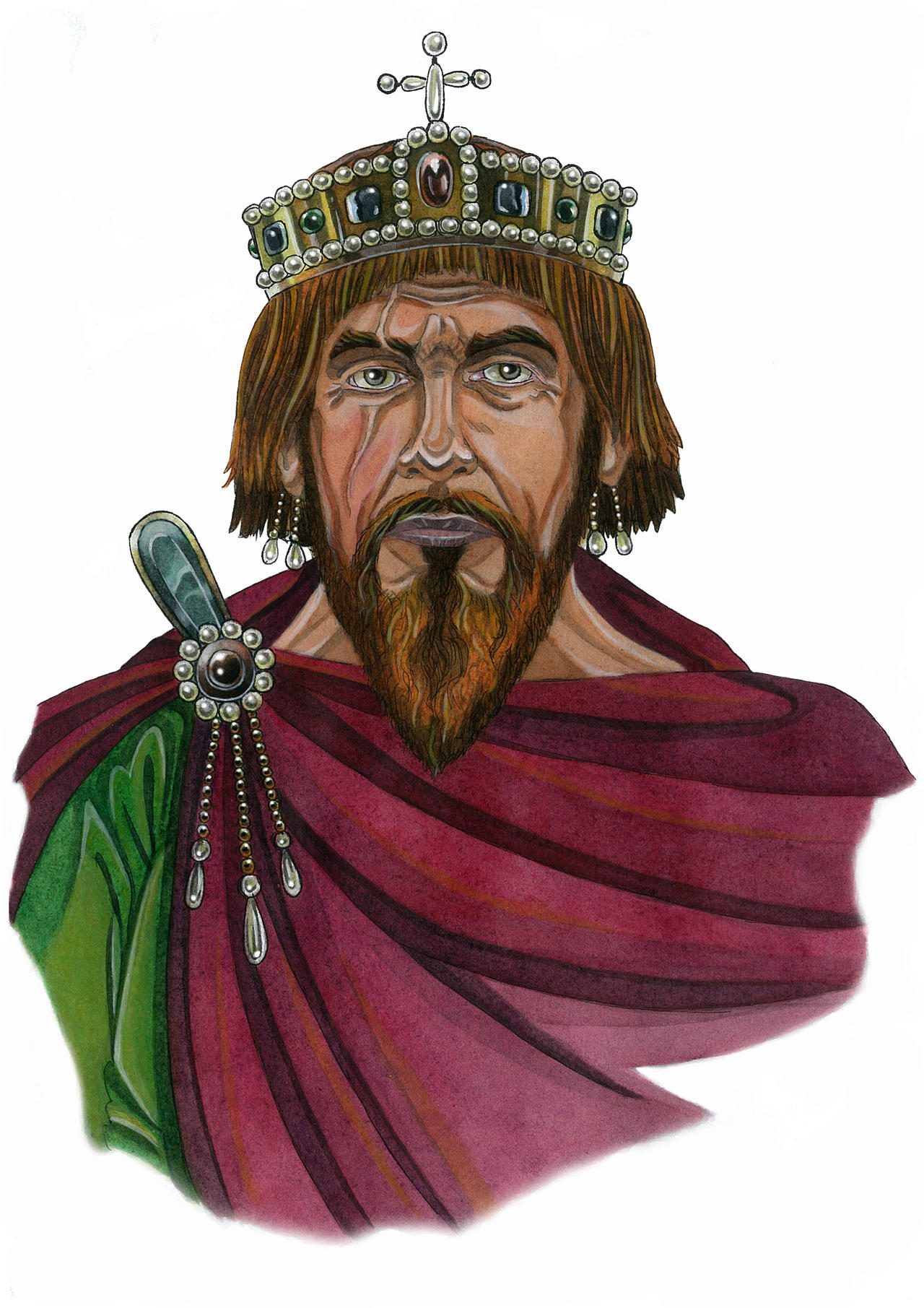
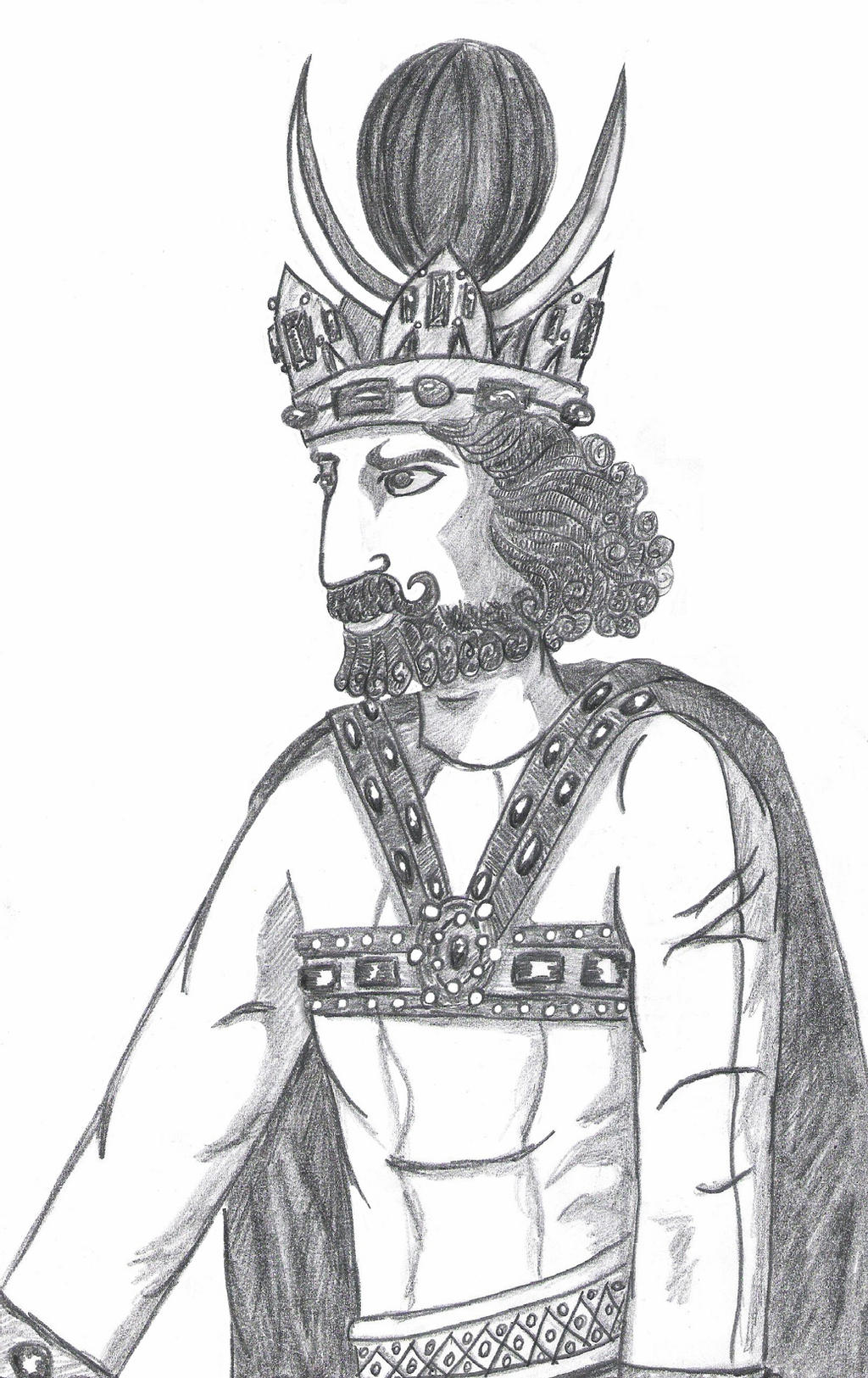
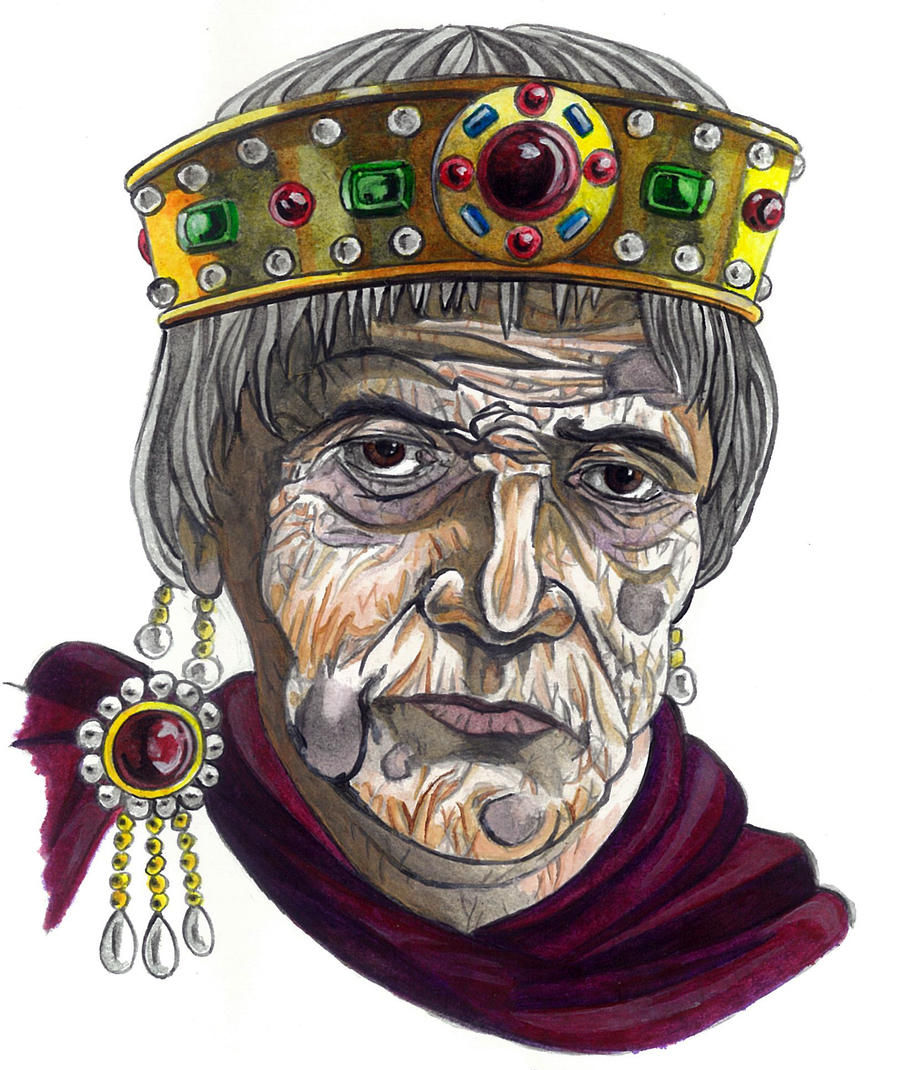
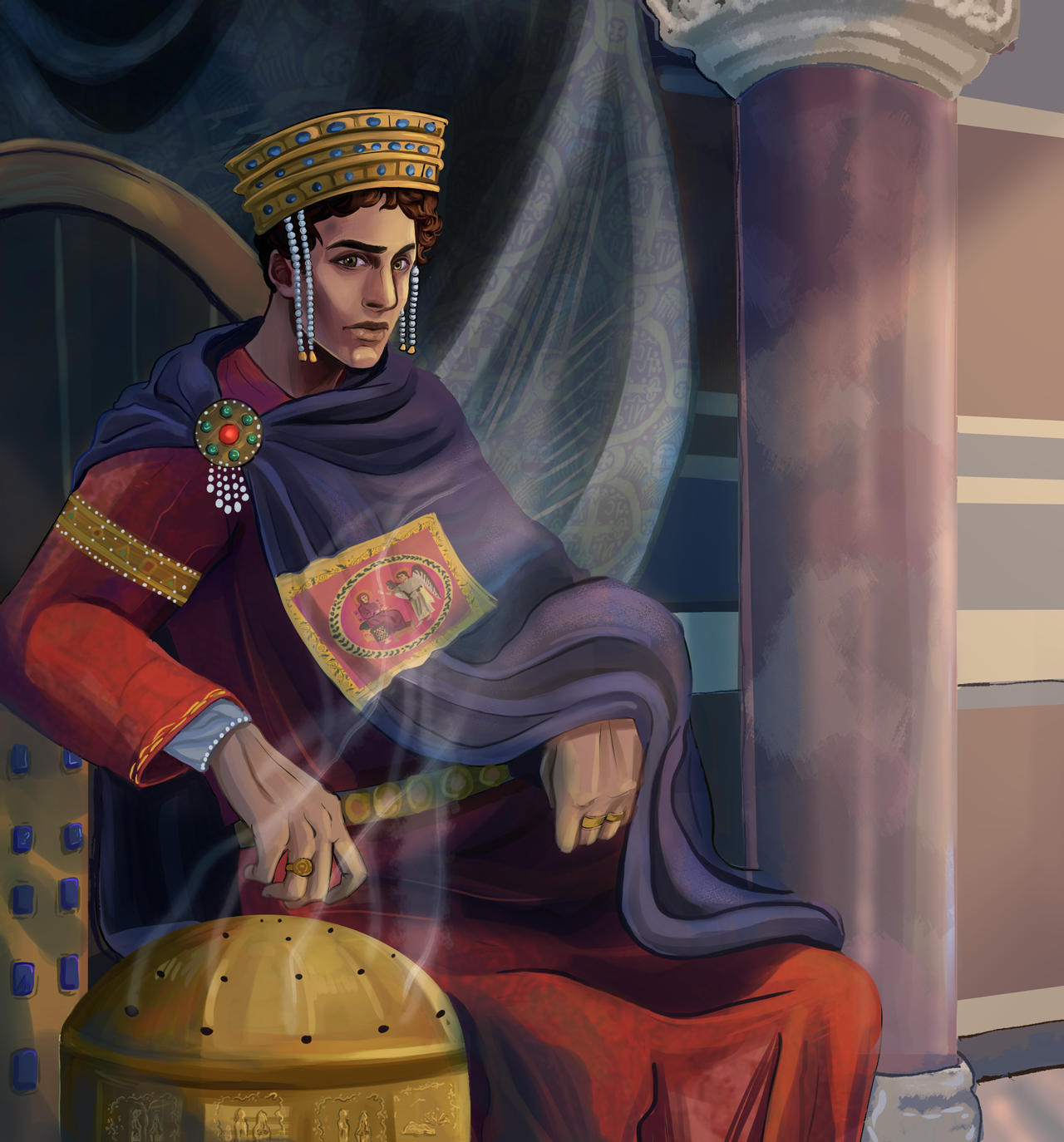
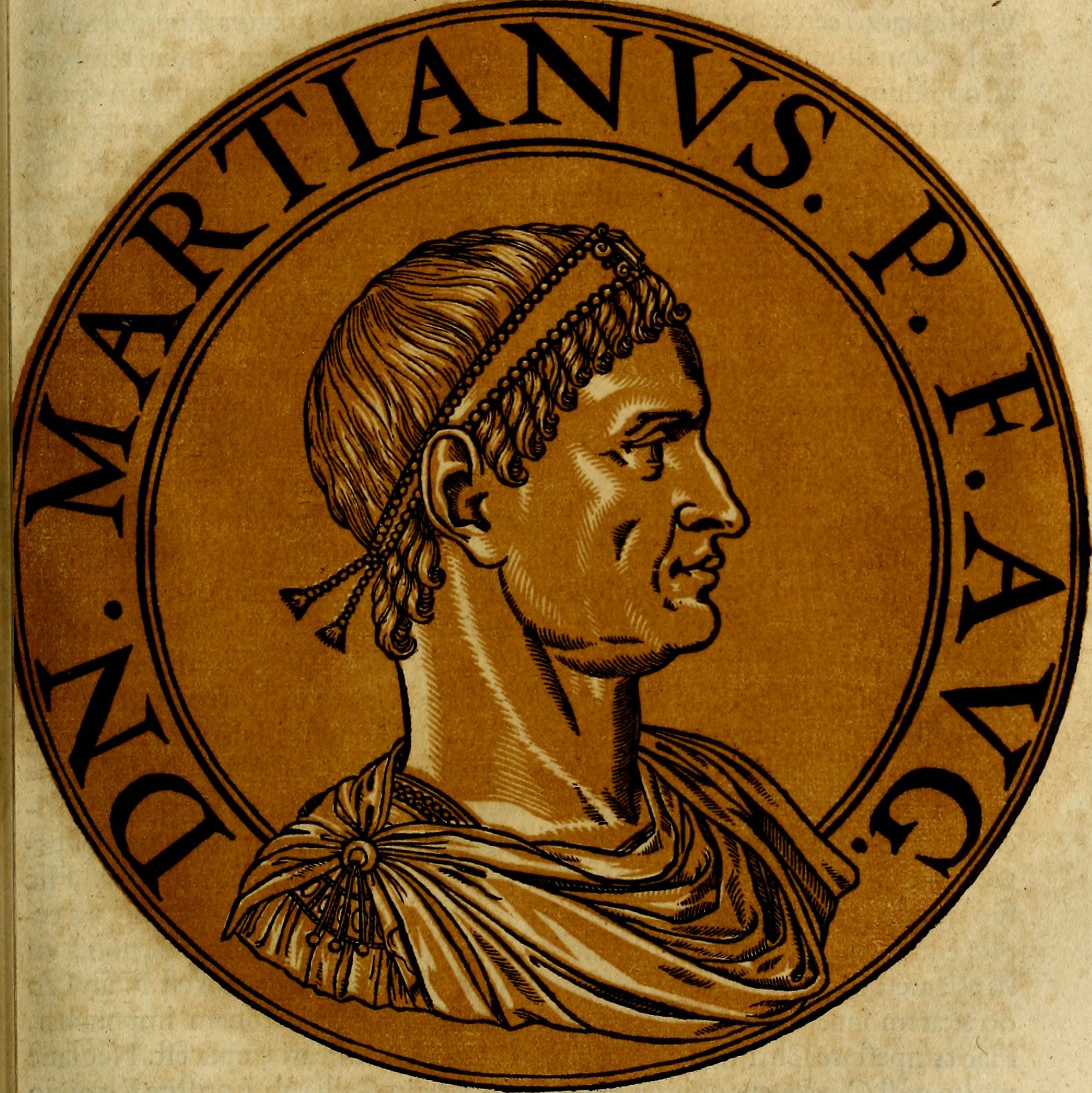
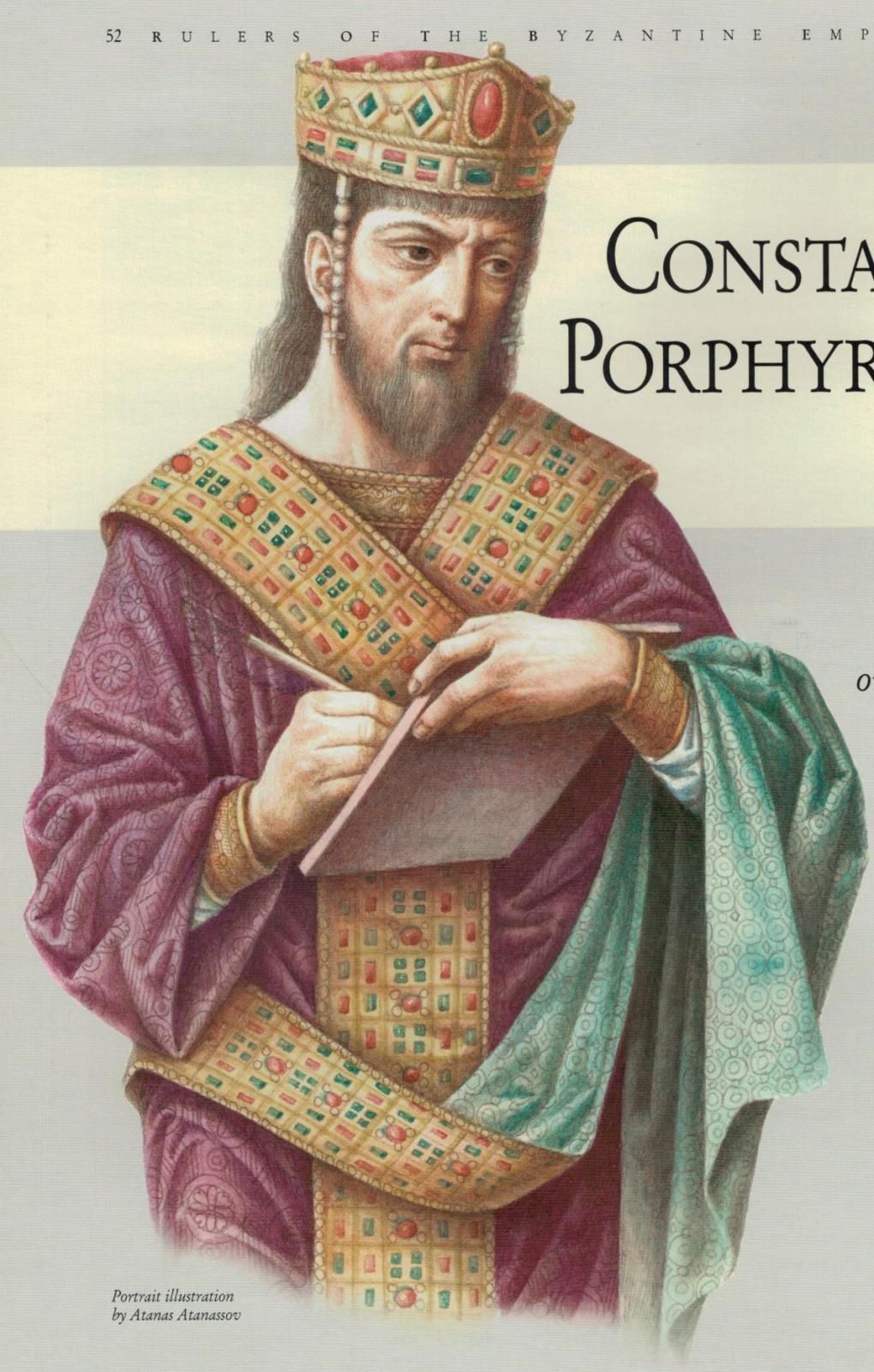
Constantine VII Porphyrogennetos– Byzantine emperor (913-959), son of Leo VI and Zoe; image found below

Alexander- Byzantine emperor (912-913), half-brother of Leo VI

Nikolaos Mystikos- Patriarch of Constantinople (901-907/ 912-925)

Simeon the Great- Tsar of the Bulgarian Empire (893-927)

Romanos I Lekapenos- Byzantine admiral turned emperor (920-944), father-in-law of Constantine VII

John Kourkouas- Byzantine general, supreme commander of the eastern forces under Romanos I

Helena Lekapene- Byzantine empress, daughter of Romanos I, wife of Constantine VII

Bardas Phokas the Elder- Byzantine general of the powerful Phokas clan

Romanos II- Byzantine emperor (959-963), son of Constantine VII and Helena

Joseph Bringas- Palace eunuch and advisor of Romanos II

Basil Lekapenos- Palace eunuch and advisor, son of Romanos I

Nikephoros II Phokas- Byzantine general and emperor (963-969), son of Bardas Phokas the Elder, “Pale Death of the Saracens”

Leo Phokas the Younger- Byzantine general, younger brother of Nikephoros II, son of Bardas Phokas the Elder

John I Tzimiskes- Byzantine general and emperor (969-976), nephew of Nikephoros and Leo

Sayf al-Dawla- Arab Emir of Aleppo (945-967)

Polyeuctus- Patriarch of Constantinople (956-970)

Otto I the Great- King of East Frankia and Holy Roman Emperor (936-973)

Zoe Porphyrogenita- Daughter of Constantine VII and Helena, Byzantine empress and wife of Nikephoros II and John I in this story

Sviatoslav I “the Brave”- Grand Prince of the Kievan Rus’ (945-972)

Bardas Skleros- Byzantine general, and eventual emperor in this story

Bardas Phokas the Younger- Byzantine general, son of Leo Phokas the Younger
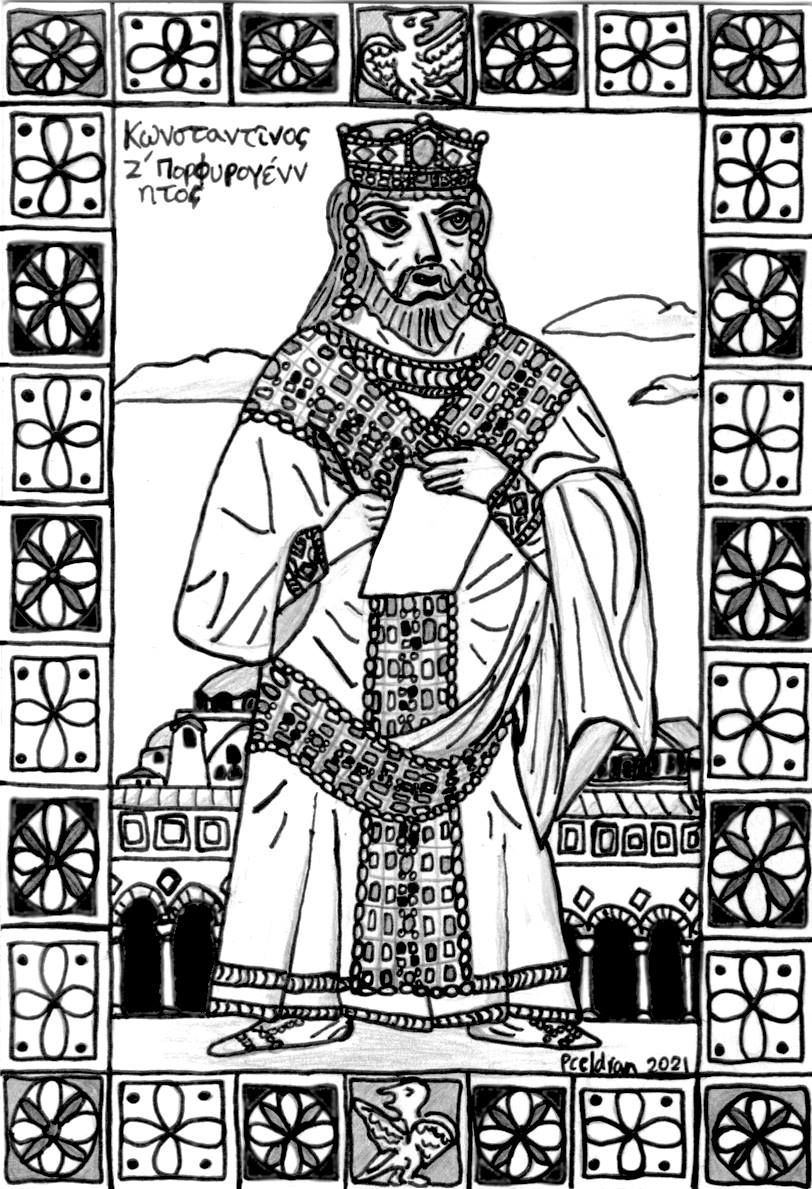
187960930_547350640003562_1250936903065672689_n
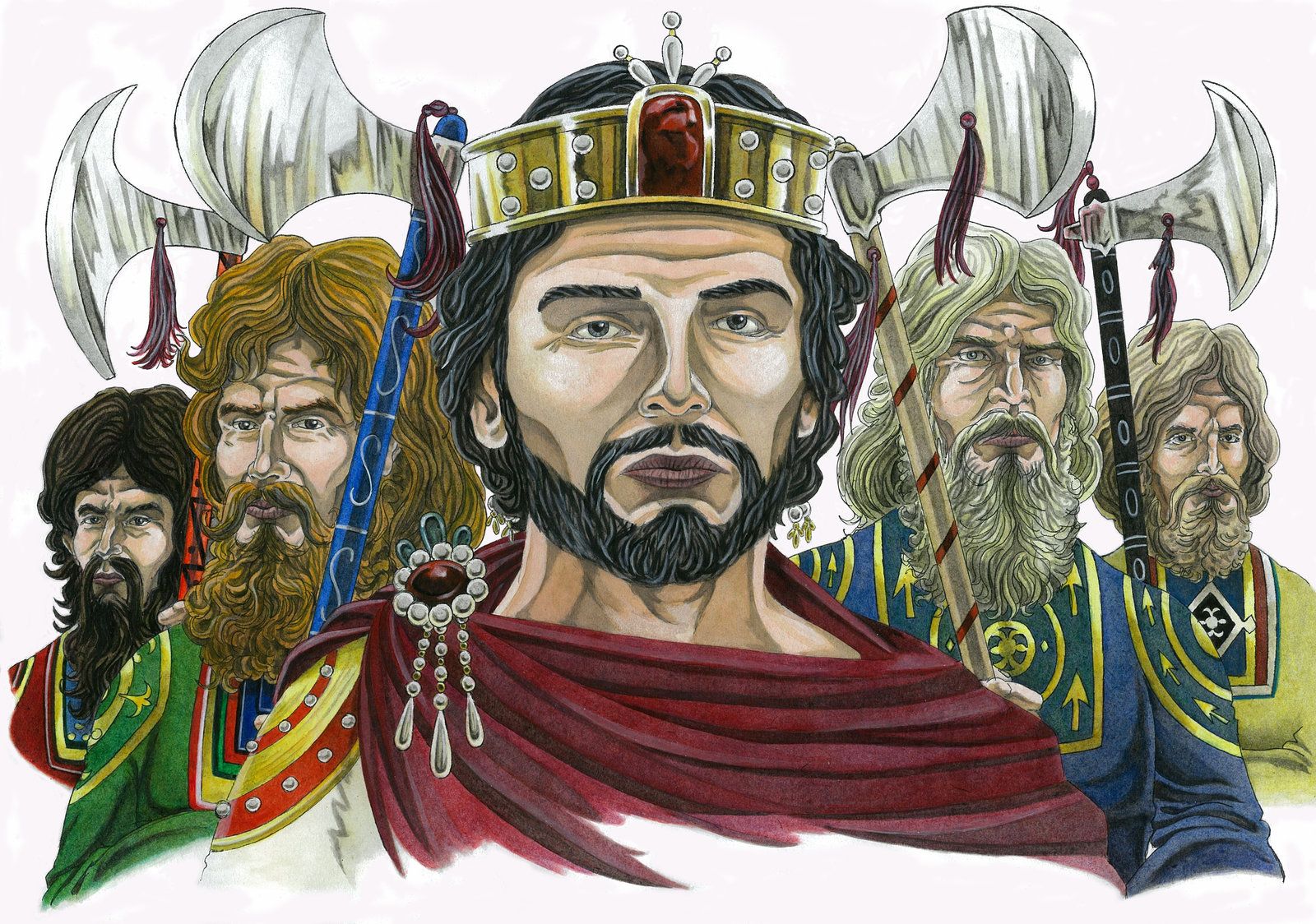
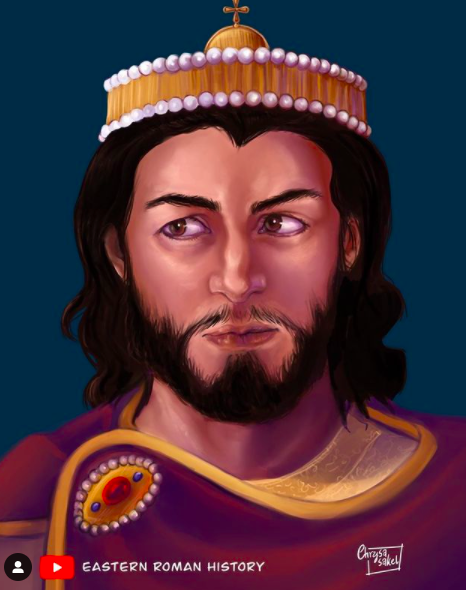
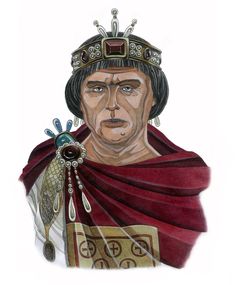
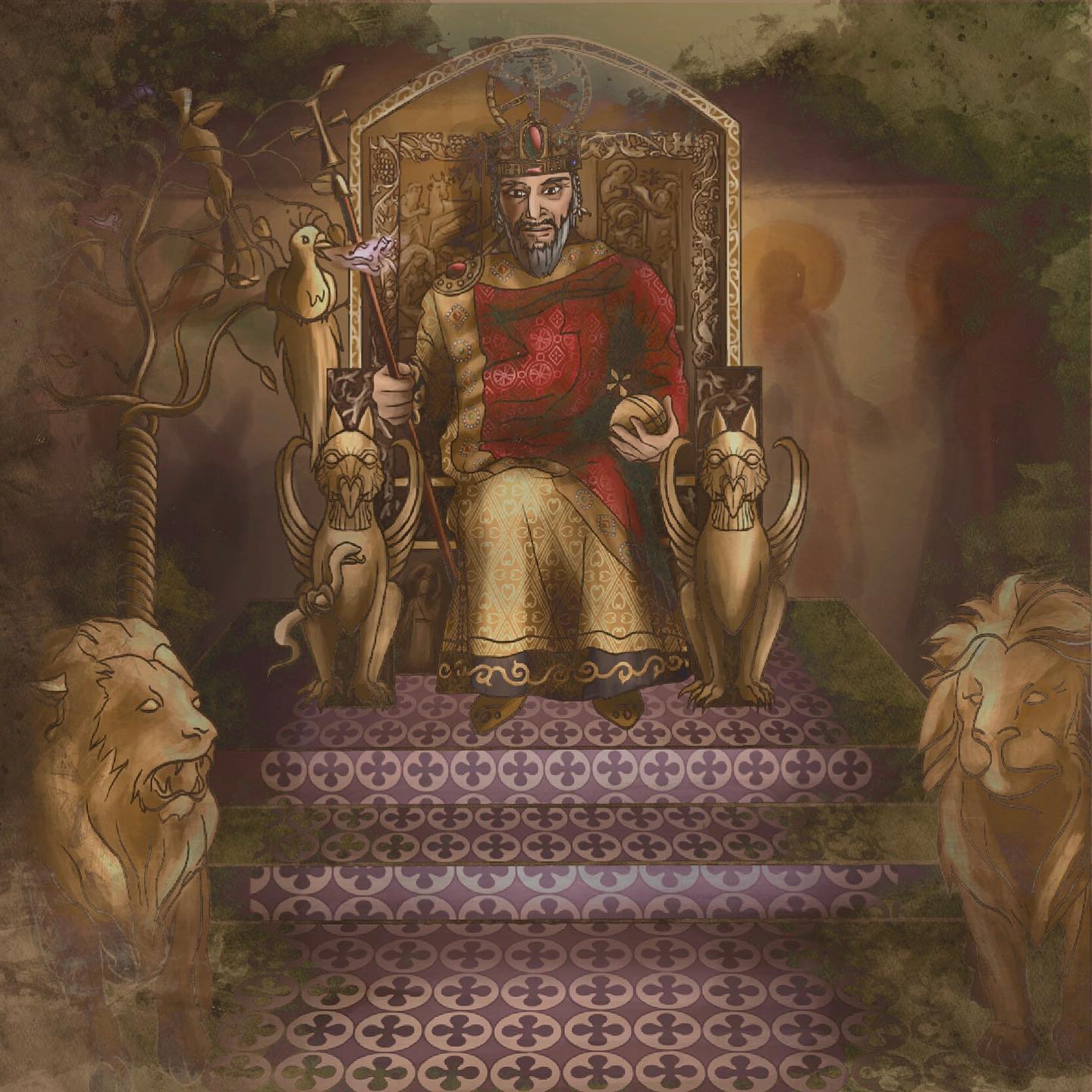
Emperor Constantine VII Porphyrogennetos of Byzantium (r. 913-959), art by myself

Background Guide: Byzantine characters (blue), Bulgarians (dark orange), Arabs (green), Franks (gold), Rus (dark red).


Part I.

Prologue- The Amorian Dynasty and the Rise of Basil the Macedonian, the Wrestler Turned Emperor (811-886)        

Palaiologos_Dynasty_emblem1

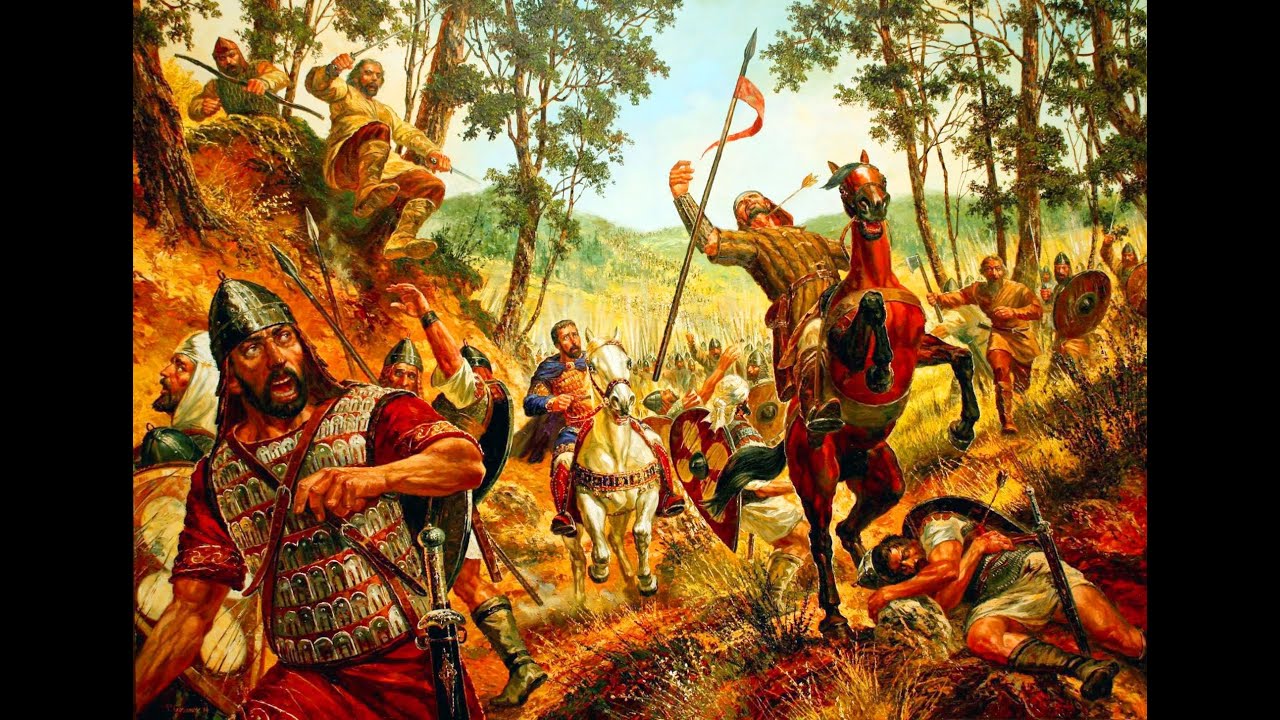
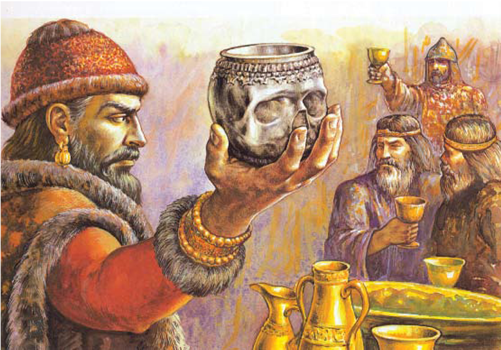
At some time in 811 was born the future emperor Basil the Macedonian to peasant parents in the Byzantine Theme of Macedonia near the city of Adrianople, though its name can be misleading as this Theme was not in Macedonia itself but in Thrace. Though Basil was born a peasant and known as the Macedonian, he was in fact not a Macedonian but in his father’s side an Armenian descended from the Arsacid Dynasty that ruled Armenia (12-428AD) as well as a descendant of the first Byzantine emperor Constantine I the Great (r. 306-337), if you would believe the fabrication made about Basil’s lineage made during his reign later on, but in this story’s case his noble lineage would be true. In his mother’s side, Basil was either of Slavic or Greek descent- and possibly even a descendant of the famous Macedonian ruler Alexander the Great (r. 336-323BC)- which would still remain unclear but the known fact is that Basil’s father from Byzantine Armenia before Basil was born was resettled into the Theme of Macedonia which was part of the imperial policy to balance ethnic groups across the empire and integrating them with others to prevent a strong sense of unity that could lead to ethnic rebellions. Basil’s early life is not known but it is said, which would be true in this story was that his mother once had a dream wherein a saint told her that her son Basil would one day become emperor no matter how impossible that seemed as they were from a very simple family, but Basil took this prophecy very seriously believing it was his destiny. Some sources though put Basil’s birth at around the 830s but also in the Theme of Macedonia hence his nickname “the Macedonian” while other sources say that as a child, he was taken into the Bulgarian Empire up north as captive returning to Byzantine Macedonia in the 830s, but this story would simply stick to Basil born in 811 and nothing eventful happening in Basil’s early life except for the prophecy of him becoming emperor. Now let us have a recap of the events in the 9th century which the previous chapter mentioned as well and here let’s begin with 811, the year of Basil I’s birth which was also the same year the Byzantine emperor Nikephoros I the Logothete who overthrew Empress Irene (r. 797-802) in 802 died at the Battle of Pliska against the Bulgarian forces of the Bulgarian ruler or khan Krum leading to a severe defeat for the Byzantine forces whereas the dead emperor’s skull was turned into Krum’s drinking cup. Nikephoros I though had a son named Staurakios who fought in this battle and survived but badly injured from it that in only 2 months he abdicated from ruling as emperor as by becoming paralyzed, he could not rule properly therefore he retired as a monk dying the next year and had passed the throne to his brother-in-law Michael I Rangabe (r. 811-813) who as emperor had no military experience that in 813, he lost against the Bulgar forces of Krum when his forces deserted him.
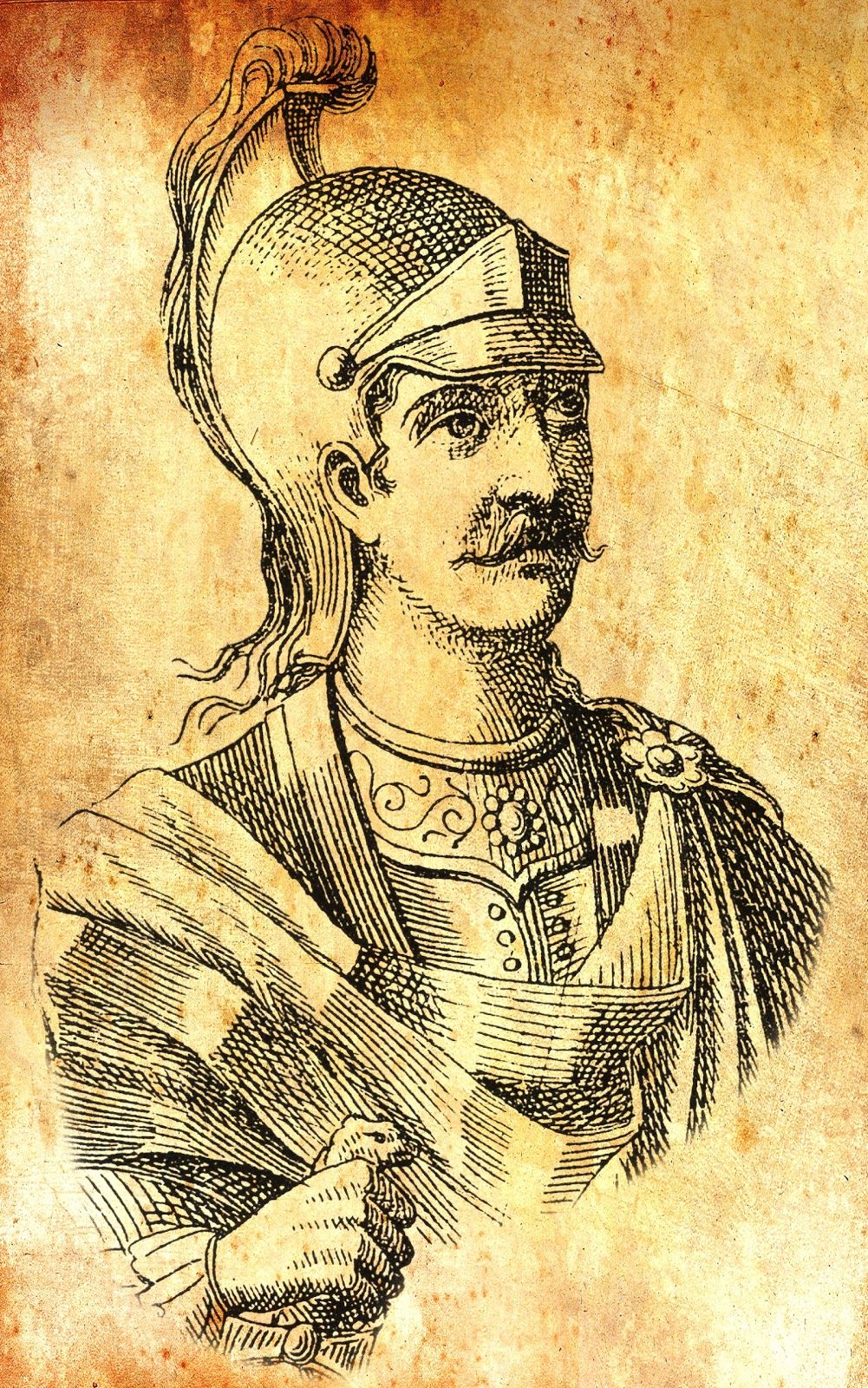
247217167348c845ab85c8255335f3df
Emperor Leo V the Armenian, Byzantine emperor (r. 813-820)

Not wanting a bloody end, Michael I abdicated and again retired to become a monk and would live up to 844 while the throne was passed to Leo V the Armenian (r. 813-820) who was the same general that deserted Michael I, and as emperor Leo V brought back the old policy of Iconoclasm or the breaking of religious icons which was thought to have ended back in 787 if you remember from the previous chapter, though Leo V was not entirely serious about it but rather only used returning the policy for political reasons to please his soldiers that supported him as they were still hardcore Iconoclasts. Under Leo V though, the Bulgarian threat to Byzantium disappeared when Khan Krum died in 814, however Leo V did not rule long enough and establish a dynasty as in Christmas of 820 an unlikely coup happened when his friend and trusted general Michael the Amorian turned on him and killed him during the Christmas Mass, thus Michael II the Amorian was proclaimed emperor.
d6625434d75b417a739ff1217d3a3948
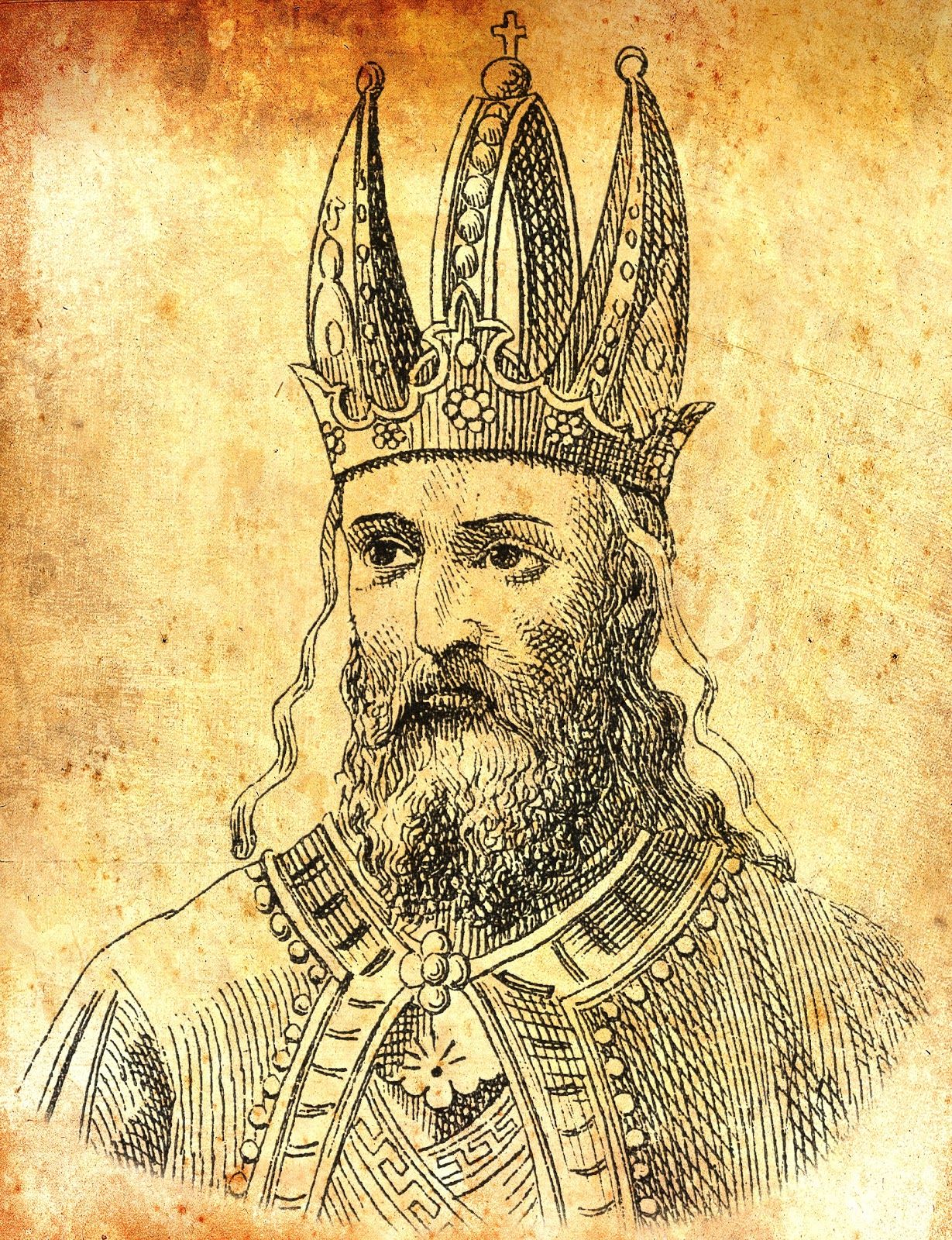
Michael II the Amorian, Byzantine emperor (r. 820-829)

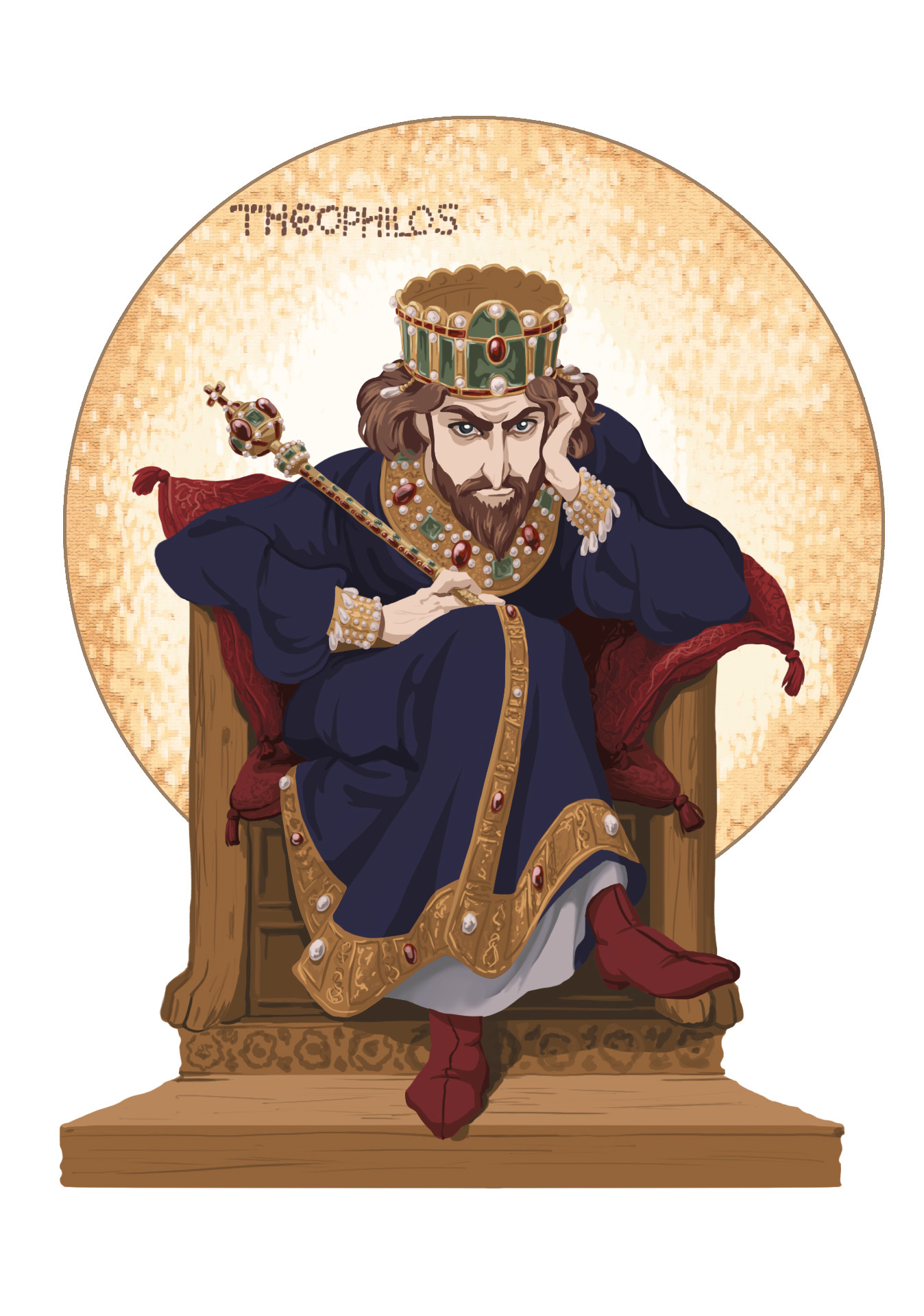
Michael II to justify usurping the throne tried to pretend like he had nothing to do with Leo V’s murder, and as emperor he was an able ruler except he lacked education and class, but so did he lack legitimacy that his other general friend together with Leo V which was Thomas the Slav in 821 rose up against him starting a full scale civil war that was as damaging to Byzantium the same way a foreign war would be, and this civil war lasted for 2 years until Thomas was defeated, had surrendered, and was executed in 823 but despite winning a victory, it was a very costly one for Michael II as he ended up burning a big portion of the Byzantine fleet which Thomas controlled, and losing a major part of the fleet opened up some regions of the empire to foreign invasion. In 824, the entire island of Crete fell to Arab pirates from Spain who were exiled from the Umayyad Arab Muslim state that controlled most of Spain known as Al-Andalus or rather the Emirate of Cordoba as this group rebelled against the authorities there but failed thus turning to piracy in the Mediterranean, and without a Byzantine fleet to stop them Crete fell to these pirates thus creating the Emirate of Crete which would then be a major thorn for the Byzantines’ commercial activities in the Mediterranean from here on as Crete was a very strategic area in the Mediterranean. However, not only Crete had fallen as in 827 Byzantine control of Sicily would begin to slip out when the army of a new Arab power in North Africa known as the Aghlabids first invaded, and here would start the Arab conquest of Byzantine Sicily. Michael II who founded the Amorian Dynasty then died in 829 and would be succeeded by his 24-year-old son Theophilos who unlike his father was very educated and cultured and despite being a Byzantine, he greatly admired the arts, sciences, and general culture of the Islamic Arab world, most especially that of the Abbasid Caliphate based in Baghdad as Theophilos’ idol was the sophisticated and powerful Abbasid caliph Harun al-Rashid (r. 786-809) who had been mentioned significantly in the previous chapter.
anastasia-soldatkina-theophilos
Emperor Theophilos, Byzantine emperor (r. 829-842), son of Michael II

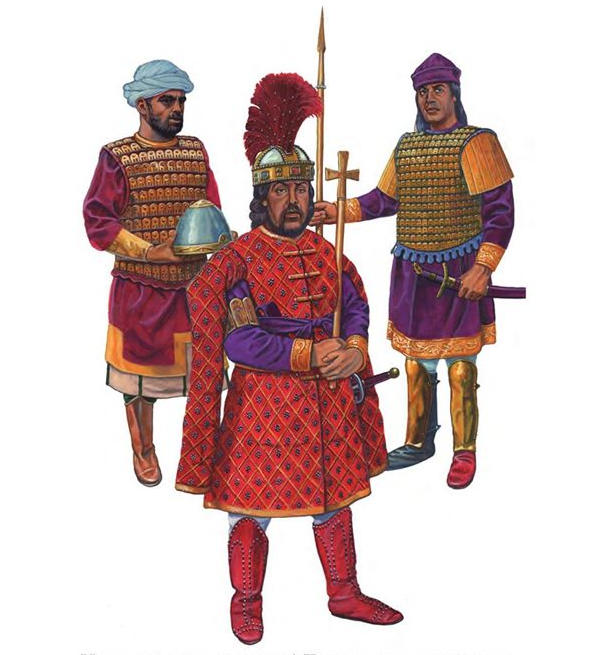
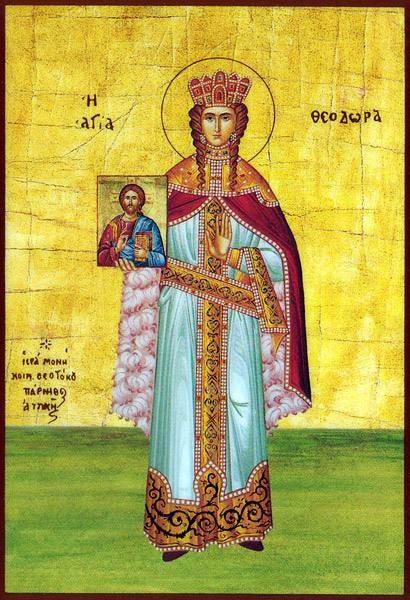
Though Theophilos greatly admired the Abbasid Caliphate in cultural aspects, he was also threatened by them therefore he was committed to fight them in battle which he spent most of his reign doing, and had ended either winning some victories but losing great defeats as well such as at the Battle of Anzen in 838 wherein Theophilos led the army himself but ended up losing leading to the Abbasid forces penetrating deep into Byzantine Asia Minor and sacking the city of Amorion, the capital of the Anatolic Theme, the empire’s most powerful Theme or military province, but surprisingly this would be Byzantium’s last major defeat to the Arab caliphate. Back in Constantinople, Theophilos was a great patron of the arts and sciences doing just as his idol Harun al-Rashid did with his capital Baghdad by using public funds to construct several luxurious palaces and learning centers, and his patronage of art and science would kick-start the Byzantine cultural Renaissance, but at the same time he was also a supporter of Iconoclasm like his father Michael II and Leo V before him, though not an extreme one as Theophilos only did it to please his powerful Iconoclast allies in the army, and little would he know that he would be the last Iconoclast emperor whereas his wife the empress Theodora was a strong Iconophile or supporter of religious icons and their veneration.
main-qimg-e04e4b7083d7486e06ceba05c5382054
Empress Theodora, wife of Emperor Theophilos, empress-regent 842-855

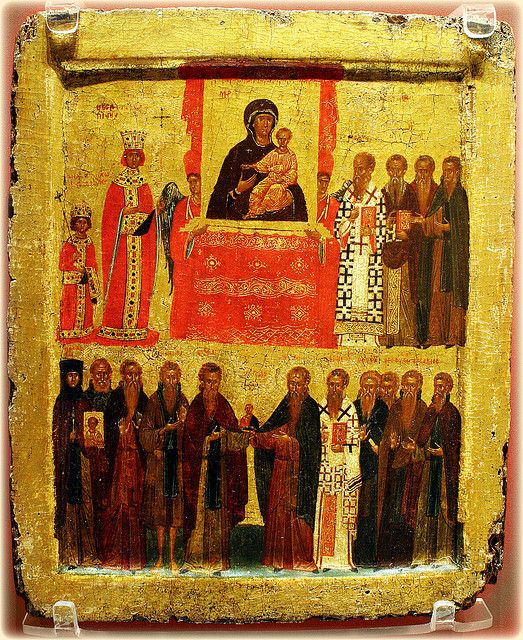
Meanwhile, the threat of the Arabs was still at large as in 841 the Abbasid caliph Al-Mu’tasim launched a massive naval expedition intended to attack Constantinople but it failed as Al-Mu’tasim died in early 842 and so did Theophilos from dysentery, and here he would be succeeded by his son Michael III who was only 2-years-old therefore ruling at first under the regency of his mother Empress Theodora, the powerful eunuch Theoktistos, and his uncles Bardas and Petronas who were his mother’s brothers. The first act of Michael III as emperor, although carried out by his mother was in finally ending the issue of Iconoclasm wherein a Church Council in Constantinople was held in 843 which then declared Iconoclasm a heresy while the Iconoclast Patriarch of Constantinople John VII Grammatikos was removed from office by force and replaced by the Iconophile Methodios I who would also serve as the young emperor’s regent. This kind of regency council would only be the first one mentioned in this story as it is about to become a standard in Byzantine politics, and so would be eunuchs running the government, but another standard that would be set following the end of Iconoclasm was a rebirth in the arts as after all those years of icons being destroyed making art look plain, the art scene of the Byzantine Empire especially in religious paintings found in churches would be ever more impressive than before as a way to make up for all those years these images were being destroyed for no useful reason.
maxresdefault-7
Byzantine forces defeated by the Bulgars at the Battle of Pliska, 811
Media-12984-pic
Khan Krum of Bulgaria uses Emperor Nikephoros I’s skull as his drinking cup
AKG1697387
Assassination of Emperor Leo V, Christmas of 820
Thomas_the_Slav_negotiates_with_the_Arabs
Rebellion of Thomas the Slav and civil war 821-823, from the Madrid Skylitzes
d4e3278e12d5feba699715bff1488ad9
Invasion of Byzantine Crete by the exiled Arabs from Spain, 824
history-of-sicily-arrival-of-arabs-in-mazara-del-valloon-17-june-827-ERGJ5G-1
Invasion of Byzantine Sicily by the Aghlabid Arabs of North Africa, 827
196614340_2592052074422730_8773178349822713491_n
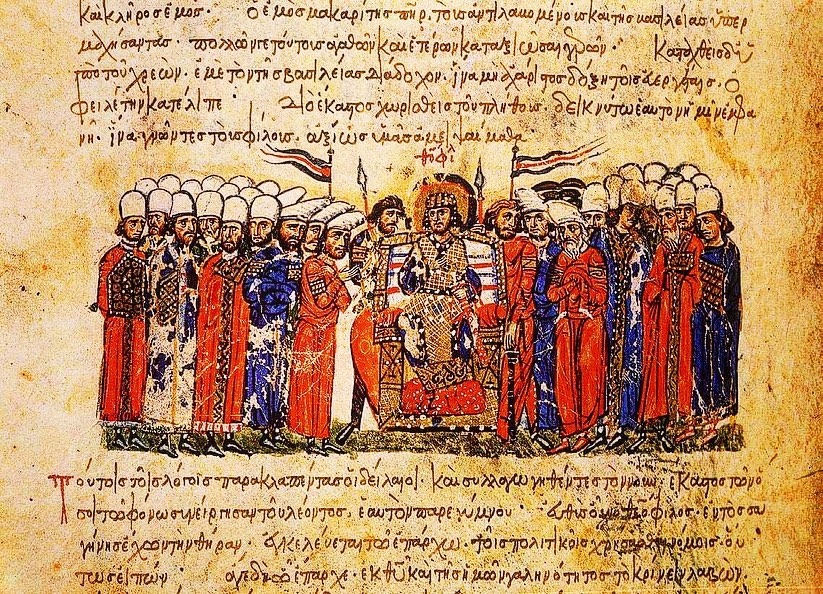
The court of Emperor Theophilos, Madrid Skylitzes
520px-MadridSkylitzesTheophilosArmyFol54r
Byzantine army under Theophilos defeated by the Abbasid Arabs at the Battle of Anzen, 838
0211atheodora
End of Iconoclasm and the Restoration of Icons under Empress Theodora and her son the young emperor Michael III, 843


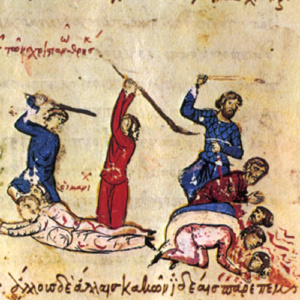
With the issue of Iconoclasm done for good and the power of the Abbasid Caliphate in the east suddenly no longer a threat following the decentralization of their state, as well as with the same kind of dissolution of the powerful Frankish Empire in the west to smaller kingdoms, it seemed like all was well for the Byzantines to kick-start their Renaissance or golden age thus ending the dystopian like Byzantine Dark Ages. Though Iconoclasm had finally come to an end, it was not really the end as soon enough new religious debates and controversies would emerge with one being now the issue over whether the Church should be run by highly spiritual officials or secular ones and another one being the rise of a heretical Christian sect known as the Paulicians in Asia Minor, which although had been around in Eastern Asia Minor and Armenia since the 7th century. As a heretical sect of Christianity, the Paulicians rejected some books of the Old and New Testament and preached against private property and at first, they seemed to be harmless until they had grown to become a political movement in the 9th century.
b1600cff7471cf2cdd7d370984c2ff58b5135d1f
Massacre of the Paulicians under Empress Theodora

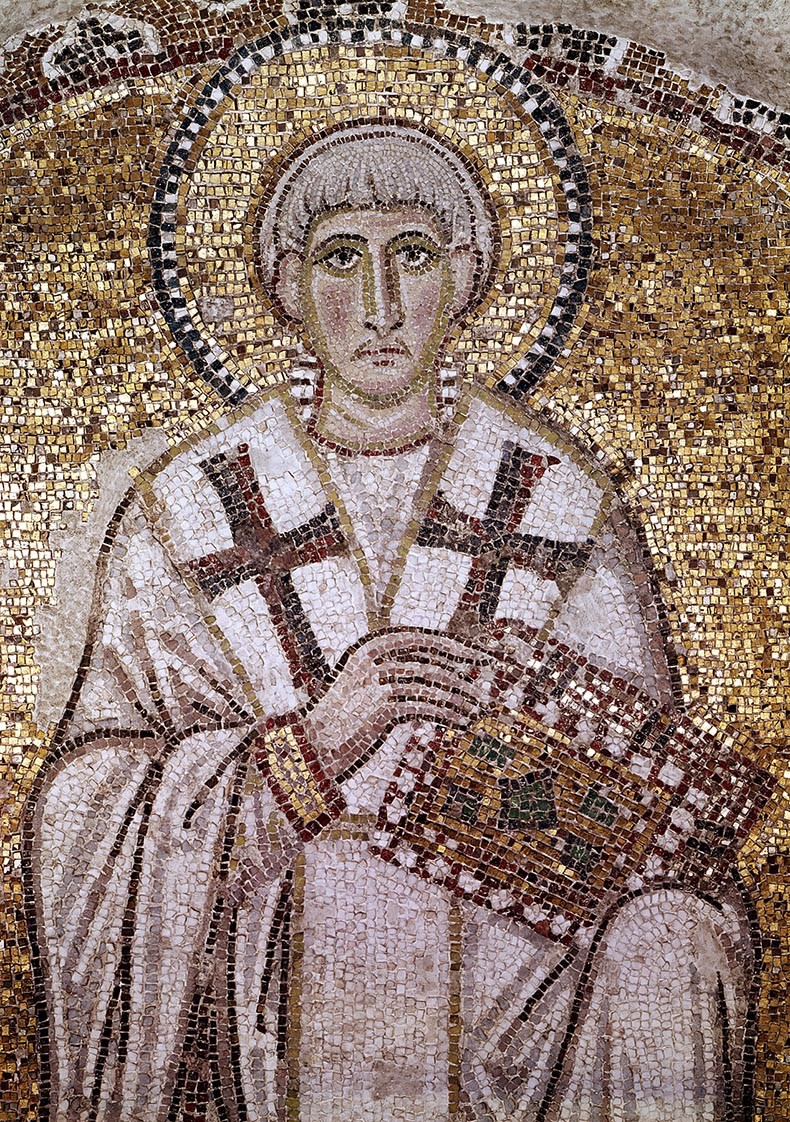
Theodora as the empress-regent and a strongly Orthodox Christian was heavy on persecuting the heretical Paulicians by force that in less than 2 years into her reign as her son’s regent, about 100,000 Paulicians were brutally put to death under her when they refused to acknowledge their errors and convert to Orthodoxy. The surviving Paulicians fled east to Armenia and to the Arabs, and later their leader Karbeas would establish the independent Principality of Tephrike (today’s Divrigi, Turkey) in Eastern Asia Minor with the help of Umar al-Aqta, the Arab Emir of Melitene which was one of the semi-independent states or emirates formed in the border between Byzantium and Abbasid Caliphate as a result of the Abbasids’ decentralization in recent years, and now this new Paulician state would pose a threat to Byzantium. At the same time as the Principality of Tephrike rose, the eunuch Theoktistos who was basically in charge of the empire here made the first attempt to recapture Crete from the Arab pirates there which although failed and in 847, the Patriarch of Constantinople Methodios I died and here the eunuch Ignatios, son of the former emperor Michael I Rangabe thus a grandson of Emperor Nikephoros I who was his mother’s father became the new patriarch, although Ignatios was a highly spiritual person who was against the Church being involved in secular matters, thus here begins the ongoing debate over Church leaders being spiritual or secular which would play a big role in this story.
beards-that-matter-visual-representations-of-patriarch-ignatios-in-byzantine-art
Mosaic of Ignatios, Patriarch of Constantinople (847-858/ 867-877)

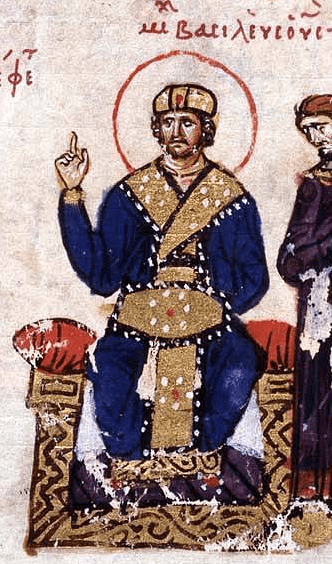
Now under Theodora and the eunuch Theoktistos, the empire seemed to be operating well especially since it suddenly acquired a lot of wealth some time back in Theophilos’ reign when a large source of gold was discovered in the empire’s Armeniac Theme in Asia Minor, and it so happened too during the regency of Theoktistos that the Byzantine fleet went as far as sailing to Egypt- which the Byzantines had not done in over 2 centuries- and attacking the Arab held port of Damietta there in 853 to punish the Arabs for their naval raids on the empire. By 855, Michael III had now come of age being 15, and he distrusted both his mother and Theoktistos relying a lot more on his uncles Bardas and Petronas, and a lot of Michael’s issues with his mother and eunuch regent had to do with the usual case of being forced to marry someone he did not like rather than his beloved mistress Eudokia Ingerina.
7627
Emperor Michael III of Byzantium (r. 842-867), son of Theophilos and Theodora

Michael III however supported by his uncle Bardas succeeded here, and Theoktistos was then arrested and executed while the empress Theodora was banished to a monastery for life, which here would be the first of many incidents like these. From 855 onwards, Bardas was the effective ruler of the empire as Michael III was still young and at the same time not really a responsible ruler as he prioritized entertainment, partying, horse riding, and drinking with friends over the empire, and it was around this time in 857 when the young Michael III would meet the future emperor Basil the Macedonian who had apparently come to Constantinople some time back. A lot of the information about Basil the Macedonian coming into Constantinople and making a name for himself remains to be of legend but would be true in this story’s case as an alternate history story, which means that here Michael III would first meet Basil in the palace’s horse stables with Basil nothing more but a stable boy.
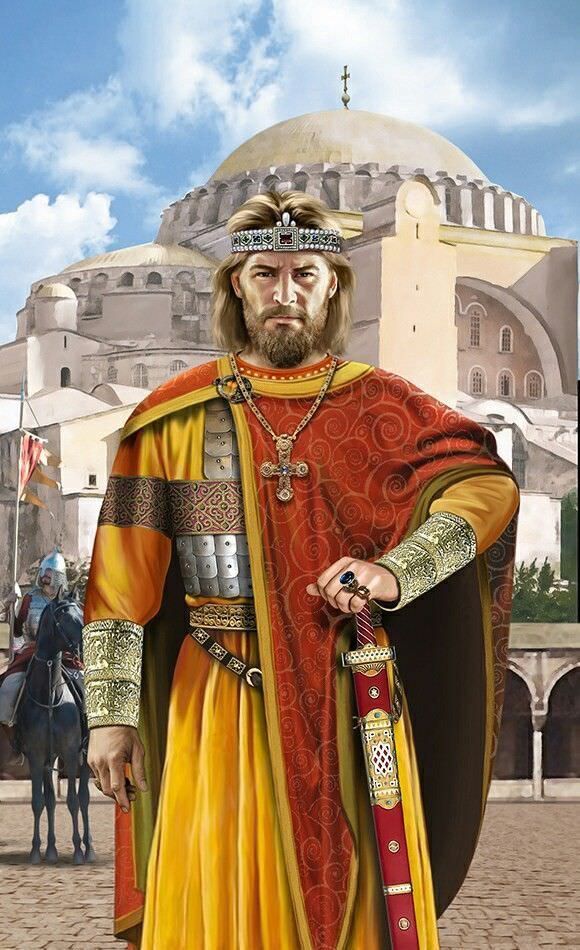
2dad1dc7106739aa3948146b6e3ec51e
Basil the Macedonian, peasant turned stable boy, turned wrestler, turned bodyguard of Michael III

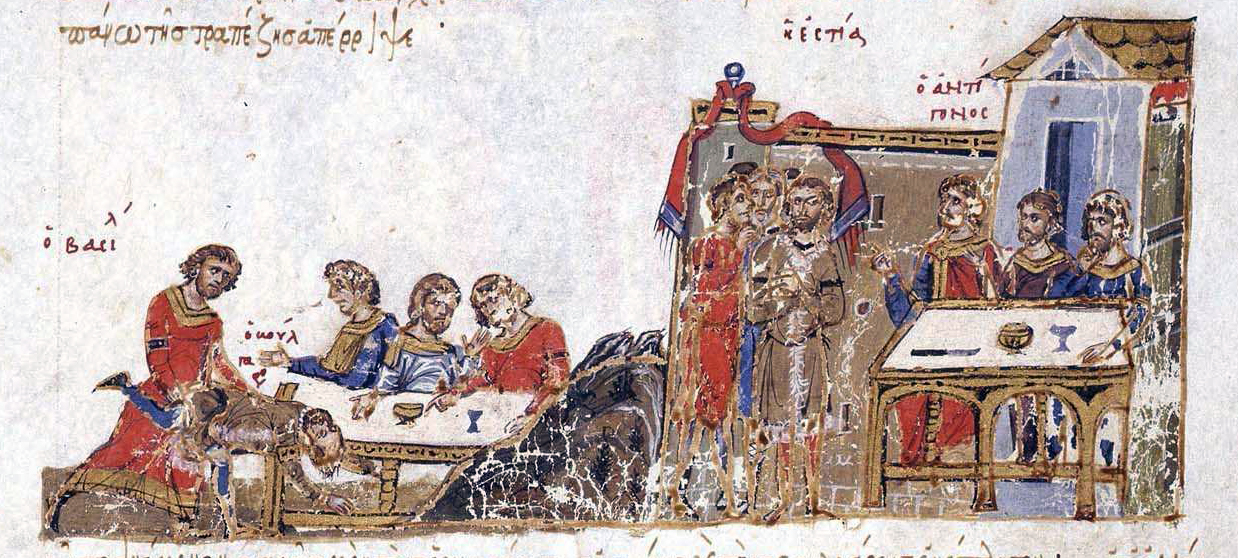
Here in 857, the massive 46-year-old Basil would out of the blue impress the emperor when being able to tame a horse nobody could tame but him as he had an ability to communicate with horses, and again sometime later Basil would prove his strength as a wrestler when the emperor himself saw Basil wrestling against and defeating the undefeatable Bulgarian champion in a wrestling match with ease, and because of his great strength and unusual abilities, Basil would soon grow to become a favorite of Michael III who would immediately make Basil his bodyguard or personal protector and chamberlain known as the Parakoimomenos in Greek, which although was a position assigned for eunuchs. On the other hand, the emperor’s uncle Bardas would do quite a pretty good job in actually managing the empire, and it was under him that the Renaissance of learning and culture would rise as he invested heavily on constructing learning centers, palaces, and richly decorated churches, though he was also a strongly secular person who in 858 forced the reigning patriarch Ignatios to resign wherein Bardas would replace him with his friend the scholar Photios who was a secular person with no religious background as Bardas saw that a politician was needed to be in charge of the Church of Constantinople.
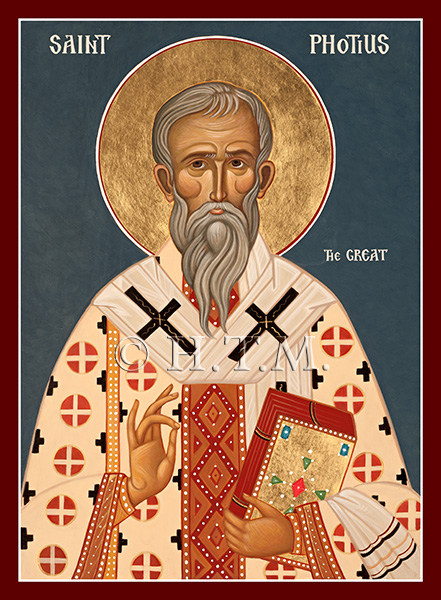
A-446-Icon-St-Photius-the-Great
St. Photios, Patriarch of Constantinople (858-867/ 877-886)

After becoming a priest in only a week, Photios quickly became Patriarch of Constantinople, though his appointment would cause a lot of tensions and again with the Patriarch of Rome or the pope in the west Nicholas I who had also just been elected as pope in 858 and apparently had backed Ignatios, thus here begins the Photian Schism which dealt with the issue of whether the emperor was to appoint or fire the Patriarch of Constantinople or if it was the job of the pope to do it, thus again making it another heated situation in the rivalry between the Orthodox Church in the east and Catholic Church in the west where again it had to do with the pope wanting to assert his supremacy over the Church of Constantinople and the other Churches which included Antioch, Jerusalem, and Alexandria whereas all the heads of these Churches were in fact intended to be equal. Now it would seem that a lot of the reasons for the Byzantine Renaissance to kick-start was due to Bardas’ administration and investments to grow Byzantine culture and literacy, but the rising Byzantine Renaissance was also due to military victories, and as Bardas was basically responsible for the cultural revival, his brother Petronas was responsible for the military resurgence as in 856 in his campaign against the Paulicians of Tephrike, he happened to go as far east even crossing the Euphrates River in Eastern Asia Minor striking deep into Arab territory being the first to do so in more than 200 years, thus returning to Constantinople with many Arab prisoners of war.
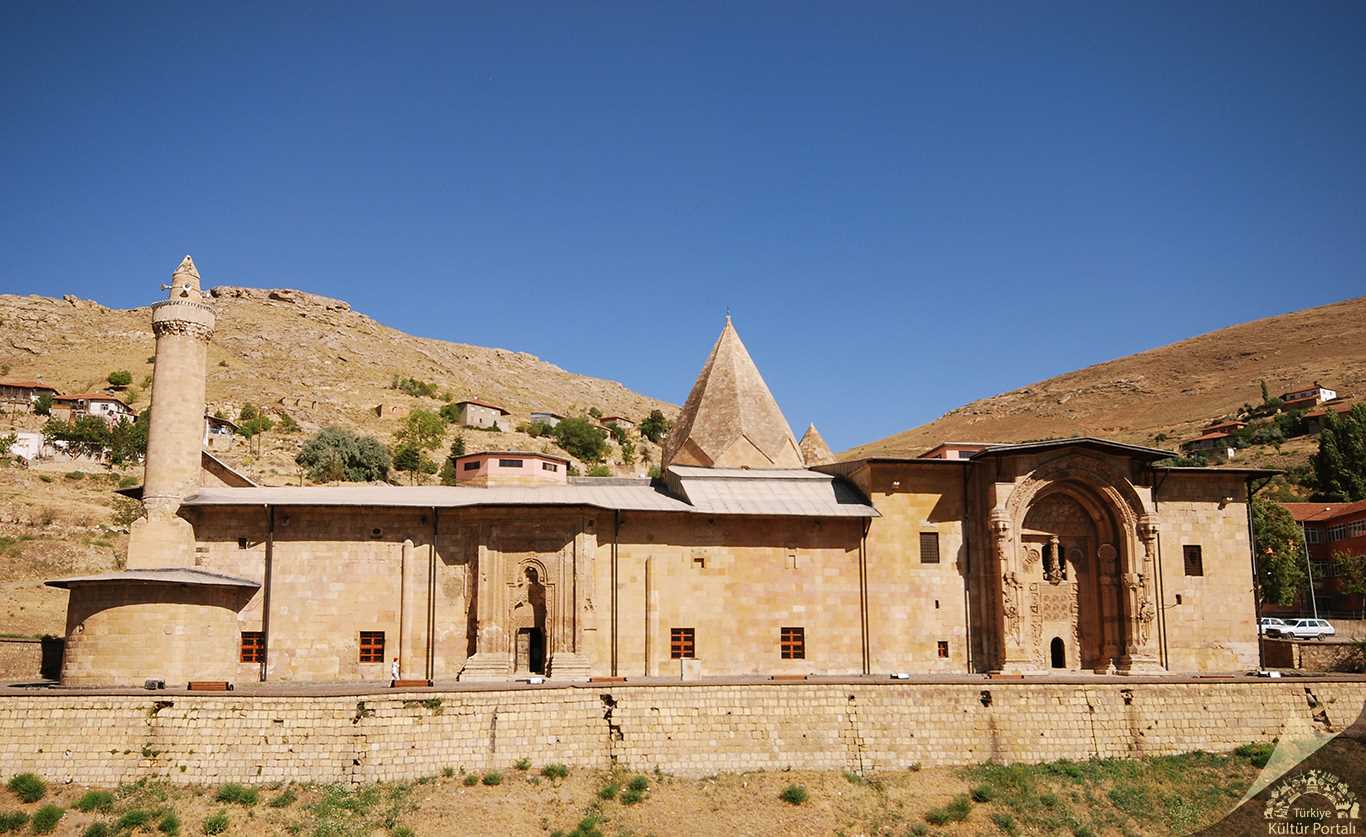
DivrigiUluCamiiveDarussifasi7_20160308144020956
Tephrike, stronghold of the Paulicians (today’s Divrigi, Eastern Turkey)
BasileiosWrestlingMatch
Basil the Macedonian (far left) defeats the Bulgarian wrestler in a wrestling match, Madrid Skylitzes


Though things seemed to be going in favor for the Byzantines when it came to expelling Arab raiders from their eastern frontiers more so with the power of the Abbasid Caliphate in decline thus creating smaller Arab emirates and small Georgian and Armenian Christian principalities along the border of Byzantium and the Caliphate, there happened to be a new unknown enemy that would attack Constantinople directly for the first time in 860 while Michael III himself was away in the east battling the Arabs.
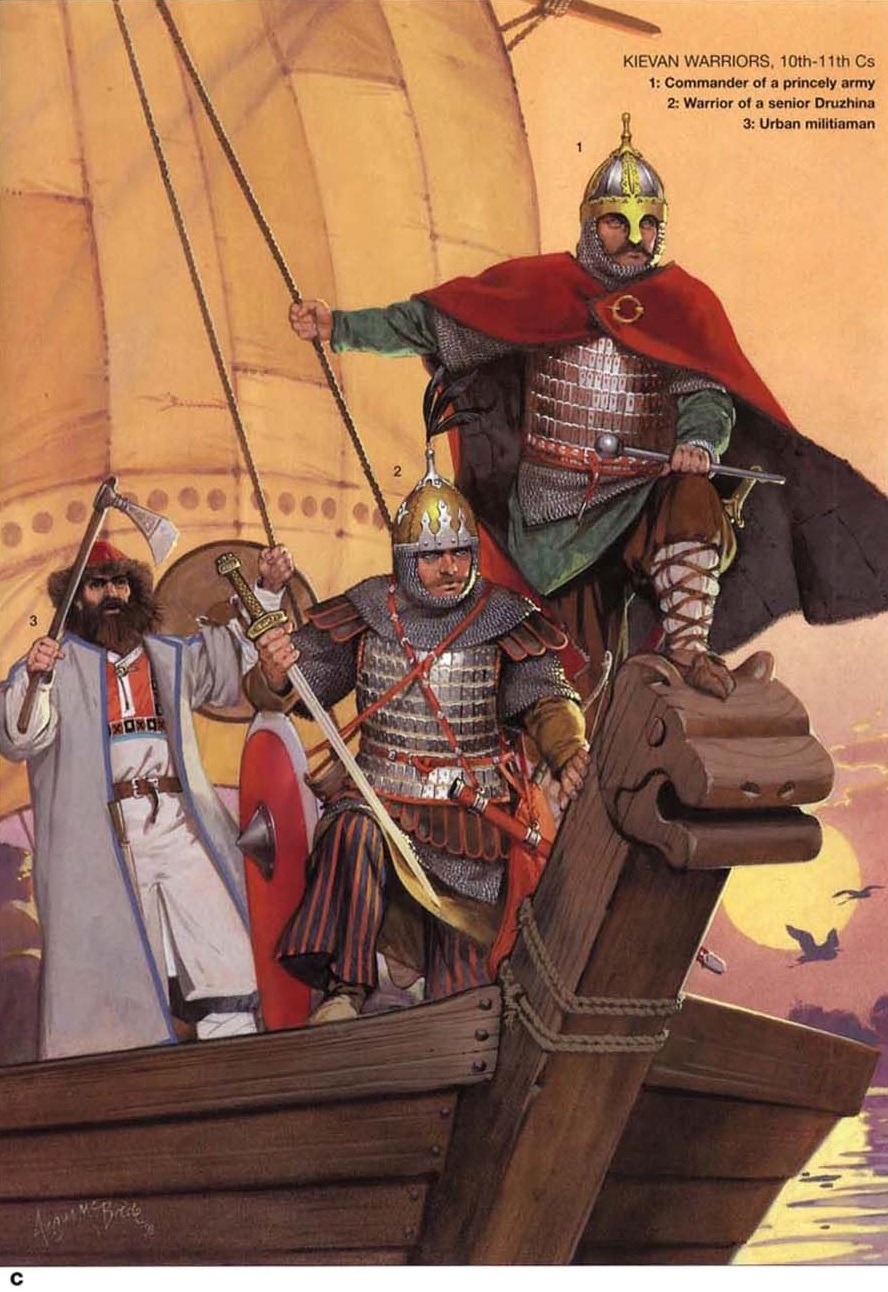
tumblr_od1nbtPwip1u6oeoao4_1280
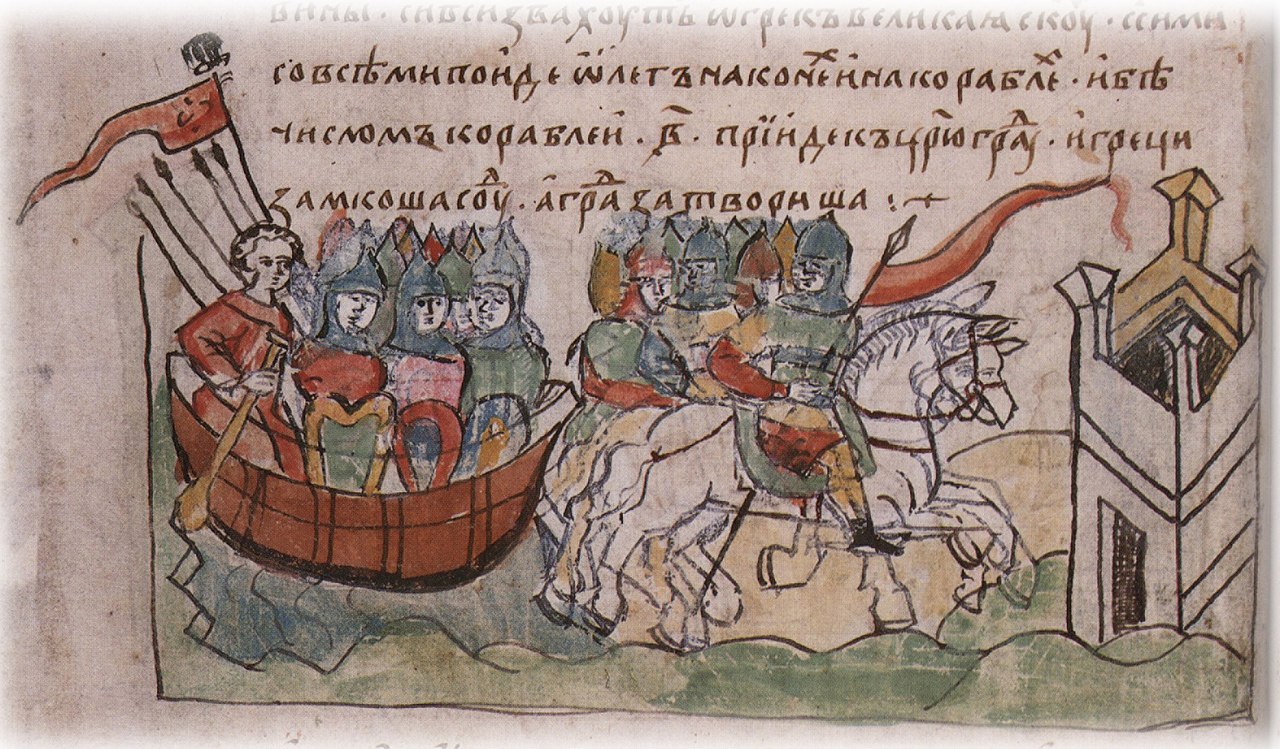
The Kievan Rus’ (Varangians) sail down to Constantinople from Russia, 860

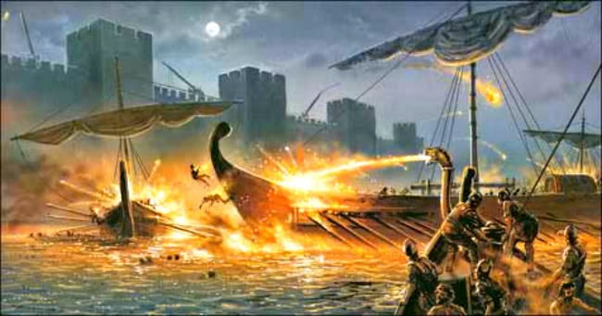
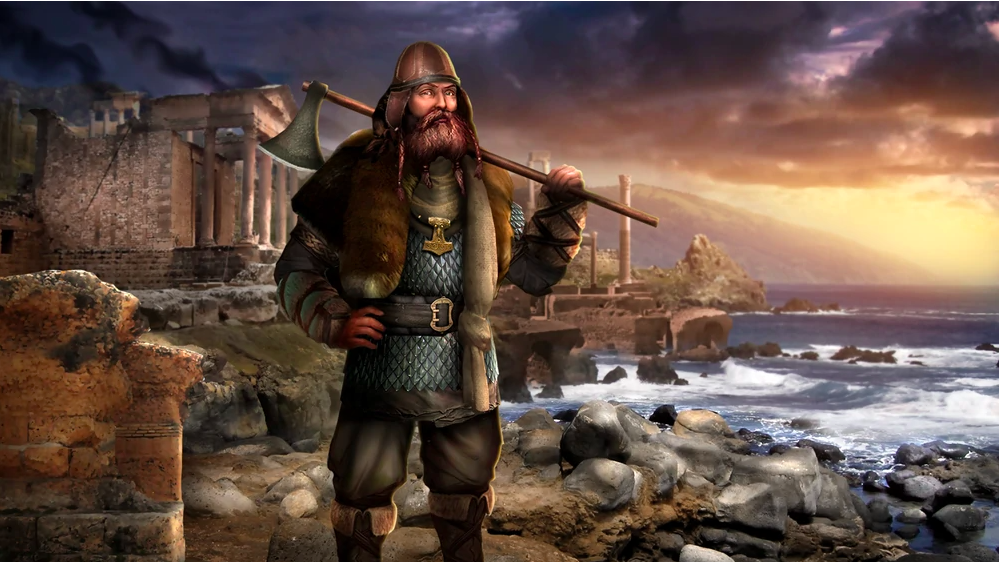
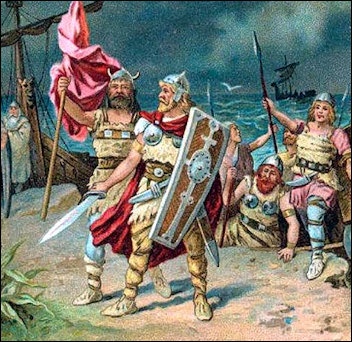
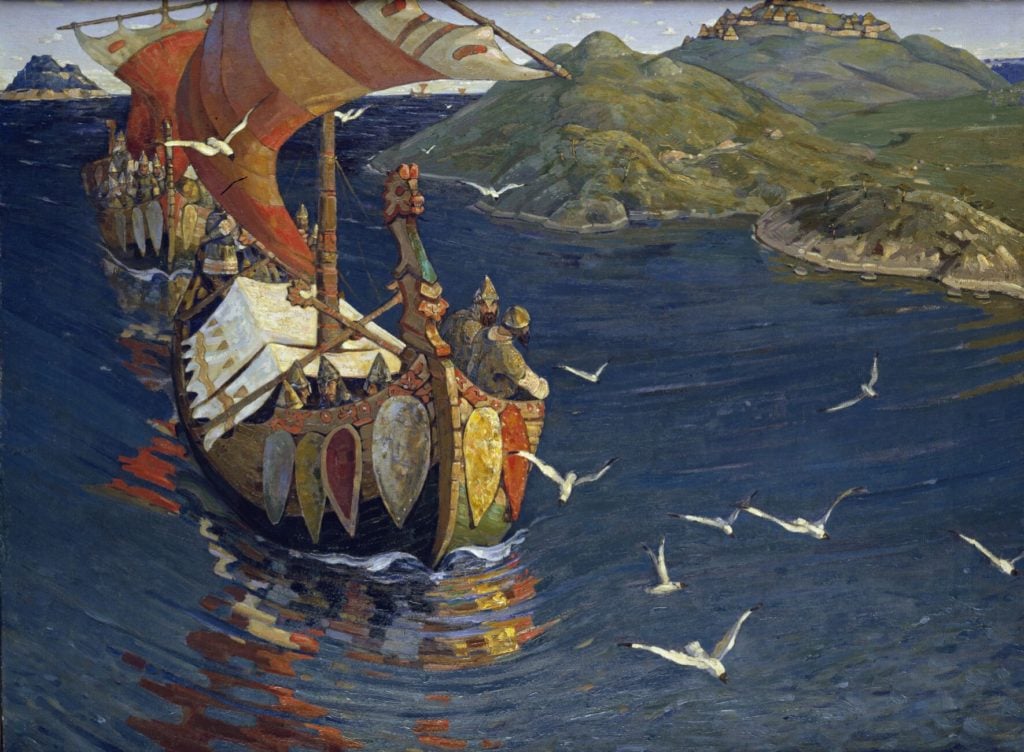
Here in 860, this unknown enemy that attacked Constantinople or at least its suburbs with their longships was the newly forming state of the Kievan Rus’ or basically the predecessor state of Russia, and these people back then were basically Norsemen from the eastern part of Scandinavia (modern day Sweden) better known as Varangians rather than Vikings, as Vikings refer more to the Scandinavians from the west (Norway and Denmark) that would come to attack Western Europe while the Varangians from Sweden led by a chief named Rurik would be the ones to sail into Russia and Eastern Europe. As you may all know that the 9th century over here was the era of the Vikings and this included the Varangians who like the Vikings in the west seeing their native land was too cold and overpopulated to farm in, they searched out for land to colonize, and here the Varangians sailed across the Baltic Sea into the rivers of Russia where they would establish trading colonies like Novgorod and Kiev and integrate with the local Slavic population there before establishing their own state there and then sailing out into the Black Sea to Constantinople. The Varangian warriors here better known as the Rus however did not really intend to besiege Constantinople but just lay waste to its suburbs and loot treasure in typical Viking fashion, and after they carried out their raid, they simply left the area when Michael III came back.
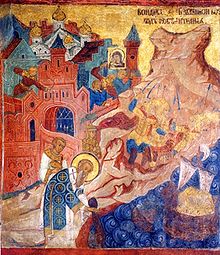
220px-Moscow_Kremlin_fresco_about_war_in_860
Fresco of the Rus’ attack on Constantinople, 860

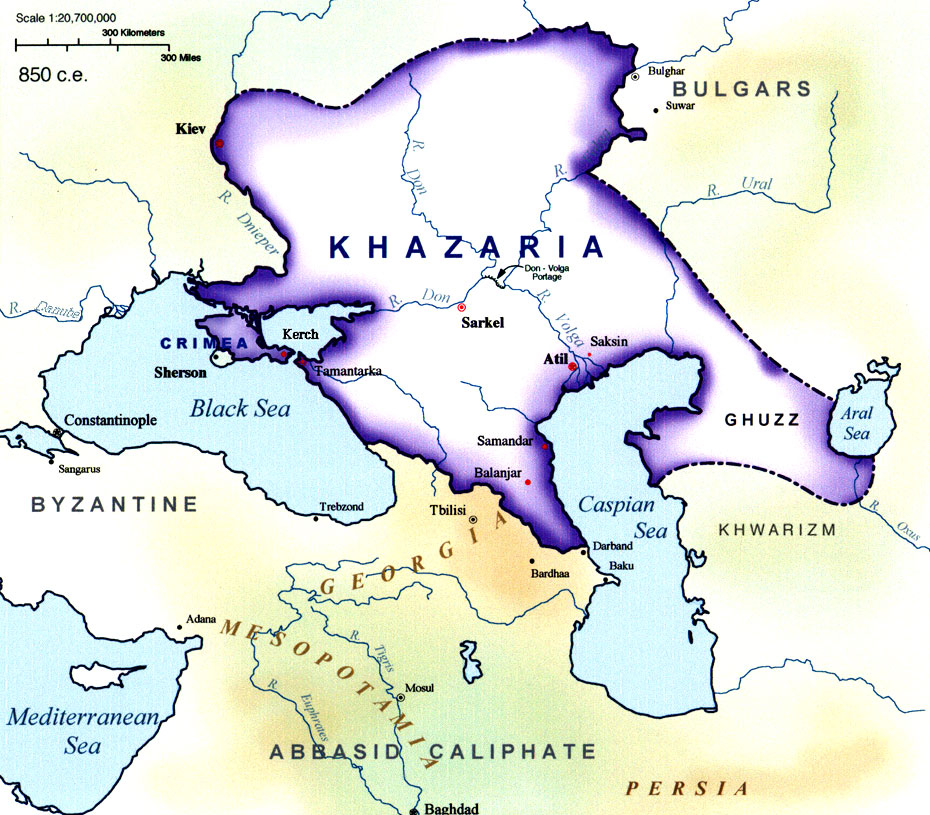
The Byzantine people however would never forget the fear caused by these warriors as their large sizes, messy hair and beards, and drunken behavior greatly intimidated them, though Patriarch Photios claims that the Rus departed because of divine intervention. When doing an investigation on the Rus’ attack, it turned out that it was indirectly caused by the Byzantines as back in Theophilos’ reign, he helped the still remaining Khazar Khanate in Southern Russia which was a long-time Byzantine ally construct the Fortress of Sarkel along the Don River which later blocked the Rus’ fleet from coming out to the Black Sea to trade, and in revenge for the Byzantines for helping build this fort, the Rus chose to attack Constantinople just to teach Byzantium a lesson. With this attack by the Rus, Photios decided that it was time to make a firm stance in converting the people up north to Christianity as a way to create allies rather than enemies, although Photios was actually doing this as part of the ongoing competition with the Church of Rome, and just like in the 20th century Cold War between the USA and Soviet Union where both were at race to beat each other into blasting off to space, here the Byzantine Empire and Papacy had their own Cold War in a race with each other on which of them would be first to convert the still Pagan Slavs and the still Pagan Bulgarian Empire up north, and apparently the Byzantines won it being first to convert the Slavs as Photios sent two missionaries deep into Central and Eastern Europe.
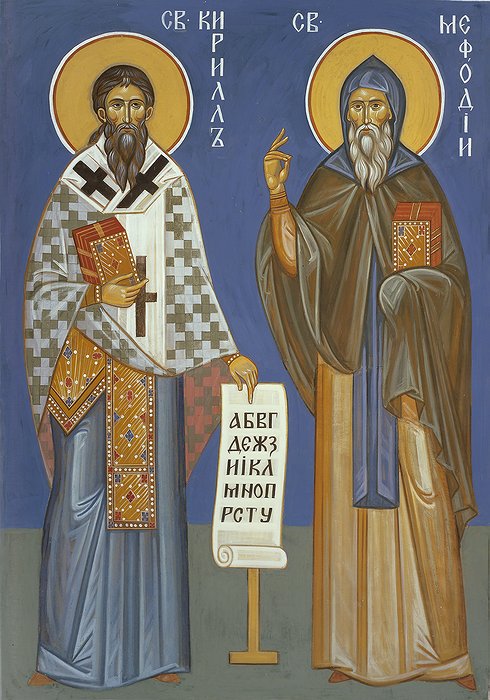
237372.b
Sts. Cyril (left) with the Cyrillic Alphabet and Methodius (right), Byzantine missionaries sent to convert the Slavs by Patriarch Photios

These two Byzantine missionaries Photios sent were the Greek brothers Constantine (renamed Cyril) and Methodius who had known the Slavic language therefore making it easier to spread Orthodox Christianity by preaching it in the people’s native Slavic language, and these brothers would end up spreading Orthodoxy to what is now Serbia, Croatia, Hungary, Czech Republic, Slovakia, Ukraine, and Russia, and despite the political agenda of Photios in converting the people of these distant lands just to beat the Church of Rome in doing so, these brothers would be forever remembered as saints, and their greatest legacy was in leading to the creation of the Cyrillic Alphabet named after the younger brother St. Cyril which would be the alphabet of many Slavic countries up to this day including Russia, though this would be more of a different story altogether. Back in the empire, Michael III would happen to be too trusting of the people that worked with him like his uncle Bardas who in 859 was promoted to the rank of Kouropalates or “Head of the Palace” and even Caesar in 862, though in 863 Michael himself led a military campaign together with his other uncle Petronas against an invading army of Abbasid Arabs and forces of their satellite Emirate of Melitene allied with the Paulician forces of Tephrike under Karbeas, and here at the Battle of Lalakaon in Paphlagonia (Northern Asia Minor), the Byzantine forces led by Petronas won a decisive victory over the Abbasids and their allies while the Paulicians’ leader Karbeas too was killed here. This victory thus happened to be the turning point wherein the tide of war against the Arabs truly switched to the offensive for the Byzantines, and this would be the reality for the Byzantines from here on, yet in the following year (864) something else went in favor for the Byzantines and this was with their northern neighbor, the Bulgarian Empire as their ruler Boris I finally chose to convert to Orthodox Christianity thus making Bulgaria fall under the Church of Constantinople and under the Byzantine sphere of influence.
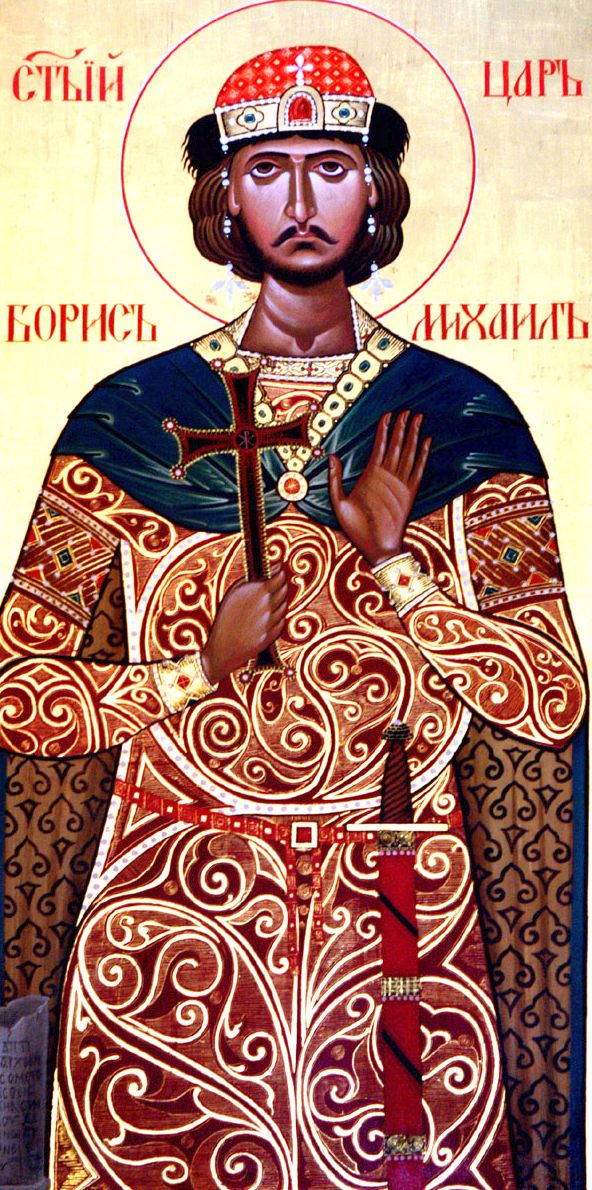
fd2b37d765189959f6d3c661a36bc97f
Boris I, aka. Boris-Michael, 1st Christian ruler of the Bulgarian Empire (852-889)

The reason now for Boris I to accept Orthodox Christianity was most certainly because he was pressured to do so according to the History of Byzantium Podcast, and I would agree with it too as Bulgaria here was surrounded by two powerful Christian Empires pressuring them to convert which were the Orthodox Byzantines in the south and the Catholic Carolingian Franks in the west and between both, Boris chose Byzantine Orthodox basically because Constantinople was closer to him and when being baptized as a Christian in the Bulgarian capital of Pliska, he changed his name to Boris-Michael using the name of his godfather, the Byzantine emperor Michael III who although was not at his baptism. As for Michael III, despite so much successes happening in his reign, he really had nothing to do with it, but no matter how irresponsible he was as a ruler who did not really give a care about anything, he had competent people behind him such as his uncles Bardas and Petronas as well as Patriarch Photios while Michael was busy partying with his friends that one time according again to the History of Byzantium Podcast, he participated in the chariot race in the Hippodrome himself and once played around with his friends dressing up in stolen clerical outfits dancing around in the streets of Constantinople as if he was mocking the clergy. Michael had also grown closer to his bodyguard Basil as the years passed which also helped Basil rise up the ranks that soon enough Michael as an act to keep his longtime mistress Eudokia Ingerina closer to him as he was still married to his wife that he did not love, he had Basil divorce his first wife Maria despite them already having a son named Constantine, thus having Basil marry Eudokia as Michael wanted to still keep her closer to him, and Basil was in fact the closest person to him.
gettyimages-526512270-594x594
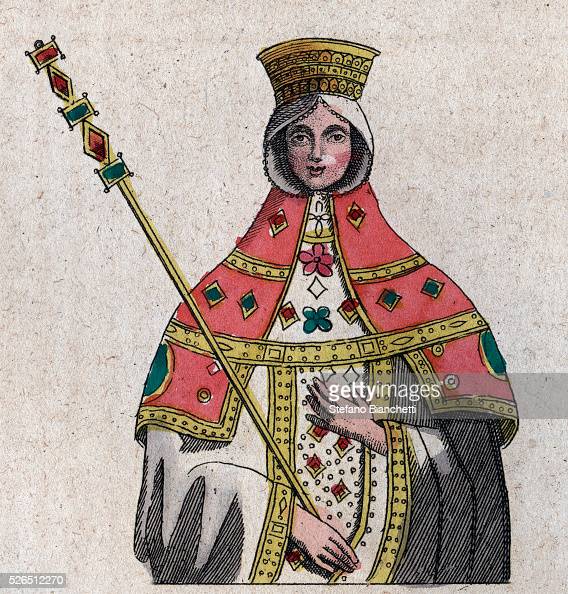
Eudokia Ingerina, mistress of Michael III, wife of Basil the Macedonian

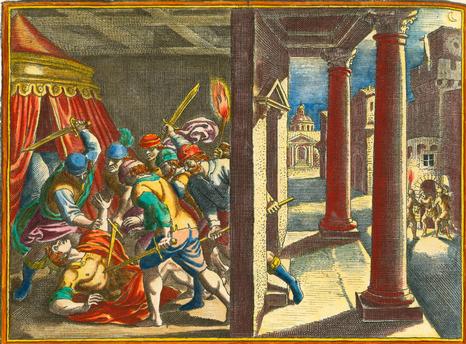
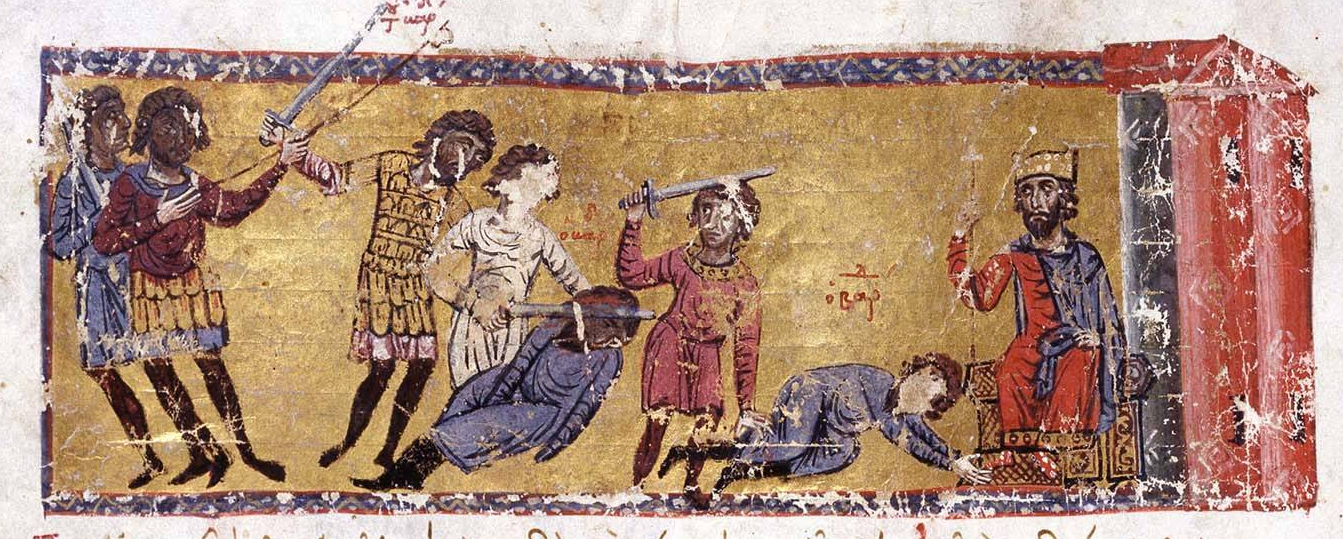
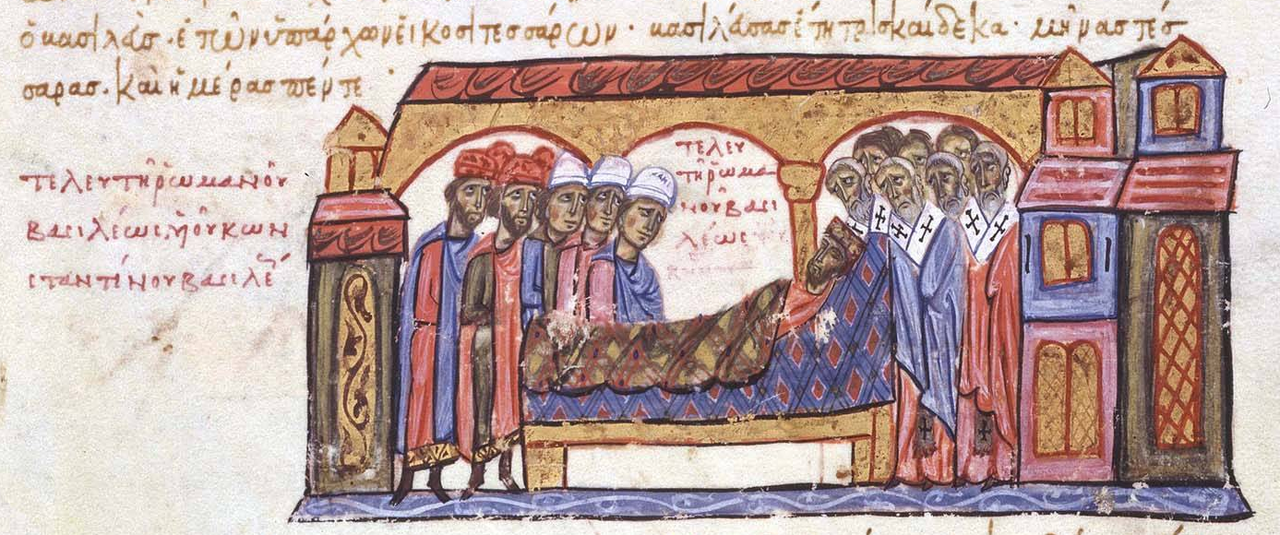
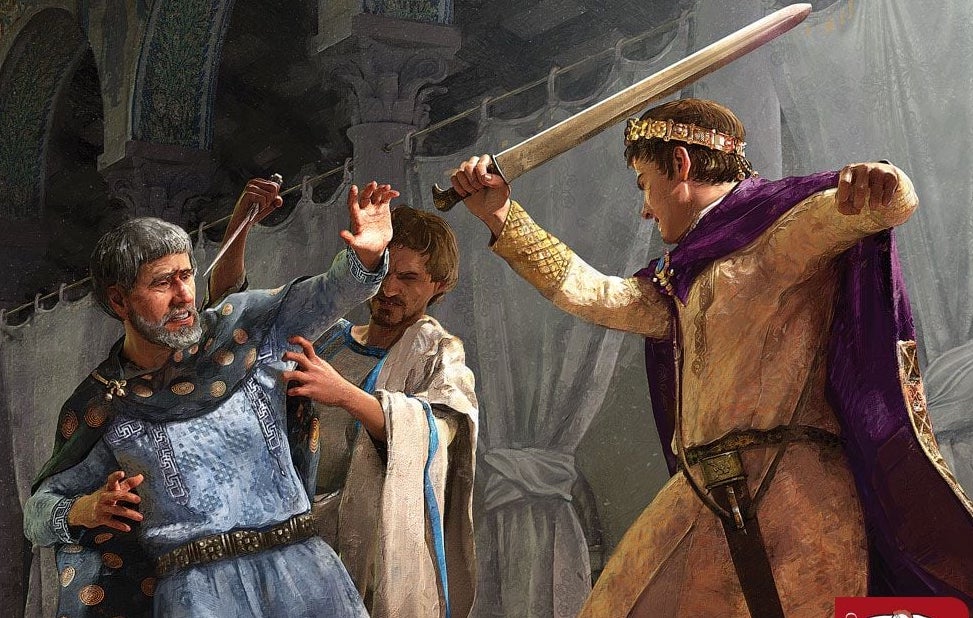
Unfortunately, the people in the government that Michael put all his trust to would not last long enough as in 865 his uncle Petronas had died, and in 866 when Bardas was preparing for another attempt to retake Crete from the Arab pirates, Basil would show his true ambitions and here he falsely accused Bardas of plotting against Michael to take the throne from him, and Michael as usual easily fell for this lie and had Basil execute Bardas which Basil successfully did, thus Basil replaced Bardas as Caesar and then even as co-emperor, though the expedition to retake Crete never happened. In 866 as well, Eudokia would give birth to her first son named Leo and his birth was celebrated with races in the Hippodrome, but it was unclear on who his father actually was whether it was her husband Basil or her lover Michael III, but this story would go with Michael III the Amorian as Leo’s father as Michael was closer to Eudokia more than Basil was, and being unable to have children with his first wife, he thought that he could use Eudokia to continue his dynasty by having sons with her. Basil on the other hand was still ever more eager to rise up to power as when already getting a taste of it, he could not stop and this meant wanting to be able to achieve the most powerful position of the empire, which was that of emperor. One night in 867 as Michael III with Basil and Eudokia were at a dinner in a palace in the Galata District of Constantinople found across the harbor of the Golden Horn, with Michael as usual drinking to get wasted, hence his nickname “Michael the Drunkard”, Basil used Michael’s drunkenness to his advantage, and so he went to Michael’s bedroom and broke the locks of the door and escaped to the Imperial Palace in the main part of the city. Michael being so wasted was carried to his bed, but some hours later as the door’s lock was broken by Basil, assassins sent by Basil rushed into the room and stabbed Michael to death. Now because of this, it can be said that Michael III’s personality of being too trusting of others too much led to his downfall especially when putting trust in someone like Basil who happened to be a murderer with his own imperial ambitions. Following his assassination, Michael was quickly buried in a small church across the Bosporus wherein only his mother Theodora and sisters were allowed to attend his funeral, though later this year (867), Theodora too would die.         
The-Rus-Wikiwand-1024x752
Kievan Rus’ (Varangian) longships in the Russian river systems
09bbb4a7b925c8d4e49958ad050508db
Byzantine forces under Petronas and Michael III defeat the Arabs and Paulicians at the Battle of Lalakaon in 863, art by FaisalHashemi
The_murder_of_the_Caesar_Bardas
Execution of Bardas Caesar, 866
7626
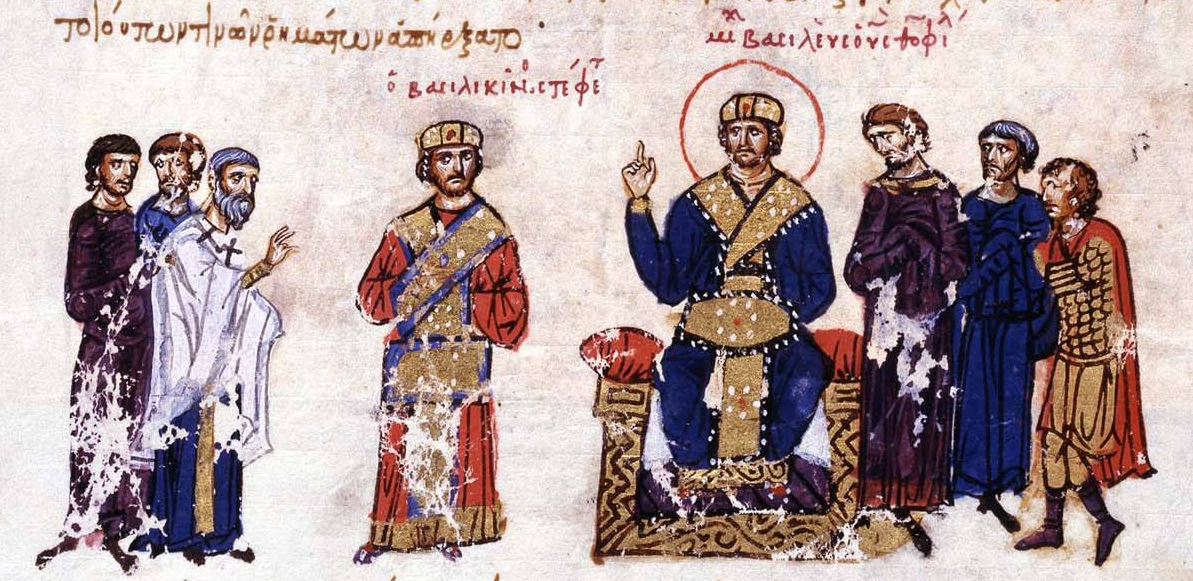
Michael III (right, in blue) makes Basil the Macedonian (left, in red) his co-emperor, Madrid Skylitzes
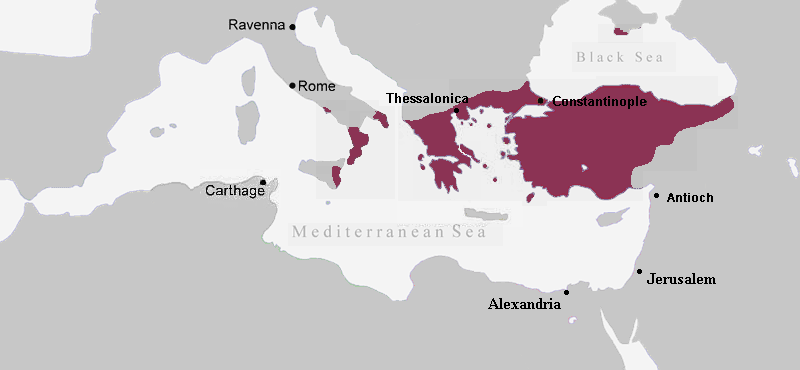
ByzantineEmpire867AD4lightpurple
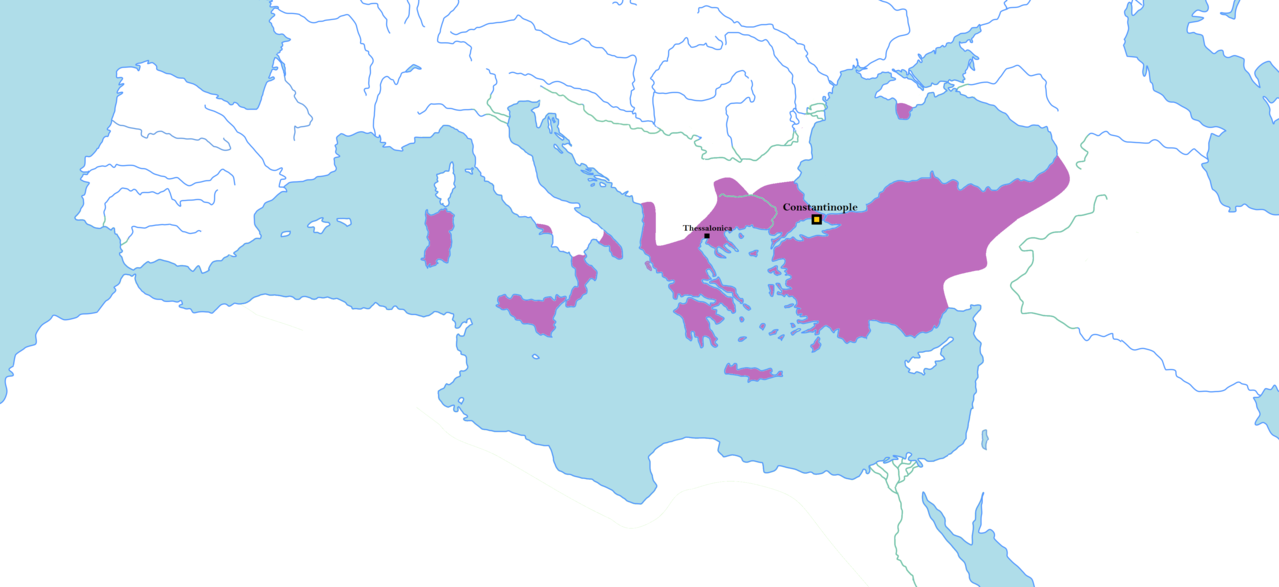
Map of the Byzantine Empire (purple) in 867 at the rise of Basil I the Macedonian


Here in 867 following the assassination of Michael III, Basil I the Macedonian at age 56 after just 10 years of knowing the previous emperor was now the sole emperor of the Byzantine Empire. The situation happened to be quite embarrassing here as a simple peasant turned horse tamer and wrestler who not only had no formal education but in fact was an illiterate person became the sole ruler of the empire, but despite being illiterate and uneducated, he was very intelligent and this was how he was able to find the right moment to usurp power and kill off Michael III, though everyone really just saw Basil as a man of great size, height, and physical strength, and nothing more.
Vasileos_I_large
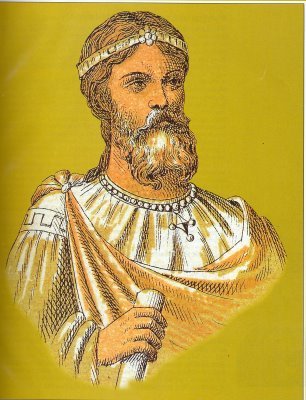
Emperor Basil I the Macedonian (r. 867-886)

In order to justify killing Michael III, Basil told everyone he was just doing this to save the empire as Michael III true enough was an irresponsible drunk who could not be trusted as if he continued ruling alone with his uncles Bardas and Petronas gone, then all the hard work that was previously done to improve the empire would easily be wasted away. However, Basil was not the first to take the throne this way as just 47 years earlier in 820 Michael III’s grandfather Michael II did just that by killing off Leo V in the Christmas Mass, therefore Basil I’s murder of Michael III seemed justifiable and nothing new to the people of Constantinople and the army, but also Basil’s usurping of power would also be justifiable as he was getting rid of the corrupt Amorian Dynasty which is what Basil’s biography written by his grandson, who will appear later would say about him. On the other hand, Basil also wanted to show that he did not really kill off the Amorian Dynasty by telling everyone basically that his son with Eudokia which was Leo was actually Michael III’s, which in this story would be true making Leo an Amorian. Now just after becoming the sole emperor or Basileus of the empire, Basil I despite knowing very little about Church politics would show his hidden ability in politics when suddenly firing Photios from his position as patriarch and replacing him with the former now 70-year-old patriarch Ignatios who back in 858 was fired by Bardas and by firing Photios, Basil was actually doing this as an act to be in good terms with the new pope in Rome Hadrian II who was just elected in 867 too and with Photios who was at odds with the Papacy removed, the pope in Rome and Byzantium would be in good terms again, and now with Photios fired ends the Photian Schism. Now when it came to ruling, Basil I wanted to show his subjects he was a devout Christian unlike his predecessor Michael III who was the opposite being quite disrespectful to his faith and debauched in lifestyle which shocked his subjects, but also to show that he was a just usurper rather than a bloody killer, Basil acted as a strong protector of the poor and lower classes from corrupt eunuchs and tax officials considering that he came from the lower class, though a lot of Basil’s reputation as this type of ruler was mostly exaggerated in his biography by his grandson.
257424989_2703486683279268_191912534609225056_n
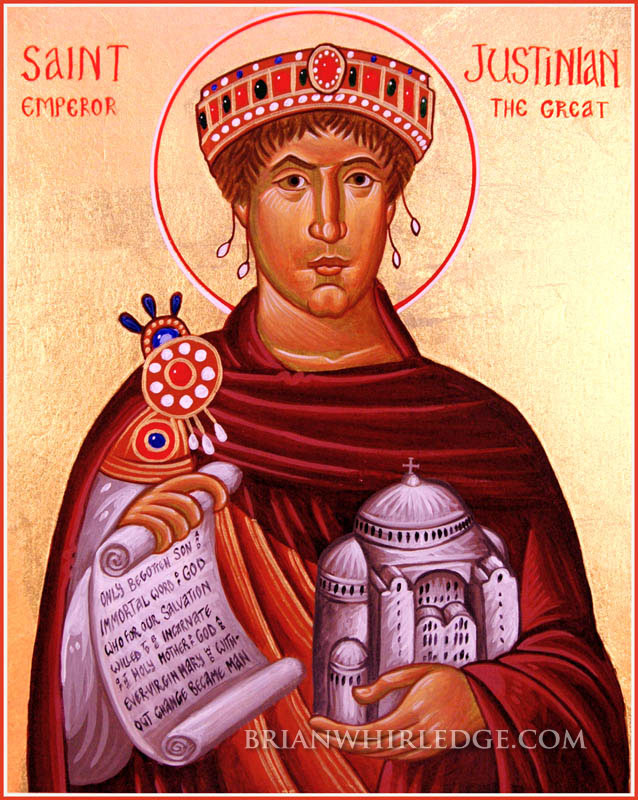
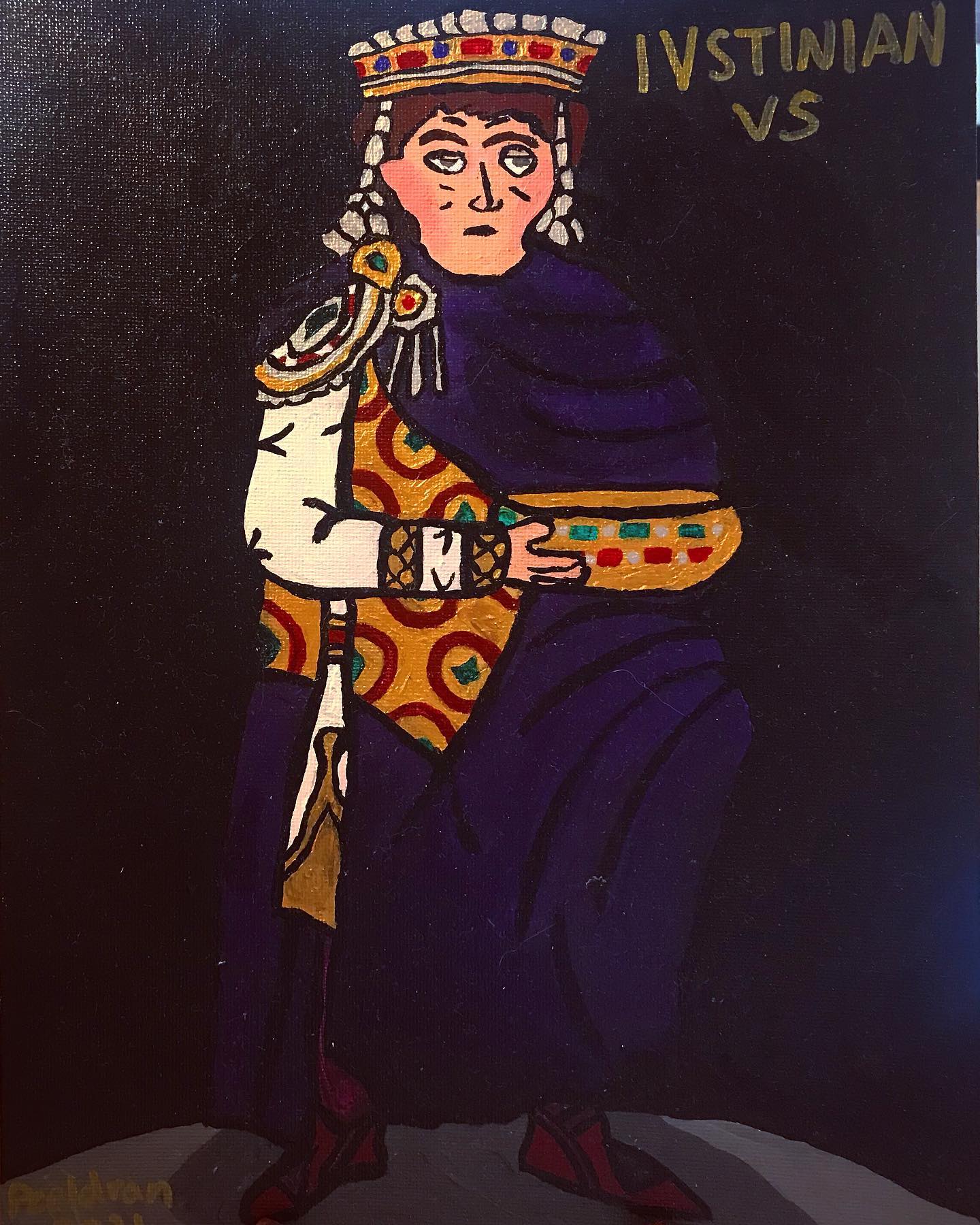
Emperor Justinian I the Great of Byzantium (r. 527-565), acrylic painting, art by myself

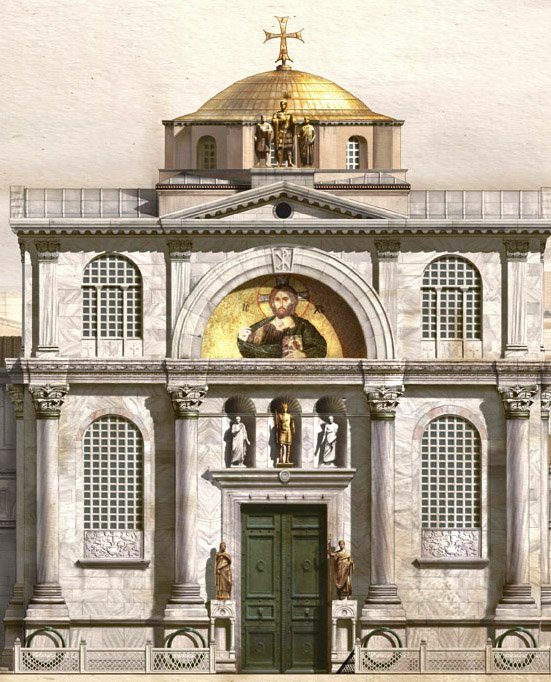
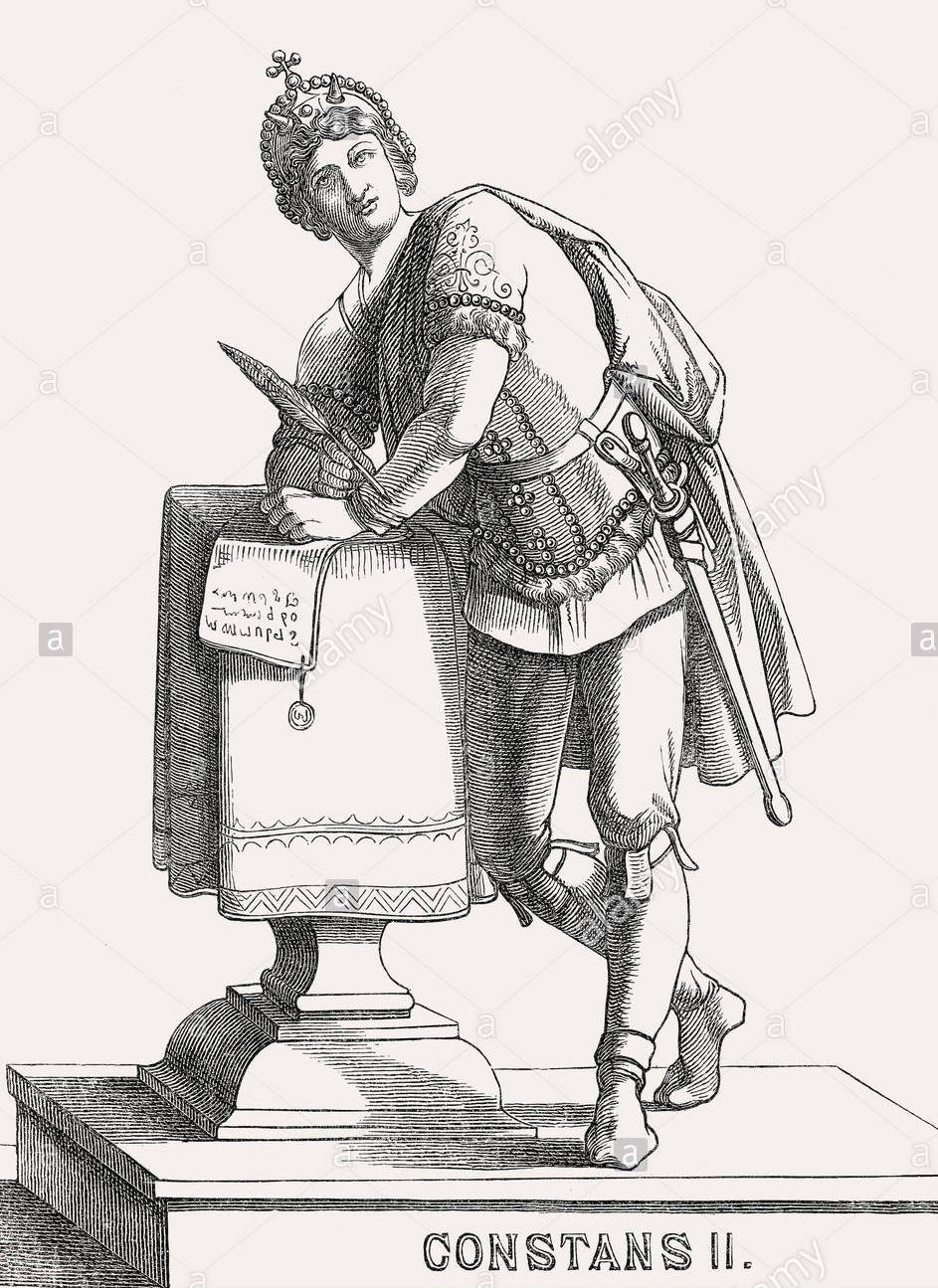
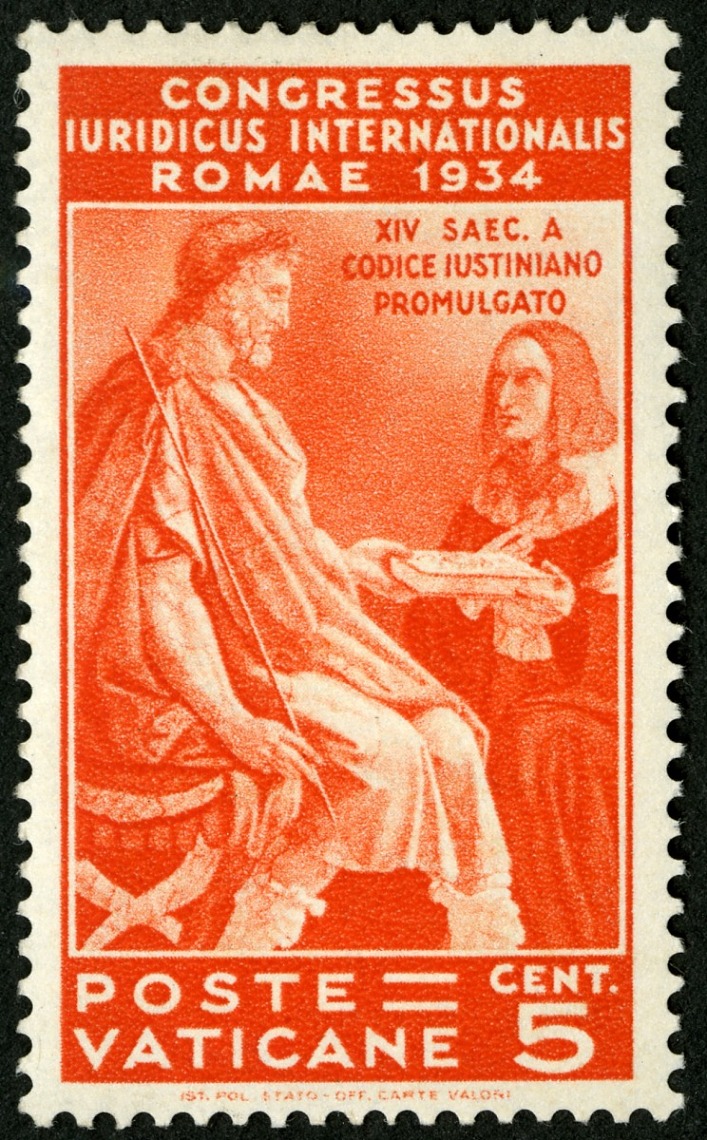
On the other hand, Basil was also trying to make an image of himself as the new Emperor Justinian I the Great (r. 527-565), the greatest Byzantine emperor so far, and to imitate Justinian I Basil carried out the ambitious project of recodifying Justinian I’s Corpus Juris Civilis itself or Code of Laws for the empire, and although Basil was illiterate, all he could do was commission the recodification of Justinian’s laws and its translation into Greek, and this new edition of Justinian’s code of laws would be known as the Basilika, though not named after him as its title actually means “Royal Laws” in Greek, and this would be the code of laws the Byzantines would use till the end of their empire. Like Justinian I, Basil also carried out ambitious construction projects, although a lot of others before including the Magnaura school which taught astronomy, geometry, and philosophy was already established by Bardas previously, so basically what Basil would do was to build a church that would rival Justinian’s 6th century Hagia Sophia cathedral in grandeur, and this church built by Basil I was the Nea Ekklesia in the Imperial Palace Complex which although was not as large as the Hagia Sophia near it but had the innovation of having 4 domes surrounding a higher inner dome, thus being the first Byzantine church in this new style. Its interiors would then have some of the finest frescos and mosaics in a new style that emerged in this era following the end of the Iconoclast period. Like Justinian I as well, Basil I also came from humble origins except Justinian was highly educated while Basil still remained illiterate even deep into his reign that he would only use a mark rather than his signature in signing documents. Just like emperor Justinian I again, Basil I would also have some interest in restoring Byzantine rule to the west in which no emperor prior to him did since Constans II (r. 641-668) 200 years earlier- the lead character of chapter IV of this series. Basil I would show his interest in wanting to restore the Byzantine west in 870 when he allied himself with the current Carolingian Frankish emperor Louis II, the grandson of the Frankish Empire’s founder Charlemagne (r. 768-814) in fighting off Arab attacks in Southern Italy which happened to be successful as in 870 the Byzantine fleet in the Adriatic Sea was able to defeat an Arab fleet and afterwards annex the Dalmatian Coast (in today’s Croatia) as part of the Byzantine Empire in order to protect it thus making Dalmatia a Theme, while the city of Bari in Southern Italy which previously fell to the Arabs in 871 fell under Louis II, though after Louis’ death in 875 the Byzantines would take back Bari. Now the successful general who would be responsible for these victories in Italy was the Cappadocian Greek noble Nikephoros Phokas the Elder, though it would be his grandson mentioned later who would be the more famous person with the same name. At the same time as Basil I busied himself fighting wars in the west, the Paulicians of Tephrike in Eastern Asia Minor again came back into the picture and this time a much bigger threat under a strong leader named Chrysocheir who succeeded Karbeas as the Paulician’s leader, and in 872 Basil himself personally led the army determined to crush the Paulician heretics in battle once and for all. When confronting the Paulicians in Eastern Asia Minor at the Battle of Bathys Ryax, Basil himself almost lost his life if not for one of his soldiers being the Armenian peasant Theophylact Lekapenos saving his life here, but at the end of the day the Byzantine forces still won the battle and Chrysocheir himself was killed while the entire Principality of Tephrike would be annexed into the empire, though the city itself would only be fully conquered and destroyed in 878. Back in Constantinople, Theophylact would be promoted to be a member of the emperor’s elite guard or Tagmata but he would have no so such ambitions, although his son who would later appear would. Now with the Paulicians fully removed as a political power, the remaining Paulician believers would be forced to settle in other parts of the empire to prevent them from starting another rebellion, and many Paulicians would end up fleeing north into the Balkan heartlands.
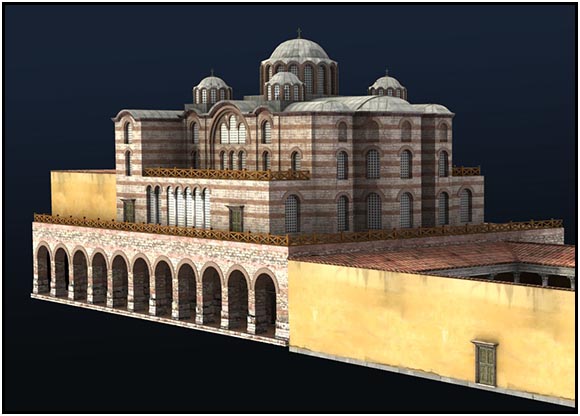
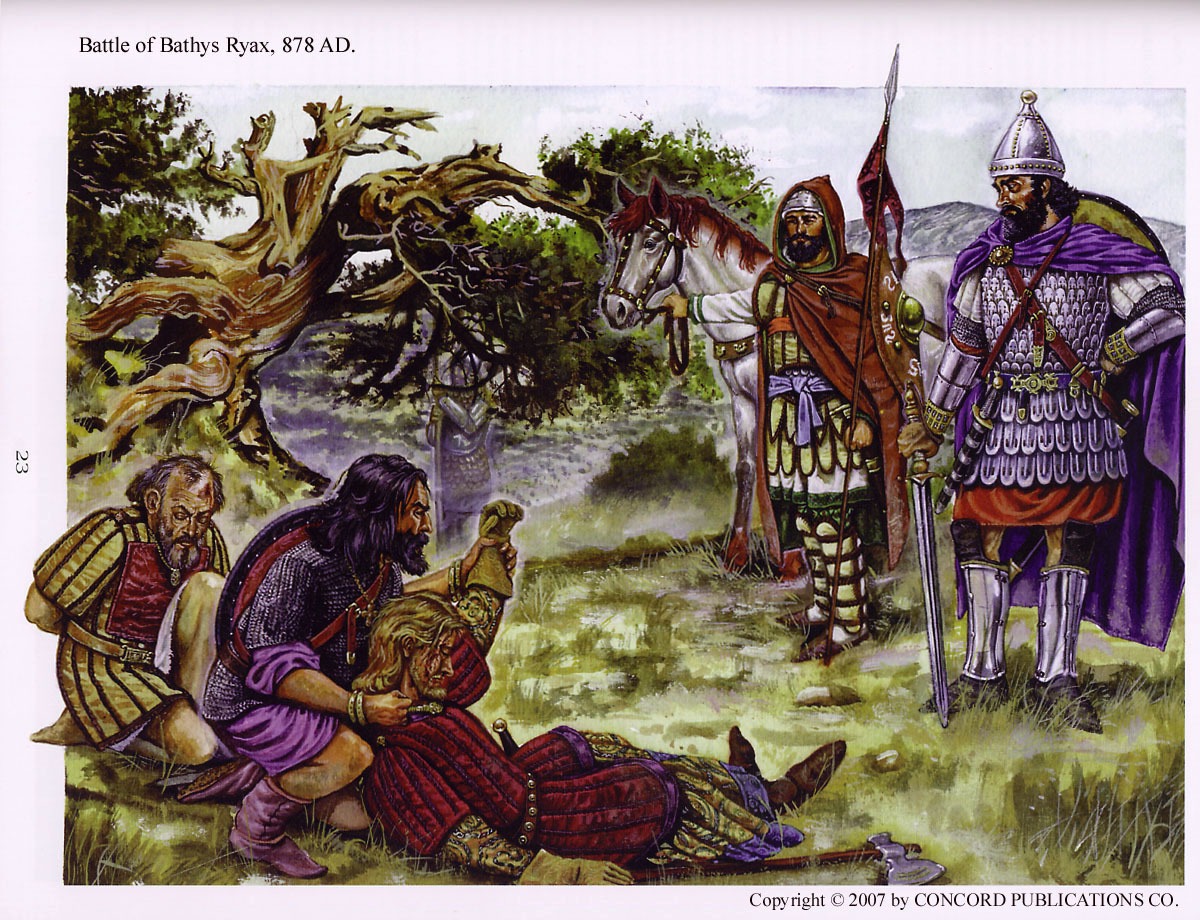
nea-eccl
Church of Nea Ekklesia in Constantinople’s Imperial Palace Complex, built under Basil I
c773cc3a963e
Basil I’s Byzantine army defeats the Paulician forces at the Battle of Bathys Ryax, 872

On the other hand, it seemed like Byzantine missionary activities were successful in Christianizing the Balkans that Photios being a politician needed to be restored as patriarch and so when the 80-year-old Patriarch Ignatios died in 877, Basil reappointed Photios as patriarch who at the same time would also be the teacher of Basil’s sons. The rest of the events however would turn out disappointing and even sad for Basil in the next years as first in 878 Syracuse which was the main city of Byzantine Sicily would fall to the Arabs, and in 879 Basil’s son and co-emperor Constantine with his first wife Maria suddenly dropped dead, therefore he had to make his youngest son with Eudokia Ingerina which was Alexander as co-emperor, and Alexander certainly was Basil’s son with Eudokia as he was born in 870 long after Michael III died which is why Basil favored Alexander more than Leo who was actually Michael III’s son, but on the other hand Basil saw Constantine’s death as divine punishment for killing Michael III.
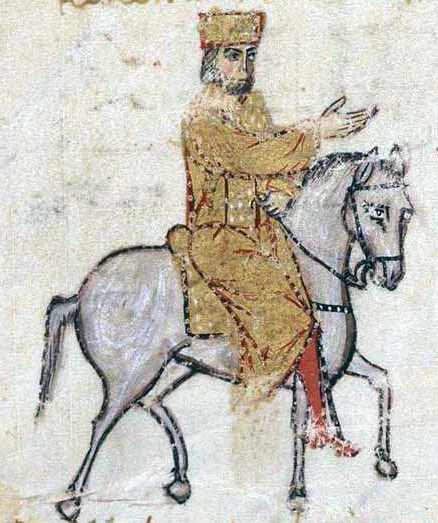
Basil_I_(867-886)_from_the_Chronikon_of_Ioannis_Skylitzes
Emperor Basil I on his horse

In 880, there would at least be some success for the Byzantines as Nikephoros Phokas the Elder was able to recapture much of Southern Italy from the Arabs but in 882, Basil would be depressed again as his wife Eudokia had died and by being more depressed, Basil would become even more paranoid as the years would go by especially with Leo who he never believed was his son anyway that Basil would in some occasions physically beat Leo basically for no clear reason except that Leo was nothing like Basil who being very manly enjoyed hunting and sports while Leo was a serious scholar who enjoyed books, and true enough Leo too did not see Basil as his real father and obviously- in this story’s case- Leo looked nothing like Basil who was large in size with a rough face, but rather Leo looked more like Michael III being thinner and shorter with a finer face. At one point, Basil even suspected Leo of trying to kill him to avenge his father Michael III’s death when Leo was discovered holding a knife even if he had no harmful intention with it, though Basil being paranoid had Leo put in prison for this, though it caused public rioting as Leo was actually loved by the public.
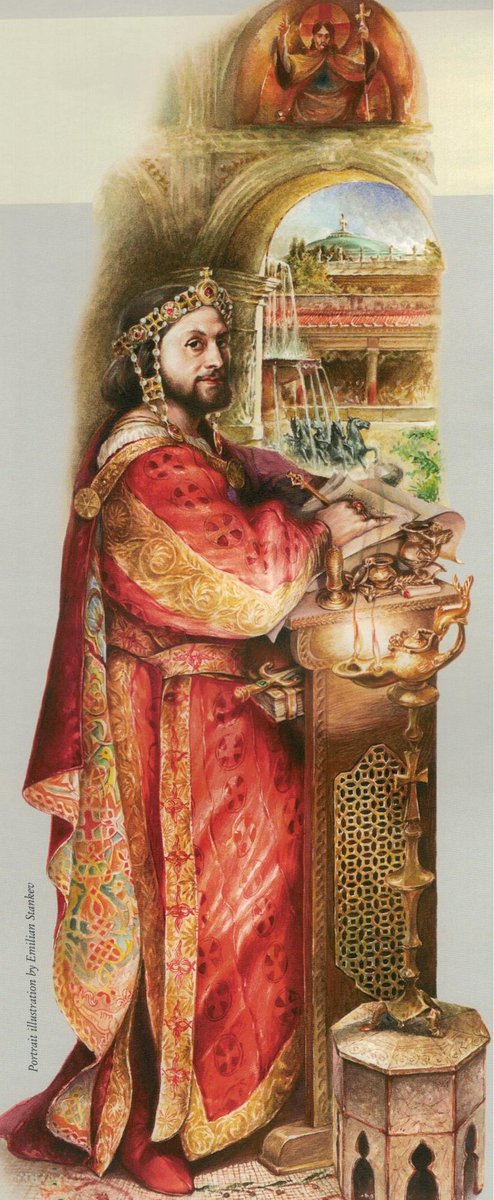
CknTTOfWEAAOeMz
Emperor Basil I in the Imperial Palace

Basil however thought of blinding Leo but was persuaded to not do it by Patriarch Photios, while one story which would be true here says that a parrot sang to Basil telling him to spare Leo but Basil not listening killed the parrot by breaking its neck, although feeling guilty for killing the parrot, he still released Leo from prison here in 886 after a 3-year sentence and restored him as co-emperor. Now in the summer of 886 after getting some relief, the now 75-year-old Basil spent some leisure time going hunting in the woods in the Asian side of Bosporus, but when hunting he ended up losing his hunting party getting stranded in the woods alone when a stag all of a sudden grabbed Basil’s belt with its antlers thus pulling him off his horse and dragging him for 16 miles through the woods as the story goes. Some hours later, the injured Basil was found by a man who cut him loose but still paranoid, Basil had the man killed for holding a knife in front of him and 9 days later, Basil would die on August 29 of 886 in his hunting lodge from the injury caused by the stag after a 19-year reign. Here, he died at least going such a long way from peasant to emperor who left behind many extravagant palaces and churches in Constantinople, and more importantly a full treasury, but little did he know that he was the first and last of his Macedonian Dynasty.
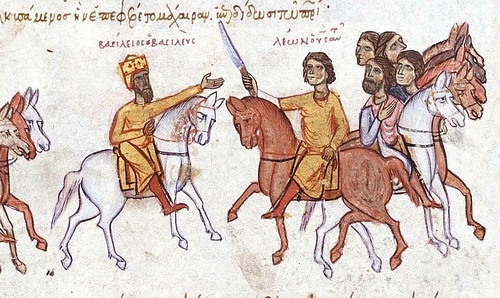
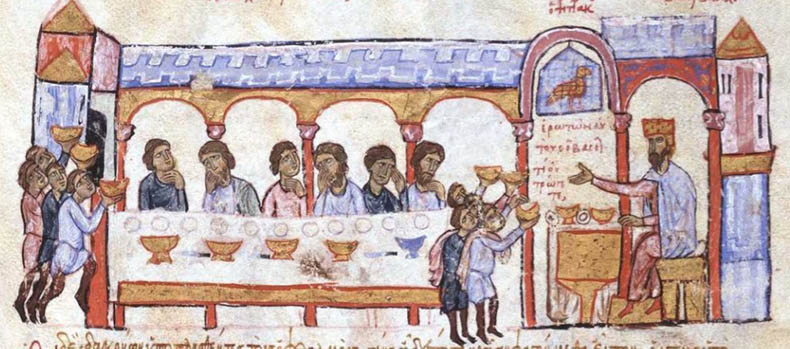
7642
Basil I and Leo holding out a knife, Madrid Skylitzes
000-00-byzan-parrot
Basil I and the parrot, Madrid Skylitzes
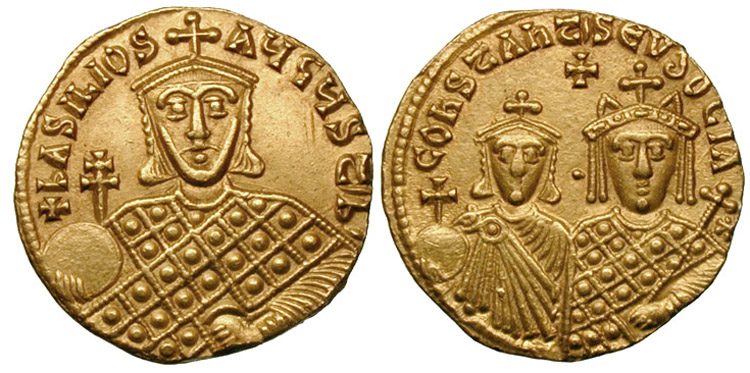
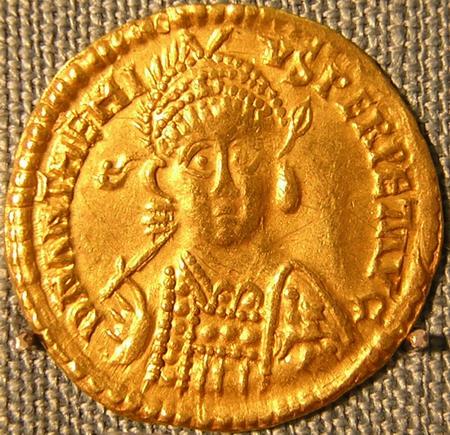
Solidus-Basil_I_with_Constantine_and_Eudoxia-sb1703
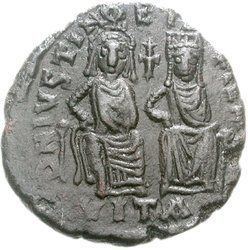
Coin of Basil I (left) with his son Constantine and wife Eudokia (right)

Watch this to learn more about Basil I’s life and reign (Jabzy).


Leo VI the Wise, A Serious Scholar but a not so Successful Ruler (886-912)         

Palaiologos_Dynasty_emblem1

After Basil I’s death, Leo VI known as “the Wise” came to the throne before turning 20 and despite him not actually being Basil’s biological son, he still became emperor as he was Basil’s legal son and the eldest surviving one. Basil I’s death caused by a hunting accident on the other hand sounded very suspicious, and it may have seemed Leo was involved in it as at Basil’s deathbed, one of Leo’s closest advisors was present which was Stylianos Zaoutzes, and it could have been him that poisoned Basil, but this cannot be entirely proven.
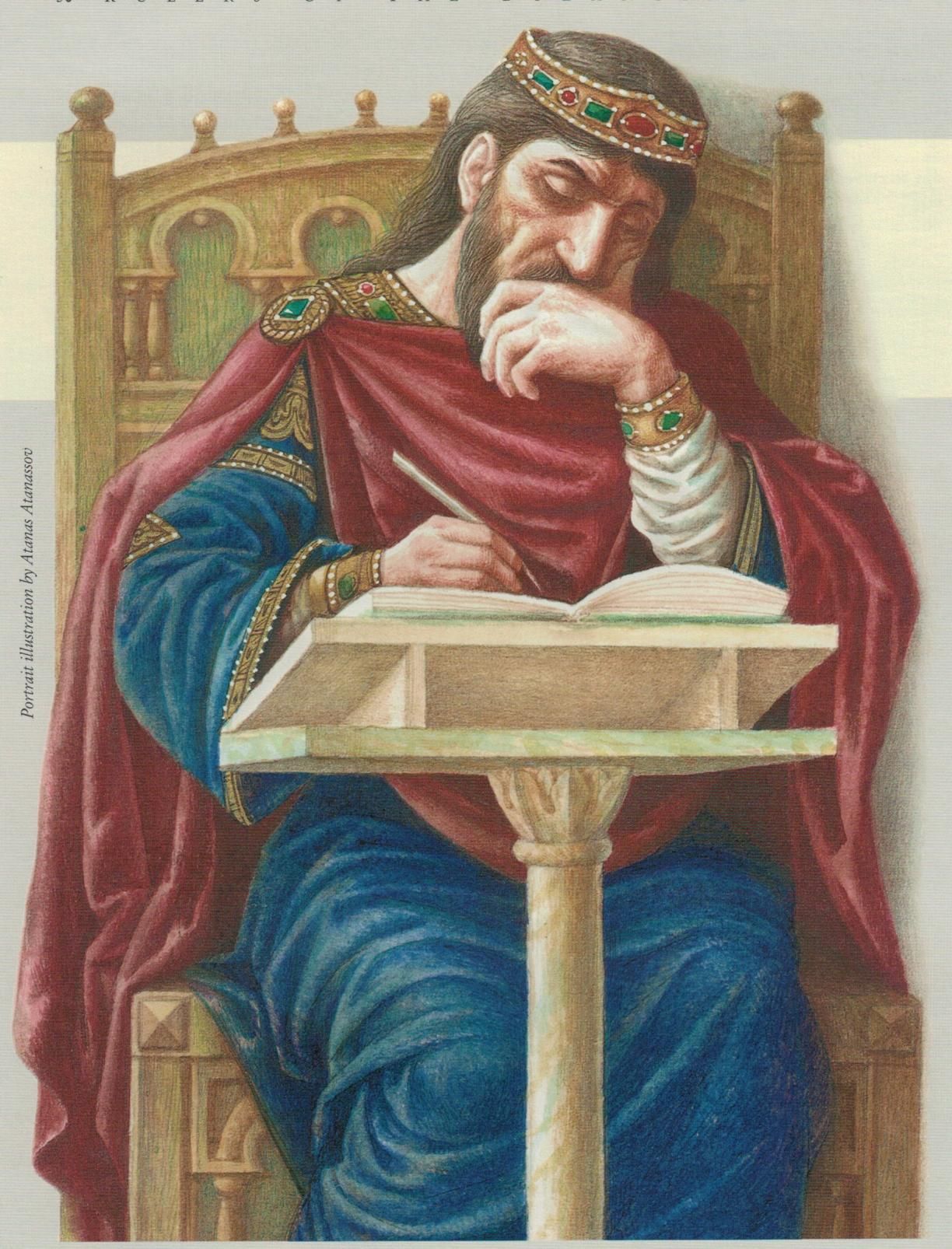
b4ac6e6049f61ec62e9b7b50e8b4a3ed
Emperor Leo VI the Wise (r. 886-912) in his study

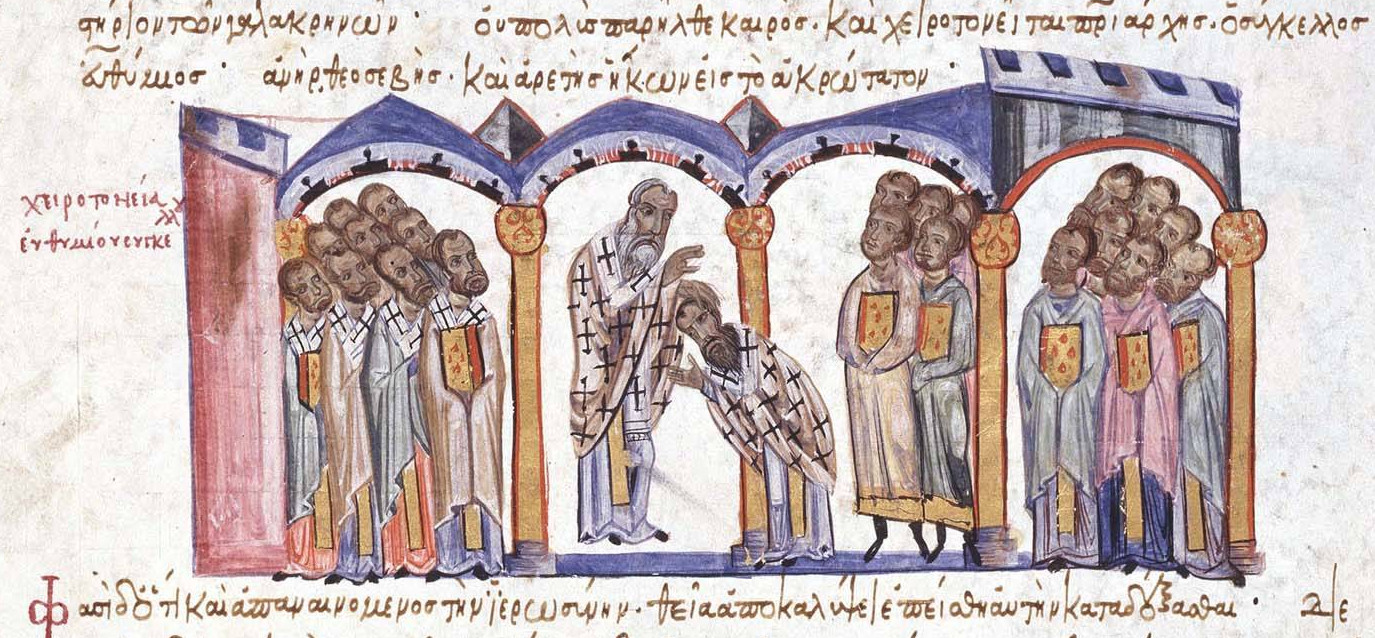
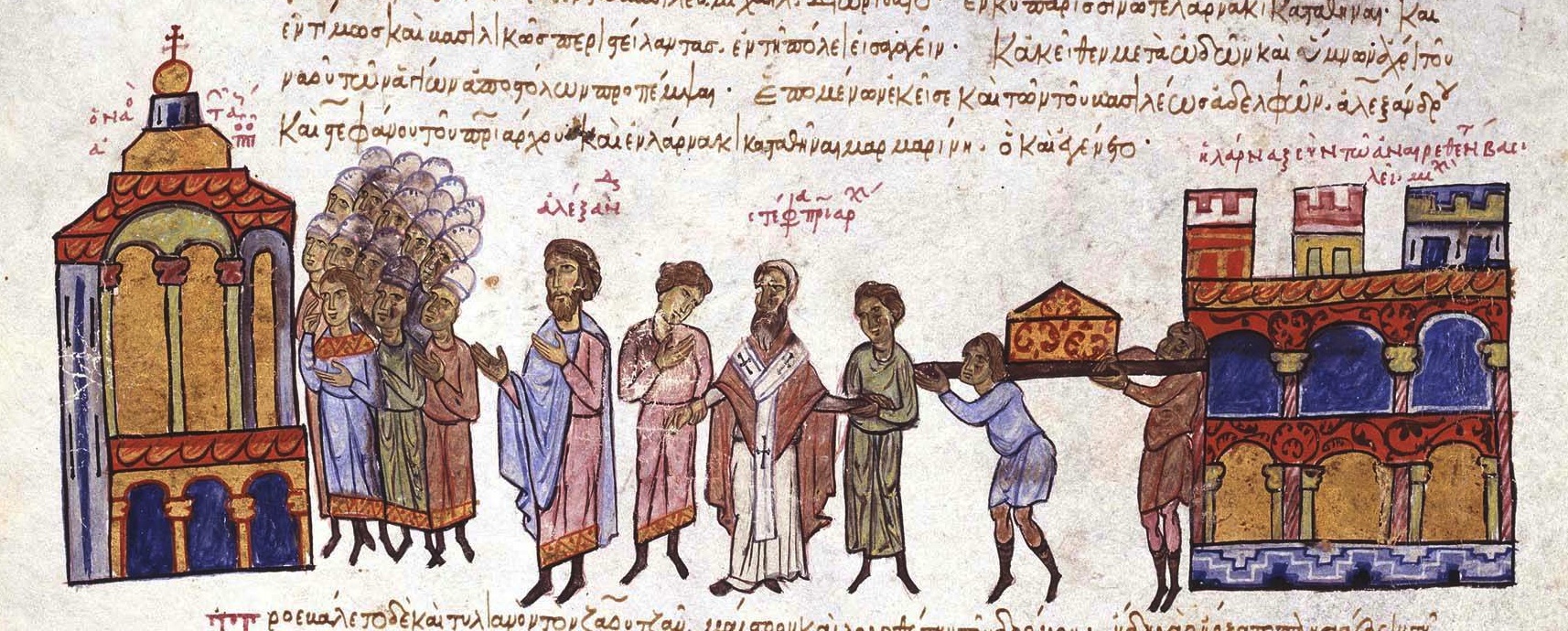
As for Leo, another reason for him to hate Basil aside from knowing that he killed his actual father which was Michael III, was that Basil forced him to marry a woman he did not like which was a pious and boring woman named Theophano Martinakia– and no, she is not the same Theophano that will be removed from this story- while Leo himself already had a beloved mistress which was Stylianos’ daughter Zoe Zaoutzaina and when still alive, Basil banished Zoe in order for Leo to marry Theophano who he had no feelings for, again history repeats itself as Leo’s actual father Michael III had the same situation when forced to marry someone he did not love while actually having a lover which was Leo’s late mother Eudokia that married Basil. Just right after becoming emperor, there is one historical evidence that shows Michael III was actually Leo’s father and this was when Leo in act of getting back at Basil ordered that Michael III’s body buried across the Bosporus in the Asian side be reburied at the Church of the Holy Apostles, the imperial mausoleum with a funeral ceremony fit for an emperor. Leo though was not the sole emperor as his younger brothers Stephen who was also rumored to be Michael III’s son and Alexander who was actually his half-brother being without question Basil’s son were his co-emperors, although Leo at the end of 886 removed Stephen from his position as co-emperor and appointed him as Patriarch of Constantinople despite his young age, thus this would be the first of many inexperienced young family members being appointed as patriarch.
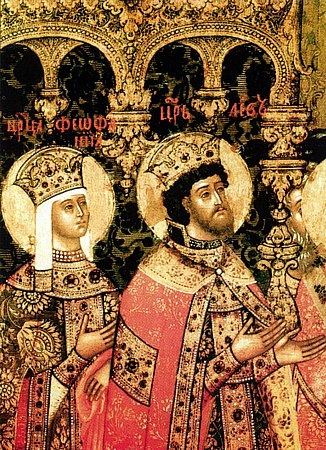
7722
Leo VI and his first wife Theophano Martinakia

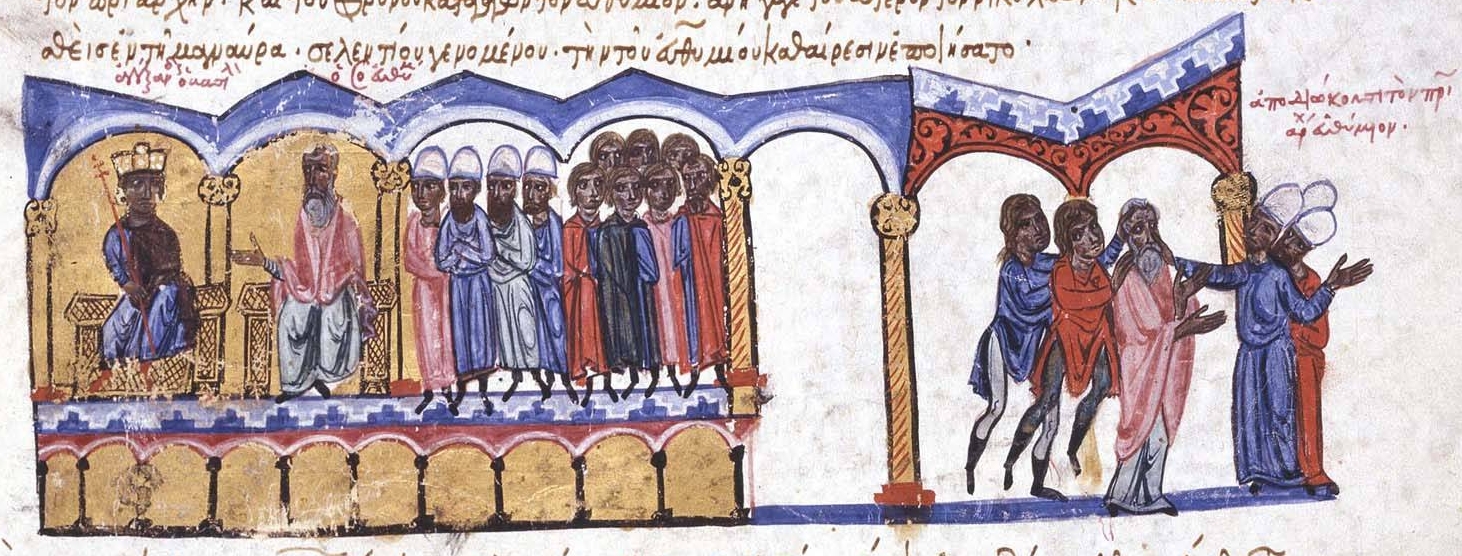
With Stephen appointed as patriarch, the old Photios on the other hand was fired from his position as patriarch as Leo distrusted him despite Photios being the one that actually educated Leo, but Leo turned on Photios for supporting Basil and the decision for Leo to marry Theophano who he hated, though Leo also wanted to be in good terms with the Papacy that distrusted Photios, though Photios would still live on until 893. Being the emperor, Leo was a dutiful ruler that attended every event that needed him whether it was chariot races or Church services, and as a serious scholar he devoted a lot of his time as well as money and energy into intellectual matters and passing new laws. In 892 Leo completed the Book of Royal Laws or “Basilika” which Basil commissioned to update Justinian I’s law code, and although Leo hated Basil he still saw it was his duty to update Byzantine law, and being a learned scholar unlike Basil before him who was illiterate, Leo personally recodified the law by putting a few of his insights into it, but the biggest revision of the Basilika was that it had finally translated the laws made by Justinian I which were in Latin into Greek so that everyone could understand it as here Greek was already the official and majority language of the empire while Latin was only used for specific court purposes. Leo too had made a reform which was to centralize the power of the emperor and limit the power of the Byzantine Senate which was at this point very much useless, as due to the rise of the Thematic System and the powerful landed military magnates in the countryside, the senate became nothing more than a club of old and rich aristocrats advising the emperor, although Leo could not fully get rid of the senate as it was an ancient institution dating back to even before the Roman Empire was established. Leo had also been vocal about loose women and adultery in his laws, but true enough he was a hypocrite as he himself had a mistress while he was already married, although Leo’s marriage to Theophano never worked out, not even very little, and being tired of her marriage to a husband that did not care, Theophano in 893 decided to leave the palace and become a nun while Leo went back to his mistress Zoe.
deb55uj-bf645e80-231a-40e5-8c6a-1d48fe29a7b1
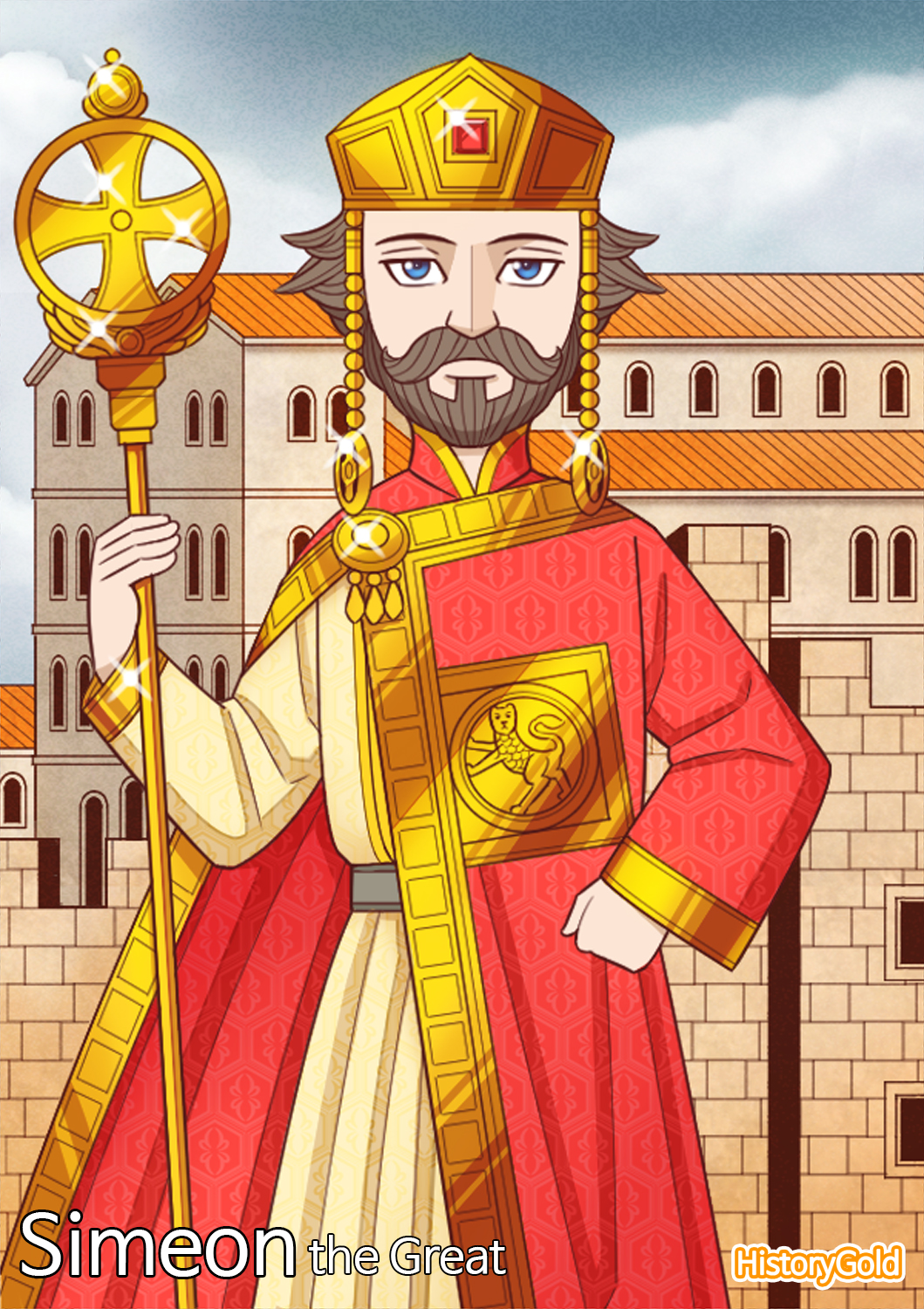
Simeon the Great, Tsar of the Bulgarian Empire (r. 893-927), son of Boris I, art by HistoryGold777

It also happened in 893 that the Bulgarian Empire up north had a new ruler being Simeon better known as “Simeon the Great” who had been educated in Constantinople by Photios being Leo’s classmate too, and was the son of the same Boris I who previously converted Bulgaria to Christianity back in 864, though here by 893 Boris was still alive except that since 889 he abdicated from power and retired to a monastery being succeeded by his eldest son Vladimir who attempted to restore Bulgaria to its old Pagan religion of Tengriism but failed greatly and in 893 was blinded by his father Boris coming out of the monastery but not wanting to return to power, Boris made his younger son Simeon who had been back in Bulgaria since 888 as Bulgaria’s new ruler. Things at first seemed to be going well between Leo VI’s Byzantium and Simeon’s Bulgaria until Leo’s highest minister Stylianos Zaoutzes who was his lover Zoe’s father as previously mentioned schemed to have the Bulgarian merchants kicked out of Constantinople and moved to the empire’s second city of Thessaloniki where they would have to pay higher taxes to sell their goods which was part of Stylianos’ corrupt motives to make himself richer, and Leo relying too much on Stylianos agreed to it in 894 which on the other hand backfired at him as the Bulgarians felt insulted, thus Simeon declared war on Byzantium. Simeon in 894 led his armies from Bulgaria into Byzantine Thrace in the south where the Byzantine forces were defeated, but in response Leo not wanting to give up recalled Nikephoros Phokas the Elder, the empire’s most talented general from Italy to Thrace where he would crush the Bulgarians in battle, but most of the success for the Byzantines here in 895 was mostly due to an alliance Leo made with a new steppe people that migrated from Russia to the north of the Danube known as the Magyars.
06413ac9850350e27f875c4fd2a12c7c
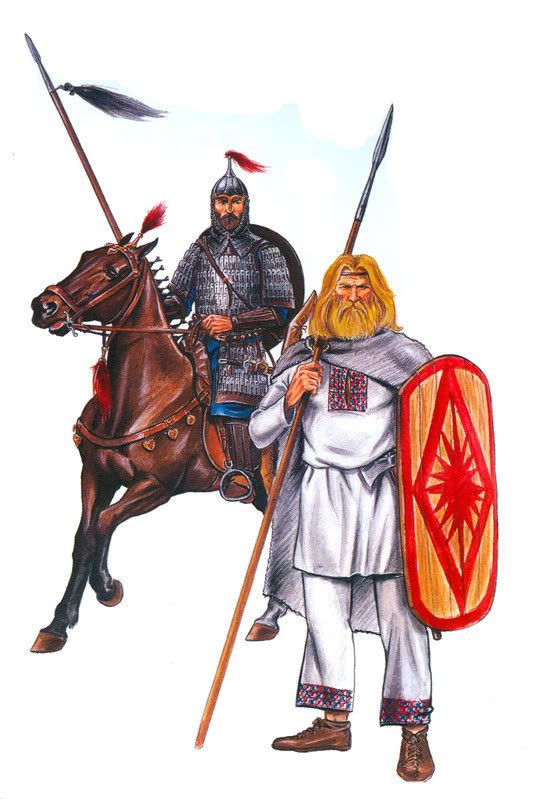
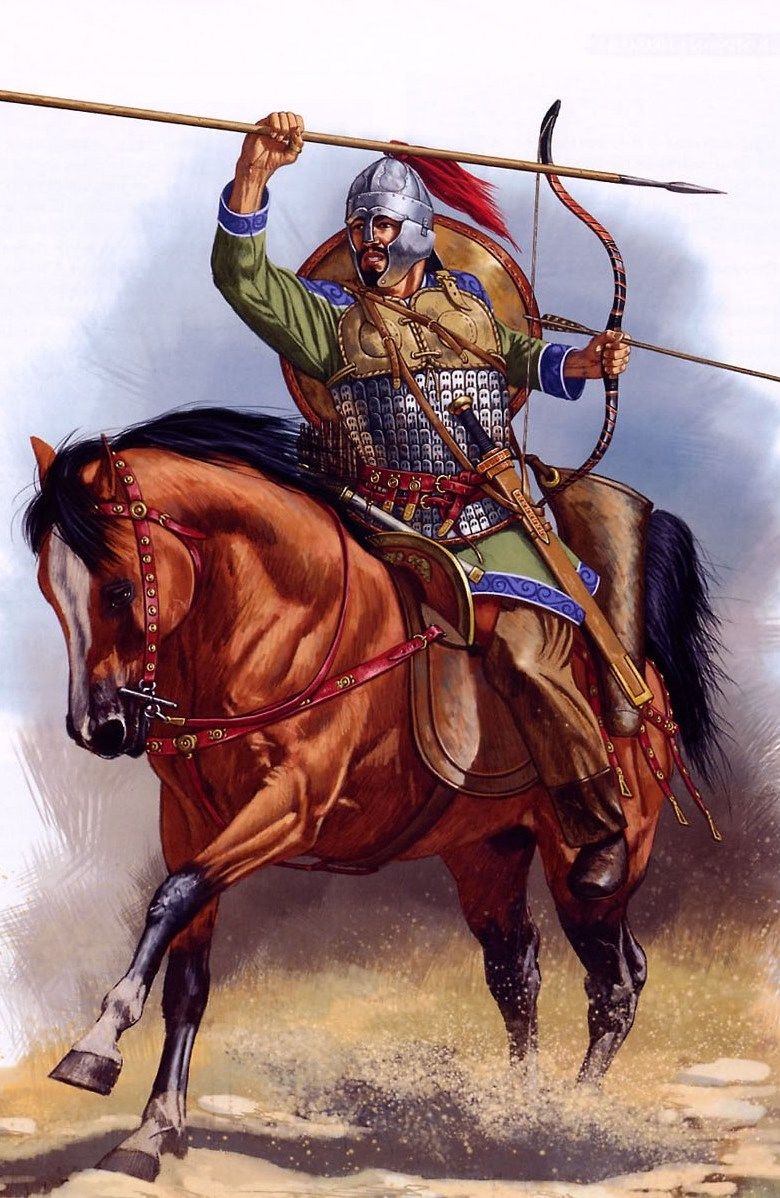
Magyar warrior, late 9th century

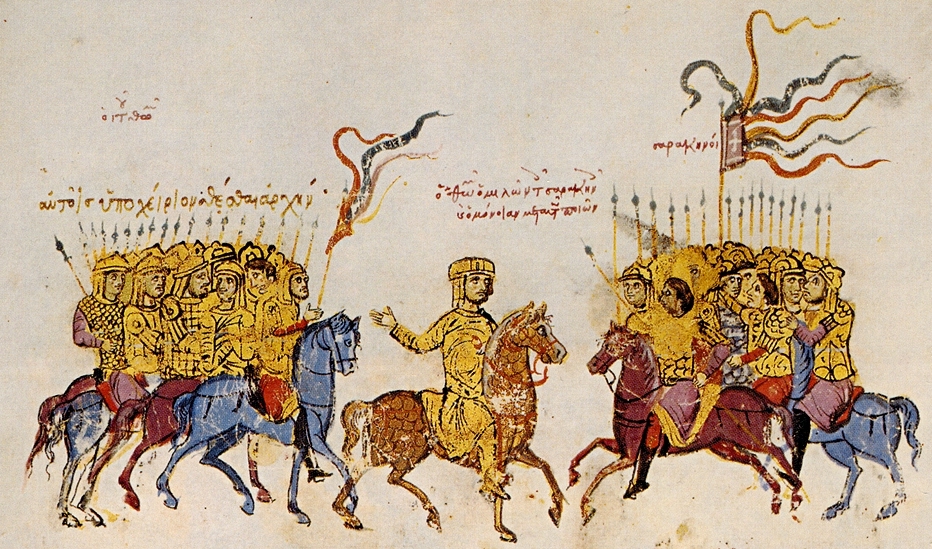
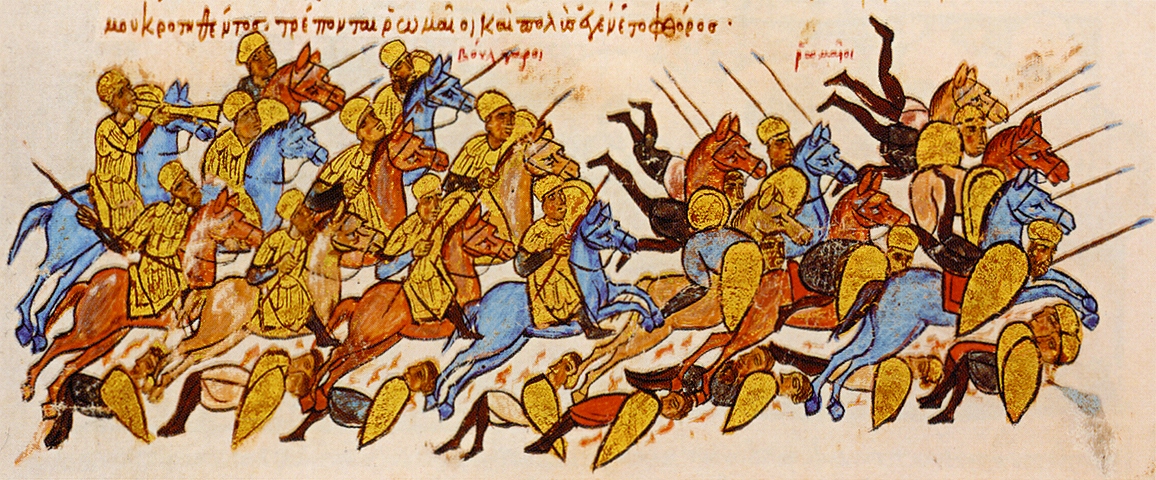
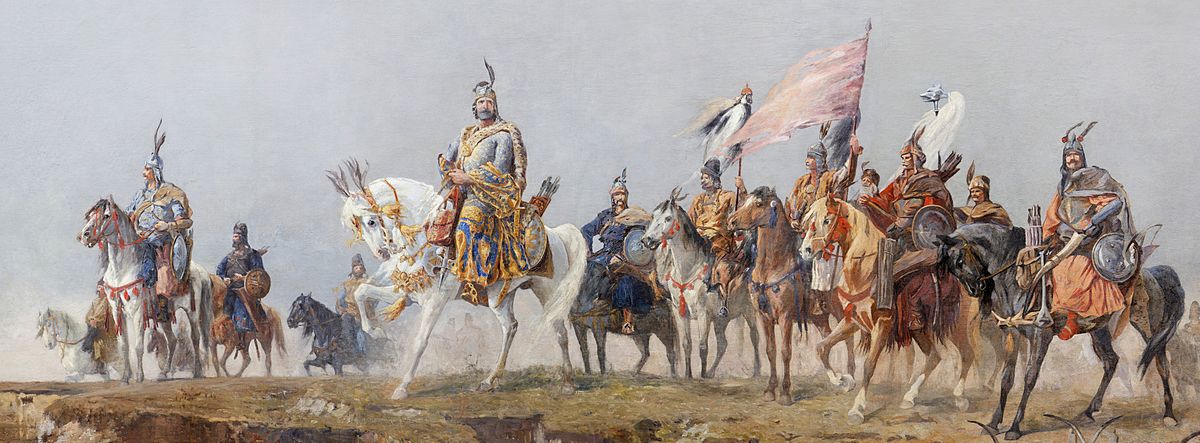
The Magyar leader Arpad accepted the bribe money offered to him by Leo and attacked the Bulgarian Empire from the north successfully making Simeon abandon his invasion of Byzantium in the south as he had to deal with the Magyars north of the Danube although shortly after, Simeon was able to defeat the Magyars by allying himself with another group of nomadic horse people north of the Danube known as the Pechenegs, which were a much more difficult and ruthlessly warlike people. With the Magyars defeated in 895 by the Bulgarians, they were forced to flee further west until they came across the Pannonian Plain which was once Roman territory wherein they finally settled down forming what would be Hungary whereas Arpad became its first ruler while for the Byzantines in 896, after losing their Magyar allies, they were severely defeated by the Bulgarians with the strength of their cavalry at the Battle of Boulgarophygon in Thrace, which at the end forced Leo to agree to paying a heavy annual tribute to Simeon to avoid war.           
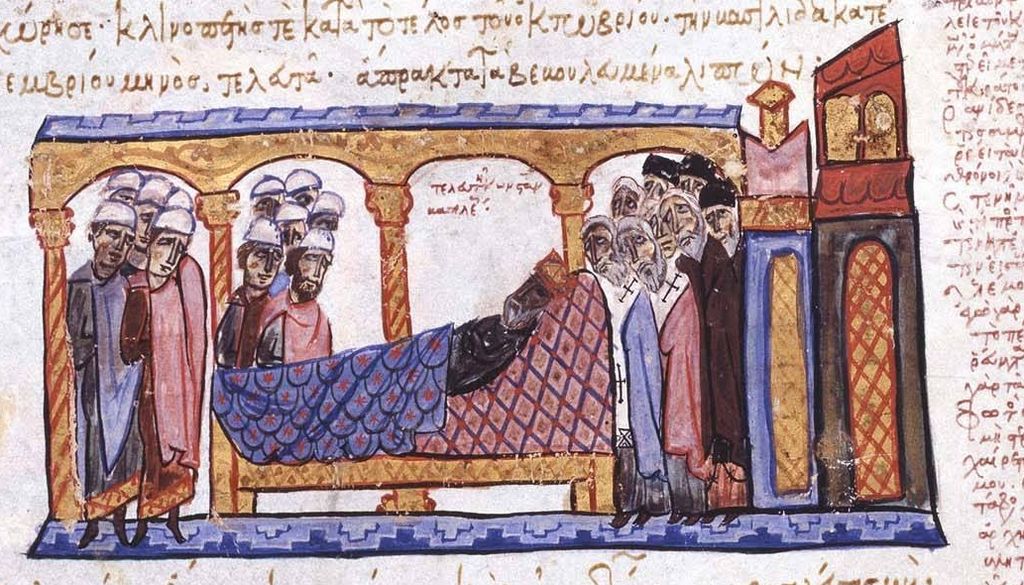
The_relics_of_Michael_III_are_transferred_to_the_Holy_Apostles
Leo VI reburies his father Michael III in the Church of the Holy Apostles in 886, Madrid Skylitzes
Boulgarofygon
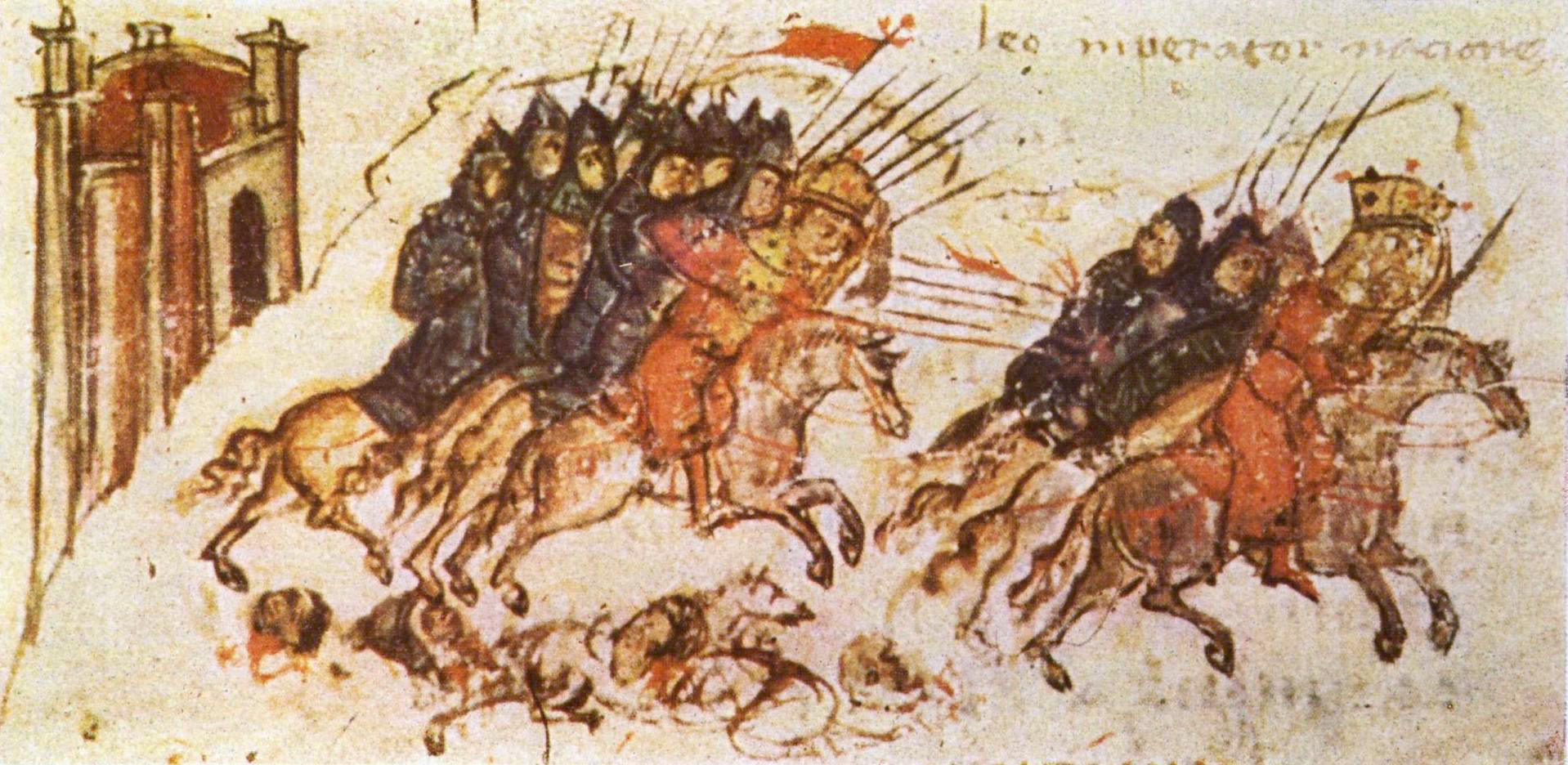
Bulgarian cavalry defeats the Byzantine army at the Battle of Boulgarophygon in 896, Madrid Skylitzes
1200px-Feszty_vezerek
Magyar people, end of the 9th century

In the meantime, in 897 Leo VI’s first wife Theophano who he never loved died in the monastery she retired to which for Leo gave him such joy, and following Theophano’s death he immediately married his longtime mistress Zoe and proclaimed her the empress or Augusta, and they would have two children together although both were daughters. Unfortunately, Leo’s happy marriage to Zoe would not last as just 2 years later (899), Zoe had died from illness and so did her father Stylianos, but in the following year (900) as the 10th century opened, the Byzantine army scored a major success when defeating the army of the Arab Emirate of Tarsus in Cilicia- another breakaway emirate of the Abbasids- and even capturing the Emir of Tarsus but in 902 however, another great tragedy would happen for the Byzantines when Taormina, the last Byzantine city in Sicily fell to the Arab forces in a siege, thus all of Sicily would fall under the newly formed Arab Emirate of Sicily. While all the wars against the Arabs were happening, Leo in 900 chose to marry for the 3rd time despite 3rd marriages being considered illegal in Orthodoxy, but Leo did it anyway just because he desperately needed a son to succeed him and his 3rd wife Eudokia Baiana was chosen by him in a bride show he organized, which here would be the last one recorded in Byzantine history, and fortunately the 3rd wife Eudokia was able to give birth to a son in 901 thus Leo thought this would be his final marriage except that after giving birth, Eudokia dropped dead and so did their newborn son a few days later, now Leo would be greatly heartbroken.
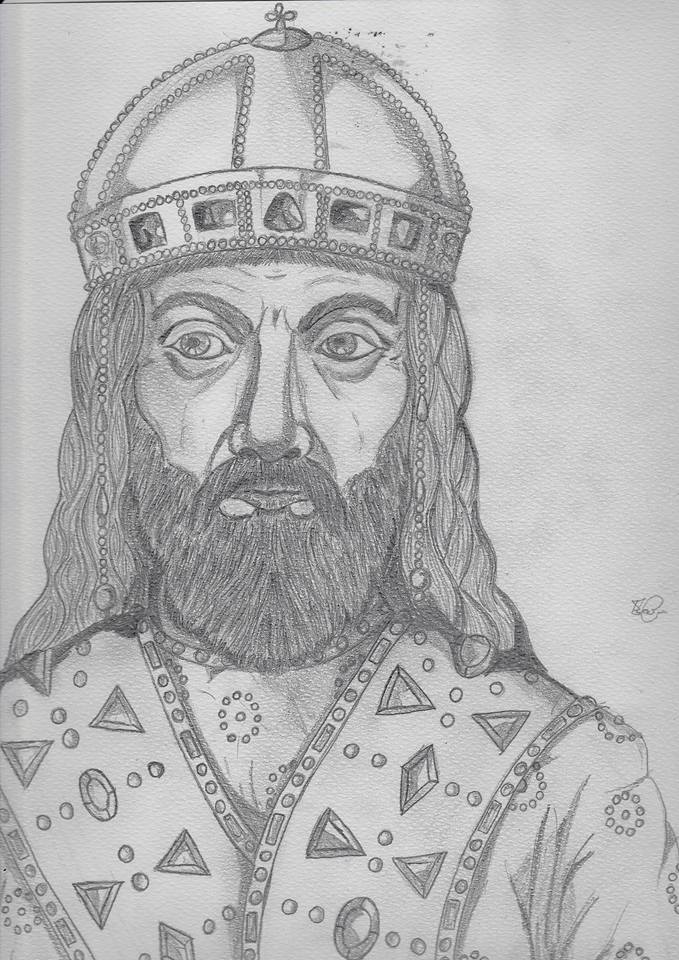
14316776_1617177115249333_6772441765490808416_n
Emperor Leo VI of Byzantium (r. 886-912), art by Spatharokandidatos

Leo would suffer another misfortune again in 904 when he was almost killed in an assassination attempt carried out by a wrestler and when investigating it, it so happened that his younger co-emperor half-brother Alexander was involved in it, therefore Alexander was removed from his position as co-emperor which would make him start holding a lifelong grudge on Leo as you will see, but worse than this was that also in 904 Byzantium’s second city of Thessaloniki was besieged and brutally sacked by Arab pirates led by the notorious Leo of Tripoli, a Byzantine Greek taken as a captive to Tripoli (in today’s Lebanon) as a child wherein he was raised to become a fearsome pirate. Thessaloniki however was just raided but had not fallen to the pirates, but it was so severely damaged that Leo VI decided to avenge its sacking by doing the same to Tarsus in the southern coast of Asia Minor where this pirate fleet came from. The Byzantine raid on Tarsus in 906 was a successful one with many Arab prisoners taken, except that the general sent to lead the mission Andronikos Doukas out of nowhere abandoned the mission as being from the distinguished aristocratic Doukas clan that had been in the Byzantine Senate since Emperor Constantine the Great established it in 330, he did not want his aristocratic pride hurt by taking orders from the fleet’s admiral Himerios who was lower than him in status, therefore Andronikos fled to the Abbasid’s capital of Baghdad itself where he would die in 910.
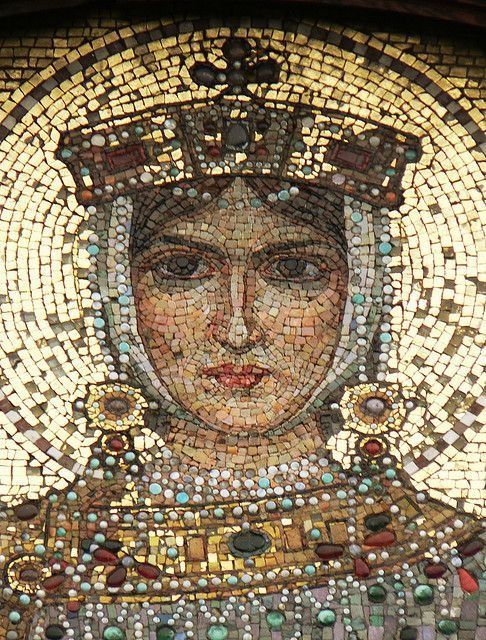
c09bbd996d685555ddddde26b924835b
Mosaic of Empress Zoe Karbonopsina, 4th wife of Leo VI

As for Leo after losing 3 wives, by 904 he took in a new mistress which was Himerios’ niece Zoe Karbonopsina, a woman with dark curly hair who was most famous for her distinct black eyes, hence her nickname Karbonopsina meaning “black eyes” in Greek, and apparently in 905 they had a son which Leo named Constantine better known as Constantine Porphyrogennetos as he was born in the purple room of the imperial palace, the place only imperial family members had access to in order to give birth to imperial heirs to secure their legitimacy, thus imperial children born here had the title of Porphyrogennetos if they were males or Porphyrogenita for females, literally meaning “purple born” in Greek, and though many would use this title, only Constantine who will rule later on and play a major role in this story would be the only Byzantine emperor to use this title officially. Leo and Zoe were already planning to marry long before Constantine was born, but of course this not only being a 3rd but a 4th marriage was totally outrageous to the Orthodox Church that the current Patriarch of Constantinople here Nikolaos Mystikos, an imperial secretary and Leo’s former classmate who had been patriarch since 901 following Leo’s brother Stephen’s death totally objected to it, so instead Leo and Zoe were secretly married at the dead of night by a priest loyal to Leo, but when Patriarch Nikolaos heard of it, Leo was banned from entering the Hagia Sophia despite being the emperor. Nikolaos however still reluctantly baptized Constantine in 906 but at the same time, Leo decided to return his half-brother Alexander as co-emperor for safety measures in case something happened to Constantine and in 907, Leo was able to get away with his illegal marriage to Zoe by firing the patriarch Nikolaos under suspicion of him siding with the rebel Andronikos Doukas, thus replacing him with the deeply spiritual monk Euthymios, who was Leo’s teacher in theology and spirituality when he was still young. On the other hand, Leo’s other motive in appointing Euthymios as patriarch was to again be in good terms with the pope Sergius III in Rome, as Nikolaos being an outspoken politician was not trusted by the pope whereas a more spiritual leader like Euthymios was more favorable to the pope, again making this another situation in the Church rivalry between Constantinople and Rome, but at the same time the pope also needed Leo’s Byzantine military assistance in defending Southern Italy from the Arabs, which is why Sergius III accepted Leo’s 4th marriage too. In 907 as well, Leo just like his actual father Michael III in 860 faced the same situation of the same Kievan Rus’ fleet of longships attacking Constantinople, except now the Rus were already an official organized state in Eastern Europe but just like in 860 here, the Rus did not attack Constantinople itself, rather they just raided the riches in the churches and monasteries in the suburbs in typical Viking fashion and retreated back north to the Black Sea after receiving some bribe money from Leo.
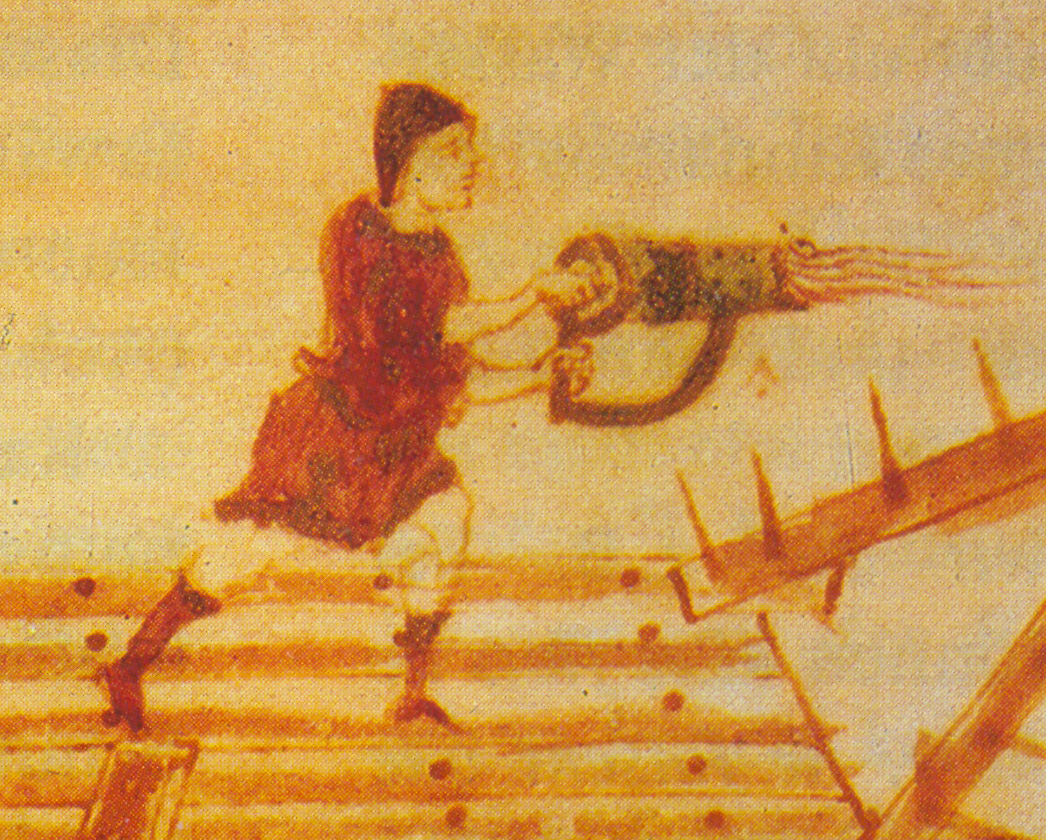
Hand-siphon_for_Greek_fire,_medieval_illumination_(detail)
Handheld Greek Fire

Leo on the other hand after suffering so many military defeats despite not ever personally joining his armies himself in military campaigns learned from his mistakes and in 908 wrote and published a military manual himself based on reports by generals in which he carefully studied and came up with new tactics basing them on where his armies had failed, and this new military manual is better known as the Taktika, though on the other hand Leo had some success in commissioning the invention of a portable version of the empire’s secret superweapon of Greek Fire which was to be hand held during sieges. In 910, Leo’s admiral Himerios would end up succeeding in attacking the Arab pirate fleet in the Mediterranean that he even went as far as attacking an Arab port in Syria, and with this success Leo in 911 sent Himerios with 177 ships on another attempt to retake the island of Crete from the Arab Emirate of pirates there but before being able to finish off his siege of the emirate’s capital Chandax, Himerios received word from the capital that the emperor fell ill and was close to death making him abandon the siege and rush back, thus another failed attempt to recapture Crete. On the return trip to Constantinople in 912, Himerios’ navy in the Aegean was surrounded and annihilated again by the same pirate Leo of Tripoli, although Himerios narrowly escaped, and when the news of the defeat of Himerios to the Arab pirates reached Leo VI in Constantinople, it was the same day he died which was May 11 of 912. Leo VI the Wise died at only 45 due to a fatal illness that could not be cured, possibly cancer while his son Constantine was only 7, but at least Leo left behind a great cultural impact for Byzantium especially in the military manual and code laws he made which would play a vital role in Byzantine politics and warfare from here onwards, but otherwise if Leo had not published these books, then he would just be remembered as a mediocre emperor that tried so hard to win battles but failed.
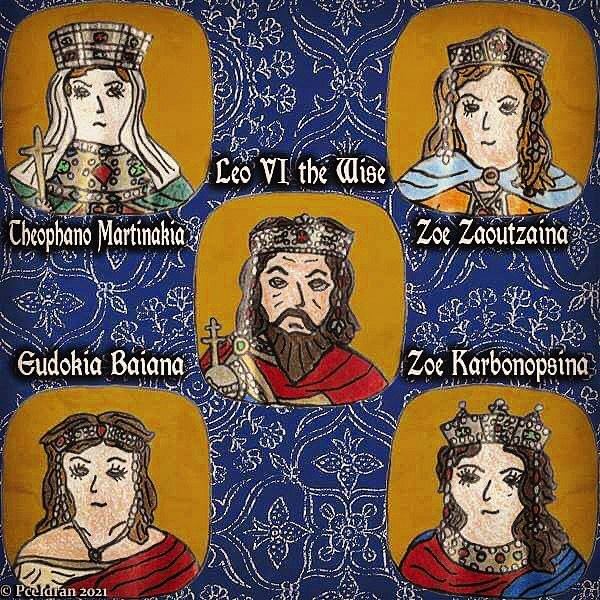
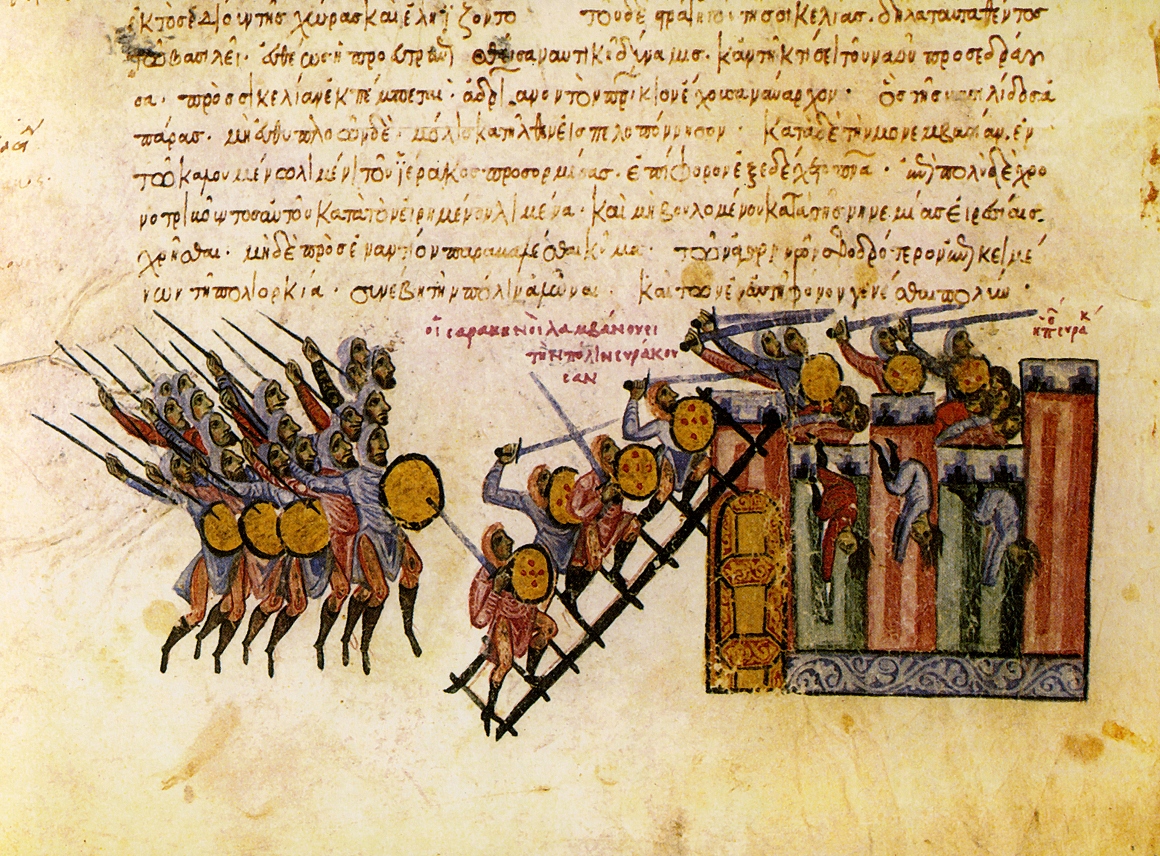
197854121_2594013937559877_7345045294462479172_n
Emperor Leo VI and his 4 wives, art by myself
MadridSkylitzesFol100vDetail
Byzantine Taormina, Sicily falls to the Arabs in 902, Madrid Skylitzes
Sack_of_Thessalonica_by_Arabs,_904
Sack of Thessaloniki in 904 by Leo of Tripoli, Madrid Skylitzes
62a3d9_7bfd797ec0ea4e9f951a85011b98b172_mv2
Baptism of Leo VI’s son Constantine in 906, Madrid Skylitzes
Consecration_of_Patriarch_Euthymius_I_of_Constantinople
Euthymios appointed as Patriarch of Constantinople in 907, Madrid Skylitzes
1280px-Oleg_tsargrad
Kievan Rus’ 907 attack of Constantinople, from the Primary Chronicle
25929501928_7c18b33046_c
Mosaic of Emperor Leo VI (kneeling down) in the Hagia Sophia’s door recreated

The Chaotic Regency and Romanos I Lekapenos, the “Gentle Usurper” (912-944)    

Palaiologos_Dynasty_emblem1

On May 11 of 912 as Leo VI was on his deathbed, his half-brother and co-emperor Alexander was present, and before dying Leo told him some prophecy saying “13 months and the devil’s time”, although Alexander had no idea what it meant but true enough he succeeded Leo as senior emperor as he was already co-emperor first since 879 long before young Constantine was born. Now Alexander definitely had no parentage issues as Basil I was certainly his father as Alexander was born in 870, 3 years after Michael III’s death, and a possible reason for why Alexander hated Leo was surely because he was Basil’s legitimate son while Leo was not, thus the Macedonian Dynasty here would only consist of Basil I and Alexander whereas Leo VI and his successors who will appear afterwards were in fact from Michael III’s bloodline, the Amorians.
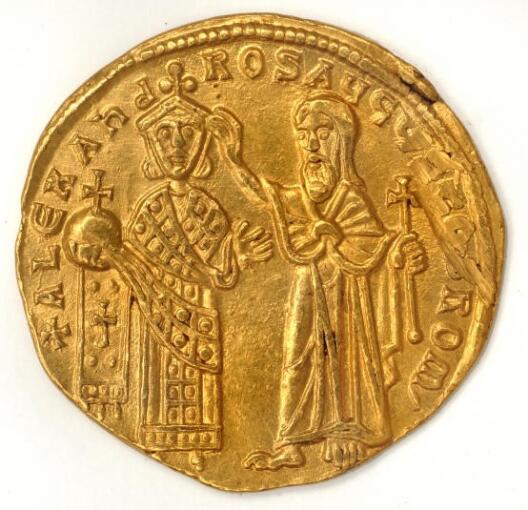
fittosize_528_510_8098d8ea8c6525c5526657c2396ce8a3_m__nze
Coin of Emperor Alexander

Alexander as Basil’s son resembled Basil in appearance a lot being tall and large in size with light brown hair and a beard which was opposite to Leo’s appearance and just like his father, Alexander was greatly passionate about hunting and sports though like Michael III, Alexander was a lazy drunk. This story now will go with the usual historical portrayal of Alexander as a lazy, debauched, childish, and incompetent ruler whose only purpose to rule was to get revenge on his older half-brother for no good reason except that Alexander was co-emperor for 33 years never getting the chance to be a senior emperor, and also because he was angry at Leo for removing him from his rank of co-emperor for just 2 years (904-906). Becoming emperor at 41 but already in bad health with bad teeth due to heavy drinking, Alexander thinking he would rule for long was the first emperor in the history of Byzantium to use the title of Autokrator or “self-ruling ruler” celebrating his end of 33 years only as co-emperor forgetting he actually had a co-emperor which was his 7-year-old nephew Constantine who Leo made co-emperor before his death, although Alexander here in 912 decided to castrate young Constantine to remove him from the succession but his advisors told Alexander to not do it as he had remained unmarried his entire life having not a single child, and so young Constantine was instead locked up in a nunnery with his mother Zoe Karbonopsina who Alexander hated too just for being Leo’s wife. Just a few months after coming into power, Alexander already showed how uninterested he was in ruling the empire that he only ruled to damage Leo’s legacy which was seen when he fired all the competent ministers that were loyal to Leo such as the admiral Himerios and Patriarch Euthymios, as well as discontinuing all of Leo’s policies just to get back at him. Now when it came to firing Patriarch Euthymios, Alexander restored the previous patriarch Nikolaos Mystikos who opposed Leo’s 4th marriage, and Nikolaos too was driven with revenge for being removed from his position that in the trial organized to depose Euthymios, Nikolaos hired a giant wrestler to beat up Euthymios in public while the trial was happening, and at the end Euthymios was sent into exile as Nikolaos returned to his position.
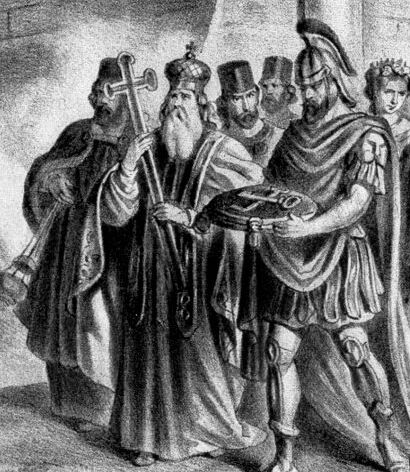
Nicholas_Mystikos
Nikolaos Mystikos, Patriarch of Constantinople (901-907/ 912-925)

Another rumor about Alexander in his reign was that some nights he would perform Pagan sacrifices in the Hippodrome as if he was asking the old gods for fertility as apparently, he was unable to produce children. As an incompetent ruler, Alexander did not pay attention to the frontiers that the main forces of the Abbasid Caliphate from Baghdad itself attacked Asia Minor, and when Bulgarian ambassadors from Simeon came to Constantinople to collect the annual tribute Leo promised, Alexander in his usual drunken rage shouted at the Bulgarian ambassadors kicking them out of his presence and refusing to pay tribute, again as an act of discontinuing Leo’s policies out of revenge. Over in Bulgaria when their ruler Simeon heard of Alexander refusing to pay tribute, Simeon feeling so insulted resumed war with Byzantium knowing he could easily defeat them considering Alexander’s incompetence. In June of 913 while Simeon was making preparations to attack Byzantium, Alexander was enjoying himself in the Polo field or Tzykanisterion of the Imperial Palace playing a game of polo or Tzykanion after some drinks of expensive Greek wine from Lesbos, but Alexander after playing a game of polo fell off his horse when suffering a heart attack and hours later, he had died. Apparently the 13-month prophecy Leo had told Alexander was true as after ruling alone for only 13 months, Alexander had died, thus here would die the last ruler of the Macedonian bloodline of Basil whereas the rule of the Amorians would continue with Leo VI’s son Constantine VII, and it was fortunate enough for the empire that Alexander died right here as if he ruled longer, the empire may have suffered more with his incompetence.          
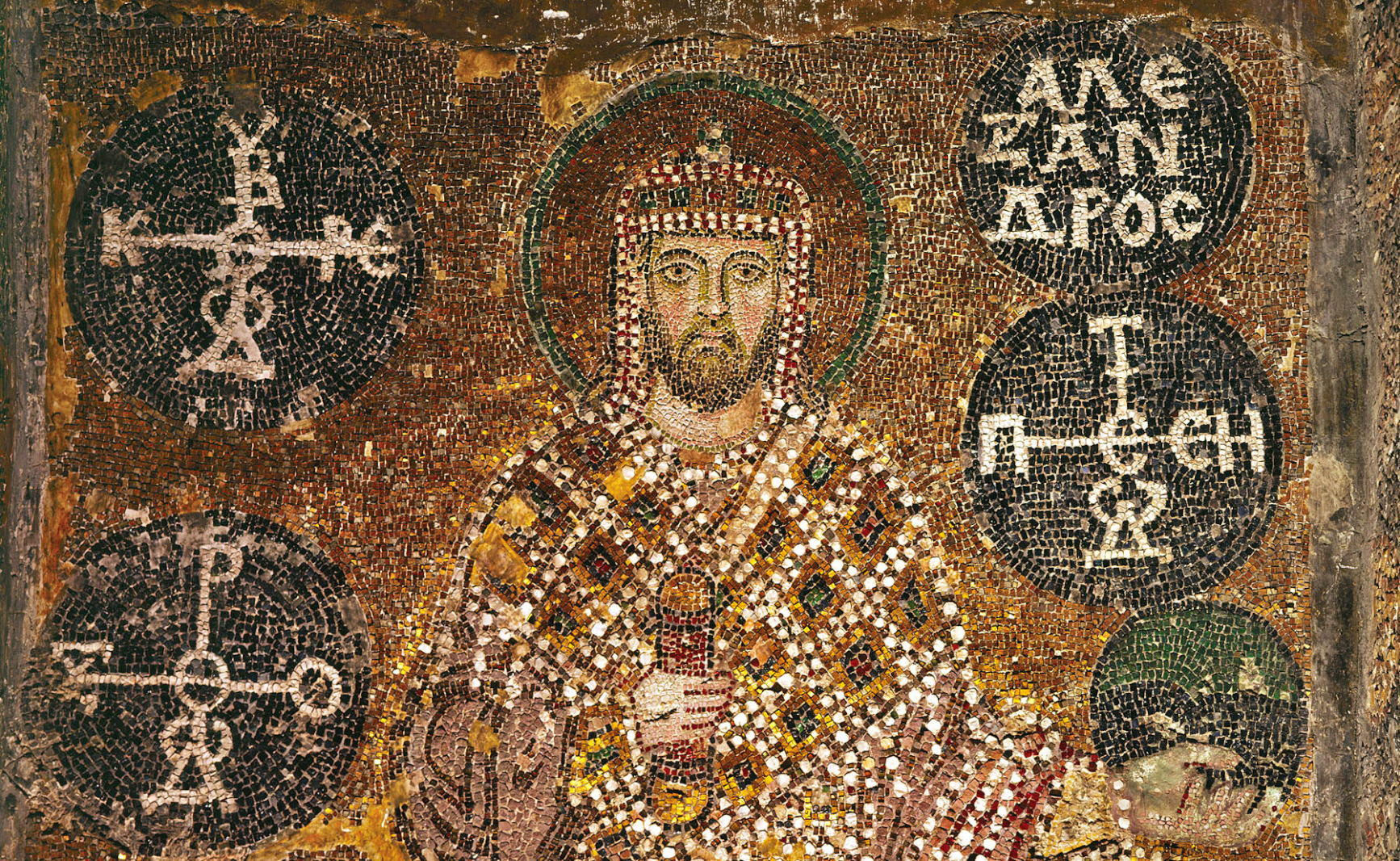
Alexander-Mosaic-of-Hagia-Sophia-Featured_01
Mosaic of Emperor Alexander (r. 912-913) in the Hagia Sophia
Emperor_Alexander_deposes_Patriarch_Euthymios
Patriarch Euthymios removed from office by Alexander in 912, Madrid Skylitzes
683a0c43ac93d5c77723d2489d9148fa
Tzykanion- Byzantine polo, art by Amelianvs

Right after Alexander’s death in June of 913, young Constantine VII Porphyrogennetos was crowned as the sole ruler of the empire as willed by Alexander, except being only 8-years-old meant that a regency council had to now rule for him led by Patriarch Nikolaos Mystikos while Constantine’s mother Zoe Karbonopsina was to stay out of it, again as willed by Alexander. The patriarch however hated the empress and did not see Constantine as a legitimate emperor as Nikolaos still did not approve of Leo and Zoe’s marriage, and in this story’s case he also did not see Constantine as legitimate because his father Leo was not a legitimate son of an emperor but an illegitimate son of a murdered emperor, therefore his successors were illegitimate and so only a few days after the council was set up, Nikolaos banished Empress Zoe back to the nunnery she was in. Patriarch Nikolaos and most of the Byzantine Senate too could not accept Constantine VII as their ruler, and so they supported a rebel general who was putting his claim on the throne refusing to accept a child as his ruler, and this general was Constantine Doukas, son of the same general Andronikos Doukas that fled to Baghdad and died there 3 years earlier. Just a few days after Constantine VII was crowned emperor, Constantine Doukas and his army who had a lot of support arrived outside the walls of Constantinople ready to storm the city but just as he arrived, the city garrison loyal to the young emperor charged at the rebel forces in open battle. Constantine Doukas seeing his side was about lose tried to escape but in the process, he slipped off his horse and fell to the ground wherein the city garrison soldiers killed him by hacking him with their swords, thus his rebellion failed, though he was not the last of the Doukas clan as they will be featured heavily in the next chapter of this series. Patriarch Nikolaos in an act of protecting himself denied that he had any part in the conspiracy of Constantine Doukas that he even had anyone he knew involved in the conspiracy executed and their bodies impaled on spikes outside Constantinople’s walls that he would gain such a brutal reputation for it.
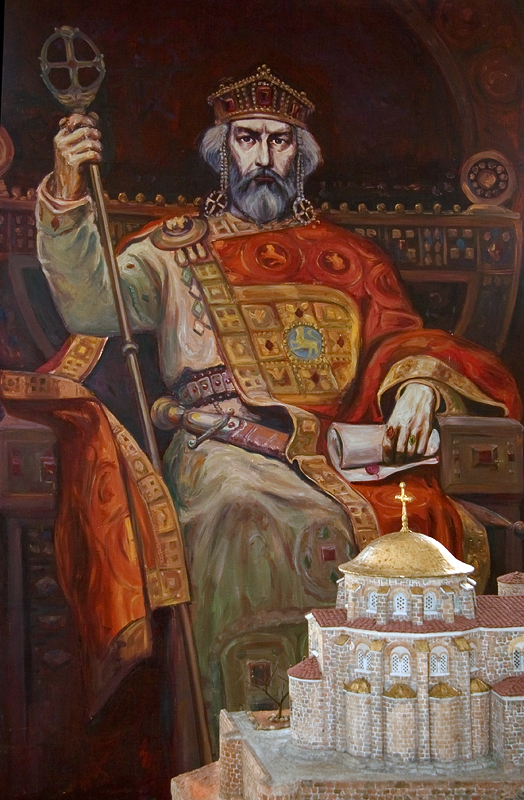
Simeon-I-the-Great-Tsar-of-Bulgaria
Tsar Simeon the Great of Bulgaria

Just 2 months after the failed plot of Constantine Doukas, it was Simeon and his Bulgarian army’s turn to arrive outside the Theodosian land walls of Constantinople, but when seeing the strength of the walls, he instead decided to attack and burn the farms outside it that Patriarch Nikolaos had to come out to negotiate peace with Simeon, and here Nikolaos agreed to resume paying the annual tribute of Leo VI but also for young Constantine VII to marry one of Simeon’s daughters, although Simeon saw this as an opportunity to take over Constantine VII’s regency and rule both Byzantium and Bulgaria himself. The senate meanwhile disapproved of the patriarch’s deal with Simeon as none of them wanted a Bulgarian foreigner who they still saw as a barbarian- despite adopting Byzantine customs and religion- ruling the empire, and so Simeon packed off and left as he got his tribute anyway but most of the senate was also displeased with Nikolaos’ brutality that in 914, they returned Empress Zoe back to the regency council getting her out of the nunnery, although Nikolaos still stayed as patriarch when being threatened by Zoe to recognize her authority. In 915 when the Byzantines won a major victory over the invading Arabs in Southern Italy, Empress Zoe’s popularity grew but at the same time she also disapproved of her son Constantine marrying Simeon’s daughter as this deal was made by Patriarch Nikolaos who she hated and also because in her Byzantine arrogance, Simeon was nothing more but a filthy barbarian. Simeon hearing of the empress turning down his offer in 915 resumed war with Byzantium that Simeon’s Bulgarian forces even briefly took the city of Adrianople until Zoe’s forces quickly took it back forcing Simeon to flee, thus Zoe again became more popular. Simeon on the other hand still continued his raids by going as far south as Byzantine Thessaly and Epirus in Greece between 915 and 916, then by 917 he returned to Thrace whereas Zoe was prepared to crush his forces by amassing a massive army led by the best generals of the empire which included John Bogas, the commanding general or Strategos of the Theme of Cherson, which was the remote Byzantine colony in the Crimea north of the Black Sea; the Cappadocian brothers Leo Phokas the Elder and Bardas Phokas the Elder who were the sons of the late and great general Nikephoros Phokas the Elder who had died back in 900; and Himerios’ replacement as the grand Droungarios or admiral the Armenian Romanos Lekapenos, son of the same Armenian peasant soldier Theophylact Lekapenos who saved Basil I back in 872. Now you may ask why all the empire’s top commanders were either Armenians or Cappadocians, and this is because by being raised in these parts being in the empire’s frontiers, these people had grown up to be tough soldiers.
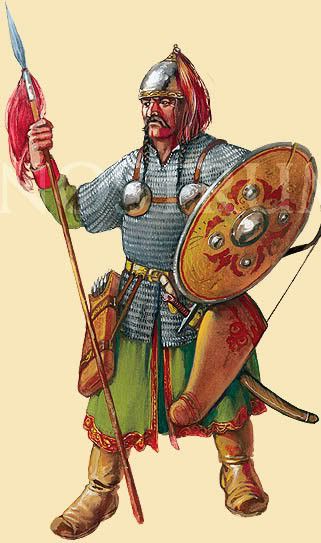
44b29142f390771dd57d6921d3c31167
Pecheneg warrior, 10th century

Now the plan here was that the army led by the Phokas brothers would march north from Constantinople while Romanos with his fleet was to ferry both John Bogas and his troops from Cherson as well as the Byzantines’ new Pecheneg allies from across the Danube to Thrace, but John Bogas and Romanos would end up arguing, as again as usual with Bogas being of high birth refused to take orders from Romanos who was of lower status, and Romanos would only agree to ferry Bogas and his troops if Bogas were to bow down to his authority, though Bogas refused and the Pecheneg mercenaries as usual being difficult to handle were tired of waiting and not yet receiving their pay gave up and abandoned the Byzantines. Meanwhile, only the Phokas brothers and their army were left to confront Simeon’s Bulgar forces, but while camping out near the port of Anchialos in Thrace along the Black Sea, Simeon and his forces caught them by surprise and charged right at their camp and what resulted was a total massacre as barely any Byzantine soldiers survived it while many panicked and retreated as well believing Leo Phokas to be dead when seeing his horse gallop away without him, though it was unclear on what happened to Bardas here.
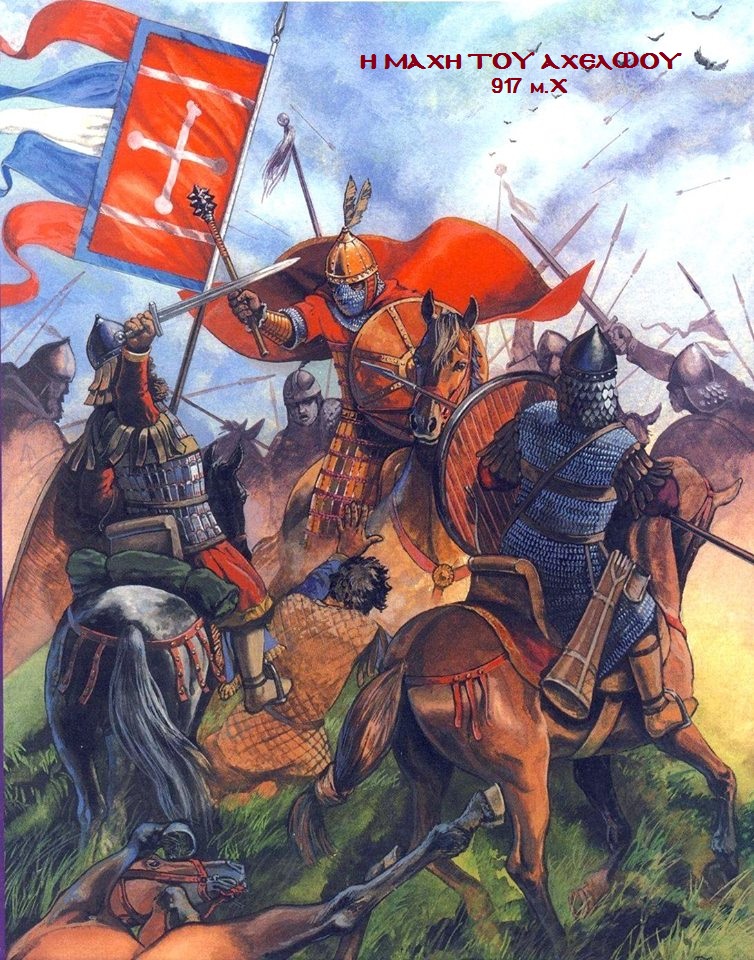
χ ψχψχ
Bulgarians defeat the Byzantines at the Battle of Anchialos, 917

Back in Constantinople, Zoe being so enraged blamed all the failures on the admiral Romanos Lekapenos who she even threatened to blind, but Romanos’ powerful friends prevented her from doing so. Leo Phokas and his brother Bardas meanwhile survived the attack and fled to the Black Sea port of Mesembria where they took a ship back to Constantinople where Leo would meet up with Zoe who however saw no fault in Leo even if he was responsible for the massacre of his men as he was taking bath while Simeon charged at them. Instead of punishing Leo, Zoe even gave him an additional two armies to command and strike back at Simeon again but when facing Simeon’s forces again outside Constantinople, Leo was severely defeated but to protect his reputation and save her own as it had been damaged due to this defeat, Zoe decided to marry him and make him young Constantine’s regent but Constantine’s teacher Theodore disagreed to it believing this would remove Constantine from the succession, therefore Theodore wrote to Romanos to take over the regency and protect Constantine.
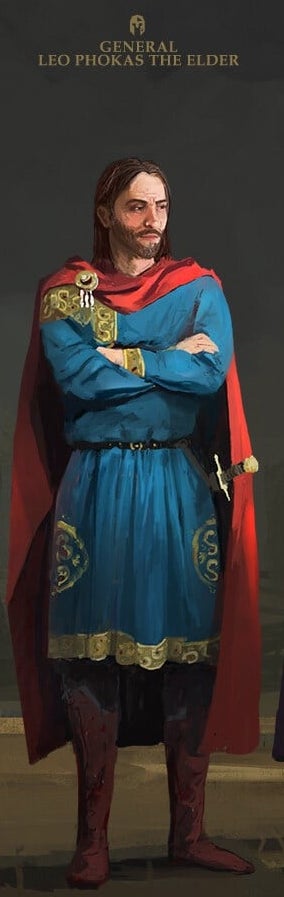
181445291_247894753779738_876966196926976199_n
Leo Phokas the Elder, Byzantine general

Zoe on the other hand asked the regency council to meet again only to find out that they all lost faith in her because of the defeat to the Bulgars at Anchialos and outside Constantinople that Patriarch Nikolaos had to return to running the regency from here on. Romanos however had turned out to have his own imperial ambitions which is why he was at odds with Leo Phokas and in 919, Romanos suddenly docked his fleet outside the Boukoleon Palace along the sea walls of Constantinople wherein he declared he was going to take over the regency while Zoe was asked to resign from it and retire for good, and here the 14-year-old Constantine VII was married to Romanos’ young daughter Helena Lekapene to secure Romanos’ claim to the throne. Leo Phokas on the other hand who was across the Bosporus put his claim on the throne as well in rebellion against Romanos claiming that he was to save Constantine VII, but before he was able to cross the Bosporus to Constantinople, Romanos sent him a letter denouncing Leo’s actions which made Leo’s men desert and as Leo tried to flee south into Asia Minor, Romanos’ men caught him and blinded him wherein he was paraded in Constantinople’s streets, though his fate afterwards is unknown. In 920 then, Romanos made a deal with Patriarch Nikolaos to keep Constantine VII in power as long as Zoe was to be banished for good, in which she did by retiring to the same nunnery she was kept in before, for good this time. Later in 920, young Constantine VII was forced to crown his father-in-law Romanos as his co-emperor and just a few months later, Romanos I Lekapenos assumed the full duty of the empire’s senior emperor, although Constantine VII was still kept in power but only in name whereas Romanos was to effectively run the empire claiming he was doing it for young Constantine’s protection.         
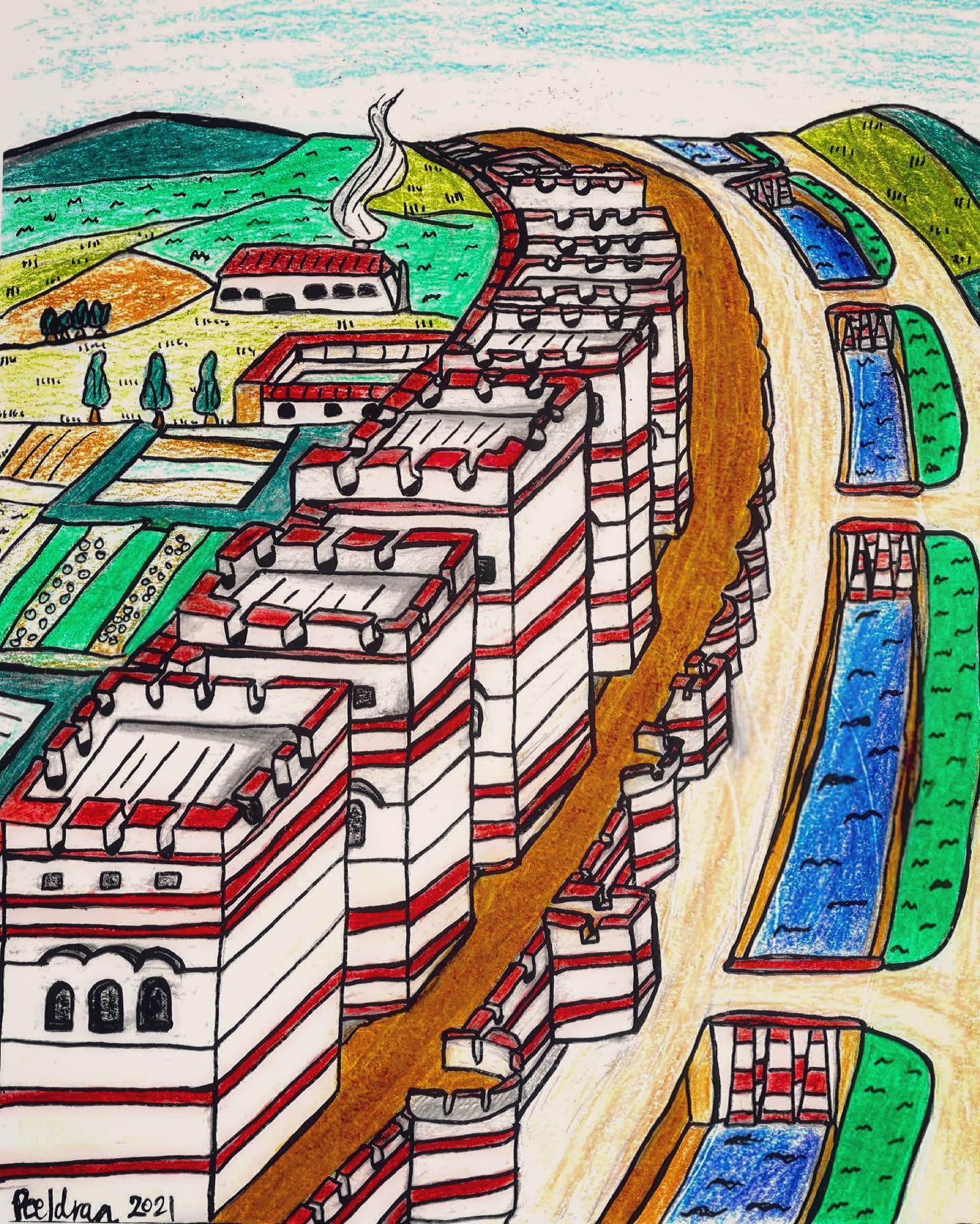
180132991_2569265576701380_183542204688021982_n
The land walls of Constantinople (Theodosian Land Walls), art by myself
Coronation_of_Constantine_VII_as_co-emperor_in_908
Coronation of young Constantine VII in 913, Madrid Skylitzes
Byzantine_army_taking_oath_before_the_battle_of_Anchialus
Byzantine army at the night before the disastrous Battle of Anchialos in 917, Madrid Skylitzes
Blinding_of_Leo_Phokas
Capture and blinding of Leo Phokas the Elder by Romanos Lekapenos in 919, Madrid Skylitzes

When Romanos I Lekapenos took over the imperial administration in 920 not only as a regent or protector but as emperor, it was suspected that he would one day murder young Constantine VII except that he didn’t, rather he had more subtle ways of sidelining Constantine VII and making himself the supreme authority, and this was by removing Constantine’s imperial authority even as he aged, thus it turned out the poorly educated admiral of low birth was actually an intelligent and cunning ruler. For the next years, Constantine VII would live in the shadows though still in the imperial palace keeping his title as emperor, except basically he was a political prisoner of his father-in-law Romanos I who had to keep watching his back being never really permitted to leave the palace without Romanos’ approval, but Constantine would in fact enjoy his time by not having to perform his duties as emperor but instead doing what he grew up to love most, which were scholarly interests such as reading and writing as well as painting and sculpting, basically Constantine took after his scholarly father Leo VI.
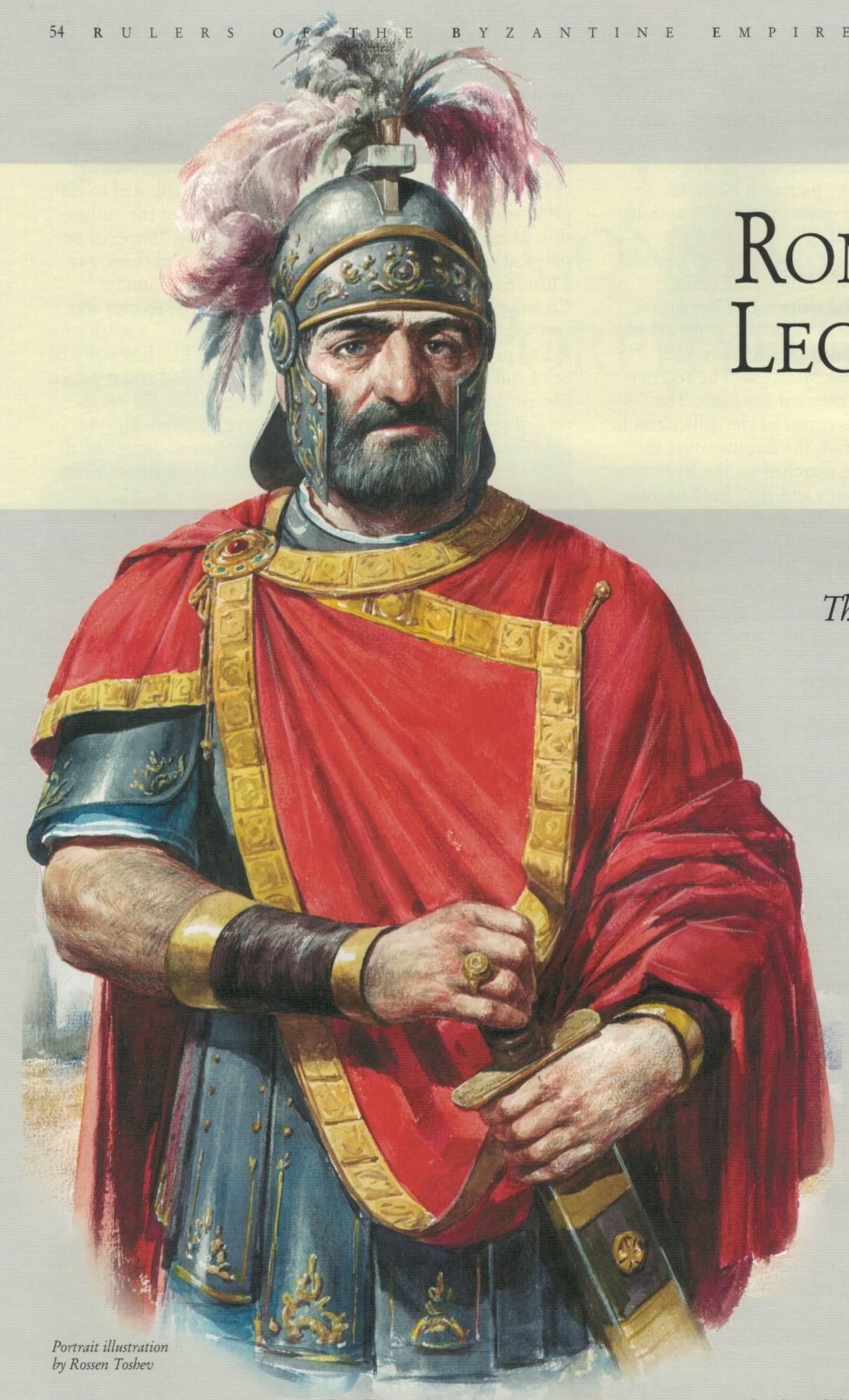
ab4f8884f30aaf601937c6ec0b550da4
Emperor Romanos I Lekapenos of Byzantium (r. 920-944)

For Romanos, to make it seem like Constantine would be powerless, Romanos made his eldest son Christopher his co-emperor in 921 who was intended to be his actual successor and in 924 Romanos I made his 2 younger sons Stephen and Constantine co-emperors too, thus Constantine VII the rightful emperor became the least powerful of the 5 emperors with his name placed at the bottom of the coins issued by the 5 rulers. The threat of Simeon of Bulgaria however was still at large and not to mention at this time, the Bulgarian Empire here under Simeon was no longer the primitive warrior state of Bulgaria 2 centuries earlier that posed a threat to Byzantium, but a highly civilized major Orthodox Christian cultural and military power in its golden age the same way Byzantium was, and in terms of size, Bulgaria was the largest empire in Eastern Europe spanning west to east from the Ionian Sea to the Black Sea and north to south from the Carpathian Mountains in Central Europe to Central Greece, and its ruler Simeon was no longer like the Bulgarian khans of old but a full emperor in authority known as tsar in their language, literally meaning “Caesar” being the first Bulgarian ruler to call himself that. Simeon in 924 made another attempt to besiege Constantinople both by land and sea except this time getting himself allied forces from the Arab powers in the Middle East, Sicily, and North Africa which Simeon believed was enough to fully take over Constantinople. The Arabs however were intercepted first by Romanos before they could reach Simeon, and Romanos won them over by even agreeing to pay tribute to them, and when finding out his Arab allies never made it, Simeon was upset. Simeon however still made it to Constantinople but when arriving, Romanos chose to resolve the issue with diplomacy, and here Patriarch Nikolaos who was still alive arranged for both rulers to meet up at a dock along Constantinople’s Golden Horn harbor. When seeing Simeon up close, Romanos I did not see a Bulgarian ruler in the traditional Bulgarian fur cloaks and fur hats but an emperor dressed in the same silks as the Byzantines did, although when they met face to face, there apparently was no violent tension brewing between them, rather it ended peacefully with Romanos agreeing to resume paying tribute to Bulgaria, also handing over to Simeon 100 silk robes as a gift. Afterwards, Simeon would never return as a physical threat except that in 925 he had the audacity to call himself not only tsar but “Basileus of both Bulgars and Romans”, literally emperor of both empires, though Romanos did not take it as an insult and instead he even joked about it saying that if he can, he would call himself “Caliph of Baghdad” without the Abbasid caliph’s approval. Simeon again not physically threatening Byzantium in 926 declared the Bulgarian Church independent from Constantinople, therefore creating a separate Patriarchate of Bulgaria though no matter how powerful Simeon was as tsar, his rule was still challenged first by his western neighbors being the Serbs (from present day Serbia) who Simeon defeated in 926, but the bigger threat to Simeon was his other more powerful western neighbor which was the Kingdom of Croatia ruled by its new king Tomislav who happened to be an ally of the Byzantines.
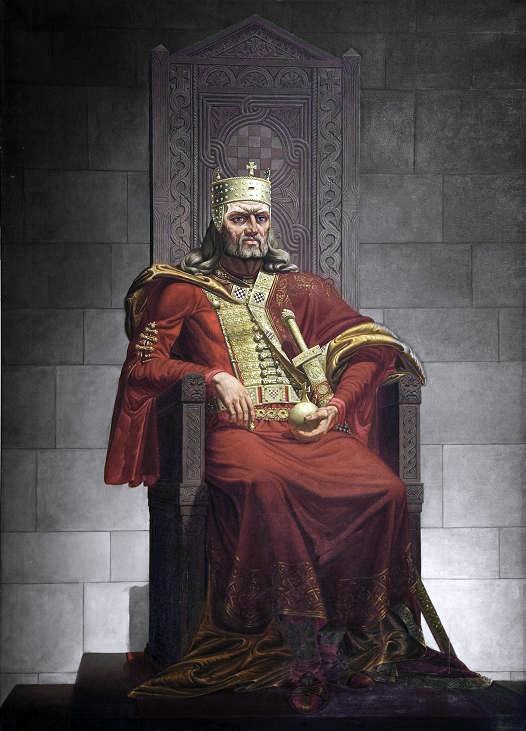
f24334c71b23ee49cf97adcdce533d4d8bf78044v2_hq
Tomislav, King of Croatia (r. 925-928)

Though seemingly undefeatable, Simeon’s forces lost a severe defeat to the Croatian forces of Tomislav in 926 in what is now Bosnia, thus Bulgaria was forced to pay a heavy humiliating tribute to Croatia and in 927, the very much humiliated Simeon died from a heart attack in his palace in the new Bulgarian capital of Preslav, and would be succeeded by his son Peter I as tsar who would happen to be a much weaker and less warlike ruler compared to his father. Peter I when becoming Bulgaria’s new tsar was also still young and wanting to rule in peace, he personally went to Constantinople to negotiate with Romanos I which was successful and as part of the deal, Peter married Romanos’ young granddaughter Maria, daughter of his eldest son Christopher while the new Patriarch of Constantinople Stephen II– who had succeeded Nikolaos after his death back in 925- married them and following this, a long 42-year period of peace would last between Byzantium and Bulgaria, allowing the Byzantines to continue fighting their other deadly enemy, the Arabs.          
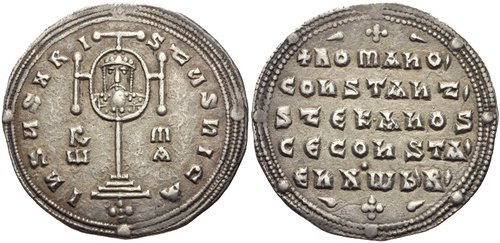
Romanos_I_with_co-emperors,_miliaresion,_931-944_AD
Coin of Romanos I with his and his sons Christopher, Stephen, Constantine, and son-in-law Constantine VII’s (at the very bottom) names
Tsar-Simeon-the-Golden-Age-of-Bulgarian-Literature-by-Dimitar-Gyudjenov
Court of Tsar Simeon in Bulgaria
703a27506ee2a180f9c0cf2d298ca096
Map of the Bulgarian Empire (yellow) under Tsar Simeon, Byzantine Empire (pink)

As the effective emperor, despite the rightful Constantine VII still having the title, Romanos I Lekapenos may have completely seemed to everyone as a tough military man being quite uncultured, uneducated, and rough around the edges which is what his rather intellectually and artistically snobbish son-in-law Constantine VII would say about him seeing him every day in the palace, although Constantine as I would say never felt respected by his father-in-law as Romanos felt his son-in-law was not tough enough being a an artist and scholar and not a soldier and politician the way Romanos was. However, despite Romanos’ tough exterior, he was also someone with a big heart as when a brutal winter struck Constantinople from 927-928, Romanos I spent a lot of the imperial treasury in building porticos for Constantinople’s streets so that the homeless would not die of the cold, and also he made sure the people had enough food to last the winter. Following this winter when seeing how much damage it inflicted on the people, especially the small farmers, Romanos I decided to pass a law that was to forbid the wealthy and powerful landed aristocracy or the Dynatoi to buy land from these farmers thus taking it away from them, but also for these farmers to not sell their land to their richer neighbors, though this was also part of an act to limit the landed aristocracy’s power as they produced the most troublemaking generals like the Phokas clan. In 931 on the other hand, Romanos I would suffer a great loss when his co-emperor son and intended heir Christopher died from an illness which Romanos mourned deeply most especially because there would be no one competent enough to succeed him when he dies as his other sons Stephen and Constantine despite them being co-emperors were rather good for nothing, therefore the only capable one was the rightful emperor Constantine VII, which was something Romanos could not accept.
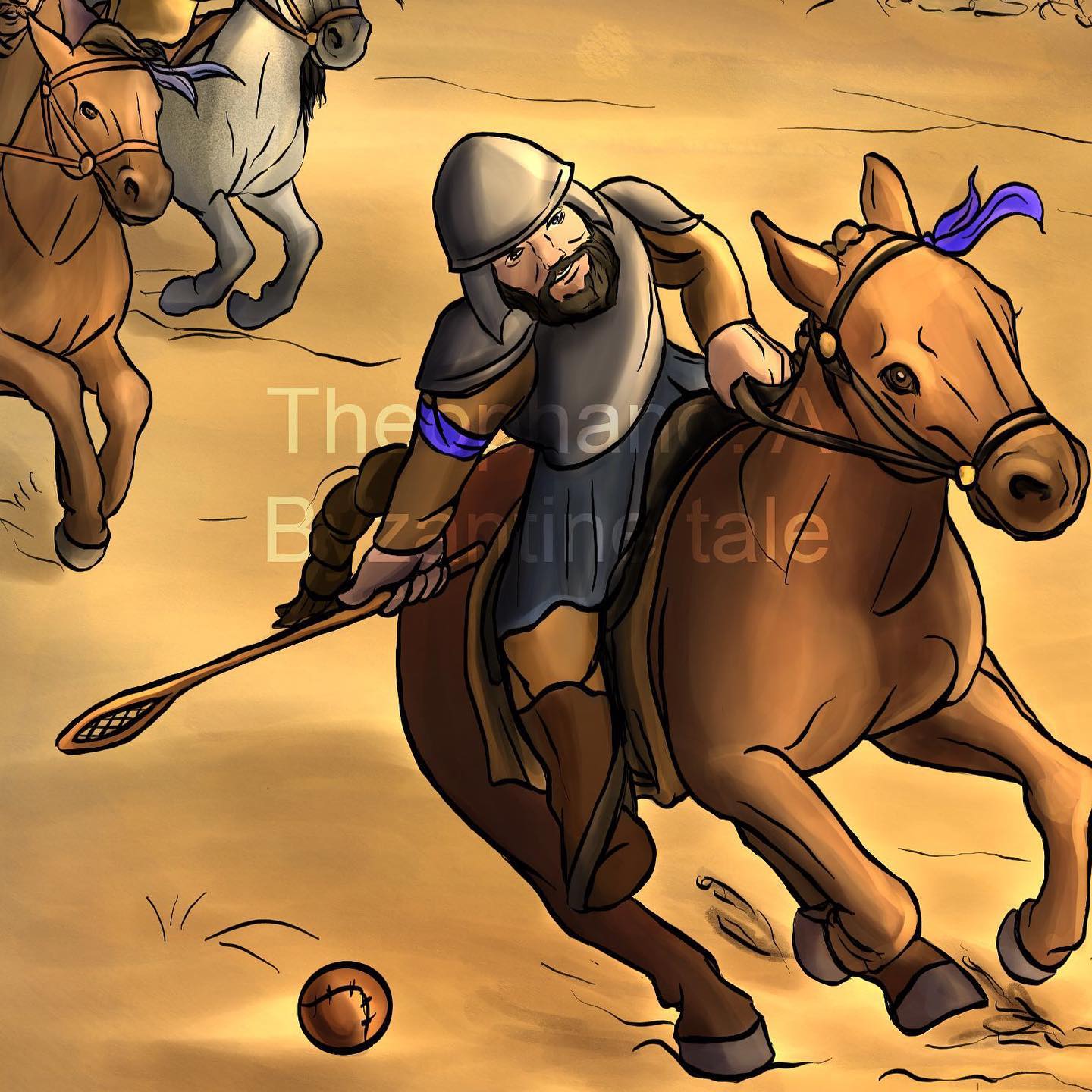
77006827_116417629803429_2747627094786703360_o
Theophylact Lekapenos, Patriarch of Constantinople (933-956) playing Tzykanion, art by Byzantine Tales

In 933, Romanos I as usual as the master of nepotism successfully schemed to make his 16-year-old son Theophylact, named after Romanos’ father be appointed as Patriarch of Constantinople which had happened to be a total embarrassment as for one Theophylact was a child who had no knowledge in theology, spirituality, and Church politics and second, his major concern was horses and playing Byzantine Polo that in one Easter he forgot to perform his duty as patriarch in celebrating the Eucharist as he had to be in the stables to watch his favorite horse give birth. Now when it came to military matters, this was where Romanos I was most successful at, although he did not personally lead the armies himself, rather the job was left to his close friend the general John Kourkouas who was from a lesser known aristocratic family, as Romanos preferred smaller time families more thus making John the commander in chief or Domestikos ton Scholon of the eastern armies, and back in 923 it was John that finally defeated the notorious pirate Leo of Tripoli in the Aegean Sea in which Leo would afterwards disappear from the historical record and in 932, John went as far as Lake Van in the border of Byzantium and Armenia capturing the trading town of Manzikert, thus giving the empire control of trade routes into Armenia and Central Asia. John Kourkouas however would score his greatest victory in 934 when finally achieving the Byzantine dream of capturing the city of Melitene (today’s Malatya, Turkey) in Eastern Asia Minor which then had been the seat of the breakaway Arab Emirate of Melitene that was a vassal of the Abbasids in Baghdad, though what would be very significant about this capture of Melitene was that it was the first time the Byzantines conquered an entire Arab Emirate and absorb it to their empire. Following the conquest of Melitene, the Byzantines immediately resettled Greeks and Armenians in the area into it before the Arabs could take it back, but the capture of Melitene also sent great shockwaves to the Muslim world that the Emirates of Mosul and Aleppo both ruled by members of the powerful Hamdanid clan would counter-attack and challenge John Kourkouas although by 940, the Arab Hamdanid general Sayf al-Dawla better known as the “Sword of the State” and John would be recalled to their capitals but in 941, John returned to campaigning in the east but had to immediately rush back again, for he heard Constantinople was under attack once again. Now in 941, Constantinople was for the 3rd time attacked by the army and fleet of the Kievan Rus’ coming from today’s Ukraine sailing down the Black Sea with their fleet of longships, except this time the Rus’ force was much larger and deadlier with 1,000 ships and 40,000 men with their Grand Prince Igor himself leading them.
d2ef632d38fee1ebaa4cfd16d16bfb8b
Igor, Grand Prince of Kiev (r. 914-945)

Having only 15 old ships in the capital, Romanos I patched them all up with the imperial secret superweapon of Greek Fire, and charged them all out to attack the Rus’ longships with the eunuch admiral Theophanes in command of the 15 ships, and with the Rus thinking they could easily crush these 15 ships, they were proven wrong when all 15 of them blew out the powerful liquid fire which burned a number of the Rus’ ships, and the Rus soldiers in fear of the sight of the fire jumped into the sea wherein many died from drowning due to the weight of their armor. After fleeing from the Greek Fire, the remaining Rus army escaped to the Asian shore of the Marmara where they committed great atrocities towards the Byzantine locals including crucifying them with nails hammered to their heads while as usual, the Rus nonstop pillaged the land. Soon enough hope would come for the Byzantines when their armies led by John Kourkouas and the same old Bardas Phokas the Elder, the younger brother of Leo Phokas who was blinded back in 919 rushed back to counter-attack the Rus, and at the end of the day the Byzantines were victorious as Theophanes with his navy also destroyed the rest of the fleet, thus the remaining Rus including their prince Igor returned home to Kiev. Now this major conflict between the Rus and Byzantines in 941 is where the graphic novel Theophano opened with the same admiral Theophanes defending Constantinople from the Rus, except here in this story the family of Theophano from Laconia in Greece would not come to Constantinople, thus the story returns to John Kourkouas who would resume his campaigns against the Arabs in the east where in 942 he would attack Aleppo in Syria, the seat of the Arab Emirate though would not be able to conquer it, but John would later on achieve what no Byzantine armies did for the past 3 centuries since all of Byzantine Syria and Mesopotamia was lost to the first wave of Arab invasions in the 630s during the reign of Heraclius (610-641), if you remember from chapter IV of this series. John here would go as far as capturing the important fortress of Dara, the same military fort both Byzantines and Sassanid Persians fought over countless times back in the old days almost 400 years earlier. Though while John Kourkouas seemed to be scoring a lot of victories in the east, Romanos I’s time as emperor was nearing its end, thus he was growing more depressed as the days went by.
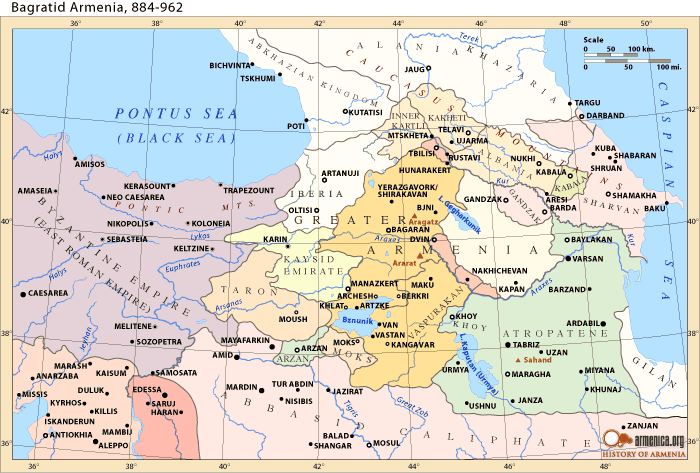
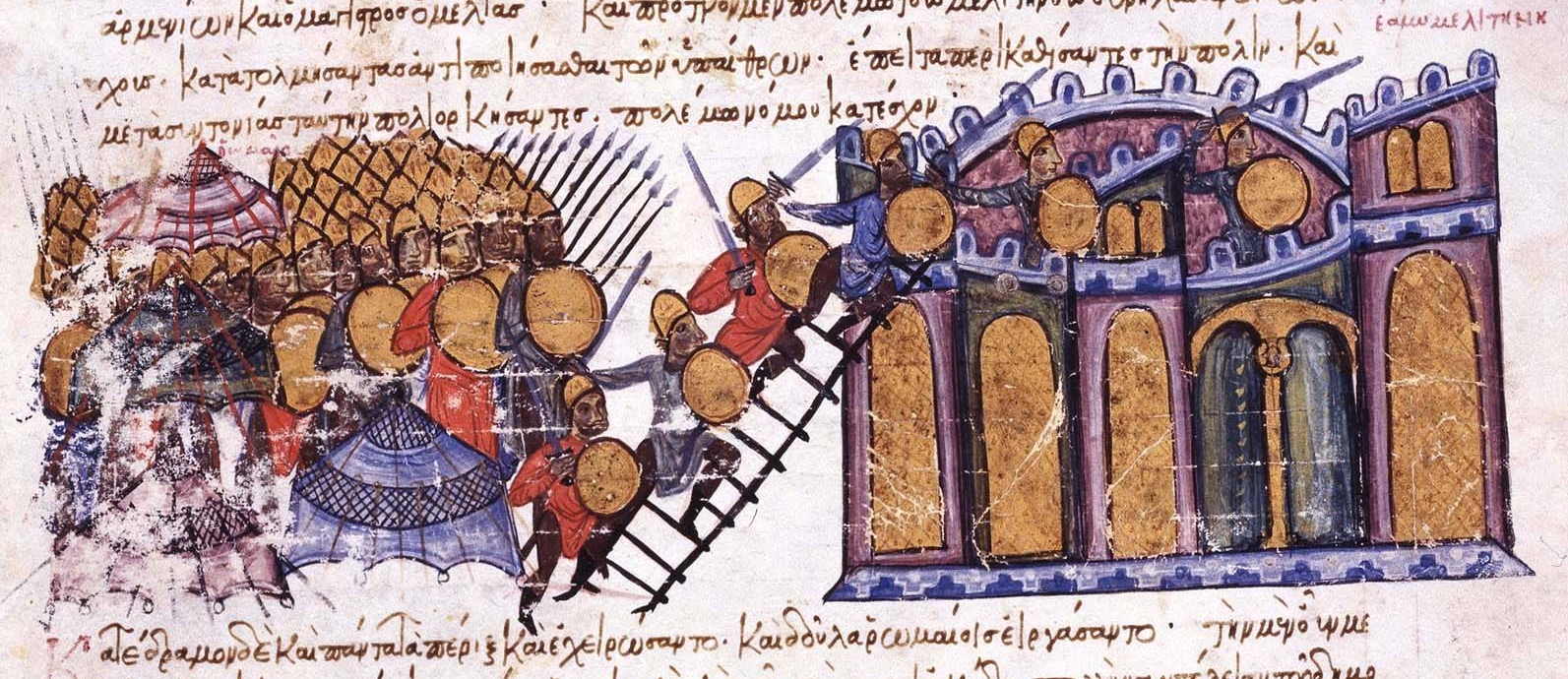
Caucasus,_884-962
Map of the small states at the Caucasus border between Byzantium and the Abbasid Caliphate in the 10th century
Melitene_by_the_Byzantines_in_934_from_the_Chronicle_of_John_Skylitzes
Byzantine forces under John Kourkouas capture Melitene from the Arabs in 934, Madrid Skylitzes
1280px-Greekfire-madridskylitzes1
Rus-Byzantine War of 941, Byzantine fleet uses Greek Fire against the Rus’ fleet, Madrid Skylitzes
Byzantines_repel_the_Russian_attack_of_941
Rus-Byzantine War of 941, Byzantine fleet defeats the Rus’ fleet at the Sea of Marmara, Madrid Skylitzes
main-qimg-667c7dd5a1cec9de75cd89f3a4c6a261
Byzantine navy using Greek Fire against the Rus outside Constantinople’s Walls, 941

Part II.

Constantine VII Porphyrogennetos, an Intellectual Snob but Surprisingly Skilled Emperor (944-959)          

Palaiologos_Dynasty_emblem1

For more than 20 years, the rightful emperor Constantine VII Porphyrogennetos had been in the shadows, although this whole time he had been busy with intellectual pursuits all while having a rather happy marriage to Romanos I’s daughter Helena who being her father’s only daughter when all his other children were sons did not have a lot in common with her father and brothers’ more manly interests, but rather like her husband, she also enjoyed the more sophisticated things.
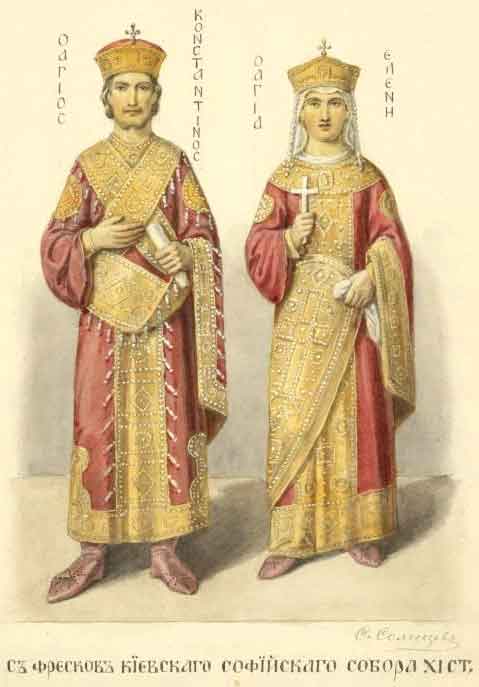
KonstantinVIIEleni
Emperor Constantine VII and Empress Helena Lekapene

Helena had turned to out to be the empire’s senior empress as well despite her only being the senior emperor’s daughter as this was due to the fact that her mother had already died a long time ago just 2 years after her father became emperor (922), and being the most powerful woman in the family as her father’s only daughter, she became the highest-ranking woman in the empire. Helena’s marriage to Constantine VII was indeed a very successful one that they were able to produce 6 children and unlike her father who had 5 sons and only one daughter, Helena with Constantine had 5 daughters and only one son named Romanos born in 938 as a Porphyrogennetos in the purple room too and named after his maternal grandfather the reigning emperor Romanos I, and surprisingly Romanos was born with a twin sister named Zoe after her grandmother, Constantine VII’s mother Empress Zoe Karbonopsina who had died as a nun a long time ago. Now back to Romanos I, by the 940s he had grown increasingly depressed especially since his son and intended heir Christopher died despite it happening 10 years earlier and in his depression, Romanos I became most concerned with what we would all be worried about when reaching old age, which is about death and the afterlife and Romanos here was deeply bothered about it especially about the salvation of his soul and like Basil I mentioned earlier on as he was in his final years, Romanos I felt the same way in feeling he had been punished by God for what he did in the past, which was taking over power from the rightful emperor. In 944 the Rus’ prince Igor I returned once again with his fleet except this time in the mouth of Danube River to the Black Sea threatening to have war with the Byzantines again, but Romanos this time was able to turn them away through diplomacy by sending them gifts. Back in the east, the general John Kourkouas continued his successful campaigns deep into Northern Mesopotamia, although he was still unable to capture the city of Edessa in 942, but instead the Arab authorities gave John a very important relic which had been in the city of Edessa’s possession since the 1st century AD and this was the Holy Mandylion which was a piece of cloth believed to have been used by Jesus Christ himself to wipe his face, therefore leaving an imprint of his features, and this was a relic of high value that the Byzantines always wanted to acquire.
200px-Christos_Acheiropoietos
Image of Christ in the Mandylion

In 944, the Mandylion was sent over to Constantinople wherein a grand ceremony was held to enshrine it in the Hagia Sophia, though Romanos I was too ill and depressed to attend it so instead his sons and co-emperors Stephen and Constantine attended it and so did his son-in-law Constantine VII but when the ceremony happened, the brothers Stephen and Constantine could not see the face on the cloth but Constantine VII did, therefore he gained a vast amount of public support as everyone believed that by being able to see Christ’s face, he was destined to take back the throne. Romanos I later on true enough announced that his time was almost near as he was already 74, therefore he named his son-in-law Constantine VII his successor as senior emperor and not his sons Stephen and Constantine, but when these two sons heard of this, they were greatly enraged and so in December of 944 to save their positions, both sons launched a coup against their father in which they broke into his bedroom while he was sleeping and here, both sons put him under arrest, dragged him to a boat, and sent him away to the Princes’ Islands in the Marmara to be a monk in a monastery there. For the next 2 or 3 weeks, both brothers Stephen and Constantine were basically in charge of the empire, and now they turned to arrest their brother-in-law Constantine VII but failed as Constantine VII already had great public support and so being convinced by his wife Helena, Constantine VII in January of 945 struck back and arrested his brothers-in-law. The people of Constantinople meanwhile started hearing some rumors that Constantine VII had been killed by the brothers until Constantine VII himself came out to greet them saying he was all alive and well and that the brothers had been banished to no other than the monastery where they sent their father to. Both Stephen and Constantine Lekapenos ended up becoming monks too joining their father in monastery arrest and while Romanos I spent his last years thinking about his soul, his sons were still thinking of ways to return to power, but at the end they never would, and Constantine VII now at 39 finally got his chance to rule alone after 32 years of being in the shadows despite keeping his title.
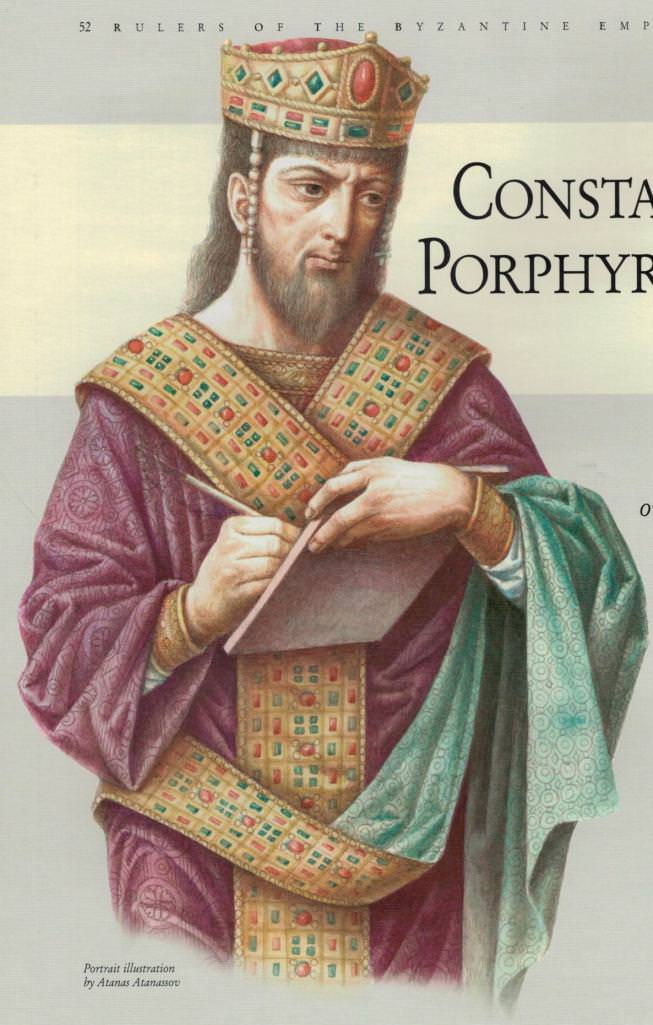
SaAeyNE
Emperor Constantine VII Porphyrogennetos of Byzantium (r. 913-959), sole emperor (945-959)

At 39, Constantine VII was tall but stocky with a long black beard and brown hair, though quite overweight as for the past 32 years he barely left the palace and instead remained in his study reading and writing as well as drawing and painting, and in those years he had been kept away, he became most interested in court ceremonies and now as the sole emperor, he put a lot of attention into it as a way to make it seem like he was all-powerful to make up for all those years where he seemed powerless. Not surprisingly, Constantine VII held a strong grudge against his in-laws, the Lekapenos family especially towards his father-in-law Romanos I and his brothers-in-law seeing them as nothing more but uncultured and improper people, or basically just trash despite being married to one, except that Helena as I said was nothing like her father and older brothers, although there were also some members of the Lekapenos family that Constantine VII still trusted as they were much like him in personality and interests and these were Helena’s younger brother the patriarch Theophylact Lekapenos who was still patriarch and Basil Lekapenos, the youngest though illegitimate son of Romanos I born in 925 who now as an adult was castrated and turned into a eunuch by Constantine VII’s orders as a way to make Basil unquestionably loyal and unable to usurp power as he was to be Constantine VII’s personal chamberlain and bodyguard.
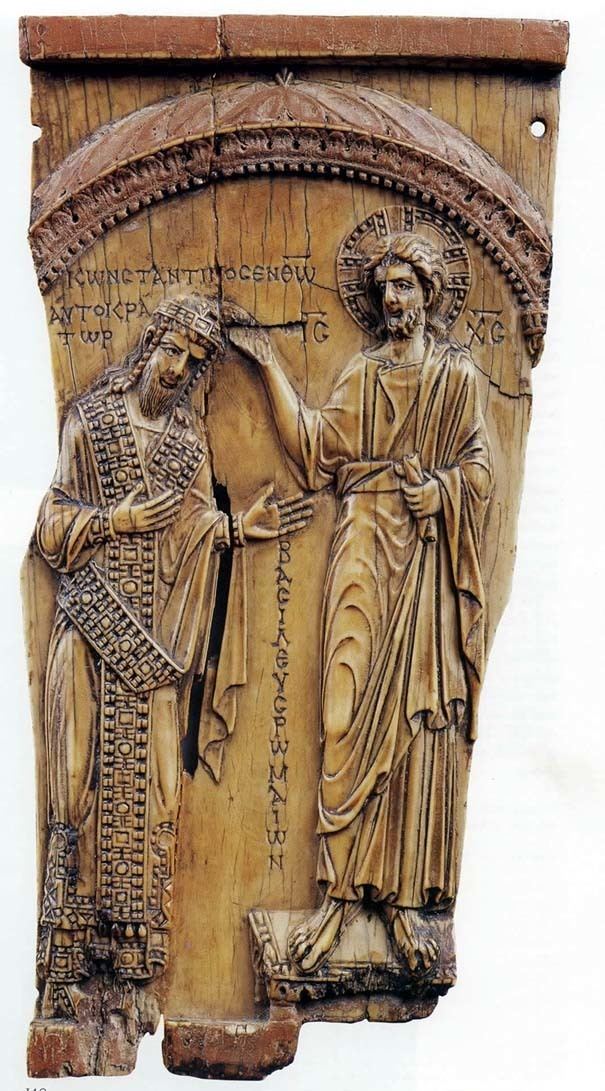
constantine-vii-aa0336b4-7ac7-4e73-84e9-a9243355d05-resize-750
Woodcarving of Christ crowning Emperor Constantine VII

As usual of emperors coming to power in this period in Byzantine history, Constantine VII began his sole rule by firing all those loyal to Romanos I including the highly successful general John Kourkouas who in 945 was dismissed from command as Constantine feared he would one day take the throne in the name of his friend Romanos I, and in return Constantine VII replaced all of Romanos I’s loyalists with people loyal to him such as the same old Bardas Phokas the Elder who in 945 replaced John Kourkouas as the supreme commander of the eastern armies and serving him would be his sons Nikephoros Phokas the Younger and Leo Phokas the Younger as well as their 30-year-old nephew John Kourkouas Tzimiskes, who was the son of their older sister and a grand-nephew of the same John Kourkouas who had been fired; and now this Nikephoros Phokas mentioned here who was named after his grandfather Nikephoros Phokas the Elder that was mentioned earlier, would be the more famous Nikephoros Phokas. The other loyal officials Constantine VII had appointed to run the government on the other hand were mostly eunuchs which included of course Basil Lekapenos but also other highly capable eunuch administrators like Joseph Bringas and Constantine Gongyles. Romanos I meanwhile had not died yet and in 947, his son Theophylact who was still patriarch here together with the eunuch admiral Theophanes who was still in command plotted to restore Romanos to the throne, but the plot was quickly uncovered by Constantine VII who when hearing about it dismissed Theophanes from command for good, while Theophylact on the other hand was still kept as patriarch as he was entirely useless being nothing more but literally a clown who even performed theatrical acts when performing the liturgy which was very scandalous, and as mentioned earlier he was lacking in brains and cared more about horses than his religious duties. Romanos I on the other hand did not live long enough and in 948 he died as a monk in the monastery he was sent to at age 78.           
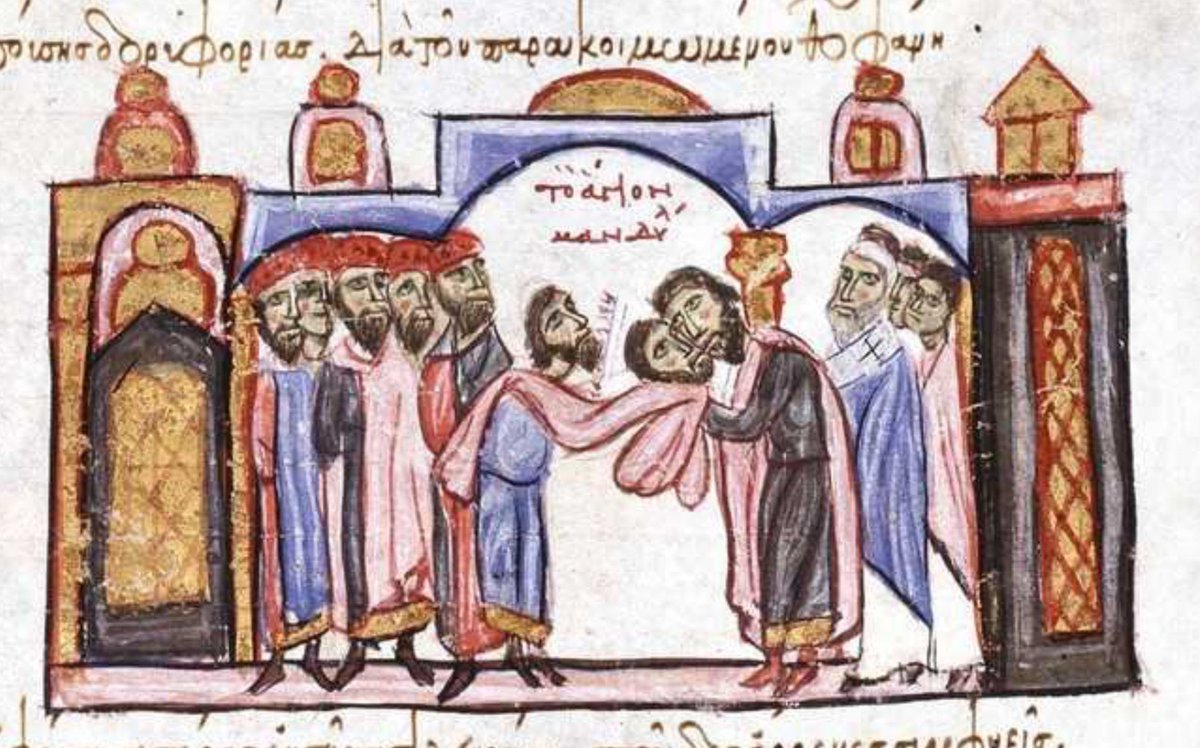
DkuHmJ6XoAAkzsF
The Mandylion brought to Constantinople in 944, Madrid Skylitzes
constantine-vii-porphyrogennetos
Constantine VII (center) in ceremonial armor
Byzantine_Empire_Themata-950-en.svg
Map of the Byzantine Empire’s Themes (military districts) in Asia Minor, 10th century

Constantine VII as emperor could have been a really disastrous ruler as when the empire was still being pressured by Arab forces in the east as well as in the seas by the Arab pirates of Crete and Cilicia while the administration at the same time was being dominated by corrupt eunuchs, Constantine VII had been preoccupied with his scholarly works which is how historians like John Skylitzes (1040-1101) portray him as, but at the same time this was not true of him as Constantine VII cared deeply about the administration, invested heavily on the army, dutifully read all documents given to him, and investigated all cases of injustices against the poor which is how historical records like Theophanes Continuatus portray him as, which is in fact the more reliable source.
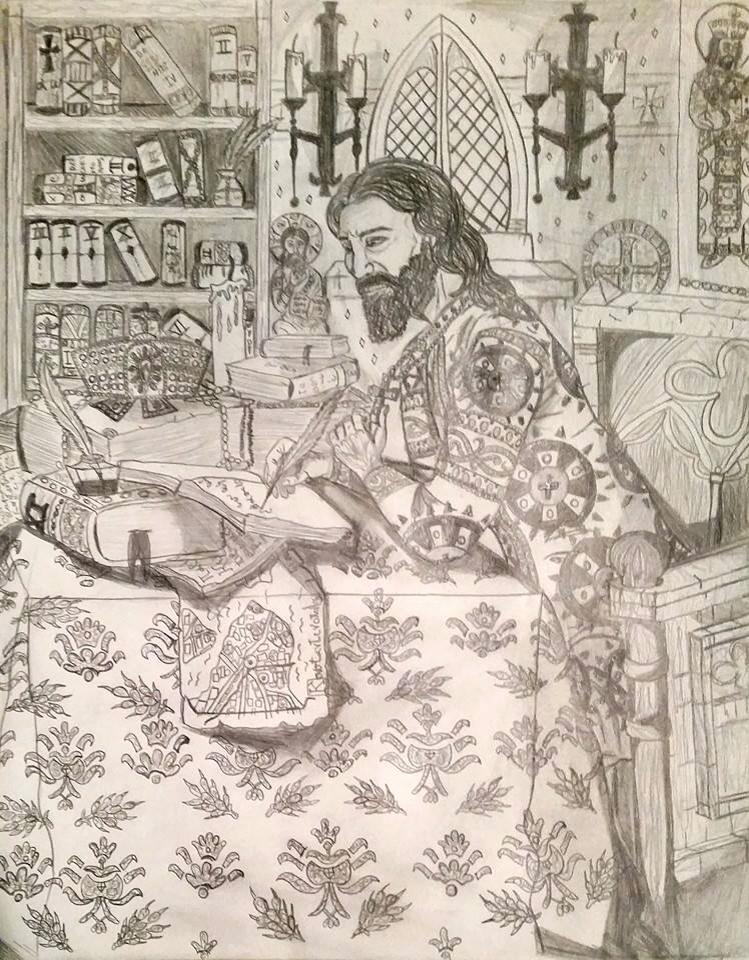
constantine_vii_porfirogennetos_by_spatharokandidatos_d7sd4r1
Constantine VII in his study, art by Spatharokandidatos

What is more true about Constantine VII was that he was simply the personification of this era, the Byzantine Renaissance as out of all the emperors of this time, he was the one who put the most attention into funding and promoting art, culture, and literacy as well as court ceremonies, and true enough his own intellectual pursuits in writing books and compiling other works would totally show he was this era’s embodiment in cultural terms whereas Romanos I before him was somewhat the embodiment of this era’s military resurgence. Constantine VII now may have excelled in artistic and literary matters, but in military matters he was not as you will see, which makes him very much like his father Leo VI and just like his father, Constantine VII in 949 made another attempt to reconquer all of Crete from the Arab Emirate of pirates there, and here he planned a larger scale invasion even allying himself with Otto I, the King of the Frankish Empire’s successor Kingdom of East Frankia better known as Germany and the Emirate of Cordoba or Al-Andalus in Spain which were after all the mortal enemies of the Emirate of Crete as these pirates in Crete were after all exiles that tried to overthrow the ruling authority of Cordoba but failed and instead turned to piracy. The proposed military alliance with Otto I’s Germany and the Emirate of Cordoba however never came to happen as both rulers had their own problems, so at the end it was only Constantine VII’s Byzantine forces under the eunuch Constantine Gongyles that were left alone to retake Crete and like Leo VI’s attempted reconquest of 911-912, this expedition in 949 was a disaster and failure not only because of Gongyles’ inexperience in military command that the Byzantine forces were massacred by the Arabs while they were sleeping, but because the island of Crete had a rough terrain that made it difficult to conquer, but either way the expedition was abandoned and Gongyles after barely escaping with his life retired from imperial service for good. Constantine VII on the other hand would not see this failed expedition of 949 to reconquer Crete as a great loss, rather he would still continue to do what he loved most which was writing books that by 950 he had already written and published 3 major literary works by himself and as a highly learned scholar, he was fluent in both Latin and Greek. Now before his reign as sole emperor in 945, Constantine VII already completed and published a biography on Basil I (Vita Basilii in Latin), which I have mentioned earlier many times and believing Basil I was his grandfather who he greatly idolized, Constantine VII portrays him as a heroic figure and defender of the poor from corrupt eunuchs that demanded tax from them while Michael III who Basil killed was portrayed as the embodiment of all that is evil and corrupt, therefore Basil’s usurping of power was seen as necessary. Little did Constantine know on the other hand that Basil who he idolized so much was actually not his grandfather and that the evil Michael III he writes about was actually his grandfather and this was mainly because Constantine was too young to remember his father Leo being alive, but if Leo lived longer, Constantine would have known the whole truth- in this story’s case- that Michael was indeed his grandfather. However, much like his actual grandfather Michael III who he labelled as “the Drunkard”, Constantine VII was also a heavy drinker and heavy eater although he was still very respectful to others, took matters seriously, and was on time in attending court ceremonies unlike Michael III who was mostly neglectful.
bub_gb_OFpFAAAAYAAJ
De Ceremoniis by Constantine VII

The other work Constantine VII wrote and published included a complete encyclopedia of the Byzantine court rituals and protocols which he was so obsessed with known as De Ceremoniis in Latin which discusses in great detail the proper behavior for court ceremonies, coronations, baptisms, weddings, funerals, etc. and also about the proper attire to wear for such events, and even about how to behave in church and in feasts, and this would be a very valuable source on Byzantine court rituals which would serve as a manual for all Byzantine emperors after him, and for us today as our greatest source for information on Byzantine court life. Constantine’s other literary work De Thematibus meanwhile would be a very valuable guide to the geography and history of all of the Byzantine Empire’s provinces or Themes, and this is believed to be the only work composed and compiled by Constantine himself as the rest were just commissioned by him, although for this story’s case Constantine did in fact write all of these himself. The most important work of Constantine VII however is the De Administrando Imperio (DAI) which was literally a guide book to running the very complicated Byzantine Empire with all its politics, while at the same time it was a diplomatic guide to all of Byzantium’s foreign neighbors such as the Arabs, Franks, Magyars, Serbs, Bulgarians, Pechenegs, and a lot more based on reports by imperial diplomats and in 952, this guide to the empire and beyond was published and presented to Constantine’s son and heir Romanos who was now co-emperor.
121217-23-Constantine-VII-Byzantine-Byzantium
Constantine VII’s De Administrando Imperio (DAI)

The DAI now was made to advise young Romanos and his successors after him on how to run the empire properly, and part of the advice in this book was that Greek Fire was to be kept as a deep state secret as it had saved Byzantium countless times, and also that Byzantine imperial princes were discouraged from marrying any princesses from foreign powers unless they were from the Franks as this was part of Constantine VII maintaining friendly relations with the rising Frankish king Otto I. As part of Constantine VII’s foreign policy in impressing the Franks was that one time possibly in 949 when the bishop of Cremona in Italy Liutprand came to Constantinople being sent by Otto I, Constantine VII greatly impressed him with the grandeur of the imperial court as here Liutprand said he was greatly impressed seeing Constantine VII on his throne being lifted up by a mechanism that elevated the throne itself while the bronze lions that flanked the throne both roared like a real lion would and beside it, the golden birds in the artificial golden tree beside the throne sang. Now Constantine VII here patterned his throne after the description of King Solomon‘s throne room according to Ancient Jewish legends, and Constantine true enough did a pretty good job, but the big mystery here is how the lion and bird sounds were actually recorded.         
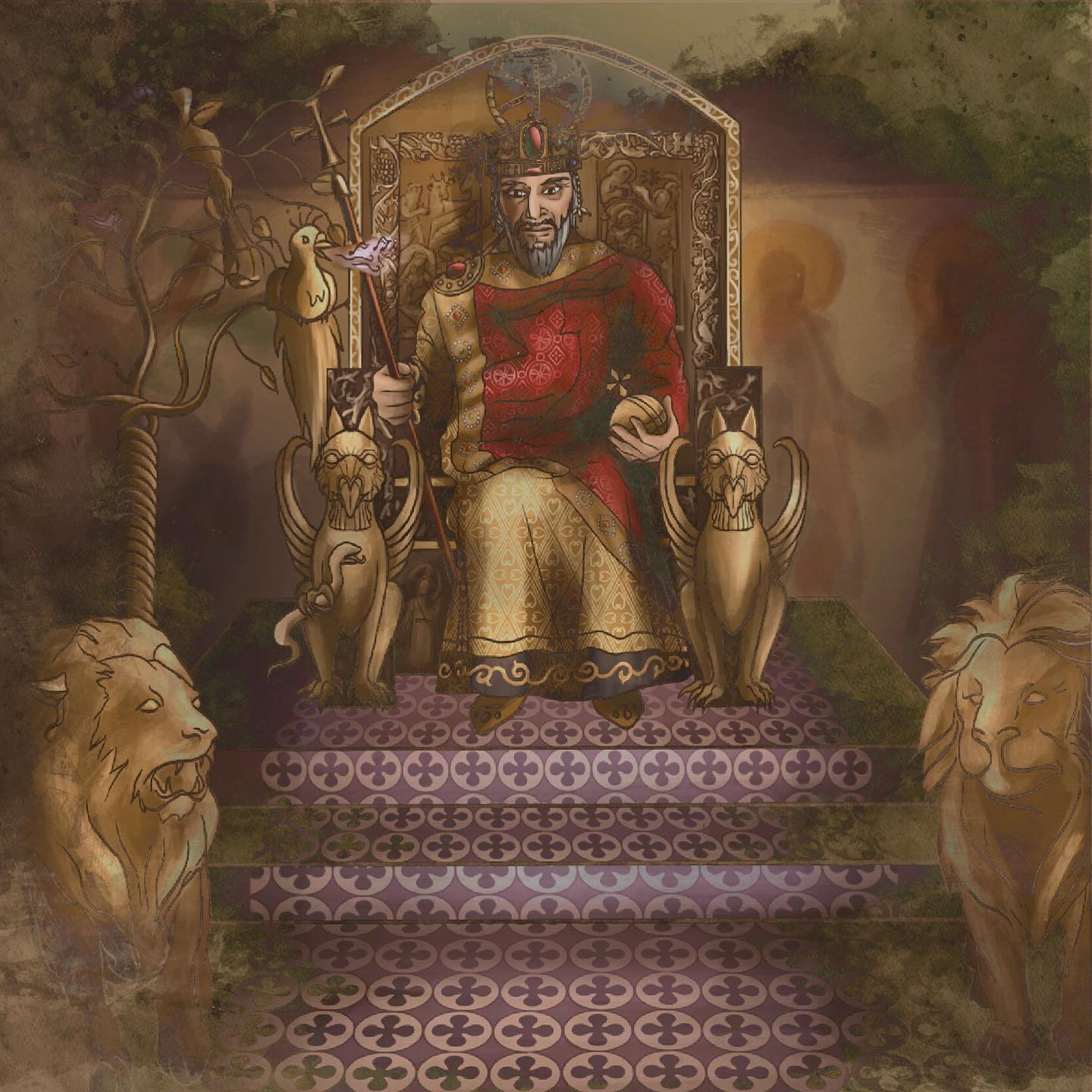
87039363_172936947484830_4405968372123041792_n
Constantine VII on his throne with the mechanical lions and singing tree, art by Byzantine Tales

Back in the eastern frontier, things were doing well for the Byzantine armies under the supreme commander of the eastern forces Bardas Phokas the Elder but in 953 when battling the forces of the same Sayf al-Dawla who battled John Kourkouas earlier who now was the Emir of Aleppo since 945, Bardas who was now an old man was severely injured in battle while at the end of the day, Sayf’s Arab forces won and even retook the city of Germanikeia in Syria from the Byzantines. Following his injury and being too old to fight anyway being already in his 70s, Bardas retired from command in 955 and would be succeeded as the supreme commander or Domestikos of the eastern forces by his older son Nikephoros Phokas the Younger who was prior to that the Strategos of the Anatolic Theme, and Nikephoros now was a far more capable and ruthless general compared to his father who spent his entire life together with his younger brother Leo learning the art of war.
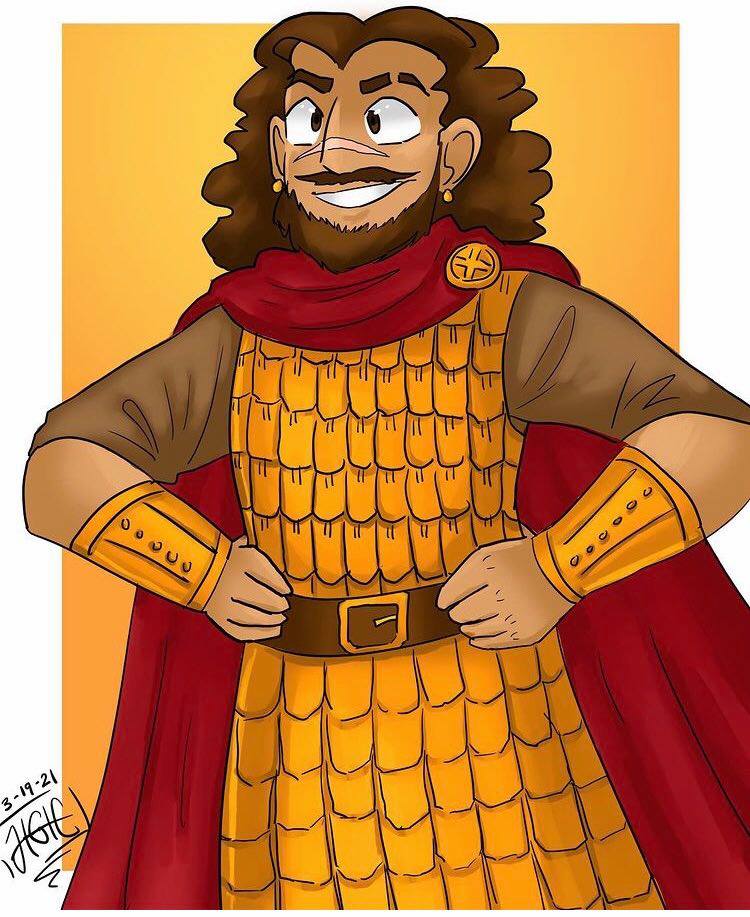
197606155_2924594291131974_8828689186046269925_n
General Nikephoros Phokas the Younger, art by Ancient City Lullaby

Nikephoros meanwhile was born in 912 in Cappadocia, the same year Leo VI died, and being part of the wealthy and powerful military clan of Phokas (plural: Phokades), he was destined to have a military career, and Nikephoros would true enough be no exception to this as he trained all his life to be a soldier, but what made him stand out was his purpose which was not only to fight for the empire or for territory and wealth but to defend the Orthodox Christian faith, and this is why throughout his entire military life, Nikephoros had an intense hatred towards Islam which makes him somewhat of a holy warrior or “proto-Crusader” as the actual Crusades would happen long after his time. All these years in military service made Nikephoros into a bloody killer especially towards Byzantium’s Muslim enemies that they would all fear his presence, but at the same time he was also a very disciplined holy man that lived life like an ascetic monk even being vegetarian in diet, and before every battle he would gather up his soldiers for prayer, therefore making him what would be a holy warrior, while his brother Leo who was 3 years younger than him would very much just follow his older brother’s example except that Leo was married.
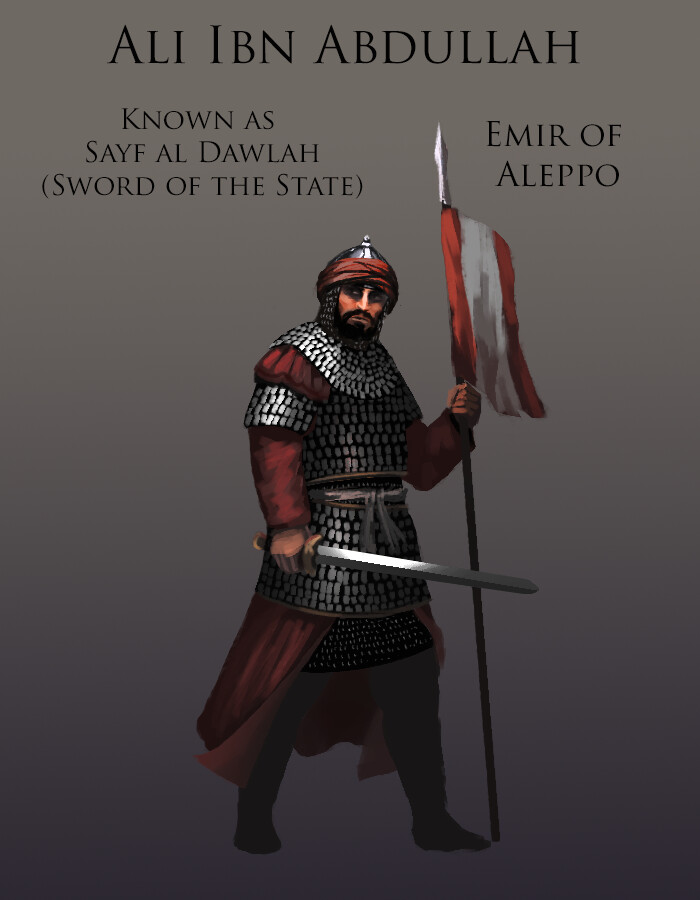
mubarizun-sayf-al-dawla
Sayf al-Dawla, Emir of Aleppo (r. 945-967), art by Marwan Musa

As Nikephoros was the top commander in the east, he made his younger brother Leo and nephew John Tzimiskes his subordinate generals, and while Nikephoros and Leo based themselves in the eastern border with the Arabs in Cilicia and Syria, John was assigned up north in the Armenian border defending it against the Arabs, though in 956 when Sayf’s Arab forces struck John’s army, John being still young and not so experienced yet was defeated and therefore had to flee but later that year, Nikephoros and Leo struck back and won a victory over Sayf’s forces and in 957, Nikephoros would campaign deeper east into Syria and capture the city of Hadath while John on the other hand in 958 would manage to actually succeed not only in crushing Arab forces in battle, but by actually recovering the city of Samosata in Mesopotamia from the Arabs while at the same time off the coast of Cilicia, an Arab fleet was destroyed by the Byzantines’ Greek Fire. It was also at around this time in real history when Theophano would come into the picture marrying Constantine VII’s son Romanos as was seen in the graphic novel, but in this story’s case it would not happen. In real history, Romanos as a child was married to Bertha, the daughter of the Frankish king of Italy Hugh (r. 926-947), although Bertha died soon after and so in around 957 with Romanos now grown up, he was free to choose his new wife and rather than choosing a powerful foreign princess or a daughter of a noble Byzantine family, he chose the young daughter of an innkeeper from the region of Laconia (the Peloponnese) in Southern Greece named Anastaso who despite being of low status was famous for her beauty and when hearing rumors about her, Romanos had her sent to Constantinople where she was renamed Theophano after marrying Romanos, although other sources say Theophano actually came from a noble family but of little importance, while her origins as an innkeeper’s daughter was just made to malign her.
250px-PE_Lakonias_in_Greece.svg
Location of Laconia in Greece (red)

For this story however, let’s just say Romanos never heard of these rumors about this young woman in Greece, therefore Anastaso would not become Theophano but rather would live a simple life as an innkeeper’s daughter in Laconia, never to be heard from again, therefore this would be the story’s greatest plot-twist. Other significant events that happened later on in the 950s with Byzantium under Constantine VII was that in 956 the mostly irresponsible patriarch Theophylact Lekapenos died from ironically falling off his horse as for his whole life he was dedicated to horses and following his sudden death at 39, he was replaced as Patriarch of Constantinople by Polyeuctus, a man who began out as a simple monk and when becoming patriarch he was the complete opposite of the fun-loving Theophylact as Polyeuctus was a serious scholar and a man of strict morals, except he was also very rude and arrogant as he would constantly challenge the emperor Constantine VII’s authority especially since he was the son of a controversial 4th marriage that Polyeuctus being strictly Orthodox never agreed to it, but also in knowledge of philosophy and religion knowing the emperor knew them well which is where Polyeuctus challenged him a lot in, while Constantine was not happy being challenged by the disrespectful patriarch, except that he did not show it.
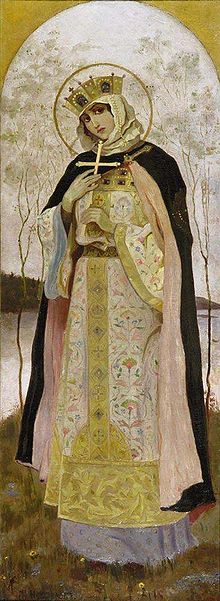
220px-St_Olga_by_Nesterov_in_1892
Olga, Princess of the Kievan Rus’

In 957, the ruling princess of the Kieven Rus’ state Olga, wife of their former ruler Igor I who attacked Constantinople back in 941 but died in 945 came over to Constantinople though not to attack but to be baptized as a Christian by Patriarch Polyeuctus, thus would mark the beginning of the Christianization of the Rus’ state who like Bulgaria before also chose to adopt Orthodox Christianity. In Constantinople, Olga was seen as an exotic beauty with blonde hair, blue eyes, and pale skin and because of her beauty, the emperor Constantine even briefly fell in love with her, but Olga prevented him from doing so by making Constantine her godfather at her baptism as a godfather and goddaughter could not be in a relationship and before returning north to Kiev, Olga as a Christian now took the name of Helena after the empress. Constantine VII on the other hand did not have much longer to live and in November of 959, right when was about to plan another campaign to reconquer Crete from the Arabs, he died in his bed at only 54 under mysterious circumstances that it was rumored that his daughter-in-law Theophano poisoned him thus giving her a bad reputation, however in this story with Theophano never coming into the picture, Constantine VII would still die here in 959 as it was surely most possible that he did not die from poisoning but rather from heart failure as Constantine was already unhealthy due to being overweight spending most of his life in his study and throne room barely moving while also eating and drinking very heavily, and at only 54 he already looked like he was in his late 60s after living a life of stress especially back when Romanos I was his protector who at any time could decide whether Constantine was to live or die. In real history, Constantine in 959 died at least having one grandson which was Basil, the son of Romanos and Theophano but here without Theophano around, Constantine would still die ruling the empire very competently leaving the empire with its cultural Renaissance and military might at a full swing.
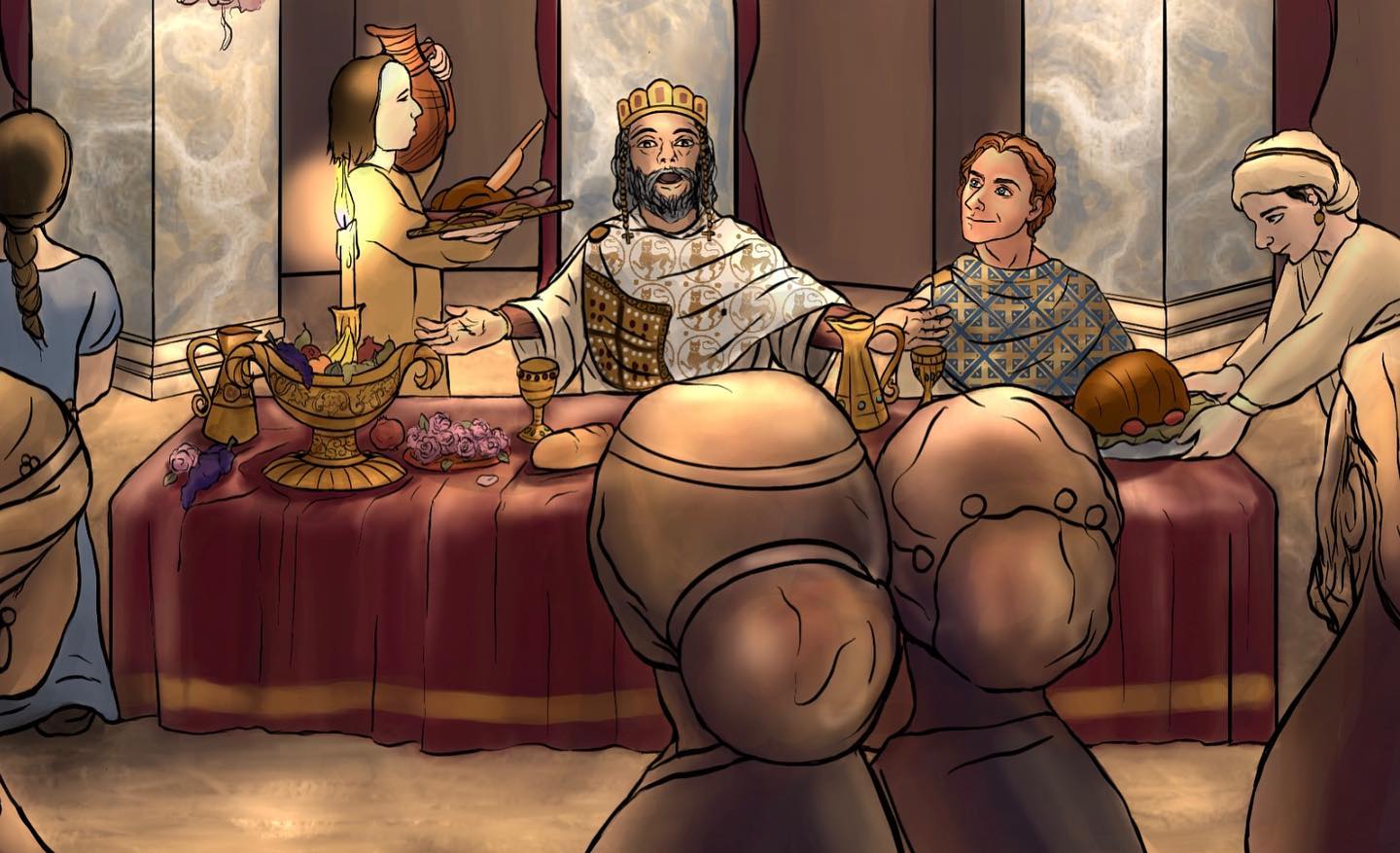
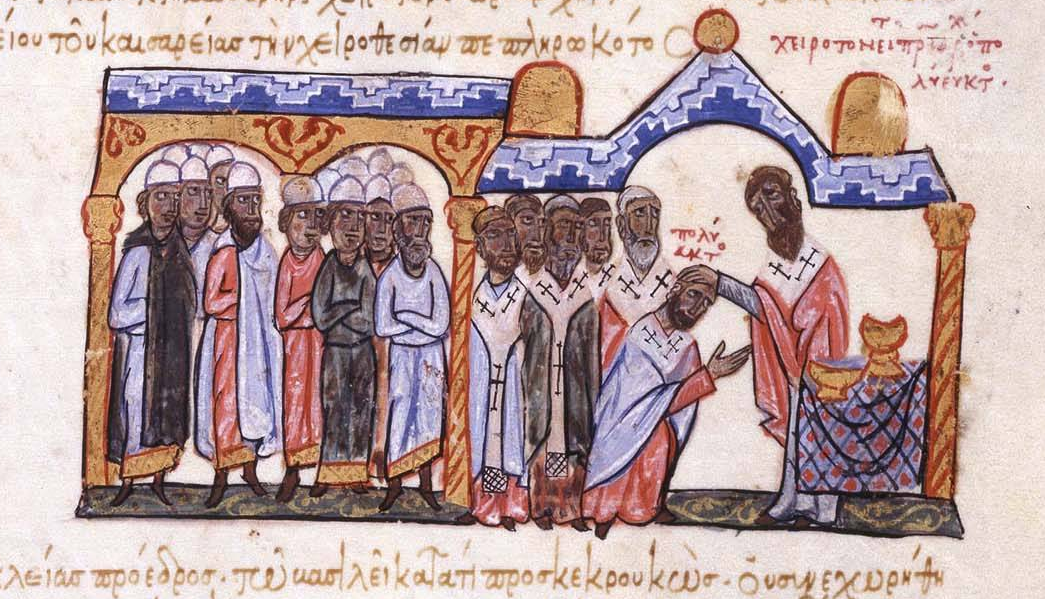
80571153_138311427614049_4501753053426221056_o
Emperor Constantine VII hosting a feast, art by Byzantine Tales
Consecration_of_Patriarch_Polyeuctus
Polyeuctus appointed as patriarch in 956, Madrid Skylitzes
Машков-Игорь-Геннадьевич-Святая-княгиня-Ольга-вступает-в-храм-св.Софии.Константинополь.-2001г.
Princess Olga of Kiev in the Hagia Sophia, Constantinople, 957
1024px-Constantine_VII_(Roman_emperor),_deathbed
Death of Constantine VII in 959, Madrid Skylitzes

The Climax Part I- Romanos II, the End of the Amorian Dynasty (959-963)          

Palaiologos_Dynasty_emblem1

In 959, Romanos II at only 21 succeeded his father Constantine VII following his death and continuing the Amorian Dynasty despite not knowing the whole truth and still thinking he was from the line of Basil the Macedonian and not of Michael III. Romanos II was very well trained by his father to succeed him as ever since 945 when Constantine VII became sole emperor, Romanos was already associated with his father on the throne as co-emperor and in addition, Constantine VII left behind to Romanos a complete manual in running the empire and its government which was the DAI.
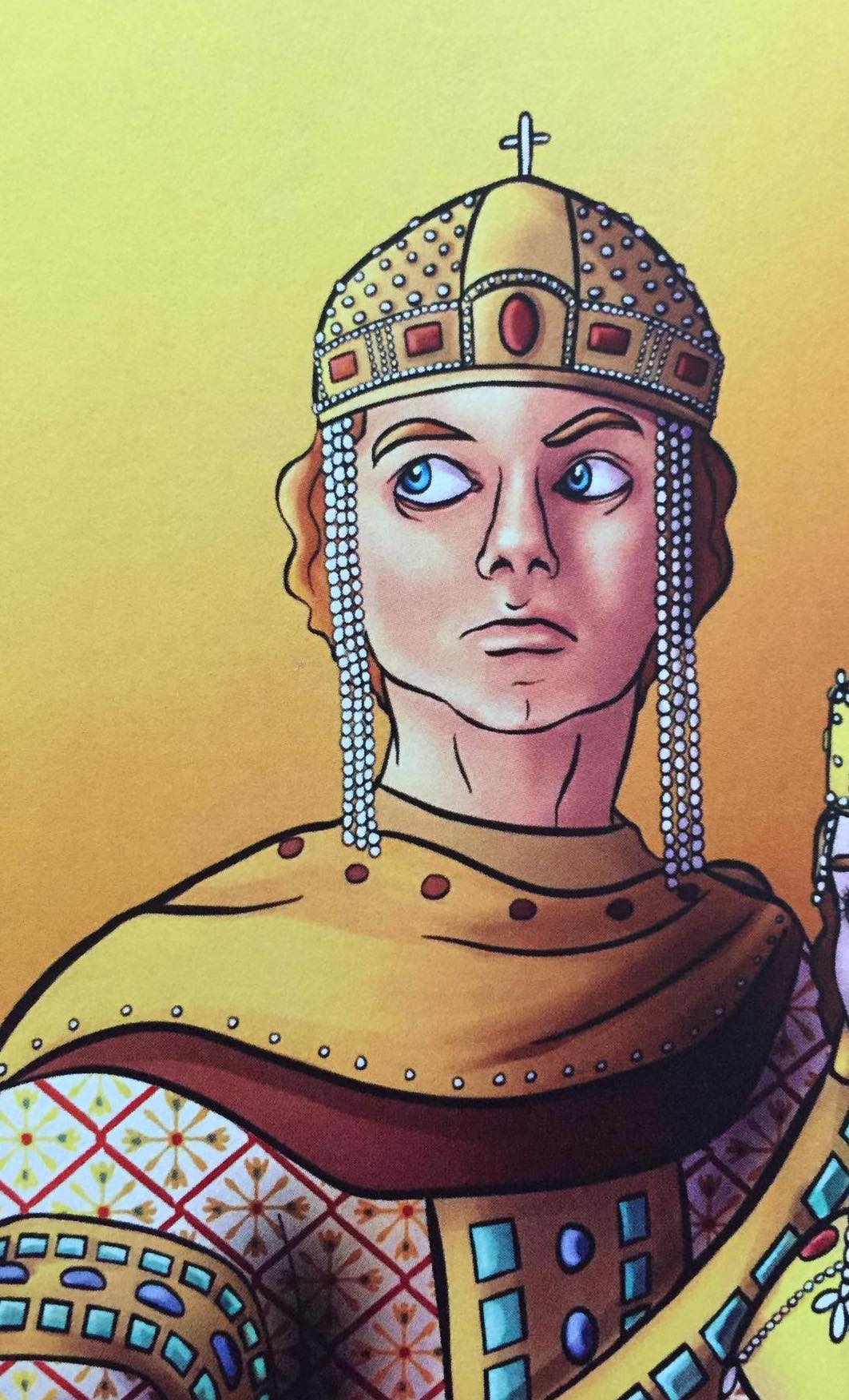
142427098_212626007117903_6130722592131895489_n
Emperor Romanos II of Byzantium (r. 959-963), son of Constantine VII, art by Byzantine Tales

The question now is if Romanos actually took his father’s advice in running the empire to heart or just wasted it away, and the answer is that he just wasted it away as he did indeed have capable advisors like the eunuch Joseph Bringas who he put all his trust to in running the empire and more capable generals like Nikephoros and Leo Phokas as well as John Tzimiskes that he could put all his trust to, thus allowing Romanos to live the life of pleasure he so loved. Now Romanos being the pleasure-loving party-boy that partied all night and neglected his duties in running the empire but at the same time still having capable ministers running the government for him was exactly like his actual great-grandfather Michael III although unlike Michael III, Romanos would not get rid of his mother and sisters and lock them up in a convent. In real history however due to the influence of his wife Theophano, Romanos banished all of his 5 sisters from the palace including his mother Empress Helena and sent them all to a convent to become nuns as they were seen as threats, or if you go with the Theophano graphic novel, Romanos’ top advisor Joseph Bringas had accused Helena of poisoning her husband the late emperor therefore forcing her to commit suicide by having her poison herself when in fact Theophano poisoned Constantine VII being manipulated by Joseph, but in this story with Theophano not coming into the picture Romanos would not do anything to his mother and sisters, and since he was unmarried he still needed an empress (Augusta) at side, therefore his mother would still keep her position as the Augusta until Romanos was to be married, and not to mention too Romanos inherited a lot from his mother especially his good looks and grace, though Romanos’ stocky figure was inherited from his father.
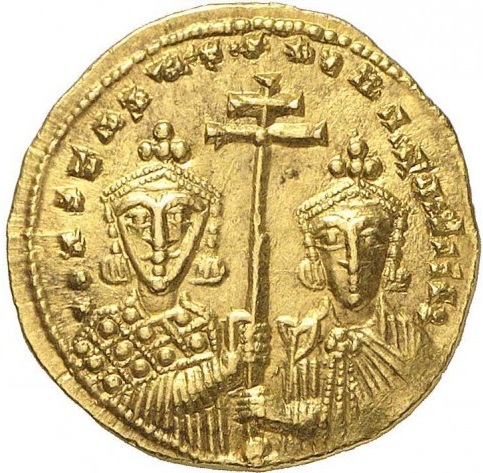
439-original
Coin of Constantine VII and his son and co-emperor Romanos II

On the other hand, Romanos’ reasons for being hands off in the administration and neglecting mostly everything his father taught him in running the empire was not so much because he did not care and just wanted to party and sleep with other women, but because he did in fact have some personal issues with his father, and a lot of this had to do with how his father looked down on Romanos’ mother’s side, the Lekapenos family and his maternal grandfather Romanos I who Constantine VII saw as trash, while Romanos was indeed close to his mother’s side especially to his late fun-loving uncle Patriarch Theophylact who did in fact influence Romanos’ pleasure-loving lifestyle, and as an act of rebelling against his father’s memory, Romanos chose to not take his advice and let Joseph the eunuch do everything as he was highly skilled at it despite being greedy and corrupt at the same time. Romanos having grown up practically raised by Joseph Bringas chose to have Joseph as his top advisor while his uncle Basil Lekapenos was put aside, although he still maintained his position in the imperial court. Now Romanos II was not all neglectful and resentful towards his father as you may think as in 960 less than a year after becoming emperor, he decided to continue what his father failed to do before he died which was to recapture the entire island of Crete and so here, Romanos planned out a massive campaign to retake the island himself though with Joseph’s advice too, but Romanos having no military experience would not lead the campaign himself, instead he selected the empire’s rising star and most capable general Nikephoros Phokas to lead it, and true enough Nikephoros had been Byzantium’s most brilliant strategist general since Justinian I’s general Belisarius in the 6th century (who played a major part in chapter III). Romanos II then had to recall Nikephoros from the eastern front to Constantinople where the fleet of 1,000 warships or Dromons including 50,000 soldiers and 27,000 sailors would take off. Nikephoros then left behind his younger brother Leo and nephew John Tzimiskes to fight off the Arabs in the east as he was to face another Arab army which were the pirates of Crete, and Nikephoros living his life to fight Arabs accepted the offer to lead the perilous Cretan expedition of 960 which would then last for about 8 months, although Nikephoros spending months on campaign already expected this.
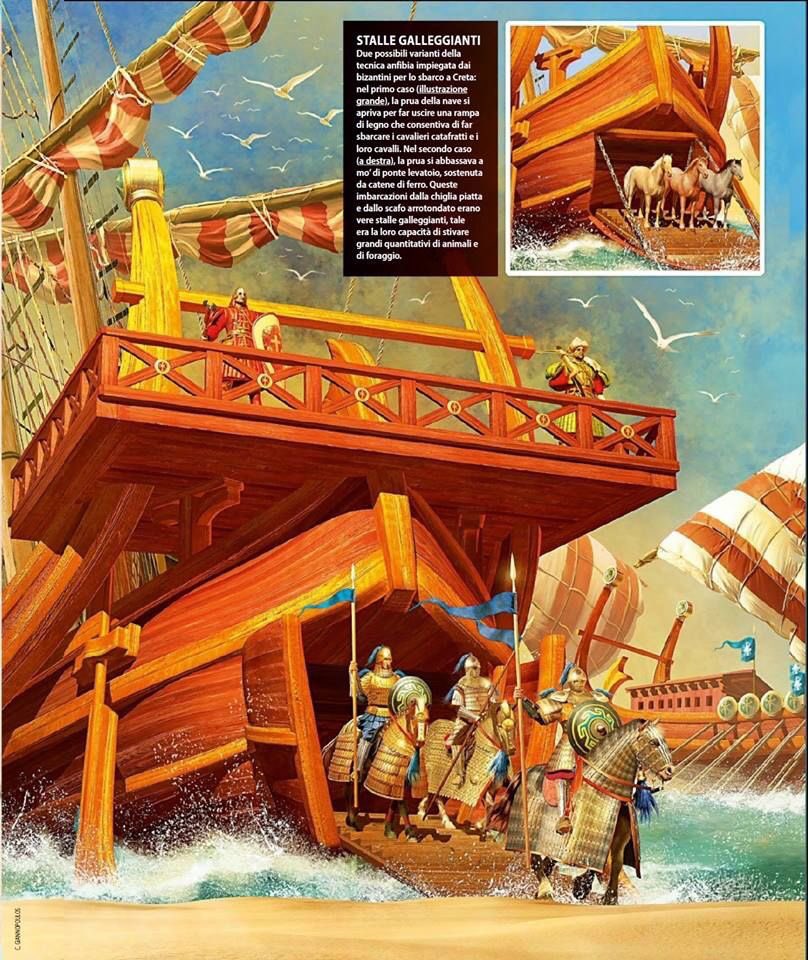
EAud8ncXYAEjVNZ
Byzantine Cataphract cavalry unload in Crete’s shore using ramps, 960

The entire fleet then arrived outside the city of Chandax which was the island emirate’s capital, and when seeing the strength of its land and sea walls, Nikephoros had his men carefully inspect it and here he immediately came up with his strategy which was to not lift the siege no matter how much time went by. For months, the Byzantine forces kept firing arrows and weights from their catapults into the city, though it never succeeded and at one point just out of fun and as an insult, Nikephoros had a live donkey catapulted high up into the air and into the city, though to mention, another tactic Nikephoros used here was to catapult in to the city heads of its peoples’ relatives from outside the walls that had been killed, as a way to bring fear to them. The siege lasted until the winter where Nikephoros ordered his men to not lift the siege but use the winter to starve off the population inside, and it was also here when ships from Constantinople arrived to restock the supplies for the army, but it was only when March of 961 came when the Byzantines would totally gain the upper hand. The emir of Crete Abd al-Aziz meanwhile was tired of being blockaded for months that he even wrote to Romanos II to order his men to abandon the siege, though it did not work as Nikephoros was already so close to taking it. The next trick Nikephoros did was to have his men dig beneath the walls to make it collapse and with explosives planted beneath the walls’ foundations, the walls collapsed allowing the Byzantine army to pour in. After months of endlessly waiting to take the city, the Byzantine army lost all their patience and once they broke the walls of Chandax, they carried out a merciless sack of the city massacring anyone they found while the survivors were taken as slaves, mosques were destroyed out of revenge, and a lot of loot hoarded by the Arab Cretan pirates over the years were recovered. By March of 961, not only Chandax but all of the Island of Crete fell once again back under Byzantine hands after 137 years of Arab control and numerous attempts to recapture it, thus the threat of these Arab pirates in the Mediterranean was done with for good and trade allowed to continue uninterrupted once again, while at the same time the emir Abd al-Aziz was taken as a prisoner and brought to Constantinople where he was paraded at the triumphal procession for Nikephoros Phokas and his army. The triumph in Constantinople meanwhile was not entirely held for the victorious general Nikephoros Phokas but for Romanos II who masterminded the whole expedition as he did not want Nikephoros getting all the credit, and here Abd al-Aziz was forced to bow down to Romanos II but was still allowed to live and retire peacefully despite not converting to Christianity, though he would never come back to the picture again.
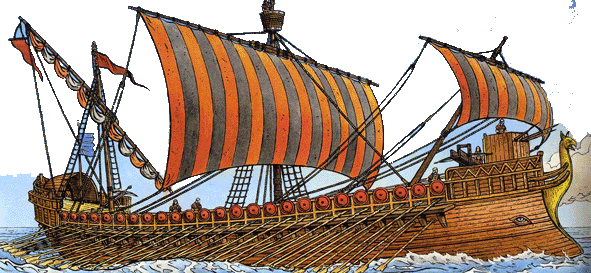
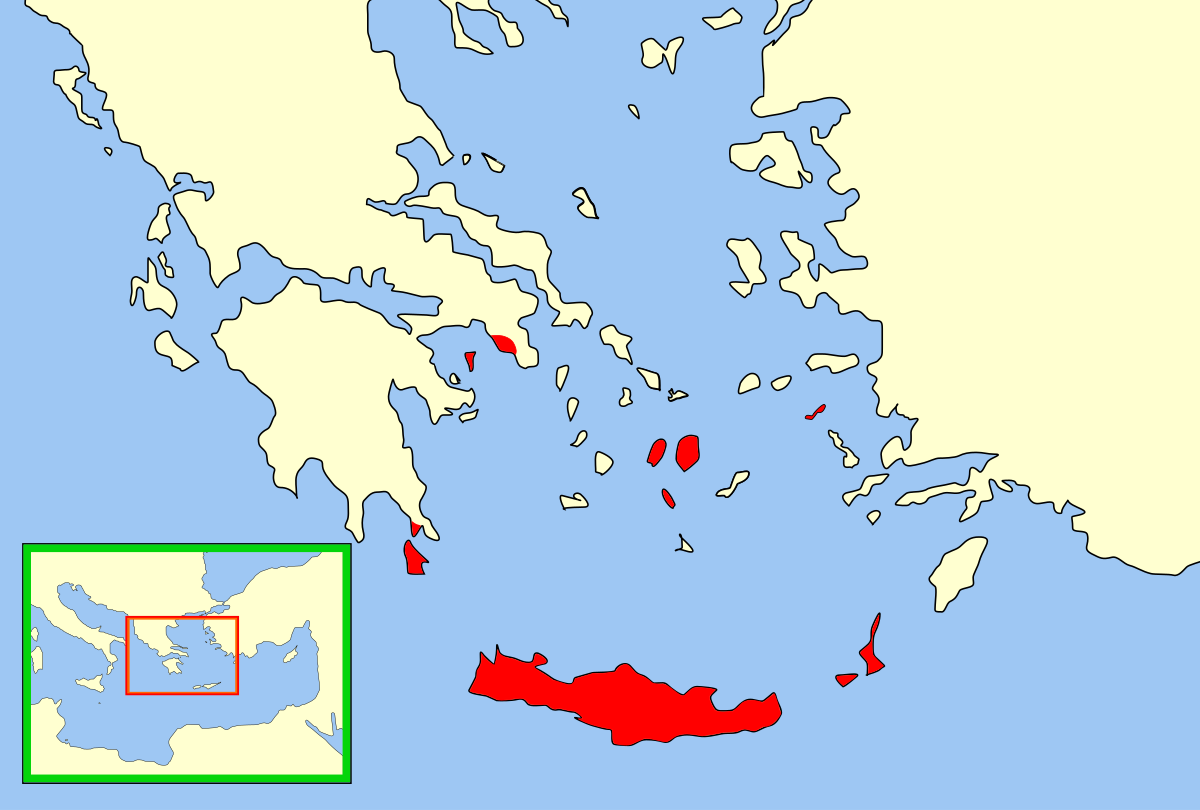
942707
Byzantine Dromon (warship)
1200px-Emirate_of_Crete_Map.svg
Territories of the Arab pirate Emirate of Crete (red), before 961
Byzantines_under_Nikephoros_Phokas_besiege_Chandax
960-961 Byzantine Siege of Arab held Chandax, Madrid Skylitzes
the-story-of-nikephoros-ii-phokas
Nikephoros Phokas’ Byzantine forces storm Chandax in 961, Madrid Skylitzes
Watch this to learn more about the life and career of Nikephoros Phokas (History Time)

By achieving the impossible in finally taking over Crete from the Arab pirates, Nikephoros Phokas would be forever remembered as the terror of the Arabs or simply the “Pale Death of the Saracens” referring to his brutal massacre of the Arab Muslim population of Chandax, although Romanos II too would gain a lot of popularity for achieving the reconquest of Crete. Nikephoros however right after celebrating his triumph was immediately sent back to the eastern frontier to continue the war against the more serious Arab threat of the Emir of Aleppo Sayf al-Dawla who was striking back against the Byzantines for their successes, although Romanos too saw that Nikephoros may pose a threat to his power if he was to stay in Constantinople longer as Nikephoros had grown even more popular than the emperor for his recent victory.
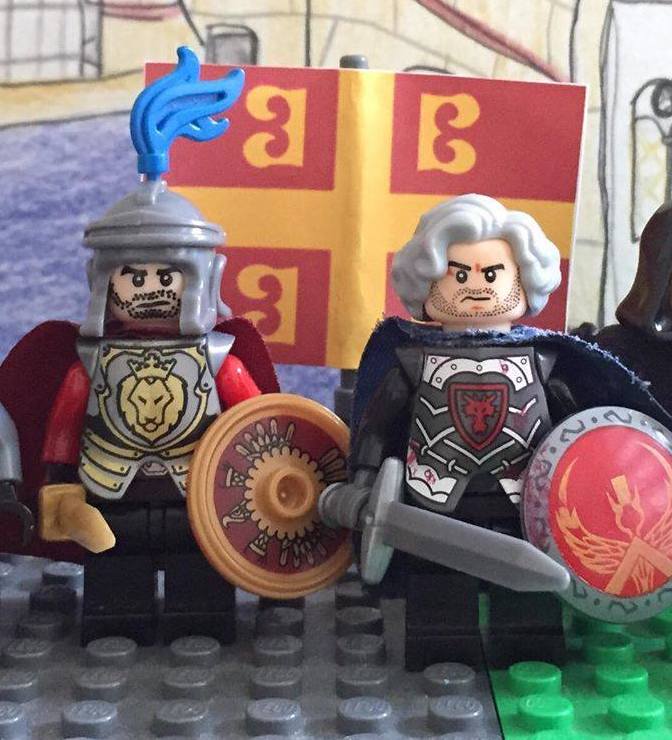
60106709_2350154375231927_925211353709281280_o
Lego Nikephoros Phokas (right) and his brother Leo Phokas (left)

In the meantime over in the eastern frontier, Sayf al-Dawla continued making his annual raids into Byzantine Asia Minor even winning a few victories in minor battles, although Leo Phokas who was left in charge there had managed to set a trap for Sayf in the Taurus Mountains where Sayf was going to pass when returning to Syria and there as his army marched through, the Byzantine forces under Leo ambushed them which was successful leaving only Sayf with 300 of his cavalry soldiers alive, although Sayf barely escaped the ambush when his prized Arabian horse he was riding was killed in the ambush. Sayf then escaped using one of his dead soldier’s horse and had even scattered his gold coins to allow his escape as Leo’s soldiers were busy picking them up. Nikephoros later on in 961 was back in Cilicia to continue his campaigns, although here he was not intending to fully invade it but to make raids as his tactic in order to weaken the state for a full Byzantine invasion later on, though it was also in 961 when Romanos II’s mother Empress Helena died like in real history from natural causes. In early 962, Nikephoros and his army was able to capture the border between Cilicia and Syria where Nikephoros had the land burned to create a dead zone as a way to make it more difficult for Sayf to invade, although Sayf still managed to cross over to Cilicia but this allowed John Tzimiskes to attack Sayf’s capital of Aleppo in Syria directly while Sayf was not there to guard it. Sayf when hearing that the Byzantine forces reached his capital returned to defend it, but when returning he was chased by John Tzimiskes and his forces to the Euphrates River wherein Sayf crossed into Mesopotamia whereas Nikephoros and Leo with their forces all surrounded Aleppo itself. For several months, the Byzantine forces had besieged Aleppo and with Sayf absent from his capital, public order there collapsed that by December of 962 the city’s garrison had to surrender to the Byzantines. Just as they did in Chandax a year earlier, the Byzantine forces did the same to Aleppo looting the city and carrying out a brutal massacre on its Muslim Arab population and when seeing Sayf’s magnificent library there, the Byzantines discovered that Sayf was not just a warrior but a highly cultured intellectual, although the Byzantine soldiers acting on Nikephoros’ orders did not spare the library out of respect, instead they burned it to the ground as part of Nikephoros’ strong grudge against Islam. The Byzantines then would only stop their brutal pillaging of Aleppo when they grew tired of it and at the end, they were able to capture over 390,000 silver dinars, 2,000 camels, and 1,400 mules thus the forces under the 3 generals Nikephoros, Leo, and John would head back west, while for the Arab world, the sack of Aleppo would forever ruin their power and prestige. Meanwhile over in the Balkans, another Byzantine general would rise to prominence the way Nikephoros Phokas did, and this was Marianos Argyros who had previously gained success in Southern Italy winning many victories against the Arabs and in 962 he had defeated a major invasion of the Magyars into Thrace making him instantly a favorite and part of Romanos’ inner circle, which was also because Romanos under Joseph’s influence soon grew to mistrust Nikephoros seeing him as a direct threat. In March of 963, as Nikephoros and his generals were in Cappadocia, news reached them that Romanos II had died and everyone was shocked as the emperor was only 25, therefore they suspected his scheming eunuch advisor Joseph Bringas of poisoning him. Now in real history, it is rumored that it was his wife Theophano that poisoned him like she did to his father as she had gotten tired of Romanos, although in this story with Theophano not being around, we will go with the other possible theory of Romanos’ death which was caused by an accident in a hunting trip whereas Romanos being drunk fell off his horse and down a ditch injuring himself, and when lying down back in Constantinople being badly injured, I would say Joseph Bringas poisoned him to finish him off, although as a eunuch Joseph could not be emperor so it was up for him to put another puppet on the throne except he did not know who, as for one he was someone who totally hated Nikephoros Phokas seeing his popularity as a threat, so here I would go with Joseph selecting John Tzimiskes as his new puppet emperor who Joseph believed could be easily manipulated, and true enough this could be why Joseph sent a letter to John in real history asking him to turn on his uncle Nikephoros and bring him in chains to Constantinople.
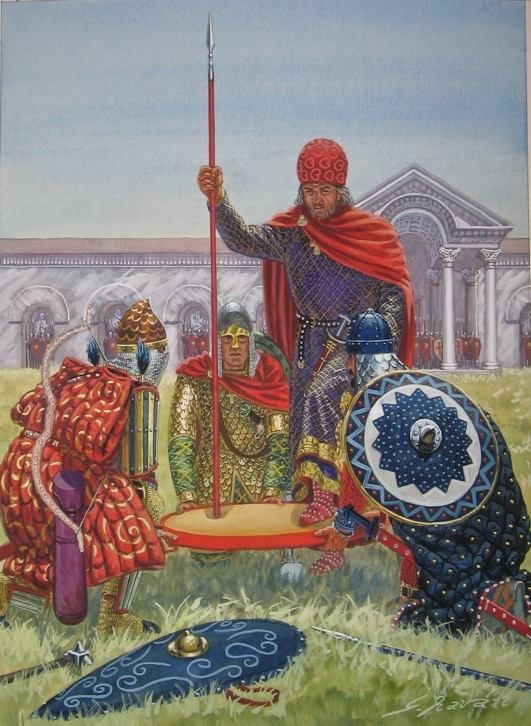
454a7736170afb44480fd24cdf3b40eb
Byzantine imperial shield coronation of Nikephoros II Phokas, 963

In real history however, Theophano having 2 young sons with Romanos, Basil and Constantine who were both already co-emperors needed a protector for them as she distrusted Joseph, therefore she sent word to the popular Nikephoros Phokas to make himself emperor to protect her sons, although here again with Theophano not being in the picture and Romanos II remaining unmarried and without children at his death, Nikephoros Phokas would set his eyes on the throne anyway using his popularity as an opportunity. The same would happen here too with Joseph Bringas sending John Tzimiskes a letter asking him to turn on his uncle Nikephoros and arrest him but like in real history, instead of turning on his uncle, John would end up having their troops proclaim his uncle Nikephoros as emperor raising him on a large round shield, thus here ends the rule of the Amorian Dynasty that had ruled since 820 and only briefly interrupted with the reign of Basil I the Macedonian (867-886) and his legitimate son Alexander (912-913), and here begins the rule of the Phokas clan over Byzantium.   
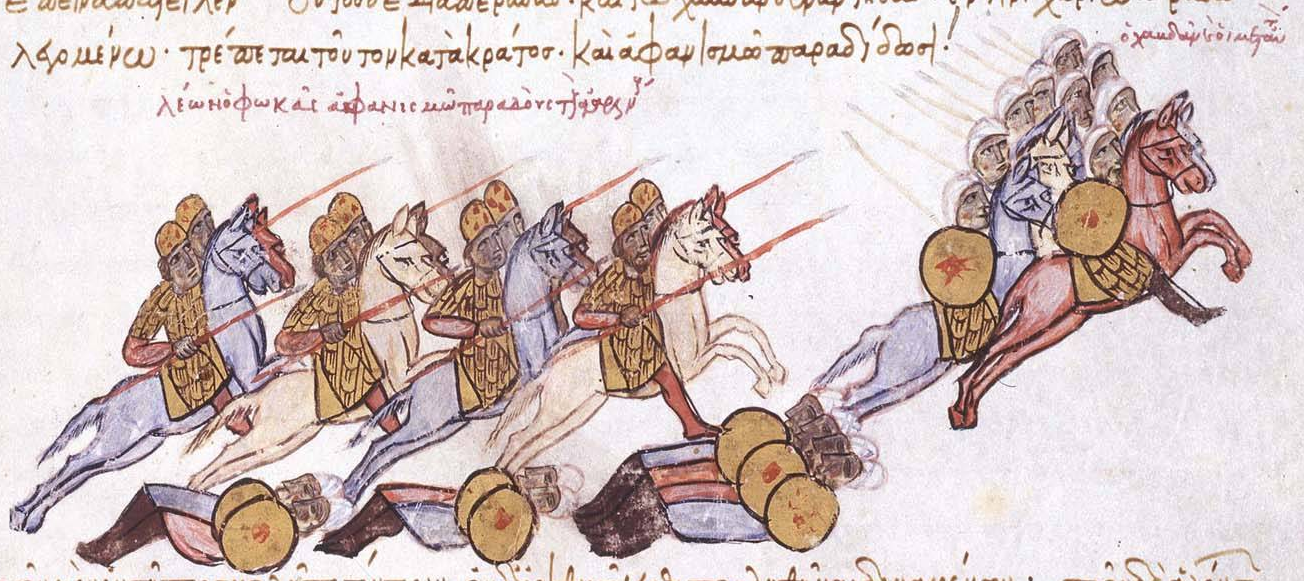
Leo_Phokas_defeats_Hambdan_at_Adrassos
Leo Phokas’ army defeats Sayf al-Dawla in 962, Madrid Skylitzes
1200px-Capture_of_Berroia_by_the_Byzantines
Byzantine forces capture Aleppo in 962, Madrid Skylitzes
1280px-Death_of_Romanos_II
Death of Romanos II in 963, Madrid Skylitzes

Watch this video below to see Nikephoros Phokas’ life in Lego (from my channel No Budget Films).


The Climax Part II- Nikephoros II Phokas (963-969), From Hero to Zero          

Palaiologos_Dynasty_emblem1

Here in August of 963 begins the highly eventful and action-packed 6-year reign of Nikephoros II Phokas, but before he could be officially crowned as emperor by the patriarch Polyeuctus, he had to make his way into Constantinople as Joseph Bringas had already taken control of the city refusing him entry. As Nikephoros and his army were camped outside the Bosporus at night, he sent his brother Leo to cross it in a small boat dressed as a port worker which he did and when reaching the docks of the European side of Constantinople, he gathered a large number of boats which he had sailed across the Bosporus to ferry the rest of the army and Nikephoros right across it again. At the same night as Nikephoros’ and Leo’s armies were crossing the Bosporus, their very old father Bardas who was still alive was inside the Hagia Sophia seeking refuge, although here the people inside all rallied under him against Joseph Bringas who they all came to hate due to his corruption, although Joseph already sent Marianos Argyros who was in charge of the city’s defense to arrest Bardas as Joseph planned to get rid of the entire Phokas clan except for John Tzimiskes who here was his intended candidate, although true enough John as a strong general was not willing to be a puppet. Bardas however would not end up being arrested as Marianos before reaching the Hagia Sophia was injured by a heavy object thrown right at his head by a woman from the balcony doing this in rebellion against Joseph, and hours later Marianos would die from his head injury. At the same time, the eunuch Basil Lekapenos who had been put aside throughout Romanos II’s reign struck back in rebellion against Joseph bribing the population of Constantinople to turn on the corrupt and fat Joseph. Nikephoros and Leo with their forces eventually crossed the Bosporus and made it into Constantinople wherein the city garrison surrendered to them as they commanded a larger army and when getting into the center of the city, Nikephoros himself confronted Joseph in a fistfight in which Nikephoros won and when losing the fight as well as all his power influence when everyone turned against him, Joseph Bringas was banished from Constantinople for good, thus returning to his native land of Paphlagonia in Northern Asia Minor never to return again.
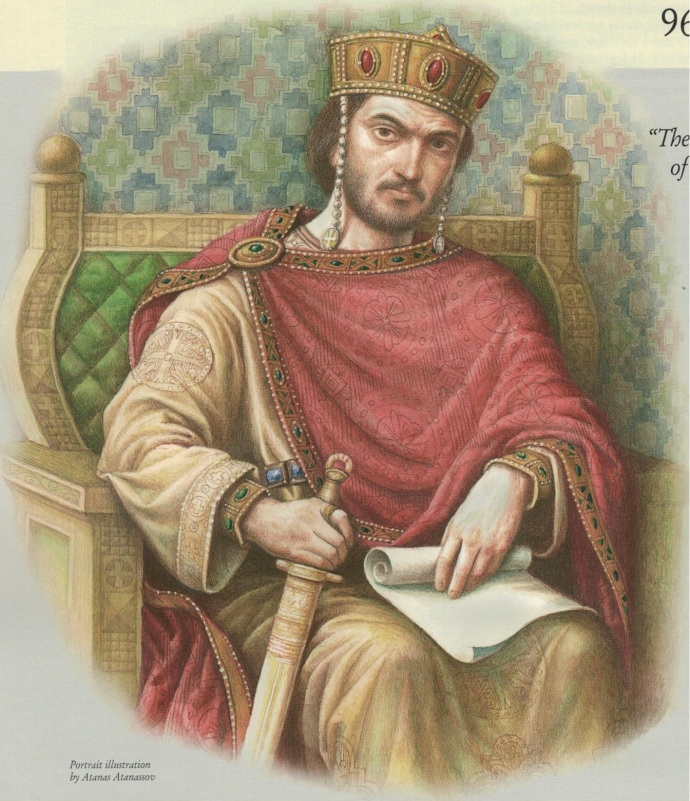
nicephorus-phocas-from-rulers-of-the-byzantine-empire-published-by-kibea
Emperor Nikephoros II Phokas of Byzantium (r. 963-969)

The next day, Nikephoros was officially crowned as emperor by Patriarch Polyeuctus, although Polyeuctus never really supported him anyway, except that after seeing power shift twice from Constantine VII to Romanos II, then to Nikephoros in only 4 years, he got tired of all this changing of emperors, so he crowned Nikephoros anyway who now was the sole emperor as here in this story there is no Empress Theophano around and her 2 sons that Nikephoros would have to rule for as their guardian. In this case, Polyeuctus also agreed to crown Nikephoros despite him having no ties to the previous ruling Amorian Dynasty because Polyeuctus knew the dynasty was ruined anyway as Leo VI long ago was not a legitimate son and Constantine VII was the son of a controversial 4th marriage, though only for the sake of legitimacy for Nikephoros to not be seen as a usurper, Polyeuctus would ask him to marry one of Romanos II’s sisters as in fact all 5 were still alive, and in this story, unlike in real history where Nikephoros married Theophano to legitimize his claim, here he would choose Romanos’ twin sister Zoe as his wife, as again Theophano would not be around here. Just like how Nikephoros in real history married Theophano despite never staying close to her as he vowed to stay away from women after his first wife and son died a long time ago and also because he wanted to live life like an ascetic monk, Nikephoros would do the same here too by marrying Zoe for political reasons only, although as part of his ascetic lifestyle, he would mostly stay away from her, but it would be worse here as Zoe had no children whereas in real history Theophano already did, and Zoe would actually not have any children as Nikephoros would never stay close to her.
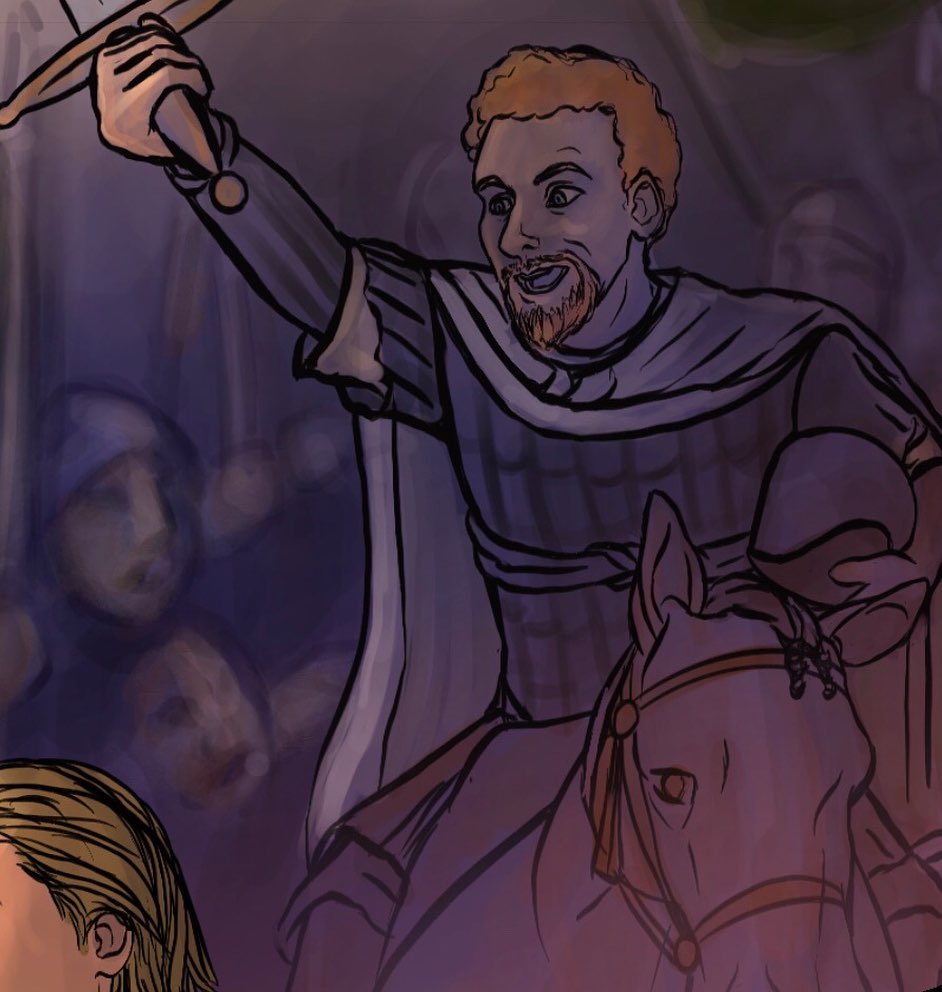
84502200_153743716070820_8790403539160530944_n
General John Tzimiskes, nephew of Nikephoros II Phokas, art by Byzantine Tales

As the new emperor, Nikephoros made his brother Leo the head of the palace or Kouropalates and his father Bardas a Caesar as an honorary title, while John Tzimiskes succeeded Nikephoros as the top commander of the eastern armies. Now for weakening Sayf al-Dawla’s threat in the east, recapturing Crete, and finishing off the corrupt Joseph Bringas, Nikephoros II was highly popular when coming into power, but his much younger nephew John Tzimiskes was even more popular mostly because of his good looks and supernatural abilities in horse riding and archery despite his short stature which is why he is known by his nickname Tzimiskes which as I forgot to mention is the Greek translation for the Armenian word for “short” thus hinting he is of some Armenian origin, and John Tzimiskes too aside from having good looks also had charm unlike his uncle Nikephoros who at 51 here in 963 was unattractive in appearance and being a veteran soldier was very rough around the edges, negative in personality, and had also lacked charm making him unable to connect with the population and only with his soldiers. Nikephoros as emperor true enough ruled the same way as he commanded his troops and rather than caring about pleasing his people, the first thing he thought about when becoming emperor was resuming the war in the east against Sayf al-Dawla. By the end of 963, Nikephoros launched another campaign against the Arabs of Cilicia, although this time he remained in Constantinople while his brother Leo and nephew John Tzimiskes led the army, and here John was able to strike the city of Adana forcing the Arab forces there to flee to a nearby hill where they made a last stand but ultimately lost when John wiped them out there. Sayf meanwhile began raiding Byzantine Asia Minor once again but did not last long enough as here in 963 as well, he suffered a stroke thus making him unable to fight in person which made him have to make a truce with Nikephoros II.
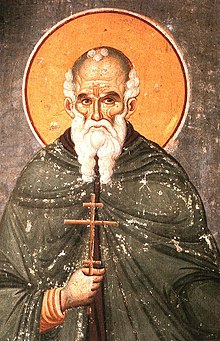
220px-Athanasios
Athanasios of Trebizond, ascetic monk and friend of Nikephoros Phokas

In 964, Nikephoros II’s popularity would already start dropping when he began to issue laws that was to limit land donations to the Church from the aristocracy thus making him unpopular with the Church, while he also continued the reforms of Romanos I and Constantine VII in limiting the aristocracy (Dynatoi) from buying land from the peasants. As a devout Christian, Nikephoros believed that the Church should not really possess worldly wealth and property which he was very vocal about, though despite this, he still gave property in the peninsula of Mt. Athos in Northern Greece to his friend the monk Athanasios of Trebizond in which Nikephoros even helped him financially construct and establish the Great Lavra Monastery which would over the years grow into a large monastic community.   
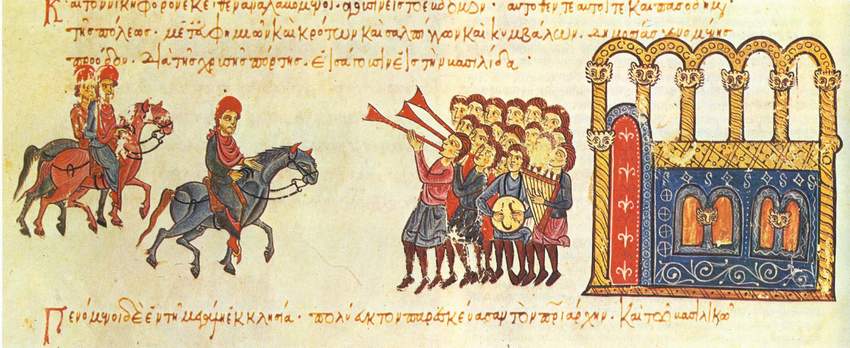
Entrance_of_the_emperor_Nikephoros_Phocas_(963-969)_into_Constantinople_in_963_from_the_Chronicle_of_John_Skylitzes
Nikephoros Phokas enters Constantinople in 963, Madrid Skylitzes
Megisti-Lavra
Monastery of Great Lavra in Mt. Athos, founded by Athanasios of Trebizond with funding from Nikephoros II


Between 964 and 965, Nikephoros II himself headed out east to continue his campaigns against the remaining Arab emirates in Cilicia and Syria to finally conquer them.
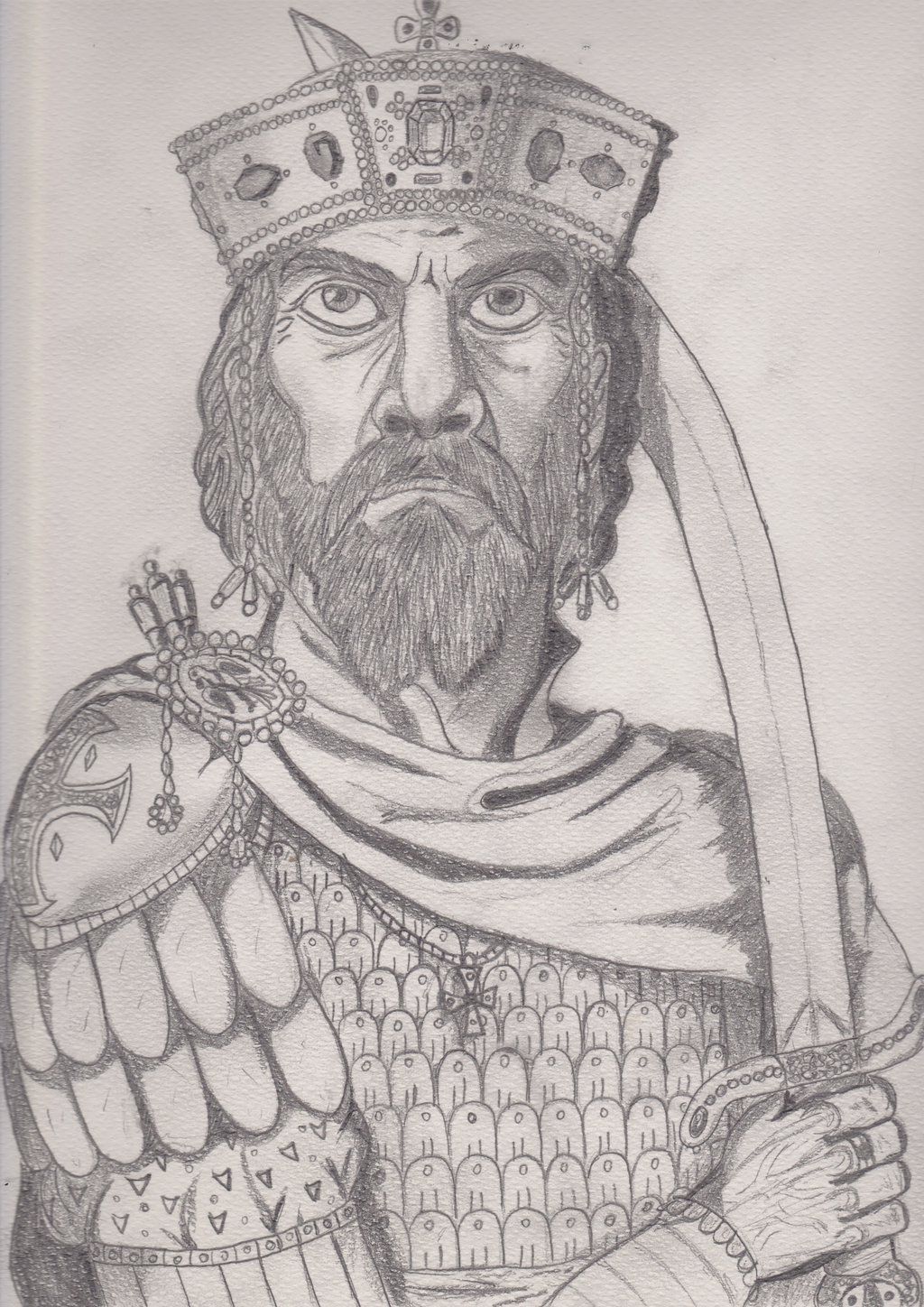
73850331690a55485d9e1d1059c96dd0
Nikephoros II Phokas, “Pale Death of the Saracens”, art by Spatharokandidatos

In 965, Nikephoros announced that the sharing of the island of Cyprus between the Byzantines and Arabs in which the Arabs having one half of the island paid rent to the Byzantines, in which they have done ever since the reign of Constans II in the mid-7th century would end, and this meant that Nikephoros launched a massive naval invasion to recapture the Arab half of Cyprus. The expedition to retake all of Cyprus led by the general Niketas Chalkoutzes was then successful making all of Cyprus Byzantine again all while Nikephoros together with Leo and John continued their Cilician campaign. For several months, both the emperor Nikephoros and John Tzimiskes were besieging the city of Mopsuestia in Cilicia while Leo was busy besieging Tarsus, which here was another haven for Arab pirates the way Crete was before 961. By July of 965, the city of Mopsuestia completely fell to the Byzantines after the soldiers of Nikephoros and John doing like they did in Crete 4 years earlier dug beneath its walls making them collapse and when taking Mopsuestia, the Byzantine soldiers being the same ones that captured Crete and Aleppo did the same as they did there by carrying out another brutal massacre on the Arab Muslim population of Mopsuestia and taking the survivors as slaves. Following the fall of Mopsuestia, Tarsus too fell to the Byzantines in August of 965 where Nikephoros chased the remaining Arab forces of Tarsus with his Cataphract cavalry and following this, all of Cilicia fell into Byzantine control thus becoming a Roman province again.
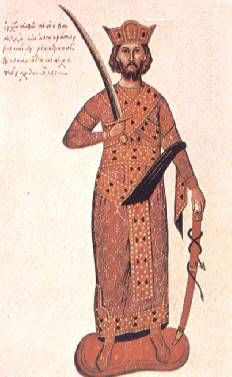
Nikiphoros_Phokas
Nikephoros II Phokas in imperial robes holding a Byzantine curved sword (Paramerion)

Back in Constantinople, a major triumph was celebrated for the complete reconquest of Cyprus and Cilicia and here Nikephoros II began a tradition which was to parade the sacred Christian relics he captured in his triumphal parade, a new practice that Byzantine emperors would do from here onwards. Though John Tzimiskes was the hero of the Cilician campaign, just shortly after returning to Constantinople he was fired from command by his uncle the emperor and forced to live under house arrest in a small estate in Asia Minor for some unclear reasons, but for this story’s case it would be because Nikephoros II here started getting paranoid and envying his nephew to the point of seeing him as a threat to his power as it was John who gained a lot of popularity for his victories in Cilicia, and it would be here when John would eventually form a conspiracy to overthrow his uncle Nikephoros. Now Nikephoros may have been successful in fighting wars in the eastern front, but in the west it was not really the case as by putting all his attention and best troops in the east, the west meaning Byzantine Southern Italy was poorly defended with weaker forces and in 965 too, the Byzantines forces after being forced out of Rometta, their last outpost in Sicily would suffer a heavy defeat to the Arab navy at the naval Battle of the Straits wherein many Byzantine soldiers died drowning in the sea and the survivors enslaved by the Arabs.
4ca8b06c99aef039f541c99ac57ba4f3
Otto I the Great, King of East Frankia (936-962), Holy Roman emperor (962-973)

At the same time too, the Frankish king of East Frankia (Germany) Otto I who maintained good relations with Constantine VII before was now hostile towards Byzantium as in 962 he had been crowned by the pope John XII as the first Holy Roman Emperor, and unlike Charlemagne back in 800 who was surprised to be crowned as a “Roman emperor” by the pope if you remember from the previous chapter, Otto who spent his whole reign unifying Germany and Italy into one empire the way Charlemagne almost 200 years ago did, was really intent in being crowned as a “Roman emperor” which he used to challenge the authority of the Byzantine Empire especially in their holdings in Italy, which Otto had wanted for himself. Nikephoros as usual of him in 966 continued fighting wars in the east and this time having his men go all the way east to Mesopotamia again to raid the Arab held cities of Amida, Dara, and Nisibis but little did Nikephoros who never really listened to his people know that his people were tired of war and were content with how large and strong their empire was already as more wars meant more taxes to pay for the food supply and salary of the soldiers. Nikephoros though was very strict in his tax policies that he constantly increased taxes to fund his military campaigns as in this story, he did indeed have the ambition like Justinian I 4 centuries ago to conquer the entire Mediterranean and make it a “Roman lake” again, except Nikephoros was forgetting that Byzantium’s armies despite being powerful was not as powerful and great in number anymore as it was in the 6th century.
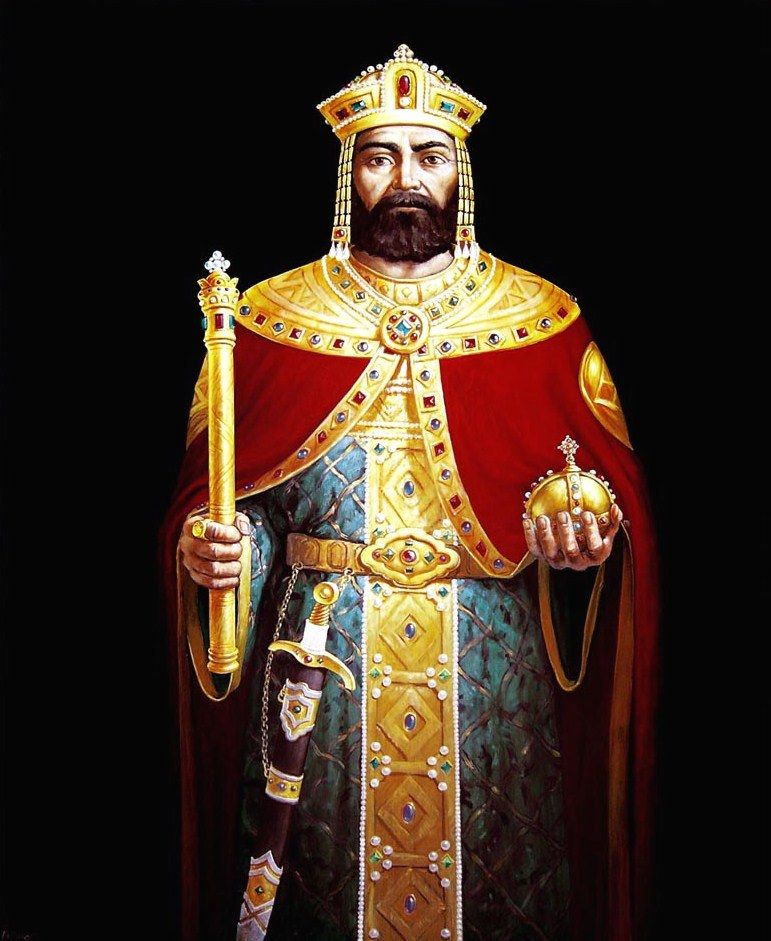
a537ae20ea72a70c2d9d8b9afbdb67f1
Tsar Peter I of Bulgaria (r. 927-969), son of Simeon

Nikephoros’ aggressive policy would again show between 966 and 967 when he would end the 42-year peace between Byzantium and the Bulgarian Empire up north which began in 925 between Romanos I and the Bulgarian tsar Simeon, and by 966 Simeon’s son Peter I was still ruling Bulgaria and by not being very aggressive, Peter did not really succeed in blocking off Magyar raids that penetrated Bulgaria and reached Byzantine territory, and because of this Nikephoros wrote him a letter telling him to be more aggressive in dealing with the Magyars from the north as they were spilling in to Byzantine territory, but Peter refused saying he was fine with what he was doing. According the contemporary historian of this time Leo the Deacon, Nikephoros insulted the Bulgar ambassadors Peter sent to him reminding them of their origins as nomadic barbarians from the steppes in which the Bulgars were from, and in this story, this would be true while Nikephoros as well refused to pay tribute to Bulgaria, which again would resume the traditional war between Byzantium and their northern neighbor after 42 years. At the same time, a new power had been rising in Eastern Europe which was that of the Kievan Rus’ and since 964, this state had been ruled by their Grand Prince Sviatoslav I, better known as “Sviatoslav the Brave”, the son of the Kievan Rus’ grand prince Igor and princess Olga who had been mentioned earlier, and Sviatoslav unlike his mother who was baptized an Orthodox Christian was a Pagan like his father, and also a ruthless warrior who had the ambition to expand the Kievan Rus’ state by force using both the fearlessness of his Scandinavian Viking ancestors and speed of the nomadic steppe people like the Huns, Magyars, Pechenegs, and Avars that had settled in that part of Eastern Europe for centuries.
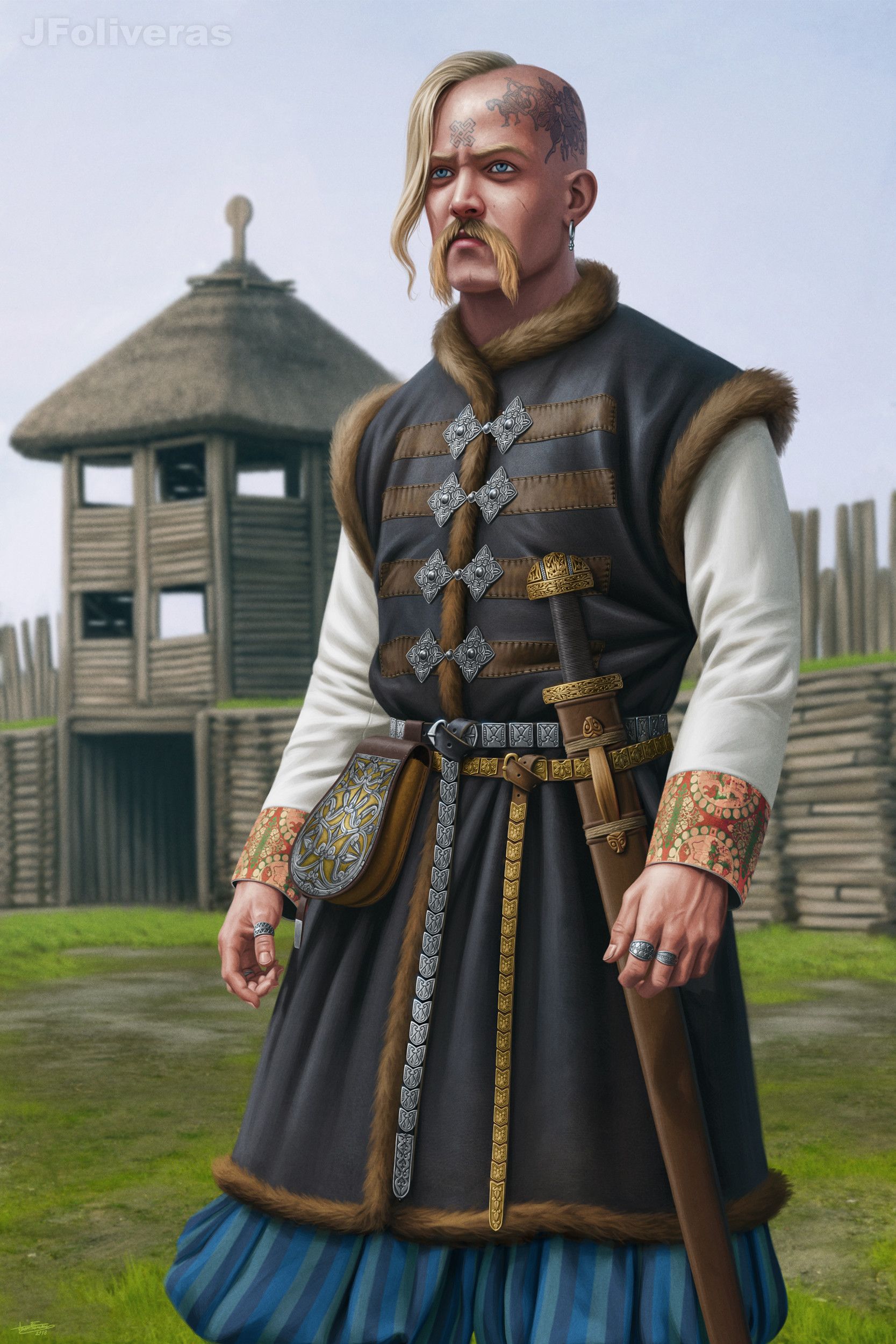
9bf62a5b07945d981d78ba0974bd9676
Sviatoslav I, Grand Prince of the Kievan Rus’ (r. 945-972)

Sviatoslav thus expanded his empire by force that in such a quick amount time with the speed and ruthlessness of his army, most of Eastern Europe was conquered that in 965 the power of the Khazar Khanate in Southern Russia that had been there for about 4 centuries was destroyed when Sviatoslav destroyed their major trading city of Sarkel along the Don River which the Byzantine emperor Theophilos helped build long ago, and the Khazar’s capital of Atil located where the Volga River comes out into the Caspian Sea too was destroyed. Sviatoslav too set his eyes on Byzantine Cherson in the Crimea intending to conquer it to gain access to the Black Sea, and when Nikephoros heard of Sviatoslav’s ambition to conquer Byzantine territory, he sent Sviatoslav money bribing him to attack the Bulgarian Empire instead in which Sviatoslav accepted the offer and rode to Bulgaria with such terror, and what resulted from his attack was the near complete destruction of the Bulgarian state that the eastern half of Bulgaria fell under his rule. Sviatoslav though did not only conquer Bulgarian lands, he even went as far as spilling into Byzantine Thrace bringing such terror there as well, which then shows that Nikephoros II was not really a skilled diplomat.
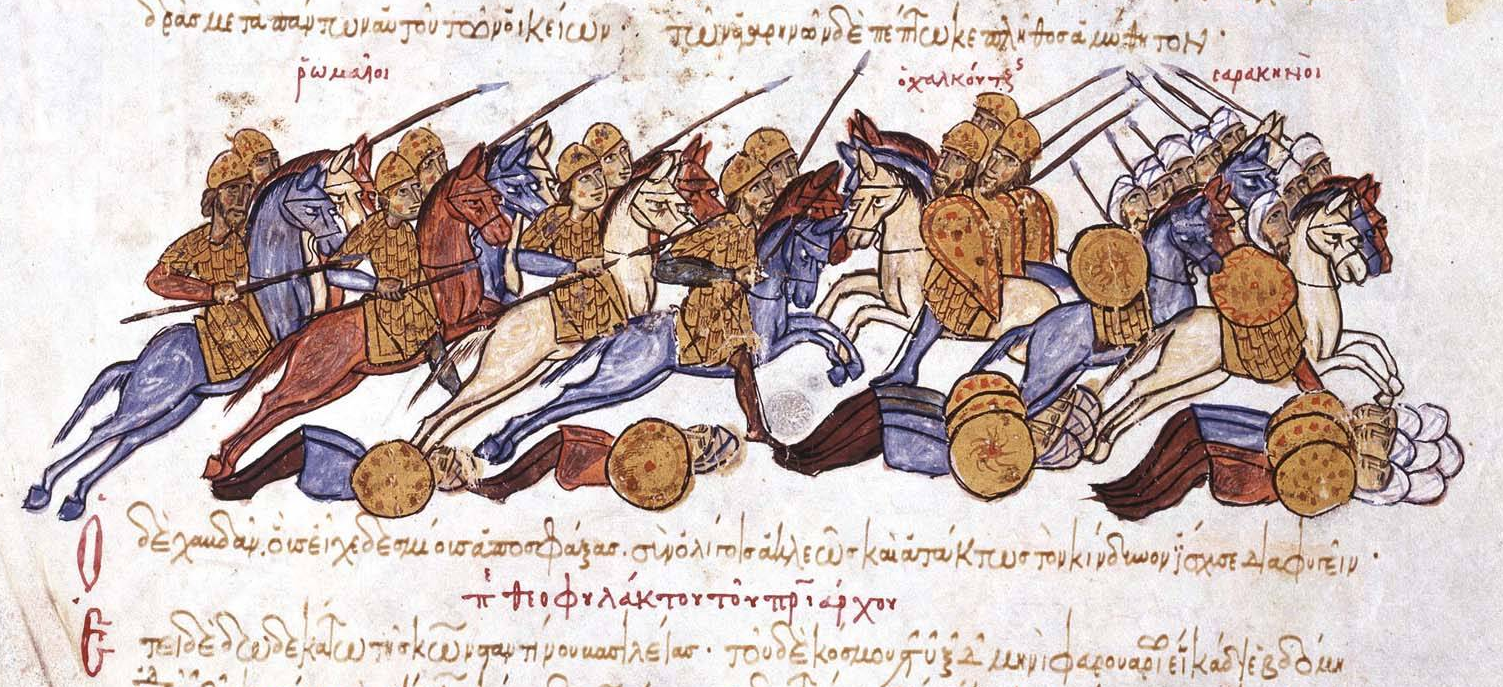
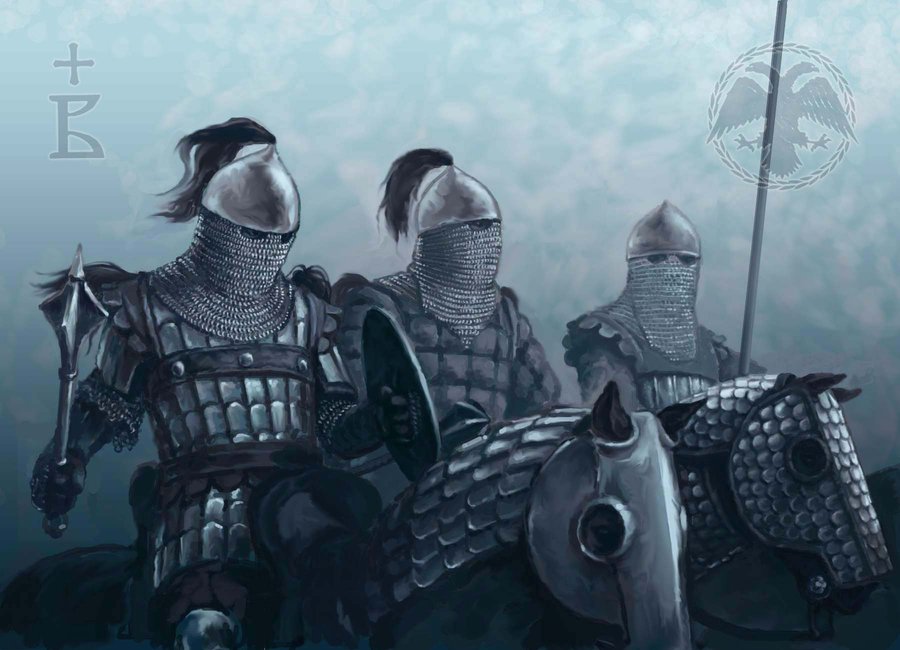
Leo_Phokas_defeats_the_Arabs_in_950,_escape_of_Chalkoutzes
964-965 Byzantine reconquest of Cilicia, Madrid Skylitzes
746484564
Cataphract cavalry of Nikephoros II
AKG160383
Coronation of Otto I as the first Holy Roman emperor by Pope John XII in Rome, 962
maxresdefault-8
Sviatoslav and his Rus’ army defeat the Khazars, 965

Meanwhile, back in the east Sayf al-Dawla had died in 967 due to complications caused by the stroke he got some years ago, and his death would begin plunging the Islamic world into chaos as for many years he was the most powerful warlord and political leader that led the Islamic world. The death of Sayf was then an advantage to the Byzantines as it would allow his lands to easily fall to Byzantine rule but in Constantinople, Nikephoros II was growing more unpopular as the days went by not only because of his harsh tax policy but because he was not as invincible as everyone thought he was which was seen with his military defeats in Sicily and his failure to stop Sviatoslav from raiding into Thrace, and his growing unpopularity even made him a target of some people who shouted insults at him or even threw stones at him as he passed, which made the emperor even more paranoid that he began arresting anyone who publicly insulted him.
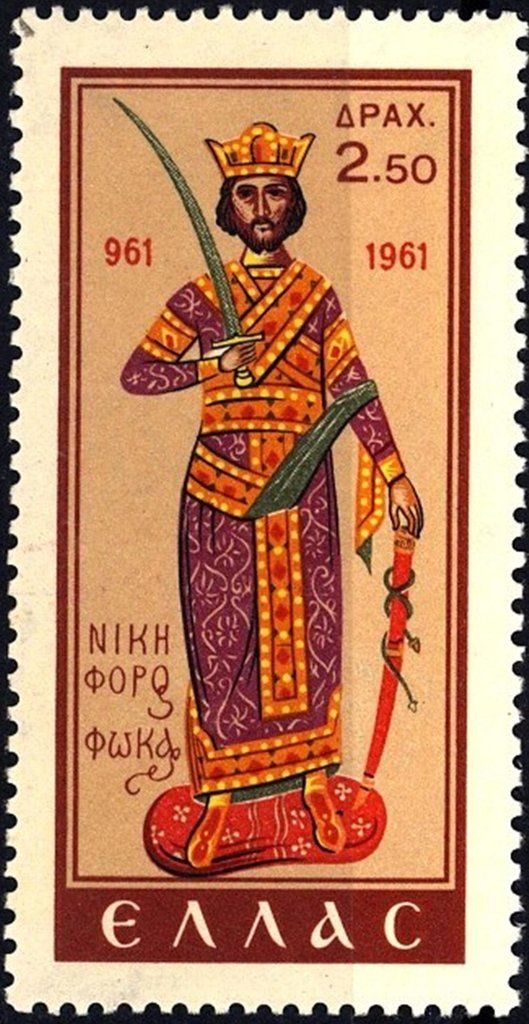
54c7769233bf929653e2286e8a4d0424
Greek stamp of Nikephoros II

Another reason why Nikephoros’ unpopularity was growing was because his troops in the capital had seemed to be undisciplined that in one occasion in 967, a fight broke out between his sailors and Armenian mercenaries in which civilians too got hurt in the process, though to prove to everyone that his soldiers were in fact very disciplined, Nikephoros had his soldiers perform marching drills in the Hippodrome, although the people misinterpreted these drills and when one idiot in the crowd shouted “the emperor wants to kill us!” everyone panicked resulting in a stampede where a large number of people either died or were hurt when exiting the narrow doorway of the Hippodrome. Nikephoros on the other hand did not make any apology for what happened as he had nothing to do with this stampede incident and instead of apologizing, he had another wall built for the imperial palace as he planned to now further distance himself from the people after what happened in the Hippodrome, but this ruined his relations with the public even more that some were already growing suspicious thinking that the emperor not being around even more was now plotting against them inside the palace. Though he was not a very skilled diplomat, Nikephoros at least succeeded once in diplomacy which was here in 968 when he annexed the Principality of Taron along Byzantium’s eastern border in Armenia into the empire when their prince Ashot III died as here Nikephoros promised Ashot’s sons high commanding positions in the Byzantine army in exchange for their principality to fall under the empire’s protection, although Nikephoros’ diplomacy would fail again with Emperor Otto I in the west. In 968, Otto I sent the same Bishop Liutprand of Cremona back to Constantinople after almost 20 years, except this time Liutprand was not impressed the way he was before in 949 when meeting Constantine VII. Here Liutprand was to ask Nikephoros to recognize Otto’s claim as “Roman emperor” and to also cede all of Byzantine Southern Italy to Otto whose dream was to unify all of Italy under his rule, though in real history Liutprand returned to Constantinople to ask for a marriage alliance between Otto I’s son Otto II and Anna, the daughter of Romanos II and Theophano, except again with Theophano not in the picture and her children never being born, Liutprand would instead go to Constantinople looking for the right Byzantine princess for the Frankish prince Otto II. Like in real history too, Nikephoros here would insult Liutprand and Otto by calling Otto only a “king” and not “emperor” while Liutprand would also insult Nikephoros by referring to him only as the “Emperor of the Greeks” and not “Roman emperor” and would also write an insulting description of Nikephoros as an ugly, short, fat, and disgusting monster with pitch black skin and a disfigured face, although not to mention Nikephoros was somewhat ugly in appearance but not extremely ugly the way Liutprand describes him. At the end, Liutprand returned to Italy empty handed with his silks confiscated and no bride for young Otto II after insulting the emperor and as he even said that when dining with the emperor, Liutprand was forced to sit at the end of the long table and instead of being served lavish dishes like the rest, he was served rotten fish. Another factor that would make Nikephoros even more distant from his people was his depression as in 968 his father Bardas Phokas the Elder would die at the very old age of 90, and here Nikephoros too would start contemplating his death and who should succeed him as emperor as again in this story’s case his wife Theophano would not be around and so would her sons the co-emperors Basil and Constantine, and since Nikephoros despite being married to Romanos II’s twin sister Zoe in this story, they would not have any children together due to Nikephoros’ ascetic lifestyle and vow to stay away from women, so here he would decide that it would be up to his younger brother Leo who had a son, Bardas Phokas the Younger to continue the imperial bloodline. To distract himself from his feeling of depression after losing his father, Nikephoros now put his attention in carrying out his other ultimate dream in his eastern campaigns, which was to finally recapture the important Roman city of Antioch in Syria from the Arabs which had been under Arab control since the 630s when the Byzantines lost it to them, and although by here it was nothing much but a depopulated provincial city, it still had great importance to the Byzantines historically. For months, Nikephoros had been using the new wall he built for the palace as a military training ground to prepare his troops for the ultimate conquest of Antioch. Later in 968, Nikephoros himself returned east again where he had a fortress built near Antioch to block the city off from supplies and reinforcements and when returning to Constantinople in early 969, he left behind his general Michael Bourtzes with only 1,500 men to be in charge of besieging Antioch, although Michael was given orders by the emperor to not capture the city until the emperor ordered him to do so. As the months went by, Michael grew impatient and so he disobeyed the emperor’s orders and after tricking an Arab traitor soldier in the walls, the Arab garrison surrendered allowing the Byzantine forces to pour into the city whereas a fire later broke out which then led to the complete capture of Antioch. When returning to Constantinople though, Michael was not rewarded by Nikephoros for his victory, instead he was fired from command for disobeying the emperor’s orders and setting fire to Antioch. Now Nikephoros was not only hated by the common people for taxing and neglecting them, or by the Church for also taxing them and for demanding to Polyeuctus that his fallen soldiers killed by Muslims should be made martyrs, or by his friends in the aristocracy for limiting their power and land, but now even by his generals who were closest to him as he had fired them for the smallest reasons, first John Tzimiskes and now Michael Bourtzes. After being fired from command, Michael met up with John Tzimiskes and John’s closest ally which was John’s brother-in-law the general Bardas Skleros, the brother of John’s late wife Maria Skleraina, and together they all agreed to kill Nikephoros and make John the new emperor.
198363577_994041061366006_6750315821369845099_n
Basil Lekapenos the eunuch, art by Ancient City Lullaby

In real history though, Theophano was said to have taken part in this conspiracy by revealing to John and his conspirators the way into the palace and where her husband the emperor slept as she and John had an affair, but in this story since Theophano is not in the picture, John who also would not have an affair with Nikephoros’ wife here Zoe would have to bribe the workers in the palace to reveal to him a secret passage, although here the eunuch Basil Lekapenos who had been powerful under Nikephoros would also betray the emperor and side with John, and he too would reveal to the conspirators the way into the palace. On the night of December 10-11 of 969 when Nikephoros was sleeping deep inside the palace, John Tzimiskes would sneak out of the estate he was banished to right across the Bosporus together with Michael Bourtzes and 2 other assassins and take a small boat across the Bosporus to the seaside Boukoleon Palace where they heard the emperor was sleeping in. In real history Theophano had a part in it by leaving the door of her husband the emperor’s room unlocked to allow the assassins to kill him, but here again with Theophano not around it would be harder for John and his assassins to do the job so instead as they reached the seaside palace by boat, they would have to bribe some of the palace workers to show them the way and as it would turn out, these palace workers were not really loyal to the emperor and had already been informed by Basil Lekapenos that John and his men would come in at any time. On this extremely cold night, Nikephoros said his usual evening prayer before sleeping as he always did while John and his men were lifted up into one of the palace’s windows by a basket manned by some of the palace workers who then showed them the way to the emperor’s bedroom but when entering, they saw no one sleeping on the bed but when looking left they would actually see the emperor sleeping on a fur blanket on the floor wearing rags.
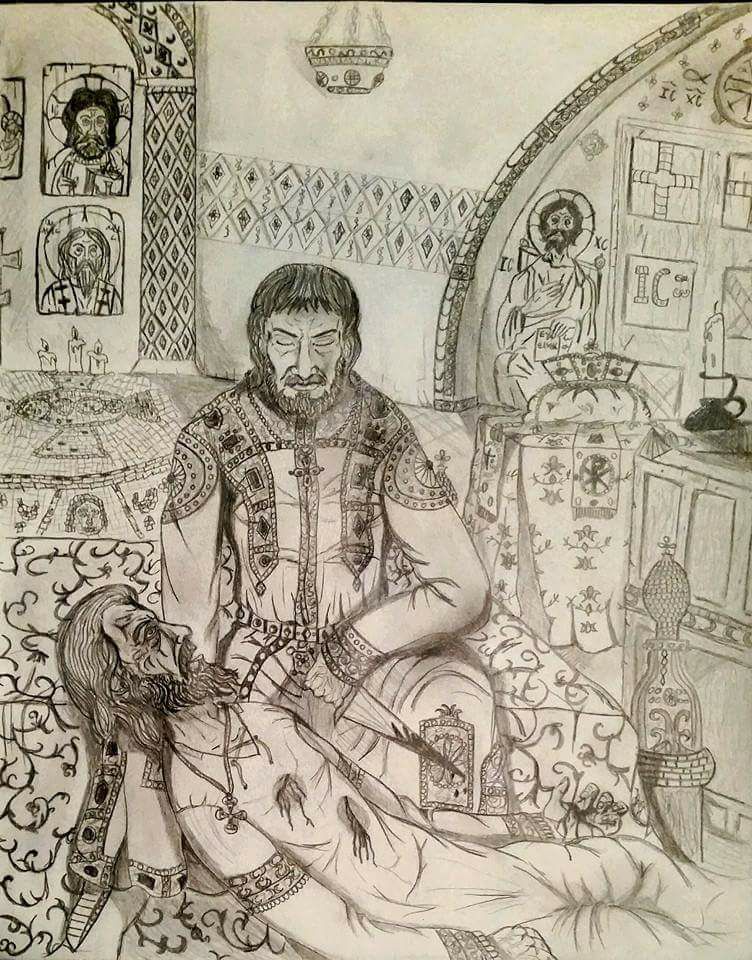
23755249_1538599396206328_5332883465522188519_n
Assassination of Nikephoros II Phokas by John Tzimiskes on the night of December 10-11, 969, art by Spatharokandidatos

The moment they saw the emperor sleeping, no one hesitated and they all slashed him with their swords all at the same time, although Nikephoros would still wake up due to the pain and seeing his nephew John among the assassins, Nikephoros was heartbroken to see his nephew betray him but John did not hesitate, instead he berated his uncle about how heartless he was to fire him from command when he had done nothing wrong and as Nikephoros was slashed multiple times by the assassins, John gave his uncle the killing blow by stabbing him in the neck. The imperial guard or Tagmata from the other end of the seaside palace rushed to the scene as apparently the screams of Nikephoros as he was being slashed was very loud but when getting into the palace’s inner courtyard it was too late as above them, they saw John Tzimiskes in the balcony holding Nikephoros’ severed and bloodied head with blood dripping down to the lower floor, and here John announced that the tyrant emperor was dead and that he was their new emperor. The Tagmata panicking here when seeing their emperor dead did not know what to do and so they all just acclaimed John as their emperor, although minutes later Leo Phokas rushed into the scene believing his brother to be dead therefore thinking it was his turn to be emperor but here, when getting into the courtyard the Tagmata already being loyal to John seized and arrested Leo throwing him out of the palace. In real history however, Theophano put on her purple imperial dress and brought her sons with her right at this moment when Nikephoros had been killed thinking she would now marry John, but in this case without Theophano around, the empress Zoe would rush into the scene in her sleeping dress and would be very shocked at what happened as she had no part in the plot, and seeing all the blood and her husband dead despite never really being close to him, she would collapse. The next day, like in real history, Patriarch Polyeuctus would be in shock about Nikephoros’ assassination even if he never really liked Nikephoros but since this was an act of murder done by an uncrowned person which was John, it was totally unacceptable, but Polyeuctus being tired of all this changing of emperors and seeing no one else left to take the throne especially since Theophano is not here and so are her young sons, he would just agree to make John emperor anyway on the condition that he married Nikephoros’ widow Zoe, execute the assassins with him, and give Nikephoros II a proper burial at the Church of the Holy Apostles while Basil Lekapenos announced to everyone in the capital about what happened. Nikephoros II Phokas, the brilliant strategist and military hero of the 10th century who even had the legacy of writing and publishing a military manual but failed as a politician thus died the way he lived, which was in violence, but at least he died in the simple life he lived by sleeping on the floor, though for his religious accomplishments and fighting for the Orthodox Christian faith, Nikephoros II would become a saint too.
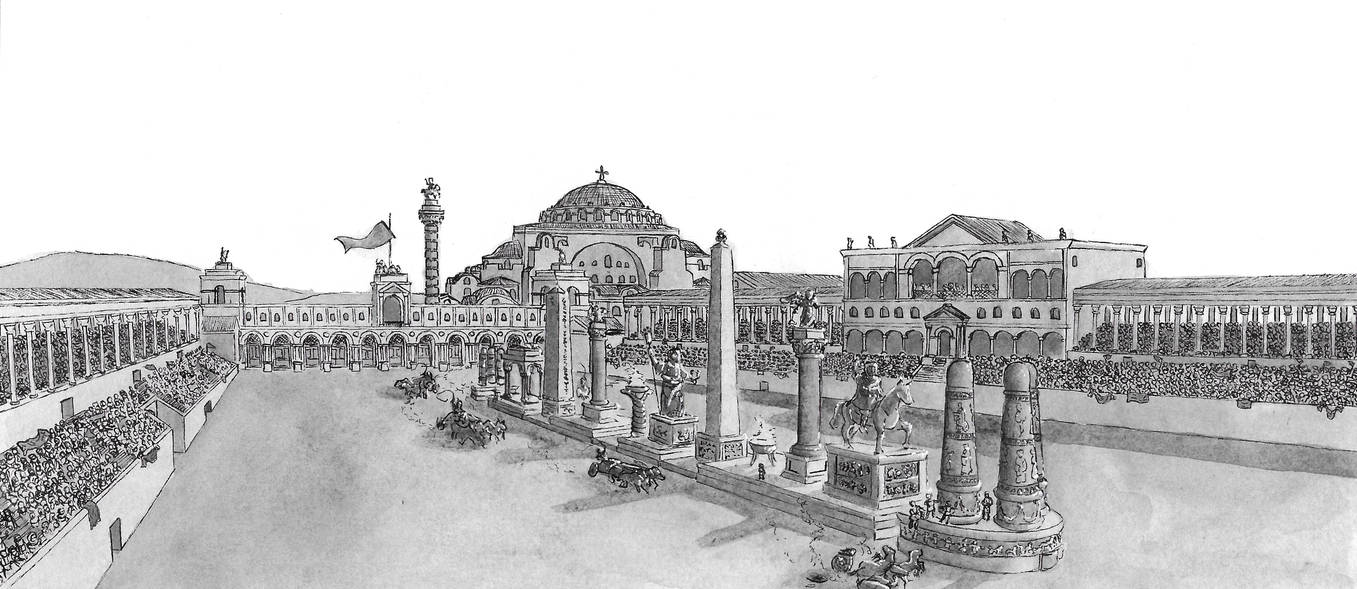
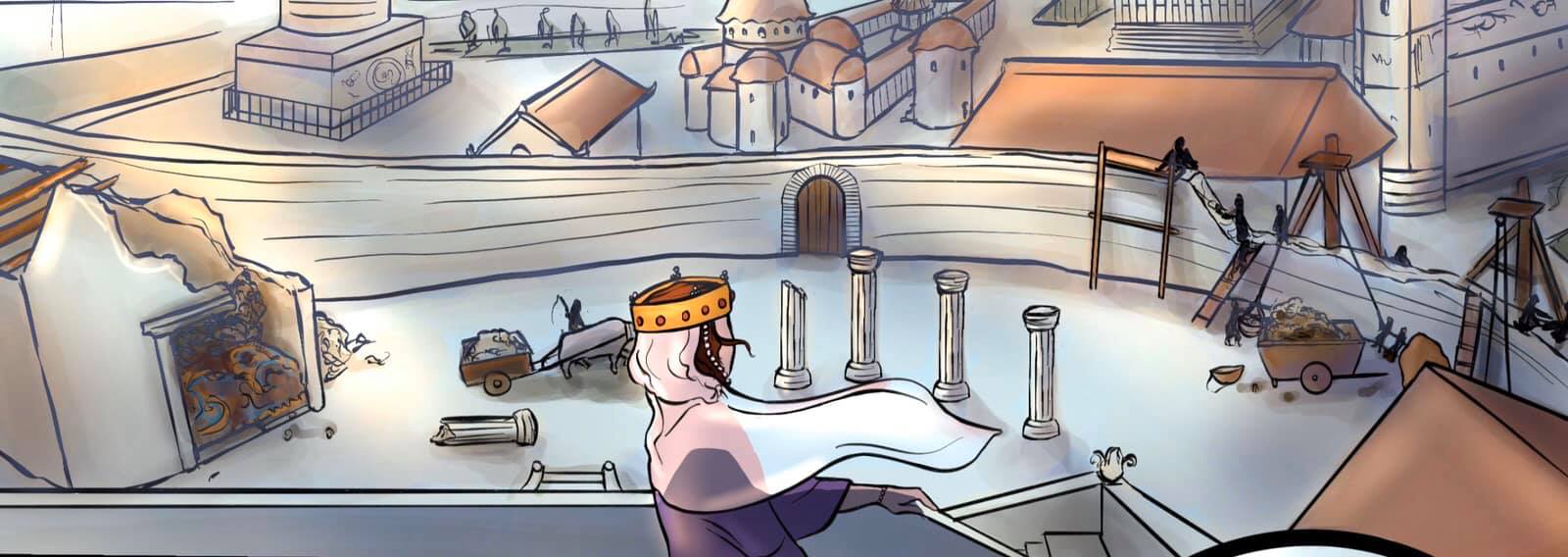
Watch this to learn more about Nikephoros II’s interaction with Liutprand of Cremona (Voices of the Past).

hippodrome_of_constantinople__fidem_et_circenses_by_ediacar_dcavwrz-pre
Hippodrome of Constantinople, art by Ediacar
97356469_234116541366870_1753659649745223680_o
Construction of the extra wall for Constantinople’s Imperial Palace under Nikephoros II, art by Byzantine Tales
Fall_of_Antioch_in_969
Michael Bourtzes captures Antioch in 969, Madrid Skylitzes
PALAIS_DE_BOUKOLEON_5
Bukoleon Palace, site of Nikephoros II’s assassination in 969
Watch this to see the assassination of Nikephoros II in Lego (from my channel No Budget Films).

John I Tzimiskes, the Conclusion to this 10th Century Epic

Palaiologos_Dynasty_emblem1

Nikephoros II Phokas here like in real history died violently at 57 similar to how Michael III 102 years earlier where this story began died and now here, John I Tzimiskes rose to the throne at 44 on the condition that he was to execute the other 2 assassins with him except Bourtzes as if to look like John had no part in the plot to murder the emperor at all, and also to give a big percent of his money as a donation to small farmers and to construct a home for lepers, though in this story Polyeuctus would have to make John marry the empress Zoe to continue the dynasty. In real history however, Polyeuctus agreed to crown John Tzimiskes only if he banished the empress Theophano to the Princes’ Islands in the Marmara for good as here the blame on Nikephoros’ death was all put on her, and John not wanting to share power anyway agreed to banish Theophano even if they had an affair, but here in this story without Theophano there would be no condition that John would have to banish anyone and with her sons not being around here as the already crowned co-emperors too, John would not have to share power with anyone. In real history, John was indeed forced to marry another one of Romanos II’s sisters and the one the he did not choose but was chosen for him by Polyeuctus was Theodora who was someone unattractive but intelligent compared to Theophano, though here in this story since Zoe was not suspected in any way to be part of the murder of Nikephoros the way Theophano was in real history, Zoe would be spared but forced to marry John. On the other hand, Theophano in real history may have not seemed to have any part in the murder of her husband Nikephoros II but was only used a scapegoat by Polyeuctus as she was an ambitious woman in a time when ambitious women were looked down upon, therefore she was banished, though it was by the time John Tzimiskes became emperor following the exile of Theophano where the idea of Theophano being part of the plot was promoted according to present day historian Anthony Kaldellis.
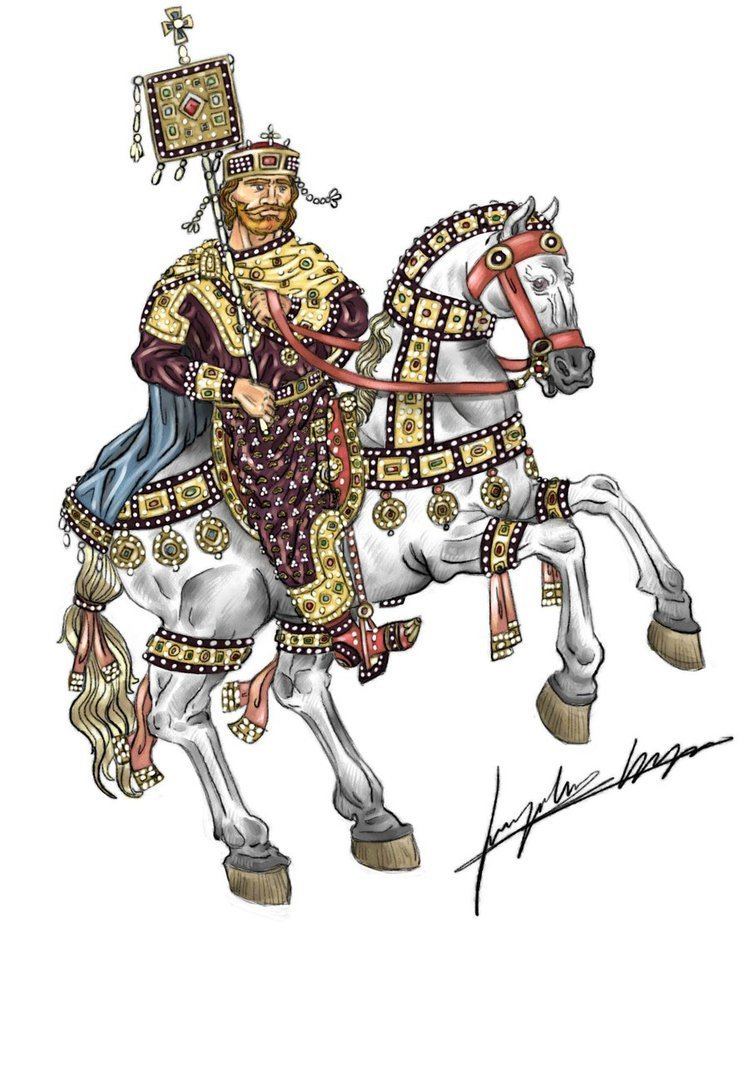
john-i-tzimiskes-b4da6ff2-cb3e-4000-aa85-f55198e0a44-resize-750
Emperor John I Tzimiskes of Byzantium (r. 969-976), art by Oznerol-1516

Now since the main plot of this story ends with the assassination of Nikephoros II, where the graphic novel Theophano had ended as well, we will basically just fast-track the next 5 years of Byzantium under John I Tzimiskes before we get to the ultimate conquest of Bulgaria. Now at the beginning of 970, just about a month after John I became emperor, Patriarch Polyeuctus had died after seeing a change of emperor 3 times in only 10 years and following his death, John appointed his friend the ascetic monk Basil Skamandrenos as the new patriarch who as John’s friend would totally recognize him as the legitimate emperor, although the biggest challenge for John when coming into power would be his uncle Leo Phokas who was still around and even after being arrested at the night of his brother Nikephoros’ assassination, Leo at some point in 970 would break free and rebel, attempting to seize the throne to avenge his dead brother but John would immediately put down Leo’s rebellion and banish Leo and his sons to the island of Lesbos in the Aegean for good while Leo’s son Bardas Phokas the Younger who was here stationed in Cappadocia would be arrested and imprisoned there. Now as emperor, John would start off finishing everything Nikephoros II could not but also clean up all the mess he created and by this, John at first like his uncle Nikephoros not being so interested in the state’s administration would leave behind the eunuch Basil Lekapenos in Constantinople to be in charge of the finances while John would immediately set off to campaign against Sviatoslav in Bulgaria and finish him off for good, and afterwards conquer Bulgaria itself which had already been weakened by Sviatoslav’s Rus’ invasion, and to lead the troops in battle, John would appoint his brother-in-law Bardas Skleros as the new top commander of the Byzantine forces while Michael Bourtzes would be put back in charge in the east. For the campaign against Sviatoslav in Bulgaria, John I however only had 12,000 soldiers with him although they were all veteran elite forces including Cataphracts and the Tagmata, but Sviatoslav’s army was much larger in number as he allied himself with the Magyars and Pechenegs north of the Danube as well as with some Bulgarian Boyars (aristocrats). The campaign at first began with some difficulty for the Byzantines until they were able to trap Sviatoslav’s forces at a mountain pass where they would eventually lose to the Byzantine forces led by Bardas Skleros at the Battle of Arcadiopolis, thus the undefeatable Sviatoslav was defeated for the first time having to leave Thrace and fall back north to Bulgaria. Though making some progress against Sviatoslav, John I got word from Asia Minor that Bardas Phokas escaped prison and proclaimed himself emperor in the name of his uncle Nikephoros II using the troops there still loyal to Nikephoros II and when hearing of this, John briefly abandoned the Bulgarian campaign sending Bardas Skleros to Asia Minor to deal with Bardas Phokas.
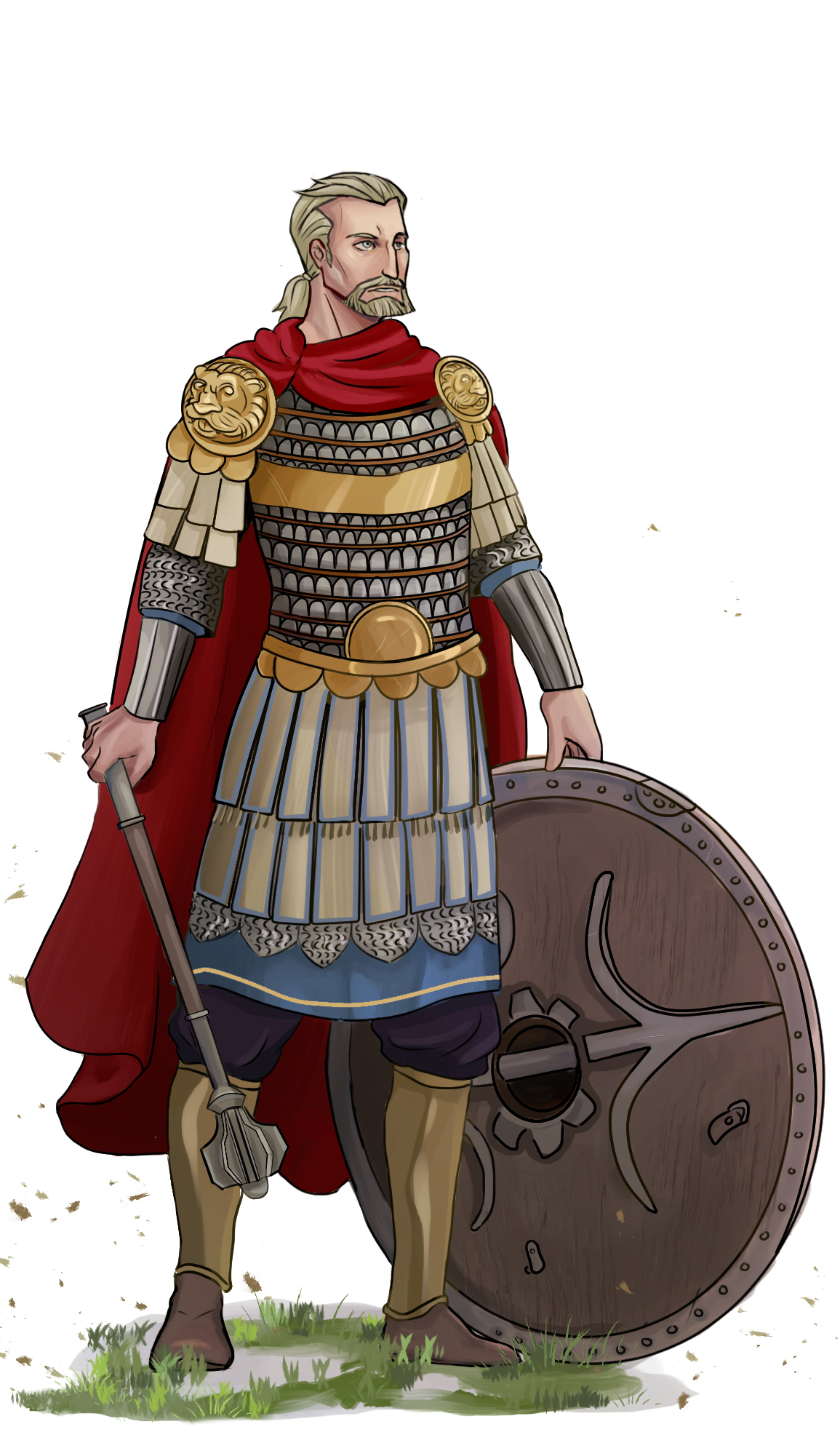
dcuhbeh-0626c59c-06fc-4c2b-ba2e-d078a80fd79f
Bardas Phokas the Younger, Byzantine general, son of Leo Phokas the Younger, art by Akitku

At the end, Skleros was able to win by diplomacy by having men dressed up as beggars to convince Phokas’ men to turn on him and join John’s army wherein they will be rewarded, thus they defected to the imperial army while Phokas left with only 300 men fled to a castle where he eventually surrendered to Skleros knowing he would not win. Bardas Phokas was then exiled to the Aegean island of Chios while his father Leo in Lesbos was blinded, never to return again. With Bardas Phokas dealt with, John with Bardas Skleros later on in 971 resumed the Bulgarian campaign this time with 40,000 men marching north through the mountain passes while their fleet sailed up the Black Sea to attack Sviatoslav’s forces at the Danube. When reaching the Bulgarian capital of Preslav, John had burned it to the ground to force the Rus’ forces to surrender it to them and at the end, the Byzantines were able to seize Preslav wherein among the Rus’ hostages in the citadel, they found the Bulgarian tsar Boris II, who succeeded his father Peter I after his abdication and retirement to a monastery in 969, and shortly after in 970 Peter died as a monk.
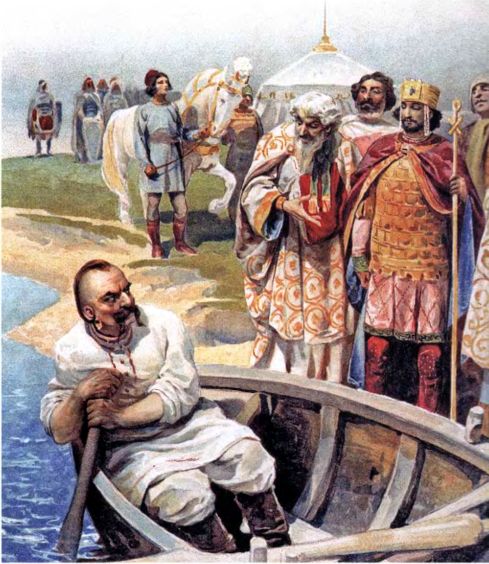
i_035
John I Tzimiskes and Grand Prince Sviatoslav (on the boat) meet at the Danube, 971

John then allowed Boris II to be spared promising him too that the Byzantines were there to not conquer Bulgaria but liberate them from the Rus, although after liberating Preslav, John I renamed the city Ioannopolis after himself. John with his forces then headed up to the Danube where Sviatoslav was, and after defeating Sviatoslav’s forces at the Battle of Dorostolon, Sviatoslav now being outnumbered with the Byzantine fleet blocking off the mouth of the Danube into the Black Sea to prevent his escape then finally surrendered to John I without a fight. Both John I and Sviatoslav then met in person along the Danube where Sviatoslav surrendering to John agreed to never attack Byzantine territory again in exchange for his people, the Rus to freely trade in Constantinople and before Sviatoslav departed by boat, he was given food and supplies by the Byzantines. John I however did not keep his word to Boris II who he took as a prisoner to Constantinople where John proclaimed that he had conquered Bulgaria while Sviatoslav on his way back to his capital of Kiev was betrayed by his Pecheneg allies who ambushed him here in 972 while he was crossing the Dnieper River back to his lands, and after he was killed, Sviatoslav’s skull was made into a drinking cup by the Pechenegs, like what happened to the Byzantine emperor Nikephoros I back in 811. 
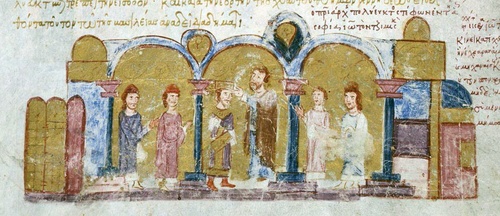
9014
Coronation of John I Tzimiskes in 969 by Patriarch Polyeuctus, Madrid Skylitzes
2019-12-01 13.14.29
Byzantine forces under Bardas Skleros defeat Sviatoslav’s Rus at the Battle of Arcadiopolis, 970
BelagerungvonDorostolon
Final defeat of Sviatoslav to John I Tzimiskes at the Battle of Dorostolon, 971


In 972, John I had declared he had conquered the Bulgarian Empire up north making it a Byzantine Theme while the Bulgarian tsar Boris II and his brother Roman were brought to Constantinople as captives and paraded at John I’s triumphal procession, although Boris II was allowed to live in Constantinople as the Bulgarian tsar in exile, while Roman was castrated to make sure their bloodline- the bloodline of Krum- died out. Although John I thought he had conquered all of Bulgaria, the northern and western portions of the Bulgarian Empire (today’s Western Bulgaria, Romania, Serbia, and Macedonia) was not fully put under Byzantine rule, and here over the years a resistance would grow to restore to the Bulgarian Empire led by the aristocratic Cometopuli clan which was of Byzantine Greek and Armenian origins. After thinking he had conquered all of Bulgaria, John I returned to where Nikephoros II failed, which was in foreign policy with the Holy Roman emperor Otto I and so in 972, John I did what Nikephoros II failed, which was to give Otto a Byzantine bride and the person John chose for Otto I’s son Otto II like in real history was his young niece from the Skleros clan- his late wife’s family- also named Theophano who later on in 972 travelled all the way to Germany and married the young Otto II, thus settling peace between Byzantium and the new Holy Roman Empire of Germany and Italy.
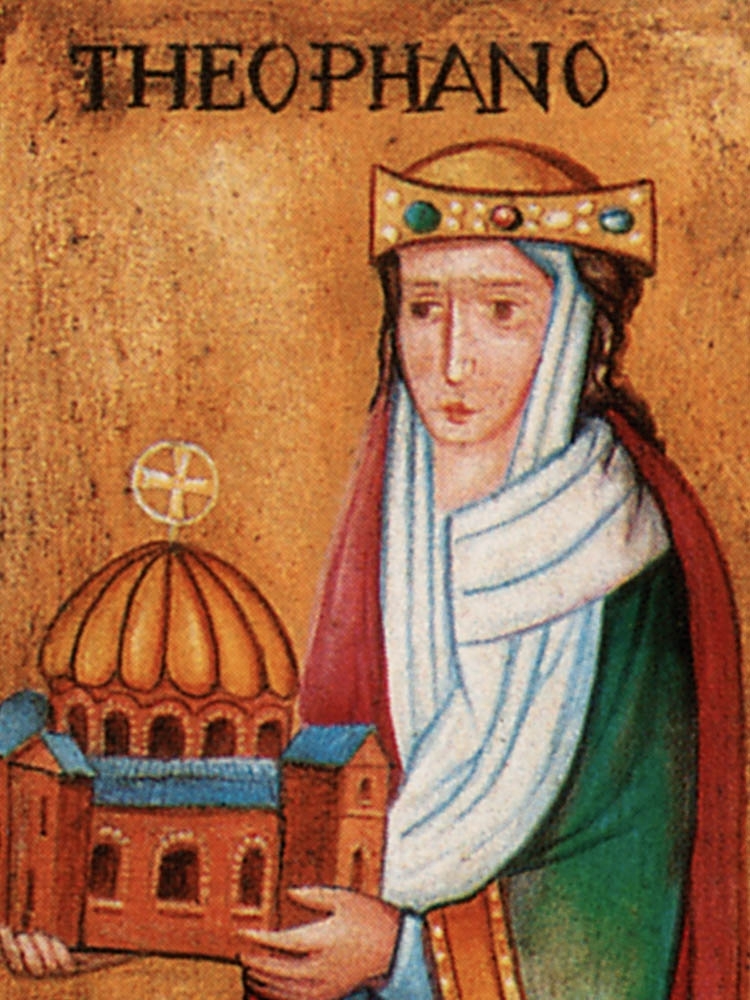
kaiserin-theophanu-schwiegertochter-ottos-des-grossen_original
Theophano Sklerina, niece of John I and wife of the future Holy Roman emperor Otto II

The threat of Otto I to Byzantium’s imperial power would then be over in 973 when Otto I died while his son the new Holy Roman emperor Otto II would not be as much of a threat to Byzantium as his father was and in fact with his marriage to Theophano, the Holy Roman Empire would even adopt some Byzantine cultural practices including the use of the fork for eating, which the Franks at first laughed at and were even scandalized by. Now with the threat of Sviatoslav over, a third of Bulgaria captured, and the issue with the Holy Roman Empire settled, John I returned to finishing off his uncle’s eastern campaigns which was now easier for the Byzantines following the death of Sayf al-Dawla back in 967 which weakened these Islamic Arab states, although despite these states in the Middle East including the Abbasid Caliphate of Baghdad weakened, a new Islamic power had been arising which was that of the Fatimid Caliphate which were believers of Shia Islam, the other sect of Islam which believed their ruling caliph should be a descendant of the prophet Muhammad, and in 969 the Fatimids had already conquered Egypt making it their base where they would start posing a threat to the Byzantines.
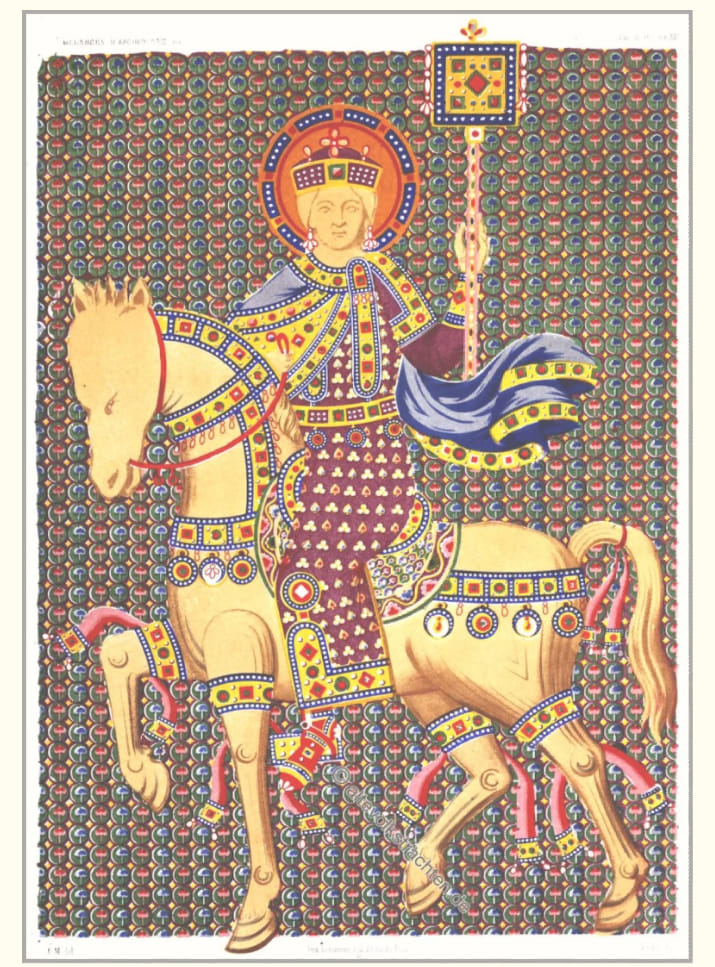
131328571_149372996956402_6096732761658683050_o
Emperor John I Tzimiskes tapestry

John I later in 972 marched into Mesopotamia once again although not for long as he returned to Constantinople leaving his general Melias to be in charge while John continued his uncle’s reforms of limiting the power of the landed aristocracy and giving more power to the small farmers. In 975, John I returned to leading the army himself and this time deep into Syria which the Byzantines could now achieve after the reconquest of Antioch and in one swift campaign, John and his forces were able to do what the Byzantine forces did not in over 300 years which was in recapturing the Syrian cities of Emesa and Damascus which the latter was the capital of the old Arab Umayyad Caliphate that died out in 750, and following this John I was able to reach as far south as Lebanon recapturing the cities of Baalbek, Tripoli, Sidon, Byblos, and Beirut, before reaching the Sea of Galilee recapturing Tiberias and Nazareth for the Byzantines, though his campaigns would end right here before being actually able to retake the ultimate prize of Jerusalem that had not been under Byzantine hands since it fell to the Arabs in 637. John I had then returned to Constantinople in January of 976 where he suddenly died in which most sources blamed the eunuch Basil Lekapenos for poisoning him, and in this story’s case it would be true as John had confiscated some of Basil’s ill-gotten lands and wealth, and in revenge Basil poisoned him. Now in real history with John I dead in 976 at the age of 50, Romanos II and Theophano’s eldest son Basil II was already 18 here therefore being of legal age to rule alone in which he did although still under the influence of his grand-uncle Basil Lekapenos, while Theophano had returned to the palace sometime here. In this story’s case, since there is no Theophano and therefore no Basil II, and John I too despite being married to Romanos II’s twin sister Zoe would not have any children with her as he also chose to barely stay with his wife similar to Nikephoros II, and so here in this story before John I died, he wrote his will proclaiming that his brother-in-law Bardas Skleros was to succeed him as emperor as they had family ties, and following John’s death Bardas immediately came to power without any challenge.              
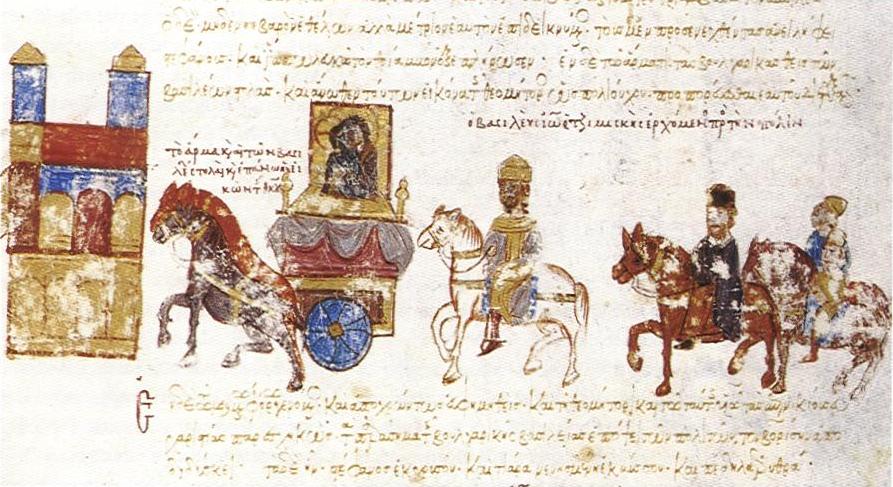
Returns
Triumph of John I Tzimiskes in Constantinople following his 971 conquest of Bulgaria, Madrid Skylitzes
e8vinp80h6e61
Meme of John I failing to retake Jerusalem due to his sudden death in 976
holyromanempire
Map of the Holy Roman Empire (red) at Otto I’s death, 973
john-i-tzimiskes-81567867-ad04-4b72-a912-4c8e4be56f8-resize-750
Byzantine Empire (purple) at John I’s death, 976

In this story’s case with Bardas Skleros as the new Byzantine emperor, some things that did happen in real history whereas Basil II finally succeeded John I would happen, but a lot would be different too. What would be the same here in the reign of Bardas Skleros was that like in reality, the Bulgarian brothers Boris II and Roman, who happened to be great-grandsons of Romanos I Lekapenos- through his granddaughter Maria’s marriage to their father Tsar Peter I if you remember- would escape captivity in Constantinople in 977 and make their way into the still independent 2/3 of the Bulgarian Empire, although like in real history Boris II here would get killed by his own Bulgarian troops mistaking him for an enemy, though Roman like in reality would survive after proving his identity.
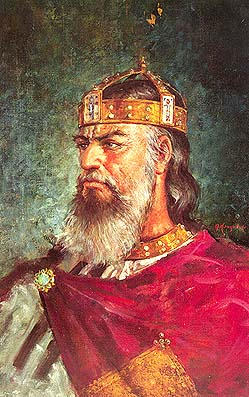
samoil
Samuil of the Cometopuli, military leader of the Bulgarian resistance against Byzantium, Tsar of Bulgaria (997-1014) in real history

Although back in the Bulgarian Empire, Roman would not really rule himself as he had been turned into a eunuch and at the same time during their absence, the new ruling dynasty of the Cometopuli rose up in resistance to the Byzantine conquest, and though Roman would only be a figurehead ruler as he was from the dynasty of Krum that dated back to 803, the real power over Bulgaria was at the hands of Samuil, the youngest of the Cometopuli brothers and a military genius. Now in real history, it would take another 40 years for Byzantium under Basil II to fully annex the Bulgarian Empire into Byzantium as Basil II had to deal with civil wars and usurpers in Byzantium itself such as Bardas Skleros who in 976 after Basil II came to power declared himself emperor in opposition to the legitimate emperor Basil II but more so to the power behind Basil II which was Basil Lekapenos who was still powerful. In real history, Bardas Skleros rebelled after Basil Lekapenos fired him from his position as the supreme commander of the eastern forces while also releasing the rebel general Bardas Phokas from his imprisonment in Chios to strike against Skleros, although Skleros in real history had a stronger position as he was able to confirm an alliance with the small time Armenian, Georgian, and even Islamic rulers along Byzantium’s border, and true enough Skleros defeated Phokas’ forces that were loyal to the emperor Basil II in two battles, but in the third one Skleros was defeated in which his soldiers even believed him to be dead after he lost in personal combat to Phokas.
198303916_861314034782033_4391985121670989794_n
Basil II, Byzantine emperor in real history, son of Romanos II and Theophano, art by Justinianus the Great

Skleros however had escaped to Baghdad to seek refuge there with the Abbasid Caliph where he would plot an invasion of Byzantium all while the emperor Basil II here had grown up and had shown that he did not want to be a weak ruler or puppet to his grand-uncle Basil Lekapenos anymore, and so in 985 he accused Basil Lekapenos for conspiring with the rebels and then fired and banished him for good, and in 986 Basil II himself led the army against Bulgaria but was defeated at the Battle of Trajan’s Gate by Samuil’s forces due to Basil II’s inexperience. This defeat made Basil II have a lifetime grudge against Bulgaria making it his ultimate goal to conquer it for good, though this defeat made Bardas Phokas lose faith in the emperor and turn against him that in 987 he called Bardas Skleros back from Baghdad to join forces with him against Basil II.
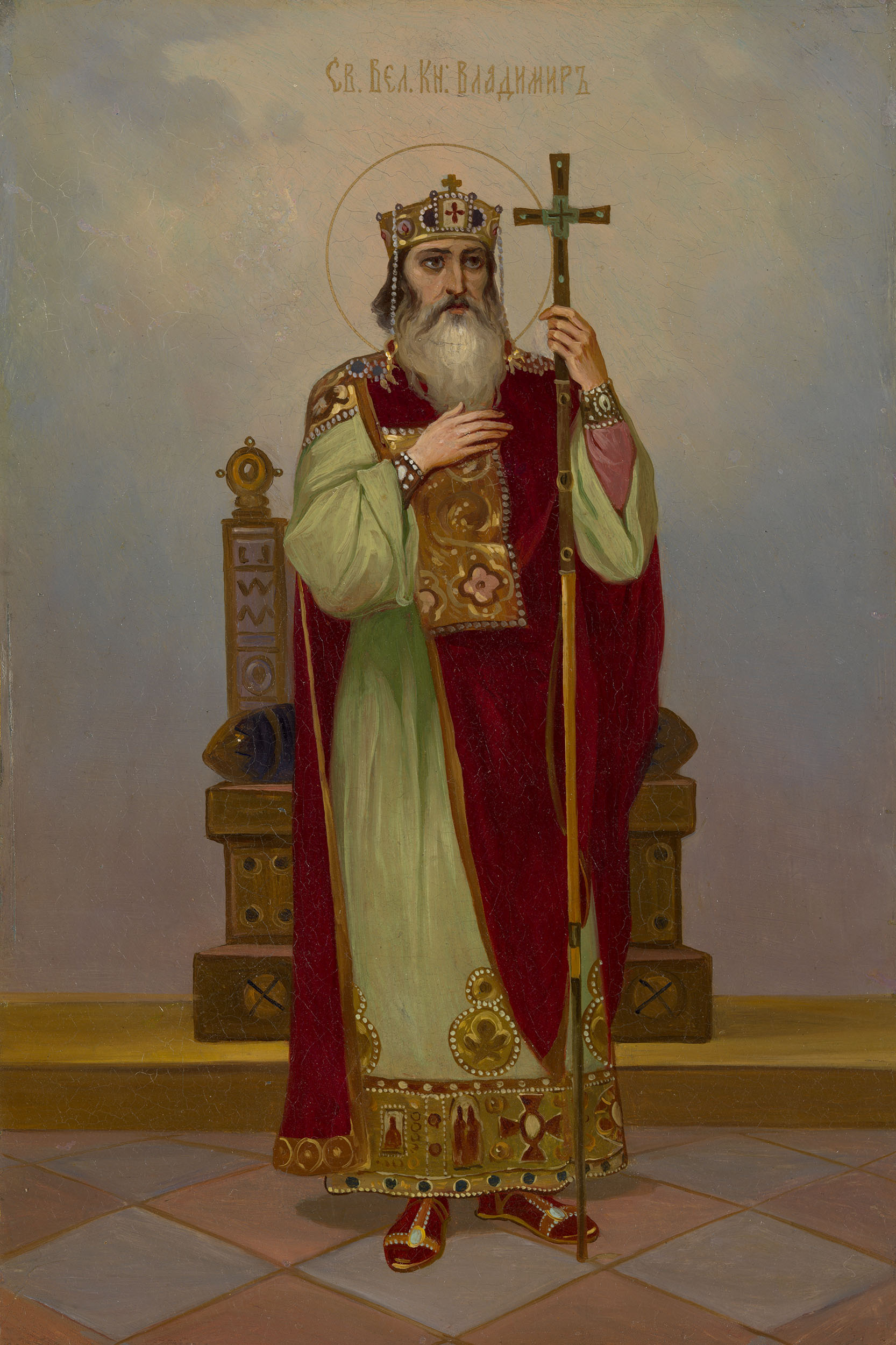
440518-1
Vladimir I the Great, Grand Prince of the Kievan Rus’ (r. 980-1015)

In real history, Basil II made an ultimate alliance with the new Prince of the Kievan Rus’ Vladimir I, the son of Sviatoslav in 988 which provided Byzantium military aid with over 6,000 Varangian (Rus and Scandinavian) warriors to join in the imperial service as the elite bodyguard force of the emperor, in exchange for Vladimir to convert to Christianity, and also part of the deal was to marry Basil II’s sister Anna who was such a great prize to marry for being a Byzantine princess as twice when offered a marriage, she refused it. With the help of these large sized and fierce Varangian warriors now in the imperial service as the legendary Varangian Guard, Basil II was able to defeat the rebellion of Bardas Phokas in 989 wherein Phokas here fell off his horse due to a seizure and died, thus ending his rebellion. Although the rebellion of Bardas Phokas the Younger ended, Bardas Skleros now an old man succeeded Phokas as the leader of the rebellion against Basil II, but eventually the cause of the rebellion had been weakened and in 991 Skleros surrendered to Basil II without a fight and died peacefully just days later.
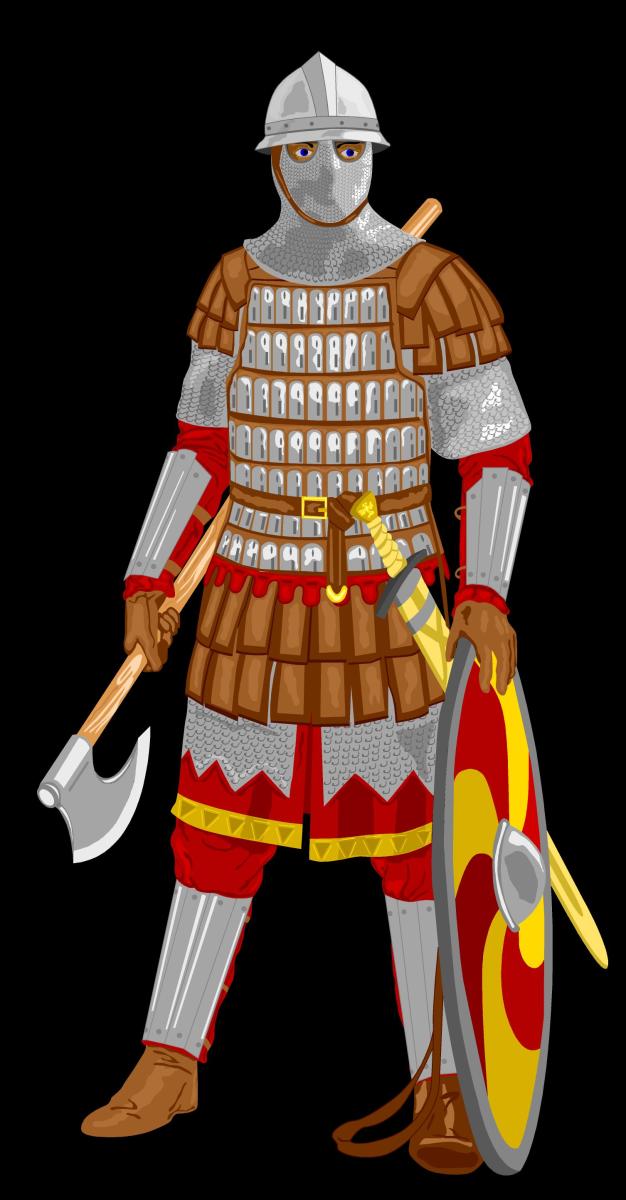
vikings-in-the-pay-of-an-emperor-the-varangian-guard-from-early-times
Varangian Guard soldier, introduced to Byzantium in 988 in real history

The full conquest of Bulgaria in reality however would only take place 2 decades after Basil II put down all opposition against him, as Basil had to conclude peace with the Islamic powers including the rising Fatimid Caliphate in order to launch a full-scale invasion of Bulgaria without distractions while over in Bulgaria, Roman died in 997 and without any heirs was succeeded by Samuil as the full tsar. The Byzantine conquest of Bulgaria in real history would then only be completed in 1014 when Basil II won a decisive victory over Samuil’s forces at the Battle of Kleidion and by 1018, all of the Bulgarian Empire was conquered, thus Byzantium having all of the Balkans would be at its greatest extent of territory in almost 400 years. Now in this story’s case on the other hand without Basil II ruling and beginning out badly due to his inexperience in military matters, Bardas Skleros having more military experience despite being not a very competent planner as the Byzantine historian Michael Psellos (1017-1078) said, he would act much quicker in subduing all opposition against him and finishing off the Bulgarian threat as compared to Basil II in real history. First of all, Bardas Skleros soon after coming into power in 976 here would execute Basil Lekapenos on charges of poisoning John I Tzimiskes, although like in real history Bardas Phokas the Younger too would actually be released from Chios by Basil Lekapenos before Lekapenos would be executed, and back in action Phokas would launch a massive rebellion against Skleros, although Skleros would do the same here as he did in real history by allying with the Armenians, Georgians, and Islamic powers against Phokas. For this story, I would just say that Skleros as the legitimate emperor chosen by John I to succeed him would eventually defeat Phokas the same way he did in real history after winning two battles, and as Skleros would have more support from the Byzantine senate and the aristocracy, Phokas in this story would be defeated in 979 wherein Skleros would kill him in single combat. Being a more capable military commander, Skleros unlike Basil II in real history would therefore not ask for a military alliance with the Kievan Rus’ prince Vladimir I in exchange for Vladimir to convert himself and his people to Orthodox Christianity, therefore there would be no Varangian Guard in the Byzantine army to assist Skleros in conquering Bulgaria, although for the next chapter of this series, the Varangians would play a big role- SPOILER ALERT! Skleros in this story instead would lead the Bulgarian campaign himself beginning 980 and unlike Basil II in real history who would take 3 more decades to conquer Bulgaria, Skleros here would take around only 7 years as Bulgaria was already weak here unlike in real history where they were able to regain strength after defeating the Byzantines in 986. Here, Skleros would instead win a number of victories and would penetrate deep into the Bulgarian heartland which is now the Central Balkans, and by 987 would capture the Bulgarian’s capital of Ohrid. In this story, Samuil himself leading his forces would be slain in battle by Skleros’ men in 987 while Roman not being actively leading the empire would end up captured and executed by Skleros, thus before 990 the Bulgarian state that had troubled Byzantium for over 300 years since 681 would be wiped off the map and all of the Balkans south of the Danube would be under Byzantine rule again after 4 centuries, thus Byzantium before the turn of the 11th century would become a superpower respected and feared by all around them. As for Bardas Skleros, his date of death in this story’s case is unknown but he would be the one to establish the new Skleros Dynasty, and by having sons it would live on to ensure a powerful and highly influential Byzantium. Now, it is only in the long-term where you could see how the empress Theophano not being around would have an impact in Byzantine history and this was not only because her son Basil II would not be around as even without Basil II who did achieve the ultimate goal in eventually conquering Bulgaria and becoming known as “the Bulgar-Slayer”, the Byzantines would still conquer Bulgaria anyway, in fact even much earlier, but more so because of her daughter Anna’s marriage to the Kievan Rus’ prince Vladimir I.
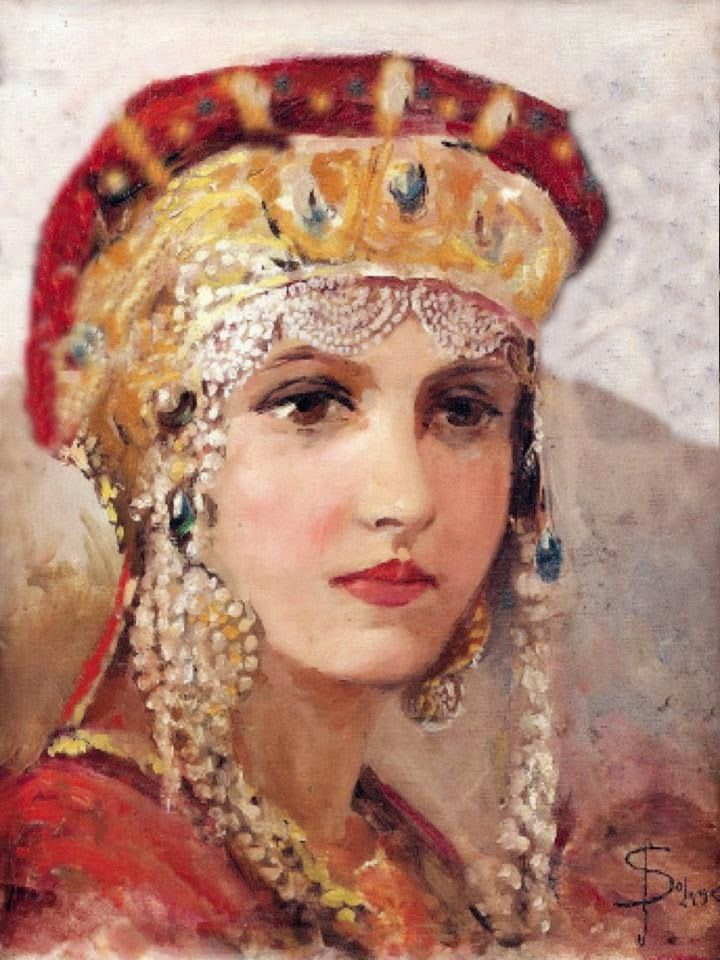
ca7b01fa16ea6dcb587d15fc4307e337
Anna Porphyrogenita, daughter of Romanos II and Theophano and wife of Vladimir I of Kiev, in real history

Now this marriage between Anna and Vladimir was a very crucial one as not only did it give military support to Byzantium, but this began the mass conversion of the Kievan Rus’ state that would eventually be Russia, Ukraine, and Belarus to Christianity, and Anna who being Theophano’s daughter was the one that made this happen, therefore this was Theophano’s major role in history. Although even without Vladimir’s marriage to Anna, the Rus’ may still convert to Orthodox Christianity as true enough Vladimir had been searching around for world religions and when given the choice between Islam, Judaism, Catholic Christianity, and Orthodox Christianity, he chose Orthodoxy as he heard from his ambassadors about the riches of Constantinople and the impressiveness of Orthodoxy’s main cathedral of the Hagia Sophia, therefore he chose Orthodoxy believing it was the religion of the powerful, which means even without marrying Anna, Vladimir may still convert his state to the religion of the Byzantines, therefore becoming a Byzantine ally. Not to mention, Theophano was also vital for being the mother of Constantine VIII, the brother and co-emperor of Basil II who would continue the dynasty through his children that would rule the empire until 1056 in real history. Either way, with or without Theophano around, Byzantium after conquering Bulgaria would again be a world power like it was under Justinian I in the 6th century both militarily and culturally, except not as powerful as it was under Justinian I, as then it had the whole Mediterranean, but here by the end of the 10th century by having all of the Balkans, all of Asia Minor, and all the way south to the Levant as well as to Southern Italy in the west, the Byzantine Empire would be a major power respected and feared by all, and by conquering all of Bulgaria, other powers would dare not bother to mess with Byzantium or they would suffer the same fate as Bulgaria and be wiped off the map.   
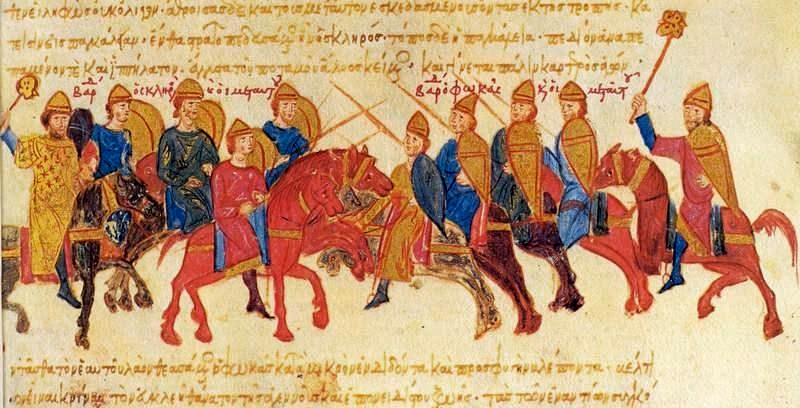
Clash_between_the_armies_of_Bardas_Skleros_and_Bardas_Phokas
Armies of Bardas Skleros and Bardas Phokas clash with each other in 979, Madrid Skylitzes
BardasSklerosEmperor
Bardas Skleros (left) as Byzantine emperor, Madrid Skylitzes
079214588f79d43aa39ef6119fe90feb
Emperor Basil II and the Varangian Guards, in real history, art by Amelianvs
3d3b91e994338b24f7a8cc3de8b4abf5
Byzantines under Basil II defeat the Bulgarians at the Battle of Kleidion, 1014 in real history
LTWEZHFiHvpNgY4wE8ksEd-480-80
The Byzantine Empire (red) at its apogee, at Basil II’s death in 1025, in real history

Watch this to learn more about Emperor Basil II (Kings and Generals).

Our story will now end here where the eventful action-packed roller coaster of the 10th century ends whereas in this story’s case Byzantium had gone a long way from an empire on the verge of extinction threatened on all sides to its apogee as a medieval superpower respected and feared by all around it. In the last 3 chapters of this series set between the 7th and 9th centuries, Byzantium went through a rough time of constant invasions from the Arabs in the east or the Bulgarians in the north, political instability, and a lot more including the destruction of icons or Iconoclasm, thus giving the Byzantine Empire and its society a dystopian setting, and at the end, nothing may have seemed to work to reverse all the setbacks and misfortunes the Byzantines had been facing, but at the end, this whole Byzantine Dark Ages did not go on forever, and little did the Byzantine people or their rulers know their empire would once again have a revival. Of course, the revival of the Byzantine Empire in cultural and military power known as the Byzantine Renaissance did not all happen in an instant, it in fact took some time, good leadership, the right reforms, diplomacy, some luck to achieve it, and even a bit of borrowed foreign influences such as the sophisticated intellectual culture the Byzantines borrowed from the Arab Abbasid Caliphate in the 9th century. It also did not just take some years, decades, or a century, it did in fact take 2 centuries for the Byzantines to consolidate their position as a military and cultural power, and this why the 9th century played significantly in this chapter when it was supposed to be exclusively for the 10th– as this series focuses on one century per chapter- as you cannot tell the story of the 10th century better known as the military and cultural revival century without telling about the origins of this revival which took place in the 9th century. On the other hand, this revival or renaissance of the Byzantine Empire which happened gradually over so many years was not something one person was responsible for doing, but rather the work of many people and their efforts to put it together. For this Byzantine Renaissance to be possible we have to thank the people mentioned in this story like Emperor Theophilos in the 9th century for adopting Arab influences and using state money to promote Byzantine sophisticated culture, Empress Theodora for putting an end to Iconoclasm once and for all in 843 which thus brought a sense of unity to the empire’s identity, Patriarch Photios for using the spread of Orthodoxy to secure alliances with people beyond the empire, Emperor Basil I despite his humble origins and lack education for finally having the guts to expand the empire east, Leo VI and his son Constantine VII for showing that emperors were not only powerful as military leaders but as sophisticated and learned scholars that could prove Byzantium is also superior in culture, Romanos I Lekapenos for putting the empire’s new military might into action and making reforms that would benefit not just the aristocracy, Nikephoros II Phokas despite his failure in diplomacy and political skills for showing that Byzantium was no longer an empire that fought to defend itself but could fight to conquer lands far beyond their borders, and lastly John I Tzimiskes for also showing that the Byzantine army was now an undefeatable war machine. Now the person removed from this story which was Empress Theophano, wife of Emperor Romanos II and Nikephoros II afterwards happens to be not very vital at all in the Byzantine Renaissance, but if you look closely she does have a role and this was to add to the complexity and scheming side of Byzantium for her part in being involved in both her husbands’ and father-in-law’s deaths, whether it may or may not be real, but either way her part shows some more color and drama to complete the story of the Byzantine Renaissance, thus making Byzantium more “byzantine” meaning complex. After all, this story set in the 10th century just shows how “byzantine” Byzantium was, but on the other had with all these power struggles and schemes, this also still shows that the traditions of the ancient Roman Republic still lives on even if Rome has been long gone and replaced as Byzantium. Anyway, even without Theophano, the period of the Byzantine Renaissance from the 9th to 10th centuries is still ever more colorful especially with all the murder plots, legitimacy issues, marriage scandals, scheming eunuchs, military rebellions, superior weapons and war tactics, diplomatic solutions, and the obscure but interesting Byzantine court ceremonies and practices all mentioned in this story. In addition, I also chose to label the dynasty ruling in the 10th century where Leo VI, Constantine VII, and Romanos II were part of as the Amorian Dynasty from 820 continued going with the historical speculation of Leo VI being Michael III’s son to add some more intriguing element to the colorful story of the Byzantine Renaissance, though in the end it still would not matter whether it was under the Amorian or Macedonian Dynasties when the Byzantine Renaissance happened, because all that would matter at the end was how great or colorful these Byzantine emperors were and not what dynasty they belonged to, and true enough the people that proved the strength of Byzantium in this time like Romanos I, Nikephoros II, and John I were not from the ruling dynasty but had only married into it. The process to achieve the complete Byzantine Renaissance at the end of the 10th century thus was rather a tricky one that involved a lot of blood and dishonesty, but the end result was very rewarding for Byzantium as after 3 centuries of being in the Dark fighting for its survival while also being insecure in their imperial position with the rise of a new empire in the west being that of the Franks, Byzantium would become the military power that had been able to strike back against the Arabs after 3 centuries of having to defend its borders against them, the power that dominated Eastern Europe culturally and spiritually by being the one that influenced most of the Eastern European powers like the Bulgarian Empire and the Kievan Rus by spreading Orthodox Christianity to them as well introducing to them an alphabet that would still be used up to this day, and lastly being the cultural superpower that was able to win over the rising Holy Roman Empire, and rather than feeling threatened by the rise of them as Byzantium was in 800 with Charlemagne’s coronation, Byzantium by the end of the 10th century was able to even influence them in imperial court culture.
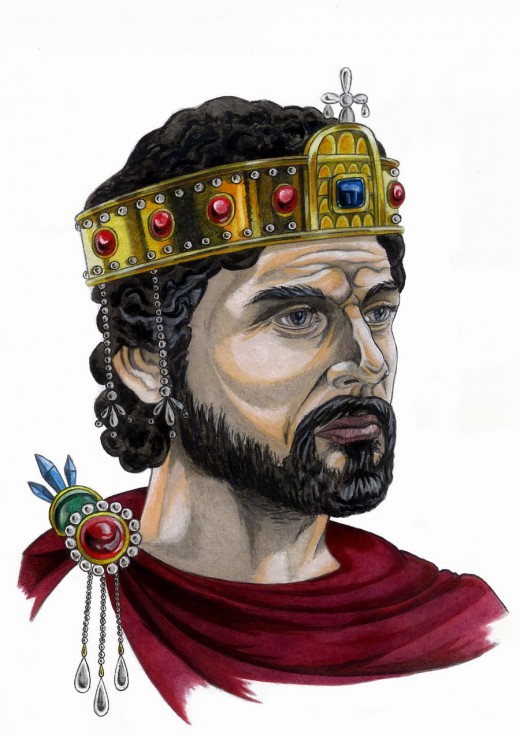
8650150_f520
Emperor Basil II the Bulgar-Slayer (r. 976-1025), to return in the next chapter of this series

Now in real history, it would be in 1018 when Emperor Basil II becoming known as “the Bulgar-Slayer” conquered the entire Bulgarian Empire when Byzantium would be at its greatest territorial extent again since 4 centuries earlier before the rise of the Arabs, and therefore a power respected and feared by all around them, but again as I mentioned earlier it did not really need Basil II to achieve this as any other competent military emperor in which this era had many of, in this story’s case being Bardas Skleros instead of Basil II would also achieve this. Anyway, this has been an extremely long chapter and I would say that it could have even been longer if I went into so much detail in describing each of the lead characters’ stories, but since this story spanned a longer amount of time than the other chapters in this series did and had so many interesting lead characters, it was only right for me to give each of these lead characters the equal amount of attention, therefore writing this story in something more of a fast-tracked documentary in style which just goes with almost everything really being what they were in reality except for a few twists here and there, and only at the very end do things become really different without Emperor Basil II who is in fact Byzantium’s longest reigning emperor. In the next chapter of this Byzantine Alternate History series, this Byzantine Golden Age continues at the beginning of the 11th century and following the conquest of Bulgaria in 1018 by Basil II, the Byzantine Empire will for once enjoy a time of peace and stability, but not for long as again the “cold war” situation with the west becomes worse and in the east, a new and unexpected enemy will rise and replace the Arabs, and this is when we say goodbye to the Arabs as Byzantium’s traditional enemy, and say hello to the Turks who will threaten Byzantium in the east, while we will also meet another new enemy being the Normans in the west, and the year 1071 will be the beginning of Byzantium’s permanent decline when they suffer an ultimate defeat to the Turks of the new Seljuk Empire at the Battle of Manzikert, but the next chapter will explore an alternate history scenario of what if the Byzantines won this battle, and how different history would be because of this. Well, this is all for chapter VII of Byzantine Alternate History, this is Powee Celdran, the Byzantine Time Traveller… thank you for your time!   

Next Story: Byzantine Alternate History Chapter VIII- 11th Century

Byzantine Alternate History Chapter VI- Irene and Charlemagne, the Wedding of the Century

Posted by Powee Celdran

DISCLAIMER: Although this is mostly a work of fiction, it is largely based on true events and characters. It seeks to alter the course of actual events that transpired in the 8th and 9th centuries AD. This story will begin with events that happened in real history but will become fictional as it progresses.

Previous Story: Byzantine Alternate History Chapter V- 8th Century
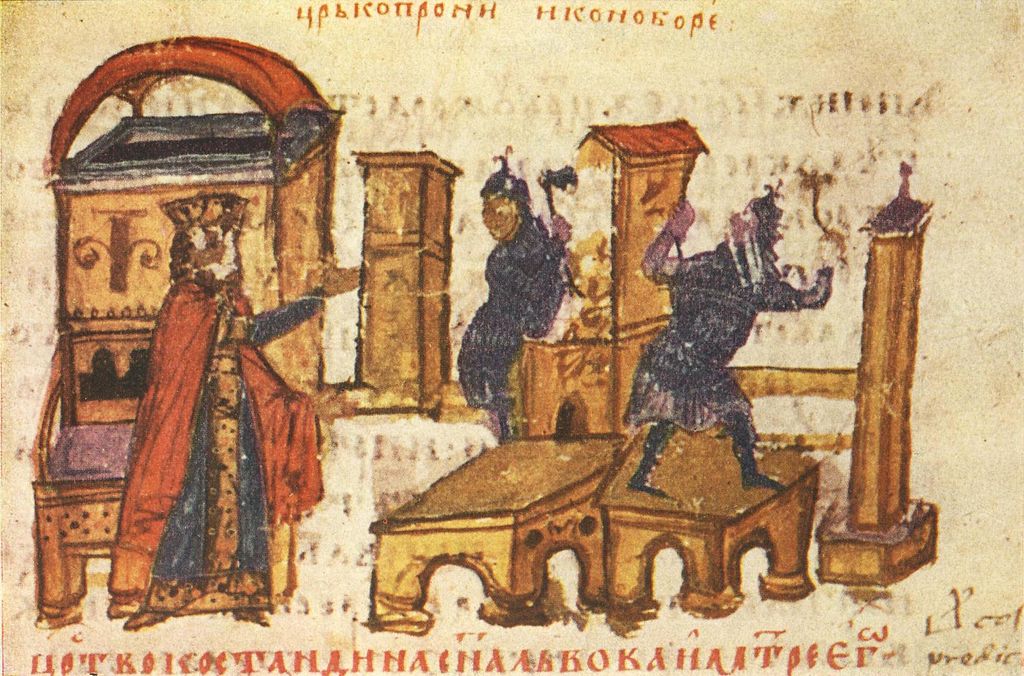
“But of Salic land no portion of the inheritance shall come to a woman: but the whole inheritance of the land shall come to the male sex.” -Salic Law

2f1c608066438c072614c5033855489c

Welcome to the 6th chapter of the Byzantine Alternate History series by the Byzantium Blogger! Last time, in chapter V of this 12-part series, I went over the Byzantine Dark Ages in the 8th century, the chaos and anarchy, the dystopian-like situation the Byzantine Empire, and the controversy of Iconoclasm or the breaking of icons that may have seemed like a simple issue but at the end caused so much tensions in the empire especially in its long-term relations with the western world, particularly the Church of Rome. The last chapter had also mentioned an event that could have ended the controversial Byzantine Iconoclasm before it could get worse and totally ruin Byzantium’s relations with the west and Church unity as a whole, and this event that could have changed it was if the emperor Artavasdos who only reigned a year (742-743) stayed in power longer rather than losing and being blinded by Constantine V (r. 741-775), who returned to power and continued Iconoclasm to an even higher level purging all those who believed in icons and worked to restore them. However, since the stories in this series despite being in chronological form with one chapter per century, their alternate history scenarios are not continuous with each other, so this means that for this chapter, the events of real history would play out whereas the Iconoclast extremist Constantine V would stay in power and not fall off a castle wall like in the previous chapter. This story then continues not so long after the last one left off and will be set at the turn of the 9th century at the tail-end of the Byzantine Dark Ages and the last days of the Iconoclast period, and therefore this will be the last part of the Byzantine dystopian trilogy which began with chapter IV. Now this chapter in this series will be a very special one as we are now at the midpoint of this series, and the thing that will be different about this story compared to the previous ones is that first it will be more of a direct sequel to the previous chapter as the same plot and scenario as well as characters from the last chapter return here except of course for the scenario of Artavasdos defeating Constantine V in the civil war, so basically it will be something not purely a 9th century story but rather an 8th and 9th century crossover alternate history story. Another unique style chapter VI over here will have which the other chapters will not is that its background part will not be a story retelling the past events, but rather already beginning in the main setting in the year 800 while the lead character here Empress Irene Sarantapechaina or Irene of Athens will be the one narrating the events of the past going back to reign of Constantine V where she comes into the picture being chosen as the wife for his son Emperor Leo IV (r. 775-780).

Screen Shot 2021-05-18 at 6.41.02 PM
Empress Irene of Athens, empress-regent (780-797), sole empress (797-802)

Now Empress Irene was one powerful, ambitious, and even ruthless woman who was basically the one running the empire for 27 years (775-802), first as the empress for her weak-ruling husband Leo IV who being already sickly since birth died too soon, then the empress-regent of the empire for Constantine VI (r. 780-797) who was her son with Leo IV as Constantine VI was never an effective ruler anyway that in 797 he was overthrown and blinded by his mother Irene who then became the sole ruler of the empire, the first woman to rule the Byzantine Empire alone. Irene may have a made a lot of achievements for the Byzantine Empire going from an imperial princess, to empress consort, and also it did not need a large anti-government resistance to end Iconoclasm, instead it only needed Irene as an empress strongly believing in icons to end the pointless issue of Iconoclasm in 787 at the 2nd Council of Nicaea. However, despite her achievements, Irene being a female ruler was not fully secured on her throne as the fact of a woman ruling an empire alone was quite unheard of that it became easy for the nobility to challenge her and in addition, she despite being a strong and decisive ruler was not very good at managing the empire and its economy, getting the whole empire loyal to her, while at same time she ruled an empire that was chaotic, almost bankrupt, and weakened. In Irene’s rule as the sole empress (797-802) and as regent before it (780-797), the Byzantine Empire though was already more stabilized than how it was back at the start of the 8th century where it was still not yet fully stable as the issue of Iconoclasm still split the empire’s population in half, a new Arab power in the east being the Abbasid Caliphate had just begun to pose as a threat to the Byzantines despite the threat of the Arabs by this time being nothing new to Byzantium anymore, to the north the new power of the Bulgarian state or the Bulgars was growing to become more of a threat to the Byzantines, and in the west the ruler of the Frankish Kingdom (France) which was Charles I or Charlemagne (Charles the Great) had rapidly built an empire in such a quick matter of time covering almost all of Western Europe that in the year 800, the pope crowned Charlemagne as a “Roman emperor”, therefore a direct insult and threat to the Byzantines who had always seen themselves as the only Roman Empire and its ruler as the only rightful person to call himself a Roman emperor despite the empire no longer being ruled in Rome or Italy, but from Constantinople. Ever since the year 476 (as mentioned in chapter II of this series) when the Western Roman Empire based in Ravenna fell, the Eastern Roman Empire or the Byzantine Empire was the only Roman power left, but because in the western lands, particularly the Frankish Kingdom, their law known as Salic Law forbade women from ruling and in 800 with the Byzantine Empire ruled by a woman, the western rulers such as Charlemagne did not see her as legitimate, therefore someone like him could challenge her and be crowned as a “Roman emperor” or more specifically an Augustus– not as “Holy Roman emperor” though as many would confuse it- without even seeking the approval of the Byzantines, although the pope also refused to acknowledge the Byzantine Empire as the real Roman Empire but instead Charlemagne’s new Frankish Empire because the issue of Iconoclasm in Byzantium- as mentioned in the previous chapter- had already grown so much to damage the pope’s ties with Byzantium. Now the rise of Charlemagne may be both a threat but also an opportunity to Byzantium as the mere fact of another king being crowned a “Roman emperor” when there is already an existing one being the Byzantine ruler was a heavy blow to the pride of the Byzantine Empire, but at the same time it could have benefited the much weaker Byzantine Empire since its ruler Irene being a widowed woman and Charlemagne being a widower could have married each other, therefore being the magic pill that could reverse all of Byzantium’s previous setbacks, refill its treasury, and unite the east and west again as one massive empire just like the Roman Empire of old before it was permanently split in half in 395, and this new united empire would be known as the “Frankish-Roman Empire“. The marriage between Irene and Charlemagne that almost did happen in 802 could have put what is now France, Italy, and Germany as well as other Western European countries together with the Byzantine Empire then being Greece, Asia Minor, and some of the Balkans as one large super-empire under two rulers of equal power (Charlemagne and Irene) with two capitals (Constantinople in the east and Aachen in the west), and together both rulers with a massive empire and a massive army of the Byzantine Thematic Army and Frankish knights combined could put an end to all of Byzantium’s external threats like the Bulgars, Arabs, and a lot more together but unfortunately, none of this happened as the idea of Byzantium ruled by a foreigner who was seen as a barbarian, which was Charlemagne was shocking to the people of Byzantium and for considering this marriage but also for failing to manage the empire’s economy, Irene had grown increasingly unpopular that with a single conspiracy by the nobility, she was easily ousted from power by a palace coup later in 802 and replaced as emperor by her finance minister Nikephoros I (r. 802-811), while Irene was exiled to the Greek island of Lesbos dying there just a year later. In this story however, the course of history will change when the marriage between Charlemagne and Irene- which would only be for political reasons- does indeed take place as Charlemagne travels to Constantinople and marries Irene before the plot against her is successfully hatched. Of course, if this marriage did indeed happen which in real history did not, then the Byzantine Empire which was here losing its significance would instead just join forces with the rapidly growing Frankish or Carolingian Empire of Charlemagne, though this union of empires which although would be like a magic pill for Byzantium in terms of reversing all the setbacks in its Dark Ages would also be very confusing as the Franks and Byzantines were of two different cultures and government systems, also it would be confusing in religion as the Franks were Catholic Christians and the Byzantines were Orthodox, so it would be confusing which religion the whole empire would fall under, and lastly in terms of succession as Irene’s son Constantine VI by 802 was already blinded and Irene being already 50 could no longer give birth, while Charlemagne though had sons but the issue would be on who rules the east and who rules the west. Now the big question here is, if Charlemagne and Irene married, would this really be the magic pill for Byzantium, or will it only be very confusing for both empires?           

95t3yr5xvfyy
Flag of the Byzantine Empire

Follow me, the Byzantium Blogger on Social Media:

Instagram: @byzantine_time_traveller

Facebook: Byzantine Time Traveller

Youtube: No Budget Films

Twitter: @byzantinetime

Deviantart: Byzantium-blogger55

Art Station: Powee Celdran Porphyrogennetos

Patreon: Byzantine Time Traveller

Note: Since this story is set from the 8th to 9th centuries after the fall of the Western Roman Empire, the Byzantine characters will be now referred to as Byzantines, not Romans.

1280px-Byzantine_Empire_802_AD
The Byzantine Empire in 800 (purple)
29111417525_a389c04761_c
The Frankish (Carolingian) Empire of Charlemagne
v202vgn7nwc61
Flag of Irene and Charlemagne’s fictional united Frankish-Roman Empire, crossover between Byzantine (red) and Frankish (blue) flags (photo from Reddit)

This article is again another work of collaboration and again with Justinianus the Great (follow her on Instagram @justinianusthegreat) who had previously worked with me in creating chapter III of this series on Emperor Justinian I the Great (r. 527-565), making this the second chapter I am putting the story together with her. Now Justinianus being a Byzantine history enthusiast as you remember from chapter III is a great fan of Emperor Justinian I the Great as her username certainly suggests, but on the other hand, she is also a great fan of Empress Irene of Athens who will be the main focus of this story. Justinianus here had also suggested that Justinian being the lead character of chapter III would make a comeback here at chapter VI and true enough, Justinian I will return here in this story 3 centuries later as a ghost occasionally coming here and there giving some advice to Irene on ruling her empire. Where Justinianus’ part comes in is basically in adding in some fictional elements from her imagination in filling in the blanks to creating some more background to Irene’s story and personality as she is its main character, and history itself too does not really record a lot about Irene’s full backstory like about her family and intentions, thus leaving a lot of historians to make guesses about her, although here a lot of the details about Irene’s unknown backstory thought of by Justinianus are actually very smart guesses. For the information used here, I again went through various articles online and went through videos on Byzantine history on this era by channels such as Kings and Generals, Eastern Roman History, Thersites the Historian, and of course the History of Byzantium Podcast by Robin Pierson.

Now before beginning the story, this topic of what if Charlemagne and Irene married is a very popular what if in Byzantine history, and possibly one of the biggest and most popular what ifs in medieval history that has already been covered many times by other alternate history blogs and videos, although this article despite it covering an already popular what if topic will have its own take on it. Since this blog site is about Byzantine history while at the same time to just remind you all that I am not very knowledgeable in the history and society of the Franks the way I am with Byzantium, it will tell the story through the Byzantine perspective, basically from Irene’s and not Charlemagne’s eyes, therefore it will cover a lot more about Byzantium in this time rather than Charlemagne’s Frankish Kingdom and later Frankish Empire in the west. Also, unlike these other videos which cover the long-term effects from this said marriage, this story will only cover its short-term effects for the Byzantine and Frankish Empires limited only to the 9th century. Now Charlemagne or “Charles the Great”, the King of the Franks is an already very famous historical figure, not only in the medieval world but in world history as a whole, so his background does not need to be explained so much in this story, although just to give a quick explanation of who he is, he was the king of the Frankish Kingdom (a predecessor to the Holy Roman Empire as well as to today’s France and Germany) from the Carolingian Dynasty who since coming to power in 768 worked for years to expand his kingdom into a powerful empire by fighting wars against the still Pagan and even Christian barbarians in Europe in order to unite Western Europe and spread Christianity and for his conquests and valor, in 800 he was crowned as “Roman emperor” by the pope.

Screen Shot 2021-05-18 at 6.43.48 PM
Charlemagne (Charles I the Great), King of the Franks (768-800), emperor (800-814)

The one confusing thing here though is that a lot think Charlemagne was the first one that was crowned as “Holy Roman emperor” by the pope and his empire became the Holy Roman Empire, though true enough he was crowned as a “Roman emperor” and his empire would be the foundation for the Holy Roman Empire later on which would begin in 962 with the coronation of Otto I as the first Holy Roman emperor, which is to be discussed in the next chapter. Now having an empire that covered both today’s France (except Brittany) and Germany as well as most of Italy, the Netherlands, Belgium, Switzerland, Austria, Bohemia, parts of Denmark, and some of Northern Spain, Charlemagne would basically be remembered as the “Father of Europe” for uniting most of Western Europe and laying the foundations of what would be Europe’s most powerful countries being France and Germany, and as for laying the foundations of a Western European Empire, his empire would also be remembered as the “First Reich”. As emperor, he was not only remembered for his conquests but for promoting art, culture, and literacy which were heavily inspired by that of Ancient Rome and Byzantium, therefore bringing into Europe what was known as the “Carolingian Renaissance” leading the west out of the Dark Ages. On the other hand, at the same time as Charlemagne was crowned as an emperor by the pope in 800, the now much downsized and battered Byzantine Empire was ruled by a woman which was Empress Irene who of course Charlemagne and the pope did not see as legitimate because not only was she a woman but seen as a usurper as well for deposing her son and had no blood relation to the Isaurian Dynasty that ruled Byzantium, except that she was only married into it. In addition, the previous years where Iconoclasm or the breaking of icons ruled Byzantium and damaged their relations with the pope, the pope in Rome could no longer accept the rule of the Byzantine emperor, and also because the pope in Rome had been threatened by the power of the Lombards of Italy while the Byzantines were too busy with their own problems in the east to focus on Italy that the pope had to turn to the Frankish Kingdom for their assistance against the ambitious Lombards, which later succeeded as the Lombard Kingdom was crushed and annexed into Charlemagne’s Frankish kingdom, therefore making him an ally of the pope. Irene meanwhile was a significant historical figure as not only was she as strong woman figure that ruled an empire by herself and by her own name, but because she put an end to the controversial Iconoclasm which again helped in fixing the schism between the Byzantines and the Western Church, and when later hearing of Charlemagne being crowned as a new emperor challenging her and Byzantium’s authority, she considered marrying him as a diplomatic way to settle all the differences between the west and Byzantium and to unite the empires becoming one Roman Empire again, but this move was too controversial to the Byzantine people that it never succeeded and instead Irene got overthrown. The climax of this story then will be with Irene and Charlemagne actually managing to marry each other and unite their empires despite their differences, and after the climax being the wedding of the century in 802, the story will go on a bit further to see how this marriage will benefit Byzantium especially on how having a united empire in the west would help a lot in military victories against the Arabs and Bulgars as Charlemagne had previously already displayed success in battle against the Lombards, Avars, and Saxons. This story’s main part will then end in the year 811, where in real history the Byzantines under Emperor Nikephoros I suffered a heavy defeat to the Bulgars under their khan Krum at the Battle of Pliska where the emperor himself was killed and his skull turned into a drinking cup, though this story will explore how this battle could play out favorably for the Byzantines if Charlemagne assisted them, so basically this will be a double what if story. As this series also covers one story per century in Byzantine history with this one being the 9th century story, it will be quite odd that its main part is at the very early part of the 9th century, though the proposed marriage of Charlemagne to Irene as well as the Battle of Pliska in 811 are not the only interesting moments of this century as later on in the 9th century, there are a lot more crucial moments in Byzantine history especially with the rule of the Amorian Dynasty (820-867), the beginnings of the Byzantine Renaissance later on and the spread of Orthodox Christianity to the Slavs in the Balkans, but since the what if scenario of Charlemagne and Irene being married and the union of their empires is a very popular one and something that intrigues me and others a lot, I chose to cover that for this 9th century chapter.

maxresdefault-6
Map of the Frankish-Roman Empire under Charlemagne and Irene (yellow)
What if Charlemagne marries Irene, Alternate History video (Monsieur Z)

Now this story as the halfway point of this series will be a very big one being a story of two great empires- Byzantine and Frankish- and two influential rulers being Charlemagne and Irene, but of course it will more or less primarily focus on Byzantine society and not medieval Frankish society, which means that the same issue of Iconoclasm from the previous story and how it divided Byzantium would return here, and part of the elements of Byzantine society here will of course include the same old Thematic System in the empire’s administration which was introduced back in chapter IV of this series, and the extravagance of the Byzantine imperial court with all its rituals, court dress, dining, and parties. Now in this story, Irene as the leading character would be depicted as a strong and ambitious woman who at the same time is a devout Orthodox Christian strongly dedicated to religious icons and despite coming from a backwater of the empire then which was Athens although from the nobility, she would also be someone who is ahead of her time for being a woman ruling in her own name, not afraid to make her own decisions for the empire, and someone with a very liberal thinking in such a conservative society, and this can be seen where she is open to marrying someone like Charlemagne who is many worlds away from her in culture and thinking whereas Byzantine women in that time only married who they were told to marry and think only the way they were told to think. To also add a sexy and sensual angle to this story, Irene would be the lead character as a woman who stays beautiful and attractive even as she ages that in an instant, she attracts the much older Charlemagne, who is however just 10 years older than her. As for Charlemagne on the other hand, history always shows him as a great emperor that united Europe under his rule, but for this story’s case just for the sake of experimenting, Charlemagne here will be downplayed as someone who seems to be so great when hearing about him, but in reality as he comes over to Constantinople, the people would just see him as a tired old man that has nothing really special about him, as having done his part now just wants to retire and marry an attractive Byzantine woman he could sleep with, which is of course Irene. Of course, this story to add more story telling element to it will include some suspense, drama, and comedy, as well as a number of important Byzantine figures of this time namely Irene’s finance minister who in reality overthrew her which was Nikephoros the Logothete who will usually be referred to as “the Logothete” – as confusingly enough there will also be another Nikephoros here who is Irene’s brother-in-law- in this story who would be the main villain as he is quite an interesting and seedy character at first being loyal to Irene though only doing this to further his ambitions to become emperor. The other characters this story will heavily feature on would be Irene’s family members from her own family from Athens and from her late husband Leo IV’s side being the ruling Isaurian Dynasty of Byzantium which was introduced in the previous chapter, as well as Irene’s son Constantine VI who here will be seen as a useless and sadistic young emperor that deserved his blinding in 797, and Irene’s eunuchs Staurakios and Aetios who are in conflict with each other. Overall, this story will be the kind of war and dystopian epic mixed together with romance and comedy, but is more importantly a story not so much anymore about Byzantium’s constant conflicts with the Arabs but about their cultural differences, and the other constant theme in the history of Byzantium which was its “Cold War” style conflict with the west that will also play a major part here. In addition, Empress Irene happens to be one of Byzantium’s most popular figures that just recently there is an entire podcast series dedicated to her, check out Icons/Idols: Irene, and before proceeding to the rest of the story I would like to thank the artists (Ediacar, Amelianvs, GeoffreyLi, HistoryGold777, Giuseppe Rava, Androklos, Melissinos Arts, and Byzantine Tales) for providing art for this era in Byzantine history.

Screen Shot 2021-04-17 at 12.05.00 AM
Guide to the Thematic System of the Byzantine army (from Wikipedia); this article contains a lot of terms of Byzantine army units
190547225_228784912342461_1017338770732483916_n
Guide to the Isaurian Dynasty of the Byzantine Empire, 717-802; characters here will be featured heavily in this chapter; character illustrations and layout by myself
Watch this to learn about Empress Irene’s life and reign (History Tea Time with Lindsay Holiday)

Related Articles from The Byzantium Blogger:

Byzantine Alternate History Chapter V- Emperor Artavasdos, the Unlikely Hero of the 8th Century
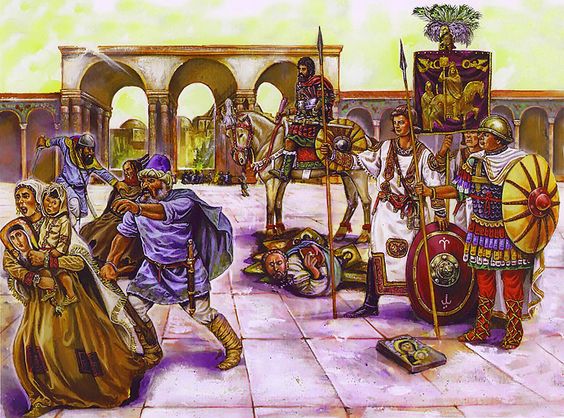
Byzantine Alternate History Chapter III- Justinian the Great Joins his Campaigns

Around the World in the Byzantine Era Part I (300-1000AD)

12 Turning Points in Byzantine History

A Guide to the Themes of the Byzantine Empire

Lesser Known and Would be Byzantine Emperors (695-1453)


The Leading Characters: 

Irene Sarantapechaina “Irene of Athens”- Byzantine empress 

Charlemagne “Charles I the Great”- Frankish emperor

Nikephoros the Logothete- Finance Minister of the Byzantine Empire under Irene

Nikephoros Caesar- Imperial usurper, brother-in-law of Irene

Tarasios- Iconophile Patriarch of Constantinople

Staurakios- Byzantine eunuch official and general of Irene

Aetios- Byzantine eunuch official of Irene

Leo IV “the Khazar”- Byzantine emperor (775-780), first husband of Irene

Constantine VI- Byzantine emperor (780-797), son of Leo IV and Irene

Theophano Sarantapechaina- Irene’s cousin

Anthousa- Twin sister of Leo IV, sister-in-law of Irene  

Christopher Caesar- Imperial usurper, brother-in-law of Irene

Leo the Armenian- Iconoclast Byzantine general

Bardanes Tourkos- Byzantine general, Irene loyalist

Louis I the Fair- Son and successor of Charlemagne

Krum- Khan of the Bulgars since 803

Harun al-Rashid- Caliph of the Abbasid Caliphate

Background Guide: Byzantine characters (blue), Franks (gold), Bulgars (red), Abbasid Arabs (green). 


The Background Part I- The Isaurian Dynasty and Empress Irene’s Origins        

2f1c608066438c072614c5033855489c

It is the year 800AD, and the Byzantine Empire at the turn of the 9th century was stronger than it was at the turn of the previous century. Here, the Byzantines had already taken back basically all of Greece from the Slavic tribes that had raided and settled it for the past 2 centuries, while in the east imperial territory stretched as far as Armenia as a lot of lands were taken back from the expanding Arab Caliphate which had been the empire’s traditional enemy for already almost 2 centuries, though in the west Byzantine control of Italy has been reduced to only the south as well as to the islands of Sicily and Sardinia as almost all of Italy fell under the control of the Lombards and the northern part of it to the Frankish Kingdom. Ruling the Byzantine Empire in 800 was a woman, Empress Irene Sarantapechaina of Athens who at the age of 48 was still stunningly beautiful with long and thick dark hair, green eyes, and a voluptuous figure. Irene however despite ruling the empire alone was not from the ruling Isaurian Dynasty that had ruled the empire since 717 when Emperor Leo III the Isaurian (r. 717-741) came to power, rather Irene was a girl from Athens from the noble family of Sarantapechos who back in 769 married Leo III’s grandson Leo IV who would later be crowned as emperor in 775 following the death of his father Emperor Constantine V (r. 741-775), the son of Leo III. Following Leo IV’s death in 775 after only 5 years as emperor, Irene came to power as regent for their young son Constantine VI (r. 780-797) who in 797 after being in conflict with her was deposed and blinded by his own mother Irene. After blinding her son who although survived it, Irene in this story’s case did not feel much guilt but now 3 years after it, she has become haunted with the guilt of blinding her son.

158292489_2535265706768034_7072517079031082445_o
Empress Irene of Athens

As the sole empress though, Irene did not choose to reign with the title of Basileus or Greek for “emperor”, but rather in respect for her gender, she still ruled with the title of Basilissa or “empress” in Greek, and in the coins minted with her name and image, she appeared alone but still using the title “Basilissa” which she also used when signing documents. Just a year earlier (799), Irene fell fatally ill that her doctors believed she was already close to death, but luckily she recovered and now in 800 having fully recovered, at the Boukoleon Palace along the shore of the Marmara Sea at the imperial palace complex of Constantinople, she was going to meet with her newly appointed finance minister or Logothete Nikephoros, a man Irene put great trust into as he was first of all an Iconophile (or Iconodule), a believer of icons the way she was, and he had a brilliant mind in finance and military matters, which was something Irene was not so skilled in, and of course he was loyal as Irene valued loyalty from her officials above all else. Now Nikephoros was a man 2 years older than Irene born in 750 in Constantinople in this story’s case, as real history does not record his place of birth, but what is documented are his ethnic origins as the Syriac source Michael the Syrian (1126-1199) and Arab source Al-Tabari (839-923) say Nikephoros is of Arab-Ghassanid descent with his ancestors coming from the Ghassanid Kingdom, the old Byzantine client kingdom at the northern edge of the Arabian Desert which was destroyed by the First Islamic Arab power of the Rashidun Caliphate in 638 before the Arab-Byzantine wars still ongoing up to this time began. In this story’s case, Nikephoros certainly did have Arab blood as seen with his black curly hair and olive skin, and he was proud of this heritage, while at the same time a proud Byzantine and Orthodox Christian too, thus showing a good amount of ethnic diversity and inclusion in Byzantium. Here, barely knowing Irene, Nikephoros was already endlessly charming her by talking about his knowledge of the Arab world and his Arab heritage that here- for this story’s case only- he introduced to Irene an odd drink that the Arabs already had knowledge of at this time, which was coffee, though not the kind of coffee we mostly know of today, but a thick and bitter muddy drink which seemed to be addicting giving someone a great amount of energy when drinking it.

a-woman-is-pouring-turkish-coffee-in-to-a-vintage-turkish-coffee-cup-600103930-5825fe325f9b58d5b129c1a3
Arabian coffee

Of course, the Byzantines in their time surely had no idea of coffee even if the Arabs in the 9th century had already been cultivating the bean and drank its liquid and true enough, coffee beans had already been cultivated in Yemen since the 6th century, and Nikephoros here being a descendant of the Ghassanid Arabs traces his origins back to Yemen in which that area was known to the Romans as Arabia Felix, the lesser known fertile southern part of the otherwise desert Arabian Peninsula; and doing this, in this story’s case, he was able to get his hands on this bean and the recipe of how to make it a drink too. When getting a taste of the drink, Irene found the taste and texture odd, but Nikephoros was quite used to it and as they drank it, Nikephoros told Irene a local legend from the Arab traders he acquired the coffee beans from knew of, which was that some time ago, a goatherd in Ethiopia (in Africa) discovered the properties of the coffee bean after seeing his goats act all excited when eating the cherries from a bush wherein the beans were found in, and true enough even the goatherd felt the same way when tasting the bean. Nikephoros though did not fully believe this story the same way it is mostly seen as a legend because coffee beans had certainly already been cultivated in Yemen since the 6th century, which is the side of the story we will stick to here, though on the other hand it was here at the beginning of the 9th century when coffee cultivation became a major thing in the area of Ethiopia and Yemen right across it from the Red Sea, and in this story’s case just too add an interesting element, the Byzantines had already gotten their hands on it from Arab traders. Now that Nikephoros told his rather trivial story, it was time Irene told hers which was also the story of the Isaurian Dynasty she married into.          

kaldi-adapted-from-uker
9th century legend of the discovery of the coffee bean by the Ethiopian goatherd
arabia-felix-ptolemy-e1267837858140
Location of Arabia Felix
PALAIS_DE_BOUKOLEON_5
Boukoleon Palace, seaside palace of Constantinople

The story of the Isaurian Dynasty that ruled Byzantium began in 717 when a Syrian general of low birth named Konon who was Irene’s grandfather-in-law took over the Byzantine throne in a period of anarchy that had seen 6 different emperors in only 22 years (695-717). When coming into power, Konon became Emperor Leo III and swore to end the anarchy period that could have brought the end of the Byzantine Empire and true enough, after successfully defending Constantinople with the help of the Bulgars in the north against the siege of the Arab Umayyad Caliphate in 718, Leo III brought order and stability to the severely weakened Byzantine Empire.

ad67227d1b4898107eac8d4ddd1f7927
Emperor Leo III the Isaurian, aka Konon (r. 717-741), founder of the Isaurian Dynasty

In his 24-year-reign, Leo III restored much of the lands in the east that the Byzantines lost to the expanding Arabs, reformed the law, and reorganized the political-military structure of the empire known as the Thematic System which was long story short, basically how the military ran the empire’s provinces as a defense system, but despite his successes Leo III would be controversial for something that damaged the empire a lot internally which was his ban on religious icons first acted on in 726 and made legal in 730. This ban on icons or Iconoclasm soon enough became popular with half the empire’s population especially the army wherein most came from eastern provinces in Asia Minor where their beliefs had been inspired by that of the Muslims and Jews who believed worshiping God or saints through painted images was sinful as it was equivalent to idolatry, and Leo III as a superstitious person blamed all the empire’s setbacks on his people’s excessive use of icons. Half the empire’s population meanwhile especially those from western provinces like Thrace or Greece where Irene’s family came from, or Italy saw the use of icons as a sacred tradition, and hearing that the imperial government as well as the Church of Constantinople put a ban on it deeply outraged them that the people of Italy being encouraged by the pope or the Patriarch of Rome rebelled against their Byzantine imperial authorities that the Venetian lagoon in the northeast coast of Italy declared their independence from Byzantium in 730 forming the Republic of Venice, though still being loyal allies to the Byzantines in business matters.

Clasm_Chludov
Byzantine Iconoclasm under Leo III from the 9th century Chludov Psalter

Leo III having successfully driven away the Umayyad Arab armies from Asia Minor fully came to believe that the ban on icons was necessary and helped the empire a lot and in 741 he died peacefully passing the empire to his son Constantine V better known as Konstantinos Kopronymos or the “Constantine the Shit-Named” as the Iconodules or believers of icons branded him as that for being their worst enemy as an Iconoclast extremist and to simply put it the “Icon of Iconoclasm”, although this nickname also comes from a rumor about him defecating on the baptismal water as a baby during his baptism. Though inheriting the imperial throne from his father, just a year after (742), Constantine V was challenged by his brother-in-law Artavasdos who being married to Constantine’s older sister Anna felt betrayed as Leo III back in 717 promised him the throne in return for helping Leo come to power as his friend and partner, and as Constantine campaigned against the Arabs in Asia Minor, Artavasdos deserted him in battle and proclaimed himself emperor using the restoration of icons as his motive for usurping power and as emperor, he did indeed have the icons that had been outlawed restored but only a year later in 743, his forces were defeated by Constantine V’s in the civil war between them. Losing the war, Artavasdos was blinded by Constantine V as being blind prevented someone from taking the throne, and he was then sent to a monastery to die 2 years later from the injuries caused by his blinding, while Constantine V took back the throne seeing Artavasdos’ rebellion as a sign to make a stronger stance against the use of icons.

Screen Shot 2021-10-11 at 10.13.22 PM
Emperor Constantine V of Byzantium (r. 741-742/ 743-775), art by Byzantine Tales

Constantine V true enough became even more of an Iconoclast extremist than his father that when issuing a ban on religious icons, he also launched a full-scale persecution on people who owned them or restored them, and as part of his anti-icon policies, countless of monks, nuns, and icon painters were either tortured, blinded, exiled, or even executed and regardless of class or age, everyone who went against the emperor’s anti-icon policies were punished. Now Irene was born in 752 in Athens which was part of the Byzantine Theme or military controlled province of Hellas as Constantine V was emperor, and the family she came from which was the Sarantapechos clan was a rich family of great influence in Byzantine Greece. Athens meanwhile which was Irene’s home city according to the English historian John Julius Norwich (1929-2018) in his book Byzantium: The Early Centuries (1988), in Irene’s time “was no longer the center of the intellectual world as it was in the Ancient days but a pious little provincial town wherein the famous temple of the Parthenon even became a church”, though the people of Athens were said to be strong supporters of religious icons when it was banned, and Irene and her family was no exception.

panagia-atheniotissa
Athens in the Byzantine era

The Sarantapechos family wherein Irene came from however was an obscure family though a wealthy one, and despite being loyal to the reigning emperor Constantine V, they were strong believers in icons, however Irene’s childhood and upbringing in Athens is unclear, but according to Justinianus when creating this story, Irene grew up wealthy and privileged receiving the best education from Greek teachers especially in history, philosophy, poetry, and the arts. Irene too was said to be an orphan but it is unclear when and how her parents died, but in this story’s case, let’s say they died when she was only 10 in 762 when both were on ship which sank during a storm in the Aegean Sea, though it was never discovered by Constantine V that Irene’s parents were Iconophiles, otherwise he would have executed them seeing it as treason. For this story according to Justinianus, Irene was a strong Iconophile growing up especially after her parents died as a way to honor their memory, but the one thing she longed for was an opportunity to get out of her conservative and sleepy Athens and go to Constantinople to make a name for herself. Now back to Constantine V, in 750 his wife Tzitzak an Oriental beauty who came from the Khazar state or Khazaria in today’s Southern Russia gave birth to twins which was first their son Leo named after Constantine’s father Leo III and their daughter Anthousa, although it is unclear if she was really Leo’s twin or the twin of one of Constantine V’s other sons with his next wife Eudokia, but for this story Anthousa would be Leo’s twin. In 750 however, Tzitzak would die shortly after giving birth to her twins, and a year later Constantine would marry Eudokia, a local Byzantine Greek.

Seventh Ecumenical Council
Church Council of Hieria in 754, headed by Emperor Constantine V and Empress Eudokia (left)

In 754 meanwhile at the Council of Hieria, Iconoclasm became fully legal in the empire in the eyes of the Church too, while churches and monasteries were to be legally raided to confiscate icons, but also to confiscate their hidden wealth which was to pay for the army and true enough, all the raids on churches and monasteries grew the army to a more powerful force. Another thing Constantine V would be known for was the breaking down of a number of Themes in Asia Minor such as the notorious Opsikion Theme in half as a way to weaken the power of the Theme’s military governor or Strategos to prevent rebellions, and part of this act was creating the Optimatoi Theme out of the Opsikion Theme, and this new Theme located right across the Bosporus Sea from Constantinople based in the city of Nicomedia was the Theme assigned to the new elite imperial army Constantine V created which was the Tagmata, the emperor’s personal guard that was to be absolutely loyal to the reigning emperor.

de24a26129c5916a23213aa0b73b4391
Byzantine Tagmata soldier, elite imperial force created under Constantine V

In the east, Constantine V taking advantage of the Arab Umayyad Caliphate falling into civil war raided deep into enemy territory retaking a large amount of land all the way up to Syria which the Byzantines had lost to the Arabs in the past century. When being able to take back some of Syria, Constantine V relocated its Christian population to Thrace as a way to make the border of the Arab and Byzantine worlds which was the Taurus Mountains a no-man’s land without anyone living there to farm it so that invading Arabs would not want to pass there to invade as they would starve to death without any food supply present there. For his many victories and giving away free food to the population of Constantinople, Constantine V was extremely popular despite his vile treatment to those who opposed him and supported icons, and by being extremely popular especially with the mostly Iconoclast army, he was seen as their hero and true savior that they would die in battle for him, but no matter how popular and well-loved he was, Constantine V too suffered from epilepsy.

67fe21e0a668bfea87958f0babc03045
Flag of the Abbasid Caliphate, founded in 750

As for the events around the world, things would be in favor for the Byzantines in the east as in 750 the Arab Umayyad Caliphate based in Damascus had dissolved as it was overthrown by the new Arab Muslim power of the Abbasid Caliphate which needed some time to consolidate its rule, therefore they would not yet pose a threat to Byzantium, and with their capital now in Baghdad they would not be so much of a threat to the Byzantines too as they were farther away than Damascus, the previous Umayyad Caliphate’s capital. In Italy on the other hand, things would be worse for the Byzantines as in 751 their capital there which was Ravenna fell to the Lombards when its last Exarch or semi-autonomous governor Eutychius surrendered it to them being unable to hold it any longer as the imperial authorities in Constantinople neglected Italy too, thus the Byzantines were only left with Southern Italy, Sicily, and Sardinia which would become Themes too (except for Sardinia).

e6756ef574d3de71a95589ffbaf4e630--renaissance-costume-ravenna
Fall of the Byzantine Exarchate of Ravenna in 751, Exarch Eutychius surrenders Ravenna to the Lombards

Now as the threat of the Arabs died down in the east, the new state of the Bulgarian Khanate in the north which had been there since 681 though not yet a massive empire would be the new major threat to Byzantium as after Constantine fortified the northern border with the Bulgars, the Bulgars saw this as a reason to declare war on the Byzantines which they did in 755 and from here on, Constantine V would fight a constant war with them as luckily he did not have to focus on the east anymore with the Arabs no longer a big threat. In 756 Constantine V won a major victory against the Bulgars though was defeated by them in 759, but in 763 after the Bulgars raided Byzantine territory, Constantine V crushed the invading Bulgars at the Battle of Anchialus along the Black Sea coast, and as a result of the defeats, the Bulgarians would be plunged into anarchy with a change of ruler 5 times from 763 to 768.

2cd781f53145098fe6f3136a1fa5a988
Bulgar army, 8th century

Now as Constantine V was busy at war against the Bulgars in the north, it was in 769 when he chose Irene to be the wife of his son Leo, and it was very ironic as Constantine V was in fact the “Icon of Iconoclasm” and Irene was a strong Iconophile, but Constantine did not know it. The reason now to why Leo or even his father chose Irene is a mystery but the most accepted one is that she at the age of 17 was that even if the empire had a lot of beautiful young women for the imperial heir to choose, she was an exceptional beauty and also because Constantine V knew the Sarantapechos family of Athens well, and Irene herself had already proven to be a smart and capable person. Here in 769 with both her parents dead, in this story’s case, Irene would be raised by her uncle which was her father’s younger brother the general Constantine Sarantapechos, who would later on be the Strategos of the Hellas Theme. By this point, Constantine V with his wife Eudokia also had 5 sons together in which the eldest one Nikephoros born in 755 would later be made a Caesar (Kaisar in Greek) in title together with his younger brother Christopher, while the next 3 sons Niketas, Eudokimos, and Anthimos would only receive the title of Nobelissimos.             

06-11-20at-202.43.01-20pm
Byzantine Asia Minor’s Themes by 750, under Emperor Constantine V
48-manasses-chronicle
Constantine V’s Iconoclasm from the Manases Chronicle
67af8478f814bad9de4ae2e4c38f64b1
Iconoclasm- breaking of religious icons and persecution of monks in the Byzantine Empire under Constantine V (743-775)
cd151bb91140ab3ff849162fbf7c0643
Map of the new Arab Abbasid Caliphate (black), formed in 750 replacing the Umayyad Caliphate

Watch this to learn more about Constantine V and his reign (Eastern Roman History).

Back in 800, Irene and Nikephoros continued drinking their coffee while overlooking the Marmara Sea from the Boukoleon Palace, and when looking at the sea and the steps leading up to the palace from the shore, Irene recalled the moment she first stepped there in 769 when she was chosen to marry Constantine’s son the imperial prince Leo and here, she continued telling her background story. On November 1 of 769, the 17-year-old Irene saw the great metropolis of Constantinople for the first time in her life as the ship she boarded from Athens arrived at the dock of this exact Boukoleon Palace greeted by a large number of people and afterwards escorted by soldiers of Constantine V’s elite Tagmata force to the Great Palace Complex (or Imperial Palace Complex) itself and along the way, people all cheered for her for some reason, which was most likely because she was to be the future empress. Irene back then coming straight out of the sleepy and slow city of Athens was shocked with the amount of energy in Constantinople’s streets, but most significantly feeling so important that she had to be escorted by palace guards, greeted by so many people of the high ranks of society, and was cheered by so much people as if she were a big star as back in Athens, no one really noticed her in the streets despite coming from the city’s influential family.

489px-Constantinople_imperial_district_tr
Map of Constantinople’s Imperial Palace Complex

On the other hand, she was also shocked but in awe with all the landmarks she saw in Constantinople such as the Boukoleon Palace built right next to the sea, the Hippodrome, Great Palace, the Hagia Sophia and its dome, and all the dining halls, bedrooms, and baths all decorated with such extravagance. Irene’s first stop in the Great Palace was her designated room in the women’s section which even had its own bath and personal assistants assigned to her. As the day ended, Irene was invited to a feast at the main dining hall of the palace wherein she would meet the emperor Constantine V himself who Irene remembers as someone at the age of 51 who was quite overweight with messy hair and a messy beard, and there she would also meet his 19-year-old son Leo who was to be her husband, who was short and round in appearance and since he was half-Khazar with his late mother being a Khazar, Leo had strong Oriental features including small and slanted gray eyes, though also having curly brown hair, a round face, and big ears. Being Khazar in his mother’s side, he was known as “Leo the Khazar” also because of his features, though his most recognizable quality was his easy going and nice personality unlike his father who was usually unstable, violent, and quick to anger. Now as Justinianus for this story says, why Leo fell for Irene who was his father’s choice for her out of all young women in the empire was because of her beauty and when meeting her for the first time, Leo was impressed not only with her looks and height wherein she seemed quite tall, but with her quick thinking and confidence that she was not shy to speak to him and his father. The day after she arrived in Constantinople, Irene’s 6 weeks of learning court etiquette began, and usually it would not be this long but in this story’s case as Constantine V noticed Irene’s rather fresh and outspoken attitude whereas women in this conservative society were supposed to be reserved and proper, her time to be taught the right way in court etiquette and protocols had to be extended before she was to marry Leo. Now from something I recently just learned when commenting on a post on Instagram asking about women’s fashion in the Byzantine era, I just found out with all the influences from the Arab world and the movement of Iconoclasm becoming a major factor that impacted the empire, women in Byzantium increasingly became more conservative in behavior and fashion, and in this story’s case Irene was someone who did not want to play along with the conservative ways of the Byzantine court.

ladies-of-the-imperial-court-of-the-6th-century
Byzantine female court fashion

Of course in order to be the future empress, Irene had to go through this 6 weeks of training in the proper behavior of an empress, and as the History of Byzantium Podcast host Robin Pierson had said, this would be an endless of process for Irene in learning the proper behavior of the Byzantine imperial court, and part of her training would be on how to talk to people of high status, how to behave in church, how to greet the people and senators, how to respond to foreign ambassadors, and also on how to sit properly when eating, and how to use a fork which was a symbol showing how sophisticated the Byzantines were when it came to dining as other people especially in the western lands did not use a fork. In this 6-week period, the one person Irene would become close to in this story’s case was the eunuch Staurakios who came from a prominent family and was making a name for himself as a eunuch in the imperial court, and in this story’s case only, he would be the palace’s chef who was very skilled at cooking lavish dishes for the imperial court but at the same time, he was also a master at managing state affairs and the army in which he taught some of that to Irene- except for cooking dishes- in these 6 weeks. Another thing Irene vividly remembered about this period of training was when she was taught to dress the proper way in imperial style as the court officials and court women that trained her noticed the informal style of the lose clothes she dressed in coming from Athens wherein they dressed like that, and in so little time 2 dresses were prepared for her which was first her wedding dress for the wedding ceremony and the gold dress for her coronation.

e0c21af956dfe3f4792850d5881f725a
Ancient Roman/ Byzantine female underwear (evidence from a 4th century mosaic in Sicily)

Irene also remembered that here in this 6-week period as she was in the baths of the palace, she was taught how to wear the imperial dresses by the court ladies where these court ladies had asked her to take off her robe to be examined if her body was healthy, as the wife of the imperial heir had to be healthy in order to give birth to a healthy heir, and true enough Irene was in good health here, though her soon-to-be husband Leo was not. Here too in the baths when dressing down to what was her underwear- a piece of cloth wrapped around the bust and the waist- her body was to be measured for the 2 dresses for the upcoming ceremonies. For Irene, this moment was rather awkward as she had to experience some women she doesn’t know see her practically naked except for her underwear, and even more that these women were to take the measurements of her bust, waist, and hips while she was barely clothed. The women measuring her here would go as far as to touching her breasts and stomach while she was again only wearing her underwear, to see if her body was in perfect shape basically because even the court ladies were attracted to her looks, perfect shape of body, and height. When this 6-week period of preparations ended on December 17 of 769, Irene came out as a fully grown and proper imperial woman at only 17 dressed in the golden coronation dress, which was a tight long-sleeved golden dress that covered almost the entire body, and when fully dressed up she met her husband-to-be Leo IV at the Hagia Sophia where Leo already being made years earlier by his father as his co-emperor placed a golden outer robe on Irene’s shoulders, and afterwards placed a crown on her head, thus Irene was now crowned as a co-empress, or at least an imperial princess and the 4th most powerful person in the imperial authority (first being the emperor Constantine V, then his wife Eudokia, then the co-emperor Leo, and lastly Irene). Now in Byzantine coronation tradition, the Patriarch of Constantinople was to crown the emperor symbolizing that the emperor got his authority from God, but the empress was not crowned by the patriarch but rather by the emperor showing she got her power from her husband, the emperor. Following the coronation, Leo presented Irene dressed in her golden dress and crown to the people of Constantinople from a balcony of the imperial palace. Leo then proceeded to the Church of the Virgin of the Pharos in the Imperial Palace Complex while Irene returned to her dressing room to change into her wedding gown, another conservative dress that covered almost her entire body, and then met up with Leo at the Pharos church where the Iconoclast Patriarch of Constantinople married them, and in attendance was Leo’s entire family including his father the emperor and the senate. At the end of the day, Irene was both crowned and married and with both ceremonies over, she and Leo changed back into more comfortable but still formal outfits for the banquet given to them by the emperor that night. The entire ceremony process would then end only 3 days later on December 20 with a bath ceremony held for Irene, except no one would see her bathe, instead as the palace officials and guards led her to her baths which was already prepared with the tub filled and towels and robes for her hanging, they left her alone to undress, fall into the tub, and take her time. Though now being married, Irene and Leo did not share the bedroom at all times but rather, Leo would frequently visit Irene in her bedchamber and in 770, Irene would be pregnant at 18 but everyone speculated if it would be a boy and true enough in January of 771, Irene gave birth to a healthy boy at the purple room of the imperial palace or Porphyria, a dark room with walls made of purple marble or porphyry and draped with purple silks. This now was another Byzantine imperial tradition as only the imperial wife or the wife of the imperial heir could give birth here as a way to secure the succession of their children to secure legitimacy as no one else but the imperial family had access to this room, and in 771 Irene and Leo’s son Constantine named after his grandfather the emperor was the second one to be born here in the purple room, the first being Leo himself as well as his twin sister Anthousa in 750. With the birth of Constantine who was to be emperor one day, his grandfather the emperor who he was named after threw lavish celebrations including chariot races in the Hippodrome and the free distribution of the purple sherbet drink Lochozema to the people of the capital and after these celebrations, the baby Constantine dressed in a golden robe was presented to the people. With the celebrations over, the Patriarch of Constantinople baptized the baby Constantine, except unlike his grandfather back in 718, he did not defecate on the water though the emperor Constantine V who was right there in that exact same spot many years later still remembered that embarrassing moment, at least from what he heard of. It was also here in her son’s baptism when Irene got herself acquainted with her in-laws such as the empress or Augusta Eudokia who was at least friendly with her in this story’s case, her sister-in-law Anthousa who was Leo’s twin wherein both her Irene would soon develop a strong bond as Anthousa also secretly supported the icons, and lastly Irene would meet the emperor’s much older sister Anna, who being 10 years older than Constantine V was still alive at 63, except she appeared to be cold and bitter as her brother blinded her husband Artavasdos and her sons with him leading to their deaths even if it was already almost 30 years ago when it happened, but where Irene and Anna would later find common ground was in their support for icons as Anna way back then- in this story’s case- led a resistance to restore the icons which failed when her brother took back the throne in 743 which also removed Anna as empress. 2 years later though (773)- in this story’s case as history does not record it- Anna would die and Constantine V too would not have much longer to live.          

maxresdefault
Diagram of Byzantine Constantinople’s Imperial Palace Complex with the Hagia Sophia and Hippodrome
1-a-ahagiasophia-1
Interior of the Hagia Sophia

Back in 800, the conversation between Irene and Nikephoros was already lasting until night and before they could call it a day, Irene proceeded to talk about her life as Leo IV’s Augusta or empress. Back in 768, a year before Irene came to Constantinople, the Bulgarians in the north got a new ruler or Khan which was Telerig and years later in 775, he successfully made Constantine V who was still alive reveal the names of his agents in Bulgaria and when finding about their identities, Telerig had them all executed which made Constantine V even more angry that he decided to again make preparations for another campaign against the Bulgars to the north.

1fc5b077dea784339ed91227bf32a550
Church of the Holy Apostles, Constantinople, burial site of the Byzantine emperors

Before he could march on Bulgaria though, Constantine V while away from Constantinople in Thrace fell ill with a fever and on September 14 of 775, he died at 57, afterwards buried at the Church of the Holy Apostles in Constantinople, the burial site of all the emperors since the empire’s founder Constantine I the Great (r. 306-337). Following the death of Constantine V, his son Leo IV immediately succeeded to throne without any difficulty as he was already made his father’s co-emperor since he was only a year old in 751, and Irene already being married to him immediately became the empress without any coronation ceremony as she was already crowned at the day of her wedding in 769. In 775 however, Leo IV at only 25 was already obviously in bad health suffering from tuberculosis and his condition disabled him from being a strong ruler in making critical decisions, therefore it was up to his 23-year-old wife Irene who was more able in body and mind to do them for him, and one of Leo IV’s first acts done under Irene’s influence- in this story’s case- was to banish all of Leo’s 5 half-brothers as well as their mother Empress Eudokia in 776 as Irene saw them all as a potential threat.

leo_iv_the_khazar_by_androklos_dc54xkw-fullview
Emperor Leo IV the Khazar (r. 775-780), first husband of Irene, art by Androklos

This incident that led to the banishing of Leo’s 5 half-brothers happened when Leo in 776 held a ceremony in the palace wherein he announced to his generals and palace officials that he was sick and did not have long enough to live, and so here he proclaimed his 5-year-old son Constantine as his co-emperor, but the half-brothers were enraged and seeing Leo’s illness as a sign that one of them should soon enough take over the throne, the most ambitious of the 5 being the eldest one Nikephoros Caesar as well as the second brother Christopher the other Caesar hatched a plot to get one of them to succeed Leo. Leo shortly after discovered their plot but with his kindheartedness and relaxed personality, he instead chose to spare his 5 half-brothers and just banish them from the palace and strip off their titles forcing them live in the outskirts of Constantinople, though the conspirators from the palace staff that helped in their plot were banished to the cold and remote Byzantine colony of Cherson in what is now the Crimea (Ukraine), north of the Black Sea. Irene however thought of punishing her brothers-in-law more severely but since they were only teenagers without much ability in running an empire, she chose to go with her husband’s decision, but deep inside Irene really wanted to act on them with force as she felt constantly annoyed with how they treated her, which was that in this story’s case, these brothers being quite unruly and unsophisticated lusted after Irene’s beauty and always attempted to seduce her, but she being smarter than them always avoided them at all times and when banishing them far away, she could get rid of them for good; and with the half-brothers only banished from the palace, this would only be their first attempted coup in taking the throne.

Icones_imperatorvm_romanorvm,_ex_priscis_numismatibus_ad_viuum_delineatae,_and_breui_narratione_historicâ_(1645)_(14560071889)
Emperor Leo IV (left) with his son and co-emperor Constantine VI (right)

Now Leo IV on the other hand being close to his Iconoclast extremist father was also raised to be an Iconoclast, although he was not an extremist as his marriage to Irene in this story’s case somewhat changed his worldview and although he did not believe in the use of icons, he at least tolerated it that his people believed in them as at the end it was only in the army where the hardline Iconoclasts lay and it was only mostly women, monks, and nuns that were strongly for the use of icons, while most of the population again according to History of Byzantium podcast did not really care if icons were legal or not. In his reign, Leo IV undid most of his grandfather’s and father’s extreme Iconoclast policies though not fully getting rid of Iconoclasm, instead only making it more moderate that he put an end to his father’s persecutions of Iconodules, though like his father he sometimes had some Iconodule members in the imperial court fired or whipped only if they publicly showed icon veneration, but on the other hand he no longer continued having soldiers raid monasteries, arrest monks, and confiscate icons like his father did, and instead he returned the monks his father banished back to their monasteries, thus the dystopian era of Iconoclasm was slowly dying down. Leo IV though did not really care about the whole point on breaking icons as he soon saw it was useless and only dividing the empire’s people, and with his failing health too he was more worried about it, and falling for Irene’s beauty here in this story, he listened to her on her opinions on how to deal with the issue on the icons. On the other hand, Leo and Irene would not have any more children aside from Constantine as Leo’s health condition made it hard for him to be with Irene often, as she too did not want to be around too much with a sick husband who was constantly coughing.

original_168
Khan Kardam of the Bulgars (r. 777-803)

When it came to ruling the empire though, there was not much significance in Leo IV’s reign except with one incident in 777 when the Bulgarian khan Telerig was ousted from the throne by the new khan Kardam making Telerig flee to Constantinople where Leo welcomed him, gave him the rank of patrician, and had him baptized as a Christian as here the Bulgars were still Pagan, though Telerig died later that year; and in 778 Leo despite his bad health decided to launch a campaign against the Abbasid Arabs in Syria as fighting a war was part of his bucket list before his death. The invasion Leo launched in 778 was a large one consisting of the armies of the Anatolic, Armeniac, Opsikion, Bucellarian, and Thracesian Themes all led by their own generals or Strategoi (singular: Strategos) and at the end, this campaign was successful in killing a large number of Arabs, winning a number of victories, taking back a large amount of spoils of war, and relocating a number of Syrian Christians to Thrace just as Constantine V did before, and the emperor at least got the honor of leading his men in battle.

Screen Shot 2021-10-11 at 10.26.46 PM
Emperor Leo IV the Khazar of Byzantium (r. 775-780), art by Byzantine Tales

Later in 778, a triumphal procession in Constantinople was held for Leo IV and all the 5 generals who survived where all the spoils of war and Arab captives were paraded, though in the next year (779) the Abbasids struck back invading Eastern Asia Minor but Leo’s army again successfully won repelling the invasion. In 780, Leo IV decided to this time launch a campaign on Bulgaria against its new ruler Kardam but before he could even start, his health grew worse that in this story’s case Irene persuaded him to give up on it and rest, and on September 8 of that year, Leo IV the Khazar died at only 30 from an extreme fever caused by his tuberculosis being the last effective ruler of his dynasty, the Isaurian Dynasty as his son Constantine VI at only 9 succeeded to the throne with his mother Irene as his full-time regent in which she will be for most of Constantine VI’s reign. Leo IV may have ruled for too short, but despite only 5 years of ruling, he was an able ruler considering that he suffered from chronic tuberculosis, although Leo IV’s reign is often called the epilogue to that of his father Constantine V’s long reign. Irene ends her story here in 780 when she came to power already as the effective empress-regent for her son, and here back to the setting in 800 she called it a day saying goodbye to the Logothete Nikephoros as Nikephoros returned to his house and Irene would return to her bedchamber which was not the empress’ room but the emperor’s as with no male emperor currently reigning, she was free to occupy it.

0032
Cataphract cavalry, elite army of the Byzantine Themes
rJPQCqYAGAChYO814OmdPQ_b
Byzantine Cataphracts battle Arabs in Asia Minor

Watch this to learn more about Leo IV’s reign (Eastern Roman History).


The Background Part II- Irene as the Empress-Regent          

2f1c608066438c072614c5033855489c

In the year 800, a few days after Irene’s meeting with the new finance minister or Logothete Nikephoros at the Boukoleon Palace, Irene in a gold and purple imperial robe headed to the polo field of the Great Palace where she saw her advisor, the eunuch Aetios playing a game of Tzykanion or Polo, who after seeing Irene stopped and rushed to her reporting about his rival eunuch Staurakios, Irene’s most trusted person before, and here Aetios brought some sad news though happy for him which was that some weeks earlier on June 3 of that year, Staurakios had died from sickness in Cappadocia when raising an army to rebel against Irene and take over the throne despite being a eunuch, although Staurakios seeing that Irene took the throne even if she was a woman thought he could too even as a eunuch.

unnamed
Byzantine eunuchs

Irene as the empress put most of her trust into the eunuchs as they were the people she was most acquainted with ever since she arrived in Constantinople back in 769, and eunuchs too being males without reproductive organs were the only men allowed into the women’s quarters as they could not do anything to a woman, and though they had no ability to become emperor, they still had the power to influence one. However when Irene fell ill in 799, both eunuchs being the younger one Aetios’ and older one Staurakios’ rivalry intensified, and the reason for their rivalry was that the old-timer Staurakios felt threatened by the growing influence of the younger Aetios, but the rivalry had also something to do with the succession as Irene with her husband having died years ago and her son blinded and sent to a monastery being unable to rule again had no heir, and she too did not want to remarry or adopt a son as she could also see them as a rival to her power, so without a named successor both eunuchs plotted to make each of their male relatives the next emperor, but neither of their plans succeeded. After Irene recovered a year earlier, she summoned both Aetios and Staurakios to a council to hear both sides of the story and at the end, she just dismissed Staurakios at least with an apology except doing nothing severe to him but only decreasing his power, but feeling insulted Staurakios headed over to Cappadocia to raise an army with the support of the Anatolic Theme’s Strategos which was the empire’s most powerful general against both Aetios and Irene but in June of this year (800), again after getting an illness that caused him to cough out blood, Staurakios died and his rebellion failed. Irene felt disappointed here as Staurakios was someone she put a lot of trust into and all of sudden after feeling cheated despite not being removed from his position, he rebelled, though to tell more about Staurakios, Irene here told Aetios the full story that Staurakios was indeed a loyal official, general, and chef who Irene knew ever since she got to Constantinople, and it was in 780 when she came to power as her son’s regent when the eunuch Staurakios also rose in influence.           

683a0c43ac93d5c77723d2489d9148fa
Tzykanion, Byzantine polo, art by Amelianvs

20 years earlier in 780, after Leo IV died, his son with Irene Constantine VI became emperor at only 9, therefore the task was left to Irene to rule as the effective ruler of the empire as Constantine VI was too young to make his own decisions, though following Leo IV’s death Irene came up with rumors that he died by putting on the crown of the former Byzantine emperor Maurice (r. 582-602) which gave him a curse causing him his death, as a way to explain why their emperor died too soon. Staurakios who in this story taught Irene the proper dining etiquette, introduced her to a number of cuisines including Byzantine, Arabic, Persian, and Frankish, turned Irene from a country girl to a sophisticated imperial woman, and helped secure her position as the empress-regent as a big percent of the army, mostly being the elite guard force or Tagmata opposed Irene as not only was she a woman but a supporter of the icons whereas most of the army were still extreme Iconoclasts undyingly loyal to the late Constantine V.

84bce17c7510e4dd43b3a30798cbe94c--byzantine-army-medieval-armor
Byzantine Tagmata, imperial guard unit

The soldiers of the Tagmata refusing to answer to Irene and Constantine VI wanted a son of Constantine V on the throne, and the perfect choice was the Caesar Nikephoros, the most ambitious of Constantine V’s 5 sons with Eudokia that were banished from the palace 4 years earlier, and although Nikephoros was never really a strong Iconoclast, he did have some imperial ambitions and so here in 780 he was proclaimed emperor by the Tagmata army in honor of their hero Constantine V, although just a month after the plot was hatched, Irene discovered it and had the conspiracy leaders exiled and Nikephoros and his 4 younger brothers made priests as a way to prevent them from taking the throne as priests and monks were also unqualified to rule. To confirm to the people that Nikephoros Caesar and his 4 brothers were made into priests, Irene had them perform the communion service at the Christmas Day Mass of 780 at the Hagia Sophia, and here the 25-year-old Nikephoros who was tall and muscular in appearance with large and dark curly hair, pale skin, and a long nose looked the most humiliated being forced to give communion to the people at the Mass. In 781 then, Staurakios was appointed by Irene as the empire’s foreign minister or Logothetes tou Dromou as Irene trusted eunuchs above all as her ministers and generals, as the rest were still loyal to the late Constantine V and therefore strong Iconoclasts and as for Staurakios, the contemporary historian Theophanes the Confessor (758-817) would call him “the foremost man of his day and in charge of everything” as if Irene was the power behind Constantine VI, then Staurakios was the power behind her. It was also in 781 when the Frankish king Charles I, later known as Charlemagne who had ruled the Frankish Kingdom since 768 first came into the Byzantine scene when Irene considered making an alliance with him by marrying her son Constantine VI to Charlemagne’s 6-year-old daughter Rotrude, known as Erythro by the Byzantine Greeks and Irene herself even sent Byzantine scholars to the Frankish Kingdom to educate the young Rotrude in the Greek language and Byzantine customs. In 782 meanwhile, the war between the Byzantines and their eastern neighbor the Arab Abbasid Caliphate would resume when the caliph Al-Mahdi launched an invasion on Byzantine Asia Minor with an army of 100,000 men led by his son Harun al-Rashid as payback for their defeat to the Byzantines under Leo IV back in 778 and 779, and this totally shocked Irene but still acting strong, she had the armies of the Themes in Asia Minor counter-attack, except things only got worse when the Strategos of the Bucellarian Theme (located in Northwest Asia Minor) Tatzates defected to the Abbasids, thus the Byzantines despite having a strong army with the elite Cataphract cavalry was defeated, although Tatzates still suggested to Harun to make negotiations with the Byzantines. Imperial envoys from Constantinople including Staurakios would meet up with Harun in Asia Minor where they would be captured by Harun’s Arab forces while Harun only agreed to release them if Irene was to pay off the Abbasids a tribute of 70,000 gold dinars and 10,000 silk garments a year for the next 3 years, and not wanting any trouble Irene agreed to it. Irene however was deeply humiliated with her defeat to the Arabs, and so to make up for it in order to gain back her popularity, in the next year (783) she sent Staurakios to command an army to campaign in Greece against the Slavic tribes that had settled there for almost 2 centuries. Staurakios marched into Greece by land from Constantinople passing through Thrace heading east to Macedonia, then south to Thessaly, and finally to the Peloponnese in Southern Greece where at the end of the year he managed to take back a large amount of territory from the Slavs and in early 784 when returning to Constantinople, the victorious eunuch general Staurakios was awarded with a triumph. Now satisfied with reconquering most of Greece in 784, Irene returned to consolidating her rule and even though only the empress-regent for her son, she put her image on the right side of the coins even if that space was reserved for the emperor which was where her son was supposed to be, but instead Constantine VI was only put on the left, as Irene wanted to show that she was actually the one really wielding power, and now being the one wielding real power Irene at this time had made the achievement of creating a new army unit known as the Vigla which was a division of the Tagmata.

tar
Patriarch Tarasios of Constantinople, appointed by Irene in 784

Irene then would turn to the more serious issue of Iconoclasm and how to end it, as in her husband’s reign it had already been dying down and now running the empire, she wanted to achieve the legacy of ending Iconoclasm but it was such a challenge as most of the army was still for it, and the policy had been already in effect for more than 50 years and so for Irene, she would only have to wait for the right moment to put an end to it, and luckily in 784 too, the Iconoclast Patriarch of Constantinople Paul IV who Leo IV appointed in 780 had died. When selecting a new candidate for patriarch, Irene as usual when it came to appointing people loyal to her chose her loyal secretary and fellow Iconophile Tarasios as the new Patriarch of Constantinople who despite having no background as a priest and being rather oblivious at most times was a skilled scholar especially in philosophy and theology and after being ordained, he became patriarch and would work to restore icons. In 785, Irene wrote a letter to Pope Hadrian I in Rome signed both by her and her son Constantine VI which was to approve a council aimed to undo all the Iconoclast policies by Leo III and Constantine V before them and return to the old ways of venerating icons, and in return the pope approved of it if both mother and son were to follow his spiritual guidance.       

nReMkeR
Army of the Arab Abbasid Caliphate

Back in the present setting of 800, Irene after her discussion with Aetios in the polo field headed to one of the storage rooms in the palace alone where she saw an old coin of her with her son with her on the right side, as well as a coin of her late husband Leo IV with their son on the obverse and on the reverse were the images of Leo IV’s father Constantine V and grandfather Leo III who founded the dynasty and since this coin was minted in the Iconoclast period, no religious images such as of Christ were to be seen and instead images of the imperial family were put but with Iconoclasm over in Irene’s time, religious images returned to imperial coins.

22d342cd1e49abcc16347163d3cd4f98
Coin of Irene and Constantine VI with Irene on the right

Another thing Irene found in the storage room was a document signed in the council of 787 that restored the use of icons. Now back to 786, Irene together with Patriarch Tarasios made their first attempt to end Iconoclasm by holding a Church Council at the Church of the Holy Apostles in Constantinople, the burial site of the emperors but before the negotiations even started, the Iconoclast soldiers of the Tagmata force, most of them having served Constantine V were still at it and attacked the church by firing arrows at it in honor of the late Constantine V and being too distracted, Irene decided to not push through with it, and so the council was disbanded leaving the soldiers to lift their siege on the church. Irene however was still intent to hold a council and in order to do it safely, she decided to hold it in the next year in the city of Nicaea right across the Sea of Marmara from Constantinople and to keep the Iconoclast soldiers distracted in order to peacefully hold the council, she sent them to all corners of the empire to defend it including to the eastern border to fight off the Abbasids.

rila_councils_7_nicaea_ii_1_ab.300x0-is-pid7438
2nd Council of Nicaea in 787, Irene and Constantine VI leading it

On September 24 of 787, the Second Council of Nicaea was held with Irene together with Patriarch Tarasios and Emperor Constantine VI as well as 365 bishops and 136 priests and monks in attendance, and the council was made to discuss the restoration of religious icons held in the Hagia Sophia of Nicaea which was also its senate hall and was the same place where the first Byzantine emperor Constantine I held the First Church Council in 325 that set the official creed for Christianity. At the end, all agreed that icons were to be restored and legalized once again, coming up with the statement that Christ had been seen on earth as a human, therefore he can be pictured. The final meeting was then held back in the Magnaura or Great Hall of the imperial palace in Constantinople on October 13 of 787 where the declaration to restore icons was signed by both Irene and Constantine VI, although Irene as usual of her signed it first to assert her authority, but no matter who signed first, the period of Iconoclasm ended right here and from here on, icons were to be restored all across the empire, although Iconoclasm was still around with the soldiers still loyal to Constantine V still in their posts. It also happened that in 787 Constantine VI turned 16 and at that age, the emperor was already expected to rule alone but, in this case, Irene never trained him to be an emperor as she still wanted to continue ruling for him, as after she got a taste of power she never wanted to let go of it.         

Menologion_of_Basil_024
End of Iconoclasm at the 2nd Council of Nicaea, 787
10002044
Coin of Emperors Leo IV and Constantine VI (left) and of Leo III and Constantine V (right)
empress_irene_of_athens_by_ediacar_dcp80mx-fullview
Empress Irene restores icons, art by Ediacar

Irene back in 800 remembering holding the last meeting of the council at the Magnaura of the palace returned there to see it once again while it was not being used for the meantime, and when stepping foot there again she remembered another incident that happened there in 788 which was the first ever imperial bride-show in Byzantine history organized by Irene for her son Constantine VI wherein he was to choose his bride. Though before this bride-show, Constantine VI was still engaged to the King of the Franks Charlemagne’s daughter Rotrude except that here in 787 Irene feared that if her son married Rotrude then Charlemagne would attempt to claim the Byzantine throne so to avoid that possibility, Irene cancelled the engagement against her son’s wishes, though this only enraged Charlemagne using this as an excuse to invade and attack Byzantine territory in Southern Italy as well as the Istrian Peninsula (Northeast Italy) in 788.

179810174_1610196432512725_3206052732810284873_n copy 2
Emperor Constantine VI (r. 780-797), son of Irene and Leo IV

With the engagement broken off, Irene organized a bride-show in the Magnaura of the imperial palace wherein several daughters of noble families from across the empire were brought there and the imperial heir was to choose one of them to be his wife, instead here the teenage Constantine had no say and instead Irene chose the bride for him which was the pious and plain looking Maria of Amnia, a Greek from Central Asia Minor and the reason for this- in this story’s case- was that Irene wanted her son to still think she was the most beautiful person to him. Constantine VI however totally resented not being able to choose his wife, but he still married Maria out of respect for his mother but because of not being able to make his own choice even in choosing his wife, this is when the bitter conflict between Constantine VI and his mother would begin and from here on, Constantine would never want to follow his mother’s advice and would even distance himself from her. By 790 with Irene still never wanting to let go of power, Constantine VI at 19 came up with a plot and here betraying his cause of restoring icons as to gain a big support base, he sided with the still Iconoclasts in the army who hated Irene, and the aim of their conspiracy was to banish Irene to the still Byzantine-held Sicily and have all her ministers including Staurakios banished. Irene however learned about the plot before it came to full effect and to punish Constantine for plotting against her, his own mother, she put him under arrest in his room in the imperial palace and his conspirators either arrested and turned into monks. Some months later though, civil war was about to erupt between the forces loyal to Irene and those loyal to her son, and the majority of them from Asia Minor was loyal to Constantine VI proving they could defeat the forces of the European side of the empire loyal to Irene, and so here later in 790 the army of the Armeniac Theme rebelled proclaiming Constantine VI as the sole emperor and fearing the possibility of civil war, Irene released her son to please the troops loyal to him. Though when being released, Constantine VI was still against his mother and so to get back at her for putting him in room arrest, he in return had her placed under house arrest at the Palace of Eleutherius outside Constantinople which she had built, while a number of her ministers were banished to the far corners of the empire and Staurakios was at first whipped in public and then exiled to the Armeniac Theme. Constantine VI now was fully in charge of the empire and highly popular, except by having no proper training to run an empire from his mother and her officials, he proved to be weak in decision making, easily persuaded, could not think for himself, and the worst part was that he soon lost a lot of allies when he showed that he was not really a real Iconoclast and only used it as a way to gain support.

Harun-Rashid
Harun al-Rashid, Caliph of the Abbasid Caliphate (786-809)

In 791, the new Abbasid Caliph Harun al-Rashid who back in 782 attacked Byzantine Asia Minor, after coming to power over the Abbasid Caliphate in 786 launched another attack into Byzantine Asia Minor, and here the Abbasid Arabs won a victory over the Byzantine forces, thus Constantine VI’s incompetence in ruling the empire was exposed especially when he agreed to pay heavy tribute to the Abbasids. Now Harun al-Rashid on the other hand happens to be one of the most renowned Arab leaders that the famous story Arabian Nights features him as one of its leading characters. As for Constantine VI still wanting to prove he was not overall incapable in leading the empire, in the following year (792), he personally launched a campaign against the Bulgars in the north leading the army in battle himself, although the Bulgar khan Kardam here already knew the Byzantine army was weak hearing of their defeat to the Arabs the previous year and so he used this to his advantage. Constantine VI unsurprisingly headed off to battle with his troops poorly prepared, and with him not knowing about the landscape of the battlefield lost here at the Battle of Marcellae, in which was the exact same place his grandfather Constantine V defeated the Bulgars back in 756. The Battle of Marcellae here in 792 then ended with a significant part of the Byzantine army destroyed, most of the Byzantines’ valuables and coins as well as horses seized by the Bulgars, and even the emperor’s tent captured by Kardam whereas Constantine VI fled to save his life returning back to Constantinople. Following his defeat, Constantine VI even lost more allies that he had no choice but to release his mother Irene from palace arrest and return her to power as his empress-regent and by doing this, the Iconoclast troops especially the Tagmata saw this as Constantine’s complete betrayal of them that later on in 792, the Tagmata dragged Constantine’s uncle Nikephoros now a priest out of the monastery he was sent to and proclaimed him for the 3rd time as emperor, though this time he no longer had any intentions of being emperor and had nothing against Constantine VI and so did his younger brothers. When hearing of this plot against him, Constantine VI had his uncle Nikephoros brutally blinded even if he had no intention to rebel while for the other uncles Christopher, Niketas, Eudokimos, and Anthimos, Constantine only had their tongues cut out even if they were completely innocent as here in this story, Constantine found his uncles to be nothing but very loud and annoying anyway, and afterwards, they were all imprisoned in a monastery outside Constantinople. With Irene restored to power, she also restored her exiled ministers including Staurakios back to their positions while here the eunuch Aetios would come into the picture already rising to prominence in the imperial court.

Emperor_Theophilos_chooses_his_wife
Byzantine imperial bride show for Constantine VI with Irene behind him, 788
11-Bulgarians crossing the Danube
Bulgar army at the Battle of Marcellae, 792

Watch this to learn more about Constantine VI’s reign (Thersites the Historian).


The Background Part III- Irene’s rise to Sole Empress          

2f1c608066438c072614c5033855489c

In the present setting, time had already gone by and here it was already early in the year 801 with Irene still as sole empress while Tarasios who was appointed as Patriarch of Constantinople back in 784 was still the reigning patriarch. On this winter day in 801, a function was to be held later that night wherein ambassadors from the Frankish Kingdom were to come over to Constantinople to bring in some news, and Irene here was anxious of it. Irene though was also thinking of what to wear for the event and what she had in mind was something quite unusual and this dress of hers was in her dressing room in the palace and as she headed there, she met up with her old friend and sister-in-law Anthousa, Leo IV’s twin sister who was now 51 here but just like Irene, she still looked like she hadn’t aged too.

Anthousa_Agia
Anthousa, twin sister of Leo IV, sister-in-law of Irene

Now Anthousa had not appeared in quite a long time, but in the past when Irene was empress-regent for her son, she asked Anthousa a number of times to be her co-regent but Anthousa refused as she was a simple ascetic woman who chose to live a simple life. In real history, Anthousa spent most of her life as a nun but in this story’s case, she lived half the year every year as a nun in a nunnery and the other half in the imperial palace. Anthousa like all women in her Iconoclast family was devoted to religious icons and in rebellion against her father Constantine V many years ago who asked her to marry, she instead refused and chose a monastic life in which she would live half the year. Just like her twin brother Leo IV, Anthousa also had strong Oriental features such as small gray eyes, and like Leo she had brown hair and pale skin but was much taller compared to Leo, though despite living an ascetic life, in the palace she wore the silk palace dresses worn by imperial princesses but beneath it, she wore an uncomfortable hair-shirt which was a vest made up of irritating animal hair worn for repentance purposes, which reflected her vow of simplicity and here she was wearing just that beneath her outfit. Irene on the other hand was the opposite and loved wearing elaborate dresses which was something she adapted to all these years in the palace and right here as she was going to be all dressed up, Anthousa who was also her personal assistant was to fix her hair and help her dress up. When Irene put on a white silk dressing robe as Anthousa was to fix her hair, Irene would continue telling her story on how she became the sole empress, and it was here in 792 when she was restored to power by her son when she asked Anthousa to be her co-regent, but Anthousa refused.

palace-alexios-1
Inside Constantinople’s Great Palace


In 792, despite Irene coming back to power, Constantine VI still asserted himself as the effective emperor, though Irene was still more popular here and she would do all it took to make her son fail in order to fully get him out of the way and this included, in this story’s case, encouraging him to brutally suppress a revolt in the Armeniac Theme wherein Constantine had the rebellious general there Alexios Mosele blinded, and out of his own cruelty he massacred a large number of the rebellious population in the Theme, thus the people of this Theme who had strongly supported him became his biggest enemy. Constantine VI though with his wife Maria of Amnia back in 790 had a daughter named Euphrosyne, thus making Irene a grandmother at 38, although with his wife Constantine failed to produce sons and in 794 when getting tired of his boring wife, he chose to divorce her which was an illegal act, although Patriarch Tarasios ignored it and the divorce happened, but it created a lot of controversy as it was against Church Law making many monks turn on Constantine VI and side with Irene. Constantine VI later in 795 would marry his long-time mistress Theodote who was a Greek beauty, though this would even make the tensions between him and his mother even stronger, and here with the monks supporting Irene because of her devotion to icons, her support base was even stronger than that of her sons’.

gettyimages-50810717-1024x1024
Empress Irene and her son Constantine VI

In 795 as well, Constantine VI launched another campaign against the Bulgars in which he was successful at this time, although no one cheered for him in the empire as he was rapidly losing his popularity. In 797, Constantine VI resumed his campaigns in the east as Caliph Harun al-Rashid continued raiding into Asia Minor again but before even going that far as when Constantine was at the baths in the city of Prusa in the Opsikion Theme right across the Marmara Sea from Thrace, he received fake news that the caliph withdrew his forces before he even began the war, although it was only Irene who came up with this as a way to get her son back to the capital, and so Constantine returned to the capital, however when returning he just realized literally everyone turned on him that people threw stones at him and shouted insults at him calling him “loser” and “idiot”. Constantine then decided to flee Constantinople when seeing everyone was against him but when reaching the dock at the Bosporus, the elite Vigla guards of the Tagmata had already been bribed by Irene, therefore they seized Constantine, beat him up, chained him, and dragged him to the imperial palace. Here on August 17 of 797, the unconscious Constantine VI woke up in the exact same purple room he was born in 26 years ago in 771 where he was met by his very enraged mother who was tired of having to deal with her incompetent and cowardly son and ruling with him, and thinking imprisoning or exiling him was not enough as someone would again return him to power one day, Irene would instead commit one of the most brutal acts in Byzantine history, and the dark and creepy purple room where he was born in 26 years ago was the last thing Constantine would see as here, the brutal emperor was brutally blinded by a court eunuch which in this story’s case was Aetios acting on Irene’s orders. Some sources including Robin Pierson in the History of Byzantium Podcast say that with the blinding being so brutal, Constantine VI would die shortly after, although this story would go with the version that after his blinding, Constantine VI was sent by ship just to one of the islands in the Marmara Sea known as the Princes’ Islands just a few kilometers from Constantinople to be put in monastery arrest for the rest of his life dying years later. Just right after Constantine VI was blinded, an unnatural natural event took place in Constantinople which was a solar eclipse and here for 17 days straight, the sky turned black although right here as Justinianus put it, Irene did not feel any sense of guilt at all and instead totally felt like she did not care while the rest of Constantinople’s people saw this solar eclipse as an act of God punishing Irene for blinding her son, and although Constantine VI was hated, the people still found what Irene did to him a bit too much.  

lhifh87agxn41
Meme of Irene blinding Constantine VI, 797


Back in 801 as Anthousa continued doing Irene’s hair, Irene recalled this solar eclipse that began her reign as the sole empress in 797 and even though she was already the sole empress, she was not fully secure and popular as everyone knew she blinded her son, and even for the Byzantine society that was so used to all this violence and blinding, they could not accept the fact of a mother blinding her son for her own gain, although Irene only saw it as necessary as her son was ruining the empire anyway with his brutality and incompetence. Irene’s first act as the sole empress was to compensate for this vile act to make herself more loved again, and to do this she had to do something no Byzantine ruler would do which was to cut taxes for the people of Constantinople in half as well as to lower the taxes for imports and exports, though for the nobility most saw this as an act of weakness shown by Irene, as a strong emperor would always think of increasing taxes. The people of the empire meanwhile were not as surprised with Irene as the sole empress as ever since the early days in the 5th century, the Byzantine Empire had moments of being ruled by a strong woman figure behind her husband, son, or brother, but Irene was the first one to rule alone not as a regent but as an empress with full imperial power. In the history of Byzantium, the empire had seen everyone from aristocratic or low-born generals, to palace officials, common soldiers, even a tribal chieftain from the mountains of Isauria, and a low-ranking tax official become emperor, but here it was unusual as it was the first time a woman who was not even from the ruling dynasty but instead only married to it that became the ruler of the empire.

deke4va-62cf077a-ff0f-4932-a449-5dcf4cfe8621
Coin of Empress Irene colored, art by GeoffreyLi

On the other hand, with Irene being a woman, a portion of the army in Asia Minor in 797 rebelled and for the 4th time chose to elevate the Caesar Nikephoros despite having been blinded back in 792 as emperor. Irene discovering another plot to make her brother-in-law Nikephoros emperor again acted quick and had Nikephoros’ 4 younger brothers blinded too, and then had them all moved to Athens to get them further away where Irene’s surviving family members there would watch over them. However, in 799 another plot made by the army in Greece which was that of the Hellas Theme again chose to proclaim Nikephoros as emperor now for the 5th time and when hearing about this, Irene had all 5 brothers moved out of Athens to one of the Princes’ Islands in the Marmara near Constantinople- though not the one Constantine VI was in- to keep them under closer watch. At the same time, the threat of the Abbasid Arabs was still at large in the east and Irene not wanting to continue conflicts with them as there was so much in her mind, chose to pay tribute again to Caliph Harun al-Rashid, which was an amount even bigger than what her son had to pay before. Irene then moved on to talking about her illness just 2 years earlier wherein Staurakios and Aetios used it to have a power struggle between themselves but Irene on the other hand in this story’s case, when getting this illness would start feeling some guilt for blinding her son, seeing the illness as a punishment from God for doing just that. Here in 801, Irene was now feeling guilty for the blinding but with a big function that was to happen later that day, Irene had to hide her emotions, which was something she learned when being trained in the proper court etiquette many years ago. With Irene’s hair now completed styled in a way with her long wavy hair put down in an orderly way, she still remained seated as Anthousa who was to dress her up picked up the dress for Irene which was just hanging.

263951604_711647749808060_8328204719720395793_n
Irene in the purple dress, front view, art by myself

The dress Irene was going to wear was something unusual for the conservative Byzantines as it showed a lot of skin completely exposing her shoulders and upper chest, though in length it extended all the way to the floor, and this purple silk dress lined with gold was to be wrapped around her body wherein the dress itself went from the top of her bust down to her feet. As Irene stood and removed her dressing robe dressing down to her underwear- the same type mentioned earlier- Anthousa here did the job of wrapping the dress around Irene’s body as the cloth that was basically the dress was too heavy for one person to do the job of dressing up. Here, Irene started with holding the long cloth over her skin at her stomach area while Anthousa began wrapping it around Irene’s body passing through the back heading upwards and coming back to the front again wherein the cloth was wrapped over her bust, and then wrapped to the back again where the dress would basically spiral around her body ending back at her feet again.

263718628_1517772368596263_1899600634853210187_n
Irene in the purple dress, back view, art by myself

To keep the dress in place so that it wouldn’t slip out considering that the dress itself was basically a large piece of cloth with no buttons or zippers to hold it up, Irene put a silver jewelled belt around her waist while Anthousa pinned the back of Irene’s dress with a pin, which also pinned her underwear for her chest to the dress in order to conceal it, as the back part of Irene’s dress exposed more skin at her back below the level of her chest underwear. In addition as a way to show her true shape of body, Irene had this dress wrapped tightly around her body, and when fully done she pushed her bust up a bit by tightening the top of her dress to show its full form as well before putting on the rest of her jewellery. Now this revealing purple wrap-around strapless silk dress had already appeared in the universe of this Byzantine Alternate History series in chapter III worn by the 6th century empress Theodora (527-548) and her successor empress Sophia (565-578), and as for Irene in the universe of this fan fiction series, when discovering old documents from the 6th century, she decided to replicate this dress with the exact same style, although no one really saw her in it except for her late husband Leo IV once when he was emperor between 775 and 780 and her son Constantine VI as Irene always tried to make herself look attractive in front of them. As the end result, Irene at 48 still looked exceptionally attractive in figure wearing this, and all prepared for the function that night wherein it would be the first time she would be seen wearing it in public.          

Irene of Athens copy
Empress Irene in the purple silk dress, art by Powee Celdran

After Irene got all dressed, the function at the Magnaura of the Imperial Palace began, and the important guests included Irene’s loyalists Aetios, Anthousa, Nikephoros the Logothete, the patriarch Tarasios, and Irene’s cousin Theophano Sarantapechaina all the way from Athens, a woman who looked much like Irene except younger and a bit on the fat side though still attractive with thick long hair and brown eyes. Theophano of Athens was indeed a real historical character who became empress later on, though it was only said she was a relative of Irene, however in this story’s case Theophano would be Irene’s younger first cousin and the daughter of her uncle Constantine who here was the current Strategos of the Hellas Theme. Of course, in this function there was sophisticated food and cocktails as well as wines from Greece and Asia Minor, though when seeing Irene enter, some people were shocked to see how much of her bare skin was exposed when wearing that dress but others were in awe seeing how attractive she still was even at 48, but on the other hand the dress was very comfortable and soft for Irene despite it being loose and unstable as it was basically just a large piece of cloth wrapped around her body. The main purpose of this function however was that everyone was here to receive word from Charlemagne’s Frankish Kingdom in Western Europe, although news did not come from Charlemagne’s capital of Aachen but from Rome itself, which now had been independent from the Byzantine Empire since 754 and put under the Papal States ruled by the pope, though under the protection of the Frankish Kingdom.

Seigneurfrane
Frankish Empire fashion

The Frankish ambassadors were already right here in the palace looking very distinct with their unkempt blonde hair and beards while dressed in wool tunics and cloaks with at least some gold trimmings, except their attire was not as sophisticated like the silks the Byzantines here were wearing. When meeting Irene, the ambassadors already told her the headline of their report in Latin, which Irene here in this story knew a bit of, though when hearing it she seemed to dread it, and afterwards she announced it to everyone in Greek. The dreadful news now that Irene announced to everyone here was that on Christmas Day of the previous year (800), the pope in Rome Leo III– not to be confused with Emperor Leo III the Isaurian- crowned the King of the Franks Charlemagne “Roman emperor” or Augustus for his valor and dedication to the Church of Rome, and even though his title of “Roman emperor” was only honorary, he still had an empire a lot larger and more powerful than that of the Byzantines. The people in the room were deeply offended hearing this while both Aetios and Nikephoros the Logothete even shouted out here “How dare he! He has no claim to our empire, he even has no trace of Roman origins!”, though Irene remembering her court training did not react in such a way, instead she only remained still and thought of what the news could mean, but instead she only remembered Charlemagne as the man whose daughter her son was supposed to marry in the 780s. For the Byzantines meanwhile, hearing of a Germanic Frankish barbarian in the west which was Charlemagne who had no trace of Roman origins was insulting and had hurt their pride as the Byzantine Empire being the Eastern Roman Empire was the legitimate Roman Empire that in fact in their time they even called themselves that, basically Romania meaning “Roman Land”, and them as people of their empire called themselves Romaioi in Greek meaning “Romans”, while the name for them “Byzantines” which these alternate history stories use was in fact only a 16th century invention used only after the Byzantine Empire was gone. If you also remember back in chapters I and II of this alternate history series respectively set in the 4th and 5th centuries, the Byzantines or Eastern Romans were still referred to as “Romans”, though after the end of the Western Roman Empire in 476, by chapter III of this series, the Eastern Romans were already referred to as “Byzantines”. The Byzantines of Constantinople had every right to be the legitimate Roman Empire as their city was founded by the Roman emperor Constantine I the Great in 330 as the empire’s new capital, the eastern half of the empire based in Constantinople too was the superior empire over the western half after the old Roman Empire was divided in 395 following the death of Emperor Theodosius I the Great (r. 379-395), and after the Western Roman Empire based in Ravenna was dissolved in 476 the east was the only surviving Roman Empire whereas the west fell to several barbarian kingdoms. Now back in this function in the palace, after hearing the news of Charlemagne’s coronation as “Roman emperor”, the people attending feeling the pride of their empire being insulted all left leaving only Irene and her cousin Theophano in the room before both went back to their quarters in the palace. Irene though was deeply angered inside as in the entire history of Byzantium, foreign rulers especially from the west would get the approval of the Byzantine emperor to rule their own lands, but now everything changed with Charlemagne not only not getting Byzantine approval to be crowned but to be crowned as a “Roman emperor” when there was still in fact a Roman Empire (Byzantium), and this could have been because for one the pope who crowned him was no longer answering to the Byzantine Empire after all these years of conflict with them and Iconoclasm, and also because Irene was a woman therefore she could not be accepted as a Roman emperor by Charlemagne and the pope, therefore times had totally changed.   

78578568_128327035279155_4160548735329239040_o
Magnaura of Constantinople’s Imperial Palace, art by Byzantine Tales

Watch this to learn more about Irene’s reign (Thersites the Historian).


The Climax Part I- Charlemagne and Irene’s Marriage        

2f1c608066438c072614c5033855489c

In the year 800 as the 9th century opens, the world looked all different compared to what it was in the previous 3 centuries as here in the western part of the world, a massive empire covered what is now all of France except the northwest peninsula of Brittany which was only a vassal state of it, almost all of what is now Germany, as well as Austria, Northern Italy, and Northern Spain and this empire was the Frankish Empire (Carolingian Empire) of Charlemagne. The Middle East as well as North Africa and all the way east up to Central Asia and what is now Pakistan was under the Arab Abbasid Caliphate of Baghdad now in a golden age under Caliph Harun al-Rashid, although most of Spain which was under the rule of Islam did not fall under the new Abbasid Caliphate but rather still remained a remnant state of the old Umayyad Caliphate known as the Umayyad Emirate based in the city of Cordoba. In the far east meanwhile, China was under the Tang Dynasty which ruled it for already almost 2 centuries and was still strongly ruling the land. In the middle of this all was no other than Irene’s Byzantine Empire and compared to the 3 other major empires of this age which was that of Charlemagne’s Frankish Empire, the Abbasid Caliphate, and the Tang Chinese Empire, Byzantium looked the weakest, most battered, and most bankrupt out of all of them and because of the current state the Byzantine Empire was in, Charlemagne thought that with the size and power of his empire, he also had every right to be the rightful Roman emperor, even if he was a Frank and so were his people, and his only connection to Imperial Rome being that he and his people were Catholic Christians in which the faith dates back to the time of the old Roman Empire made the empire’s official religion- back when it was still one with the Orthodox faith- in 381 at the Council of Constantinople led by Emperor Theodosius I.

Clovis
Clovis I, King of the Franks (r. 481-511)

Now if you remember, the Frankish Kingdom was first mentioned in chapter II of this series as well as in chapter III when it was founded by King Clovis I in 481 using the disintegration of the Western Roman Empire to his advantage in taking over what was once Roman Gaul beginning in the north and in a quick amount of time he consolidated his rule and that of his Germanic Frankish people over Gaul (France) by crushing the last Roman remnant state there known as the Kingdom of Soissons in 486, and in 507 defeating the Kingdom of the Visigoths that had occupied Southern Gaul forcing the Visigoths to flee south to Spain and thus the Franks consolidated their rule over Gaul which under them became Frankia. Clovis I died in 511 establishing the Merovingian Dynasty of the Franks which lasted for more than 2 centuries ending in 751 when the last Merovingian Frankish king Childeric III was deposed and thus rule over the kingdom known as Frankia was passed on to Pepin I (r. 751-768), Charlemagne’s father who was also known for recognizing Rome as independent from Byzantium making it the Papal States.

Charles-Martel-Photo
Charles Martel battles the Umayyads at Tours, 732

Meanwhile Charlemagne’s grandfather who was his father Pepin’s father was the famous Frankish general Charles Martel, who if you recall from the last chapter defeated an invading force of the Umayyad Arabs from Spain that had invaded Frankia at the Battle of Tours in 732, and Charlemagne whose real name was Charles was named after this grandfather. Charlemagne or Charles I then was born in 742 though his place of birth is unknown, except some say it was either Aachen in Germany or Liege in Belgium. With the death of his father Pepin I in 768, Charles succeeded as ruler of the Frankish Kingdom together with his younger brother Carloman I as co-rulers except both were at odds with each other and when Carloman suddenly died in 771, Charles took over the entire Frankish Kingdom. As the Frankish king, Charles I’s mission was to unite all Germanic people into one empire, and doing this required a lot of military campaigns and conquests and Charles himself was a talented military leader and warrior.

mon_256-1
Seal of the Lombard Kingdom of Italy, conquered by Charlemagne in 774

Earlier on in his reign, Charles I had fully conquered the Lombard Kingdom in Italy in 774 that had been there since 568 which had been a major threat to the pope in Rome for years and with this conquest, all of Northern Italy fell under the rule of the Franks, and at the same time the pope in Rome saw Charles and the Franks as a new ally they could trust as they got rid of the Lombards for them and unlike the Byzantines who the pope saw as untrustworthy and destroyers of sacred icons, they saw the Franks in the opposite way as respectful and trustworthy Christians despite being warlike and greedy people. At the same time as his conquest of the Lombards in Italy, Charles I was also busy with his wars against the still Pagan Saxon people of Northern Germany which would go on for 3 long decades beginning 772, and when Irene considered her son Constantine VI marrying Charles’ daughter Rotrude in 781, Charles actually could not really focus on this diplomatic move more because he was too busy with his war against the Saxons.

unnamed
Seal of the Frankish Kingdom of Charlemagne

At the same time too, Charles had launched campaigns in the east against the still surviving Avar Khanate in Central Europe that had been a threat to the Byzantines back in the 7th century, and as part of his campaigns in the east and south, he put what is now Austria and Bavaria under his rule. Charles too had campaigned in Northern Spain preventing the advance of the Umayyad Emirate there and in the process, he created a number of small states in the Pyrenees Mountains bordering what is now France and Spain known as the “Spanish Marches”, and one of these states created here still exists today as the small country of Andorra. For all his successful conquests which was also aimed at converting the still Pagan people he conquered like the Saxons and for giving a generous amount of money to the Church, Pope Leo III in Rome decided to crown Charles becoming known now as Charlemagne or “Charles the Great” (Carolus Magnus in Latin) as an emperor equivalent to what would be a Roman emperor in authority, although the pope’s main intention- in this story’s case- to do this was to assert the power of the west as the dominant empire over the weakened Byzantines which was ruled by a woman, therefore seeing that the position of the Roman emperor that was seen here as the ruler and protector of the civilized world was vacant.

Pope_Leo_III
Pope Leo III, crowned Charlemagne emperor in 800

Now the Franks here had stuck to a 3-century old succession law known as Salic Law (Lex Salica in Latin) dating all the way back to 500 made by their first king Clovis I where a major statement of it says “But of Salic land no portion of the inheritance shall come to a woman: but the whole inheritance of the land shall come to the male sex”, literally meaning women were excluded from inheriting land to rule over it, and although this law was the law over the Frankish lands and serves as a basis to modern European law, it did not apply in the Byzantine Empire. Charlemagne on the other hand never really made a claim to the Eastern Roman Empire, and in fact Charlemagne’s biographer Einhard (775-840) who knew Charlemagne in person says that Charlemagne was surprised when the pope decided to crown him as an emperor for there has been no ruler in the western world that held the title of “emperor” or more particularly “Augustus” since the last Western Roman emperor Romulus Augustus who was deposed in 476 while the rest of the barbarian rulers after him only used the title of “king”, although another interesting fact about Charlemagne being crowned as an Augustus was that the pope saw him as the only Augustus for the rulers of Byzantium even stopped using this title since the reign of the Byzantine emperor Heraclius (610-641), and instead used the Greek word for emperor “Basileus”. The Franks meanwhile despite originally being Germanic barbarians saw themselves as the most civilized of the Germanic people and the cultural successors of Imperial Rome even if their peoples’ DNA was not Roman or Italian but Germanic, and it could also be for this reason why Charlemagne being a Frank was crowned as a Roman emperor in 800. Now having been crowned as a Roman emperor, Charlemagne had to make sure he did his part in it which meant that in his capital of Aachen, he constructed impressive buildings such as his imperial palace and the cathedral in Romanesque architecture, as well as the baths as the city was built in natural springs, but also, he improved arts and culture adopting the Byzantine style of mosaics for his buildings and their lavish fashion as well after learning about the lavish Byzantine world from ambassadors he sent there.

8cf3b6cca74316a076ad30bc29070248
Carolingian Minuscule

In addition, he styled Aachen to look like the former Byzantine capital of Italy which was Ravenna, and to promote arts and culture in his empire to make it match that of Byzantium, he spent a lot of money on academies and teachers, and also he would set a standard writing for the Latin alphabet known as the Carolingian Minuscule, and overall his project in promoting art and culture for his empire would be forever remembered as the “Carolingian Renaissance”, Carolingian coming from his name Charles as well as his dynasty named after Charles Martel, his grandfather.   

1024px-Frankish_Empire_481_to_814-en.svg
Expansion of the Frankish Empire from Clovis I to Charlemagne (481-814)
1397744
Charlemagne’s Frankish army battle the Saxons in Germany
e1ac01fa66244ffd53e9daf5ca561c2b
Charlemagne’s Imperial Palace Complex, Aachen
Landtag beraet ueber Klage des Freistaats gegen den Laenderfinanzausgleich
Charlemagne crowned by Pope Leo III in Rome, 800


Back in Constantinople, Irene when hearing all about Charlemagne’s achievements in the west which was not only in conquests but in introducing a cultural Renaissance in the forsaken lands of Western Europe that slipped out of Roman control for more than 3 centuries which included even issuing laws called Capitularies in the style of the Roman emperors was impressed. On the other hand- in this story’s case- Irene also felt a sense of insecurity that someone in the west who was not even a Roman but a Germanic Frank was achieving the same kind of successes the Roman (and Byzantine emperors) did, and not wanting to feel left out, Irene thought of coming up with a solution to join the two empires together back into one single Roman Empire again like it was before 395, and if Irene almost attempted at doing this before by considering marrying her son Constantine VI to Charlemagne’s daughter Rotrude, she this time thought of doing it again but instead it would be her turn to marry Charlemagne himself, as Irene for over 20 years now was a widow and Charlemagne too was a widower whose wife Fastrada died back in 794.

Charlemagne crowned Roman Emperor on Christmas Day 800
Charlemagne crowned by Pope Leo III, 800

Now history is never really clear if Charlemagne proposed to Irene to marry her but the same contemporary Byzantine source of Irene’s time, Theophanes the Confessor says Irene considered marrying Charlemagne for political reasons, but this scheme was immediately frustrated by her powerful eunuch advisor Aetios. In this story’s case, Irene here mid 802 after receiving a letter from Charlemagne who was asking to marry her as a way to unite their empires and save her empire from falling apart and being bankrupt considered the offer as she knew Charlemagne’s empire being larger was also richer, while Charlemagne also saw this marriage as necessary as he did not also want his empire to be in conflict with another Roman Empire, so it was better that two empires would stand stronger as one. Here in this story, Aetios would be first to discover Irene’s objective to marry Charlemagne and unite their empires and immediately he objected to it, not because he was loyal to Irene and did not want to see the empire fall to the hands of a foreign barbarian, but rather it was for Aetios’ own gain as deep inside, he was actually conspiring to take over the throne if Irene were to die, although being a eunuch he could not rule the empire alone but rather rule through his brother Leo who was to be his puppet and in 802, Aetios being the prime minister of Irene’s Byzantine Empire had appointed Leo as the Strategos of not one but two Themes which were Thrace and Macedonia, therefore making him more powerful than a Strategos which in title was a Monostrategos.

Charlemagne_coin
Coin of Charlemagne as a Roman emperor

Irene meanwhile also had mixed feelings as she never met Charlemagne personally and therefore did not know what he entirely looked like except through his coins, but more than that did not know a thing about his personality whether he would be a lazy and useless husband or an abusive and over-controlling one, but she did know that he was only 10 years older than her which was not much of a big issue and at the end, this marriage was only to be for political reasons as she never intended to move to his capital of Aachen anyway or to sleep with him. For this story, Justinianus says Irene despite marrying Charlemagne soon would have never planned to move to Aachen as she was a proud Byzantine. At the same time as Irene was pondering the thought of marrying Charlemagne in her study in the Great Palace, an old man wearing the imperial purple cloak or Chlamys and a crown suddenly appeared out of thin air and this old man happened to be the ghost of no other than the legendary 6th century Byzantine emperor Justinian I the Great (r. 527-565).

100237-004-B5CB2808
Emperor Justinian I the Great of Byzantium (r. 527-565)

Irene here was both shocked and in awe of seeing her imperial idol, the great emperor a lot of rulers after him from all over the known world looked up to, but Justinian I’s ghost was disgusted seeing the current situation the Byzantine Empire was in, not because it was ruled alone by a woman but because of how much all the lands he worked so hard on to conquer in his reign especially in the west was all lost, and that toxic schemes and infighting became the new normal especially with Irene’s eunuchs Aetios and the late Staurakios before. Irene then told Justinian’s ghost that she only wants to do the right thing which she sees with her proposed marriage to Charlemagne as this was to get back all the lands in the west they had lost and in fact gain even more than what they had in Justinian’s time, but the ghost told her that she must be careful with what she wishes for when marrying Charlemagne as he is not a Roman but a barbarian and Justinian definitely was someone who resented barbarian rule. Justinian however came to agree with Irene’s proposal hearing from her that Charlemagne even as a barbarian wanted to get rid of the Dark Ages brought about by barbarian invasions, but the one advice Justinian’s ghost gave to Irene as Justinianus put it was that Irene should not trust everyone in her path like she always did before especially with her eunuchs which got her into trouble many times, and therefore when marrying Charlemagne she should not be submissive to him, but to be able to solve problems by herself to still prove that she is still in charge of their empire. As Justinian’s ghost vanished, Irene picked up her pen and wrote a letter to Charlemagne asking him to come to Constantinople wherein the Byzantine army would let him through all the way to the Theodosian Walls of Constantinople, and at the same time Irene also sent letters to all the military commanders in the empire to grant Charlemagne access as he passes through with his horse coming from the northwest.          

Woodcut_illustration_of_Irene,_Empress_of_the_East,_and_Charlemagne_-_Penn_Provenance_Project
Supposed marriage proposal between Irene and Charlemagne

In order to gain more support from the people of Constantinople, Irene as usual went out to the Hippodrome and the streets of Constantinople to give away money and food, but here it was soon enough going to be too late for Irene to still keep her popularity as both Aetios and her other most trusted advisor Nikephoros the Logothete were now hatching a plot to turn the people against her. Nikephoros the Logothethe on the other hand also had his own intentions to overthrow Irene which were different from Aetios’ and his was because as the finance minister, he objected to all of Irene’s weak financial policies such as reducing taxes for the nobility, and coming from the nobility he saw this as a sign of weakness wherein he could just bribe his way to power in order to get support to oust Irene. After all, Nikephoros even if being an Iconophile and loyal to Irene only wanted to work for her and pretend to be nice to her as a way to advance himself in power and one day take the throne. Now Nikephoros the Logothete and Aetios together with other conspirators including another palace official named Niketas Tryphillios, Irene’s cousin Leo Sarantapechos, and in this story’s case a young scheming Iconoclast soldier with his own ambitions which was Leo the Armenian– who in real history would become emperor in 813- would all meet up at a high-end tavern near the Great Palace in Constantinople where they would discuss their plot to overthrow Irene as they drank a few cups of wine. Where both Nikephoros and Aetios had common ground however was that they both objected to Irene marrying Charlemagne and for their empire to be ruled by a barbarian but as it turned out, both Aetios and Nikephoros had conflicting ambitions as Aetios still wanted to use this conspiracy to make his brother Leo emperor and rule through him while Nikephoros on the other hand was set to make himself emperor and not wait any longer and instead find the soonest opportunity to overthrow Irene while Aetios was still waiting for her death.

263537747_231696045741373_4006433442967318588_n
Street life in Byzantine Constantinople

In the tavern, Nikephoros already had an entire organized campaign in mind to get rid of Irene, which was to bribe off heralds and officials in the city to spread word that Irene wants to give up their empire to Charlemagne as well as announcing all of Irene’s inappropriate things in public even if they were not really proven which here for this story would include Irene lying down naked sunbathing at the Imperial Palace’s balcony among a lot of others, which was a similar strategy the historian Procopius did in the 6th century to ruin the image of the empress Theodora, Justinian I’s wife if you recall from chapter III, except Procopius’ was more privately done. Another rumor too was spread that Irene’s son Constantine VI had already died, therefore she killed him as a way to further vilify her. Nikephoros the Logothete too already got ahead in his plot to make himself emperor and this meant- in this story’s case- that he was to trick Irene’s still alive brothers-in-law the Caesars Nikephoros and Christopher despite being blind that they would be his co-emperors in order to get more support from the still Iconoclast troops in the army who were still undyingly loyal to Constantine V and his sons, though the other 3 brothers Niketas, Eudokimos, and Anthimos who were all still alive were to be left behind. Now Nikephoros Caesar by 802 was still in the Princes’ Islands in the Marmara under close watch by Irene’s officials and would only rise up one last time later on in 812 in real history, but in this story’s case, Nikephoros the Logothete would go there to this island just a few hours by boat from Constantinople, bribe the guards and monks of the monastery to only get the Caesars Christopher and Nikephoros out, and together they would flee to a stronghold in Thrace.

250px-Istanbul_location_Adalar.svg
Location of the Princes’ Islands in the Marmara (red)

In Constantinople meanwhile, after receiving a lot of fake news, a major percent of the population would already turn on Irene though the rest would still remain loyal, while Aetios on the other hand when discovering that Nikephoros already beat him to taking the throne switched his loyalty back to Irene and returned to the palace while Aetios’ brother Leo in Thrace also gave up his ambitions. Now in real history, on October 31 of 802 as Irene was not in the Great Palace, the conspirators of Nikephoros the Logothete told some false information to the palace guards telling them Irene had fallen ill and was close to death therefore she chose Nikephoros to succeed her as a way to get rid of the scheming Aetios and later during the night, the guards believing it found Irene and escorted her back to the Great Palace where Nikephoros confronted her. Nikephoros here explained everything he was doing, though only as a way to get Irene to reveal to him where she kept all her gold which she did, and when Nikephoros got all the gold he wanted, he had Irene pack up all her things and then at the dead of night, he put her on a boat headed for one of the Princes’ Islands in the Marmara where she was to now be under his watch in a monastery there which she founded while Aetios was fired from his post, and Nikephoros then was crowned as emperor by Patriarch Tarasios who was as usual oblivious to the matter.

dae-a3028186
Irene as empress (right) and nun after 802 (left), in real history

However, things would be very much different here in this story as Irene already made her move in asking Charlemagne to come over to Constantinople to marry her while Nikephoros knowing about this fled to Thrace to raise an army in rebellion against Irene and Charlemagne and there in Thrace, Nikephoros- in this story’s case- would craft an explosive which was like a grenade made using the combustible ingredients of the Byzantines’ superweapon Greek Fire, which included naphtha, quicklime, and resin, and this grenade was to be lit by a fuse which was to be blown up whenever the wedding of Charlemagne and Irene would happen. Now on October 31 of 802 in this story, rather than Irene losing the throne all of a sudden without her even knowing there was a plot to overthrow her, Charlemagne instead arrived in Constantinople escorted only by a few of his Carolingian knights, and here he was welcomed warmly by the people, only because Irene told them to receive him well.

tumblr_nc3obqFDxc1rwjpnyo1_500
Sample of a Byzantine era grenade

The people however were not in awe but questioning what they saw which was Charlemagne as from everything they have heard of, he was some kind of great warrior emperor that could take down an army or a wall with his bare hands, but when seeing him ride his horse through the streets, he looked nothing like an old fat man with messy hair and beard despite still being tall and muscular, but still looking like he hadn’t taken a bath- which of course he did not after so many weeks riding his horse- and as he got off his horse, everyone noticed him walking in an odd way looking that there was nothing regal about him after all. Charlemagne with his entourage would meet Irene who was dressed in the complete imperial robes and crown at the Hippodrome where Charlemagne was immediately taken away by Irene’s beauty despite her already being 50 and here, the 60-year-old Charlemagne knelt down and out of nowhere spat on the ground and kissed Irene’s hand afterwards grabbing her legs, although Irene immediately moved her legs away before she could fall; now Irene was already quite tall but Charlemagne was so much taller than her being from the Germanic race. The first thing Charlemagne however said to Irene was that he asked her where is the nearest bath and bedroom as he needed to rest, and Irene pointed him to the palace while Charlemagne without even properly greeting her said he had such a long journey wherein he took a ship from the Istrian Peninsula in Italy to Greece and from there rode nonstop down the Ancient Roman road of the Via Egnatia to Constantinople for 2 weeks.

_history_of_byzantine_empire__irene_of_athens_by_historygold777_dejyw79
Empress Irene of Athens, art by HistoryGold777

Now on the same night as Charlemagne arrived in Constantinople, Irene once again dressed up in the same purple silk wrap-around dress she wore when discovering Charlemagne was crowned emperor more than a year earlier, and as the function held to celebrate Charlemagne’s arrival in Constantinople had begun in the Magnaura of the Great Palace, the people that came to attend included Aetios, Anthousa, and Irene’s cousin Theophano. As Charlemagne got up from his nap entering the hall, he was immediately stunned by Irene’s outfit and how it hugged tightly to her body showing that she still had an attractive body even at 50, and in fact she thought of wearing it seduce Charlemagne. In this celebration dinner then, there was a lot of food, drinks, and entertainment such as acrobatics and fire eating which also impressed Charlemagne, but the one thing here Charlemagne found odd was a utensil the Byzantines used when eating their meat which was of course the fork whereas in the Frankish Kingdom here, people just ate with their hands and a knife. When getting his hands on the fork, Charlemagne said in Latin “what the hell is this!” that he ended up breaking the fork, and also seeing all the dances and eunuchs he said the same thing too, but at the same time everyone else there was laughing at him and his unsophisticated way of eating. Sitting next to him was Irene and as she spoke Greek, Charlemagne could at least understand some of it but when she started speaking Latin, they started having a proper conversation, although after drinking too much wine that was served, he began rubbing Irene’s legs and stomach but soon enough as he moved his hands up to rub her breasts, he passed out in front of everyone wherein they all saw how unkempt he was especially with the saliva dripping out of mouth and gas he was farting out that Irene had to order him carried off to one of the rooms in the palace.          

Byzantine-Food
Feasting in the Byzantine Empire

Now just like Irene 33 years earlier on December 17 of 769 when she married Leo IV, she would marry Charlemagne on this exact same day again in 802 for this story, although Charlemagne in the past 6 weeks that he had been in Constantinople would not do the same as Irene before when going through training in court etiquette, rather he would observe Constantinople for 6 weeks in order to get ideas for decorating his capital Aachen, and it was the newly restored mosaics by Irene replacing the previous ones that were destroyed by the Iconoclasts that inspired him most, and so were the public and private baths that he wanted to model the existing baths in Aachen to look like them. In the morning of December 17 of 802, Charlemagne was to be crowned as the Eastern Roman emperor in the Hagia Sophia by Patriarch Tarasios, and although he did not really need it as he had already been crowned emperor by the pope 2 years earlier, it was only for ceremonial purposes that he needed to be crowned as the eastern emperor, as this way he would be accepted by the Byzantine people as an emperor who the patriarch crowned rather than just a foreigner who seized the empire.

emperor-charlemagne-742-814-king-of-the-franks-from-768-814-king-of-ERGKF0
Charlemagne in a Byzantine Loros

Irene watched the coronation ceremony from the empress’ box on the upper floor of the Hagia Sophia while Charlemagne who was being crowned by the patriarch Tarasios at the large circle known as the Omphalion felt uncomfortable in the Byzantine imperial robes he had to wear which was the Loros, a long golden scarf embroidered with gems tightly wrapped around the body which he saw as something that was suffocating him as it was wrapped so tightly whereas the golden robes he wore back at home were lose and comfortable, but he needed to wear it anyway to prove that he was accepting his position as the Eastern Roman emperor, and at the end of the ceremony he became known as Basileus Karoulos in which this name was Greek for Charles. In Thrace on the other hand, Nikephoros the Logothete had already sent a slave dressed up as a monk to Constantinople hiding the explosive under his robes after receiving reports that Irene and Charlemagne were to marry on the 17th of December.

cb74472e4f5be33ec974959fb10b3ab0
Nikephoros I the Logothete crowned as emperor standing on a shield, 802

Now on the same day as Charlemagne’s coronation and later his wedding, Nikephoros also dressed up in the golden imperial Loros though placed over a blue instead of a purple silk tunic, and here in this Thracian fortress, he placed a crown on his head and stood on a large round shield having his soldiers lift it and proclaim him emperor, and right here he became Emperor Nikephoros in direct rebellion against Irene and Charlemagne, while the two blind Caesars who still looked very young Nikephoros with his large black curly hair and Christopher with his red curly hair were made co-emperors, though only as a way to please the mostly Iconoclast troops there. Back in Constantinople, it was Irene’s turn to get ready for her second marriage, and as she was being dressed up in her wedding dress, the same style of the long and tight one from before that covered almost the entire body, she started to think about things like how far she’s gone in life and being able to stay as the sole empress for 5 years now, and that now by marrying Charlemagne she would be the joint ruler of a global empire, but at the same time she also started feeling the guilt again for blinding her own son who here was still alive in the Princes’ Islands, but she also came to remember that she was already a grandmother here as her son Constantine VI had a daughter Euphrosyne who was somewhere out there. While she was dressing up, the same ghost of the old emperor Justinian I popped out again although this time very quick only telling Irene to remember that her marriage to Charlemagne is only political and to not give in to his demands as this could start giving mixed signals to the people of the empire that a barbarian is now running the show. In the afternoon of that cold day, the wedding ceremony took place at the Church of Pharos in the Imperial Palace Complex where Irene and Leo IV married on this day back in 769, and again Patriarch Tarasios retuned to marry both of them, but at the end of course this was all political as Irene never had any kind of feelings for Charlemagne who in return also did not, except that he was only attracted to her looks. As the ceremony took place, the reception area also in the palace complex was being set up and here the slave sent by Nikephoros the Logothete had arrived placing that explosive right under Irene and Charlemagne’s table, but everyone else did not notice as they were setting up the food and the expensive wine from Burgundy which was part of Charlemagne’s empire.

women-warming-wine
Medieval wine making

Following the ceremony, the reception began and everyone enjoyed themselves- despite the day being cold as there were several braziers lit to warm up the outdoor area- with the food, wine, and festivities such as dances and circus performances, while Irene having not eaten the entire day to make sure she wouldn’t be full for her big day and to fit into her dress went straight for the Frankish wines which she was curious about the most that she kept drinking it noticing that it tasted different compared to the Greek wines she was used to, while Charlemagne on the other hand enjoyed himself by stuffing himself with food. Aetios meanwhile was also here together with Anthousa, Theophano, and the patriarch and Aetios though was still bitter about Irene’s marriage with Charlemagne but still wanting to keep his position, he pretended like he was all for the marriage. Meanwhile, as everyone was enjoying themselves, the slave sent by Nikephoros the Logothete with no one noticing him, not even Irene and Charlemagne crawled beneath their table and lit the fuse, and a few minutes later Aetios smelled something burning and tracked it to Irene’s table wherein he bent down and grabbed the explosive which was hot in his hands, and although he never really cared about Irene he still grabbed it and threw it into the fountain below just to save himself, as if he weren’t there he would have just let it explode killing Irene and Charlemagne in the process. The grenade then exploded in the fountain below while the slave dressed as a monk ran away but was immediately spotted by Irene’s loyal Vigla guards who seized him, beat him up, and dragged him to prison. Irene meanwhile did not notice anything as she drank too much of the Frankish wine and not eating anything prior to that, it was here her turn to pass out and be carried off to the palace while Charlemagne remained alert and using the very little Greek he knew, he asked everyone to return to the palace, but at least both were still married.               

Omphalion-the-place-where-Byzantine-emperors-have-been-crowned-in-HagiaSophia.-Byzantium-was-sometimes-described-as-being-the-navel-of-the-world
Omphalion, coronation square in the Hagia Sophia

Irene woke up the next day in a hangover in her room in the palace dressed down to her underwear forgetting everything that happened the previous day until Charlemagne entered telling her everything that happened including the explosion which woke Irene up. Charlemagne meanwhile did not care to investigate anymore as they at least survived, and all he wanted anyway was to retire here in Constantinople feeling he had done his part already in growing his empire and therefore making it larger by now adding Irene’s Byzantine Empire into it, and thus he revealed that he only came to Constantinople to marry Irene and sleep with her. Irene on the other hand wanted to know who was behind the plot and so she had that slave who was caught and imprisoned by the Vigla guards tortured wherein he revealed that Nikephoros the Logothete who had proclaimed himself emperor crafted it and sent him to plant it and after revealing it, the slave was stabbed to death in the neck in his prison cell. With the investigation over, Irene sent some men to track down Nikephoros but Charlemagne objected to it saying that this investigation is useless as now they both rule a massive empire together that the rebel emperor Nikephoros has no chance standing against it, but Irene felt like it was her duty to do it as she put a lot of trust in Nikephoros and therefore still wanted to make him explain himself. Irene remembering Justinian’s advice to act on her own to solve problems here had her troops hunt down Nikephoros even if this would mean a civil war, while Charlemagne wanted to discuss the more important matter which was how both will run the empire, and Irene again remembering that she must act on her own asserted herself saying that Charlemagne must return to Aachen where he would rule from and she would stay in Constantinople as she did not want to go all the way there and leave her home.

2cc64896937897.Y3JvcCw4MjksNjQ5LDc1MSwxMjQ5Ng
Irene and Charlemagne married

Charlemagne agreed to the deal but only if he was to rule the empire as the senior emperor and Irene as the junior ruler though Irene first objected to it, but knowing that between her and Charlemagne, he was more experienced so it was left to him to be the senior ruler, but Irene still wanted to keep her position as empress which was granted to her, therefore she was to rule the smaller eastern half but at least being able to use the troops and funds from Charlemagne’s more powerful western half. The next issue they had to deal with was with Church matters whether the Byzantines as well as the patriarch would now have to submit to the pope and the Western Church or vice-versa, but Irene again asserting herself chose to not submit to the pope as long as the patriarch and pope would still be in good terms with each other and Irene ruling the empire would follow the pope’s spiritual guidance rather than ignoring it, which Charlemagne again agreed to as after all the pope and Byzantium were again in good terms after the period of Iconoclasm had ended back in 787. Now the last thing they had to settle is the political structure on whether to keep the Themes or not or to make Charlemagne’s western half divided into Themes as well and at the end, both could not come up with a conclusion, so rather the Themes were to be kept in the Byzantine Empire while the Frankish western half still was to keep its own system of provinces or territories while the divide between both halves would be in the Istrian Peninsula between Italy and the Balkans, and only a small piece of land would connect them which is the Adriatic coast of the Balkans running from Northern Italy down to Albania in which this part would be under the eastern half. The tough part for Charlemagne though was that he did not want to leave the great city of Constantinople which he already fell in love with but in early 803, he got word from one of his men that the Saxon war in Northern Germany was not yet over, therefore he needed to return there and also because he had many children (as many as 18 in total) back in Aachen that needed him and as a father, he was very devoted to his children, especially his daughters. Now in early 803, Charlemagne kissed Irene goodbye departing now by ship directly from Constantinople to Istria in Italy where he would ride north to Aachen knowing that he could now travel freely in Byzantium as he already controls it. Irene then made a public announcement to the people of Constantinople in the Hippodrome about her marriage to Charlemagne in which everyone shouted insults to her at first still not accepting that a barbarian would rule them, but Irene told them the other side of Charlemagne that he was a cultured man that would be very respectful to their culture and that he has agreed to retain the autonomy of the Byzantine Church, adopt Byzantine customs, and that the people could now travel freely from Greece to Frankia as all of that is now under one empire. Irene had also announced that under the protection of Charlemagne and his armies which were stronger and more in number compared to theirs, they would be more secure and no longer going to face the threat of extinction, but most importantly what cheered everyone up was that they had a massive global empire again, which was once again a united Roman Empire.    

smgxqtwln5c51
Speculated map of Irene and Charlemagne’s united empire

The Climax Part II- A United Frankish-Roman Empire and the Bulgarian War          

2f1c608066438c072614c5033855489c

In 803, the landscape of Europe and Asia Minor had changed compared to how it was just like a year earlier, as instead of one massive empire in the west, a crumbling empire in the east, and several growing kingdoms or tribal confederations in the middle, there was now one massive empire that went from Northern Frankia and Northern Germany all the way down to Greece and Asia Minor now known as the Frankish-Roman Empire, although the half of the eastern empire ruled by Irene was barely connected by land to the larger western half of Charlemagne except for a thin strip of land in the Balkans along the Adriatic coast connecting Greece to Italy where the divide between the eastern and western halves was, while Southern Italy and Sicily itself which were under Byzantine rule too was in no way connected to the main empire by land as the Papal States where Rome was separated it from Northern Italy which was under the united Frankish-Roman Empire too. Though Irene was solely in control of the eastern half but at the same time still answering to Charlemagne in Aachen who controlled the larger western half as the superior ruler, a part of Northern Greece including the Themes of Thrace and Macedonia were in rebellion not recognizing either Charlemagne or Irene as their rulers but instead recognizing Nikephoros the Logothete who by 803 in this story’s case would take over the city of Serdica (today’s Sofia, Bulgaria) in Thrace making it his own capital. Like in real history too in 803, over in the Bulgarian state north of Byzantium, a new ruler would come to rule the Bulgars following the death of their previous ruler Khan Kardam, and the new ruler that came to rule the Bulgars was Khan Krum, though not related by blood in any way to Kardam but instead he was one of the tribal leaders of the Bulgars that managed to take the throne when the previous ruler died without a successor.

AFS4082745-preview-logo-watermarked
Irene exiled in Lesbos (in real history)

Now in real history, Irene in late 802 who was in the Princes’ Islands in the Marmara banished there by the new emperor Nikephoros I the Logothete just after a month of being there was again banished by Nikephoros to the more isolated Greek island of Lesbos in the Aegean Sea as her first location in the Marmara was too close to Constantinople, therefore Nikephoros felt that Irene was too close to the capital meaning someone loyal to her might soon enough come to her rescue. In the real timeline then, Irene just after 9 months in exile in Lesbos died there from unknown reasons at the age of 51, but it was said that she died in her sleep, and in fact her blind son the former emperor Constantine even outlived her by 2 years and Charlemagne by 11 years. In this story’s case however, Irene would still be alive and well in 803 ruling the eastern half, but the biggest problem for her now was her rival emperor Nikephoros in Thrace who by this point would have already raised a large army but for Irene, it would not be much of a problem as she had Charlemagne and his more powerful army on her side and with them ruling one empire, his troops could come over to the east to help her.

ffcf296edb1eab8161e340afe7c570ee
Emperor Nikephoros I the Logothete, Byzantine emperor in real history (r. 802-811)

With Nikephoros I as the Byzantine emperor in real history in 803, he would inherit a heavily troubled empire caused by the disasters of Constantine VI’s reign and of Irene’s after him, and part of these problems he inherited was Charlemagne who in 803 put pressure on Byzantium by attempting a massive invasion of it as a way to get back at Nikephoros for overthrowing Irene who he proposed to marry, but also because he was now attempting to have Byzantines recognize his claim as emperor, and he was only doing it here 3 years after he was crowned because when he was crowned in 800, Irene who was a woman was ruling the empire, therefore he could not agree to a woman recognizing his claim, but now with a man running the empire, Charlemagne now thought he could have the Byzantines recognize him. Nikephoros I however did not want to recognize Charlemagne and in fact did not even want his name mentioned in the empire at all, which led to Charlemagne launching naval attacks in the Adriatic Sea against the Byzantine fleet, which then made Nikephoros conclude a treaty with Charlemagne known as the Pax Nicephori named after Nikephoros I which was not in full effect between both empires until 814 acknowledging that the Adriatic Sea was the permanent border between both empires.

220px-Charlemagne_et_Louis_le_Pieux
Charlemagne and his son Louis

In this story’s case however, the Adriatic was still to be the border between the eastern and western halves but the whole conflict with the Byzantines and Charlemagne over his recognition as emperor would not happen any longer as Charlemagne was basically the one in charge of the Byzantine Empire now together with Irene after he married her and took the Greek name “Karoulos” which the Byzantines of the eastern half would refer to him as. On the other hand in 803 in the real historical timeline, Nikephoros I in order to secure his legitimacy on the throne and form a dynasty made his son also named Staurakios like Irene’s former eunuch advisor as his co-emperor but in this year too, his rule would be challenged by a general loyal to Irene named Bardanes Tourkos who marched to Constantinople but failed to gain support, therefore his rebellion failed and he was forced to become a monk, although he also failed as one of Bardanes’ loyal soldiers which was Leo the Armenian- the same one mentioned earlier- as an act to move up the ranks switched his support to Nikephoros I knowing Bardanes would lose. In this story’s case, Bardanes Tourkos would remain loyal to Irene serving as her top general, while Leo the Armenian here would be Nikephoros’ top general despite being an Iconoclast while Nikephoros was still an Iconophile. Nikephoros I in real history as an Iconophile continued Irene’s policy of restoring icons but undid Irene’s policy in relaxing taxes, instead Nikephoros would restore the regular tax collection and increase taxes especially for the nobility by coming up with creative means to do so which included a tax on the size of furnaces or a “hearth tax”, meaning that those with bigger furnaces had to pay more, as well as imposing a tax on farmers based on the quality and quantity of their produce. Now with Irene still ruling the empire in this story, she would however start showing more strength in ruling, that after realizing that her own lax taxation policy made her an easy target for conspiracies by the nobility and had turned out to empty the treasury that way, she would gradually increase taxes, although not come up with the creative genius solutions Nikephoros would in taxation, but like Nikephoros in real history she would soon enough create the new Themes of Thessaloniki, Cephalonia, Dyyrhachion, and the Peloponnese in Greece. Irene though would not do it entirely alone but with the advice of Bardanes Tourkos and Aetios who would still remain with her, while Charlemagne at times would have the final say in her decisions by sending word to Constantinople. Now Charlemagne here by 804 would be too busy with his own wars such as the war with the Saxons in Northern Germany which he finally finished and came out victorious in 804 forcing the Saxons to convert to Christianity but at the same time, he would be troubled by a new mysterious enemy in the north which were the Danes or Vikings who had first appeared in the historical record back in 793 when attacking Anglo-Saxon England, and here they would begin raiding the northern coasts of his empire with their longships.

khan-krum
Krum, Khan of the Bulgars (r. 803-814)

The other new problem bothering Charlemagne here just like in real history was the Avar Khanate in Central Europe (Hungary and Romania) which however here like in real history would eventually be subjugated by him in 805 turning the Avars into his client kingdom to protect them from the expansion of Krum’s Bulgars from the south. In 805 on the other hand, the Bulgarian Khan Krum had defeated and finished off the Avar Khanate annexing it to his Bulgarian Empire which now doubled in size by adding what is now Romania into his empire following the defeat of the Avars, while the western remains of the Avar Khanate would fall under Charlemagne’s empire- in this case under the new united Frankish-Roman Empire- being made a frontier march or border state just as Northern Spain was, and now the Frankish word “march” had therefore meant borders state. Another event that would also happen here in 805 just like in real history was the death of the blind Constantine VI in the monastery he was sent to in the Princes’ Islands in the Marmara, though in real history he still outlived his mother Irene by 2 years but here, Irene when hearing about it in Constantinople would be guiltier than ever just realizing that she had killed her son by blinding him 8 years earlier.           

a920486912af834a4d18bd6f4955d5fd.jpg.1d38d06251b73a21638a5a14e64da6cb
Avars, defeated by Charlemagne and the Bulgars in 805
dssdvvfdfv
Army of Charlemagne’s Frankish Empire

Watch this to learn more about Nikephoros I’s reign (Thersites the Historian).

Now the issue that Irene would face following her blinded son’s death in 805 was the succession as she being now 53 could not give birth to a new son anymore and she too had no surviving male relatives to inherit the empire, though luckily Charlemagne here had 3 adult legitimate sons that Irene could choose as her successor. In 806 like in real history, Charlemagne sticking to the Frankish royal tradition of the ruler dividing his realm among his sons named the eldest one also named Charles or better known as “Charles the Younger” as his main successor as emperor and chief king of the empire, while the second son Pepin was given control of Northern Italy as its king though answering to his older brother, and the third son Louis known as “the Fair” was given control of Aquitaine as well as Provence and Burgundy as its king but also answering to his eldest brother, but what Charlemagne- in this story’s case- forgot was who will inherit the eastern half considering that he was in charge of it too as here he thought his wife Irene had someone in mind without knowing she had no surviving male relatives. Irene on the other hand when hearing of Charlemagne’s plan of dividing the western half of the empire among his sons as kings of different parts of it thought that the east after she would die could be ruled by the eldest son Charles as he like his father was to be the senior emperor, and he being still single was suggested by Irene here to marry her also still single cousin Theophano who was already in her 30s. Meanwhile in real history back in Byzantium, Nikephoros I as part of undoing Irene’s policies decided to give up paying annual tribute to the Abbasid Caliphate, which however only made things worse between them that in 804 the still reigning caliph Harun al-Rashid invaded Asia Minor again, and Nikephoros wanting to face off the Arabs in battle suffered a heavy defeat to them at the Battle of Krasos and again in 806, the Abbasid Arabs invaded with 135,000 men, but Nikephoros knowing he was unable to contain the invasion decided to give up and continue paying annual tribute again.

nikephoros5
Nikephoros I, Patriarch of Constantinople since 806

In 806 too just like in real history, the mostly oblivious Patriarch Tarasios would die though in reality, the new patriarch Nikephoros I who was also a historian and major source of this period was appointed as patriarch by emperor Nikephoros I who shared the same name as him, and in this story too, the same patriarch Nikephoros I too would be appointed following Tarasios’ death in 806 as being an Iconophile, Irene would trust him too. In this story’s case however, with Irene still ruling the empire she would still continue her foreign policy in paying annual tribute to the Abbasids, therefore no Arab invasions would happen as she was ruling, therefore giving her time to focus on dealing with the rival emperor Nikephoros who here by 806 was still not yet defeated as Irene’s forces here had never been able to besiege Serdica, and Charlemagne’s forces could not yet come to the rescue still being busy pacifying their own borders in the west. Here for this story, it would be only in 807 when Charlemagne would come to Irene’s rescue in the east by sending his troops there to help her troops defeat the rebel emperor Nikephoros’ forces in Serdica in which Irene’s general Bardanes Tourkos here would succeed in taking the city forcing Nikephoros and his still surviving loyalists including Leo the Armenian and Irene’s brothers-in-law the Caesars Nikephoros and Christopher to flee north. Still not feeling defeated and wanting to take the throne, Nikephoros the Logothete would decide to head north to the now larger and more powerful Bulgaria of Khan Krum to get his support in taking the throne, and being enraged with the failures of the brothers Nikephoros and Christopher even if they were not responsible for anything as they were blind, Nikephoros the Logothete here would kill both of them and dump their bodies in a river, though this act would actually lead to his downfall as the Iconoclast soldiers that supported him were actually backing the brothers more than him and with both brothers dead, the Iconoclast troops loyal to them would end up defecting to Irene despite her being an Iconophile as she was after all from the same family as the brothers, though Leo the Armenian would still remain with Nikephoros the Logothete. It will be very ironic though in this story that Nikephoros the Logothete would join forces with the Bulgarian khan Krum to get him on the Byzantine throne, as in real history with Nikephoros I as emperor he decided to launch a massive campaign to finish the Bulgar state of Krum for good after Krum captured Serdica from the Byzantines in 809, but little did Nikephoros I know that the Byzantines had very little chance in fully defeating the Bulgars who now had a massive empire covering almost the entire Eastern Balkans all the way north to the Carpathian Mountains. Now in this story, in 809 Krum would do the same as in real history by capturing Serdica from the Byzantines, except here Krum would be assisted by Nikephoros the Logothete and Leo the Armenian, and when hearing about this in Constantinople, Irene would be furious that she would be the one to launch a massive campaign on the Bulgarians consisting of 50,000 men the way Nikephoros I did in real history, except here it would be even larger as Irene would be assisted by Charlemagne’s army from the west. What would also happen in this story like in real history in 809 would be that the Abbasid caliph Harun al-Rashid would die thus relieving the Byzantines from the Arab threat in the east, and in 809 Irene’s sister-in-law Anthousa would also die at age 59.

220px-Pépin_d'Italie
Pepin, King of Italy (r. 781-810), son of Charlemagne

Charlemagne here however would not be able to act quick as in 810, his western half of the empire would face somewhat of a succession crisis when his son Pepin the King of Italy had died at 33, although he had a son Bernard who was though still very young, and so now out of Charlemagne’s sons only Charles the Younger and Louis were left alive. Charlemagne meanwhile by 810 would already start suffering from bad health suddenly as according to his chronicler Einhard, Charlemagne was in good health all the way till old age until around 810 which was 4 years before his actual death but here by 810 in this story, he had already transformed his capital of Aachen worthy of an imperial capital just like Constantinople in opulence with buildings like the octagonal Palatine Chapel of his imperial palace built in Byzantine style, though the only thing Aachen did not have that Constantinople did was a scenic skyline by the sea, a harbor, and a strategic position on a peninsula at the border of two continents.          

1200px-Territorial_expansion_during_the_reign_of_Khan_Krum_(803-814)
Bulgarian Empire under Krum (territory added by Krum in yellow)
080818-49-Charlemagne-Europe-Medieval-Middle-Ages
Palatine Chapel in Aachen, Germany; Byzantine style mosaics added by Charlemagne

With the Bulgars now attacking Irene’s half of the empire and going deep into Thrace, Irene had already sent an army led by both Bardanes Torukos and Aetios to push them out and soon enough march deep into Bulgarian territory. While Irene was directing her armies in battle though from Constantinople, Justinian I’s ghost would appear again this time telling Irene that she is doing a pretty good job in directing military campaigns even if she had never set foot out of the palace, the same way Justinian I did back in the 6th century in annexing great amounts of lands in Italy, North Africa, and Spain to the empire without even leaving the palace. Justinian here though would give Irene some war advice which is to tell her troops to be ruthless in battle in killing enemy, strike fear into them, and never give in to their demands, but to also show mercy in conquering the people of Bulgaria especially since a lot of the subjects of the Bulgar khan were still Byzantines by blood therefore the Byzantine army would have to be seen as their liberators from the Bulgars and not foreign conquerors, and true enough this was the tactic Justinian used in his conquests which was in brutally killing his enemies but sparing the people who were still Romans to make them feel like they were in fact liberated. In addition, Justinianus says Irene would just direct her generals in battle from Constantinople but would not personally lead the armies herself unless there is an emergency that really needs her there in battle itself. Now in real history, in Nikephoros I’s campaign against the Bulgars in 811, he personally led the Byzantine army deep into Bulgarian territory even capturing their capital of Pliska and razing it to the ground, though also the Byzantine army here committed great atrocities including a massacre of the entire population of the city as a way to get back on the Bulgarians. In this story however, Irene’s Byzantine army would consist of the entire armies of the Themes of Macedonia and Thrace which previously defected from Nikephoros to Irene, as well the armies of the Opsikion, Optimates or the Tagmata, and Thracesian Themes, and the armies of the 5 Themes campaigning in the Bulgarian heartland itself would do as Irene told them and not massacre the locals but instead burn the farms to cut the Bulgar army’s food supply.

b15cf57ee1d0a952e6f72d90aa7a2ae3
Carolingian Frankish knights, elite army of Charlemagne

However, Charlemagne’s Frankish forces from the west would arrive too by land in 811 led by both his sons Charles the Younger and Louis, and they would be the ones carrying out the destruction of Pliska here as well as committing brutal atrocities there like massacring locals, similar to what they did before in fighting the Saxons in Northern Germany. In real history, Krum in 811 thought of concluding peace with Nikephoros I after Pliska was razed and his lands severely devastated by the Byzantines, but Nikephoros being intent on finishing the war and conquering Bulgaria did not agree to Krum’s terms as he knew he was close to winning, so instead he continued campaigning until Krum soon enough set a trap for him as Nikephoros’ army marched through the Varbitsa Pass in Bulgaria. Now in this story’s case, Krum after seeing his lands severely devastated by both the Byzantines and Franks would consider making peace with Irene and Charlemagne, but Nikephoros who here would be on Krum’s side would persuade Krum to continue fighting as he still wants to finish off Irene for good, but here rather than setting the trap for the Byzantines at the Varbitsa Pass, the Bulgars and Nikephoros’ army would instead be the ones marching through it. Charlemagne meanwhile despite his failing health would still go to the campaign all the way in Bulgaria, except he would no longer lead his armies in person and instead leave the job to his sons, while he would reunite with Irene back in Serdica which the Byzantines had just taken back and here, he and Irene would discuss their plan of how Bulgaria would be annexed to their empire. The sons of Charlemagne meanwhile would be the ones setting the trap for the Bulgars and Nikephoros at the pass using one side of it while the Byzantine forces of Aetios and Bardanes would ambush the Bulgars and their Byzantine allies from the other side.

carolingian-emperor-bodyguard-800.jpg.004bcce02f24a11b63817205ad76a0f3
Carolingian knight, 9th century

The combined forces of the Byzantines and Franks here would number up to 70,000 with the majority being Byzantines and here at the mountains pass, the combined forces would easily overwhelm the forces of Nikephoros and Krum, that their general Leo the Armenian would be killed here in the ambush, though Irene’s general Bardanes Tourkos in this story would get killed as well by the arrows and javelins of the Bulgars while leading a cavalry charge down the mountain pass. Like in real history, this battle would also take place on July 26 of 811, except here it would be in favor of the Byzantines and Franks as in real history, the Byzantines were caught by surprise and decimated in a single day and even Emperor Nikephoros I did not survive the battle, although his son and co-emperor Staurakios fled badly injured. In this story however, the Bulgars and Nikephoros’ forces would be outnumbered and surrounded by the Byzantines and Franks, though both Krum and Nikephoros would try to escape the pass using the opposite ends but before getting out, they would both be stabbed to death by spears, Nikephoros by the Byzantines and Krum by the Franks. The remaining Bulgars and Byzantines of Nikephoros would then surrender and be sent to Charlemagne’s western half of the empire as slaves while both Krum and Nikephoros would be decapitated and their skulls later made into drinking cups. Now back in real history, after Nikephoros was killed in this battle at the age of 61, his severed head was given to Krum who made it into his drinking cup which here was a Bulgarian tradition that the defeated enemy ruler’s skull was to be made their khan’s drinking cup. Here however, Charlemagne had learned of this Bulgarian custom and chose to adopt it and since his troops killed Krum, Krum’s skull would be used as his drinking cup and since the Byzantines killed Nikephoros, his skull would be made into Irene’s drinking cup.

179221937_1610196429179392_2361628854991046118_n
Staurakios, Byzantine emperor in reality (r. 811), son of Nikephoros I

Back in real history, Nikephoros’ son Staurakios who was 33 here immediately succeeded his father as emperor and was carried off to Adrianople which was the nearest city to the pass, although from the battle, his spinal cord was severely injured that it caused him to be paralyzed, therefore he could not properly rule as emperor that his advisors had to suggest that he had to abdicate which he finally did on October 2 of 811 passing the throne to his brother-in-law Michael I Rangabe who was married to Nikephoros’ daughter Prokopia, while Staurakios would retire to a monastery dying in January of 812 from his injuries. On the other hand, Nikephoros’ son Staurakios in real history had been married to Irene’s cousin Theophano since 807 and with Staurakios injured in 811, he even suggested that Theophano succeed him as sole empress the way her cousin Irene ruled, but this plan failed at the end and Michael I succeeded him and with the Bulgars victorious, they were still left as a major threat by 812. Here in this story though, both Staurakios and Michael Rangabe would live a quiet life the whole time while Nikephoros was challenging Irene, but following Nikephoros’ death here Irene would uncover the locations of both Nikephoros’ son Staurakios and son-in-law Michael, hunt them down, and have them blinded and sent to the Princes’ Islands as well to prevent another power struggle, while at the same time she would also have Krum’s son Omurtag who in real history would succeed his father in 814 blinded too, and the entire Bulgarian Empire too would be annexed into Irene and Charlemagne’s empire. Now, the Battle of Pliska in 811 wherein Nikephoros I in real history was killed was a major disaster for the Byzantines that would again prolong their dark ages and because of this, the Byzantines would continue suffering defeats to the Bulgars for the next few years, and this too would with Nikephoros I’s death would be the first time an emperor would die in battle against a foreign enemy ever since the death of Valens (r. 364-378) at the Battle of Adrianople in 378 by the Goths, if you remember from back in chapter I. In this story however, the Byzantine-Frankish victory here would be the first major success of their united empire, therefore showing that the union of both empires was a successful one as it led to a major victory and the annexation of the entire Bulgarian state, which would fall under Irene’s eastern half.

1_136268_04
Pliska, capital of the Bulgarian Empire, attacked in 811
maxresdefault-7
Byzantine forces defeated by the Bulgars at the Battle of Pliska in 811, in real history
Media-12984-pic
Khan Krum uses Emperor Nikephoros I’s skull as his drinking cup, in real history

Watch this to learn more about the Byzantines’ defeat to the Bulgars at the Battle of Pliska, 811 (Kings and Generals).


Aftermath and Conclusion        

2f1c608066438c072614c5033855489c

In this story, after the first victory of the united forces of the Franks and Byzantines over the Bulgars in 811, the entire Bulgarian state in the Balkans would be annexed to the eastern half of the Frankish-Roman Empire under Irene, and thus wiped off the map, and with this victory too, the Byzantine treasury would be filled up with all the spoils of war, thus Irene’s empire would be far from being bankrupt like how it was before she married Charlemagne. Now one of the other main advantages of Charlemagne marrying Irene and uniting their empires together was in making Byzantium rich again as before Irene’s marriage to Charlemagne back in 802 in this story, the Byzantine state was almost bankrupt while Charlemagne’s Carolingian Empire was much larger and richer, and now with both empires united, they would share each other’s incomes. On the other hand with both empires united, Charlemagne would agree to settle some people in his part of the empire including Franks, Saxons, Lombards, and Avars into the depopulated eastern half of Irene, and learning the strategy that Byzantine emperors of the past used in resettling people in the empire, Charlemagne would do the same in scattering his people in different parts of the eastern half and let them assimilate with the local population there whether Greek, Bulgar, Slavic, Armenian, or Syriac as a way to prevent unity among a single race which would later cause them to rebel. The local people in the eastern half such as the Greeks in Greece and Asia Minor, the Armenians in the east, or Slavs and Bulgars in the newly annexed Balkans would at first disapprove of Germanic people being forced to live side-by-side with them that it would in fact cause some conflicts between them, although in time these Germanic people settled in the eastern half would learn to assimilate, adopt Byzantine practices, learn Greek, even convert to Byzantine Orthodoxy, and intermarry with the locals. On the other hand, Charlemagne would also resettle the Byzantine locals in the eastern half into his western half also to balance the population there, but more importantly the Byzantine people Charlemagne would settle in his half especially in Aachen would be Byzantine scholars, scientists, and artists in order to further make Aachen as impressive of an imperial capital the way Constantinople was. Now back to the empire’s succession issue, like in real history Charlemagne’s eldest son Charles the Younger would die in December of 811 in Bavaria from a stroke at 39, here in this story after returning by land from the campaign in Bulgaria, therefore leaving the youngest son Louis as the only one left to succeed his father who here had returned back to Aachen later on in 811, though sometime before his son Charles died.

Louis-I-the-Pious
Louis I, Frankish emperor (r. 813-840), son of Charlemagne

Louis in this story’s case would have stayed behind in Constantinople with Irene, as here he was now made his father’s co-emperor and assigned to the eastern half, and here in this story in early 812, Irene would have her younger and still single cousin Theophano marry Louis only to secure Louis’ claim on the eastern empire, as Louis though had already been married before to Ermengarde of Hesbaye and already had 3 sons with her. In real history though, Ermengarde was still alive by 812 and would only die in 818, but in this story’s case just for the sake of conveniency, Ermengarde would have already died in 812 when Louis married Theophano, who in real history in 812 had already retired together with her late husband the 2-month reigning emperor Staurakios. Irene then in this story’s case would not have much longer to live and later on in 812, she would die in Constantinople at the age of 60 from a heart attack but at least satisfied knowing that she was able to settle the complicated succession herself, and before she stopped breathing on her bed, Justinian I’s ghost would appear one more time telling her she had done her part in running the empire well, and then Justinian’s ghost would vanish right when Irene stopped breathing. As a Byzantine ruler, Irene here would be buried in the Church of the Holy Apostles in Constantinople right next to her son Constantine VI whose body was brought there from the Princes’ Islands and first husband Leo IV, and both Louis and Theophano would oversee her funeral, although Charlemagne being too old to travel himself would not attend, instead he would order that the whole city of Aachen should mourn their co-ruler’s death too.

Charlemagne-chromolithograph
Old Charlemagne, before his death in 814

Louis meanwhile in 813 would return to Aachen alone just to be fully recognized by his father as his co-emperor like in real history, and again like in real history Charlemagne would die on January of 814 in Aachen at age 71 leaving Louis to inherit the entire unite empire, both east and west except for Northern Italy, which was still under his nephew Bernard as its king, who eventually would die in 818 like in real history. Now with Louis as the sole ruler of a global empire from the North Sea to Asia Minor, he would not be able to completely rule it alone, so he would make his wife Theophano rule the east from Constantinople and him ruling the west from Aachen, thus Theophano would be the second female ruler of Byzantium after her cousin Irene, and here begins the rule of the Carolingian-Sarantapechos Dynasty over the Frankish-Roman Super-Empire. The Byzantine-Frankish conquests here would resume and under Louis, the western Frankish armies would succeed more in conquering more lands in Spain from the Arab Umayyad Emirate and more lands in the north as well taking over some of Denmark and in the northeast going as far as parts of Poland conquering it from the Slavs. In the east meanwhile, the combined armies of the Byzantines and Franks would soon enough recover all of Asia Minor and Armenia which was lost to the Arabs and at the same time, more of the Balkans would be annexed to the eastern half to give in more land access from the east to west, and as the end result the united empire would be much larger, except some lands within the empire would remain independent such as the Papal States where Rome was as it was agreed that the pope should retain his autonomy over these lands, while the small Republic of Venice in Northeast Italy would still be independent although a vassal and large naval partner of the united Frankish-Roman Empire, the same way Brittany was and would always be.

The-Bust-of-Charlemagne.-Photo-Credit-439x640
Bust of Charlemagne in Aachen, containing his relics

As for Louis, like in real history, here he would also be a devout Catholic Christian thus known as “Louis the Pious”, therefore never wanting to convert to Orthodoxy although he would respect it that the eastern half was to remain Orthodox as part of the agreement between Charlemagne and Irene, while he too would respect that his wife Theophano would remain Orthodox. Louis too like in real history here would be also paranoid and would purge his family members which were his father’s illegitimate children- his half-siblings- that he saw as a threat, although here like in real history, Louis already had 3 sons from his first wife which were Lothair, Pepin, and Louis II and in 815, Louis like in real history had already made his son Lothair govern Bavaria and Pepin govern Aquitaine, then in 817 like in real history too, Louis would proclaim his eldest son Lothair his co-emperor while at the same time making Pepin King of Aquitaine, and Louis II better known as “Louis the German” as King of Bavaria. In real history, the Frankish emperor Louis I’s wife Ermengarde had died in 818, therefore Louis married again to Judith of Bavaria in 819, although here this would not happen as he was already married to Theophano who was his co-ruler ruling the eastern half, and like in real history in 823 when Louis had a son with Judith named Charles, named after his grandfather, here Charles would also be born in 823 except in Constantinople being Louis’ son with Theophano who despite being already in her late 40s would still be able to give birth, and Charles here would be named as the heir to the eastern empire, thus continuing the Carolingian rule over Byzantium. Now in the 820s, the Byzantines in real history would experience major losses of territory to the Arabs, first being Crete which in 824 fell to exiled Arabs from the Umayyad Emirate of Spain and in 827, the new Arab Dynasty from North Africa known as the Aghlabids would begin their conquest of Byzantine Sicily. In this story however, with the Byzantines being a now stronger force with their Frankish allies combined would resist the Arab attacks in Crete and Sicily, and not only would their armies halt the Arab attacks there, they would also launch attacks into North Africa, thus the land where the old city of Carthage was (Tunisia), would be annexed to the empire’s western (Frankish) half too, and the Aghlabid state in North Africa would soon be wiped off the map as well and be annexed to the Frankish half of the empire. In the east meanwhile, the Byzantine forces in the 830s and 840s would continue their campaigns against the Arab Abbasid Caliphate and now no longer fighting on the defensive position like before, but instead on the offensive, though to be realistic, the Byzantines no matter how powerful they now are here with the combined forces of the Franks would not entirely destroy the Abbasid Caliphate, instead only the Levant (Syria and Palestine) would return to Byzantine hands, though with their losses the Abbasids would have to campaign elsewhere, therefore having to expand east into India and Central Asia instead of west into Byzantium.

LOTHAIR I (795?-855). Holy Roman Emperor. Carolingian manuscript illumination, c850
Lothair I, Frankish emperor (r. 817-855), son of Louis I

Now fast-forward to 840, and here Louis like in real history would die at around 62 in what would be in Germany in the western half of the empire, and here his eldest son Lothair I succeeded him as the Frankish emperor, but in this story’s case with Byzantium as part of their empire with them, Charles II who was Louis’ son with Theophano would immediately succeed as the ruler of the eastern half with Lothair as the western half’s ruler as here like in real history, Louis’ middle son Pepin had already died in 838, though Louis II was still alive. In reality, Lothair I in 843 split the Frankish Empire with his 2 other surviving brothers Louis II and Charles II with the Treaty of Verdun thus splitting Charlemagne’s Frankish Empire into 3 leaving Lothair ruling the middle part known as Middle Frankia as its king based in Aachen, while Louis II had East Frankia which would be Germany, and Charles II left with West Frankia which would later be France. In 855, with Lothair’s death, the realm would further be split among his 3 sons with the Treaty of Prum thus creating the Kingdom of Lotharingia based in Aachen which would be under his son Lothair II while Lothair I’s other son Louis would inherit Italy as his kingdom, and Lothair I’s other son Charles would inherit Provence which would be his kingdom, thus Charlemagne’s Frankish Empire had been split into 5 parts as Lothair I’s other brothers Louis II ruling East Frankia and Charles II ruling West Frankia were still alive.

da77d379860e06d30ab006fea79ed79f
Charles II the Bald, King of West Frankia (r. 843-877), son of Louis I; Eastern Roman emperor and son of Louis I and Theophano in this story

In this story however, in 843 Lothair I would only split his realm in half with him ruling West and Middle Frankia from Aachen and his brother Louis II ruling East Frankia as their younger half-brother Charles II had already become the eastern emperor in Constantinople. Now the rest of the story for the Frankish Empire gets confusing after 855, so instead this story would end before 855 with the united Frankish-Roman Empire under Lothair I, Louis II, and Charles II, and here let’s just say that the situation would not be that the Byzantine Empire entirely became absorbed to the Frankish Empire both politically and culturally, rather both cultures would eventually fuse with each other, though it would be quite too difficult to explain it all here, so instead this story will just end in a rather happy but confusing way. What would happen as well is that the Franks in the west would soon enough face the growing raids of the Vikings or Norsemen in the north who were in search of land to settle and farm in escaping their cold and inhospitable lands in Scandinavia therefore making raids into Europe whereas they would arrive and settle into what is now Russia forming what would be the Kievan Rus’ Empire in 862 which would later pose a threat to Byzantium. The big question here though is that will the united Frankish-Roman Empire survive in the next decades given the confusing situation of the succession system especially with the successors always having to divide their lands among each other, and this story will no longer go there, so it is best that you as viewers should decide how this story will go in the next half of the 9th century.         

d4e3278e12d5feba699715bff1488ad9
Invasion of Byzantine Crete by the exiled Arabs from Spain, 824 in real history
history-of-sicily-arrival-of-arabs-in-mazara-del-valloon-17-june-827-ERGJ5G-1
Invasion of Sicily by the Aghlabid Arabs of North Africa, 827 in real history
Treaty-Verdun
Treaty of Verdun- division of Charlemagne’s Frankish Empire into 3 parts: East (green), Middle (purple), and West (orange) Frankia; 843 in real history
1200px-Vertrag_von_Prüm.svg
Further division of the Frankish Empire into 5 parts with the Treaty of Prum, 855 in real history

Watch this to learn more about the dissolution of Charlemagne’s Empire (Kings and Generals).

Now in the Byzantine Empire in real history, following their defeat to the Bulgars in 811 and the abdication of Nikephoros I’s son Staurakios, Michael I Rangabe who was Nikephoros I’s son-in-law inherited the empire but had turned out to be a weak ruler especially when the empire was in great danger with Krum still on the offensive against them. Michael I though acknowledged Charlemagne as emperor, though only as the Greek “Basileus” and not as “Roman emperor” but Michael I’s biggest problem was the Bulgars in which he saw that the only solution was to fight on the offensive against Krum which he did, although Michael I was hesitant about it. The Byzantine forces and the Bulgars eventually clashed at the Battle of Versinikia in 813 wherein the army of the Anatolic Theme under the same Leo the Armenian in this story having no loyalty to Michael I deserted, leaving Krum to be victorious again.

Byzantine_Greek_Rangabe_-Me
Emperor Michael I Rangabe, Byzantine emperor in real history (r. 811-813), art by Melissinos Arts

Michael I later in 813 decided to abdicate which everyone agreed to as no one saw him as a fit ruler anyway, therefore he passed the throne to the general Leo the Armenian and retired to become a monk in which he would live the rest of his life as all the way till his death in 844. Though Leo V the Armenian was the new emperor, Krum had already gone as far as the walls of Constantinople thus ravaging the Thracian countryside, and wanting to put an end to Krum’s terrorizing of Thrace, Leo V attempted to have Krum assassinated except Krum escaped it, and out of revenge continued massacring the Byzantine people in Thrace. Leo V however struck back by invading Bulgar lands and carrying out massacres on the Bulgars, and just before Krum could launch another attack on Constantinople again, he suffered a stroke and died leaving the Bulgar state to his son Omurtag who then decided to end the conflict with the Byzantines as he feared Leo V would make an alliance with Charlemagne’s son Louis who just succeeded his father in 814.

247217167348c845ab85c8255335f3df
Emperor Leo V the Armenian, Byzantine emperor in real history (r. 813-820)

Leo V now as an Iconoclast had blamed all their defeats to the Bulgars on the restoration of icons by Irene, and so in 815 Leo V after firing the Iconodule patriarch Nikephoros I and appointing new Iconoclast scholars to be in charge of the Church, he once again resumed Iconoclasm which was more so as a way to please his supporters who were the now old veteran soldiers still loyal to the late Constantine V, that in fact these soldiers even wanted Constantine V resurrected to turn their empire’s problems around. Leo V’s Iconoclast policies though were not as extreme as his predecessors Leo III and Constantine V, as here Iconodules were no longer persecuted and monasteries were no longer raided for icons, instead the new order was that icons were only to not be displayed in public. Leo V had turned out to rule successfully except that in 820, he fell out with his friend and general Michael the Amorian who Leo thought was having an affair with his wife, and so Leo punished Michael by imprisoning him in the furnace of the palace and tied to a large ape to see whether Michael would die from dehydration or be hacked to death by the ape, although the execution was delayed as it was Christmas giving Michael enough time to have his conspirators dress up as choir members who then stabbed Leo V to death at the Christmas Eve Mass in the Hagia Sophia leaving no heir to succeed him.

d6625434d75b417a739ff1217d3a3948
Michael II the Amorian, Byzantine emperor in real history (r. 820-829)

The next day, Michael was dragged out of the furnace and immediately crowned with the chains still on his feet to prevent a succession crisis, and here begins the age of stability for the Byzantine Empire under the Amorian Dynasty beginning with Michael II. However, Michael II too was an Iconoclast, though not an extreme one and since his first wife died, Michael II married the same Euphrosyne who was the daughter of Constantine VI and granddaughter of Irene, as a way to legitimize himself as emperor as Michael II only began out as a common soldier. Michael II in his reign although faced many difficulties such as the rebellion of the general Thomas the Slav which led to a civil war as Thomas proclaimed himself emperor even claiming to be Constantine VI though not knowing Constantine VI had been blinded by Irene and had died in 805, and this civil war would go on for 2 years (821-823) resulting in Thomas defeated and executed in 823. Though Michael II won the civil war, his army was weakened thus unable to stop the exiled Arabs from Spain from taking over Crete in 824 which then led to the creation of the Emirate of Crete as mentioned earlier, and in 827 the Aghlabid Arabs of North Africa began their conquest of Sicily. Michael II then died in 829 at least leaving Byzantium more stable than it was when Leo V came to power in 813, and here Michael II at least established a dynasty being succeeded by his son Theophilos, who too was an Iconoclast.

anastasia-soldatkina-theophilos
Emperor Theophilos, Byzantine emperor in real history (r. 829-842), son of Michael II

Theophilos now as emperor spent his entire reign in war against the Arab Abbasid Caliphate in the east and again with the Bulgars in the north in which he had mixed results, though in his reign, the Byzantine army and empire itself was much more stable again. One of Theophilos’ great achievements was the creation of the Beacons System which was made up of several torches built across Asia Minor from the Taurus Mountains to Constantinople to send signals in case an Arab army was attacking, therefore a Theme’s army could easily come to reinforce the other Theme under attack. Theophilos suddenly died in 842 with his son Michael III (r. 842-867) who being only a year old when becoming emperor was under the regency of his mother Theodora, the wife of Theophilos who like Irene was also a major supporter of icons. Here history would repeat itself as just how Irene held a council in 787 to put an end to Iconoclasm when being the regent for her young son Constantine VI, Theodora here as the regent of her young son Michael III held a Church Council in Constantinople in 843 that finally put an end to Iconoclasm for good. Although Theodora did not depose Michael III the way Irene did to Constantine VI in 797, instead Michael III in 857 when grown up got rid of his mother’s regency and ruled alone, and although he was an irresponsible ruler, he at least had good administrators running the empire for him.

8227800d15ebc922454a458deb1f9081
End of Iconoclasm in Byzantium under Michael III and his mother Empress-Regent Theodora, 843

It was in Michael III’s reign, following the end of Iconoclasm wherein Byzantine art and culture would have a Renaissance as after all these years wherein art became plain and simple, here it was revived to more extravagant levels to make up for the years it was lost under the Iconoclasts. Here in Michael III’s reign as well would begin the conversion of the Slavs north of the Byzantines in Eastern Europe into Orthodox Christianity by two Byzantine missionaries St. Cyril (originally Constantine) and St. Methodius beginning 863, and in 864 the Bulgarian ruler Boris I, being an ally of the Byzantines would be baptized as a Christian, thus converting the Bulgarian Empire to Orthodox Christianity as well. Now in the second half of the 9th century, Europe would have 3 major empires which was the Frankish Empire, Bulgarian Empire, and Byzantine Empire which here had come out of the Dark Ages and steadily entered its second Golden Age (first one being the 6th century).         

53-manasses-chronicle
Byzantines defeated by the Bulgars at the Battle of Versinikia from the Manases Chronicle, 813 in real history
AKG1697387
Assassination of Emperor Leo V, 820 in real history
Thomas_the_Slav_negotiates_with_the_Arabs
Rebellion of Thomas the Slav and civil war from the Madrid Skylitzes, 821-823 in real history
1200px-Byzantine_beacon_system-es.svg
Map of the Byzantine beacons built across Asia Minor by Theophilos
84405178_1059560454423004_4551359856975544320_o
Byzantine Empire in the 2nd half of the 9th century (yellow)

Watch this to learn more about the Battle of Versinikia, 813 (Kings and Generals).

Our story will now end here with the closing of the dystopian like Byzantine Dark Ages which had seen Byzantium be under constant attacks for 2 full centuries by the Arabs coming from the south and east and then from the Bulgars in the north, a pointless war against religious icons that was thought to save the empire but at the end only made things worse especially in their relations with Western Europe, and of course the humiliation of their empire’s pride as at one point in the 6th century they were the masters of the Mediterranean and then came the 7th century when in an instant, the Byzantines lost more than half of their empire to the Arabs coming out of nowhere. At first, Byzantium in the 7th century beginning with the reign of Constans II (641-668) thought that they could still one day reverse their defeats and gain back their lands but then came 2 sieges of Constantinople by the Arabs, first from 674-678 and again from 717-718 and from here onwards things would change. From the 7th century onwards to the 9th, the Byzantines were then forced to fight on the defensive against the Arabs that by the 8th century it became the new world order for the Byzantine Empire, that they existed to fight on the defensive even when winning victories. Now at the beginning of the 9th century where this story took place, the Byzantine Empire despite having been stabilized was weak economically and politically and having a woman as a ruler which was Irene was a big question for them especially since she was not even part of the dynasty but had only married into it. Now, I would see that Irene had considered marrying Charlemagne for various reasons especially since he had a much a larger and younger empire which was much wealthier with a larger army than Irene’s Byzantium, and this could be as I said in the introduction of this story the magic pill that could save the deteriorating Byzantine Empire. Now the marriage between Irene and Charlemagne could have benefited both empires a lot, though it would benefit Byzantium more as it could save it economically and in helping them reverse all their setbacks while for Charlemagne’s Frankish Empire, uniting with Byzantium would make them more cultured not only in art but in governing. However, the union between both empires had a lot of down sides as well, as for one it could ruin the proud identity of the Byzantines as Orthodox Christians as the empire of Charlemagne being Catholic and under the guidance of the pope would have to be the official religion of the empire as Charlemagne’s half was the more powerful one, thus this would not be received well by the proud Orthodox Byzantines, although since the religious icons had been restored under Irene, the relationship between Eastern and Western Churches would be much friendlier, which is what I chose as the outcome of the marriage between Irene and Charlemagne in this story. Another down side with their marriage is that things will only become confusing especially in the governing system of the empire as this could mean that the western Frankish half would have to adopt the Theme System or that Irene’s half would have to adopt the Frankish governing system, and even more confusing would be the cultural impact on the people of the united halves as this union could either mean that the Byzantines would have to integrate into the Germanic culture and customs of the Franks or vice-versa, therefore I could not decide how this union would fully turn out, so I chose to not go any further anymore beyond the mid 9th century. Now overall, I would say that the marriage between Charlemagne and Irene was not so much a magic pill that could turn all the setbacks for the Byzantines around, though in the short-term it could as the Byzantines were threatened by the Bulgars in the north, and having a union with the massive Frankish Empire could definitely help the Byzantines crush the immediate threat of Krum’s Bulgarian Empire but in the long term, the union will not be very much that magic pill as for one obviously, the Byzantines and the Franks were from two different worlds as the Byzantines despite being the older and weaker empire was the more sophisticated and cultured one while the Franks were a new barbarian empire that had just learned to adapt to the sophisticated culture of the Greeks and Romans, therefore it would actually be hard to see them act as one empire except if they had a common enemy. Now for me, it was overall quite a difficult job in creating this story especially with the outcome of Irene and Charlemagne’s supposed marriage and writing about it, especially since the situation that would soon enough follow this crucial event was certainly something very confusing especially on how both halves of the united empire would be run especially given the confusing tradition of the Franks when it came to inheritance and diving their realm among their successors, and because of this I would see that this union would not really work out well and would not last a full century, therefore sometime after 855, this united empire would disintegrate leaving the east independent, though still under the rule of the Carolingians. On the other hand, I am also not very knowledgeable about the Franks and their history, society, and culture the way I am with Byzantium but when writing this, it also made me somewhat interested in the story of the Franks too. On the other hand, this what if scenario of Charlemagne and Irene marrying is a very popular one in Byzantine Alternate History and when writing this story, it was fun especially in the more insider situations and stories such as Irene and her personal life especially in her personality and how she dresses, as well as in portraying Charlemagne in a different light as rather than showing him here as the legendary “Father of Europe”, it was quite fun to show a more human side to him as a tired old man, and of course writing certain events like the grand imperial wedding and this fictional plot hatched in it of the exploding grenade. This story too despite being a bit too confusing was also something rather experimental in blending genres together as it included Byzantine politics and religious debates, the extravagance of the Byzantine court, medieval politics and wars, and family drama all mixed up with some comedy, romance, action, suspense, treachery, and a bit of a dystopian feeling. Another thing I enjoyed most in writing this story was putting more attention on Irene rather than on the more famous Charlemagne, as I would say Irene is overall an underrated historical figure who is somewhat fun to play around with when writing a fan fiction as she had a very complex personality, was beautiful with a perfect body, was courageous and decisive, ruthless but still caring, intelligent and sophisticated, though not very skilled in running an empire and securing loyalty, therefore she was far from perfect which makes her an even more interesting character to build a story on which I just did here, and I should definitely thank my friend Justinianus for building up Irene’s character more in this story and adding a bit of some entertaining twists such as the return of Justinian the Great from chapter III here as a ghost. Now as the centuries would go by, Charlemagne would be forever remembered as one of the greatest figures of medieval Europe that actually managed to unite almost all of Europe into one empire that ambitious and ruthless leaders later on like Napoleon Bonaparte in the 19th century and Adolf Hitler in the 20th century would follow the example of Charlemagne in putting Europe into one empire, but little did these future leaders know Charlemagne would have actually succeeded more in making a complete European superpower if he was to marry Irene and absorb the Byzantine Empire. Of course, this marriage never happened and the empires never united, but not so long after Charlemagne died in 814, his empire never really lasted as a unified one but rather an empire divided among his successors, and for this reason in the empire being divided, this would soon enough lead to the foundation of the medieval Kingdom of France and in 962 the actual Holy Roman Empire beginning with Otto I who was the first Holy Roman emperor, thus laying the foundations for Germany. As for Byzantium in reality, this marriage would later turn out to be something not so necessary as in the next half of the 9th century, after Iconoclasm would be finished off for good, the Byzantine Empire would get over its Dark Ages and enter a new age of a Renaissance in art, culture, and military power that the whole standard of living for the Byzantines of living in fear seeing the end of their empire was imminent would be no more, instead the Byzantines by the end of the 9th century would finally turn the tide of war against the Arabs to the offensive.

d44ef06632719cb3107613e4cb09f674
Icon of Empress St. Irene of Athens

Now Irene would then have the legacy of being Byzantium’s first female ruler making that a possibility, and more importantly for putting an end to the controversy of Iconoclasm which would indirectly lay the foundations for the empire’s new Golden Age, and for this reason no matter how flawed Irene was, she would become a saint in the Greek Orthodox Church. Of course, the Byzantines despite coming out of its Dark Ages would still go through some hard times which includes their Cold War situation with the west still continuing but by the end of the 9th century, Byzantium would be one of the 3 most powerful empires in Europe next to the Carolingian Frankish Empire and Bulgarian Empire. The Byzantine Golden Age wherein all its setbacks and humiliations for the past 3 centuries would be reversed would be another chapter in the 1,100-year history of Byzantium and therefore a story for another time. The next chapter of this Byzantine Alternate History series will explore the rise and peak of the Byzantine Golden Age from the late 9th to early 10th centuries followed by the glorious 10th century of Byzantium under the powerful military and palace emperors of the Macedonian Dynasty all put in one story, but with only one significant historical character of this period eliminated to see how history would turn out to be, without this one person. Well, this is all for chapter VI of Byzantine Alternate History- the midpoint of this series and therefore a very special alternate history story in this series- this is Powee Celdran, the Byzantine Time Traveller… thank you for your time!

Next Story: Byzantine Alternate History Chapter VII- 10th Century 

Byzantine Alternate History Chapter V- Emperor Artavasdos, the Unlikely Hero of the 8th Century
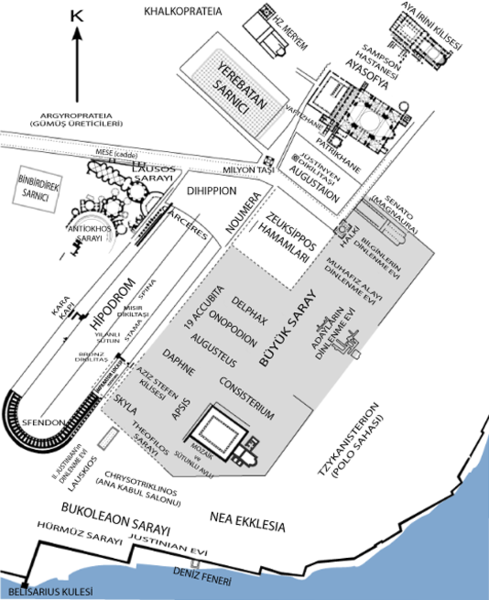
Posted by Powee Celdran

DISCLAIMER: Although this is mostly a work of fiction, it is largely based on true events and characters. It seeks to alter the course of actual events that transpired in the 8th century AD. This story will begin with events that happened in real history but will become fictional as it progresses. Also keep in mind that this story has some content that may be disturbing to some readers.

Previous Story: Byzantine Alternate History Chapter IV- 7th century
“Icon comes from the Greek word “eikon”, which means “images”, but in the Greek-speaking Roman world, before the advent of Christianity, eikon was usually used to describe portraits of humans.” -Leslie Brubaker, Inventing Byzantine Iconoclasm (2012)

2f1c608066438c072614c5033855489c

Welcome to the 5th chapter of the Byzantine Alternate History series by the Byzantium Blogger! Last time, in chapter IV of this series, I went over the turbulent 7th century which saw the end of the early era of the Byzantine (Eastern Roman) Empire or Late Roman era and the beginning of its Dark Ages together with the sudden expansion of an unexpected empire, the Arab Caliphates, as well as the turbulent reign of the autocratic emperor Constans II (641-668). The 7th century was a major turning point for the Byzantines as here they had lost more than half of their imperial territories first to their long-time enemy, the Sassanid Persian Empire which the Byzantines managed to defeat but just shortly after it, the over exhausted Byzantines were to face the rise of an unexpected enemy from the south, the Arabs who would stop at nothing to conquer in the name of Islam, which for the Byzantines could have been their end. The Byzantine Empire still at least managed to survive the expansion of the Arabs but it had cost them a lot as a large portion of their imperial territories, most importantly the rich provinces of Egypt and Syria were forever lost to the Arabs while the Sassanid Empire on the other hand had completely fallen to the rule of the rising Arab Caliphate by the mid-7th century. It was in reign of Emperor Constans II when things began to totally change for the Byzantines, first in terms of territory as with a great loss of it, the Byzantines had to adapt to these changes by increasing military presence in order to check the expansion of the Arabs, thus leading to a reconstruction of the empire’s administrative system that included the creation of smaller military-controlled provinces known as Themes in Asia Minor (Turkey), which would become the empire’s new heartland. On the other hand, the 7th century had also seen the major shift of Byzantium in terms of language and culture from Latin to Greek, though despite this drastic shift from Latin to Greek, the Byzantine Empire still and would always remain the Roman Empire continued with its emperors still called “Emperor of the Romans”. In the previous story, I went with the possible what if scenario of Constans II actually relocating the Byzantine Empire’s capital to Syracuse in Sicily which he did in fact plan to do seeing that Constantinople was far too dangerous, and also if he survived the assassination attempt on him in 668 and living long enough to permanently divide Byzantium in half so that it would be much easier to protect and preserve for much longer. The previous story’s main topic on Constans II moving the capital to the west and dividing the empire in 2 parts between his sons with one based in Constantinople and the other one in Syracuse could have actually benefited the empire a lot, as having an emperor in the west could help restore Byzantine rule in Italy which by then had already been slipping away to the rising power of the Lombards, but also having the capital there could ensure the Byzantine reconquest of Egypt and North Africa from the Arabs. However, since the stories in this alternate history series are not continuous with each other, this story will go with the course of events in real history, therefore Constans II did die in 668 assassinated in his bath and his plan to move the capital west to Sicily never came to happen and from 674 to 678, Constantinople would be put under siege by the Arabs with Constans not being around to come to the aid of his son, the new emperor Constantine IV like what happened in the previous chapter, although the Byzantines happened to win this war in reality and weaken the Arabs for a time at least. What will continue though from the previous chapter will be the new “dystopian” condition the Byzantine Empire is at from being a world power like it was in the 6th century to now having to fight on the defensive for its survival against the endless rapid expansion of the Arabs where its people are now having to live in constant fear, which is why this dystopian-like period for Byzantium would be known as the “Byzantine Dark Ages” going on for over 2 centuries until the Byzantines would turn the tide of war against the Arabs from the defensive to the offensive. This new “Byzantine Dystopian” style for this alternate history series had started in the previous chapter as the Byzantine Dark Ages had begun and will continue on to this chapter where things will go at first from bad to worse until things will slowly get better again, and as the dystopian Byzantine world from the previous story will continue to this one- despite the alternate history outcome from last time not continuing here- a lot of the elements of the dystopian Byzantine world will return here including the political instability and usurpers, emperors with a dictatorial style of ruling, people resisting against the rule of the emperor to change society, an empire in a dangerous situation, constant war and economic crisis, the new dystopian-like Thematic System, and unimaginable new technology like the superweapon Greek Fire. This story will begin with a background on the real history of Byzantium in the late 7th century briefly covering the reigns of Constantine IV (668-685) and his son Justinian II (685-695), followed by a 22-year period of anarchy (695-717) which had seen a change of emperor 7 times and with all this instability, the Arab Umayyad Caliphate which had been weakened by the Byzantine victory of 678 would once again come back with a vengeance taking over Byzantine lands including Carthage ending Byzantine rule in North Africa once and for all. The year 717 then would be a very crucial moment as Byzantium which after 22 years of instability would face another siege on their capital, Constantinople by the Arabs but at the end, the Byzantines under their new emperor Leo III the Isaurian would win once more and slowly turn the tide of war against the Arabs. The siege of 717 would then be remembered as the “Battle for the Fate of Europe”- more than the Battle of Tours in 732 was- as if things went in favor of the Arabs, then the Byzantine Empire could have ended right at this moment, thus this would allow the Arabs to continue expanding deep into Europe, and now if not for the Byzantine victory here, most of Europe would have already fallen under Islamic rule and history as you know it would be totally different. It was then here in this battle where the Byzantine Empire and more particularly Constantinople would best be remembered as the wall that had protected Europe from the advance of Islam, in which Byzantium will prove to do just that many more times. This story will not yet end here and its what if scenario will also not be if the Byzantines lost and the Arabs won and how Europe would be different because of this, NO, instead it would continue further on into the reign of Leo III (717-741), the founder of the Isaurian Dynasty which shows an even more dystopian side to the history of the Byzantine Dark Ages mainly due to his anti-icon policies known as Iconoclasm or the breaking of religious icons (painted human images) that will shake and split the empire’s population and plant the seeds for its permanent split with the Western world or simply the “Great Schism”. This event in Byzantine history is one of its oddest in their 1,100-year history as the Byzantines being Orthodox Christians would surely be known to highly value their religious icons, but true enough there was a time when icons were outlawed as the emperor Leo III saw it as sinful therefore blaming all the empire’s setbacks against the Arabs on the overly excessive use and veneration of them. Now when it comes to doing a kind of dystopian style story set in the Byzantine Empire, the 8th century is a perfect time as like in all dystopian stories where a kind of autocratic government in charge outlaws something creating massive unrest and resistance, here in Byzantium the same can be said here when the imperial government had outlawed religious icons which therefore outraged half of the empire’s population while the other half supported it. This time in Byzantine history thus shows that an issue that may seem so small which here is about the use of icons could cause so much tension not only among the people of the empire but in the unity of the entire Christian Church as well. A little-known fact too is that something as small the banning of the use of icons by Emperor Leo III was a total major turning point in medieval history which would start the permanent schism between the Church of the east (Orthodox) and Church of the west (Catholic) and for the Byzantines, this was another period of great unrest despite having come out of a previous one, and once again another episode in the endless cancer of religious schisms in Byzantine history. The 7th century then was a major turning point as the Byzantines would for the first time face the expansion of the Arabs now having to fight on the defensive, while the 8th century where this chapter is set in features Byzantium at its lowest point, which would be another major turning point as it is here mainly due to Iconoclasm when the permanent schism both politically and culturally between Byzantium and Western Europe would start growing, turning into something like a centuries long “Cold War”. The period of Iconoclasm in the Byzantine Empire would not only be during Leo III’s reign, but would go on for over a century which totally deepened its divide with the Latin Catholic west, although this growing divide with the west could have been reversed if Iconoclasm could have ended earlier, and it surely did almost happen shortly after Leo III’s death in the year 742 when the Armenian Artavasdos, a loyal general of Leo III who helped him come to power in 717, who was however secretly against the Iconoclast policy usurped the throne from Leo III’s son Constantine V for the sake of ending Iconoclasm and restoring the use of icons, although in real history, the rebellion of the usurping emperor Artavasdos failed while the even more extremist Iconoclast Constantine V succeeded and would rule the empire for 3 more decades. Now the big question this story will tackle in its climax is that if Artavasdos’ rebellion succeeded thus restoring the use of icons much earlier on, would this lessen the chances for the permanent schism between Byzantium and the west and preserve Church unity?    
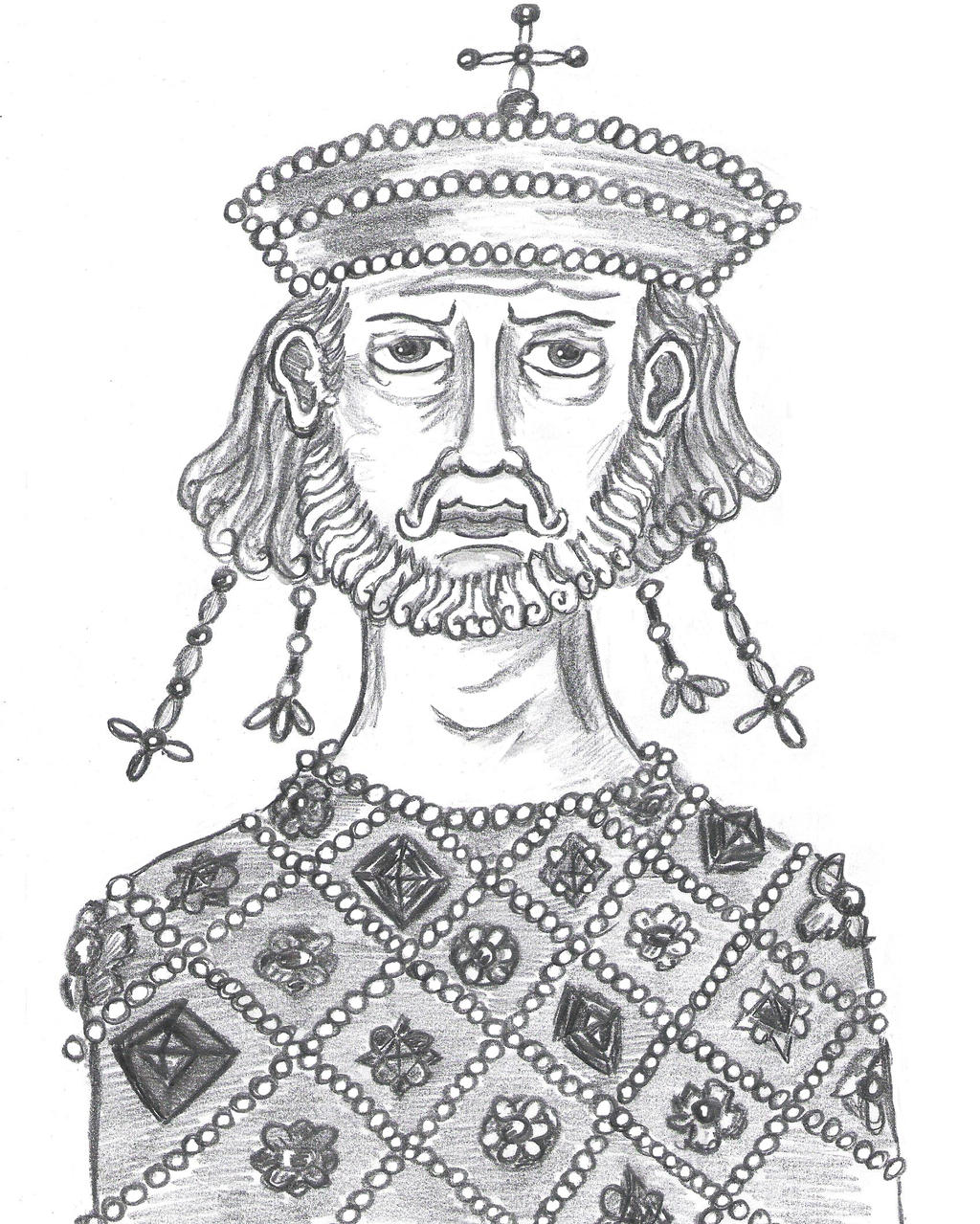
95t3yr5xvfyy
Flag of the Byzantine Empire

Follow me, the Byzantium Blogger on Social Media:

Instagram: @byzantine_time_traveller

Facebook: Byzantine Time Traveller

Youtube: No Budget Films

Twitter: @Byzantinetime

Deviantart: Byzantium-blogger55

Art Station: Powee Celdran Porphyrogennetos

Patreon: Byzantine Time Traveller

Note: Since this story is set in the 8th century after the fall of the Western Roman Empire, the Byzantine characters will be now referred to as Byzantines, not Romans.

Byzantine_Empire_717_AD
The Byzantine Empire in this story’s setting, 717 (purple)
islam-expansion
Map of the expansion of the Islamic Rashidun and Umayyad Caliphates (622-750)

For this article, I am working in collaboration with Mario Puyat (follow him on Instagram @mariopuyatrewreplays and on Twitter @mario_puyat), a friend of mine who in this case helped me put this story together, thus making this story the second one in this series to be done in collaboration with someone (the last one being chapter III). In my previous special edition article wherein I interviewed 5 of my friends by having them react to quotes said by Byzantine era people, Mario happened to be one of these 5, and now he is returning for this article to give his take on Byzantine history despite not being so completely familiar with it. To give a quick background on Mario, he is a 22-year-old film student who plans to direct films and write movie scripts, while at the same time he is also a pop culture enthusiast being a big fan of the Star Wars, Marvel, and DC universes as well as of young adult dystopian stories, in which this story’s genre will somewhat be just that, except not so much the young adult type. On the other hand, when getting to know me, Mario had developed quite an interest in Byzantium as well and not to mention, he previously helped me in making my Lego Byzantine epics for my channel No Budget Films as a co-producer, as well as being a voice actor for a number of Lego Byzantine characters in my films, most notably the leading character Emperor Andronikos II Palaiologos from the 2020 Lego 13th century Byzantine epic War of the Sicilian Vespers. Though neither a historian nor a passionate Byzantine history enthusiast, Mario has a passion for writing stories, which is why I chose him to have a part in the creation of a chapter for this series, and this one here is the perfect one for someone like him to have a part in as this one I would say is something not so entirely Byzantine in the sense of being stuck in the past, but rather something more relatable to modern readers and pop culture enthusiasts, as it has quite a modern take on it being a dystopian style story with a bit of family drama, intimate romance, and lots of blood and gore. In this 12-part series, I on the other hand wanted to experiment as well by having someone who isn’t so entirely familiar with Byzantium’s take on Byzantine history as after all, I do want to make the rich and fascinating history of Byzantium more accessible to a wider variety of people and not only limited to scholars and historians, and part of this means experimenting with the history of Byzantium by making some kind of fan fiction out of it, which is exactly what I’m doing here. Though most of this story is basically me writing it, Mario’s part comes in when creating the personalities and actions of this story’s characters to fill in the blanks in parts where history does not record them such as these characters’ personalities and intentions, so therefore despite these characters being real ones, they had to be embellished a lot here for the sake of creating a full story considering that sources on the happenings of the 8th century in Byzantium are very limited. When creating this story, I also did some extensive research using more scholarly but fun sources online such as the Byzantine history Youtube channels Kings and Generals, Eastern Roman History, and Thersites the Historian, as well as no other than the highly comprehensive History of Byzantium Podcast by Robin Pierson.

Now when it comes to the dystopian genre of stories, many would immediately think of only modern ones most notably George Orwell’s 1984– which I was also a great fan of and made fan fictions of it too for my Youtube channel- or more recent novels like the Hunger Games and Divergent series, but as it turns out, the dystopian genre is not only limited to a modern or futuristic world setting, but can also go as far back as to the medieval era Byzantine Empire, especially if you are able to look closely into its history and use all your creativity. When it comes to the entire 1,100-year history of Byzantium from the 4th to 15th centuries, it is the 8th century’s story in which this article will be set in that I am least fascinated with due to the fact that it had more internal than external struggles, and not so much too was documented about this period which is therefore why it is also called the “Byzantine Dark Ages”, but when looking deeper into the story of this era, especially with the lack of information, it is the perfect time in Byzantine history to create a highly experimental fan fiction, which is basically this story here with Byzantium under the Isaurian Dynasty. Of course, to set the stage for this story, the same thing will go as in the previous stories of this series beginning off with a historical background to it which will discuss the events that led to the dystopian setting of Leo III’s Byzantium beginning where the previous chapter left off as we leave the early Byzantine era and enter the middle part of it, then giving a background to the leading characters such as the madman emperor Justinian II and afterwards Leo III the Isaurian who originally was Konon, a Syrian shepherd of Isaurian origins with an Eastern influenced mind together with the Armenian Artavasdos as well who helped him come to power, then we proceed to the beginning of Leo III’s reign with the epic battle of the 717-718 Siege of Constantinople where the Byzantines again come out victorious. The dystopian genre of the story then comes in at the part on Leo III’s reign (717-741) especially when the ban on icons is imposed and how the people of empire would react to it.

Solidus_of_Leo_III_the_Isaurian
Coin of Emperor Leo III the Isaurian (r. 717-741), author of Byzantine Iconoclasm

Basically, a dystopian story features the world under the rule of a totalitarian government which envisions a bright future, but really everything in society just goes wrong and the 8th century Byzantine Empire of Leo III is no exception to this kind of setting. As usual in dystopian stories where some kind of freedom to do something is banned by the government, here in this story it would be exactly the same case as in real history where the use of religious icons were banned, therefore icons were confiscated from anyone and everyone that owned them and either destroyed or burned, and again like most dystopian stories which feature a kind of dictator that runs the totalitarian government just like Big Brother in 1984, for this story, the totalitarian state supreme leader character would be Emperor Leo III, the author of the Iconoclast movement and after his death in 741, his son the even more Iconoclast extremist or simply the “Icon of Iconoclasm” Constantine V, wherein the climax of the story takes place in. Most dystopian epic stories too feature a protagonist who is destined to rise up and overthrow the system, and for this story, it will be the historical figure the Armenian-Byzantine general Artavasdos who in reality from 742 to 743 usurped the throne from Constantine V in the name of restoring the use of religious icons. This story then will have the very much unknown Byzantine emperor Artavasdos as its lead character who was in fact the person that helped Leo III come to power, and later as Leo III’s right-hand-man was married to Leo III’s daughter Anna which is surely what also gave him a claim to the throne in 742. Now many, even those who are very familiar with Byzantium may not really know much about this usurper Artavasdos or if they do, they would just remember him as an unsuccessful usurper who never had anything important to do with real history, but when getting to know him and his plans more, you would definitely find out that he could have in fact played a crucial role in Byzantine history by reversing the repressive movement of Iconoclasm before it would grow even stronger if he was able to survive and not be defeated and blinded by Constantine V in 743. As the lead character of this story, the 55-year-old Artavasdos in 742 would be a reluctant hero who is secretly against Leo III’s Iconoclast policy but is afraid to show it as he was also loyal to his father-in-law Leo III who he helped come to power in 717, but following Leo III’s death, he would have to rise up for the good of Byzantium or at least for those who value icons and their beliefs, also because he had some personal reasons to rebel which was mainly his envy and hatred for Leo III’s son Constantine V who he felt betrayed by as Artavasdos before Constantine V’s birth was promised the throne by Leo III. For this story too, there will however be no fictional character made up for it, instead with the help of Mario, I will somewhat fictionalize these historical characters in terms of personality as history true enough does not describe what these characters’ personalities were like. The 3 leading characters who’s personalities and backstories will be created in a fictionalized way for this story will include the general and soon-to-be emperor Artavasdos who in Mario’s take in creating the story would be the emperor’s loyal general but is deeply troubled by the emperor (Leo III) having a son; Constantine V who is Leo III’s son and heir being something like a smart but somewhat odd and insane, immature, arrogant, decadent, and bloodthirsty young ruler with an addiction to pleasure who believes he is always right and is a blind believer of everything his father says most especially Iconoclasm making him someone more likely to hate than like; and lastly Leo III’s daughter Anna who is Constantine V’s older sister and Artavasdos’ wife who here for this story would be an intellectual and artistic woman who behind her father’s and brother’s back is the leader of the resistance against Iconoclasm who in personality is nice and calm but becomes cruel and ambitious in order to protect the interests of her family, as she is also abused by her brother who had envied her too. On the other hand, the much better-known emperor Leo III or Konon too will play a major role here in the story’s first two-thirds and although contemporary historians who wrote about him, most notably Theophanes the Confessor (758-817) who strongly opposed Iconoclasm portrays him as a total villain, here in this story Leo III’s portrayal would be more unbiased as both the talented and cunning savior emperor saving Byzantium from its ultimate extinction at the hands of the Arabs and restoring stability following the 22-year period of Anarchy despite being of low birth, but also would later on be a villainous ruler for his declaration of the banning of icons plainly for superstitious reasons which resulted in thousands of valuable icons destroyed and the human rights of those who venerate and create them violated, whereas some even died for the sake of freely venerating icons. The big twist here will be on Artavasdos who for the most part would be Leo III’s right-hand-man strongly enforcing Iconoclasm in the empire with Leo III still alive, though after the death of Leo, he has a big shift in character when betraying Constantine V in 742, suddenly becoming a strong fighter against imperial Iconoclasm and a symbol for those who believed in the icons, even if his main reason to usurp power was his personal hatred for Constantine V. This story too will focus more deeply on the issues in the Byzantine Empire’s Dark Ages in the 8th century showing how Byzantium is no longer like it was in the Golden Age of Justinian I in the 6th century (as seen in chapter III), most especially with the empire at its lowest point of power and the internal war against icons tearing the empire apart whereas Iconoclasm would be popular with many most especially soldiers and those from the eastern provinces while many, most especially those in the western provinces and women strongly opposed it. Therefore, this story will not focus too much on the external wars of Byzantium in which they also had a lot of at this time not only against the Arabs but against a new enemy too being the Bulgars in the north; instead, it would be something more on the society of Byzantium and of course the constant burden of religious debates that Byzantium became famous for. Also keep in mind that this story will have a lot of mature content such as blood and gore, disturbing moments, language, nudity to a certain extent, and a lot more.

Screen Shot 2021-04-17 at 12.05.00 AM
Guide to the Thematic System of the Byzantine army (from Wikipedia); this article contains a lot of terms of Byzantine army units
unnamed-5
A Renaissance era depiction of Byzantine Iconoclasm (breaking of religious icons)
190547225_228784912342461_1017338770732483916_n
Guide to the Isaurian Dynasty of the Byzantine Empire, 717-802; these characters will play an important role in this story; character illustrations and layout by myself

Related Articles from The Byzantium Blogger:

Byzantine Alternate History Chapter IV- Constans II Relocates the Imperial Capital to Sicily

Byzantine History for Everyday People- Reactions to Quotes from Byzantium

Around the World in the Byzantine era- Part I (300-1000)

12 Turning Points in Byzantine History

The Art of War in the Byzantine World

A Guide to the Themes of the Byzantine Empire

The Sieges of Constantinople

Lesser Known and Would be Byzantine emperors (695-1453)

Natural Disasters in Byzantine History

Related Videos to this era:

The 22-Year-Anarchy (Eastern Roman History)

The Arab Siege of Constantinople, 717-718 (Kings and Generals)

The Byzantine Empire’s Themes and Thematic Army (Kings and Generals)


The Leading Characters:

Leo III the Isaurian (aka. Konon)- Byzantine emperor (717-741)

Artavasdos- Leo III’s imperial partner and Byzantine general, Strategos of the Armeniac Theme

Anna- Wife of Artavasdos, daughter of Leo III, leader of the resistance against Iconoclasm

Constantine V Kopronymos- Son and successor of Leo III

Anastasios- Iconoclast Patriarch of Constantinople

Niketas- Byzantine general, son of Artavasdos and Anna

Nikephoros- Son of Artavasdos and Anna

Tzitzak- Khazar wife of Constantine V

Maria- Byzantine empress, wife of Leo III, mother of Anna and Constantine V

Eutychius- The last Byzantine Exarch of Ravenna

(Credits to Ediacar, Amelianvs, Faisal-Hashemi, Krzysztof Pyzik, Androklos, and Chrysa Sakel for their art on this era which are featured here.)

Funko pop versions of the 3 leading characters of the story created by myself- Artavasdos, Anna, and Constantine V:


The Background- The Themes, Justinian II and the 22-Year Anarchy (695-717)         

2f1c608066438c072614c5033855489c

Since the 630s, the Byzantine Empire had lost a great amount of territory, most notably the rich provinces of the Levant (Syria and Palestine) to the sudden expansion of a new enemy, the Arab Rashidun Caliphate or simply the Islamic Empire from the deserts of Arabia in the south. The Byzantines never expected the people from the deserts of Arabia to be such a threat until the unexpected happened for Byzantium when the people of Arabia all united under the new faith of Islam, and their unity combined with their ability to travel across deserts with such great speed turned the Arabs from scattered tribes in the desert to a world power in an instant. In only about 20 years since the birth of Islam, the Arabs had now controlled much of the Middle East as well as Egypt which they had conquered from the Byzantine Empire and by 651, the Arabs had completely conquered all of Persia destroying the Byzantine Empire’s traditional mortal enemy, the Sassanid Empire, thus the Arab Caliphate had now replaced the Sassanids as Byzantium’s eastern mortal enemy.

Rashidun_Caliphate_Flag
Flag of the Rashidun Caliphate, the 1st Islamic Empire

Meanwhile, as the Byzantines lost most of their eastern provinces mainly Egypt and Syria, Asia Minor became its new heartland while the Taurus Mountains in Eastern Asia Minor would be its natural barrier against the expansion of the Arabs, although the Arabs were creative that when knowing they were unable to cross the Taurus Mountains into the Byzantine heartland, they soon enough began constructing their own navy after taking the ports of Syria and from there, they would begin attacking Byzantium by sea. By the 7th century, Byzantine territory had drastically shrunk not only because of the expansion of the Arabs but with the loss of almost the entire Balkans (Southeast Europe) to a number of external enemies mainly the Slavs, and this was a devastating loss as the Balkans played a major role as the recruitment center for soldiers in the Byzantine army. In the mid-7th century, the Byzantines still at least had control over half of Italy as the other half fell to a new enemy being the Lombards, and some of Byzantine North Africa too fell to the Arabs; though these remote parts of the empire being Italy and North Africa were not under the direct rule of the emperor but of a semi-autonomous governor known as the Exarch who answered directly to the emperor and there were two of them controlling their own Exarchates, the two being the Exarchate of Ravenna that controlled Byzantine Italy from Ravenna and the Exarchate of Africa that controlled North Africa from Carthage. Now with the Byzantine Empire so heavily reduced in size and population and the new heartland now being Asia Minor, the emperor Constans II (r. 641-668) saw the need to reorganize the empire’s administrative and military structure more particularly in Asia Minor, thus leading to the creation of the Thematic System or Themes between 659 and 661, which were to be smaller military-controlled districts named after their respective armies that controlled them.

Constans II
Emperor Constans II of Byzantium (r. 641-668), art by myself

Basically, in these new shrunken provinces or Themes, each of them had a mobile army assigned to it while recruitment was done locally per Theme to increase the number of soldiers, while all young men too living in these Themes were encouraged to join the army in exchange for land given to them, to also ensure their full loyalty to the empire. Each of these Themes were under a general called a Strategos who was both the top commander of the Theme’s army and its provincial governor, and each of the Themes was to provide both soldiers and resources for the empire. The main purpose though for the Themes was more in terms of military matters as when the eastern border would be under attack, the army stationed in that Theme near there would immediately come to the rescue of the border, while on the other hand when another part of the empire would be under attack, the emperor could simply have another Theme’s army come over to that part, which therefore was a smarter defence method rather than how things were before when an entire army had to march from one end of the empire to the other when a war broke out. The first 5 Themes created under Constans II were all in Asia Minor and these were the Anatolic (Anatolikon) Theme found in Central Asia Minor, the Armeniac (Armeniakon) Theme which was the largest of the Themes found in Eastern Asia Minor next to the border with the Arab world, the Thracesian (Thrakesion) Theme in the western coast of Asia Minor, the Opsikion Theme in Northwest Asia Minor right across the sea from Constantinople which consisted of the empire’s most elite army which however will soon enough prove to be the most troublesome of the armies later on, and lastly was the Karabasian (Kibyrrhaioton) Theme in the southern coast of Asia Minor which was basically the one controlled by the navy. While the Themes were being created, the Arab Caliphate entered its first civil war or the First Fitnah (656-661) which gave the Byzantines time to recover but as the civil war ended 661, the Arab Rashidun Caliphate being destroyed was replaced by the new Umayyad Caliphate under Caliph Muawiyah I who made the Caliphate now based in Damascus in Syria into a more organized state and as the first Umayyad caliph or emperor, he was fully intent in taking over Constantinople. Knowing that Constantinople was too dangerous in location, Constans II in 662 left it for good later finding himself in Sicily where he planned to make the city of Syracuse there as his new capital as it was also part of his plan to launch the Byzantine reconquest of Egypt and restore Byzantine imperial presence in the west but in 668, he was assassinated in his bath by a servant using a soap dish, thus his plan to both relocate the capital west and take back Egypt failed.          

1280px-Byzantiumby650AD.svg
The Byzantine Empire in 650 (orange) under Constans II
Dzj08neWkAEdcba
Cavalry of the Arab Rashidun Caliphate, 7th century
maxresdefault-3
Map of the first original 5 Themes of Asia Minor created under Constans II
muslimheritage-damascus-east-meets-west-venice-8
Damascus, capital of the Umayyad Caliphate beginning 661

Following the death of Constans II in 668, Caliph Muawiyah I using his fleet took over some of the Byzantine ports of Asia Minor launching the first Arab Siege of Constantinople in 674, although this was not really a major attack but a series of intermittent skirmishes on Constantinople by the Arab army and fleet and up until 677, the siege was not coming into any results until the young emperor Constantine IV (r. 668-685), the son of Constans II counter-attacked the Arab fleet head-on using the secret superweapon Greek Fire for the first time totally obliterating the Arab fleet and army.

8a2f830642f740ee369fb93a7a973595
Emperor Constantine IV (r. 668-685), son and successor of Constans II

In 678, the Arabs fled Constantinople and the Byzantines, thanks to Greek Fire emerged victorious while Muawiyah later signed a truce with the Byzantines agreeing to pay them annual tribute and return to them the islands and ports they previously captured from them. Following the death of Caliph Muawiyah in 680, the Arab world again fell into civil war which here was the Second Fitnah going on for the next 12 years, thus giving Byzantium some relief and time to recover after all the damage the Arabs had inflicted on them. Meanwhile, despite Byzantium for now saved from the threat of the Arabs, another new enemy would come for them from the north which was that of the Nomadic Bulgars from the Steppes near the Volga River in today’s Russia as when losing a war to the Nomadic Khazar people of the area, the Bulgars were forced to migrate south to lands they could settle in, and the only available land for them was Byzantine Thrace (Southeast Europe). Leading the migration of the Bulgar hordes into the Balkans in 680 was their ruler or Khan Asparukh, and with the eastern borders of Byzantium secured, considering the Arabs were again in conflict with each other, Emperor Constantine IV summoned the armies of all the 5 Themes to confront the Bulgars in battle at the empire’s northern border, the Danube Delta, where the Bulgar army led by Asparukh had already assembled at.

de07ef7add317da7d563ff131258f97c
Khan Asparukh, First ruler of the Bulgarian Empire (r. 681-701)

After assembling the Byzantine army at the Danube Delta, Constantine IV had to rush back to Constantinople after falling ill, although he also had more important matters to attend to, which here was the 6th Church Council wherein at the end, he succeeded at declaring the religious controversy of Monothelitism which his father stood for as a heresy and reaffirming the Orthodox belief in the natures of Christ. Meanwhile with the emperor not present in battle, the Byzantine army panicked and were thus defeated by the Bulgars here at the Battle of Ongal in 680, and as a result Constantine IV in 681 had to cede Northern Thrace to Asparukh acknowledging the birth of the Bulgarian state there which would therefore become Bulgaria, and it is true enough where today’s Bulgaria is too. From here on, the Bulgarian state was born and there to stay which would later be both a valuable ally and brutal enemy to the Byzantines at different times as you will see later, and Constantine IV despite losing Northern Thrace to the Bulgars still remained popular as at quite a young age he solved a difficult religious controversy and successfully defended Constantinople from the Arabs earlier on, while at this time he would also create the new Theme of Thrace to further protect Constantinople from the nearby Bulgars that were just to the north. In 685, Constantine IV died at only 33 from dysentery later becoming an Orthodox saint for his achievement in solving the Monothelite Controversy, and following his death he was succeeded by his 16-year-old son Justinian II (born 669) who as the new emperor was very ambitious wanting to live up to the emperor he was named after, Justinian I the Great (r. 527-565), Byzantium’s most influential ruler so far, although Justinian II did not have what Justinian I had being the vast amount of wealth to carry out such ambitious conquests and building projects considering that the Byzantium of Justinian II was weakened and exhausted compared to the powerful Byzantium Justinian I inherited back in 527.

Justinian_ii_(2)
Emperor Justinian II in his 1st reign (685-695), son of Constantine IV

It also happened here in 685 over in Byzantine Syria at the town of Germanikeia (today’s Kahramanmaras, Turkey) where a boy named Konon who would later be emperor was born to a simple family of Syrian and Isaurian origins as an only child and from a young age, Konon would develop the ability to speak the Arabic language together with his native Greek as his name suggests, but at the same time he could understand the culture and mind of the Arabs due to the fact that living close to the border of the Arab Caliphate, he was exposed to Arab people who came to his town to trade and from them, he learned everything about their culture. The one thing about the beliefs of the Arabs that intrigued Konon most was how they disapproved worshiping God through icons or the form of a human image as it was strictly forbidden for the Arabs as Muslims to worship God that way considering it as idolatry and as a Christian, Konon thought this was true enough the right way to worship God. Another factor that had influenced Konon’s stance against icons too which will be shown in his time as emperor later on was that coming from the east, most people there were Monophysite Christians, those who believed Jesus Christ was fully divine and not human, therefore as God it was not right to have an image of him, unlike the Orthodox Christians of the western parts like Constantinople who worshiped Christ as God with images. On the other hand in the Armeniac Theme in 687, the person who will later help Konon come to power, Artavasdos was born, although history does not record his date and place of birth and family background except that he was a Byzantine-Armenian known as Artavazd in Armenian with “Artavasdos” as his name’s Greek translation, so for this story it will just be made up that he was born in the Armeniac Theme (Northeast Asia Minor) considering he was an Armenian and would be 2 years younger than Konon, and for this story Artavasdos is someone from a prominent military family.

8a3521f5338d9daecb7d3588af8e1cbd
Greek Fire used against an Arab ship at the 674-678 Siege of Constantinople
Asparuh'Bulgarite_atlas_Hofart
The coming of the Bulgars, Khan Asparukh and his Bulgar hordes arrive in Byzantine Thrace, 680

Meanwhile back to Justinian II, he came to power with a great amount of luck as he was from the 5th generation of the unbroken Heraclian Dynasty founded by his great-great-grandfather Emperor Heraclius (r. 610-641), showing here for the first time in Byzantine history, and in fact in all of Roman history that a dynasty ruled on for 5 generations in one straight hereditary line from father to son, but little did Justinian know he would be the last of his dynasty. The young emperor was deeply ambitious and a religious fanatic as well believing that it was his destiny to defeat the Arabs once and for all in the name of Christianity, and considering the Arabs were still in conflict with each other, Justinian II’s armies successfully attacked the Arabs in Armenia and Syria thus retaking some lands the Byzantines lost and with the Arabs defeated, the new Umayyad caliph here Abd al-Malik (r. 685-705) in 688 agreed to pay tribute to Byzantium.

Ibn Zuhr
Caliph Abd al-Malik of the Umayyad Caliphate (r. 685-705)

Afterwards, Justinian II focused his attention on the Balkans to deal with the Slavs and take back the lands Byzantium lost to them, wherein Justinian himself personally led his men in battle and at the end, he managed to succeed in defeating the Slavs while the Slavs that survived were forced to relocate to Asia Minor to repopulate it and provide more troops, as the previous wars against the Arabs there killed many. Justinian II would also put the Themes his grandfather Constans II created into full effect and this meant resettling people from across the empire into them in order to balance each Theme’s population, but another reason for him doing this was to limit people of the same race (e.g., Slavs) in one Theme as having too much of one race in a certain area would lead to rebellion, and the Slavs being seen as a rebellious people by Justinian II were moved to Asia Minor, while the Mardaites who were mostly Monosphysite Christians and seen as troublemakers as well living in Southern and Eastern Asia Minor were relocated by Justinian II to the Balkans, and this would be when Konon and his family were relocated from Byzantine Syria to Thrace, though it is not clear when this happened, but for this story’s case it would be in 695 before Justinian II was deposed. Now before Justinian II was deposed, as a fanatically religious ruler, he was the first emperor to put the image of Christ in the coins used around the empire, and part of his imperial policy too was to crack down on the last remnants of Pagan practices, meaning putting a ban on playing games such as Dice and Tabula in public as he saw it as Pagan in origins, thus this started making him extremely unpopular.

810266
Coin of Emperor Justinian II (left) with the image of Christ on the obverse (left)

Justinian II too was not only unpopular for being puritanical in his policies, but strongly unpopular with the rich as he increased taxes on them as well as having rich tax evaders imprisoned and tortured and instead, he favored small landowners and farmers. In 692, the Second Fitnah had ended with Caliph Abd al-Malik victorious and the Umayyad Dynasty still ruling the Caliphate, though the caliph was extremely outraged seeing Byzantine coins with Christ’s image on them as again the Arabs being Muslims strongly opposed the idea of seeing God as a human so in retaliation against Justinian II, Abd al-Malik had Islamic art put on the papyrus scrolls the Byzantines imported from Arab Egypt and due to this as well as the Arabs imitating Byzantine art by putting mosaics in their capital Damascus further enraged Justinian II making him declare war on the Arabs. The peace between the Umayyad Caliphate and the Byzantines then ended right here in 692 when both forces confronted each other at the Battle of Sebastopolis in Southern Asia Minor where the Slavic warriors Justinian had resettled into Asia Minor for the first time fought in the Byzantine army but at the middle of the battle, the 20,000 Slavs for unclear reasons- although most possibly because they were never loyal to Byzantium and were forced to fight for them- defected to the Arabs and at the end, the Byzantines suffered a heavy defeat. As a result of this defeat, Justinian II had the man responsible for it, the young leading Isaurian general Leontios the Strategos of the Anatolic Theme imprisoned, and it was also here when Justinian II would show how much of a madman he was when he had the families of the defected Slavic warriors in the Opsikion Theme massacred leaving no one alive not even the women and children according to the historian Theophanes the Confessor (758-817), who although portrays Justinian II as a madman, which is true for this story. Justinian II would later on become even more unpopular for his autocratic style of ruling which he inherited from both his father Constantine IV and grandfather Constans II as shown when he summoned a Church Council in 692 also known as the Quinisext Council, in which out of his own orders demanded that all Churches including the west which was basically the Church of Rome under the pope to use Eastern practices in their liturgy like the use of the Greek language, and this surely offended the pope making this one of the first steps that began the split of the Eastern and Western Churches.

200px-Facial_Chronicle_-_b.13,_p.443_-_Council_in_Trullo
Justinian II’s Quinisext Council, 692

Another thing that would make Justinian II be labelled as a madman was how he used the taxes he brutally extracted from rich taxpayers to expand the Imperial Palace complex in Constantinople by expanding the garden and constructing a new dining hall as a way to imitate Justinian I’s ambitious construction projects, but in the process of this as Justinian II built a new fountain in the palace, a church had to be destroyed, which also turned the Church against him. In 695, Justinian II released Leontios from prison after 3 years making him the Strategos of the newly created Theme of Hellas (Western Greece), but this here would be the downfall of Justinian II as when Leontios was assigned to Hellas, the population there mostly being rich landowners rose up under him naming him emperor against Justinian II. When arriving in Constantinople with the army of the Hellas Theme, Leontios was then backed by the Patriarch of Constantinople and the people of the Blue faction of the chariot races mostly consisting of the aristocracy, wherein they all plotted to overthrow the emperor.

178639384_2566257330335538_7080852158832311675_n
Mutilation of Justinian II’s nose, 695

The plot was then successful and the ministers of Justinian II who were responsible for the brutal taxation of the aristocracy were executed while Justinian II himself was caught and brought to the newly proclaimed emperor Leontios, but rather than executing Justinian II, Leontios had his nose cut off, which here was a practice for deposing an emperor known as Rhinokopia, as having a single deformity such as missing a nose would make someone unfit for sitting on the imperial throne, as the emperor for Byzantines had to be seen as someone physically perfect. The 26-year-old Justinian II whose nose was mutilated was then loaded into a ship and sent over to the remote Byzantine colony of Cherson, a cold and desolate place north of the Black Sea in what is now the Crimea in Ukraine which was a dumping ground for political enemies in Byzantium, and the reason now why Leontios did not just execute Justinian II was because Leontios was loyal to Justinian’s late father Constantine IV who appointed him as the Anatolic Theme’s Strategos back in 682, therefore he wanted to honor his late friend by sparing his son, though this was not yet the end for Justinian II.

muslims
Arab forces at the Battle of Sebastopolis, 692
krzysztof-pyzik-slavic-warriors
Slavic warriors, resettled into Asia Minor by Justinian II, defected to the Arabs in 692, art by Krzysztof Pyzik
maxresdefault
Diagram of Byzantine Constantinople’s Imperial District featuring the Hagia Sophia, Imperial Palace Complex, Hippodrome, and Polo Field

Watch this to learn more about Justinian II’s first reign, 685-695 (Eastern Roman History).

In 695, the 35-year-old Isaurian Leontios was emperor being the first ruler of the 22-year anarchy period, and to consolidate his rule as he was a usurper with no ties to the previous Heraclian Dynasty he overthrew by deposing Justinian II, he spared Justinian II’s family members such as his mother Anastasia the wife of the late Constantine IV, although Leontios despite being backed by the aristocracy and Blue faction was never that popular basically because he was a usurper with no legitimate claim to the throne, and an Isaurian in origins in which the Byzantines of Constantinople till this point still saw the Isaurians being the people of the mountains of Southern Asia Minor as still barbaric and primitive, even though Leontios was only Isaurian in blood and was not even born in the mountains of Isauria. As emperor, Leontios decided to avoid making offensive measures against the Arabs which Justinian II did, and instead chose to only fight defensive measures against them, though the caliph Abd Al-Malik saw this policy of Leontios as a sign of weakness thus using it to his advantage to launch a naval invasion on Byzantine Carthage in 697, the last piece of land Byzantium still held in North Africa. In response to the Arab invasion of Carthage, Leontios sent an army and the fleet of the Karabasian naval Theme under the command of the general John the Patrician to retake Carthage which happened to be successful at first until the Arab reinforcement fleet arrived in 698 defeating the Byzantines, thus Carthage here completely fell to the Arabs ending the Byzantine Exarchate of Africa. The surviving Byzantines together with John retreated to Crete where John was killed when the surviving soldiers mutinied replacing him with Apsimar, a Droungarios or 3rd in command of the Thematic Army who was of Germanic descent as his name suggests; the soldiers then named him as Emperor Tiberius III fearing Leontios would punish them for losing. The army under Tiberius III marched to Constantinople blockading it while in the city, another outbreak of the Plague of Justinian from the 6th century occurred and inside the city, the Green faction of the chariot races that never wanted Leontios in power anyway switched their support to Tiberius III opening the gates for him, thus Leontios was overthrown making Tiberius III the second ruler of this 22-year anarchy. Leontios then instead of being executed suffered the same fate as Justinian II who he overthrew 3 years earlier, and as Leontios’ nose was mutilated he was sent into monastery arrest in the capital. As the new emperor, Tiberius III was at least successful in resuming attacks against the Arabs in the east led by his brother Heraclius, and in repopulating Cyprus as well with Arab prisoners of war, but the one thing he failed to see was the rising threat of the exiled Justinian II returning. The one thing Tiberius III’s reign would best be known for was the end of Byzantine control over Africa with the complete loss of Carthage which had been under the Byzantines ever since the conquest of the Vandal Kingdom there in 534 by Emperor Justinian I’s general Belisarius, and at the turn of the 8th century, Byzantine rule over Africa was permanently lost as Tiberius III believed that taking back Carthage and keeping it under Byzantine control was too risky considering it was too far from Constantinople. From 698 onwards, Carthage would be under the rule of the Arabs and from here, the Arabs would continue to expand westwards joining forces with the native Moorish (Berber) people who they converted to Islam and from here, they would expand more later crossing the Strait of Gibraltar over to Spain believing it was the easier despite longer way to successfully reach and take over Constantinople.

KarthagoGesamtrekonstruktion
Byzantine era Carthage, capital of the Exarchate of Africa, completely lost to the Arabs in 698
Arab Warriors 7th century
7th century Arab cavalry advance across the deserts of North Africa

Meanwhile, for the past 9 years (695-704), the slit-nosed Justinian II remained in exile in the cold and desolate city of Cherson along the freezing north shore of the Black Sea and here, Justinian II- for this story’s case- was put under house arrest and only allowed to walk strictly within the city walls once a day, though he made friends with a local abbot who he told his plans to, which was that of taking back the throne and having revenge on those who wronged him.

842bdda852f1b59b9ba7875e71310b05
Byzantine ruins of Cherson in the Crimea, Ukraine; exile place Justinian II, 695-704

The local authorities in Cherson soon began to know about Justinian’s true intentions and therefore planned to have him sent back to Constantinople to be tried and executed and so in 704, he escaped Cherson in the middle of the night fearing for his life, and he fled west across the strait to the mainland of Caucasian Russia which here was part of the land of the Khazars ruled by their khan Busir and when there, Justinian was received well by Busir who even married off his younger sister to Justinian, and when married she was renamed Theodora after the famous wife of Justinian I, again as an act of Justinian II imitating the man he was named after. Both Justinian and Theodora then lived happily in an old Roman mansion given to them along the Black Sea’s northern coast, as this area was once a Greek and Roman colony, though Busir was soon enough given a bribe by Tiberius III to betray and kill Justinian who was discovered to have fled there. However, Justinian soon enough knew of the plot so instead, he killed the men sent to kill him by strangling them with his own hands, and afterwards he fled southwest across the Black Sea to the new land of the Bulgars to seek their alliance, however leaving his wife behind. On the way to Bulgaria in 705, the ship Justinian was in got caught in a storm, though at least they all survived and arrived safely in Bulgaria, now ruled by Khan Tervel, the son of Asparukh who had died back in 700. Justinian II here was able to gain the assistance of Tervel and his Bulgar army in exchange for Justinian paying tribute to him as well as giving Tervel an honorary Byzantine title, and together they marched south to Constantinople and along the way in Thrace, Justinian and Tervel encountered the 20-year-old Syrian shepherd Konon, who with his family had been relocated by Justinian II there 10 years earlier. Konon here was someone who was willing to use every opportunity to get himself into a position of power, and the right opportunity came for him here when meeting Justinian II who was on his way to take back the throne, and here Konon thought of finding a way of getting into the imperial service as a soldier and spy by providing Justinian II and his army with sheep to eat.

lamb-machboos-50293760
Arabic lamb dish, cooked by Konon for Justinian II

Justinian II here at his tent privately met the young Konon for dinner which Konon prepared himself- for this story’s case- and what was prepared was a lamb dish cooked in the Arabian style with lots of flavorful spices, which was a dish from Konon’s native Syria with some influences from the Arabs that had passed there, and here Justinian II was greatly impressed not only by Konon’s ability to cook such flavorful food but with how he could speak Arabic so fluently and with how much he knew the culture and way of thinking of the Arabs. Soon enough, Justinian II together with his Bulgar allies and Konon arrived outside the walls of Constantinople where they camped outside for 3 days as Justinian was denied entry since the people still despised him even after 10 years. After 3 days, Justinian with a few of his men were able to sneak into Constantinople in the middle of the night finding a way up through the 4th century aqueduct, and when inside the aqueduct Justinian and a few of his men including Konon climbed down through a building attached to the aqueduct.

Valens-Aqueduct-History_1479400017
Aqueduct of Valens, Constantinople

The next day, the people were shocked to see the former emperor with his nose cut-off together with Bulgar soldiers walking through the city’s streets, while Tiberius III after just waking up fled across the Bosporus to the Asian side of Constantinople when hearing Justinian II returned. Now back in power, Justinian II honored his promise to Khan Tervel naming him a Caesar, which now was just an honorary title, while Tervel was the first foreign ruler to receive the title, and as Tervel and his army returned to Bulgaria, Justinian II at 36 was crowned again being the 3rd ruler of the anarchy period, and now known as Justinian II Rhinotmetos or “the slit-nosed” in Greek, using a replica of his nose made of gold to cover the cavity where his real nose once was, as a way to make it seem he was still in perfect shape.

178648561_2566257333668871_8230251526424561426_n
Emperor Justinian II (r. 685-695/ 705-711), art by Amelianvs

In 706, Tiberius III over in the Asian side of the Bosporus was captured and brought to Justinian II who as usual had Tiberius’ nose cut off, and together with the previously deposed Leontios who was dragged out of the monastery he was in, they were both paraded in Constantinople’s streets with their cut-off noses exposed before both were brought to the emperor’s box at the Hippodrome where Justinian II when watching a chariot race used both Leontios and Tiberius III as his footstools with each of the former emperors’ necks stepped on by a foot of Justinian II as a symbol of having conquered both of them, and afterwards both Leontios and Tiberius III were beheaded followed by a purge ordered by Justinian II on all those loyal to both usurpers leading to the deaths of thousands including Tiberius’ brother Heraclius. Konon meanwhile was sent over by Justinian II east to negotiate with the rulers of the small kingdoms of Alania and Lazica over in the Caucasus to make them recognzie Justinian II’s return to power, and also to spy on the Arabs there as Justinian now knew Konon knew the behavior of the Arabs. Although Justinian true enough betrayed Konon here by stranding him across the Caucasus, but Konon soon managed to return to Byzantine territory by foot crossing the snowy mountains with just snowshoes. Konon would then disappear into the Anatolic Theme in Asia Minor for some time now, and in this story’s case he would marry a Greek woman named Maria like in real history, though for this story’s case she would be the daughter of the Theme’s Droungarios, and by this point they would have their first child, a daughter named Anna whose real birthdate is unknown, but in this story she would be born in 708.

justinian_ii__byzantine_comic_preview__by_ediacar_dceji2m-fullview
Emperor Justinian II Rhinotmetos, 2nd reign, art by Ediacar

As for Justinian II in his second reign, his full purpose of ruling the empire now would no longer be for growing it, but to carry out revenge on all those who wronged and humiliated him before, and this is when he would be known as the bloodthirsty madman emperor he is better known as. In his second reign, Justinian II put all his energy into purging all those who opposed him and helped overthrow him back in 695, and true enough not a day went by without anyone being arrested or executed, though also in 706 Justinian’s Khazar wife Theodora and their infant son Tiberius arrived in Constantinople being sent there by the Khazar khan Busir who now gave up the plan of betraying Justinian due to Tiberius III being deposed and executed. Just as he did in his first reign, Justinian II resumed his impulsive style of ruling in his second one that in 708 he launched a campaign against the Bulgars and their Slav allies to gain the lands he gave up to the Bulgars in exchange for returning him to power, thus even betraying his closest ally Tervel who helped him take back the throne in 705, though Justinian II and his forces were defeated by the Bulgars forcing him to renew his peace agreement with Tervel. The defeat of the Byzantines to the Bulgars in 708 allowed the Arabs to continue raiding into Asia Minor, in which in 709 they managed to capture some cities in Cilicia, and from there go as far deep into Cappadocia too, and because of the defeats the Byzantines had suffered, Justinian II in his usual act of vengeance had the commanders he saw responsible for it executed, despite them being capable leaders, thus the empire would lose some of its best military leaders. On the other in 709, Justinian II turned his attention to the remains of Byzantine Italy, particularly Ravenna in which he found out was the place that opposed him the most, and it was true enough the aristocrats of Ravenna including its bishop that played a major part in overthrowing him back in 695. Justinian II here though succeeded in sending an expedition to Ravenna to round up and arrest all those who conspired against him, afterwards all these people were brought over to Constantinople where Justinian had these aristocrats, true enough his life-long enemies executed right in front of him while the bishop’s eyes were gouged out. As many people were already beginning to flee Constantinople in fear of getting killed by the emperor’s orders, since soon enough everyone no matter guilty or innocent as long as seen as suspicious by the emperor were put to death or killed in the confusion and because of Justinian II’s tyrannical rule, the colony of Cherson where he was banished to earlier on rose up against him in 710 under the Armenian patrician general Bardanes or Vardan, who Justinian II had just sent there to be in charge of it. Now Bardanes was someone who really desired the throne that back in 695 when Leontios seized power, Bardanes who helped Leontios eyed the throne more than Leontios did. As the uprising against Justinian II in Cherson grew even worse when Bardanes allied himself with the Khazars, Justinian II in 711 then sent an army to Cherson to deal with rebellion, but instead the army sent there defected to rebels later on sailing south to Constantinople finding out Justinian II was away as he headed over to the Armeniac Theme to again suppress another rebellion against him by the aristocracy there. With the emperor gone, Bardanes and his rebel forces were let into the city by the people who were tired of Justinian II anyway, and thus Bardanes was proclaimed here as emperor renamed Philippikos while Justinian II never made it back as on December 11 of 711 Justinian II when heading back to Constantinople to counter-attack Philippikos was arrested and beheaded at age 42.

le-sac-de-ravenne-en-711-mene-par-lempereur-byzantin-justinien-ii-au-cours-duquel-est-arrete-larcheveque-felix-justinian-ii-byzantine-emperor-sav-2BMHMAM
Tiberius, son of Justinian II at his grandmother Anastasia’s arms is hunted down by the soldiers of Emperor Philippikos, 711

Shortly after, the soldiers of Philippikos hunted down Justinian’s 6-year-old son Tiberius in Constantinople who was hiding in a church with his grandmother, Justinian’s mother Anastasia and when caught, the young Tiberius was hacked to death by the soldiers, thus fully ending the bloodline of Heraclius and the Heraclian Dynasty. Anastasia though as a woman was spared but would never be heard from again, while Justinian’s wife Theodora in this story’s case would return back to her native land of the Khazars, while Justinian’s head was then sent to Rome and Ravenna to be paraded and displayed in public whereas everyone cheered as the evil emperor was dead, and although he tried to live up to Justinian I whom he was named after, he was only Justinian II and not the “Second Justinian”. A legacy that Justinian II left behind however was the introduction of the Loros or a long golden embroidered scarf wrapped around the body as the new uniform for Byzantine emperors, as previously this kind of outfit was only worn by consuls in the Byzantine senate, but with the office of consul now abolished, this uniform became for the emperor’s use only beginning with Justinian II, and it would now be the standard uniform for Byzantine emperors till the very end. 

khazar03_01
Empire of the Khazars (purple), early 8th century
2f753f3623906997342f3f88739fb458
Justinian II makes the Bulgar Khan Tervel a Caesar in Constantinople, 705
boyana_sh5
The Loros, new Byzantine imperial uniform introduced by Justinian II

In 711 as well, the same year Justinian II’s rule was finally put to an end with his execution, the Arab Umayyad Caliphate now under its new caliph Al-Walid I was at its height of power as here in 711, the Arab armies from North Africa together with their subjugated local Moorish forces there had finally begun their conquest of Europe by crossing the Strait of Gibraltar into Spain easily defeating the weakened Visigoth Kingdom there. Previously, the Christian Visigoth Kingdom of Spain that had been around there since the 5th century after the Germanic Visigoths took over Spain from the Western Roman Empire- if you remember from chapter II– by the late 7th and early 8th century fell into civil war thus further weakening it, that when the Arabs finally crossed into Europe through Spain, the Visigoths stood no more chance and in only a few years after 711, the Visigoth Kingdom would meet its end, although remnants of Visigoth Spain would still survive as the Christian Kingdom of Asturias in the north formed by the surviving Visigoths, and this new kingdom would resist against the expansion of the Arabs before turning the tide of war against them beginning the Christian Reconquista a few centuries later.

900px-Flag_of_the_Kingdom_of_Asturias.svg
Flag of the Kingdom of Asturias, resistance kingdom of the Visigoths in Northern Spain

The Arabs though would still stop at nothing conquering everything in the name of Islam that in only about 10 years after arriving in Spain, they had already conquered almost the entire Iberian Peninsula including what is now Portugal, leaving the Christians including the ever-independent Basque people to the remote corners of Northern Spain, and this was not yet the end as the Arabs were also set to conquer the Frankish Kingdom to the north. In the east meanwhile, the rule of the Arab Umayyad Caliphate had already reached as far as the Sindh region in today’s Pakistan which they had conquered back in 708, thus the rule of the Arabs now spanned from the Atlantic Ocean all the way east to the Indus River. Back in Byzantium, the new emperor Philippikos as the 4th ruler of this anarchy period had turned out to not really be an effective ruler, as the only thing he did good for his people was finishing off the madman Justinian II but plainly as a general, he had not much experience in politics and at the same time, he as an Armenian was also a believer of the Monothelite doctrine that was condemned as a heresy by Constantine IV back in 680 as the Monothelite faith was stronger with people in the eastern regions of the empire like Armenia. In 712, he renounced the ruling of the 680 Council of Constantinople attempting to restore the Monothelite doctrine of Christ having only one energy, thus Philippikos fired the Orthodox Patriarch of Constantinople Cyrus replacing him with the Monothelite John VI, and here is when the foundations of Iconoclasm as an imperial practice was laid when the emperor had some religious icons in the capital that did not please him removed. For returning the heretical Monothelite doctrine, Philippikos soon enough became hated by his people and opposed by the pope in Rome, and because of executing Justinian II, the Bulgar khan Tervel who still had some loyalty to the late emperor struck back and raided into Byzantine Thrace going as far as the Walls of Constantinople. To counter-attack the Bulgars, Philippikos sent the army of the Opsikion Theme right across the sea from Constantinople to cross the Bosporus into Thrace in order to push back the Bulgars which they were successful at, although when putting too much attention to fighting the Bulgars up north, the Arabs attacked Asia Minor by land again from the east. In 713, the Opsikion army that beat the Bulgars rebelled in Thrace marching straight into Constantinople where the city’s garrison easily opened the gates for them as they and even Philippikos’ bodyguards had turned out to have no loyalty towards him as he was again another usurper with no ties to the previous Heraclian Dynasty. The rebelling soldiers then caught Philippikos at the moment he was taking a nap in the imperial palace wherein they dragged him out to the Hippodrome where he was publicly blinded, and after that sent to a monastery wherein he died some months later also in the same year as a result of his injuries from the blinding. With Philippikos deposed in 713, the Opsikion Theme army chose to proclaim Philippikos’ senior secretary Artemios as their new emperor who then was renamed as Emperor Anastasius II thinking he could be easy to manipulate, but the Opsikion army here was wrong as true enough he did not want to be a puppet and so he executed the soldiers who plotted to overthrow Philippikos as a way of installing discipline. Anastasius II was then the 5th ruler of the anarchy period and it was in his reign in 713 when Artavasdos first comes into the picture whereas here he was 26 at this point and already a highly skilled soldier and for his skills, Anastasius II appointed Artavasdos as the Strategos or commanding general of the Armeniac Theme where he came from. In 714, the Arabs continued their attacks penetrating as far as the Anatolic Theme in Asia Minor and soon enough they had blockaded the coastline of Asia Minor with their fleet, and in response to these Arab attacks, Anastasius II ordered that the land and sea walls of Constantinople be repaired fearing a possible siege of the city. At the same time, Anastasius II also ordered that the food supply of Constantinople be restocked to last at least 3 years, had the fleet rebuilt, and in 715 cancelled the Monothelite decree Philippikos had issued returning to Orthodoxy again by deposing the Monothelite patriarch John VI and replacing him with the Orthodox Germanus I. Konon then comes back again to the picture in 715 when Anastasius II appointed him to be the Strategos of the Anatolic Theme wherein he now settled as Anastasius II saw that Konon possessed a lot of military skill and afterwards Konon was sent east to surprise attack the Arabs in Syria, as here the caliph Al-Walid died as well in which Anastasius saw as an opportunity to resume the attacks on the Arabs. Anastasius II too sent a fleet to come to the defense of Rhodes in case the Arabs would attack it but here the same Opsikion army troops that put Anastasius in power 2 years earlier felt betrayed by him thinking he sent them there to die, and so they mutinied, gave up on the mission, and returned to the Opsikion Theme. The army though this time could not find the right person to name as their new emperor until finding an unlikely random unnamed tax collector of low birth who they elected as emperor, although he was unwilling to and fled to the woods to hide but was soon enough found hours later and had no choice but to be proclaimed as Emperor Theodosius III being the 6th and last ruler of the anarchy period. Constantinople was then put under siege for the next 6 months which later resulted in Theodosius III victorious and Anastasius II fleeing across the Bosporus to the city of Nicaea where he was later found in 716 and forced to abdicate and retire peacefully as a monk in Thessaloniki, as Theodosius being a merciful and reluctant ruler wanted to avoid any form of bloodshed. The Umayyad Arab forces meanwhile under the command of their general Maslama, brother of the new caliph Suleiman which were still in Asia Minor in 716 laid siege to the Anatolic Theme’s capital Amorion where the Theme’s Strategos Konon with his wife Maria and daughter Anna were in after he just returned from his campaign in Syria.

179810174_1610196432512725_3206052732810284873_n copy
Prince Masalama, general of the Umayyad forces

Konon however knowing the Arab language convinced Maslama and his forces to leave by promising them he would be their ally if he would take the throne from Theodosius III as the fact that Theodosius was a weak and reluctant emperor gave Konon now the right opportunity to fulfil his dream of taking over the throne. In late 716, Konon had found common ground with the Armeniac Theme’s Strategos Artavasdos who also intended to overthrow Theodosius III, and here in late 716 Konon proclaimed himself emperor when meeting up with Artavasdos on the way to Constantinople. Theodosius III meanwhile knowing the Arabs would soon besiege Constantinople renewed Byzantium’s alliance with the Bulgar khan Tervel, though at the same time in early 717 Konon and Artavasdos when arriving in the city of Nicomedia very close to Constantinople captured Theodosius’ son also named Theodosius who was however spared and in so little time, the rebelling armies of the Armeniac and Anatolic Themes arrived outside Constantinople ready to besiege it again. Theodosius III however did not want another fight, and not wanting to be emperor anyway, he abdicated in favor of Konon and retired to become a monk, while here on March 25 of 717, Konon was no longer Konon but now renamed as Emperor Leo III proclaiming an end to the 22-year anarchy. 

22 year anarchy
The 6 emperors of the Byzantine 22-year-Anarchy (695-717)- Leontios (top-left, r. 695-698), Tiberius III (top-middle, r. 698-705), Justinian II Rhinotmetos (top-right, r. 705-711), Philippikos Bardanes (bottom-left, r. 711-713), Anastasius II (bottom-middle, r. 713-715), Theodosius III (bottom-right, r. 715-717), art by myself, images recreated based on their respective coins 
1200px-El_rey_Don_Rodrigo_arengando_a_sus_tropas_en_la_batalla_de_Guadalete_(Museo_del_Prado)
Umayyad Caliphate forces arrive and conquer Visigoth Spain, 711
be1b231add3716cd386702d042403ac90ae9af18
Map of the Umayyad Caliphate at its greatest extent, 710s

The Siege of Constantinople- “The Battle for the Fate of Europe” (717-718)

2f1c608066438c072614c5033855489c

On March 25 of 717, Konon the simple Syrian shepherd boy with a cunning mind and deep knowledge of the Arab culture was now the emperor of the Byzantine Empire Leo III the Isaurian, except the empire he now came to rule was a shell of its former self. In 717, Byzantium only controlled slightly more than half of Asia Minor, only Eastern Thrace in the Balkans, less than half of Greece, and in Italy only Sicily, the southern regions, Rome, Ravenna, and the Istrian Peninsula (part of today’s Croatia), although at least all the Aegean Islands together with Sardinia and Corsica and the remote colony of Cherson north of the Black Sea were still Byzantine, as the Lombards occupied most Italy, the Slavs occupying what was once the Byzantine Balkans, and the rest of course having already fallen to the Arabs. Here in 717, Konon now as Leo III was emperor at 32 with long curly dark brown hair, a short beard, and a short and stocky built while Artavasdos here hitting the age of 30 looked somewhat like Leo except much taller and thinner with long black hair and green eyes and at the same time too, Leo’s wife Maria and daughter Anna had arrived in Constantinople settling themselves in the imperial palace.

ad67227d1b4898107eac8d4ddd1f7927
Emperor Leo III the Isaurian, aka Konon (r. 717-741), founder of the Isaurian Dynasty

Leo not wanting to be another usurper that would easily be overthrown possibly 2 years later again as he had literally no ties to the previous Heraclian Dynasty or any dynasty before it here promised Artavasdos to marry off Anna despite Anna being 21 years younger than Artavasdos, which was a sure way to establish a new dynasty and in addition to this, Leo even promised that if ever he died Artavasdos as his son-in-law would immediately succeed him to the throne as Leo had no sons, but just about a month later in this story’s case, Maria happened to be pregnant which gave some joy to Leo and a bit of a sense of uneasiness for Artavasdos, especially if Maria were to give birth to a son. The moment Leo III came to power, he immediately broke his alliance with the Umayyad Caliphate as he never wanted to ally with them anyway, only pretending to make an alliance to get them to leave so instead, he chose the same old Bulgar khan Tervel up north who he met back in 705 with Justinian II as his ally, renewing the alliance of Theodosius III. The Bulgars meanwhile still hated the Byzantines for various reasons, but they hated the Arabs even more and so for the sake of keeping the new Bulgarian state alive in order to not fall to Arabs knowing that the Arabs would stop at nothing to conquer, Tervel decided to ally with the Byzantines having the Umayyad Arabs as their common enemy, although Leo III did not meet Tervel personally here, but instead they only exchanged letters with each other.

sveti_
Tervel, Khan of the Bulgars (r. 700-721)

Over in Damascus, the new caliph Suleiman who had succeeded his brother Al-Walid in 715 soon enough got word that Leo betrayed his promise of allying with them when a letter from Leo reached him saying he had never wanted their help anyway and only for them to leave, but this here totally enraged Suleiman making him send an army of 80,000 men from all parts of the Umayyad Caliphate from North Africa to Syria, from the Arabian Desert to Central Asia together with a fleet of 1,800 ships to directly attack Constantinople under the command of again his brother Maslama intending to finally carry out the ultimate dream of the Umayyads. In July of 717, Leo III together with Artavasdos in this story’s case had already completely fortified Constantinople’s land and sea walls stationing a sufficient number of troops and by August, the Arabs now crossing the Dardanelles strait into Thrace arriving in Europe built a temporary stone wall some kilometers away from the 5th century land walls of Constantinople to guard their Thracian camp and block all reinforcements coming for the Byzantines, while the fleet later sailed directly into the Marmara Sea and Leo III from the rooftop of the imperial palace saw the Arab army and fleet miles away. Now to completely seal off the city’s harbor or Golden Horn from the attack of the Arab navy, Leo III had a large chain as long as 20m placed on opposite ends of the harbor’s entrances, one side being the main city and the other side being the Galata District across the harbor. The situation now seemed hopeless for the Byzantines as the 22 years of anarchy, riots, and executions issued by Justinian II depopulated the capital and its army, therefore the walls which Anastasius II luckily repaired was the city’s only hope for survival and if not for that, Byzantium would soon enough already end. However, when all hope seemed to be lost, a young patrician eunuch working in the imperial court named Eutychius– in this story’s case- presented to Leo the empire’s state secret, the superweapon of Greek Fire in which here only 3 ships were equipped with it, and at this moment, the procedure of operating the weapon was given to Leo III for his and the operating team of the navy’s eyes only.         

Byzantine_Empire_717_AD
The Byzantine Empire in 717 (purple)
20180707_131505
The chain at the Golden Horn, installed by Leo III
180132991_2569265576701380_183542204688021982_n
The land walls of Constantinople (Theodosian Land Walls), art by myself

The “Battle for the Fate of Europe” then began when the Arab fleet attacked Constantinople from the sea, while the army of 80,000 attacked by land completely surrounding the city to completely block it off from any reinforcements or food supply but luckily, the people of Constantinople had a food supply that could last for 3 years, thanks to Anastasius II. The people inside the city were now all fearing the worst and so Leo III despite not wanting to lay his eyes on religious icons encouraged the people including soldiers to all rally under them to boost their morale as here too, with a lack of soldiers, civilians whether women or children including the elderly and monks were all encouraged to defend the walls. The first wave of attack came from the Arab fleet attacking south from the Marmara, but before arriving at the entrance to the city’s harbor, Leo III deployed the 3 large ships with Greek Fire in it right against the advancing Arab fleet and at the end, the Greek Fire totally burned down 20 of the Arab supply ships while its sailors either died burning or jumped into the water and drowned to death at the frightening sight of liquid fire emitted from a large brass gun- an ancient version of a flamethrower. Not a lot of the Arab ships though were destroyed, but after seeing 20 of their ships burned by a kind of flame never seen before, the sailors decided to just give up, therefore the ships instead docked outside the Galata District unloading troops that laid siege to the walls there.

umayyads-750ad
Umayyad forces at the 717-718 Siege of Constantinople

The main army however was still over in Thrace while their general Maslama chose to stay there camped outside Constantinople the whole time believing they will win this way as back in previous Arab siege from 674 to 678, the Arabs using the strategy of launching minor attacks and retreating back to their bases in Asia Minor when winter came proved unsuccessful and resulted in the loss of a lot of men. As the months passed and autumn came, the Arabs happened to run low in their food supply as there were too many men sent on this expedition with not enough to feed them, while Maslama did not expect the siege to last this long, therefore a group of the Arab army formed a foraging party that pillaged the countryside of Thrace to find food whether it was grain from the farms or mushrooms from the woodland areas. At this point when a foraging party of 4,000 Arabs searched the countryside of Thrace for food, the Bulgar cavalry army of Tervel finally came to the aid of the Byzantines, and here they ambushed and completely wiped out the foraging Arabs, afterwards returning back north to Bulgaria for the meantime. Leo III on the hand came up with the strategy of delaying the siege for the attacking Arabs since he knew winter would come soon and knowing the Arabs well, he knew that winter was their ultimate weakness as they came from the southern deserts in Arabia where snow did not exist and true enough when the winter of 717-718 came, it was an exceptionally harsh one even for the Byzantines. The winter then happened to go on for 3 months with the snow covering the ground the entire time disabling the Arabs to continue attacking Constantinople’s walls, but allowing the Byzantines to return to rebuilding their defences due to the Arab attacks slowing down. As the months passed, the Arabs soon enough ran out food supply considering that their army was still large in number that the Arab troops had to resort to first eating their horses and camels as well as weeds, tree barks, leaves, and mushrooms in which some were even poisonous thus killing some of them. The famine soon enough grew even worse as the winter passed that it was even reported that the Arab soldiers had to resort to cannibalism eating the flesh of their fellow fallen soldiers that had died either from battle, the cold of winter, or from starvation, and to mask the taste of human flesh and blood, the Arabs had to go as far as coating the human flesh they ate with their own shit. With the increase of the death toll in the Arab army rising each day, burying their fallen soldiers became a problem so the Arabs too had no choice but to eat their dead fellow soldiers. At the same time too as the Arabs laid siege to Constantinople, the caliph Suleiman had died in the town of Dabiq in Syria in September of 717 and was succeeded by Caliph Umar II who was not related to him but still ruled as part of the Umayyad Dynasty and when the spring of 718 came, the new caliph sent a reinforcement army and fleet from Egypt making the situation for the Arabs improve by a bit. The sailors in the Arab reinforcement fleet however were mostly Christians as the Muslim sailors were already used in the first wave and being Christians, these sailors immediately switched sides joining forces with the Byzantine navy thus turning the tide against the Arab fleet which was soon enough outnumbered. Here also in the spring of 718, Leo III had his ships with Greek Fire again attack the Arab ships blockading the Bosporus Strait from the north, and with the power of Greek Fire the entire Arab fleet blockading the Bosporus was destroyed.

FB_IMG_1560845945586
Emperor Leo III on his ship at the 717-718 Siege of Constantinople

In this story’s case, Leo III together with Artavasdos and Eutychius were on one of the ships equipped with Greek Fire and as Leo kept ordering the weapon to nonstop shoot out fire, he saw for himself that the weapon had a flaw too which was that if it was overused, it could overheat and possibly explode or shoot fire back at them, though the other flaw was that it was unwieldy as the gun was too heavy and its range for shooting fire was only a few meters, therefore to burn an enemy ship they had to go up close to it. In this story’s case too, after the Arab fleet blocking off the Bosporus was destroyed, Leo together with Artavasdos got off in the Asian side across the Bosporus leading a cavalry charge themselves against the Arab reinforcement army there and by summoning the nearby Opsikion Theme’s army to march there, they both succeeded in totally decimating the 20,000 Arab reinforcements by attacking from both sides trapping them. Across the Bosporus in Thrace meanwhile, the now over exhausted remnants of the Arab army that survived the winter were still camped there, and by the time the Bulgar cavalry arrived again this time with Khan Tervel personally leading them, the Arabs with no more strength stood no chance, and a large number of them were massacred.

Siege_of_Constantinople_(717–718)
Map of the 717-718 Arab Siege of Constantinople
1592724
Byzantine navy using Greek Fire against the Arab ships, 718
1*kICrSxpHy3pp3LUvbDT9UA
Greek Fire operated by the Byzantine navy
158276817_266278371627263_2799500461318803174_n
Bulgar army massacres the Umayyad Arabs outside Constantinople during the winter of 717-718

The siege then continued to go on for a bit more than a year until August of 718 when Maslama who was still alive got word from the caliph Umar II himself to immediately abandon the siege as if it went on, then they would lose more men therefore creating a shortage of troops in the caliphate. In over a year, about 30,000 Arab soldiers had died, though mostly from the winter and from the Bulgars as the Byzantines forces true enough did not do much of the fighting but rather more particularly the defense of the walls. While the Arabs retreated back to their ships, the last remnants of them in Thrace that were rushing into their ships were again massacred by Tervel’s Bulgars. Maslama then led the army in their retreat to Syria and along the way, a storm in the Marmara destroyed a large portion of the retreating Arab fleet, while the rest were also destroyed by the larger Byzantine ships pursuing them that at the end, only 5 of the 1,800 ships sent to Constantinople made it back safely to Syria. All thanks to Greek Fire, a brutal winter, the assistance of the Bulgars, and a mass defection of the Arab navy, the Byzantine Empire survived the event that could have brought about their end, and with the Byzantine victory it was not only them that was saved, but the rest of Europe as well, as if the Arabs managed to defeat the Byzantines here, then the way for them to conquer the rest of Europe would be clear. As for the Arabs, this attack on Constantinople was completely fruitless that this defeat made them swear to never attack Constantinople again, and true enough this would be the last time the Arabs would attack Constantinople with full force and at the same time, this defeat would totally weaken the prestige of the powerful Umayyad Caliphate that was still at its greatest territorial extent here. Though Constantinople was spared once more, the wars between Byzantium and the Arabs was not yet over and as emperor, Leo III from here on would focus his policy on continuing the attacks on the Arabs to weaken them, but first it was time for him to consolidate his rule. However, for saving the Byzantine Empire from its ultimate destruction, Leo III at only 33 was hailed as a national hero, and the biggest feat here was that he went from a simple shepherd boy to the savior of the empire.

Second-Siege-of-Constantinople-717-718-HistoryNet
Tervel and his Bulgar army’s final attack on the Arab forces outside Constantinople, 718

Watch this to learn more about the 717-718 Umayyad Arab Siege of Constantinople (Eastern Roman History).


The Reign of Leo III and Iconoclasm (718-741)         

2f1c608066438c072614c5033855489c

Having saved Byzantium from ultimate destruction, Leo III now in 718 focused on rebuilding the severely damaged empire he inherited and luckily for Leo III, he could now finally establish his own dynasty thus ending all the instability Byzantium faced as here too back in June of 718, his wife Maria gave birth to a son who was named Constantine after the emperor Constantinople was named for and founded by, Constantine I the Great (r. 306-337), the founder of the Byzantine Empire. With the birth of the boy Constantine, Artavasdos who was still in Constantinople here was deeply upset as he thought the throne would be passed on to him, but being loyal to Leo III, he hid his true feelings and now after the siege was over, Leo III thanking Artavasdos for his part in helping him come to power and successfully defending Constantinople was awarded the title and position of Kouropalates which was basically the head of the imperial palace, although Artavasdos also retained his position as the Strategos of the Armeniac Theme wherein he would reside in its capital of Amasea for most of Leo III’s reign.

leo_iii_the_isaurian_by_androklos_dcqzg54-fullview
Emperor Leo III the Isaurian, art by Androklos

Meanwhile over in Byzantine Sicily in 718 as the siege was still happening in Constantinople, some fake news had reached there saying that Constantinople had fallen to the Arabs and in the panic there, the people named a local government official there named as Basil as their emperor believing there was no more emperor, but when Leo III in Constantinople got word of this, he sent a part of the army to Sicily to crush this rebellion not wanting the previous anarchy period to repeat itself. When the army arrived in Sicily telling everyone Constantinople was still theirs and that they still had an emperor, the people of Sicily still being loyal surrendered the usurper Basil who was then executed right there while his head and hands were sent to Leo III too. Back in Constantinople later on in 718 a few months after young Constantine was born, he was baptized by the same patriarch Germanus I who also survived the siege and in attendance were both his parents, older sister Anna, and Artavasdos who was soon to marry her, and here a very bizarre and apocryphal incident happened which was although written by sources hostile to Leo III and his son Constantine saying that Constantine as a baby took a shit on the water he was being baptized in, which here in this story’s case is true hence the origin of the nickname he would be known by later on being Kopronymos meaning “shit-named” in Greek. Just a year later in 719, the ex-emperor Anastasius II came out of his monastery in Thessaloniki intent on taking back the Byzantine throne from Leo III therefore marching east to Constantinople supported by the Bulgars of Tervel who then betrayed Leo III switching support to Anastasius II. In response to this, Leo III personally led the army west where he confronted the small army of Anastasius II defeating it and having the ex-emperor executed while the Bulgars retreated back north to their homeland. Leo III here by executing Anastasius II made his intention plain and simple that he was there to stay and establish a dynasty to make sure the 22-year anarchy period was no longer to last, and to further make sure he was there to stay in power till death, he focused on reforming the empire, first of all by reducing the power of the Themes’ Strategos (plural: Strategoi) as he knew by holding so much power as he had seen it before with himself as a Strategos and with the Opsikion Theme overthrowing both Philippikos and Anastasius II that with this much power, an emperor could be easily overthrown, and part of his reforms in the Thematic System was dividing the Karabasian naval Theme creating a new naval Theme in charge of the entire Aegean Sea using the other half of the Karabasian. In the meantime, his wife Maria gave birth to two more daughters after Constantine, the first one being Irene who in this story would be born in 720 and the next one Kosmo born in 721. Meanwhile in 720 two important events happened, first was the wedding of the now 33-year-old Artavasdos to the 12-year-old Anna in Constantinople- although for this story’s case only, as in real history their marriage possibly happened some time earlier, possibly 717- but here too in this case like in real history, the second big event of 720 was Leo III making his 2-year-old son Constantine co-emperor to fully secure his dynasty, though betraying Artavasdos in the process who was promised earlier by Leo to succeed him. In the ceremony of young Constantine being crowned as his father’s co-emperor, Artavasdos as Mario put it pulled out a dagger from his sleeve, although he quickly left the throne room without saying anything hiding his true feelings of being cheated. Leo III then moved to making one of his greatest achievements in his reign which was a code of laws known as the Ecloga, a continuation of Emperor Justinian I’s Corpus Juris Civilis from the 6th century.

9780198701576
Leo III’s Ecloga

The legal reforms in Leo III’s Ecloga was envisioned to make Byzantium a better place to live in for all classes of society after all the years of war and instability, and these reforms included the abolition of paying the increasingly high taxes the rich had hated, and also the abolition of serfs in the empire who were then turned into landowning peasants. Another major change in Leo III’s Ecloga was in criminal law with the discontinuation of the practice of cutting off noses to prevent someone from taking back the throne as Leo saw that this practice was just silly as Justinian II in 705 came back to power anyway despite his nose being cut-off, instead Leo III replaced this punishment with blinding, as this would surely disable someone from coming back to power, while the punishment of death penalty however was a bit too severe. True enough in the entire history of Byzantium later on, no emperor would return to power blind except for one later on in the early 13th century, as you will see in chapter X of this series.          

leo3
Emperor Leo III (left) with his son and co-emperor Constantine V (right)

The process in creating the Ecloga took several years and only in 726 was it completely finished as Leo III had to make sure these laws would work, but the one particular thing Leo added here was his own stance on the excessive use of icons in the empire, and although he was not so much a religious person, he strongly believed that what he believed was for the good of the whole empire. Leo originally as Konon from the eastern provinces of Byzantium lived among Monophysite and Monothelite Christians also coming into contact with Muslims and Jews countless times which definitely influenced him in being not a fan of icons, as Jews and Muslims did not believe in worshiping God through images. These Christians in the east believing Christ was only divine believed he could not be seen as a human as well as the Virgin Mary and saints, and seeing Christ as only God, there was no way God could be visualized, and Leo despite being Orthodox leaned heavily towards the beliefs of the eastern Christians. Things for the Byzantines of the western parts including Constantinople, Thrace, Western Asia Minor, Greece, the remains of the Balkans, and the remains of Italy however were different as icon painting and veneration became a very sacred tradition, as there many people were as descendants of the Greeks and Romans kept with them the old Pagan tradition of using images to worship, which from statues of the old gods like Zeus and Athena turned into painted images of saints.

267504edd3ac56dd0d4c0af71aa6b7d4
Early-Byzantine era religious icon

What really disgusted Leo on the excessive use of icons among the people of Constantinople was how they used icons for everything even as godparents in the baptisms of their children, and Leo as a strong believer of the 2nd Commandment Thou shall have no other gods before me had come to believe that this practice of icon veneration was already like Idolatry or worshiping other gods, therefore sinful. Back in 725 before the Ecloga was completed, Leo III made a public speech in the Hippodrome against the excessive use of icons warning people that they were offending God that way, although many here did not take what he said seriously, and Leo though did not punish them in any way too as he only wanted to warn them. Now in 726, the same year the Ecloga was finished, the unexpected happened in the Aegean Sea when the underwater volcano at the island of Thera (today’s Santorini) erupted spewing an ash cloud so high that it could be seen all the way from Constantinople, and Leo III again at the rooftop of the imperial palace where he saw the Arab invasion in 717 this time saw the ash cloud knowing that enough was enough on the icons as God was definitely punishing them for their excessive use on them through the volcano. For the entire 8th century so far and the 7th century before it, Byzantium faced nothing but military defeats, plague, depopulation, political instability, civil wars, and now a massive volcanic eruption, and here the superstitious Leo III had to find something to blame for all these setbacks, and of course what he blamed it all on was his people’s excessive use of icons. Getting word soon enough that this massive eruption came from Thera, Leo III seeing this as the last straw decided to carry out his first public act against icons and so here, he ordered the large mosaic of Christ above the gate of the imperial palace or Chalke Gate removed, which was a mosaic made back in the 6th century to celebrate the victories of Justinian I.

D0QT_vHX0AI2A90
The Chalke Gate at the Imperial Palace of Constantinople

In this story’s case, Artavasdos in an act of loyalty to Leo III as his partner in action and the head of the palace being present in Constantinople here ordered the palace guards to take down the mosaic, although Artavasdos here deep inside did not want to carry out the job as he was married to someone who highly valued icons, the emperor’s daughter Anna wherein despite their major age gap, they were having a happy marriage. Here in 726, Anna was already a very pretty grown woman at 18 with long straight black hair, a slim built with a thin waist, a medium sized chest, and not very tall in height and at only 18, she already had her first son with Artavasdos which was Niketas, though in the past years for this story’s case, she busied herself in pursuing an artistic and scholarly career in painting icons as well as playing music and studying the history and politics of the empire. Anna was present at a corner of the imperial palace complex near the Chalke gate, and seeing the mosaic taken down by no other than her husband truly broke her heart as she lived to make beautiful icons, although she did not fight back by running to her husband or the soldiers asking them to stop, instead she left the scene and went to her mother crying. Maria here at her room in the palace told Anna that she too despite being loyal to her husband Leo III was not at all for the destruction of icons, and so she asked Anna to gather a number of women to fight back.

Clasm_Chludov
Byzantine Iconoclasm from the 9th century Chludov Psalter

Most men were fine with the destruction of the mosaic of Christ at the Chalke Gate but the women were upset with it, and as it would turn out later on, women had valued icons a lot more than men therefore strongly condemning what would be Leo III’s Iconoclast policy and so here in this story’s case as Mario put it, Anna ordered some local women of Constantinople who were upset with the destruction of the Chalke Gate mosaic to kill the palace guard officer in charge of tearing down the mosaic. Like in real history, the officer in charge of taking down the mosaic was hacked to death by a group of angry women and following this, riots mostly led by women broke out all over Constantinople lasting for the next few years, although intermittently. It was not only in Constantinople though where people opposed the first stage of destroying icons as in 727, the fleet in the Aegean Sea mostly made up of Western Greek sailors that highly valued icons mutinied against Leo III, although their small-scale rebellion was easily crushed where in this story’s case, Leo sent Artavasdos to mercilessly crush it. The uprisings in the empire over the first wave of the confiscations and destruction of icons grew worse over the next years that in 730, Leo III after being convinced by eastern bishops who strongly opposed icons, finally had no choice but to declare a general ban on icons making Iconoclasm or the “destruction of icons” a law in the Ecloga. To fully make Iconoclasm a law, the Church of Constantinople had to be in line with it too, although the Patriarch of Constantinople Germanus I who had been patriarch since 715 did not agree to destroying icons, so here in 730 he resigned and was then replaced by the Iconoclast Anastasios who Leo III appointed, thus Iconoclasm was in full effect with the Church now supporting it. With Iconoclasm now a law, all icons no matter where in the empire and how valuable they were, were to be confiscated by imperial soldiers and to be destroyed either by being smashed or burned, while those caught holding icons were to be punished severely by getting whipped, and for those who restored broken icons or were caught painting icons were to get their hands burned. At this point though, there was still no death penalty on those who supported icons better known as the Iconodules as the laws of Iconoclasm went primarily against religious icons and not the people who venerated them, as the icons were seen as the cause of Byzantium’s failures. A large number of monks and artists who restored icons soon feared for their lives in Constantinople or Asia Minor that a lot fled in large groups to Byzantine Greece or Italy where the imperial authorities there weren’t as severe in punishing those who supported icons, and Italy on the other hand would be a safe haven for them, especially in Rome which here was still under Byzantine rule, but its autonomous ruler being the pope as usual in wanting to assert Rome’s independence from Constantinople welcomed those who fled Constantinople and the east.     

volcano_1153017.ngsversion.1517375709053.adapt.676.1
Eruption of the Thera Island Volcano in the Aegean Sea, 726
iconoclastes
Destruction of the mosaic at the Chalke Gate under Leo III, 726

As the Byzantines in the 720s had been in no large conflict with the Arabs, Leo III could therefore put all his attention in the cracking down on religious icons in the empire but if the conflict did not come from the Arabs, it came from the people of Italy who highly valued icon veneration as a sacred tradition.

OLYMPUS DIGITAL CAMERA
Pope St. Gregory II, Patriarch of Rome (715-731)

First of all, in 726 when Iconoclasm was first instituted by Leo III, the people of the Byzantine Exarchate of Ravenna which was still around here encouraged by the pope Gregory II rebelled in large numbers with such violence that the Exarch of Ravenna Paul was killed when crushing the riots. To finish off the unrest in Italy, Leo III in 727 appointed the same patrician eunuch Eutychius who helped him defend Constantinople from 717-718 against the Arabs as the new Exarch of Ravenna, sending him to Italy where he first arrived in Naples still held by the Byzantines. Eutychius’ mission in Italy was also to find a way to remove the authority of Pope Gregory II who Leo III saw as a threat to his power, as the pope being from the west was a strong icon supporter. Most of Italy here was now part of the Lombard Kingdom of its ambitious king Liutprand and with the Lombards being Christian, the pope was more than willing to ally with them rather than following orders from the Byzantine emperor who was though in charge of Rome, and with Eutychius as the new exarch, he offered bribes to Liutprand to give up his alliance with the pope which was successful, as the Lombards after all being Germanic barbarians would do anything for a good amount of money.

Liutprand, König der Langobarden
King Liutprand of the Lombards of Italy (r. 712-744)

In 730, a usurper in Italy named Petasius based in the area of Umbria near Rome rose up against Leo III proclaiming himself emperor and when hearing of Petasius’ rebellion, Eutychius immediately rushed south to deal with it wherein he managed to kill Petasius in battle. On the other hand in 730 as well, another rebellion against Byzantine rule in Italy broke out, again over the ban on icons and this one happened in the Venetian Lagoon, the now growing community by the Adriatic Sea founded back in the 5th century from mainland Roman Italians escaping the Huns. Here, the Venetian people from the community of the lagoon in rebellion against the emperor proclaimed their community’s leader or Dux Ursus known as “Orso Ipato”in Italian as their independent ruler or Doge, thus the Venetian Lagoon here separated from the Byzantine Empire giving birth now to the Republic of Venice, which would be both a strong ally and a bitter enemy to Byzantium in the next centuries to come.

orso-ipato-4d72238a-89a0-47c1-b335-0c931beaa93-resize-750
Orso Ipato, First Doge of the Republic of Venice

Although wanting to be independent from Byzantium, Orso Ipato still wanted to maintain peaceful relations with Leo III, agreeing to provide the empire ships as an ally as long as they kept their independence and because of this, Leo III acknowledged the Venetian’s independence. Pope Gregory II meanwhile continued to strongly oppose Leo III’s Iconoclasm by encouraging revolts against imperial rule in Italy and writing letters to Leo III condemning Iconoclasm and in response to this, Leo also in 730 doing as Emperor Constans II did back in 653 when arresting Pope Martin I, also sent some soldiers from Constantinople to Rome to arrest Gregory II but due to a storm, the ship was unable to cross the Adriatic Sea and in early 731, Gregory II died before he could be arrested. Following Gregory II’s death, Gregory III was elected as the new pope and he too opposed Leo III’s Iconoclasm excommunicating all those in Italy who destroyed icons, though Leo III gave up his plans in arresting the pope seeing it was useless, instead he later put the Church dioceses of Sicily and the remains of the Byzantine Balkans under the Patriarch of Constantinople and not the Patriarch of Rome or the pope, thus replacing their bishops with those under Constantinople, and here is where the soon-to-be schism between the Churches of Constantinople and Rome would begin.

440px-Liutprand's_Italy
Map of 8th century Italy- Byzantine territory (orange), Lombard territory (blue)


In the early 730s, the Byzantines again did not get into much conflict with the Umayyad Arabs in the east as at this point, the Arabs focused more on fighting against India in the east, the Frankish Kingdom in the west, and the Khazars of the Caucasus Mountains in the north. In 732, the Khazar khan Bihar, son of the same khan Busir- whose sister earlier on married Justinian II- made a defensive alliance with Leo III’s Byzantium against the expanding Arabs and to fully seal it, Bihar sent his daughter Tzitzak to Constantinople to marry Leo III’s son Constantine who here was already 14 and quite overweight but already a learned scholar despite actually hating scholars and monks, though the young Constantine was also unstable and childish in personality- in this story’s case at least- but most importantly he inherited his father’s extreme disgust for icons as Constantine knowing theology more than his father believed too that God could not be painted as a human. Constantine too was believed to be a bisexual, which he is in this story, but when seeing the Khazar princess Tzitzak who here was 4 years older than him, he was struck by her exotic oriental beauty having long black hair, fair skin, and gray eyes.

1e03f7d854a40e5c851e032ec59d3f1f--historical-clothing-modest-clothing
Khazar women’s fashion sample

In this story’s case, Tzitzak came to Constantinople in her native Turkic steppe people dress decorated with tons of gold and silver scales, as well as a headdress full of jewelry, and not speaking any Greek at all, therefore having an interpreter with her, and to all the people of Constantinople her appearance totally left everyone questioning it, although this was not the first time an emperor would marry a Khazar woman as Justinian II’s wife Theodora was a Khazar too, although when she arrived in Constantinople in 706, Theodora was already dressed in Byzantine robes as she had already married Justinian II prior to that. What was particularly intriguing to those who saw Tzitzak up close was the tattoos seen around her upper-body as was a nomadic Khazar custom. When being presented to the empress Maria at the baths of the imperial palace, Maria at first took a good look at Tzitzak privately to see if she was healthy in which she seemed to be, however when Maria took a deeper look, she was shocked to see all the tattoos on Tzitzak’s body as true enough to inspect if Tzitzak was healthy, Maria had to undress her as Tzitzak not knowing Greek therefore could not understand that she was told to take her clothes off.

Screen Shot 2021-05-02 at 4.17.44 PM
Sample Khazar women’s tattoos, from @laura.petresc on IG

When seeing the rest of Tzitzak’s body with her clothes off, Maria then laid her hands all over her body and when feeling that her body was nice and attractive, she felt that Tzitzak was the right match for her son despite all the tattoos, but Maria approved of her more because of her well-behaved personality considering that she did not fight back when she was undressed and seen naked by a woman she just met. Later when Constantine came to see her at his bedroom, he was surprised to see the amount of tattoos when removing her dress as they were to sleep together naked, but for Constantine he’d rather have an exotic foreign wife than a Byzantine woman who he found boring and conservative in dress and appearance. The 18-year-old Tzitzak was then baptized and renamed to the Greek Irene (although she would still be known as Tzitzak in this story) and after being baptized she would marry young Constantine, then in the next years she would have to learn Greek which now completely took over Latin as the empire’s primary language. It also happened in 732 when the Umayyad Arab forces from Spain invaded the Frankish Kingdom but suffered a heavy defeat at the Battle of Tours to the Frankish army under their general Charles Martel thus putting a full stop to the Arabs’ advancement into Europe. As for Artavasdos, still the Armeniac Theme’s Strategos he would meanwhile remain in the Armeniac Theme’s capital of Amasea with Anna where they would have more children including another son named Nikephoros all while Anna being away from Constantinople for this story’s case would continue her art projects in painting icons away from her father’s eyes, though Artavasdos would see it but not react to it anyway, as he still respected whatever his wife did being happily married to her. The 730s meanwhile was not a much recorded part of Leo III’s reign and so here on a few occasions, Artavasdos and Anna with their children would travel to Constantinople for some family functions wherein for this story Leo himself would cook the flavorful Arabic food he grew up with but for his family this time, although in this story’s case nothing would go by pleasantly as envy and distrust would start erupting between family members especially between Anna and her father over their views on the use of icons, Constantine and Anna as Constantine would soon grow more and more envious of his older sister as she was more liked and got more praise and attention for her art and literary works while Constantine did not despite him also doing them, but the bigger hatred was of course between Artavasdos and Constantine as Artavasdos still felt betrayed by Constantine’s birth.

tumblr_inline_ngeq8siHKN1skgfyi
Arabic food cooked by Leo III

Artavasdos when in Constantinople would try to do whatever it took to get rid of the lazy and arrogant young Constantine, that Artavasdos when seeing him would mockingly call Constantine “Kopronymos” remembering the incident of Constantine as a baby shitting on the baptismal water thus angering Constantine, and at one point he intentionally pushed Constantine in the imperial palace’s halls making it look like it was an accident and another time, as Mario added Artavasdos would accuse Constantine of stealing his jewellery telling it to Leo III himself, except Leo here refused to believe it saying his son would not do such a thing. Meanwhile, Leo III’s war on icons was still brewing stronger especially in Constantinople that not a day would go by without soldiers looting churches to confiscate icons and bonfires in almost every square of the city wherein icons were burned much like in Nazi Germany where books were burned in bonfires, while Leo III too would have the previous coins of Justinian II with Christ’s image that were still around melted down to make new coins. When in Constantinople seeing icons burned in these bonfires, Anna had enough of her father’s useless and superstitious policy of destroying icons as Anna being a more educated person knew the icons had nothing to do with the empire’s setbacks.

europe-iconoclasm
Sample image of faces damaged by Iconoclasm (not Byzantine)

Here in 735 for this story’s case, Anna encouraged by her mother Maria had decided to save icons from destruction, thus at the middle of the night she with a group of local women from Constantinople, the same ones who killed the palace guard officer back in 726 would horde the undestroyed or even broken icons while the city guards were asleep, and would then hide them all in the underground 5th century Cistern of Theodosius which they would use as their base wherein the women would restore icons at midnight. Anna had also come up with a plan for the remaining people who owned icons which was to hide them under their clothes, which is what most monks and nuns did when fleeing to Italy in order to not get caught possessing illegal icons. Meanwhile, not all religious icons could be restored since a lot which were already painted in the walls of churches or in mosaics were damaged in a way that their faces were removed leaving an empty blank spot, and restoring them would definitely lead to being arrested at the spot. While in the Armeniac Theme, Anna would also travel to Cappadocia, the perfect place to hide icons especially in the deep and labyrinthian cave systems there wherein people actually lived and there, the people in which most were still for the icons would restore them there, or even make new ones.           

main-qimg-a7482db7b9cd83d8a2c5e55549216f1f
Charles Martel and the Franks defeat the Umayyad Arabs at the Battle of Tours, 732
Amasya-Turkey
Amasea, Capital of the Armeniac Theme in Asia Minor
theodosius_cistern_lead
Cistern of Theodosius in Constantinople, secret base of Anna’s resistance against Iconoclasm
unnamed-6
Cave systems of Cappadocia
495px-Destruction_of_icons_in_Zurich_1524
Destruction and confiscation of icons under Leo III

The secret resistance movement led by Anna in this story’s case would soon grow larger with more people joining it for the sake of restoring valuable icons that artists worked so hard to make, though neither Leo III nor Constantine nor even Artavasdos knew of Anna’s movement, although Artavasdos and Anna’s sons Niketas and Nikephoros soon will and would join their mother’s cause against their grandfather. Now on the other hand, the Arabs won a major victory over the Khazars in 737, thus the Arab forces resumed their raids into Asia Minor attacking in two sides although never intending to attack Constantinople again after the failure of 718. Back in Constantinople, Constantine by here was now no longer a child but in mentality he still was, especially in how he envied his older sister Anna as she got more attention than him by the palace officials and the people of Constantinople. As an Iconoclast and artist at the same time, Constantine in this story’s case developed his own simplistic style of art mostly consisting of symmetrical crucifixes with no images, while Anna made very intricate icons or art depicting nature which her brother and father definitely saw as it had no religious images on them, but Constantine surely envied his older sister’s more superior style in art that pleased a lot of people more than they did with his work.

fb1313a21f12982c384d7974ac46345c
Playing music in the Byzantine era

Constantine and Anna too were musicians skilled in playing the lyre although the people cheered more for Anna who sang with a very excellent voice, again fuelling Constantine’s envy and hate towards her. Now in personalities they were so far apart as Anna was a serious and mature person while Constantine was impulsive and immature, and Anna being calm as usual would often remind him to stop envying as not everything is a competition and scoring points do not matter, although Constantine and Anna kept quarrelling nonstop to the point of slapping each other. Constantine could still not yet get over Anna, so one day in 740- in this story’s case- after drinking at a tavern, he gathered a group of thugs from the tavern to locate Anna’s base as Anna was back in the Armeniac Theme here. Constantine and the thugs managed to find Anna’s base at the Cistern of Theodosius where they looted all the icons under restoration there as no one was there and in an act of revenge, Constantine had some of them burned, and another set of icons in which he saw Anna’s name on them personally destroyed by himself. In the gardens of Constantinople’s imperial palace, Constantine himself in a mental breakdown as Mario put it personally destroyed the icons his sister made by stepping on them, slamming them against the courtyard columns, breaking them with his knees, and even urinating on them, and here his father caught him right at the moment doing that. Leo III caught Constantine screaming and cursing countless times thus asking Constantine what was wrong and Constantine clearly kept screaming “Anna you double-crosser, this is what you deserve!”, and here Leo saw the icons his daughter had made or restored and was not surprised as he always argued with her about icons, though Leo still did not know Anna was leading a secret resistance against Iconoclasm, but knowing how Constantine felt, Leo told him that he felt this kind of way before back in Justinian II’s 2nd reign when Leo as Konon then was betrayed by the emperor who he thought put all his faith into him when Justinian II stranded Konon across the snowy Caucasus Mountains before meeting Maria and Anna’s birth. Leo here told Constantine he would get his chance to prove himself right here by going to battle as an Arab army had breached into the Anatolic Theme in Asia Minor which needed to be driven away. Leo III like in real history here one more time led his army mostly consisting of the Cataphract cavalry in battle, and this time with his son and co-emperor Constantine by his side confronting the Arabs at the Battle of Akroinon just south of the Anatolic Theme’s capital Amorion and here, the Byzantines would again defeat the Arabs killing 13,000 of them including the Arab generals. This battle then turned the tide of war against the Arabs and with the success here, Leo III believed that God was now on the side of the Byzantines for getting rid of unholy icons while Constantine would here gain the popularity he so wanted as the army would now praise him for his bravery in battle. Although the Byzantines won a major victory, in October of 740 a great earthquake struck Constantinople destroying a lot of buildings while the Hagia Eirene church was severely damaged too, and so were the Theodosian Walls, while the large statue of Constantine I above the Column of Constantine fell off as well. Now those who supported the icons including the empress Maria here thought that this earthquake was punishment from God for destroying holy icons, and following the earthquake Leo III proceeded to rebuild the land and sea walls but was here beginning to grow worse in health.

leo_the_isaurian_and_constantine_v_by_nikolaos_thessalos_def1ugx-pre
Leo III and Constantine V fighting Umayyad Arab forces at the Battle of Akroinon in 740, Byzantine victory
Hagia-Eirene-Church-Museum-810x414
Hagia Eirene in Constantinople, partially destroyed by the 740 earthquake

Watch this to learn more about Leo III and his reign (Thersites the Historian).


The Climax- War of the Emperors (741-743)        

2f1c608066438c072614c5033855489c

Following the victory of the Byzantines at the Battle of Akroinon in 740, a period of stability for the empire and the Thematic System would begin, and after repairing the damage on Constantinople from the recent earthquake, Leo III would no longer be able to function well anymore and so here he reassigned Artavasdos to the Opsikion Theme closer to Constantinople to be its Komes– as this Theme’s general was not known as a Strategos- moving his family there except for his eldest son Niketas who was left behind in the Armeniac Theme replacing his father as its Strategos at only 18. By this point in 741 when moving to the Opsikion Theme, Artavasdos and Anna had a total of 9 children as it is recorded that after Niketas and Nikephoros, they had 7 more children although their names and genders are not recorded, so for this story’s case 3 of the 7 were boys and the 4 were girls. Now on June 18 of 741, Emperor Leo III the Isaurian formerly known as the Syrian shepherd Konon had died at 56 from complications caused by his health condition of edema being the first emperor since Constantine IV in 685 to meet a peaceful end, though Leo III’s legacy of Iconoclasm would live on now that his 23-year-old son Constantine V being his co-emperor immediately succeeded to the throne crowned by the Iconoclast patriarch Anastasios, while Constantine’s 27-year-old wife the Khazar Tzitzak who now was becoming fluent in Greek and had given up her Khazar clothes and now wearing Byzantine ones was crowned as his empress or Augusta.

Solidus_of_Constantine_V_Copronymus
Coin of Emperor Constantine V Kopronymos

Artavasdos here had the worst day of his life when Constantine V was crowned as the empire’s sole emperor and so Artavasdos rather than attending the coronation in the Hagia Sophia in Constantinople went hunting alone in the Opsikion Theme- in this story’s case- while Anna and their children attended. Here Artavasdos was already 54 but still looking as young and strong as he was when helping Leo III come to power in 717 with long dark hair and a long beard, while Anna here at 33 despite having already 9 children was still looking young and beautiful as ever, and Constantine V at 23 looked very young too with thick and long dark curly hair and a short and stocky stature like his father, though he was quite overweight and bad in posture. Constantine V spent the first few months of his reign in 741 consolidating his power and continuing enforcing the Iconoclast policies of his father, and true enough soldiers continued their constant raids into houses and churches across the empire confiscating icons and burning them. While the war on icons continued to rage on, Anna and her resistance movement of women still continued to horde and restore icons in the middle of the night. Constantine V now had everything he wanted as emperor, and almost every night he would host lavish and wild parties at the imperial palace dancing and drinking to the point of getting hangovers. As a bisexual, Constantine enjoyed having young men and women at his parties barely clothed except for a toga over their underwear and in these parties, Constantine too would get high by inhaling a flower that could be used as a drug from Asia Minor. Both Anna and Artavasdos now had their own reasons to hate Constantine as not only was he an Iconoclast extremist and an obstacle to Artavasdos, but he was also an excessive young man that cared more about pleasure than for the good of his empire and so here in their house in Constantinople, Artavasdos when at his bedroom with Anna told her that it was time to get rid of Constantine for the good of the empire by poisoning him, and Anna was also intent on doing it as part of revenge on him for destroying her icons the previous year. Artavasdos here also told Anna in private that Constantine V needed to go as they both knew Constantine had a health condition which was epilepsy, in which was a valid reason to make him not completely suitable to be emperor as just a simple health condition could discredit someone from being emperor, as after all the emperor needed to be seen as a perfect human, and Artavasdos having no kind of health condition or deformity would be a perfect candidate for the throne. In this story’s case in one night in March of 742, while Constantine V was having another wild party in the palace, Anna decided to attend it too as being the emperor’s sister, she would definitely be allowed entry and so in her house, she dressed up for the occasion in more lose and revealing clothes as for Constantine, the more skin showing the better. The dress Anna put on here was simply a red silk Ancient Roman style dress which was just an easy to put on red sleeveless tunic just fastened above the shoulders with a pin, and a red toga cloth known as a Stola draped over it with only two belts to hold up the dress where one was fastened below the bust and the other at the waist, and first of all before putting on the dress, she put on her underwear which was basically a cloth band wrapped around the bust to simply hold it without shoulder straps- as depicted in a 4th century Roman mosaic- and after Anna tightened the band around her bust, she put on the red dress and when wearing it, she realized how comfortable it was compared to the more conservative and difficult to wear tight Byzantine style dresses of her time.

b303004822c5760b1a4cea5260138c9c
Sample Roman red dress with a Stola

While Anna was dressing up, Artavasdos came in giving her the vial of poison which Anna put deep inside her underwear, which she tightened more to hold in the poison vial, and it was here when she told Artavasdos the whole truth that she was in fact leading a the resistance against Iconoclasm, and Artavasdos did not really seem to mind as he never really cared about Iconoclasm anyway and would just do whatever it took to get rid of Constantine, and it was here at this party through Anna that would be his first opportunity to get rid of Constantine as Leo III was now dead and Artavasdos with Leo still alive would not do any harm to his family. Before leaving Artavasdos kissed Anna and brushed his hand down her hair to her face, neck, upper chest, and finally to her breasts which he held on to tightly to make sure the poison vial stayed in place inside her underwear, then he brushed his hand down to her stomach holding on to it for a few seconds, and then he kissed her one more time in her breasts then in her lips before she left. The party then went on in the imperial palace and Anna was able to enter freely looking for the drinks being served to Constantine, although she failed to carry out the plan as she soon enough couldn’t help but indulge herself in the alcoholic drinks and later, she got too drunk that the poison vial slipped out of her dress into a couch, then she later crashed into one of the beds nearby waking up the next day when the party was over. The next day as the palace staff cleaned up the room where the party the night before was, they found the vial of poison and a headband and when Constantine saw both items, he knew the headband belonged to Anna, therefore Constantine concluded Anna was attempting to poison him. Anna however happened to be inside the palace and when woken up by the palace staff cleaning it, she was immediately brought by them to Constantine in her sleepwear who then pulled her hand dragging her to the palace courtyard where he had the palace guards chain her up to one of the columns and afterwards tear off the back of her nightgown, while Constantine pulled out a whip ready to whip her himself. Now as emperor, Constantine had the right chance to punish his older sister that made him feel so miserable, and here he viciously whipped Anna’s back on and on, and as he remembered all the moments Anna got all the attention instead of him, he increased the power of the whipping until Anna passed out, and at the end Constantine gave Anna 30 lashes until her back was filled up with bruises, although there was not much bleeding as it was only a soft leather whip that was used on her. The first people to pick up Anna later on and help her recover were her two younger sisters Irene and Kosmo, as well as her mother Maria who put her in a cold bath in their part of the palace where Maria looking at her daughter in the bath saw all the wounds at her back. Anna waking up felt some kind of discomfort as her mother and sisters were present while she was naked in the bath, but she told her mother here exactly what happened and that Constantine is insane, while Anna also told her mother that Constantine does not know yet she is leading the resistance against Iconoclasm, but if he finds out he’ll have everything they worked so hard on to restore destroyed, and them all executed regardless if they’re his family members. Maria then told Anna here that it was now time to rise up against Constantine V and replace him with Artavasdos, but it was also hard for Maria as this meant getting rid of her son, although she asked that Constantine should instead suffer a more humane punishment which was to just have his tongue cut off if Artavasdos succeeded in his rebellion. Some nights later after Anna recovered from her wounds, while she and Artavasdos were at their bed in their house in Constantinople, Artavasdos at the bed while looking at the wounds in Anna’s back as she was lying down completely naked with only the blanket covering her front told her some valuable information he heard from Constantine V, which was that the reigning Umayyad Arab caliph Hisham ibn Abd al-Malik launched another attack into Asia Minor and that Artavasdos was asked to take part in the counter-attack by leading the Opsikion Theme’s troops. Here, Anna told Artavasdos that this was the right opportunity to strike against Constantine V by doing it in the middle of battle abandoning Constantine V’s forces there.

1_5cWIRsVT8aMuqo9CeemuTw
Iconoclasm continues under Constantine V
gratis-png-imperio-bizantino-traje-de-hombro-vestido-de-prendas-de-vestir-exteriores-mapa-constantinople-byzantine
Dressing up a Byzantine era woman


As the summer of 742 came, Artavasdos with the Opsikion Theme army joined Constantine V as they marched east out of Constantinople into Asia Minor to confront the Arabs while Anna right here organized a meeting with the members of the Iconodule resistance at their base, the Cistern of Theodosius where she asked everyone if they were all in favor of Artavasdos as emperor in which all said yes, as they’d rather have anyone else other than the monster Constantine V. For the people that supported icons, Artavasdos was the perfect choice even if he was not really a strong believer of icons, but for them it would seem like he was not a usurper with no legitimacy as he had family ties being Leo III’ son-in-law, and was also a disciplined and no-nonsense soldier and administrator unlike the unstable and somewhat insane Constantine V who they were now all comparing to all the lunatic and bloodthirsty Roman and Byzantine emperors of the past like Caligula (r. 37-41AD), Nero (r. 54-68AD), Commodus (r. 180-192), Phocas (r. 602-610), and Justinian II. Together with Artavasdos in this campaign was his younger son Nikephoros who was being trained here by his father in battle, but right before they would all confront the Arab forces, when marching somewhere in the Anatolic Theme, Artavasdos and a few of his Cataphract cavalry soldiers charged right at the portion under Constantine V’s command by surprise wherein one of the commanders of Constantine’s bodyguard force named Beser was killed.

elite__byzantine_cataphract_by_dmavromatis_d36vs3j-pre
Byzantine Cataphract cavalry soldier

Artavasdos then shouted out loud to Constantine that Anna ordered this as she is leading the resistance against Iconoclasm, although Constantine here did not attack Artavasdos fearing Artavasdos’ forces will kill him first, so instead Constantine and the troops loyal to him fled the site retreating to the Anatolic Theme’s capital Amorion which was just nearby. Artavasdos together with Nikephoros after turning on Constantine V also did not continue with the campaign, instead they marched their forces back to Constantinople where Artavasdos was ready to crown himself emperor before Constantine could make it back there. When arriving back in Constantinople, both Anna and Patriarch Anastasios welcomed them, and here there was total shift in Patriarch Anastasios who from being a strong Iconoclast suddenly became an ardent supporter of Artavasdos, of Anna’s resistance, and of icons in general. Anastasios meanwhile just like Artavasdos never really cared much about Iconoclasm or defending icons, as he being the patriarch only wanted to be in favor of the reigning emperor no matter who whether Iconoclast or not, but when seeing for himself how much the people rallying under Anna were so ardent about icons, he felt their pain and therefore in an instant became totally on their side and a defender of icons. Artavasdos at 55 here was soon enough crowned as emperor dressed in the new imperial robes or the Loros Justinian II previously introduced, while Anna was crowned as empress or Augusta, and Nikephoros even though being their second son was crowned as co-emperor to fully secure Artavasdos’ branch of the Isaurian Dynasty as the eldest son Niketas was still over in the Armeniac Theme here at this point in 742, therefore there was no time to crown him as co-emperor as Constantine V could return at any moment. It is also debated by historians that Niketas may not be Artavasdos’ son with Anna but from a previous wife which is why he was not crowned co-emperor, although this is highly unlikely and this wouldn’t be the case for this story. After his coronation, Artavasdos was then backed by Anna’s mother Maria and younger sisters Irene and Kosmo who all encouraged him to take the title of “Protector of the Holy Icons” as by supporting the cause of the people for the icons or the Iconodules, his legitimacy as emperor would be more secure as majority of the people of Constantinople had backed him. Meanwhile in Amorion, Constantine V was still emperor but only there, as the people there especially the army with him and of the Anatolic Theme supported Iconoclasm therefore backing him. As it turned out, the soldiers that were in Amorion were mostly the same ones two years earlier at the Battle of Akroinon that helped Constantine and his father defeat the Arabs and remembering him well, they all rallied under him and so did the entire army and people of the Anatolic Theme. Constantine V here at least got the dream he wanted so much which was to have a great amount of popularity and these soldiers not only supported him, they pledged to fight and die for him and for the name of Iconoclasm as well. Constantine V though when in Amorion in this story’s case would also get some strange dreams, although this would be due to his growing addiction to the flower drugs he was taking, and as Mario put it here, Constantine one time dreamt that he was in his bedroom there in Amorion seeing Artavasdos in the bed next to him thinking it was real until waking up the next day seeing Artavasdos was not there. Artavasdos too experienced the same thing back in Constantinople, except instead he got a dream of Constantine overthrowing and blinding him- as what happened in real history. As emperor in Constantinople, Artavasdos’ first act was to restore all the icons to their rightful places as well as to repaint the frescos in which their faces were destroyed, and all this had to be done in so little time before Constantine V could come back, while Artavasdos too apologized to the people for what he did back in 726 in taking down the mosaic at the Chalke Gate saying he only did it because of his loyalty to Leo III. Under the guidance of Anna with her mother and sisters, a lot of these icons were successfully returned to their rightful places from being kept underground at the Cistern of Theodosius, while a lot of those that were destroyed were fixed to be as good as new again. At the same time, both Constantine V in Amorion and Artavasdos in Constantinople during the autumn and winter of 742 began preparing their armies for the ultimate civil war to come. Constantine further encouraged his soldiers by reminding them that they are fighting to get rid of Artavasdos and Anna who he called the “double-crosser” in his speeches, and this anger also further increased the morale of the soldiers as they knew from reports that they were rapidly undoing the Iconoclast policy of Leo III who was their hero. The armies of the Themes of Thrace and Opsikion would then switch sides to Anna’s resistance and Artavasdos, and so would the distant Armeniac Theme under Niketas who immediately got word from his father to join forces with him against Constantine V who meanwhile was backed by the armies of the Anatolic and Thracesian Themes all being loyal to the Iconoclast cause. By early 743, it turned out that almost the entire population of Constantinople especially monks, nuns, and women were all loyally behind Artavasdos giving him hope that he will defeat Constantine V, also because he had 3 Themes with him while Constantine only had 2 Themes.          

Seal_of_Artabasdos,_patrikios_and_kouropalates_(Schlumberger,_1900)
Seal of Emperor Artavasdos
0032
Cataphract cavalry, elite army of the Byzantine Themes
0010
Amorion, Capital of the Anatolic Theme

Watch this to learn more about Emperor Artavasdos (Eastern Roman History).

Over in Italy, in this story’s case Exarch Eutychius in 743 when hearing of Artavasdos being crowned emperor, he switched his support to Artavasdos and restoring icons even if he was against icons considering he a was loyal supporter of Leo III. Eutychius though would only switch his support since he desperately needed imperial support no matter from who, as Byzantine rule in Italy was almost completely lost due to the ambitious conquests of the Lombard king Liutprand that in 738 Ravenna was temporarily captured by the Lombards that Eutychius had to flee to the new Republic of Venice before recapturing the exarchate’s capital of Ravenna some years later.

Pope_Zachary_Illustration
Pope Zachary, Patriarch of Rome (741-752)

It also happened that back in 741, the new pope Zachary was elected, and in 743 when hearing of Artavasdos coming to power and restoring icons, here in this story’s case he congratulated him agreeing to have the Church of Rome in good terms with Constantinople again. Soon enough, the message to restore icons were spread to the western parts wherein Leo III had previously replaced their bishops with Iconoclast ones, but with the Iconoclast policy gone under both Emperor Artavasdos and Patriarch Anastasios of Constantinople, the icons were freely allowed to be restored. Back in Constantinople, in this story’s case, Anna had managed to actually get Constantine’s wife Tzitzak who was left behind in Constantinople to support icons after having a couple of drinks together, and this would be possibly because women were more attached to religious icons than men. With the army of Artavasdos fully assembled, they all marched into Asia Minor under Artavasdos’ command while the Armeniac Theme’s army under Niketas would meet them along the way, although Artavasdos chose to attack Constantine V in waves but was not expecting that Constantine V led his entire army from both the Anatolic and Thracesian Themes to confront Artavasdos’ forces. The two sides met near the city of Sardis in Western Asia Minor in May of 743 and being outnumbered to the entire Thematic armies of Constantine V, Artavasdos’ and Niketas’ forces were defeated here, although both father and son still survived as Niketas fled north and Artavasdos back to Constantinople to gather the second batch of his troops.

1573476646_9
Byzantine Thematic army soldier, 8th century

3 months later, Niketas and his Armeniac Theme army was spotted and cornered in the town of Modrine near the Black Sea coast of Asia Minor, where Constantine with such a fury led a charge defeating the Armeniac troops, again forcing Niketas to flee. Niketas though would still manage to regroup his army and blockade the Dardanelles strait to prevent Constantine passage into Europe, but later on outside the city of Nicomedia on the way to Constantinople, Niketas lost again to his uncle due to Niketas being too young and inexperienced in fighting battles and when losing, Constantine captured his nephew Niketas himself personally beating him up to the ground, and later shipping him to Constantinople to be imprisoned. Having defeated Niketas, Constantine then crossed the Dardanelles Strait into Thrace and later arriving outside Constantinople’s walls laying siege to it. Constantine V though did not entirely lay siege but more so blockaded it by both land and sea and after some 2 months by November of 743, the defending army tired of being locked in surrendered thus allowing Constantine V entry, while Artavasdos together with Anna and Nikephoros made it in time to flee across the Bosporus to the Opsikion Theme, while Niketas was left in a prison within Constantinople.          

Solidus_Artabasdos_Nikephoros
Coin of Emperor Artavasdos (left) and of his son and co-emperor Nikephoros (right)
byzantine_civil_war_by_faisalhashemi_d8htkgx-fullview
Byzantine Civil War- Battle of Sardis, 743- Constantine V’s forces defeat Artavasdos’ forces under Niketas, art by Faisal Hashemi

When the city garrison surrendered to Constantine V who now entered Constantinople in the new uniform of the imperial Loros after more than a year of losing the throne, he was beyond disgusted to see how much icons Artavasdos and Anna restored, and the worst part for him- in this story’s case- was seeing his name with the title “Kopronymos” graffitied in the city’s walls which was the nickname people that hated him used to put him down, reminding him of defecating in the baptismal water as a baby.

11blind
Byzantine blinding from the Madrid Skylitzes

Constantine though did not yet destroy the icons that were just restored, instead he first focused his attention on rounding up everyone he knew that was loyal to Artavasdos and Anna, mostly being monks and women in the resistance movement and had them all either blinded, their noses cut off, or executed in the most brutal ways such as being sawn in half or burned alive right in front of him as he celebrated with drinks and music. The next person Constantine targeted was Patriarch Anastasios who Constantine saw betrayed him and Iconoclasm by switching sides to Artavasdos so here like in real history, Constantine had Anastasios’ robes torn off and put on the back of donkey to be paraded around the streets of Constantinople, wherein those loyal to Constantine all laughed at the site mocking Anastasios.

Medieval Execution, Death by Sawing, 1474
Sawing in half execution method

Constantine though like in real history here did not fire Anastasios, instead he only punished him by humiliation and afterwards chose to keep him as patriarch as he could not find any replacement, and just wanting to be in favor with the reigning emperor again, Anastasios chose to switch his support to Constantine V again. The next move Constantine V planned was to install a large mosaic of a black cross which was to replace an old mosaic with an image of Christ for the apse of the Hagia Eirene, which was here under repair after the damage caused to it by the earthquake of 740, but before he began working on it Constantine returned to his wife Tzitzak in the imperial palace before going to his bath alone as a way to relax now that he had taken back the throne. When in his baths, as Mario again put it, Constantine again went back to inhaling the drug flowers he so loved that soon enough he began hallucinating things including the time he was a baby defecating on the baptismal font, his sister Anna getting more attention for her works, the icons of Anna that he broke and urinated on, how Anna tried to poison him, and lastly he saw Artavasdos again right next to him this time with a dagger about to slit his throat, although later Constantine snapped out seeing this was only a hallucination.

Opium-poppy-seed-fruit-flower-detail
Drug flower inhaled by Constantine V

Although right when Constantine woke up from his hallucination- in this story’s case- his 3 sisters Anna, Irene, and Kosmo all surrounded him, and out of fear thinking they were there to strangle him in his bath under Artavasdos’ orders, Constantine immediately told Anna he was sorry for hurting her before, but Anna replied telling him he was only hurting himself with what he did to her by only making his hatred consume him. Anna then told Constantine that Artavasdos sent her back there offering to settle the claim to the imperial throne with a personal duel between Artavasdos and Constantine to the point of only making one submit to the other, which would allow Constantine to prove himself once again. Constantine at first did not want to leave his bath, but Anna feeling a sense of anger towards him put her hand in the water of the tub roughly grabbing Constantine’s private part, and so Constantine was now willing to fully have revenge on Artavasdos and agreed to the duel, thus putting on his golden imperial armor with a purple cape included and readying his sword, the curved single-bladed Byzantine saber known as the Paramerion. In real history, after fleeing Constantinople in November of 743, Artavasdos sought refuge in a castle in the Opsikion Theme but was immediately caught there by Constantine V’s soldiers and brought to Constantinople where he together with both sons Niketas and Nikephoros were blinded and sent to live out their lives in the small Monastery of Chora in the outskirts of Constantinople, where all 3 would die possibly not so long after from the infection caused by the blinding, thus ending the rebellion and short reign of Artavasdos.

1e2dce9e1f38a073301a5e153fc4a3df
Paramerion, Byzantine curved sword

In this case however, Constantine himself travelled to this castle across the Bosporus together with his sisters who brought him to Artavasdos who was already waiting for Constantine in his imperial armor above the castle walls. The duel between both emperors would begin with Constantine striking with his sword first which Artavasdos immediately dodged, and watching from the other side of the walls opposite to them were Anna, Irene, Kosmo, and Nikephoros while Artavasdos’ loyal troops stayed below inside the castle, and Constantine’s troops outside. Both Artavasdos and Constantine here both duelled each other with their Paramerion sabers, and for a long time neither of them got the upper hand as both blades kept parrying each other, although Constantine managed to head-butt Artavasdos while Artavasdos in return swept Constantine’s leg pinning him down, but Constantine later managed to cut Artavasdos’ leg with his sword injuring him. Constantine then used the pommel of his sword to beat Artavasdos’ face into a pulp, but Artavasdos still fought back by choking Constantine and while trying to pin him down, he kept taunting Constantine with insults including again calling him “Kopronymos” which only made Constantine angrier therefore breaking free from Artavasdos’ choke hold making Artavasdos drop his sword, and then pinning Artavasdos down to the ground. Constantine then dropped his sword and placed his foot on Artavasdos’ neck as again a sign of having conquered him, though Constantine took too much time doing that to show everyone around him that he and Iconoclasm had still won, thus the soldiers loyal to Constantine outside the castle walls all cheered, but by taking too much time showing off to everyone, Artavasdos enraged as ever at Constantine for beating him managed to break free from Constantine’s foot, got up, hit Constantine’s waist hard with his elbow, kicked Constantine in the stomach, and kicked Constantine again, though the second kick resulted in Constantine falling off the railing of the castle wall. Constantine then fell off in what would be equivalent to 3 floors hitting his back right at the ground of the castle’s interior to the point of being critically injured and in a coma, while the cheers of his soldiers outside the walls suddenly stopped, and Anna being shocked at the sight of her brother falling off the castle walls screamed “Artavasdos what did you do!”, while Artavasdos also being shocked at what happened fell to the ground exhausted. The soldiers loyal to Constantine meanwhile in the panic all decided to switch their support to Artavasdos, but at the same time they also carried Constantine’s body away while Anna put her hand on his neck noticing his pulse was still beating despite him being unconscious. Later on, everyone who was at that castle including Artavasdos all returned to Constantinople quietly as none of them expected the duel to end with Constantine critically injured and near dead. When hearing of what happened to her son, Maria refused to speak to Artavasdos and took a vow of silence refusing to even lay her eyes on him for her entire life as he almost killed Constantine who Maria only wanted slightly injured to make him unqualified to take back the throne. Now that Constantine despite surviving the fall was completely paralyzed and had to be confined to what would be here the Chora Monastery, and by being completely paralyzed there would be no more chance at all for Constantine to return to power. Artavasdos meanwhile as the full emperor again would keep Anastasios still as patriarch, who would again shift his loyalty back to Artavasdos and icons, then Artavasdos too would establish his branch of Leo III’s Isaurian Dynasty now making his other son Niketas who would here be released from prison as his other co-emperor together with Nikephoros, and now fully taking back the throne, Artavasdos would issue a decree saying that all icons in the empire are to be restored.

D869_94_581_1200
Patriarch Anastasios paraded on a donkey by order of Constantine V
d43a4b097493ac42f7ed3c19422bffb5b12dc5f3
Iconoclast art, the cross at the apse of the Hagia Eirene added by Constantine V
chora2
Byzantine era Chora Monastery in Constantinople, Constantine V’s exile place (Artavasdos’ in reality)

Aftermath and Conclusion         

2f1c608066438c072614c5033855489c

In real history the failed rebellion of Artavasdos and his civil war against Constantine V showed that the empire was literally split in half over the issue of icons, so it was basically Byzantium vs Byzantium where icons were still popular among one half of the population and despised by the other half. Constantine V in reality saw the uprising of Artavasdos which he defeated as a sign to make him have a firmer stance on Iconoclasm which he took to an even higher level, later passing death sentences on those who possessed icons as the issue could lead to civil wars like the one he faced from 742 to 743 that nearly cost him his life.

9d161d8b6efe48f23cf45a63967dbbff
Emperor Constantine V Kopronymos (r. 741-742/ 743-775)

In real history, Artavasdos and his sons Niketas and Nikephoros were all publicly blinded in the Hippodrome and all banished to the Chora Monastery in Constantinople whereas Anna and the rest of their 7 children would all follow them there to retirement, where Anna would be the one caring for her blinded husband and sons who would die not so long after, possibly only 2 years later in 745 from the infection caused by the wounds of the blinding. The same historian Theophanes the Confessor who was hostile to Constantine V as well as to his father Leo III and Justinian II before him mentions that 30 years after Artavasdos’ rebellion failed (773), Anna returns to the picture now as an old woman while Constantine V was still in power, and here he forced Anna to dig up the bodies of her husband Artavasdos and her 2 sons with him, using her cloak to carry their bodies, and dump them in a mass grave as a way of condemning them as heretics for supporting icons, while Anna afterwards disappears from the pages of history. Constantine V in 754 in real history called for a Church Council at Hieria, found right across the Bosporus from Constantinople attended by hundreds of Iconoclast bishops and priests from all over the empire wherein the full-scale persecution of Iconodules was declared.

Seventh Ecumenical Council
Church Council of Hieria, 754 headed by Emperor Constantine V (left)

As emperor, Constantine V’s Iconoclast policy was even way more extreme than his father’s as not only did he pass death sentences on those who supported icons especially on those who restored them or encouraged to restore them, but he hating scholars and monks primarily targeted them, thus he had monasteries raided to confiscate icons and their hidden wealth to fund his armies, and had many monks and nuns blinded as well. Another thing Constantine V did as a result of the rebellion of Artavasdos which he crushed was that he divided the troublemaking Opsikion Theme which Artavasdos was in charge of into two halves as a way to weaken its power; the first one still being the Opsikion Theme which had Nicaea as its capital, and the other half then became known as the Optimatoi Theme with Nicomedia as its capital. As part of creating the new Optimatoi Theme, Constantine V had also introduced a new unit in the Byzantine army which was the Tagmata (singular: Tagma), the new elite force in charge of protecting the emperor in battle which was to be loyal to the emperor at all times, which Constantine V created in response to Artavasdos’ failed rebellion, and the Tagmata were then assigned to the Optimatoi Theme as it was directly across Constantinople.

de24a26129c5916a23213aa0b73b4391
Byzantine Tagmata soldier, elite imperial force created under Constantine V

On the other hand, other than viciously persecuting Iconodules and carrying out an extreme policy of Iconoclasm, Constantine V was a very popular emperor especially among the army as he was most of the time victorious in battle against the Arabs and later against the Bulgars up north, and also because he gave free food to the people of Constantinople, possibly as a way to compensate for his persecutions on Iconodules. Now back to the situation of the Arab Umayyad Caliphate, as their armies were raiding into Asia Minor by the time Constantine V and Artavasdos fought the civil war with each other, they never really penetrated as far, as by this time the Umayyad Caliphate was already weakening and by 746 once Constantine V finished the civil war, he turned his attention to the war against the Arabs winning a great victory and even recaptured his father’s hometown of Germanikeia in Syria which had some time earlier fallen to the hands of the Arabs. Following this victory, the Byzantine navy defeated an Arab fleet near Cyprus in 747 while in 752, Constantine recaptured a great number of territories in Eastern Asia Minor from the Arabs and resettled the people there to the Balkans right at the border with the Bulgarian state. Meanwhile, in 750 the Umayyad Caliphate after another civil war was destroyed and replaced by a new Arab power being the Abbasid Caliphate moving the capital from Damascus to Baghdad, which relieved the Byzantines as the new Caliphate’s center was farther away and that it would take some time for this new power to consolidate its rule over the Arab world, though in 751 the new Caliphate won a victory over the forces of the Chinese Tang Empire at the Battle of Talas in Central Asia while in the far west, Spain which fell under the rule of the Umayyads still remained an Umayyad state in exile based in Cordoba refusing to be under the Abbasids.

e6756ef574d3de71a95589ffbaf4e630--renaissance-costume-ravenna
Fall of the Byzantine Exarchate of Ravenna in 751, Exarch Eutychius surrenders Ravenna to the Lombards

However in the remains of Byzantine Italy, not all went in favor for the Byzantines and by 751 with Italy being neglected by Constantine V and Leo III before him as it was too far away, the Exarchate of Ravenna came to an end when Eutychius its last exarch surrendered Ravenna to the Lombards as it proved already too impossible to hold. The fall of Ravenna to the Lombards though was also another blessing in disguise, as if it stayed longer under Byzantine rule, the valuable mosaics there such as those of Justinian and Theodora which had their faces on it would have been destroyed, and the Lombards not being Iconoclasts would keep them that way when holding Ravenna. With the emperor neglecting Byzantine Italy as their problems were mostly in the east, the pope had also begun to lose faith in the Byzantines, also because of their Iconoclast policy, so for protection against the ambitious Lombards, the pope would have to turn to the new powerful Frankish Kingdom up north in today’s France which was willing to fight the Lombards and could be more trusted by the pope, as the Franks unlike the Byzantines did not destroy icons.

Screen Shot 2021-10-11 at 10.13.22 PM
Emperor Constantine V of Byzantium (r. 741-742/ 743-775), art by Chrysa Sakel

From 755 onwards, Constantine V with the threat of the Arabs dealt with turned his attention north to wage war against the Bulgars who also declared war on them when feeling suspicious of Constantine V fortifying the Byzantine border with them. In this war, the Byzantines won 3 major victories over the Bulgars first in 756, then in 759, and lastly in 763 and with all these victories, Constantine surely believed that Iconoclasm was definitely a successful move. Constantine V later planned another attack on the Bulgars again in 775 but failed as he died that year at the age of 57 and at his death, he left the empire stronger than he had founded it. According to the Russian Byzantinist historian George Ostrogorsky (1902-1976), Constantine V had an equally positive and negative reputation as on the positive side he scored countless victories against the Arabs and Bulgars making him very popular with the army especially, but on the negative side he was a more vicious Iconoclast than his father, that the same historian Theophanes the Confessor described him in the same vicious way as he did with Justinian II saying Constantine V was a “monster” and even a “precursor of the Antichrist” because of how extremely he went against icons, therefore because of his extreme Iconoclasm he would forever be remembered as “Kopronymos” or the “shit-named” despite him still being a capable emperor.                 

48-manasses-chronicle
Constantine V’s Iconoclasm from the Manases Chronicle
cd151bb91140ab3ff849162fbf7c0643
Map of the new Arab Abbasid Caliphate, formed in 750 replacing the Umayyad Caliphate
0a88a9b9cf549d2f1c12ad8d87f0aa29
Battle of Talas, 751- Abbasid Caliphate Arabs defeat the Tang Chinese forces in Central Asia
1200px-Fighting_between_Byzantines_and_Arabs_Chronikon_of_Ioannis_Skylitzes,_end_of_13th_century.
Byzantine-Bulgarian Wars from the Madrid Skylitzes
1xoh0d31z1f61
Meme of Constatine V the chad compared to Virgin Basil II (r. 976-1025)

Watch this to learn more about Constantine V (Eastern Roman History).

Now in this story’s case, the events in history will play out quite but not so differently with Artavasdos as emperor and Constantine V out of the scene after 743. For Constantine V in this story’s case with Artavasdos winning the civil war, he would be paralyzed for life and would have to be confined to the Chora Monastery where in real history Artavasdos and his family were banished to, and in possibly only 2 years (by 745)- the possible date of Artavasdos’ death in real history too- Constantine V would die from his severe injury at only 27. His wife Tzitzak here would have to return to her native land of the Khazars like what Justinian II’s wife did back in 711, whereas in real history Tzitzak had died in 750 after giving birth to Constantine V’s first son Leo IV “the Khazar” who would succeed his father as emperor. With Artavasdos continuing his reign as emperor on the other hand, not so much would be different as compared to Constantine V’s reign in reality, except of course for the destructions of icons, and with Artavasdos fully reigning as emperor from 743 onwards, the icons previously destroyed under Leo III and Constantine V would all be put back in place and day and night, the people serving Anna’s resistance would put the icons right back in their rightful places and repaint those that were damaged by the years of Iconoclasm. Therefore with Artavasdos as emperor, there would be no Council of Hieria in 754, no persecutions, and no having to blind monks and nuns, and instead by some encouragement from Anna and her sisters who were strongly devoted to icons, Iconoclasm would be made illegal and the same Ecloga of Leo III would be updated with the part on Iconoclasm removed, and instead prohibiting it. As for the conflict with the Arabs, the same of course would happen with the Umayyad Caliphate’s power weakening so due to that, Artavasdos just as Constantine V did would also win a great number of victories against the Arabs in the east in 746, 747, and 752 also taking back Leo III’s hometown of Germanikeia. With Artavasdos staying as emperor though, things will only be different in the Byzantine world as outside it, things would still play out the same way as it did in real history so over with the Arabs, the Umayyad Caliphate would still be dissolved in 750 and be replaced with the Abbasid Caliphate, and over in Italy the ambitious Lombards would continue to expand and in 751 take over Ravenna as well. The fall of Ravenna to the Lombards that would end the Byzantine Exarchate meanwhile would still be inevitable due to the increasing power of the Lombards, so in this story’s case even with Artavasdos as emperor, the same would happen in Italy wherein Exarch Eutychius would still surrender Ravenna to the Lombards and afterwards disappear from the pages of history by fleeing to the new Republic of Venice never to be heard from again. Byzantine territory in Italy following the fall of Ravenna like in real history too would only consist of the southern regions and Sicily, as Rome was always asserting itself as independent anyway. However, since icons and icon veneration was now reinstated in Byzantium, the pope would therefore still remain loyal to Byzantium and its emperor Artavasdos also agreeing to still keep Rome under the Byzantines’ protection, therefore this would be a very major change if Artavasdos who favored icons stayed as emperor as with this happening, the pope would no longer have to turn to the Frankish Kingdom for support against the Lombards, but instead still to the Byzantines while the Republic of Venice too would still remain an ally to Byzantium whether the empire was Iconoclast or not. Back in the empire when it would come to reforming the Themes, Artavasdos would also do the same as Constantine V in limiting the power of the Opsikion Theme thus dividing it and making the other half divided out of it also as the Optimatoi Theme, as from his rebellion against Constantine V from 742-743, Artavasdos would realize from it despite being the one rebelling that this Theme was something that was causing trouble. In the process of breaking the Opsikion Theme in half too, Artavasdos would also do the same as Constantine V in real history in creating the new imperial elite force or the Tagmata that would be the emperor’s personal army in battle, and he too would assign them to the new Optimatoi Theme. Artavasdos though considering that he was way older than Constantine V when taking over the throne in 742 being 55 then would not rule as long as Constantine V in real history who ruled until 775, instead Artavasdos as I would put it would die by 759 at the age of 72 despite having begun Byzantium’s new war against the Bulgars in 755 just as Constantine V did in real history, though at his death Artavasdos would still leave the empire stronger than he had founded it, meaning Byzantium was more stable compared to how it was in 717 when Leo III with the help of Artavasdos took over the empire wherein the Arabs laid siege to Constantinople, though for defending and restoring icons, Artavasdos would be made a saint too after his death in this story’s case. Following Artavasdos’ death, the elder son Niketas then would be the senior emperor though his younger brother Nikephoros having already been crowned co-emperor will still stay co-emperor. It would then be in the reign of Niketas and Nikephoros as co-emperors that the Byzantine-Bulgarian war would go on, and just as it went in favor for Constantine V and Byzantium in real history, I would also say the same thing for Niketas and Nikephoros’ Byzantium wherein they would also score major victories over the Bulgars. Now we have come to the big question which is what if Artavasdos succeeded in defeating Constantine V and stayed as emperor, and would this do a lot of change to the course of the Byzantine history? Well, the answer to this is not very simple but also not very complex. In the short-term, not a lot of changes would happen to the Byzantine Empire in its geography or political situation as after Artavasdos’ death in this story’s case which would be in 759, the Byzantine Empire would still be the same in size and power as it was in real history by this time wherein it was ruled by Constantine V, therefore Asia Minor would still be the heartland where all the Themes and the empire’s army came from, and though powerful the armies would still not be that powerful enough to relive the conquests of Justinian I in the 6th century, thus there would be no more chance to take back Italy and North Africa again. In the long-term things may be favorable for Byzantium if Artavasdos survived in power as considering the popes in Rome always opposed the Byzantines’ policy of Iconoclasm and with Artavasdos supporting the icons, then the Byzantine emperor as well as the Church of Constantinople would still be in good terms with the Church of Rome, therefore this will change a lot of things in the long-term for the turbulent relations between the pope and Byzantium. With icons reinstated earlier enough in Byzantium, then Byzantium’s relationship with the pope would not be fractured that much, therefore the pope would no longer have to ally with the Frankish Kingdom of Pepin I, and Rome rather than later on becoming an independent state known as the Papal States would still remain under the rule of the Byzantine emperor except with some autonomy under the pope, and in the centuries to come if Byzantium remained in good terms with the pope if icons were reinstated earlier on, then possibly there would be no Great Schism later on in 1054 where the final division between the Eastern and Western Churches happened, and possibly no tensions between the Byzantines and the Crusaders by the time the 11th century ends, and lastly with Byzantium and the pope still good terms, there may even be no bloody 4th Crusade later on in 1204 that almost ended the Byzantine Empire. Of course, Iconoclasm in Byzantium did not go on forever as in 787 the empress regent Irene, the daughter-in-law of Constantine V called for a Church Council that put an end to it temporarily, although by 815 Iconoclasm made a comeback under Emperor Leo V (r. 813-820), but in 843 with another Church Council led by the empress regent Theodora, Iconoclasm came to a full stop, therefore this also shows women were strongly devoted to icons.           

rJPQCqYAGAChYO814OmdPQ_b
Byzantine Cataphracts battle Arabs in Asia Minor
06-11-20at-202.43.01-20pm
New Byzantine Themes in Asia Minor by 750

And now I have come to the very end of chapter V of my Byzantine Alternate History series, but before finishing I would like to share my thoughts on this era and creating this kind of dystopian Byzantine story with a mix of family drama and more. First of all, this era in Byzantine history being the 8th century is the part of Byzantine history I am not very much interested in as most of the conflicts except for the epic Arab Siege of 717-718 were mostly internal such as Iconoclasm, while the empire was also at its lowest point, and not so much too was recorded on this era, which is why it is often called the “Byzantine Dark Ages”. However, despite not being so interested in this era and having not so much recorded about it, I started to think that this was the best era to experiment by adding more fictional elements especially in creating a bit more of a fictional twist with the personalities and stories of historical figures who aren’t so much documented in real history like Artavasdos and Anna as well as Constantine V, except here since this story is in favor of the Iconodules or icon supporters, I made Constantine V look like the same kind of villain Iconodule historians like Theophanes the Confessor describe him as, although just to make the story in favor Artavasdos more, I kind of had to embellish Constantine V’s villainous personality as someone more sadistic, deranged, envious, and decadent than what he actually was in reality. In addition, since there are not so many conflicts in this era for Byzantium to go so much into detail about, I also wanted to use this chapter as my chance to experiment more when writing about Byzantium by adding in some more family drama, intimate romance, wild partying scenes, a bit on Byzantine fashion and art, the origins of Constantine V’s title as the “shit-named”, the story of Leo III originally being Konon which was another Byzantine rags to riches story, a totally made up scenario of Constantine V being kicked off the walls by Artavasdos which was in fact a scene inspired by the season 2 finale of Cobra Kai, and a dystopian angle which was overall this story’s genre considering the whole issue on Iconoclasm and how it became a law in the empire. As for Artavasdos, this was the most interesting part for me to write about as he is possibly Byzantium’s least known emperor but indeed was an emperor even if ruling so short and having quite an unusual name for a Byzantine emperor, and no matter how insignificant he may seem he may have actually had a great impact on Byzantine history in the long term if he stayed in power, as he supported icons and with Iconoclasm being one the major reasons for the permanent and bitter schism between Byzantium and the west, then this schism in the long-term may not be so great in scale if it so happened that Iconoclasm ended earlier under Artavasdos rather than in real history when it went on for about a century more with a small break in the middle (787-815). Of course, this story also had to include Justinian II’s first (685-695) and second (705-711) reigns, the 22-Year-Anarchy period (695-717), the complete loss of Byzantine North Africa, and Leo III’s reign (717-741) as a way to give some background to the situation of 8th century Byzantium as this 22-Year-Anarchy period was put here to show how bad the situation for Byzantium was setting the stage for the cruel 8th century while the first 2/3 of this story with Leo III’s reign and the Arab Siege of Constantinople from 717-718 was definitely important as way to set the stage for the foundation of Iconoclasm and for the conflict between Constantine V and Artavasdos in the climax. Now lastly, I also want to talk a bit about Byzantine Iconoclasm here and even though in its time it was popular among many and seemed to be what could have saved the empire from almost falling apart considering the reigns of the Iconoclast emperors Leo III and Constantine V were successful ones, it was also as I would say a waste of time for the Byzantines that really had no purpose and scientific or logical reason and was rather all based on superstition, as when they could have used this time to possibly fix their relationship with the pope and therefore with the rising Western European kingdoms which in turn could have strengthened Byzantium in totally turning the tide of war against the Arabs in the east or the Bulgars in the north, instead the Byzantines wasted their time in the internal issue of Iconoclasm, and even though the empire would live longer beyond Iconoclasm vanished, it still ruined their relations with the pope and the west, thus in the long-term Iconoclasm was one of the driving factors for the downfall of Byzantium. Of course back then, without much science to explain things, people would turn to the most stupid of things such as destroying icons thinking it would save them without knowing it would do more harm than good. Overall, as I finish this chapter I have to realize that it was a very hybrid kind of story with the Arab-Byzantine wars fused together with a modern-era dystopian angle, religious controversies, family drama, romance, decadence, sex, and very little details that are too less important for history to mention, and this was the whole purpose for writing this chapter in particular, which was to show a more personal and emotional touch in retelling the rich and fascinating history of Byzantium, and of course I would have to thank my friend Mario for helping me here in creating the littlest details for this story found here and there. Of course, here in the 8th century, no matter how far this may have been from the time of the Roman Empire, the Byzantine Empire was still the Roman Empire in name and politics despite its culture now drastically shifting to Greek, yet here the dystopian story of the Byzantine Dark Ages does not yet end as the next chapter will continue the story of Byzantine Iconoclasm ending in 787 and how Byzantium will react to the birth of a new empire in the west that will come to challenge their authority.

158292489_2535265706768034_7072517079031082445_o
Empress Irene of Athens (r. 780-802), daughter-in-law of Constantine V

Up next in chapter VI of Byzantine Alternate History, the story from this chapter on Artavasdos staying in power will not continue, though the next chapter will start off not too long after this one finished off which means some characters including Constantine V- but this time like in reality staying power- will return and here, the period of Iconoclasm in Byzantium would come to an end with Empress Irene but at the same time, Byzantium will face the rise of the new Frankish Empire of Charlemagne in 800 that had come to challenge the authority of the weakened Byzantine Empire, but if Irene and Charlemagne were to marry, then possibly it would be one of the biggest what ifs in world history, thus with this marriage Europe could once again become a super-empire almost as large as the Roman Empire of old. Well, this is all for chapter V of Byzantine Alternate History, this is Powee Celdran, the Byzantine Time Traveller… thank you for your time!

Next Story: Byzantine Alternate History Chapter VI- 9th Century
Byzantine Alternate History Chapter IV- Constans II Relocates the Imperial Capital to Sicily

Posted by Powee Celdran

DISCLAIMER: Although this is mostly a work of fiction, it is largely based on true events and characters. It seeks to alter the course of actual events that transpired in the 7th century AD. This story will begin with events that have happened in real history but will become fictional as it progresses.

Previous Story: Byzantine Alternate History Chapter III- 6th Century
I call on you to be advisors and judges for the common welfare of our subjects.” -Emperor Constans II, 641AD

2f1c608066438c072614c5033855489c

Welcome to the 4th chapter of the Byzantine Alternate History series by the Byzantium Blogger! Last time, in chapter III, I discussed the reign of the Byzantine Empire’s most influential and most remembered emperor Justinian I the Great and his reign in the 6th century when the Byzantine Empire (Eastern Roman Empire) at its golden age was also at its greatest territorial extent. However, being too massive ruling the entire Mediterranean again as a “Roman lake”, it was far too stretched and left far too exposed for enemies to attack on all sides, most notably their traditional enemy in the east, the Sassanid Persian Empire. In the previous story however, I went with the what if scenario of Justinian I saving his empire and preserving its stability for many more centuries to come by sending the devastating plague that hit his empire in 542 east over to the Sassanids resulting in their total destruction, and at the same time the what if of Justinian himself personally going to his own military campaign in Italy to restore it to imperial rule and training his own nephew and successor Justin II to be a strong ruler just like him. However, since the stories in this alternate history series are not continuous with each other, this story will go with the course of events in real history meaning that after Justinian died in 565, the plague was still present in the Byzantine Empire, the economy ruined from all the wars and the plague, the Sassanid Empire in the east still alive and strong, and Justinian’s successor Justin II coming to the throne as a not so competent emperor. The main part of this story where the course of history will change happens a full century after Justinian’s reign, therefore unfamiliar territory for me as I still have much to discover about this era of Byzantium, and here the Byzantine Empire ruled by Emperor Constans II would literally be a shell of its former self, compared to the glorious state it was in under Justinian I. Here in the mid-7th century, Byzantium being devastated from total war, first against the Sassanids and afterwards against a new enemy being the Arabs, it had lost more than 50% of the lands it gained under Justinian and now has to fight on the defensive against the rapidly expanding Arab Caliphate, in which the Byzantines for the longest time never knew would pose such a threat to their existence. Now Justinian’s legacy in the cathedral of the Hagia Sophia which he had constructed in the imperial capital Constantinople and his code of laws known as the Corpus Juris Civilis which he commissioned may have lived long beyond his time, but his legacy in expanding the empire in terms of land did not last long and in the latter half of the 6th century and early 7th century, all his hard work in restoring the old Roman Empire through conquests had begun to fall apart. For instance, after Justinian’s death, Italy which had just recently been put under Byzantine rule quickly began falling to a new Germanic enemy invading from the north which were the Lombards, Byzantine Southern Spain slowly began falling back to the Visigoth Kingdom in the north, the Avars and Slavs began frequently raiding the Byzantine Balkans, and the threat of the Sassanids in the east resuming in full scale wars, and the worst part was that the Byzantine treasury was growing increasingly empty. The hard times for Byzantium then began in 602 when the last emperor of Justinian’s dynasty, Maurice was dethroned and executed by his army which resulted in chaos reigning in Byzantium allowing the Sassanids to now invade imperial territory to the point of coming right outside Constantinople! In 610, Heraclius who would be another strong and decisive emperor came to the throne to save the empire and true enough by 628 he was able to finish off the Sassanid threat once and for all by winning the great war against them which totally fractured the Sassanid Empire, and though the Byzantines here had won, years of war weakened the empire and its economy that one more war could result in Byzantium’s total annihilation. As for the Byzantines, little did they know that the war with the Sassanids was not yet the end, and little did they know that the new deadly threat to them would come from the Arab people from the deserts of the south, who the Byzantines never had thought would ever be much of a threat. Apparently, the disunited Arab tribes of the southern deserts in the early 7th century had all united under the new religion of Islam to form an empire or Caliphate and began expanding north beyond Arabia to conquer both the Byzantine and Sassanid Empires to spread Islam by the sword, and for them the Byzantine capital Constantinople was the ultimate prize. Now, the sudden rise and expansion of the Arab tribes of the desert becoming the Rashidun Caliphate was one of history’s most unexpected moments, but at the same time it was also expected that the Byzantines would lose a great amount of their imperial holdings in the east, most notably all of Egypt and Syria to the Arabs very quickly as the previous war with the Sassanids heavily devastated the Byzantine forces and facing a powerful and swift enemy like the Arabs, the Byzantines could not stand a chance but at least with the Byzantines being able to adapt to these challenging times by coming up with new kinds of military and administrative systems and secret superweapons like Greek Fire, they survived the expansion of the Arabs whereas the Sassanid Empire that had fallen into civil war after the great war with Byzantium stood no chance and was soon enough entirely absorbed into the Arab Caliphate by 651. The main part and climax of this story will then be on the 27-year reign of Constans II (641-668), the grandson of Heraclius who in 641 at only 11 inherits an empire that fell into a war with the Arabs and already at a breaking point. Unlike emperors Justinian I and Heraclius whose reigns and achievements remained well remembered long after their time, Constans II’s does not and remains one of Byzantium’s most underrated emperors despite achieving a lot as emperor and so much happening in his reign as it was under him when the course of Byzantine history had been drastically changing. For instance, it was under Constans II when the Byzantine Empire in an instant lost a large amount of territories most of them being important ones like Egypt and Syria, it was also under Constans II when Byzantium began its shift from Latin to Greek culturally and linguistically, and most importantly it was under Constans II when the new administrative system of Byzantium’s provinces known as the Thematic System was introduced whereas the Byzantines now having to fight constantly on the defensive against the expanding Arabs from the east while at the same time losing large amounts of land had to adapt to the situation, and this meant reducing their provinces in size thus creating smaller military provinces called Themes to increase military presence. Under Constans II, the major shift in the course of Byzantine history took place as it was here where they would now for the next 2 more centuries to come have to fight on the defensive to protect their empire from the ambitious conquests of the Arabs and in these difficult times, Byzantium had to adapt by coming up with all sorts of creative ideas for their survival including the creation of Thematic System- which you will learn more about how it works when reading this- to make their defenses easier, and creating weapons like Greek Fire, a naval superweapon that was to remain a Byzantine state secret, and yes these new solutions the Byzantines came up with in these difficult times did prove effective enough in allowing the Byzantine Empire to live on through these hard times and eventually by the 9th century rise up again to counter-attack the Arabs. As for Constans II on the other hand, others may remember him as the emperor that met a very odd end being killed by a servant using a soap dish when bathing, but in the story of his death that took place in the city of Syracuse of Sicily, Constans II did indeed have some kind of secret intention which was to move the Byzantine Empire’s capital to Sicily seeing Constantinople was far too vulnerable to the Arab attacks and having Syracuse as the new capital was more effective as its location was central in the Mediterranean and could help in further defending the Mediterranean and taking back lands such as Egypt and North Africa that were lost to the expanding Arab Caliphate. Now, I actually think here that Constans II did really intend to move west as he was looking to further defend the Mediterranean from the Arabs while at the same time I also see that he had also cared about the west and Byzantium’s Roman heritage, therefore this makes him and not Justinian the last Roman emperor to have some kind of connection to the west and Rome, considering that the Byzantine emperors despite ruling from the east were still considered Roman emperors. This article will be another long and complex one as it covers the very crucial 7th century and the worlds of the Byzantines, Arab Rashidun and Umayyad Caliphates, Sassanid Persians, and even the Tang Chinese Empire but a lot of it will focus on Emperor Constans II’s reign and his decision to move the imperial capital to Syracuse being the last Byzantine emperor that still cared about Byzantium’s western roots, but the real question here is that if Constans II moved the Byzantine capital to Syracuse, could this really change the course of Byzantine history?

95t3yr5xvfyy
Flag of the Byzantine Empire

Follow me, the Byzantium Blogger on Social Media:

 Instagram: @byzantine_time_traveller

Facebook: Byzantine Time Traveller

Youtube: No Budget Films

Twitter: @ByzantineTime

Deviantart: Byzantium-blogger55

Art Station: Powee Celdran Porphyrogennetos

Patreon: Byzantine Time Traveller        

Note: Since this story is set in the 7th century after the fall of the Western Roman Empire, the Byzantine characters will be now referred to as Byzantines, not Romans.

Justinian555AD
The Byzantine Empire at its greatest extent by 555 under Emperor Justinian I the Great

1280px-Byzantiumby650AD.svg
The Byzantine Empire in 650 (orange) under Constans II

islam-expansion
Map of the expansion of the Islamic Rashidun and Umayyad Caliphates (622-750)


Here, in chapter IV of my Byzantine Alternate History series, I am writing the story alone this time basing it on historical facts from 7th century Byzantine history and coming up with my own plots for the characters of the story. Most of the story will be relying on historical facts with an intense amount of research and info from the History of Byzantium Podcast and Youtube channels Kings and Generals and Thersites the Historian, as well as other history related media online and books. However, when we get to the year 668, the year Constans II was killed in his bath in Syracuse, rather than going with the course of real history wherein Constans II met his end at the baths, this story will take a different turn whereas Constans II survived and would continue to build up the empire’s Mediterranean defense, as well as continue his war against the Arab forces of the Umayyad Caliphate.

Solidus_Constans_II_(obverse)
Coin of Emperor Constans II (r. 641-668)

Although before getting to this story’s climax of Constans II’s fate in 668 wherein he avoids it, it is important to give some context to the story by discussing the background of the plot of the rise of the Byzantine-Arab conflict which will take us all the way back to Byzantium in the late 6th century following Justinian I’s death. This story then will have a long background section that will discuss Byzantium after Justinian, the total war against the Sassanids, the emperor Maurice, the take-over and failed reign of the emperor Phocas, the rise and achievements of Emperor Heraclius, the great war against the Sassanid Empire known also as the “Final Byzantine-Sassanid War” and the Sassanids’ defeat, and the sudden rise of the Arabs and expansion of Islam since it would be difficult to understand the Byzantine Empire of Constans II without knowing about how Byzantium changed so much before his time. Once the background of the story and its conflict is explained in the historical context, this article will proceed to the turbulent reign of Constans II from 641 to 668, and then to the climax of the story wherein things will take a totally fictional shift. This story will then proceed and finish off with the reign of Constans II’s son Constantine IV (668-681) with the first Arab Siege of Constantinople in 674 and the invention of the superweapon Greek Fire despite Constans II still alive, except here in this case after 668 the Byzantine Empire would be split in half to be able to fully defend all its borders properly whereas Constans II would rule permanently from the west in Syracuse while his young son Constantine IV would rule from the east in Constantinople. Now Constans II for me is one of Byzantium’s most underrated yet very important emperors as like mentioned earlier, he ruled Byzantium in a very crucial time when the empire had suddenly downsized in land and population as a large percent was lost to the Arabs, therefore it was in his reign where many important reforms and changes were introduced which would last for many centuries to come such as the introduction of the Thematic System and the shift from Latin to Greek in language and culture which would be the new standard for Byzantium from here onwards with the Latin language and Roman identity of the past slowly but significantly disappearing as for instance, the imperial court began using Greek as the language of administration. Other than the creation of Byzantium’s Theme System that would be the standard of the empire’s governance for many centuries to come, Constans II’s reign was one with many significant moments which included sending an embassy to the Tang Empire of China, almost getting killed in a naval battle against the Arabs, arresting the pope, travelling the empire personally, leading battles himself, settling in Syracuse as if it were the empire’s new capital, and getting assassinated in his bath by a soap dish. Now, the 7th century was a very crucial turning point in the history of Byzantium as this was when the empire entered a somewhat dystopian setting which would be its “Dark Ages” where it drastically downsized, therefore losing the imperial power and prestige it had as the all-powerful empire it was from its beginnings in the 4th century to the age of Justinian in the 6th century and also, it was the time when the purpose of war for the Byzantines shifted from one for territory to holy war to defend Christianity, first against the Zoroastrian Sassanid Persians in the first half of the 7th century and against the Muslim Arabs in the 2nd half; and it would not only be the Byzantines fighting for faith but the Arabs too as their purpose for expanding was to spread Islam. This story in the 7th century thus will only be the beginning of the wars the Byzantines would have against Islam which they would fight against till the very end in 1453, while this story too will be the beginning of the Byzantines vs Arabs and Dark Ages phase, which the next 2 chapters of this series will cover. As for creating a what if story for 7th century Byzantium since each century in Byzantium’s history gets one story in this series, I could have done more popular ones such as if the war against the Sassanids from 602 to 628 had not happened, if the Arab expansion never happened, if Emperor Heraclius lost to the Sassanids, or if Heraclius successfully beat the Arabs, but instead I chose to go deeper into the 7th century and deeper into the Byzantine-Arab conflict, therefore into the complex reign of Constans II as in this alternate history series, I usually like to go for lesser known emperors and events, and this article will do just that. Of course, the more popular events of the 7th century like the reign of Heraclius and his wars against the Sassanids and later with the Arabs will play a large role in this story giving a background to Constans II and the situation of the empire he ruled, and considering Constans II is the grandson of the more famous Byzantine emperor Heraclius, it is impossible to not discuss the heroic yet tragic reign of Heraclius. Now for the main character of the story, I chose Constans II (real name: Heraclius Constantine) who I would consider a very complex person as I always find stories that center on a flawed, unlikeable, and mean-spirited protagonists very interesting and Emperor Constans II is no exception for this kind of character. Unlike the other protagonists I chose for the previous 3 stories like Valentinian I, Anthemius, and Justinian who I portrayed as rather likeable characters, Constans II here as the lead character is the opposite, and just as he is recorded in history to have ruled, Constans II here will be portrayed as a young mean-spirited emperor ruling with an iron fist, purging all those who opposed him including family members and even the pope, and falling out with his family which is why I would also say he left for 5 years to settle in Sicily, never to return again. As an emperor, Constans II too would be his grandfather Heraclius’ polar opposite as Heraclius is usually portrayed in a heroic fashion being Byzantium’s savior from incompetence and tyranny and from the ultimate destruction of the Sassanids yet at the same time as a tragic hero as even though he achieved so much in finally putting an end to the constant war against the Sassanids, he did live long enough to die a broken man unable to stop the new Arab threat while his grandson Constans II is usually and here will be seen as an unlikeable autocratic ruler in which others may know him as “Constans the Bearded” or the “Bearded Autocrat”- as he is depicted  in his coin to have a large beard- and although tyrannical as an emperor and not very effective in religious and foreign policy, he was not incompetent and was actually a visionary with some good intentions for the survival of his empire which is why he introduced the Theme System- though historical sources aren’t that clear about if he exactly created them- and thought of relocating the imperial capital seeing he could use that as a base to save the threatened western provinces. Constans II too being part of the Heraclian Dynasty founded by his grandfather Heraclius would also be the one to set the standard of his dynasty’s ruling style as strong autocratic rulers in which this kind of ruling style Constans II had would be seen with his son Constantine IV as you will also see here, and with Constantine IV’s son Justinian II (r. 685-695) who would be this dynasty’s last emperor, and it was also here at this point in time with Byzantium under the Heraclian emperors wherein you would no longer see powerful women running the empire like in the 5th and 6th centuries, instead you will notice that the 7th century was a time for strong young men running the empire such as Constans II, Constantine IV, and Justinian II with women no longer having a major part in the political scene. This story too will not be the kind of black and white story wherein the Byzantines are all good and their enemies like the Arabs all bad, instead it will be a very gray one as its lead character Constans II despite being the hero of the story will be somewhat villainous in nature as a result of the difficult situation the empire was facing as he grew up, but with actually good intentions therefore being an anti-villain with a complete character arc, while the Arabs on the other hand like Constans II’s arch-enemy Caliph Muawiyah I would not be seen as pure villains even if this story is told through the Byzantine perspective, as true enough the Arab Caliphate’s intention was just to expand and conquer in the name of Islam without any bad intentions yet they had actually been tolerant as rulers at times, thus this story too will do justice to the Arabs who are usually seen as the villains in other stories. At the same time, this story too will give you a full picture of the world of the 7th century by not only telling the story of Constans II but of the collapse of Byzantium’s long-time mortal enemy, the Sassanid Empire wherein the Arabs would replace them as the new traditional enemy, the relations of Byzantium with the distant Tang Dynasty Empire of China at this time, the continuation of the endless headache of religious debates and schisms, the introduction of Byzantium’s Theme System which would prove effective in the empire’s survival, the Byzantine Exarchates, the development of Greek Fire, and the ultimate change in the course of Byzantine history from fighting to conquer lands to fighting on the defensive. Of course, in order to be more interesting for a wider range of viewers, this story would not focus too heavily on the endless religious debates of the time and the political situation of the empire, but rather more on the happenings of the time including the wars and power struggles in which Byzantium would also be forever remembered for. Although at the same time, this story will be one that is more centered on the empire and its political and geographic situation rather than on characters, but the characters and their stories like of Constans II will play a major part too.

Constans II
Emperor Constans II of Byzantium, black and white illustration, art by Powee Celdran

hercdyn3
Guide to the Heraclian Dynasty of the Byzantine Empire, 610-695 (covered heavily in this story)

Related Articles from The Byzantium Blogger:

Byzantine Alternate History Chapter III- The Empire Strikes Back

Byzantine History for Everyday People- Reactions to Quotes from Byzantium

Around the World in the Byzantine Era- Part I (330-1000)

12 Turning Points in Byzantine History

The Art of War in the Byzantine World

A Guide to the Themes of the Byzantine Empire

The Sieges of Constantinople

Lesser Known and Would be Roman and Byzantine Emperors (27BC-695AD)

Related Videos to this era:

Constans II the Bearded (Thersites the Historian)

Early Muslim Expansion- Yarmouk and Al-Qadisiyah (Kings and Generals)

Constans II: Struggle for Survival (Eastern Roman History)

The Byzantine Empire, 565-602 (Dovahhatty)

The Great-Byzantine Sassanid War, 602-630 (Dovahhatty)


The Leading Characters:

Constans II- Byzantine emperor

Constantine IV- Son and heir of Constans II

Theodore I Calliopas- Byzantine Exarch of Ravenna

Mizizios- Byzantine general, Komes of the Opsikion Theme

Muawiyah I- 1st Caliph of the Umayyad Caliphate

Heraclius- Son of Constans II and co-emperor

Tiberius- Son of Constans II and co-emperor 

Fausta- Byzantine empress, wife of Constans II, mother of Constantine IV, Heraclius, and Tiberius

Theodosius- Twin brother of Constans II

Kallinikos of Heliopolis- Byzantine engineer, inventor of Greek Fire

Paul II- Patriarch of Constantinople

Pope Martin I- Patriarch of Rome 

Saborios- Byzantine general, Strategos of the Armeniac Theme

Yazid- Arab general, son of Muawiyah I

Peroz- Last heir of the Sassanid Empire in exile, Persian general in China

*Alexios- Byzantine senator and diplomat sent to China (real character with not much of a story, his story is expanded here)

*Philippikos- Byzantine senator and diplomat sent to China (real character with not much of a story, his story is expanded here)

Gaozong- Tang emperor of China

(Credits to AmelianvsSkamandros, Gambargin, Ahmed AbuElnaga, Marwan Musa, Sergio-Quijada, and Giuseppe Rava for their art on this era which are featured here.)

Background Guide: Byzantine characters (blue), Latin west (light blue), Arabs (yellow), Sassanids (green), Chinese (red-orange). 


The Background- From Justinian I to Heraclius (565-630)

2f1c608066438c072614c5033855489c

On November 14, 565 died the most influential ruler of the Byzantine Empire, Justinian I the Great who had ruled for a total of 38 years coming to power back in 527 and with him died the golden age. Under Justinian I, the Byzantines came to rule the entire Mediterranean by conquering North Africa from the Vandal Kingdom, Italy from the Ostrogoth Kingdom, and Southern Spain from the Visigoth Kingdom and though the Vandals and Ostrogoths were destroyed under Justinian I, the Visigoth Kingdom still lived on in Spain as only the south was put under Byzantine rule and despite these conquests, the might of Byzantium was weakened. Certainly, Justinian’s imperial conquests of the former Western Roman provinces needed funds and though the dream to reconquer these provinces had been achieved, the treasury ran low due to all the wars fought to reclaim these lands considering the war to retake all of Italy spanned almost 20 years.

850-stjustinian-bw-15-800
Icon of Emperor St. Justinian the Great (r. 527-565)

The worst part however was the plague that struck the Byzantine Empire so severely in 542 that killed 1/3 of the empire’s population and as a result of all the deaths crippled the economy, but even though all this happened, Justinian I was able to put the entire Mediterranean under Byzantine rule and die at least knowing he was able to fulfil his ultimate dream despite never even taking part in his own conquests, but instead staying his entire reign in Constantinople. Though Justinian I died with his ultimate dream of reconquest achieved, little did he know that shortly after his death, all his hard work would fall apart and a lot of this would be due to the leadership of his nephew and successor Justin II (r. 565-578) as Justinian in fact never properly trained a successor and never had children of his own with his wife Theodora and following Theodora’s death in 548, the devastated Justinian vowed to never marry again, and little did he know that this would be a terrible decision. Justin II inherited from his uncle a massive empire that controlled the entire Mediterranean but no matter how large it was in territory, he lacked the vision and strong administrative skills his uncle had, and the Byzantine Empire Justinian I left behind to Justin II had an economy ruined by the plague and wars, and having an empty treasury while facing enemies on all borders particularly the Avars across the Danube border in the Balkans allying with the Slavic tribes there making attempts to cross the river and settle in Byzantine lands.

15109589_1640303306270047_6803436306746716131_n
Emperor Justin II of Byzantium (r. 565-578), nephew and successor of Justinian I

The Avars now had been making raids into the Danube borders of Byzantium ever since Justinian I’s reign but part of Justinian’s policy was to pay off the Avars and their allies, the Slavs (Sclaveni in Latin, Sklabenoi in Greek) to stay where they are and not attack but when becoming emperor, Justin II seeing the treasury was too empty to continue paying the Avars annual tribute decided to stop paying tribute, therefore making them raid with full force into the Byzantine Balkans with their Slav allies to find land to settle down and farm; the Avars here fought as cavalry and the Slavs as infantry. As for Byzantine Italy which had just been entirely conquered from the Ostrogoth Kingdom, the wars and plague left it as a depopulated wasteland and due to pressure from the Avar hordes in Central Europe, the Germanic tribe of the Lombards led by their king Alboin migrated south to look for land as prior to this, some Lombards have already served as mercenaries for the Byzantines in their previous wars to conquer Italy from the Ostrogoths.

77403205_2696696373753026_4650264780479660032_n
Lombards cross into Italy in 568, art by Giuseppe Rava

When hearing about how the war turned Byzantine Italy into a depopulated wasteland, Alboin saw this as an opportunity to settle in Italy thus he led a large number of men invading Byzantine Italy in 568 meeting very little resistance as not that many troops were left to defend Italy as a result of the deaths from the previous war against the Ostrogoths and in such a short amount of time, the Lombards were able to take over half of Italy leaving only the major cities of Ravenna, Rome, and Naples as well as the south to the Byzantines. In the eastern border of the Byzantine Empire on the other hand, ever since 562 Justinian I agreed to a truce with their mortal enemy, the Sassanid Persian Empire ruled by Shah Khosrow I, King of Kings though the amount of money to be paid off to the Sassanids as tribute was soon to be impossible with the Byzantine state now critically running out of funds, and again like what Justin II decided to do with the Avars, in 572 he decided to stop the annual tribute to the Sassanids, therefore resuming war and this time to an even more severe level wherein the Sassanids had the upper hand making them able to seize some of Byzantine territory in Syria, including the strategic fortress of Dara at the border.

f715b4d2fea515b0a01338b8dbcad94c
Avar cavalry (left) and Slav infantry (right)

The resumption of the war against the Sassanids and the defeat of the Byzantine forces to them as well as the pressure of running such a massive yet fractured empire in 573 made Justin II break down and lose his sanity, memory, and confidence that he so believed had that soon enough he became unfit to rule. The historian of that time John of Ephesus mentions that Justin II cried out loud animal sounds, hid under his bed, and tried to jump off the window that his wife the empress Sophia had to install bars on his windows so that he wouldn’t jump off. It was even said that Justin II bit court attendants and bodyguards that the bite marks on them made people believe he was a cannibal; and to be calmed down, Justin II had to be on a mobile throne with the sound of soothing organ music playing day and night. Finally in 574, Justin II was convinced by Sophia to abdicate, leave the palace, and rule in name only and appoint his friend and commander of the palace guard or Comes Excubitorum the Thracian Tiberius to run the empire not as Caesar while Justin II still ruled as Augustus or senior emperor, now Tiberius would be the first Byzantine emperor from here on to primarily speak Greek. Justin II then adopted Tiberius as his son and heir despite them being the same age here (54) as a way to continue the Justinian Dynasty as Justin and Sophia had no sons, and from here on Tiberius would be the one effectively running the empire cleaning up the mess Justin II left behind which included continuing the defense of Italy against the Lombards and campaigning against the Sassanids in the east to push them back, though the campaigns were left to their generals as Tiberius like Justin II and Justinian I before him again ruled as a palace emperor though luckily one day, out of chance Tiberius discovered tons of gold in his new house in Constantinople which was the house of the late Narses, the eunuch general of Justinian I who had died in 573 and apparently Narses had been keeping a large amount of gold for himself and having no children to inherit the wealth, it was passed on to the state. As Caesar, Tiberius made good use of Narses’ hidden wealth spending it generously on public entertainment to make his people happy, buying his way to peace by resuming paying tribute to the Avars and Sassanids, and recruiting tens of thousands of locals from the Balkans and Asia Minor to the army as well using the funds to hire thousands of foreign mercenaries.

aeda090205bdebb601dbd22ea9370e6d
Tiberius II Constantine, Palace Guard Commander, and successor of Justin II (r. 578-582)

In 578, Justin II had died and Tiberius II adding “Constantine” to his name now ruled as the empire’s sole Augustus though Empress Sophia considering marrying him to continue ruling herself as the Augusta or empress but Tiberius already having a wife refused and banished Sophia from the imperial court and now as emperor, Tiberius would at least rule more competently than Justin II but still lacking the abilities, enthusiasm, and vision of Justinian I but still, Tiberius II was popular with the masses as he relaxed taxes and had managed to keep the fractured empire together by keeping the Avars across the Danube away, containing the Lombard threat in Italy by paying off the Franks of Gaul to distract the Lombards by attacking them from the north, and managed to continue making a truce with Khosrow I’s Sassanid Empire. In the Sassanid Empire in 579, the old shah Khosrow I died and was succeeded by his son Hormizd IV who had certainly wanted to continue the war with the Byzantines and with the peace with Sassanids over again, Tiberius here decided to again face off the Sassanids at war and luckily, he had appointed a competent general to lead the campaign against the Sassanids which was the Cappadocian Greek Maurice– formerly Tiberius’ secretary and the palace guard commander since 574 succeeding Tiberius to this position- who in 580 successfully marched the army deep into Sassanid territory as far as Iraq pushing back the Sassanid army.

2000px-Derafsh_Kaviani_flag_of_the_late_Sassanid_Empire.svg
Sassanid Empire flag

However, Tiberius II having pulled out troops from the Balkans in order to launch the Sassanid campaign left the Balkans defenseless allowing the Avars and Slavs to continue their raids facing little resistance to the point of taking over the important city of Sirmium (in today’s Serbia) from the Byzantines. By 582, the conflict with the Sassanids was more or less settled allowing Tiberius to continue focusing on the threat of the Avars in the Balkans and not wanting to resume war against them, Tiberius again agreed to pay tribute to them as well as to formally cede the city of Sirmium to the Avars and Slavs but in return the Avars and Slavs destroyed Sirmium when it was given to them. It was also in 582 when Tiberius II Constantine died at 62 most possibly from food poisoning, though it also rumored he was poisoned but when dying he named Maurice his successor saying to Maurice “make your reign my finest epitaph”.  

1280px-Kingdom_of_the_Lombards_572.svg
Start of the Lombard invasion of Byzantine Italy in 568, Lombard lands (blue), Byzantines (orange)

105932245_3412964015404828_4744888690598088371_o
Imperial court of the mentally insane Justin II (seated) with Empress Sophia (left) and Tiberius II as Caesar (right), by Amelianvs

440px-Sirmium,_Pannonia_Inferior,_Serbia_(41394007495)
Byzantine Sirmium, ceded to the Avars and Slavs in 582

13f7df6663a48b8dbf3d637502eff466 copy
Slavs attack Byzantine Sirmium, 582

Here in 582 at the age of 43, the general Maurice after marrying Tiberius II’s daughter Constantia came to rule the empire and would prove to be a competent and worthy emperor with a vision, another one of who primarily spoke Greek, and the first Byzantine emperor since Theodosius I (r. 379-395) 2 centuries earlier- with the exception of Zeno (r. 474-491)- to personally lead the armies in battle as many of his predecessors, most notably Justinian I never led the armies in battle, instead only giving orders to generals to do the job, and here Maurice would set a new standard for emperors to lead their troops in battle. The loss of Sirmium to the Avars and Slavs was a heavy blow to the prestige of the empire giving Maurice a reason to continue the war with them which he did, though this ended in total disaster that he had to again continue paying off tribute to them which therefore began bankrupting the empire more and more.

09788e89a9b048ff3afd6c7f3844adb4
Maurice, Byzantine emperor (r. 582-602)

Other than that, as Maurice having a vision to save and rebuild the strong empire Justinian before him planned to have, he looked into the matter in Italy that was under attack by the Lombards, North Africa threatened by the Berber tribes of the Sahara Desert, and Byzantine territory in Southern Spain slowly being taken back by the Visigoths, and here he decided to create two semi-autonomous provinces to further protect the provinces too distant from Constantinople. These two semi-autonomous provinces Maurice had created were known as the Exarchates which were to be ruled by an Exarch or a semi-autonomous governor with almost the same authority as the emperor himself but still answering directly to the emperor, and these Exarchates will play an important role in this story. In 584 the Exarchate of Ravenna was created which was to rule all of the remains of Byzantine Italy as a way to continue in the effort of containing the Lombards as Maurice being too busy dealing with problems in the east and the Balkans at the same time did not have the time and neither could not split himself in half to focus on problems on all sides, therefore he left Italy under the care of an appointed Exarch based in Ravenna, the Byzantine capital of Italy. In 585, it was Byzantine North Africa’ turn to become a Byzantine Exarchate based in Byzantine North Africa’s capital Carthage and here the North African provinces as well as Sardinia and Corsica, and the remains of Byzantine territory in Southern Spain fell under the Exarchate of Africa as again Maurice had no time to focus on the problems there, but at least he still cared to keep these lands that Justinian worked so hard to conquer for the empire. Not to mention, it was also during Maurice’s reign when the fertile lands of Byzantine North Africa outside Carthage (Tunisia and Algeria) due to over-farming and climate change began to dry up turning more and more into a desert, therefore limiting the abundant grain supply for the empire which came from these lands. Meanwhile in the Sassanid Empire, due to the heavy defeat they faced earlier under Maurice’s hands, the shah Hormizd IV was enraged that his general Bahram Chobin lost a number of times to the Byzantines, thus Hormizd IV to remind Bahram of his failures gave him a gift of a woman’s dress as a direct insult. Feeling insulted by his king, Bahram in 590 rebelled against Hormizd IV, and when Sassanid troops loyal to Bahram in the Sassanid capital Ctesiphon killed Hormizd, Bahram then became Shah Bahram VI making Hormizd IV’s son and Khosrow I’s grandson Khosrow II flee into Byzantine territory. Maurice was then given an offer by the young Khosrow II who promised to give him some lands back in exchange for an alliance while the Bahram promised Maurice more land in exchange for an alliance, and torn between the two, Maurice considered allying with Khosrow as he was of the Sassanid imperial family while Bahram was just a usurper. Khosrow II in 591 with with military aid from Maurice returned to Ctesiphon, dethroned and killed Bahram VI, and successfully regained the throne, therefore resuming peace with the Byzantines promising not to attack as Maurice helped him regain the throne.

4b7c1edaf28fe55f56be3018bddb0ac3
Khosrow II, Shah of the Sassanid Empire (r. 591-628)

With the peace once again signed with the Sassanid Empire as well as Byzantine lands in Armenia and Eastern Asia Minor previously conquered by the Sassanids returned to Byzantine control, Maurice now focused on continuing the war with the Avars and Slavs in the Balkans and maintaining diplomatic relations with the neighboring kingdoms of the Caucasus as well as with the Arab tribes of the deserts in the far south, but little did he know that they would one day erupt as a total threat to the Byzantines. At this time, as Maurice continued fighting his wars against the Avars and Slavs in the Balkans and actually leading the army himself, his famous military manual known as the Strategikon was written and though it is debated if Maurice wrote it himself or if it was his brother Peter or some of his generals that wrote it, I would believe that it was actually Maurice himself since he had a lot of military experience and as an emperor was also a skilled and practical general.

61YSTzYsCcL
The Strategikon of Emperor Maurice

This military manual here is basically a guide on how to fight particular enemies the Byzantines had at this time whether Franks or Lombards, Avars or Slavs, Sassanids or other eastern enemies, and Nomadic horsemen from the distant steppes of Central Asia and this book discusses not only how to beat the enemy by learning their fighting styles but from learning about their culture and behavior as well, and a lot of the information for this book came from Byzantine spies sent to study these people. However, this book has not much mention about the Arabs from the south and their fighting styles as at this point, they were not in any way seen as a big threat but rather as disunited tribes without much capability in fighting, though the useful advice given here was when it came to fighting the Slavs, it was best to fight them during winter by camping across the Danube in order to contain them and prevent them from crossing as they were at their weakest during winter, but as it would turn out, this tip from the Strategikon would cause Maurice his downfall.

6th-century-byzantine-cavalry
Byzantine cavalry soldier in Maurice’s reign

In 602, before winter came, Maurice successfully led his forces in beating back the Avars and Slavs across the Danube and with this success, the army was ordered to camp across the Danube during winter while Maurice returned to the capital. From the beginning, Maurice was already unpopular with Constantinople’s people especially the elite for never being around that much in the capital to please them and for his weakness in economic policy which led to the empire’s near bankruptcy and across the Danube, it was his own army that came to despise him for making them live in harsh conditions at enemy territory especially since they were to do it during winter wherein the cold was much more brutal there than it was within Byzantine territory but more importantly, these soldiers began to rise up due to their lack of pay, although this was not Maurice’s fault as the empire’s treasury was already emptying out. The soldiers camped across the Danube then refused following orders and went in open revolt against Maurice and here their centurion or senior officer Phocas who had been spreading lies to the soldiers about Maurice planning to kill them all by forcing them to camp across the Danube was sent to march to Constantinople and overthrow Maurice in favor of Maurice’s son Theodosius who for the army was seen as a better choice. However, when Phocas arrived in Constantinople, the blue and green factions who were traditionally each other’s enemies united and rioted with support from the Byzantine Senate in favor of Phocas as their new emperor. With the unrest ongoing, Maurice with his family fled Constantinople across the narrow Bosporus Sea to Chalcedon on the Asian side but it was too late as when arriving there, they were caught by Phocas’ men although Maurice’s eldest son Theodosius was already sent away right in time to seek help from Khosrow II in the Sassanid Empire, though when caught, Maurice’s wife and daughters were banished to monastery while Maurice and his 5 sons as well as his brother Peter were all sentenced to death. Here on November 27, 602 at one of Constantinople’s harbors, Maurice witnessed his 5 sons beheaded in front of him before he himself was beheaded and when he and his sons were killed with Phocas as the new emperor overseeing the executions, the eldest son Theodosius escaped but was later found though spared and sent to live out his life in the neighboring Kingdom of Lazica (today’s Georgia) in the Caucasus. The execution of Maurice thus ended the Justinian Dynasty founded back in 518 by Justinian’s uncle Emperor Justin I (r. 518-527); some historians too use the event of Maurice’s execution in 602 as the end of antiquity and the Byzantine golden age and the start of the Dark Ages.

640px-Exarchate-Ravenna
Byzantine Exarchate of Ravenna (red), established in 584

Exarchate_of_Africa
Byzantine Exarchate of Africa (red), established in 585

158195593_3654893564606434_8652952056485431858_n
Maurice’s troops across the Danube in 600, art by Amelianvs

The Byzantine Emperor Maurice about to be executed by the usurper Phocas, having seen his five children killed in front of him, 602
Execution of Emperor Maurice in 602, end of the Justinian Dynasty

31582
The Byzantine Empire in 600 (green) and Sassanid Empire (orange)

Watch this to learn more about the Strategikon of Emperor Maurice (Kings and Generals).

Following the execution of Emperor Maurice and his 5 sons, the 53-year-old centurion Phocas, a Greek speaking Thracian was now emperor but for taking over power by killing off Maurice and having no dynastic connections he was seen as a usurper. Phocas had no ties to Maurice or the Justinian Dynasty, therefore making him the first Byzantine emperor to usurp power without having any blood or familial connections with previous emperors, not even a lineage traced back to previous emperors, instead he was a simple and barely educated common soldier rising above the ranks and seizing complete control of the empire by force, though it still remains unclear why the senate still backed him.

emperor_phocas_by_amelianvs_d9tbt7x-fullview
Emperor Phocas of Byzantium (r. 602-610)

Phocas though was married but had no children but as emperor and due to his lack of education, he lacked the skill to run an empire, and being a low-born usurper, he soon enough became a constant target of conspiracies by the elite of Constantinople. Meanwhile, when hearing of Maurice’s execution, the Sassanid shah Khosrow II broke his peace agreement with Byzantium and again declared war as a way to avenge Maurice who helped him come into power where in fact avenging Maurice’s memory was more of an excuse because with Maurice as emperor, Khosrow II would not dare attack Byzantine lands as Maurice backed him but with Maurice dead, Khosrow II who really did intend to conquer Byzantine lands had every reason to now invade and at the end of 602, a massive Sassanid campaign was launched against Byzantium. At the same time, the Sassanids now had their former vassal Arab Lakhmid Kingdom to their south absorbed into their empire as their own province, as well as the lands across the Persian Gulf (today’s Qatar, UAE, and Oman) being the Sassanid province of Mazun, while Yemen too at the southwest portion of the Arabian Peninsula was also made a Sassanid province, though both Yemen and Mazun were not connected to the main Sassanid Empire by land but with these lands already theirs, the Sassanid Persians were now to gain more by expanding west conquering Byzantine provinces. Now Phocas would be a great example of tyranny and incompetence as when he ruled, he primarily focused on eliminating the conspiracies targeted against him and executing all those who opposed him especially the remaining family members of Maurice and Maurice’s loyal generals, while Maurice’s wife Constantia and the daughters they had were all put to death in 605 when Constantia conspired against Phocas. All while Phocas busied himself getting rid of threats against him, little did he know that he left the Balkans even more exposed to the Avars and Slavs and true enough all of Maurice’s hard work to contain them was undone as these enemies raided deeper into the Balkans. Phocas when hearing of the Avars and Slavs’ raids decided to let them attack and not pay them off any tribute as the treasury too had already been emptied out, but the worst part was at the east, as when Phocas was too busy purging those who opposed him the Sassanids without much resistance penetrated deep into Byzantine Asia Minor as well as Syria, and Phocas seeing nothing could be done about it just let it happen. Soon enough, Phocas would lose support from the senate as they never wanted an incompetent usurper as emperor anyway while his most loyal top general Priscus– who was although a loyalist general of Maurice before being made one of Phocas’ top generals- too was accused of treason so in 608, Priscus fled Constantinople to the Exarchate of Africa to get the help of its exarch, the Armenian Heraclius the Elder in Carthage to overthrow Phocas as it turned out a lot of provincial governors had still been loyal to Maurice even if he was unpopular with the senate and elite of Constantinople, especially since a lot of the governors were those that were appointed by Maurice. Heraclius the Elder and his son Heraclius the Younger were no doubt Maurice loyalists especially since the elder was appointed as the first Exarch of Africa by Maurice himself and when Priscus arrived, both father and son were willing to openly rebel against Phocas that in Carthage they started minting coins with their faces and names and named themselves consuls too.

Revolt_of_the_Heraclii_solidus,_608_AD
Coin of Consuls in Carthage Heraclius the Elder and Heraclius the Younger

To fully kick start the rebellion, Heraclius the Younger set off to Egypt as his father was too old to journey therefore remaining in Carthage. Heraclius the Younger with his cousin Nicetas then seized Egypt for themselves in rebellion against Constantinople by cutting off the grain supply for the capital, therefore starving the people of Constantinople which was a sure move that turned them against Phocas who did not do anything to stop the rebellion. In 609, Heraclius the Younger then proceeded with his fleet to Greece and in 610 arrived in Constantinople and once the ship had docked in the harbor, the mob together with Priscus having already turned on Phocas in favor of Heraclius seized Phocas and severely beat him tearing off his robes, thus Phocas was brought to Heraclius whereas Heraclius questioned him “is this how you have ruled, scum?” and in return Phocas said “and will you rule better?” and being so enraged, Heraclius had Phocas beheaded and mutilated at the spot. Now here on October 5, 610, the 35-year-old Flavius Heraclius the Younger, a native Greek speaker of Armenian and Cappadocian Greek descent was crowned emperor who was yet to face a very heavy burden of ruling a damaged empire.

f437faf7ce3c680aadc967aeefc58bab
Khosrow II’s Sassanid imperial court

untitled_by_amelianvs_db9f2sl-pre
Heraclius the Younger overthrows and executes Phocas in 610, art by Amelianvs


The Byzantine Empire Heraclius came to rule in 610 was heavily fractured and threatened on all sides, first of all the Avars and Slavs raided even deeper into the Balkans, the Lombards still threatened Italy, and in the east the Sassanids had already captured Byzantine Mesopotamia (Southeastern Turkey) and Heraclius on the other hand who came to power by force was also seen as a usurper as he also had no connections to any of the previous dynasties except that his father was appointed Exarch of Africa by Maurice, though some time after 610, Heraclius the Elder would die at least knowing his son successfully took the throne.

emperor_heraclius_by_skamandros_dc31yj5-fullview
Heraclius the Younger, Byzantine emperor crowned in 610, art by Skamandros

Meanwhile the Sassanid shah Khosrow II when hearing Phocas had died and Heraclius took over still did not decide to end the war as the Sassanids were already gaining the upper hand and with Byzantium’s eastern borders left poorly defended under Phocas’ rule, the Sassanids led by their powerful and highly skilled and feared general Shahrbaraz– whose name meant “royal boar” although his real name is unclear- scored major victories that in 611 he captured the major city of Antioch itself from Byzantium, followed by the capture of Damascus in 613, and afterwards even Caesarea in Cappadocia in Asia Minor fell to the Sassanids which opened the way for the Sassanids to expand westwards to Constantinople. As for Heraclius, before becoming emperor he had married Fabia Eudokia, a patrician woman from North Africa and in 612 their first child who was to later be Emperor Constantine III was born but shortly after Constantine’s birth, Eudokia died and due to her popularity, the whole of Constantinople mourned at her funeral. With his first wife dead, Heraclius decided he needed to marry again in order to have more children and establish a legitimate ruling dynasty, though Heraclius had no choice but to marry his niece Martina, the daughter of his older sister Maria in 613. The marriage between Heraclius and Martina shocked the population of Constantinople and most especially the Church as it was definitely incestuous and illegal but they still married and Martina was still proclaimed Augusta by Heraclius and crowned by the Patriarch of Constantinople Sergius I, who crowned Heraclius back in 610. The Byzantines again suffered a heavy blow to them in 614 when Jerusalem was captured by the Sassanids led by Shahrbaraz, and although Jerusalem and in its location had no strategic importance, as the holy city it did have a lot of spiritual importance and for the Byzantines, losing the city was a heavy loss that angered the people of the empire.

0a980b2710915b912a550873241b37c3-1
Sassanid general Shahrbaraz, art by Gambargin

The Sassanids had turned out to favor the Jews over Christians and when capturing Jerusalem with the help of Jews upset about being treated as second class citizens by the Christians, they assigned these Jews to be in charge of the city over the Christians which definitely angered the Christians making them revolt against their Jewish and Sassanid Persian overlords, though the rebellion was brutally crushed by the Sassanid forces and as result of quelling the rebellion, the Sassanids looted the city and massacred a large number of Christians, taking away its most important relics as well including the True Cross wherein Jesus Christ himself was crucified in and many other relics from the time of Christ as well as the Jewish Menorah- which if you remember from the previous chapter was one of the spoils the Byzantines gained when capturing Carthage from the Vandals in 534 which was then returned to Jerusalem, its original place- over to the Sassanid capital, Ctesiphon. The looting of the relics of Jerusalem truly shocked the people of Constantinople who knowing the oppression of the Christians there were not only due to their Sassanid overlords but by their Jewish allies began having anti-Jewish sentiments that the Byzantine Christians in Constantinople would randomly beat-up Jews in the streets, while Heraclius here saw the loss of Jerusalem as God’s punishment for his incestuous marriage to his niece Martina. The Balkans here was still facing a heavy crisis of the raiding Avars and Slavs, and it grew even worse there when Heraclius had to pull out its troops to head over to the east to focus on the Sassanid threat but Heraclius himself too did not want to lose the Balkans, so even with the Sassanid threat ongoing, he headed north to confront the Avars and Slavs where in 619 he tried to propose peace with the Avar khan or ruler as the Sassanid threat was more important and devastating, but the khan refused Heraclius’ offer and set a trap to kidnap him, although Heraclius escaped the trap almost getting himself killed, thus due to failing in kidnapping Heraclius, the Avars were then forced to make peace with the Byzantines.

guerreros-avaros-siglo-vi-vii.png.d7f11ef12d96ba55d94dcbe41f23d8c0
Byzantine soldier (right) attacks a Slav (left) with an Avar behind, during the 7th century Balkan Wars

At this point, things would go from bad to worse for the Byzantines as in 619, the Sassanids now managed to invade and capture Byzantine Egypt, thus totally cutting off the empire’s grain supply and triggering riots all over the empire because of this while in 620, almost the entire Byzantine Balkans and half of Greece were lost to the Avars and Slavs as again troops needed to be sent over to fight the Sassanids in the east. With all this crisis going on, Heraclius first thought hope was lost and that he had to move the imperial capital to Carthage where he was based in before, but soon he knew he could solve it but in order to do so, he needed to take the greatest of risks and a lot had to do with taxation policies which included increasing taxes and taxing the Church and cutting in half the annual pay for the soldiers and court officials and although this would trigger them to revolt like they did under Maurice, Heraclius at least convinced them it was only temporary, assuring them everything will soon stabilize when the war against the Sassanids will be over. In the meantime, it was around this point, more particularly in the year 622 down south in the Arabian Desert when the new religion of Islam was born as here in 622 the prophet Muhammad– an Arabian trader from the Quraysh tribe born back in 570 when Justin II ruled Byzantium- with his followers fled his birth city of Mecca to Medina when the people of Mecca did not accept this new faith, although as early as 610, Muhammad had already been receiving some divine revelations.            

xy2-2862813
Sassanid army captures Byzantine Jerusalem, 614

sassanian_empire_621_a-d
Greatest extent of the Sassanid Empire (orange) under Khosrow II, by 622

In 622, Heraclius’ holdings were only limited to Constantinople, Thrace, some of Greece, the Aegean Islands, and Western Asia Minor as North Africa and Italy were under the control of the exarchs while the Sassanids had now captured almost all of Asia Minor penetrating all the way as far as the Asian shore of the Bosporus, right across Constantinople that the people of Constantinople even reported that at night when looking across the Bosporus, they could already see the campfires of the Sassanid army, although no matter how much land they have conquered, the Sassanid Persians did not have a fleet to let them cross into Europe and lay siege to Constantinople. It was here in 622 when the Sassanid Empire under Shah Khosrow II was at its largest territorial extent reaching as far west as Chalcedon across Constantinople, as far south as Egypt and Yemen, as far north as the Caucasus Mountains in Southern Russia, and as far east as the border of India, and here Heraclius would make a very bold move by attacking the Sassanids when they were at their most powerful and largest in land.

5d34c7d78810a4925b8b81d909bada4a
Emperor Heraclius in full battle gear

By 622, Heraclius’ army was now fully prepared to face off the might of the Sassanids in battle so here they set off from Constantinople by sea landing at the location of Issus in Cilicia, Southern Asia Minor, the same place Alexander the Great had defeated the Achaemenid Persian Empire all the way back in 333BC. In his campaign, Heraclius brought along with him his wife Martina who would give birth to their children as they travelled while Heraclius’ eldest 10-year-old son Constantine was left behind in Constantinople to watch over it together with Patriarch Sergius I. After landing at Issus, Heraclius and his army headed north to Sassanid occupied Cappadocia where they actually managed to beat the invincible general Shahrbaraz in battle recapturing the region, afterwards heading north back to the region of Pontus along the Black Sea coast of Asia Minor which was still under Byzantine rule, and here Heraclius made the coastal city of Trebizond as his base for the campaign. It was at this point when the idea of warfare would change from fighting over conquering lands to fighting for faith and as to motivate his soldiers in battle, Heraclius encouraged them they were fighting not to get rid of an enemy but in the name of Orthodox Christianity as they saw the Zoroastrian Sassanids as the enemy of their faith considering they looted the holy sites of Jerusalem and stole the most important Christian relics.

Trebisonde_(Relation_d_un_voyage_du_Levant)
Trebizond, base of Heraclius in his Sassanid campaign

By 623, Heraclius crossed deep into Sassanid territory through Armenia in pursuit of Khosrow II who was believed to be in the Sassanid’s province of Albania (today’s Azerbaijan), although Khosrow II was nowhere to be found but instead it was here in this area where the Zoroastrian holy site of the Fire Temple was found, which had been sacred to the Persians ever since the days of the ancient Persian kingdoms and empires and as Heraclius and his army arrived there, they believed the stolen relics were to be found there, although they were wrong and when finding nothing there, Heraclius out revenge for the Sassanids’ looting of Jerusalem ordered the Fire Temple burned down completely.

20200725_233754
Persian Zoroastrian Fire Temple sample drawing

In 624, Heraclius had come across the Nomadic Turkic Khazar people of the Caucasus and here made an alliance with their khan against the Sassanids as they both had the Sassanids as a common enemy and with this alliance, Heraclius was able to score more major victories against the Sassanids, and it was at this point when the Byzantines were able to reclaim Armenia from the Sassanids and although they had been scoring victories in the east against the Sassanids, it also happened here in 624 in the far west that the Visigoths of Spain completely took over the last remains of Byzantine Southern Spain, which the Byzantines never bothered about recapturing anymore. In 625, Heraclius again with the help of the Khazars were able to recapture Mesopotamia forcing Shahrbaraz who was defeated again here to flee while also here in 625, Martina gave birth to her only healthy son with Heraclius which was Heraklonas as due to inbreeding, the other children of Martina and Heraclius either died shortly after birth or had physical deformities.

475px-Khazar_12
Nomadic Khazar army from the Caucasus

When fleeing Mesopotamia, Shahrbaraz in 626 headed all the way to Sassanid occupied land across Constantinople in Asia Minor where he found a way to send word to the same Avar khan that almost captured Heraclius in 619 to form alliance to attack Constantinople, and here the Avars and Slavs being at the European side laid siege to Constantinople’s land walls itself making this the second time Constantinople was attacked by an enemy army, the last one being the Goths in 378 which failed, mentioned back in chapter I. Using the absence of Heraclius to their advantage, the Avars and Slavs with 80,000 men combined attacked Constantinople’s invincible 5th century Theodosian Walls but using primitive siege weapons, they got nowhere near breaching it and poor communications with the Sassanids across the Bosporus made the coordination of this siege even more difficult. Defending Constantinople here as Heraclius and his best forces away was Heraclius’ 14-year-old son Constantine as well as the patriarch Sergius I and the patrician Bonus who all did not have much military experience and only commanding some 12,000 men, though Heraclius soon got word of the siege and not wanting to waste his efforts in coming close to winning the Sassanid war in the east, here he split his army in 3 parts where the smallest division under him was to defend Armenia, the division of his brother Theodore was sent over to defend what was recaptured in Mesopotamia, and third one to reinforce Constantinople.

257373391_5207724525910292_7946559038544612493_n
Byzantine fleet intercepts the small Slavic boats, 626 Avar-Slav-Sassanid Siege of Constantinople

As the Avars and Slavs attacked by land, Sharbaraz attempted to aid them by sending his forces across the Bosporus using the small boats of the Slavs which failed as these boats were too unstable to carry large armies and soon enough the Byzantine fleet arrived at the Bosporus destroying the Slavic boats and killing the Sassanid soldiers that boarded them. After multiple attempts at scaling Constantinople’s walls, the Avars and Slavs gave up, and so did the Sassanids, thus they retreated and for the Avars, their loss in this battle broke off their power forcing them to retreat back north never to return again, although leaving their Slav allies behind in the Balkans. Over in Mesopotamia also in 626, Theodore and his forces won a decisive victory over the Sassanid forces led by the general Shahin and with this defeat, Shahin committed suicide while his body was brought over to Khosrow II who enraged with Shahin’s defeat disfigured Shahin’s body himself by whipping it many times. It was in 627 when Heraclius himself resumed personally leading the army as for 626, he left the job mostly to his Khazar allies as in 627, the alliance with the Khazars broke when their khan died and here Heraclius marched south to the Sassanid heartland in Iraq by stalking the Sassanid forces under the general Rhahzadh until both forces met near the ancient Assyrian city of Nineveh. Here on December 12, 627 when the Byzantine and Sassanid forces clashed at the Battle of Nineveh, Heraclius personally killed Rhahzadh and two other Sassanid commanders himself and at the end of the day, the Byzantines won a decisive victory opening the way for them to besiege the Sassanid capital of Ctesiphon which unlike Constantinople was not surrounded by water making it easier to attack being on flat ground. The shah Khosrow II meanwhile began suspecting Shahrbaraz of treason and when sending a letter to Shahrbaraz, Heraclius intercepted it and forged it ordering Shahrbaraz to remain in Asia Minor which definitely allowed Heraclius and his army to seize, capture, and loot Khosrow II’s palace of Dastagird near Ctesiphon in 628 and when looting the palace, they came across tons of exotic spices and Persian carpets, exotic animals like lions and tigers, and 300 Roman war standards captured over the past 3 centuries by the Sassanids in battle and after taking the loot, the palace was burned to the ground, though since Khosrow II was away, Ctesiphon was left untouched by the Byzantines. Khosrow II on the other hand was still nowhere to be found as he fled further east fearing a prophecy saying he would be killed, although his end did not come from the Byzantines but from his own people. After Heraclius and his army began heading back west, the Sassanid nobles together with Khosrow’s son Sheroe and general Shahrbaraz conspired to overthrow Khosrow II and on February 28, 628 Khosrow II was captured and executed and so were his other sons except of course Sheroe who was then crowned as Shah Kavad II and his first act as the new Sassanid emperor was to finally end the war and make peace with Byzantium.

7004181873_419ea481d8_b
Execution of Khosrow II, 628

Kavad II acknowledged Heraclius as the victor of the war sending Shahrbaraz to Asia Minor where Heraclius was at to conclude peace and here, the relics looted from Jerusalem including the True Cross were returned to Heraclius. Part of this peace agreement too was for all Sassanid forces in Byzantine territory to retreat back home and to return to the Byzantines all the lands the Sassanids had conquered from them since 602 which included Armenia, Syria, Palestine, and Egypt as well as the major cities of Antioch, Jerusalem, and Alexandria, and right here the long war ended without achieving really anything for the Byzantines despite them penetrating deep into the Sassanid heartland, instead it only resulted in the pre-war borders restored.

167979315_1384005748645138_9148205075837190547_n
Byzantine era sketch of Heraclius in 628 (left) with his family

Heraclius here at 53 at least returned to Constantinople victorious as a war hero celebrating his return with a triumphal march and in it was paraded all their loot taken from the 6-year campaign including 4 Persian war elephants and with all this victory, Heraclius became extremely popular with his people as also winning the war had filled up the empty treasury once again, thus the promise to resume paying the army and government officials in full again was fulfilled. The following year (629), Heraclius himself journeyed to Jerusalem, which had just been restored to Byzantine rule to return the True Cross and before entering, he felt a kind of divine energy that him feel it wasn’t right to ride into the city, rather he dismounted from his horse and carried the True Cross himself to its rightful place, the Church of the Church of the Holy Sepulcher, setting a new tradition for those who would conquer Jerusalem in the next centuries to come which was for the conquering ruler to walk into the city by foot.

cdfe3fee-e8b4-4fea-860f-95c8614cfd9b
Heraclius returns the True Cross to Jerusalem, 629

Heraclius too after defeating the Sassanids took the ruling title the Sassanid Persian rulers used which was “King of Kings” as well as dropping the Roman title of Augustus in which all Byzantine emperors before him used, instead replacing it with Basileus which was “emperor” in Greek and for the next 800 years all emperors would use this title, thus here marks the beginning of the Greek age of the Byzantine Empire. As for the Sassanids, right when they thought they came too close to crushing the Byzantines and conquering the world, they were proven wrong here as in 628, their all-powerful emperor Khosrow II was executed, his son and successor Kavad II died the same year from the Plague of Justinian which again returned in Sassanid lands, and in the following year, civil war broke out that would definitely spell the end of the Sassanid Empire, thus this war that had just ended would be remembered as the “Final Byzantine-Sassanid War”.

1437956556
Byzantines defeat the besieging Sassanid forces at Constantinople, 626

b5d149ac8398c9cb4091901b90355cd8
Emperor Heraclius and his Byzantine forces defeat the Sassanids at the Battle of Nineveh, 627

DuOMXAtW4AAY0ZP
Heraclius and his army loot the Sassanid imperial palace at Dastagird, 628

maxresdefault-4
Ctesiphon, imperial capital of the Sassanid Empire

Watch this to learn more about the Byzantine-Sassanid War of 602-628 (Kings and Generals).


The Rise of the Arab Caliphate (630-641)

2f1c608066438c072614c5033855489c

As the Byzantines and Sassanids clashed in a full-scale war, the disunited Arab tribes of the southern deserts began to unite and what caused them to unite was the new religion of Islam which the prophet Muhammad had successfully spread. By 629, Muhammad and his followers who became his army successfully conquered Mecca where they had been chased away from years earlier, and soon enough they had united almost all of Arabia under Islam except for the lands still under Sassanid rule.

conquest-of-mecca-088a56e3-648d-4976-9545-457cd1c2ad9-resize-750
Muhammad’s Conquest of Mecca, 629

Early Muslim sources say that in 628 before the recapture of Mecca, Muhammad sent letters to both Heraclius of Byzantium who was referred to as the “Roman emperor” and Khosrow II of the Sassanid Empire who was still alive, encouraging them to join him by converting their empires to Islam, and Heraclius here after his triumph received the letter and politely wrote back saying he would consider it but his people would not, while Khosrow II already losing his sanity at this point before his death rudely tore the letter which gave a reason for Muhammad’s followers to one day invade the Sassanid Empire.

163389
Muhammad’s letter to Heraclius

The failure to convert Byzantium to Islam led a small Arab army to attack the Byzantine lands that bordered the Arabian Desert (today’s Jordan) and here at the Battle of Mu’tah, the Byzantines aided by the forces of their client kingdom, the Christian Arab Ghassanids that had settled right at this part at the edge of the Arabian Desert were able to defeat this small Arab force. Back in the Sassanid Empire, the civil war after Kavad II’s death got even worse that one ruler just kept coming after the other and in this unstable time, the general Shahrbaraz even took the throne and became shah in 630 but was killed the same year and replaced as ruler by Khosrow II’s daughter Boran, the first and only female Sassanid ruler who was later killed in 632 and in this time of civil war, the Sassanid governors of the provinces of Mazun and Yemen declared independence making these provinces an easy target for the now united Arabs which they soon enough had conquered. In the meantime as Heraclius had won the Sassanid war being more popular than ever, he had been touring the eastern provinces that the Sassanids had just returned to the Byzantines and at this time, being the year 630, he had his first grandson which was the son of his eldest son Constantine with his wife Gregoria, born as Heraclius Constantine on November 7 and was named after both his grandfather and father but to not confuse things, historians would refer to him as Constans the nickname he was called which meant “little Constantine” in Latin. It also happened at this time in 632 that the prophet Muhammad died in Medina and at his death, all of Arabia was united under Islam and even though the founder of the rising Empire of Islam had died, his work was to be continued by his close friend and relative Abu Bakr who would succeed Muhammad as the leader of the Islamic people and become the first Caliph or emperor of the first Islamic Empire which here, founded in 632 was the Rashidun Caliphate and it was under the first Caliph Abu Bakr after putting all of Arabia under his rule wherein the Islamic Arab armies would expand beyond Arabia to conquer Byzantine and Sassanid territories.

Rashidun_Caliphate_Flag
Flag of the Rashidun Caliphate, the 1st Islamic Empire

All while the Arab armies were set to expand beyond Arabia, Heraclius as most of the emperors did got himself involved in the endless religious debates and controversies which here in the 7th century was again between the Orthodox and Monophysite Christians with the debates being again on the natures of Christ and ever since 622, Patriarch Sergius I of Constantinople proposed a new compromise which was to end the debates by concluding a new doctrine saying that Jesus Christ had one energy. This new doctrine was well agreed to by many bishops and patriarchs across the empire, even by the Patriarch of Rome or the pope, though only the Patriarch of Jerusalem Sophronius objected to it.

220px-Ieremias_i
Patriarch Sergius I of Constantinople

While Heraclius had been occupied by religious debates, the Arab armies numbering up to 24,000 here in 633 had now made their first full attacks in Byzantine Syria and Palestine invading from the east as previously, the Arabs had already conquered the Sassanid territories along the border with Byzantine Syria and Palestine. In 634, Caliph Abu Bakr had died and was succeeded by Omar, another follower of Muhammad as the 2nd Rashidun caliph and it was under his rule when Islam would fully expand by force as here too in 634, his forces further defeated the Byzantines and even more in 635 when almost all of Syria including the city of Damascus fell to the Arabs. At this time, Heraclius concluded that he was too old to lead the armies in person but being in Antioch at the time the Arabs began their invasion of Syria, Heraclius sent an army of 40,000 men under a general named Theodore– which was not his brother with the same name- to push the Arabs back, and though the fighting styles of the Arabs were not familiar to the Byzantines at all as it was never mentioned anywhere, not even in Maurice’s Strategikon, Heraclius and his generals at least tried to wing it out thinking the strength of the Arabs was nothing much, as after all they were just desert tribes barely armed and armored and had just began expanding. The Byzantine forces under Theodore and Arab forces under their energetic general Khalid ibn al-Walid, another follower of Muhammad met them at the Battle of the Yarmouk River in the Syrian Desert in August of 636 and here the Byzantines now saw the full strength and capability of the Arab armies that could easily overwhelm them in an instant with the speed of their cavalry consisting of horses and camels as well as their harassing tactics.

Tarikhuna_bi-uslub_qasasi-Khalid_ibn_al-Walid_at_Al-Anbar
Khalid ibn al-Walid, commander of the Arab forces at the Battle of Yarmouk, 636

The Byzantines though had been used to fighting in fixed formations in all their wars especially against the Sassanids, and here they thought they could face off the Arabs this way, but the Arabs fought differently by attacking in lose formations and with such speed surrounding the Byzantine forces exhausting them. The battle went on for 5 days and at first, the Byzantines seemed to be having the upper hand but on the 5th day, a sudden sandstorm blew at the directions of the Byzantine forces to the point that they could not see even a meter ahead of them and as a result of this, the Arabs not affected by the sandstorm used it as an opportunity to slaughter the Byzantines, and at the end of the day, not a single Byzantine soldier was left alive including their general Theodore, thus this opened the way for the Arabs to capture everything the Byzantines gained back from the Sassanids in 628.        

Dzj08neWkAEdcba
Cavalry of the Arab Rashidun Caliphate

yarmuk
Battle of Yarmouk, 636- Defeat of the Byzantine forces (left) to the Arabs (right)

In the meantime, while the Byzantine forces were absolutely defeated at the Battle of Yarmouk in 636, the Arabs again won another great victory later that year, this time against the Sassanid forces at the Battle of Al-Qadisiya where another division of the Arab army with their speed and harassing tactics totally annihilated the Sassanid forces weakened from the previous war against the Byzantines, and even if the Sassanids had elephants here, they still lost with most of their generals killed. Following this victory, the Arabs proceeded further into the Sassanid Empire with very little resistance and by 637, they had laid siege to Ctesiphon while the very young Sassanid shah Yazdegerd III, grandson of Khosrow II who had come to power in 632 fled Ctesiphon to the north and not surprisingly, Ctesiphon had fallen to the Arabs in very little time. Back in Syria, the way for the Arabs was clear and now their ultimate prize was Jerusalem as they knew it was the holy city for the Byzantine Christians and also a holy city for Islam, though the Arabs knew that capturing Jerusalem would weaken the morale of the Byzantines. The Patriarch of Jerusalem Sophronius though knew the Arabs would soon attack Jerusalem so before things could get worse, Sophronius had the relic of the True Cross returned by Heraclius in 629 shipped to Constantinople for safekeeping fearing the Arabs would steal it the way the Sassanids did before.

sofronie
Patriarch Sophronius of Jerusalem

Now in early 637, the Arab forces again led by the victor of Yarmouk Al-Walid laid siege to Jerusalem which was poorly defended by the very exhausted and outnumbered Byzantine troops with only Patriarch Sophronius leading them. Seeing the Arab forces outside, Sophronius did not want to put up a fight, instead he agreed to surrender the city only if the caliph Omar himself would accept the surrender. At this time, Omar all the way in the Arab Caliphate’s capital Medina in the Arabian Desert travelled himself north to Jerusalem in a white camel, where doing the same as Heraclius did in 629 out of respect for the city got off his camel and entered the city by foot where he was met by Sophronius himself who surrendered the keys of the city to Omar. In Jerusalem, Omar was treated well as Sophronius himself gave him a tour of the city’s holy sites, and here they made a deal which was that Omar was allowed to take Jerusalem as long as he allowed Sophronius to keep his position as patriarch and for the Christians and Jews to be left alone to worship freely with their Muslim occupiers. Jerusalem then fell peacefully while the Arabs later conquered all of Syria and Palestine except for Antioch where the emperor was still in, but hearing now that Jerusalem and Syria was lost, Heraclius just chose to say goodbye knowing that with the might of the Arabs, it would be too difficult to take them back so he then set sail returning to Constantinople while later in 637, even Antioch had fallen to the Arabs.

Umar_Farrukh's_Caliph_Umar_arrives_in_Jerusalem
Surrender of Jerusalem to Rashidun Caliph Omar (on camel), 637

Over in the Sassanid Empire, the Arabs again severely defeated the Sassanid forces at the Battle of Jalula in Iraq while Shah Yazdegerd III fled even deeper into Iran which the Sassanids still held. Heraclius on the other hand had been losing his popularity after losing all of the east to the Arabs, and a lot of people blamed his defeats again all on his incestuous marriage to Martina and when arriving back across the Bosporus in Constantinople, Heraclius had developed a great fear of water that Martina had to have a wooden bridge lined with railings for him to cross so that he would not see the water. In 638, Heraclius here had been losing his sanity that he could no longer rule alone so here he appointed his 26-year-old son Constantine to be his co-emperor Constantine III though Martina also convinced Heraclius to make her son with him Heraklonas who was now 13 as his other co-emperor equal in rank to Constantine III.

main-qimg-5dbf93052b90f002a53969fa6357b632
Emperor Heraclius of Byzantium (r. 610-641) as an older man

It also happened in 638 that Patriarch Sophronius of Jerusalem and Patriarch Sergius I of Constantinople both died peacefully- in their respective cities- leaving the new Monothelite doctrine unresolved while Heraclius’ health grew even worse that it was said by the 9th century historian Nikephoros that Heraclius was suffering a kind of prostate cancer as he had difficulties in urinating. By 639, the Arabs now began their invasion of Byzantine Egypt while in 640, they began invading Byzantine Armenia and Heraclius here was now in shock, but knowing nothing can be done about it anymore, as here, the dying emperor concluded that God was definitely punishing him for marrying Martina.

martina_by_skamandros_dc3c3pf-pre
Empress Martina, wife and niece of Heraclius, art by Skamandros

In February 11, 641 the 66-year-old Emperor Heraclius had died in Constantinople ruling for 30 years through many ups and downs. In his reign, Heraclius began ruling a deeply troubled empire in ruins which grew worse but was able to put it back together, but just as he thought he did, everything he worked so hard on fell apart, thus he died a broken man seeing all the lands he regained after defeating the Sassanids lost to the Arabs, therefore it can simply be said that Heraclius had lived too long that it would be better off that he died shortly after his victory against the Sassanids in 628 as a happy man, but instead he lived long enough to see all his hard work undone unlike Justinian I before him who at least died long before his hard work in expanding the empire would be all shattered. Heraclius though had the legacy of beginning the Greek era of Byzantium by turning Greek into the major language that it would no longer be only a major language for everyday use but a language used in the government and army, reorganizing the political-military system of the empire by laying the foundations for the Thematic System that would be operational years later, and seeing the Taurus Mountains of Asia Minor as the empire’s new natural defense against the Arabs, which sure enough will soon happen as well.

battle-of-al-qdisiyyah-4f20d46a-2168-4a29-a4d0-2d2b0edc3c0-resize-750
Battle of Al-Qadisiyah- ultimate defeat of the Sassanid Empire to the Arab Rashidun Caliphate, 636

g23BWr74p2J4QG7z9wwSf5HfLa8Ck6
Coin of Heraclius, Constantine III, and Heraklonas as co-emperors, 638-641

rashidunjrfgber
Fullest extent of the Arab Rashidun Caliphate in the 7th century (green) with vassal states (light green)


The Reign of Constans II (641-656)             

2f1c608066438c072614c5033855489c

The year 641 would forever be remembered as the year of the 4 emperors first being Heraclius who died in February of that year and was immediately succeeded by his eldest son Constantine III who was extremely popular with the people of Constantinople as it was him at only age 14 back in 626 who helped successfully defend Constantinople from the Avars, Slavs, and Sassanids. However, Constantine III is not be confused with another Roman emperor who was also Constantine III, a usurper turned legitimate emperor from the Western Roman Empire (r. 407-411) who was mentioned in chapter II of this series, though surprisingly this Byzantine emperor in 641 was also Constantine III despite there being another one with his name, and as emperor at age 29, the Byzantine Constantine III was already in bad health suffering from tuberculosis, and the empire he inherited from his father had a very empty treasury due to the previous wars with the Sassanids and now with the Arabs that a few weeks after his father’s death, he had to open his father’s coffin, take the crown, and sell it to increase the treasury. After only 2 months of being in power, Constantine III fell deathly ill and here he sent off some money to an Armenian general named Valentinus, a descendant of Armenia’s ancient Arsacid Dynasty that ruled Armenia (54-428AD), to back Constantine’s young son Constans as the new emperor as Constantine did not feel his half-brother Heraklonas who was his co-emperor at an equal level was fit to be emperor as he was under the regency of his mother Martina who Constantine III did not really trust as his step-mother.

fabaccb4673561d900bde3839524fffd
Emperor Heraklonas of Byzantium (r. 641), son of Heraclius and Martina

Previously, Martina convinced Heraclius that her son Heraklonas should be Constantine III’s co-emperor to protect her interests which the old Heraclius had agreed to and although a lot of historians always give a bad image of Martina as the wicked step-mother, it is not entirely true as at that time, ambitious women were usually given a bad image as the standard back then was for women to be content with where they are and true enough in this story’s case, Martina never really had any evil intentions. On May 3 of 641, Constantine III died from tuberculosis, though again others suspect Martina and Heraklonas of poisoning him, and Constantine’s son Constans surely believed Martina and Heraklonas envied his father and poisoned him and so now the 16-year-old Heraklonas ruled as the sole emperor, though only a puppet of his mother Martina. Heraklonas’ actually ruled as “Heraclius II” but to not be confused with his father, he used the name Heraklonas meaning “little Heraclius” just as Constans meant “little Constantine” and already when Heraklonas came to power, he was already unpopular, precisely because he was the child of an incestuous marriage between uncle and niece and his mother Martina was surely unpopular being an ambitious woman. It was here some months after Heraklonas became emperor when the general Valentinus arrived outside Constantinople with orders from the late Constantine III demanding that Heraklonas make young Constans his co-emperor to continue Constantine III’s line, but Heraklonas and Martina refused the offer. Sometime later, Valentinus began spreading rumors that Martina and Heraklonas wanted to depose young Constans, and the people who were loyal to Constantine III with Constans being his son all revolted in favor of Constans and by September of 641, both Martina and Heraklonas were arrested and the almost 11-year-old Constans was put in the throne reigning as “Constantine IV”, although history would forever remember him by reigning with his nickname as “Constans II” whereas his son who will appear later on would be the “Constantine IV”, and now the first Constans was the 4th century Byzantine emperor Constans I (r. 337-350), who was discussed back in chapter I. Martina and Heraklonas were then banished from the palace and young Constans II came to rule the empire under the regency of Valentinus, the senate, his mother Gregoria, and the new Patriarch of Constantinople Paul II. Later that year at only 11, Constans would already show the kind of autocratic style of ruling that would define his reign when he spoke to the senate at the square outside Constantinople’s Hagia Sophia known as the Augusteum where the Column of Justinian was, and here he falsely accused Martina and Heraklonas of poisoning his father even if he died naturally, yet with his speech, the young emperor would already show how smart, cunning, and articulate he was in the skill of speech, and here is how the speech goes:

After my father Constantine was born, he was emperor with his own father, my grandfather Heraclius for a long time during his life, but after him for a very short while, for the envy of his stepmother Martina ended his high hopes and his life. She did this for the sake of Heraklonas, who was her illegitimate son by Heraclius. It was mostly your decision, which expelled her and her son from the imperial power, and your great dignity knows it well. Therefore, I can call on you to be advisors and judges for the common wealth of our subjects.

-Constans II, 641

byzantine-constantinople
The Augusteum of Constantinople with the Hagia Sophia and Column of Justinian


Now Martina and Heraklonas in fact did not commit any crime, rather they just envied Constantine III but with this kind of eloquent speech made by young Constans II, the senate immediately put all the blame on Martina and Heraklonas falsely accusing them, as they never saw Heraklonas as legitimate ruler anyway as for them the incestuous marriage between Heraclius and Martina was already illegal, therefore Heraklonas was an illegitimate child and unfit for being an emperor. As Martina and Heraklonas were both condemned as public enemies, the mob seized them and had Martina’s tongue slit while Heraklonas’ nose was cut off, the first time it would happen to an emperor, thus making this a new practice for deposing emperors, as having just a single deformity like not having a nose would make someone unfit to rule whereas the Byzantines saw that their emperor had to be perfect in physical form. Both Martina and Heraklonas were then banished to the Island of Rhodes where Heraklonas would die by early 642 possibly from suicide or from the severity of the injury caused by his nose being cut-off while Martina would die possibly peacefully years later in Rhodes as well. Now back to young Constans II, it also turned out that he too was a child of an incestuous marriage, although the level of the marriage of Constantine III and Gregoria was not as high as the level of incest between Heraclius and Martina being uncle and niece as Constantine III and Gregoria were only second cousins with Greogria being the daughter of Heraclius’ cousin Nicetas who helped Heraclius seize Egypt back in 608 from Phocas’ loyalist army, and one lesser known fact was that Constans II did indeed have a twin brother named Theodosius who looked very similar to him but not exactly, making this one of the few rare cases of rulers in world history that actually had a twin. The big question here was why it was Constans that was chosen to be emperor and not Theodosius even if possibly one could not tell which was the older one, but the answer could be that their father Constantine III certainly knew Constans came out first on November 7 of 630. Constans and Theodosius were born when their grandfather Heraclius was at his height of popularity but as they grew up, they would hear nothing more but tragic news of entire provinces being lost to the Arabs and their grandfather losing his popularity by a lot, and as the host of the History of Byzantium podcast Robin Pierson says, the reason why Constans II would end up ruling in such a bitter and paranoid way was the childhood he grew up with as first he grew up hearing stories of his empire’s armies which were once so powerful suddenly being defeated, then he became emperor at only 11 inheriting a highly troubled empire, therefore he would indeed lose his childhood putting all his attention to his empire. As for Theodosius, due to the fact that he did not become emperor, he would instead enjoy life growing up in the imperial palace while his twin brother ruled, although he secretly did want to claim the empire as he had some kind of idea that he could have been born first, which is why he would later be suspected of plotting, well at least in this story’s case. The empire Constans II had inherited was now having to fight on the defensive against the Arabs in the east with the provinces of Syria and Palestine lost, Egypt now under attack, the Balkans and half of Greece entirely lost to the Slavs who were left behind by their Avar allies there, Italy split in half between the Byzantines and Lombards, all of Byzantine Spain lost, and North Africa where Carthage was soon to be threatened by the Arabs. The biggest mystery for Constans II, which in this story’s case would define his true intention to fully deal with the Arabs by force is how the Arabs expanded out nowhere as just shortly before his birth, they had just been scattered tribes in the southern deserts that did not ever pose much of a threat to the Byzantines that the Strategikon of Maurice even said nothing about their fighting styles, yet now in only less than 20 years since expanding out of the desert they had crushed the Sassanid Empire and took away almost half of Byzantium. The answer to this mystery then is that if all the people of this vast desert in which there were many all united under a common ideology which here is the religion of Islam, then they would all be fighting with such zeal that would allow them to keep wanting to conquer, and this true enough was the case for the Arabs who no one saw their sudden expansion out of the Arabian Desert coming. In addition, the Arabs being people of the desert moved quick and light which allowed them to travel so fast unlike the Byzantines and Sassanids who always moved in formation and always with a plan, while the Arabs just moved spontaneously without having much equipment and supplies the way the Byzantines and Sassanids did, and also unlike the Byzantines and Sassanids who could not cross deserts, the Arabs being from it could which allowed them to quickly take over all of Byzantine Egypt soon enough.

7749682_orig
7th century Arab infantry army charges with full speed

Arab Warriors 7th century
7th century Arab cavalry advances across the desert


Now the year 642 would be a bad year for the Byzantines as this was when Egypt completely fell to the Arab Rashidun Caliphate when the last Byzantine garrison in Alexandria feeling they could no longer hold onto it agreed to surrender the imperial capital of Egypt to the Arabs, although the Byzantine authorities back in Constantinople knew it was not yet over and that they could still take it back one day.

fort_luxor_by_amelianvs_d7pbok0
Last of the Byzantine forces in Egypt, 642, by Amelianvs

It was also in 642 when Valentinus married off his daughter Fausta to Constans, and though it was not recorded how old Fausta was, in this story’s case she would be 2 years older than Constans, and as for Valentinus he was appointed as commander of the armies or Magister Militum which was still in use but would soon no longer be, and being only regent and not co-emperor, he was still allowed to wear the imperial purple. In 643, with news of the Arabs attacking Eastern Asia Minor, Valentinus with an army was sent to deal with them while also in this year, the young Constans II would score a great achievement, not only in military matters but in diplomacy, and here is when he would send Byzantine ambassadors far away to the court of the Tang Empire of China itself. There are not much sources on Constans II’s embassy to Tang China, but it is said that it happened here in the year 643, though it is not said who exactly young Constans II sent to China, but in this fan fiction story’s case, the two ambassadors sent all the way there were 2 senators from the patrician class named Alexios which was the older one and Philippikos the younger one with 2 other attendants- as an illustration of the imperial court of China with them in it depicts- who would travel for a year or more, and considering the Sassanid Empire at this point was already in ruins and the Arab Caliphate having not yet reached Central Asia, their journey would be easier.

Illustration_of_Byzantine_embassy_to_Tang_Taizong_643_CE
Byzantine ambassadors of Constans II arrive in the court of the Tang Chinese emperor Taizong in Chang’an

Despite the distance of China, then known as Seres to the Romans (Byzantines), Constans II knew something about it considering that the Byzantine silk industry was something taken from China when a century ago if you remember from the previous chapter, monks that journeyed there smuggled Chinese silkworms presenting them to the emperor Justinian I also reporting to him how they made their silks there, and after stealing the Chinese state secret, the Byzantines were true enough able to develop top quality silk just as the Chinese did, which was true enough indeed able to once again revive their economy that was ruined by the plague. Apparently, the Old Book of Tang as well as the New Book of Tang from China in this era records an embassy from the Roman (Byzantine) Empire in 643 by Constans II (referred to by the Chinese as King Buduoli) and his empire as Fulin, although even before this, the Roman Empire and China have long been aware of each other. The gifts Alexios and Philippikos brought over to the Chinese Empire’s capital of Chang’an in behalf of Constans II included red glass and green gemstones, though it is not clear what their intention was, but in this story’s case I would say these ambassadors came to Tang China asking their emperor Taizong for some military alliance and funds against the expanding Arabs.

unnamed-4
Taizong, Tang Chinese emperor (r. 626-649)

Back in Byzantium in 643, a rebellion in Italy rose up against Constans II, this one here was in Rome led by its military commander or Dux Maurikios Chartoularios (his name literally the Greek translation of Maurice) and here he wanted to rule Rome as his own state independent from the Byzantine Exarchate of Ravenna, but the Exarch of Ravenna here which was Isaac soon enough got word about this, thus sending an army to Rome which successfully captured Maurikios, executing him in Ravenna. Meanwhile, Valentinus and his army suffered a defeat to the Arabs in Asia Minor and Valentinus wanting to regain his relevance after this defeat marched back to Constantinople demanding the throne and for Constans II to be deposed. As Valentinus and his army amassed outside Constantinople in 644 now turning on Constans II, the people persuaded by Patriarch Paul II backed Constans II as he was seen as the legitimate ruler, therefore turning on Valentinus who was later killed by the mob as they rushed out of the gates, thus leaving Constans II here at only 14 as the sole ruler of the empire without a regent. Historical sources though do not mention what Constans II’s mother Gregoria had been doing here or his wife Fausta, but let’s just say here that Gregoria refused to run the empire leaving everything behind to her young son, who here would lose his childhood and teenage years plain and simple by having to face the burden of ruling an empire. On the other hand, the Byzantine Christian people of the lands of Syria and Palestine which the Arabs had conquered were actually fine with being under the Arabs and not demanding the Byzantines to reclaim their lands as the Arabs proved to be tolerant rulers that were easy on taxation, therefore no need for rebelling against them. Although in Arab occupied Egypt, things were much different there as there the Arab overlords were harsher in taxation and less tolerant in allowing the Christians there to practice their faith which led the people to rebel wanting Byzantine rule to be restored. Just as the people of Egypt started rising up against their new Arab overlords, a Byzantine fleet from Constantinople with an army on board under the command of the admiral Manuel was to set sail for Egypt to liberate at least Alexandria from the Arabs. In 645, Manuel and his forces captured and occupied Alexandria putting it back again under Byzantine rule using the absence of its Arab governor Amr ibn al-As to his advantage as the governor was recalled to Medina, the Rashidun Caliphate’s capital as here they had a new caliph which was Uthman, another of Muhammad’s followers who had succeeded Omar following Omar’s death in 644.

d1eji6l-ff3fdbab-d328-46e5-9424-3ca9b24289f8
Amr ibn al-As, Arab general and governor of Egypt, art by sergio-quijada

Manuel was seen in Alexandria as their liberator and savior but in 646, the Arab governor Amr arrived back in Egypt, and to the surprise of the Byzantines the Arabs returned with a full fleet as apparently, in the previous years with the Arabs having captured the Levant (Syria and Palestine), they had been able to amass a fleet capturing old Byzantine ships and get the locals of the area to sail the fleet for them and so here in 646, the Arab fleet defeated the Byzantine fleet and took back Alexandria together with the rest of Egypt while Manuel returned to Byzantine territory, never to be heard from again. This event here in 646 marked the end of Byzantine rule in Egypt which was to be certainly a heavy blow to the empire as the major grain supply was lost, but not all of it as the empire still had Carthage which produced a major amount of grain, but losing Egypt too meant allowing the Arabs to take over more ports which then blocked off the Byzantines’ trade with the Red Sea and Indian Ocean, and when losing Egypt here in 646, the Byzantines now would never have hopes in taking it back anymore. Prior to the complete fall of Byzantine Egypt in 646, when the Arabs under Amr ibn al-As occupied Alexandria back in 642, Amr had the walls of Alexandria razed and here legends says, he had the ancient and highly important Library of Alexandria burned down together with all the books and knowledge kept in it but really, when he occupied Alexandria, the library was already rundown ever since the late 4th century when fanatical Christian mobs ransacked the library wanting to get rid of ancient Pagan knowledge. The truth however was that the Arabs did not want the metropolis of Alexandria as their capital, instead they would rather have a location along the desert and not by the sea as this was the life they were used to coming from the Arabian deserts, and so back in 642 Amr turned the village of Fustat deeper down the Nile River and closer to the Egyptian Desert as the new provincial capital, which would later on become the city of Cairo.

Fostat-329-1
Fustat (Cairo), new imperial capital of Egypt under the Arabs

Fast-forward to 646, now that the Arabs had all of Egypt with Cairo as their capital, they decided next to turn west and conquer the Byzantine Maghreb (Northwest Africa) including Carthage while at the same time in Carthage, the Exarch of Africa Gregory who was a relative of the ruling Heraclian Dynasty, and therefore of Constans II rebelled and declared himself emperor feeling Constans was too underaged, but the Arab armies having the ability to cross a desert without difficulty crossed the Sahara Desert from Egypt arriving near Carthage in 647 forcing Gregory to have to confront them in battle. Being as far west as Carthage, Exarch Gregory did not know that much about how powerful the Arabs were in battle until confronting them and right here, Gregory was killed at the Battle of Sufetula near Carthage against the Arabs and so was almost his entire army, therefore ending his rebellion. Though the Arabs defeated the Byzantines here in North Africa and made raids into it, North Africa did not yet fall to the Arabs as the Byzantine authorities of Carthage agreed to pay tribute to the Arabs, now making the Exarchate of Carthage a vassal state to the Arab Rashidun Caliphate. It also happened in 647 that the Arab armies from the east now having occupied most of the Sassanid Empire started raiding deeper into Byzantine Asia Minor into regions such as Cappadocia, Cilicia, and the mountains of Isauria, and these attacks were being directed by the Arab governor of Syria Muawiyah, a native of the Arabian Desert coming from the Umayyad clan, meaning he was not part of Muhammad’s clan and before Muhammad united Arabia, Muawiyah and his family opposed Muhammad until Muhammad recaptured Mecca in 629 wherein Muawiyah switched his support to Muhammad, converted to Islam, and became Muhammad’s scribe and in 639 following the Arab conquest of Syria, Muawiyah was appointed as its governor by Caliph Omar and to be based in Damascus, and he had turned out to be a very ambitious leader with the ultimate goal of conquering Constantinople. 

Byzantine-Arab attackers
Arab forces of the Rashidun Caliphate march across the Sahara Desert to Carthage, 647

KarthagoGesamtrekonstruktion
Byzantine era Carthage, capital of the Exarchate of Africa

Watch this to learn more about the Battle of Sufetula, 647 (Kings and Generals).


As the Arabs directed by Muawiyah continued their raids into Byzantine territory in 648 wherein they had reached as far west as Phrygia in Asia Minor, Constans II knew it was to time to act in defending the empire and this meant not repeating the past mistakes of emperors which even included his grandfather Heraclius who busied himself too much with creating the new doctrine of Monothelitism and trying to consolidate it across the empire while the Arabs were winning victories against them, so Constans here decided it was time to put all the endless religious debates on the natures of Christ aside as there was an even bigger threat, the Arab expansion.

66f8ca7da99c5c555f3f6dea1cdbf422
Coin of Constans II as a young emperor

To solve the entire issue of the religious debates, Constans here in 648 with Patriarch Paul II’s guidance issued a decree known as the Typos that forbade any kind of debates on the natures of Christ that was tearing the religious unity of the empire apart at such a difficult time, but it was to also to stop the persecutions of heretical sects of Christianity that were not seen as Orthodox, though what this decree actually meant was absolutely no more debating on Christ’s natures, and what was already ruled by the Patriarch of Constantinople on Christ’s nature which here was the Monothelite doctrine of Christ having one energy was final, and those who did not abide by this would get their property confiscated or worse, be jailed. Here at age 18, Constans had already shown the full autocratic nature of his reign and how much he had despised the Byzantine senate even if they were the ones that put him in power as a child and had been acting as his regents as he was still quite young, but here at this point even being only 18, Constans already showed to the senate he was capable of ruling alone with absolute power and did not need them at all. By issuing a decree that was to prohibit all religious debates on Christ’s natures, Constans had now become increasingly unpopular with most of the bishops of the empire- except Patriarch Paul II- as it was the bishops’ job to debate on religious matters and these bishops included the Patriarch of Rome or the pope himself, which in 649 was Pope Martin I who had just been elected as pope, though illegally according to Constans II, and just as he was elected as pope, Martin I called for a council in Rome to condemn Constans II’s ruling of the Monothelite doctrine and the Typos itself as it did not allow religious leaders to do their job.

220px-Pope_Martin_I_Illustration
Pope Martin I

Meanwhile in 649, Muawiyah had already been making some progress as here he had landed in Byzantine controlled Cyprus partially taking the island leaving the other half still to the Byzantines, and for the next 300 years, the island of Cyprus would remain split between Arab and Byzantine control. Constans here when finding out half of Cyprus was lost to the Arabs, he decided to sign a peace treaty with Muawiyah and the Rashidun Caliphate but little did he know that by signing this, this would allow Muawiyah to build his fleet as his intention to capture Cyprus was to build a fleet there that could attack Constantinople by sea. In 650 on the other hand, Constans II now decided to take action on Pope Martin I for violating the decree of the Typos by holding a council that spoke against the decree and for Constans, it did not matter who violated this decree, even if it was the pope, and so here Constans sent a letter to the reigning Exarch of Ravenna in Italy Olympius ordering him to head over to Rome and arrest the pope who was to be brought over to Constans himself in Constantinople. Exarch Olympius then carried out the job and headed to Rome but when there, he failed to arrest the pope as he claimed the pope was too divinely protected as most possibly, Pope Martin successfully convinced him to turn away. Now rather than arresting the pope, Olympius in 650 instead turned on Constans, led his soldiers in rebellion, and declared himself emperor ruling Byzantine Italy as his own state completely independent from the empire. Soon enough, a small Arab army and fleet arrived in Sicily to raid it and here Exarch Olympius headed south to Sicily to counter-attack the Arab force that invaded it but in 652 as Olympius was in Sicily, another episode of the Plague of Justinian from the previous century had broken out killing many there including Olympius himself, as well as most of the invading Arab army, thus the Arab invasion failed. In the meantime, it happened in 651 when the Sassanid Empire completely died out and not with a big event like a large battle, instead the Sassanid Persian Empire only died out here when its last ruler Yazdegerd III at age 27 when continuing his flight east to escape the Arab invasion of the Sassanid Empire was killed outside the city of Merv in the Steppes of Central Asia at the edge of their empire.

a986d31215dd686a692171fa11afed61
Yazdegerd III, last shah of the Sassanids (r. 632-651) fleeing from the Arabs

It remains unclear on how Shah Yazdegerd III had been killed but some sources say a simple miller killed him to take his jewellery but no matter what was the cause of his death, his death marked the end of the Sassanid Empire that just recently was a dominant world power having been around for 4 centuries since the 3rd century, and with the Sassanids gone after years of civil war and defeats to the Arabs, it was now time for the Arab Caliphate to replace the Sassanids as Byzantium’s new traditional eastern enemy. Though the last Sassanid emperor had died when actually trying to flee east to the Tang Empire of China, he at least had a wife who though unnamed was said to be a Christian and with her they had a young son named Peroz who was also a Christian and not a Zoroastrian like his father, and young Peroz and his mother would at least survive and make it to China, their final destination to seek refuge in.

byzantine-emperor-constans-ii-mary-evans-picture-library
Imperial court of Constans II in Constantinople


Hearing about the final dissolution of the Sassanid Empire in 651 was not so much a relief for Constans II as all while hearing of this happening, he knew the empire of the Arabs would grow even larger and true enough with Sassanid authority crumbling in their last province of Khorasan (Central Asia), the Arabs were able to also take this entire area, thus wiping the Sassanid Empire out of the map. Now it is about time to discuss a bit about Constans II’s life as an emperor at a young age and his family, and here Constans was now in his 20s but with all the difficulties he faced in his teenage years, he had aged very fast both in looks and in mentality, but this meant that his bitter nature and autocratic style of ruling would increase even more.

constans-ii-constantine-the-bearded-630-668-emperor-of-the-byzantine-empire-from-641-to-668-M9HAF6
Young Constans II illustration

Historical sources though do not say much about Constans II’s twin brother Theodosius but in this case, let’s just say that now at this point, Constans was growing more suspicious of him even though Theodosius was rather useless and had no potential to be a serious threat, but for Constans- at least in this story’s case- having a twin brother meant potential trouble and even though Theodosius was not really seen as a threat, one day he could be when his soldiers might mistake Theodosius as Constans considering that they looked very much alike even if not identical twins and with this, they could even start calling Theodosius their emperor, forgetting Constans is still around, or possibly Theodosius would one day rebel and take the throne with the excuse that it does not matter who is emperor as both are twins and no one would really be sure who was born first. Historical sources too do not mention about the happenings with Constans’ mother Gregoria at this point, so for this story’s case we could just say Gregoria had retired and had completely left the world of politics, though other than Gregoria, historical sources do not also mention much about Constans’ wife the empress Fausta except that here in 652 she gave birth to her first child with Constans and sticking to the naming tradition of the eldest son named after his grandfather- just how Constans with Heraclius as his real name was named after his grandfather- Constans’ first son was named Constantine after Constans’ father Constantine III, and this Constantine would be the emperor Constantine IV. Now about Fausta who historical sources do not say much about, in this story’s case as mentioned earlier, she was 2 years older than her husband and of Armenian descent as her father, the late general Valentinus was an Armenian, though her mother remains unknown, though in appearance Fausta- in this story’s case- had a strong Armenian or eastern look with large piercing green eyes, tanned skin, black hair, and a short and round stature. In the meantime, Constans II was still not yet finished with his plan to arrest Pope Martin I for disagreeing with his decree, so here in 653 with the previous exarch of Ravenna Olympius dying the previous year from the plague in Sicily, the new Exarch of Ravenna Theodore I Calliopas– who had already previously been Exarch of Ravenna from 643 to 645- was again reappointed by Constans and following his appointment was charged by Constans to again head over to Rome and arrest the pope. This time, Exarch Theodore succeeded in arresting Pope Martin I by sending his soldiers to the pope’s palace at the Lateran Basilica who tricked him into shipping him over to the Greek island of Naxos in the Aegean Sea where the pope when arriving there was thrown into prison, while back in Rome Theodore convinced the Roman bishops to elect someone else as their pope which they did by electing Pope Eugene I in the next year (654).

EVc3eoYUcAEj10a
Pope Martin I arrested and brought to Constantinople, 653

Later on in 653, Martin I was brought over from Naxos to Constantinople where he was paraded in the streets in chains like a prisoner before confronting Constans II at the Hippodrome who sentenced him to be executed for opposing the emperor’s Monothelite decree as well as being elected illegally, although for Constans Martin I was accused of being elected illegally meant that he was elected without the emperor’s approval. Right when Constans was about to have the deposed pope executed, the dying Patriarch of Constantinople Paul II came to the pope’s rescue and when listening to Martin’s pleas, Paul convinced Constans to not execute Martin but to instead send him to exile in the most remote land of the Byzantine Empire, which was the isolated Peninsula of Cherson or the Crimea (in today’s Ukraine), a cold and desolate Byzantine port colony in the north coast of the Black Sea, as exiling the pope to a warm Aegean or Ionian island would be sending him to exile in some kind of island paradise while sending him to cold Cherson would be a fitting death sentence. As it would turn out, when Pope Martin I was sent into exile in Cherson, he would die soon enough in 655 at age 57, possibly due to the cold and lack of food there but he would still become a saint after his death, whereas Patriarch Paul II would die in late 653.

842bdda852f1b59b9ba7875e71310b05
Byzantine ruins of Cherson in the Crimea, Ukraine; exile place of Pope Martin I

On the other hand, Muawiyah here continued his conquests of the Mediterranean islands that in 654, he had conquered the Greek island of Kos and afterwards Rhodes, and when in Rhodes the first thing the Arab army did was to clear out the ruins of the famous Colossus of Rhodes, a massive statue of the Greek sun god Helios build in 280BC standing 30m high but over time after several earthquakes, the statue was reduced to ruins, and though some legends say Mauwiyah and his army tore down the Colossus itself, rather when the Arabs arrived, they found it ruins and decided to scrap it to be made into gold coins, and when taking down the ruins, it was said that the Arabs used up to 900 camels to cart off the ruined blocks as the statue was literally that large and the metal that it was made of was that heavy. Hearing of the fall of Rhodes to the Arabs, Constans now felt threatened and decided he had enough and so he put an end to the truce he signed with Muawiyah back in 649 and assembled a fleet in Constantinople to attack Muawiyah’s fleet which had at this point been stationed in the southwestern coast of Asia Minor while at the same time here in 654, he appointed his 2-year-old son Constantine as co-emperor. The Byzantine fleet of 500 ships was fully constructed by 655- the same year Pope Martin I died in Cherson- and the 25-year-old Constans II here decided to lead the fleet himself assuring they would score a victory that way and so the fleet sailed south to the Lycian coast of Asia Minor where Muawiyah’s fleet was stationed. On the night before the battle, Constans II when sleeping in his luxurious cabin in the emperor’s personal ship- according to the Byzantine historian of the next century Theophanes the Confessor– and in this story’s case as well, he had a dream that he was in the city of Thessaloniki and when waking up, he thought this meant he would win a victory as Thessaloniki in Greek meant something to do with scoring a victory, but little did he know that the “Thessaloniki” of his dream meant the other definition of the name which in Greek was thes allo nike meaning “give victory to another”. The next day, the Byzantine and Arab fleets met at a location known as Finike (Phoenix) off the Lycian coast of Asia Minor and here as the sea was rough the battle was fought, and this battle here would be remembered as the “Battle of the Masts”, referring to the masts of the ships.

Tarikhuna_bi-uslub_qasasi-Battle_of_Dhāt_al-Ṣawārī
Battle of the Masts, Byzantine vs Arab naval battle, 655

The battle resulted in a decisive victory for the Arabs despite them having only 200 ships compared to the Byzantines having 500, and although it is not clear on how the Arabs won, in this story’s case the Arab ships being smaller in size were faster thus being able to quickly crash into the larger Byzantine ships, which they quickly boarded, and were soon enough able to outnumber the more heavily armored Byzantine troops in them. Constans himself barely escaped the battle, that according to the same Theophanes, and in this story’s case too, he did a trick he was good at, so he exchanged his purple imperial robes with a young sailor who was about the same age and short stature as him, and while Constans escaped disguising himself as a sailor, the sailor dressed as the emperor was mistaken for Constans and was killed right at the spot by an Arab soldier whereas Constans retreated back to Constantinople in a small ship that had survived. As it turned out, Constans’ dream meant the opposite of what he thought it meant, therefore meaning “give victory to another” which were the Arabs but the following year (656), the Byzantines would have at least some luck as here when Caliph Uthman was assassinated in Medina, conflict broke out between the ambitious Muawiyah of the Umayyad clan and Uthman’s successor Caliph Ali, the son-in-law of Muhammad and this conflict would be the first full civil war in this history of the Islamic Caliphates, better known as the First Fitnah.

1280px-Byzantiumby650AD.svg copy
Location of Cherson (encircled in black)

Colossus-of-Rhodes2
Colossus of Rhodes before the Arab conquest of Rhodes in 654

maxresdefault-2
Arab fleet (left) and Byzantine fleet (right) engage each other at the Battle of the Masts, 655

CyclopÌ|dia of Universal History: The modern world. 2 pt
Byzantine and Arab fleets clash with each other at the Battle of the Masts


Birth of the Thematic System and the Move West (656-668)       

2f1c608066438c072614c5033855489c

With the Arab Caliphate at a civil war with each other, Constans II now used the moment to his advantage in order to focus on restoring some parts of the empire that had been ruined by the previous wars and invasions, and these included the Balkans and Eastern Asia Minor while Muawiyah who was here in conflict with the caliph Ali agreed to not bother Constans and instead to even pay tribute to him.

ahmed-abuelnaga-
Ali, the last Rashidun caliph (r. 656-661), art by Ahmed AbuElnaga

Now focusing on the problems of the empire, the first thing Constans thought about was the economy considering that the loss of Egypt had a heavy blow on the once abundant grain supply for Constantinople and the empire that before it happened once a month that this abundant grain supply from Egypt allowed people in the capital to get free distribution of bread, but with Egypt gone free bread was no longer possible. Although the second grain source which was Carthage was still around and fortunately for the Byzantines, after the civil war between Muawiyah and Ali broke out, the Exarchate of Africa based in Carthage which had become a vassal of the Caliphate since 647 was fully restored to imperial rule, although unfortunately the land around Carthage had already been drying up turning into a desert from over-farming, so the next place the Byzantines looked to for grain supply was Thrace and Asia Minor, although the grain supply in these places weren’t as abundant as Egypt, therefore there would be no more free grain distribution for the people of Constantinople. The next major challenge in the Byzantine Empire other than the economy was the cultural shift from Latin to Greek which was now truly evident in Constans’ time than it was in his grandfather Heraclius’ time, as here the Greek language had almost entirely replaced Latin amongst the people of the empire and in the imperial court, as well as in the army that Latin titles had now been evolving to Greek ones, which was evident even in the imperial court as the emperor was now referred to as the Greek “Basileus” meaning emperor instead of Augustus, or the Greek title Autokrator instead of the Latin Imperator, and a lot of these changes in the Greek language becoming the more dominant one had a lot to do with Heraclius’ reign as he was a native Greek speaker of Cappadocian and Armenian descent, meaning he had more connections to the east while the people he appointed to govern the empire were also native Greek speakers from the eastern provinces unlike before when most high officials of the empire were Latin speakers from the Balkans or western provinces. Constans meanwhile was adapting to the changes in the empire both in geography and in language as well culture quite well, but he was still feeling some kind of connection to the west and the empire’s Roman roots- at least for this story- and here in 658 with the conflict against the Arabs in the east at least put to a halt for now, he decided to turn his attention west to the Balkans which was now completely overrun and settled by the Slavs who were left behind there by their Avar allies who retreated back north sometime after they failed to besiege Constantinople in 626. The loss of the Balkans meanwhile was a heavy blow to the Byzantines as for the longest time, all the way back to the era of the Roman Empire, the Balkans played a major role as the major recruitment ground for soldiers, so now with the Balkans gone, this would mean shortage of soldiers, but again with the pressure of the Arabs coming to a halt here in 658, Constans set off from Constantinople to campaign in the still Byzantine territories of the Balkans.

Byz+and+slav
7th century Byzantine soldier clashes with a Slav warrior

Here, Constans managed to win a number of victories against the Slavs by defeating a large Slavic raid, and afterwards returned some of Greece to Byzantine rule and after defeating these invading Slavs, his army had captured many prisoners of war which were Slavic warriors, who were then all stuffed into ships and sent over across the Aegean Sea to Asia Minor to be resettled in as the previous wars against the Sassanids and Arabs have resulted in the near depopulation of Asia Minor. In 659, Constans briefly returned to Constantinople to be with his family as by this point his wife Fausta had given birth to two new sons Heraclius and Tiberius, although history does not specify their birth years, so instead for this story Heraclius as the elder one would have been born in 656 and Tiberius in 657, and here in 659 Constans back in Constantinople appointed both sons Heraclius and Tiberius as co-emperors even if they were too young to read and write, and so now there were 4 people with the imperial title being Constans II and his 3 sons, and this for sure would have made Constans’ twin brother Theodosius feel threatened as he was put aside in favor of Constans’ very young sons, but Constans on the other hand never really cared as he always saw that having a twin was a threat, so here Constans began his plans in eliminating his twin brother. After his short stay in Constantinople, Constans travelled to Asia Minor, this time to drive back the Arab forces that had still remained, and due to the Arab Caliphate in conflict with each other, Constans took advantage of the situation and when leading the army himself, he campaigned far into the east of Asia Minor successfully driving away the Arabs. It was in this 659 campaign in Asia Minor where Constans would make his greatest achievement in the history of Byzantium, which was the creation of the Thematic Systems or to put it short, the Themes (Themata in Greek), and this was another change that marked the transition of the empire from Latin to Greek as the names of these new smaller provinces or Themes would be in Greek. History though is not very clear about the formation of the Theme System or if Constans II exactly created it, as others say it was his grandfather Heraclius that did, but many sources still agree that the first 5 Themes or shrunken military provinces of the Byzantine Empire were created under Constans II between 659 and 661, and in this story’s case it will true enough be Constans II that toured Asia Minor between 659 and 661 to create the Thematic System.

Screen Shot 2021-11-26 at 7.22.37 PM
Strategos, Commanding general of a Byzantine Theme

The word “Theme” here does not really have a literal translation but it simply meant the name of a particular area bearing the name of the mobile army that was stationed in it, as each of these new provinces had their own mobile armies assigned to it, and these provinces too were under the administration of their army’s general known as the Strategos, basically a Greek title which replaced the former Latin Magister Militum. Now in these new provinces or Themes of Asia Minor, the soldiers stationed in them were given land of their own in which their children would inherit as well as succeed their fathers as soldiers as a way to ensure their full loyalty as the empire was sure enough running out of soldier recruits with most of the Balkans lost and the remnants of the Plague of Justinian from the previous century still making comebacks. On the other hand, the Slavic warriors that were previously captured in the Balkans were relocated to Asia Minor to be settled as the soldiers for these Themes wherein here they were to marry the locals, though at the same time Constans still encouraged many of the local men of Asia Minor to join the army and had many of the ruined castles of Asia Minor rebuilt as well, which were to be the strongholds for each of the Themes’ armies. It was here at this point that Asia Minor became the Byzantine Empire’s new heartland as it was to now provide both soldiers and food supply for the empire and with the creation of these new provinces or Themes, each of the Themes were to produce their own goods for the empire’s survival whether it was minerals, food, wood, or military equipment while each Theme too had its own foundry to manufacture its soldiers’ uniform weapons and armor.

1573476429_3
Byzantine Thematic army soldier, 7th century

Under Constans II, 4 Themes were created in Byzantine Asia Minor (Turkey) with their own generals in charge of it and with its own capital, and these first 4 Themes were the Anatolic Theme (Anatolikon in Greek) consisting of the central and southern part of Asia Minor in which the eastern army of the empire was stationed in and the city of Amorion was its capital; next was the Armeniac Theme (Armeniakon) which was the largest of the Themes being located in the eastern part of Asia Minor along the border with the city of Amasea as its capital; next was the Thracesian Theme (Thrakesion) in the western coast of Asia Minor where the Thracian army would be based in, hence the origin of its name; and last would be the Opsikion Theme in the northwest part of Asia Minor which here was to be administered directly from Constantinople, and this Theme would be under the most elite army of the empire or the Praesental army commanded not by a Strategos but by a general with the title of Komes, which was an honorary title for a general. After creating the 4 land Themes in Asia Minor, Constans decided to create a fifth one which was this time to be a naval Theme under the imperial navy and marines which was to be the Karabasian Theme (Kibyrrhaioton) in the southern coast of Asia Minor to further protect the Aegean and Mediterranean coasts of Asia Minor. The first known generals Constans II appointed to be in charge of these Themes included one of Sassanid Persian descent named Saborios, whose name is the Greek version of the Persian name Shapur who would be the Strategos of the Armeniac Theme and another one named Mizizios, an Armenian general who was made the Komes of the Opsikion Theme, the most elite of the Themes. Constans on the other hand before even hitting the age of 30 made a very strategic achievement for the empire that was to prove very effective in the next centuries to come, although still it was not entirely him who came up with the idea of these Themes from scratch but rather his grandfather Heraclius when he saw the provinces of Syria and Palestine lost to the Arabs and Asia Minor as the new core of the empire, though it would be Constans II to put this whole idea into full effect. There is a lot more to explain about the Themes of Byzantium, the Thematic System and how it functioned, and its elite armies being the Cataphract cavalry but that would be for the upcoming stories after this one, but to put it short, it was effective in the way that when both parts of the empire were under attack, one Theme’s army could focus on one side while the other could focus on the other side without having to march an entire army from one far end of the empire to the other, therefore these Themes made it quicker for armies to respond to external attacks.

maxresdefault-3
Map of the first original 5 Themes of Asia Minor created under Constans II

krzysztof-pyzik-slavic-warriors
Slavic warriors, resettled into Asia Minor by Constans II

0032
Cataphract cavalry, elite army of the Byzantine Themes

Watch this to learn more about the Thematic System and its structure (Kings and Generals).


After being away from Constantinople for 2 years from 659 to 661, Constans returned to the capital wherein he started becoming increasingly unpopular and though it is not really said why, in this story’s case this would be mainly due to his defeat to the Arabs back in 655 at the Battle of the Masts and for being absent from the capital for 2 years despite doing the latter to actually further protect the empire by creating the Themes.

imam-ali
Caliph Muawiyah I, 1st Umayyad Caliph

It also happened in 661 that the caliph Ali was assassinated in a mosque at the city of Kufa (in today’s Iraq) and with his death died the Rashidun Caliphate as with Ali dead, Muawiyah took over as Caliph ending the civil war and beginning the Umayyad Caliphate wherein he turned the Caliphate into something more politically organized and had also moved the caliphate’s capital from Medina in the Arabian Desert to Damascus in Syria which was more of a threat to the Byzantines as the Arabs’ capital was closer to their borders, although for the meantime, Muawiyah still organizing the new caliphate did not yet have plans to attack Byzantium, thus giving Constans more time to rebuild the ruins of his empire and put the Themes into full effect. Here in 661, Constans II at the age of 30 now had a full and thick square beard in his large round face, which was the first thing to be noticed about him as well as his thick and long curly hair as seen in his coin which too will be a new standard for future Byzantine emperors in appearance, henceforth his nickname Konstantinos ho Pogonatos meaning “Constantine the Bearded” in Greek as true enough he ruled by his real name “Constantine” while his family members and those closest to him still referred to him as the Latin “Constans” or “little Constantine” (Konstas in Greek). Now back to Constans’ growing unpopularity, the people here at this point in 661 started favoring Theodosius over his twin brother and considering that they almost looked a like, the people who hated Constans thought it would not hurt those who favored Constans if they deposed Constans and replaced him with Theodosius as long as Theodosius would grow a longer beard the way Constans has, therefore those who are loyal to Constans would still mistake him for Constans, however it would not really work out as Theodosius still did not have Constans’ brutal and autocratic personality whereas Theodosius was still more relaxed. For this story at least, Constans suspected something wrong about his twin, so let’s say the faction loyal to Constans soon enough knew of the plot by those who opposed him to overthrow him and replace him with Theodosius and so when finding out about this, Constans now knew this was the right time to act against his twin brother and get rid of him for good. History too does not say when Constans and Theodosius’ mother Gregoria died but let’s just say that here in 661 she had already died which now gave Constans every reason to get rid of his twin brother as he would most definitely not do it while their mother was still alive. Having enough of the possibility of Theodosius taking over the throne from him with popular support, Constans without any hesitation had some of the palace guards arrest Theodosius at his quarters in Constantinople’s imperial palace and cut off his tongue, again as a way to make sure he would not try to claim the throne, as again a single deformity like missing a tongue would render him unable to rule as emperor. Constans too thought of simply executing his twin brother but he soon started to think cutting off his tongue was a better punishment as Theodosius had still done nothing wrong that deserves the death penalty that in fact he never even once tried to launch a coup against Constans, and so after getting his tongue cut off, Theodosius was forced to take Holy Orders and become a monk in a monastery outside Constantinople, but little did Constans know that the injury Theodosius received when getting his tongue cut off cost him his life and later on in 661, Theodosius had died as a monk. Constans here would therefore be remembered as the “Bearded Autocrat” or “Constans the Killer” and this would not be it yet for his vicious deeds, although he was at least still very loyal to his wife Fausta and 3 sons but Fausta hearing about Constans’ vicious act that ended up killing his twin brother would soon begin to fall out with him. Each day- in this story’s case- Constans and Fausta would argue more and more that they would stop eating and sleeping together, while Fausta even tried to get her 3 sons Constantine, Heraclius, and Tiberius away from their father fearing that her sons would follow in their father’s footsteps becoming a bloodthirsty tyrant. Now in 662, Constans had grown tired of living in Constantinople being unpopular with the people and ignored by his family, so here is when he decided to leave the capital again and protect the empire, but here he also began to think about the rather short life he had lived so far, about how he had lost his childhood and teenage years when having to put it aside for the responsibilities of running an empire, about how the difficulties in his early reign of having to face challengers left and right turned him into a bloodthirsty autocratic ruler, and how this kind of personality of his turned his people and family against him. Constans here thought it was time to change his image which is why he decided to head to Greece and protect it as he got word that the Slavs were invading again, and here at this point, the Theme Systems was now more or less fully operational that if Constans pulled out one Theme’s army, the armies of the other Themes could defend that Theme wherein the army had been pulled out, and since the Opsikion Theme was closest to Constantinople with its troops being the elite retinue of the imperial army, he called for this Theme’s army to join him in this campaign. The Opsikion Theme’s general Komes Mizizios, the Armenian noble 8 years older than Constans who was said to be very tall and handsome but at the same time shy and reserved led his troops across the Marmara to meet Constans in Constantinople where he and his troops were to accompany the emperor in his new campaign.

download
Coin of Mizizios, Komes of the Opsikion Theme under Constans II

Meanwhile- in this story’s case- the senators Constans sent to China almost 20 years earlier, Alexios and Philippikos had returned to Constantinople with Alexios who left Constantinople in his 40s was now in his 60s and Philippikos who was then in his 20s now in his 40s, and now when returning both reported to Constans about their fascinating journey in this far away land, about how sophisticated the imperial court was in their capital of Chang’an with buildings made with crystal and glass, about the colorful silks worn by its people that in fact even the poorest people there wore silks, and the exotic and tasty food there unknown to the Byzantines such as fisheye that was only reserved for the emperor.

tang-dynasty-women-001-1
Women’s fashion in Tang Dynasty China, 7th century

Additionally, the senators told Constans that in China, it were yellow and gold silks reserved only for members of the imperial family unlike in Byzantium where it was purple while there in Tang China, women too were more empowered than in Byzantium and that they were fascinated with the rather peculiar fashion women there wore such as the kind of silk gowns that appeared rather revealing wherein they left their upper chests exposed with only a thin silk robe covering the arms, which thus reflected the empowerment of women there. The senators then also told Constans that their emperor Taizong had agreed to lend them some money in exchange for Byzantine jewelry, although Taizong had already died back in 649 and was succeeded by his son Gaozong, who at this point was still ruling and Gaozong too had agreed to help Byzantium as he too feared the expansion of the Arabs even if it was still far from China. The senators too had told Constans that the last Sassanid heir which was the young Peroz, son of the last shah Yazdegerd III had arrived in China seeking refuge wherein at this point he had already grown up and had built a church there as he was true enough a Christian and there in Tang China, the young Peroz had been training to be a general to command the Chinese imperial forces to one day lead an attack against the Arabs in Central Asia. Constans was intrigued hearing of the stories from what he thought was a parallel world to Byzantium but not wanting to waste time, he asked both senators Alexios and Philippikos to join him in his campaign with Mizizios and the Opsikion army.

rotonda_bg
Illustration of Byzantine era Thessaloniki

After setting off from Constantinople by sea, Constans and his retinue arrived first in Thessaloniki, where Constans having dreamt about being there back in 655 before losing the Battle of the Masts would finally step foot there, as true enough dreams usually do predict a future, and as he also remembered that the dream he dreamt meant for him scoring a victory, this time his predication actually came true as here in Thessaloniki, Constans himself leading the Opsikion Theme’s army fought the invading Slavic army with success driving them away from the walls of Thessaloniki. For the rest of 662, Constans together with the Opsikion army, Alexios, and Philippikos for a long time toured the remains of Byzantine Greece as Constans needed this lengthy amount of time to examine the situation in Greece, for he also thought of expanding the Themes beyond Asia Minor by establishing one in Greece too but in his long stay in Greece, Constans recruited more men to the Byzantine army as well which also included the Slavs he had defeated in battle and captured. For the winter of 662-663, Constans set himself up in Athens which at this time was now a ghost town wherein he would start drafting new plans for creating Themes in Greece but by early 663, Constans had now decided to leave Greece and set sail west for Byzantine Italy whereas Mizizios and the Opsikion army, Alexios, and Philippikos joined him once more.   

sketch_for_constantinopolitan_street_by_amelianvs_db1iio2
7th century Constantinople street life, art by Amelianvs

b5d60bb9bcadc928beb10f46eed97d8c
Chang’an, imperial capital of the Chinese Tang Empire

solidus_constans_ii
Full coin of Constans II the Bearded including reverse

In 663, Constans and his men set sail from Athens to Italy arriving some weeks later in the port of Taranto in Southern Italy which was still under the Byzantines but right when arriving, Constans following the example of his grandfather Heraclius and Maurice before him, decided to lead his army north to attack the Lombard capital Benevento taking advantage of the fact that the Lombard king Grimoald I left his capital to head north and fight off a Frankish invasion.

unnamed-3
Map of 7th century Italy divided between the Byzantine Exarchate of Ravenna (orange) and Lombards (blue)

In one swift campaign led by Constans and Mizizios, the Byzantines overwhelmed the Lombards in their holdings in Southern Italy taking over a number of fortress before arriving in their capital Benevento facing little resistance there, also considering the fact that it was the mostly elite Byzantine army that was brought over to Italy that made the Byzantines win quite an easy victory here. The Byzantine forces did in fact come so close to taking over Benevento, however a Lombard messenger reached Grimoald I in time to warn him of the Byzantines’ attack and in very little time, the forces of Grimoald arrived to relieve Benevento forcing Constans’ army to retreat, although at least the Byzantines despite losing did not suffer many casualties and were able to retreat to Byzantine held Naples in an orderly way, though a portion of Constans’ army again suffered a heavy defeat when retreating to Naples.

e40fa35de225cb02a991ffe7b7937410
Lombard army of Italy, 7th century

After a short stay in Naples, Constans now joined by his old friend Exarch Theodore Calliopas- in this story’s case at least- joined him and from Naples, they all headed north and visited Rome which was still under Byzantine hands, making him the first Roman emperor to set foot in Rome since the Western Roman emperors 2 centuries earlier, and the last Roman (Byzantine) emperor to do so for several centuries. At some time in 663, Constans had a 12-day visit of Rome wherein he was greeted personally by Pope Vitalian– the successor of the former pope Eugene I who died in 657- who personally showed Constans, Theodore, Alexios, and Philippikos around Rome, the eternal city and Vitalian was also pleased with Constans for getting rid of Martin I who Vitalian had opposed before. Constans who had still felt Byzantium’s connection to its Roman origins showed a lot of respect for the eternal city that he stopped at every important Roman landmark including the Forum, Trajan’s Column, Baths of Caracalla, and the Palatine Hill Imperial Palace, and wanting to show the people of Byzantine held Rome that he was a much better person than how everyone saw him as, he greeted most of the people he saw in the city in a friendly way, although his soldiers acted differently except for their general Mizizios due to his reserved personality.

Pope_Vitalian_Illustration
Pope Vitalian

When stopping by the Ancient Roman Pantheon, which had been turned into a church by the Byzantine usurper emperor Phocas who Heraclius overthrew in 610, Constans saw his soldiers looting its valuables and stripping off its copper roof, although Constans despite getting angry at them for doing it still allowed them to do it as long as the loot was to be sent to Constantinople to be minted as coins to further improve the economy and not so long after, Constans’ 12-day stay in Rome was over, so here he proceeded south to Sicily setting himself up in its most important city, Syracuse while Theodore returned north to Ravenna. Constans II’s real intention for setting himself up in Syracuse still remains unclear as some say it could be because he wanted to restore Western Rome’s relevance in Byzantium the way Justinian I a century before him wanted to do as well, or maybe because he remembered his grandfather Heraclius’ possible decision one time to move the capital to Carthage as Constantinople was more at risk to be attacked especially now with the Arabs making Sicily a safer location as it was easier to defend being at the center of the Mediterranean, or rather because Sicily would be a good base to reclaim parts of Byzantine North Africa like Cyrenaica (Northern Libya) and Egypt that were lost to the Arabs, and for this story, it would be for all these reasons why Constans decided to set himself up in Sicily which he would do for the next 5 years never thinking of returning to Constantinople again. Another possible reason why Constans left his family behind in Constantinople to journey alone was to make up for his lost teenage and young adult years in which he spent nonstop worrying about defending his empire, according again to the History of Byzantium podcast, and for this story I would also agree with it that Constans left to at least enjoy life in the warm Mediterranean climate of Sicily, and for this story’s case he true enough would do just that drinking and partying hard with his soldiers. Although when basing himself in Sicily, Constans also decided to raise the taxes to the same levels as taxes were in Constantinople, Byzantine Greece, Asia Minor, and North Africa to make things fair and also to increase the army’s pay, though forgetting that the people of Sicily were much poorer than in the other parts of the empire. Constans here in Sicily would again return to showing how much of an apathetic autocratic ruler he was when he started losing his sanity by nonsensically brutalizing the tax collection on the Sicilians that it was said that the Sicilians had to sell their children to slavery and that women were forced into prostitution just so that they could pay up Constans’ harsh taxes, although most of these were just written by sources hostile to Constans, but in this story’s case with Constans as a villainous ruler, it would be true that all of these were happening for the next 5 years as Constans was in Sicily. Constans in Sicily on the other hand after a time wrote to Fausta in Constantinople asking her to come over to Sicily with their 3 sons, abandon Constantinople, and all settle in Syracuse as the new imperial capital as Constans also knew that with the Themes set up in Asia Minor, Constantinople will still be protected. In 663 meanwhile, as the months passed with the emperor not present in the capital, the Byzantine senate decided to name the 11-year-old son of Constans, Constantine as emperor in Constantinople knowing Constans would not return, although since Constantine was only 11, the same age his father was when becoming emperor, he was to rule under the senate’s guidance but only as co-emperor as Constans still being around was still the senior one.

1200px-White_flag_3_to_2.svg
White flag of the Umayyad Caliphate

Now back in the newly formed Umayyad Caliphate of Caliph Muawiyah that had just adopted a simple white flag as their symbol, at this point after forming his new caliphate, he resumed his attacks on Byzantine Asia Minor which were carried out by his son and general Yazid, who Muawiyah also named his successor, which was a practice unheard of in the Arab world as a caliph did not inherit his position from his father, but rather was elected by the Caliphate’s leaders but to secure the new Caliphate’s succession, Muawiyah thought it would be better to adopt a hereditary succession like the Byzantines and Sassanids had. With the Arabs back in action again, the newly created Themes in Asia Minor were for the first time put into their full wartime function and here, the Anatolic and Armeniac Themes were able to hold out against the Caliphate’s attacks for a time though from 665 to 666, the Armeniac Theme had become more and more devastated from the Arab attacks which made their troops and their Strategos Saborios think that Constans being in Sicily gave up on the east allowing the Themes there to suffer defeats to the Arabs. In 667, the general Saborios of the Armeniac Theme decided that with Constans away and unable to protect Asia Minor, it was time for him to declare himself emperor against Constans and his family as there was no emperor to protect the east, but rather than continuing the war against the Arabs, Saborios instead asked for an alliance with Muawiyah sending word to Damascus agreeing to even pay tribute to the Umayyad Caliphate and in return Muawiyah agreed to it even sending some Arab troops to back Saborios’ rebellion, and in late 667 Saborios with the Armeniac Theme’s army marched west to Constantinople. In the meantime, the people of Constantinople were beginning to grow worried especially since their senior emperor Constans II had been away for 5 years now while the Arabs were gaining some success in invading Asia Minor, but right at the moment when everyone was starting to think hope was lost, an unlikely Byzantine Greek refugee from Arab occupied Syria, Kallinikos of Heliopolis arrived at young Constantine’s imperial court in Constantinople thinking Constans was there as he had plans of creating a superweapon that could destroy the Arab fleet which only needed the emperor’s approval.

79cad39e51ba5b5e27958e82c51d695f
The Pantheon of Rome, parts stripped down by Constans II’s soldiers in 663

untitled_by_amelianvs_daqiaqh
Constans II in Sicily, art by Amelianvs


The Climax- Constans II Strikes Back (668-675)   

2f1c608066438c072614c5033855489c

While Muawiyah’s Arab armies were again putting pressure on Byzantium’s eastern borders and this time actually gaining an opportunity when allying with the usurping general Saborios, Constans was still in Sicily enjoying himself by again drinking and partying every night with his soldiers as well as with Mizizios, Alexios, and Philippikos as a way to make up for not being able to do this in his younger years while the people of Sicily were suffering by having to pay the heavy taxes Constans imposed on them, and with his oppressive way of ruling the Sicilians, they would start referring to Constans as the new Phocas- in this story’s case- the usurping emperor Constans’ grandfather deposed. Another thing Constans had done now in Sicily- which is only for this story- is that he started adopting the Chinese imperial practice Alexios and Philippikos had told him about which the Tang emperor of China Gaozong had done, eating fisheyes, a dish only reserved for the emperor and that everyone else who ate it was to be executed, and here Constans did just that as the Chinese emperor did by having everyone else who ate fisheyes executed that here in 668 he had about 40 people killed whether they were Sicilian fishermen or elites for simply eating fisheyes. The real turning point however for Constans’ life was on September 15, 668 when Constans went to the bathhouse of the imperial palace in Syracuse and here as he bathed, a Greek servant who was the only one in the room that was to scrub the emperor grabbed a bucket or rather a soap dish and used it to assassinate the emperor, which is how the contemporary historian of this time Theophilus of Edessa, who was a Greek working for the caliph described Constans’ death, therefore a very odd way of assassinating someone.

xy2-3005673
Assassination of Constans II in real history with the use of a soap dish, 668

In this story’s case however, as the 37-year-old Constans was alone in the imperial baths to enjoy himself on the afternoon of September 15, he had noticed something different in the energy around him after this Greek servant put some soap over his eyes, and as the servant went further away from Constans to grab a soap dish, Constans in his usual paranoia feeling that the soap dish might be used against him got some water to wash his eyes, afterwards when able to see everything, he grabbed the servant by the leg dragging him into the pool whereas the heavy marble soap dish fell into the water sinking. While soaking in the pool water, Constans strangled the servant with his arm asking him if he really intended to kill him, and the servant replied saying he came into the baths to do just that. While Constans strangled him, the servant told him everything about the plot and that killing Constans in the baths was the easiest way since the palace in Syracuse was heavily guarded and the only way to get to Constans up close was to do it in the baths while no one else was around, not even the guards.

GUEST_fb1d88f5-73a7-4096-891e-c76a86cbc2f2
Marble soap dish intended to kill Constans II

The servant too had said that earlier in that day, he got a letter with orders from Caliph Muawiyah in behalf of the Armeniac Theme’s Strategos Saborios in which both wanted Constans dead as Muawiyah feared that now with Constans in Sicily, he could easily take back Arab held Egypt from there as Muawiyah knew that when Constans was younger his forces took back Alexandria for a year, therefore believing Constans had the same intention again, while Saborios wanted Constans dead so he could fully take the throne without opposition believing Constans did not care at all about the eastern border. After Constans learned everything he needed to know form this servant, he strangled the servant to the point of unconsciousness with his bare arm and when knocked out, Constans dragged the servant up to the marble ground where Constans killed the servant ironically by smashing his head with the same marble soap dish meant to kill Constans, and afterwards the guards rushed into the baths as Constans put on a towel.

Constans
Meme of Constans II’s assassination

And now history is fully altered here as Constans II survived his assassination and would continue ruling from Syracuse, but the big mystery now is why and who directed the assassination attempt on Constans II, and others here say it could be the people of Sicily who were totally over with his brutal taxation policy, or it could be some disgruntled soldiers who were tired of being in Sicily for so long and had wanted to return to Asia Minor, but the best reason could be that it was masterminded by Caliph Muawiyah who was given more insider information on the job by Saborios who knew Constans personally, except that Saborios did not know anything about Sicily but rather he knew Constans’ personal schedule, and for Muawiyah, he could sense that Constans was surely going to take back Egypt with Sicily as his base since Sicily was much closer than Constantinople to Egypt and for the Arabs, Egypt too had proved to be a very valuable asset.

Caliph_Muawiya_Calligaprhy
Seal of Caliph Muawiyah I

In this story’s case, Constans being in Sicily had now changed his mind as when he was a young ruler, he thought when Egypt was fully lost in 646 there was no more hope in taking it back, but now the much older Constans was fully intent to take it back as it also meant resuming their trade with India and China due to access to the Red Sea and Indian Ocean. With Constans now surviving the assassination attempt unlike in real history, he would meet with Alexios and Philippikos in the Syracuse palace where he would once again ask them to return by land to Tang China, this time to ask for a military alliance with Emperor Gaozong to counter-attack the Arabs from the east as Constans here knew from the servant who tried to kill him that Muawiyah was again set to direct more attacks on Byzantium after allying with the rebellious general Saborios, and Constans here even with the Themes did not have much men to face off the full might of the Arabs, therefore if the Chinese forces were to attack the Arabs from the east in Central Asia, the farthest the Caliphate extended to in the east, then this would distract the Arabs making them have to focus their attention east. Alexios and Philippikos then set sail to Constantinople by ship first to inform Constans’ family that he was almost killed but had survived and that they must ready themselves for a full Arab attack, and from there they would sail for Cherson in the Crimea where they would again journey east by land back to Tang China’s capital Chang’an. Now in real history, following Constans’ assassination, his army in Sicily proclaimed their general Mizizios as emperor against his will while in Constantinople, the 16-year-old Constantine IV became the senior emperor, and only when seeing coins with Mizizios’ face on it did he deal with Mizizios by travelling to Sicily himself in 669 to deal with Mizizios’ forces, although the army of the Exarch of Africa loyal to Constans had already sailed north to Sicily where they beat Mizizios’ forces and had already executed Mizizios- despite Mizizios having no part in Constans’ assassination- by the time Constantine IV had arrived there. In this story however with Constans surviving, Mizizios would have no reason to become emperor as he had no ambition anyway as could be seen with his reserved personality, so here Constans with Mizizios would plan their reconquest of the rest of North Africa as well as Cyrenaica and Egypt with the then Exarch of Africa Eleutherios, while the Exarch of Ravenna Theodore- who in real history had died in 666, but for this story’s sake would still be alive- would be put in charge of continuing the defense of Italy against the Lombards.

f1b60ded97677db6eece720e5b7b4f34
Syracuse in the Byzantine era, Constans II’s new capital

muslimheritage-damascus-east-meets-west-venice-8
Damascus, capital of the Umayyad Caliphate beginning 661


For the past 5 years now, young Constantine IV had been put in charge of Constantinople’s administration while his father was away in Sicily, and in these 5 years, young Constantine had learned to be a strong and competent emperor. In this story’s case, in 668 rather than getting word that his father had been assassinated, Alexios and Philippikos at their arrival in Constantinople instead told young Constantine that his father now intended to divide the empire whereas Constans II would rule from Syracuse and Constantine IV from Constantinople, so therefore Constans in his letter asked Constantine to crown himself emperor, which he did here in 668 at the age of 16, and now Byzantium had 2 reigning senior emperors as Constantine’s younger brothers Heraclius and Tiberius remained as junior co-emperors.

8a2f830642f740ee369fb93a7a973595
Emperor Constantine IV, son and successor of Constans II

Apparently, back in 597 when Emperor Maurice got a fatal illness, he thought of this same solution too which was to divide the empire in two parts between his sons, but when recovering shortly after the plan was scrapped, but here in this story it was Constans who now decided to stick to this plan, which was a strategy a lot of Roman emperors in the past had used and while Constantine IV’s half of the empire included the Themes of Asia Minor, over in the west Constans II thought of creating Themes in Italy as well, and part of it was to make the whole of Sicily an entire Theme too; although by 700 in real history, Sicily too became a Theme. Now like in real history, as Constantine IV came into power, here in this case the same would happen when some of the soldiers in Asia Minor would here for this story get some fake news that Constans II had died, so they marched to Constantinople and demanded that Constantine IV rule in equal power with his two younger brothers Heraclius and Tiberius but just as Constantine IV did in real history, he refused to do so in being manipulated and so he had the leaders of these rebellious troops executed after tricking them to meet with him peacefully, therefore beginning his reign in the same autocratic manner as his father, a trait he sure enough inherited, and rather than ruling with his brothers equally, Constantine remained the senior emperor of the east with his brothers only as junior co-emperors. Meanwhile, the larger rebellion of Saborios and the soldiers of the Armeniac Theme had been growing and here by late 668, almost the entire Asia Minor was on his side the moment he was already in the region of Bithynia in the Opsikion Theme very close to Constantinople. Here as Saborios was stationed in the Fortress of Hexapolis drilling his army and waiting for his Arab reinforcement army to arrive, he would meet the same fate as he did in real history, and as Saborios got word that an imperial loyalist army from Constantinople was marching towards them, he mounted his horse right next to the fortress’ main gate but when he got on, his horse suddenly bolted and charged at the gate whereas Saborios slammed his head on the gate as a result of his horse charging. The horse then galloped away while Saborios fell to the ground, and since he had not yet put on his helmet when his head was slammed against the gate, he died a few minutes later from the injury while his army with no more leader just defected to the loyalist forces of Constantine IV, thus Saborios’ rebellion was over, though it was not yet it for his coming Arab allies. Even with Saborios dead, the Arab army led by Muawiyah’s son Yazid was still headed directly to Asia Minor and true enough they were only using Saborios as a way to get to Constantinople themselves wherein if Saborios took over the throne with Arab support, he would only be Muawiyah’s puppet but with Saborios gone, the Arabs had every reason to take Constantinople for themselves. As for Constantine IV here in 669, he would have no reason to head over to Sicily like in real history as his father had not been killed, therefore Mizizios would not rise up in rebellion, instead Constantine IV would have to focus with the happenings in Asia Minor as here in 669, 5,000 Arabs under Yazid’s command reached as far as the Anatolic Theme taking over its capital Amorion, although soon enough like in real history, the army of the Anatolic Theme liberated their capital driving the Arabs away. At the same time, Muawiyah like in real history sent a fleet to attack Sicily and Carthage in 669 and in this story’s case, it would be for the reason of stopping Constans from launching an attack on Egypt, although Constans with Mizizios by his side here would easily defeat the Arab fleet sent against them. Back in the east, Yazid who was still around commanding the fleet in 670, like in real history was able to capture the port of Cyzicus in the Marmara Sea which was very close to Constantinople, and intended to be used as a base to construct a larger fleet for the attack on the capital. In 672, the Arabs would now make more progress when the fleet of Yazid had captured the port city of Smyrna in the Aegean to be used as another base to build more ships for their grand assault on Constantinople.

mqdefault
Greek Fire sticking on water

In Constantinople meanwhile, Constantine IV was growing even more worried but here Kallinikos the engineer would demonstrate to him the new weapon he had created which was a kind of brass cannon that was able to blow out some kind of sticky liquid fire that was operated with a kind of pump, but the secret was its chemical ingredient being naphtha, sulphur, and resin which was to be ignited with this mechanism, and Constantine only agreed to use it if its exact formula and procedure was a secret to be kept between both of them and the elite naval force that was to operate it only. Late one night in 672- in this story’s case at least- both Kallinikos and Constantine tested this weapon on the shores of the Marmara and to their surprise, it worked as the fire emitted from the cannon did stick to the water for a time as was intended.       

69053083-1582735058
Strategos Saborios leads the army of the Armeniac Theme in rebellion, 667-668

marwan-musa-finazz
Umayyad army led by Yazid in Asia Minor, art by Marwan Musa

smyrna-1
Byzantine Smyrna, captured by the Umayyads in 672


For the entire year of 673, both Byzantines and Arabs had been preparing for the grand battle to come, therefore Constantinople was still safe even if the Arabs in 673 had already captured some of the southern coast of Asia Minor including the city of Tarsus; although in this story’s case with Constans II still alive and Syracuse as his capital, he started feeling the need to go back to Constantinople, just to save it from the upcoming Arab attack. Just like in real history, the grand battle here would come in 674 when the Arab fleet and army themselves under the command of Yazid besieged Constantinople both by land and sea, and this Siege of Constantinople went on for 4 years (674-678) intermittently as the Arab forces would pause every winter retreating back to their naval bases in Cyzicus and Smyrna, as winters were something alien to the desert born Arabs, thus every time spring came, the Arabs would resume their attacks. There are not that much sources on this 674-678 Siege of Constantinople, but it was clear that things had not come to any results until 677 when Constantine IV decided to lead the fleet himself head-on against the Arabs, and this would be where the secret superweapon Greek Fire would first come into use and in 678, the Arabs being unable to continue the attack due to the power of Greek Fire had fully retreated, and on their retreat they were heavily defeated once again by the Byzantine fleet off the coast of Lycia in Southwest Asia Minor. On the other hand, while the Siege of Constantinople was ongoing, Constantine IV was too busy defending capital that he could not put his attention to other parts of the empire and true enough, Thessaloniki with most of its troops having to march to Constantinople to reinforce it was left poorly defended when the Slavs besieged it in 676, although when the Siege of Constantinople was over by 678, the Slavs too have abandoned their attack on Thessaloniki.

11walls of byzantium - article1
Constantinople at the 1st Arab Siege, 674

In this story’s case on the other hand, the Siege of Constantinople would play out in a much different way considering that Constans II here was still alive, although when it would begin in 674 he was still absent from Constantinople, thus leaving the 22-year-old Constantine IV to lead and supervise the defense of the city himself, and here he would be extremely nervous as this would be the first time he was to lead his army in a full scale battle against about let’s say 50,000 Arabs while the defending Byzantine forces only numbered up to let’s say 15,000 but luckily in the case of this story, the superweapon of Greek Fire was already built and its engineer Kallinikos was to be by Constantine’s side the whole time as the weapon in this battle was at Constantine’s imperial ship.

1*kICrSxpHy3pp3LUvbDT9UA
Greek Fire operated from the imperial ship

Feeling nervous about what was to come, Constantine motivated himself by remembering how his grandfather Constantine III at only 14 helped lead the defense of Constantinople in 626 against the Avars, Slavs, and Sassanids, and after feeling some sense of motivation, Constantine encouraged his younger brothers Heraclius and Tiberius as well his mother Fausta- in this story only- to all take part in defending the city. By April of 674 like in real history, the Arab fleet from Cyzicus sailed up the Marmara arriving in Constantinople’s south shore, and unlike in real history when Constantine IV confronted them only in 677, here he already led the fleet head-on against the incoming Arab fleet of Yazid the moment the Arabs arrived. Here at this moment, Greek Fire would first be used against the enemy ships, and it would turn out it would be fully effective as the sticky flames would not only stick to the water but burn down the smaller wooden Arab ships too, but what was even more devastating was its fear factor as when the flames began to burn the ships and water, the Arab soldiers panicked and jumped off into the water drowning to death. Again like in real history, the battles here would go on each day, pausing at night, and again resuming the next day to the point that the Arab infantry had already disembarked from their ships and began scaling the walls, though Constantinople’s walls as usual would still be too impossible for the Arab forces to fully scale due to their height, number of towers, and the number of soldiers defending them as it turned out more troops were assigned to the walls than in the sea, and it was also in the walls where Fausta, Heraclius, and Tiberius would be rallying the troops despite not going into action themselves. As the weeks had gone by, the battles still continued with no clear result to the point that the Byzantines had been losing hope, but just when they all thought hope was lost, as Constantine looked south into the Marmara, he saw a large fleet consisting of 300 Byzantine ships, and as it would turn out this was his father Constans II himself leading a reinforcement fleet together with Mizizios to relieve Constantinople. In their approach, thousands of flaming arrows fired by Byzantine archers from these ships flew across the sky into Yazid’s ships further burning them and soon enough, these larger Byzantine ships crashed straight into the smaller Arab ships destroying them. Constans would then see the other imperial ship where his son was at and when seeing a streak of flames fired from it against a larger Arab ship, Constans was amazed at the sight, but at the same time he kept cursing in Greek as he could not believe what he just saw.

Constantine-portraits-Constans-II-Pogonatus-hexagram-coin
Coin of Constans II with his son Constantine IV

Having dealt enough damage here and as the days were getting colder as the year progressed, Yazid ordered his entire army and fleet to retreat. As the Arab forces and ships were retreating, Constans now had the chance to get off his ship and board his son’s ship, where they would now reunite after not seeing each other for almost 12 years, and here the 44-year-old Constans barely recognized his son who was now fully grown up, as the last time they had seen each other, Constantine IV was only 10. As the days would now go by, the Byzantines had noticed that they were no longer under attack, therefore the people of Constantinople had begun rebuilding the damage caused by siege, but soon enough they had noticed the days would turn into weeks, and weeks into months with no more attacks against them from the Arabs when the year 675 came.

8a3521f5338d9daecb7d3588af8e1cbd
Greek Fire used against an Arab ship at the 674 Siege of Constantinople
180132991_2569265576701380_183542204688021982_n
The 5th century Theodosian Land Walls of Constantinople, art by myself

Now in this story’s case, the main difference here in the 674-678 Siege of Constantinople was that here it was over in its first year, and not having to go on much longer for 4 more years like in real history, and the reason for this scenario happening in this story was not only due to the still alive Constans II coming in time to assist Constantinople, but by also making a fictitious alliance with the Tang Chinese emperor Gaozong.

Gaozu_of_Tang_Dynasty
Gaozong, Tang Chinese emperor (r. 649-683)

Back in 668, after Constans survived the attempt on his life, he sent the senators Alexios and Philippikos to China and as it turned out when back there again, they were able to successfully convince Gaozong, the emperor there to amass an army over the next 6 years, and only by 674 were they completely ready to march west and distract the Arabs who were attacking Constantinople by forcing them to turn east and face off an attack by the Chinese forces. At this point, the last member of the Sassanid ruling dynasty, Peroz who had been living in Tang China was already grown up in his 30s and now a powerful general in the Chinese army who had been trained to fight in the ways of both the Chinese and of his own Persian people and in this story’s case, it would be Peroz dressed in his Sassanid imperial armor that would lead a total of 100,000 men west from China into the border of the Umayyad Caliphate in Central Asia, and these 100k would consist of Chinese infantry and cavalry including war elephants, as well as Sassanid Persian refugees dressed up once again in their own Persian armor and ready to bring the fight to the Arabs to avenge their fallen empire’s twin defeats to them at Al-Qadisiya in 636 and Jalula in 637.

main-qimg-06dbb4cec1e55db9324f1526995ccd23
Tang Chinese imperial army

Word of the caliphate’s eastern border under attack would first reach Caliph Muawiyah in Damascus who would then send word about it to his son Yazid who was camped with his army in Smyrna, and here in 675 just when Yazid was preparing to set sail to Constantinople again to continue the siege, he got word from his father that the eastern border in Central Asia was under attack, and the worst part he heard was that it was under attack by the Sassanids, the very enemy the Arabs thought they had completely crushed. Believing that the Sassanids were planning to reclaim their empire, Yazid with his army instead of continuing on besieging Constantinople would immediately rush east where the Sassanid refugee forces and their Chinese allies were already making progress being already in what is today’s Afghanistan, very close to the Sassanid heartland of Iran which the Arabs now held. Before the winter of 675-676 would arrive, Yazid and his very tired forces after marching such a long distance from Asia Minor all the way east to Central Asia for months would confront the fully energized 100k army of Peroz at Bactria (Afghanistan), where due to being exhausted would lose to the combined Sassanid and Chinese forces, although Yazid would still survive retreating back to his father in Damascus never wanting to lead another campaign again after losing almost his entire army in the east. Peroz meanwhile after winning this entirely fictional victory would not anymore try to reclaim the Sassanid Empire even if he was the son of the last Sassanid emperor, instead he would return to China to continue loyally serving Emperor Gaozong, as here Peroz never really wanted to reestablish the Sassanid Empire, instead he only chose to fight the Arabs as he wanted to show that the Sassanids would make up for all the harm they had brought on the Byzantines for the past centuries, and by defeating the Arabs here, the last of the Sassanids did indeed redeem themselves to their old enemy. Although in reality, this kind of battle would happen in the next century (751) where the Arab and Chinese forces would clash in battle in Central Asia. Back in Constantinople, the days would still go by without an Arab attack, and as an entire year went by in peace, it was concluded that the Arab siege was over. Constans II meanwhile remained in Constantinople for most of 675 reuniting with his family, and although his wife Fausta would still be angry at him for abandoning them back in 662, she would at least forgive him as Constans still came back at the last minute to relieve Constantinople from the Arab siege, and as Constans saw his two younger sons Tiberius and Heraclius again, he was surprised to see how much they have grown and now as young adults, both brothers looked very different from each other (as they are depicted in Constantine IV’s mosaic in Ravenna) whereas the older one Heraclius very much resembled his mother with tanned skin as well as thick and curly dark hair, while the younger one Tiberius looked a lot more like his father and eldest brother with lighter hair and lighter skin.

5780396835_49251e2673_b
Mosaic of Constantine IV (right) with his brothers Heraclius (first to the left) and Tiberius (2nd to the left), Sant’apollinare in Classe, Ravenna

In Constantinople, Constans would congratulate Constantine for his bravery and success in the defense of Constantinople and for the creation of Greek Fire, and at the same time Constans as the most senior emperor would congratulate the weapon’s architect Kallinikos too. Constans too would tell Constantine the whole secret on why the Arabs had no longer showed up, and this was because if it were not for Constans asking the Chinese emperor to send an army to attack the Caliphate, then the Arabs would have not turned their attention east and would instead return to attacking Constantinople. Constantine would then thank his father for doing just that, and just before Constans was to return back to Sicily, he confirmed with Constantine that the empire was to now be fully divided with two capitals, Constantinople and Syracuse although when Constans would die, Constantinople would remain as the superior capital where Constantine would rule from, and Syracuse as the inferior one where Heraclius and Tiberius would rule from after the event of Constans’ death. Constans too had settled a divorce with Fausta with the approval of the current Patriarch of Constantinople here Constantine I, and after concluding the divorce Constans would leave by ship to Sicily for good while his general Mizizios would return to the Opsikion Theme in Asia Minor he was in charge of to continue being its Strategos, and with Constans gone again, Constantine IV was now the senior emperor of the eastern half of the Byzantine Empire ruling from Constantinople.

late
Sassanid forces in Central Asia returning to the fight the Arabs, 675 (in this story’s case)

Aftermath and Conclusion            

2f1c608066438c072614c5033855489c

The much older Constans II now was clear that he never wanted to rule from Constantinople again and after returning to Syracuse, he was to never return to the main imperial capital despite being the most senior emperor. However, for Constans when returning to Constantinople coming to the rescue when it was under attack, he knew he had done his part in making up for all those years he was absent from his family, and what was even more honorable of him here was that he came back right in time to save his family at the moment when their end was about to come, but now when doing what he needed to do to redeem himself for his family, he returned to Sicily enjoying himself alone away from his family once again, while he also thought it was for the best to divorce Fausta as after all, his marriage to her when he was only a child was only for a political alliance with Fausta’s father Valentinus who turned out to be a traitor anyway. In this entirely fictional scenario of Constans surviving his assassination back in 668, in the following years as he based himself in Syracuse, he would actually end up turning Sicily itself into a new Byzantine Theme, though back there Constans would still never really change and continue being oppressive in his ruling style and taxation. By 679, for this story’s case at least, Constans would achieve his greatest dream which was the Byzantine reconquest of Cyrenaica and Egypt using the 300 ships that helped him defeat the Arabs in Constantinople, and here all of Cyrenaica would be recaptured, though for Egypt it would only be Alexandria and the northern coast that would return to Byzantine rule, while the Arabs would still remain in the rest of Egypt. However, a portion of the abundant grain supply for Constantinople would still resume, though by losing the coast of Egypt, the Arabs deep within Egypt would have a more difficult time communicating with their imperial capital, Damascus.

umayyad-mosque-damascus-vector
The Umayyad Mosque of Damascus, built under Caliph Muawiyah I

As for Constantine IV in Constantinople, with the siege not going on until 678 as it did in real history, he would use the following years after 675 to rebuild the imperial capital and due to the success of Greek Fire, he would now make it a permanent wartime weapon, though it would still be a state secret wherein its formula and procedure would be only revealed to members of the elite naval force and to those in the line of succession to the imperial throne, while the weapon’s architect Kallinikos would be appointed as the empire’s chief military scientist working in the imperial court. Like in real history, the Arabs would suffer major defeats too after they lost the Siege of Constantinople, except here in this case the Arabs were defeated a lot earlier before 678, though here they would do the same as they did in real history after being defeated, which was Caliph Muawiyah in 679 agreeing to humiliating peace terms with Byzantium which included paying an annual tribute of 50 slaves, 50 horses, 3,000 pounds of gold, and returning the Aegean islands including the port cities of Smyrna and Cyzicus which the Arabs had recently captured from the Byzantines. What would be different for this story though is that with the Arab Umayyad Caliphate losing heavily both at Constantinople and in Central Asia, their weakened armies would no longer have much interest to fight and so would their defeated general Yazid, and soon enough with the ports of Mediterranean Egypt lost, the Arabs would eventually lose all of Egypt to the Byzantines. Caliph Muawiyah in this story like in real history would also die in 680 realizing from his failure that it was impossible to breach into Constantinople, and at his death he would be succeeded by his son Yazid as caliph just as Muawiyah had planned. As for the diplomat senators Alexios and Philippikos, they would choose to remain in the imperial court of China at Chang’an where they would serve the Chinese emperor Gaozong as Byzantine ambassadors to strengthen relations between both empires, and there they would introduce some Byzantine customs to China and vice-versa. Back in Italy, the Exarch of Ravenna Theodore I Calliopas- who in real history died back in 666- for this story’s case had already died by around 673 while the empire was already split in half. Constans II on the other hand in this story’s case would die in 680 before hitting the age of 50 and ironically, he would die in the same baths of Syracuse’s imperial palace, although this time not anymore by being smashed in the head by a servant like in 668 in real history. Instead, Constans here when alone at the baths would suffer a heart attack and pass away within minutes 12 years after his death in real history, and he would only be found dead in the baths later as his servants entered the baths for cleaning. Constans’ body would then be sent to Constantinople where he would be buried in the Church of the Holy Apostles- where he was really buried in 668- and his funeral would be presided over by Constantine IV, although since Constans II was never really popular, had abandoned Constantinople for Sicily, and ruled in an oppressively autocratic way, his funeral would not be mourned by many but due to the fact that he relieved the city from the siege 5 years earlier, there would be at least some mourning for him. Following Constans II’s death, Constantine IV now as the most senior ruling emperor would honor his father’s plan in dividing the empire in order to fully protect all sides of it and continue their holding onto Italy, thus he would send both his younger brothers Heraclius and Tiberius to Syracuse to rule together as both were already co-emperors since 659, while Constantine IV would rule as the most superior of them from Constantinople, which was to still remain the main capital.  

4edb9408f09cca1d8876ce34309509a8
Coin of Emperor Constantine IV

GettyImages-173346345
Court of the Umayyad Caliphs in Damascus


Now with Constans II having survived the assassination attempt on him and therefore successfully moving the capital to Syracuse, coming right in time back to Constantinople to relieve it from the Arab siege, further masterminding a heavy defeat on the Arab armies by conspiring with the Tang Chinese Empire, and later on dying from natural causes, on the other hand the same happenings too would happen for Byzantium in Constantine IV’s later reign as it did in real history. A lot of things Constantine IV had done as emperor were still mostly achievements, like for instance the 3rd Council of Constantinople between 680 and 681 which was finally able to solve the controversy of the Monothelite doctrine Constans II and his grandfather Heraclius before him strongly supported that even led Constans II to go as far as arresting Pope Martin I in 653 for opposing it.

266765.p
3rd Church Council of Constantinople headed by Constantine IV, 680-681

Here in this story, like in real history, Constantine IV would succeed in solving the issue by looking back at the ruling on the natures of Christ from the Council of Chalcedon back in 451 and afterwards reaffirming them, and for both successfully defending Constantinople from the Arabs and solving the Monothelite controversy once and for all, Constantine IV would become more popular than ever- as he was in real history- and gaining so much popularity, he would be hailed as the “New Constantine the Great”- the first Byzantine emperor (r. 306-337)- and the “New Justinian the Great” and coincidentally, Constantine IV here at this point was married to a certain Anastasia and already had a son named Justinian who he was training to be his successor, but in this story’s case to rule from Constantinople.

260077531_267487338738990_4489746357272358113_n
Emperor Constantine IV of Byzantium

Tragically for Constantine IV by 681 like in real history, his health already began to fail despite his young age, which historians say he could have been suffering from cancer. In real history however, Constantine IV in 681 following in the footsteps of his father in mutilating his twin brother in 661 had both his younger brothers Heraclius’ and Tiberius’ noses cut off to prevent them from succeeding to the throne as a sure way to secure young Justinian’s succession, though in this story’s case this incident would not happen as Heraclius and Tiberius got their chance to rule the empire already from Syracuse where they would busy themselves continuing the campaign against the Lombards in mainland Italy. The other real event that too would happen in this story’s case was the first major invasion of the Bulgar hordes from the steppes of Russia led by their ruler Khan Asparukh across the Danube into Byzantine territory in 680 while Constantine IV was busy heading the Church Council. Again like in real history, Constantine IV here would lead the armies of the 5 Themes north to confront the Bulgars in 680 as well but at the middle of the campaign would suffer a bad illness due to his unspecified chronic sickness, thus making him have to retreat back to Constantinople leaving his army to confront the Bulgars, and without Constantine commanding them, the army like in real history would panic as their emperor had left, thus suffering a defeat to the Bulgars at the Battle of Ongal in 680.

de07ef7add317da7d563ff131258f97c
Khan Asparukh, First ruler of the Bulgarian Empire (r. 681-701)

Like in real history, Constantine here in 681 would have to acknowledge the creation of the first Bulgarian state ruled by Khan Asparukh in what was the Byzantine province of Moesia in the south bank of the Danube, and here is when the story of Byzantium’s northern neighbor and greatest enemy and ally at different times, the Bulgarian Empire begins. Constantine IV though would not lose his popularity for his defeat to the Bulgars, but in addition for this story’s case too like in reality, he would create the Theme of Thrace based in Constantinople to further protect the valuable province of Thrace, the empire’s capital region from the rise of the Bulgars who had now gained their own state subjugating the Slavic locals there. History though does not say what Constantine IV had been doing after 681 but it is most likely that he had been putting the Themes of Asia Minor his father created and the Theme of Thrace he created into full effect in case the Umayyad Arabs would come back again, but it is highly possible that Constantine was not so active anymore after 681 due to his failing health. In this story, Constantine IV would die just 5 years after his father on September 14, 685 at only 33 like he did in real history and would be succeeded in this story’s case as the emperor in Constantinople by his now 16-year-old son Justinian II while his brothers Heraclius and Tiberius would still remain in Sicily. The reign of the passionate and ambitious yet tyrannical and evil emperor Justinian II now would be a story for another time, although here like in real history, Constantine IV for successfully defending the capital and finally solving the issue of Monothelitism would become a saint after his death. Now the big question at the end of this story is what will happen to the Umayyad Caliphate after being defeated even more than they were in real history and if the establishment of Syracuse as the second Byzantine capital was worth it, however the answer to both cannot fully be told in a simple way but to put it short, all I can say is that even when defeated, the Umayyad Caliphate was still around and would still one day return to action, and for the Byzantines having 2 capitals with their own emperors just as the empire did before 476, they would be able to focus on both sides of their empire as in the east the Theme System would soon enough be fully prepared and functional if ever the Arabs rise again while in the west, the emperor ruling from Syracuse could focus on the problems there and restore Byzantine rule to Italy which had been neglected with the growing threat of the Arabs in the east. Now to simply put it, Constans II’s decision to make Syracuse a capital was to prove effective especially since this would help the Byzantines slowly regain control of the Mediterranean again, and therefore not spiral down in the sense of rapidly losing lands, and this is how this move to Sicily could change the course of Byzantine history.         

Asparuh'Bulgarite_atlas_Hofart
The coming of the Bulgars, Khan Asparukh and his Bulgar hordes arrive in Byzantine territory, 680

flags_of_medieaval_roman_empire_1_by_amelianvs_dasz03n-pre
Flags of the armies of the Byzantine Empire’s Themes, to be developed from here on, art by Amelianvs

80867682_2562717067157428_6669549968295985152_n
Full mosaic of Constantine IV with his brothers and son Justinian II (leftmost) in Sant’Apollinare in Classe, Ravenna

Watch this to learn more about Constantine IV (Eastern Roman History)

And now I have reached the very end of this story but before I finish, I have to mention about creating this and why Constans II is for me such an interesting historical figure to the point of dedicating an entire fan fiction story to him. Now as you may know, this fan fiction article happens to be an extremely long one and I have to admit it was a very long and tiring process writing it as it required an extensive amount of research and considering that my favorite history related Youtube channel Dovahhatty had only reached as far as the end of the Great War with the Sassanids by 630, I had to go the long way to put this story together by watching several documentary videos on this era from rather more scholarly channels like Kings and Generals, Eastern Roman History, and Thersites the Historian, as well as listening to the History of Byzantium Podcast, and in fact even reading more scholarly research works in order to get the whole story of 7th century Byzantium. When completing this story, I also discovered that I have now entered unchartered territory as in the entire history of Byzantium, I am not entirely familiar with the 7th century which on the other hand is not as well documented as the 6th century Byzantium of Justinian I or the later eras, and what made this much more challenging to write was that I put it all together. At the end I also realized that there is a lot more to discover about Byzantium even if I am still more or less familiar with its entire 1,100 year history and as it had turned out, the 7th century is surely an interesting but very crucial time for Byzantium as this was when things just changed in a blink of an eye wherein almost half of its imperial territories it had in the 6th century was lost as the Arabs out of the blue expanded, and in only a few decades already came so close to ruling almost the whole known world putting Byzantium in the defensive position for the next 2 centuries to come considering the arrival of the Bulgars at the end of the century too. The other crucial part for Byzantium in this century was the changing of their geography with the creation of the Thematic System and the drastic cultural shift from Latin to Greek, and more importantly the end of the golden age or rather the age of antiquity and the beginning of the Dark Ages. Not to mention, the 7th century too is in fact a very tiring era to read and write about with all the endless wars and shifting of borders, but the new creations of this era including the Thematic System and Greek Fire makes its story very interesting at the same time. It is for the reason that the 7th century was such a crucial time in Byzantine history that this chapter had to be a really long one, but no matter how long it was I still wanted it to go full circle, which is why I ended it with the return of the Sassanids to make up for the harm they did to the Byzantines in the past by indirectly helping them against the Arabs. As for the part of Constans II, I had to choose him as the lead character for this story out of all the emperors of this century because I find his story and more particularly his odd choice of suddenly wanting to move the imperial capital to Sicily very interesting. Constans II too is an emperor who I believe has a very complex personality as at the same time as being the kind of strong emperor with a dictatorial style of rule, he was still more or less a visionary who saw the need to take extreme measures to ensure the survival of his empire. At the same time, I cannot also blame Constans for ruling in such an autocratic way by purging all those he saw as a threat including the pope and his twin brother because he ruled the empire in a very difficult time when it was at the verge of extinction to the Arab Caliphates. On the other hand, it is also hard to judge Constans’ character as he grew up with so much stress being only 11 when coming to power yet having to face a very troubled empire, so no matter how much people bash Constans for ruling in such an autocratic way, he should also be admired as he came to throne at such a young age ready to face the burden of ruling an empire at the verge of extinction. I also have to say that it was also exciting to particularly write this chapter (chapter IV) of this Byzantine Alternate History series as this article has somewhat a different approach not just centering on the lives of the Byzantine rulers and people, but on the political and geographical situation of a larger world at this time, and at the same time not only on the world of the Byzantines but of the Arabs Caliphates, Sassanids, and Imperial China too, together with other people too like the Avars, Slavs, Bulgars, and Lombards, and when planning out this alternate history fan fiction series, I always wanted to write about the unknown Chinese angle in Byzantium, and now I got the chance to do so. At the end, the result for this story happened to be a kind of dystopian Byzantine epic featuring a severely weakened, troubled, and shrunken Byzantine Empire at the state of perpetual war, ruled by an autocratic dictator emperor, and having new kinds of unthinkable technology being Greek Fire compared to the past 3 articles featuring a stronger Byzantium being the dominant world power. Now this chapter is only the beginning of this dystopian Byzantine setting as it is the end of the early Byzantine era and entry point to the Byzantine Dark Ages which the next 2 chapters of this series will be part of, so the next 2 chapters of this series will be when Byzantium will be at its lowest points having to constantly fight on the defensive against the expansion of the Arabs before the coming of the 10th century when the Byzantines would turn the tide of war, this time finally fighting on the offensive against the Arabs ready to conquer everything they have lost to them since the setting of this chapter in the 7th century. Up next, in chapter V of this Byzantine Alternate History series, in the 8th century the Arab Umayyad Caliphate will strike again this time even stronger than before whereas Carthage will even fall to them, while the new power of the Bulgars in the Balkans would rise up as well, and Byzantium this time would be very close to extinction due to external pressure and internal conflicts until Leo III, another unlikely savior emperor again with a very complex personality would come to the rescue, although the next story will rather center more on Artavasdos, the man behind Leo III’s rise to power who too will become emperor for only a year (742-743) before meeting his end, though the next chapter of this series will explore what Byzantium would be like if this very unknown emperor would have ruled much longer, but of course as the rule of this series, there will be no continuity from the fictional ending of this story to the where the next one will begin. Well, this is all for chapter IV of Byzantine Alternate History, this is Powee Celdran, the Byzantine Time Traveller… thank you for your time!        

Next Story: Byzantine Alternate History Chapter V- 8th Century
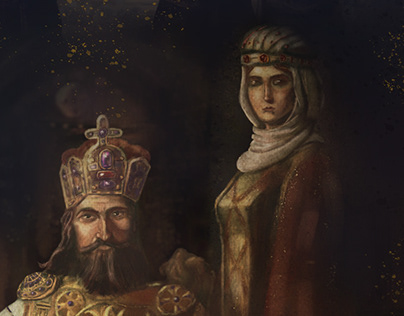
Byzantine History for Everyday People- Reactions to Quotes from Byzantine History by 5 Different People (Special Edition Article)

Posted by Powee Celdran

Pewton Foundation copy
Byzantine Time Traveller logo

Welcome back to the Byzantium Blogger! As for now, I will be taking a break from the overly lengthy and informative Byzantine Alternate History series as I have now completed the 3rd chapter of my 12-part series. To break my streak of consecutive Byzantine fan fictions, I have decided to come up with another special edition article that is basically a fun activity that also involves the history of Byzantium as I for this year, I had also planned on doing interactive articles wherein I get the chance to interview others on their thoughts on Byzantine history, and now looks like I have finally got the chance to do this! In this activity, I had shown my friends who aren’t so familiar with Byzantine history quotes by famous people of Byzantine history or from Byzantine era texts, asking for their own reactions to it in order to know how they see the world of Byzantium, and this article will be exactly just that. Surprisingly, a lot of them seemed like they totally got these quotes even if they were said centuries before our time but it was also no surprise that they did not get or had a very different interpretation of what some of these quotes said by these Byzantine era people centuries ago actually meant. This article will consist of 4 different quotes which is one from the 6th century emperor Justinian I the Great (r. 527-565), his wife Empress Theodora, from the military manual Strategikon by the emperor Maurice (r. 582-602), and from the speech of the last Byzantine emperor Constantine XI Palaiologos (r. 1449-1453) in his last moments before the fall of Constantinople and the Byzantine Empire itself on May 29, 1453. Now, Byzantium or the Eastern Roman Empire- or basically the Roman Empire itself continued- has a 1,100 year-long rich history full of fascinating and colorful figures, victories and defeats, wars and intrigues, and so much more and it was for these reasons that someone like me got so passionate about it and because of my now 2-year long unending passion for it, it was only fitting for me to ask some of my friends who keep wondering why I am so obsessed with Byzantium to read these quotes from the Byzantine era itself and see how they would react to them. I myself am not a Byzantine history scholar, academic researcher, or historian but only an entrepreneurship student that had suddenly come to the point of becoming so passionate about Byzantium that it became a part of my life and to further enhance my passion for it, I wanted to share it with my friends and a lot of others I know, who aren’t so familiar with it and for these reasons I have made this activity for these friends of mine, just so that they get themselves familiarized with the fascinating history of Byzantium. Now for this article, what I basically did- as you will see below- is that I listed 4 quotes and for each of them, I asked the same 3 questions “What is your understanding of this quote?”, “What message do you think it was trying to convey?”, and “What relevance, if any, does this quote have to today’s world?”, then afterwards I had asked all of them 2 bonus questions about what they think about Byzantium.  

The quotes as you will see will appear in this kind of large text font.

95t3yr5xvfyy
Flag of the Byzantine Empire

In order to further enhance my passion for Byzantine history and make it know to my friends and the rest of the world, I have created a number of social media accounts for my Byzantine history passion. Follow me, the Byzantium Blogger on social media:           

Instagram: @byzantine_time_traveller

Facebook: Byzantine Time Traveller

Twitter: Byzantine Time Traveller

Youtube: No Budget Films

Deviantart: Byzantium-blogger55

Patreon: Byzantine Time Traveller

Related Articles from my site The Byzantium Blogger:

Byzantine Alternate History Series Chapter III- Justinian the Great

A Review, Analysis, and Casting for the Graphic Novel Theophano: A Byzantine Tale

My Byzantine Journey (2019-2020)

War of the Sicilian Vespers: A Byzantine Epic

The Complete Genealogy of the Emperors of Byzantium


Before I move on to the Byzantine quotes and the discussion on them, I would first like to introduce the 5 friends- together with their ages put in a parenthesis () beside their names in which I have interviewed here. The 5 of them are between the ages 18 and 28. This article will feature the 5 of them and their reactions and understandings to these quotes that will appear below. All of these 5 people that will be interviewed here despite not knowing so much about Byzantium have already had some experience in Byzantine history related media as all 5 of them have had a part in the Byzantine history Lego epic film I had written, produced, and directed last year “War of the Sicilian Vespers: A Byzantine Epic” (2020), click the link below to watch it!

War of the Sicilian Vespers (2020), Lego Byzantine epic by No Budget Films

Miguel Abarentos (23)- He is a graduate of marketing (2019) and a former schoolmate of mine in college. Currently, he is a live streamer for PC games in his Twitchchannel HybridNinja wherein he does live streaming for PC games every Friday, Saturday, and Sunday. Miguel has also contributed to my films for my Youtube channel No Budget Films by sending me some footage of battle scenes from League of Legends which I have used for some of my films. He also voiced a number of characters for my Lego films, most notably the fictional Byzantine general Stephanos Raoul for both Lego epics Summer of 1261 (2019) and its War of the Sicilian Vespers (2020) and now continues to support my channel by streaming my films in his weekend live streaming in his Twitch channel. By getting to know me, Miguel has also started to be inclined to get to know more about Byzantium.  

159494090_256648762734271_8220642385336059185_n
Hybrid Ninja Twitch channel logo

Felipe Chuidian (28)- He is a graduate of entrepreneurship (2019) and a former schoolmate of mine in college. Felipe is a Play Station and basketball fan but also someone who is interested to know a bit more about Byzantium. Felipe has also contributed to my channel by voicing a number of characters for my Lego Byzantine films last year including War of the Sicilian Vespers and The Imperial Epilogue.

Mario Puyat (22)- He is currently studying film (2nd year) in the same college I study in and is a film and pop culture enthusiast. Mario is a big fan of the Star Wars, Marvel, and DC universes but when getting to know me, he somewhat had developed an interest for Byzantium as well. He also contributed a lot to my channel by being a co-producer for my 2020 Lego Byzantine epic War of the Sicilian Vespers wherein he also voiced its leading character Andronikos II Palaiologos who later became Byzantine emperor succeeding his father Michael VIII Palaiologos- who I voiced- and for the films follow up The Imperial Epilogue, Mario also reprised his role as Andronikos II, this time as an old man. In the future, Mario plans to direct films as well as write novels and movie scripts. (Instagram: @mariopuyatrewreplays)

Andronikos II
Real Emperor Andronikos II Palaiologos (left) vs Lego version (right), Lego character voiced by Mario Puyat

Geno Roy (21)- He is currently studying psychology (3rd year) though not in the same college as I am, though I have already known him for a much longer time. Geno is a big film and pop culture enthusiast as well as a photographer and has contributed a lot to my channel especially in my Byzantine Lego films by being the behind-the-scenes photographer for the Lego character pictures, while at the same time, he had also been part of the extra voice cast for a lot of my films. You can also see the pictures Geno took for my Lego Byzantine characters side by side with their respective historical characters on Bored Panda. (Instagram: @roy_geno)

Carlos Francisco (18)- He is currently a senior high school student who I have known for a very long time and has been contributing to my channel ever since 2016. Carlos is a very big fan of pop culture especially Marvel, Star Wars, and Cobra Kai but has also started an interest for Byzantium through me. He has made a major impact for my channel for a consecutive 5 years now as a co-producer, videographer, photographer, and set assistant for my Lego films and for my Byzantine films, he is notable for voicing the old monk and scholar character Georgios Doukas for the 2019 Lego Byzantine epic Summer of 1261 and its 2020 sequel War of the Sicilian Vespers. (Instagram: @itscarlosfrancisco)

69231634_2422795061301191_5687725778779766784_o
Lego Byzantine character Georgios Doukas, voiced by Carlos Francisco

The Quotes

Palaiologos_Dynasty_emblem1

I.          

The first quote mentioned here is one that came from perhaps Byzantium’s most influential emperor Justinian I the Great (r. 527-565) who’s name is synonymous with the Byzantine Empire. Justinian I- who was the main focus of my previous article- is best remembered for his ambitious projects in restoring the Roman Empire by retaking the Western Roman provinces of Italy, North Africa, and Hispania putting them back again under Roman control, from the imperial capital Constantinople.

100237-004-B5CB2808
Emperor Justinian I the Great of Byzantium (r. 527-565)

Justinian is one of the few Byzantine emperors whose legacy still lives up to this day as seen with the cathedral of the Hagia Sophia in Constantinople still standing today in its 6th century form built under Justinian and in legal matters, Justinian is best remembered for issuing the Corpus Juris Civilis or “Body of Civil Laws” in 529 which was to be the empire’s standard code of laws and it is still used up to this day as the basis for the legal systems of many countries. Justinian the Great ruled a total of 38 years seeing the Byzantine Empire at its greatest extent but his reign was one of constantly fighting against the odds wherein he faced a number of devastating wars, economic crisis, a pandemic known as the “Plague of Justinian” in 542, and several natural disasters but with his wisdom and strong rule, he was able to keep his massive empire together. This quote below is something Justinian the Great would have stood by which is something from his code of laws.

164650091_859002068277125_5240976597455791329_n
Quote by Emperor Justinian I

Freedom is the natural ability of everyone to do what he likes, unless it is prohibited by law or by force.

-Emperor Justinian I the Great

1-giantsalzenberg-1
The Hagia Sophia, built under Justinian I
Screen Shot 2021-03-21 at 12.38.07 AM
Detailed map of the Byzantine Empire at its fullest extent under Justinian I, 555 (gold)

Q&A

Powee Celdran (PC): What is Your understanding of this quote?

Miguel Abarentos (MA): This quote is a no brainer. It’s basically saying that we all have freedom in nature, and that rules and regulations restrict us from doing a lot of things. Like for example killing a person. Everyone is free to kill but rules say, you kill, you go to jail. Hence freedom is restricted.

Felipe Chuidian (FC): God gave us free will and intelligence. We have freedom to do anything for as long as we are not breaking laws of man and God.

Mario Puyat (MP): Everyone really has freedom to do what he/she wants even to please themselves. But if what they want is too harsh or mean, illegal, or abuses the idea of freedom than there should be some limitations.

Geno Roy (GR): Everyone is free to do what they want unless there are authorities that have the tendency to prohibit it.

Carlos Francisco (CF): You can do anything but there will be consequences or free will isn’t really free.

PC: What message do you think Emperor Justinian I was trying to convey here?

MA: That if you give humans too much freedom, there will be chaos. I can tell by the fact that he said “freedom to do whatever he likes”. Technically that also involves cruel things like killed, forced sex, and etc. with rules and regulations that put that to halt and I agree as of right now, we only have a degree of freedom but not to a full extent like a lion if they kill their kind, they would not be subject to human law.

FC: We enjoy freedom but we must also take into consideration others and most importantly our Creator.

MP: That everyone has freedom to do what they want, but if it will lead to danger or something harming the law then that is a bad form of freedom, or abusing freedom.

GR: Everyone can be free unless there are prohibitions that start.

CF: That people are under a rule.

PC: What relevance, if any, does this quote have to today’s world?

MA: Yeah, it does! So easily, remove rules and regulations and give humans full extent of freedom, oh boy!

FC: In today’s world where everyone does what gives pleasure, it is important to realize that we are accountable for every action we do.

MP: It has relevance with maybe speaking out anything political.

GR: The relevance it would have in today’s world would be all citizens can be free to do what they want to do in the country but they have to follow the governments orders.

CF: That there’s still rules to follow.

12-Emperor-Justinian-Enters-hagia-sophia-credit-hellenic-world-foundation
Justinian I enters the Hagia Sophia for the first time, 537

Watch Dovahhatty’s episode on Justinian the Great here:


II.         

The next quote here is this time from Emperor Justinian I the Great’s wife Empress Theodora (500-548), originally an actress of low birth who later fell in love with Justinian who was 17 years older than her before he became emperor. Despite having humble origins- and so did Justinian- together with her husband, they were strong and decisive rulers. Theodora’s strong personality by solving a problematic situation by force happened in a fateful event in 532 when the chariot racing political factions of the Byzantine Empire, in the imperial capital Constantinople turned on Justinian for his reforms which seemed unpopular for them becoming what would be known as the Nika Riot as the rioters shouted “Nika!” meaning “conquer” in Greek.

11th4
Empress Theodora (center) with her court ladies

Each day the riots got worse and worse turning into total violence and destruction as the rioters burned their way through the capital destroying several important landmarks. Justinian thought the situation was hopeless as the rioters proclaimed another man named Hypatius as emperor and so he thought that they must flee the palace and possibly retake the capital but Theodora stepped in with a speech encouraging Justinian to send the army to mercilessly kill the rioters in order for the couple to remain in power and at the end, Justinian listened to her and 30,000 rioters were killed, thus the couple was spared and had remained in power. This rather complicated speech by Empress Theodora which these 5 people will react to says, which however only 2 out of the 5 have had something to say about it.  

My lords, the present occasion is too serious to allow me to follow the convention that a woman should not speak in a man’s council. Those whose interests are threatened by extreme danger should think only of the wisest course of action, not of conventions.

In my opinion, flight is not the right course, even if it should bring us to safety. It is impossible for a person, having been born to this world, not to die; but for one who has reigned it is intolerable to be a fugitive. May I never be deprived of this purple robe, and may I never see the day when those who meet me do not call me empress.

If you wish to save yourself, my lord, there is no difficulty. We are rich; over there is the sea, and yonder are the ships. Yet reflect for a moment whether, when you have once escaped to a place of security, you would not gladly exchange such safety for death. As for me, I agree with the adage that the royal purple is the noblest shroud.

-Empress Theodora, 532

242441830_orig
Theodora convinces Justinian to crush the Nika Riot, 532

Q&A

PC: What is your understanding of this quote?

MA: I actually have no idea what to say about it aside from gender double standards that a woman can’t be in a man’s position and then there is also reference of financial status that the rich should live and the poor should not.

FC: The one speaking is a woman, who in her time is forbidden to speak up. She is not free to express herself but she finds it vital to make a statement especially for those who do not have a voice.

MP: (no answer to this particular quote)

GR: (no answer to this particular quote)

CF: (no answer to this particular quote)

PC: What message do you think Empress Theodora was trying to convey here?

MA: She (Theodora) would rather die as a royal than get dethroned and live because at least you die a high status instead of living as a low status.

FC: She sees the need to fight and not to flee.

MP: (no answer to this particular quote)

GR: (no answer to this particular quote)

CF: (no answer to this particular quote)

PC: What relevance, if any, does this quote have to today’s world?

MA: It seems to only be relevant to arrogant rich people. Honestly, at least that’s what it feels like.

FC: In today’s world, we need to take courage and not be afraid even if it costs us our lives.

MP: (no answer to this particular quote)

GR: (no answer to this particular quote)

CF: (no answer to this particular quote)

jane-f-ashley-commission-high-high-res
Empress Theodora artist’s rendition (art by JaneArts)
a0e5aca1e509949719f5668d49071792
Justinian and Theodora inspect the aftermath of the Nika Riot, 532

III.           

This next quote is from the military manual known as the Strategikon of Maurice, one of the best sources for Byzantine battle tactics and military formations. This military manual was written in around 600, though it is debated whether it was written by the emperor Maurice (r. 582-602) or just attributed to him but considering Maurice being a soldier emperor and in fact the first emperor to actually lead his troops in person in over 200 years since Emperor Theodosius I (r. 379-395), it is most likely Maurice wrote it.

09788e89a9b048ff3afd6c7f3844adb4
Maurice, Byzantine emperor (r. 582-602)

The Strategikon was made to codify new battle tactics developed in this era of constant war and emergence of new enemies unknown to the Romans before and it consists of 12 chapters which focus on specific topics relating to war such as formations, ambushes, baggage trains, training drills, strategies for generals, military maxims, instructions for sieges, surprise attacks, and most importantly the characteristics and battle tactics of the enemies the Byzantines fought in the late 6th and early 7th centuries such as the Franks and Goths of the west, Avars and Slavs of the north, and Sassanid Persians of the east. This book makes a point that in order to defeat an enemy, you must know their culture and battle tactics and part of this suggested that it was best to fight the Slavs across the Danube by attacking them during winter, and though this may be a successful tactic in repelling the Slavs, this caused the emperor Maurice his downfall being an unpopular instruction to his soldiers which led to them to rebel in 602 thus deposing and executing Maurice and his sons.

61YSTzYsCcL
The Strategikon of Emperor Maurice

The Strategikon may have been successful in helping the Byzantines fight several enemies that raided the highly exposed borders of their massive empire at this time but little did the Byzantines know then that soon enough they would face an unlikely enemy from the desserts of the south, the Arabs which the Strategikon makes no mention of their fighting styles and true enough the Arabs did expand so greatly that they have been a constant pain for the Byzantine for the next 3 centuries almost bringing an end to Byzantium. Though Byzantium was to face the fatal threat of the Arabs, the Strategikon true enough still proved to be an effective manual for battle tactics for the next centuries of the empire’s existence, especially since the Byzantines no doubt had to keep fighting wars without end which they became known for, yet they fought smart thanks to the instructions of the Strategikon. One quote from this manual which is a good glimpse on how the Byzantine armies fought smart, meaning staying in formation and not charging out courageously, in which the 5 of the interviewees will respond to says:

Do not fall back, do not advance ahead of your standard. This is what a brave soldier does. If you leave your standard, you will lose. Do not charge out impetuously, do not break ranks.

-Strategikon of Maurice

1200px-40-manasses-chronicle
Manuscript of Maurice’s Strategikon

Q&A

PC: What is your understanding of this quote?

MA: As a soldier, don’t push your limit. Don’t play like you’re an experienced general. Always play it safe.

FC: It means soldiers are being advised to stand their grounds.

MP: I guess don’t retreat, don’t go ahead, go at the same pace as your fellow soldiers. Go together.

GR: Always stick to any standard that you have so that you can be more dominant as you go on.

CF: Balance your behavior, or balance is the key.  

PC: What message do you think the Strategikon of Maurice was trying to convey here?

MA: It feels more like you’re being told to know your place in order to live but at the same time, don’t look down on yourself, hence the “do not fall back”.

FC: Simply bravery meaning following orders.

MP: About being and charging together amongst your fellow soldiers and not going alone. Pretty much teamwork.

GR: To always show strength as a soldier.

CF: There is no good or bad.

PC: What relevance, if any, does this quote have to today’s world?

MA: It is for people who think they can suddenly surpass an experienced individual.

FC: In today’s word, we are asked not to lower our standard otherwise we lose.

MP: If people want to rebel or fight back like to their government or anyone else, it would be together, not alone.

GR: People should have standards to increase their confidence in today’s world.

CF: It is relevant when it comes to situations like balancing moods.

training_instructors_in_later_roman_army_by_amelianvs_dddtxcp-pre
Early period Byzantine soldiers in training (art by Amelianvs)

Watch the latest animated documentary on Maurice’s Strategikon by Kings and Generals here.


IV.           

This last quote for this article is an excerpt from the final speech of the Byzantine Empire’s last emperor Constantine XI Palaiologos (r. 1449-1453) addressing his soldiers on the early morning of May 29, 1453, the day the Byzantine Empire ended as Constantinople fell to the army of the Ottoman Turks led by their sultan Mehmed II.

6cfb5aef00ff17da9cafd705b3c673d2
Emperor Constantine XI Palaiologos (r. 1449-1453), the last Byzantine emperor

The Byzantine Empire survived centuries of wars and new enemies one after the other invading thus weakening their empire and out of all the enemies they faced from the Persians, to the Arabs, Bulgars, Rus, to the Seljuks, and Crusaders, the one that would spell the end for the Byzantines were the Ottoman Turks. In the last years of Byzantium, the Ottomans rapidly grew their empire in Asia Minor before expanding into Europe and true enough they had expanded all the way deep into the Balkans leaving Constantinople alone but still, Constantinople was the ultimate prize and by the 1450s it was definitely possible as the 1,100-year-old capital, Constantinople was already surrounded by Ottoman territory. The young Ottoman sultan Mehmed II came to power in 1451 and was totally driven to begin his reign by taking Constantinople and to do this, he first simply asked the reigning Byzantine emperor Constantine XI if he could easily surrender the city but the emperor refused as knowing the end of Byzantium was inevitable, he would rather end it in a more honorable way by putting up a fight rather than shamefully surrendering thus Mehmed II launched a massive attack on Constantinople’s impregnable walls fating back to the 5th century which here 1453 proved ineffective against the cannons the Ottomans had built.

8fea05d0747495a8f59b4f190fd7d0b6
Ottoman sultan Mehmed II captures Constantinople, May 29, 1453

Constantine XI with only 7,000 men in which only 2,000 were Byzantines and the rest being Italian and other Western European (Latin) mercenaries strongly resisted the Ottomans for over 2 months but the end was true enough unstoppable. Constantine XI knowing the end was to come, as recorded by his advisor George Sphrantzes, made an encouraging speech thanking all his soldiers, both local and foreign for their support, and reminding them all they are fighting and dying for a noble cause, the great legacy of the 1,100-year Byzantine Empire. This excerpt from this famous speech in which the 5 interviewees will respond to says:

Consider then, my brothers and comrades in arms, how the commemoration of our death, our memory, fame and freedom can be rendered eternal.

-Emperor Constantine XI Palaiologos, 1453

ern-mediterranean-1450.svg_
Remains of the Byzantine Empire (purple) in 1450
DeYQUL6V4AEsUJ6
1453, the final siege of Constantinople and fall of Byzantium to the Ottomans

Q&A

PC: What is your understanding of this quote?

MA: Basically, even though their bodies are mortal and will die, their accomplishments are immortal and will be forever recorded in history. I would say “if I will die, I am going to die historic”.

FC: The person (Constantine XI) here is like a soldier telling his comrades that their death will be considered everlasting.

MP: It’s like how his teammates or fellow soldiers in arms when they reach their death, the memory of those soldiers and their fame and freedom that came with them will always be with them. So, when they die, everything they had including their love, memory, fame, and freedom died with them. They weren’t alone.

GR: This quote talks about how people can strengthen their eternity.

CF: When one ends, the other begins.

PC: What message do you think Emperor Constantine XI was trying to convey here?

MA: That our accomplishments will never be forgotten.

FC: I think that when saying it, Constantine XI was ready to die.

MP: They weren’t alone when they died, since they were buried with their love, memory, fame, and freedom.

GR: That it is essential to depend on eternity.

CF: With everything, I (Constantine XI) will have a legacy.

PC: What relevance, if any, does this quote have to today’s world?

MA: To motivate people into leaving a mark in the world, so even when they die, they will not be forgotten for what they did

FC: We need not be afraid to die if we have lived well.

MP: If people die or get put in jail for what they did, they did it with honor.

GR: Our freedom can always lead to eternity.

CF: A lot of legends nowadays are gone but their legacy will be honored.

image
Last moments of Emperor Constantine XI, May 29, 1453
045a1930362e7e2baba2d539034d4b98
The Ottomans capture Constantinople, May 29, 1453

Watch this video from Eastern Roman History to get the full final speech of Constantine XI Palaiologos in 1453.


Bonus Questions

Palaiologos_Dynasty_emblem1

PC: Would you imagine yourself living centuries ago in the age of the Byzantine Empire? If yes, then how do you think your life will be living in those times?

MA: I am not sure, based on my personality, I don’t think I would be fighting in the olden militaries.

FC: No, because I don’t think I would be able to survive fighting with war and I wouldn’t really go around the world that frequently.  

MP: Not really, I wouldn’t imagine myself in those times.

GR: No.

CF: Nope, I can’t imagine that, sorry.

34962618_1964194973615080_3487405919845744640_o
Life in Byzantine Constantinople (art by Amelianvs)

PC: Would the 1,100-year history of the Byzantine Empire which includes epic battles, civil wars, political intrigues, interesting emperors and empresses, and fascinating cutting-edge inventions be something of interest to you?

MA: Yes, it would be, if someone were to make a movie put of it, I wouldn’t mind giving it a watch

FC: Yes, it would be something of interest to me. I would also like to know more about these things.

MP: Maybe the Romans with their battles but not the Byzantines even if they are more or less the same.

GR: Yes, if ever I travel to a European country, it would be a pleasure for me to be familiar with them.

CF: Yes, these kinds of things make history more interesting. It gives us new ideas and thoughts of things in life.  

140998458_10158821923060795_1822959595171962627_o
Byzantine armies- Cataphract cavalry (art by Ana Cagic)
153630594_2526551854306086_573671900463645925_o
Byzantine art recreated- Emperor Andronikos III Palaiologos (r. 1328-1341) and his wife Empress Anna of Savoy (art by Powee Celdran)

And now as the Q&A section with my 5 friends has come to an end, let me now share you my own thoughts and reactions these said quotes by these famous Byzantine era people. For the first quote said by Justinian I, I surely agree that we all have free will but there must be something like the law control it because our free will can sometimes go out of hand. As for the speech of Theodora, like the rest of my friends, I agree it is a complicated passage but from my understanding I would say that it totally makes sense that when faced with a difficult situation, yet you want to get through with it, you must act on it quick and with force and just like Theodora I agree that it is better to die free or doing what you like or in Theodora’s case die as ruler rather than live in fear or in Theodora’s case live your life in defeat. For that particular quote from Maurice’s Strategikon on staying in formation, I would totally agree that this quote best defines Byzantine military tactics as for them winning battles meant staying in formation and fighting in an orderly and disciplined manner and not by striking first or heroically and sometimes this quote makes sense especially when it comes to teamwork done in group projects. Now with the last quote, I only chose to use one part from Constantine XI’s final speech in which I think is the most touching part of this dramatic speech as in that part, I could see how he sees that even if they are dead, the legacy of their empire will live on and from this particular part of his speech, I can totally relate to it because people even when long gone will be remembered forever like Constantine XI and when saying this speech, he could already see his future long after his death as even though he and the Byzantine Empire are gone, his bravery and sacrifice displayed in the final battle against Ottomans would remain one of the most remembered moments not only in Byzantine but world history as one of history’s most dramatic last stands. On the other hand, I would say that my friends who are not very familiar but starting to get to know something about Byzantium have actually got a good understanding of the gist of these quotes from Byzantine times even if they might have not completely and thoroughly understood the full context of them. As for the bonus questions, they have no relation to the 4 quotes mentioned above, but before finishing off I thought of asking them these questions as a way to test if they surely know the Byzantine history I always talk about and to know if they actually are interested to learn about it. It was quite a surprise to me that these 5 friends even if they have no previous experiences with Byzantine history and rather live in their own worlds that they have some kind of inclination to get into Byzantine history that was I did and so I recommended a few sites to check out online as well as Facebook groups focusing on Byzantine history for them to join as well as videos on Byzantium to watch in my channel No Budget Films as well those from Eastern Roman History, or my favorite one Dovahhatty and also to listen the very well researched and written History of Byzantium Podcasts. These sites include the likes of The Byzantine Legacy, Byzantine Tales, and Byzantine Real History as for the FB groups, these include Roman and Byzantine History and Byzantine Real History (BRH) which they took into consideration as well.        

byzantium-1
Constantinople, Byzantine Imperial capital

And now I have come to the end of this special edition interactive article. When reading this, you could now see that the reason for it was not just to break the streak of the lengthy and expansive short stories featuring the endless universe of Byzantine history but to again reconnect with my friends. For the past 3 months, ever since I started my Byzantine history Instagram account, followed by my Facebook page, then Patreon, then Twitter, life has been very busy nonstop posting Byzantine history content online which includes my blog articles written in the past months in order to grow my online accounts to increase awareness on the forgotten yet fascinating history of Byzantium. Along the way, I have met- only virtually and not personally- many great friends from different countries who also have a fascination with Byzantium but in the process, I also did not want to leave my friends who I’ve known for much longer behind as well as my old interests and hobbies in pop culture prior to my Byzantine interest so the best solution I came up with to both stay on track on my Byzantine journey yet still reconnect with my old friends was to get them a bit involved in Byzantium; hence this activity was created. Again, I have to say that I am surprised that my friends who live in their own worlds actually feel some kind of inspiration to like Byzantine history and I certainly appreciate that. On the other hand, when doing this article, I have also come to discover when reading through these said quotes and my friends’ responses to them that a lot of what has happened in Byzantium and what we have learned from these people back then do still have some relevance in today’s world. The Byzantine Empire may be long gone but its legacy still lives on and this include the wise words said here that we can still take into consideration and true enough what Constantine XI said in his final speech about their legacy living on throughout the centuries, it is truly evident. Now, as the first quarter of 2021 comes to an end, I have also made this article to mark the end of the first quarter and beginning of the second, so this means at every end of a quarter, I would definitely come up with other interactive special edition articles like this featuring interviews with friends or other Byzantine history enthusiasts. Well, this is all for this special edition article and before I finish off, I’d like to thank my 5 friends for handing over some of their time to be interviewed about their thoughts on Byzantium for this article and of course I would like to thank all of you viewers for reading this and I hope you got what my friends were saying here! This is Powee Celdran, the Byzantium Blogger, thank you all for viewing!    

Byzantine Alternate History Chapter III- The Empire Strikes Back; Justinian the Great Saves his Empire from the Plague and Personally Joins his Campaigns

Posted by Powee Celdran

DISCLAIMER: Although this is mostly a work of fiction, it is largely based on true events and characters. It seeks to alter the course of actual events that transpired in the 6th century AD. This story will begin with events that have happened in real history but will become fictional as it progresses. This will be an extremely long article!

Previous Story: Byzantine Alternate History Chapter II- 5th Century
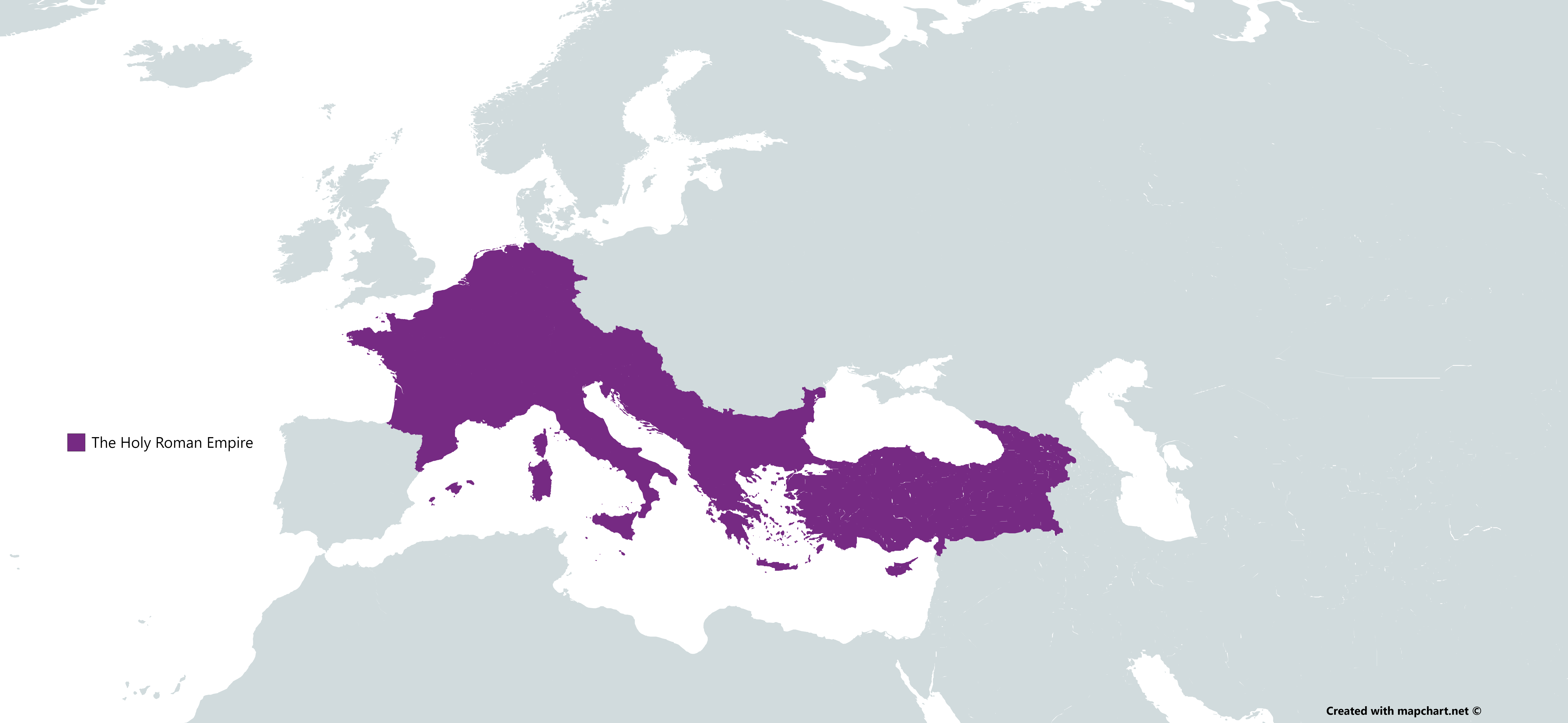
Keep cool and you will command everyone” -Emperor Justinian I the Great (482-565AD)

2f1c608066438c072614c5033855489c

Welcome to the third chapter of the Byzantine Alternate History series by the Byzantium Blogger! Last time, in chapter II of my alternate history series, I discussed the events leading up to the Fall of the Western Roman Empire in the late 5th century (476 AD) and how their twin empire, Eastern Roman (Byzantine) Empire played a part in the western empire’s story. At the same time, the previous chapter discussed a lesser-known event in the year 472 that could have helped save the Western Roman Empire from meeting its end just 4 years later, which would be if the last competent Western Roman emperor Anthemius was not killed off in 472 like in real history. The last article too discussed a possible scenario of an epic world war between the two Roman Empires and their foreign allies against a massive Barbarian Alliance. However, for this new chapter of the alternate history series, again as I said about the background of this series I am making, there will be no continuity from the previous story to this one, so this story will begin with real history taking its course wherein the Western Roman Empire actually fell in 476 leaving the Eastern Roman Empire as the only surviving Roman Empire, now better known as the “Byzantine Empire”. Also keep in mind that this article will be very long because it will cover possibly the most eventful reign in Byzantine history, which is that of its most influential emperor Justinian I the Great. This story will be set in the 6th century AD, where under Emperor Justinian I the Great, the Eastern Roman (Byzantine) Empire would be at its greatest extent when North Africa, Italy, and Southern Spain for a time returned to Roman rule from Constantinople, the eastern empire’s capital after they have for a time fell to the hands of several barbarian powers. The Eastern Roman Empire on the other hand was never expected to regain the lost western provinces, but this would soon enough become possible when Emperor Justinian I came to rule the eastern empire in 527 though at the same time, his reign was not all victory and imperial glory as we all remember, as it was also one of military and natural disasters but as a capable ruler, Justinian managed to face all the odds and die ruling the massive empire he had dreamt of. It is also timely that I wrote this article because as the COVID-19 pandemic is happening right now, this story will cover the pandemic back then known as the “Plague of Justinian” in 542 which was named after Justinian himself who in fact was a victim of it but had survived it. Also, just recently, my favorite history related Youtube channel Dovahhatty just released his full feature video on Justinian the Great, and I should say that this story will be based a lot on Dovahhatty’s retelling of Justinian and his personality as he sees it. Now, Byzantine history cannot be told without telling the story of its most influential ruler Justinian the Great (aka. Flavius Petrus Sabbatius) who is one of history’s few rulers that came from humble origins but has left behind a very strong legacy in many aspects that are still live on up to this day and some of his greatest legacies include the complete codification of Roman law that still lives on to this day as the basis for the legal systems most countries use and the impressive structure of the Hagia Sophia in Constantinople built in the 6th century which is still in its full form today. Having achieved so much in his lifetime, Justinian would not only be remembered as “the great” but as an Orthodox saint as well for doing his part to defend the faith and expanding an empire in the name of Orthodoxy.

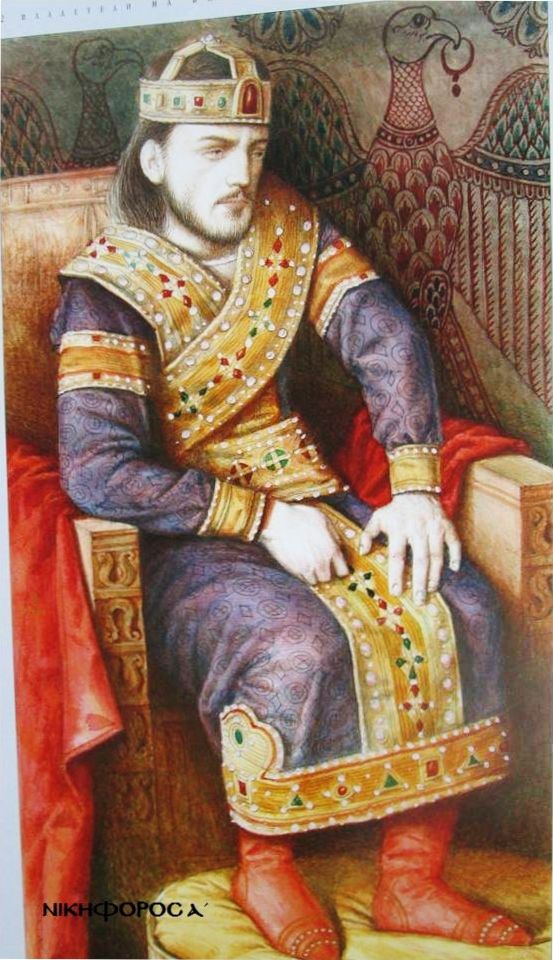
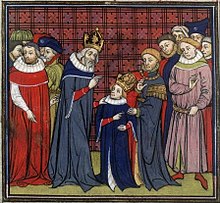
100237-004-B5CB2808
Emperor Justinian I the Great of Byzantium (r. 527-565)

As emperor though, Justinian’s greatest feat was the carefully planned reconquests of the lost Western Roman provinces through his policy of what is known as “Intervention Imperialism” or finding reasons to justify the conquest of a place especially if it had to do with defending the Orthodox Christian faith, which this story will be covering a lot of, together with the men responsible for his victories which were particularly his generals Belisarius and Narses, but at the end were all of Justinian’s ambitious conquests of North Africa, Italy, and Hispania worth it? In real history, despite these lands once again returning to Roman rule, it did not really last long as while Justinian was ambitiously masterminding the reconquest of the former Western Roman provinces, another war was being fought in the east with the empire’s long-time mortal enemy, the Sassanid Persian Empire and after Justinian’s death in 565, no matter how much lands were conquered it would be all downhill from here as the empire would undergo a chronic war with the Sassanid Persians in the east and face new enemies raiding into the empire from the north such as the Slavs, Avars, Lombards, and more. Others blame Justinian for the downfall of the Byzantines’ imperial power due to his overly ambitious reconquests that drained the empire’s economy thus weakening it, but I would say it was not entirely his fault because there were things that happened which could not be controlled by Justinian no matter how powerful and talented he was, for instance the plague in 542 which undid most of his hard work and almost destroyed the Byzantine economy. Justinian too was one of a one of a kind exceptional ruler and only he could manage a very large empire no matter the odds while his successors were not as capable as he was. Not to mention, Justinian too, if considering all the Byzantine emperors until their end in 1453 as “Roman emperors”, he would be the last Latin speaking Roman emperor, which leads some to say that the age of Imperial Rome ended with him. In this story however, I will try to change the course of history by creating a fictional scenario of Justinian as emperor finding solutions to fight the plague of 542 by using it as a biological war to destroy the constant headache of the Sassanid Empire in the east since in the entire history of Rome’s wars against the Sassanids, there was no way the Romans could win by military force so I believe that if a biological war was used through the plague against the Sassanids, then the Romans (Byzantines) could end up victorious giving them more time to totally focus on their reconquests of the west. In addition, this story will also tackle one of Justinian’s mistakes which was not properly naming his successor. At the same time, Justinian no matter how energetic and hard-working he was as emperor earning him the title “the emperor that never slept” was a complete “palace emperor” who never left Constantinople in his reign no matter how much his empire expanded, but here I believe that if Justinian took part in his own ambitious conquests himself and got to know his nephew and successor Justin II a bit more by personally training him in his military campaigns in Italy, then then I believe that empire would stand stronger after Justinian’s death. Coincidentally, since this story is about how Byzantium strikes back to regain the west, it was fitting that I used the same title as Star Wars Episode V “The Empire Strikes Back” (1980). Now, if Justinian I was able to control the plague, train his own successor, and join his own military campaigns, would the Golden Age of the Byzantine Empire he worked so hard to attain still live on?     

95t3yr5xvfyy
Flag of the Byzantine Empire

Follow me, the Byzantium Blogger on Social Media: 

Instagram: @byzantine_time_traveller

Facebook: Byzantine Time Traveller

Youtube: No Budget Films

Twitter: @ByzantineTime

Deviantart: Byzantium-blogger55

Art Station: Powee Celdan Porphyrogennetos

Patreon: Byzantine Time Traveller

Note: Since this story is set in the 6th century following the fall of the Western Roman Empire, the Byzantine characters will be now referred to as Byzantines, not Romans.
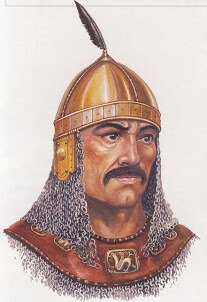
Justinian555AD
The Byzantine Empire at its greatest extent by 555 under Emperor Justinian I the Great
78464035_707997939606101_8485343853350486016_n
Byzantine era Constantinople, capital of the empire

This article here is the first story in this 12-part series wherein I am working in collaboration with another fellow Byzantine history enthusiast and in this case, I put together this story with the help of my friend, an Instagram user who prefers to call herself Justinianus Byzantinus (follow her on Instagram @justinianusthegreat), a Byzantophile or enthusiast of Byzantine history, but more significantly as her username and Instagram profile pic suggests, she is an enthusiast of Emperor Justinian I the Great and his ambitious project known as the Renovatio Imperii or “Imperial Restoration” in Latin as stated in her bio. To give a brief background of Justinianus, she has been a fan of Byzantine history ever since the age of 15 and is currently 19 and a student of chemistry, but her true passion is Byzantine history and art. Aside from being a Byzantine history enthusiast, Justinianus is also an artist who makes illustrations of Byzantine characters in her own style, both through handmade drawings and digital art using the software Ibispaint; her artworks of 6th century Byzantines such as Justinian I will appear in this article too. Justinianus too dreams of being a Byzantinist in the future and to visit the places on earth where the Byzantine legacy is very strong including Turkey, Greece, and Italy.
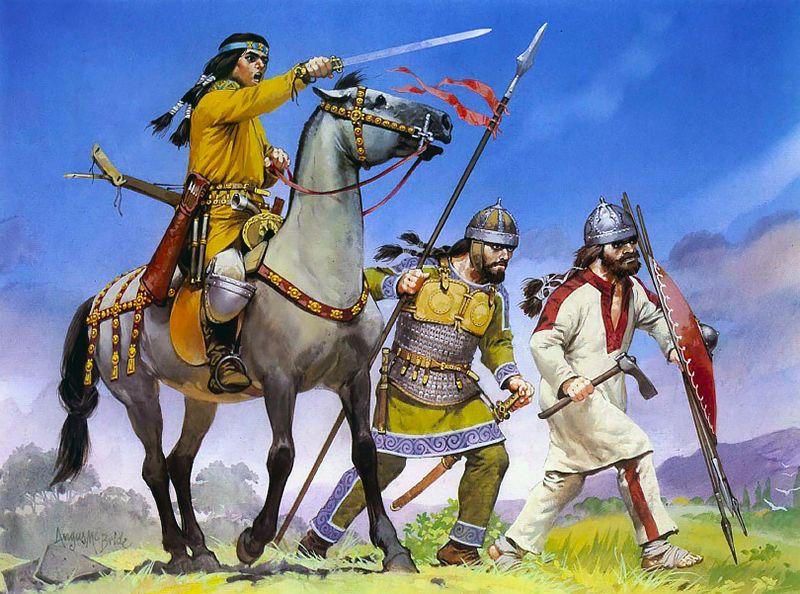
Similarly, what we have in common is that we are both young in age and not academics or historians but we share a strong passion for Byzantine history and want to create some buzz for it, and I am honored to do my very first collaboration article with her. When starting my Byzantine history Instagram account Byzantine Time Traveller very early this year, Justinianus was one of the first to follow me and apparently it had turned out that we see Byzantine history in the same way which is more or less a strong passion, so we came to work together in creating this story by doing our own role-playing of 6th century Byzantine history through Instagram chat for the past month and a half, and here in this role-playing chat, she played as Justinian the Great himself and as I should say, she totally gets into his character very well, so the cool-headed and wise yet scheming personality and unknown side of Justinian that this story will tackle will be more or less her take of it. This alternate history story was created in our Instagram role-playing, as here in this story there will be events that did not happen in real history, most notably an elderly Justinian joining his military campaign in Italy himself while at the same time in this role playing, Justinianus had filled in the gaps by telling the unknown stories of Justinian’s own origins story, private and family life, and source of his ambitious dreams in both hers and my own point of view and since history does not record much about Justinian’s early life as well as private life, this fan fiction story will do just that even if it may not entirely be accurate to real history, just as how Dovahhatty told it in his most recent video. Our role-playing scenario will take place in the second half of this story set in Justinian’s later reign beginning in the year 550AD following the death of his beloved wife, Empress Theodora wherein Justinian from the hopeful and ambitious emperor he was earlier on in his reign becomes a bitter and sad old man thinking all his hopes were crushed especially due the recent plague until meeting a mysterious general and former wrestler named Andreas who will inspire Justinian to join in the conquest of Italy from the Ostrogoths together with the generals Belisarius and Narses as the conquest of Italy nears its end, and almost coming into a victory for the Byzantines. This story though will begin giving a background story to Justinian, his rise to power, and his early reign which will mostly be all based on historical facts, then it will proceed to the main part which will be on the Plague of Justinian beginning 541, thus the climax will begin in the year 550 when the plague is still around, but at least Justinian has managed to control it, and to get himself over the grief of losing Theodora, he decides to join his army in Italy together with his nephew Justin who he decides to train to be his successor as he is the only choice left as Justinian’s intended heir which was his cousin Germanus had just died. Overall, this story is more of a fan fiction re-write of history than a what-if story but it also includes a number what if scenarios, especially if Justinian properly trained his nephew who would eventually succeed him and the what if of Justinian using his own intelligence to destroy his mortal enemy being the Sassanid Empire with the plague. The age old problem of succession was surely something that eventually ruined the great legacy Justinian worked so hard on as in real history, he did not properly name his successor so instead the throne was left to his nephew Justin, his sister’s son who lacked the experience in running an empire while at the same time was hot headed, but the worst part was that in 565 when coming to the throne, he inherited an extremely massive empire when having no experience in ruling it and as emperor Justin II’s own impulsive actions led to the war against the Sassanids in the east resuming when refusing to pay tribute to them, thus all the war and pressure of running an empire made him insane due to his lack of ability in riling that he had to abdicate, thus Justin II’s reign ruined everything his uncle worked so hard on. Now if Justin II was only properly trained by no other than his uncle Justinian the Great who would give him the advise “stay cool and you will command everyone”- as the quote by Justinian himself says right at the top of this article- then I believe he would have been as great as his uncle in ruling the empire, thus this story will rewrite history that way.

Screen Shot 2021-03-21 at 12.38.07 AM
Detailed map of the Byzantine Empire at its fullest extent under Justinian I
144396598_412890186648137_2221843938853085856_n
Guide to the late Roman army’s structure; this article contains a lot of terms of late Roman army units, art by myself

Related Articles from The Byzantium Blogger:

Byzantine Alternate History Chapter II- Preventing the Fall of the Western Roman Empire 4 years in Advance

The Art of War in the Byzantine World

12 Turning Points in Byzantine History

Around the World in the Byzantine Era Part1 (330-1000)

The Story of 3 Plagues Across Centuries

Natural Disasters in Byzantine History

Constantinople: The Queen of Cities and its Byzantine Secrets

The Ravenna Mosaics and What to Expect

10 Inventions from the Byzantine Empire

Justinian the Great Related Videos:

Unbiased History: Byzantium I- The Eastern Empire (Dovahhatty)

Emperor Justinian I (Thersites the Historian)

Justinian I’s Wars (Thersites the Historian)

Justinian the Great: Reconquest and its Legacy (Eastern Roman History)

Watch Dovahhatty’s Justinian the Great episode here.

This story will be extremely long as it spans the entire reign of Justinian I which was a total of 38 years and more. Justinian was 45 when he became emperor in 527, and 83 at his death in 565, something very unusual for people at their time. This story will be basically focusing on Justinian I as its lead character while it will go in detail as well in going through his thoughts and personality which a lot of it happens to be missing in real history and in addition, this story too will contain some flashbacks of his earlier life told in his perspective. As the main character of this story, Justinian is surely a fascinating character to write about as despite coming from humble origins as a simple peasant in the Balkans born as Flavius Petrus Sabbatius in 482, he had a dream that he never let go of which was not only to be an emperor but to be the best and have a great legacy worth remembering up to this day, and no matter how much odds he faced in his reign including a devastating pandemic that nearly destroyed his empire’s economy, a prolonged endless war to retake Italy, and a large number of natural disasters, he was able to achieve so much.

257424989_2703486683279268_191912534609225056_n
Emperor Justinian I the Great, acrylic painting, art by myself

Though Justinian is this story’s lead character, his nephew and successor Justin II will also play a major part in the story’s second half since a lot are not very familiar with the man who directly succeeded Justinian to the throne and here, Justin would be at first the stereotypical young, hot-tempered, and ignorant man who will go through a journey to be trained to become a wise and strong leader like his uncle by his uncle Justinian himself. History though does not mention what kind of relationship Justinian had with his nephew Justin but this story will do its best to tell that part of history (in a highly fictionalized form). This 12-part series too includes a fictional or unknown historical figure who will have a story built around him right in the middle of all these events, and here it will be Andreas, who appeared in real history as a Byzantine wrestler and soldier serving the general Belisarius back in the Sassanid War of 530 and though history does not mention what happens to Andreas after, in this case he rises up to become a general and personally fights with Justinian himself in the case of this fan fiction when Justinian himself goes over to Italy and in our role-playing, I had the chance of playing the character of Andreas as well as Justin II. Famous people of this age such as Justinian’s wife Empress Theodora, the generals Belisarius and Narses, the Ostrogoth king Totila, the Sassanid ruler or shah Khosrow I, and the contemporary historian Procopius will be covered and so will their back stories. The historian Procopius, who was a Byzantine senator and secretary of the general Belisarius meanwhile is another interesting figure being a man with two sides as at first he wrote two books- Wars and On Buildings recording the reign of Justinian I in such great detail with such great praise for him and his administration but at the same time, he secretly he wrote his book The Secret History which totally slanders the image of Justinian as an incompetent and insane ruler while at the same time exposing his wife Theodora’s life as an actress and her sex scandals exaggerating her as a former prostitute. In this case, just like in Dovahhatty’s most recent video, Procopius for ruining his emperor’s image out of pure envy will be this story’s villain together with the Ostrogoth and Sassanid rulers Totila and Khosrow I as Justinian is the protagonist, but no matter how much Procopius has tried to destroy Justinian’s reputation, his works remain a very valuable source of this era and Justinian’s reign as well as on the history of the late Roman age for the Eastern and Western Roman Empires. This story will be more Byzantine centric despite covering some of the happenings with the Ostrogoths of Italy, Visigoths of Spain, and Sassanid Empire, though at the same time it will be a mix of the genres of adventure, drama, comedy, romance, politics, and war and though no matter how detailed this story will go in the characters and their lives, I would not bother too much in explaining the political structures of the time, such as the imperial system of Byzantium and the names of the provinces of the empire. And of course, I have to say that when it comes to writing an alternate history story for 6th century Byzantium, it is impossible not to do this story of Justinian I as 6th century Byzantium was literally dominated by Justinian I and no one else but in the wider world, I’d say the 6th century was a very challenging time with so much happening especially since this is when Western Europe entered the Dark Ages while Byzantium stood at its finest as the bastion of Greco-Roman civilization. Additionally, Byzantine history cannot be told without Justinian as literally whenever people hear of Byzantium, Justinian I would be the emperor that would come into everyone’s minds, thus this story would have to be a very long and highly detailed one.   

Justinian Dynasty main
Guide to the Justinian Dynasty of the Byzantine Empire, 518-602, art and layout by myself


The Leading Characters: 

Justinian I- Byzantine emperor

Justin II (the Younger)- Heir apparent and future Byzantine emperor, nephew of Justinian I

Flavius Belisarius- Byzantine general

Narses- Byzantine eunuch general

*Andreas- Byzantine general and former wrestler (real named character but with not much story, his story will be expanded here)

Theodora- Byzantine empress, wife of Justinian I 

Vigilantia- Sister of Justinian I, mother of Justin II

Procopius of Caesarea- Chronicler of Justinian I’s reign, secret antagonist 

Sophia- Niece of Theodora, wife of Justin II, future Byzantine empress 

John (Ioannes) the Cappadocian- Finance Minister of Justinian I

Germanus- Cousin and original heir apparent of Justinian I

Matasuintha- Wife of Germanus, former Ostrogoth princess 

Liberius- Elderly Byzantine general

Tribonian- Jurist of Justinian I’s court

John (Ionnes) the Sanguinary- Byzantine general in Italy 

Totila- Ostrogoth King of Italy (541-552) 

Athanagild- Visigoth rebel leader in Hispania and later king 

Khosrow I- Shah of the Sassanid Persian Empire 

(Credits to AmelianvsAkitku, G. Rava artSlifer621, Androklos, Foojer, AncientCityLullaby, Jane Arts, and Justinianus for their art on this era which are featured here.)   

Background Guide: Byzantine characters (yellow), Ostrogoths (red), Visigoths (blue), Sassanids (green). 


Part I.

The Background- Before Justinian (The Real History)

2f1c608066438c072614c5033855489c

Ever since 395, the Roman Empire had been permanently split in half between east and west, and while the Western Roman Empire faced catastrophe after catastrophe of barbarian invasions and settlements that totally weakened its power, the Eastern Roman Empire better known as the “Byzantine Empire” based in the growing imperial city of Constantinople, founded by the Roman emperor Constantine the Great (r. 306-337) in 330 still stood strong due to its geographical position as it also controlled several provinces rich in resources such as Egypt, Syria, and those in Asia Minor. The western empire on the other hand had faced the worst, and even though it was able to defeat the army of the invading Huns in 451 at the Battle of Chalons with the help of their former enemy, the Visigoths of Gaul, the end was already inevitable. In 472, the assassination of the last competent western emperor, Procopius Anthemius (r. 467-472), who was in fact a Greek from the Byzantine Empire was the event that spelled the end for the Western Roman Empire based in Ravenna. 4 years later in 476, the Western Roman Empire died out in a whimper when the barbarian Ostrogoth general Odoacer deposed the last western emperor, the puppet child ruler Romulus Augustus and instead of claiming the throne as emperor, Odoacer with the backing of the Roman Senate in Ravenna instead chose to just make himself “King of Italy” as the western empire at this point basically only consisted of Italy as well as parts of today’s Switzerland, Austria, and Slovenia. In what was for the Western Romans the turbulent and dreadful 5th century, Gaul and Hispania were lost to the Visigoths, North Africa to the Vandals, Pannonia to the Ostrogoths, while Northern Gaul fell to the Franks, and Northwest Hispania fell to the Suebi while the eastern provinces on the other hand very much remained intact, though the 5th century too wasn’t entirely all great for the east as it too would have suffered the fate of the western empire’s collapse wherein barbarian elements would eventually taken over the army and destroy the empire from within if it were not for the determination of strong rulers like Leo I (r. 457-474) and his successor Zeno (r. 474-491). The emperor of the east at the time the Western Roman Empire was abolished and turned into the Kingdom of Italy was Zeno, son-in-law of Leo I married to Leo’s daughter Ariadne and following Leo I’s death in 474, Zeno succeeded him as emperor but shortly after in early 475, Zeno was usurped by his wife’s uncle Basiliscus out of popular pressure as Zeno being an Isaurian, a primitive non-Hellenized and non-Romanized citizen from the mountains of Asia Minor despite being their chieftain originally named Tarasis Kodisa but renamed “Zeno” to make his name more acceptable to the civilized Greek speaking people of Constantinople. In the one year the general Basiliscus usurped the eastern throne (475-476), his incompetence in fact made him turn out to be even more unpopular than Zeno and when the army sent by Basiliscus to hunt down Zeno in Isauria defected to Zeno’s side as they consisted of Isaurian warriors, they marched back to Constantinople and deposed Basiliscus who was exiled to Cappadocia wherein he died of starvation the next year (477) when being locked up in a cistern.

158879134_548779396091876_488658624703300232_n
Zeno the Isaurian, Byzantine emperor (r. 474-475/ 476-491), art by myself

Though Zeno came back to power in 476, he still remained as unpopular as he was in his first reign and most of this was due to not coming in time to save the western empire from falling to the hands of Odoacer. When coming back to power, Zeno received the crown of the last western emperor Romulus Augustus who was sent into exile wherein Zeno accepted it acknowledging that the Western Roman Empire was no more, though the King of Italy Odoacer was to still answer to Zeno the way the western emperors previously were to answer to the eastern emperors who were their superiors. It was now here in 476 with the loss of the western empire that the Eastern Empire as the only surviving Roman power would be the “Byzantine Empire” from here on. The western empire here may have died out as Italy fell to Odoacer but there were still a few Roman territories in the west namely Dalmatia under the governor Julius Nepos who was previously the western emperor (474-475) appointed by Leo I and in Northern Gaul ever since 461, there was a surviving breakaway Roman state there known as the “Kingdom of Soissons” ruled independently by a general named Syagrius. However, these breakaway Roman states in the west did not last as in 480, Julius Nepos was assassinated giving Odoacer the opportunity to invade Dalmatia annexing it into his Kingdom of Italy and in 486, the Kingdom of Soissons fell to the new Kingdom of the Franks when Syagrius was defeated in battle by the Frankish king Clovis I. Back in the Byzantine Empire, Zeno’s reign was not only troubled by riots every week as well as usurpers left and right but by a troublemaking Ostrogoth mercenary commander ravaging Thrace named Theodoric Strabo so to combat Strabo, Zeno had the King of the Ostrogothic Kingdom of Pannonia to the north Theodoric the Amal, better known as “Theodoric the Great” as well as a new enemy raiding into Thrace being the Bulgars attack Strabo, but Strabo managed to beat the Bulgars, though he soon enough met his end by falling off his horse into a spear and with Strabo’s death, his men joined the army of Theodoric the Amal who thus united the Ostrogoths and soon enough became a problem for Zeno himself going as far as making plans to start a rebellion within the Byzantine Empire and establishing his own kingdom there.

theodoric-the-great-circ-454-308526-king-of-the-ostrogoths-471-526-BABW2M
Theodoric the Amal “the Great”, King of the Ostrogoths (r. 475-526)

It was also in the reign of Zeno where this story’s protagonist Flavius Petrus Sabbatius was born, and before being known as “Justinian”, this story will call him first as “Petrus”. Now Petrus was born on May 11, 482 in the village of Tauresium somewhere in the Balkans (in today’s North Macedonia) to a simple family of peasants, his mother’s name was unknown while his father was a low-ranking military officer also named Sabbatius, but not much is said about him in history, so soon enough in this story’s case he would die possibly in battle. Petrus was a Roman citizen of Thracian and Illyrian origins and coming from a rural area, he did not grow up educated as a child though when it came to language, he was a native Latin speaker coming from a Latin speaking area which is why as emperor, he would be the last Latin speaking one, as the rest after him all being native Greek speakers, although Petrus would be fluent in Greek as well. Before Petrus was born, his uncle Justin, the brother of Petrus’ mother migrated to Constantinople to serve in the army after fleeing an attack on their village by barbarian hordes- in this story’s case the Foederati army of Theodoric Strabo- sometime in 473. History does not say when Justin travelled from his village to Constantinople, but here we will put the date at 474 wherein Justin arrived at Constantinople and at the same time, we will go with the version of Dovahhatty’s first Byzantium series video wherein Justin arrived at Constantinople to join the army at the exact time Emperor Leo I was dying in January of 474 from dysentery.

Tauresium,_Macedonia2
Tauresium, Macedonia, birthplace of Justinian, 482

Justin was born back in 450 and was 24 by the time he arrived in Constantinople with a few friends and as it is said, Justin and his friends came to Constantinople as refugees with nothing but the clothes on their backs and when arriving, they soon enough started a business of selling bread to support themselves, and the worst part was that they were doing this in these times of difficulty when Basiliscus usurped Zeno and Zeno took back the throne from Basiliscus. Eventually, Justin joined the elite palace guard force or Excubitors– a new unit created by Leo I- under Zeno but never got anywhere far yet up the ranks. Though Zeno was unsuccessful in Church matters, he was successful in dealing with the new troublemaker King of the Ostrogoths Theodoric the Amal and first to satisfy Theodoric, Zeno in 488 gave him the position of Magister Militum or supreme commander of the army in a certain area, but Theodoric would still continue being problem that he almost came so close to besieging Constantinople if it were not for Zeno here with the help of his wife Ariadne making a deal with Theodoric asking him to leave and head to Italy instead and be Odoacer’s problem there as Zeno started feeling Odoacer would be a problem when hearing Odoacer was planning to invade the Byzantine Empire so to stop this, Theodoric immediately headed west with his army to attack Odoacer at his capital, Ravenna.

rMfRlfv
Eastern Roman Excubitor (elite palace guard)

As emperor meanwhile, Zeno remained unpopular until his death in 491 due to his Isaurian origins seeming uncivilized to the people of Constantinople, his failure to prevent the western empire’s fall, his failure to maintain Church unity, and his thuggish style of ruling wherein he chose to always strike first thus spending his reign picking fights with everyone rather than using peaceful solutions except with Theodoric the Amal. Zeno was at least able to stay in the throne up to his death at age 66 without losing it another time, though his death was not entirely peaceful as it was caused by his epilepsy which he had developed later on in life, though a 12th century legend says that Zeno died by being buried alive by the people seeing an opportunity to kill him when Zeno fell sick, which had been Dovahhatty’s version of Zeno’s death. No matter how unpopular Zeno was as emperor, he was able to save the eastern empire from a full-scale invasion of Theodoric the Amal- who in 491 continued besieging Odoacer at Ravenna- and was able to clean up the political instability that plagued his reign. It was then up to Zeno’s widow Ariadne to choose the new emperor, and the man she chose was one of the Silentiarii or the court secretaries that worked directly for the empress and knowing this man named Anastasius quite well, Ariadne chose to marry him. Meanwhile with Zeno dead, the people shouted in the streets “give us an Orthodox emperor, give us a Roman emperor” for they were tired of violent rulers in which the past 3 being Leo I, Basiliscus, and Zeno were, and at the same time they did not want a thuggish Isaurian again who compromised with heretics which in this case was Zeno and true enough, the people got what they wished for as their new emperor Anastasius I was a refined man, intelligent, energetic, and cool headed, but also a skilled economist opposite of the warrior Zeno was, and already 60-years-old, Anastasius was still very handsome, tall, and fit with one eye blue and the other one black which is why he has the nickname Dicorus meaning “mismatched eyes”, in other words he had heterochromia

odoacer_romulus
End of the Western Roman Empire, Romulus Augustus surrenders to Odoacer in Ravenna, 476
byzantium-1
Constantinople, Eastern Roman Imperial capital since 330
AKG1616916
Legend of Zeno’s death by being buried alive, 491
fa5bd26b363f817de859f432e8984dba
The world after 476, Odoacer’s new kingdom in Italy (brown)

Anastasius was born in the port city of Dyrrachium (today’s Albania) in 431 and was a native speaker of Latin and here in this story, going with Dovahhatty’s version, when Anastasius’ mother was pregnant with him, she was struck with a curse but mostly overcame it before giving birth to him, but the remains of this curse would stay with Anastasius later on in life and it affected him by secretly being a Monophysite in faith which was unpopular especially with the people of Constantinople which made them previously hate Zeno as he sided with them, and thinking Anastasius would be pure Orthodox, little did they know that he was a Monophysite heretic deep inside.

b2e5697e912330c3cfba5d079f85b596
Anastasius I Dicorus, Byzantine emperor (r. 491-518), art by Amelianvs

At this time, politics in Constantinople was represented by 2 chariot racing teams, the blues and greens and though they cheered for their respective colors during races in the Hippodrome, these factions stood for two different ideologies; the blues stood for the ancient traditions, Orthodox faith, and conservative values while the greens stood for more radical values and the Monophysite faith and Anastasius as a secret Monophysite strongly supported the greens but shortly after becoming emperor, there had been a more legal candidate for the throne, Zeno’s younger brother Longinus who Ariadne previously considered marrying, and Zeno’s Isaurian troops still in the city went on a rampage- as they usually did when drunk- in early 492 by bribing off both blues and greens to riot and proclaim Longinus as their emperor, though Longinus’ rebellion failed and he was exiled to Egypt but this led to the outbreak of war against the Isaurians. For the next 5 years, the Byzantine troops of Emperor Anastasius besieged the remaining Isaurian troops at their strongholds in the mountains of Isauria in Asia Minor and in this Isaurian War, Justin who would later be emperor rose up the ranks becoming a general, but here he too would suffer a fatal war wound on his chest. With the Isaurian War over in 497, Justin now promoted to a general returned home to his village in Tauresium seeing his nephew, his sister’s son Petrus for the first time and here Justin decided to adopt him and take him to Constantinople to be educated in the best of ways. It is not clear though when the young Petrus Sabbatius (Justinian) was brought over to Constantinople, but it was clear that he was born as a peasant in the village of Tauresium though when creating this story through our role-playing, Justinianus here claims that the young Petrus travelled with his uncle Justin to Constantinople at age 15. No matter what version may be the right one here, Justin being uneducated and in fact illiterate saw hope for his nephew seeing he had potential to be a highly educated person who would bring pride to their family. When moving into Constantinople, Petrus would not only become highly educated, he would develop a dream like no one else had, a dream to restore the provinces of the west that fell to barbarian powers back to Roman rule, a dream to make the Roman Empire great again like it was when it was the supreme world power in the 2nd century due to reading Roman history over and over again, especially when learning about Rome’s glory days. It was in Anastasius I’s reign when the dreadful 5th century ended and so did the 6th century begin in what everyone thought would be hopeful and when ruling the empire, Anastasius’ top priority was the economy so it would one day have enough funds to regain the lost western provinces.

byzantium-anastasius-ae-folis-512_246_09036035ad80a22aL
Follis coin issued by Anastasius I

In reforming the economy, Anastasius made policies to make sure everyone paid taxes in coin and to do this he had to devalue the currency in order to make coins of lesser value which led to the creation of the bronze coin or Follis so that everyone could pay up. In addition, he also abolished the unpopular tax for everyone who passed by Constantinople, abolished the unpopular tax that hurt the poor, but to literally save up, Anastasius cracked down on spending on games and public entertainment, which made him quite unpopular as these games and public entertainment kept the people alive. In the meantime, Theodoric the Amal successfully took over Ravenna from Odoacer in 493 and after a failed negotiation, Theodoric killed Odoacer in front of everyone in the palace, thus Theodoric took over Italy founding his Ostrogothic Kingdom under the Amal Dynasty, his dynasty. Back in the east, when everyone thought the new century would be a hopeful one, Byzantium’s eastern neighbor the Sassanid Persian Empire in which they had always been paying tribute to for the longest time to avoid war demanded the Byzantines to double the tribute paid to them as the Sassanids ran out of funds to defend their northern borders against the same nomadic Huns that terrorized both Romans and Persians in the 5th century and here the Huns happened to be the Hephthalites or “White Huns”.

tancredi-scarpelli-death-of-odoacer-killed-by-theodoric-king-of-the-ostrogoths_a-G-9858720-8880731
Theodoric the Great, King of the Ostrogoths kills Odoacer in Ravenna, 493

Anastasius meanwhile refused to pay double to the Sassanid ruler or Shah Kavad I claiming that he needed to save money, though this triggered a massive war with the Sassanids at the Byzantine-Sassanid border which would be known as the “Anastasian War” named after the emperor. The war began in 502 when Kavad’s forces invaded Byzantium taking over the cities of Theodosiopolis and Amida in Armenia and this was the first full-scale Roman-Sassanid War since the failed campaign of Emperor Julian in 363, if you remember from back in chapter I of this series. The Byzantine generals that led the armies against the Sassanids were Justin, Celer, Vitalian, and Anastasius’ nephew Hypatius and no matter how hard both sides fought, the war resulted in no conclusions and in 506, the Byzantines and Sassanids signed a peace treaty that only achieved reverting to having the same borders since the war started 4 years earlier. With the war over, Anastasius had the fortress of Dara at the Sassanid border in Syria constructed to further fortify it. While the war happened against the Sassanids in the east, the empire’s Danube frontier in the Balkans were left exposed allowing new enemies, the Slavs and the Bulgars to invade so in 507 to further protect Constantinople from their raids, Anastasius ordered the construction of the “Anastasian Wall” spanning from the Marmara Sea to the Black Sea which was a structure similar to Hadrian’s Wall, built by the Romans earlier on in Britain.

7985397251_ce55e83d2b_b
Diptych of Anastasius I, victory over the Sassanids, 506

It also happened in 507 that over in Gaul, the Franks led by their king Clovis I had defeated the Visigoths at the Battle of Vouille killing the Visigoth’s king Alaric II, thus taking over Southern Gaul and the Visigoth’s capital, Toulouse forcing the Visigoths down to Hispania which they would continue holding on to as most of Gaul fell to the Merovingian Frankish Kingdom. With Clovis’ victory at the battle, Anastasius seeing some potential in him as a Roman ally awarded him the title of Patrician and Honorary Consul and hearing of the Visigoths’ defeat to the Franks, the Ostrogoth king of Italy Theodoric fearing the expansion of the Franks made the fallen Alaric II’s son Amalaric the King of the Visigoths in Hispania his puppet, as Theodoric wanted to rule an entire Gothic Empire of Visigoths and Ostrogoths and with his puppet Amalaric in charge of Hispania, Theodoric now had control of both Italy and Hispania.

Clovis
Clovis I, King of the Franks (r. 481-511)

Back in the Byzantine Empire, the now old Anastasius’ Monophysite side which left its mark in his black eye, would be clearly shown when he deposed the Orthodox Patriarch of Constantinople in 512, though this again caused massive riots by the people and with his turn to the Monophysite faith, the general Vitalian rebelled in 513 taking over most of Thrace in the name of Orthodoxy and would turn out to be a difficult target to fight but in 515, Vitalian’s threat was taken care of as he went into hiding and it also happened in 515 that Anastasius’ wife Empress Ariadne had died. Anastasius himself had no sons except for an illegitimate one killed in a riot years ago, so it was left to either of his 3 nephews Hypatius, Pompeius, and Probus to succeed him but being indecisive on who to choose, one day in 518 he summoned all of them to a room in the Imperial Palace and in there he hid a letter beneath one of the couches with the word Regnum or “reign” and whoever sat on it would be the next emperor, but none of them did so Anastasius changed the rule saying that the first person who enters the room the next day will succeed him, and that person was Justin, now the commander of the Excubitor palace guard force. The 87-year-old Anastasius I had died on July 9, 518 and was succeeded by Justin who now went from simple peasant to emperor, the true rags to riches story of the century while his nephew Petrus would now be ready to enter civil service after years of extreme education. Anastasius died after ruling the empire for 27 full years and with him died the dynasty of Leo I founded back in 457, as he was linked to it by marrying Leo I’s daughter Ariadne, though he had left behind a full treasury and together with the stability the empire achieved at the death of Zeno back in 491, the upcoming emperors had all they needed to make the Eastern Roman Empire a world power and other than stability and funding, all that was needed was one man with the drive and here Petrus was one step closer as his uncle Justin was now in power.           

107458920_1177388512640197_2600268600627119323_o
Map of Europe in 510 during the reign of Anastasius I (Byzantium in yellow)
wall_1
Reconstruction of the Anastasian Wall of Thrace, built in 507
img-2
Franks defeat the Visigoths at the Battle of Vouille, 507

In 518, the world changed when the 68-year-old Justin I, who originally a simple peasant became the Eastern Roman emperor, and according to the most notable source of this era the historian Procopius (who will appear later on), Justin as a peasant in origin was illiterate, uneducated, and unrefined only knowing about war as in career he was nothing but a soldier, and though this historian Procopius speaks in such a biased way to the Justinian Dynasty, he seems to be telling the truth here about Justin since having no formal education, the old Justin I was certainly unrefined in character but as emperor he still wanted to do his part in ruling, and knowing he cannot rule the empire alone, he depended highly on highly skilled advisors and among them was his now 36-year-old nephew Flavius Petrus Sabbatius who with his uncle now becoming the emperor was adopted as his uncle’s successor and from here on, his name would be forever changed to Justinian meaning “son of Justin”.

Screen Shot 2021-03-22 at 4.09.30 AM
Justin I, Byzantine emperor (r. 518-527) by Dovahhatty

The truth behind Justin becoming emperor was that he used the bribe money given to him by Anastasius’ chamberlain to bribe the soldiers to acclaim the chamberlain as emperor, but Justin listening to his nephew’s advice used the bribes to instead pay off the soldiers to name him emperor and soon enough, Justin at a meeting with the Patriarch of Constantinople, senate, and city council was recognized by all as emperor and crowned at the Hippodrome. Just 9 days after coming into power, Justin had his potential rivals assassinated and at the same time, the same general Vitalian who rebelled against Anastasius I returned to Constantinople but was soon enough assassinated by the orders of Justinian fearing Vitalian might rebel against Justin as well. The new emperor though lacking education was a devout and fundamental Orthodox Christian and as emperor, the policies he issued himself all had to do with strengthening the faith of Orthodoxy and persecuting the heretical Arian and Monophysite Christians in the army and state, but perhaps his greatest achievement shared with his nephew Justinian in 519 was the final resolution of the Acacian Schism with the Church of Rome that lasted for 36 years since Zeno’s reign. In his uncle’s reign, Justinian got his chance to rise up the ranks as first he succeeded his uncle in his position as the head of the palace guard force or the Comes Domesticorum, was elevated to the rank of patrician, and then consul in 521 and around this time, Justinian finally met the love of his life, the actress Theodora after he spent all his life alone studying jurisprudence, theology, and Roman history day and night on how to be a great emperor, receiving first rate education in Constantinople.

Screen Shot 2021-03-22 at 4.09.04 AM
Justinian as a young man studying, by Dovahhatty

As a young man, Justinian was quite hot tempered especially as an overly enthusiastic fan of the blue faction in the chariot races, and being a leading member of the blues faction, a female friend of his who was a belly dancer named Macedonia who served as an informant for him informed him of a young woman of extreme beauty and perfect shape, an actress from the blue faction named Theodora who was her friend whom she met in Antioch. Now the origins of Theodora are conflicting as the 12th century historian Michael the Syrian claims she was born in Syria while another source claim she is a Greek-Cypriot from Cyprus, though in this story’s case, Theodora was originally from Cyprus and a speaker of Greek born there in 500 during the reign of Anastasius I. Theodora’s father Acacius was a bear trainer for Constantinople’s green faction but he died when she was very young leaving her unnamed mother to raise her 3 daughters with Theodora as the middle child while she had an older sister named Comito and a younger sister named Anastasia and when they were all very young, their mother desperate for work presented them to the leader of the blue faction to accept her and her daughters as actresses for their faction and from here on Theodora would become a strong supporter of the blues. Now again, the historian Procopius had usually slandered Theodora in her years of being an actress as a prostitute sleeping with men of high and low birth and performing sexual acts on stage as a mime actress, although what this meant was that in that time, actresses were seen as equivalent to prostitutes and were at the bottom of society unlike today where actresses have turned into international celebrities with the best treatment.

Benjamin-Constant-Queen_Herodiade-1881
Theodora as an actress by Jean-Benjamin Constant

At 16, Theodora travelled to North Africa and later to Antioch where she grew closer to the Monophysite faith and in 524, she finally met Justinian in Constantinople and in only a few days they fell in love, and for Justinian here, this was the first time in his life that he would be in love with someone, yet he was already 42 years old! Now the existing law said that patrician men- in which Justinian was at their rank now- could not marry women from outside their rank which included actresses but Justinian knowing that Theodora was destined to be his empress convinced his uncle to pass a new law which decreed that reformed actresses can marry men outside their rank if approved by the emperor, and Justin being old and having no legal experience just passed this new law anyway through his nephew’s guidance and this here was Justinian’s first experience in drafting laws which he would be most famous for later on. As for the emperor Justin, he continued paying tribute to the Sassanids and tried maintaining peaceful relations with the Ostrogoth King of Italy Theodoric the Great that Justin even took in Theodoric’s son-in-law Eutharic to Constantinople and made him a consul in 519, though he died in 522. Though the actual war with the Sassanid shah Kavad I was at a halt, the Byzantines and Sassanids resorted to fighting proxy wars that involved religion and Justin as well as his nephew Justinian were always at it to defend Orthodox Christianity, and one of these wars involved a faraway land in the south of the Arabian Peninsula known as the Kingdom of Himyar (today Yemen), a Sassanid client state wherein the contemporary chronicler John Malalas (491-578) claimed that Byzantine Christian merchants there were robbed and put to death by their Jewish king and seeing the tortured victims return to Constantinople, Justin listening to his nephew Justinian’s advise- in this story’s case- sent word to the Christian king Kaleb I of the Kingdom of Aksum in Ethiopia to invade the Himyarite Kingdom.

A6F8992B-256B-444C-B443-BF0F13401669
King Kaleb I of Aksum

In 525, the Himyarite Kingdom was destroyed when Kaleb I crossed the Red Sea with the help of Byzantine ships and invaded Himyar annexing it to Aksum and making it Christian as well. Back with the Sassanids, the shah Kavad I asked if his youngest 12-year-old son Khosrow be adopted by Justin to secure his legitimacy over Khosrow’s older brothers who Kavad did not favor, though Kavad also believed that if his son were adopted by Justin then Khosrow would inherit both Sassanid and Byzantine empires as Kavad knew that Justin had no male heir, but little did Kavad know that Justin’s nephew was destined to succeed his uncle. Now the one thing many may not know about was that Justinian had something like a step-brother which would later be his Persian mortal enemy ruler Khosrow, although Justin did not adopt Khosrow as a son but instead as a barbarian hostage, and Justin’s treatment of Khosrow insulted Kavad making him begin making preparations to wage war against Byzantium again. Nothing much is said about the time when Justinian grew up with a step-brother he so despised so this part of the story will be made up here and since Justinian was way older than the teenage Khosrow, they had never really gotten along as Justinian was already too busy in actually running the empire for his uncle except that young Khosrow here would learn the art of statecraft the Byzantine way in Constantinople. Since the schism with the Papacy in Rome was already solved back in 519, between 525 and 526, the pope John I visited Constantinople to re-crown Justin I then spending Christmas and Easter with him but when returning to Italy later, Pope John I was immediately thrown in prison by the now extremely paranoid King Theodoric for the reason of favoring the Byzantine emperor over Theodoric, thus the pope would die within only a few days of being in prison.

Pope_John_I
Pope St. John I

Now Theodoric was an extremely devout Arian Christian and he ruled his Kingdom of Italy very successfully even more than it was under Odoacer before him as if it were like the Western Roman Empire again in terms of culture considering Theodoric grew up in Constantinople educated by the general Aspar who basically controlled the empire before his death in 471, except the people of Italy who were mostly Roman resented the rule of Theodoric especially since he and his army were Arian Christians while most of his people were Catholic-Orthodox and now at an old age, the paranoid Theodoric began persecuting Orthodox Christians in his kingdom in order to assert the dominance of his Arian faith in it though in 526, Theodoric the Great died and was succeeded by his grandson Athalaric, the son of Theodoric’s daughter Amalasuintha and the same Eutharic who died in Constantinople in 522 and with Theodoric’s death, the Ostrogoths of Italy lost control over Visigoth Hispania. Around the same time as Theodoric’s death was the massive earthquake of Antioch in 526 that came close to destroying the entire city and killing some 250,000 people, though Justin here responded by sending money to have the city rebuilt in which its process would take years. Justin however only named Justinian his successor in April of 527 as Justin was already close to death, though Justinian had already been running the empire for quite some time as Justin had already gone senile and on August 1 of 527 the 77-year-old Justin I died of his war wound on his chest from back in the Isaurian War of the 490s and now it was Justinian’s time to rule as the sole Roman Augustus with Theodora as his empress.

sassanid-empire
Map of the Sassanid Empire (yellow) beside the Byzantine Empire (blue)
aksum-8737843
Map of the Himyarite Kingdom (right in red) annexed to the Kingdom of Aksum (left), 525
TE524
Theodoric the Great’s Ostrogoth and Visigoth Kingdom (pink), Burgundian and Vandal Kingdoms (dotted), Byzantine Empire (purple)
Theodoric enters Rome in the year AD 500
King Theodoric the Amal “the Great” in Ravenna

The Early Reign of Justinian I (527-540)

2f1c608066438c072614c5033855489c

It was here on August 1 of 527 when Justinian I came to the Byzantine throne ruling as a “palace emperor” since for all these years that he had trained to be emperor, he met talented people along the way that he knew could run the empire without him having to be everywhere, and these talented men he met along the way included a brilliant young general named Flavius Belisarius who here at only age 22 was appointed as Magister Militum or master of the army. Belisarius was born in 505 in Thrace (part of today’s Bulgaria) and like Justinian, was of low birth but already at a young age, he joined the army and soon enough his talents were recognized by both Justinian and his uncle Justin who was still emperor then.

c79c8dafec7cd683fdb7ec7a751e6aa8
Emperor Justinian I the Great (aka Flavius Petrus Sabbatius)

Belisarius though only became an active commander 3 years later in 530 but prior to that, he had come up with a totally innovative development for the army, the creation of the Bucellarii cavalry unit which were made into the core of the army, and these cavalrymen were equipped with both composite bows and lances in battle. Right when Justinian came to power in 527, Belisarius now appointed as a general was assigned with a legal assistant and secretary, which is this story’s villain Procopius who was mentioned earlier, a Palestinian Greek from Caesarea born in 500 who would later study law at the academy of Berytus (Beirut) and later at Constantinople, and though he admired the talent of Belisarius, he envied Justinian for becoming emperor and not him as Procopius thought that if Justinian who was of low birth could become emperor, and so could Procopius, and in the case of this story, this is why Procopius would slander Justinian and anyone close to him in the works he wrote.

561
Flavius Belisarius, Byzantine general

It also happened that when Justinian succeeded Justin to the throne, the Sassanid shah Kavad I forced the people of the Kingdom of Iberia (Georgia) at the border of the Sassanid and Byzantine Empires to convert to Zoroastrianism but their king back then fled to Justin I’s Byzantium to make peace, though this here insulted Kavad who was later even more insulted when his son Khosrow was adopted by Justin not as a son but as a barbarian hostage so in retaliation against the Byzantines, Kavad invaded through Syria and when Justinian became emperor, he immediately sent his generals Belisarius and Sittas east to defend the border. Sittas is someone of obscure origins but together with Belisarius, they had met and became friends with Justinian serving under him as part of the Excubitor imperial guard force in Justin I’s reign and just like with Belisarius, Justinian too saw great talent in Sittas. Initially, Belisarius and Sittas’ forces were defeated by the Sassanids but not giving up, they both expanded their army with the use of Hunnish mercenaries as well as the barbarian people from the far north (probably Scandinavia) which were the Heruli, as well as the Arab people that lived at Byzantium’s border at the Arabian desert which were the Ghassanids who by Justinian’s orders converted to Christianity. Belisarius knew that the Sassanids and in fact all enemies of the empire would lose to fear due to the presence of the Huns as it had been tried and tested in history such as when the Western Roman general of the 5th century Flavius Aetius effectively used them to defeat the barbarian invaders in Gaul and seeing how much fear the Hunnish cavalry could bring, Belisarius made these Huns occupy half of the cavalry with the other half being his Bucellarii.

main-qimg-ba80bf410945b6ece4fec860ed918a30
Belisarius’ Bucellarii cavalry

When heading east, the army split up with Sittas heading to Armenia to fight the Sassanid forces there and Belisarius heading to Syria where the main forces of Kavad attacked from. In 530, Belisarius and his men set themselves up at the same fortress of Dara built by Anastasius I two decades ago. According to Procopius, before the battle began the Sassanids sent one of their strongest warriors to challenge Belisarius in single combat but rather than Belisarius, his slave who he personally trained in combat to be a wrestler named Andreas fought and killed this Sassanid warrior and killed another one the next day, and though this may be fictional, in this story’s case it was true and here Andreas rather than being a slave was a simple warrior from the mountains of Isauria working under Belisarius and his feat in single-handedly taking down two of the toughest Sassanid warriors made him make a name for himself. The actual battle soon enough began when the Sassanid forces mostly consisting of their Cataphract cavalry and their allies, their client kingdom being the Lakhmid Arabs of the desert to the south of them charged at Belisarius’ men but Belisarius responded by just laughing as he had his men already dig up trenches to prevent the cavalry from clashing on them, and when the Sassanids got trapped in the trenches the Huns and Heruli cavalry of Belisarius charged straight at the Sassanids, thus the Byzantines and their allies won the Battle of Dara despite this day being extremely hot (45 oc).

c8e66fbe5d3925d091c2608a0a4ccd7c
Sassanid and Byzantine forces clash at the Battle of Dara, 530

At the same time as Belisarius won this decisive victory, Sittas in the north won another one against the Sassanids at the Battle of Satala in Armenia and both victories further infuriated Kavad so in retaliation, Kavad sent 20,000 of his cavalry forces to attack the now vulnerable Antioch that had just been devastated by the 526 earthquake. Before the Sassanids arrived in Antioch, Belisarius had his men counter-attack them, though some of the older officers that envied his talent charged ahead without orders and got crushed by the Sassanids here at the Battle of Callinicum in 531 leaving Belisarius to take care of the battle but still failed as these officers had already ruined it. Belisarius at least survived while the Sassanid forces had to return east to their empire as their ruler Kavad here in 531 had died.

khosrow_i__by_androklos_dcq54qr-fullview
Khosrow I, Shah of the Sassanid Empire, unknown step-brother of Justinian I, art by Androklos

Belisarius then returned to Constantinople while Justinian with Kavad’s death was relieved that he could send his step-brother Khosrow who he despised so much back to his empire to die as Khosrow’s older brothers were all staging a civil war against him. Now in the past years that Khosrow had lived in the imperial palace of Constantinople, despite not being treated as part of the imperial family, he saw it with his own eyes how much gold was left behind in the treasury by Anastasius I which he then saw as the best way to cripple Justinian and his ambitions which Khosrow already knew Justinian had. In 531 when Khosrow returned to his empire, he managed to defeat all his brothers and ruled the empire even stronger than is father did after learning some empire management skills from the Byzantine court and knowing how much gold the treasury had, he demanded that Justinian pay him 11,000 pounds of gold a year as this was to be an “eternal peace”, and Justinian here agreed to it as long as the Sassanids used it to pay off the Huns at the northern border to keep them further away from the Byzantines.

Battle_of_Dara-battleplan
Map of the Battle of Dara, 530
dara_11
The Fortress of Dara, Byzantine-Sassanid border

Watch this to learn more about the rise of Belisarius and the Battle of Dara, 530 (Epic History TV).      

Back in Constantinople, Justinian had a pretty good start as emperor and even if he did not need to be on the battlefield, he knew he could count on his generals like Belisarius and Sittas as well as a barbarian named Mundus, the son of the king of the Gepids, the Germanic tribe settling in Pannonia (Hungary) who in fact was even a descendant of the Scourge of God Attila the Hun from the 5th century. The Gepids here had made peace with Justinian by sending Mundus to him to be appointed as Magister Militum and was charged with fighting off the raiding Slavs and Bulgars in the Balkans, and when Belisarius was demoted after his failure at the Battle of Callinicum in 531, Mundus replaced him as commander of the eastern forces.

Screen Shot 2021-11-22 at 9.02.37 PM
Emperor Justinian I, the “Emperor that Never Slept”, art by Ancient City Lullaby

Justinian meanwhile still continued spending all day and night at meetings, reading up on new strategies, studying his empire’s borders, and inspecting Constantinople seeing what new buildings had to be built, that he barely had any time for parties or for a little fun all while his younger sister Vigilantia was his polar opposite. Now, no one would really know that Justinian did indeed have a sister but this story here will try to tell a bit more about her even if history does not say much and in this version, Vigilantia who was born in 490, came to Constantinople with her mother some months after Justinian did back in 497, though being only 7 when she moved, she was too young to experience the hard life of a peasant unlike Justinian who did as he was already 15 when he moved to Constantinople. Unlike Justinian who was hard working and ambitious, Vigilantia was a wasteful glutton who spent all day and night drinking, partying, and sleeping with other men- at least in this version- though she had married a man named Dulcidius, possibly an aristocrat and would have 3 children, the eldest son named Justin the Younger born in 520 in Constantinople and was named after his grand-uncle and founder of the dynasty Justin, the second one being Marcellus, and a daughter named Praejecta. Shortly after becoming emperor, Justinian already launched one of his greatest projects in which he would be most remembered for throughout the ages, the Corpus Juris Civilis or “Body of Civil Laws” completed in 529 by a talented jurist he appointed named Tribonian who had extensive knowledge of Roman laws all the way back to the first emperor Augustus Caesar (r. 27BC-14AD) and this compilation of all laws going back to Augustus’ reign was to codify all Roman laws into one book by removing all conflicting laws and making them all consistent to each other. This book would then be divided into 3 parts first being the Codex which would be all the laws issued by Justinian, the Digest consisting of laws from the past emperors, and the Institutes which would be a handbook for all students of laws.

An-illustration-for-the-book
Justinian I’s Corpus Juris Civilis

Some of the laws made by Justinian here forbade civilians from carrying weapons like axes and spears as they could incite rebellion with it but this happened to be unpopular with many of rural citizens who live to carry weapons, while other laws here stated that no one could make rivers or lakes their private property. These laws at the same time highly favored Orthodox Christians and was to convince all to convert to Orthodoxy as it disapproved of the beliefs of Arians, Monophysites, Pagans, and Jews and Justinian himself indeed hated the Jews for feeling they were above everyone else especially in economic matters and part of his policy was to ban Jews from the army as the army was really made up of Christians- mostly Orthodox- fighting for their faith, on the other hand Justinian had also closed down one of the empire’s last Pagan academies in Athens to stop the spread of their beliefs that contradicted Orthodoxy while at the same time, he issued laws for teachers to teach history in the form of Christian propaganda.

NPM-2008_2009_37
Stamp of Tribonian presenting the Code of Laws to Justinian, 529

Justinian not having any ties to the aristocracy of the empire appointed people based on merit and absolute loyalty to him and not by connections and wealth and these included the jurist Tribonian and the finance minister John the Cappadocian, a man of low birth from Cappadocia in Asia Minor but with strong administrative skills and ruthlessness as well, and no matter how brutal he was by torturing rich tax payers forcing them to pay as most evaded paying taxes, this sure indeed filled up the treasury more especially since Justinian was to pay 11,000 pounds of gold a year to Khosrow. For the longest time, as the rich including Jewish merchants had found ways to get exempted from paying taxes, the poor were usually hurt and Justinian knowing what it was like coming from the lower classes of society knew that the rich could no longer escape this privilege, though this surely made him unpopular with the rich. As for Theodora now as empress, feeling insecure because of her low birth, she wanted to assert her power by strongly promoting court ceremony practices making everyone that met her bow down lying face-down on the floor in front of her and her husband and to kiss their rings, also that none could question her, only she could question those who came before her.

c739c71ff15c9a27f056f86782e1d21e
Justinian I and Theodora at the imperial court

People that met her and Justinian no matter how high in society they were including senators had to wait in line in a stuffy room in the palace before it was their turn and with such difficulty just to meet the imperial couple, these said officials and senators felt like they were treated as slaves. On the other hand, Theodora took part in almost every meeting Justinian had advising him too in legal matters that Justinian called her his “partner in his deliberations” and part of Theodora’s acts as empress was in making Justinian issue laws that further protected women’s rights especially for actresses like her before. Meanwhile in early 532 at the same time as Justinian and Khosrow settled peace, the chariot races began civil unrest in Constantinople when the blue and green factions continuously beat each other up in the streets and for inciting such violence, Justinian ordered the blue a green faction leaders hanged but the execution true enough failed for 2 leaders who later hid in a church while the mob rushed to Hippodrome for a day of a another chariot race wherein Justinian and Theodora sat in the imperial box but to their surprise the entire mob shouted “Nika!” or “victory!” over and over again, though Justinian at first did not bother, instead he tried negotiating with them but it did not work.

2f7e4436110f102cd2f1522c115fbbdf
John the Cappadocian, Finance Minister of Justinian I

The mob then in a rampage burned everything in Constantinople, liberated prisoners, and damaged property and part of the buildings burned included the old Hagia Sophia church which was the city’s main cathedral and the Baths of Zeuxippus, one of the structures that predated Byzantine Constantinople in 330. Wanting to get over the violence, Justinian asked the mob what they wanted and they demanded that John the Cappadocian and Tribonian who they all saw as corrupt be fired though when getting back to the palace, Justinian found out that a number of senators had paid off the people to riot so in return he fired these senators and spoke to the people again that he had fired John and Tribonian in which he actually did not and as the people continued rioting, Justinian resorted to threatening to kill them all if they did not stop. The people true enough did not stop and even chose to elevate the old Hypatius, nephew of Anastasius I as emperor who almost came to power in 518 if he sat on the chair with the note but here Hypatius did not want the throne although once he was lifted in the streets, he had a change of heart.

a_day_at_the_races_by_akitku_dbhm93f-pre
Chariot racing at the Hippodrome of Constantinople, art by Akitku

At the palace, Justinian was more terrified of what was to come that advisors told him to just let go of the throne, leave Constantinople, and take it back one day but Theodora stepped in convincing Justinian that the riot needs to be dealt with once and for all. At this time, Mundus who was in charge of the east returned to Constantinople while Belisarius was in the city too and here another court official of Justinian, the Armenian eunuch Narses who in this story’s case according to Justinianus was originally a slave from Armenia born in 478- like in real history- and bought by Justinian during his uncle’s reign. Narses now possessed a great amount of natural intelligence but lacked education and here in 532 he was assigned to bribe off some of the rioters most of them being blues while Belisarius and Mundus were tasked to put the Hippodrome on lockdown before they send their troops inside it. With the rioters trapped in the Hippodrome, Belisarius’ and Mundus’ men including Hunnish mercenaries killed up to 30,000 rioters in a single day while the leaders either got their property and wealth confiscated, were exiled, or executed, and Hypatius here was executed while John and Tribonian were reinstated to their positions. Seeing Constantinople in ruin, Justinian was sad but at the same time saw the ruins of the city as an opportunity and making the most of the destruction, he ordered that the city be rebuilt in a grander scale like never before, and the building here he so desired to rebuild was the church of the Hagia Sophia.

2a387b3c27ee0576dd7516c810947ee5
Justinian I and Theodora surrounded by senators and courtiers
chariot-racing-drawing-xlarge
Chariot racing in Constantinople
Slaughter in the Hippodrome at Constantinople in AD 532
Massacre of the 30,000 at the Hippodrome ending the Nika Riot, 532
a0e5aca1e509949719f5668d49071792
Justinian and Theodora inspect the aftermath of the Nika Riot, 532

Watch this to learn more about the Nika Riots, 532 (Invicta).


Over in the Vandal Kingdom of North Africa based in Carthage, their king Hilderic, the son of the Vandal king Huneric (r. 477-484) and the grandson of the Vandal Kingdom’s founder Genseric (r. 428-477) was an ally of the Byzantines and when coming to the throne in 523, he maintained friendly terms with Justin I and later with Justinian following Justin’s death. Hilderic happened to be a half-Roman as his mother was Eudocia, the daughter of the Western Roman emperor Valentinian III (r. 425-455) and a granddaughter of the Byzantine emperor Theodosius II (r. 408-450) making Hilderic one of the last descendants of the Theodosian Dynasty, and the Vandal Kingdom despite being a barbarian power adopted Roman customs and were most famous for their navy that basically ruled the Western Mediterranean waters.

AKG5822888
Hilderic, King of the Vandals of North Africa (r. 523-530)

The Vandals had been Arian Christians like many of the barbarian powers, but Hilderic due to his Roman half tolerated the Orthodox-Catholic religion in his kingdom which angered his cousin Gelimer who in 530 deposed and imprisoned Hilderic which angered Justinian in Constantinople even more as Hilderic was his friend who had come to Constantinople a few times before. Gelimer responded to Justinian telling him to mind his own business as North Africa was not his kingdom and as for Justinian, this was a perfect excuse for him to start a war as his reign was marked by the policy of “Intervention Imperialism” meaning that he would invade a land when they were at conflict with each other wherein he would take the side of one faction. To put it short, Justinian despite having the dream to take back all the western provinces the Romans lost to the barbarians would invade these lands if given any reason to do so unlike other rulers of the past who would strike first and invade all because they wanted to, but for Justinian he thought that invading when there is a perfect reason was the smart move. In the past, there had been two attempts to reconquer the Vandal Kingdom and return it to Roman rule and both failed, first was in 460 when the western emperor Majorian (r. 457-460) built a fleet in Southern Hispania but had never even left the port as traitors in his army convinced by the Vandal king Genseric burned the fleet before it even left and in 468, the eastern emperor Leo I launched a fleet of 1,000 ships carrying 100,000 men to invade Carthage but before the battle, the fleet’s commander Basiliscus- who usurped the throne in 475- agreed to a peace with Genseric resulting in half the fleet destroyed and the mission failing. Justinian here in 533 now knew he wouldn’t fail especially since he assigned Belisarius for the job and that he had a full treasury due to John the Cappadocian’s efforts. On the other hand, Justinian at this point was quite unpopular especially after brutally suppressing the Nika Riot, thus to gain popularity, he thought crushing the Vandal Kingdom was the best choice.

gelimer___king_of_the_vandals__draft__by_slifer621_ddxg1b5
Gelimer, King of the Vandals (r. 530-534), art by Slifer621

To test Belisarius’ ability, he was only assigned with 15,000 men and even more, John the Cappadocian who was in charge of the mission’s finances supplied moldy bread for the army as a way to cut down on costs but to also test how strong the health of the soldiers was, and though a few suffered from food poisoning, they survived it which was a sign that the whole army was in good health. Before the fleet left Constantinople, Belisarius had a bad start when two drunk Hunnish mercenaries killed a soldier but Belisarius quickly had these Huns executed and the mission proceeded as the fleet sailed west directly to Carthage. At the same time, Justinian funded a revolt in the Italian island of Sardinia which was under the Vandals to scatter the Vandal army in order to make Belisarius meet little resistance in North Africa and before arriving in the area of Carthage, Belisarius settled in Ostrogothic held Sicily first to resupply as Justinian persuaded the regent ruler Amalasuintha who he was in good terms with to use the island and from there, Belisarius quickly proceeded to North Africa landing there and crushing the Vandal forces. Hearing Belisarius had arrived, the Vandal king Gelimer killed Hilderic in prison thinking Belisarius might reinstate him and afterwards ordered his army of 25,000 men to attack Belisarius’ forces at the salt flats outside Carthage in what would be the Battle of Ad Decimum.

belisarius-and-captains
Belisarius and his army in North Africa

Here, Gelimer divided the army with his brother to attack Belisarius on both sides of the salt flats but the brother was soon enough killed by Belisarius’ Bucellarii which therefore distracted Gelimer when the main battle came and as he grieved his brother’s death, Gelimer’s forces were soon easily crushed by Belisarius’ 15,000 men causing Gelimer to flee west as Belisarius without any resistance proceeded to Carthage and took over it taking over the palace right in time for the feast prepared for Gelimer’s victory but since Gelimer had lost, Belisarius sat at the throne for the feast. When taking over Carthage, Belisarius ordered his men not to plunder or kill anyone as Justinian wanted to show the local Roman people of Carthage that the Eastern Romans were to be seen as their liberators and not as foreign oppressors, and true enough when Belisarius took over Carthage, the people cheered as they despised living under the rule of the Vandals, especially Gelimer. However, Gelimer was still around and had grouped up with his other brother Tzazo who was previously in charge of Sardinia but kicked out when the Byzantines captured it and together, they marched to Carthage attempting to take it back, but Belisarius and his men charged out of Carthage clashing again with Gelimer at the Battle of Tricamarum at the end of 533 and again Gelimer lost his brother as Tzazo was killed in battle.

belisarius
Byzantines take over Carthage from the Vandals, 533

Gelimer attempted to flee to the mountains of Numidia but realized he was in a hopeless situation, so instead he turned himself over to the Byzantines as Belisarius allowed him to be spared, though Belisarius came in too late to save their ally Hilderic who had just been killed in prison. As 533 ended and 534 began, Belisarius had won the war, recovered all the wealth the Vandals looted from back in 455 when they sacked Rome including the Menorah stolen from the Temple of Jerusalem when the Romans destroyed it in 70AD. Though the Vandal Kingdom had been destroyed after only less than a century of existing and put under the direct rule of the Byzantines, the parts of North Africa further inland were still under independent Moorish states that refused to be ruled by the Byzantines so to deal with them, another general named Solomon was sent to fight them in battle in which later in 534 he was able to crush the Moors and annex their lands all the way to what is now Morocco to the empire as Belisarius returned to Constantinople to celebrate his triumph. In 534, Northwestern Africa was annexed to the Byzantine Empire and now connected by land to Egypt through Libya while Sardinia, Corsica, and the Balearic Islands which were also once under the Vandals too were annexed, thus the Vandals were expelled from North Africa eventually fleeing back to where they originally came from in today’s Germany. Back in Constantinople, Belisarius was given a triumph and in fact the first one in ages wherein he and his army marched through the city’s main street or the Mese with the spoils of war from North Africa including the Menorah while Gelimer too was paraded here and brought before the feet of Justinian and Theodora wherein Gelimer feeling angry for losing his kingdom whispered to Justinian “vanity of vanities, all is vanity” but was told to shut up, but at least he was able to retire and live out his entire life in Asia Minor peacefully. All the wealth taken from the Vandals in North Africa now allowed Justinian to complete his greatest project, the new Hagia Sophia or “Church of Holy Wisdom” in only 5 years since construction began in 532.

71378_1000_650
Anthemius of Tralles and Isidore of Miletus, architects of the Hagia Sophia

In December of 537, with all the wealth taken from North Africa, the complete structure of the Hagia Sophia including its massive dome was completed under the architects Anthemius of Tralles, a Greek-Egyptian and Isidore of Miletus, though the interiors were still bare at its completion as it would take many more years to fill in the mosaics but when entering for the first time, Justinian said out loud “Solomon I have outdone you” referring to the long gone Temple of Solomon in Jerusalem known for its size and beauty and that Justinian’s new creation had outdone it. Now, I would say the hidden meaning to this phrase of Justinian reflected his negative feelings towards the Jews and by building the Hagia Sophia, he could prove that Christianity is more superior to the Jewish faith but back to the Jewish Menorah, Justinian did not agree to keep it in the Hagia Sophia as it was a Jewish relic, instead he shipped it back to Jerusalem, its original place.

Vandalic_War_campaign_map
Map of Justinian I’s Vandalic War, 533-534
9417
Map of the Battle of Ad Decimum, 533
crE2b6R
Belisarius charges at the Vandals in North Africa
bels
Belisarius defeats the Vandals at the Battle of Tricamarum, 533
byzan-sports
Hippodrome of Constantinople
Hagia-Sophia-Laengsschnitt2-1
Hagia Sophia of Justinian I, constructed 532-537
12-Emperor-Justinian-Enters-hagia-sophia-credit-hellenic-world-foundation
Justinian I enters the Hagia Sophia for the first time, 537

Watch this to learn more about Belisarius’ command in the Vandal War, 533-534 (Epic History TV).

North Africa may have been restored to Roman rule, but that wasn’t Justinian’s main objective, his main objective was to reconquer Italy, particularly Rome as the fact that the city of Rome, where Roman civilization all began was not under Roman hands was humiliating. For Justinian, he had no reason to invade Italy as its regent ruler Amalasuintha was a loyal ally to him that heavily practiced Roman customs, though it was her son Athalaric that was actually the ruler in name although he did not take his duties seriously and turned to drinking, then in 534 the 18-year-old Athalaric was killed by the Ostrogoth nobility and was replaced by his uncle Theodahad, a nephew of Theodoric the Great. Amalasuintha was later assassinated in her bath in 535 and this here finally gave a reason for Justinian to invade Italy especially since Theodahad rejected Roman customs making the local Roman population more and more angry thus wanting to be ruled once again by Roman, which was no other than by Justinian. In the eastern empire, some of the people of the older generations were alive before the west fell in 476 and therefore wanted to see the west restored to Roman rule, and Justinian was more than happy to please them.

CrF8W23XYAAG1uO
Theodahad, King of the Ostrogoths (r. 534-536)

Now Justinian began his reign quite unpopular that he was almost overthrown in the Nika Riot of 532 but after his conquest of North Africa in 534, he gained the respect and love of all his subjects and putting Italy back under their rule made him think he would gain their respect and admiration even more. Justinian in Constantinople was later informed of Amalasuintha’s death and Theodahad’s usurpation by an official named Liberius, one of the local Romans of Italy living under Ostrogoth rule that had been alive even before the western empire fell in 476, and as an old man, he wanted to die seeing his land under Roman rule again. After receiving Liberius, Justinian knew exactly what to do so again he sent Belisarius on another mission, this time to finally retake Italy and in 535, he departed Constantinople by sea this time with only 7,000 men as the rest of his army was needed to secure North Africa although Justinian also sent Mundus who was in charge of Illyria at this point to invade Italy by land first by recapturing Dalmatia, which was still under the Ostrogoths. 536 was then an odd year, and here Procopius who had joined Belisarius again as his secretary writes that in this year, a thick layer of smoke covered the sky and blocked the sun yet he had no idea what caused this, but this event made this year a bad one for harvests. Only modern studies explain exactly what caused this event, which happened to be that volcanoes around the world erupted and the wind carried the ash away causing this unnatural event to happen, but no matter how odd this year was, Belisarius continued to push on with the ambitious reconquest of Italy.

bfx5ndf30zfz
Ostrogoth Kingdom flag

As for the barbarian general Mundus in 536, he succeeded in taking back Dalmatia from the Ostrogoths but was killed in battle, although his troops still managed to secure their hold there. Belisarius on the other hand swiftly retook Sicily and Southern Italy but the mission had to be aborted for a moment as news reached Belisarius that some of his soldiers in North Africa together with the surviving Vandals rebelled and named one of their own officers named Stotzas as emperor so Belisarius had to rush back to North Africa and here, he easily crushed the revolt forcing Stotzas to flee deep into the Numidian desert. Belisarius then rushed back to Italy to resume his main objective and luckily his troops still held on to what they have retaken so they proceeded to take back the port city of Naples but was proven too hard to be recaptured especially with very limited men but one day, the same old Isaurian wrestler Andreas from Dara, in this story’s case found an open waterway at the aqueduct which led straight into the city so Belisarius had the hole widened allowing the Byzantines to reclaim Naples with little resistance.

9ca4fda120d666ef36d65c116862ec8a
Belisarius’ army in Italy

Due to Theodahad’s failure to stop the Byzantines’ advance, he was usurped and killed by an Ostrogoth noble named Vitiges who was married to Amalasuintha’s daughter Matasuintha thus ending Theodoric’s Amal Dynasty but as king, he too feared Belisarius’ advance. In Rome itself, Pope Silverius too was tired of having to take orders from the Ostrogoth king, so he sent word to Belisarius inviting him to capture Rome and without a fight, Rome was retaken and put under Roman rule again, but Vitiges was still out there but Rome was no longer the imperial city it was as years under the Ostrogoths as well as 3 attacks on the city in the 5th century (410, 455, and 472) made it a shell of its former self but Belisarius made sure it was to be rebuilt. Vitiges meanwhile marched his army to retake Rome and went as far as cutting off the aqueducts to stop the water supply for the people inside but Belisarius with his brilliance resolved to make a mill on the Tiber River using two boats by attaching wheels to them and this was indeed successful in providing grain supply for the people inside. This siege of Rome then went on for an entire year (537-538) and as the Goths tried every trick they could to take the city such as by throwing their dead soldiers to the river to destroy the grain mills or by using siege towers, Belisarius used any trick he could find such as building a chain at the river to stop the bodies in order to resume the operation of the mills and shooting flaming arrows at the siege towers.

6a00e0099229e88833013489163022970c
Belisarius’ ship mill, Rome

Vitiges meanwhile was tired of the fighting and as all his men were slaughtered by Belisarius’ Bucellarii stationed outside the Aurelian Walls, he tried to negotiate with Belisarius but Belisarius just laughed as he wouldn’t agree to a surrender, instead preferring the extermination of the Ostrogoths. After a year, the siege ended as thousands of reinforcements sent by Justinian under a younger general named John the Sanguinary broke the siege forcing Vitiges and his forces to flee using the Milvian Bridge, the same place Constantine the Great won a great victory in 312 where most of Vitiges’ men were slaughtered again by Belisarius’ Bucellarii. As Vitiges fled north to the capital Ravenna, John and his forces headed north to pursue Vitiges and managed to reclaim the city of Rimini wherein he was later surrounded by Ostrogoths.

gettyimages-89858391-1024x1024
Vitiges, King of the Ostrogoths of Italy (r. 536-540)

More reinforcements however came under the palace bureaucrat Narses, who now had been fully trained to be a general despite being already 60 here and unlike Belisarius who displayed such charisma to his men, Narses was more of a massive sized man with a very uninteresting personality, mostly a skilled manager in terms of military logistics; simply more like a robot following orders without question, considering that in this story’s case according to Justinianus, he was slave that was bought, freed, and trained to become a general. Despite both Belisarius and Narses at odds with each other, they both relieved John who was trapped in Rimini surrounded by Ostrogoths by completely surrounding the Ostrogoth forces while Belisarius here lit several campfires in the hills to make it look like they had a bigger army but true enough it did not to scare the Ostrogoths while the Byzantine fleet blocked the sea as well and so the Ostrogoths were eventually again defeated and John being saved chose to thank Narses rather than Belisarius who did more than Narses did.

132043632_144868267415790_3323156227678692385_n
Narses, Byzantine general

The rest of the Italian cities meanwhile such as Milan (Mediolanum) revolted against their Ostrogoth overlords inspired by the victories of the Byzantines so they requested Belisarius for reinforcements but the Byzantines were too outnumbered to send forces to all these Northern Italian cities. With the people of Milan rebelling, the Burgundians now under the Franks invaded Italy from Gaul to besiege Milan but the people there lacking an army could not hold out against the Burgundians so when getting word of this, Belisarius being too busy in reorganizing Roman control to the parts of Italy that had just been retaken sent John to reinforce Milan and attack the Burgundians but refused to as he only took orders from Narses, although soon enough John caught a fever delaying the mission thus further weakening the people of Milan who then had no choice but to reason with the Burgundians. The Burgundians on the other hand did not agree to the terms and when the gates of Milan were opened to them, they sacked the city killing almost everyone and almost razing the city to the ground while the Burgundians’ overlords, the Franks themselves invaded Northern Italy (the Piedmont region) too but after pillaging the countryside, they decided to retreat to Gaul as there was nothing left for them in Italy anyway.

84aaf45c57d375d16a463b4c27bc5878
Burgundian army

In 539, after hearing of the sack of Milan, Belisarius wrote to Justinian the whole story that a lot of it was due to John taking orders from the less effective Narses and in return, Justinian recalled Narses to Constantinople while John was to now follow orders from Belisarius alone and now coming so close to taking back the entire Italy, only Ravenna was left under the control of Vitiges as Milan following the sack was ceded to the Byzantines anyway. Tired again of Belisarius constantly winning victories, Vitiges resorted to the ultimate trick of sending envoys to the Sassanid Empire asking Khosrow I to break the eternal peace with Justinian by resuming the war so that the Byzantines would have to pull out of Italy. Back in Italy, Belisarius got word of Khosrow attacking again so he decided to rush the attack on Ravenna before he would be recalled to the east and Vitiges in fear once again came up with another trick, this time asking Belisarius to accept his surrender and at the same time offering Belisarius the position of the “Western Roman Emperor” restored and Belisarius wanting the fight over accepted it and marched into Ravenna but instead of taking the throne, Belisarius arrested Vitiges as well his wife Matasuintha and here in 540 all of Italy was again put under Roman rule and Justinian’s dream was finally achieved, thus Belisarius once again returned to Constantinople as a hero parading Vitiges and Matasuintha in his triumph though despite Italy taken back, the war left it in ruins which could still be repaired.

1024px-Gothic_War_-_First_Phase,_535-540.svg
Map of Justinian I’s Byzantine Reconquest of Italy (Gothic War), 535-540
dustveilquote11
Procopius’ description of the 536 Dust-Veil
1200px-Belisarius_refusing_the_crown_of_Italy_offered_by_the_Goths
Belisarius enters Rome and meets Pope Silverius, 536
EEgSxgTWkAEgWBE
Belisarius defending Rome from the Ostrogoths, 537-538, art by Amelianvs
Screen Shot 2021-03-22 at 3.00.05 PM
Belisarius’ campfires outside Rimini, by Dovahhatty
9f32830154e9228762cc64e34d58f2ff-1
Milan (Mediolanum), attacked by the Burgundians in 539
belisarius_and_narses_arguing_over_command_by_amelianvs_dbykcgd-pre
Belisarius and Narses arguing on the Italian Campaign, art by Amelianvs

Watch this to learn about the Siege of Rome, 537-538 (Kings and Generals).


The Plague Years (540-550)             

2f1c608066438c072614c5033855489c

Though Italy had been retaken, the Sassanid ruler Khosrow getting word from the Ostrogoths to attack the Byzantine Empire already made preparations and after only 8 years broke the eternal peace given the reason that the Armenian border people were not satisfied with Justinian’s rule and when the Byzantine forces were sent there to crush the rebellion, the general Sittas from the Persian war a decade ago was killed here in 539 fighting the rebels. Now while the 5-year war at Italy was happening, both Justinian and Khosrow did their own thing whereas as Justinian and Theodora worked on rebuilding Constantinople from the damage caused by the Nika Riots and in the process, they had ordered the decorating of the Hagia Sophia with mosaics and according to Justinianus playing Justinian, she says the Hagia Sophia’s mosaics took over 2,000 men to assemble working 24/7 day and night with one shift consisting of a thousand workers from all over the empire, at the same time too Justinian ordered the construction of his own massive triumphal column in the square known as the Augusteum outside the Hagia Sophia which had an equestrian statue of him above.

Illustration-of-workers-working-on-the-mosaic-of-Constantine-I-and-Justinian-I-in-the-imperial-church-Hagia-Sophia-in-Constantinople.-artist-Andre-Durenceau.
Assembling of the Hagia Sophia’s mosaics

At the same time, Justinian had sent explorers to the far-off places of the world such as Scandinavia, Sub-Saharan Africa, the Central Asian steppes, and India to give him reports while at the same time he sent Christian missionaries to convert the people of Nubia south of Egypt (today’s Sudan). Khosrow meanwhile in this 8-year “eternal peace” tried to imitate Justinian’s Byzantium making his rule mirror that of Justinian’s in terms of sophistication but when asked by the Ostrogoths to invade Byzantine territory in 540, Khosrow broke this “eternal” peace and invaded Syria, capturing Antioch which still had not yet recovered from the 526 earthquake, and thus enslaved its people, bathed in the Mediterranean himself, and bribed off chariot races in different eastern cities to make the green faction win just to backstab Justinian who had been backing the blues his whole life. Khosrow though did not stay long enough as after asking more tribute money from Justinian which Justinian accepted, Khosrow returned to his empire but was now all set to launch another massive scale war against the Byzantines all while Belisarius was still in Italy. Belisarius was still able to bring Vitiges and Matasuintha to Constantinople wherein Vitiges died shortly after and Matasuintha was then married to Justinian’s cousin, the general Germanus.

OLYMPUS DIGITAL CAMERA
Column of Justinian I with his equestrian statue outside the Hagia Sophia

Belisarius though only remained in Constantinople for 2 weeks in this story’s case as the war had already broken out with Khosrow so again, Belisarius was sent to another campaign again with his Bucellarii and Huns and the area the war would take place in would be in Lazica (Georgia), the kingdom Khosrow wanted to annex in order to gain access to the Black Sea to launch an invasion of Constantinople and here Belisarius was to block Khosrow’s invasion. In 541, a political rivalry grew between Theodora and the finance minister John the Cappadocian and as usual with Theodora always wanting to succeed, she had Belisarius’ wife Antonina meet with John to frame him for plotting against Justinian and Theodora and as Justinian discovered this so-called plot of John, he punished John by sending him to Egypt forcing him to be a priest just to please Theodora. At the same time as John arrived in Egypt, something mysterious meanwhile had occurred there at the Mediterranean port of Pelusium wherein one sailor in a ship delivering wheat harvested from the fields of Egypt to Constantinople and in this one ordinary day, this sailor felt some pains in his head, arms, and legs but thought it would go away if he just slept it out but at night he could not sleep as he started experiencing nightmares and as he woke up his eyes turned red and not only did he feel these symptoms, the rest of the crew did as well. At this exact same day, they saw a ship crash straight into the harbor of Pelusium and when port workers went to investigate the ship, they saw the entire crew all dead with black spots on their bodies and soon even the crew investigating it died of this sickness. In a matter of weeks, this plague had spread across Egypt through the grain shipments and soon enough to all cities across the Mediterranean such as Jerusalem, Antioch, and a lot more when ships containing grain supply headed that way as little did the people at the port know that the ships carrying off the grain supply carried the fleas that caused the illness. 

747B7EE9-F62D-4DBD-9F37-51EC0D92912B
Justinian I of Byzantium and Khosrow I of the Sassanid Empire, art by Justinianus
11th4
Empress Theodora with Antonina (Belisarius’ wife, left), and Sophia and Vigilantia (right)
1200px-Lazica_in_Late_Antiquity.svg
Kingdom of Lazica (Georgia) map
egypte-pelusium-peluse-vue-generale-jc-golvin
Port of Pelusium, Egypt
Screen Shot 2021-03-22 at 4.14.37 PM
The Plague begins with sailors in Egypt, 541 by Dovahhatty


Back then in the 6th century as this plague spread wherein people quickly started feeling ill, vomit blood, rot from the inside and then died went on, no one knew what it exactly was or what caused it, neither did doctors know the cure for it, and true enough doctors also caught the illness and died. Procopius here writes that this plague originated in Pelusium, Egypt but modern studies show that it originated far away in the Tian Shan Mountains of Central Asia in Western China as the plague at this time also affected China, India, and the Sassanid Empire and here as Belisarius was preparing to battle the Sassanids in 541, he was met with no fight at all as the Sassanid soldiers were affected by the plague with most of them dying from it.

54c636407b09b840f3cd40020cd6a142
Belisarius in the Lazic War against the Sassanids, 541

This plague then was transmitted by fleas that sucked the blood of rats and transmitted it to people when biting them and these fleas then had developed inside the warehouses in Egypt wherein harvested grain had been kept for so long allowing rats to infest it, as well as fleas. The year 542 began in a very normal way for Constantinople as Justinian and Theodora did their thing by continuing the passing of laws, the workers still worked 24/7 on the Hagia Sophia’s mosaics, Narses returned to working in the palace training Justinian’s young nephews Justin and Marcellus to be skilled administrators (in this story’s case at least), while Justinian’s sister Vigilantia who hadn’t been mentioned in a long time still did as she pleased, stuffing herself up at feasts and drinking all night without a care as her brother worked so hard to keep their empire working but everything changed when the grain ships arrived at the port of Constantinople.

flat,1000x1000,075,f
Roman-Byzantine grain ship by Kate Eller

At first, people no matter who started experiencing light fevers but were advised by doctors in the city market to just not think about it as it will pass and for some, they were able to get over the fever but for others it was worse causing them to fall into a coma while others developed some acute dementia wherein they were imagining that people were attacking them making these people jump into the waters of the Bosporus and Marmara to save themselves. The doctors then were most worried about these symptoms of dementia as they have never seen or heard of something like this before but when it came to people’s symptoms such as the swollen spots in their bodies, doctors were curious to know about it so they decided to open up the corpses of those who died from this illness (autopsy) and here they discovered that there was bacteria inside these wounds and it was this bacteria that killed the victims but they also found out that if they cut off the bacteria from the patients, the patients would be cured but would soon enough die days later due to the loss of blood.

bubonic-plague
Transmission of the Plague of Justinian

As doctors too got infected by cutting up the plague sores, they decided to cover themselves up in full protection cloaks and masks (PPEs) which turned to be working out well for them. In only a few weeks, thousands in Constantinople began dying from this plague that by March of 542, as Procopius had said there had been 5,000 to 10,000 deaths a day in Constantinople alone and the only ones that remained and would forever remain uninfected were the stylites, the hermits living above columns as they have chosen to separate themselves from everyone else. It was only here when Justinian began to respond to the crisis as at this point, he knew it was not only in Constantinople but in the entire eastern part of his empire and this when he sent word to all the governors around the empire to put all the cities under lockdown forbidding people from leaving their houses in order to stop the spread of the plague but little did Justinian know that the plague did not pass on so much from human to human but from flea to human and when finding out about its source being fleas, he had the a number of grain warehouses set on fire but the plague still kept spreading, and at the same time had the lockdowns lifted after a month as it too did not do anything to stop the plague.

daniel4
Stylite hermit

In the next few months, the death toll just kept rising in Constantinople and across the eastern provinces that Justinian had to pass new decrees to handle the plague and these included forcing people to wear masks- which many just chose to die rather than be forced to do something inconvenient by the state- assigning people to search houses for dead bodies each day, and to assign people to the city gates to count the number of dead carted out each day. Seeing the death toll in Constantinople rising himself, Justinian further issued an order that people must wear name tags at their wrists so that if they died away from their homes, they could be identified. With the weeks going by, the death toll still continued rising that bodies had to be buried in mass graves but with no more space left for these mass graves, dead bodies had to be kept inside a military fortress across Constantinople’s Golden Horn harbor but again with so much dead, rooms in this fortress were filled up to the ceiling and among the victims was the jurist Tribonian who made Justinian’s code of laws back in 529, and though in real history the plague killed him, in this version Justinianus gives an alternate ending to Tribonian wherein he actually survives the plague but became very weak.

black-death-european-middle-ages
Death toll of the Plague of Justinian, 542

Though not exactly said in real history but still definitely in the year 542, in which in this story’s case would be in June, the 60-year-old Justinian himself after inspecting the dead from the plague got a fever and in the next day started vomiting and having the same lymph nodes over his body then fell into a coma, thus he tested positive for the plague. He then remained at his bed not moving a muscle and as his fever kept rising, his doctors concluded that even the most powerful of people could still catch it. Theodora meanwhile did not catch it and so did Justinian’s sister Vigilantia, her sons and daughter, and everyone else in the palace but little did Theodora know that she actually caught the plague but was one of the very few rare asymptomatic cases of it- at least in this story.         

plague
Victims of the Plague of Justinian, 542
vilius-petrauskas-plague-of-justinian
The Plague of Justinian hits Constantinople, 542

Before the plague hit Constantinople, things did not go very well in Byzantine Italy which had just been retaken by the Ostrogoths as the governor assigned to Ravenna named Alexander was corrupt when using the war funds given to him by Justinian to fund his own personal expenses making the defeated Ostrogoths scattered around Italy uniting under a leader from one of their own named Totila in 541. Though Vitiges was taken to Constantinople wherein he died, the Ostrogoths were still around in Italy and now under Totila they had grown even stronger and at first, they took back the city of Verona for themselves afterwards defeating the forces of Alexander at the Battle of Faventia wherein Alexander fled never to be heard from again.

2190-1
Totila, restored King of the Ostrogoths of Italy

Totila and his Ostrogoths won a few more victories before proceeding south in 542, ready to undo everything Belisarius achieved in the past years and although he still failed to take back Rome, he convinced many including Ostrogoths, Roman locals, and even Byzantine soldiers to defect to his side as he convinced them through lies that the Byzantines and Justinian were corrupt when it was only Alexander that was. The plague though hadn’t hit Italy yet but back in Constantinople, Justinian himself was near death that his sister Vigilantia who he was hardly close to him stood by his bedside and so did her 3 children who barely knew him as well- in this story’s case- and of course Theodora and other palace officials including Narses and Liberius were by his bedside too and seeing the worst possible scenarios to come, they were already deciding on who was to succeed Justinian.

Screen Shot 2021-03-22 at 5.24.41 PM
Justinian I as a plague victim, by Dovahhatty

While in a coma, Justinian got a shocking dream which was that Italy again completely fell to the Ostrogoths and this woke Justinian up- in this story’s case according to Dovahhatty’s retelling- and true enough the first thing he heard when waking came from Narses who in this story told him the Ostrogoths have been starting to regain control of Italy under Totila. Justinian had realized he fell into a coma for a month- according to Justinianus in her retelling- but was at first too weak to do anything though as he soon started gaining the control to get out of bed, he came to realize one thing here and this was an effect of the plague which was that his voice changed wherein he started talking with a lisp- at least in this story- although he at least luckily survived. Theodora here told Justinian that she handled the empire by herself and had successfully prevented all power struggles assuring everyone he would still live but for a total of 6 months including his one-month coma, Justinian was bedridden and unable to run his empire. By December of 542 in this story’s case, Justinian fully recovered while the plague too had subsided in Constantinople at least, due to the fact that thousands died each day that by this point, there had been about 200,000 deaths in Constantinople alone while in the rest of the empire, the plague still kept spreading. The now recovered Justinian again took a tour of Constantinople fearing he wouldn’t get it again but instead of seeing people suffering from it, he saw dead lying everywhere with their wounds open and puss leaking out as well as dead parents holding on to their children that were still alive. On this plague of 542, the contemporary historian John of Ephesus (507-588) writes a more dramatic story of the plague compared to Procopius’ more factual version as here John writes that in the eastern provinces of the empire, there had been villages with only one child surviving, herds of cows running off into the wild with no one to herd them, roads completely empty, and ships stuck at sea as their entire crews were dead.

38b35485580ecbf8f5102193e6dc3526
Aftermath of the Plague of Justinian, 542

543 then would be the worst year ever for the Byzantines as though the plague struck in 542, in 543 all the mess had to be cleaned up one by one by a newly recovered Justinian but despite all the hardships, letting go of all his ambitious projects was the last thing he wanted but with all the damage caused by the plague especially on the economy, considering the extreme death toll on the people of the empire that created a scarcity of workers and many businesses to shut down, all Justinian could do was to put all his projects on hold and resume them another time. First of all, many of the workers who have worked in decorating the mosaics of the Hagia Sophia had died of the plague so Justinian had to put the construction on hold, for the army many had suffered and died from it too so he had to now resolve to hiring mercenaries from distant lands not affected by the plague, and as for taking back Italy Justinian decided that at this point it was not important and would return to it another time. In 543 as well, the Plague of Justinian that had plagued the eastern provinces in 542 had totally become a pandemic when ships arrived in Italy bringing the plague there, soon enough it had spread to the Frankish Kingdom in Gaul when ships arrived in Marseilles, later on to Visigoth Spain and Byzantine North Africa as well, and by 547 it had reached Britain now controlled by different Saxon rulers. Now if the Byzantine Empire and the rest of Europe was hit hard, the Sassanid Empire was hit even harder by the plague that Khosrow did not want to continue his war with Byzantines fearing that his soldiers might pass on the plague to him but over in Byzantium, Justinian knew that with Khosrow now idle, this was the perfect opportunity to attack the Sassanids, not by force but by bringing the plague there.

2000px-Derafsh_Kaviani_flag_of_the_late_Sassanid_Empire.svg
Sassanid Empire flag

Here is when history literally changes as in reality, the war between Byzantium and the Sassanids would continue up to 562 without achieving much results again. Prioritizing the western reconquests again, Justinian now decided to get the plague away from his empire by closing the entire eastern border with the Sassanids and sending loads of plague victims as well as the infected grain supply over to the Sassanid Empire, definitely enraging Khosrow, but being too paranoid of the plague Khosrow was now hopeless in facing this new threat from Justinian. Though the Byzantine Empire survived the plague, 1/3 of its entire population died from it but for the entire world, the plague claimed 10% of its population according to modern studies.

plague541ab
Map of the spread of the Plague of Justinian
Screen Shot 2021-03-22 at 5.11.18 PM
Total death toll of the Plague of Justinian in the Byzantine Empire (1/3 of the population), by Dovahhatty

In 543 as well, Totila managed to retake Naples and again using his tricks to get people to his side, he spared all its citizens when in fact all he wanted was to rule Italy for himself. Justinian in 544 recalled Belisarius from the Persian border- as in this story’s case, the war with the Sassanids was no longer ongoing- and sent him to Italy invading by sea from the south again, except this time Justinian was now growing more jealous of Belisarius’ previous victories and the fact that he had the plague and Belisarius did not as I would think so, and due to Justinian’s growing envy he did not provide Belisarius with funds this time, especially since he was using them for the plague’s relief effort in helping citizens affected by it so Belisarius here had to pay for his own soldiers’ food and equipment.

90401b0ef1c33014a8507be1d236ab84
Flavius Belisarius, art by Amelianvs

Procopius too joined Belisarius again this time and had recorded that this long war and the plague created a great famine in Italy but despite everything happening, Belisarius focused on cleaning up Italy from the Ostrogoths and Totila meanwhile laid siege to Rome again, and like Vitiges before took almost 2 years and only by December of 546 was Totila able to retake Rome for the Ostrogoths when he bribed off Belisarius’ Isaurian troops to let them scale the walls at night and when taking over the city, Totila here showed his true intention to completely level the city to the ground, and afterwards he proceeded south to hunt down the last of the Byzantines including the same old John the Sanguinary who pained Belisarius years earlier. With Totila away from Rome, Belisarius meanwhile used this as an opportunity to retake it again and by the spring of 547, Belisarius took back Rome once again, though Totila returned but failed to take back Rome, instead he took over the other cities nearby such as Perugia.

d7hi1qd-78a842be-bdad-4e66-9c19-8430a3e3295e
Belisarius re-enters Rome in 547, art by Amelianvs

Belisarius now was short of supplies so he had no choice but to return to Constantinople to ask for supplies from Justinian himself but true enough, it was actually Theodora that had now planned to recall him, for it was her that was jealous of him and suspicious that Belisarius due to his popularity will one day be acclaimed emperor by the people thus overthrowing her and Justinian. When Belisarius arrived back in Constantinople in 548 however, he was met with a shocking surprise, which was that Theodora had died. Back in 542, Theodora in this case happened to be an asymptomatic victim of the plague but this did not mean the disease would one day have a toll on her life as by this point in 548, she grew extremely weak due to contracting cancer in her breasts being a long-term effect of the plague and on June 28, she died at age 48. Though before Theodora died, she arranged for her niece Sophia, the daughter of her older sister Comito and the late general Sittas to marry Justinian’s eldest nephew Justin. Now Sophia who in this case was now 20 at this point and had grown up to be very beautiful just like her aunt Theodora was back in her day in the 520s, and in this story’s case Sophia very much resembled her aunt Theodora by having the same thick wavy hair, large eyes, and clear light skin, although unlike Theodora who had a large figure with large shoulders, a large bust, and wide hips, Sophia had a smaller figure, though unlike Theodora who in her early years was an actress, Sophia was a well-respected high society figure. Justinian was deeply affected here as the love of his life had died that in this story’s case as Justinianus put it, Justinian became vegetarian as eating meat and fish would remind him of his days with Theodora enjoying a full meal.

Empresses-Euphemia-and-Theodora
Last days of Empress Theodora, 548

Though the plague was still going on and off in Constantinople, Justinian decided for once to give up on spending on the plague efforts and instead pour in a lot of gold for a lavish funeral for Theodora and despite how many times Theodora and her Monophysite point of view gave Justinian headaches, there was no other woman than her but strangely the couple despite being married for more than 20 years never had any children but by arranging Justin and Sophia’s marriage, Theodora here considered Justin to be their successor and even if Justinian was not close to him, Theodora in this story’s case thought he was the best choice only because he was the eldest nephew. Now at the funeral at the Church of the Holy Apostles, thousands of mourning citizens- especially women who all thanked her for passing laws protecting their rights- gathered outside while only family members as well as the Patriarch of Constantinople stayed inside for the ceremony and in attendance inside included Germanus with his Ostrogoth wife Matasuintha, Vigilantia again with her 3 children who were now all grown up, Theodora’s sister Comito and her daughter Sophia, and of course Justinian himself who was teared up so much that no one recognized him anymore. Belisarius who had not trusted Theodora and vice-versa out of respect attended the funeral and so did Narses, Liberius, and Tribonian who in this case survived the plague.

1fc5b077dea784339ed91227bf32a550
Church of the Holy Apostles, Constantinople, burial site of the Byzantine emperors

Justinian being so heartbroken refused to speak to anyone, even to Belisarius who had been urgently asking for supplies but soon enough when Justinian was able to speak again, Belisarius decided he did not need to ask for help anymore as now he had grown tired of war and had wanted to retire which Justinian accepted. The retirement of Belisarius was another heavy blow for the grieving Justinian as his most competent and trusted general had to go but at least his second most trusted general and younger cousin Germanus was still around who Justinian now counted on to finish off the reconquest of Italy but in this case, if Justinian were to name his own successor at this point, he would have chosen Belisarius- at least in this story- but since Belisarius retired, Justinian considered it to Germanus or if not Germanus’ son with his first wife also named Justin but later on in 548, a jealous Armenian general named Artabanes who in this story’s case secretly plotted with Procopius and John the Cappadocian who returned from Egypt following Theodora’s death to kill both Justinian and Belisarius in favor of Germanus. On the other hand, Germanus despite being overly talkative in this story’s case was completely loyal and had no intention to take the throne and eventually, it was the other Justin and this case with Justinian’s nephew Justin that uncovered Artabanes’ plot reporting it directly to Germanus who then had the Excubitor palace guards arrest Artabanes who instead of being imprisoned was sent to his death to fight against Totila in Italy with a very small army. In this story’s case, Justinian still had not known of Procopius’ secret plotting while John the Cappadocian would remain unpunished, although he would die at this point in history (around 549) like in real history. At the same time back in Constantinople, Justinian’s nephew Justin and Theodora’s niece Sophia married in a not so lavish ceremony in the Hagia Sophia as Justinian still depressed over Theodora’s death and still spending on the plague’s relief effort could not spend on such festivities. Justinian though considered Germanus as his heir even if Theodora earlier on backed Justin and this was because Justinian saw that Germanus had great skill and that his children will carry the blood of both the Justinian and Ostrogoth Amal Dynasty of Theodoric the Great due to Germanus’ marriage to Matasuintha. Germanus was appointed to lead the continued Italian campaign replacing Belisarius but in 550 when Germanus was still in Thrace, he too contracted the plague that still lived on and died while Matasuintha was still pregnant with their child who being born some months later was also named Germanus after his father. With Germanus gone, Justinian replaced him with the now 85-year-old Liberius who was sent to Sicily but due to his old age, he never achieved much except pacifying the island.

Screen Shot 2021-03-22 at 5.44.41 PM
Justinian I at the funeral of Theodora, 548 by Dovahhatty

Watch this to learn more about the Plague of Justinian (Invicta).


Part II.

The Climax- The End of Justinian’s Wars (550-555)- In collaboration with Justinianus

2f1c608066438c072614c5033855489c          

In the year 550, Justinian was now a sad old man at age 68 and now already 2 years after Theodora’s death, he was still extremely bitter also because the plague ruined his dream that he worked so hard on that he sat all day and night in the palace’s dining hall drinking and eating food that were of course plant based but one day an old general came, and this was the Isaurian wrestler Andreas who after many years was promoted to become a general. Now this is the part of the story wherein our role-playing will come in full form and when creating this story, Justinianus came up with the idea of the vegetarian aging Justinian and due to the plague still happening, the wearing of face masks- which Justinian I in this case had been wearing one since the plague of 542- would be happening.

justinianus_i_by_amelianvs_d5oob4s-fullview
Justinian I as an old man and plague victim by 550, art by Amelianvs

Andreas after serving Belisarius for many years in the Sassanid border, North Africa, Italy, again in the Sassanid border, and again in Italy went to greet Justinian but at first Justinian did not really have any idea on who he was until Andreas introduced himself and his story in the past 2 decades and as both Justinian and Andreas shared some drinks of wine, Justinian began to lighten up and ask Andreas what he has been up to though Justinian still sad tells Andreas how much the plague ruined all his plans and how Theodora’s death made him not want to think about anything anymore. Andreas however gave some hope to Justinian telling him that at least his code of laws made ages ago was something successful and that Hagia Sophia was a definitely a beauty like no other despite the mosaics still unfinished as Justinian only ordered the decoration of the mosaics to be resumed just a year ago in this story’s version. The next day, Justinian and Andreas met up again and feeling some more relief after getting know Andreas, Justinian takes him for a tour around Constantinople as Andreas having been in the battlefield for years never really got the chance to fully see the imperial capital and even better, this time seeing all its secrets with the emperor himself. The first place the pair headed to was the square with Justinian’s column known as the Augusteum beside the Hagia Sophia and the Basilica Cistern just near the Hagia Sophia which Justinian had just completed and this here was a water supply supported by hundreds of columns taken from the abandoned and destroyed Pagan temples across the empire.

d0b2a919484f45396b34ac18e3e21ccf
Basilica Cistern, Constantinople

After this, Justinian brought Andreas over to the now repaired Baths of Zeuxippus that had been destroyed by the Nika Riot in 532 which Andreas remembers being in it helping Belisarius kill off the rioters with his bare hands. Justinian in his usual sadness told Andreas that it was there in these baths where he and Theodora, still an actress dated privately after they had met back in 524 and Justinian back then being already a high-ranking official in the empire could close down the baths just for him and Theodora to bathe together without anyone else seeing them having their intimate moments. In the present setting however, Justinian stopped speaking once he remembered the days he spent with Theodora there and remembering his daily routine to visit Theodora’s tomb, he took Andreas to the Church of the Holy Apostles where Justinian as usual knelt down and wept. At night, both dined at the great palace’s dining hall again where Justinian showed to Andreas his newly developed hobby of writing and singing Orthodox hymns and for Andreas, Justinian surely had a great voice that sang with so much passion yet sadness at the same time. The next day, the pair toured Constantinople again seeing how dead the city had become after the years of plague and by this point, effects of the plague were still felt but at least with 8 years since the height of plague had gone by, people were now more hopeful.

15284896_1107058166010649_8140791518769818834_n
Belisarius as a senator, 550

Andreas then asks to see Belisarius who was now retired from the army, although at this point serving as a senator but later that day, Belisarius himself returned to the palace and though in real history, Belisarius was no longer active after 548, here in this case in 550, he regained the feeling of wanting to lead his troops again especially since he was only 45 here while all the other generals in charge of the campaign like Liberius and Narses were so much older than him. Narses on the other hand was already 72 at this point and had already been sent to Italy to replace Liberius in full command of the troops but lacking full Byzantine soldiers as well as the Bucellarii and Huns Belisarius commanded, Narses in Italy resorted to hiring barbarian mercenaries from the lands northeast of Italy, and these people were the Germanic Lombards. Back in the palace, Justinian again fell back into his depression staring out into a window while Andreas and Belisarius were catching up and seeing Justinian spaced out, Belisarius whispered to Andreas how Justinian made him fight in Italy without providing funds the last time although Belisarius tells Andreas it was all Theodora’s fault and luckily, she had died. Justinian though had been staring out into that window for about 2 hours now and here Belisarius asks him why and Justinian first still does not speak but after a while he says “I miss her so much”. Belisarius then tells Justinian that he should come with him and Andreas to the high-end tavern next to the palace to get relieved of his sorrows. The 3 men head to the tavern wherein the emperor himself actually shows up in a tavern and here Justinian orders some wine and so does Belisarius but Andreas as a tough mountain man orders a barbarian drink known as “mead” and here the 3 have a nice and friendly conversation about the wars they have fought in the past years. Justinian here is happy to talk about how much the Sassanid Empire of Khosrow who is still alive is just totally falling apart from the plague that Justinian brought over to the Sassanids intentionally. As they continued drinking, Andreas gave a speech convincing Justinian to not let go of the dream he has been working to achieve as it is for the good of the empire as a whole while Belisarius gives a toast saying “to Italy!” making it clear that they want to resume the war and here Justinian after drinking some wine with friends agrees saying something he never would’ve said. For his entire reign, no matter how hard Justinian worked, he was a palace emperor that never left Constantinople even if Italy and North Africa were retaken but now, at his old age he agreed to go to Italy and finish off the war against Totila. The next day, Justinian with Belisarius and Andreas as well as Justinian’s remaining family members attend a Mass at the Hagia Sophia for the good luck of their mission while Belisarius afterwards departed ahead by fleet headed straight for Italy. As for Andreas, it would take 3 more weeks to assemble his army and here he swore to Justinian that he will personally stand by his side in Italy. Justinian later asks his nephew Justin to meet him at the throne room though Justin comes in with a bad mood thinking it is a waste of time as Justinian asks him to accompany him to Italy but Justin refuses saying he hates travelling, but Justinian tells him to consider it as it would be good training for Justin to be an emperor or else Justin would end up a useless glutton like his mother, so Justin then considers the offer with great reluctance, although he hadn’t really confirmed yet if he would travel to Italy by sea. 3 weeks then had passed and Justinian with Andreas head over to their ship docked at Constantinople’s harbor along the Marmara Sea as now a fleet of 80 ships were set to again invade Italy though Justinian here felt nervous especially since he’s never been on a long trip by sea before. When at sea, Justinian constantly felt sea sick and here Andreas when learning of Justinian’s anxiety about traveling asks about Justinian’s early life and how he travelled to Constantinople for the first time from his village whether it was by sea or land and Justinian said it was by land. Justinian talks about how hard life was in the Balkans wherein barbarians constantly raided his farm which is what gave him his life-long hatred towards them fuelling his desire to conquer their lands. It was only in 497 at age 15 when Justinian back then as Petrus first met his uncle Justin who returned to his village now with some wealth promising him a better life in Constantinople and together, they travelled for kilometers by foot and then by horse. It was during Anastasius I’s early reign when Justinian settled in the capital having top-grade education provided by his uncle who was then already the imperial guard’s commander. At this time, his sister Vigilantia who was then 7 with their mother followed up and also here, Justinian despite not getting to meet Anastasius in person met his wife Empress Ariadne, at least in this story’s version.

9352d77782c47b11783dc25524b66e0a
Empress Ariadne, daughter of Leo I, and wife of Zeno and later of Anastasius I

Now I would say what inspired Justinian’s great dreams was meeting the aging empress who was the wife of the former Zeno and daughter of the former emperor Leo I and she did in fact have the honor of seeing the Western Roman empire still around while her father was emperor of the east with the great western emperors like Majorian and Anthemius being her father’s co-emperors, and she too had the honor of meeting Anthemius himself when he was still in the east before he was assigned by Leo I as his western co-emperor in 467. Now this case wherein young Justinian had met Ariadne may be totally made up but I’d say this was a great source of inspiration for young Justinian especially since he met someone who was there to see the days when there was still hope for the west, and it was therefore Ariadne that inspired him to dream big. Back to the present setting, Justinian felt a bit of frustration when Andreas reminded him of his peasant background but Andreas told him in return to not see it that way as despite his low birth, Justinian was able to achieve a lot, and so Justinian admitted here that he never thought he would go this far.     

byzantine-constantinople
The Augusteum of Constantinople with the Hagia Sophia and Column of Justinian I
maxresdefault
Diagram of Byzantine Constantinople’s Imperial District featuring the Hagia Sophia, Imperial Palace Complex, Hippodrome, and Polo Field


At this point, history is again totally altered wherein the palace emperor Justinian the Great himself finally leaves Constantinople and travels by sea for a total of 3 weeks to Italy, the land he always dreamed of holding on for the empire. Now I would say that if Justinian was so fixated in putting Italy back under Roman hands, his intentions would only be very fitting if he actually went to Italy himself to see the land where Roman civilization all began and so in this case, he actually goes to see his cultural motherland. Justinian though may have had no Roman-Italian blood, but being a Roman citizen of Illyrian and Thracian blood from the Balkans and a native Latin speaker, Italy and more particularly Rome itself was seen as his spiritual home. Now after 3 weeks at sea, the fleet carrying Justinian arrived at the Bay of Naples in Italy while Belisarius, in this case arrived much earlier on in Italy’s eastern coast to meet up with the same general John the Sanguinary who pained him over the years who here was still commanding the troops in Italy.

flat,750x,075,f-pad,750x1000,f8f8f8
6th century Byzantine infantryman, art by Foojer

At this point in late 550, Naples had already been liberated from the Ostrogoths but just a year earlier, Rome which Belisarius took back again fell again to Totila who using Belisarius’ return to Constantinople managed to once again retake Rome and sack it. When in Naples, Justinian here personally gave orders to his soldiers in taking back Rome and with so much passion in his speech, he encouraged them that they are doing this to preserve the great legacy of Rome, of the great emperors of the past like Augustus, Claudius I, Trajan, Hadrian, Marcus Aurelius, Aurelian, and Constantine the Great, and after making his speech Justinian remembered the words the people shouted when wanting victory “Nika!” even if it reminded him of the horrors of the 532 riots, but all the soldiers too shouted the same thing. Justinian accompanied by Andreas and their Excubitor guards marched north to Rome and Justinian having no experience in fighting battles told Andreas he’d just stay at their camp in the Janiculum Hill overlooking Rome while Totila who was not in Rome at this time had its walls strengthened to make any Byzantine attempt to retake it impossible but Andreas remembering how he helped Belisarius recapture Naples almost 2 decades ago when the Gothic War in Italy began by using a tunnel, he remembered that the walls could be breached if his men dug beneath it. Andreas’ men including his Heruli mercenaries dug deep beneath the Aurelian Walls and in only a few hours, a part of the walls collapsed and when Justinian woke up from his nap, he noticed that the walls were breached and seeing it collapsed to the ground, he had a change of heart, thus he mounted his horse and together with the Bucellarii cavalry charged straight into Rome and to their surprise, Totila’s forces were very limited but still eager to face off the Byzantines. The Ostrogoths then charged in a frenzy but were all slaughtered by the arrows fired by the Bucellarii as they rode with full speed while Justinian too managed to kill a number of the Ostrogoths before making it to the Roman Forum where Andreas planted the Byzantine banner to signal victory. Now in real history, Rome only returned to the Byzantines once again when the Gothic War ended in 552 but here by the end of 550 with Justinian fighting the battle himself, Rome returned to Byzantine hands much earlier on thus turning the tide of the Gothic War to the Byzantines’ favor.

2070e01d64f63fe639b6410c891f8540--trajans-column-roman-architecture
Trajan’s Column, Rome

Justinian was overjoyed now that he had finally seen Rome, the eternal city that ruled the greatest empire of its time- in which in reality he never saw- and when in Rome, Justinian and Andreas headed to the Column of Trajan which was now neglected and seeing it, Justinian told Andreas how Trajan has been such an inspiration to him ever since Justinian was barely an adult studying Roman history. What really inspired Justinian most about Trajan was that in his reign (98-117AD) his conquests brought the Roman Empire to its greatest extent of territory north to south from Britain to Egypt and west to east from Portugal to the Persian Gulf and Caspian Sea, and Justinian here wanted to achieve just that for his own empire and now with Rome taken back and all of Italy almost theirs again, he knew he could achieve his lifelong dream before he died. True enough, Justinian when hearing of Trajan’s Column that celebrated Trajan’s conquest of Dacia in his reign, Justinian thought of having his own column in Constantinople constructed to celebrate his own conquests, in which this column in Constantinople was true enough already built. As Justinian mentioned his imperial dreams, Andreas reminded him of the question of succession and Justinian here said that he had it under control as he asked for his nephew Justin to come over to Italy in order to train him to be an emperor. With Rome back under their hands, Justinian now thought of visiting Ravenna which here was still under Byzantine hands as the Ostrogoths were still scattered around Italy.

1200px-Roman_Empire_Trajan_117AD-pt.svg
The Roman Empire at its greatest extent under Emperor Trajan, 117AD


Now in 551, both Justinian and Andreas travelled north to Ravenna and would stay there for a long time, especially since Justinian had to fix the Byzantine administration of Italy, which was based there and during their stay in Ravenna, Justinian finally saw the mosaics in the church of San Vitale which he had commissioned years ago which were to depict him and his court together with Belisarius, Narses, John the Cappadocian, senators, priests, and Excubitor guards by his side while across it was the one of Theodora and her court and seeing it, Justinian was in tears especially since he saw Theodora’s face and when seeing his own portrait, he too remembered the good times as he looked very young in it, remembering his early days as emperor when he was still attractive despite being over 40 but now at this point at age 68, he looked far different as he gained so much weight, while his hair turned gray, and face started enlarging due to age and seeing Andreas, Justinian told him he will commission a mosaic of him in Ravenna as well (which had never happened in reality due to Andreas not existing anymore after 530).

61662072_1394529044019445_992072587074863104_n
6th century Church of San Vitale, Ravenna

The pair later toured Ravenna seeing it so dead after years of war and plague and in their walk, they also took a look at the beautifully decorated mausoleum of the Western Roman empress Galla Placidia, the daughter of the last united Roman emperor Theodosius I (r. 379-395) and seeing more of Ravenna, Justinian was amazed at how beautiful the mosaics were but was disappointed in remembering its shameful history under the incompetent western emperors that resided there like Honorius (r. 395-423) and Valentinian III (r. 425-455) that contributed to the fall of the west and ruled from Ravenna, even more so disappointed remembering that it was in Ravenna where the last western emperor Romulus Augustus was overthrown by the barbarian general Odoacer in 476.

61648622_2033212463474446_49883201874690048_n
Mosaics of the Galla Placidia Mausoleum, Ravenna

It was here in Ravenna where Justinian discovered there was a hidden plot against him all along by Belisarius’ secretary Procopius who was in Constantinople at this time and it was through Andreas where Justinian learned of it as the two were staying in Ravenna. Andreas here told Justinian that Procopius was plotting in a more subtle way which was that he was writing a secret book to slander Justinian and Theodora known as the Secret History which is a very biased account on Justinian’s reign and was only discovered in the 16th century and only made public in 1623, and this source is what gave many others a negative perspective on Justinian’s reign and Theodora’s sexual activities but on the other hand, Procopius in his main source on Justinian’s reign and the history of the Western and Eastern Roman empires entitled Wars, he remains the most valuable source as he is very factual here. The truth however was that Procopius strongly envied Justinian for becoming emperor despite coming from humble origins as Procopius thought that if Justinian coming from nothing could come to power- in this story’s case at least- so could he, but not wanting to fall out of favor with the imperial court, Procopius did not want to make his intentions clear so his solution was to write them all down somewhere for no one to see it.

091318-43-Procopius-Caesarea-Byzantine-Byzantium-Ancient-History
Procopius’ Secret History

Justinian meanwhile never knew of this work by Procopius but in this case, when being revealed of it by Andreas, he knew that Procopius was not to be trusted and what further angered him was how Procopius said Justinian walked around the palace at night in the form of monster similar to a Hydra and worse for Justinian, Theodora the love of his life was slandered. Andreas here told Justinian everything Procopius had told him and one of this- as Procopius did in fact write in is Secret History– was a slanderous accusation on Theodora in her earlier life as not only being an actress but a prostitute wherein she performed a very explicit act of Leda and the Swan wherein Theodora as an actress stripped off all her clothing lying on the ground placing bird feed on her naked parts for the swans to feed on; of course this cannot be proven true because Procopius had not yet met Theodora when she was an actress and in this story’s case with Justinian knowing Theodora as an actress, he knew this was all an accusation.

IMG_2194
Theodora as an actress performing the act of “Leda and the Swan”

Andreas further tells Justinian that Procopius in this story’s case told him that he saw Theodora already as empress in the palace when at functions with other women dressed in something very revealing and improper which Justinian never knew about and this outfit that she dressed in was a very lose dress that looked like it could easily slip off and had exposed too much skin leaving her shoulders completely bare (this here is the outfit Theodora is seen wearing in the 1889 painting by French painter Jean-Benjamin Constant that inspired her look in the game Civilization V and later Dovahhatty’s version of her). Now, this dress Theodora had worn was basically a large piece of cloth made of fine silk wrapped around her body like a blanket from above her bust down to her feet without anything to hold it up except for a belt across her waist, and even more shocking was that when wearing it, she appeared almost naked as for one her shoulders, upper chest, and arms were completely exposed, and this large piece of cloth was next to nothing but her bare skin, as of course no one really knew if she was wearing something underneath.

259786282_220675996861683_4204361821956772266_n
Concept art of Theodora in the silk dress (inspired by Jean-Benjamin-Constant’s painting and Civilization V), art by myself

Justinian on the other hand was a man of strong Orthodox Christian morals but when hearing all of this about Theodora, he accepted it as she was already gone and this was to be stuck in the past but surely- in Justinianus’ version- he never knew of this dress as he only knew Theodora like him wore purple robes decorated with jewellery. Although when hearing of Theodora wearing this shocking outfit, he came to miss her and her attractive body, as being married to her, Justinian definitely did see the full beauty of her body naked with her curvy figure and large bust, thus he came to think that Theodora would have looked very stunning it it. When hearing of this outfit too, Justinian knew that this could be a new fashion trend for future women considering that Justinian had just sent monks to the far away empire of China, known to them as Seres to smuggle silkworms in order for the Byzantines to manufacture their own without spending so much on imports. Justinian after hearing everything about Procopius was enraged especially hearing what was said about Theodora so he decided he had to punish him when returning to Constantinople but at the same time, he got word that his nephew Justin was going to arrive in Ravenna and the next day, both Justinian and Andreas headed to the harbor to greet Justin. Justinian at first nicely greeted his now 30-year-old nephew but Justin rudely answered back that the sea trip made him seasick and that he has no purpose in Italy, therefore he just wants to return to Constantinople but Justinian tells him that his first candidate for succession Germanus had died and wanting to honor Theodora’s choice of naming Justin his successor, Justinian believed that this mission in Italy will train Justin to be a strong ruler like his uncle and not a degenerate like his mother. In the next few days in Ravenna, Justin begins developing a bond with his uncle that he was never really close to as real history too never mentions their bond and here Justin bonded with his uncle by accompanying him during meetings with government officials and military commanders in Ravenna. After a while Justinian remembered his sister Vigilantia who he had not seen and spoken to since Theodora’s funeral back in 548 though Justin tells his uncle that his mother was all fine and still stuffing herself as usual and Justinian hearing about this had some sense of relief.

F6348BA1-33A9-4836-A376-8D28400091F6
Justin the Younger, Justinian I’s nephew, selfie style portrait, art by Justinianus

Meanwhile, it had already been 16 years since the Gothic War of Italy had started (535) and just as the Byzantine reconquest of Italy had resumed, the same old general John the Sanguinary with his subordinate commander Valerian were to engage the fleet of Totila in the Adriatic Sea just outside the city of Rimini and to assist the Byzantine forces in attacking the Ostrogoths by land, Justinian decided to head south from Ravenna to Rimini with Andreas and Justin and this mission was to train young Justin in military matters. As the Byzantine fleet engaged the Ostrogoth fleet off the Italian coast, the Byzantines had easily won a victory as they had more naval experience than the Ostrogoths, though ship rams weren’t much used anymore here by the 6th century, so instead both fleets battled each other by boarding each other’s ships. As the naval Battle of Sena Gallica was fought in 551 like in real history, Justinian and his men entered Rimini which was still under Byzantine control awaiting an attack from the Ostrogoths, and Justinian recalling his earlier years as a member of the Excubitor palace guard force remembered the basics of sword combat which he would then use here while for Justin, it was the first time he would use a sword though both Justinian and his nephew here had not put on any armor. Justinian meanwhile did not know much about fighting in open battle so he simply told Justin to just follow Andreas here and so the fictional battle begins at this moment as the Ostrogoth army begins firing arrows at them. Justinian not skilled enough to face open battle hides inside a weapons’ storage room while Andreas orders the city gates to be sealed and for their archers to continuously fire back at the advancing Ostrogoths while Justin decides to have the ballistae at the city walls to fire back at the Ostrogoths.

2cbefe7357477772bf2447aede3a262d
Ostrogoth army, 6th century

Meanwhile, in the hills surrounding Rimini several campfires were lit to make it look like a larger Byzantine army was going to clash at the Ostrogoths, but again this was Belisarius pulling out the same old trick he did before exactly here years ago and this forced many of the Ostrogoths to flee, although some still stayed behind and managed to scale the walls. Justinian meanwhile got out of the building to check what was happening and as an Ostrogoth charged at him, Justinian killed him with his sword, afterwards he grabbed his spear and threw it, killing another Ostrogoth. A number of arrows then fired towards Justinian but despite his old age, he managed to block them while running to pick up a shield inside the same building he came from while Andreas ordered his men to form a shield wall to block off the arrows. As Justinian headed inside the building to grab a shield, the building due to the Ostrogoths’ flaming arrows caught fire and as the flames continued burning the building, Justin as well as Andreas ran straight inside to rescue Justinian and as Justinian here was able to escape before the ceiling collapsed after he grabbed Justin’s hand tightly, Andreas was trapped inside, however a few minutes later Andreas jumped out and fell unconscious at the ground. At around the same time, the Byzantine fleet destroyed the Ostrogoth fleet while in this case, Belisarius outside Rimini routed the rest of the Ostrogoths, though Justinian and Justin were at a panic despite their victory as Andreas was knocked out unconscious. Justin then called for a doctor for Andreas and Andreas was then brought to Rimini’s governor’s villa to be healed.

245627f87eca02f59b5062f4884459ed
Emperor Justinian I and his men mosaic, Basilica of San Vitale, Ravenna
65ce1b22dc9eb754a0b0f1fc8488ebf2
Empress Theodora and her court mosaic, Basilica of San Vitale, Ravenna
jane-f-ashley-commission-high-high-res
Empress Theodora in the so-called dress inspired by Jean-Benjamin-Constant’s painting, art by Jane Arts
ravaseanagallica2
Naval Battle of Sena Gallica in 551, Byzantine victory over the Ostrogoths, art by Giuseppe Rava


Andreas rested for the next 2 weeks but was at least relieved hearing that the Ostrogoths had been beaten by Belisarius while Narses on the other hand who was already in Italy was continuing the fight and the search for Totila. Justin on the other hand was sent to join both Belisarius and Narses who now at least began getting along with each other, especially since the troublemaking John was no longer with them and was instead sent back to Constantinople after his recent naval victory. For a much longer time now, both Justinian and Andreas were doing nothing as the wounded Andreas still had to recover from his burns while Justinian in his spare time wandered off to see the Italian countryside and coastline, and seeing the countryside gave Justinian memories of his simple childhood in the Balkans while the coastline gave him memories, and here he began to think how far he went in life from just a simple peasant boy in a remote part of the empire to now coming so close to ruling the known world. When meeting Andreas again, Justinian full of inspiration said he is the emperor to be “luckier than Augustus and better than Trajan” or as the saying says in Latin Felicior Augusto, melior Traiano, but knowing he could not achieve the dream alone, Justinian considered turning the Franks of Gaul to his side despite them planning an invasion of Italy before, though when thinking if the Franks ever turned against them, he even considered a Roman reconquest of Gaul, but history still never specified if Justinian aimed to take back Gaul from the Franks.

Roemische-Ruinen-in-Aquileia
Ruins of Aquileia, original city destroyed by Attila the Hun in 552

The year 551 then had passed and now in 552, Andreas was fully recovered from the accident that almost caused him his life and so it was time they headed to Aquileia together with Justin who had returned to them in order to face off the Ostrogoths one more time and after a long ride north, they had arrived at the ruined city of Aquileia right at the 100th year anniversary of when Attila the Hun destroyed it (452), though Justinian also remembered that nearby there was growing community in a lagoon founded by the survivors of the attack on Aquileia (today’s Venice). At Aquileia, the 3 with their small army were met with nothing, instead heavy rain started pouring while at the same time a messenger told them that Totila had headed west so the rest of them decided to escape Aquileia through the sewers as the rain was pouring heavily and due to city being totally destroyed, there was no roof to hide under. The rains got stronger and stronger and so did the wind, thus Justinian concluded this was the worst storm he’s seen in his entire life but not wasting time, all of them including the old emperor crawled through the city’s abandoned Roman sewers despite them almost drowning but at least they were able to get out alive exiting at a farm whereas the sky had already cleared. Justinian thought that everything was over until a spear flew at his direction out of nowhere, thus seeing another Ostrogoth army charge at them, Justinian then grabbed that same spear and threw it back at the Ostrogoths.

a377aee39d9cbadfad290afd0d447e6e
Ostrogothic cavalry

Andreas saw that it was impossible to face this great number of enemies with only so few men but luckily, he saw a spare carriage which he had Justinian board with him as Andreas drove it while Justin sat behind firing arrows as the rest of the army was to mount the horses stolen from the Ostrogoths. The carriage sped through the Italian countryside for kilometers running over as many Ostrogoths as possible while here Justin suddenly discovered he was skilled with a bow- at least in this story- while Justinian realized he totally missed out on life as he spent so much time indoors and in the city, when experiencing so much action in this chase. Soon enough, the Hunnish cavalry of Belisarius was spotted and here they were totally crushing the Ostrogoth forces, and soon Belisarius himself was spotted doing as he always did, slashing every Ostrogoth that he came across. With the Ostrogoths almost defeated, Andreas stopped the carriage while he together with Justinian and Justin jumped off rolling in the grass of the Italian countryside (in which this would be in the area of Bologna).

general_narses_by_amelianvs_d96qbnk-fullview
Byzantine general Narses in 552 with pendants of Justinian and Theodora, art by Amelianvs

The Byzantines here had won this fictional battle which totally weakened the Ostrogoth forces but Totila had not lost yet, however at the same time another major battle occurred (factual this time) somewhere in Umbria in the village known as Taginae wherein Totila now intent to take the Byzantine throne dressed in the gold armor and purple cloak of a Byzantine emperor led a surprise charge at the army of Narses but the 74-year-old Narses- who not even dressed in armor for battle but instead a long tunic with a blue cloak over it as well as two golden pendants with one depicting the emperor Justinian and the other with the late empress Theodora- ordered his men mostly consisting of Lombard mercenaries to stay still and wait for the Ostrogoths to charge at them, and with his massive size and intimidating presence, Narses was able to crush and rout the Ostrogoths by having his army assemble in a crescent-shaped phalanx formation and in the Ostrogoths’ escape, Totila was killed by the Byzantine forces. Back in the north of Italy, Belisarius after this fictional victory got word of Narses’ victory and Totila’s death making him more energized to continue the war, however Andreas stepped up and told Belisarius that the emperor himself was tired after this battle they have gone through.

ca6e00542b549138736feb98d7535fee
Totila before the Battle of Taginae, 552

Though Totila was killed, his son Teia succeeded him as the King of the Ostrogoths without a capital and with the Ostrogoths still around, Belisarius told Justinian here that they must station the army all over Italy to enhance their presence and finally finish off the Ostrogoths once and for all by killing off Teia. Justinian, Justin, Belisarius, and Andreas remained at the army camp in this part of Northern Italy for weeks and here a messenger came giving word to Belisarius that the Franks hearing about the defeat of Totila were planning to invade Italy to avenge Totila and here Justinian knew that the Franks true enough betrayed him, but Justinian knowing that the Franks being barbarians despite being Catholic-Orthodox and not Arian would always take the side of their fellow barbarians, so here he did not bother to plan an invasion of Gaul anymore as the war in Italy plus the plague effort had already drained the treasury, but he still had enough funds for another small reconquest and this would be of Visigoth Hispania, or at least just the southern coast of it. Ever since 549 when the Visigoth king Agila came to power, as a fanatical Arian, he had been persecuting his Catholic-Orthodox subjects causing a rebellion led by a Visigoth noble named Athanagild who supported the oppressed Catholic-Orthodox citizens there, even though just like Totila he was eyeing the throne and so here in 552, news got to Justinian that Athanagild was crowned king despite Agila still reigning and seeing this conflict as a reason to defend the Orthodox Christian faith, Justinian agreed to help Athanagild but also because Justinian knew that if he retook Southern Hispania this would create a buffer zone to prevent the ambitious Visigoths from invading Byzantine North Africa knowing that a century ago, the Vandals that took over North Africa crossed the narrow Strait of Gibraltar from Hispania. The problem now was who to send to reconquer Hispania as Belisarius and Narses were both needed to clean up the mess in Italy while Justinian feeling tired decided to return to Constantinople so without any more choices Justinian asked his nephew Justin to be the one to go over to Hispania with the assistance of the now 87-year-old Liberius and since Liberius was too old to actually lead his men at the front, the job was up to the now 32-year-old Justin in this story’s case. At first Justin with tears objected saying this war in Italy traumatized him- in which this kind of trauma would define his reign in real history- but Justinian with such encouragement told him that to be a great emperor means to face his fears even if it means dealing with them with such ruthlessness, and here Justinian told his nephew about the time he almost lost to fear yet almost lost his life at the Nika Riot 20 years ago whereas Justin was only 12 here, therefore not at all involved in the events. Back then in 532, when seeing the intensity of the riot to overthrow him, Justinian kept negotiating with the mob to the point of threatening them with death and when nothing worked, his advisors even told him to just leave the city and let the people’s candidate Hypatius take the throne while Justinian could just one day take back the throne, but Theodora stepped up in front of Justinian and his entire court with a very strong and motivating speech ending with the phrase “the royal purple is noblest shroud” meaning that she’d rather die than lose the throne, and Justinian here took this advice to heart and conquered his fear by having Belisarius, Narses, and Mundus end the violence with violence.

242441830_orig
Theodora convinces Justinian to crush the Nika Riot, 532

20 years later in 552, Justinian was still living with that fear- in this story at least- but this event only made him wiser and so here he told Justin to remember that event when he feels he is about to lose and that Justin should not lose to fear as he has the best and strongest men of the empire with him at all times being Justinian, Belisarius, Narses, and Andreas. Here would also be when Justinian would say one of his most his most famous lines “keep cool and you will command everyone” to Justin as a word of advice. Feeling some encouragement, Justin nodded at his uncle and was told to remain in Italy with Belisarius and Narses until Liberius arrived from Constantinople, while Justinian with Andreas by his side was to tour the rest of Italy to see the damage of the war in order to study on how to rebuild it from the ashes before heading back to Constantinople.

battle_of_ariminum_ad_553_sketch_by_amelianvs_dbnlx17-pre
Byzantines defeat the Ostrogoths at the Battle of Taginae in 552, art by Amelianvs

Watch this to learn more about the final part of Justinian I’s Italian Conquest (Kings and Generals).


After the 17-year Gothic War plus the plague, Italy had turned into a depopulated wasteland that was beyond repair, but I believe that if Justinian were there to see the aftermath of the war, he would know how exactly to deal with it although the damage was beyond his control but what he could do to repair Italy is to make sure it will one day be repopulated and in this case, seeing the ruins of Italy, Justinian would allow people from more populated parts of the empire like Egypt and Syria as well as loyal barbarian allies to come over to Italy and settle in it. Before heading back to Constantinople, Justinian and Andreas visited Rome one more time and after a 3 week journey by sea, they finally arrived back in the capital and Justinian now being old, went first to Theodora’s tomb to pay his respects, then to check on the progress on the Hagia Sophia’s mosaics seeing the one with himself already completed, and then finally to bed without doing anything else for 2 full weeks as he now believed that 25 years of hard work since coming to power in 527 had finally paid off despite the reconquest of Italy not completely over and one more mission to back Hispania yet to come, but Justinian knew he had done his part in growing the empire and it was now up to his generals and Justin to finish the job.

6219668985_e258bda05e_b
Mosaic of Justinian I in the Hagia Sophia

After his 2-week break, Justinian met with the very old Liberius- although history is unclear on which general led the reconquest of Hispania beginning 552 but the contemporary historian Jordanes says it was Liberius- and in this story, Justinian asked Liberius to serve the empire once more by heading to Italy first to meet up with Justin in this story’s case, and then sail to Hispania with him. In real history though, Justin had stayed in Constantinople this whole time and so did Justinian of course still ruling as a palace emperor, but 552 was also a major year for Justinian back in Constantinople as this was when the monks sent to China finally returned with the ultimate prize, silkworms. In this story’s case, as Justinian returned to Constantinople, the monks who were originally sent as missionaries to India later discovered the silk to be from what is the Empire of China, the distant highly advanced empire the Romans have been hearing about for centuries. Hearing from the monks of this distant land as superior as the Byzantines in culture, Justinian was highly fascinated but what struck him more was the treasure they brought home and these monks revealed it by pulling it out of their bamboo canes, and here were the silkworms that could produce the finest silk. With the economy ruined from the plague and the war in Italy, Justinian thought the best solution was for the Byzantines to build silk factories and farms in the empire in order to produce their own high-quality silk without having to import them from the Sassanids who imported them from China, and in this case with the Sassanid Empire on the verge of collapse due to the plague, there were would be no one to import these silks directly from anymore.

Mulberry silkworm National Sericulture station, Thika, Kenya
Silkworm in a mulberry bush

The monks told Justinian the whole process of making silk which they saw for themselves in China and that these worms would grow in mulberry bushes in which Byzantium had many of anyway, and so Justinian ready for this new ambitious project had mulberry bushes planted across the empire and silk factories built in the distant rural places of the empire so that not many would uncover this secret process of silk making. Another issue Justinian had to deal with back at home was of course Procopius where in this story’s case he discovered the lies Procopius spread about him and here Justinian confronted him ordering him to burn the Secret History and here Procopius showed his villainous side saying that he indeed deserved the throne. Andreas who was with Justinian here in Procopius’ house tried to kill Procopius but to punish him, Justinian just confiscated this book and had Procopius exiled to the Crimea north of the Black Sea- the farthest Byzantine holding in the north- to live his entire life there in the cold wasteland, while Justinian himself took this book of lies and burned it himself.

15ad757ba2
Procopius of Caesarea mosaic

Now Justinian here would not have Procopius executed as his previous book Wars wrote about Justinian’s reign very well and factually, but Procopius still needed to answer for his false accusations, though in real history, Justinian never knew of Procopius’ accusations and Procopius lived until 570, 5 years passed Justinian’s death. However, the sources for Justinian’s later reign after 552 would no longer come from Procopius but from another contemporary Greek historian here named Agathias who was an eyewitness to all these events in the 550s. Italy meanwhile was still as impoverished as ever and the war still not over but in 553, Narses here like in real history won one more victory against the Ostrogoths at Mons Lactarius in Southern Italy where the last King of the Ostrogoths Teia was killed, thus earning Narses the title “Hammer of the Goths” and finally the war was over, though the last of the Ostrogoths would go into hiding in the mountains of Italy. As for Justinian in this story’s case, he would be able to function again and get over the death of Theodora by making himself busy inspecting the silk farms and manufacturing plants in Thrace, Macedonia, and Asia Minor by travelling there himself with the same monks he sent over to China. In 553, Justinian would head an important Church Council known as the 2nd Council of Constantinople to once again solve the schism with the Monophysite heretics in which he contained most of them to Egypt, however this council never really came to any results.

1-giantsalzenberg-1
The Hagia Sophia fully completed
Monks present silkworms to the Byzantine Emperor Justinian
Justinian I receives silkworms from monks coming from China, 552
silkmakers1-56a48faf5f9b58b7d0d78d43
Silk production in 6th century China
Second_Ecumenical_council_by_V.Surikov
Justinian I at the 2nd Council of Constantinople, 553
Gothic_Battle_of_Mons_Lactarius_on_Vesuvius
Final defeat of the Ostrogoths to the Byzantines at the Battle of Mons Lactarius, 553

Watch this to learn more about silk production in Justinian I’s Byzantium (Kings and Generals).


In Italy, Justin had already departed by sea to Hispania the moment Liberius arrived later on in 552, and in this case Belisarius still remained in Italy together with Narses beyond 553, but when thinking the war was all over, the Franks from Gaul suddenly invaded Italy in late 553 promising to help the Ostrogoths but came too late, though it did not matter anyway as they still wanted a war with the Byzantines. The Franks split themselves up into two groups, though the first one when marching south all suffered from the plague as it had returned in Italy wherein a large number of the Franks died from it, while the other group of Franks charged at Narses’ army at the Volturnus River in Southern Italy, where here in this story with Belisarius joining Narses, the phalanx of Narses’ men held back the Franks while Belisarius’ Bucellarii cavalry rushed in and destroyed them all, thus Italy was spared from the Frankish attack, though some Franks would join the remaining Ostrogoths in their last holdouts.

7e4d1c76cb242f66780a2f3ccb5bd448
Frankish army, 6th century

Now over in Hispania, the Byzantine fleet with Liberius and Justin in this story’s case with a smaller army that came from Narses’ army in Italy arrived in what is now Malaga in late 552 meeting up with their ally Athanagild, and for the next year they fought together against Agila’s forces in the civil war. History though does not record much about the Byzantine reconquest of Southern Hispania except that they were supported by Athanagild and his rebels while Liberius in 553 returned to Constantinople when the Southern Spanish coast was already taken back. Since there is not much record on this conquest of Visigoth Hispania, I would not explain much about it anymore except that Justin in this story’s case now gaining some confidence continued leading his very small army in battle using the knowledge he learned when fighting in Italy, and of course keeping to heart the advice his uncle gave him during their time in Italy. The moment the Byzantines had taken the southern coast of Spain in order to block the Visigoths from crossing over to North Africa, Athanagild felt betrayed as he only wanted the Byzantines’ help against Agila, not for them to take land but since Agila was still around, Athanagild still acknowledged the presence of the Byzantines there.

464096
Athanagild, rebel leader and King of Visigoth Hispania (r. 554-567)

Now if Italy may have been severely damaged by the wars to the point of becoming a wasteland, Hispania was still fresh and Justin here saw that Hispania could be the new frontier for many Byzantines to settle in as it was fertile, spacious, and very significant to Roman history as this was where the great emperors like Trajan and Hadrian originated in. By 554, the Byzantine reconquest of Hispania was over and having at least the southern coast, Justinian in Constantinople ordered the conquests to stop for he had what he already wanted which was at least some land in Hispania, and now the Byzantines had at least a strip of land there in the southern coast of Spain including the cities of Seville and Cordoba (though still not covering what is today’s Southern Portugal), and this narrow strip of land along Hispania’s southern coast would become the Byzantine province of Spania. Justin here would return alone to Constantinople now celebrated as a hero while Liberius at age 89 also died this year (554) in Constantinople. In 555, the supporters of Agila fearing the success of the Byzantines in the south turned on him and assassinated him defecting to Athanagild who now became King of the Visigoths. Now in 555, Justinian’s ambitious reconquest of the Mediterranean known as the Renovatio Imperii was all over, thus now he could focus on securing peace all over his empire. At this point, the Byzantine Empire controlled the entire Mediterranean again as a “Roman lake”- except for the Mediterranean coast of Southern Gaul which was still under Frankish rule- and had spanned north to south from the Crimea in Ukraine to Egypt and west to east from Southern Spain to Syria, but no matter how large the empire was, again it was in ruin as the plague and wars took the lives of countless that by 555, the population of the empire had dropped by a million since Justinian came to power in 527.

Byzantine-battle-of-casilinum-ad-554
Byzantines defeat the Franks at the Battle of Volturnus in Italy, 554
Hispania_560_AD
Byzantine Province of Spania in Southern Spain (purple), conquered in 554
1024px-Europe-In-555AD
World Map in 555AD, end of Justinian I’s conquests (purple)


The Last Years of Justinian, Aftermath, and Conclusion (555-565)

2f1c608066438c072614c5033855489c

With North Africa, Italy, and some of Hispania under Roman rule again, Justinian could finally enjoy life at his old age with his remaining family members and focus on keeping the peace. The moment all the reconquests were over, Justinian no longer cared about fighting wars as that time had passed and luckier for him 555, in this story’s case only, he finally received the most relieving news ever from the Sassanid Empire, which was that their emperor Khosrow had got the plague and died, though in real history the war against Khosrow went on until 562, while Khosrow himself lived until 579 ruling the Sassanid Empire till his death. In this case though with Khosrow dead and the plague still ongoing in the Sassanid Empire, there was no more Sassanid Empire as the death of Khosrow broke the empire apart into smaller states ruled by Khosrow’s sons all at war with each other and still suffering heavily from the plague, and Justinian here can be indirectly credited for destroying the Sassanid Empire by sending plague victims and fleas there over the years.

a0e50e913898cc5f70f248c39b8f7b15
Mosaic of the old Justinian I in Ravenna

The final dissolution of the Sassanid Empire that pained the Romans for 3 long centuries had come and Justinian with a sigh of relief turned to his new hobby as an old man, which was the farming silkworms and the making silks which in a few years became mass produced and a major export of Byzantium. In addition, in this story at least, the monks back in 552 gave Justinian a gift of Chinese herbs which were given to doctors in Byzantium and true enough these proved more effective in healing people who were still affected by the plague as by this point, the plague still kept coming on and off which still deeply worried Justinian since he wanted the population of the empire to grow, but the plague’s victims were usually unfortunately newborn babies. To ensure a population growth to his damaged empire, Justinian working with old jurist friend Tribonian again issued laws to encourage families especially in rural areas to keep producing children. Tribonian meanwhile would die in 556 from the long-term effects of contracting the plague- though in real history Tribonian had already died from it in 542- while Belisarius too returned to Constantinople again and this time to fully retire in his estate in Thrace.

966378ceeecfdd7719aea5ad42d64a52
Byzantine made silk using the Chinese technique

With everything now settled down, Justinian at last had some good time to spend with his remaining family members having frequent get togethers in the imperial palace and here, he would grow his bond with his nephew Justin by continuing to train him more to be an emperor and with his sister Vigilantia as Justinian here now done with all his hard work would finally fix their relationship that he and sister would soon enough become closer to each other, in this story’s case at least. Out of the family members, Justin’s wife and Theodora’s niece Sophia would be the one to grow very close to Justinian as she would be the one asking for his advice in running an empire as Sophia wanted to imitate her aunt Theodora as well when her time comes to be Justin’s empress. Justinian meanwhile would still try to find ways to get over his grief of losing Theodora and a lot of this would be by taking hunting trips and playing Byzantine Polo or Tzykanion with his nephew Justin, the retired Belisarius, and Andreas who was still actively in military service. As for the silk manufacturing, things have been starting to become very successful in such a short time and as the manufacturing began, the first silk product to made before the silk would be mass produced was a dress for Sophia, the upcoming empress and apparently the dress custom made for her was exactly the same revealing type Theodora secretly wore as Procopius said, meaning that her niece knew about it which is why she asked for a dress of the same style made for her.

259959262_386705823207250_5195636285219935960_n
Sophia in the same so-called dress design worn by Theodora, art by myself

For Sophia however, it fit more perfectly on her as the new silks were sturdier that it would not fall off as much as it did with Theodora before that it was no longer only held up by a belt. Just as how this dress was made for Theodora before, it was made the exact same way for Sophia being also a long piece of silk wrapped around her body from her bust down to her feet, and again it was next to nothing but her bare skin- with the exception of her underwear inside- and it left her shoulders, upper chest, and arms completely exposed. Luckily, the same palace maid of Theodora that dressed her up in that dress of the same style years ago was still alive, and here she was the one to dress up Sophia in this silk dress by wrapping it around her body knowing exactly how to make it stay fit on her, and of course a few adjustments were made as Sophia had a much smaller body with smaller breasts compared to Theodora, although Sophia still appeared very stunning and seductive wearing it. Now with Sophia, this dress from becoming a deep secret would become well known to the women of the empire even being introduced as a fashion trend (even if this dress is entirely fictional appearing first in the 19th century painting by Jean-Benjamin Constant).

hagiasophialast
Dome of the Hagia Sophia, damaged by the 557 earthquake

The Hagia Sophia’s mosaics too had been completed but in December of 557, a terrible tragedy would happen which was a massive earthquake that struck Constantinople and since the city was so dense with very little open spaces, people had no safe place to take refuge. According to Agathias who documented this event, he says that the earthquake almost “destroyed” the city but it had lasted very quick and luckily did not kill a large number of people, though it still left many especially in the crowded areas homeless, while the rain which had also happened on that night made it more difficult for the people outside that they had to seek refuge inside churches all over the city to escape the cold. In the panic as the earthquake struck that December night, people behaved as if disorder reigned but as the earthquake ceased minutes later, they all cheered and embraced each other as the worst was over while Justinian was fast asleep in the palace not noticing anything. Justinian only knew of the earthquake after waking up and when inspecting the city- here in this case with his nephew Justin- seeing so much damage again, he broke down inside as another disaster had come again in his reign. Out of respect for the people that died and were left homeless, Justinian refused to wear his crown for 40 days and with the money that the state had been generating from the silk production, he decided to use it to pay for repairing the damage caused by the earthquake. In the months following the earthquake, there too had been a change among the people’s attitudes as Agathias states as well wherein the rich who never turned to charity turned to it, while doubters began to pray, and the most vicious of men started helping others out but this only lasted for a short time as a few months later, they all reverted to their usual attitudes. The Hagia Sophia meanwhile did not receive a lot of damage from the earthquake for the meantime but in May of 558, a terrible tragedy came again as the dome of the Hagia Sophia Justinian and his architects had worked so hard on completely collapsed, but at least most of the mosaics still remained unharmed. Despite having had too much already in his life, the very old Justinian still acted strong and had the dome rebuilt and considering that a first dome was already made and that its blueprints were still around, building a second one was not so much a problem anymore, but it would take time, while most of Constantinople’s walls were damaged as well. Meanwhile, just as Justinian thought all his wars were over, a group of Huns known as the Kutrigurs allied with the Slavic tribes crossed the Danube River into the empire in late 558 and were directly headed to Constantinople to attack it, but at least they were held back by the Anastasian Wall of Thrace built ages ago.

64afeec955db7d273bd63d4bdf0395b6
Kutrigur Hun warrior, 559

Since most of the army was scattered across the empire stationed in the newly conquered provinces of Hispania, Italy, and North Africa, Justinian in 559 when hearing of this new invasion asked Belisarius to come out of retirement one last time to fight off these invaders- as it did happen in real history too- except in this case, the now older Belisarius was joined again by Andreas, Justinian’s nephew Justin and Justin’s younger brother Marcellus who was now an experienced general. With most of the army scattered across the empire, Belisarius here only commanded 300 of his veteran soldiers as well as Thracian locals who he asked to assist them by scattering across the woods and again, Belisarius came up with a trick this time in which here he had the locals he recruited continuously beat the trees above the hills to release giant dust clouds in order to set a trap for the enemy. This small battle took place in the village of Melantias just 20km west of Constantinople, and it had been an easy victory for the Byzantines as the Kutrigurs and their Slavic allies fled in a panic when seeing the dust clouds released from the trees, and in their flight they were ambushed by the 300 veterans led by Belisarius and in this case Justin as well.

guerreros-avaros-siglo-vi-vii.png.d7f11ef12d96ba55d94dcbe41f23d8c0
Byzantine soldier (right) attacks a Slav (left) and a Kutrigur Hun (behind) at the Battle of Melantias, 559

The Kutrigurs then fled back north leaving the empire for good and to further secure the Danube border from the invaders beyond, Justinian had the river fortresses built by previous Roman emperors rebuilt while Belisarius after fighting his last battle retired once again. Narses meanwhile still remained in Italy ever since he ended the war defeating the Franks in 554 and in these years, he was assigned to assembling Byzantine garrisons in all the cities and recruiting new men to the army, though the last of the Ostrogoths and Franks had still remained at the holdouts and it was only in 562 that all the remaining Ostrogoths and Franks were fully defeated and the entire Italy pacified. The years between 559 and 562 remained uneventful for Justinian, his family, and Belisarius but in this case with the Sassanid Empire destroyed after Khosrow dying of the plague in 555 leaving the Sassanid Empire broken apart into many states, the Kingdom of Lazica in Georgia in which the Byzantines and Sassanids have been fighting over in the previous years, here had been annexed to the Byzantine Empire as a result of the Sassanid Empire’s dissolution in this story. It also happened in 562 that the retired Belisarius out of nowhere was accused by his political enemies of corruption and plotting against Justinian, thus he was summoned to a court hearing wherein he was judged guilty and thrown in prison, the same way as it happened in real history. Not so long after, Justinian himself freed Belisarius from prison and pardoned him from all these false charges made against him; though one legend here says that when Belisarius was judged guilty, he was blinded and turned into a beggar but in reality, and in this story’s case too, Belisarius was pardoned and allowed to return to retirement for the rest of his life.

David_-_Belisarius
Legend of the blind Belisarius

It is also believed that the judge who ruled Belisarius guilty was his former secretary Procopius who secretly despised him too but in this story with Procopius exiled to the Crimea, the judge here would be another one named Procopius. The next 3 years again would remain uneventful except here, a now aging Justinian could not fully rule his empire alone, here in this story’s case at least, thus his nephew Justin now appointed to the newly created position of Curopalates or “head of the palace” like in real history too was ever more experienced in state matters after years of training under his uncle and fighting wars in Italy, Hispania, and recently against the Kutrigurs, and so it was now him running the state and attending most of the senate meetings while his uncle had now become too old and weak to attend them all. In March of 565, Belisarius’ time had come as he died in his sleep in his estate at the age of 60 but at least he died a peaceful and happy death after a lifetime of fighting wars for the empire suffering defeats but achieving a lot of victories too. The death of Belisarius better known as the “Last of the Romans” further saddened Justinian as now he had lost his best general, but at the same time it was all fine as Belisarius had served his purpose and Justinian too knew that his time was almost near.

0x0-istanbuls-nightmare-a-timeline-of-earthquakes-that-shook-the-city-1537912347994
557 Constantinople earthquake
Screen Shot 2021-03-22 at 10.29.59 PM
Justinian I at the funeral of Belisarius in 565 by Dovahhatty
161724608_4148200858537612_7529619894649485338_n
The Byzantine Empire (yellow) at Justinian I’s death, 565  


On the night of November 14, 565 Justinian the Great had at last died in his sleep at the age of 83 from a heart attack. The only person to witness Justinian’s last moments on earth was Callinicus, the eunuch assigned to the palace’s bedrooms and in real history, it was Callinicus that claimed that Justinian named his nephew Justin his successor though it is unclear what Justinian’s exact dying words were but surely, he named someone named Justin his successor, although this could be the other Justin who was the son of Justinian’s long-gone cousin Germanus who was the original designated heir. Callinicus on the other hand claimed it was Justin being Justinian’s sister Vigilantia’s son that was to succeed the throne and whether this claim was true or not, Callinicus was in favor of Justinian’s nephew Justin as he was someone who could be easily manipulated, in real history at least, but in this version since Justin underwent several years of training both in running the government from Constantinople and fighting wars in Italy and Hispania, he was surely ready to take throne. In this version as well, Justinian before dying was already prepared for his nephew to succeed him while Justin was nothing but ready to become emperor and rule a massive empire whereas in real history, Justin reluctantly accepted becoming emperor and was not ready for it as he lacked the experience as in the past years, all he did was manage the palace as Curopalates.

an_emperor_by_akitku_ddgzdhe-fullview
Emperor Justin II, nephew and successor of Justinian I, art by Akitku

It however remains unclear what Justinian was thinking before he died, but I’d say for this story that Justinian came to think that he has achieved so much more than any emperor in his era could by conquering North Africa, Italy, and Southern Hispania all under his rule no matter the odds, he also came to think that he was truly blessed as he survived the plague when almost dying from it, he thought about the empress Ariadne who inspired him to dream big and restore the empire of old so many years ago when he was still growing up, he thought about his uncle Justin who made it possible for him to become emperor, he thought about how he came so far from being a simple peasant boy in the Balkans to becoming the ruler of the entire Mediterranean, he thought about how he succeeded in training his nephew Justin to become a strong ruler just as he was in this story at least, and lastly he thought about Theodora the love of his life and that now he was ready to join her together will all those he was closest to and inspired him the most including his uncle Justin, cousin Germanus, Belisarius, Empress Ariadne, and so many more in the afterlife. The day after Justinian’s death, Justin II who was 45 at this point- same age his uncle was when coming to power in 527- was crowned as the new Augustus by John Scholasticus, the newly appointed patriarch Justinian appointed before his death while Sophia who was now 37 here was crowned as the new empress or Augusta. Now in this story as well as in real history, Justin II would be the first Byzantine emperor to be crowned in the new Hagia Sophia rebuilt by Justinian I with its dome now fully repaired, while a few days after the coronation, Justinian’s funeral took place and it would be attended by literally everyone in the city as the funeral of the century, even grander than Theodora’s funeral 17 years earlier. At the beginning of his reign, Justinian may have been unpopular for many things including his taxation policies and choices of people in the government but now at his death after a reign of 38 years, he was mourned by all as he fought hard to give his people a strong empire, he built a massive cathedral like no other seen around the world being the Hagia Sophia, he managed to lead his empire out of the plague and rebuild the economy, he reclaimed 50% of the lands in the west that had fallen to the barbarians in the previous century thus making almost the entire Mediterranean Sea Roman again, and lastly but in this story’s case only he had managed to destroy the Roman Empire’s longest traditional enemy being the Sassanid Empire turning them into small ineffective states by sending the plague there.

30697701_586581971720857_5936992142902689792_n
Crusaders loot the tomb of Emperor Justinian I in 1204, art by Amelianvs

At the day of Justinian’s funeral, people from all classes all paid their respects by falling in line to bow down at his body as it was on display at the Forum of Constantine in Constantinople, and when everyone got their chance to do so, Justinian was buried in the Church of the Holy Apostles right next to Theodora and as the centuries went by, something unique occurred with Justinian’s corpse which was that it had not decayed and this would be noticed centuries later in 1204 when an invading army of Crusader soldiers from Western Europe sacked Byzantine Constantinople looting Justinian’s tomb in the process wherein they found his body still intact, which will be discussed in chapter X of this series- SPOILER ALERT! As Justinian joined Theodora in the afterlife, his spirit looked down on Justin ensuring he will rule long and well, and the first acts of Justin II was to pay off all his uncle’s debts which he failed to pay as he died before doing it while for the palace guard force or Excubitors, Justin like in real history appointed his friend the Thracian Tiberius as their commander. On the other hand, Justinian before his death commissioned the construction of the Orthodox Monastery of St. Catherine in the deserts of Egypt but it was only completed after his death in 565 and in the following year, when Justin heard of its completion, he and Sophia- in this story’s case- travelled to Egypt to inaugurate it.

sophia-empress-06cfbb5c-4a54-4ef2-9e21-9011ba2beaf-resize-750
Coin of Justin II and Empress Sophia

Part of the lessons Justin II learned from his uncle was to be ruthless to stay in power and here in Egypt, joining him was the other Justin who was also considered as Justinian’s heir and suspecting the other Justin would plot against him, Justin II also listening to his wife’s advice had the other Justin, the son of Germanus assassinated in Alexandria- as it also did happen in real history- except Justin II and Sophia weren’t in Egypt in reality. Sophia on the other hand, grew to be ruthless and energetic as empress much like her aunt Theodora was before yet she too had the same level of beauty as Theodora even as she continued aging, yet Sophia still remained the style icon still introducing new fashion trends to women across the empire with the new silks that Byzantium here was now proud of making. In real history, it was in Justin II’s reign when Byzantium became a major exporter of silk but the empty treasury caused by the plague and the wars of Justinian was a constant headache for Justin II, so with an empty treasury Justin II had to carelessly undo his uncle’s policy of paying tribute to all their enemies beyond their borders thus triggering the Avar hordes beyond the Danube to begin making raids again into the Balkans while in the west, he discontinued paying tribute to the Lombards allowing them to already raid into Italy in 568, just 3 years after Justin came into power while Narses now in his 90s was recalled to Constantinople wherein he died in 572.

1200px-Alboin's_entrance_into_Pavia
Lombards first invade Byzantine Italy, 568

For Justin II in real history, the biggest disaster was the Lombard invasion of Italy led by their king Alboin beginning 568, when the whole of Italy had just recently been taken back from Ostrogoths, yet in only a few years after 568 the Lombards took over most of Byzantine Italy leaving only major cities like Rome and Ravenna still under the Byzantines. Though if not for Italy, the even bigger disaster in Justin II’s reign in reality was the resumption of the war against the Sassanid Empire in 572 when Justin II again running out of funds decided to refuse paying tribute to Khosrow I who still ruled the Sassanid Empire, thus the war resumed and due to the war with the Sassanids resuming and everything the Byzantines had worked on to put Italy back under Roman rule again falling apart due to the Lombard invasion, Justin completely lost his sanity in 572 that the contemporary late 6th century historian John of Ephesus, who previously wrote about the plague, said Justin behaved like a wild animal, was wheeled around the palace in a mobile throne, tried to throw himself off a window, and bit people making others believe he was a cannibal that in 574, at Sophia’s suggestion Justin abdicated and left the imperial palace making his closest friend and the commander of the palace guard Tiberius who would be adopted as his son and heir to be his regent together with Sophia.

105932245_3412964015404828_4744888690598088371_o
Imperial court of the mentally insane Justin II (seated) with Empress Sophia (left) and Tiberius II as Caesar (right), art by Amelianvs

Justin II thus did not rule long and in 578 he died at age 58 and was succeeded as Augustus by his adopted heir Tiberius as Justin and Sophia had no children and as the new emperor, Tiberius II taking the ruling name “Constantine” at least was more capable in ruling as in Justin II’s reign he was a highly competent general that successfully managed to contain the raiding Avars and Slavs in the Danube border and later successfully fight off the Sassanids. As the Augustus of the empire following Justin II’s death in 578, Tiberius was at least effective in the war against the Sassanids but in his service he had a highly competent Cappadocian Greek general named Maurice and after only ruling as Augustus for 4 years, Tiberius died in 582 and was succeeded by Maurice who then married Tiberius’ daughter Constantia. To put it short, Maurice was another highly competent emperor in this time of war that in 591 he finally ended the war against the Sassanids by putting his own ally Khosrow I’s grandson Khosrow II in the Sassanid throne after a civil war in the Sassanid Empire, thus Maurice believed he could continue to maintain and restore the massive empire Justinian I left behind but in the Danube, the war against the Avars and Slavs were far from over and his soldiers tired of war and not being paid enough for risking their lives as the treasury was already running low turned on Maurice who in 602 was overthrown and executed by a usurper soldier named Phocas who proclaimed himself emperor. Maurice’s execution though was taken harshly by his ally, the Sassanid ruler Khosrow II who then declared war on the already war-torn Byzantine Empire and from here on, it is all downhill for the Byzantines. This though would be the final war against the Sassanids but it lasted for more than 20 years ending in 628 leaving both Byzantine and Sassanid Empires at a breaking point that in only a few years after the great war, a new enemy came out of nowhere being the Arabs ready to finish off both empires and though the Sassanid Empire here completely fell to the Arabs, the Byzantines at least survived but at a great cost.

e9
St. Catherine’s Orthodox Monastery in Egypt, completed in 565, built under Justinian I
31582
The Byzantine Empire in 600 (green) next to the Sassanid Empire (orange)
The Byzantine Emperor Maurice about to be executed by the usurper Phocas, having seen his five children killed in front of him, 602
Execution of Emperor Maurice in 602, end of the Justinian Dynasty


In this version however, considering the Sassanid Empire was destroyed in 555 by the plague which killed its ruler Khosrow I, this was a great relief for Justin II and even though the treasury ran low due to the previous wars and the plague, at least he did not have to go through the stress off paying off Khosrow I anymore, or the stress of risking another massive war against the Sassanids in the east.

77403205_2696696373753026_4650264780479660032_n
Lombards cross into Italy in 568, art by Giuseppe Rava

In this story’s case too, Narses would still be recalled to Constantinople by Sophia but Andreas who was still currently serving as a general would replace Narses in command of Italy, while in the Balkans both Justin’s younger brother Marcellus and the palace guard commander Tiberius would be in charge of containing the raiding Avars and Slavs. The Lombards meanwhile who after serving Narses in Italy and seeing an opportunity to take over the land due to its depopulation would under their king Alboin still head south from their homeland in Central Europe (today’s Austria and Hungary) and raid into Northern Italy, but Andreas here with new recruits would do all he could to stop them though at the end, I would see it in a way that only Northern Italy including Milan would fall to the Lombards but the rest of the peninsula would still be under the Byzantines unlike in reality where the Lombards by the end of the 6th century already took over half of Italy.

illustration of a Alboin (before 526-572/573), Lombard king
Alboin, King of the Lombards (r. 560-572)

As for Hispania on the other hand, Justin II in this story’s case after seeing the place for himself years earlier would consider building growing Byzantine communities there along the southern coast with a vision in making it an important trading hub like it was in the days of the old Roman Empire and this could also help in growing the economy and building a place wherein the empire could live on in case the Balkans would continue being threatened by the Avars and Slavs. In addition, I would say Justin II without having to worry about the Sassanids anymore would focus on eventually launching a reconquest of at least Southern Gaul (Province of Septimania) which would later be able to connect Byzantine Hispania to Italy by land, thus making literally the entire Mediterranean under Roman rule again by adding the southern coast of Gaul. The reigning Visigoth king of Hispania Athanagild though would continue causing problems for Justin II’s Byzantium but in 567, just 2 years after Justin came to power, Athanagild would die just like in real history and would be succeeded by Leovigild who like in real history would reign Hispania imitating the rule of Justinian I by also issuing a codex of laws and Byzantine style coins. Leovigild in this case would also make himself an ally of Justin II and like in real history, Leovigild in 584 would defeat and conquer the Suebi Kingdom in Northwest Hispania.

245px-El_rey_Leovigildo_(Museo_del_Prado)
Leovigild, King of the Visigoths of Hispania (r. 568-586)

Now in this case, the major factor for Justin II ruling more effectively without coming to a mental breakdown in 572 was the mere fact that the Sassanid Empire had been destroyed, and this is the major what if for this story. I would believe that if the Sassanid Empire was destroyed indirectly by Justinian, then the Byzantines would be able to continue maintaining their hold on the west, particularly Italy which was the ultimate prize for Justinian. As for Justin II, with the Sassanid Persian threat non-existent, he would have no reason to have breakdowns, also considering in this story’s case wherein he underwent years of training under his uncle, rather than turning insane due to all the pressure, Justin II would still continue to run the empire effectively together with Sophia doing the same as Justinian and Theodora did before them. Unlike Justinian who worked hard on military campaigns to expand his empire, Justin II on the other hand here would be happy with whatever he has and choose to keep the empire that way without thinking of expanding anymore. Now if Justin II did not suffer losing his sanity, then I would say that he would rule until his death possibly in 585 at the age of 65 and since he and Sophia had no sons but only a daughter, the line would pass on to possibly Justin’s brother Marcellus who would probably pass it on to his sons in order to continue Justinian’s dynasty rather than Justin adopting Tiberius who would be the one to continue the dynasty, and although Tiberius II was adopted in reality, it still continued the dynasty which was continued to but finished off with Tiberius’ son-in-law Maurice.

aeda090205bdebb601dbd22ea9370e6d
Tiberius II, Palace Guard Commander, and successor of Justin II in reality (r. 578-582)

In reality, though the Sassanid Empire was hit worse than Byzantium by the plague, it still managed to survive and later on go back to fighting wars with Byzantium again but in this case, I would say that with the complete destruction of the Sassanid Empire by the plague, Byzantium would’ve not been weakened by war in the decades to come as even though they would still be fighting against the Avars, Slavs, and Lombards, these wars were not as large in scale compared to that against the full might of the Sassanid Empire. The big question now is, if the Sassanid Empire died out because of the plague thus sparing Byzantium from the many more wars to come with the Sassanids later on as it did happen in real history, then would the Byzantine Empire survive the new Arab threat that is to come in the next century? True enough the Arab threat that rose in the 7th century that came directly for Byzantium and the Sassanids was unforeseen so nothing could have stopped it, and Justinian himself too would not know what was to come after his time. Now many would blame the downfall of Byzantium in the 7th century on Justinian’s ambitious over expanding of imperial territory but I would say that Justinian did not see the continuation of the war with the Sassanids and the rising Arab threat coming.

09788e89a9b048ff3afd6c7f3844adb4
Maurice, Byzantine emperor (r. 582-602), successor of Tiberius II

Overall, the disasters Byzantium would soon enough face that would force their empire to downsize was not entirely due to Justinian’s wars but rather a chain reaction of events first of course being the plague and its devastating effects on the economy and army, Justinian still continuing his ambitious conquests even after the plague struck the empire, Justin II in reality triggering war with the Sassanids by refusing to pay tribute, and the overthrow and execution of Maurice in 602 triggering an even larger war with the Sassanids and with all these wars, and with all this happening Byzantium in the 7th century would no longer have the full strength to face a new enemy, but that here is a story for another time.

Constantine-justinian-theotokos-christ-child-mosaic-in-Hagia-Sophia-2
Mosaic of Emperor Justinian I the Great (left) and Emperor Constantine I the Great (right) in the Hagia Sophia
12240851_10153718456264723_3336442450572079942_o
Coin of Emperor Justin II of Byzantium (r. 565-578)


And now I have come to the very end of this extremely long article. To be honest, I never knew this article of mine would be an extremely long one but I guess since this one covers the most influential and eventful reign in Byzantine history, which was that of Justinian the Great, it had to be very long so to deal with the extreme length, it was not entirely divided in half but segmented into two sections. To conclude this article, all I have to do is to give an evaluation of Justinian the Great, his reign, achievements, and what could he have done better. First of all, I would say that in the larger picture of history, Justinian I is a one-of-a-kind ruler as he had gone such a long way from humble origins as a peasant- and so was his wife Empress Theodora originating as an actress- to ruling a massive empire controlling the Mediterranean, yet his achievements were not only in military conquests but in legal matters and impressive structures seen up to this day. Though the Byzantine Empire may be gone today, its legacy is very much still seen at this day, and a lot of it has to do with Justinian the Great, out of all the emperors of Byzantium throughout is 1,100 year history, it is Justinian the Great who’s legacy very much lives on as when you see the structure of the Hagia Sophia still around, this was exactly the same structure built under Justinian in the 6th century and more importantly is his legal code made back in 529, and though it may not be very obvious seeing it still existing today, it still does as many countries still base their legal systems on this exact code of laws of Justinian. Of course, Justinian the Great had so much more achievements that would live beyond his time and this included the manufacturing of silks in the Byzantine Empire which it became famous for, the construction of various cities in the empire that would grow to importance in which some of them he even named after himself, sending explorers to see the far parts of the world to spread Christianity and get new valuable information about, and the reorganization of the empire’s government systems that allowed it to live on for centuries beyond his time.

67132577_2280084362241571_8092291927006773248_n
Legacy of Justinian I

Justinian definitely had his flaws and a lot of it had to do with his over ambitious projects of expanding the empire to its farthest extent, his religious intolerance to non-Orthodox Christians, Jews, and Pagans that would soon create internal tensions in the empire, his policy of meddling too much in the affairs of foreign kingdoms for the benefit of Byzantium which although may have been beneficial for Byzantium, and his failure to prevent war with the Sassanids in the east. On the other hand, I have to give it to Justinian because no matter how much odds he faced including the plague, on and off wars with the Sassanids, an unending war for control of Italy, civil unrest, economic difficulties, and the loss of his wife Theodora, he still persisted with his dream, the dream to revive the Roman Empire of old and save the world from the Dark Ages Europe had fallen to, and for this reason he earns his title “the great”. Even more, Justinian after death is considered a saint in the Orthodox Christian faith for his entire life dedicated to growing and defending the faith of Orthodoxy and growing Byzantium in the name of it, and at the end he was able to achieve that no matter the odds, even if after his death everything will gradually go downhill for Byzantium. At the end, this dream was only partially achieved as not all the lost provinces of Western Rome were recovered but only Italy, North Africa, and Southern Hispania as he knew it would also prove too difficult to recover the rest including Gaul, Britannia, Dacia, and Germania considering its distance to Constantinople and the lack of funds to recover them all, but at least he went far recovering a good 50% of the lost western provinces.

850-stjustinian-bw-15-800
Icon of St. Justinian the Great

However, if the plague did not happen and so did the wars with the Sassanids, then I believe that after Justinian’s time, these other western provinces could have been recovered too, and those that were reconquered in real history too would have stayed longer under Byzantine rule. Now, others may blame it all on Justinian’s over expanding that brought the empire down shortly after his death, but I would say it was not all his fault because the plague which no one saw happening happened causing a great collapse in the economy, and that he did not know all the troubles that would come after his time. As for me, I would think that if Justinian only visited the provinces he reconquered like Italy and be able to see how they can be managed, if he actually handled the plague better off by actually using it to his advantage by using it to destroy the Sassanids, and if he only could properly train a successor to rule like him in this case his nephew Justin II who in real history did succeed him, then I believe that by doing all this, the Byzantine Empire would have not come to its downfall so soon enough and it is for all these reasons why I wrote about this for the 3rd chapter of this Byzantine Alternate History series. I would also have to say that Justinian only was able to achieve such great dreams of imperial conquest because he was lucky to have a full treasury due to the reign of Anastasius I before him and a stable state due to all the instability cleaned up by Zeno before Anastasius, but also because Justinian carefully planned everything and invaded with the right reason, again with his policy of “intervention imperialism”. On the other hand, I have to admit, this story was very difficult to put together but luckily Dovahhatty’s most recent video on the reign of Justinian did come out, but of course Byzantine history itself is not complete if the reign of Justinian were not written about and it is for this reason, why the 3rd chapter here had to involve Justinian. Of course, I also have to thank Justinianus for helping me in the creation of this story as it was her idea all along to come up with the fictional scenario of Justinian himself travelling to Italy to join his own military campaigns. Well, I hope this was a very interesting and intriguing fan fiction for the 3rd part of my Byzantine alternate history series made possible with the contributions of Justinianus, and as always, the next chapter will not have any continuity to this one’s alternate history scenario. The next article will go on with the case of real history wherein the weakened Byzantine Empire from Justinian’s over-expansion would be further weakened from an ultimate war with the Sassanids that it came so close to the verge of extinction with the unexpected expansion of the Arabs a century after Justinian’s time. The next story then will discuss in more depth the years following Justinian I’s death with the reigns of Justin II, Tiberius II, Maurice, Phocas, and Heraclius, the continued wars, invasions, and changing political and geographical landscapes before getting to the story of the lesser known yet very interesting 7th century Byzantine emperor Constans II who like Justinian also had a vision to continue expanding west, but this time at the cost of moving the Byzantine capital from Constantinople to Sicily to further defend the west from the expansionist Arabs and recapture Italy this time from the Lombards, but at the end failed to do it when being assassinated, but if Constans II survived, then would the course of Byzantine history change? Well, this is all for chapter III of Byzantine Alternate History, this is Powee Celdran, the Byzantine Time Traveller… thank you for your time!

Next Story: Byzantine Alternate History Chapter IV- 7th Century


Byzantine Alternate History Chapter II- Preventing the Fall of the Western Roman Empire 4 Years in Advance

Posted by Powee Celdran

Disclaimer: Although this is a work of fiction, it is largely based on true events and characters. It seeks to alter the course of actual events that transpired in the 5th century AD.

Previous Story: Byzantine Alternate History Chapter I- 4th Century

2f1c608066438c072614c5033855489c

Welcome to the second chapter of the Byzantine Alternate History series by the Byzantium Blogger! Last time, in chapter I of my alternate history series, I discussed what could have happened if the armies of the combined eastern and western halves of the Roman Empire worked together and won the critical Battle of Adrianople in 378, where in real history the Romans lost thus marking the beginning of their end. In the previous story, I also discussed possible scenarios that could have happened but never happened in history such as if the western emperor Valentinian I the Great- who died in 375- lived a bit longer in time to help his brother the eastern emperor Valens in the war against the invading Gothic tribes at the Battle of Adrianople itself as well as a possible scenario of the future Roman emperor Theodosius I taking sides with the Goths, then eventually becoming their ruler and one day take the Roman Empire for himself and unite it with the Goths ruling a super-empire. However, in this alternate history series I am writing, despite this being the second chapter of the series, it will have no continuity to the previous story. As I mentioned it previously, all 12 articles will be stand-alone pieces, and each one will have a totally different what if scenario beginning with real history, but with a twist at the end that none of us had ever seen happening. This here is my 5th century AD fan fiction and just like the first chapter, it is just myself writing it, while just as how this series is made, this chapter will have no continuity with the alternate history outcome of the previous chapter. This article will be not just the story of one empire, but two- the Eastern and Western Roman Empires- and the climax will be a particular event taking place in the year 472, 4 years before the actual fall of the Western Roman Empire (476) and here a very much unknown scenario that could have prevented the eventual fall of the west involving the Eastern Roman or Byzantine emperor Leo I and a secret order, the Western Roman emperor Procopius Anthemius and an assassination attempt on him, and an insignificant battle that took place in Rome. The fall of the Western Roman Empire in 476 happens to be so romanticized especially in the western context when in reality, it was nothing more but humiliating rather than dramatic as all that happened was that the puppet boy emperor Romulus Augustus was simply overthrown by his barbarian general Odoacer who decided to just abolish the title of emperor as the position had been a very useless one anyway, thus putting an end to the western empire making everyone later on believe this event marked the end of the Roman Empire. This event in 476 personally makes me cringe a lot as Rome did not really fall here, in fact it still lived on in the east as Byzantium, though I believe this fall in 476 could have easily been stopped. One scenario that I believe could have prevented Western Rome from falling in 476 was something that took place 4 years prior to it where the western emperor Anthemius, who was actually an Eastern Roman (Byzantine) and one of the very few competent emperors in the 80-year history of the failed state being the Western Roman Empire would have not been in killed 472 at the Battle of Rome, whereas in real history he fell out with his powerful barbarian general Ricimer who later defeated and killed him. Though Anthemius ruled the west for only 5 years (467-472) being a puppet of the Western Empire’s army general Ricimer, he was still a strong and competent emperor who clearly did not want to be a puppet, and even though ruling an empire that was falling apart, he was still motivated to restore it and fight back the barbarian tribes that had been taking over it as well as establishing a dynasty to make sure the empire would still last, but sadly he did not achieve his dream due to his betrayal and death. Anthemius was killed by the orders of his puppet master Ricimer who only out of chance intercepted a letter made by the eastern emperor Leo I to kill Ricimer, which he used instead as an order to kill Anthemius. After the death of Anthemius, disorder and anarchy reigned in the Western Roman Empire for 4 more years with 4 more weaker emperors following him and a lack of central authority eventually culminating in the abolition of the western empire in 476, leaving the west to completely fall to barbarian rule and the Eastern Roman Empire based in Constantinople to be the only Roman Empire left around. Now, if Anthemius still stayed alive by receiving the letter ordering Ricimer’s death before Ricimer got his hands on it, would the Western Roman Empire still have many more years left to live or not?  

95t3yr5xvfyy
Flag of the Byzantine Empire

Follow me, the Byzantium Blogger on Social Media:

Instagram: @byzantine_time_traveller

Facebook: Byzantine Time Traveller

Youtube: No Budget Films

Twitter: @ByzantineTime

Deviantart: Byzantium-blogger55

Art Station: Powee Celdran Porphyrogennetos

Patreon: Byzantine Time Traveller

Note: Since the story is set in the 5th century, Byzantine characters will be referred to as Romans not Byzantines.

090918-26-Attila-Hun-Ancient-History
Map of all Barbarian invasions into the Roman Empire, 100-500AD

The previous chapter discussed the Gothic War from 376-382 with a Roman victory, but in real history the defeat of the Romans to the Goths at the Battle of Adrianople in 378 was the beginning of the end, for the western half of the empire at least, as the east though being devastated was in the perfect geographical position to remain standing as the western half was more exposed to frequent barbarian invasions through the Rhine and Danube river borders. In only less than a hundred years after the catastrophic Battle of Adrianople, the Western Roman Empire ceased to exist in 476 but in that 98 years between 378 and 476, a roller coaster of events has happened for the Romans, both east and west. Following the Gothic War’s conclusion in 382, peace was settled and the enemy being the Goths were settled into the Roman Empire as allied soldiers or Foederati under their own leaders by the new eastern emperor Theodosius I, however in the years to come, these barbarians that would become a majority in the Roman army would prove to be terrible and rebellious. In 395, the Roman Empire would be permanently split in half when Theodosius I died passing the eastern half which would be the Byzantine Empire to his older son Arcadius and the western half to his younger son Honorius and in the years that followed, disaster after disaster occurred in the western half including a massive barbarian invasion into the empire crossing the frozen Rhine in 406, the loss of Roman Britain, 2 sackings of the Eternal City Rome (in 410 by the Visigoths and in 455 by the Vandals), the birth of new barbarian kingdoms within the empire, a series of invasions by the world’s enemy being the Huns, and an epic battle worth talking about thousands of years later which was the Battle of Chalons (Catalaunian Plains) in Gaul in 451 wherein the Western Romans with their barbarian Visigoth, Frankish, and Burgundians allies proved successful in defeating the world’s enemy, Attila the Hun. Though the Huns were eventually defeated after 451, the Western Roman Empire was beyond repair, as in the past few years, barbarian tribes that had recently invaded such as the Visigoths, Franks, Vandals, Suebi, and Ostrogoths already took over a large percent of Roman lands and began becoming a constant headache for both the western and eastern empires, while the western empire’s government and succession system remained unstable especially due to having a series of incompetent emperors whether from an imperial bloodline or just usurpers wanting to take power for themselves or worse, puppet emperors controlled by powerful barbarian puppet masters as after all by the 5th century the position of Roman emperor already came to mean nothing now that powerful generals of barbarian descent had been running the empire. The western half of the Roman Empire based in Ravenna though was only more or less a satellite state of the eastern half or Byzantine Empire based in Constantinople which stood stronger as it held the richer provinces of the Roman Empire including Syria and Egypt as well as several important cities including Antioch and Alexandria, and at the same time having mostly competent emperors, a more stable government system, and less control by barbarian generals. As for the west being the east’s satellite state, basically its emperor to be considered legitimate had to be appointed or have the consent of the eastern emperor for sitting in the western throne, or he’d be considered a usurper. Now in the entire 80-year history of the western empire, it turns out only 5 of the 14 western emperors were considered legitimate as they were recognized by the eastern emperor and only 2 of these 5 were competent ones which was Majorian (r. 457-461) the ambitious soldier emperor who still had a vision to restore his empire and make the role of emperor still a functioning one but met a tragic end, and Procopius Anthemius (r. 467-472) who is the central character of this story, a Greek in blood and a native of Constantinople who had a vision to restore the dying western half that had been overrun by barbarians but was betrayed and killed by those who feared his growing independence, particularly his puppet master general Ricimer who was also behind Majorian’s fall and death. Since only 4 other western emperors ruled the west after Anthemius and neither of them were strong ones, Anthemius has the legacy of being perhaps the last capable Western Roman emperor and even in his short 5-year reign, he had a pretty good start in saving the western empire from total extinction.

4cVR6H5-U4MGsqIoZi0UudfnL6Uw25oa-V3HcjY6tzs
Flag of the Western (red) and Eastern (purple) Roman Empires combined
k579j4ldnlv01
Roman Empire 5th century map, dissolution of the west (red). Cover photo of the article as this story focuses on the western empire’s dissolution
144396598_412890186648137_2221843938853085856_n
Guide to the late Roman army’s structure; this article contains a lot of terms of late Roman army units, art by myself.

Related Articles from The Byzantium Blogger:

Byzantine Alternate History Chapter I- Roman Victory at the Battle of Adrianople, 378

The Art of War in the Byzantine World

12 Turning Points in Byzantine History

Around the World in the Byzantine Era Part I (330-1000)

Lesser Known and Would be Roman and Byzantine emperors (27BC-695AD)

The Fall of Western and Eastern Rome Compared

Fall of Western Rome Related Videos:

Unbiased History: Rome XIX- The Fall of Rome (Dovahhatty)

Unbiased History: Byzantium I- The Eastern Empire (Dovahhatty)

Ranking the Byzantine Emperors: The Leonid Dynasty (Eastern Roman History)

The Rise of the Vandal Kingdom (Kings and Generals)

Fall of the Roman Empire, 337-486 timelapse (TominusMaximus)


The 5th century was one epic story for the Roman Empire especially being the western empire’s last century and the steady rise of the eastern empire or Byzantine Empire. Now, there happens to be so many crucial events in the 5th century history of Rome that could create many what if scenarios such as what if the general Stilicho was not executed in 408, what if Attila defeated the Romans in 451, what if the Vandals never sacked Rome in 455, or what if the western emperor Majorian was not killed in 461, but out of all the events that happened in this century, I chose to go for one particularly obscure scenario which is one that involves the western emperor Anthemius and his death and what if it did not happen, which I believe would be something that could at least save the western empire for some more years. Now, a video by the Youtube channel Eastern Roman History which had been ranking the Byzantine emperors of the Leonid Dynasty starting with its founder Leo I (r. 457-474) who will be a central character of this story too made quite a theory saying that if the eastern emperor Zeno in 476 who was overthrown here stayed in power instead, the west would have been saved and another one being that if Zeno’s son the short reigning emperor Leo II (r. 474) did not die after only 9 months in power as a child, history may have turned out to be different, though for me I would go for the option of saving the west from falling back in 472 with Anthemius surviving, but after watching this recent video as well and hearing of the theory of Leo II living long enough, I decided to put this theory of Leo II here as well. Basically, I wanted to do an article covering a lesser-known part of Roman-Byzantine history and a character in this period which happens to be a very interesting figure, and in this case it is the Greek Constantinople-born Western Roman emperor Procopius Anthemius, another forgotten but able ruler in history and only recently I have been fascinated with him and his story. On the other hand, the Western Roman Empire from 395 to 455 had undergone such epic events but the few years between the Vandals’ sack of Rome in 455 and the final end of the Western Roman Empire in 476 are not very much remembered so what I am doing here in this article is to bring some light into this mysterious 20-year period of history set in the middle of important and well-remembered events. It was only recently when I got to know about the emperor Anthemius and what he did which was in December of 2020 when I wrote an the article of comparing the fall of the Western Roman Empire in the 5th century to the fall of Byzantium in the 15th century and here I discovered something interesting which was not only about Anthemius but a particular mystery that involved a secret letter sent by the eastern emperor Leo I and again I should mention that it was through my favorite history related Youtube channel Dovahhatty in his final episode of his Unbiased History of Rome series, Chapter XIX: The Fall of Rome where I first came across this particular story and Anthemius himself. Strangely, I have already grown very familiar with the Eastern Roman characters of this part of the 5th century such as Emperor Leo I, his successor Zeno, the arrogant and incompetent general Basiliscus, the eastern empire’s powerful puppet master general Aspar, and many others, but not with Anthemius who in fact was a Byzantine too. In the past I have also included these characters previously mentioned in my articles but not Anthemius, so now I will do my best to blend Anthemius into the story making him a leading character together with the eastern emperors Leo I, Basiliscus, and Zeno. Since in this series I will be experimenting by playing around on some historical characters and their back stories, in this case I will do it with Anthemius who has not so much written about him by historians of his time despite being one of the most documented of the unknown western Roman emperors, so here I will do my best to create his character’s traits and intentions. In addition, I will do the same as last time in blending in a fictional character into the historical setting to add some more plot twists to the story and in this case, it will be however a real character which was the Eastern Roman soldier sent by Leo I with secret orders to kill Ricimer which was for Anthemius’ eyes only, though this soldier was never named and his story never told, so for this chapter I will give a bit of a story to this particular soldier named Cyriacus and in addition, I also decided to include a side story of Emperor Leo I no one has heard of which was his discovery of a miracle making spring in Constantinople. Now in real history, the Western Roman Empire ever since 456 was basically under the control of a powerful Germanic barbarian general in their army named Flavius Ricimer and under his manipulation were the puppet emperors Majorian (r. 457-461), Severus III (r. 461-465), and Anthemius (r. 467-472) and all these emperors met their ends by Ricimer who fell out with all three. In 472, which is where this story’s climax will take place, it happened in real history that the eastern emperor Leo I was pressured by the Vandal king of Carthage Genseric to make his friend Olybrius the western emperor but Leo being a friend of Anthemius who worked well with him as a co-emperor came up with a smart trick which was to pretend to agreeing to kill Anthemius to please Genseric, but secretly he planted a letter with this soldier Cyriacus escorting Olybrius to Italy but when arriving in Italy, Ricimer intercepted the letter which had orders to kill him as well as Olybrius to break Anthemius out of his control. Being shocked when seeing this letter, Ricimer decided to turn on Anthemius, proclaimed Olybrius his new puppet emperor, and besieged Rome- making this the 3rd time in the century that Rome would be attacked- where Anthemius held himself in and after 5 months, Anthemius was defeated and beheaded by Ricimer’s orders but shortly after, both Ricimer and his new puppet Olybrius died of natural causes, and just 4 years later with instability in the west growing more and more, the western empire was finally abolished in 476 when the powerless last emperor, the boy Romulus Augustus was depsoed by his powerful barbarian general Odoacer who simply chose to not use the title of emperor anymore as it came to mean nothing by this point. However, I believe that if Anthemius got the letter ahead of Ricimer, he would have ruled himself independently and thus restoring significance to the position of emperor, establish a dynasty, and keep the empire alive for much longer while at the same time closely cooperating with his eastern co-emperor Leo I. In this story, the main antagonists will be Ricimer and the eastern empire’s puppet master Aspar who will be depicted as those who seek to destroy civilization itself from within which will be a more fictional element as real history does not really say what their true intentions were except that they were clearly power-hungry leaders and more significantly barbarians running the Roman Empire, very ironic as for the past centuries the Roman were the ones ruling the world seeking to destroy the barbarians, but here by the 5th century the barbarians were the ones that had taken over the Roman Empire both from the outside and inside. Though even if the western empire would still survive after 476, there would still be a possibility of the whole known world eventually starting what would be the first world war thousands of years before World War I happened and here I could imagine the Eastern and Western Empires allying with the Franks and Sassanid Empire against a large coalition of barbarians including the Visigoths, Ostrogoths, Vandals, Burgundians, Saxons, Suebi, and Huns fighting wars all across Europe, North Africa, and the Middle East. At the same time, with the Western Roman Empire still surviving after 476, this could also mean that the epic reconquests of the Eastern Roman or Byzantine emperor Justinian I in the 6th centuries would not really come to happen anymore. This story here will be much longer than the previous one because of its variety of character as well as the geography it focuses on, and it will not only tell the story of one character or one empire but of both Eastern and Western Roman empires, a number of emperors, and other nations including the Vandals, Visigoths, and Ostrogoths and how they came to overrun the Roman Empire, as well several ongoing conflicts between them in a setting of such a larger world over the span of not just many years but decades. Before beginning the rest of the story, I would like to thank the artists (Amelianvs, Androklos, Aureliokos, Spatharokandidatos, Roninpizza, HistoryGold777, Simulyaton, and Byzantine Tales) for providing their artworks to guide you viewers through this story’s 5th century setting.


The Leading Characters:

Procopius Anthemius- Western Roman emperor

Leo I (Leo Marcellus)- Eastern Roman emperor

Flavius Ricimer- Magister Militum of the West

Anicius Olybrius- Rival of Anthemius

Flavius Zeno- Eastern Roman general, later emperor

*Cyriacus- Eastern Roman Palatini soldier (real character but unnamed, therefore I gave his name)

Genseric- King of the Vandals of North Africa

Odoacer- Commander of the Ostrogoth Foederati

Gundobad- Burgundian leader and Ricimer’s 2nd in command

Bilimer- Western Roman general

Aspar- Magister Militum of the East

Basiliscus- Eastern Roman commander

Julius Nepos- Eastern Roman general

Theodoric Strabo- Rogue Ostrogoth mercenary

Marcian- Son of Anthemius

Alypia- Daughter of Anthemius 

Ariadne- Daughter of Leo I and wife of Zeno

Daniel the Stylite- Eastern Roman prophet and hermit

Leo II- Eventual Eastern Roman emperor, son of Zeno and Ariadne 

Not to mention, the story’s lead character Emperor Procopius Anthemius has his own Instagram! Follow @the_anthemius.

Character Images Below of Selected Characters from this Story

Background Guide: Western Roman characters (red, although Anthemius was a western emperor his yellow background is because he is from the east), Eastern Roman characters (yellow), Ostrogoths (green), Vandals (blue).


The Background- The Real History (378-465)       

2f1c608066438c072614c5033855489c

In 378, the Roman army faced a catastrophic defeat to the invading Gothic army at the Battle of Adrianople where the eastern Roman emperor Valens was killed and following this was a great crisis. Without an emperor in the eastern half of the Roman Empire, the young Roman-Spanish general Theodosius the Younger was appointed as the east’s emperor based in Constantinople- the new capital of the Roman Empire founded by Emperor Constantine I the Great in 330- by the reigning young western emperor Gratian who felt that he could not rule the entire empire both east and west alone and in 382, the crisis of the Goths was solved when peace was settled with the Goths allowing them to settle in Roman lands under their own leaders and fully armed so long as they provide military assistance for the Romans becoming a unit in the Roman army known as the Foederati as the Goths could no longer return to their homeland which had been taken over by the world’s enemy, the expanding Huns from Central Asia. The following year (383), civil war broke out in the west when Magnus Maximus, a Roman-Spanish general in Britain pulled out his troops there, marched into Gaul and usurped power after hunting down and killing Gratian. Magnus Maximus however wanted to share power with his friend, the eastern emperor Theodosius I but Theodosius disagreed as the west already had a legitimate emperor, Gratian’s younger half-brother Valentinian II, so a civil war was fought between Theodosius and Magnus Maximus, which first resulted in Magnus Maximus taking over Italy forcing the young Valentinian II with his mother the empress Justina to flee to Constantinople where Justina persuaded Theodosius to march west and defeat the usurper Magnus. In 388, Empress Justina had died in Constantinople while Theodosius also won the civil war against Magnus with the help of his new Gothic allies, Magnus Maximus was then executed, thus Valentinian II returned as emperor in the west.

241426872_2655529718074965_3090408841786348095_n
Emperor Theodosius I of the Eastern Roman Empire (r. 379-395), art by myself

Theodosius I as emperor had the legacy of not only settling the barbarian enemies of Rome into the empire but making Nicene Christianity the empire’s official religion as well thus marking a major turning point in history that had put an end to the centuries old Pagan traditions of Rome including the Vestal Virgins, several holidays, and the Olympic games. The emperor Theodosius however as his reign progressed became a bit too much of a Christian extremist that in one case in 390, he ordered the city garrison’s commander of Thessalonica in Greece who was a Goth to arrest the star chariot racer all because the racer was a homosexual which the emperor despised. The people of the city however were upset about it and so they stormed into the garrison and killed the Goth commander, and when hearing about this, Theodosius was so enraged that he ordered a Gothic Foederati unit in the Roman army to march to Thessalonica and slaughter its inhabitants, however Theodosius eventually changed his mind but it was too late as the Gothic soldiers already entered the city and killed 7,000 people in the Hippodrome.

Emperor Theodosius forbidden by St Ambrose from entering Milan cathedral
Bishop of Milan St. Ambrose bans Theodosius I from the Church, 391

When hearing of the massacre ordered by Theodosius, the bishop of Milan Ambrose who was close advisor Theodosius banned Theodosius from attending Church services for a year and could only repent if he was more extreme on cracking down on the Pagan faith, thus Theodosius followed and became more of a Christian extremist ordering the destruction of old Pagan temples as if to erase the Classical legacy of Rome. In 392, another civil war broke out when the western emperor Valentinian II killed himself when his protector general Arbogast, who previously assisted Theodosius in defeating Magnus Maximus turned against him proclaiming a scholar in Gaul named Eugenius as his puppet emperor as an act to please the Pagan who were persecuted by Theodosius, however Arbogast and Eugenius only used defending Paganism as a way to gain public support as both were Nicene Christians anyway. Theodosius at first did not really care about his co-emperor Valentinian II’s death and Arbogast’s betrayal but when realizing that Arbogast and his puppet Eugenius wanted to undo his work and restore the Pagan faith, Theodosius decided to march west from Constantinople to take care of the problem there.

Janez_Vajkard_Valvasor_-_Bitka_med_Teodozijem_in_Evgenijem
Battle of the Frigidus River, 394

In 394, Theodosius and his forces again mostly consisting of Gothic Foederati won a decisive victory against Arbogast and Eugenius at the Battle of Frigidus (in today’s Slovenia), and the commanders that helped in bringing a victory for Theodosius included the half-Roman half-Vandal Flavius Stilicho and a Goth warrior leader named Alaric, although the battle also turned to the favor of Theodosius when a sudden Alpine wind storm blew towards Arbogast’s forces redirecting their arrows towards them. The defeated Arbogast then killed himself and Eugenius was executed after the battle. With Theodosius winning the civil war again, he ruled as the last emperor of a united Roman Empire west to east from Portugal to Syria and north to south from Britain to Egypt for only 4 months as he died in January of 395 leaving the empire to his underaged sons Arcadius and Honorius, while Theodosius I would also be the last Roman emperor for a long time to personally lead his troops in battle.

68645626_723315461458563_5284472437524660224_n
Emperor Arcadius of the Eastern Roman Empire (r. 395-408), son of Theodosius I, art by Androklos

The Roman Empire was now permanently split in half with the division of line the empire stretching from the Balkans down to Libya, with the older brother, the 18-year-old Arcadius inheriting the richer eastern empire based in Constantinople while the younger brother, the 10-year-old Honorius inherited the weaker western half based in Milan which was to be a satellite state of Constantinople meaning the western emperor had to answer to the east which was his superior, though Honorius was under the regency of his father’s general, the brilliant and heroic Stilicho who despite being half-barbarian with a Vandal father was a true Roman at heart who would do anything he could to make sure Rome which was on the verge of collapsing would not fall.

a9484884f8aed0a258fb116fc7c31974
Flavius Stilicho, Magister Militum of the Western Roman Empire

Though the empire was divided east and west, they still had the same government system, same senate, and same military structure and one could go between east and west without being stopped. As the 5th century began, things were more or less much stable in the eastern empire despite the incompetence and uselessness of its emperor Arcadius as he had able generals and ministers but for the western half, disaster would soon enough come one after the other. First of all, in the east, the Gothic Foederati’s leader Alaric who was a descendant of the Thervingi Gothic tribe that invaded the empire in 370s went rogue for being denied a promotion to Magister Militum or commanding general of the eastern legions as a reward for his victory at the Battle of Frigidus in 394 making him declare himself king of his own people, known as the Visigoths who would pillage through Greece and the Balkans. Instead of continuing reigning terror in the eastern empire, Alaric turned west to become their problem but never really succeeded at first but if it was not Alaric that troubled the west, it was a new Gothic invasion into Italy from the north in 405 that troubled the west but in no time, Stilciho was able to crush this Gothic invasion.

index
Emperor Honorius of the Western Roman Empire (r. 395-423), son of Theodosius I

In the meantime, the western emperor Honorius chose to move the capital from Milan to the swamp city of Ravenna for more protection but the true catastrophe though came on the last day of 406 when thousands of Germanic barbarian people including the Vandals, Suebi, and Alans crossed the frozen Rhine River into Gaul wherein the defense of the Roman border legions or Limitanei proved useless to control it and so from here on, these barbarians were free to roam the empire or be incorporated as Foederati troops. Following the massive invasion of the Rhine, a low-ranking officer in Britain usurped power in 407 against Honorius declaring himself Emperor Constantine III pulling his troops out of Britain and taking Gaul and later Hispania as his own. Arcadius meanwhile died in 408 and was succeeded by his 7-year-old son Theodosius II as the eastern emperor under the regency of the city prefect Flavius Anthemius while the western empire’s regent general Stilicho was executed too in 408 by Honorius’ orders being blamed for being the cause of the west’s defeats as well as being accused of trying to usurp power, although Honorius’ mind was corrupted by his advisor Olympius who fed him with lies about Stilicho being evil. The execution of Stilicho though only made things worse as Alaric began attacking Italy again, and Honorius realizing he had no more support just decided to make the usurper in Gaul Constantine III his co-emperor.

unnamed-3
Alaric I, King of the Visigoths (r. 395-410)

The real death blow to Rome though came in August of 410 when Alaric and his rebellious Visigoth troops sacked Rome, which would the first time in 800 wherein the city of Rome itself was attacked and sacked by a foreign enemy, and although Rome was not the capital anymore but still considered highly valuable. Honorius over in Ravenna meanwhile did not even seem to care about Rome being sacked and even worse, Honorius when hearing that Rome was attacked first panicked thinking his pet chicken named “Roma” had died, but when finding out his chicken was all fine and it was the city that was attacked, he was relieved. On the other hand, as Britain was already falling into disorder after the Roman legions pulled out and Saxon pirates from across the North Sea endlessly pillaged it, Honorius just decided to abandon Britain ordering the last of the troops to pull out and telling the people there it was no longer his problem and it was up to them to defend themselves. Before Alaric and his army could sail to Carthage across the Mediterranean and invade it, he died in Southern Italy also in 410 from a fever shortly after his sack of Rome and was succeeded by his brother-in-law Athaulf who decided to head north instead and settle in Gaul together with his captive which was Honorius’ half-sister Galla Placidia who Athaulf married, while the Visigoths later transformed themselves from a tribal state to a kingdom during Athaulf’s reign (411-415).

istockphoto-1148854947-612x612
Empress Galla Placidia, half-sister of Honorius, daughter of Theodosius I

In 411 meanwhile, the usurper Constantine III who was based in Gaul was deposed and executed by an army sent by Honorius who could no longer trust him, the Burgundians from Germania invaded Gaul settling there as Foederati in exchange for supporting a Roman usurper there who was defeated by Athaulf in 413 in Honorius’ name, while at the same time parts of Hispania were given to the unruly Suebi and Alans that crossed the Rhine back in 406 to make them at least settle somewhere. Following Athaulf’s death in 415, Galla Placidia was returned to the Western Roman Empire’s capital Ravenna where she would marry Honorius’ general Constantius who later became Honorius’ co-emperor in 421 and had plans to revive the power and stability of the empire, though he died that same year after ruling for only a few months. Honorius eventually died in 423 and at his death, there was at least some stability in the empire as the Visigoths, Burgundians, and Franks in Gaul as well as the Suebi and Alans in Hispania were at least settled as Foederati or allied states and not as their own independent kingdoms which was however not the case of the Vandals here in Southern Hispania at this point, although the one thing the highly incompetent and disastrous Honorius did good was dying after ruling for 30 years.

30629764_10216183466329915_7100632773483823104_o
Defeat of the Romans at the Battle of Adrianople, 378
Partition_of_the_Roman_Empire_in_395_AD
The Roman Empire permanently divided between east (Byzantium) and west, 395
byzantium-1
Constantinople, Byzantine imperial capital since 330
battle-of-the-frigidus-f5150e95-4c80-4d7a-bb42-6772bf55a10-resize-750
Battle of the Frigidus, 394- victory of Theodosius I and Gothic allies against Arbogast, art by Amelianvs
12731
Barbarian tribes of the Vandals, Alans, and Suebi cross the frozen Rhine, 406
gettyimages-534257476-612x612
Alaric I and his Visigoths sack Rome, 410

Watch this to learn more about the Battle of Frigidus in 394 (Kings and Generals).

Watch this to learn more about Alaric’s Sack of Rome in 410 (Kings and Generals).

Over in the eastern empire, a short war was fought between the Eastern Romans and their traditional enemy, the Sassanid Persian Empire with not much conclusions but in the west with Honorius dead, there was a power vacuum so without a candidate to the throne, a nobleman of Ravenna named Joannes was elevated to the position of Augustus or literally the western emperor but lacked legitimacy as he was not recognized by the eastern emperor Theodosius II who instead backed his cousin, Honorius’ 6-year-old nephew Valentinian III, the son of Galla Placidia and the late Constantius as the western emperor as the young Valentinian III was in Constantinople with his mother at this time.

zfb3j7wgouf31

In 425, Joannes was defeated and killed by the forces of Galla Placidia and Theodosius II’s barbarian general Aspar that had marched into Italy, though Joannes was already supported by the western empire’s best general, Flavius Aetius who went beyond the empire to get the support of the world’s enemy, the Huns but arrived too late to save Joannes, instead he sent his Hunnish mercenary army away and swore loyalty to Galla Placidia and Valentinian III.

cef1628ffab43e9f6a1ebe14f75267d9
Western Roman emperor Valentinian III (r. 425-455)

In the following years, the Foederati Visigoths, Franks, Burgundians, Alans, and Suebi would go back and forth either being allies or enemies of Rome making Aetius, who was assigned as the Magister Militum of Gaul constantly have to keep these barbarian settlers under control in which he was successful at. In the meantime, Aetius built up his own faction or club consisting of Rome’s best military officers of the 5th century which included the likes of the Roman Italian patrician Majorian, Aegidius of Gaul, Marcellinus of Illyria, Avitus of Gaul, and the Germanic Flavius Ricimer who was a son of the ruling families of the Suebi (father’s side) and Visigoths (mother’s side) who enlisted in the Western Roman army at a young age who in this story’s case did this having the intention to rise up the ranks to rule to the empire and destroy it from within. Aetius meanwhile was not overall trusted by the west’s regent empress Galla Placidia who preferred the general Count Bonifacius more thus firing Aetius leading to a civil war between Aetius and Bonifacius in which Aetius lost in 432 despite Bonifacius being mortally wounded and dying from his wounds, though Aetius not accepting defeat travelled again beyond the empire’s borders to the Huns’ new homeland in the plains of Central Europe (Hungary) to get their help again which he was once again successful at and using the Huns to intimidate Galla Placidia, Aetius regained his position as the western empire’s Magister Militum. Aetius meanwhile who was also part barbarian and once a hostage in the court of the Huns at a young age was educated in the fighting styles and culture of the Huns so when being a general of the western empire, Aetius used Hunnish mercenaries in his service, which in one case he heavily relied on when fighting a war against the Burgundians in 436 wherein the Huns totally decimated the Burgundian people in Gaul.

FLAVIUS AETIUS
Flavius Aetius, Western Roman Magister Militum under Valentinian III

The Vandals on the other hand that had settled in Hispania led by their ruler Genseric joined forces with the Alans that settled in Hispania too and ended up crossing the Strait of Gibraltar invading Bonifacius’ territory which was North Africa after previously betraying Bonifacius who asked for their assistance against Aetius, and in 439 the Vandals took over the Western Romans’ capital of North Africa, Carthage founding the Vandal Kingdom there in 442 thus the Western Empire lost a valuable asset, which was Carthage’s wheat fields that had ever since supplied an abundant amount of grain for the empire. However, despite the Vandals of Genseric succeeding in capturing Carthage, the Eastern Roman emperor Theodosius II responded early enough by evacuating Roman troops and citizens there by ships moving them to the eastern empire in exchange for allowing the Vandals to take over North Africa as theirs. Over in the eastern empire, the Huns finally arrived in Roman territory for the first time passing through the Danube into Thrace in 434- the same route the Goths passed back in the 370s as mentioned in the previous chapter- under their new ruler Attila, and again in 440, except the eastern emperor Theodosius II decided to keep Attila away by constantly paying him off bribes which were doubled each year and it was no problem as the eastern half he ruled was richer in resources compared to the west but by increasing his pay for Attila, this only made Attila’s army more powerful.

2d255764c9134be42ac68f247ea72c98
Attila the Hun, ruler of the Huns (434-453)

In 447, Attila invaded the eastern empire again, won a major victory against the Eastern Romans in the Balkans, and attempted to besiege Constantinople in 448 but luckily, Constantinople ever since Theodosius II’s early reign was already protected by massive 3-layered walls built by his regent back then Flavius Anthemius (died in 415), who in this story’s case was a veteran of the Gothic War in the 370s as mentioned in the previous chapter and could already foresee that not only the Goths but the Huns would one day invade the empire which is why he decided to build this particular wall, the “Theodosian Walls” named after Theodosius II. Unfortunately, a massive earthquake destroyed the new Walls of Constantinople before Attila and his forces arrived, but with Theodosius II and his sister Pulcheria forcing the people of Constantinople to rebuilt the walls day and night like slaves without any breaks, the walls were as good as new. Fortunately for the people of Constantinople, the Huns’ army mostly consisted of cavalry so when Attila and his forces arrived, there was no way they could breach the walls, so Attila decided to leave for good as long as Theodosius II continued paying him off. At the same time in the west, the Suebi in Hispania renounced their status as Foederati subjects and declared themselves an independent kingdom while in Northern Gaul in 449, Aetius and Majorian repelled a Frankish invasion and made the Frankish king’s son Merovech their puppet ruler for their Frankish Foederati subjects.

theodosius-ii-f4de8386-21cb-46cc-8791-566c40f6e88-resize-750
Eastern Roman emperor Theodosius II (r. 408-450)

Theodosius II meanwhile died in 450 at the age of 49, although still a child at heart as he always lived, and what killed him was his passion which were horses as he died in a horse-riding accident while in a hunt and without having sons, his older sister Pulcheria married Marcian, a commander of the imperial guard force or Palatini who became the new emperor and as emperor, he reversed Theodosius II’s policy of paying off the Huns and decided to show aggression to Attila and his Huns instead. As for Attila, he had no reason for invading the western empire but when the emperor Valentinian III’s sister Honoria out of the blue decided on a marriage alliance with Attila, Attila demanded half of the western empire but when refused by Aetius, Attila declared war and invaded Gaul through the Rhine. In so little time, Aetius travelled across lands still under the western empire including Gaul, Hispania, Italy, and Illyria to recruit men which he was successful at and he had personally trained these recruits too at what would be like his dojo. Aetius too convinced the Visigoths of Gaul under their king Theodoric I, the son of the same Alaric I who sacked Rome in 410, and despite being a thorn for the empire all those years, Theodoric joined forces with the Romans as the Huns were a common enemy seeking to wipe out everyone in their path whether Roman or barbarian. Theodoric then joined forces with Aetius’ legions together with other barbarian Foederati allies including the Franks under Merovech and the Burgundians against Attila. In 451, the allied forces of the Romans, Visigoths, Franks, and Burgundians met with the forces of the Huns led by Attila with their subjugated Ostrogoth and other barbarian allies at the Battle of Chalons or the Catalaunian Plains in which despite the countless of casualties on both sides, it was a decisive victory for the Romans and their allies while Attila was defeated for the first time, and this battle would be remembered throughout the ages for it.

De_Neuville_-_The_Huns_at_the_Battle_of_Chalons
Huns at the Battle of Chalons, 451

The alliance with Visigoths and other barbarians though only lasted very short and the Visigoth king Theodoric was killed in that battle, except he proved that he and the Visigoths were able to redeem themselves for their crimes against Rome such as Alaric’s sacking of Rome in 410. Attila meanwhile was still out there and constantly waiting for Attila to invade Gaul again, Aetius got word that Attila instead invaded Italy from the north in 452 razing the city of Aquileia to the ground, though some of its citizens at least managed to escape and establish a new community in the nearby lagoon. Before Attila could proceed further south to destroy Rome, the pope or Patriarch of Rome Leo I, a diplomatic genius met with Attila in person and successfully persuaded Attila to leave Italy. At the same time, the eastern emperor Marcian sent legions across the Danube to Attila’s base forcing Attila to retreat and defend it, thus the empire was spared from the Huns’ threat. Attila then died in 453 after heavy drinking and with his death, his Ostrogoth and other Germanic subjects rebelled later defeating and dispersing the Huns in 454 forcing them to flee back east to their original homeland in the Central Asian steppes.     

180132991_2569265576701380_183542204688021982_n
The 5th century Theodosian Land Walls of Constantinople, built by Flavius Anthemius under the reign of Theodosius II, art by myself
fiaAsKe
Battle of the Catalaunian Plains, Aetius’ forces vs Attila the Hun, 451
c98682e78eaa22c97b7f1d181aee66b1
Huns clash with the forces of the Romans and barbarian allies at Chalons
AKG421720
Pope Leo I prevents Attila from marching to Rome, 452
Morte_di_Attila,_Ferenc_Paczka
Death of Attila the Hun, 453

Thanks to the efforts of Aetius who knew the fighting style of the Huns in order to beat them and Pope Leo I who was a master of diplomacy, the western empire was saved from ultimate destruction, but not entirely as the damage caused by the Huns and all the barbarians that settled and invaded it was beyond repair. Aetius and his officers following their victory discussed strategies on how to restore the ruined western empire but one day in 454, Aetius while at a meeting with his top officers in Ravenna was assassinated in front of all of them by the emperor Valentinian III who grew paranoid of Aetius’ popularity being the hero of the war against the Huns. Valentinian III though was convinced by a senator named Petronius Maximus that he would soon be deposed by Aetius and believing this lie immediately, Valentinian III quickly used this as the right opportunity to backstab and kill Aetius. Valentinian III however would soon enough pay the price for killing the empire’s hero as he in fact did not kill his master but the empire’s savior. With Aetius dead, his officer Marcellinus rebelled taking the whole province of Illyria, his homeland for himself refusing to answer to the emperor and in early 455, Petronius himself had Valentinian III assassinated in Rome as Petronius was really looking for any opportunity to kill Valentinian III as Petronius was both denied being given Aetius’ position and also being angry at Valentinian III for raping his wife. Petronius then tricked Aetius’ Scythian bodyguards into killing Valentinian III as a way to avenge their fallen master.

s-l400
Petronius Maximus, Western emperor (r. 455)

Petronius Maximus then bribed the senate to have him declared emperor and for legitimacy, he divorced his wife and married Valentinian’s wife Licinia Eudoxia, the daughter of the former eastern emperor Theodosius II while Valentinian III and Licinia’s daughter Eudocia was married to Petronius’ son and the other daughter Placidia was married to Petronius’ friend and fellow senator Anicius Olybrius, a patrician of Rome and though Petronius was made the western emperor, the eastern emperor Marcian did not approve of his rule, therefore Petronius was seen as a usurper. Eudocia though was previously arranged to marry Huneric, son of the Vandal king Genseric and finding out the marriage was cancelled as Eudocia was instead married to Petronius’ son, Genseric used this as an excuse to set sail from Carthage and invade Rome while the empress Licinia also asked for Genseric’s help to depose Petronius who she felt forced to marry. When hearing news that Genseric and his Vandal fleet were headed towards Italy, Petronius did nothing but order the people of Rome to run for their lives and in the process, Petronius and his son were hacked by the mob while a few days later, Genseric and his Vandals arrived in Rome and sacked it for days although Pope Leo I again came into the picture and persuaded the Vandals to spare the people but still loot anything they could find. Genseric true enough agreed to Pope Leo’s terms but took the empress Licinia Eudoxia, both her daughters, and Olybrius as hostages to Carthage. The Vandals meanwhile ever since taking over Carthage in 439 as well as the Roman fleet became masters of the Mediterranean Sea and the toughest pirates of the Mediterranean even if just a few decades ago they were just a small Germanic tribe from the woods of Germany without any naval experience, and already being highly skilled sailors by 455, the Vandals at the same time as their attack on Rome took over the island of Sardinia west of Italy. The Vandals’ attack on Rome too would forever give them such a reputation that even up to this day, the word “vandal” meaning “someone that destroys one’s property” originates from the Vandals’ sacking of Rome and the severity of the damage they caused.

vandal-and-alan-warriors
Vandals arrive in Roman North Africa, 420s

Over in Gaul, Petronius after becoming emperor sent Avitus, a former veteran and diplomat of Aetius to the court of the Visigoth king there Theodoric II, son of Theodoric I to get his approval of Petronius as emperor, however with Petronius dead, Theodoric II instead proclaimed Avitus as western emperor who again was not recognized by the eastern emperor Marican as Avitus was really the Visigoths’ puppet and a native of Gaul. In his short reign as the western emperor, Avitus was however not very popular though during his reign, the Visigoths of Gaul that supported his claim returned to Foederati status but in late 456, Avitus was deposed by Aetius’ veteran generals Majorian and Ricimer who spared Avitus as he was their friend before and instead they made him a bishop in Italy; though for the meantime there was no emperor in the west as neither of the generals accepted the position.

marcus-maecilius-flavius-eparchius-avitus-western-roman-emperor-from-M8XY77
Western Roman emperor Avitus (r. 455-456)

Ricimer being a full-blooded barbarian knew he could not be emperor but had all the skills needed to rule as one, so to make himself be in power, he chose to have Majorian as his puppet, for Majorian as a Roman patrician was a likeable person. In early 457, the eastern emperor Marcian died without any heir as with his wife Empress Pulcheria who died back in 453 they had no children, although shortly before his death he considered his son-in-law Procopius Anthemius who was married to his daughter Marcia Euphemia from a previous marriage to be his successor but Marcian died before naming Anthemius his successor. With Marcian dead and not naming an heir, Aspar who was basically his and before him Theodosius II’s puppet master general as well, who like Ricimer due to being of full barbarian blood and in Aspar’s case an Arian Christian could not be emperor, Aspar instead randomly chose his friend, the low-ranking officer of low birth the Thracian Leo Marcellus as his new puppet emperor as Aspar saw that Leo being more or less uneducated and already old- 55 at this time- could be easily be manipulated. As Leo I- ironically having the same name and title as his contemporary Pope Leo I- was proclaimed as the new eastern emperor, he immediately recognized Majorian as his western co-emperor thus making Majorian legitimate while Marcellinus over in Illyria together with his nephew Julius Nepos renounced their rebellion against the western empire and swore loyalty to Majorian who they could both trust, though Avitus who was made a bishop too was mysteriously killed in 457 by Ricimer’s orders.

majorian-or-flavius-julius-valerius-majorianus-western-roman-emperor-M8XY7G
Western Roman emperor Majorian (r. 457-461)

Seeing that the western empire was left in ruin, Majorian launched an ambitious campaign to restore it, thus leaving Ricimer behind in Italy as its Magister Militum in charge of it, while appointing his fellow officer and veteran of Aetius which was Aegidius as Magister Militum of Gaul while Majorian focused on passing new laws and reforms and campaigning against the unruly barbarian settlers in Gaul and Hispania. In 458, as the Vandals proceeded to conquer Corsica, the Visigoths broke free of their federate status and conquered Arles but were soon defeated by Majorian who returned them to federate status, while in 459 the Burgundians took over Lyon but were beaten back by Majorian again who took back the city as well.

Screen Shot 2021-11-15 at 9.29.38 PM
Emperor Majorian of the Western Roman Empire, art by Aureliokos

In 460, the Suebi broke free again in Hispania but Majorian quickly rushed there and easily beat them making them again return to federate status and after their defeat, Majorian had a large fleet built at the Mediterranean coast of Hispania intended to be used in taking back Carthage from the Vandals but the Vandal king Genseric knowing he could not face the might of Majorian in battle bribed disloyal western soldiers to betray Majorian and burn the fleet before it was even finished. The invasion thus never happened and Majorian was forced to conclude peace with the Vandals then afterwards returned to Italy wherein he discovered that Ricimer had betrayed him. While Majorian was away, Ricimer feared Majorian was growing too independent especially since Majorian was doing Ricimer’s job in commanding armies therefore making Ricimer lose his power so when conspiring with the corrupt senators in Ravenna that opposed Majorian, Ricimer hatched his plot to depose and kill Majorian who Ricimer could see could now be easily deposed due to his losing popularity ever since his defeat to the Vandals and here in 461, when Majorian returned to Italy from Gaul by land, he was arrested by Ricimer himself and tortured to death dying at age 40 after 5 days of extreme torture.

gettyimages-1150989433-1024x1024
Ricimer, Magister Militum of the Western empire since 456

Following Majorian’s death in 461, chaos began to reign in the western empire as in Eastern Gaul, the Alemanni tribes formed their own kingdom and later on in 462, the Visigoths again broke free and established their own kingdom consisting of Southern Gaul and most of Hispania while the Ostrogoths who were previously subjugated by the Huns invaded Western Roman Pannonia. The Vandal king Genseric meanwhile seeing a vacant western empire supported his friend Olybrius’ claim to the western throne as Olybrius had ties to the previous Theodosian Dynasty as he was married to Valentinian III’s daughter Placidia making Genseric somewhat related to Olybrius too as Genseric’s son was married to the other daughter of Valentinian III, though Ricimer as the one basically in control of the west did not agree with it since Olybrius would be Genseric’s puppet anyway and not his, so instead Ricimer chose Libius Severus, a weak-minded senator as his own puppet emperor as he was easy to manipulate, and true enough hardly anyone recognized Severus III’s reign including Leo I, Genseric, and the generals Marcellinus and Aegidius. Marcellinus again revolted after Majorian’s death in honor of his friend making Illyria once again independent and Aegidius did the same in Northern Gaul declaring it independent in rebellion against Ricimer for killing Majorian, however Aegidius took it even further by declaring the birth of his own kingdom in Northern Gaul known as the “Kingdom of Soissons”, though he together with Marcellinus in Illyria still swore loyalty to Leo I who they still saw as the true emperor. Ruling his own kingdom, Aegidius at least managed to defeat the invading Visigoths that attacked Orleans, though Lyon again this time permanently fell to the Burgundians, while in 465 Aegidius died passing his Kingdom of Soissons to his son Syagrius. Meanwhile, Severus III too died in 465 poisoned by Ricimer who felt he had no more use since Severus was not really recognized by anyone thus leaving the west in another power vacuum whereas in real history, Severus III possibly died from natural causes. Genseric again saw the death of Severus III as the right moment to put his claim on the western empire by again using Olybrius, who was in Constantinople at this time as his puppet though the eastern emperor Leo had his own plans, which was making his friend Procopius Anthemius the western emperor. Ricimer though was confused but this is what he had wanted anyway, the western empire broken apart to the point of being dissolved wherein Ricimer thought it would be best to just let the west slip out of control leaving most of it to fall under the now independent barbarians that had settled in it such as the Vandals, Burgundians, Visigoths, Suebi, Alemanni, and Alans while the eastern parts of it would cede to the eastern empire.

126249040_3892255240809034_5435301913134179070_o
Valentinian III kills Aetius, 454
Screen Shot 2021-02-27 at 3.15.18 PM
Genseric, King of the Vandals (r. 428-477)
Genseric_sacking_rome_456
King Genseric and his Vandal army sack Rome, 455
Roman_Empire_460_AD
Western Roman Empire restored by Majorian (purple), Eastern Empire of Leo I (pink)
soissons
Aegidius’ Kingdom of Soissons, Independent Roman state in Northern Gaul, founded in 461

Watch this to learn more about the reign of Majorian (History Marche).


The Reigns of Leo I and Anthemius (457-471)           

2f1c608066438c072614c5033855489c

Procopius Anthemius was born in Constantinople in 420 during the reign of Theodosius II, and was from prominent families in both father’s and mother’s side. Anthemius was an only child and on his mother’s side was the grandson of the same general Flavius Anthemius, former regent of Theodosius II in his early reign and the architect of Constantinople’s massive walls who however disappeared from the scene in 415 while Procopius Anthemius’ father Procopius was also a general in the Eastern Roman army and a descendant of the usurping emperor Procopius (r. 365-366), the cousin of the last Constantinian Dynasty emperor Julian (r. 361-363) and the same one that rebelled against the eastern emperor Valens (r. 364-378) but was executed, if you remember from the previous chapter.

12113527_868522163243602_4649476596236446717_o
Emperor Procopius Anthemius of the west (r. 467-472), born in Constantinople, 420

Since he came from the eastern empire and was a Greek in blood, Anthemius’ first language was Greek but still knew Latin very well and at a young age, Anthemius was sent over from Constantinople to Alexandria in Egypt to be educated by one of the best scholars of the time, the Neoplatonist philosopher Proculus and among Anthemius’ classmates and friends he met in Alexandria included the same Marcellinus of Illyria who was in fact a devout Pagan. Anthemius though was still a Nicene Christian in faith but due to his education, he was also sympathetic to the Pagans and their beliefs in which former emperors like Theodosius I and his son Arcadius suppressed, thus this led many later to suspect Anthemius himself was a Pagan. Like the usual rich aristocrats of his time, Anthemius was no exception being a lover of food, wine, and sports such as the Persian influenced polo (Tzykanion in Greek) but was still a person of great intelligence including military knowledge which was one of his natural abilities, considering the men in both his mother’s and father’s side were generals, and in appearance Anthemius was short and stocky with thick wavy hair and a short beard.

77006827_116417629803429_2747627094786703360_o
Tzykanion (Byzantine polo), art by Byzantine Tales

Since a young age, Anthemius too had some kind of ambition in wanting to rise up and becoming an emperor of either the eastern or western empire as he also saw that it was a possibility, especially since there was no law that a Roman emperor had to be succeeded by his son and knowing that the succession was never stable in both east and west, Anthemius knew he would have his chance one day to not only rule as emperor but bring stability by establishing a dynasty. In 453, the reigning emperor of the east here was Marcian- who back in 451 famously led the Council of Chalcedon that condemned the new heresy of the Monophysites from the eastern regions of the Eastern Empire, and here in 453 his wife Pulcheria died as well, though Marcian before his marriage to Pulcheria when still an unknown soldier was already married to an unknown woman and exactly here in 453, Marcia Euphemia who was Marcian’s daughter with his first wife was married to the 33-year-old Anthemius. Following his marriage, Anthemius and Marcia had their daughter Alypia– who’s birthdate is not mentioned but here I would place it in late 453- but at the same time after his marriage, Anthemius was promoted by Marcian to the high ranking military position of Comes rei Militaris and sent to the Danube frontier up north which in the past years was heavily devastated by Attila’s invasions while Anthemius was put in charge of rebuilding the defenses as well as recruiting and stationing new Limitanei border guard legions there.

Icones_imperatorvm_romanorvm,_ex_priscis_numismatibus_ad_viuum_delineatae,_and_breui_narratione_historicâ_(1645)_(14560242177)
Eastern Roman emperor Marcian (r. 450-457)

In 455, Anthemius and Marcia’s twin sons Anthemiolus and Marcian (the second one named after his grandfather) were born, though it is not recorded when they were born or if they were twins, but in this story’s case I would place their birth at 455 and make them twins. Not to mention, also in 455 Anthemius served as consul in the eastern empire’s senate together with the western emperor Valentinian III who served as consul in the west, yet Valentinian III was also killed in this year by Petronius Maximus’ orders. The eastern emperor Marcian then died in early 457 from natural causes but before his death, Marican was about to name his son-in-law Anthemius as his successor but died before he could do it. Instead, to fill in the power vacuum in the east, Marcian’s powerful puppet master general, the barbarian Alan Aspar knowing he could not take the throne due to his barbarian blood and Arian Christian faith did as he did before when naming Marcian his puppet emperor in 450 with his friend, a random low-ranking army officer Thracian named Leo Marcellus as his puppet emperor who Aspar believed could be easily manipulated the way Marcian was.

maxresdefault
Emperor Marcian at the Council of Chalcedon, 451


The new eastern emperor in 457 Leo I or Leo Marcellus meanwhile had a different backstory compared to that of his contender to the throne Anthemius who was an aristocrat and highly educated and cultured whereas Leo was a provincial of low birth and a native of Thrace, though a Roman citizen although like Anthemius, Leo was also an only child. Nothing much is known about Leo’s early life except that he was born in 401 in Thrace and was of Thracian and Dacian origins and a Nicene- or rather after 451 Chalcedonian- Orthodox Christian and since he came from the rural parts of the empire, he was hardly educated but possessed a good amount of common-sense. In appearance, Leo was tall with a big stature and had big curly hair while his primary language was Greek knowing very little of Latin making him the first primarily Greek speaking Roman emperor.

Leo_I_Louvre_Ma1012_n2
Emperor Leo I (Leo Marcellus) of the Eastern Roman Empire (r. 457-474)

At an early age, Leo joined the army in Constantinople but in all those years he was in the army, he never really rose up the ranks as he displayed very little ambition and only in his 50s did he become an officer with the rank of Comes though back in 450, Leo as just an ordinary soldier according to some legend- in which would be true in this story’s case- accidentally discovered a hidden spring in Constantinople that did create miracles and here Leo made a random blind man he encountered see again by dunking his head in the water. Leo however by the time he suddenly was appointed emperor by Aspar in 457 was already married to Verina, an Illyrian woman from somewhere in the Balkans and a daughter of a military officer who definitely showed more ambition than him and it was her that became more driven when Leo was emperor. The powerful eastern Magister Militum Aspar meanwhile despite unable to make himself emperor due to his barbarian origins surely had his own ambitions in ruling the empire thinking Leo due to his old age and lack of ambition and education made Aspar think he could easily be manipulated as at the same time, Aspar too saw that with his age, Leo would be nothing more but a placeholder who would die soon enough. Aspar had also thought that since Leo had no sons, rather only two daughters, Leo could marry off his older daughter Ariadne to Aspar’s son Patricius, therefore Aspar will have his way fully ruling the empire through his own dynasty the moment his son becomes emperor.

Piatto_di_ardaburio,_argento_fuso,_434_d.c._(found_in_1769)_03
Relief depicting Aspar (left) and son Ardabur (right)

Now the reason why Aspar’s son could become emperor and not him was because his son had a Roman citizen mother which was Aspar’s unnamed wife while Aspar himself was of both Gothic and Alan origins. At the beginning of his reign, Leo was all fine being under the control of his puppet master Aspar but over time, Leo would start developing some kind of independent streak especially due to the advises given to him by his ambitious wife who believed Leo did not need Aspar around, though Leo’s first acts only had to do with religious matters wherein he simply just agreed to continue his predecessor Marcian’s policies at the Council of Chalcedon despite Leo not knowing too much about religious policy. Leo’s first years as emperor happened while Majorian in the west- who like Leo also came to power in 457- was ambitiously restoring the ruined empire but in the east, Leo’s first years in power was rather uneventful except that in his early years ruling, he built a church over the miracle making spring he discovered years ago which attracted pilgrims later on. Not to mention though, Leo I’s coronation in 457 marked one milestone in the Eastern Roman Empire’s history as he was the first emperor to be crowned by the Patriarch of Constantinople and not just in the traditional way of standing on a shield lifted by the soldiers, although Leo was first crowned by standing above a shield before the patriarch formally crowned him in the city’s great church. Now one proof of Leo’s lack of ambition in his early reign was seen when he did not bother to do anything with Anthemius who was a potential rival to his power as he had more connections to the previous emperor Marcian being his son-in-law, however Anthemius too did not bother much about the fact that Leo was the eastern emperor, as Anthemius knew he too had the chance of ruling the west. Anthemius now had also received a prophecy- which is in this case fictional- from an odd hermit in Constantinople named Daniel the Stylite who lived above a column for years refusing to go down claiming it would help him more spiritually but also because he sought to imitate someone who lived this way as well which was the stylite hermit Symeon in Syria who became famous for living this way almost his entire life, thus Daniel believed he could outdo Symeon by living above a column for much longer.

daniel-stylite-1
St. Daniel the Stylite on the column, Emperor Leo I (right)

Daniel told Anthemius by shouting from high above that it was evident that the west will slip into chaos especially with the barbarian Ricimer in control of it and barbarian tribes taking over large parts of it and so that the task was left to Anthemius to restore the west before it would be ultimately destroyed, in which Anthemius took this prophecy to heart. Other than Anthemius, the senator Anicius Olybrius of Rome who had been taken as a hostage to Vandal Carthage back in 455 came to Constantinople in around 459 and had also met with Daniel the Stylite who foretold to Olybrius that the Vandal king Genseric will release Olybrius’ wife Placidia as well as her mother Licinia Eudoxia and return them to Constantinople. In 461, the prophecy proved to be true as after the western emperor Majorian was killed by Ricimer’s orders, Genseric demanded that Olybrius be his puppet western emperor and in the process, he released both Licinia Eudoxia and Placidia to be with Olybrius in Constantinople thus Licinia Eudoxia returned once again to her birthplace, though Genseric still continued to pressure Italy by raiding its coasts with his fleet. As for Ricimer, he fought back by having the weak senator Severus III used as his puppet emperor but due to Severus’ lack of skill, he was not recognized by anyone else, not even by Leo I who at this point still showed a lack of ambition. Anthemius meanwhile despite being Leo’s rival was appointed as Magister Militum in the east and in 460 he led an army against and defeated the Ostrogoths who were now free from Hunnish rule that were raiding into Illyria.  

94318160_1118440168535032_6628714170864893952_o
The Life Giving Spring of Constantinople, discovered by Leo I; Leo I and Empress Verina (left)

Watch this to learn more about Emperor Leo I (from Thersites the Historian). 


In 465, two important events happened which was that Severus III died over in Italy beginning a 2-year power vacuum for the west and in Constantinople, a large fire broke out in the city arsenal along the Marmara Sea. First of all, with the western throne vacant, Genseric again pressured both Ricimer and Leo I to make Olybrius the western emperor again but both refused although here Ricimer felt that there was no more need for an emperor to run the western empire anymore as he was basically already ruling the west as if he were the emperor while both Leo and Aspar too recognized his rule, but Genseric would not accept a vacant throne which he thought was something he could use as an opportunity in ruling the west. Now back to the great fire in Constantinople, it had such great intensity that it lasted for 3 days and the ones that happened to play an active part in rallying the people and fighting the fire were Aspar and Anthemius and not Leo who instead relocated across the northern harbor of the city or the Golden Horn as the Imperial Palace got a lot of damage from the fire. Aspar was then hailed as a hero by the people and so was Anthemius for putting down the fire and here was when Leo’s envy and mistrust for his puppet master Aspar began. Leo though knew he could not take down Aspar alone and immediately since Aspar was very powerful and had the entire army backing him so Leo’s solution was to create a new army consisting not anymore of Germanic barbarian men in which mostly made up Aspar’s army but instead an army of warlike natives of the Eastern Roman Empire coming from the mountainous wild region of Isauria in Southern Asia Minor, a people he had recently heard about. Now the Isaurians were a tough and warlike tribe and though they were Roman citizens within the empire, they still remained neither Hellenized nor Romanized as their location high up in the mountains made it impossible for them to adapt to the Greco-Roman culture, rather they remained independent following their own tribal government system led by a war chief and did not dress up like Greeks or Romans but rather in more primitive clothing with messy hair and beards, but Leo could see they would be fierce and loyal warriors so he considered asking them to come over to Constantinople and join the army.

83a48443a966e5cb561fba5edc8652e1
Isaurian tribesmen

466 then was another major year for both eastern and western empires as here, the Huns although no longer led by Attila invaded the eastern empire for the 4th time but still never got anywhere as Anthemius beat them back before they could fully cross the Danube, while in the west a new Germanic tribe which was the Rugii invaded the Western Roman province of Noricum (today’s Austria) and settled there, while the west still had no emperor. It also happened in 466 that Genseric pressured Leo to make Olybrius the western emperor and to do this, Genseric sent his Vandal fleet all the way to Greece which was under the eastern empire to raid the Peloponnese Peninsula. The Vandals continued sacking the western coast of Greece for months all the way to the spring of 467 and here Leo having enough of the Vandals decided to decline Genseric’s request and here fulfilled the prophecy of Anthemius making Anthemius the western emperor sending him over to Italy. Leo meanwhile had every reason to appoint Anthemius as his western co-emperor as first of all this was to get Anthemius who was still a potential rival of his far away but at least still not only keep him alive but make him still have some authority but other than that, Leo knew Anthemius was a capable general and having him as the western emperor could prove useful in finally defeating the menace of Genseric and his Vandals. Despite Anthemius and Leo being imperial rivals, they both grew to become close friends ever since Leo became emperor in 457 that Anthemius (well in this story’s case rather) was the one that introduced the sophisticated lifestyle to the unrefined and provincial Leo and thanks to Anthemius, Leo became more cultured and seen more and more as a real emperor despite retaining his tough provincial personality within. Now since Anthemius had helped Leo in many ways, Leo felt that he could not get rid of Anthemius even if he was a rival for having familial relations to the previous emperor so the best thing he could do was to make Anthemius fill in the power vacuum in the west as this could at least still make Anthemius an emperor thus Leo’s co-emperor, and as for Anthemius he was fine with ruling the west as he wanted to at least rule the empire no matter what half anyway. Back in Constantinople in 467 as well, the Isaurian tribesmen had arrived led by their chief Tarasicodissa, a tough and impulsive warrior who met up with Leo and these tribesmen were soon enough incorporated into the army made as the emperor’s loyal bodyguards or Excubitors with Tarasicodissa made its commander and to make him integrate into Constantinople’s society, his name was forever changed to the Greek Zeno.

rMfRlfv
Eastern Roman Excubitor (elite palace guard)

In addition, the 42-year-old Zeno was married to Leo’s 17-year-old daughter Ariadne who was previously arranged to marry Aspar’s son Patricius and this here was a major blow to Aspar who now felt Leo betrayed his word. The Isaurians then would start occupying the eastern empire’s army more and more though soon enough, the highly sophisticated people would start having no tolerance for these new Isaurian men in the city guard and army for their thuggish behavior especially since these Isaurian men lacking education looted homes and beat-up people as they pleased, though the rich people of the capital would soon start hiring these Isaurians as their bodyguards.  

1870-Great-Fire-of-Pera-illustration
Great Fire of Constantinople, 465
12371_2020_498_Fig1_HTML
Location of Isauria in Asia Minor (red)


Before Anthemius arrived in Italy, Leo too had gotten the consent of Ricimer to appoint Anthemius as the western emperor though Ricimer only agreed to it if Anthemius was again to be his puppet but secretly Anthemius had his own intentions which Leo knew as well while Ricimer too would have no power to take down Anthemius as for one Anthemius came over to Italy with a large army and was backed by the eastern emperor. Anthemius then arrived in Italy with his family and old friend and fellow classmate back in Alexandria, the independent ruling Magister Militum of Illyria Marcellinus who upon Anthemius’ coming into power again renounced his rebellion against the western empire and swore loyalty to Anthemius since both were friends. Anthemius was then proclaimed the western emperor some 12 miles outside of Rome on April of 467 and in Constantinople, Anthemius’ coming into power was celebrated in public with a speech praising him as the man who will finally crush the Vandals. As the new western emperor, Anthemius remained in good terms with Leo I of the east and at the end of 467, Anthemius now getting well acquainted with Ricimer agreed to a marriage alliance between his daughter and eldest child Alypia and Ricimer, who had been single all his life. The wedding took place in Rome and was attended by all levels of society and present too was the Roman poet from Gaul Sidonius Apollinaris who could tell there was something off about the couple especially since Alypia was only 14 and her husband Ricimer was 49 and a barbarian.

Thevet-Sidonius-small
Sidonius Apollinaris, Western Roman poet (430-489)

True enough Alypia detested her marriage to Ricimer especially since he was way older than her and a barbarian, although Ricimer was in fact a sophisticated person despite his barbarian blood but Alypia was only a young girl who wanted to be left alone. On the other hand, ever since Genseric had been raiding the Greek coast in late 466, Leo together with Anthemius and Marcellinus hatched a plan to finish what Majorian failed to do in 460 and construct a massive fleet in the Marmara Sea intended to sail to Carthage and finally punish the Vandal Kingdom for their sack of Rome in 455 and raiding the Greek coast by literally invading their kingdom. Also, taking back Carthage would again resume the grain supply for the west and stabilize their weakened economy once again whereas the east still had the rich grain source of Egypt. Leo knew that the Vandals were strong and skilled sailors but would be no match to a massive Roman fleet of 1,000 large ships and in 468, the fleet was fully constructed consisting of 1,000 ships with a total of 100,000 soldiers sent on this daring mission to take back Carthage and North Africa for the Roman Empire.

image_search_1571094762794
Eastern Roman ship, 468

Before launching the mission, Leo now slowly putting Aspar aside did not appoint Aspar to lead it, instead Leo appointed his brother-in-law Basiliscus, Verina’s younger brother to be in full command of the fleet although behind Leo’s back, Aspar talked Basiliscus into betraying Leo by sabotaging the mission by any means possible. Basiliscus was first unsure why he had to do this but Aspar simply paid him off making Basiliscus agree to the plan while Aspar on the other hand did not care if the Vandals won, so long as Leo loses which is a sure way of putting the blame on Leo making the people turn on him as Aspar was feeling more and more that Leo was planning to get rid of him. Now the mission to retake Carthage was divided into 3 groups, first was Basiliscus who was to sail directly from Constantinople to Carthage, Heraclius who was stationed in the eastern provinces to sail to Libya and attack the Vandals by land, and Marcellinus with his western army who was to take back the islands of Sardinia, Corsica, and Sicily that had just fallen to the Vandals while Anthemius was to remain in Italy to defend it in case the Vandals or other enemies invade it. Both Marcellinus and Heraclius succeeded in their tasks and Libya, Sicily, Sardinia, and Corsica were retaken for the Romans but for Basiliscus on the other hand, things went the other way around.

unnamed
Vandals in North Africa

When the massive fleet of Basiliscus arrived in Cape Bon in the Mediterranean Sea between Sicily and Carthage, he accepted a 5-day truce with envoys sent by Genseric when in fact Genseric proposed this to buy time for him to set up a trap. Basiliscus agreeing to Aspar’s terms on betraying Leo for money ordered the fleet to dock for 5 days and when the 5 days were over, Genseric’s trap was finally set as he launched hundreds of unmanned fireships to attack the Roman fleet and even worse, the winds were on the side of the Vandals’ fireships which at the end resulted in the complete destruction of half the fleet Leo worked so hard in building. Half of the fleet including Basiliscus fled from the battle the moment the fireships destroyed the Roman ships but half of the Roman fleet remained despite the other half leaving and in charge of the remaining fleet was Basiliscus’ brave commander Joannes who made a heroic last stand against the Vandals who then sent their larger manned ships jumping from ship to ship killing as many Vandals as he could but at the end, he saw that his ship was captured by the Vandals and not wanting to accept defeat, Joannes who was dressed in heavy armor jumped into the sea drowning himself to death shouting out loud that he “would never come under the hands of dogs” referring to the Vandals.

1c835b5f80969d67d87fa5a5d73d4169
Vandals on stolen Roman ships

Basiliscus meanwhile retreated back to Sicily to meet up with Marcellinus before heading back to Constantinople while Marcellinus was found in some shipyard in Sicily where Ricimer met up with him in person wherein he had Marcellinus assassinated by Ricimer’s own nephew and protégé, the Burgundian Gundobad who decapitated Marcellinus while Heraclius disappeared into the Libyan desert. With Marcellinus dead, his nephew Julius Nepos inherited command over Illyria but still stayed loyal to Anthemius while Basiliscus when returning to Constantinople wanted to avoid the wrath of the people and the emperor for causing their defeat by hiding inside the cathedral of the Hagia Sophia. Leo soon enough found Basiliscus hiding there and threatened to kill him but his wife and Basiliscus’ sister Verina convinced Leo to spare him, so instead Basiliscus was fired from command and sent to retirement in an insignificant town in Thrace. The whole expedition that Leo and Anthemius worked so hard on thus failed forcing Leo to conclude a humiliating peace with Genseric but both Leo and Anthemius were still not yet over in their quest to punish the Vandals.

Screen Shot 2020-12-14 at 10.41.07 PM
Leo I constructs his fleet in Constantinople to invade Vandal North Africa in 468, by Dovahhatty
Screen Shot 2021-02-28 at 6.46.17 AM
Vandals destroy the Eastern Roman fleet at the Battle of Cape Bon, 468
The_Defeat_of_the_French_Fireships_attacking_the_British_Fleet_at_Anchor_before_Quebec
Genseric’s Fireships

With the North African campaign ruined, Anthemius turned to face the ongoing problems in Gaul in which the instability of Roman rule there caused the Visigoths’ new ambitious king Euric, the son of Theodoric I who died at the Battle of Chalons back in 451 who came to power in 466 to exploit the weak Roman rule by expanding his territory, although Northern Gaul or Soissons still remained under the Roman rule of Syagrius who however still remained independent even with Anthemius as emperor.

euric-king-of-the-visigoths-manuel-rodriguez-de-guzman
King Euric of the Visigoths (r. 466-484)

Anthemius then decided to do all he could to save what was left of Roman Gaul even if he lacked an army especially since most together with the fleet were decimated at the Battle of Cape Bon against the Vandals the previous year, so Anthemius turned to ask for the help of Syiagrus who agreed to it after receiving Anthemius’ letter despite not surrendering his kingdom back to the western empire. In the east, Leo I and Zeno’s bond grew stronger and seeing more potential in the Isaurian Zeno, Leo appointed him as Magister Militum in command of the armies in Thrace which again fuelled Aspar’s anger and envy. In 469, Zeno was in command of several missions which were mostly successful including one to suppress a rebellion in his native land of Isauria but it also happened in this year too that when Zeno was in Thrace, Aspar sent an assassin to kill Zeno but Zeno quickly evaded the assassination attempt and killed the assassin himself and here he now knew Aspar was up to no good. Back in Constantinople, Leo and Aspar confronted each other over Aspar’s son Patricius’ elevation as Leo’s new junior emperor or Caesar though Leo angrily accepted Aspar’s offer which was to also marry Patricius to Leo’s younger daughter Leontia but when the people found out that Patricius was to be Leo’s heir, they rioted under the leadership of some monks as they could not accept an Arian Christian as their new emperor but Leo persuaded them saying Patricius will eventually become Orthodox, which at least put down the riots. In the meantime, the Vandals in 469 took back Sardinia and Corsica while the Ostrogoths completely took over Roman Pannonia establishing their own kingdom there and in 470 back to Anthemius, he heard of a mysterious civilized king in Britain named Riothamus, although Britain had long been abandoned by the Romans ever since 410 during Honorius’ reign. Riothamus read Anthemius’ letter asking for assistance against the Visigoths and immediately crossed the channel from Britain to Gaul and with the help of Syagrius’ army and the Burgundians who were at this point Roman Foederati allies attacked the Visigoths and at first won a major victory and took back the city of Bourges from the Visigoths, but when Riothamus pushed deep into Visigoth territory in Western Gaul, he was completely crushed by Euric’s army forcing Riothamus to flee east to Burgundian territory where he completely disappeared, never to be mentioned again.

steamuserimages-a.akamaihd
King Riothamus of the Britons

Anthemius meanwhile like all western emperors resided in Ravenna but soon enough, he started growing more and more unpopular more because the people he ruled over did not understand him and his lifestyle. The people of the western empire were more conservative and were not open to Anthemius’ liberal philosophy due to his education in Alexandria which made them suspect he was a Pagan but this was also due to Anthemius being Greek whereas the Western Romans did not trust the Greeks too much especially their more liberal way of thinking. It also happened in 470 that Anthemius mysteriously fell ill and many suspected his illness was due to sorcery and believing Anthemius was going to die, a senator in Ravenna named Romanus who was a close friend of Ricimer used Anthemius’ illness as an opportunity to usurp power, thus Romanus declared himself emperor and was actually backed by Ricimer who at this point started distrusting Anthemius feeling the same way he felt with Majorian before as again Ricimer saw that Anthemius just like Majorian before was becoming too independent especially when taking matters into his own hands in the campaign against the Visigoths as well as seeing that Anthemius was planning to make his own dynasty using his sons. Anthemius eventually recovered and soon enough discovered Romanus’ treachery, so he had Romanus executed which however further strained his relationship with Ricimer who seeing Romanus’ execution made him feel Anthemius was true enough out of control as this execution did not have any approval by Ricimer. Again, taking matters to his own hands, Anthemius launched a second attack on the Visigoths in Gaul led by his 16-year-old son Anthemiolus with 3 other Western Roman generals to assist and train him but the moment they crossed the Rhone River, Euric leading his army intercepted them killing Anthemiolus in battle and routing the generals making them pillage the Gallic countryside in a rampage and later disappear and become bandits there.

Map-of-Ravenna
Ravenna, capital of the Western Roman Empire since 402

Back in Ravenna, Anthemius and Ricimer grew more and more bitter with each other and this had to do a lot with the unhappy marriage between Alypia and Ricimer in which they constantly fought each other every day so Alypia complained to her father about Ricimer and when Anthemius confronted Ricimer about how Alypia was treated, Ricimer declared he and Anthemius were now enemies just as how Leo and Aspar did and not trusting each other anymore, Ricimer led his own army of 6,000 without even asking Anthemius, again attempting to fight the Vandals of North Africa. Anthemius was of course enraged that Ricimer took matters to his own hands to attack the Vandals so Anthemius fought back by organizing mobs in Rome and Ravenna to fight Ricimer’s supporters in the streets which forced Ricimer to abandon his campaigns as he had to deal with the rebellious Anthemius first, however in late 471 the bishop of Pavia Epiphanius intervened and forced Anthemius and Ricimer to sign a one-year truce.

Screen Shot 2021-02-18 at 1.39.16 PM
The world of 472, Eastern Roman Empire (purple), Western Roman territories (dark pink)

Watch this to learn more about the reign of Anthemius (Eastern Roman History). 


The Climax- The Battle of Rome (472)           

2f1c608066438c072614c5033855489c

In the eastern empire, Zeno had been away from Constantinople for almost 2 years now and while he was gone, Aspar using the absence of Zeno again started increasing his influence over the now old Leo I, except this time Leo was more impatient with Aspar making him want Zeno to return. The 70-year-old Leo now was no longer the same man he was when he became emperor back in 457, no longer a relaxed and unambitious person but a strong and ruthless emperor with an independent mind yet somewhat a bully who now wanted to not at all be a puppet but instead to make his own decisions and policies such as forbidding any non-religious celebrations and even banning the playing of music on Sundays, but his main objective was to establish a new dynasty making his son-in-law Zeno his successor. Leo too now saw that he was destined to be a real emperor and so were his successors, and no longer an emperor who was just plainly living in luxury while being overall controlled by a powerful barbarian, in this case being Aspar, thus this was the last straw for Leo regarding Aspar. Now in 471, the 71-year-old Aspar together with his older son Ardabur hatched a plot late at night to kill Leo, although Leo one day was informed by the same stylite hermit Daniel that Aspar was up to a conspiracy as Daniel had perfected the skill of reading people’s minds after years of meditation above his column- though this part is entirely fictional- and when hearing about this from Daniel, Leo thought it was now the right time to kill off Aspar and finally remove him from this world. Leo organized a plot together with his Isaurian bodyguards although not Zeno who was still away from Constantinople at this point but to hide his true intention, Leo invited Aspar and his sons Ardabur and Patricius for lunch at the newly renovated Imperial Palace that was damaged by the fire back in 465. Aspar thinking Leo was going to finally settle peace with him went to the palace with his sons, and for lunch they were served a large variety of grilled meats including steaks and mutton chops- as a way to remind them of their barbarian heritage- and wine but when Aspar took his first bite, Leo ordered his new Isaurian Excubitor guards to corner him while one particular young Isaurian Excubitor named Cyriacus (made up in name for this story) strangled Aspar himself from behind with a bowstring, thus killing Aspar. Both of Aspar’s sons however tried to attack the Excubitors but with their large size, the Excubitors knocked them out while one of them killed Ardabur by decapitating him with his axe. Patricius meanwhile tried to escape but when ending up running deep into the palace, he was confronted by Leo’s daughter Ariadne who he was arranged to marry at the very beginning. Ariadne kicked Patricius to the ground, knocked him out, and brought him before her father who sat still the whole time, thus Leo ordered that Ariadne finish him off, so Ariadne then grabbed a knife and slit Patricius’ throat killing him.

9352d77782c47b11783dc25524b66e0a
Ariadne, daughter of Leo I and wife of Zeno, later empress

Meanwhile, in real history it was Leo I’s court eunuchs ordered by Zeno and Basiliscus who returned to his commanding position who although were not in Constantinople at this time that assassinated Aspar and Ardabur while Patricius was only wounded and expelled from Constantinople while Ariadne had no part in their murder as she was with her husband Zeno the whole time, though Ariadne was in fact actually a tough woman inheriting these traits from both her parents. Either way in reality and in this story’s case, Leo earned the nickname of “the butcher” for his murder of Aspar wherein some might think Leo did this as he was a cold-hearted tyrant but I would say Leo did this to save the eastern empire from falling under the control of the power-hungry barbarian Aspar and for future generations of emperors to no longer be under barbarian influence. In this story’s case, Zeno and Basiliscus like in real history also remained somewhere outside Constantinople while in the capital, Leo promoted Cyriacus to become an officer and allowed Basiliscus to return to his position commanding the armies since Leo here only came to realize that the failed invasion of Vandal Carthage in 468 was in fact part of Aspar’s scheme wherein Basiliscus was just used. In the meantime, Leo felt that Genseric was up again to attacking the eastern empire and pressure him to once again make Olybrius, who was still in Constantinople at this time the western emperor replacing Anthemius but Leo still did not agree to it as Anthemius was still his most trusted friend in the west who despite his failures, Leo still believed he still had the chance to restore order to the broken western half. Fearing that Genseric would declare war again, Leo after taking some time contemplating back in the same spring he discovered many years ago finally gave in and had Olybrius go over to Italy to be proclaimed emperor, although Leo was actually only pretending to let this happen as deep inside he was actually planning to get rid of both Olybrius who he saw as a thorn on his side as the Vandal king Genseric kept pressuring Leo to make Olybrius his puppet western emperor and Ricimer who Leo felt was exercising his power too much over Anthemius, and Leo now ruling independently with Aspar gone wanted Anthemius to do the same in getting rid of Ricimer. Leo here knew that Ricimer and Anthemius had been quarrelling with each other for a year now so in early 472, Leo pretended to send Olybrius over to Italy to mediate between Anthemius and Ricimer and once this was done, he was to go to Carthage to again settle peace with Genseric. This story now will go with the Byzantine historian John Malalas’ (491-578) version wherein Leo I sent Olybrius over to Italy to negotiate peace between Ricimer and Anthemius as already earlier on in 472, the conflict between them resumed to the point that Anthemius had to barricade himself in Rome which was put under siege by Ricimer. Olybrius then left Constantinople as well as his wife Placidia and daughter Anicia Juliana for a 3-week journey by sea to Ostia, the port of Rome and accompanying him was the Excubitor Cyriacus who was given a secret letter for Anthemius’ eyes only written by Leo which said:

I have removed Aspar and Ardabur from this world, so that no one who might oppose me would survive. But you also must kill your son-in-law Ricimer, lest there be anyone who might betray you. Moreover, I also have sent the patrician Olybrius to you; I wish you to kill him, so that you might reign, ruling rather than serving others. -Leo I          

Wiener_Dioskurides_6v_(portrait_detail)
Illustration of Anicia Juliana, daughter of Olybrius

This letter now happens to be a very crucial piece as if it was actually read by Anthemius only, then the course of Western Roman history would have been very different as Anthemius could have had both Olybrius and Ricimer killed, therefore the west like the east would have been saved from the rule of a barbarian warlord. In real history however, the moment Olybrius arrived in Italy, a guard assigned by Ricimer to watch out for Olybrius’ arrival intercepted the letter the moment Olybrius arrived, showed the letter to Ricimer who panicked and made Olybrius his new emperor turning against Anthemius who held himself in Rome for the next 3 months until he lost the battle to Ricimer’s forces and was beheaded when found in the disguise of a beggar, thus Olybrius became Ricimer’s new puppet.

1200px-Flavius_Anicius_Olybrius_erfgoedcentrum_Rozet_300_191_d_6_C_53
Olybrius, Western emperor (r. 472)

Now in this story’s case, when Olybrius arrived at the harbor of Ostia, Cyriacus meanwhile hid the letter deep inside his tunic beneath his armor wherein no one would notice it and when getting off the ship, they were met by Ricimer’s unnamed guard who asked why a small task force of Eastern Romans arrived but Olybrius simply said they were there to assist Ricimer although Olybrius was still thinking he actually came to kill Anthemius and be made the new emperor. The guard then brought over Olybrius, Cyriacus, and their team of 15 other Excubitors to Ricimer who was just nearby still besieging Rome with only a few hundred men. Olybrius then met up with Ricimer who was at his camp outside Rome’s Aurelian Walls and here Olybrius talked Ricimer into another negotiation with Anthemius, although Ricimer only agreed to it if Anthemius was to be finally killed if the negotiation failed, in which Olybrius agreed to as well. Ricimer then ordered his soldiers mostly consisting of barbarian Foederati to lift the siege and together with Olybrius, Cyriacus, and the Excubitors they entered Rome to meet up with Anthemius who was hiding in a church in what is now St. Peter’s Basilica and it turned out Anthemius faked an illness so that he didn’t have to fight against Ricimer as the truth was that he was tired of all the fighting. Olybrius when meeting Anthemius spoke up saying that he intends to again settle peace again between both of them but Anthemius did not believe it knowing that Olybrius surely meant trouble. Cyriacus who joined them meanwhile remembered that Leo told him to show Anthemius the letter but he didn’t know that he was to show it in private, instead he reached his hand deep inside his shirt beneath his armor and pulled out the letter which he handed over to Anthemius who then read it.

7Roman_312
Magister Militum Ricimer in full armor

Anthemius now learned that Leo killed Aspar and was being asked to do the same too by killing his overly ambitious puppet master Ricimer though at first Anthemius was hesitant but still did not tell anyone around him what the letter said but soon enough, he started hearing voices inside his head which included the voices of both Leo and Daniel the Stylite who reminded him that he was meant to save the west and be a great emperor but also being reminded of how Ricimer was abusive to his wife which was Anthemius’ daughter, Anthemius had enough and so he gave in to his anger by ripping the letter, throwing it right at Ricimer, pulling out his sword immediately slashing Olybrius who fell to the ground, and the moment Olybrius fell, Anthemius stabbed and killed him telling everyone else this was Leo’s message. Ricimer meanwhile could not believe what just happened and now seeing for himself that Anthemius was totally out of control, Ricimer shouted to Anthemius “no mercy” beginning a one-on-one duel between Ricimer and Anthemius right inside old St. Peter’s Basilica. The duel went on for quite some time with the Excubitors including Cyriacus in attendance and it went on with no results to the point that both Anthemius and Ricimer bloodied each other with their blades, fists, and kicks, though Ricimer managed to head-butt Anthemius with his helmet knocking Anthemius to the ground and with Anthemius down, Ricimer told Anthemius that he will suffer Majorian’s fate of being killed a slow way for refusing to be his puppet but Anthemius angrily answered back reminding Ricimer that he was a loyal soldier of Rome that served Aetius, the best general of their time therefore he had put to shame all the work they’ve done for Rome but Ricimer here told Anthemius his true intention of actually destroying the empire from within by joining the army and getting promoted to let anarchy rule so that his people, the barbarian tribes will soon enough take over.

anthemius-western-roman-emperor-from-467-to-472-M8XY7X
Western Roman emperor Procopius Anthemius

Anthemius however managed to get up, disarm Ricimer and grab Ricimer’s sword using it to slash Ricimer’s helmet, and finally when pinning Ricimer down to the ground and slashing his face thus weakening him, but Ricimer still remained alive. With Ricimer down, Anthemius went to his seat to grab his scepter which he then used to continuously club Ricimer’s face to a pulp but before Ricimer could die from the beating, Anthemius’ son Marican, the twin of Anthemioulus and daughter Alypia who was Ricimer’s wife came in convincing their father to not kill Ricimer himself but to simply have him executed in an honorable way. Anthemius then gave up beating Ricimer and instead asked Cyriacus who gave him the letter to give Ricimer the killing blow. Cyriacus then pulled Ricimer up by his hair, pulled out his sword and decapitated the 54-year-old Ricimer after 3 blows of the sword, after which Ricimer’s headless body was dragged and thrown off the steps of the church. Now history is totally altered here with Ricimer being the one beheaded at St. Peter’s rather than Anthemius like in real history, and with Ricimer’s head chopped off, Cyriacus went up the Aurelian Walls of Rome and proclaimed to Ricimer’s men that their Magister Militum was dead showing them the severed head. However, the commanders of Ricimer’s army which was his Burgundian nephew Gundobadand and the Ostrogoth warrior Odoacer, once a loyal officer of Attila the Hun took this the wrong way and angrily resumed fighting positions again resuming the Siege of Rome. Now in the 5th century, Rome was attacked 3 times first by Alaric and his Visigoths in 410, by Genseric and his Vandals in 455, and now in 472 by Ricimer’s men mostly consisting of barbarian troops in a small civil war but this battle though was much smaller in real history but in this case, with Ricimer dead, his soldiers would lose their mind and, in a frenzy, began attacking without thinking.

foederati-035bf872-249e-4a0d-83a6-1f6e6a49b11-resize-750
Ricimer’s barbarian Foederati soldiers

Gundobad and Odoacer knew they could not besiege the walls themselves so Gundobad resorted to asking for Burgundian reinforcements from Gaul from his father Gondioc who ruled as its king. Cyriacus returned to Anthemius inside Rome telling him that Ricimer’s men lost control and began attacking again with full force and Anthemius was shocked especially since he did not have enough men, therefore he ordered that the civilians of Rome pick up whatever weapons they can and defend the city. Anthemius too sent a letter to the last remaining Western Roman general in Gaul, the Frankish-Roman Bilimer as well as the King of Soissons Syagrius and his own army to assist them. At the same time, he also thought of asking reinforcements again from the east; now even if the 472 Siege of Rome continued, at least the 52-year-old Anthemius still lived.

Aurelian_Walls_Rome
Aurelian Walls, Rome
4867977f3e617118cc832501d87f0e3a
Old St. Peter’s Basilica, Anthemius’ hiding place in 472


Back in Constantinople, following Olybrius’ departure for Italy, unrest broke out when supporters of Aspar rebelled avenging his death as it also happened in real history. Aspar though despite being an Arian and of barbarian origin had happened to be popular among some especially those who served under him and one of them was an old commander who now went rogue named Count Ostrys who then gathered a mob and stormed the Imperial Palace in which Leo was inside, but Zeno and the Excubitors defeated the angry mob then dispersed them sending them away to Thrace. Count Ostrys then fled to the base of the now rogue Ostrogoth Foederati leader Theodoric Strabo who had lost one eye in battle before, somewhere in Thrace and together they joined forces against Leo to avenge Aspar unaware that there was this kind of war being fought in Italy between Anthemius and Ricimer’s loyalists. Theodoric Strabo meanwhile wanted to avenge Aspar since they were relatives as it turned out Theodoric Strabo’s sister was Aspar’s first wife and with Aspar dead, Strabo believed he could succeed him as Magister Militum, so with Count Ostrys and their forces consisting of Ostrogoths and the same mob, they marched to Constantinople.

a377aee39d9cbadfad290afd0d447e6e
Ostrogoth warrior of Theodoric Strabo

However, before they could reach the Theodosian Walls of Constantinople, they were met by the city’s armies including the Isaurian Excubitors led by the generals Zeno and Basiliscus who however did not trust each other much as the arrogant Basiliscus did not want to take orders from the Isaurian Zeno while Zeno felt that Basiliscus would just screw up again like he did at Cape Bon in 468 making them both as hot-headed military men come into brawls with each other in front of their own troops. This event of Zeno and Basiliscus teaming up against Theodoric Strabo in 472 was actually real yet unlikely considering that in 475 with Zeno now becoming emperor, Basiliscus revolted against him and took the throne. Though Zeno and Basiliscus distrusted each other, they still managed to end up working together when the Ostrogoth mercenaries and mob attacked them, then they succeeded in defeating the army of Theodoric Strabo killing Ostrys too, although history does not mention whatever happened to Ostrys afterwards, so for this story Ostrys would be killed. As Strabo’s forces were defeated, Strabo agreed to surrender only if he was to receive Aspar’s properties, that his Goths were to be formally allowed to settle in Thrace, and if he were to be promoted to Aspar’s position of Magister Militum, so Zeno and Basiliscus went back to Constantinople to ask Leo for his approval of Strabo’s demands but Leo tired of having to deal with barbarians refused all of them except for making Strabo Magister Militum as long as he swore an oath of loyalty. Strabo then was unhappy that Leo refused his demands making him start a pillaging spree across Thrace making Leo put Basiliscus in charge of putting Strabo under control while Zeno- in this story’s case- was to be sent over to Italy as again Leo consulted Daniel the Stylite who could sense Anthemius was in danger therefore he needed help. In addition, Leo also had word sent to his other ally, the Magister Militum of Illyria Julius Nepos, the late Marcellinus’ nephew who was at this point residing in the old palace of the Roman emperor Diocletian (r. 284-305) in Dalmatia (today’s Split, Croatia). Zeno meanwhile set sail on an almost 1-month journey by sea from Constantinople to Ostia, this time with a larger army while Nepos was also headed that way except due to Dalmatia being closer to Rome, he would arrive quicker, and here would be an entirely fictional story of Zeno coming to the west.

Diocletians-Palace
Diocletian’s Palace in Dalmatia, base of governor Julius Nepos


The Siege of Rome meanwhile was an on-and-off battle going on for the next months, though the people constantly defended it day and night but the attackers were soon enough getting tired and at the same time running out of spears and arrows. The Burgundian Gundobad seeing the reinforcements from his father not yet arriving thought of giving up the fight but his co-commander Odoacer answered back saying that they as Germanic barbarians should never give up which is a sign of weakness.

_history_of_italy__flavius_odoacer_by_historygold777_det44nu
Odoacer, Ostrogoth Foederati commander, art by HistoryGold777

Now just as the attackers were about to give up, the Burgundian reinforcements sent by their king Gondioc finally made it outside Rome right in time to reinforce the attackers, and now Anthemius inside was ever more terrified but the next day, the reinforcement Roman army from Gaul actually did arrive led by Bilimer except that they only numbered up to 800 men, so Anthemius seeing it was still unsure if it was enough, although his remaining children Marcian and Alypia told him that there was still hope. Zeno meanwhile was sailing with an army of 2,000 men from the east in what was left of Leo’s fleet which had survived the disastrous Battle of Cape Bon against the Vandals in 468 and luckily the winds were on their side, thus they were able to arrive in Italy in only 3 weeks now in July of 472, in which in real history was when the siege ended with Anthemius killed (July 11). Outside Rome on the other hand, the reinforcement army led by Bilimer proved to be no match to the Burgundians and in the fighting, Odoacer on his horse charged directly at Bilimer killing him by knocking him off and just like in real history, Bilimer did die in this battle. With Bilimer dead, Odoacer proclaimed that he was to take over Ricimer’s position as Magister Militum but Gundobad being furious fought back by punching Odoacer’s face as Gundobad claimed that he should be Ricimer’s successor as they were related with Gundobad being the son of Ricimer’s sister with Gondioc.

3811343
Gundobad, Burgundian Foederati warrior and nephew of Ricimer

Odoacer meanwhile was in this story’s case an Ostrogoth warrior- though his real ethnicity remains debated, but it is for sure he is of the Germanic race- that served under Attila the Hun fighting against the Romans, Burgundians, Franks, and Visigoths at the Battle of Chalons back in 451 but with Attila dying in 453, Odoacer had no more master to serve making him a rogue but luckily in 470 while Anthemius was the western emperor, he met Ricimer becoming a commander of the western empire’s Foederati forces. Before both Odoacer and Gundobad began fighting each other in a duel, they heard the horns of what was the legions led by Zeno coming from Ostia as well as the legions of Julius Nepos joining forces with Zeno heading their way. Odoacer then ordered their remaining men including the Burgundians to lift their siege of Rome and attack the legions of Zeno and Nepos that were headed towards them with their dragon banners waving in the air. Standing at the walls of Rome, Anthemius was relieved that Leo did indeed send some reinforcements making him decide to head out to battle himself with Cyriacus, while the Eastern Roman Cataphract cavalry charged right into the Burgundian army. Soon enough, Zeno and Nepos’ infantry Comitatenses soldiers with their shields clashed directly on the Burgundian infantry, and with their more superior spears they were able to crush the Burgundians routing a large number of them but it was not over yet as the large sized Odoacer headed towards Zeno who although was a big man was not as big as Odoacer who was around 6ft and 5 inches tall while Nepos headed towards Gundobad.

131895819_3964239733610584_4670425723655224480_o
Late Roman Comitatus (plural: Comitatenses) soldier in full armor

Odoacer with his large 2-handed sword and Zeno with a one-handed longsword or Spatha duelled each other in which Odoacer seemed to be having the upper hand while Zeno began fighting in fear but as Odoacer struck his sword towards Zeno, Zeno dodged the attack and stabbed Odoacer from behind making Odoacer fall to the ground. Odoacer was furious at his defeat saying out loud that he was destined to take over the western empire and attack the east but Zeno not wanting to hear anything anymore after being so tired from battle slashed Odoacer so hard that Odoacer was almost cut in half as Zeno’s sword cut Odoacer from his shoulder down to his hip, ironically the same way Odoacer was actually killed in 493 in real history. Nepos meanwhile struggled in his duel against Gundobad although luckily a spear thrown by one of Zeno’s cavalrymen threw Gundobad to the ground but Gundobad still got up and this time pinned Nepos to the ground though Nepos acted quick, grabbed his sword, and stabbed Gundobad in the eye killing him. Anthemius riding on his horse meanwhile joined up with Zeno’s cavalry and continued routing the rest of the Burgundians and Ricimer’s army.

84087607_10221243657866140_982284425326755840_o
Late Roman Cataphract cavalry soldier

At the end of this hot July day, the battle was over and Anthemius won it thanks to Zeno and Julius Nepos coming in time. The deaths of both Gundobad and Odoacer too would actually be useful in preventing the eventual fall of the west as Gundobad in reality took Ricimer’s place as Magister Militum following Ricimer’s death from natural causes later on in 472 in which it was said Ricimer continuously vommited blood till he died, while just a few months later Olybrius died as well and just a year later (473), Gundobad would abandon the empire in order to return to his homeland and be king as his father Gondioc, the King of the Burgundians had died while Odoacer was the exact same person that abolished the western empire itself by deposing the last emperor in 476. Now with both leading barbarian warriors dead and Anthemius still alive, the western empire at least would still have a chance of surviving. In this battle, Anthemius proved that he did not only have the dream to restore the western empire but proved that he actually could as he helped win it and in the aftermath of the battle, Anthemius asked both his children Alypia and Marcian to come out while he also congratulated and thanked both Zeno and Nepos for saving him at the last minute when he saw all hope was lost. Both Nepos and Zeno then told Anthemius that they are happy to be his ally and as Anthemius’ children came out, Anthemius here at the moment announced to the surviving members of the eastern and western armies that he now does plan to establish a dynasty naming Marcian here his co-emperor and Caesar right at the moment while the Isaurian Cyriacus was named by Anthemius as his new Magister Militum in Italy taking Ricimer’s place.

coin_anthemius
Coin of Emperor Anthemius

To further seal his alliance with Illyria’s Magister Militum Julius Nepos, Anthemius had Alypia who was now Ricimer’s widow marry Nepos, although unlike Ricimer who Alypia detested for being a barbarian, she was better off with Julius Nepos despite him still being a lot older than her as he was 42 here and she was only 19, but at least he was not a barbarian and would prove to be more respectful towards her, though in real history Nepos was instead married to a niece of Leo I’s wife Verina. Zeno then returned to Constantinople following their victory while Nepos with Alypia returned to Diocletian’s Palace in Dalmatia while Anthemius with his son Marcian returned back to the west’s capital Ravenna where Anthemius’ wife Marcia was all this time and with the conflict all over, even better news arrived when Anthemius got back to Ravenna, which was that the king of the independent Soissons Syagrius who did not make it to help Anthemius in battle due to having his own problems with the Visigoths renounced his rebellion and surrendered his kingdom back to the western empire despite it being cut off by land from Italy by the Visigoth and Burgundian Kingdoms of Gaul, though Syagrius thought of surrendering to the empire as a way for him and Anthemius to help each other fight off the Burgundians and Visigoths since here Syagrius came to realize that Anthemius was indeed a capable ruler. In the east however, it was Zeno that now fully took Aspar’s place as Leo’s new Magister Militum and in 473, Theodoric Strabo after being defeated by Basiliscus finally surrendered to Leo I after running out of supplies when pillaging Thrace, although only on the condition that Strabo was made Magister Militum of Thrace in which he was while Leo still had the headache of paying him an annual tribute of 2000 pounds of gold. Anthemius and Leo though would continue working together despite being apart from each other to continue fixing all the damage done in the past years as even though Anthemius was saved from being killed, the enemies such as the Visigoths, Burgundians, Suebi, Vandals, and now the Ostrogoths were still at large but the most important lesson both Eastern and Western Romans learned here- just as it was in the previous chapter set in the 4th century- was to cooperate with each other as they were still the same empire despite having different emperors.    

26bd8f7302ecc2f5c7ca3a1b317f0fe7
Western Roman reinforcement Comitatenses legion of Bilimer
late_roman_empire_army___i_by_roninpizza_ddtxro1-fullview
Late Roman Comitatenses soldiers with their dragon banner, art by Roninpizza

Aftermath and Conclusion- The Roman World, Post 472 and a Possible World War?         

2f1c608066438c072614c5033855489c

In the case of real history, the capture and execution of Anthemius in 472 in many ways sped up the fall of the Western Empire 4 years later as its new emperor Olybrius was again a powerless puppet while also later on in 472, Ricimer died of a sickness that caused him to vomit blood and was succeeded in his position by his nephew Gundobad although Olybrius also died before 472 ended as well, again leaving no emperor in the west for the next few months until Gundobad elevated one of the Palatini Guard commanders in Ravenna named Glycerius as the new western emperor. Gundobad meanwhile had to leave Ravenna as also in 473, his father the Burgundian king Gondioc died making him have to return to the Burgundian Kingdom in Gaul and rule as its king leaving Glycerius alone.

glycerius-flavius-glycerius-augustus-western-roman-emperor-from-473-M8XY88
Glycerius, Western Roman emperor (r. 473-474)

With Anthemius dead however, the eastern emperor Leo I had another candidate for the western throne which was the same Julius Nepos in this story, the nephew of the late Magister Militum Marcellinus and a relative of Leo’s wife Verina as well and Leo did have some hopes again that Nepos would rule long and well in which Anthemius failed to do before him. Nepos arrived in Italy in 474 with his army from Illyria and Glycerius who was now powerless at this point surrendered to Nepos without a fight, thus Glycerius was exiled to Nepos’ own base becoming the Bishop of Salona based in Diocletian’s old palace. Nepos now would be the 5th and last Western Roman emperor to be recognized by the eastern emperor, and while his reign was somewhat successful in almost retaking Southern Gaul from the Visigoths but out of the blue in 475, his own Magister Militum Orestes, a Roman citizen of barbarian descent who had served Attila the Hun as his secretary before rebelled against and drove Nepos away from Ravenna sending him back across the Adriatic Sea to Dalmatia joining Glycerius.

Julius Nepos, westrˆmischer Kaiser
Julius Nepos, Western Roman emperor (r. 474-475)

Orestes though did not proclaim himself emperor, instead he named his 15-year-old son Romulus Augustus as his own puppet emperor which was more like Orestes’ way of exposing the humiliating state of the Western Roman Empire that anyone, including a young boy without much knowledge can become an emperor. Odoacer who previously served the deceased Ricimer and before that Attila though was still around and still a commander of the barbarian Foederati troops in Italy and with Orestes basically running the empire for his son, Odoacer demanded that Orestes give him a third of Italy but Orestes refused thus Odoacer rebelled. In August of 476, Orestes fled from Odoacer hiding himself in the city of Pavia, though Odoacer’s men tracked him there forcing Orestes to flee again wherein he was captured and executed in Piacenza. The victorious Odoacer then marched into Ravenna on September 4, 476 and after a minor battle, he took over the city and peacefully deposed the 16-year-old Romulus Augustus rather than executing him as Romulus being a powerless puppet had no need to be executed.

odoaker-i-cesarz-romulus-augustulus-reprodukcja-ryciny-nieznanego-autorstwa-zdj-wikipedia-Rome-5be2c712b654a
Odoacer dethrones Romulus Augustus, 476

Romulus instead was sent to live out the rest of his life in Southern Italy while Odoacer decided to abolish the western empire by no longer proclaiming himself emperor as he certainly could not due to his barbarian origin, so instead he simply proclaimed himself “King of Italy” as the Western Roman Empire was no longer an empire anyway and the position of emperor becoming meaningless already. Odoacer too refused to take Romulus’ crown and imperial insignia, so he instead sent to Constantinople in which at this point, the eastern emperor was already Zeno who succeeded Leo I. Zeno thus became the first emperor to rule the Roman empire alone with no more western co-emperor as he accepted the western emperor’s imperial insignia and acknowledged Odoacer only as “King of Italy” and nothing else, though both Zeno and Odoacer would remain in good terms, and as the self-proclaimed King of Italy Odoacer chose to keep the Roman Senate based in Ravenna as after all it was the senate that backed Odoacer as king. As emperor though, Zeno turned out to be very much unpopular not only because of his Isaurian ethnicity which made the more civilized Greek people of Constantinople see him as an outsider and a barbarian, but also because he allowed the west to fall but true enough, there was no need for the west to have an emperor anymore as over the years, their empire broke apart anyway. By the time Odoacer abolished the western empire in 476, the main empire itself basically just consisted of Italy and parts of today’s Switzerland, Austria, and Slovenia although parts of Illyria still remained under Roman rule under Julius Nepos who still had a claim to the western throne while Northern Gaul still being the Kingdom of Soissons was still a Roman state though under Syagrius who was an independent ruler but still Roman in identity. In 480 however, Julius Nepos was assassinated and his death prompted Odoacer to annex all of Nepos’ territory in Illyria to his kingdom which he did though in Gaul, the Kingdom of Soissons lasted only until 486 when the Franks rose up under their king Clovis I, the grandson of Aetius’ Frankish ally Mervoech, wherein Clovis defeated Syagrius in battle here and the defeated Syagrius then surrendered his entire kingdom to the Franks. As for Odoacer, he continued ruling his own Kingdom of Italy plus parts of Illyria until the Ostrogoth king Theodoric the Great persuaded by Zeno who was constantly troubled by him invaded Italy in 488, though Odoacer proposed an alliance with Theodoric to rule Italy together but in 493, Theodoric had enough and murdered Odoacer himself in the palace in Ravenna, thus taking over Italy establishing his own Ostrogothic Kingdom.

tancredi-scarpelli-death-of-odoacer-killed-by-theodoric-king-of-the-ostrogoths_a-G-9858720-8880731
Theodoric the Great, King of the Ostrogoths kills Odoacer, 493

Now this is the real story of the fall of the Western Roman Empire which is rather a very humiliating end as it just ended in such an anti-climactic way wherein its last emperor simply surrendered to the warlord Odoacer who simply decided to abolish the empire as compared to the highly climactic and dramatic end of the Eastern Roman or Byzantine Empire in 1453 wherein it fell with one big battle as the armies of the Ottomans besieged Constantinople wherein the Byzantine emperor Constantine XI dramatically died in battle, which will be discussed way later on in chapter XII, the finale of this series- SPOILER ALERT! However, even if the Western Roman Empire fell, the Roman senate still remained in Ravenna under Odoacer and Theodoric the Great after him, and though many may think that Roman civilization ended in 476, it did not as the eastern empire still stood strong even though political instability was so frequent in the reign of Zeno but at least by the time Zeno died in 491, the eastern empire finally not only stabilized but became more powerful than ever.          

Mediterranean_476
The Western Roman Empire (light blue) and its territories including independent Illyria and Soissons before September 4, 476
fa5bd26b363f817de859f432e8984dba
The world after 476, Odoacer’s new kingdom in Italy (brown)
romulus
Romulus Augustus, the last Western Roman emperor (r. 475-476)
odoacer_romulus
End of the Western Roman Empire, Romulus Augustus surrenders to Odoacer in Ravenna, 476
ad879f4993656d63fc2c571c10c87e4d
Zeno in Constantinople receives the crown of the last western emperor Romulus Augustus, 476

Now if this story wherein Procopius Anthemius survived 472 with Ricimer and his allies Gundobad and Odoacer dead was the reality, then pretty much things would have been different in many ways for the Western Roman Empire at least, though nothing spectacular too would happen at the same time. If Anthemius had lived beyond his actual death on July 11, 472, then he would have surely established his own dynasty first by naming his eldest surviving son Marcian his co-emperor and with a dynasty in place, there would surely be some stability for the already ruined west. After recovering from the battle of Rome in 472, Anthemius would settle down in Ravenna and begin planning his new campaigns to restore the empire picking up where Majorian left off at his death in 461 and in the meantime, Anthemius would also train his son Marcian into becoming a capable emperor. With Ricimer still alive, there would have been no chance for Anthemius to make any of his sons emperors as Ricimer would only choose one candidate of his own that could be easily manipulated but with Ricimer dead, Anthemius was now free to act on his own as emperor, though in this story’s case his major challenge was his son Marcian who he saw as not very responsible to be running the empire compared to his late son Anthemiolus who was previously killed in battle in 471, but here since all Anthemius had was Marcian, he had to take on the responsibility of training the rather irresponsible and pleasure loving Marcian into a strong ruler like him; although in this story like in real history too, Anthemius had two younger sons Flavius and Romulus but both were still way too young. With Anthemius still alive, the same unstable events in the next 4 years with Olybrius, Glycerius, Nepos, and finally Romulus Augustus becoming emperor one after other would surely not happen and with Odoacer dead as well, there would be no one to later cause trouble and topple over the western empire especially since no child ruler will be sitting on the throne in Ravenna. In this case, Anthemius’ successor Olybrius would already be dead as Anthemius already killed him after receiving the letter, and so would be Ricimer’s successor as the new puppet master which was his nephew Gundobad and without Gundobad around in the empire, the Palatini commander Glycerius would have no chance at all in becoming emperor as Anthemius was still alive, therefore there would be no one to elevate him, instead Glycerius would remain as just a palace guard commander in Ravenna. Julius Nepos who in real history was named by Leo I as the new western emperor as a replacement for the deceased Anthemius making Nepos the last one to be recognized by the east would in this story’s case with Anthemius still alive remain in Illyria as a strong ally to both Anthemius and Leo I continuing where his uncle Marcellinus left off. Now without Nepos becoming emperor, what would be very much different is that Orestes his Magister Militum would in no way try to usurp power as he would not even be in the position of Magister Militum as Nepos not being made emperor still stayed as the Magister Militum, therefore Orestes would still remain an officer of Nepos while Orestes’ son Romulus would in this case be totally insignificant.

orestes-father-of-romulus-augustulus-88d133e0-941d-4cda-8031-fbdec23f6a8-resize-750
Orestes, Magister Militum and father of Romulus Augustus

In this story’s case however, I would come up with the possibility that Orestes by around 475 like in real history would now rebel against Nepos wanting to take over as Illyria’s Magister Militum but Nepos would soon enough find out about this and after finding out the whole truth that Orestes once served their ultimate enemy Attila the Hun before together with Odoacer- who would in this story’s case be damned in memory as an enemy of Rome- he would have Orestes executed and his son Romulus sent into exile in Southern Italy as what really happened after 476 for Romulus. As for Anthemius, his mission of restoring the empire would still be far from over as the Visigoths in Gaul still led by their troublesome king Euric were still at large and in this case, they would ally themselves with the Burgundians. For the Burgundian king Gondioc, the same would happen here in this story as it did in real history wherein he died in 473 but in reality with his death, his son Gundobad resigned as the western empire’s Magister Militum returning to Gaul to rule the Burgundians, though with Gundobad dead nothing would change much for the Burgundians as in reality not only Gundobad succeeded his father but his 3 other brothers Chilperic II, Godomar, and Godegisel and the only difference would be that the Burgundians would just have 3 different rulers instead of 4.

mon_256
Kingdom of the Burgundians seal

The death of Ricimer meanwhile would not contribute much except that Anthemius would be free from being under an ambitious puppet master who constantly gave him headachaes, but this would also mean that the west just like the east after Aspar’s death in 471 was finally free from the reality that their emperor and empire was under the control of a barbarian warlord, but it was really killing off Odoacer in 472 that would be the main factor of saving the west from falling 4 years earlier as Odoacer was the one that really put an end to the western empire himself. In the following year (473), Anthemius with his new Magister Militum Cyriacus and now joining forces with Syagrius in Northern Gaul who surrendered back to the western empire would launch their ultimate campaign against the allied Visigoths and Burgundians with Anthemius having a more personal motivation for this campaign which was to avenge the death of his son Anthemiolus 2 years earlier, although the forces of the western empire would end up again having an inconclusive war against the Burgundians and Visigoths of Euric but soon enough the Western Romans would have the upper hand.

Empire_of_Theodoric_the_Great_523
Barbarian Kingdoms after 476
Watch this to learn more about the impact of the fall of Western Rome (Kings and Generals).

In the east meanwhile, the same events in real history would happen except that since Anthemius who was Leo’s ally was still power, Leo would here have no reason to appoint Julius Nepos as his new puppet western emperor as what really happened and what would be the same as in real history is that in early 474, Leo I would meet his end and in this story like in reality, Leo would also die from fatal dysentery but at least he already named Zeno his successor. Leo I too after his death became venerated as an Orthodox saint, and the same will be said in this story. In real history however, Leo I named his grandson Leo II, the son of Zeno and Leo I’s daughter Ariadne as his heir but in this case it would be Zeno that would be named Leo I’s successor since Leo II was only 7 at this time, therefore it was totally unnecessary for him to be the Augustus of the east as he had literally no experience although in real history, Leo II immediately after becoming emperor already had his father Zeno become his co-emperor and it was Zeno that basically ruled for him as young Leo II could not even sign documents himself.

9ad1ac9966eaaca53fb375b2c877183c
Byzantine emperor Leo II (r. 474), son of Zeno and Ariadne

In this case however, Zeno instead would be the senior emperor himself but to secure his son’s legitimacy, Leo II would this time be made his father’s co-emperor and only Caesar, not Augustus and in Zeno’s coronation in early 474, Anthemius himself would travel from Ravenna back to Constantinople and attend it congratulating Zeno while Nepos will do the same as well coming over to Constantinople from his base in Dalmatia. Again, another what if in history is if Leo II actually lived longer enough to rule as emperor himself as in reality Leo II did not last long dying 9 months after he became emperor in November of 474 due to an outbreak of some kind of epidemic in Constantinople, and considering that the child mortality rate was very high back then even for imperial children, it was sure the 7-year-old Leo II would die but here in this story, the moment this plague broke out in Constantinople, Leo II’s parents would get him away from Constantinople to the Asian side where it was safer and more spacious as they could not afford to lose him as he is the one to continue Leo I’s bloodline being directly related to the dynasty’s founder Leo I.

158879134_548779396091876_488658624703300232_n
Zeno the Isaurian (aka. Tarasicodissa), Eastern Roman emperor, art by myself

Now Zeno as the ruling emperor would do the same as he did in real history at the very start of his reign which was that he successfully concluded peace through envoys with the Vandal king Genseric who was in fact still alive but being in his 80s already here by late 474, Genseric did not have much energy anymore to plan new raids into Roman territory, instead he agreed to Zeno’s terms and would never pose a threat to at least the Eastern Roman Empire again though not to the west since in this story’s case, despite the west still living on Olybrius’ murder made Genseric more furious with the western empire and Anthemius for killing Genseric’s intended puppet but again due to his age, Genseric would not have the energy to plan another massive campaign. As for Zeno, he like in real history would still be unpopular among the majority of Constantinople’s snobbish population due to him being an Isaurian and the people would still look down on them still seeing them as the primitive thugs from the mountains of Asia Minor. With Zeno’s unpopularity like in real history, in this story’s case he would also be overthrown in early 475 by no other than Basiliscus- who really hated Zeno ever since- coming out of the blue bribing the people to turn against Zeno and make him emperor, although Basiliscus’ revolt was more due to Zeno’s mother-in-law and Leo I’s wife Verina who since the start already hated him basically because she saw him as an outsider.

AII79972
Emperor Basiliscus of the Eastern Roman Empire (left, r. 475-476)

However, with Leo II still alive in this story, his uncle Basiliscus will still choose to spare him and keep him as co-emperor as Leo II was directly related to Leo I but Zeno would still be driven out of Constantinople with his Isaurian warriors and his wife Ariadne as well while leaving their son behind as they flee to Isauria. The same events too would happen in this story that took place in Basiliscus’ short reign (475-476) which included another great fire in Constantinople and a massacre of the remaining Isaurians in the capital orchestrated by Basiliscus who let the capital’s people unleash all their anger towards the Isaurians, however Basiliscus here just like in real history would turn out to be even more unpopular than Zeno as not only did he commit such a vile act in the massacre, but he was also both incompetent in ruling and a degenerate who frequently wasted the empire’s money in throwing wild parties and usually dressed up as the Ancient Greek hero Achilles in public, plus he was a Monophysite and he had sold off government positions just so that he could make money out of it. When Basiliscus sent the general Illus like in reality as well who was actually an Isaurian over to Asia Minor to hunt down Zeno, Illus being an Isaurian and also a friend of Zeno would do the same as in real history by defecting Zeno and together marching into Constantinople to dethrone Basiliscus in 476. In this story’s case, Basiliscus when defeated would do the same as in real history by hiding once again in the Hagia Sophia but would eventually be found by Zeno though in real history, Zeno at least spared Basiliscus but banished him to Cappadocia with his wife and son where they died the following year (477) of starvation being locked up in a cistern.

emperor_zeno_by_spatharokandidatos_dabyoff-fullview
Emperor Zeno of the Eastern Roman Empire (r. 474-475/ 476-491), art by Spatharokandidatos

In real history however, the moment Zeno returned to Constantinople to take back the throne was the same time he received envoys from Odoacer declaring that the western empire had already fallen, but in this case with the west still around and Anthemius still as emperor, Zeno will choose to spare Basilscus as Zeno would need him again one day to assist Anthemius whenever he would be in danger. Basiliscus meanwhile would come to regret unnecessarily revolting against Zeno, though both would still distrust each other to some extent but at least they would soon start getting along more. Though Basiliscus had revolted, here he would tell Zeno to pardon him saying that his revolt was not so much his doing but Verina’s and Zeno now knowing his mother-in-law meant trouble, Zeno would banish her but his wife Ariadne would object as that was her mother but would eventually agree for Zeno to do it for the good of the empire. Now Zeno would still remain unpopular back in power as first, he was an Isaurian, second as emperor he was just more of a thug than a gentleman much like Leo I before him as compared to Leo I’s predecessors the refined Theodosian emperors Arcadius, Theodosius II, and Marcian, and third was because Zeno sympathized with the Monophysite heretics of the east despite being Orthodox but this still made Constantinople’s mostly Orthodox people see him as an enemy, but in this case due to the west not falling in 476, Zeno would not be as unpopular to the point that literally everyone sought to overthrow him like in real history, as the fact that the west fell during his reign made him ever more unpopular causing political instability that every week there was a riot in Constantinople. Zeno too would seek the advice of Daniel the Stylite who was actually alive after 476 and with Daniel’s guidance, Zeno would also possibly change his ways becoming more reasonable and not always wanting to pick a fight with everyone like he always did. In addition, with Anthemius’ son Marcian already in the west and named his father’s successor, he would not rebel against Zeno in 479 as he did in reality, as Marcian being related to 2 emperors, Anthemius in the west and his maternal grandfather Marcian in the east, he felt that he had every reason to take the eastern throne but at the end his rebellion failed which forced Marcian to become a monk, but here in this story he would instead remain in the west as his father’s co-emperor. Not to mention in 479, a massive earthquake again hit Constantinople causing heavy damage and, in this story, this would still happen as it was a natural event and although this did not do any harm to Zeno’s reputation, it was just one of the disasters that kept on multiplying during his reign. However, the important part here is that 476 had already passed and for the west it was just another normal year except for the conflict with the Visigoths in Gaul still continuing without much conclusion and what was Syagrius’ Kingdom of Soissons in Northern Gaul still disconnected from the main empire, except now back under the control of the western emperor who now was in no way a puppet, although still recognized by the new eastern emperor Zeno.

the-eastern-roman-empire-the-byzantine-empire-over-time-l
Eastern Roman (Byzantine Empire) under Zeno, 476
500px-Vandal_Kingdom_at_its_maximum_extent_in_the_470s
Map of the Vandal Kingdom of North Africa

Watch this to learn more about Emperor Basiliscus (from Thersites the Historian).

Watch this to learn more about Emperor Zeno (from Thersites the Historian).

Without the event of the west falling in 476 with Odoacer already dead since 472, the Western Roman Empire though being spared was still highly at risk as in this story’s case by 476, the Visigoths of Gaul had already moved south and taken over all of Roman Hispania since 472 while only the northwest corner of Hispania (today’s region of Galicia in Spain) was under the Kingdom of the Suebi ever since the early 5th century.

v_century_roman_warrior_by_simulyaton_d8kloaf-fullview
5th century Western Roman legionnaire soldier, art by Simulyaton

Central Gaul meanwhile remained under the Burgundians and to the north of them was the smaller Alemanni Kingdom, and north of it was the now growing Frankish Kingdom (in today’s Belgium). Over in Illyria, Julius Nepos would still be in charge as its Magister Militum serving the western emperor Anthemius, now his father-in-law but the major problem for Nepos was his neighbor to the northeast over in Pannonia which was once under Roman rule, the new Ostrogoth Kingdom of Theodoric the Amal, better known as “the Great”- who was mentioned earlier in this chapter- who was formerly educated in Constantinople under Aspar and had just become the Ostrogoths’ king in 475, although at this point in 476 Theodoric would not yet pose a problem. The Vandal Kingdom that now took over almost the entire Northwest Africa based in Carthage- except for smaller territories in the dessert ruled independently by the native Moors ever since the area slipped out of Roman control in the 430s- would continue to live on though in 477 like in real history, the 87-year-old king Genseric after such a long and eventful life would finally die. Genseric meanwhile had seen all these crucial events take place throughout his entire lifetime being alive ever since the reign of Theodosius I (379-395) if you would believe it!

steamuserimages-a.akamaihd
Vandal Kingdom of North Africa seal

Genseric had been alive ever since his people crossed the Rhine into the Western Roman Empire in 406 with him being part of it, he’d seen his people cross over from Gaul to Hispania and into North Africa, it was under him that his people took over Carthage and suddenly became a naval power after stealing Roman ships and their crews with it, it was under him that his people attacked Rome in 455, and it was under him that they once again obliterated the Romans in battle in 468 and in the case of real history, Genseric even lived long enough to see the western empire end in 476.

5c121913aef65
Genseric, King of the Vandals, died 477

The Vandals then had made themselves the story of 5th century going from a small woodland tribal state in Germany to becoming the feared naval power of the Mediterranean, all under the rule of their king Genseric. With Genseric dead, his son Huneric married to the former western emperor Valentinian III’s daughter Eudocia would now become the new Vandal king in 477 and would begin his reign continuing his father’s expansionist policies and shortly after becoming king, he would declare war on Anthemius’ western empire as well as the east, thus breaking his father’s peace agreement with Zeno. Now the eastern and western empires again learned the ultimate lesson which was to cooperate together and when the renewed war between the two empires and the Vandals would begin, which in this story’s case would be in 479, both Zeno and Anthemius would imitate Leo I back in 468 by reconstructing the fleet they had lost and this time even larger as both Zeno and Anthemius would each construct 1,000 ships and together would launch an invasion on Vandal Carthage in 480 with 2,000 ships carrying a total of 200,000 men and in command of the western forces would be the Magister Militum Cyriacus and of the east would again be Basiliscus who now in this case made peace with Zeno agreeing to serve him for the good of the empire and this time, Basiliscus would not repeat the same mistake of agreeing to a fake truce with the Vandals, instead this time both fleets will battle their way till they reach Carthage by sea, although what would follow would be a prolonged naval siege of Carthage and here in 480, the great war would begin as the Vandal king Huneric would start looking for allies.

images_large
Huneric, King of the Vandals (r. 477-484)

The Visigoths and Burgundians of Gaul still posing a threat to the western empire would again join forces not only with each other but with the Vandals finding a common cause in destroying Roman rule and establishing a “Barbarian Alliance” to rule Europe. In 481, the same event in real history would happen wherein the eastern emperor Zeno asked for assistance from the Ostrogoth king Theodoric the Amal in defeating the same troublesome mercenary in Thrace Theodoric Strabo, and the same events in real history would happen wherein Theodoric the Amal would fail to help Zeno while Theodoric Strabo would instead march to Constantinople but would die falling off his horse into a spear with his men joining forces with Theodoric the Amal, although a new enemy being the Nomadic Bulgar people of Central Asia would appear in Europe for the first time migrating from the steppes of Central Asia and before fighting against Theodoric Strabo, Zeno would ally with them but with their common enemy Theodoric Strabo dead, the Bulgars will instead turn on Zeno and join forces too with Theodoric the Amal.

ef6943b071022ff7cc5292e3c84483c5
Bulgar hordes

Now that the Ostrogoth Theodoric the Amal had joined forces with the Bulgars and Strabo’s men, he would also get word from the Visigoths, Burgundians, and Vandals asking to join him to form the barbarian alliance and from 481 onwards, Theodoric the Amal would form this “Barbarian Alliance” himself with him as its leader, thus the conflict had now escalated into what would be a “world war” almost 1,500 years before the actual First World War broke out in 1914, although if I would explain in detail how this war would be fought, this article would go on forever so it’s best I just summarize how I see this great war playing out. This would be somewhat a world war because the Ostrogoths, Visigoths, Burgundians, Alemanni, and the peasant insurgents of Gaul and Hispania known as the Bagaudae would join forces against the combined forces of the Eastern and Western Roman Empires and in 482, the Frankish Kingdom of Northern Gaul under their new king Clovis I too would take sides with them and later on, the new Germanic tribe that settled north of Italy known as the Rugii would take sides with the Romans as Foederati allies as well.

b3d53062da37de4215772444d96dd805--romani-dark-ages
Bagaudae insurgents of Gaul and Hispania

I would say that this great war’s course would go first by the eastern and western forces both finally storming into Carthage in 482 with the help of the Berber tribes of North Africa as well, finally retaking it forcing the Vandal king Huneric and his Vandals to flee deeper into North Africa and later back into Hispania. Anthemius meanwhile will focus on fighting the Visigoths in Gaul attacking from the east coming from Italy, while Syagrius still in Soissons cut off from the main empire would attack the Visigoths from the north. In Illyria, Julius Nepos would have to focus now on fighting the forces of his northeast neighbor, the Ostrogoth Kingdom of Theodoric the Amal who will also be Zeno’s problem due to their proximity. Anthemius and Syagrius meanwhile would be in trouble battling the Visigoth forces of Euric as Euric’s Visigoths joined forces with the large force of the Burgundians under their king Chilperic II and Godegisel- as their other brother Godomar like in real history too died in around 476- as well as with the Suebi of Hispania and the Bagaudae rebels of the hinterlands. Since the combined forces of the Visigoths and their allies were too large, both Anthemius and Syagrius here in 482 would ask for assistance from the Franks and though the Franks were Germanic barbarians too, they happened to be the most Romanized out of them while their king Clovis I was leaning towards converting to Orthodox-Catholic Christianity unlike all other barbarian kings who converted to Arian Christianity.

Clovis
Clovis I, King of the Franks (r. 481-511)

Gaul and Hispania would then soon enough turn into a major warzone between 482 and 486 as by 486, the tide of war would change thanks to the Franks who would storm deep into Gaul although for the Visigoths, their kingdom was still at large extending all the way down to Southern Hispania though their King Euric like in real history would also die in 484 from natural causes and would be succeeded also by his son Alaric II. The war here would still continue when Alaric II would submit to Theodoric the Amal as his vassal thus making the Visigoths and Ostrogoths one kingdom and to counter the now growing power of Clovis I’s Franks, they would ask the Saxon pirates of the North Sea to join forces with them to attack the Romans and Franks in Gaul by sea, although the Saxons would still be no match for the combined forces of the Romans and Franks. At the same time, the Huns would resume and continue posing as a threat for both the Eastern Romans at the Danube border and for the Sassanid Persian Empire attacking their northeast borders as in 484, their shah Peroz was killed in battle against the Hephthalites or “White Huns” and his successor Balash would have to continue fighting them and it would turn out that the eastern emperor Zeno who was his neighbor was also facing the same enemy in this story’s case, so both would join forces against the Huns and would easily drive them away by 485, but since Theodoric the Amal would continue posing a problem to Zeno in the Balkans, Zeno would even have some Sassanid forces cross over to Europe and help him against the Ostrogoths, thus Zeno here- just like in real history as well- would be the first eastern emperor in a long time since Theodosius I almost a hundred years earlier to personally set foot in battle.

2000px-Derafsh_Kaviani_flag_of_the_late_Sassanid_Empire.svg
Sassanid Empire flag

The Romans and Sassanids on the other hand had been enemies for the longest time but when finally joining forces in this fictitious war, both Romans and Sassanid Persians would find common ground especially since they were both highly civilized powers at a war against barbarians and although both Romans and Sassanids were so different culturally especially in religion with the Romans here being Christians and the Sassanids being Zoroastrian, they would soon enough realize the barbarians or the less civilized people was their common enemy. The final phase of the war would take place in 487 and here, the Franks already took over all of Gaul, destroyed the Burgundian and Alemanni Kingdoms, and pushed the Visigoths all the way down to Hispania long before Clovis actually did it in real history as in reality it was only in 507 when Clovis conquered all of Gaul from the Visigoths. The Visigoths here still a vassal of the Ostrogoths would still be under Alaric II but in this part of the war in Hispania they would fight together with the Suebi and the exiled Vandals against the Romans and Franks and by 488, the Romans and Franks would come out victorious but still suffering many losses.

mon_256
Seal of the Visigoth Kingdom of Gaul and Hispania

It would then be in 489 when this world war would come to an end and here the Visigoths and their allies would be completely defeated in Hispania while in Illyria, Nepos with the forces of Zeno as well as the generals Illus and the now very old Basiliscus and their Sassanid and Rugii allies would fight the last battle, this time against the Ostrogoths of Theodoric the Amal. Since the Eastern Roman forces and their allies were more in number, they would end up victorious against Theodoric, and the now defeated Theodoric would be brought over to Constantinople to be executed. With the great war now over, the defeated barbarian alliance would have to sign a humiliating peace treaty with both Zeno and Anthemius and with this treaty, all of Northern Gaul would fall under the rule of Clovis I’s Frankish kingdom who would now be a permanent ally to the Western and Eastern Romans while the entire Hispania would completely return to the rule of the Western Roman Empire and so would North Africa, while the Visigoths, Burgundians, Alemanni, Suebi, and Vandals following this treaty would all be banished back to Germania where they came from, and the Bagaudae would end up becoming subjects to the Franks.

theodoric-the-great-circ-454-308526-king-of-the-ostrogoths-471-526-BABW2M
Theodoric the Amal “the Great”, King of the Ostrogoths (r. 475-526)

In the east meanwhile, the Huns would no longer pose a problem and so would the Ostrogoths and with Theodoric the Amal executed, his kingdom in Pannonia would be taken back for the eastern empire while the Sassanids now being a permanent ally to the Eastern Romans would return to their empire and no longer pose a problem anymore. Theodoric’s execution would then change a lot for history, as in reality it was Theodoric who established his own Ostrogoth Kingdom in Italy in 493 after killing off Odoacer, thus making Ostrogoth Italy a dominant power. Anthemius on the other hand would finally die here in 489 at age 69 and would now be immediately succeeded by his son Marcian and in the east, Zeno like in real history would also die in 491 at age 66 and by the time of his death, despite facing so much devastation from the war that just happened, he would at least see some political stability in his empire due to rivals uniting to fight a common enemy. Zeno here would die no longer hated as he was during his reign for being an Isaurian as his victory in the war made the people now see him as a hero that saved them from ultimate destruction. Now since Leo II would be alive in this story’s case, he would succeed his father Zeno at age 24 and as Augustus, Leo II would prove to be somewhat a smart ruler despite his young age as living through the war helped shape him to be a stronger person but would still retain having a thuggish way of ruling inherited from his father Zeno and grandfather Leo I. With Leo II in this case living long enough to become emperor, the event in which Zeno’s wife Ariadne would marry the finance minister Anastasius Dicorus would not happen as in real history since Zeno died without any children as his only son with Ariadne Leo II died back in 474, Ariadne had to marry someone who would be the new eastern emperor, and the people demanded that they have an “Orthodox” and “Roman” emperor unlike Zeno who was neither Hellenized nor Romanized being an Isaurian and sympathetic to the Monophysite heretics and true enough, the Eastern Romans in 491 did get an “Orthodox” and “Roman” emperor with Anastasius- who although was also sympathetic to the Monophysites- and unlike Leo I, Basiliscus, and Zeno who displayed violent and thuggish streaks when ruling, Anastasius made a difference being once again another cultured and reasonable emperor, although Anastasius was still not what the people wanted as he was in fact also sympathetic to the Monophysites, though his reign would be a story for another time.

b2e5697e912330c3cfba5d079f85b596
Anastasius I Dicorus, Eastern Roman emperor (r. 491-518)

In 491, with Leo II as the new eastern emperor instead of Anastasius I like in real history and Marcian as the western emperor, the geography of the known world would be that Italy together with Southern Gaul, all of Hispania, and North Africa would again be under the western empire, Northern Gaul under the Franks, Britain still remaining abandoned with the Romans or Franks never bothering to recover it as it had already been ravaged by the Saxons while the eastern empire would not really change its borders except for adding Pannonia back after defeating the Ostrogoths while everything else including Egypt and Syria would still be under them. Now, the case of Leo II actually becoming emperor would do a lot of changes, and personally I would think that if Leo II lived long enough to become emperor, then Anastasius I would never come to power, therefore his successors Justin I and Justinian I the Great would never rule as well since it was Justin I, an imperial Excubitor bodyguard commander that was named as Anastasius I’s successor and Justinian being Justin’s nephew was his successor, thus with Leo II remaining in power he would soon enough marry and have sons thus continuing the Leonid Dynasty, but I would not go that far anymore explaining what more will happen during the fictional reigns of Leo II and Marcian as co-emperors of the east and west respectively, as it would be too long put to put it short, thus it is safe to say that both east and west will never reunite under one emperor as for the longest time, the east and west were already divided with their own emperors as the empire from the Atlantic Ocean all the way to Syria had proved to be far too difficult for one emperor to manage especially since there were external enemies everywhere, but even though there were two different empires with two different emperors, they would still definitely cooperate with each other as if they ruled one empire.  

Screen Shot 2021-03-01 at 4.31.02 PM
The Alignment of the Fictitious Great War between the Roman Alliance and the Barbarian Alliance with the characters and nations involved
454455029_preview_2015-06-03_00007
Eastern Roman legions in the fictitious “Great War”, 481-489
Justinian555AD
The west (Italy, North Africa, and Southern Spain) regained by the Romans; Byzantium at its greatest extent in Justinian I’s reign, 555

And now, I’ve reached the very end of the 2nd chapter of my Byzantine alternate history fan fiction series and I have to admit that when writing this, I didn’t know where this story would go as first I thought it would just be a very simple story focusing on the Battle of Rome in 472 wherein history would change if the emperor Anthemius was not executed, but as I was in the process of writing it, more and more ideas kept coming into my head especially since this era of the late 5th century was a very crucial time for Eastern Roman history as this was the time when the barbarian tribes that invaded the Roman Empire began forming into kingdoms that would later become the medieval kingdoms of Europe such as France and a lot more. This article too was a long one because it was not just the story of one empire but two- western and eastern- and the story of two emperors, Anthemius and Leo I, and the story as well of many characters from the Isaurian Zeno to the generals Aspar, Basiliscus, and Ricimer, to the Vandals of North Africa and the Visigoths of Gaul, though this story being set in the 5th century would also be the last time we would see the Romans in this part of the world namely Gaul, Britain, and other parts of Europe as with the rise of the new barbarian kingdoms, it was the end of Roman rule in the west and now the time for the east or Byzantium to rise. Overall it was only when I completed it that I realized this story I wrote was again a full scale empire-wide action epic involving a large variety of characters like the previous one, yet I have to say that this one is in fact even more epic than the last one as chapter I only covered the Roman-Gothic War between 376 and 382 and was limited only to characters involved in it, while this one had turned out to be one involving the story of 2 empires that were supposed to be one, the story of enemy kings, and not only epic battles but treachery, politics, family drama, and even a bit of the supernatural as was with the case of the prophecies of Daniel the Stylite and the legend of Leo I’s discovery of Constantinople’s hidden spring which I only discovered at last minute before writing this story, thus I decided to add it in as well. On the other hand, ever since I have been so fully passionate about Byzantium 2 years ago, the stories of these 5th century emperors like Leo I and Zeno fascinated me a lot, but only recently did I discover Anthemius who at first I thought was just a useless puppet emperor of the west but true enough he was one of if not the last competent Western Roman emperor who deserves more attention to and just recently I came to think that since Anthemius was still at it to restore the dying western empire but was killed off by Ricimer before he could achieve his dream, there would still be some possibility that the western empire would still live on if Anthemius did not suffer the fate he did in real history in 472, and now that I wrote this alternate history, I just showed that if Anthemius killed Ricimer instead and continued ruling by establishing his own dynasty, then the western empire would perhaps still live on. However, I did not want to end this story with a happy-ever-after ending wherein Anthemius wins and rules at peace, so instead I decided to go with the possible scenario of an ultimate great war between the Eastern and Western Romans and their allies against an entire barbarian alliance if the west survived 476, which would already be like a world war more than a thousand years before both world wars happened, though I mentioned here that at the end the Romans thanks to support from the Franks would win the war and in this alternate reality, Anthemius’ western empire would take back most of Gaul and all of Hispania and North Africa that were previously lost while the east would still remain at the same level of power as it always did since the full division between east and west in 395. The very end of this story however remains unresolved but it is still clear that both eastern and western empires survived having their own emperors with Marcian in the west and Leo II in the east- and again having the young boy Leo II who died as a child survive to becoming the sole ruler is another twist I wanted to add here- but still, the question is up to you readers, whether the east and west will remain two different empires for centuries to come or if the west would be dissolved and fully cede to the east? Now again, we go back to the question of 476 being what everyone calls the fall of the Roman Empire and whether it did or did not happen due to this event in 472 taking place, remember that the Roman Empire did not fall here because the east being the Byzantine Empire which was really just the same old Roman Empire itself except becoming more and more culturally and linguistically Greek definitely survived. However, if the west did not fall in 476 and still lived on to the next century, and even if the west was just Italy and Carthage remaining under Roman rule, then the well-known Roman reconquests of the Byzantine emperor Justinian I in the 6th century would not have taken place but this would be a story for another time. Well, I hope this chapter was a very interesting and intriguing fan fiction being the second part of this series, and up next in my Byzantine alternate history series, this story will not continue to the next once as the next one will be on Justinian I’s reign (527-565) which in this story’s case would’ve not happened especially since the western empire still survived. The next article will explore many possibilities that could have happened in Justinian I’s reign, yet never did and the what if there will be if Justinian actually managed to contain the plague, now would he be able to maintain the western parts of the empire he reconquered instead of the empire soon enough losing it after his death? The next chapter too will feature many characters from this one returning as well, except with events that really happened to them in real history. Well, this is all for chapter II of Byzantine Alternate History, this is Powee Celdran, the Byzantine Time Traveller… thank you for your time!

Next Story: Byzantine Alternate History Chapter III- 6th Century

Byzantine Alternate History Chapter I- Roman Victory over the Goths at the Battle of Adrianople, 378

Posted by Powee Celdran

Disclaimer: Although this is a work of fiction, it is largely based on true events and characters. It seeks alter the course of actual events that transpired in the 4th century AD.

So intense was Valentinian’s wrath, he burst a blood vessel in his brain. His legacy would be that of the last strong western Augustus to rule an empire at peace, however the true catastrophe was yet to come.” -Dovahhatty, Unbiased History: Rome XVII- Imperial Wrath

2f1c608066438c072614c5033855489c

Welcome to the Byzantine Alternate History series by the Byzantium Blogger! This article will be the first part of an article series I will be making this year featuring a scenario in Byzantine history and discussing an alternative outcome to it, basically a what if in Byzantine history. For this series, I will come up with 12 different what if stories in Byzantine history featuring one per century in its 1,100-year existence and I will start this series off with the 4th century, the same century where the story of the Eastern Roman Empire or the Byzantine Empire begins. To give you all an idea of what this new project of mine is, I am basically going to experiment on rewriting events in Byzantine history, especially major turning points to see how different their history will turn out to be if a particular event went the opposite direction from what actually happened in real history. In this 12-part series I will be writing some articles alone, and some others with other Byzantine history fans like myself, though for this one it will just be myself writing it. Take note here that each article in this series will be a stand-alone piece and will have no continuity with each other. This one being the first chapter of a 12-part series will be featuring the Gothic War from 376-382 and the devastating defeat of the Eastern Roman army to the massive numbers of the invading Goths at the Battle of Adrianople in 378 which resulted in the settlement of the Gothic tribes within Roman territory beginning the gradual collapse of the Western half of the Roman Empire ending with the fall of the west in 476 due to many more conflicts with the Goths and other barbarians following the Roman defeat in 378. Now what if the story of the Gothic War went the other way around wherein the Romans of the combined Eastern and Western Empires at that time won and defeated the Goths? Will this literally change the course of history?

95t3yr5xvfyy
Flag of the Byzantine Empire

Follow me, the Byzantium Blogger on Social Media:

Instagram: @byzantine_time_traveller

Facebook: Byzantine Time Traveller

Youtube: No Budget Films

Twitter: @ByzantineTime

Deviantart: Byzantium-blogger55

Art Station: Powee Celdran Porphyrogennetos

Patreon: Byzantine Time Traveller

Note: Since the story is set in the 4th century before the fall of Western Rome (476), Byzantine characters will be referred to as Romans not Byzantines.

(Photo Credits: The Late Roman Group)

090918-26-Attila-Hun-Ancient-History
Map of all Barbarian invasions into the Roman Empire, 100-500AD

In the long history of Rome, the Romans faced many defeats such as to the Parthian Persians at Carrhae in 53BC and to the Germanic Tribes at Teutoburg Forest in 9AD but these defeats were only shocking moments that weakened the strength and pride of their superior military power and not devastating enough to actually result in the downfall of the Roman civilization the way the Battle of Adrianople in 378 did. In real history, we know that in 375, Valentinian I, the last strong and great emperor of the western half of the Roman Empire died out of his own anger after failing to negotiate with invading Germanic tribes, and the following year after his death, Gothic hordes numbering up to 200,000 suddenly invaded the Roman border of the Danube River which was part of the eastern half of the Roman Empire ruled by Valentinian I’s younger brother Valens, as this multitude of Goths were seeking for asylum within Roman territory fleeing their homeland in Eastern Europe from a mysterious and deadly enemy that had the power to destroy civilization coming from the east, which were the Huns of Central Asia. The Gothic hordes of the Thervingi and Greuthungi tribes were granted asylum in the Eastern Roman Empire but their numbers proved too impossible for the Roman authorities to feed leading the Goths to rebel and for the empire to declare war on them eventually culminating in the catastrophic Battle of Adrianople on August 9, 378 not so far away from the Eastern Roman Empire’s capital Constantinople wherein the Gothic army severely outnumbered the Roman army resulting in the death of the Eastern Roman emperor Valens in battle. Following Valens’ death and the Roman defeat, the Goths were free to roam around the empire raiding it until they were eventually subdued by the new eastern emperor Theodosius I, who however did not literally defeat the Goths and send them back to their homeland in the north but instead made a deal with them that had the Goths settled in the Roman Empire as federate subjects, but eventually this plan would not work out too well as this settlement of the Goths into the Roman Empire allowed the Goths and later other barbarian settlers from beyond the empire the opportunity to rebel against Rome and establish their own independent kingdoms within the empire, thus leading to the collapse of at least the Western Roman Empire. On the other hand, sending the Goths back to their homeland in Eastern Europe was out of the question since the Huns have already been constantly making raids into it and the Goths had no such power to stand against them, but if united with the Romans they possibly would; and true enough the Goths that had settled in Roman Gaul becoming the Visigoths would actually one day join forces a century later in 451 when the Huns finally came to the point of invading the Western Roman Empire and with the combined forces of Romans and Goths, the Huns were weakened and eventually driven away, although this is totally different story for another time. Though the Gothic War with Rome beginning 376 had some positive outcomes like when the Goths eventually joined forces with the Romans against the Huns defeating them in 451 but on the negative side, the settlement of the Goths in the empire after 382 caused the Western Roman Empire to slowly slip away to the control of the growing power of the Goths who would quickly transform from tribes to kingdoms such as that of the Visigoths and Ostrogoths.

4cVR6H5-U4MGsqIoZi0UudfnL6Uw25oa-V3HcjY6tzs
Flag of the Western (red) and Eastern (purple) Roman Empires combined
350px-Guerra_gotica_376-382_-_anno_377
Map of the Gothic War in the Balkans, 376-382
144396598_412890186648137_2221843938853085856_n
Guide to the late Roman army’s structure; this article contains a lot of terms of late Roman army units, art by myself.

Related Articles from The Byzantium Blogger:

The Art of War in the Byzantine World

12 Turning Points in Byzantine History

The Roman and Byzantine Armies Compared

Lesser Known and Would be Roman and Byzantine emperors (27BC-695AD)

The Fall of Western and Eastern Rome Compared

Gothic War Related Videos:

Unbiased History: Rome XVII- Imperial Wrath (Dovahhatty)

Battle of Adrianople 378- Roman-Gothic War Documentary (Kings and Generals)

Ranking the Emperors of the Valentinian Dynasty (Eastern Roman History)


What inspired me to do an article about the Gothic War out of all events in the 4th century was my favorite Youtube channel on Roman history Dovahhatty in Episode XVII of his Unbiased History of Rome series entitled Imperial Wrath wherein Valentinian I’s death caused by his own anger in 375 was shown, and here Dovahhatty narrates saying that after Valentinian’s death, “the true catastrophe was yet to come”. This part here made me come to think that if Valentinian had survived, would this help in preventing the catastrophe to come? And so now I have come up with a story revolving this what if scenario. Now this article will be focused on the what if scenario wherein the Goths were defeated by the Romans in 378 at Adrianople and sent back to their homeland. It will also dive into other possible scenarios that could alter the course of history in the late 4th century such as if the western emperor Valentinian I lived after 375 and did not die out of his own anger, therefore he would be around to help his eastern co-emperor and younger brother Valens in the east the moment the Goths arrived in 376 whereas in real history, with Valentinian I dead, the west was passed on to his young son Gratian, who still training to be a stronger emperor was late to send reinforcements to help his uncle in the east. Now if Valentinian I who was known to be a strong military emperor with a great anger towards the barbarian enemies of Rome was still alive to help Valens in the east against the Goths, would this result in the Roman Empire actually being spared from the large-scale threat of the Goths? On the story of this Gothic War however, there are not much primary sources from the era except for the Roman historian and former soldier Ammianus Marcellinus who writes about the conflict in detail but only from the Roman perspective. In this article, I will do my best not just to tell the story of this Gothic War from the Roman perspective of the co-emperors Valentinian I and Valens but also from the side of the Goths and their leaders Fritgern, Alatheus, and Saphrax and in addition, I will explore and experiment on possible scenarios in this conflict which would be that what if the Gothic forces of the Thervingi (later Visigoths) and Greuthungi (later Ostrogoths) were actually more united and had more of an objective rather than being just raiders looking for land and wealth and instead being fully committed to destroying Roman civilization, which means that the Goths would have to take a Roman hostage which would be no other than the future emperor Theodosius I- in real history- as in order for the Goths to be able to beat the Romans they would need someone to help them understand Rome’s fighting techniques, therefore making Theodosius betray Rome and take the side of the Goths. This article too will include one fictional character fused into the historical setting of the Gothic War which will be a female Goth leader and warrior named Valdis, and I would do the same as well in blending in a fictional character for the following parts of my series as this new series I am doing aside from being an alternate history series will also be a historical fan fiction wherein I would experiment by exploring on and playing around with the stories of some existing historical characters and adding in some fictional elements and events in history that could have happened but we’ve never seen happen, and in this case it would be Valentinian I and Valens joining forces in battle which could be vital in helping the Romans win against the Goths as another reason for the Roman defeat was because of the disunity between the eastern and western halves of their empire which came to see themselves as competitors wherein they were actually one empire despite each half having its own emperor. This story will then end discussing the possible outcomes of the Romans winning the Battle of Adrianople and how the empire would be different if the Gothic threat was dealt with. The 4th century in which this story is set in was a very crucial time for the Roman Empire being a time of religious debates and controversy as it saw Christianity rising while at the same time it faced major waves of barbarian invasions and migrations from the north and a chronic war with their mortal enemy, the Sassanid Empire in the east but since the main focus of this story will be about the Gothic War in the late 4th century, it will focus less on the happenings all over the empire, and rather more the subject of battles and warfare of this era and on this particular conflict. Basically, this first chapter fo this series will be basically more or less a war epic more focused on the warfare of this time rather than the complex political and religious situation this age- the 4th century- was known for. On the other hand, I would also like to thank the artists (Amelianvs, Giuseppe Rava, HistoryGold777, and Roman Emperors) whose works I’ve chosen to add into this story to add more visuals to its 4th century setting in the distant past.


The Leading Characters:

Valentinian I the Great- Western Roman emperor

Valens- Eastern Roman emperor and brother of Valentinian I   

Fritigern- Chieftain of the Thervingi Goths

Gratian- Western Roman co-emperor and son of Valentinian I  

Theodosius the Elder- Western Roman general

Theodosius the Younger- Eastern Roman general and son of Theodosius the Elder

Athanaric- Rival Thervingi Goth chieftain of Fritigern

Alatheus- Co-Chieftain of the Greuthungi Goths

Saphrax- Co-Chieftain of the Greuthungi Goths

*Valdis- Greuthungi Goth leader (fictional character)

Alavivus- Thervingi Goth leader

Lupicinus- Eastern Roman general in Moesia

Maximus- 2nd in command to Lupicinus  

Valentinian II- Son of Valentinian I and future co-emperor

Justina- Western Roman empress, 2nd wife of Valentinian I

Flavius Merobaudes- Western Roman general  

Richomeres- Western Roman general

Sebastianus- Eastern Roman general

Profuturus- Eastern Roman general

Trajan- Eastern Roman general

Flavius Bauto- Western Roman commander

Arbogast- Western Roman Comitatus soldier

Flavius Stilicho- Western Roman Comitatus soldier  

Flavius Anthemius- Eastern Roman Comitatus soldier  

Sueridus- Thervingi Goth warrior

Colias- Thervingi Goth warrior  

*Genseric- Chieftain of the Quadi (real character but unnamed, therefore I gave his name) 

Character Images Below

Background Guide: Western Roman characters (red), Eastern Roman characters (yellow), Thervingi Goths (blue), Greuthungi Goths (red orange), Quadi (green).


The Background- The Real History

2f1c608066438c072614c5033855489c

In the 4th century, the Roman Empire despite coming out of a long 50-year period of crisis- the Crisis of the 3rd Century (235-285)- still covered a vast amount of territory north to south from Britain to Egypt and west to east from Portugal to the Caucasus Mountains but with a territory so large, this meant that enemies would be attacking from all sides as in the east, the Roman Empire shared a border with a powerful hostile neighbor, the Sassanid Persian Empire, to the north of the empire were several Germanic tribes including the Goths who at this time have been settling in Eastern Europe and have been long-time enemies with the Romans since the mid-3rd century but far to the northeast, a mysterious and deadly power was expanding and coming closer and closer to the Roman Empire. This rapidly expanding power were the Huns, an unknown warlike race of people from deep within Central Asia that were expanding westwards into Europe displacing several people that settled there such as the Gothic tribes that settled in what is today’s Romania, Ukraine, Belarus, and Poland. The Roman Empire had not yet felt the presence of the Hunnish threat of the east, but instead they felt it in waves coming in the form of several invasions of barbarian Germanic tribes through the empire’s Rhine and Danube River borders. The 4th century was a crucial time of change for the Roman Empire as it was here when the Roman Empire was first divided into 4 quarters with their own emperors in what was known as the Tetrarchy which eventually led to a series of civil wars between its divisions until these civil wars were put to an end and the divisions united again as one empire by Emperor Constantine I the Great (r. 306-337) in 324.

38fa253997cb5a4653a46326ed181573
Emperor Constantine I the Great (r. 306-337), founder of Constantinople

At the same time, it was also in Constantine I’s reign that Imperial Rome went through a very major transition which was the rise of the Christian religion as under Constantine I’s Edict of Milan in 313, the Christian faith was now finally no longer outlawed but tolerated and practiced all over the empire, and true enough it had grown so fast to become the dominant religion of the empire even though just some years earlier, Christians under the co-emperors Diocletian (r. 284-305) and Galerius (r. 293-311) of the Tetrarchy were severely persecuted. Constantine I also had the legacy of organizing the Council of Nicaea in 325 which established the official statement of beliefs for the Christian religion known as the Nicene Creed and in 330, Constantine I too rebuilt the port town of Byzantium in the European side of the narrow Bosporus Strait between Europe and Asia- founded by the Ancient Greek hero Byzas of Megara in the 7th century BC- into the Roman Empire’s new capital renaming it Nova Roma or “New Rome”, although his people stuck with calling it Constantinople meaning “Constantine’s city” as it was in only 6 years (324-330) transformed by Constantine I from a small port town to an imperial metropolis.

184371277_2576401419321129_2154886826450721771_n
Emperor Constantine I the Great lays the foundations of Rome’s new capital Constantinople

Now the old capital Rome which was founded back in 753BC, ever since the second half of the 3rd century was no longer in use as the empire’s capital due to its distance from the borders where all the action was, and even though Rome had great historical value, its location was not strategic as well. While moving the capital east to Constantinople, Constantine I too had relocated many important families from the Roman Senate in Rome to Constantinople as well, together too with the best minds from Rome to the east. Constantine I’s move to the east was mostly due to the reason that there was more trade opportunities, riches, and purpose of being in the east, though also because Constantine having some Greek origins felt the Roman world needed to shift its attention east, also because a lot of Rome’s traditions and beliefs were influenced by the Greeks.

de8jg7z-f63a5c35-42b5-4477-a162-96757a29359d
Emperor Constantine I the Great, art by HistoryGold777

Other than that, Constantine had also introduced a new standard gold currency for the empire known as the Solidus, which would be the type of coin the Romans from here on would be using, while he also finalized the restructuring of the Roman army from entire legions consisting of thousands of men to more legions consisting of less men, and in his lifetime he fought many wars against both imperial rivals or foreign invaders and never lost any battles, but no matter how great he was, he was not able to completely solve the division in the Christian Church that had been growing in his time and although he was able to establish the official creed for Christianity and declare the other division known as Arianism that opposed the creed as heresy, the Arian division of Christianity still thrived and it was only at his death in 337 that Constantine was actually baptized as a Christian and ironically by an Arian bishop, therefore making him be baptized as an Arian Christian. At Constantine I’s death, the Roman Empire was once again divided and this time into 3 among his 3 sons Constantine II the eldest taking the westernmost provinces of Gaul, Hispania, and Britain; the youngest one Constans I taking Italy, Illyria, Pannonia, and most of North Africa; while the middle son and most able ruler of the 3, Constantius II took the entire eastern half of the empire which was based in Constantinople, the new capital. The 3 brothers began their reign after their father’s funeral by putting their uncles which were Constantine I’s brothers and their sons which were their cousins to death in an event known as the “Massacre of the Princes” so that the reign of the sons of Constantine would be unchallenged, however only 3 cousins were spared due to their young age. The 3 brothers however would end up in conflict with each other and in 340, the eldest brother Constantine II feeling that as the eldest he deserved the largest piece of territory demanded the lands of his youngest brother Constans I, and when Constans refused, Constantine II invaded Italy but was killed in battle against Constans’ forces thus all of the late Constantine II’s lands were passed on to his youngest brother but in 350, a division of Constans I’s army led by the general Magnentius revolted and killed Constans leaving Constantius II to deal with the usurper Magnentius resulting in a war lasting for 3 more years. Constantius II eventually defeated the usurper Magnentius in 353 and now ruled the entire Roman Empire alone.

300px-07_constantius2Chrono354
Emperor Constantius II (r. 337-361)

Constantius II too happened to be an Arian Christian, and the Arians though still believing in the Christian faith denied the divinity of Christ believing that the Father was more superior to the Son, while Nicene Christianity believed that both the Father and Son were God. However, it was not only in the Roman Empire where the Arian heresy was spreading among the people as at the same time as Constantine I and his son Constantius II ruled the empire, beyond the Danube borders in Eastern Europe, a Greek priest from Roman Asia Minor of the Arian Christian faith named Ulfilas who was taken as a captive by the Goths at a young age and raised as a Goth spread Arian Christianity among the Goths in the lands of Eastern Europe beyond the empire’s borders. In the process of converting the Goths to Arian Christianity, Ulfilas knowing the Goths’ language translated the Bible from Greek into it as well as developing the Gothic alphabet based on the Greek one and at some point later on, Ulfilas returned to the Roman Empire to be ordained as an Arian bishop by Eusebius of Nicomedia, the same Arian bishop that baptized Constantine I in 337. With Ulfilas as a bishop, Arian Christianity continued spreading among the Goths, but a large number of Goths still stuck to their old Pagan religion and a certain chieftain of the Thervingi Goths from today’s Romania named Athanaric who was a devout Pagan began persecuting his Christian subjects, and here Ulfilas would flee from the Gothic lands and disappear from history never to be mentioned again.

0_dkOsn1HmeqtSk9OD
Map of the Roman Tetrarchy, 293-324
main-qimg-27d4f91bfefe6f3d645d8509ba0795f9
Map of the Roman Empire reunited under Constantine I, 337
7trumpets-part1120607172126phpapp01-1-47-638
The Roman Empire divided among Constantine I’s sons Constantine II, Constans I, and Constantius II following Constantine I’s death, 337
RE
Map of the spread of Christianity in the Roman Empire
146030669_3607248162684648_3177941387692897014_o
Ulfilas spreads Arian Christianity among the Goths, 4th century

Back in the Roman Empire, during the reign of Constantius II (337-361), a young soldier named Valentinian (born Flavius Valentinianus), a native of Roman Pannonia (today’s Croatia) rose up the ranks first in the imperial bodyguard unit of Constantius II in Constantinople and later in the Roman field army of the west, where in 355 he served in the army of Constantius II’s western Caesar or junior emperor which was his young cousin Julian who was one of the 3 spared cousins and the son of Constantine I’s half-brother Julius Constantius– who was killed by Constantius II’s orders in 337- in defending the border of the Rhine River from the invading Germanic Alemanni tribes, however at some point in 355, Valentinian was falsely accused of being responsible for the Romans’ defeat to the Alemanni which resulted in him being dismissed from the army by the emperor Constantius himself. Now speaking of Valentinian’s background, he originated in the town of Cibalae in Southern Roman Pannonia born on July 3, 321 during the reign of Constantine I and Valentinian’s father was a Roman-Illyrian soldier of low birth named Gratian the Elder who rose up the ranks from a common soldier to a high-ranking officer under Constantine I and his son Constans I (r. 337-350), the emperor of the middle portion of the empire then, and when climbing up the ranks earlier, Gratian was able to purchase an estate in Pannonia (today’s Croatia, Serbia, and Hungary) where his sons Valentinian and Valens (Flavius Valens)- born in 328- grew up and growing up, both Valentinian and Valens were educated not only in civil and military matters but in painting and sculpting as well but when growing up in Pannonia, it was Valentinian that was deeply bothered by how exposed their area was to barbarian invasions considering that the province of Pannonia was at the frontier of the Roman Empire along the Danube and due to his frustration towards the constant threat of barbarian invasions into Roman Pannonia, Valentinian decided to join the army at a young age in the late 330s in order to fight the barbarians that deeply bothered him and nothing would define Valentinian more than his anger towards barbarians which explains why he had such a hot and violent temper to whoever provoked him. Between 355 and 357, when Valentinian was dismissed from the army, he returned to Pannonia but this time retired to his new family estate in Sirmium (today’s Serbia) where he eventually married Marina Severa and in 359 when he was back in the army- this time serving as a cavalry commander of the elite imperial guard force of the Palatini in Gaul again under the Caesar Julian- Valentinian’s son Gratian named after Valentinian’s father was born. In 360, the Caesar Julian in Gaul who was popular with his troops was declared Augustus or senior emperor by his army in Lutetia (today’s Paris) in opposition to the reigning Augustus in the east Constantius II, thus signalling a declaration of civil war but in 361 before Constantius could meet Julian in battle, he died in Cilicia (Southern Asia Minor) of a sickness at age 44 declaring his cousin Julian, his last male relative as his successor and following Constantius’ death, Julian was the sole ruler of the Roman Empire setting himself up in Constantinople as he had already marched east with Valentinian part of his army.

83e5bfcecc547065eddbb5cd97329d9f
Julian crowned Augustus in Paris, 360

Part of Julian’s Palatini or elite imperial guard force by the time he became the sole Augustus in 361 other than Valentinian was Valentinian’s younger brother Valens and another Roman-Illyrian named Jovian. Though the emperor Julian as a highly learned philosopher was a Pagan that renounced Christianity in which he was born into, making himself be known as “the Apostate”, he also tolerated Christians making sure no religion was favored over the other and so to show this, both Jovian and Valentinian who were Nicene Christians were appointed to high military positions. Julian’s reign however lasted for less than 2 years as in 363, he led a large military campaign against the Sassanid Persian Empire in the east intended to defeat Persia and joining Julian were both Jovian and Valentinian in his elite forces though Julian split the army with his maternal cousin Procopius, but when Julian arrived at the Sassanid capital of Ctesiphon (today’s Iraq), Procopius did not and when waiting for Procopius’ men to arrive, Julian’s army was ambushed by the Sassanids and having no time to put on his armor, Julian rode into battle and was suddenly and mysteriously impaled by a flying spear from a Persian soldier and mortally wounded, Julian died soon enough on June 26, 363 saying that the Christian faith has won, thus his dream to return the empire to its Pagan past had failed.

205618796_4746532698696146_8521093931954236377_n
Emperor Julian (r. 361-363) before his death by a flying spear, art by Amelianvs

As Julian died suddenly in battle without naming an heir, the army being confused with no emperor in place decided to elect Jovian who was the imperial guard’s commander as their next emperor as being in this position made him the closest person to Julian. Procopius’ army though still did not arrive and Jovian feeling unready to continue the fight against the Sassanids chose to buy time and wait for Procopius to arrive and continue the war but Procopius never arrived so he was left with no choice but to agree to a humiliating peace with the Sassanid Persian emperor or Shah Shapur II who was a long-time enemy of Rome since Constantine I’s reign and this peace Jovian signed with Shapur demanded that the defeated Romans surrendered all the lands they conquered from the Sassanids in the past years back to the Sassanids, including all of Northern Mesopotamia and Southern Armenia in exchange for the Romans to return home unharmed.

shapur_ii_shahanshah_by_dewitteillustration_d998h2i-fullview
Shah Shapur II of the Sassanid Empire (r. 309-379)

Jovian agreed to surrender these lands but also successfully requested a condition for this agreement that all Christians in these areas taken back by the Sassanids would be allowed to return to Roman lands and when Jovian led the retreat back to the empire, this was the only time he met up with Procopius again and as for Shapur II, he honored the terms and allowed the Romans to return home even if he actually planned of killing every last man in the Roman army but the eastern border of Shapur’s massive empire was also threatened by the same Huns that threatened the Goths in the north, and if Shapur continued the war against the Romans, he would not have enough men to send to the east to fight off the Huns.

gettyimages-51242732-612x612
Emperor Jovian (r. 363-364)

Jovian though returning alive to the empire was highly mocked by the people of Antioch with offensive graffiti targeted at him for having no claim to the throne as a common soldier, though Jovian returned to the Christians their privileges taken away from them by Julian, but Jovian too did not last long in power and after Antioch on the return trip to Constantinople, he appointed Valentinian to be in charge of a fort in Asia Minor and charged a commander of Frankish origin named Flavius Merobaudes with burying Julian’s body back at Constantinople but before making it back to Constantinople, Jovian died in his sleep in the town of Dadastana in Asia Minor in February of 364 of carbon monoxide poisoning as he slept in a room with newly painted walls with a lit brazier so close to the walls that it released the walls’ toxic fumes suffocating him. With Jovian dead, the army again had to look for a replacement to fill in the power vacuum and being the nearest most competent general, Valentinian was elected by the army as the new emperor.

Julian_Campaign_363
Map of Julian’s Sassanid Campaign, 363
81c50e80a640bd9b7c8204f7d069dfe9
Romans against Sassanid Persians in Julian’s campaign of 363, art by Amelianvs 

When arriving back in Constantinople, Valentinian I at age 43 accepted the acclamation of emperor but knowing he could not rule the entire empire alone and to prevent further succession crisis, Valentinian one month later named his younger brother Valens who was 36 at that time and still in the imperial guard in Constantinople as his eastern co-Augustus- also so that Valens would not rebel one day for being left out- and it was already tradition at this time that the Roman Empire was to be divided ever since Emperor Diocletian’s division between east and west in 286. Although the west and east had different emperors with Valentinian and Valens respectively, no matter how much both halves would see each other as competitors, it was still one empire with the same armies and military structure, and generals in the west could be assigned to provinces in the eastern half and vice-versa, while people could still travel the whole empire without any restrictions.

Valentinianus_I_and_Valens,_emperor_on_horseback,_perhaps_German_imitation,_c._370_AD_-_Bode-Museum_-_DSC02731
Coin of co-emperors Valentinian I (left) and Valens (right)

Though both brothers Valentinian and Valens were close to each other, they still had many differences, most notably it was that the older brother Valentinian was a stronger military man who was impulsive by nature with a bad temper and believed that all barbarian enemies of Rome could not be reasoned with and therefore have to pay in blood, while Valens was good and friendly in nature but at the same time tough but lacking the impulse his older brother had making him not quick to decide in a critical moment; other than that their biggest differences was that they were of the 2 rival branches of Christianity as Valentinian was a Nicene Christian and Valens was an Arian. When both brothers became co-emperors, this would be the last time they would see each other in person, at least for the meantime and in 365, Valentinian had already made Mediolanum (Milan)- as done usually by previous emperors- as his capital for the west where he ruled as the empire’s more senior emperor whereas Valens stayed in Constantinople. However just one year into power, Valens’ indecisive personality would already show and this happened in 365 when the former emperor Julian’s maternal cousin Procopius who led the other division in the Persian campaign 2 years earlier came out of nowhere, rebelled against Valens who was not present in Constantinople at this time, and declared himself emperor of the east taking over Constantinople itself with his claim of being the last relative of the Constantinian Dynasty but not in blood as he was only related to Julian in the latter’s mother’s side, though Procopius also claimed that Julian before leading the campaign secretly named him his successor in case Julian died.

procopius_investiture_in_365_by_amelianvs_db0g5so-fullview
Procopius proclaimed Eastern Roman emperor in 365, art by Amelianvs

For Valens who was in Asia Minor at the time of Procopius’ rebellion, he took an entire year to crush it as the first army he sent to Thrace was easily defeated by Procopius’ forces and Valens unsure of what to do sent a letter asking for help from his brother who thought of helping but word of the Alemanni Germanic tribes raiding the Rhine border in Gaul forced Valentinian to focus on his half of the empire first before helping his brother. Valentinian though did not arrive to help his brother in the east making Valens already come to the point of contemplating abdication and even suicide when the armies in Western Asia Minor supported Procopius but a year later (366), he was at least was able to defeat Procopius’ forces and order Procopius’ execution but what turned out to be worse than Procopius’ rebellion was that Procopius allied himself with the Goths beyond the Danube river, though the Goths did not arrive in time to help him, instead they came late and crossed the Danube border and pillaged their way through Thrace a year after Procopius’ death (367).

AKG398828
Emperor Valens and the Gothic king Athanaric settle peace at the Danube, 369

Valens marched north from Constantinople and was able to push back the Gothic horde of 30,000 back to the Danube forcing the Goths led by their leader Ermanaric to surrender, although Valentinian in the west not trusting the Goths sent a letter to Valens telling him to not accept their surrender and declare war as Valentinian could see the Goths would become a bigger menace one day if they were not dealt with by war so Valens with his army crossed the Danube into Gothic territory, again beating the Goths and forcing them to flee further north. The conflict ended in 369 when Valens and the other Gothic leader which was the same Athanaric mentioned earlier signed a peace treaty at a boat in the middle of the Danube.

147735988_4105256966175526_4535282312383779575_o
Emperor Valentinian I the Great (center) with his Palatini legions, art by Amelianvs
main-qimg-9a4e1b18bce97b5b540eee00e735caef
The Roman Empire divided between Valentinian I in the west (purple) and Valens in the east (pink), 364
f6c9e39a84786fcac3e7351c9092b281
Constantinople, new capital of the Roman Empire’s eastern half since 330

As for Valentinian I in the west, he was busy doing what he did best, protecting the empire from barbarian invasions on all sides but the worst that was to happen for Valentinian was in Britain in 367 as the previous wars in the past years weakened Roman rule in Britain making Roman traitors there conspire with the Picts, Hibernians, Franks, and a new enemy being the Saxons of Germania to invade Britain on all sides and loot everything they find in exchange for sharing the looted wealth with the Roman traitors. Between 367 and 368, the Picts invaded Roman Britannia from the north (Scotland) when the traitors guarding Hadrian’s Wall at the border of Roman territory with the land of the Picts up north were bribed by them, the Hibernians of Ireland then invaded by sea from the west, and the Saxons and Franks invaded by sea from the east coming from Northern Germany and by the time Valentinian was informed of the situation in Britain, the Romans had already almost lost all of the island but Valentinian would not let it happen so he sent his best general, Count Theodosius the Elder, a native of Roman Spain to retake Britain and joining Count Theodosius was his son, Theodosius the Younger who was training to be a general as well under his father.

barbarian_conspiracy
Map of the Great Conspiracy barbarian invasion of Roman Britain, 367

After sailing from Gaul, Theodosius the Elder and his army arriving in Britain set themselves up in Londinium (London) and from there, Theodosius the Elder in one swift campaign was able to take back the whole island and drive away, arrest, and execute all the conspirators who planned to make Roman Britannia fall and once the conflict in Britain known as the “Great Conspiracy” was solved, Count Theodosius returned the wealth stolen by the raiders back to their owners and Northern Britannia was renamed Valentia in honor of Valentinian. Valentinian at this time was more in Trier than in he was in Milan as it was closer to his objective in fighting off barbarian raids in the Rhine border and in 368, Valentinian himself led an army into the heartland of Germania to battle the Alemanni wherein he was successful and to keep the Alemanni tribes away, he ordered Roman forts built across the Rhine in the Alemanni’s territory which of course angered the Alemanni people making them want to negotiate with Valentinian who refused which made them destroy the forts which in return made him even angrier. With the Alemanni attacking the Rhine border again, Valentinian sent word to the Alemanni’s mortal enemy, the Burgundians to attack the Alemanni but the Burgundians too asked for negotiations with Valentinian to give them land in exchange for helping him, but Valentinian again not wanting to negotiate with barbarians refused and so the Burgundians did not do as they were told, instead it was left to Theodosius the Elder to invade the lands of the Alemanni which he did by passing through Raetia (Southwest Germany).

9f32830154e9228762cc64e34d58f2ff
4th century Roman Mediolanum (Milan), capital of the western empire

Meanwhile in 370, Valentinian’s wife the empress Marina Severa and mother of their son and heir Gratian who happened to be a bisexual woman was attracted to another woman who she had been acquainted with while at the baths in Milan, this woman was Justina, a relative of the late emperor Julian and Marina was greatly struck with her beauty due to see her full physique while bathing, that Marina asked her husband to make polygamy legal for him to marry Justina in order for Marina to be close to her. Polygamy was definitely illegal in the Roman Empire even before Christianity became dominant and even more so with Christianity now having a major role in the empire, but soon enough Marina died and Valentinian married Justina as wished by Marina, and with Justina Valentinian had another son named Valentinian II and after him 2 more daughters while Gratian as the imperial heir was mostly based in Trier the whole time. Though the threats to Valentinian’s western empire did not only come from the Germanic tribes as in 372, a Roman client Berber prince in Numidia (North Africa) named Firmus rebelled against the corrupt Roman governor there and responding to this, Valentinian sent Count Theodosius again who was in Germania south to North Africa to deal with the rebellion and having experience in crushing revolts as he did in Britannia during the Great Conspiracy, Count Theodosius succeeded in North Africa by arresting the corrupt governor, defeating the rebellion, and executing Firmus.

Dunakeszi-fort-persp-1
Sample Roman fort build across the Danube border

In 373, as Valentinian in the west and Valens in the east did the same in building forts beyond Roman borders, more Germanic tribes across the Danube including the Quadi were provoked to attack the empire and this time the Quadi allied with the Sarmatian hordes and raided into Roman Pannonia where the 2 Roman legions sent to quell the invasion failed to cooperate with each other making the Sarmatians rout them. In 374, to the south of Pannonia another Sarmatian horde with their Quadi allies broke through the eastern half’s Danube border into the province of Moesia (Serbia) but this invasion was quickly dealt with and repelled by the Dux or general of the army there, Count Theodosius’ son Theodosius the Younger now a general after gaining experience in Britain years earlier, but after such hard work in defending Moesia, Theodosius the Younger was displeased as he was not given any honors or credit by either Valentinian or Valens for his achievement. When hearing that the barbarian conflict shifted from the Rhine to the Danube, Valentinian set out from Trier to the Danube leaving Gratian in Trier and at this time appointed the same half-Frankish officer Merobaudes that buried Julian years ago to the rank of Magister Peditum or top commander of the infantry. In the Danube, Valentinian continued the war against the Quadi and Sarmatians but soon saw he had enough of war so he finally agreed for a peace negotiation meeting with the Quadi.

677a0206aab24d84d0cb8f92e5d5cd2e
Germanic Quadi tribe

On November 17, 375 the Quadi leaders led by a certain Genseric– not a fictional character but since he is unnamed, I gave him his name for this story- met Valentinian at his camp in Brigetio (in today’s Hungary) along the Danube wherein it was agreed that the Quadi would be allowed to leave in peace if they supplied young recruits into the Roman army, however when the Quadi leaders met with Valentinian personally, the leaders told Valentinian the whole truth that they attacked the Danube all because they were provoked by the fortresses Valentinian had built, and this negotiation with the Quadi only made Valentinian grow more and more angry especially since they were insulting him and knowing that Valentinian would not stop harassing them by putting military presence in their lands, the Quadi leaders told it straight to Valentinian’s face that they would refuse the terms of the treaty. The attitude of the Quadi however only fuelled Valentinian’s anger more as for his whole life, he had had enough of the barbarians ever since growing in Pannonia, fighting wars with Julian against the barbarians, and constantly defending Rome from them in his reign. The Quadi and the Palatini bodyguards of Valentinian could see how intense his anger was that his face was turning red and was already coming so close to having a fatal seizure. Before this burst of anger could end his life by popping a blood vessel in his brain, his Palatini guards rushed to him and stopped him from exploding, therefore Valentinian fell to the ground almost unconscious and here is where the course of history is altered.

fdzddf
Picts invade Roman Britain in the Great Conspiracy, 367
118212087_3611180425583185_5456889941791185881_o
Soldiers in a late Roman era fort

The Gothic War (375-378)

2f1c608066438c072614c5033855489c

In reality, what we know is that after getting so enraged after negotiating with the Quadi, Valentinian gave in to his anger and died after bursting a blood vessel in his brain but in this story, let’s say the Palatini guards came in time to stop him from giving in completely to his anger. Now after the Palatini came to his aid, Valentinian fell into the ground almost unconscious due to his fit of rage and the Quadi leaders including Genseric meanwhile who were still in the fort’s boardroom saw for themselves the full wrath of Valentinian which was enough to scare them to submission, therefore they finally agreed with the peace terms and decided to flee back to their homeland or suffer severe consequences. Valentinian luckily had a doctor with him in his camp at Brigetio who advised Valentinian to get some rest as that fit of anger almost killed him while in the next day, the Quadi leaders have left ordering their men to abandon their invasion and true enough the threat of the Quadi and their Sarmatian allies had vanished. As Valentinian used the next few weeks to rest and calm himself down in his own quarters at the fort by taking time to cool down by fishing and exploring the woods and not attending meetings with his commanders, his doctor also told him to save his rage for another time when it is most needed as at this point the whole empire, both east and west really depended on Valentinian as if he died, his son Gratian was too young and unprepared to rule effectively and Valens in the east could not be able to rule such a massive empire alone. Valentinian then came to realize that he shouldn’t have gave in fully to his anger as he could sense that there would be more wars to come not just in his part of the empire but in Valens’ east, and Valentinian knew that his younger brother was not tough enough the way he was to face a full scale war and if Valentinian was dead, Valens would be helpless.

c3b6e12898e5c02e2c90dd8d01354396
Gratian, son and co-emperor of Valentinian I

Now in reality, with Valentinian’s death in 375, this created something like a power vacuum in the west as Gratian though already an Augustus and not Caesar was not overall experienced due to his young age so the Magister Peditum Merobaudes exploited Valentinian I’s death to make himself in charge of the empire by making Valentinian’s 4-year-old son with Justina Valentinian II his puppet emperor as Merobaudes having Frankish barbarian blood could not be accepted as a Roman emperor, although despite Valentinian II being made Augustus, 16-year-old Gratian still maintained himself as the senior emperor of the west, but the most senior emperor of the whole empire here would be Valens as he was the oldest of the 3. However, in this case with Valentinian I staying alive after his rage, he would still be the empire’s most senior emperor while Gratian who had been his father’s western co-Augustus still stayed as co-Augustus, except here since Valentinian II was still too young, he would not receive any imperial titles yet, instead Valentinian I would soon enough discover Merobaudes’ treachery in planning to make young Valentinian II his puppet emperor and in the process framing Count Theodosius in North Africa for treason as Merobaudes always envied him. In reality, after Valentinian I’s death, Merobaudes true enough framed Count Theodosius who he envied ordering the latter’s execution in early 376, thus this led to Count Theodosius’ son Theodosius the Younger fearing the same fate of his father to retire from military service in Moesia and return to his native Hispania to start a family but in this case with Valentinian I still alive, Valentinian would return to Trier to reunite with Gratian and here he would call Merobaudes to answer for his own treason in plotting against him and Gratian.

Screen Shot 2020-10-11 at 7.40.49 PM
Valentinian I and his pet bears, art by Roman Emperors

Valentinian I did not respond well to treason and Merobaudes would be proven guilty and as a punishment, Merobaudes would be fed alive to Valentinian I’s pet bears named Golden Camel and Innocence as it was known that Valentinian in his reign executed traitors in the army and government by feeding them to his bears which were kept in Trier, and here the half-Frank Merobaudes would suffer that fate. Valentinian would then apologize to Count Theodosius for Merobaudes’ behavior and not only pardon Count Theodosius in North Africa but appoint Count Theodosius to the highest military position of the west or Magister Militum charged with being the protector of both Gratian and Valentinian II while in Moesia which was part of the eastern half of the empire, Theodosius the Younger would still remain there but without having much significance. Meanwhile in the eastern half of the empire by 376, its emperor Valens had at least succeeded in building a massive and highly effective aqueduct in the capital, Constantinople but had spent most of his reign engaged again in the age-old war with the Sassanid emperor Shapur II except not to invade the Sassanid Empire but over the disputed control of Armenia and Iberia (Georgia). When Valens was over in Antioch preparing for his campaign against the Sassanids, he received shocking news from the Danube border of the eastern empire which was that the Goths have arrived and were seeking asylum within the Roman Empire from the Huns, so Valens decided to conclude another treaty with Shapur II so that he could rush back to the Balkans to check on the situation there. 

800px-BnF_MS_Gr510_folio_104_recto_-_detail_-_Death_of_Valentinianus_Galates_(cropped)
Byzantine illustration of Emperor Valens
aquaeduct
Valens’ Aqueduct, Constantinople

The threat of Goths meanwhile was nothing new to Rome as ever since the 3rd century crisis, the Goths have already been invading the Danube border of the Roman Empire and in one event in 251, the Roman emperor Decius (r. 249-251) when pushing away the Goths from the empire was killed in battle against them. Valens himself years earlier in 367 fought against the Goths who supported the usurper Procopius that Valens had defeated so Valens based on his experience in actually winning the war knew what the Goths were capable of and knew they did not pose too much of a threat, so when Valens received word of the Goths all amassed outside the Danube border requesting for asylum within the empire, Valens agreed to it thinking the Goths could be dispersed once inside the empire wherein they could enter and be integrated as Roman citizens, surrender their weapons, renounce their tribal leaders, and allow their young men to be recruited into the Roman army. However, this was not the case here as the numbers of Goths outside the border numbered up to 90,000 and included men, women, and children all trying to get away from the Huns.

migrating_germanics
Goths from across the Danube travel into Roman lands, 376

The Goths though have already been amassed outside the Danube border town of Durostorum in Moesia long before Valens got word of it as Valens was miles away, all the way in Antioch in Syria when he heard of this. Since Valens pulled out most of the troops mostly consisting of the best soldiers from the Balkans to Syria, the Danube border was undermanned and only protected by the less trained Limitanei army or border guards while the Goths outside the border requesting asylum in the empire did not just consist of a small band of warriors and families but almost the entire Thervingi tribe, which came from right across the Danube border in today’s Romania led by their new ruler Fritigern who demanded that they be let in because their homeland was under the threat of a new and unknown enemy that had the power to destroy civilization which were the Nomadic Huns. This mysterious race of people known as the Huns lived on their horses and destroyed everything in their path as a Nomadic Empire coming from deep within Central Asia and in the early 370s, a large horde of Huns arrived in the Steppes of Ukraine and defeated the Alani tribes that lived there and soon enough clashed with the tribe of the Greuthungi Goths who were from the area of today’s Ukraine along the Black Sea defeating them, and due to the Greuthungi Goths’ defeat, their leader Ermanaric, the same one who surrendered to Valens years ago killed himself and was succeeded by another ruler named Vithimiris who tried fighting back the Huns by hiring Hunnic mercenaries but was killed in battle earlier on in 376.

qvn05gscxm6d6d6w.D.0.450_Hun_cavalry_COL
Hunnish cavalry warrior

At the same time, the Roman vassal state of the Kingdom of Bosporus in the Crimea north of the Black Sea was lost as it fell to both the Huns and the Greuthungi. But for the Greuthungi, with Vithimiris died and his son Vithericus too young to rule, he was under the regency of 2 of the toughest and most brutal Greuthungi warriors Alatheus and Saphrax who did not seem to trust each other at all times but the young ruler also had his aunt, his father’s younger sister Valdis, another fierce and vicious warrior as his regent- though entirely made up just for this story- and ironically just like the siblings Valentinian and Valens who’s names began with a “v”, the siblings Vithimiris and Valdis also shared a “v” for their first names. The leaders of the Greuthungi Alatheus and Saphrax led their tribe first south into the lands of the Thervingi ruled by Athanaric- who made peace with Valens earlier- however Athanaric over the years had also been engaged in wars against the Huns and his many defeats weakened his authority that a majority of his men deserted him in favor of 2 other warriors Fritigern and Alavivus. By the time the Greuthungi Goths settled in Thervingi lands, Fritigern and Alavivus who were also converts to Arian Christianity were already basically in charge of the tribe but since Athanaric was still alive, Fritigern did not want to risk a civil war and persecution by the Pagan Athanaric especially since it was a bad time to do that considering the expansion of the Huns, so Fritgern and his men had no choice but to seek asylum in the Roman Empire and their Greuthungi neighbors thought about the same thing too, however it was Fritigern, Alavivus, and the Thervingi that showed up first at the Danube border and Fritigern himself wrote to Valens who was in Antioch to grant him and his men entry into the empire. Now looking back to decades earlier, the Goths beyond Roman borders accepted Arian Christianity as their faith rather than Nicene Christianity because it was closer to their own Pagan beliefs wherein they could worship outdoors like they did with their old gods.

goths-on-the-move
Thervingi Goths migrate into Eastern Roman territory

As the Goths were amassed outside the Danube border, Valens among many other Romans felt like giving the Goths a chance as the Romans too heard rumors that Huns who came out of nowhere “uprooted and destroyed everything in their path like a whirlwind descending from high mountains”, so feeling some sympathy for the Goths given their current situation, Valens decided to grant them asylum sending orders to the young army commander in Moesia, the Dux Lupicinus who was a tall and thin man with black hair and his 2nd in command Maximus who was both tall and quite overweight to assist Fritigern and his Goths in crossing the Danube into the empire and providing them with food and land to settle in. When seeing the Goths, Lupicinus and Maximus were shocked to see their numbers as 90,000 crossed the Danube in small boats and even tree trunks in such a panic that a number of them even died drowning in the river due to their combined weight. The moment the Thervingi Goths were within the Eastern Roman Empire in Moesia (Bulgaria), their numbers proved to be too impossible for the Limitanei border troops to control and for Roman authorities to feed that the food supply ran out thus starving them, though Lupicinus and Maximus when having the option to disperse them across the empire chose to contain all of them in Moesia as it would pose a threat to the whole empire if they were to be dispersed. With the shortage of food, the historian Ammianus Marcellinus here mentioned that the situation was so severe that the Goths had to sell their children to Roman slave traders in return for rotten dog meat. The Dux Lupicinus meanwhile sent word to Valens who was still in Antioch that they had made a mistake in letting the Goths in as their numbers were far beyond control but just as Lupicinus sent this report to Valens, the situation grew even worse as now the Greuthungi Goths led by Alatheus, Saphrax, and Valdis were now the ones outside the Danube border this time.

d70539t-1fdbf98c-d5cd-4674-8c24-b3f015ddcb5c
Late Roman Limitanei border guard soldier, art by Amelianvs

Now Vithericus, the young ruler of the Greuthungi though was left behind in their lands to be raised by his mother. At this moment however, Lupicinus claiming he had orders from Valens refused to grant asylum to the Greuthungi realizing how the Thervingi were too difficult to manage. As for Fritigern who was feeling impatient, he broke out of his containment zone in Moesia attempting to take over some land to settle in and grow their own food but before doing it, he was caught by Lupicinus who secretly came up with a plot to capture both Fritigern and his tribal co-leader Alavivus by luring them into having a feast at the city of Marcianople in Moesia located near the Black Sea. With the absence of Lupicinus, Maximus, and their army at the border, the Greuthungi Goths that were being held there grew impatient and stormed into the border not knowing anything about their relationship with the Roman Empire and the agreement to be settled and integrated into the empire. Instead, the Greuthungi in this story’s case before making it to the Danube met up and allied with the same Quadi tribe and their leader Genseric that Valentinian I was at war and defeated a year earlier. The Greuthungi leaders Alatheus, Saphrax, and Valdis out of impatience slaughtered the Limitanei legions guarding the border, crossed the river again by stealing the small boats the legions had, and stormed into the empire mercilessly plundering the villages they saw and slaughtering all its people. The Greuthungi Goths then raided their way through Moesia and while the Greuthungi were continuing their pillaging spree, Lupicinus and Maximus invited Fritigern, Alavivus, and their bodyguards to a feast in Marcianople but it was all a trap as when the Thervingi leaders arrived, Lupicinus hoping this would end the unrest had his soldiers massacre Fritigern’s bodyguards killing Alavivus too in the process. Fritigern however managed to escape with only a few surviving bodyguards back to his army of 7,000 which happened to be assembled in the hills outside Marcianople and when returning to his men, Fritigern told them that the Romans had betrayed them by setting up a trap in which Alavivus was killed in and the Goths as people were known to have revenge easily when they are humiliated.

goths
Fritigern’s Gothic cavalry charge at the Romans outside Marcianople, 376

Hearing of Alavivus’ death, the Gothic army of Fritigern all demanded they attack Lupicinus and his forces and so the Goths under Fritigern proceeded to ravage the farms outside Marcianople burning everything they saw leaving Lupicinus and Maximus to confront the 7,000 Goths with their army of only 5,000 Limitanei troops which were not as effective and well trained as the mobile field army or Comitatenses in which most of them were with Valens in the east. Lupicinus’ Limitanei army however were no match to the vengeful Gothic warriors of Fritigern who in a fit of rage all charged at the Limitanei legions outside Marcianople easily shocking them. At the end, the Goths overpowered the Eastern Roman army making most of the barely experienced Limitanei legions flee back to the city and in the battle, Maximus was captured while Fritgern was able to interrogate Lupicinus asking him if Valens was secretly planning to betray them, instead Lupicinus with such fear in his heart told Fritigern that he was only following orders and demanded to be let go promising to give in to the Goths’ demands this time.

a50a98ab1ecd0029680ac3f2b48e9915
Late Roman legionnaire’s weapons and equipment

Fritigern then told Lupicinus his own intention of actually making a kingdom of Goths within the Roman Empire and not fully believing Lupicinus’ word, Fritigern decided to spare him though Fritigern still pinned Lupicinus down to the ground and broke Lupicinus’ arm himself by pulling it thus snapping his lower arm out of his elbow joint, and with such trauma and humiliation Lupicinus galloped back to Marcianople in tears and pain while Fritgern ordered his men to pick up the more superior weapons of the dead Roman legionnaires including spears, longswords, shields, bows, javelins, and darts which would be helpful in fighting the Romans later on. Fritigern took many prisoners among the Roman legions as well enslaving many of them in order to show his men the way to the rich villages and towns and in the next couple of weeks, the Thervingi Goths in an act of vengeance against the Romans for mistreating them burned everything in their path, stole all the wealth, and massacred even the newborn babies. 

5c470f7aa7f9c6e7822a25cc7acf75ac
Goths settling in the Roman Empire mistreated by Roman authorities
58379609_2435490829818823_8264395325301587968_o
Greuthungi Goths cross the Danube and slaughter Roman legionnaires

In late 376, Valens still in Antioch got word from Moesia hearing the Goths under Fritigern now joined forces with their Greuthungi neighbors and were pillaging their way through Moesia heading towards Thrace and also that Lupicinus had been defeated getting his arm broken. Valens now had no choice but to declare war on the Goths in order to contain them but he was not yet over in settling the conflict with the Sassanids so he sent his generals Trajan– named after the great 2nd century Roman emperor- and Profuturus with their legions west to the Balkans and contain the Goths. Over in Trier where Valentinian I was still alive in this story’s case, his son and co-emperor Gratian was first to get word from his uncle Valens that Thrace needs reinforcements from the west. Valentinian at this point was upset at his brother Valens for actually giving in to the Goths’ demands thus leading to such a large-scale catastrophe wherein Valentinian from the beginning being known to hate the barbarian enemies of Rome would have already not trusted the Goths and would immediately deny them entry when they camped outside the border.

118080889_10223967260239898_5139555629747006414_n
Western Roman emperor Valentinian I the Great (r. 364-375) with his Palatini legions

Now being so displeased with Valens’ decision, Valentinian chose not to head east leading the army, instead he sent a small number of poorly armed and poorly trained auxiliary troops and Limitanei legions from the Alps and Pannonia over to Thrace as a message for Valens to realize his mistake. Gratian however could somewhat see his uncle was going to be in trouble so he sent the half-Frankish general Richomeres to go east with a large army of the elite Palatini and Comitatenses legions. Now in early 377, before the eastern and western legions would meet each other in Moesia, Fritigern and his Thervingi tribesmen met up with the Greuthungi tribe setting up camp in the part of Thrace where the Danube meets the Black Sea and here Fritigern held a meeting with his now co-leaders Alatheus, Saphrax, and Valdis so to test the strength of his new allies, Fritigern asked Saphrax, one of the toughest warriors of the Greuthungi to challenge their new ally, the Quadi’s leader Genseric to a duel and in this sword duel, Saphrax was able to disarm and pin Genseric to the ground and with Genseric losing, Fritigern demanded Genseric leave their alliance for losing in a single duel as Fritigern did not tolerate weakness especially since he knew they would soon be at war with Romans who were much stronger and disciplined when it came to war. After Genseric angrily left the alliance’s camp feeling betrayed, Fritigern then asked Alatheus to prove his strength in killing Romans by asking him to kill their prisoner, Lupicinus’ co-commander Maximus in which Alatheus after removing his armor and tunic beneath it to the point of only wearing his pants and boots eagerly clubbed Maximus to death so brutally in front of the Goths in which even Fitigern was shocked seeing such brutality. With the overweight Maximus beaten so brutally, Alatheus spat on his face and minutes later Maximus died from his wounds and his body was dumped into the Black Sea. Fritigern now at least knew he could count on his new Greuthungi Goth allies but he knew that in order to win against the Romans, he needed a Roman to take as a hostage willing to betray Rome and expose the weak points of the Romans to them. The western forces led by Richomeres meanwhile had arrived in Moesia and got into a few skirmishes with the Goths while the eastern legions led by Trajan and Profuturus also arrived in Thrace with their Armenian allies as they headed north to Moesia and near the mouth of Danube, both eastern and western forces were able to meet up.

142312847_2882753701958465_2012275159397031795_n
4th century Roman Comitatus legionnaire (left) and auxiliary (right)

When both eastern and western Roman forces met up near the same city of Marcianople where the conflict began almost a year earlier, they were from there able to track the Goths to nearby the town of Ad Salices meaning “by the willows” where the Danube met the Black Sea where the combined Goths under Fritigern, Alatheus, and Saphrax were encamped and there they readied themselves creating a wagon fort known as a laager surrounding themselves with their own wagons. The combined forces of the Greuthungi and Thervingi Goths started feeling uncomfortable being held inside their wagon fort that both Alatheus and Valdis demanded that Fritigern allow them to leave and simply attack the Romans who they heard were approaching but Fritigern told them that they had to fight smart, as one careless charge would make them lose. The Goths then spent the whole night behind their wagons which formed a circle and when the sun rose, they could see the Roman legions headed their way coming from the hills and seeing the Romans coming, Fritigern ordered his other fellow Thervingi warriors, Sueridus and Colias who were his 2 other toughest men to charge at the Roman legions while Fritigern, Alatheus, Saphrax, and Valdis stayed behind the wagons.

8dcae94346bd55e234f040cf712132c0
Medieval illustration of a Gothic “laager” or wagon fort

The battle started without any results except for both the Romans and Goths losing the same number of men over the next hours due to the javelins they threw at each other until the point when both forces’ shields clashed with each other. When nightfall came, both eastern and western Roman forces abandoned the battle seeing that they have lost so much men and the Goths did the same too, though both Sueridus and Colias survived and retreated back to the wagon fort. As for the Western Roman forces, the general Richomeres noticed that his men were already too weakened from the battle thus he abandoned the mission and retreated back west with what was left of his army while the eastern generals Profuturus and Trajan seeing that they could not do anything about the battle anymore retreated south. The Goths however stayed for one more week in their wagon fort as they were expecting the Romans to attack again but when learning of no new attack, Fritigern ordered the fort to be dismantled and that they disperse again across Moesia, thus the Romans though coming so close to containing the Goths failed to contain them again. As for Trajan and Profuturus, when heading south, they met up with Lupicinus who had now fully recovered and together had stationed soldiers and ordered the construction of blockades in the mountain passes of Thrace to prevent the Goths from reaching Constantinople. Fritigern then led his men west hoping to arrive in either Greece or Constantinople that way but were blocked by the new fortifications in the mountain passes where they got into several unsuccessful skirmishes with the Romans, though as they travelled west, here a fictional scenario happened wherein a small army led by the same Dux of Moesia Theodosius the Younger, son of Count Theodosius clashed with the Goths, and Theodosius here wanted to score points for Rome as he did before in 374 when the Quadi and Sarmatians invaded Moesia.

ede309852e1f33f6406a6e424af26939
Fritigern, ruler of the Thervingi Goths on his horse

Theodosius’ forces however lost in battle to Fritigern and Theodosius himself was captured and chained while his army scattered. He was later brought to the Goths’ new camp while Fritigern still thinking of ways on how to defeat the Romans sent word to the Alans beyond the Danube to help them, also sending funds to pay for an army of Hunnish mercenaries. At the camp, Fritigern met with the 30-year-old Theodosius the Younger where Fritigern was convincing him to join the Goths, though Theodosius was at first not open to the idea since he was loyal to Rome and wants to prove to his emperors Valentinian and Valens that he was worthy of being promoted to a higher rank in the army but Fritigern wanting a Roman on their side convinced Theodosius with lies that Valentinian could get rid of him one day if Theodosius would do something wrong as Fritigern knew this about Valentinian’s personality so Theodosius falling for this considered the option of joining Fritigern who also promised to make Theodosius the Goth’s puppet Roman emperor with all the imperial privileges if the Goths were to win.

68401131_10220175383165341_8384107956605550592_o
Roman legionnaires at the Battle of Ad Salices against the Goths, 377

Meanwhile, in late 377 Valens finally marched out of Antioch after taking care of a few local disputes including a small rebellion there gathering almost all the forces in the east stationed at the border of Armenia to join him in their march west to face the Goths while in Gaul, Richomeres returned reporting to Valentinian of their defeat to the Goths at Ad Salices. Valentinian as usual was angered hearing of this defeat but hearing from Richomeres that the Goths possessed a large number of men and that their strength was underestimated, Valentinian agreed that it was time to help his brother in the east despite Valentinian growing more and more displeased with Valens’ incompetence and also to the fact that Valens was an Arian Christian making him a heretic but since a bigger threat was coming and this threat came from Germanic barbarians that Valentinian was extremely angered at, he decided it was finally time after 13 years since coming into power to help his brother. With Valentinian still in Trier, his general Count Theodosius unaware that his son joined the Goths told Valentinian that if he marches east then the Rhine would be unprotected making the Alemanni invade Gaul again so Valentinian entrusted Count Theodosius with 3 western legions to stay in the Rhine border and together with Gratian defend it against a possible Alemanni threat all while Valentinian’s younger son was in Milan at this time under the care of his mother Justina.

tumblr_a938da48b23f3b2790909177371d87f5_943e9255_540
Sample Germanic Alemanni warrior and weapons

Now in real history, with Valentinian I dead by the time the Goths were invading Thrace, Gratian who was now the western senior emperor was already sending a reinforcement army east to help Valens but the Alemanni true enough did invade the Rhine which made Gratian have to focus on defending it first thus delaying them from meeting up with Valens, however in this case with Valentinian I still alive, he would be able to manage the army better by splitting it in half with one division sent to guard the Rhine and the other one which included Palatini legions to join him in their march east. Now as both western and eastern Roman legions were regrouping again, the Goths now with their Hunnish and Alan allies under Fritigern were able to break through the Roman blockades in the Haemus and Rhodope Mountains and were able to get deep into Thrace already so close to Constantinople but stopping them was the city of Deultum (in today’s Bulgaria) along the Black Sea which was heavily guarded by an Eastern Roman army. Fritigern knowing that there was no way to take over the city since they had no siege weapons assembled his camp in a swamp some kilometers away from the city and by this point Theodosius the Younger was already with the Goths but still unsure whether he would loyally serve Fritigern or not as the Goths Alatheus and Saphrax openly distrusted him for being a Roman.

7ef3a004e2fb298e36d0084248709102
Concept art of a female Gothic warrior (Valdis in this story’s case)

As Theodosius thought of whether to betray Rome or not, the tough and blonde female Greuthungi Valdis who was brave enough to do anything including fighting only wearing a band of cloth across her chest and a fur cloak over her shoulders leaving most of her body except for her legs and breasts exposed entered his tent and again convinced Theodosius that the Goths will surely beat the Romans and with Roman authority gone, Theodosius would have no longer any more purpose at such a young age and with Fritigern, he would have a future. Valdis then told Theodosius that Fritigern needs him in their next mission which was to find a way to steal the siege weapons of Deultum and only a Roman which is Theodosius could be able to help them sneak into the city and here Theodosius agreed to help.

9db7f89320a3681195967f11ecf84efd
A Late Roman Onager (catapult)

As for Valens now in 378, he had already arrived in Constantinople where he was met by massive rioting due to him being an Arian and not being around when the Goths invaded but since Valens had no time to deal with the riots especially since the Goths were coming so close, he soon enough left Constantinople to meet up with his generals in a town nearby where Trajan, Profuturus, and Lupicinus met up with him as well as another general named Sebastianus who had arrived from Illyria and here when Valens heard of Trajan letting his men lose to the Goths at Ad Salices, he had Trajan demoted and sent to quell the unrest in Constantinople replacing him with Sebastianus who was made Magister Militum.

praetorian_signifer_early_4th_century_by_amelianvs_dbtfn12-fullview
Eastern Roman Magister Militum

Lupicinus here told Valens exactly what the Goths were up to which was that they did plan to actually make a kingdom of their own in Roman territory which now justified for Valens a reason to fight them in battle so Valens first sent Sebastianus to head north and wipe out the Gothic raiding bands that were reported to have been raiding through Thrace. Now in real history, Lupicinus after his defeat to Fritigern back in 376 disappeared from history but in this case to expand more on his character, he was asked by Valens to join him against the Goths as Lupicinus facing the Goths’ full power earlier on knew what to expect, meanwhile the same Quadi leader Genseric and his men also met up with Valens this exact moment now fully swearing loyalty to Rome after being betrayed by Fritigern for showing weakness, and Valens desperate for a larger army accepted Genseric and his Quadi warriors as allied troops better known as Foederati. To the north, the general Sebastianus with a small force was able to defeat all the raiding Gothic hordes near the city of Adrianople and due to their defeats, the surviving Goths headed back to Fritigern to tell him to proceed to Adrianople as Valens had come to reinforce it. Over in the coastal city of Deultum along the Black Sea, here is another fictional scenario for this story’s case wherein a team of only 6 consisting of the Greuthungi leaders Alatheus, Saphrax, Valdis with the Thervingi leaders Sueridus and Colias and their hostage Theodosius the Younger broke into the city at midnight as Theodosius who had been to Deultum before knew of a way in wherein he led them through bypassing the city’s garrison through an entrance by the beach and once they were in, Theodosius showed them the storage room of the siege engines where they had Sueridus and Colias guard the door while Alatheus, Saphrax, Valdis, and Theodosius went inside to steal the siege weapons including ballistae and onagers, however when coming in they realized they did not bring any tools to dismantle the weapons so Alatheus who was in charge of this mission angrily slapped Saphrax for making them fail the mission so the 5 Goths escaped the city using the same passage they entered leaving Theodosius alone inside.

SC265-Late-Roman-Ballista-2
Late Roman Ballista

However, when the sun rose, Theodosius came out of the city’s main gate with the entire city’s garrison though not betraying the Goths, instead he bribed the Roman garrison there to join the Goths and surrender the city and even more, he was able to acquire the siege weapons with the help of the local garrison. The 5 Goths except for Alatheus were all pleased with Theodosius’ efforts as Alatheus began to feel that the Roman Theodosius who they had just met was getting more attention as Alatheus always felt he was everyone’s favorite warrior. Back in the camp, Fritigern was pleased hearing that Theodosius helped them take siege weapons they so needed so he called for just Alatheus, Saphrax, Valdis, and Theodosius to personally meet with him at his personal tent wherein he told them that alliances are indeed important and that they were now to head to Adrianople as Fritigern heard that Valens was going to reinforce it. Fritigern however told them that they must head over to Adrianople as he heard Valens was sending an army there and that Valentinian from the west was soon to arrive. Again, in real history, the forces of Gratian would take months to arrive and help Valens in the east especially since the Alemanni invaded Gaul making Gratian have to focus his attention there but in this case Gratian with Count Theodosius would be there in Gaul to fully focus on the Alemanni which had just invaded while Valentinian I was already heading east with Richomeres. Valens meanwhile had been waiting for Valentinian to arrive for 2 months now and this whole time, the thought of Sebastianus scoring victories would make Valens feel like a loser so feeling confident to attack the Goths to score points and gain the respect of the people in Constantinople even before Valentinian could arrive, Valens ordered all his men including his commanders Profuturus, Lupicinus, and Genseric to depart their base near Constantinople for Adrianople on the morning of August 7, 378, although both Sebastianus and Richomeres met up with Valens here and Richomeres gave word to Valens that Valentinian was very near so Valens did not have to charge into battle yet.

dddtxcp-16ff70b4-572e-479a-a439-ad2b31fead0f
Training process of the late Roman army, art by Amelianvs
main-qimg-7f309869412702dbcbc0a5c0e0ee32b6
Fritigern and his Goths ride through Thrace in 378, art by Giuseppe Rava

The Climax- The Battle of Adrianople (378)

2f1c608066438c072614c5033855489c

Before Valens and his army arrived outside Adrianople, Fritigern and all his allies arrived ahead setting themselves up in one of hills near the city of Adrianople in Thrace where they did the same as before building a circular fort using their wagons and placing their tents inside it and again with their women and children brought with them too. Valens meanwhile on the night of August 8, before reaching the area of Adrianople received an envoy from Fritigern which was an Arian priest who addressed that the Goths only wanted some land in the Roman Empire, and Valens hearing the truth from Lupicinus before in this story’s case knew certainly that Fritigern was lying but Valens did not think of attacking yet because he still knew Valentinian would arrive soon enough. Valens and his generals then held a war council to decide whether to attack immediately or wait for Valentinian but Sebastianus told Valens to just attack believing Valentinian might have had other places to go in his long march and if they attack, Valens who had never gotten much credit in his life will finally get it while Richomeres on the other hand told Valens to simply wait since it was about time the Romans showed unity against a common enemy. Valens and his men then did not sleep the entire night as they were waiting for either a surprise attack from the Goths or for Valentinian and reinforcements to arrive and during this hot summer night night Valens contemplated his whole reign and was deciding if he should listen to Sebastianus and attack since it could gain Valens some credit as for his whole reign he felt as if he lived in the shadow of his older brother and had never achieved much and now was his chance.

220px-Kastell_Theilenhofen_Iciniacum_(English)
Layout of a late Roman Castra (army camp)

Just as everyone remained awake all night, a young Roman-Egyptian Comitatus soldier in the eastern army named Flavius Anthemius under the command of Profuturus saw an army of legionnaires marching to their camp and Anthemius immediately sent word to Valens at his tent that the full western army finally arrived with Valentinian dressed in full golden imperial armor and a purple cape over it at the lead. Once the western legions arrived in Valens’ camp, Valentinian proceeded to Valens’ tent and the brothers would see each other again in person after 14 full years as the last time both had seen each other was in Constantinople back in 364 when both were made co-emperors and now, they were finally reunited for the moment they were both needed most to fight together as Eastern and Western Romans united. Valens here wearing only his sleepwear which was a loose white tunic was filled with joy seeing his older brother again but Valentinian in full armor slapped Valens’ face when seeing him as a way to scold Valens for his incompetence especially in committing a terrible mistake in trusting the Goths and letting them into the empire thus leading to a devastating war. Valens told Valentinian that he admitted he was wrong but Valentinian was still not happy with Valens’ answer though Richomeres told both co-emperors to stop arguing with each other like children as they cannot do something this stupid in such a critical time when the Goths are already coming so close to them. In the middle of Valentinian and Valens’ argument, the same Quadi leader Genseric saw Valentinian again despite from afar and thought of deserting remembering the trauma in him caused by seeing Valentinian’s rage 3 years earlier, but Lupicinus stood up and told everyone that this kind of disunity among the Romans is what the Goths want to exploit and that the threat of the Goths was no joke and was deadlier than all the enemies both Valentinian and Valens had faced in their lifetime, therefore they must unite for something deadlier is coming for both east and west. Valentinian then apologized to Genseric for his anger burst 3 years ago and told Valens that he was now settled and had agreed that he and Valens will lead the legions themselves. As the sun rose, the eastern and western legions departed the camp with the columns of eastern legions on the right with Valens in front of them next to his generals Lupicinus, Sebastianus, and Profuturus with their Palatini, Comitatenses, Limitanei legions and cavalry including Roman Cataphracts behind while at the center were the Quadi Foederati troops led by Genseric and on the left were the columns of the western legions led by Valentinian I in front with Richomeres and behind them too were the west’s Palatini, Comitatenses, and Limitanei legions and cavalry as well.

131895819_3964239733610584_4670425723655224480_o
Late Roman Comitatus soldier in full armor

The combined eastern and western legions despite getting no sleep the whole night before marched from their camp several kilometers away from Adrianople for 8 long hours in the heat of summer through rough terrain and at 2pm they caught sight of Fritigern’s wagon fort above a hill and when seeing the camp, the eastern and western cavalry units rode forward to flank both sides of their emperors and legions. Fritigern however wanted all his forces to attack at once so to buy time he planned a fake peace negotiation again with the emperors, again sending the same priest to negotiate with Valens in which Valens was about to agree to it but Valentinian soon enough rode to Valens demanding him to refuse it as he knew it would be a trap so Valens took the letter, ripped it, and threw it back at the priest who then returned to Fritigern’s camp, but soon enough he returned the next hour telling them that Fritigern wants to meet with them in person and Richomeres feeling like giving up agreed to surrender himself as a hostage to the Goths but Valentinian told him to shut up and shouted right at the priest telling him that they have had enough and did not march all the way there to settle for peace. The Roman legions meanwhile were all impatient and tired as they marched for 8 hours under the hot sun with such heavy armor making them extremely sweaty and dehydrated but both Valentinian and Valens told them to put that all aside and focus although out of nowhere- just like in the real story of this battle- a division in the Eastern Roman army consisting of Iberian archers from Georgia grew impatient and without orders from both co-emperors they charged up the hill to Fritigern’s camp wherein they were ambushed by a unit of Fritigern’s Thervingi Goths. Shortly after this division carelessly charged, a large army of the Greuthungi Goth cavalry with their Hunnish and Alan allies led by both Alatheus and Saphrax appeared and were charging downhill at the Romans, first breaking and routing the Iberian archers. As the division of Alatheus and Saphrax with their Huns and Alans charged from the north, the division of Greuthungi Goth cavalry together with the Thervingi warriors Sueridus and Colias and Valdis leading them charged from the east, thus beginning the battle.

0a274451c25e45cc3a92914991f7fba3
Emperor Valens riding to battle in 378, art by Giuseppe Rava
main-qimg-5b2a30778afee0b8ffd58cd6f93e3581
378, Battle of Adrianople war map

As the battle fully broke out, the first of the Goths to charge at the Romans included the cavalry of Alatheus and Saphrax with their Hunnish and Alan cavalry and at this moment, the Romans saw for once how deadly and swift the Huns were as they charged with great speed at their formations constantly firing arrows as they rode but what was more terrifying to the Romans was that the Huns unleashed their lassos in which they managed to take down several of the weaker Roman Limitanei legions using them. To combat the Goth, Alan, and Hun cavalry, the Western Roman cavalry including the heavily armored Cataphracts led by the half-Frankish officer Flavius Bauto charged at them in wedge formations to break through the spinning circular formation of the Huns, while in the lower ground the Western Roman Comitatenses infantry without orders from a commander but from 2 young soldiers in their ranks, the half-Frankish Arbogast and half-Vandal Flavius Stilicho told all the infantry to form a shield wall or a version of the old Testudo formation but to remain still on the ground without moving, and at least they were able to resist the incoming waves of the Greuthungi Gothic infantry with it.

11e52c7224fc08ba62b23b34b734c3ba--attila-the-hun-roman-soldiers
Hun attacks a late Roman legionnaire

In the east side of the battle, Richomeres charged to confront Valdis and the other half of the Goths’ cavalry where Richomeres charged straight at it killing many Goths in the process. However as Richomeres charged at the center of Valdis’ division, Sueridus and Colias were able to break through the sides charging at the Eastern Roman infantry but again, the eastern legions including the young Anthemius and their commanders Sebastianus and Profuturus formed the same shield wall resisting the Goths’ charge and killing many although soon enough it looked like both eastern and western Romans forces were going to be encircled by the Goths and their allies as the division of Alatheus and Saphrax already charged on one side and the division of Valdis from the other side and ahead of them, Fritigern from his camp saw that the Romans were already trapped on both sides so he sent his Thervingi infantry using stolen Roman spears and shields to charge at the Roman infantry as if in phalanx formation. The first to charge at the Goths’ advancing phalanx though was not a Roman infantry division but the Foederati Quadi troops led by Genseric who were able to fight off and break the Goth’s formation but were soon outnumbered and Genseric himself was killed in the attack, thus routing the Quadi. On the north side of the battle, Alatheus killed many Romans in his path and was headed to Lupicinus, however Lupicinus who here was in command of the eastern Palatini legions used them to block off Alatheus’ attack while Saphrax and his cavalry charged at and broke the shield wall of the Comitatenses unit of Stilicho and Abrogast forcing both of them to flee to the Western Palatini legions. Both Valentinian and Valens meanwhile retreated to the back of the battle seeing that they were true enough almost surrounded and the battle was coming to no conclusions so far so Valentinian ordered that the Western Palatini cavalry return to him and the Eastern Palatini cavalry to Valens and form into columns to break through the Goths so that they could reach Fritigern’s camp as attacking it could distract the Goths.

84087607_10221243657866140_982284425326755840_o
Late Roman Cataphract cavalry soldier

Meanwhile, the Goths still had more surprises and this time, Fritigern ordered their stolen Roman siege engines to be rolled out and from the hill, 8 stolen ballistae fired bolts scattering the Roman infantry. Seeing the ballistae and onagers firing at them from above, Sebastianus who was fighting off the Alan cavalry this time ordered the Eastern Roman archers to aim for the siege engines and to his shock, Sebastianus saw that the ones manning the siege engines were the Roman legionnaires that had betrayed Rome. Valdis on the other side of the battlefield was thrown off her horse by a javelin hitting her horse thrown by one of Richomeres’ men while Richomeres was pushed off his horse by a Goth he killed, thus leading to a one-on-one duel between Richomeres who only had his longsword or Spatha and Valdis wielding both a Gothic axe and a stolen a Roman Spatha making it her own weapon. The Huns on the other hand encircled several units of the Western and Eastern Roman infantry and in the attack against the Hunnish cavalry, the eastern general Profuturus was killed although the Huns’ battle formation was broken by Bauto and his cavalry which headed straight for the Goths at the same time as Valentinian and Valens both dressed in full imperial armor with golden jewelled helmets and purple capes with their Palatini cavalry charged in full speed to Fritigern’s camp and in the process scattering the Gothic forces and once above the hill, the Palatini cavalry slaughtered the Roman traitors and took over the siege engines now turning the tide of battle as they fired missiles at the Goths. Valens now was to lead the attack on the remaining Goths in their wagon fort while Valentinian was headed to Fritigern’s tent to confront him.

late-roman-army-post-mid-4th-century-ce-artwork-by-johnny-shumate-pinterest
Roman Comitatenses legions defend themselves against the Goths

In the battlefield, Saphrax was able to wipe out 3 Roman Comitatenses and 4 Limitanei units with the help of the Huns while Sebastianus himself confronted Saphrax in a duel but due to Saphrax’s intense speed in combat, Sebastianus was slashed in his legs and when falling on the ground was killed as Saphrax decapitated him with his axe. Alatheus meanwhile could see at the same time that the Goths were close to losing except for the Gothic infantry with Colias and Sueridus leading them being able to completely surround the Palatini legions led by Lupicinus, and Alatheus was now feeling conflicted whether to defect to the Romans fearing for his life or to continue fighting for his people. Alatheus now came to realize that there was no need to fight and destroy Rome as at this point he knew the Romans would give them the promise of a civilized life in exchange for the Goths submitting to them and now seeing all the glory he could have when serving Rome and also feeling that he would soon fall out of favor with the Goths as Theodosius was now becoming their new favorite, Alatheus had a change of heart and he himself with the Alan cavalry under him charged directly at Sueridus and Colias who were killed by spears thrown by Alatheus’ Alan cavalry, afterwards Alatheus freed the surrounded Palatini legions and Lupicinus who Alatheus then went up to telling him that now they should fight together.

c8c3e3f05ce0be9588c70eef2743289d
Alan cavalry warrior

Lupicinus was first unsure of how to react, but when the Huns came his way, Alatheus and his Alan cavalry immediately assisted him in counter attacking the Huns and when the Huns ran out of arrows to fire, they deserted the battlefield. The western legions meanwhile were close to being completely crushed by the remaining Goth infantry and cavalry led by Saphrax with Stilicho and Arbogast close to death but soon enough Stilicho who was knocked down on the ground and being constantly kicked in the chest by Saphrax gained the upper hand, pulled down Saphrax’s legs and stabbed him right in the chest with his sword while Arbogast did the same thus killing Saphrax while Bauto’s cavalry charged and routed Saphrax’s Goths. As night fell, both Greuthungi and Thervingi Goths seeing their leaders Saphrax, Sueridus, and Colias dead and Alatheus defecting, they all began deserting the battlefield. Back to Richomeres, he was in such fear fighting Valdis not only because of her skills but because of her fearsome screaming in which the fact that she was fighting almost naked except for the cloth band around her chest, fur cloak, and pants added up to the fear. Richomeres who was in full armor and a helmet however gained the upper hand and was able to disarm and injure Valdis as well as slash off her fur cloak, but before Richomeres could kill her, Alatheus, Lupicinus, Stilicho, Arbogast, Bauto, and Anthemius showed up urging Richomeres to leave her alone since with the Goths defeated, Valdis would be useless and she could even be a possible candidate for Roman citizenship while her status in Gothic society could make her a perfect wife for a Roman Patrician. Valdis who now being beaten in a duel with Richomeres and now only wearing the cloth band around her large breasts and pants as her cloak had been cut off refused the offer given to her by Lupicinus and instead went up to Alatheus telling him he is a traitor and will pay in blood but Lupicinus said that Alatheus is now a loyal citizen of Rome who can have the power to punish her, though without saying a thing, Valdis left never to return again.  

image.thumb.png.ab0e02f59d82469d95c179fefd93507f
The Hunnish lasso
89975253_543048493015632_5651726376516976640_n
Goths charge at the Romans at the Battle of Adrianople, 378
emperor_valens_at_adrianople_by_fall3nairborne_d37wj7w-fullview
Late Roman legions form a shield wall
72063457_10220617606260642_3020127668612890624_n
Roman legionnaires weakened by the Goths at the Battle of Adrianople, art by Giuseppe Rava
30629764_10216183466329915_7100632773483823104_o
Last stand of the Eastern and Western Romans before their eventual (fictional) victory at the Battle of Adrianople, 378

As the battle was nearing its end below the hill with the sun setting, Valentinian made it into Fritigern’s camp killing Fritigern’s bodyguards himself with his sword while Valens and his cavalry looted and burned the tents of the Goths as well as the wagons surrounding the encampment killing the Gothic women and children that were kept in there as well since nothing could be done about them. Inside Fritigern’s tent, Valentinian to his horror saw Theodosius the Younger now fully a Goth in heart in full Gothic attire with a tunic, pants, and a fur cloak practicing with his sword as Fritigern observed him though Fritigern went up to Valentinian himself saying that the young Theodosius already saw that the Roman Empire would fall. Theodosius then spoke directly to Valentinian telling him to listen to Fritigern as Theodosius here could now truly see he was right for siding with the Fritigern’s Gothic coalition since Theodosius came to realize that the Roman Empire was broken and so divided especially because of the religious division between the Arian and Nicene Christians and only with the rule of the Goths would Rome rise up again united and be rebuilt under new leadership. Valentinian shocked seeing what Theodosius had become told him that Fritigern was poisoning his mind and to think about his own actions especially since Theodosius betraying Rome would make his father, the most loyal Roman general Count Theodosius very ashamed of him but the young Theodosius still did not listen saying his father too was weak and all he has done for Rome with his father was useless. Seeing Theodosius’ betrayal fuelled Valentinian’s rage once more but instead of choosing to attack Theodosius who he still saw as a fellow Roman, Valentinian charged straight at Fritigern with his sword though Fritigern blocked his attack with his sword and both were engaged in a vicious sword duel inside Fritigern’s tent which looked as luxurious as a Roman emperor’s tent could be.

2d5045b083780f9313e9d370a02126e5
Sample design of Fritigern’s tent

In their duel, Valentinian managed to kick Fritigern who was much heavier with his armor to the ground and disarm him but Fritigern too kicked Valentinian’s arm disarming him too as Theodosius watched the rulers duel. With both disarmed, Fritigern and Valentinian fought with their fists until Valentinian was able to pin Fritigern to the ground wherein with such anger he punched Fritigern’s face countless times till it bled out until Theodosius dragged Valentinian out of it to protect Fritigern. Valentinian who however only met the young Theodosius once in 367 in Trier before the British campaign told him that Fritigern cannot be trusted and will kill Theodosius the moment he will get his way through him but Theodosius told Valentinian that the Roman imperial government itself cannot be trusted as all this time when Theodosius scored victories for Rome, he was not for once given credit and with Fritigern he will gain more credit than ever and with so much rage Theodosius proceeded to attack Valentinian with his sword but Valentinian not wanting to fight back still seeing some hope in Theodosius stood still and blocked all of Theodosius’ attacks with his sword that he had just picked up from the ground. Valentinian continued telling Theodosius to come back to the side of the Romans and see for himself what his father will think of his actions but Theodosius continued his attacks until managing to slash Valentinian’s face and out of defense, Valentinian pushed Theodosius to a brazier knocking him out, though this also pushed the heavy brazier to the ground making the flames spread and start burning the tent’s walls. As the tent started burning, Valentinian checked on the knocked-out Theodosius if he was still alive but Fritigern was able to get back on his feet and push Valentinian to the ground wherein Fritigern kicked Valentinian several times. As Valentinian was weakened, Fritigern proceeded to choke him and with Valentinian close to death, the Eastern and Western Palatini legions tore down the burning tent’s walls surrounding the them while Valens after wiping out most of the camp’s people rushed to Fritigern and kicked him saving Valentinian. Valens then angrily told Fritigern he deserves death for betraying his word and pillaging the countryside of Thrace and Moesia but Fritigern laughed seeing Valens himself willing to fight him off as Fritigern did not believe it knowing Valens unlike his older brother was a weakling and based on his indecisiveness in the war that started 2 years ago would surely have no guts to fight back but Valens here saw for himself his great mistake in trusting the Goths so he attacked Fritigern too with his sword.

scholae-palatinae-72888599-dcc6-4ba3-b47d-d654757b6f3-resize-750
4th century Palatini Imperial Guardsman, art by Giuseppe Rava

Valentinian got up and both he and his younger brother Valens dueled Fritigern with their swords until both managed to disarm Fritigern again. As the cloth walls of the tent burned away and its fires were put down by the Palatini legions using the water they took from the Goths’ supply, both Valentinian and Valens finally fighting together as one proceeded to savagely beat Fritigern’s face to the point that his beard was soaked in his own blood. Fritigern then grew exhausted from all the fighting and fell to his knees but as he fell, a reinforcement of his bodyguard units from the battlefield rushed up to the camp surrounding Valentinian, Valens, and their Palatini legions. Fritigern told the brothers to surrender but Valentinian clearly refused and deep inside his head he could see not just all the battles he fought his entire life against Germanic barbarians but instead he was able to glimpse all the way back to the 1st century AD seeing all the wars Rome fought against any Germanic barbarian tribes whether Goths, Franks, Cherusci, Quadi, Vandals, or Alemanni and how much destruction they have brought to the empire which made Valentinian once again explode in anger. With such anger, Valentinian’s strength grew and just by slashing his sword, he killed a large number of Fritigern’s bodyguards while the surviving ones horrified seeing Valentinian’s anger fled in fear but before Valentinian could kill Fritigern himself, he fell to the ground as a blood vessel in his brain popped.

Screen Shot 2021-02-11 at 1.58.40 PM
Wrath of Valentinian I, by Dovahhatty

Fritigern too was shocked seeing the full wrath of Valentinian while Theodosius woke up after being knocked out and rushed to Fritigern while Valens went to check on his brother and Valentinian who fell to the ground told Valens that he has done his part and Rome is saved and that now it is up to both Valens and Gratian to ensure the empire will thrive again and due to suffering a burst blood vessel in his brain, Valentinian stopped breathing and died at age 57 but at least this time being able to spare the empire from a massive Gothic invasion. Fritigern then told Valens that he gave up due to seeing Valentinian’s anger which showed him this kind of frightening situation could happen if you messed with Rome. Valens then offered Theodosius again the chance to return to the side of the Romans as he could continue growing his career and be just as great of a general like his father Count Theodosius but the young Theodosius told Valens to get lost as he already has a future with Fritigern and the Goths so Fritigern then told Theodosius they are going back to the land of the Goths across the Danube saying that the war isn’t over yet. As both Fritigern and Theodosius the Younger left the scene, Valens had the Palatini troops picked up and placed Valentinian’s body in a cart headed for Constantinople where he will be buried, then Valens returned to the bottom of the hill to check on his men.

92008084_3199887600045805_7793473760685719552_o
Romans (fictionally) defeat the Goths at Adrianople

It was now late at night when Valens himself inspected the aftermath of the battlefield seeing that despite their victory against the Goths, it was a pyrrhic victory as 2/3 of the Roman army was lost but at least the Goths losing their leadership had fled and if not for Alatheus and the Alans defecting to the Romans, the Romans would have surely lost like in real history. In this case, the Romans were able to at least win despite losing more than half of their army and suffering from dehydration due to the heat because they did not lose to fear unlike in reality and here as well, Valentinian who was alive to be in this battle inspired such courage in his men to not give up. Richomeres and the young Stilicho who survived the battle went up to Valens asking what happened to Valentinian though Valens said that his older brother sadly passed but his sacrifice will not be forgotten for his anger was able to spare Rome from the devastating consequences of the Gothic War. Valens then told his men to all rest and set up camp right at the battlefield as in the next day, both eastern and western troops would return to Constantinople with their loot and Gothic prisoners wherein in a few weeks, they would celebrate a triumph when Gratian who is now the west’s new senior Augustus would arrive.

valens_at_adrianople_by_amelianvs_d9mqx2j-fullview
Valens (fictionally) survives the Battle of Adrianople with his legions behind

3 weeks later, unlike in real history where Valens died in battle by either being shot by an arrow or being burned inside a farmhouse and the Goths continuing their pillaging through Thrace wherein they failed to besiege both Adrianople and Constantinople, a large triumph was celebrated in Constantinople’s main street or Mese for the surviving heroes of the battle of Adrianople following the burial of Valentinian I at the Church of the Holy Apostles, the newly built burial site for the emperors since Constantine I. In this triumph, Valens was now no longer unpopular as he was before but now celebrated as the hero of Adrianople while behind him both surviving eastern and western legions followed with their Gothic prisoners of war.

220px-Domitia_Longina
Empress Albia Dominica, wife of Valens

The triumphal procession ended at Constantinople’s Hippodrome where Valens stood in a platform together with his wife Empress Albia Dominica and his now western co-Augustus, his now 19-year-old nephew Gratian who just arrived after just successfully defeating the Alemanni invasion of the Rhine with Count Theodosius coming east alone to congratulate the heroic soldiers and commanders particularly Richomeres, Lupicinus, Bauto, Stilicho, Arbogast, Anthemius, and their new Gothic ally Alatheus who were all called to come up to the platform together with the general Trajan who had remained in Constantinople all this time. Gratian who was also victorious in his own battles at the west then made his speech saying that with his father gone, he will do all his best in being a strong emperor like his father now that he was already an adult while Valens in his speech said that the struggles in the Gothic War taught them that it was their disunity that almost made them lose and that now east and west despite being ruled by different emperors must always cooperate with each other at all times, then Valens announced that when he dies as he had no sons ever since his only son died back in 370 at only age 4, the eastern half of the empire will be inherited by Gratian’s younger half-brother Valentinian II. Once the speeches were over, Gratian was fully acclaimed as the west’s new senior Augustus so the western legions that were in the Hippodrome pulled out a large circular shield where Gratian stood on as soldiers including Stilicho and Arbogast lifted him acclaiming him as their new emperor while cheers were once again heard from everywhere. 

1fc5b077dea784339ed91227bf32a550
Church of the Holy Apostles, burial site of the Byzantine emperors
Sultanahmet-Hippodrome_Painting-partial
Hippodrome and the Imperial District of Constantinople


Aftermath and Conclusion- Roman Victory and the Aftermath of the Gothic War

2f1c608066438c072614c5033855489c

In real history, the Romans could have actually beaten the Gothic army of Fritigern and his allies if Valens did not make the stupid decision of attacking the Goths without waiting for western reinforcements which means they could have worked together to overcome the Goths but instead Valens wanting to gain the credit he so wanted thought he could defeat the Goths himself but in the end, it meant the end for Valens. The Battle of Adrianople in reality resulted in the deaths of not only Valens but 35 of his senior officers and 2/3 of the Roman army dead and what really caused their defeat was not so much the lack of troops and strength or the heat but losing to fear as when they arrived at the battlefield, they were overwhelmed by the Goths that encircled them forcing many of the Roman soldiers to flee in fear instead of standing up against the Goths.

eagles_in_the_dust_by_amelianvs_d751ulq-fullview
Historical death of Valens at the Battle of Adrianople

Now in this story, the result of the battle was the same with 2/3 of the Roman army- both eastern and western combined- lost but what would be different here in this case compared to the historical version is that since Valentinian I was still alive and present at the battle, being an able and charismatic general to his troops, he was able to inspire them to stand up and not lose to fear even if it would mean dying in battle as they would all die to protect their empire but also what would cause victory for the Romans in this case despite suffering so much casualties was that their army was larger in number consisting of the full force of eastern and western legions and not to mention the fact that the Goth commander Alatheus and his Alan cavalry defected to the Romans. At the end however, Valentinian I too died in this alternate version and again due to his own anger resulting in a burst blood vessel in his brain as how it happened in his real death in 375 but at least his death and the intensity of his anger that caused it was frightening enough to scare Fritigern away and never return as this incident of Valentinian’s death happened right in front of Fritigern. Now in this case with Fritigern escaping the battlefield out of fear together with his new loyal Roman ally Theodosius, his Greuthungi commander Saphrax dying in battle, Valdis disappearing, and Alatheus defecting to the Romans, the outcome in real history wherein Fritigern and his Goths were free to pillage their way through Thrace while Alatheus and Saphrax would raid all the way into Illyria and Pannonia would not happen, instead the Romans seeing how close they were to losing would take this as a lesson to strengthen their defenses in the Balkans where the Goths had invaded and also due to realizing that their division almost caused them their defeat, the Romans would take this experience as a lesson that both eastern and western empires should cooperate more with each other. Now back to the historical version of the Battle of Adrianople and its aftermath, following the Goths’ victory and death of Valens, they were invigorated to pillage everything in their path though due to lacking siege weapons were unable to besiege the city of Adrianople and later Constantinople. Following the Battle of Adrianople in 378, the Goths attempted to besiege the eastern capital Constantinople but were crushed in a small battle against the army of the city wherein the city’s defense was supervised by Valens’ wife Empress Albia Dominica and also in this small battle, the defending Roman army had Arab mercenaries with them which proved effective in defeating the Goths and it was even said that one Arab soldier charged into battle naked and slit a Goth’s throat sucking his blood out which caused so much fear in the Goths that they fled, though still continued pillaging through the Balkans. The situation with the Goths however was partially dealt with by Theodosius the Younger himself who in reality instead of betraying Rome and siding with the Goths was recalled to Moesia from his retirement in Spain in late 378 wherein he actually campaigned successfully against the Goths. It was though only in early 379 when Gratian finally arrived in the east after defeating the Alemanni- particularly Lentienses- invaders but knowing he could not rule both east and west alone due to his young age and due to the fact that the threat of the Alemanni in the Rhine was not over yet, Gratian appointed Theodosius who was the nearest most capable general around to be his eastern co-emperor based in Constantinople trusting him since Theodosius was the son of Gratian’s father’s most trusted general Count Theodosius.

132117334_141271967581158_1434054368243270860_n
Emperor Theodosius I (r. 379-395)

Now in real history, since Theodosius I became emperor of the east, he moved his new wife Aelia Flaccilla who was also a native of Roman Spain and their infant son Arcadius to Constantinople from Spain while Theodosius set up Thessalonica as his military base in the second phase of the war against the Goths which were still devastating the Balkans. The second phase of the Gothic War from 379 to 382 began out terribly as Theodosius decided to attack the Goths using retired army veterans, inexperienced recruits that were forced into the army despite them mutilating their hands to be spared, and hired Gothic mercenaries and this only resulted in most of the army deserting and the Gothic mercenaries defecting Fritigern who they were actually loyal to. In Pannonia meanwhile, the Gothic threat was ended by the Western Roman army led by the generals sent by Gratian which were the same Arbogast and Bauto who were mentioned here in the battle and after being driven out of Pannonia, the Goths were now successfully pushed back to Thrace by the summer of 381. The Gothic War then finally ended in 382 when Theodosius decided to just make peace with them since he knew there could be no military victory against the Goths and by 382, the Gothic leaders Fritigern, Alatheus, and Saphrax were no longer mentioned again, and it is unclear on what dates they died.

01-ATANARICO
Athanaric, Ruler of the Thervingi Goths, died in 381 in Constantinople

Another incident that happened before the war ended was that in 381, Fritigern’s rival Thervingi ruler Athanaric was exiled by his own tribesmen making him seek refuge in the Roman Empire wherein Athanaric unexpectedly came to Constantinople making a deal with Theodosius that made Athanaric’s Gothic army be settled into the eastern empire as federate troops while Athanaric after seeing the impressiveness of Constantinople as the imperial city, came to realize that there was no more reason to have war with the Romans which perhaps made him choose to settle peace with Theodosius and shortly after, Athanaric died in Constantinople sometime in 381 and was given a funeral with full honors by Theodosius. Basically what happened after 382 was that Theodosius did the same as he did with Athanaric’s men a year earlier which meant that the remaining Goths he signed peace with were allowed to settle within the Roman Empire though under their own leaders but were at least successfully made into Foederati or allied troops to the Roman army and this peace agreement with the Goths turned out to be successful, at least until Theodosius I’s death in 395. These new Gothic Foederati troops in the Roman army became of use when Theodosius fought civil wars first against the usurper Magnus Maximus of Britannia between 383 and 388 and against the usurper Eugenius and the now traitor general Arbogast between 392 and 394. The Goths including their future ruler Alaric I then played a major role in helping Theodosius win a decisive victory over Arbogast and Eugenius at the Battle of Frigidus in 394 .

unnamed-3
Alaric I, King of the Visigoths (r. 395-410)

The devastating part however only came after Theodosius’ death in 395 when Alaric rose to power and declared himself king thus making his men independent from Roman rule despite him being given the title of Magister Militum later on. The real consequence of the Romans’ defeat at Adrianople in 378 and the conclusion of the war that allowed Goths to settle in the empire was truly evident in the event that Alaric and his Goths suddenly sacked Rome in 410 which marked the beginning of the end of the Western Roman Empire as after this, the Goths were again free to roam pillage the west until they eventually settled in Gaul and later in Spain, breaking away from the Western Empire and forming their own kingdom.

battle-of-the-frigidus-f5150e95-4c80-4d7a-bb42-6772bf55a10-resize-750
Battle of the Frigidus, 394- victory of Theodosius I and Gothic allies against Arbogast, art by Amelianvs
gettyimages-534257476-612x612
Alaric I and his Visigoths sack Rome, 410


Now in the case of this alternate story wherein the Romans won the Battle of Adrianople, there would be no ongoing Gothic threat in the Balkans, therefore no need for the new western Augustus Gratian to appoint Theodosius the Younger as his eastern co-emperor especially since in this case Valens would still be alive and Theodosius too won’t be around to either be appointed as co-emperor or try to take the throne since he had joined the Goths and with their defeat, he fled with them back to the Gothic homeland.

Galleria_degli_Uffizi,_Florence_(32212815186)
Bust of Emperor Valens

With the Romans victorious against the Goths in 378, Valens as the most senior emperor of the whole empire would come to realize his mistake especially in attempting to fight the Goths alone wherein he could have gotten killed as he did in real history if not for Valentinian coming to his aid. Here Valens would see that he should have learned to not make his insecurities of feeling that he has not gotten any credit to get the best of him because eventually he did defeat the Goths and gained credit for it, therefore he also learned that he needed to be patient as the time will come for him to earn the praise from his people that used to despise him before. Now because the Eastern Romans won with the help of the west, Valens too would learn that working together as Romans is definitely important especially if the threat comes from outside, which was here the case with the Goths and that one division or particularly the emperor of one division of the empire shouldn’t think he should compete with the other especially since they were still one empire after all except divided with co-emperors. Now after 378, Valens would continue ruling the east as the most senior emperor of the empire as he is the oldest of the emperors and now also a respected figure and military hero while in the west Gratian would rule as his uncle’s western co-Augustus and since the war with both the Goths and the invading Alemanni in the Rhine was over, Gratian would use the time to practice becoming a strong ruler the way his late father was. Since Valentinian I was dead, Gratian would now be on his own to run the west and due to his experience in actually defending the Rhine, he would already have what it takes to manage a complex and war-torn empire and all these experiences of his in these hard times would sure enough shape Gratian into a wise and not only a tough emperor.

unnamed
Emperor Valentinian II, son of Valentinian I

Meanwhile, following Valentinian I’s death in 378 in this story, his younger 7-year-old son Valentinian II here would now be made not only a Caesar of Gratian but his co-Augustus of the west though due to his young age, he would still be under the regency of his mother Empress Justina while Count Theodosius the actual protector of Valentinian II would eventually retire from military service and return to his native Spain after 378 due to his old age as by this time he could already be in his late 60s or early 70s but his sudden retirement would also be because of the sadness he felt after discovering his son who he always thought would be a loyal soldier to Rome betrayed Rome and joined the Goths and worse even becoming a top general of the Goths. Since Count Theodosius retired from his military service in the west, he would be replaced as the new Magister Militum by Richomeres who would definitely be a loyal general to both Gratian and Valentinian II while Bauto who survived the battle would be the west’s cavalry general or Magister Equitum while both young soldiers Stilicho and Arbogast would quickly rise up the ranks to becoming both Magister Peditum or infantry generals of the west due to their valor shown in the Battle of Adrianople. The Greuthungi Goth leader Alatheus meanwhile after swearing his loyalty to Rome would be given land in Pannonia and command of his Alan cavalry as the empire’s new barbarian federate troops in the scenario of a future war against possibly the Goths, Franks, Sassanids, or even the Huns as the Battle of Adrianople also showed the Romans that they need barbarian allies who know the fighting styles of the barbarians in order to fight the barbarians and since Alatheus was inspired by how orderly and sophisticated the world of the Romans was and not chaotic like the world of the Goths where he came from, he would surely become a loyal commander to Rome despite being a Goth. In the east, the general Trajan who Valens demoted before the Battle of Adrianople would turn out to do his job well as Constantinople’s city prefect or mayor charged with keeping order and building up the imperial city to something even greater than that of Rome while Lupicinus who has survived the battle and gained more military knowledge from it would end up becoming the east’s Magister Militum. The character of Flavius Anthemius meanwhile who was mentioned here was true enough the same Anthemius who later became the city prefect of Constantinople that built the famous and massive Theodosian Walls in the 410s and just like in real history, Anthemius here would become Constantinople’s city prefect and in the future would built the same 3-layered walls we know of except since there would be no Emperor Theodosius II that the walls was named after due to Theodosius II’s grandfather Theodosius I betraying Rome, these walls would maybe be called the “Anthemian Walls” after Anthemius which would do the same as in real history in protecting Constantinople for more than a thousand years to come. Back to Valens, since he survived that battle in 378, he would most probably die by around 395- the same year Theodosius I died in real history- and since Valens had no sons , he will sure enough be succeeded by his nephew Valentinian II as the new eastern Augustus and now both Gratian and his younger brother would rule as western and eastern co-emperors the way Valentinian I and Valens did before them while Gratian who would definitely be married by this time would most possibly have a son so there would be no succession problems.

video-theodosian-walls-constantinople
The Theodosian (aka. Anthemian) Walls of Constantinople, built in the early 5th century 


The biggest change in this story now happens to be that Theodosius I better known as “Theodosius the Great” would not become eastern emperor in 379 and this would surely change a lot of things. Without Theodosius I for one, the Goths would not be settled into the empire under their own leaders but this too would not happen since they were already defeated back in 378, though the even more pivotal changes that would happen if Theodosius would not be emperor would surely be that Nicene Christianity would not be made into the empire’s official religion being made superior among all others, thus all religious beliefs whether Christian (Arian or Nicene) or Pagan would still be tolerated in the empire under Gratian and Valentinian II, therefore no persecutions of Pagans, no destruction of ancient temples and traditions, and no banning of the Olympics games as what happened in the reign of Theodosius I.

10410498_533318343500291_8283643418281828860_n
Emperor Theodosius I the Great

With Theodosius I not around too, there would also be no reason for his old friend Magnus Maximus in Britannia to start a civil war against Gratian in 383 as he did this in hopes of being Theodosius’ co-emperor, also there would be no civil war against the usurper Eugenius in 392 as Valentinian II would sure enough grow up to be a capable ruler and not a puppet as he was when Theodosius I was emperor in reality meaning Valentinian II would not be betrayed due to his weak leadership making the army led by Arbogast be in favor of Eugenius, though Arbogast would still possibly have his own imperial ambitions but since either Gratian or Valentinian II would turn out to be strong rulers, they would soon enough discover Arbogast’s treachery and later have him executed. Lastly, without Theodosius around in the empire at this point and since in this story Theodosius had not retired to Hispania as his father was not executed, Theodosius here would have not been married to Aelia Flaccilla, therefore his sons and later the incompetent emperors Arcadius and Honorius would not even be born meaning there would be no need to permanently divide the empire between east and west as what happened in reality with the death of Theodosius I.

241426872_2655529718074965_3090408841786348095_n
Emperor Theodosius I the Great of the Eastern Roman Empire, art by myself

Now since I have mentioned Theodosius betraying Rome and after 378 fully becoming one of the Goths by joining Fritigern in returning to the Goths’ homeland across the Danube, there could be many different possibilities on what could happen to him. Since the Goths had lost, Fritigern would have to think of ways of survival especially since the Goths would again have to face the threat of the Huns and now they would stand no chance especially after being beaten back by the Romans so Fritigern would have no choice but to ally himself with his old nemesis Athanaric and both be co-rulers of the Thervingi Goths in order to stand up against the Huns or even plan another invasion of the Roman Empire. As for Theodosius, he would not only become Fritigern’s and later both his and Athanaric’s top general but would also be adopted as Fritigern’s son and successor and in all those years, Theodosius living that hard life in the cold land of the Goths as opposed to the easier life he lived before in the warmer and more fertile Roman Empire would be shaped into a ruthless killer for the Goths that would be brainwashed to hate Rome making him kill Romans himself with such brutality like no other. As for the female Greuthungi leader Valdis who fled the Battle of Adrianople after her defeat to Richomeres, she would return to her homeland and Greuthungi tribe north of the Black Sea to now be the sole regent of her nephew Vithericus as Alatheus defected to the Romans and Saphrax died in battle. What could happen here is that Fritigern wanting a stronger and unified Gothic nation would fully unite his Thervingi tribe with the Greuthungi by marrying Theodosius to Valdis and since Fritigern due to old age and Athanaric as well would die some time sooner, the most possible new ruler of the united Goths would be both Theodosius and Valdis together while Vithericus would might as well be poisoned to death to stop him as a threat to both rulers and due to Theodosius as a Roman having the knowledge of their more superior battle tactics, the Goths would sure enough learn Roman tactics and prove to be an even deadlier enemy to the Romans when they would come to invade the empire again. The most possible scenario for the Goths to strike again and this time with Theodosius both leading them as their ruler and the candidate for the imperial throne with the backing of the Goths would be the death of Valens in 395 and since Theodosius being last in the Roman Empire in 378 would most possibly never have heard that Gratian’s half-brother Valentinian II existed, so he would use the death of Valens and the supposed vacancy of the throne in the east as an excuse to invade the empire and install himself as emperor, therefore being emperor of both Goths and Romans.

Theodosius_I's_empire
The Roman Empire divided between east (purple) given to Arcadius and west (red) given to Honorius at Theodosius I’s death in 395 (in reality)


What could possibly happen here is that Theodosius with Valdis could gather a full force of a new Gothic army plus new Hunnish allies, with a new sidekick being the young Alaric, and a Roman ally which is Theodosius’ fellow Spaniard Magnus Maximus who at the time was based in Britannia to wage a deadly empire-wide war against Gratian and Valentinian II but since Gratian and Valentinian II learned that they should act as one in such challenging times, they would command the full force of the Roman army to battle the forces of the Goths and Huns in an epic battle worth talking about thousands of years later.

a1f6fc1952b9f8ba737e179f7fa4c28f
Deadly Hunnish cavalry

In this epic battle that is to come, it is either that the united forces of both Western and Eastern Romans plus their new Frankish, Gothic, and Alemanni Federate armies defeat the full force of the Goths and Huns and finally have Theodosius tried and executed for treason, or that Theodosius wins and kills both Gratian and Valentinian II and then rules a super-empire covering the entire Europe that would turn the tide of history subjugating the Romans under barbarian Gothic rule with Theodosius I as the “Emperor of the Goths and Romans”. Another outcome though could be that after Theodosius defeats and kills both Gratian and Valentinian II, he would see his own mistakes in the past, abandon his Goths by sending them away together with Valdis, and come back to his senses becoming a true Roman once again and now with both Gratian and Valentinian II defeated and killed, Theodosius would end up becoming once again an emperor of a united Roman Empire but what would happen after would be unknown as it could be either that his half-Gothic children with Valdis could succeed him or he could marry again and sure enough establish a stable dynasty that would continue to preserve the rich legacy of Rome. Personally, I would go with the possible outcome of Theodosius taking control of the Roman Empire absorbing it into his new Gothic-Roman Empire which would totally change the course of European history since this could lead to a new Roman Empire reborn that would be under new Gothic leadership but retaining its old Roman values, systems, literature, and science and technology though with this new empire coming into existence, there would be no reason for the Byzantine Empire to exist as Western Rome would not fall and true enough this new and even more powerful and massive super-empire spanning north to south from the Baltic Sea to Egypt and west to east from Portugal to Syria and all the way to the Volga River in Russia could become a world power strong enough with such a massive army of Romans and Goths to face the deadliest threats known to man such as the Huns and Sassanids which they could surely easily defeat. Well, it is up for you viewers to decide what kind of outcome goes best with this alternate history story if the Romans beat the Goths at Adrianople and if the Goths and Romans go to war again.     

148305282_237077611358849_1110522258123381664_n
Map of the Hypothetical Gothic-Roman Super-Empire of Theodosius I


And now I have now reached the end of the first chapter of my Byzantine history fan fiction series and though this is only first one, it may seem very long but this is particularly because the Battle of Adrianople was one event in Roman history with such a great variety of characters and true enough had such great consequences for the future of Rome as less than a hundred years after this battle, the Western Roman Empire came to an end in 476 leaving only the eastern half surviving as the Byzantine Empire. The defeat of the Romans at Adrianople led to the Goths being settled into the empire under their own leaders in order to settle peace with them wherein at first the Goths were loyal allies to Rome until the death of Theodosius I in 395 and the rise of the new Visigoth king Alaric I which led to the sack of Rome in 410 and the establishment of the Visigoth Kingdom in Gaul and Spain in the 5th century. The victory of the Goths in 378 and their invasion of the Roman Empire too led to the Thervingi Goths becoming the Visigoths who would settle in the empire wherein this would lead them to establishing what would be later on the ancestor state of medieval Spain, while the Greuthungi Goths eventually settling in the empire as well would a century later invade Italy and form the Ostrogoth Kingdom. In real history, the aftermath of the Goths’ victory at the Battle of Adrianople did have a lot of negative outcomes for the Roman Empire, especially the west since it led to the formation of new independent kingdoms like the Visigoth Kingdom of Gaul that would further weaken Roman authority in the west, though the victory of the Goths in 378 and their settlement into the empire also had positive outcomes and the most notable one being that the Visigoth Kingdom in Gaul founded by Alaric’s successors would one day redeem themselves by allying with the Western Romans in 451 when the Huns led by Attila finally invaded Roman territory as here the Visigoths under their king Theodoric I fought side by side with the Roman general Flavius Aetius at the Battle of Chalons in Gaul which was possibly 10 times even more epic that the Battle of Adrianople in 378 with even more casualties on both sides but at the end, thanks to the support of the Visigoths, the Western Roman Empire was spared from the deadly threat of Attila and his Huns although since the Western Empire was already weakened by too much wars and barbarian invasions as well as 2 sackings of Rome first by the Visigoths (410) and the Vandals (455), the empire was eventually only left with Italy thus leading to the fall of the Western Empire in 476. Now in this case, if the Romans were able to manage to defeat the Goths in Adrianople, the fall of Rome- at least the Western Empire- would still be inevitable as sooner or later the Huns, even possibly led by Attila could invade both eastern and western empires but since both halves learned to fight as one after almost losing to the Goths in 378, they could possibly manage to defeat the Huns and their new Gothic allies that they have subjugated the moment their invasion comes in the 5th century. Now before I end, I would then say that the Battle of Adrianople with a Roman victory would not do much in changing the course of Roman history, as the empire was bound to fall anyway ever since the Crisis of the 3rd Century though most possibly only the west which was more threatened by barbarian invasions would be the one to fall as the east becoming the Byzantine Empire would most definitely have more chances of survival as their empire included many rich cities and richer lands. On the other hand, unless the rare possibility of Theodosius betraying Rome and becoming a Gothic ruler would actually happen, this would true enough change the course of history like no other way especially if he were to rule both Romans and Goths together thus establishing an empire more powerful than any other in its time. Now for the 4th century, this topic of an alternate outcome to the Battle of Adrianople and the Gothic War with a Roman victory only came to my mind lately and after being inspired by Dovahhatty’s episode XVII “Imperial Wrath”, I just thought for myself that if Valentinian did not die from his own anger in 375, he could have been there to help his brother Valens eliminate the Gothic threat that just came into the empire the year after Valentinian’s death and since Valentinian was known to be a better military emperor than Valens, his skill would help the Romans defeat the Goths. Also, this team-up between Valentinian and Valens had also for me turned out to be one of the topics I have always wanted to do for a fan fiction ever since after again watching Dovahhatty’s video in his “Unbiased History of Romeseries. On the other hand, I also wanted to add a plot twist to this story which was Theodosius being seduced by Fritigern to joining the Goths and the Gothic leader Alatheus defecting to Rome and for these plot twists, I was greatly inspired by the storyline of season 3 of Cobra Kai. Personally, I think Theodosius is a very interesting and controversial figure who is the kind of Byzantine emperor I’d like to experiment on as in reality he is someone who should have not been in power as his actions as emperor helped indirectly cause more division that weakened the Roman Empire, for instance allowing the Goths to settle in the empire, so I would see that he would be better off joining the Goths so I did just that when writing this story. Well, I hope this was a very interesting and very complex fan fiction considering it is my first in this series. Now in this Byzantine fan fiction series I am making, I just have to say here that the stories will not be connected with each other in the alternate history plot and up next, the second chapter of my series will be focused on another possible what if scenario in the 5th century set in year 472 if the Western Roman emperor Anthemius was not assassinated and instead he assassinated his evil puppet master Ricimer if he received the secret letter from his Byzantine (Eastern Roman) co-emperor Leo I, now could this other outcome of the story alter the course of history by slowing down the fall of Western Rome wherein it would live even beyond 476? The next chapter too will discuss the actual aftermath of the Battle of Adrianople in real history resulting in the Goths and other Germanic barbarians like the Vandals and Franks taking over the western half of the Roman Empire while the Huns would invade the empire in full force. Well, this all for chapter I of Byzantine Alternate history, this is Powee Celdran, the Byzantine Time Traveler… thank you for your time!  

Next Story: Byzantine Alternate History Chapter II- 5th Century

A Byzantine History fan reacts to new Byzantine graphic novel Theophano: A Byzantine Tale including a Complete Book Review/ Analysis and fan casting for the novel

Posted by Powee Celdran

Theophano does a great job showing us the unknown side of history in such a fascinating and contemporary way that we can relate to centuries later. It has such an amazing balance of Byzantine easter eggs and stories mixed with modern pop culture elements and truly has the potential to introduce the world of Byzantium into today’s pop culture.” -Powee Celdran, Byzantine history fan and creator of The Byzantium Blogger

WARNING: THIS IS A VERY LONG ATICLE AND MAY CONTAIN SPOILERS!!

If you don’t want any spoilers, please order the book online in Amazon and Comixology.

IMG_2218-scaled
Theophano: A Byzantine Tale (2020)

Welcome to the Byzantium Blogger’s first post for 2021! Hello everyone, I am Powee Celdran better known as the “Byzantium Blogger” and I would like to start off my new Byzantine adventure for this year 2021 with a very special article featuring the recently published graphic novel with a Byzantine era setting Theophano: A Byzantine Tale (2020), a Byzantine fan fiction based on real historical events. For almost 2 years now, my life has been all about this history of the Byzantine Empire that I have been making articles on this site non-stop and Lego films with a Byzantine setting on my channel No Budget Films since then but sadly the story of the Byzantine Empire or Eastern Roman Empire is not very much talked about and neither is it brought into the world of pop culture the way the history of Ancient Greece, Rome, and Medieval Europe is. However last year (2020), when hearing out of the blue that a new graphic novel with a Byzantine era setting has been published, my heart literally jumped out of my chest finding out that Byzantine history sure enough does have a place in the world of pop culture. This graphic novel by the way written by Spyros Theocharis and illustrated by Chrysa Sakel is set in the 10th century golden age of the Byzantine Empire under the Macedonian Dynasty, an intriguing and exciting time in of resurgence in their imperial power as the military and cultural power of Eastern Europe and the Eastern Mediterranean but behind all this power and glory in this era was also a time of extreme imperial extravagance, a toxic imperial court run by scheming eunuchs, and powerful generals all eyeing the ultimate prize, the imperial throne. This graphic novel which is divided into 5 chapters tells the story of these complex times yet very fascinating up to this day in the perspective of Theophano, an actual historical figure of this time who was a young woman of humble origins that up marrying the imperial heir and later becoming the empress of the Byzantine Empire herself being the wife of 2 emperors as well as a mother of 2 emperors. Overall, this graphic novel does a truly great job showing us readers in the modern age what the lesser known lifestyle, politics, battles, and fashion was in the interesting time of the 10th century when the Byzantine Empire was at its height and I have to definitely say that I had the great honor of actually getting to interview the creators of this novel by messaging them through Instagram, more particularly with the novel’s illustrator Chrysa Sakel who I have asked a long series of questions to which have proven useful to guide my article/ graphic novel review. It was quite a challenge to actually get the chance of having a private Q&A with the graphic novel’s creators that in fact the whole process took 4 days! At the end it was all worth it as I got to know more about not just the behind-the-scenes of writing this novel but about the background of the story and its littlest details and why in particular Theophano was chosen as the subject of the story and I would like to thank Chrysa very much for giving some of her time to answer all the questions I have come up with when reading the novel in order for me to make this article possible. In addition, I am also going to do something very unique and special for this article which will be a fan casting for the graphic novel as when reading the novel, I had already envisioned a list of actors and actresses who in my opinion could nail playing the characters featured here. Now this article here will be overall how a Byzantine history fan reacts to this amazing new graphic novel. Before I even start, I have to mention that this novel will be featured today at the Edinburgh Byzantine book festival and fortunately I came right in time to complete this article on the book!

133945106_410348327077023_6648500325476987593_o

117877740_306184214160102_4371661848003956013_o

146203109_434213021357220_1898141935350029685_o

Check out their website byzantinetales.com to get more info on the graphic novel. 

Facebook: Byzantine Tales

Instagram: byzantine_tales

Twitter: Theophano: A Byzantine tale

Youtube: Byzantine Tales

Follow the novel’s illustrator on Instagram: ChrysaSakel

Watch the trailer to the graphic novel here!

(Photo credits: Byzantine Tales FB page, Madrid Skylitzes, and artworks by Amelianvs and Ediacar)

Last year, it was when listening to the History of Byzantium podcasts by Robin Pierson and the podcast of Byzantium and Friends by the historian Anthony Kaldellis where I learned that this graphic novel existed so I decided to order it online wherein I received the book at the very start of this year so I kick started 2021 reading this 137 page graphic novel and 3 weeks later, I finished reading it in time to ask a number of questions to its creators through Instagram after I shared a story last January 25 that I have complete reading it. Luckily, when I received the book and posted it as my first post in my newly created Byzantium centered Instagram account Byzantine_Time_Traveller, the creators using the novel’s account followed my new account the moment I shared my post and tagged them. Reading this novel sure gave me a really fascinating impression of Byzantium in the 10th century, however I already knew what to expect since for one I am already very familiar with the whole history of Byzantium ever since I have been drawn to it in early 2019 and second I am already familiar with the story of Theophano and 10th century Byzantium and what it is known for as before reading this novel I have a read number of Byzantine history books as well and the best so far- aside from this graphic novel of course- that totally gave me a perfect glimpse of the life of the Byzantine Empire was Anthony Kaldellis’ Cabinet of Byzantine Curiosities and The History of the Byzantine Empire by Radi Dikici in which second one mentioned tells the story of Byzantium through the lives of all its emperors from beginning to end (330-1453). Now I would say this graphic novel would be a good start off for readers who are not very familiar with the history of Byzantium and I would highly recommend it to my friends and cousins who don’t really understand why I am so into Byzantium, and hopefully this novel will show them just why. Basically, why this graphic novel can hopefully make Byzantium relatable to modern people is because this novel tells its story in such a contemporary way through the same kind of modern language we use for its dialogue and very well made drawings that can make us imagine these historical Byzantine figures as real people and no longer as faded stick figures as they have been depicted in their time through manuscripts like the Madrid Skylitzes and Menologion of Basil II.

95t3yr5xvfyy
Flag of the Byzantine Empire

Please check out my online sites too!

Instagram: Byzantine_Time_Traveller

Facebook: Byzantine Time Traveller

Youtube: No Budget Films

On the other hand, as I have mentioned earlier I have been doing Lego fan fiction films using the subtitle of “Byzantine Epic” since 2019 and surprisingly the first one I did with a Byzantine setting was set in the same era of this novel with the emperor Nikephoros II Phokas as its main character who happens to be a major character in this novel. This Lego Byzantine epic I did set in the 10th century was The Rise of Phokas (2019) in which Theophano too had a quick appearance as a Lego character, then this was followed by its short sequel Killing a Byzantine Emperor (2019) focusing plainly on the assassination of Nikephoros II, which (spoiler alert!) also appears at the end of this novel. The surprising part happens to be that the creators started creating this novel in the last quarter of 2019 and finished in the summer of 2020 and ironically enough it was in the last quarter of 2019 that I made my full feature 13th century Byzantine era epic Summer of 1261 while its sequel War of the Sicilian Vespers was released in the summer of 2020. Now when it comes to bringing the hidden history of Byzantium into the world of pop culture, I should say first that even I intend to do that which is why I make Byzantine Lego films that are relatable to today’s viewers and other than myself there is someone I have always been mentioning in my past articles which is my favorite Youtube channel Dovahhatty who has reached great levels of success through his animated 19 episode series the Unbiased History of Rome in which now began its second season with its first episode on Byzantium but between my channel and Dovahhatty, this graphic novel Theophano: A Byzantine Tale is what I should say is the one that pretty much nailed it in making Byzantium something worthy of modern pop culture the same way many medieval fantasy series and films like The Lord of the Rings and Game of Thrones does and if you continue reading this, you will know why. Basically, this novel is written in the form a failed fairytale by doing what a Disney fairytale movie does in centering on a young female lead character which in this case is Theophano and why in particular Theophano was chosen according to the creators in my Q&A was because they did not want a really famous character in Byzantine history like Emperor Justinian I of the 6th century or Basil II of the 10th century but someone who’s story is mostly unclear and Empress Theophano was certainly the perfect choice for it as her story could be altered but at the same time she was chosen as the main character because her story was very interesting as she acted as a link between the famous characters of this era including Emperors Constantine VII, Romanos II, Nikephoros II Phokas, and John I Tzimiskes as the main part of the novel covers a span of a complete 20 years in her life (956-976). On the other hand, this novel was also done to show a more human side to the character of Theophano as history usually remembers her as an evil empress that killed 3 emperors which were her father-in-law and 2 husbands out of her own evil ambitions and I have to admit I thought the same way too before but when reading this novel, it made me see a different side to her which was that she was sure enough ambitious but necessarily evil as history shows her as when reading this, I came to realize that Theophano sure enough was doing all these evil things just to protect herself and her children’s succession as basically the world around her was evil with plots left and right. Now before I move on to the rest of my article, I also want to congratulate the creators of this graphic novel as after 6 months of being published it has been quite successful so far that it now has a Greek version coming up and a good number of online reviews and features including this article right here!

Other Reviews and Articles on Theophano: A Byzantine Tale:

From Medievalist.net

From Fan Base Press

From Greek City Times

From Eileen Stephenson

Related Articles from my site The Byzantium Blogger:

My Personal Byzantine Journey (2019-2020)

War of the Sicilian Vespers: A Lego Byzantine Epic

Imperial Women in the Roman and Byzantine Empires

Constantinople: The Queen of Cities and its Byzantine Secrets

The Complete Genealogy of Byzantine Emperors

7 Reasons to be Interested in Byzantium

Reasons Why You Should Buy and Read Theophano: A Byzantine Tale

Palaiologos_Dynasty_emblem1

Many still think that Roman civilization ended in 476 when the Western Roman Empire based in Ravenna was taken over by a barbarian mercenary named Odoacer who deposed the last emperor Romulus Augustus and became King of Italy leaving the rest of Europe to fall into the Dark Ages ruled by barbarian kingdoms. The truth is that in 395, the Roman Empire was split between east and west permanently and when the west fell in 476, the east survived as what we know as the Byzantine Empire which lived throughout the entire middle ages still using the name of the “Roman Empire”. This novel thus shows us that in the 10th century when the rest of Europe (England, France, Germany) went through hard times of constant wars and broken kingdoms, there was one side of the world where things remained as culturally and intellectually advanced as Ancient Rome which was the Byzantine Empire having a very cosmopolitan and technologically advanced capital which was Constantinople (today’s Istanbul) known as “The Queen of Cities”. However, despite Byzantium being a lot more advanced than Western Europe, it was still very far from perfect as in the 10th century Byzantium despite rising above their enemies still fought chronic wars against their neighbors such as the Arab powers and the Bulgarian Empire and it’s imperial court was very unstable as it was filled with ambitious officials and generals all wanting the throne but no matter how unstable politics were, the empire at least had a stable system of government.

byzantium-1
Constantinople, Byzantine imperial capital

Theophano shows us what the word “byzantine” means in this current day meaning “complicated” is as it really shows it in detail how complicated the imperial court worked with scheming eunuchs and ambitious generals all in the quest for power, hence giving birth to the definition of this word. At the same time, it brings the word “byzantine” in a very realistic sense to a fairytale story especially since it is the kind of fairytale story that is not to have a happy climax and ending.

It has done a pretty great job in its illustrations which were created using the software Procreate for the illustrations and Photoshop for its finishing touches. Its illustrator Chrysa Sakel has surely done it with such color, life, and emotion and not only are characters drawn so impressively but backgrounds and scenes too from city life in Constantinople to famous landmarks depicted in its full glory and armies in massive battles. The art of this novel according to friends I have showed it to say it does not look as intricate as those in the Marvel and DC comics but in fairness, this novel was actually Chrysa’s first project as a comic illustrator as said in her profile at the end of the book, although it also says she has been doing traditional art since age 5 and this here is her first project using digital art. Other than that, in my Q&A with Chrysa, she said that its style was intended to look cartoonish because it is actually targeted for younger readers.

88102884_179744720137386_2429884125738434560_o
Sample drawing in “Theophano: A Byzantine Tale”

Nevertheless, all these illustrations true enough bring Byzantium to life as the History of Byzantium podcast host Robin Pierson and Professor Anthony Kaldellis have mentioned. Now in my opinion, I’d say the illustrations are able to capture the look and proportions of the landmarks a lot better than it does in showing some realism in the faces of the characters.

You will be invested in the characters despite the cartoonish style of drawing because their faces still show a lot of emotion and so do their dialogues show a lot of drama, and when reading you surely be invested in many characters such as Theophano, Romanos II, Nikephoros II, and John Tzimiskes. When reading it, the story gives you two different feelings, first from Theophano’s perspective, the story seems more like a fairtytale story while on the perspective of Nikephoros Phokas and John Tzimiskes it seems like an American Western style film which focuses on the frontier while here, I would say a Byzantine Western style film through the point of view of the army generals.

The novel’s illustrations and story were based on intense research done by its writer Spyros Theocharis who has based the novel on both Byzantine sources of the 10th century as well as Slavic sources like the Primary Chronicle by Nestor the chronicler and as I asked where the evidence of what costumes in the novel actually looked like, it turns out it was very well researched too and not just a wild guess of Byzantine fashion in its 1,100 years of existence, instead it was based on illustrated manuscripts from that era of Theophano more or less such as the well-known Madrid Skylitzes by the 11th century court official John Skylitzes which documents the history of Byzantium from 811 to 1057 through a series of illustrations and the Menologion of Emperor Basil II made in the year 1000, therefore making the costumes you see very accurate to that of the era.

It is a unique work putting Byzantium in pop culture as nowadays, there are many pop culture media set in the medieval world whether they are fictional but based on the real world like The Lord of the Rings, Game of Thrones, and The Witcher or historical series such as Vikings and The Last Kingdom but all are based or are set in Western Europe particularly England and France showing the medieval period as dark and gray with only stone castles and farmhouses whereas Byzantium is almost non-existent in medieval pop culture or films except for possibly Greek films and films all the way back in the 1950s when period films were the thing. Theophano gives a different outlook to the middle ages by showing a rich world where things were just as sophisticated and literate as it was in Classical Greece or Rome yet even more extravagant than it. However, LOTR does in fact have some inspiration from Byzantium and here no one really knows that J.R.R. Tolkien based the Kingdom of Gondor on the Byzantine Empire and its civilization which is why they use a communication system of beacons similar to Byzantium in the 10th century. In the world of video games however, it is only Assassin’s Creed Revelations (2011) that has a Byzantium angle but they only play a minor role in it while popular history for children series like Horrible Histories has no mention of Byzantium at all!

The 10th century setting of the novel surely makes it sellable because aside from the era of Justinian I in the 6th century, many who are familiar with Byzantium will know this era as well as it was their second golden age wherein they had grown to be Europe’s cultural and military power. On the other hand, this happens to be the best era of Byzantium to do a movie or comic on especially centering on Theophano since all the famous people of that time many are familiar with such as Emperors Constantine VII, Nikephoros II Phokas, and John I Tzimiskes all meet each other and at the same time, it was the time in Byzantine history wherein they had it all from scholarly works, to mechanical thrones, lavish feasts, Greek Fire, the professional Thematic armies including the famous Cataphract cavalry, and richly decorated churches. On the other hand, many would immediately think of Justinian I’s reign when hearing of Byzantium, however in that time they would still associate Byzantium with the Roman Empire of old whereas this 10th century setting of Theophano will show you the authentic medieval Greek Byzantine Empire known for its complex politics and imperial extravagance.  

84238660_168035361308322_1508611050881155072_o
Byzantine Cataphract army in the novel

This novel can help familiarize people with Byzantium because it is written in such a way that the complicated life of Byzantium can be easily understood as instead of using such formal language many period films do, the dialogues the characters speak are spoken in the modern casual English we use today. Personally this is something I would love seeing in period films and in fact, in the Lego films I make for No Budget Films, I choose to make my voice actors speak in the modern English language they normally use in real life and not fake it by speaking in a formal old fashioned way so it seems both natural and relatable and I see that this novel tries to do just that.

nazistbyzantineflag
Crossover flag of the Roman and Byzantine Empires

It also tries to be very authentic despite being relatable to the present day in its dialogue as it uses titles that barely anyone except Byzantinists know like Kouropalates and Spatharios to give the feeling that you are rreally in the medieval Byzantine world. Even though it is set in what we know as the Byzantine Empire, the word “byzantine” is not even used by the characters as the Byzantines in fact never called themselves that, instead they still referred to themselves as the “Romans” and the characters in this novel sure enough do that calling their empire still the “Empire of the Romans” or “Romania” or in Greek Basileia ton Rhomaion. The word “byzantine” referring to the empire was in fact only coined in the 16th century a century after the fall of Byzantium by westerners who did not see Byzantium as Rome’s imperial successor, thus the empire was stuck with that term. However, some of the characters here use their English names instead of Greek ones such as “John” instead of “Ioannes” for consistency reasons.  

145730080_2514259635535308_6236305522047262168_n
Greek Fire in the Madrid Skylitzes

It shows a different side to Byzantium when many would think of Byzantium for being extremely religious which was mostly true but at least this novel does not go that deep into the religious debates and controversies the history of Byzantium was well known for as doing this could possibly turn off many readers making them think it would be too serious. Rather than focusing on all the endless religious debates that Byzantium made itself famous for, this novel instead focused on the other things Byzantium made itself famous for such as unimaginably impressive art and riches as well as the superior military tactics that proved itself successful in battles countless times including the Cataphract cavalry and Greek Fire.

You will see get to see in detail the most notable sites of Byzantine Constantinople including the world’s largest and most impressive cathedral back then which was the Hagia Sophia, the massive city walls of Constantinople, the Great Palace, Hippodrome, richly decorated mosaics, and a lot more.

78596814_132107341567791_2923114845706387456_o
The Hagia Sophia’s details from “Theophano: A Byzantine Tale”

It can be suitable for younger readers as its violent scenes are not too extreme with intense blood and gore and also does not contain sex, rape, or obvious nudity- as is common in a lot of medieval dramas- except for a scenes of the lead character Theophano only showing partial nudity such as when at her bath but they rarely appear. According to Chrysa the illustrator, the comic was actually intended to address younger audiences which is why as mentioned earlier the characters were drawn with a cartoonish feeling in the texture but she says that in the future this would change as she could experiment in doing more mature content. In addition, this era in Byzantine history featured a great number of bloody genocides such as the merciless genocide of the Arabs Chandax by Nikephoros Phokas’ army in 961 when recapturing Crete which was omitted from the novel. Now if this comic were to give readers the full medieval experience, then I would have to say it has to contain extreme violence and sex in which the middle ages was definitely known for.

It is an innovation to have a young female character being Theophano as the lead role for a Byzantine epic as many wouldn’t expect a Byzantine epic centering around a strong woman but rather a strong but unstable emperor or a soldier but Theophano here is presented as a strong woman who acts on her own will and is not useless and submissive as many empresses of strong military emperors in Byzantium were. The part of Theophano as the lead character shows this novel having a Disney princess fairytale angle as Theophano at the start came from humble origins as an innkeepers’ daughter and was unexpectedly chosen as the wife of the future emperor Romanos II. Theophano herself is surely a strong woman as she is not afraid to speak to people above her in rank and social class and as empress she would do all she can so that she survives and stays in power but more importantly so that her sons will be safe and not fall from power as the happenings at that time were so unpredictable that a lot of the people Theophano trusted would end up betraying here and (spoiler alert!) at the end she is ultimately betrayed and exiled but at least like a Disney princess has a happy ending when she is reunited with her children the moment her first born son Basil II who will later be the “Bulgar-Slayer” becomes emperor in 976.

90783145_201169191328272_2618436973899022336_n
Empress Theophano book cover

Byzantium however had other powerful women too such as Justinian I’s wife Empress Theodora, Empress Irene of Athens in the late 8th century, and Empress Anna of Savoy in the 14th century, meaning every now and then Byzantium would have a powerful woman, though not in all centuries.

It does justice to the character of Theophano as history usually remembers Theophano as a stereotypically evil woman that poisoned her father-in-law Emperor Constantine VII, first husband Emperor Romanos II, and arranged the assassination of her second husband Emperor Nikephoros II out of pure evil ambition but instead shows her as just a woman who wanted to do what was best for herself and her children while the world around her was cruel, so she had to act cruel to fight it. Now if Dovahhatty in his new Byzantium series would end up reaching the point of doing an episode with Theophano in it, I wonder if he would portray Theophano as evil the way he did with most of his empresses or if he would have read this novel too and portray her like the novel does?

146212221_269299817879304_2748788343531996787_n
Anastasia becomes Theophano, chapter I

It has a unique feature starting where it ends in 976 being narrated by an old palace official standing at Constantinople’s sea walls who at the end of the story (spoiler alert!) reveals himself as Theophano’s father Krateros. Chapters II, III, and IV of the novel begins with a flashback scene in Theophano’s life. Other than that, the novel too has some creative features such as characters doing a narration while a montage of events happens, the most notable being (spoiler alert!), the poisoning and death of Romanos II in 963.

Its story is not plain black and white with one side being all good and the other side all evil, rather it shows that everyone no matter how good their intentions were had to do evil things to make them happen and this was the case with Theophano. The novel also shows how power corrupts and can make good hearted people like the emperors Romanos II, Nikephoros II, and John I have a change of heart and turn evil due to how much power they are holding. On the other hand, it also shows that some people are just purely evil like the eunuch Joseph Bringas who (spoiler alert!) is at least defeated and banished at the mid-point of the story although in the second half (spoiler alert!) the emperor Nikephoros II and the other court eunuch Basil Lekapenos who for the most part was seen as good guys turn out to be the new villains. For me a story that is plain black and white is very biased and lacks a lot of meaning.

82113849_141361667309025_5196554645954101248_o
Character of General Nikephoros Phokas in the novel

It is truly entertaining as it has a fusion of epic battles, court intrigues, romance, family drama, poisoning, betrayal, visions and ghosts, extravagant settings and palace ceremonies, and Byzantine easter eggs and at the same time will remind you of a Shakespeare play by the way it was written and divided into 5 chapters (like the 5 acts of Shakespearean plays) except of course easier to understand as Shakespeare’s plays use old fashioned formal English. Now since Shakespeare never wrote any plays set in Byzantium, this novel comes close enough to doing a Byzantine setting for a Shakespearean play.

It is a type of fan fiction that tries to remain as historically accurate and realistic as possible that it does not go experimental by blending in dragons, zombies, vampires, magical spells and potions, teleporting, and creatures to a Byzantine setting, neither does it have talking animals like in the Disney princess fairytales considering this is the type of story. Although it would also be a good idea too to have a Byzantine era graphic novel or novel that have elements of fantasy in it. However, no matter how historically accurate the novel tries to be, it still does have a number of inaccuracies which will be mentioned later.

It has a very important moral at the end which teaches you that if you do not belong in the ruling class, aspiring to be in it could mean a lot of consequences as was the case of Theophano, lesson here is to mind your own business especially if it does not concern you. The story also teaches us that power corrupts especially with a government system like Byzantium where the people still have power and more significantly, the army has true power and they can use that power to make or break an emperor, therefore showing that even though it had been centuries since the Roman Empire when things were like this, it still remained this way in Byzantium. To put it short, as Byzantium was the continuation of the original Roman Empire, it kept very much the same imperial system wherein there was no law that the emperor had divine rights meaning that when they lose support from the senate, army, or people, they could be overthrown, therefore it was easy for an emperor to be dethroned and replaced.    

Basil-II
10th century Byzantine life in the Madrid Skylitzes

Background of the Story

Palaiologos_Dynasty_emblem1

To understand the story of Theophano: A Byzantine Tale, you must know a bit about the history of Byzantium too. Basically, Byzantium is the continuation of the Roman Empire in the Middle Ages though the date to start off Byzantine history still remains debated as you can start it when the Roman Empire was first divided by Emperor Diocletian in 286, with the founding of the new imperial capital of Constantinople in 330 by the Roman emperor Constantine I the Great, with the final division between the Eastern and Western Roman Empires in 395 following the death of the last united Roman emperor Theodosius I, or lastly with the fall of the west in 476 wherein only the east based in Constantinople survived as the only Roman Empire. In the 6th century, the Eastern Roman Empire being Byzantium reached its height of power and territory under its most influential emperor Justinian I (r. 527-565) wherein the empire stretched west to east from Southern Spain to Syria and north to south from the Crimea to Egypt but shortly after disintegrated due to a devastating war with their mortal enemy then, the Sassanid Persian Empire in the early 7th century during the reign of Heraclius (r. 610-641) which was followed by the destruction of the Sassanids not by Byzantium but by the newly born power of the Arab Caliphate which also in the 7th century began posing a major threat to Byzantium taking away all of North Africa from them and even almost ending their empire when laying siege to Constantinople twice (674-678 and 717-718). The Byzantines though managed to survive because they adapted to the current situation by reforming their administrative system into militarized districts known as Themes which were provinces made to increase military presence especially since enemy raids became more frequent and at the same time, they had also invented great innovations such as a secret flamethrower naval weapon known as Greek Fire which protected Constantinople from both of these Arab sieges. In the 9th century, Byzantium came out of these dark times when turning the tide of war against the Arabs by fighting on the offensive as for the past 2 centuries, the Byzantines in their heartland (Asia Minor or Turkey) always fought on the defensive but in the 9th century, they were able to retake the lands lost to the Arabs, however to the north the new Bulgarian posed as a problem at the same time ever since Nomadic Bulgar hordes settled in Byzantine Thrace in the late 7th century. In the year 867, a peasant by origin named Basil plots against and murders the reigning emperor Michael III and establishes the long-lived and successful Macedonian Dynasty, the ruling dynasty in this novel’s setting and the golden age begins here with Basil I (r. 867-886) followed by his son and successor Leo VI (r. 886-912), though at Leo VI’s death he was succeeded by his brother Alexander who put aside Leo’s actual son and heir Constantine VII, the reigning emperor at the beginning of the story. Alexander only ruled for a year and died in 913, and it was here when the young boy Constantine VII came to power but under a troubled regency under his mother and the Patriarch of Constantinople, a total disaster which was only resolved when an admiral of low birth, the Armenian Romanos Lekapenos usurped power making himself emperor in 920 as a way to protect the young Constantine VII from other usurpers. Romanos I’s reign was a successful time in Byzantine history as this was when most of the lands lost to the Arabs centuries earlier were recovered after many battles fought by his armies and in his reign, the story’s protagonist Theophano was born. Though Romanos I reigned successfully, Romanos I appointed 3 of his sons as his co-emperors making the rightful one Constantine VII the least effective one of the 5 co-emperors but the eldest son died and in 944, his 2 sons Stephen and Constantine fell out with Romanos I making them exile him to a monastery and taking the throne for themselves for about a month but a palace coup overthrew them both and sent them to their father in his monastery making Constantine VII no longer a puppet but the sole emperor and by this time he and his wife Helena had a son and heir Romanos II who was destined to succeed his father but to be an emperor, he needed a wife and though he could have clearly chosen a girl from the nobility, he ended up- though being manipulated by his scheming mentor the eunuch Joseph Bringas- marrying a commoner named Anastasia who renamed herself Theophano when being selected as young Romanos II’ wife. At the same, the empire had many powerful generals from the military aristocracy namely Nikephoros Phokas, his brother Leo, and their nephew John Tzimiskes son in order for none of these families gaining the upper hand and usurping the most valuable prize which was the throne, the imperial heir Romanos had to marry Theophano who was a commoner so that none of the noble families would be in conflict with each other. At the setting of this novel beginning in the 950s, the Byzantine Empire pretty much consisted a great amount of land including southern Italy, most of Greece, Thrace, and more than half of Asia Minor.  

Partition_of_the_Roman_Empire_in_395_AD
The Roman Empire permanently divided between east (Byzantium) and west, 395
Justinian555AD
Byzantium at its greatest extent in Justinian I’s reign, 555
Byzantine_Empire_Themata-950-en.svg
Map of the Byzantine Empire’s Themes (military districts) in Asia Minor, 10th century
78280655_124846375627221_139711283229360128_n
Map of the 10th century Byzantine Empire (purple) in the novel
mace
Complete Genealogy of Byzantium’s Macedonian Dynasty (867-1056)

The Characters and the Ideal actors to play them (in my opinion)

Palaiologos_Dynasty_emblem1

The 2020 graphic novel Theophano: A Byzantine Tale features a great number of complex characters that well drawn making them look authentic to the era despite not having very realistic features like well-known comics do. As I read the novel, when looking at the characters, I already had an ideal fan cast in mind for a potential movie of this graphic novel consisting of many talented actors and actresses of different nationalities who in my opinion can nail their respective characters. To say it simply, there has been no mainstream Byzantine era Hollywood film the way there are so many films even up to this day set in Ancient Greece or Rome or in Medieval Europe though if there were to be a Byzantine era film, this novel could be a good basis for a film adaptation as its style was written like an epic movie too. Now, on order for a film adaptation set in the Byzantine era sell, it needs a list of well-known actors as on the other hand just last year, there was true enough a live-action documentary-drama which featured Byzantium which was The Rise of Empires: Ottoman wherein the Byzantines in their last year (1453) had a big part but the thing is, when watching it, you would not seem hooked to the characters as they were played by lesser known actors.

AAAABR1PqSQBSBzYmA4Mjps_e7NY9lXIPBbvbF3QZ3Lvk23eX82mVVjhoAUsFDxhvsgWl0ipjSwIDVY2HdXGi1cemt5BLJtTEAbtsGsQDJUXJTY9CF5GWQXK02p3z0ETAA
Rise of Empires: Ottoman series

However, if a Byzantine film such as this novel could use well-known actors many are familiar with from other pop culture media, then this could make a possibility for Byzantium to be introduced into the world of pop culture. Now, let us proceed to the novel’s characters and the actors/ actresses that I think could nail their roles! Helping me in casting some of the characters in this novel was my friend and partner in my channel Carlos who by the way voiced John Tzimiskes in my films- shout out to @itscarlosfrancisco on Instagram! As for you viewers, please feel free to comment if my casting choices are not so much to your liking.

117321842_300243678087489_2570303688330922257_o
Leading 9 characters of “Theophano: A Byzantine Tale”

Check out the fan cast list for Theophano I made on IMDB here.

Anya Taylor-Joy as Theophano/ Anastasia– The story’s lead character is a young woman named Anastasia who is renamed Theophano when being selected as the bride of the imperial heir Romanos in 956. When I asked the creators about Theophano’s origin as a commoner whose parents came from Laconia (Southern Greece) while she grew up in Constantinople in her father’s inn was true, I was told by them that no one can really answer that since the sources about her origins are conflicting as she could have possibly come from the Byzantine nobility but not from a known family while her humble origins could just be a theory or a Phokas propaganda as the Phokas family who opposed the ruling emperor Constantine VII by the time Theophano entered the imperial family probably came up with lies about her as they possibly wanted one of their own to marry Romanos. The story however goes for the option of making Theophano a woman of low birth whose origins are from the Southern Greek region of Laconia (where Sparta is today) though she was born in Constantinople as at the beginning of the novel, her parents fled Laconia when Slavic tribes that settled there attacked their village and when arriving in Constantinople, she was born some time in 941.

Theophano cast1
Anya Taylor-Joy as Empress Theophano (Anastasia)

Another source I read however said she grew up in Laconia and the future emperor Romanos II met her there. In the novel, Anastasia though despite coming from humble origins grew up quite well-off as her father Krateros was the innkeeper of not just an ordinary inn but the high-end tavern located near the imperial palace which was frequently visited by palace officials including the imperial heir Romanos and in the story, the couple met at this tavern. At the start of the novel however, Anastasia already had fantasies of living in the palace which was very close to her home, and at her first visit to the palace, her whole world turns around when she expressed it out loud that she wanted to live there which alarmed the court eunuch officials Joseph Bringas and Basil Lekapenos thus beginning the plot to lure her in which was achieved when Bringas arranged her to marry the heir Romanos, thus Anastasia was renamed as Theophano though since she not from the nobility many especially the empress Helena Lekapene do not trust her. Theophano gains some of the empress’ trust when she is able to give birth to male heirs but her independent personality in casually talking to important people shocks the court and the empress making Helena attempt to poison Theophano to rid her for good as she had proven to be such an embarrassment. Theophano though was revealed of the plot to poison her so when receiving a cup of wine at a feast, she reluctantly passes it to the emperor Constantine VII who she believes is plotting to kill her resulting in the emperor’s death and the empress falsely accused of doing it and imprisoned, though this paved the way for Theophano to become the next empress or Augusta at only 19 while her husband Romanos II was crowned at only 21 although Romanos II grew more distant from her due to the schemes of his trusted advisor Joseph Bringas who poisoned Romanos to believing Theophano caused his parents’ death which makes Romanos start turning on her. Theophano then knew for sure Joseph Bringas was the true villain who only got her to marry Romanos in order to use her for his own personal gain and now that she has been used, Joseph plans to eliminate her but her father informs her that she must get rid of Joseph to survive but the only way to do it is to poison her husband who is Joseph’s source of authority and puppet. For Theophano it was now a tough choice since she still loved him but since Romanos distanced himself from her now wanting to divorce her and marry someone else, she had to poison him to ensure the safety of her children so that they wouldn’t end up being puppets like their father. With Romanos II dead however, his sons with Theophano were too young to rule alone and although Theophano thought poisoning her husband could get rid of Joseph, it was the complete opposite as Joseph already seized power as the regents for her sons wherein he has Theophano banished but she is saved by a coup led by the general Nikephoros Phokas with his brother Leo and nephew John Tzimiskes as well as the eunuch Basil Lekapenos, her father Krateros and his friend the admiral Theophanes. The coup is successful and Joseph Bringas is banished while Nikephoros Phokas becomes emperor marrying Theophano to secure his legitimacy and Nikephoros as the senior emperor swore to protect Theophano’s sons who were already made co-emperors back when Romanos II was still alive. Nikephoros II Phokas as emperor however turned out to be too ambitious in his military conquests that he also grew distant from Theophano but it was Nikephoros suddenly naming his brother Leo as his successor when Theophano had the last straw and to protect her children, she had to eliminate him. At this time, she was in fact in love with John Tzimiskes who was banished but with the help of the eunuch Basil Lekapenos, John returns to Constantinople where with the help of Basil and Theophano plot to murder Nikephoros. In a cold winter night of December 969, Theophano helps John Tzimiskes and his 3 fellow conspirators into the heavily fortified palace to assassinate Nikephoros in his sleep but killing the emperor had so much consequences, that the mastermind of the plot John Tzimiskes who in fact eyed the throne had to comply the patriarch of Constantinople Polyeuctus and banish Theophano to the Princes’ Islands in the Marmara Sea in order to secure his place as emperor.

theophano-10th-century-3b5d6bc8-60a6-4a5f-8298-3a2904ce9ac-resize-750
10th century Empress Theophano (in real life)

Theophano was thus betrayed and stripped off her title and it was revealed that it was Basil Lekapenos that was behind the plot and was backing John Tzimiskes, however John was reluctant to send Theophano away but still had to do it to comply with the patriarch. For the next 7 years, Theophano was banished to the Princes’ Islands though her sons at least remained co-emperors while John I Tzimiskes was the senior emperor though in 976, John I suddenly died making the new senior emperor being Theophano and Romanos II’s son Basil II arrange to have her brought back, thus her story ends happy as she is reunited with her children. The story’s epilogue then says Theophano lived out the rest of her days in Constantinople’s palace regaining the title of Augusta but after learning from all the consequences of her actions in the past, she never again actively participated in the administration. The story though does not mention the year of her death while real history also does not mention it so I had to ask the creators to give an estimated year of death for her and they answered me saying that the last time Theophano was mentioned in the sources was when she took the responsibility to negotiate with the Georgians for a potential alliance with her son Basil II and this had happened definitely before the 990s, therefore they estimated her death to be some time in the 990s while her son Basil II reigned long before his ultimate conquest of the Bulgarian Empire. Basically the novel shows Theophano as a brave and independent woman who to great extent did not know how behave herself seeing powerful people as equals and refused to not act submissive to anyone and would do anything to protect herself and her children even if it meant killing those who posed a threat to her but true enough despite committing such evil acts, the novel shows that her intentions were not purely evil as true enough the world around her was cruel so she had to act that way in order to survive and at the end she at least met a happy ending as the empress again. Like most of the characters in the novel, Theophano’s personality has undergone a lot of changes coming from an idealistic young woman who dreams of being an empress seeing it as fantasy where she gets everything her way but as time progressed, it turned out to be the complete opposite as the world literally went against her seeing the actual reality of being an empress in the Byzantine Empire though at the end she learned from her mistakes and ambitions which is why she had ended up remaining less active and more of an advisor to her son Basil II.

129232642_391602722284917_4064712512580820697_n
Theophano character recreation

Not to mention, Theophano too has the great honor of being a wife of 2 emperors, mother of 2 emperors (Basil II and Constantine VIII), and mother-in-law of the Grand Prince of Kiev Vladimir the Great. Though Theophano, is the lead character of the story in which it is based on her perspective, the story seems like the plot revolves around her and not her moving the story which is similar to the case of Jyn Erso, the protagonist of Rogue One: A Star Wars Story in which the plot revolves around her and not her changing the story’s plotline. Now ever since I started reading the novel as this year began, I already envisioned Anya Taylor-Joy (@anyataylorjoy) playing Theophano; Anya Taylor-Joy is a young American-Argentine-British actress known for playing Beth Harmon in the 2020 Netflix series The Queen’s Gambit and her performance there as an independent young woman with complex emotions makes her perfectly fit the role of Theophano. In addition, Theophano was known for her striking beauty with dark hair and green eyes as she appears in the novel and although the actress has brown eyes, she could still do well portraying Theophano as the character in the novel has a similar look and figure with the actress, not to mention Joy’s age as of now is more or less similar to the age of Theophano in the story and though Theophano’s adult character goes through a span of 20 years in the main section of the story, it should be possible that Anya Taylor-Joy can play the character throughout the entire 20 years with just some makeup and prosthetics to appear as if she had ages. The novel too features Theophano as a child at the beginning of chapter III, though I have no possible choice for an actress who could play the child Theophano. When mentioning my ideal casting in the comments section in their Instagram post of the novel’s characters, I commented too that Anya Taylor-Joy would play a good Theophano, though the novel’s illustrator Chrysa Sakel agrees Anya Taylor-Joy is a great actress but in her opinion sees British actress Kaya Scodelario (@kayascods) as her choice for Theophano who’s appearance also has a lot of similarities with the character. For me, another choice for an actress to play Theophano is the star of Netflix’s Haunting of By Manor and You Victoria Pedretti who’s face is perfect for a Byzantine role in my opinion although she does not look very much like Theophano except her deeply emotional style of acting as seen in Bly Manor makes her a possible choice to play Theophano, however if not for Theophano, she could also play another minor role in this story as a cameo character.

146197918_730254267628808_825009792756313211_n
Lego Nikephoros II Phokas (left) and Theophano (right) in Lego by No Budget Films 

Keanu Reeves as KraterosThough the story is told in the perspective of Theophano, it also seems like it is being narrated by someone as the novel opens when an old man appearing to be a palace official in the year 976 stands in at the palace walls telling a story to the guards, this old man happens to be Krateros who has served for many years in the court and happens to tell the story of his daughter Theophano. Krateros’ story begins in 940 where he was nothing more but a simple citizen from the region of Laconia in Southern Greece coming from Sparta where he and his wife escape in a ship headed for Constantinople helped by a naval officer named Theophanes as a band of raiding Slavic people that settled in their area attack their homes. When arriving in Constantinople, Krateros joins the navy to fight off an invading fleet of the Kievan Rus’ (Varangians) in the Bosporus Sea using the secret weapon known as Greek Fire which together with a surprise attack by the Byzantine Cataphract cavalry destroys the Rus’ invasion.

Theophano casting 4
Keanu Reeves as Krateros

When settling in Constantinople, Krateros opened up an inn near the palace wherein he became rich while his inn grew to become a high-end tavern as high ranking palace officials often dined and drank there. Krateros basically raised Theophano (Anastasia) himself as his wife died giving birth to her in 941, and it can be hinted that Theophano’s independent character was due to her upbringing by him. Before Theophano married Romanos, Krateros was advised by his best friend Theophanes and eunuch Joseph Bringas to close his tavern to become a court official with the title of Spatharios so that Theophano can be legitimized as part of the imperial family, though Krateros at first objected, he accepted the position anyway and closed his tavern. During the time Theophano was part of the imperial family, Krateros enjoyed the privileges of being a court official together with his best friend Theophanes but when Romanos II becomes emperor in 959 following the death of his father Constantine VII, Romanos forced Krateros to join the expedition of Nikephoros Phokas to recapture Crete as Romanos was manipulated to do so by Joseph Bringas who saw Krateros and his friends Theophanes and Basil Lekapenos as threats so sending them there would mean sending them to their deaths for it was going to be a perilous mission. While at the expedition, Krateros however was just in charge of logistics but this was very vital since it kept the expedition operating instead of retreating due to lack of supplies and historically, Nikephoros’ expedition of Crete succeeded because supplies were sent to the army in Crete by ship. It was here however where Krateros sends word to Theophano to poison Romanos in order to get rid of Joseph who he felt was getting too powerful. Krateros later reunites with his daughter and helps in Nikephoros’ coup to overthrow Joseph Bringas in 963 following the poisoning of Romanos, though in the process Theophanes was killed. During the reign of Theophano’s new husband Emperor Nikephoros II Phokas, Krateros barely appears in the story but he still remains alive except now much older, though he appears only a few times conversing with Basil Lekapenos who still remained a court official under Nikephoros II. In the story’s climax, after Nikephoros is assassinated in his sleep in 969, Krateros returns again and here Basil Lekapenos reveals he was behind the plot to lead Nikephoros to his downfall and have Theophano banished and here Basil who turns out to be the secret villain even goes as far as threatening to beat the old Krateros if he pleads for Theophano to be spared but fearing for his life, Krateros has to allow his daughter to be banished. Other than Theophano and Basil Lekapenos, Krateros is one of the only 3 lead characters that live till the very end of the story. Now Krateros is historically Theophano’s father but history does not record anything else about him so the novel goes deeper by building up Krateros’ character being Theophano’s father and ultimate supporter till the very end and he is surely one person that has gone a long way from a common folk in Laconia to a court official witnessing the countless intrigues of this golden age of Byzantium. When looking for an actor to play Krateros, I had a hard time finding one who has a strong presence especially in narrating the story but luckily my friend Carlos when seeing the appearance of Krateros chose no other than Keanu Reeves to play the character and I agree since the movie would be a hit with someone as legendary and talented as him starting off the film by narrating it and I can tell he is one actor that can play a wide variety of roles, even Byzantines; on the other hand, I also thought of casting Keanu Reeves as Nikephoros Phokas though late I came to think Pedro Pascal who will be mentioned next would be a better choice.

72961857_115180286593830_3242803538018959360_o
Theophano’s parents with Admiral Theophanes arrive in Constantinople, 941

Pedro Pascal as Nikephoros II PhokasNikephoros II Phokas is a real historical figure and one of Byzantium’s most renowned military emperors who married Theophano in 963 following the death of Emperor Romanos II until his own death in 969. Nikephoros Phokas was from the prominent Phokas clan of Cappadocia born in 912, the son of the general Bardas Phokas the Elder and older brother of Leo Phokas and Nikephoros’ entire life was basically all about military service and fighting the Arab enemies in the east and his constant wars against the Arabs ever since a young age shaped him to have an intense anger towards the Arabs and Islam itself making him something like a “crusader” as his purpose in his fighting his wars was not only for territorial expansion but to fight in the name of Orthodox Christianity.

Theophano cast2
Pedro Pascal as Nikephoros II Phokas

In the story, Nikephoros is first introduced in chapter I in 956 before Theophano marries Romanos and here, Nikephoros is seen as a loyal general who is given the high ranking military position of Domestikos ton Scholon or “Domestic of the Schools” by the emperor Constantine VII wherein he was approached by Theophano to be made the godfather of her first son Basil and afterwards, he spent most of the time campaigning against the Arabs in the empire’s eastern borders achieving a lot of success but hearing of Constantine VII’s death in 959, Nikephoros had to return to Constantinople to pledge loyalty to the new emperor Romanos II who charges Nikephoros with leading the long awaited naval expedition to retake Crete from the Arab Emirate established there back in the 820s. In 961, Nikephoros led the successful expedition in retaking Crete which he finally completed and back in Constantinople a triumph was celebrated for him where their Arab prisoners including the last Emir of Crete thus Nikephoros was nicknamed the “Pale Death of the Saracens”. Though Nikephoros won a great victory in Crete, he was sent back to the east where the Arab threat grew again. After the death of Romanos II in 963 though, Theophano and John Tzimiskes asked the help of Nikephoros and his army to march into Constantinople and overthrow Joseph Bringas and moths later, Nikephoros arrived in Constantinople with an army defeating the forces of Joseph Bringas who surrendered after losing in a fight to Nikephoros thus Joseph was banished and Nikephoros was now crowned the senior emperor and guardian to the rightful young emperors Basil II and Constantine VIII while Theophano was re-crowned as empress afterwards marrying Nikephoros though Theophano did not truly love Nikephoros as he was not only 30 years older than her but had also thought of himself as an ascetic monk-warrior who preferred to distance himself from women ever since his first wife and son died.

main-qimg-3a64fa1ed64933b7d8b1af43024b0feb
Emperor Nikephoros II Phokas (r. 963-969)

As emperor however, Nikephoros’ personality had a great change but nevertheless he was still the tough no-nonsense military man he was but the downside of him as emperor was that he was too ambitious and living too much in the past that he also had the dream of making the Mediterranean a “Roman Lake” again as it was back in the 6th century under Emperor Justinian I forgetting that they were no longer living in a time when these kinds of conquests were still possible. Nikephoros turned out to be hated by his people for his brutal taxation policies to fund his wars, though they were also content with the empire they had and did not care about expanding too much anymore. Nikephoros II true enough was nothing more but a general and not a politician and man of the people which caused his downfall especially since he tolerated dirty means of taxations such as torturing taxpayers to pay up and even going as far as taxing the Church and forcing the patriarch to consecrate every Byzantine soldier that was killed by a Muslim. As his reign progressed, Nikephoros II grew more and more tyrannical and abusive even to his wife Theophano and when celebrating another triumph, the people instead of cheering for him protested and stoned him while in terms of foreign policy, Nikephoros II was a failure leading to renewed war with Bulgaria in the north, an invasion by the Kievan Rus, and a total defeat in Sicily to the Arabs. As Nikephoros grew more and more unpopular for his taxations and unrealistic conquests, he grew more and more paranoid that he had the imperial palace heavily guarded and even turned into a military fortress and at one point he tried to please the people but since he did this by having his Cataphract cavalry form into formations, the people took this the wrong way and panicked causing a lot of them to die in a stampede.

128773471_392271928884663_4276967151171505799_n
Nikephoros II Phokas character recreation

Theophano meanwhile could no longer handle Nikephoros’ abusive rule and finding out Nikephoros betrayed her by naming his younger brother Leo his heir instead of her sons, this was the last straw for her and this was when she reunited with her actual lover John Tzimiskes and the eunuch Basil Lekapenos to plot and kill Nikephoros. In chapter V, John Tzimiskes and his 3 conspirators are led into the palace by Theophano as an inside job where they kill Nikephoros himself who was sleeping on the floor on midnight of December 11, 969. The dead emperor’s head was shown to the palace guards in order to stop Leo Phokas from taking the throne, instead Leo was banished while John I Tzimiskes, Nikephoros’ and Leo’s nephew was crowned emperor. Personally, Nikephoros II is one of my favorite emperors as he has achieved a lot in terms of military victories but lacked the skills as a politician, though I think this novel also exaggerates his abusiveness as an emperor, but overall I see Nikephoros II as a badass emperor and one who was never really afraid to fight, though at the start he had a good nature that as a general he refused to usurp power but as emperor he was prone to be corrupted by power drastically turning him into a bloodthirsty people hating tyrant, therefore he remains one of Byzantium’s most notable hero to zero stories and 3 centuries later, Nikephoros’ story repeats itself with the emperor Michael VIII Palaiologos (r. 1261-1282) who at first was the hero that took back Constantinople from the Crusaders in 1261 but due to his diplomatic policies in submitting Byzantium to the pope’s authority and his harsh treatment to those who opposed it, he was hated by his people. As a fun fact, Nikephoros was said to be a vegetarian, was actually married and had son before though both his wife and son died, and though he and Theophano were a couple, their looks contrasted each other as Theophano was young and beautiful and Nikephoros was 30 years older than her and unattractive. The actor I see that could nail the performance of Nikephoros is Pedro Pascal (@pascalispunk), the Chilean-American actor who has been playing major roles in series like Narcos, Game of Thrones, and The Mandalorian wherein he played the lead character Din Djarin himself and his performance as Din Djarin as a tough and cold warrior surely shows that he can play the role of the tough and cold Emperor Nikephoros II, also his appearance in the novels very much resembles that of Pedro Pascal.

Alexander Dreymon as John I TzimiskesJohn Kourkouas Tzimiskes is Nikephoros Phokas’ nephew and a Byzantine general of Armenian descent born in 925; his nickname Tzimiskes is the Greek word for the Armenian word for either “red boot” or “short stature” and as the second meaning of his nickname suggests, he was described by contemporary sources as short in stature but well-built with reddish hair and blue eyes that made him attractive to women and true enough the novel depicts him this way except not entirely being entirely short in stature, fun fact he was said to have been a skilled archer and according to the contemporary historian in his time, John Tzimiskes could jump from one horse to another in full speed, strike an arrow into a small ring, and strike a leather ball into a cup without damaging it even when riding in full speed.

Theophano casting3
Alexander Dreymon as John Tzimiskes

In the novel, John Tzimiskes is first introduced in chapter I set in 956 as a young and talented general, although the opening of chapter IV set in 963 starts by going back to 956 where apparently Theophano before being introduced as Romanos’ bride first met John and both fall in love with each other on first sight. In the earlier part of the novel, John mostly serves as his uncle Nikephoros’ sidekick but when Nikephoros returns to Constantinople in 959 to swear loyalty to the new emperor Romanos II, John stays behind in Eastern Asia Minor with his other uncle Leo Phokas to guard the frontier against the Arabs and while Nikephoros successfully reclaimed Crete in 961, John helped his uncle Leo manage to defeat an Arab invasion in Cappadocia. John Tzimiskes returns to the picture in 963 after the poisoning of Romanos II and Theophano’s banishment by the eunuch Joseph Bringas where John comes to her rescue and it is John that keeps Theophano safe before the arrival of Nikephoros who was still at the east. It was also John that informed his uncle’s troops of Bringas’ plot so John encouraged them to acclaim Nikephoros as emperor by raising him on a shield as was tradition, and this here is one of the most touching scenes in the novel for me. The following scene happens to be one of my best and most exciting ones too wherein Nikephoros Phokas stages his midnight coup taking over Constantinople and overthrowing Joseph Bringas wherein John Tzimiskes helps out too and so does their eunuch ally Basil Lekapenos. Before Nikephoros II was crowned emperor, Theophano not being married to Nikephoros yet had to reside away from the palace in what is today’s Fener district of Istanbul where her affair with John begins. During the reign of Nikephoros II, John still continued being a successful general stationed in the east but it soon revealed that he too wanted the throne, now I find this part showing a lack of character development to John as for most of the story he was a loyal general with no such ambitions, unless he has been hiding it all this time. It is soon revealed to Nikephoros that John was interested in the empress and wants to replace his uncle which leads to John being banished. For the rest of the part focusing on Nikephoros II as emperor, John does not appear until one of the emperor’s disgraced generals Michael Bourtzes conspires with Basil Lekapenos and Theophano to get John back from exile in some place in Asia Minor and back to Constantinople, John who had always been loyal to his uncle before was now intent on betraying him together with Theophano. The plot to kill Nikephoros meanwhile was already orchestrated and John Tzimiskes together with conspirators including Bourtzes, Anemas, and Bardas Skleros cross the Bosporus at night in a small boat, gets lifted up the walls of the Boukoleon Palace by a basket assisted by Theophano and later quietly storms the emperor’s room. When killing Nikephoros, John planned to do it in a quiet and organized way but Bourtzes shouts and immediately kills Nikephoros in his sleep leaving John to give the killing blow. Following Nikephoros II’s death, the throne was vacant and before the empire could fall into anarchy, John Tzimiskes complied with Patriarch Polyeuctus to banish Theophano to the Princes’ Islands in the Marmara Sea in order to be emperor to save the empire.

131328571_149372996956402_6096732761658683050_o
Silk tapestry of John I Tzimiskes

At the end, even if John I Tzimiskes betrayed Theophano to become emperor, he did not primarily intend to do that but only had to because of the patriarch’s terms and more importantly to save the empire from anarchy and true enough near the end of the story, John as the emperor visits Theophano in the Princes’ Islands once but nothing much is said anymore, therefore John is one of the only few characters here that somewhat resisted being corrupted by power unlike Nikephoros II and Romanos II- who will be up next. The reign of John I though is omitted in this novel as it could be something made for a follow up to the novel but his reign was just as eventful as that of his uncle’s except John I possessed better looks and charm and his good looks make him a perfect match for Theophano’s beauty. Where the story ends in 976, John I had already died passing the empire to Basil II who was now no longer a co-emperor but the senior one. Now the actor I chose for John Tzimiskes is Alexander Dreymon (@alexander.dreymon), the German actor who is the star of the Netflix series The Last Kingdom set in Anglo-Saxon England, apparently a century before this story’s setting and here he plays the protagonist Uthred of Babenberg and his portrayal of Uthred makes him fit for the role of John Tzimiskes as both are warrior roles and the way John appears in the novel looks similar to Alexander Dreymon’s Uthred in my opinion. 

dd62mo0-d298cabc-2761-4913-b5a5-052dc2713e06
Banishment of Theophano by John I Tzimiskes in 969 featuring Theophano, Basil Lekapenos, John I, Basil II, and Constantine VIII by Amelianvs


Tanner Buchanan as Romanos IITheophano’s first husband, the emperor Romanos II in this novel is portrayed as an energetic, playful, and hedonistic young man as he is in real history who at the beginning is the only son and heir of the reigning emperor Constantine VII. Romanos Porphyrogennetos was born in 938 and was named after his maternal grandfather Emperor Romanos I Lekapenos, the senior emperor at his birth and when growing up was well trained by his father in civil and military administration but when grown up, Romanos decided to forget everything his father taught him and even forget all the struggles his father went through so that he could gain the throne, instead he just focused on indulging himself in all kinds of pleasures.

Theophano casting4
Tanner Buchanan as Romanos II

When Romanos is introduced he is already a pleasure loving young man who bumps into Theophano at her father’s high-end tavern where the eunuch and Romanos’ mentor Joseph Bringas arranges for their marriage and when it is time for him to choose his bride, he chooses that same commoner he met named Anastasia who is renamed Theophano. Romanos’ choice of Theophano as his wife greatly bothered his mother Empress Helena and father Emperor Constantine VII, though they still married anyway. While his mother grew more and more suspicious of Theophano, Romanos did not feel the same way and following Constantine VII’s sudden poisoning, Romanos succeeded him as the sole emperor at only 21 but as emperor he was pretty much quite useless and like he usually does, kept indulging in pleasures like drinking, hunting, playing polo (Tzykanion) and womanizing but at least he was able to have 3 children with Theophano. As the emperor, Romanos II supervised his parents’ burial and had the luck of being the ruler when Crete was retaken by Nikephoros Phokas and his army but he was too dependent on his eunuch mentor Joseph Bringas who poisoned his mind making him believe Theophano caused his parents’ deaths making them more and more distant with each other despite her still loving him.

IMG_2216-scaled
Romanos II and Theophano crowned as emperor and empress with Joseph Bringas (left) and young Basil II (right), 959

Romanos despite having a good heart in the earlier part of the story has a turn to the dark side when becoming emperor being so reliant on Joseph who was in fact evil and his marriage with Theophano which began out so romantically began failing in his reign when he started getting more and more irritated with her and being fed with lies about her by Joseph and an old general named Marianos Argyros, Romanos had plans to divorce her and marry someone of nobility being Argyros’ daughter though Theophano soon enough knew that Joseph’s power was growing stronger and as advised by her father, she had to do the tough choice and poison Romanos in order to get rid of Bringas so that her children will not remain puppets. The death scene of Romanos was only one of my favorite parts as it appears to be in a form of montage wherein Theophano tells the story of Romanos to her son Basil ironically while Romanos is slowly poisoned when drinking his wine, and here I can imagine some slow piano music in the background. Now the actor I chose for the role of Romanos II is the American actor Tanner Buchanan (@tannerbuchananoffcial) who appeared in the series Designated Survivor and is better known for playing Robby Keene in Netflix’s hit series Cobra Kai when reading the novel, when I saw Romanos’ character I was immediately reminded of Robby from Cobra Kai as both look very much alike and true enough the actor’s age now is the age Romanos was when he became emperor. In Cobra Kai, I can tell that out the young cast, Tanner Buchanan has the potential to play a Byzantine role as his acting is very natural and varied that he could play someone who is both playful, emotional, and angry like Romanos II and (spoiler alert!) for those who haven’t seen Cobra Kai’s season3, Robby has a character arc of turning bad and he could do the same thing with Romanos who also had this kind of arc in turning bad the moment he comes to power in which reading the novel also reminds me of Anakin Skywalker’s turn to the dark side in Star Wars Episode III: Revenge of the Sith.    

Danny DeVito as Joseph BringasThe primary villain of the first half novel is the manipulative and unapologetic court eunuch and senior palace official or Praepositus Joseph Bringas, a native of Paphlagonia who began his service to the imperial court under Constantine VII, though when the novel opens, Joseph is already quite old and has been the one that educated the imperial heir Romanos. Joseph and a younger court eunuch named Basil Lekapenos are first to notice Theophano (Anastasia) when she visits the palace overhearing her saying she wants to live there and be an empress which leads Joseph to hatch a plot in getting Theophano to be the heir’s wife as he manipulates Romanos to marrying her.

Theophano casting6
Danny DeVito as Joseph Bringas

Though most of the imperial court opposes Romanos marrying Theophano who is a commoner, Joseph convinced them that it is a better choice since marrying someone from the nobility could create tension among the nobles, however Joseph really intended to just use Theophano as a means to get himself more power. At the earlier part of the novel, you can already see how powerful Joseph was that he could appoint a patriarch but could not take the throne for himself due to the fact that he was castrated and made into a eunuch though the empress Helena and Basil Lekapenos are suspicious of him thinking he wants throne though Romanos is oblivious to it thinking that Joseph at his older age would not have such ambitions. However, Joseph truly did have ambitions and would orchestrate his plot from behind the scenes doing just that as when hearing of a plot by the empress to poison Theophano, he revealed the plot to Theophano to use her in poisoning the emperor Constantine VII and as the emperor fell on the ground and died, Joseph already carried out his plan and falsely accused Empress Helena for doing that thus sending her to prison where she poisoned herself. With Romanos II as the new emperor, Joseph Bringas was now literally the power behind him being his puppet master and now since he had used Theophano to get himself into power, he now considers her useless and makes Romanos believe that Theophano caused his parent’s death which further ruins their marriage. When Romanos II was emperor, he spent most of his time indulging in pleasures while Joseph as a skilled statesman ran the administration but what was not mentioned in the novel was that Joseph was in fact a naval commander under Constantine VII. Following Romanos II’s poisoning by Theophano in March of 963, Joseph already seizes power as the regent for Theophano’s sons already knowing Theophano poisoned her husband which he has her thrown out of the palace for doing that but soon enough, she is rescued by John Tzimiskes who helps her stage a coup to overthrow Joseph and acclaim Nikephoros Phokas as emperor. The coup of Nikephoros seized Constantinople where Argyros was killed by Nikephoros and Joseph himself lost in a duel to Nikephoros and since he had lost, Joseph was thus banished to his homeland of Paphlagonia never to return again. With Joseph gone, Theophano gained her place back while her sons were released from Joseph’s control and now placed under the regency of Nikephoros; in the second half of the novel, Joseph no longer appears. When making my fan casting for this novel, it was a quite a challenge for me to cast Joseph Bringas although my friend Carlos said when seeing Joseph’s appearance that Danny DeVito could do well playing the role. Now Danny DeVito is an American actor who has had many years of acting experience, although despite being in his 70s whereas Joseph’s character was only in his 50s, DeVito could still nail the role of Joseph as Joseph’s appearance as bald and stocky man of short stature somewhat resembles DeVito’s appearance and based on DeVito’s performance as the villain in Batman Returns (1992) which was the Penguin, he can surely do the part of the villain Joseph Bringas well who in my opinion appears more to the type of villain that is vocal with a high voice and is highly manipulative and at most points creepy, and now if this novel were made into a film, DeVito could be doing a guest starring role the same way Keanu Reeves would do for Krateros.

Thure Lindhardt as Basil Lekapenos- Other than Joseph Bringas, the other lead eunuch of the story and secret antagonist in the second half is Basil Lekapenos, the illegitimate son of the former emperor Romanos I Lekapenos (r. 920-944) who was castrated and made into a eunuch. In contrast to Joseph Bringas’ vocal personality, Basil Lekapenos is more reserved and but true enough knows how to get things his way and in his case he does not care which side he’s on as long as it’s the side of the victor so he can continue staying in power.

Theophano casting7
Thure Lindhardt as Basil Lekapenos

At the beginning of the novel, Basil together with Joseph first encounter Theophano (Anastasia) when she first visits the palace but when Theophano had already been married to Romanos, Basil together with his half-sister the empress Helena, his closest ally is suspicious of Joseph that he even advises Theophano not to trust Joseph. It is unknown when Basil began working at the imperial court but under his brother-in-law Constantine VII, he was the imperial chamberlain and as said in the contemporary chronicle of Theophanes Continuatus, he was dedicated and loyal to his emperor, true enough the novel depicts him such only because that was his way of retaining his position. At the time Constantine VII was poisoned in 959, Basil Lekapenos accompanied Queen Olga of the Kievan Rus’ who visited Constantinople back to her homeland but rushed back when hearing Romanos II was crowned as the new emperor. However, since Joseph Bringas accused Empress Helena of murdering her husband, he also ordered that Basil be banned from the palace for being an ally of the late empress. Since Romanos II favored Joseph Bringas over his uncle Basil, Basil was sidelined in Romanos II’s reign but in the novel appears to have joined Nikephoros Phokas’ expedition to reclaim Crete from the Arabs and since he and Joseph had become bitter he rivals, he uses the campaign to include Theophano’s father Krateros and the admiral Theophanes to join him in plotting to overthrow Joseph. When the expedition was over and victorious, Basil at least stayed in Constantinople but away from the palace and only after Romanos II was poisoned in 963 did Basil come back to the picture helping arrange the coup to overthrow Joseph Bringas, crown Nikephoros Phokas as emperor, and reinstate Theophano as empress. It is in second half of the novel where Basil Lekapenos has a bigger role wherein he was appointed by Emperor Nikephoros as the head of the Byzantine senate, equivalent to today’s Senate President. Basil later on however together with Theophano and John Tzimiskes are disillusioned with Nikephoros’ abusive rule so he too joins the plot to eliminate him and replace him with John. After Nikephoros’ assassination, it is now revealed that the true villain of the novel’s second half was not Nikephoros but Basil who was behind all the disorder in the city such as the rioting in the harbor and the stampede at the Hippodrome wherein he bribed the people convincing them Nikephoros planned to kill them all in order to make Nikephoros completely lose his popularity and now since John had won and was crowned emperor by Patriarch Polyeuctus in exchange for banishing Theophano, Basil taking the side of the victor betrayed Theophano too instead of pleading to let her stay causing an enraged Theophano to punch him in the face which actually happened in real history. Basil Lekapenos though is one of the novel’s few characters that survives all the way till the very end when Theophano returns to the palace and during the reign of Basil II, he still played an important role in the imperial court until he was banished in 985. Now Basil Lekapenos, here is seen as a very interesting person who did well in keeping his villainy concealed by playing out the entire time as a loyal official but deep inside he only wanted to be in power and would do anything he could to stay in it even if it meant betraying people he was close to like Nikephoros II and Theophano and what was interesting too about him was that he was also a patron of the arts.

220px-Poster_for_the_film__Byzantium_
Byzantium movie (2012)

Now the actor I chose to cast for the role of Basil Lekapenos is the Danish actor Thure Lindhardt (@thurelindhardtactor), one of the bigger names in the Danish film industry who had played a large variety of roles in Danish and English language films which included a wide variety of period films and other popular ones including Angels and Demons, Fast and Furious 6, and ironically he was also in a 2012 vampire film called Byzantium, which however has nothing to do with the Byzantine Empire. For me, Thure Lindhardt is surely a great actor who can do a great job playing a villain, especially a more reserved one like Basil and Basil’s appearance in the novel as a tall and thin with long blonde hair- considering that Basil was said to be half Slavic- very much resembles that of the actor. Basil too ages as the novel progresses as he has been in it from beginning to end and even lives all the way deep into the reign of Theophano’s son Basil II.

Mark Hamill as Constantine VII PorphyrogennetosThe reigning emperor when the story begins is Constantine VII Porphyrogennetos, whose title means “born in the purple” which was in fact the title all Byzantine emperors who were born imperial heirs when their fathers were emperor used though he is the only one in history to officially use this title. When Constantine VII is introduced, he appears to be an all-powerful, well respected, and wise emperor in his 50s though behind his regal appearance is tragic back story.

Theophano casting8
Mark Hamill as Emperor Constantine VII Porphyrogennetos

Constantine VII was born in 905 as a son of an illegal marriage between his father Emperor Leo VI the Wise and his 4th wife Zoe and Leo back in the day failed to produce sons in his 3 marriages and only in the 4th was he able to but it raised such controversy especially since he broke a law that he made which was to forbid multiple marriages. Leo VI died in 912 and was immediately succeeded by his younger brother Alexander who sidelined young Constantine though when Alexander died childless the following year, Constantine came to power as a young boy under a troubled regency shared between his mother and the patriarch which almost led to civil war tearing the empire apart if not for the Armenian admiral Romanos Lekapenos to step up and usurp power in 920 as a means to protect the young emperor. For 24 years, Constantine VII though marrying the usurper’s daughter Helena stayed behind in the shadows while his ambitious father-in-law Romanos I ruled as senior emperor making his 3 sons his co-emperors leaving Constantine as the least powerful of the 5 rulers despite him being the legitimate one but Romanos I’s luck did not last long as his eldest son died, and in 944 his 2 other sons overthrew and banished him but soon enough they too were banished in a coup led by Romanos I’s daughter Helena and sons Theophylact and Basil to make Constantine VII finally step in as the sole ruler in early 945. Constantine VII was a very interesting figure as he was not only a wise ruler but was someone particularly fixated with lavish court ceremonies as a way to assert the dominance of the Byzantine Empire to all other powers around the world that ambassadors who came to his court were all in awe seeing him in a throne that was elevated up into the air by a mechanism, a golden tree beside him with singing birds, and golden lions that flanked him that produced a roar.

2469161bbbc4cc2dfb8289fc28ea0137
Emperor Constantine VII of Byzantium (r. 913-959)

Though he appeared so powerful, he was not particularly interested in state administration and military campaigns as he was able to delegate them to his wife Helena, court eunuch officials Joseph Bringas and Basil Lekapenos, and generals like Nikephoros Phokas and his brother Leo Phokas. Constantine VII was not particularly interested in this because of his traumatic experiences as child undergoing the court intrigues that almost cost him his life if not for overthrowing his father-in-law and brother-in-laws being overthrown giving some kind of PTSD but despite this, his experiences with this kind of politics gave him vast knowledge of the complexities of the Byzantine court and its government system that he wrote 3 books about it for his son and heir Romanos II which remain valuable sources of Byzantine court administration up to this day. When Romanos II chose the commoner Theophano (Anastasia) as his wife, Constantine was unhappy with his son’s decision reminding him that he did marry Empress Helena out of love but to secure an alliance. Constantine still remained alive to see Theophano as his daughter-in-law and give birth to grandsons but in one night in 959, he was reluctantly poisoned by Theophano who gave him a poisoned wine glass thinking he was trying to poison her as revealed to her by Joseph Bringas and right after Constantine’s death, Joseph got his way and accused Empress Helena for poisoning him. A fun fact is that Constantine VII was a true Renaissance man as not only was he a ruler but a writer, painter, sculptor, and diplomat who was skilled in receiving foreign guests and certainly he is one of my favorite Byzantine emperors as he is a rare type for being a true neutral cool headed wise ruler rather than the usually energetic and hot tempered or cowardly Byzantine emperors.

87039363_172936947484830_4405968372123041792_o
Constantine VII on his elevated throne in the novel

Another interesting topic for debate here is that Constantine VII and his descendants including Romanos II and his son Basil II could possibly be not from the Macedonian Dynasty but the previous Amorian Dynasty since Constantine’s father Leo VI was rumored to have been not the son of the Macedonian Dynasty’s founder Basil I the Macedonian but the illegitimate son of Michael III, the emperor Basil I killed, though Constantine still believed Basil I was his grandfather, though Leo did not think so. The actor I see portraying Constantine VII is no other than Mark Hamill himself (@hamillhimself) who is best remembered for playing Luke Skywalker in the Star Wars movies and his portrayal of Luke in Episode VIII: The Last Jedi (2017) and quick appearance in Episode IX: The Rise of Skywalker (2019) gave me a clear image on how Constantine should be portrayed like as Luke in these movies appeared as an old man full of trauma from past events the way Constantine is seen in this novel however Constantine appears to be friendly and warm rather than Luke who seemed mostly cold but nevertheless I think Mark Hamill can do a great job playing an emperor even though his age now is something like 10 years older than Constantine who was only in his 50s in the novel despite looking a bit older, though this could possibly suggest that the hardships he faced made him age quicker. Constantine’s appearance in the novel too kind of resembles Mark Hamill’s Luke Skywalker in the sequel trilogy.

80571153_138311427614049_4501753053426221056_o
Emperor Constantine VII hosting a feast in the palace, chapter II

Emily Watson as Helena LekapeneThe empress or Augusta when the story opens is Helena Lekapene, the wife of Emperor Constantine VII and daughter of the former emperor Romanos I Lekapenos and when she is introduced, it is her that is more active in running the state administration together with her younger half-brother the eunuch Basil Lekapenos as Constantine remains too busy in scholarly pursuits making Helena mock him for that believing he is better off as a monk.

Theophano casting9
Emily Watson as Empress Helena Lekapene

The moment Theophano (Anastasia) is introduced to the court, Helena already starts feeling suspicious of her especially since Theophano is a commoner in origin though Helena pretends to act at least tolerant towards Theophano despite showing no respect for her privacy that she even goes as har as touching Theophano’s body roughly as she is bathing. What concerns Helena most about Theophano is her untamable behavior in acting so casual in talking with people above her rank though when Theophano gives birth to 2 sons, she at least tries to give Theophano a chance but when Theophano exhibits her natural independent behavior again when trying to talk casually with the Queen of the Kievan Rus’ Olga, this was the last straw for Helena who now attempts to get rid of Theophano who on the other hand was revealed of the plot causing her to reluctantly poison Constantine VII during a feast wherein afterwards, Joseph Bringas accuses Helena of the poisoning and has her thrown in prison where she is forced to commit suicide by drinking poison, later she and her husband Constantine appear as ghosts haunting Theophano. Now the novel depicts Empress Helena Lekapene as uptight, cold hearted, and tough towards her husband, son, and daughter-in-law though the historical sources do not really mention much about her personality except that she was a strong woman running the administration, though the History of the Byzantine Empire by Radi Dikici mentions that Helena was good in nature and got along well with her husband ever since they were married as children. Though Helena seems most of the time unlikeable when reading the novel, you would later at least feel bad for her when she was falsely accused and put in prison- which here was an old bathhouse. Casting Helena meanwhile was difficult task as I had a hard time finding an actress who like the character is in her 50s but still attractive so eventually, the option I chose was the English actress Emily Watson who fits the character’s description and true enough she is a talented actress who has appeared several times in stage and films and has great experience in period films such as War Horse (2011) and Anna Karenina (2012).


Henry Thomas as TheophanesOne of the first characters introduced in the novel is the naval officer Theophanes who later becomes an admiral and best friend of Theophano’s father Krateros and a father figure to Theophano (Anastasia) who in facts accompanies her in her first visit to the Great Palace where she is discovered. For most of the story’s first half, Theophanes served as a high-ranking court official as well as an admiral and remained always close to Krateros.

Theophano casting 10
Henry Thomas as Theophanes

After Constantine VII was poisoned in 959, Theophanes despite being suspicious of the powerful eunuch Joseph Bringas acted loyal to him and forbade Joseph’s eunuch rival Basil Lekapenos from entering the palace and in 961, Romanos II as the emperor was manipulated by Joseph to send Theophanes as well as Krateros and Basil to the perilous expedition of Crete as a way to send them to their deaths as Joseph feared their growing influence too though Theophanes helped lead the troops to victory in Crete. Theophanes appears again during the coup of Nikephoros in 963 where joins the skirmish against Joseph’s troops but is killed in the fighting by a spear and apparently, at the end of the story, Basil Lekapenos who turns out to be traitor reveals he let Theophanes die in the skirmish.

250px-Surrender_of_the_Mandylion_to_the_Byzantines
Theophanes in the Madrid Skylitzes

When reading the novel, I always came to question that if whether Theophanes was a historical character or fictional and when asking the creators, I was informed that Theophanes was actually a real person who was a naval commander and possibly a eunuch during the reign of Romanos I Lekapenos in which the story opens in and during Romanos I’s reign in one of the story’s first scenes, Theophanes fighting the Kievan Rus’ fleet was real although after this battle in 941, Theophanes disappears from the historical record as he must have been exiled after Romanos I was deposed by his sons in 944. The creators though chose to make Theophanes have a bigger role by making him live longer and be close to Theophano which was purely fictional. Since Theophanes plays quite a major role in the first half of the story, I chose to cast him with quite a well-known actor but not someone too famous so I chose the American actor Henry Thomas (@hjthomasjr) best known for playing Elliot in E.T. (1982) to play him since he looks similar to Theophanes’ character in the novel and due to his performance lately in the 2020 Haunting of Bly Manor series as uncle Henry playing a British character, he looks like he can do a good job playing Theophanes who like uncle Henry is a father figure. 


Diego Luna as Leo PhokasAccompanying Nikephoros Phokas for the most part of the story was his younger brother and sidekick Leo Phokas the Younger who in reality is either 3-8 years younger than Nikephoros though the novel depicts him looking a full 12-15 years younger though just like his older brother, Leo was a skilled general who had scored a number victories against the Arabs in the east since the reign of Constantine VII (945-959).

Theophano casting 11
Diego Luna as Leo Phokas

Leo’s first appearance is in chapter II is when campaigning in the east against the Arabs with his brother Nikephoros and nephew John Tzimiskes after Constantine VII’s death in 959 and during the entire reign of Romanos II (959-963), Leo was seen still campaigning against the Arabs in the east where he destroyed an Arab army by throwing stones at them from above a ridge and later is rejoined by Nikephoros after the latter’s conquest of Crete in 961. Together with John Tzimiskes, Leo has the army acclaim Nikephoros as emperor in 963 and takes part in his brother’s successful coup. When Nikephoros II is crowned emperor, Leo still remained always with his brother as his top general but also appointed as the minister of the treasury and Kouropalates or top manager of the palace. Unlike Nikephoros who was a man of big personality, Leo was the quieter version of his older brother though in my opinion, the novel did not do that well in showing his character development as when Leo was introduced he did not tolerate corruption in the government but in his brother’s reign he seemed to be fine with all the harsh taxation policies, and also he starts out as a quiet character and all of a sudden at the second half when his brother is the emperor, he instantly turns into a hot-headed and arrogant bully especially towards Theophano that he even openly expresses castrating her children in front of her, but I could also see that his personality drastically changed since Nikephoros named him his heir making him ever more arrogant. At the climax when Nikephoros is killed, Leo rushes to protect him but instead finds out his brother is dead; thus, Leo was banished by the new emperor John I Tzimiskes though historically, Leo rebelled against John in 970 and again in 971 where he failed and was blinded. My casting choice for Leo is the Mexican actor Diego Luna (@diegoluna) who is remembered for playing Cassian Andor in Rogue One: A Star Wars Story (2016) and I think he could do a great job in playing Pedro Pascal’s Nikephoros Phokas’ younger brother as both somewhat look alike while Diego Luna is someone I think that can play a variety of roles with such emotion.

Lars Mikkelsen as Patriarch PolyeuctusOne of the only characters in the story to have such strong morals in this immoral time was the Patriarch of Constantinople Polyeuctus who was appointed to the Patriarchate of Constantinople in 956 as replacing the former patriarch Theophylact Lekapenos who died from a riding accident and as the head of the Church, Polyeuctus was a simple but pious monk but a no-nonsense Church leader in contrast to his predecessor who ignored his religious duties and indulged in pleasures.

Theophano casting 12
Lars Mikkelsen as Patriarch Polyeuctus of Constantinople

Polyeuctus was appointed to the Patriarchate by Joseph Bringas and was patriarch throughout the entire story in the reigns of Constantine VII, Romanos II, Nikephoros II, and John I and throughout the entire story he distrusts Theophano seeing her beauty as sinful and her independent behavior as unthinkable, yet he could speak about her low birth without getting punished as he was the head of the Church. Polyectus here was shown as the one who baptized Queen Olga of the Kievan Rus and sent missionaries to convert the people there, afterwards he presided over the funeral of Constantine VII and Empress Helena and later in 963 over the funeral of Romanos II where he orders that Theophano should only mourn for her husband when she asks him to help her plot against Joseph Bringas. In Nikephoros’ coup, Polyeuctus remained neutral but had later been the one to marry Nikephoros and Theophano and crown Nikephoros as emperor but as Nikephoros’ reign progressed, Polyeuctus too began opposing Nikephoros believing the latter lost his mind and did the unthinkable demanding that the Church be stripped of their tax exemption privileges and that every soldier slain by a Muslim must be made a saint. Polyeuctus however did not approve of deposing Nikephoros by murdering him making him refuse to crown John Tzimiskes unless John made up for his murder by banishing Theophano as Polyeuctus knew Theophano who he always distrusted had a part in it; this scene then is his last appearance though in real history, he died shortly after in 970. The actor I chose to play Patriarch Polyeuctus is the Danish actor Lars Mikkelsen, older brother of the famous Danish actor Mads Mikkelsen as his serious appearance very much resembles that of the patriarch as he is depicted in the novel.   

Consecration_of_Patriarch_Polyeuctus
Patriarch Polyeuctus in the Madrid Skylitzes

Thomas Ian Griffith as Marianos ArgyrosOne of Byzantium’s most famous generals of the 10th century is Marianos Argyros who appears briefly in the novel during the reign of Romanos II (959-963) as a strong supporter of his and Joseph Bringas.

Theophano casting13
Thomas Ian Griffith as Marianos Argyros

Argyros had been serving as a general since Constantine VII became sole emperor in 945 and since then fought campaigned in the Balkans and in Italy. In the novel, Romanos considered marrying Argyros’ daughter and divorcing Theophano and after Romanos’ death in 963, Argyros took part with Joseph Bringas in defending Constantinople against Nikephoros’ coup but at the end was killed by Nikephoros’ blade. The actor to play the old general Marianos Argyros was someone who isn’t that well-known so I chose the American actor Thomas Ian Griffith who is best remembered for playing the villain Terry Silver in The Karate Kid III (1989) and could possibly return for season4 of Cobra Kai, even if he hasn’t been acting for years.

Kristina Klebe as Queen Olga of KievOne of the notable historical characters that made a cameo appearance in the novel was Queen Olga of the Kievan Rus- the powerful nation north of Byzantium at that time which consisted of Russia, Ukraine, and Belarus- who had visited Constantinople in 957 according to the Russian sources to be baptized, however other sources say she visited Constantinople before the novel’s setting though the novel went for the option of including Olga in the story when Theophano was already introduced.

Theophano casting14
Kristina Klebe as Queen Olga of Kiev

Olga appears quickly in chapter II where she meets Theophano herself, is baptized by Patriarch Polyeuctus and given the Christian name Helena after the empress and like in real history, she was rumored to have had an affair with Constantine VII as she overstayed in Constantinople, but she returns to her homeland to convert her people to Christianity. Ironically despite being canonized as a saint for converting her people, Olga has done terrible things as a ruler before which included setting the entire city of Korosten hled by their enemy Slavic tribe of the Drevlians in Ukraine on fire by tying Sulphur into birds to set fire to city from above out of revenge for them killing her husband Prince Igor I of Kiev, though later in life she redeemed herself by converting to Christianity. Sources are conflicting on Olga’s date of birth as it could be any year between 890 and 925 so in the comments of the novel’s Instagram post on Olga, I asked the creators if Olga was supposed to be an older woman or a younger woman, and they said that they chose the option of placing her birthdate at 925 which is why she is seen as a younger woman. Interestingly, in the novel Olga did not speak Greek (in the novel’s case English) and needed an interpreter as back then there was no universal language of diplomacy but the strange thing was that she was seen conversing with Theophano. Though Olga’s appearance was quick, I still have a casting choice in mind for her and I chose the German-American actress Kristina Klebe (@kristinaklebe) to play her since her age fits well with the character if Olga were to be in her 40s as the actress who is in her 40s still looks much younger and attractive for her age and Olga in the novel has blonde hair and Nordic features as she was of Varangian (Swedish) origin, coincidentally the actress looks the same way too. Coincidentally again, Kristina Klebe appeared in the 2019 film Sinister Seduction with Tanner Buchanan who I chose to play Romanos II so here they would reunite even though both characters were never seen side-by-side with each other in the novel.

“Stone Cold” Steve Austin as Prince Sviatoslav of KievIn chapter IV of the novel, Olga’s son and the new prince of the Kievan Rus’ Sviatoslav makes a cameo appearance as in Nikephoros II’s reign (963-969), Sviatoslav invaded Bulgaria which came into war with Byzantium so the emperor Nikephoros II asked the Prince of the Rus Sviatoslav to attack Bulgaria for the Byzantines but instead Sviatoslav continued raiding into Byzantine Thrace and only after Nikephoros II’s death was peace settled with Sviatoslav by John I Tzimiskes in 971.

Theophano casting 15
“Stone Cold” Steve Austin as Sviatoslav

Sviatoslav appears as a large man with no hair except for a thin long stand on his scalp so to cast him, I had to choose someone large and intimidating in appearance who does not really need speaking lines, so as Carlos suggested, I went for American actor, WWE superstar and podcast host “Stone Cold” Steve Austin (@steveaustinbsr).

Guillaume Canet as Michael BourtzesOne of the prominent Byzantine generals of the era that appears in the novel is Michael Bourtzes, a native of Eastern Asia Minor who served under Nikephoros II in his reign but was secretly loyal to John Tzimiskes as he tells Theophano while she joins Nikephoros in his trip in Cappadocia where Bourtzes is first introduced.

Theophano casting16
Guillaume Canet as Michael Bourtzes

Later in 969, like in real history, Bourtzes retook the city of Antioch from the Arabs by persuading a traitor in the city to surrender one of the walls’ towers which he did making Bourtzes use it to defend against the attackers inside the walls and after 3 days taking back the city, though the emperor Nikephoros was enraged because Bourtzes disobeyed orders and set fire to the city so he was whipped and dismissed from command even if he won a victory so this led Bourtzes to conspire with Theophano and Basil Lekapenos to bring back John Tzimiskes and kill Nikephoros. Michael Bourtzes was one of the 3 conspirators that joined John Tzimiskes in killing Nikephoros II and it was Bourtzes who stuck Nikephoros first out of revenge. In John I’s reign, Bourtzes again served as a general and again in the reign of Basil II. Though Michael Bourtzes has a minor role in the story, I still decided to cast him and randomly I went for the French actor Guillaume Canet (@guillaumecanetofficiel).

Fall_of_Antioch_in_969
Michael Bourtzes captures Antioch, 969

Rodolfo Sancho as Bardas SklerosIn chapter V, at the story’s climax, one of the 3 conspirators that joined John Tzimiskes is the general Bardas Skleros, a powerful ally of John who took part in killing Nikephoros II in his sleep. Afterwards, Skleros would be one of John I’s trusted generals in his reign together with Bourtzes and later would be the same general that rebelled against Basil II. Just as I did for casting Bourtzes, I did the same and randomly went for casting the Spanish actor Rodolfo Sancho (@rodolfo_sancho) to play Bardas Skleros who does not appear to have any speaking lines.

Theophano casting 18
Rodolfo Sancho (top left) as Bardas Skleros (far right) and Jonathan Roumie (bottom left) as Anemas (near right)

Jonathan Roumie as AnemasOne of the 3 conspirators that joins John Tzimiskes in killing Nikephoros II at the climax in chapter V is the Arab Al-Numan who was renamed Anemas when converting to Christianity. Anemas was the son of the last emir of Crete who was deposed when Nikephoros Phokas captured the island in 961 and was taken to Constantinople as a prisoner and as seen in the novel, Anemas had his reasons to kill Nikephoros since it was Nikephoros that dethroned his father; afterwards Anemas would serve as one of John I’s generals. Like I did for casting Bourtzes and Skleros, I did the same and randomly went for casting Jonathan Roumie (@jonathanroumieofficial), an American actor of Middle Eastern descent to play Anemas who is an Arab by ethnicity. 

James Scully as Patriarch Theophylact LekapenosAnother historical character that makes a cameo appearance is the Patriarch of Constantinople Theophylact Lekapenos who as patriarch was more or less a joke as he was appointed to the position at age 16 by his father Emperor Romanos I in 933 and as patriarch, he cared more about his horses and spent more time in his stables rather than in his religious duties and once he did not show up in an important liturgical event in the Hagia Sophia as his favorite horse was giving birth.

Theophano casting17
James Scully as Theophylact Lekapenos

Ironically, Theophylact died falling off a horse in 956 and as seen in the novel, he died in an accident by hitting his face in a rock when playing polo with the imperial heir and his nephew Romanos II, which for me was actually one of the more comedic scenes in the novel. Here, both Theophanes and Krateros who are observing the polo game are shocked especially seeing the head of their Church being where he shouldn’t be. The actor I chose to have a cameo role playing Theophylact is the American actor James Scully (@scullynjames) from the series Heathers and You, who with his young age and playful looking appearance looks like he can fit the role of the neglectful polo player patriarch.

Gianni DeCenzo as Basil II, Noah Schnapp as Constantine VIII, and Jenna Ortega as Anna PorphyrogenitaThe 3 children of Romanos II and Theophano have quick appearances in the novel, though for most of the story the sons who would be the future emperors Basil II and Constantine VIII appear as young boys so I have no idea on who to cast for them. The first son Basil was born in 958 and the second one Constantine in 960 while their daughter Anna was born in 963 2 days before her father’s death though Anna’s birth is not shown or mentioned in the novel. At the story’s epilogue, when Theophano returns to the palace in 976, her 3 children all standing next to each other are now all teenagers and 18-year-old Basil II is now the senior emperor with 16-year-old Constantine VIII as his co-emperor. Basil II, one of Byzantium’s most famous emperors here however is not depicted in the way we usually know him to look like which is short and round with dark hair, instead here he has light hair and is tall and thin.

Theophano casting20
Top left: Gianni DeCenzo, Middle left: Noah Schanpp, Bottom left: Jenna Ortega as Basil II, Constantine VIII, and Anna Porphyrogenita respectively

For the 18-year-old Basil II, I chose to cast Gianni DeCenzo (@gianni_decenzo) who is best known for playing Demetri in Cobra Kai as his age and appearance matches that of the novel’s Basil II and strangely, Gianni here would be playing the son of Tanner Buchanan’s character Romanos II’s son and both actors appeared in Cobra Kai and are almost the same age with Tanner being only 3 years older, however in 976, Tanner’s character is already long dead and Basil II here is almost the same age as his father was when he became emperor in 959. The actor I chose for Basil II’s younger brother Constantine VIII as a teenager is Noah Schnapp (@noahschnapp) who plays Will Byers in the series Stranger Things who would appear here as a cameo role, and their younger sister Anna in my opinion who looks like a young Theophano could be played by 18-year-old American actress Jenna Ortega (@jennaortega) from the series Jane the Virgin and You. Basil II would from here on rule for almost 50 years later becoming known as the “Bulgar-Slayer” with Constantine VIII as his co-emperor and later successor after Basil’s death in 1025 while their sister Anna in 988 married the Kievan Rus’ Prince Vladimir the Great.

Clotilde Hesme as Theophano’s motherAt the flashback where chapter II opens, Theophano’s unnamed mother is seen giving birth to her but dies shortly after leaving Theophano (Anastasia) to be raised by her single father Krateros.

Theophano casting19
Clotilde Hesme as Theophano’s mother

Theophano’s birth scene happens to be a flashback she receives when it is her time to give birth to her first son Basil II. Though Theophano’s mother appears so quickly, I still chose to cast her and the actress I chose was French actress Clotilde Hesme from the most recent Netflix series Lupin.

Victoria Pedretti as Argyros’ daughter and Vanessa Rubio as Joseph’s handmaidenLastly, I still got to cast the characters with the smallest appearances and these include the daughter of the general Marianos Argyros who Romanos II thought of marrying and for her I’d cast American actress Victoria Pedretti (@then0t0ri0usvip) from the series Haunting of Bly Manor and You who I also considered for another option in playing Theophano as I mentioned earlier although I think Anya Taylor-Joy would do better as the lead protagonist. However, I see Victoria Pedretti as someone who could perfectly play a Byzantine character so I chose to keep her in my casting list to play a cameo role. Meanwhile, another female character that appears to have a role that is more than a glimpse is the handmaiden of Joseph Bringas who holds the poisoned win intended for Theophano which Theophano uses to poison Constantine VII and the actress I chose for this cameo role is Colombian American actress Vanessa Rubio (@veryvness) who in Cobra Kai played Carmen, the mother of Miguel, the protagonist.

Lastly, I would also like to see the creators of the novel Spyros Theocharis and Chrysa Sakel have cameo roles too but also be the films’ producers though one person I’d also like to see as a cameo role and a producer of the film as well is no other than my favorite Youtube creator Dovahhatty. For the movie’s other producers, I have no idea on who can do the part but one possible option could be Elena Andreicheva, producer of last year’s Oscar winning documentary/ short film Learning to Skateboard in a Warzone (If You’re a Girl). For the movie’s director, I could not choose one myself so when asking the creators, I asked who they could see as their choice of director if their graphic novel was made into a movie, and for them they said it is either a tie between Ridley Scott and Zack Snyder and both surely have experience in doing dramatic and action packed films, but it would be their first time doing a Byzantine epic. For the film’s musical scoring, I could imagine the composers Jepser Kyd and Lorne Balfe who as I know have done the soundtrack of Assassin’s Creed Revelations which too had a setting in Constantinople and tis soundtrack surely having a Byzantine feel to it, therefore they could do the same again in giving a Byzantine feel to the soundtrack to a possible film adaptation to this novel. In my opinion, it would be a great experience to have the Icelandic hit rock band Of Monsters and Men (@ofmonstersandmen) also have a part in the movie’s scoring too!

characters_concept_by_amelianvs_d5f8nee-pre
Bardas Skleros, John Tzimiskes, Constantine VII, Romanos II, Theophano, and Basil II visualized as modern day characters by Amelianvs

Byzantine Historical Easter Eggs

Palaiologos_Dynasty_emblem1

Since Theophano: A Byzantine Tale is a graphic novel with hundreds of images, it does show a lot of Easter Eggs and references to Byzantine history especially of their time and these not only include buildings of the era or costumes but things people who know Byzantine history would be familiar with such as Byzantine Polo, Greek Fire, the imperial palace, the Cataphract Cavalry, and much more. For instance, the book cover shows the story’s lead character Empress Theophano dressed in full imperial attire and at her hands are mosaic tiles or Tesserae which is a reference to the mosaics that decorate the interiors of several Byzantine era churches while behind her flanking her left and right are images of emperors with erased faces.

imgbin-battle-of-the-milvian-bridge-roman-empire-christian-cross-chi-rho-christianity-vine-BVCSUVACBMfQLg4mUTBiyyNCr
Byzantine chi-rho symbol

In my interview with the creators through Instagram message, I asked what was up with the defaced emperors as I thought it was a reference to the Byzantine Iconoclasm a century before Theophano’s time wherein faces were erased though they said it was allegorical and these erased faces represent the two emperors Theophano killed which could be Constantine VII and Romanos II, Romanos II and Nikephoros II, or Constantine VII and Nikephoros II while also flanking Theophano if you look closely are two Chi-Rho symbols, one of Byzantium’s imperial symbols that dates all the way back to the times of the Roman Empire in the 4th century. Now since this novel was inspired by historical events, it has to include references to the time it was set in to make it look authentic (spoiler alert for those who haven’t read the book yet!). Luckily, the novel ends with a list of notes on historical facts which I am mostly basing this section of my article on.  

maxresdefault
Diagram of Byzantine Constantinople featuring the Hagia Sophia, Imperial Palace Complex, Hippodrome, and Polo Field

Chapter I- Ambition

  • The novel’s opening scene in 940 features Slavic tribes that had settled in the Peloponnese revolting and attacking what is medieval Sparta wherein Theophano’s parents with her mother pregnant with her are escaping from and true enough it was during the reign of Romanos I (920-944) when they revolted though the year is not exactly stated.  
  • The secret superweapon of Byzantium Greek Fire makes a signifact appearance and so was the victory against the invading Kievan Rus’ fleet in Bosporus and the land battle against them where the Byzantine Thematic army defeated them.
  • When Theophano first visits the palace, as she enters you see a large mosaic of Christ above the palace gate, this here was a real location being the Chalke Gate of the imperial palace. The two soldiers you see guarding the gate are part of the emperor’s elite army or the Tagmata.
  • When Emperor Constantine VII is introduced, you see him seated in the elevated throne that he was said to have been sitting on as well as the mechanical roaring lions that flanked him and the golden tree of singing birds. This here is a reference to the Italian bishop and diplomat Liutprand of Cremona’s encounter with Constantine VII in 949, although here the foreign ambassador meeting him is probably someone else as the main part of the story opens in 956.
  • The bride show set up for the imperial heir Romanos II wherein he chose Theophano as his wife was true enough a tradition in this period of Byzantine history wherein the imperial heir would choose his wife out many young noble women from all over the empire. In Byzantine history, emperors like Leo IV (r. 775-780), Constantine VI (r. 780-797), Staurakios (r. 811), Theophilos (r. 829-842), and Leo VI (. 886-912) chose their spouses this way.
  • The Church of the Virgin of Pharos where the marriage between Romanos II and Theophano took place was a real location and this a chapel exclusive to only the imperial family and court located within the Imperial Palace complex.
145783098_2514259632201975_2214180771157809673_n
Byzantine navy uses Greek Fire in battle

Chapter II- Intrigue

  • At the start of chapter II in the year 958 setting, a cat is seen sitting on the foot of Krateros who is already a palace official. Now this detail requires you to pay a lot of attention to notice it but apparently a friend of mine and fellow Byzantine history fan (@anacagic) who I met online commented on the novel’s Instagram post of this exact image that she noticed the cat and apparently the creators said in response to her comment that the cat here was a reference to the many cats you see in today’s Istanbul.
78100623_122191042559421_7325401962705321984_o
Krateros and the hidden cat, chapter II
  • When Theophano gives birth to her first child Basil II in 958, she does it in a purple room, which however in the novel doesn’t appear to be purple. This was a true fact in Byzantine history since imperial heirs to ensure their legitimacy were born in a room line with purple stone or Porphyry hence came the title Porphyrogennetos for all imperial children born in that room, though only Constantine VII as emperor uses it in his title. Since there were no laws of divine rights in Byzantium and the Roman Empire before them, emperors had to come up with creative solutions to ensure succession among their children and one of them was for their children to be born in this one and only purple room, if not then this could create generals to find a good reason to usurp power.
  • Today Polo is better known as a sport for the rich and powerful and even back in Byzantine times it was wherein it was a game borrowed from Persia called Tzykanion wherein players ride on a horse and hit a ball with a netted stick, and in the novel you see the young Patriarch of Constantinople Theophylact Lekapenos playing it wherein he dies out of an accident. The polo field or Tzykanisterion seen here which is the one found at the Great Palace Complex near today’s Topkapi Palace was built in the reign of Theodosius II (r. 408-450) who excelled at the game and so did other emperors like Basil I the Macedonian (r. 867-886) and his son Alexander (r. 912-913) who died after a game of it; Theophano’s son Constantine VIII (r. 1025-1028), Alexios I Komnenos (r. 1081-1118) and Theodore II Laskaris (r. 1254-1258) played the game too.   
683a0c43ac93d5c77723d2489d9148fa
Tzykanion, Byzantine polo played in the Tzykanisterion of the Imperial Palace
  • The ivory box of Empress Helena which seen when she is conversing with Joseph Bringas is a reference to the art form of ivory carving, a popular Byzantine art form that was used for several book covers and portraits of emperors.
  • The palace right next to the sea where Queen Olga of Kiev first arrives in is the Bukoleon Palace, one of the more notable palaces in Constantinople’s Imperial Palace Complex. The interior of the Hagia Sophia meanwhile features the entrance to the building that is still used today.
  • Before Olga leaves, you now know Theophano did not speak Olga’s language since whatever Olga says to Theophano is translated by an interpreter and what is spoken in Olga’s thought bubble in the Cyrillic alphabet is actually the Russian translation for what the interpreter was saying and here I asked the creators about this Russian text and apart from telling me it meant exactly what the interpreter was saying, they said they had no knowledge of Russian so they just used Google Translate for it- what I usually do when I use foreign language dialogue in my Lego films- though they also said that a historian told them that Ukrainian was a better option as it was closer to the Kievan Rus’ language but it was too late to change that.
  • The prison Empress Helena was put in was once the Baths of Zeuxippus, a popular bath site in Constantinople back in the 6th century and the earlier days.
81576273_144816340296891_2666584454935347200_o
Empress Helena imprisoned at the ruins of the Baths of Zeuxippus, chapter II

Chapter III- Sovereignty

  • The church where Emperor Constantine VII and Empress Helena were buried in was the Church of the Holy Apostles, the burial site of many Byzantine emperors which is now the Fatih Mosque of Istanbul. Since it is unclear what the here in the novel shows it looking similar to St. Mark’s Basilica in Venice in which the architecture was based on the Holy Apostles church. The purple sarcophagus of Constantine VII as will see is based on the surviving porphyry sarcophagus of the Byzantine emperors which you will see in Istanbul’s Archaeological Museum. In addition, Romanos II and Theophano are seen wearing white, which is the Byzantine color of mourning, although there is no evidence of this in the 10th century as sources that mention white as a mourning color only come in the 14th century.
84271669_161324721979386_7981214297386647552_o
Byzantine imperial porphyry sarcophagus in the novel, chapter III
  • In Nikephoros Phokas’ expedition in Crete, one panel depicts the Cataphract cavalry unloading in the beach through ramps coming out from ships similar to the D-Day landings in World War II (1944), it turns out that the Byzantines used this kind of tactic when invading enemy territory from sea. The scene of the walls of Crete’s capital Chandax collapsing by mining beneath it was actually how Nikephoros’ army in 961 captured the city from the Arabs.
  • The single column seen next to Romanos II and Joseph Bringas in the middle of field is the Column of the Goths, one of the oldest structures in Constantinople and could even date back to its founding by Constantine the Great in 330, today it still stands in Istanbul’s Gulhane Park near Topkapi Palace.
  • The scene of Nikephoros Phokas acclaimed by his troops by standing on a shield shows the Roman and Byzantine tradition wherein an emperor acclaimed by his troops was lifted on a shield.
  • The part of John Tzimiskes firing an arrow is a reference to him as a highly skilled archer as documented by his contemporary historian Leo the Deacon.
  • The house of the eunuch Basil Lekapenos shown here happened to be the house of the 5th century Byzantine general of Gothic origin Aspar, the puppet master of Emperor Leo I (r. 457-474) who in fact killed Aspar. Being a high-ranking court official, Basil Lekapenos gained so much wealth over the years that he commissioned a highly valuable golden reliquary which still exists today known as the Limburg Staurotheke, which can be seen in the background of the part where Basil and John Tzimiskes are talking.
  • The ceiling mosaics in the scene Theophano walks in as empress in my opinion looks like it was patterned after the dark blue and gold ceiling mosaics of the 5th century Mausoleum of Galla Placidia in Ravenna.

 Chapter IV- Disorder

  • The street seen where the coronation procession of Nikephoros II is Constantinople’s main artery known as the Mese which connects all the city’s forums ending in the Hippodrome.
  • Before Nikephoros II’s coronation in 963, the house Theophano was staying in wherein John Tzimiskes came to visit her was in today’s Fener district of Istanbul. The History of the Byzantine Empire by Radi Dikici’s chapter mentioning Theophano also mentions that she had to be placed in a house outside the city center before her wedding to Nikephoros II as custom dictated.
unnamed-scaled
Map of Byzantine era Constantinople including its main street, the Mese
  • The red imperial robes and crown Nikephoros II Phokas is seen wearing as emperor looks similar to the exact robes and crown he wears in his existing portrait wherein he is carrying a Paramerion or curved sword.
  • The Byzantine senate too makes a quick cameo appearance but it is also mentioned here that they did not have a powerful role in society anymore as they did in the age of the Roman Empire, instead the senate only remained as a board of rich and powerful old men serving as advisors for the emperor. The Senate of Constantinople meanwhile was founded by all the way back in 330 by Constantine the Great who moved some noble families from Rome east and according to tradition, some of the important Byzantine families such as Doukas and Palaiologos were originally Roman patrician families moved to the east by Constantine the Great.
  • The region of Cappadocia, which was also a Theme of the empire back then and the homeland of Nikephoros II and growing up there which was then a wild frontier constantly attacked by Arabs shaped him into a tough general determined to kill his Arab enemies. Apparently, the trip Nikephoros with Theophano and her sons took to Cappadocia between 964 and 965 did indeed happen and seen here in the novel is a church with frescos of Nikephoros and Theophano themselves and today these can be found in a rock carved church in what is today the village of Cavusin. When asking the novel’s creators if this trip to Cappadocia actually happened, I was also informed by them that Nikephoros even briefly left the army for a time to spend time with Theophano, and now here’s something new I learned from the creators which was not even seen in the book itself.
122035596_356914272420429_8061092861732073790_n-1
Church fresco of Nikephoros II and Theophano in Cappadocia in the novel
  • The rioting scene in the harbor has a quick appearance of the “powww!” text when a man punches a soldier, a reference to the action scenes in old comic books. The Hippodrome scene meanwhile shows a bird’s eye view of the famous Statue of the 4 Horses which are now in Venice after being taken by the 4th Crusade in 1204, this is seen when Nikephoros’ cavalry marches into the Hippodrome, the most common gathering location in Constantinople. In addition, the 70m tall Column of Justinian I can be seen in the background of the Hippodrome, this was taken down after the Ottomans took over Constantinople in 1453.
  • I had also asked the creators if the stampede was true event, and it certainly was as they had answered me. It also did happen in history that Nikephoros II built another wall to protect the palace as he feared a prophecy of him being assassinated but it was exaggerated here that the palace became a military camp.
97356469_234116541366870_1753659649745223680_o
Imperial Palace turned into a military camp under Nikephoros II
  • In the scene where Nikephoros II angrily insults a cardinal sent by the Holy Roman emperor Otto I, this cardinal happens to be the same Bishop Liutprand of Cremona who visited Constantinople in 949 meeting Constantine VII but his encounter with Nikephoros II was the complete opposite of his encounter with Constantine VII. When meeting Nikephoros, Liutprand was insulted being seated at a remote part of the dining hall and being served a smelly fish sauce as punishment for calling Nikephoros only as “Emperor of the Greeks” and not “Roman emperor”; to retaliate as well, Nikephoros refused to call Otto I “emperor” but instead “king” and when returning to Italy, Liutprand’s purple silks were confiscated as he insulted the emperor. The novel however omitted the whole part of Liutprand meeting Nikephoros, instead only showing one scene of it as part of a montage sequence, though it would add some comedy to the story when putting in this scene.
  • The church structure behind Patriarch Polyeuctus when he is talking with Basil Lekapenos and Theophano is the Hagia Eirene or Church of Holy Peace which still exists today part of the Topkapi Palace Complex of Istanbul.

Watch this. to learn more about Nikephoros II’s encounter with Liutprand of Cremona (from Voices of the Past).

Chapter V- Betrayal

  • When seeing the prayer object Nikephoros II was holding, I first thought it was a Rosary but when asking the creators what it was, they replied saying it is a prayer rope known as a Komboskini, as the Byzantine Orthodox Christians do not have rosaries in their tradition.
adaf1859f5caf77bf0974e50cad2da31
Komboskini, Byzantine prayer rope
  • When Nikephoros II is assassinated in his sleep, he is seen wearing monk’s robes and on the floor. The monk’s robe he is wearing a reference to his preference to live the life of an ascetic monk ever since his wife and son died years ago which is why he chose to distance himself from women even when marrying Theophano. As mentioned in the historical records, Nikephoros slept on the floor when he was killed, though when I made my short film on this subject matter back in 2019, I missed out this detail and I only knew about it when someone later on commented that he slept on the floor that night. The decapitated head of Nikephoros meanwhile was meant to show proof that he was dead.
  • It actually happened that Theophano sought refuge in the Hagia Sophia when Basil Lekpaneos betrayed her and it was actually true that she punched him out of anger when hearing he had betrayed her.
zoom
Coin of Empress Theophano
  • The location where Theophano departs the palace and later comes back to in 976 is the same seaside Bukoleon Palace. The end page meanwhile shows a coin from Theophano’s time in the 10th century with her image on it which shows proof of what she looks like even if the coin is faded so it is hard to know what she actually looked like.
the_great_palace_of_constantinople_by_ediacar_dc8jlb1-fullview
Great Palace Complex with the Hagia Sophia and Hippodrome by Ediacar

Historical Errors and Missing Items

Palaiologos_Dynasty_emblem1

Though this novel was well written and well-illustrated giving readers a clear image of what life in 10th century Byzantium was, there are quite a few historical errors and though some of them I can tell were done intentionally just to exaggerate the tory a bit more to make it have some fantasy elements. As a Byzantine history fan, I was able to pay attention to the details and point out some loopholes. Here is a list of them as seen per chapter.

Chapter I- Ambition

  • The novel mentions that the trip Theophano’s parents and Theophanes took from Laconia in Southern Greece to Constantinople by sea took months though historically speaking, back then sea trips took long but since Laconia and Constantinople were not too far from each other, the trip could have just taken about a week as a sea trip to from Italy to Constantinople was something like 3 weeks unless the ship stopped at many places along the way which was mentioned here.
  • As mentioned earlier, sources of Theophano’s origins can be conflicting that she could have even came from the nobility but from an unknown family though the creators of the novel went for the option of Theophano’s humble origins showing that she grew up in Constantinople while her father grew rich over time as he owned not an ordinary inn but a high-end one visited by court officials from the palace.
  • Before Romanos II and Theophano met and married in 956, Romanos was married as a child to Bertha of Italy who died in 949 and in fact there is an ivory carving which is said to depict Romanos II and Bertha.

Chapter II- Intrigue

  • In the novel, Patriarch Theophylact Lekapenos died in 958 as Basil II was already born before the accidental death of Theophylact, although it is accurate that Theophylact died ironically in riding accident as he was fond of horses but historically, he died in 956 and was not accidentally kicked to a rock by Romanos as shown here. This scene however could be in 956 as the birthdate of Basil in this novel could have been placed earlier.
  • There is a major inaccuracy here in the novel on the birth years of Basil II and Constantine VIII, although for Basil it was more or less accurate because he was born in 958 when his grandfather Constantine VII still ruled as emperor though the second son Constantine VIII was born in 960 when his father Romanos II was already the sole emperor whereas the novel says that Theophano gave birth to Constantine VIII while his grandfather who he was named after was still alive. It is also unclear if Theophano asked Nikephoros Phokas to be the godfather of her son Basil as shown here.
  • When Queen Olga of Kiev visited Constantinople, it is unclear whether Theophano was already around or not as Olga’s visit could have been before 956 but other sources place it at 957 which means she would have most likely met Theophano.
  • It is remains unlikely if Empress Helena who distrusted Theophano planned to poison and it is also unclear if Joseph Bringas actually revealed the plot to Theophano. At the same time, it is only rumored that Theophano poisoned Constantine VII in 959 as his death could have also been due to natural causes as weeks before his death, he was already bedridden.
320px-Romanos_II_tries_to_expel_his_mother_and_sisters_from_the_palace
Romanos II banishes his mother and sisters in 959, Madrid Skylitzes
  • In reality, Empress Helena was not betrayed and imprisoned by Joseph Bringas wherein she was forced to commit suicide by poisoning herself, instead according to the choronicler at that time Theophanes Continuatus, when her son Romanos II became emperor in 959, she was banished with her 5 other daughters to a convent as Theophano convinced Romanos to do that while at the same time Romanos too purged the court of those disloyal to him and Joseph such as Basil Lekapenos. Helena after her husband’s death in 959 retired while she died in that convent in 961.

Chapter III- Sovereignty

  • Instead of accompanying Queen Olga to the lands of the Rus at the time of Constantine VII’s death in 959, Basil Lekapenos was joining the general John Tzimiskes in his campaigns against the Arabs in the eastern frontier.
  • The merciless genocide of the citizens of Crete in 961 as well as the sacking and massacre of the citizens of Aleppo in 962 both committed by Nikephoros Phokas were omitted from the novel and so were the battles against the Emir of Aleppo Sayf Al-Dawla in the east.
600px-Capture_of_Berroia_by_the_Byzantines
Byzantines capture Aleppo from Sayf Al-Dawla, 962
  • Though the novel depicts Romanos II growing more and more distant from Theophano and their children, in reality they were still close that Romanos made his young son Basil his co-emperor in 960 and Constantine in 962, though Romanos indulging himself in all kinds of pleasures was known to have been a playboy. The proposed marriage between the general Marianos Argyros’ daughter and Romanos shown here is purely fictional as said by the creators in my interview with them.
ca7b01fa16ea6dcb587d15fc4307e337
Anna Porphyrogenita, daughter of Romanos II and Theophano, born 2 days before Romanos II’s death (March 15, 963)
  • The death of Romanos II in 963 again was rumored to be done by Theophano but it is also possible that it was caused after returning from a long and tiring hunting expedition though it is highly possible too that it was caused by poisoning since Romanos was only 25 at his death and still healthy. In addition, Romanos and Theophano’s 3rd child Anna was born just 2 days (March 13) before Romanos’ death (March 15).  
  • The old general Marianos Argyros in fact tried to get John Tzimiskes to plot against the latter’s uncle Nikephoros Phokas but John refused. Instead of being killed by Nikephoros’ blade as seen in the novel, Marianos was killed by a platter thrown at him by a woman but also in the same coup of 963.
  • During Nikephoros’ coup of 963, his old father Bardas Phokas the Elder was still alive and possibly around 80 as Nikephoros was 51 when becoming emperor and it was Bardas that hid the young co-emperors Basil and Constantine in the Hagia Sophia when Joseph Bringas attempted to kill them but were spared through Basil Lekapenos’ mediation. Bardas however was omitted from the novel and had no appearance nor mention even.

Chapters IV- Disorder & V- Betrayal

  • In Nikephoros II’s reign, it is unclear if he gifted Theophano with exotic animals like a peacock but it is also clear that Nikephoros did not care for any other class of society but the army and that he even taxed the Church for his military campaigns but at the same time he was a pious Christian who with his friend Athanasios of Trebizond helped establish the Great Lavra Monastery of Mt. Athos in Greece by funding their construction, though Athanasios and Mt. Athos too were omitted from the novel. Despite Nikephoros’ brutality in battle and as an emperor, he is actually venerated as as saint in the Eastern Orthodox Church for defending Orthodoxy in war, his feast day is his day of death which is December 11. Instead of imposing heavy taxes particularly on poor farmers, Nikephoros also imposed them on rich landowners.
  • In the novel, the conspirators that joined John Tzimiskes in killing Nikephoros II were all real historical figures which included the disgraced general Michael Bourtzes, and the other generals Bardas Skleros and Anemas but in reality the 3 other conspirators were assassins hired by John and here in the novel the fellow conspirators were spared whereas in real history, John complied with Patriarch Polyeuctus’ terms and executed his fellow conspirators as well as banishing Theophano. To be legitimized as an emperor, John Tzimiskes married Romanos II’s sister Theodora and though John died in 976, it is not said when she died.

Suggestions, Sequel, and Conclusion    

Palaiologos_Dynasty_emblem1

Though I would say this again that this graphic novel has done a great job in visualizing and making the forgotten history of Byzantium very relatable, there are still a few things that I noticed were missing and things that could have been improved on. First of all, the flaw I noticed most was when it came to character development and here I noticed that some characters like Romanos II, Leo Phokas, and even Nikephoros II Phokas did not have much character development and they went from seeming surely like the good guys to all of a sudden turning into power hungry villains in just a blink of an eye. Other than that, the drawings in my opinion were done pretty well in capturing emotion even though people I showed the comic to don’t really agree saying this style looks quite too cartoonish and unrealistic though this could be due to the fact the people I know are more used to the more detailed style of comics as seen with Marvel or DC. I also noticed that there were some interesting and important Byzantine history items and easter eggs left out such as locations in Constantinople such as the central square or the Forum of Constantine, the cisterns, aqueducts, the massive Theodosian land walls, as well as the the Byzantine beacon system of communication between the Themes of the empire and the forks which were commonly used in 10th century Byzantium when it came to eating and it also was in the 10th century when the Byzantines introduced the fork to the rest of Europe. Another thing too I’d like to suggest which could have improved the novel was to give more background to the Byzantine setting such as what the Themes or military provinces of the empire were being their version of what the Feudal system was to Western Europe, that it should also show a more realistic angle to history by showing the brutally real events such as Nikephoros Phokas’ massacre and sacking of Crete in 961 and Aleppo in 962 to give the story a true medieval feeling, and that it should have made more references to Byzantine emperors and events of the past such as Justinian I and his conquests or even better that it made some hints to the future of the Byzantine Empire like there could have been someone predicting the future of the empire such as it expanding even more under Basil II or someone foreseeing their eventual defeat to the Turks at Manzikert in 1071. However, at least there was one mention of great Byzantines of the past and this was seen in the part where Theophano gave birth to Basil II telling him that one day he will be as great as the past emperors Justinian I and Heraclius and true enough what she was saying was to be a foretelling of his future as Basil II would indeed be one of Byzantium’s greatest emperors. Also, I asked the creators about the beacon system which is one thing I also knew well about this era of Byzantium and why it was not included and here they replied saying they wished they included it but the novel was only 137 pages so there was no way to put it in especially since it was told through a woman being Theophano’s perspective. However, they said that they could include these missing items like the beacon system if they were to do a sequel of it. On the other hand, one scene that I was surprised to see appear in the novel was the Cappadocia trip showing the character of young Basil II growing up by practicing with a sword to be trained to be a warrior, which in fact is something Byzantine history fans like myself never got to see. Another thing I have to mention that I noticed in the novel was that it put too much attention to the Russian relationship with Byzantium more than it does with Byzantium’s relationship with the rest of Europe and the novel surely shows the Russian angle by focusing more on the Kievan Rus’ parallel story to Byzantium at this time rather than with let’s say showing parallels with Italy or France or the Holy Roman Empire but I would also think that the Russian angle was focused on more as a way to show that the Russian world was Byzantium’s spiritual successor after the empire’s fall in 1453. Now back to the 10th century setting, I would say it is a very interesting time not just for Byzantium but for the rest of the world too as this time also saw the birth of new kingdoms including the Holy Roman Empire, the medieval Kingdom of France and many other powers.

o6j7237ykxg11
Map of the Byzantine Empire’s beacons across Asia Minor (black and orange dots)


Now speaking about a sequel graphic novel to Theophano, I also asked the creators what they have in mind if they were to do one and they replied to me saying that the most possible sequel to it would be one set directly after this one focusing on the reign of John I Tzimiskes following Theophano’s exile in 969 and continuing up to the early reign of Basil II beginning 976, though this one as I could see would overlap a bit with this story except the creators said that if they were to do a sequel, they would tell it from someone else’s point of view and no longer Theophano’s so probably through the perspective of John I or Basil II and in fact it is already hinted in this novel that the story could continue with Basil II especially since it features his childhood and his path in growing up to become an emperor which we never really get so see when reading Byzantine history. For me, I’d think a graphic novel on Basil II would be an interesting spin especially since he is one of Byzantium’s greatest emperors and his reign was one of the most eventful being almost 50 years.

5935-1378539452-0
Emperor Basil II of Byzantium (r. 976-1025)

Now if the sequel were to be set directly after this novel, then there is a good chance that the beacon system and the forks would appear especially since it happened in the reign of John I Tzimiskes when his relative also named Theophano married the future Holy Roman emperor Otto II and introduced the fork to the rest of Europe, and possibkly this other Theophano could make a cameo appearance in the sequel. In addition to asking about a possible sequel, I also asked the creators if they interested to do the same kind of graphic novel but this time featuring some of the emperors of Byzantium which I find to be the most interesting and conflicting characters like Julian (r. 361-363), Zeno (r. 474-491), Justinian II (r. 685-695/ 705-711), Alexios I Komnenos (r. 1081-1118), Isaac II Angelos (r. 1185-1195), John III Vatatzes (r. 1222-1254), and Michael VIII Palaiologos (r. 1261-1282), they said that it would be quite difficult as there would be a need for a lot of research for these people, though they said Alexios I is a favorite of theirs too and a possible option for a graphic novel, and this could possibly even by a graphic novel of his life as told by his daughter Anna Komnene in her book The Alexiad.

Watch this to see the life and reign of Basil II (from Kings and Generals).

Anyway, I have now come to very end of this article which I thought would just be a quick review but at the end turned out to be a complete analysis of the whole graphic novel! For me, it was such a great experience reading and seeing the world of Byzantium come into color with such lively illustrations instead of just usually seeing these people as barely visible images in documents like the Madrid Skylitzes and not to mention the book was very well printed with very good quality pages and a very excellently designed book cover. When reading this novel, finally there was something that shows all these Byzantine characters I am familiar with and have grown fascinated with such as Constantine VII, Nikephoros II Phokas, John I Tzimiskes, and Theophano come to life and on the other hand, this novel had also done a great job in showing a lighter and more human side to someone history sees as an evil woman which is Theophano. Though I said the characters do not show much development, I still have to say you would still get invested in them but what I would say is the main highlight of the novel is how it brings scenes of Constantinople and the Byzantine Empire itself to life. Of course, the whole story isn’t overall perfect as it is in fact the first novel these creators made and true enough, they have done a pretty great job for their first novel in which now has a Greek version of it in the making! As for myself being a true Byzantine history fan, this book was surely a dream come true and even more, it was such a great honor to interview its creators who turn out to have a lot in common with me being both Byzantine history fans who have also taken a lot of inspiration from Kaldellis’ Cabinet of Byzantine Curiosities. Among both creators, it was really the illustrator Chrysa Sakel that I have had the great honor of getting to interview especially since she had set aside some time to answer my endless questions for 4 days and turns out that she had also taken a lot of inspiration from travelling to Constantinople (Istanbul) itself and she is surely someone who has had a fascination with Byzantine history especially when learning it all the way back in 5th grade which she said had been building up in her since then as I asked her if she had been into Byzantine history ever since she was young. Now it was quite a challenge to get to ask the creators some questions and required a lot of anticipation especially since when in the process of asking questions, there seemed to be no end for me as new questions kept popping up in my head and what was even more challenging was the wait for an answer thinking whether they would reply or not but at the end, I could say that I was able to do my part and ask everything I needed to and I would like to thank them for using some of their time for me and for giving me the chance as well for publishing this article of mine on their page and overall it was still a great experience to chat with the creators of the novel! Another challenging but exciting experience too was casting all the characters in the novel as it was actually really fun when reading the novel wherein I was already thinking of which actor or actress can be seen as this particular role but after doing this Byzantine casting, I have to say that since it was actually such a fun experience that I plan to do the same again in doing fan casting for other people in Byzantine history. Now back to the creators of the novel, I wish them luck for their future projects as I too would continue to do more projects as well whether they would be articles or films. Now for 2021, my biggest project as a Byzantine history blogger and fan is to do a 12-part series of what ifs in Byzantine history which will be a rewrite of events in Byzantine history wherein I would alter one story of a particular event per century beginning with the 4th century in which I will post very soon! Now this is all for this extremely long and special article on this very special and intriguing graphic novel Theophano: A Byzantine Tale in which I would like to say before finishing off that it gave me a good reason to kickstart the year well. Anyway, thank you all for reading and I hope you have taken a lot from this!   

The Byzantine Journey (2019-2020)- My Personal Story with byzantium, year end post

Posted by Powee Celdran

“In less than 2 years, I came from just thinking of Byzantium as some kind of interesting subject matter to the point that Byzantium has already become a part of me.” -Powee Celdran on Byzantium

The complete journey of my passion for Byzantium, My story as a Byzantine filmmaker, Lessons from Byzantium, What Byzantium means to me, Recommended readings and videos, thanks, and updates for 2021

WARNING: THIS IS AN EXTREMELY LONG ARTICLE !!

51yH-GdxGtL._SX425_

I am now about to tell you all a story. A story of how one empire’s story could have so much of an impact on someone, and of course here I am going to recap not the history of Byzantium but my Byzantine history passion and my journey through it in the past 2 years despite living centuries apart from their time. Now I’ve come to my year-end post for this year 2020 and my belated Christmas gift for you all and instead of doing the usual very scholarly and informative stuff I have done so much of this past year and last year, I’m going to finish off the year with a lighter yet very long more personal post, basically talking about the story of my study journey through the fascinating world of the history of the Byzantine Empire by traveling to places and sitting in front of my computer screen or reading books about it at home. In this article, I just want to share with you all my thoughts on Byzantine history and the empire, how much Byzantium means to me, all my discoveries of the great story of this empire, and my complete journey of getting deeper into Byzantine history in the span of this whole 2-year period including all the materials I read, channels I watched, people I met along the way, and places I travelled to, but also I will use this article to tell you some behind the scenes of my posts and other Byzantine history related media I do such as my Lego Byzantine films in my channel No Budget Films, and also some recommended reading and videos for those who want to get into Byzantium, credits to those who have made my journey in the past 2 years possible, and updates for my Byzantine history posts next year. This article would not include any deep research, analysis, complete storytelling of Byzantium, or a massive load of photos like usual and will also seem to be very messy as it won’t be in any chronological form as the rest of all my articles, instead it’s just going to be me talking about Byzantine history in my own voice without going into so much detail anymore but will also be told using a lot of memes. It is also going to be about my thoughts and observations on the fascinating people, places, and stories in the world of Byzantium. If you’re looking for more information that I wrote on Byzantine history, the links to my other articles will be found as you read along the paragraphs. This article is going to be a very long one because it focuses on my entire journey and there is no way to shorten up Byzantine history since it is just so colorful; anyway it will begin with my story of what got me into Byzantium and how it evolved in me in the past 2 years. Of course, this article will be the article that sums up all my other articles and projects which will be linked here, as this one is basically all about the evolution of my Byzantine history story from when I just started out writing simple posts to the point where I have ended up writing complicated and unique articles going as far as making 60 pages, close to already making an entire book. So basically, to be honest I never actually studied a Byzantine history college course, rather I just first learned about it as part of my high school history subject but just studying a small part of it in school in fact got me so interested in it. Fast-forward to some years later, as I am in college taking up entrepreneurship which is a business course, I find a random Byzantine history book in my house and I start reading it out of curiosity as I started feeling interested in learning the story of Byzantium, and true enough I was so drawn to the book that I actually finished it and from then on, my thirst for knowledge in the world of Byzantium would never end and it still lives on in me almost 2 years after. It’s now almost 2 years since I read that book which is Byzantium; The Surprising Life of a Medieval Empire by Judith Herrin, and after that I have read 5 more Byzantine history books and went non-stop searching online for Byzantine history content and discover a lot of new interesting channels and sites along the way where I would learn a lot more about the subject matter from comprehensive and scholarly podcasts including “The History of Byzantium” and “12 Byzantine Rulers” to fun and entertaining ones like Dovahhatty’s Unbiased History which has now become my favorite Youtube channel aside from my own of course. When starting out my Byzantine history journey in February of 2019, I only knew the basics of it, but in the almost 2-year span of the journey which goes up to this day, I can say I have discovered possibly 5 years’ worth of Byzantine history content and have done countless related projects including the whole genealogy of all the Byzantine emperors from beginning to end, travelled to the world’s top Byzantine destinations like Constantinople (Istanbul) and Ravenna, made 2 full films, a 3-part audio epic, and 3 short films with a Byzantine history setting using Legos. Then came 2020, I started the year deciding to continue with Byzantine history posts and was working on my biggest Byzantine era film War of the Sicilian Vespers, but the COVID-19 pandemic came, but it still did not stop me, in fact this entire year of just staying home has helped me in so many ways to make so much more out of my growing interest in Byzantium like new Byzantine content including more articles on this site and Lego films and I fact I have to thank Byzantium for helping survive these hard times of the pandemic by keeping me moving and not losing myself. Also in these trying times of 2020, I have also rediscovered Ancient Rome, which was my first passion before Byzantium and this way I was able to actually see both empires as the same as most of Byzantium’s systems and culture dates back to the Romans. Despite the hardships of 2020, this year on the positive side made me see how much Ancient Rome and Byzantium means to me and how much they still remain relevant to today’s world as no matter how long ago it was turns out people and situations still remain unchanged, also another positive side of 2020 is that it made my Roman-Byzantine history journey even more meaningful by discovering new content online especially the channel of Dovahhatty, which made me appreciate the history of Rome/ Byzantium even more and just a quick mention, I have some great news that Dovahhatty just released his first episode of his Byzantine Empire sequel series! Now if the COVID-19 pandemic had affected businesses and other industries, I can surely say it has not affected the world of Roman and Byzantine history, in fact I can say it has even made it grow more especially when people being at home would end up discovering new things. Lastly, to sum up my entire almost 2-year Byzantine journey, I went from seeing Byzantium as a mysterious side of history that is not given much attention to, to coming to the point of seeing Byzantium no longer as a myth and legend but already as pop culture material and mainstream history that I can very much relate with and more importantly see where all those stereotypes about Byzantium are wrong and that no matter how corrupt and scheming the Byzantine Empire was in history, they still have a very human side to them and are still relevant to today’s world. Back in early 2019, I barely knew the emperors of Byzantium or their whole history in order, and now at the last days of 2020 I have grown so close to it to the point that I can relate so much to the stories of the Byzantine emperors, get so excited when I hear discussions on Byzantine history, and in fact be so obsessed with it that I cannot even stop talking about it even if the topics being discussed are not even related, you will also get to know more about it as you continue reading. As 2020 comes to an end however, there are still some questions I can’t fully answer, especially how exactly Byzantium is the same old Roman Empire and how to exactly place that question in history, also where to mark the start of Byzantine history, and so much more which I will further discuss as you read along.   

98045339_2657447631169265_4574454256903389184_o
Byzantine Empire flag
132946073_859780988142472_8230427097118708309_n
All my Byzantine reading materials in the past 2 years

Please like and follow my other social media sites:

WordPress travel blog site: Far and Away

Facebook page for Lego Byzantine films: No Budget Films: Making Unknown History Known

Deviant Art: Byzantium-blogger55

Byzantine content Instagram: ByzantiumTimeTraveller

Watch Dovahhatty’s Unbiased History: Byzantium IThe Eastern Empire here.

Watch this to get an intro to Byzantium through anime (from Hellenic History Series).

The Beginnings of my Byzantine Journey, my Commitment to Byzantium, and Travels in the Byzantine World

Palaiologos_Dynasty_emblem1

HLoyaNQ_350x200_1x-0

As a kid, I have always been into ancient history especially Ancient Greece and Rome as well as Medieval and Renaissance Europe but I never really fully understood what Byzantium or the Byzantine Empire was, except that I only knew it in name. What first got me interested in Byzantium was playing the Assassin’s Creed Revelations game sometime in 2012 or 2013 and although this game is set in Ottoman era Constantinople between 1511 and 1512, it does show a Byzantine angle featuring some Byzantine characters, although its story more or less depicts the Byzantines as the villains namely the last Byzantine heir Manuel Palaiologos, but nevertheless I saw these mysterious Byzantine people, particularly soldiers shown in the game as interesting especially on their character designs. So basically, it was Assassin’s Creed Revelations which features both assassins Ezio and Altair that first got me interested in Byzantium, although the first thing about Byzantine history that I was interested in was their army including soldier units, armor, and weapons which I first saw when playing this Assassin’s Creed game making me so intrigued. At first I thought all Byzantine military units only looked like those in Assassin’s Creed but the funny thing was that when I searched online back then, there was a lot more to Byzantine soldiers and their armor than those shown in the game and in those shown in the game are not even very much accurate to the real Byzantine armor and weapons. Of course, back then, my other interest aside from playing the Assassin’s Creed games was first Ancient Greek then Ancient Roman history which I got interested in when learning it in history class at high school. Unlike many kids who find their history subjects boring, it was my favorite in high school and in my 2nd year in high school, I took up Roman history and even read the Ancient Roman classics like Livy and Tacitus and at this point in life when in high school, I had gotten so into Ancient Roman history all the way to the point of being so obsessed with it the way I am with Byzantium right now that I even watched the old hit miniseries I, Claudius over and over again, which got me even more fascinated in not just the warfare or basics of Ancient Rome but its culture as well since this miniseries does great in showing Ancient Roman culture in detail. Now here in this part of my high school life, I was so into Ancient Roman culture and history but not entirely as my focus on Ancient Rome back then was quite narrow only to the very much focused era in Roman history which was the rise of the empire from the 1st century BC to 1st century AD while I never really got into the history of Rome after the 2nd century and it was only this year that I did get into it. Then came my 3rd year in high school and my history lesson would change moving onto medieval history and this is where I would finally start learning about Byzantium in school. Byzantine history though would only be a very small fraction of my topics for the history subject as the whole year covered the entire history of the Middle Ages including the Dark Ages, Crusades, Hundred-Years’-War, and a lot of Church history which meant Byzantium had to be a part of it and true enough, the subject matter of Byzantine history was very short but still, it sparked something in me that I just could not resist getting fascinated by it.

imgbin-battle-of-the-milvian-bridge-roman-empire-christian-cross-chi-rho-christianity-vine-BVCSUVACBMfQLg4mUTBiyyNCr

Even though my Byzantine history lessons in high school were very much basic, I still got to learn about Byzantium in a nutshell which was that they were the advanced civilization in the Middle Ages when the rest of Europe was in the dark and just by learning about it for the first time, I was already so amazed especially with its exceptional people like Emperor Justinian I the Great who already interested me so much when first reading about him especially on how he built the world’s greatest cathedral back then being the Hagia Sophia and how he set up a standard code of laws which is still relevant up to this day. Other things I learned in school about Byzantium that got me so drawn to it at first site was the topic of the Byzantine army and their Cataphracts, the elite Nordic Varangian Guard units, Byzantine art such as mosaics and frescoes, and technology you would have not believed existed back then such as a flamethrower known as Greek Fire used in ships. When finishing that year of high school in 2015, I already knew Byzantium would be the kind of history I’d like and want to continue learning more about, and it also happened at the same time in 2015 that I had already founded my Youtube channel No Budget Films and the first Lego film I made though was set in Ancient Rome which back then I still preferred over Byzantium and this first film was based on the episode of I, Claudius entitled Some Justice featuring the character of Claudius who later becomes Roman emperor and his brother Germanicus the war hero but the 2nd film I made which was also in 2015 had a Byzantine angle as I was already getting into Byzantium, though the film I made was a very loose version of the story of the 4th Crusade in 1204 wherein the Byzantine capital, Constantinople was sacked and captured by the Crusaders, although in this film, I told it through the perspective of the defending Byzantine soldiers. By 2015, I had already added Byzantine history to one of my historical interests as back then I was into other European history especially the Middle Ages and the Renaissance, but back then it was primarily Byzantine military stuff that was my interest there as it was also then when I did my first sketches of Byzantine military units with weapons as well as when I made my first article on this exact same site you are reading now based on these sketches I made. Time had passed however and more things started to interest me including film and actual pop culture like Star Wars but Assassin’s Creed still remained close to me and so did my interest in Byzantium and Ancient Rome but the strange thing is that between when I first started getting into Byzantium in 2015 and when I actually fully got into it in 2019, I never really bothered to study the history of Byzantium itself and rather just look up Byzantine travel destinations in the Balkans or Turkey and of course Byzantine armies, armor, and weapons as for the longest time I was really into historical arms and armor finding Byzantine arms and armor the most interesting of them all.

img_6016
Byzantine soldiers from Assassin’s Creed Revelations

maxresdefault-4
Greek Fire from AC Revelations

byzantium-1
Constantinople, Byzantine imperial capital
b99fc7e1fac9339ee41a287c68b1a802
Map of the Balkans today

As time passed, my interests also do the same going from one topic to another but deep inside, I still would not let go of my love for Ancient Rome and Byzantium even if I still did not know much yet about Byzantine history. Throughout 2016, 2017, and 2018 my interests kept on switching that I can’t even remember what I was actually in to, also this was a very challenging time in life as this was when I was unsure of what to do with my life, as this is when I first entered college (2017) going for a film course where I later did not feel was the right place for me making me shift to entrepreneurship after a year (2018) and this was when I also started seeing the world by travelling in a more realistic way and not as a child anymore, which also meant that I was getting more drawn into the history of these countries I went to. In 2017, before going to college, I had an 11-day trip in the Balkans moving from one city to another each day, sleeping in another location every night but no matter how tiring this trip was, I got to see a very new and undiscovered side of the world that has so much history which made me appreciate Byzantine as well as Ottoman history especially since that part of the world is rich in both Byzantine and Ottoman cultures. From 2017-2018, I had also become very interested in Europe in general, not only its history but geography, countries, cities, food, and languages that in my other blog site called Far and Away for my travel articles as well as my top 10s in travel destinations which although included Byzantine travel destinations too, you should check this site out as well. However in 2018, my long-time interest in Roman history sparked again for some reason which included re-discovering the old series I, Claudius again after 3 years, also the release of Assassin’s Creed Origins and later that year Assassin’s Creed Odyssey had also helped me return to my linking for Ancient Greece and Rome, the Byzantine angle would come in not so long after. Also in 2018, I went to Constantinople (Istanbul) for a second time (the last time being 2015) and in that 2018 trip though I wasn’t yet very particular in my historical interest that I was still open to see both the more dominant Ottoman side of the city and the hidden Byzantine secrets that are still around, considering that of course Ottoman history was more recent and that Constantinople was the Ottomans’ imperial capital too. Also, considering that Turkish and Greek are my all time favorite cuisines, there’s got to be some reason that I would like its history too since these cuisines have a lot to do with both the Ottomans and Byzantines before them, and although my liking for these kinds of cuisines could have also gotten me interested in the Ottoman world too, I already had a fascination for Byzantium but not so much knowledge of it. It also happened in 2018 that I joined this really informative and interesting Facebook group Roman and Byzantine History especially since it was Ancient Rome that was my one of my favorite subjects back then and Byzantine armies too but it was in this group when I started discovering more of Byzantium than Ancient Rome. Basically, I can thank this awesome Facebook group for first getting me into Byzantium as when I joined it in mid-2018, my knowledge of Byzantine history wasn’t as broad yet and I only came in for the content on Imperial Roman history, and only then did I find out that Byzantine history too was not different but in fact part of the story of the same old Roman Empire. Now going back exactly 2 years from now with 2018 ending, let me just tell you that I did not see it coming that in 3 months I would end up becoming so obsessed with Byzantium despite having already gone to the Balkans and Constantinople, at this point I was so focused on playing Assassin’s Creed Odyssey as well as with the other Assassins’ Creed games so my interests would keep shifting each day from Ancient Rome or Ancient Greece to the colonial age of the 17th to 18th centuries which a lot of other Assassin’s Creed games are set in too. At the beginning of 2019, my historical interests were still in Ancient Greece and Rome but again thanks to that group, I was starting to get more and more into the history of Byzantium seeing posts about certain emperors from the 6th century emperor Justinian I the Great to the powerful military emperors of the 10th century like Nikephoros II Phokas and Basil II as well as their cool advanced technology like Greek Fire. Now where my whole journey in the Byzantine world actually began wherein my unbroken fascination with Byzantium would begin is in this one February day of 2019. At this point, I have already been getting some new information about Byzantine history from that FB group and it just got me curious to learn about them and at the same time when I keep passing by the hallway of my house, I kept seeing the side of a gold book with the word “Byzantium” and due to all this curiosity on Byzantium being sparked in me due to all the Byzantine content in that FB group, I decided to give that book a try. This gold covered book was entitled Byzantium: The Surprising Life of a Medieval Empire written by Judith Herrin and as I picked it up I scanned through all the chapters to see how the book was like, out of all the chapters to give a try reading it, I went for the one about Greek Fire since it was one of the the things that fascinated me about Byzantium ever since first getting into it back in 2015, and this was the extraordinary advanced super-weapon known as Greek Fire which was basically an ancient flamethrower that actually blew out fire operated by a mechanism in which after seeing it in Assassin’s Creed Revelations where you can actually get to operate it in the game got me so intrigued by it.

2166088
Byzantium: The Surprising Life of a Medieval Empire by Judith Herrin

When reading this Greek Fire chapter, there was no more going back as I did not only learn about what this Greek Fire was or how it was operated but this chapter told me more about it especially that this weapon was a well kept state secret so that the Byzantine would remain invincible to its enemies, considering that in their history that had so much foreign enemies. After finishing this chapter, I went back to the book again a few days later, this time to start from the beginning which was the origins of the Byzantine Empire which was of course the reign of the Roman emperor Constantine I the Great (r. 306-337), who founded the imperial capital Constantinople in the year 330. Of course, even before Constantine the Great, Constantinople already existed as the port of Byzantium which was founded all the way back by Greek colonists allegedly by a hero named Byzas in the 7th century BC but in all these centuries, this town had never been so important until Constantine I chose to make it the new Roman capital and it would prove to be the right move since it was built in a strategic location that was in literally in between 2 continents (Asia and Europe) and surrounded by water on 3 sides making it hard for enemies to attack especially since the small piece of land that spans the peninsula of the city could be easily walled and true enough in the early 5th century, the massive Theodosian Wall was built in to defend the land side of the city which was so effective that these massive land walls were never successfully breached until the final siege of the city by the Ottomans which was the actual fall of the Byzantine Empire in 1453 and even till this day, these walls still stand. First, I would think I’d soon enough stop reading this gold book after I read enough of what I wanted but I was wrong, every chapter was so interesting that I just kept reading although skipping some chapters especially those about the religious story of the empire despite it being so vital to Byzantine history as its subject matter seemed too intellectual for someone like who is not a real historian. Prior to reading this book, I already knew the basics of Byzantine history such as that it was the continuation of the Roman Empire, its foundation by Constantine the Great, it’s culture being a mix of Classical Greek and Roman with the Christian religion, its height of power at the reign of Justinian the Great in the 6th century, and of course the army. When reading this book, I would later discover a lot more, so no wonder I just kept reading and reading and from then on it was not only the Byzantine army’s soldiers, weapons, and armor that was my primary fascination with Byzantium but its contributions to our world from the legal code of Justinian I and the spread of Christianity to the people of Europe to smaller things like the introduction of the fork to the world during Byzantium’s golden age in the 10th century which I will talk about more later. This book also opened me up to so many possibilities in history which seemed like they could only be possible in Byzantium such as the mere fact of simple peasants becoming emperors which was the story of no other than Emperor Justinian I the Great and Basil I the Macedonian later on in the 9th century and this together with a lot of others is one of the sure reasons why Byzantine history is so interesting. It was at the end of March 2019 when I finished this book and true enough it had moved me so much especially seeing the story of how the Byzantine Empire evolved over the centuries and how tragic yet dramatic its end was when the Ottomans laid siege to Constantinople in 1453 with Byzantium’s last emperor Constantine XI Palaiologos personally leading his men to the end wherein he would die with his empire. This Byzantine history book by Judith Herrin may not be well organized in chronological form so it took me a while to understand the timeline of events and emperors in Byzantine history but this book more or less is a good introduction to the culture of Byzantium like a DK book or encyclopedia except with less pictures, and just to mention there is still no DK book purely about Byzantine history and I hope to see one in the future. Anyway, this book had in fact permanently opened me up to the world of Byzantium that from then on there was no going back so in the process of reading that book, I returned to writing articles on this site you are reading right now and from then it just went on an and on until this day. Prior to reading that book as well, after 2015 I have not written any content on this site since doing those Byzantine military figures sketches back then and in fact I thought I’d never write in this site again and rather only stick to doing travel articles for my other site which although had some Byzantine content in them but after almost 4 years of not updating this site, all of a sudden I returned again as my interest in Byzantium started and in late February of 2019, there was no going back as here I wrote the article 7 Reasons to be Interested in Byzantium for this site and from then on, I would go on and on writing here about Byzantium. Before rediscovering Byzantium in early 2019, I thought I would never write on this site again after only less than year writing in it (2015), but when this interest in Byzantium sparked in me again, I decided that this blog site would be revived and would only be usually committed to posts on Byzantine history with a few exceptions from time to time as this blog site needed to have some unique content. At this point in time, I have also been having quite a rough time which is too hard to explain so I wanted to look for some balance in life especially being in college with so much work and school pressure and true enough I did find that balance in Byzantine history when discovering this exact book at home. As I returned to write for this site again in early 2019 after almost 4 years, the new me began, I was then no longer the kid who only found Byzantium interesting because of its soldiers, arms, and armor, or the person who wrote about ranking travel destinations even if not actually going to them but a new person who was willing to get deeper and deeper to the history of Byzantium, its emperors, culture, military, and bizarre tales, fully committed to writing about Byzantine history based on newly discovered knowledge from books and online, here began me as the Byzantium Blogger.     

Byzantine-Empire
The Byzantine Empire’s extents in 3 different periods
DeYQUL6V4AEsUJ6
1453, the final siege of Constantinople

I was so fascinated with this book “Byzantium: The Surprising Life of a Medieval Empire” that I literally brought it with me wherever I went even if it look off but when I finished reading it in March of 2019, my world had completely changed as from then on there was no going back, my mind had been opened to the truly surprising and fascinating yet bloody and tragic story of the Byzantine Empire and once finished reading that book, I proceeded to write another article using the same title of the book which was basically my review on that book and all my learnings and new found discoveries of Byzantium from it and this is when my commitment to spreading the word of Byzantine history began. When reading this book, I saw that Byzantine history was just as fascinating as that of the history of Imperial Rome, England, or France, yet Byzantine history does not receive much attention as others like Ancient Greece and Rome or medieval England and France that I started realizing it especially since in that same FB group, there happened to be more posts on Ancient Rome than on Byzantium and more obviously that that there are no mainstream media or films set in the Byzantine era wherein there are a lot set in Medieval Europe or Ancient Greece or Rome, and lastly I also noticed why Byzantine history seems to be forgotten. Here I started questioning why and I also discovered that it was partly because after the Byzantine Empire fell to the Ottomans in 1453, Western Europe emerged as the new powers of England, France, Spain, and Portugal and they would be the ones to write history and these were more or less the same westerners that distrusted the Byzantines centuries ago seeing the Byzantine people as cowards and traitors during the time of the Crusades (11th-13th centuries) so with Byzantium falling and the west who never trusted them rising, Byzantium had become forgotten. Also, later on in the 18th century the great intellectuals of the era like the English historian Edward Gibbon would describe Byzantine history as nothing more but a time of corruption and decadence and the French philosopher Voltaire too had described the history of Byzantium as worthless and disgusting. However today, as we continue discovering more and more about history, Byzantium is actually becoming discovered more and seen for what it actually was and when I started writing my articles in 2019, I already made it my mission to put Byzantine history in the spotlight and hopefully make it seem more relatable than myth and even as mainstream history and pop culture. Anyway, in April of 2019 when already getting deeply into the world of Byzantium and being committed to bring it out into the world, I started out by continuing to do my articles on this site and even for a final project in one subject I had for school, I designed a Byzantine themed board game called Byzantium X which I hope that it gets pitched one day and give some attention to Byzantium. Although I finished reading my first book on Byzantium (the gold one), I still skipped some chapters especially on religion but some months later I got the chance to go back to that book and read some chapters I missed like the one about Byzantine icons and the movement of Iconoclasm in the 8th-9th centuries, an interesting yet dark and controversial period in Byzantine history. Anyway, since I already finished reading my first Byzantine history book in April of 2019, soon enough I got a new book which was a copy of A Cabinet of Byzantine Curiosities by the historian Anthony Kaldellis and I just have to say this book was the most interesting Byzantine reading material I read but also the most easy to read, especially if you are in the mood for a light read but at the same time wanting to get into Byzantium. It was when reading this book that I got particularly into the Byzantine emperors and got to know them in order when reading the back end of the book and based on all the trivia I learned on the emperors, I wrote a new article specifically on all the Emperors of Byzantium and basically all the weird trivia about them and their lives based on that new book I read from the first emperor of Byzantium being Constantine I the Great (306-337) and ending with the last one Constantine XI (1449-1453). As I started again writing for this site over here that you are reading, I already focused on promoting them by sharing my article on the Roman and Byzantine History FB group so that I get more viewers and even more, I went as far as actually having the first Byzantine articles I wrote shared on one of the most complete and informative Byzantine history Facebook pages being Great Eastern Roman Empire, although unfortunately this page had been hacked and possibly deleted later on in 2019, but despite it I still continued on with my articles and sharing them online.

61dZOFZ884L._SX332_BO1,204,203,200_
A Cabinet of Byzantine Curiosities by Anthony Kaldellis

Now reading this “Cabinet of Byzantine Curiosities”, I actually ended up doing several articles throughout 2019 based on selected chapters from the book which I found interesting and after the one on the emperors, I made one based on this book’s chapter on the forgotten but very interesting science and technology of Byzantium sometime in June of 2019 which was followed up by another one I made based on this book’s chapter of Byzantine crimes and punishments as well as medical practice. For me, it was the topic of Byzantine science and technology that truly intrigued me especially with their unique inventions and scientific discoveries and when finding out about all the cool Byzantine inventions such as Greek Fire both the one used in ships and the portable one, flaming grenades, advanced silk manufacturing, ship mills, a systematic beacon communication system and also that the idea of a spherical earth was also discovered by a Byzantine named Symeon Seth in the 11th century and that the basis of our calendar was also based on a model of the 14th century Byzantine scholar Nikephoros Gregoras made me even appreciate Byzantium even more especially since they were so enlightened as people that their inventions could even be admired up to this day. Also, the other chapter in this Cabinet of Curiosities book that interested me a lot was the one about foreign lands and people and how the Byzantines saw them and it was so interesting to see how the Byzantines saw far away lands like India and China so intriguing the same way how I see Byzantium today while this chapter also talked about how some Byzantine writers also had some strange views about other different people including Huns, barbarian Germanic peoples, Scandinavians, Slavs, Arabs, Persians, and in the later centuries western people like the Franks, Normans, Italians, Germans, and even English who the Byzantines saw as unrefined barbarians who don’t know how to live life while in return they saw the Byzantines as nothing more but the stereotypical effeminate schemers. Since I found the topic of foreign lands and people according to the Byzantines based on the chapter from the Cabinet of Curiosities book so interesting, I made 2 articles in July of 2019 on them which will be linked here too; the first one about the people of the east and neighbors according to the Byzantines and the next one about the western people according to the Byzantines. Following these 2 articles, I continued to do another one based on another chapter of this book which was about warfare and tactics in Byzantine history, which was what got me into Byzantium at the very beginning. This article I made which is The Art of War in the Byzantine World and this chapter was another very interesting one in the book especially since it talks about the true nature of the Byzantine Empire when fighting wars in which most of their emperors preferred using diplomacy to fight and used much smarter solutions like bribing their enemies’ neighbors to attack them or using spies to gain information on their enemies, and that when it came to fighting battles the Byzantine army turned out to be very disciplined that it was most important for them to stay in formation at all times. Another very interesting thing to learn about Byzantium was their use of the Theme System in administering their empire which was yet another great innovation of theirs wherein they organized their empire’s geography into smaller military provinces or Themes which actually proved to be effective ever since this system was formed in the 7th century when Byzantium was facing constant threats of the Arab invasions, and this system made it possible for the armies to be more mobile especially since armies were stationed not so far from each other and when one Theme was under attack, the army from the next one could easily come to their aid rather than marching all the way from the other side of the empire, and this Theme system indeed helped make the Byzantine Empire’s army structure a well organized one. In September of 2019, I made a whole article which is A Guide to the Byzantine Empire’s Themes on the Themes of the Byzantine Empire including the whole story of Theme System and a list of all the empire’s Themes and even more interesting how these Themes created new Themes over the centuries. I also got a copy of Streams of Gold, River of Blood by Anthony Kaldellis which is a more scholarly work of his compared to his Cabinet of Curiosities, and this book focuses on politics and warfare of the Byzantine Empire during their height of power from the 10th-11th centuries and sudden decline following it due to the rise of new foreign enemies like the Seljuk Turks, Pechenegs, and Normans; however, I never got the chance to fully read this book as it takes a lot of time and patience but hopefully soon I’ll get the chance to read it.

51E2VcPk4tL._SX351_BO1,204,203,200_
Streams of Gold, Rivers of Blood by Anthony Kaldellis

As 2019 progressed, I also discovered an older but very informative 18-part Byzantine history podcast which is 12 Byzantine Rulers by Lars Brownworth which although was made 10 years earlier telling the history of Byzantium through 12 different emperors, and in fact I would keep listening to it on and on while in the car during traffic or travelling long hours that it got me so in to the lives and stories of the emperors that ruled Byzantium. Later on in 2019, listening to these podcasts over and over again got me so into the emperors that it made me decide to do an article again on the emperors of Byzantium and more about their personalities and how they reigned and this writing process was so long that I had to divide it into 3 parts which was my blog posts for October of 2019 which all 3 parts will be linked here too; part1- emperors from 330-867, part2- emperors from 867-1180, part3- emperors from 1180-1453. Then following these 3 posts on the reigns and personalities of the Byzantine emperors, I went back to doing another feature on another chapter of Cabinet of Curiosities and this article was on the natural disasters in Byzantine history and it was also good to know that Byzantium suffered many natural disasters including plagues, earthquakes, floods, tsunamis, fires, and more which makes their story even more inspiring surviving them all. Other than that, I already decided to go a bit more experimental later on in 2019 by doing some unique Byzantine articles like one that had to do with different states that formed out of Byzantium which I surprisingly discovered the Republic of Venice was one of them which began in the 8th century which is rather a long story while other kingdoms too like Serbia and Bulgaria were other states that were culturally built up by Byzantium and on this subject matter I made a 2 part-series on 15 states physically and culturally formed out of the Byzantine Empire; the first part being the 7 of them including the Western Roman Empire, Exarchates of Ravenna and Carthage, Venice, Cilician Armenia, Serbia, Bosnia, and the Bulgarian Empire wherein I also got interested in the story of medieval Serbia and Bulgaria; and the second part being the next 8 being other Byzantine breakaway states including the Crusaders’ Latin Empire based in Constantinople from 1204 to 1261, the temporary Byzantine Empire of Nicaea, the break-away Empire of Trebizond, the rebel Despotate of Epirus, Despotate of the Morea, Montferrat which was a small Italian state that at one point was ruled by a Byzantine imperial family member, the Genoese vassal state of Lesbos, and Moscow which can be considered Byzantium’s spiritual successor. Now when finishing off 2019, I then worte a very long article The 12 Turning Points in Byzantine History all based on what learned over the year about Byzantium and basically this article was my retelling of Byzantine history through 12 different major events in their history and it was here when writing this article that I truly learned what Byzantine history was all about which was that it was a story of continuous ups and downs and for this reason their empire actually lasted for over a thousand years. Not to mention for 2019, in almost all my articles I started by quoting a Byzantine history quote either from the age of Byzantium or what someone from a different time had to say about it, although by 2020 I slowly stopped using this style.

Byzantine-1024x655-1280x720

LatinEmpire
Map of the aftermath of the Byzantine Empire after 1204

NIK_9915
Byzantium X board game, my own project

byzantine_civil_war_by_faisalhashemi_d8htkgx-fullview
Warfare in Byzantium

Not to mention, despite 2019 being the year that my Byzantine history passion started, it was also a very special year because all in one year I was able to travel to the greatest Byzantine destinations in the world first Ravenna, Italy and next to Constantinople itself, then I dedicated my film channel to Byzantine films, and my greatest project of the year was making literally the complete genealogy of all the Byzantine emperors from start to finish. In May of 2019, I would finally get my chance to see Ravenna in Italy itself, the capital of the short lived Western Roman Empire from 402 to the fall of Western Rome in 476 and even back in 2015 when I wasn’t so very much into Byzantium, I already knew about Ravenna and was so in awe only seeing pictures of it. Now in May of 2019, when going to Italy, this would be the first time when in travelling that my primary goal is to see Byzantine sites so in Rome instead of going to the main tourist attractions, cause obviously I’ve been to Rome a few other times before already so it was time to see new things so this time in Rome, I chose to go to a number of hidden churches which had hidden gems being the remains of Byzantine era mosaics decorating apses and walls despite these churches having evolved in architecture over the centuries but overall it is very interesting to see these churches in Rome having usually Baroque architecture but still remains of the past Byzantine era mosaics in them which is very thoughtful too of them to preserve their past even if these mosaics though are not entirely Byzantine but rather made by Byzantine artists in the 8th century that fled to Rome to pursue their work as making religious icons in Byzantium had been banned due to the emperors’ Iconoclast policies.

DSC06731
Byzantine era mosaic found in Rome

Anyway, I have also done an article in my other site about these churches in Rome that feature some of the best Byzantine style mosaics though it would take so much time to remember the names of all these churches, also this article tells my experience seeing the Capitoline museum of Rome and its Ancient Roman finds. The highlight of this trip however was of course the hidden gem of Italy, Ravenna a city that is quite hard to imagine that it was once an imperial capital so many centuries ago especially now that it appears to be a sleepy town compared to so many historical Italian cities like Florence and Bologna as Ravenna’s gems are found inside its landmarks. Ravenna is also the kind of place that is hard to imagine it as an imperial center especially since it is located in an area hard to reach in a marshland but in the year 402 it was strategically moved to this location by the western emperor Honorius who may have screwed up in ruling his empire but at least he thought of this location as some place that could protect the imperial capital and it worked for a long time, although Ravenna was not impregnable as in 476, the Western Roman Empire died in Ravenna too as the barbarian general Odoacer marched through swamps into the city to overthrow the last western emperor Romulus Augustus.

Map-of-Ravenna
Ravenna, capital of the Western Roman Empire since 402

As for me, I have actually already been fascinated with and interested in going to Ravenna ever since I first got into Byzantium in 2015 and again when reading the gold Byzantium book which started my Byzantine journey in early 2019, there had indeed been a full chapter on Ravenna and the mosaics which also talks about the history of the city and its time under the Byzantines. It was in the same Italy trip of mine in May 2019 when I finally got my chance to go and see Ravenna and what it actually is and I have to say that it was not easy to get there as Ravenna itself is out of the way not in any main train route or highway in Italy, also no matter how impressive its mosaics are, it at least still seems to be a popular destination but still not as hyped as everything else in Italy around it and basically it is because of it being out of the way as of this day considering that it had been an important city first as the Western Roman Empire’s capital, the capital of Ostrogoth Italy, then the capital of Byzantine Italy’s Exarchate until its fall to the Lombards in the 8th century but it was only back then in the distant past when Ravenna was significant making one of those kind of places that had been something great long ago but had faded away after a certain point in time until it was rediscovered but on the positive, Ravenna losing its significance also helped preserved its gems, otherwise if it still stayed important, its old treasures would have been built over. As of this day, Ravenna is for me one of the world’s most unique places as it is one of the few places on earth that may look ordinary from the outside but so impressive from the inside especially with its ancient mosaics still intact. Now I have to admit that I was truly in awe seeing the mosaics in Ravenna and at first before going there I thought they would all be in one place but turns out there were actually 8 landmarks which are all UNESCO world heritage sites and in the single day I saw the city, I at least saw 6 out of the 8 and all were impressive. One of the most impressive was the mausoleum of the western Empress Galla Placidia which turns out to date back to the 5th century, also this happened to be the exact same place that has the famous blue ceiling mosaics that are one of the first search results when searching for Byzantine art. However, the best highlight of Ravenna was of course the main church itself, the Basilica of San Vitale which has what of course could be the most iconic of Byzantine mosaics, the panel of the 6th century Emperor Justinian I and his generals facing the panel of his wife Empress Theodora and court members, and even better was that the entire walls and even the small narrow spaces in the church were filled with colorful mosaics and though the mosaics may look one-dimensional compared to the lively Renaissance and Baroque paintings, this kind of style makes Byzantine art what it its, the kind of art that is supposed. to draw you in.

61648622_2033212463474446_49883201874690048_n
Mosaics of the Galla Placidia Mausoleum

Though I only stayed in Ravenna for less than a day, I was so amazed with how much was actually put into everything and how skilled these people were especially in decorating everything with mosaics including the narrowest spaces and highest areas considering that they did not have the modern technology to do it. On the other hand, I also felt that my visit to Ravenna was not complete as I missed out on seeing the other 2 heritage sites such as the white marble Mausoleum of the Ostrogoth king Theodoric who ruled Ravenna before Justinian I’s eventual reconquest and the Church of Classe which has another iconic mosaic featuring the 7th century Byzantine emperor Constantine IV although this church had happened to be out of the way not in the city center but rather in the middle of a field. However it was more of the Classe Church that I was still more interested to see than King Theodoric’s Mausoleum and even till this day I still feel bad that I wasn’t able to see the Church of Classe and its mosaics but hopefully I do return to Ravenna some day to see it, not to mention I also felt bad that I did not get to see the country of San Marino too which was also so close to Ravenna. On the other hand, this short trip to Ravenna had also taught me as I mentioned earlier that some places may look generic at first site but if you look deeper they have so much more than what you see. Also, I also learned here in this short trip in Ravenna that it sometimes does not always help to get a guide because based on my experience here of having a guide in Ravenna, it could only help you in showing you the way around and telling you what exactly you see like in the mosaics but sometimes having a guide does not really work much especially if you are someone like me who wants to know more and more about the history and the hidden stories and sometimes they may only know the more basic things and I can surely prove my opinion here because it was only long after going to Ravenna when I learned the more interesting stories of the people that lived and ruled from there and all the weird things that happened in it such as the Empress Galla Placidia and her son Valentinian III who had turned out to be a bad ruler that murdered his competent and heroic general Flavius Aetius in Ravenna out of envy when in fact it was Aetius that was saving the empire or the other crazy story of the emperor Honorius prior to that who was relieved when finding out that the city of Rome had been attacked and not his chicken named Rome. Now I learned all these details on the history of Ravenna from other materials later on like history videos online and not from a guide touring me in Ravenna and these are one of the reasons why I wouldn’t really suggesting a guide but of course if you are just an ordinary tourist who is just interested in knowing about the basics of a place, then I would suggest having a guide but for a Byzantine history enthusiast like me, then it would not be very worth it to have a guide otherwise it would also feel awkward especially when a person like me would end up annoyingly non stop questioning the guide and feel like you know your history better than your guide, not to mention sometimes it is not also so reliable to have a guide especially since they could make things up about their city basing all their knowledge on local legends rather than proven historical facts. Now after having visited Ravenna, I can say that it is one place so underrated but worth visiting but why it still remains underrated is as I said because it is out of the way but more significantly because Italy is one country with just so much landmarks, cities, and destinations to see including 2 separate countries within it being the Vatican City and San Marino and Ravenna is only 1% of what’s there to see in Italy and that it would take a lifetime to see everything in Italy but the other thing I can say about Ravenna is that it is a very specialized place for people although for a lot it could just simply put them in awe when seeing the mosaics but for history fans like me, going to a hidden gem like Ravenna is a truly meaningful experience especially since you are actually steeping in the place where all those events in Byzantine history happened and this is possibly the best place to see Byzantine mosaics all the way back from the 6th century and earlier still intact. Lastly, this short one-day trip had indeed have such a huge impact on me that it had changed my way of travelling and seeing the world as from then on my travelling interest had been so narrowed down due to by obsession on Byzantium and the same can be said for my next trip which was to Constantinople itself later in 2019. Prior to my Ravenna trip of 2019, I was more open to see all kinds of historical destinations when travelling but this trip truly turned me around and I could already see it, like for example when I was in Bologna at the same time as my Ravenna trip and there I did not really care much when seeing the historical landmarks of Bologna even if they have a lot of historical value but since my historical interests has already been so narrowed down to Ancient Rome and Byzantium, seeing sites from Medieval or Renaissance Italy did not fascinate me as much unlike me before getting into Byzantium, when all parts of history fascinated me.

245627f87eca02f59b5062f4884459ed
Emperor Justinian I and his men mosaic, Basilica of San Vitale, Ravenna
65ce1b22dc9eb754a0b0f1fc8488ebf2
Empress Theodora and her court mosaic, Basilica of San Vitale, Ravenna

Read my article on the Ravenna mosaics here.

Now later on in 2019 I returned for a quick 2-day trip to the imperial capital Constantinople itself, and here my obsession with Byzantium having grown even more made me only want to see the Byzantine attractions of Istanbul despite the Ottoman attractions being obviously more dominant. In this Istanbul trip however, I had long planned it to be more focused on Byzantine era Constantinople and of course this would mean searching deep for them. In this 2-day trip in Istanbul I can say that I achieved what I wanted to do and in such as short time I had been able to see so much including the remains of the ancient palaces in the city center, the Hagia Sophia, and even all the way to the back of the city seeing the remains of the old imperial Blachernae Palace, and even more going as far as seeing the Princes’ Islands in the Marmara Sea, the exact same islands where Byzantine emperors were exiled to. Now previously I said it was not always worth it to have a guide but sometimes there are exceptions and in this case I was wrong as in this trip of mine in Constantinople, this is when I can say it was surely worth it having a guide especially since it helped in getting me actually a VIP entrance to the Hagia Sophia and other locations without falling in line and it surely helped having one especially in getting to know exactly where the old Byzantine landmarks once stood buried beneath this great city and without having a guide I would not know exactly where to located them as Istanbul’s map is a maze while in Ravenna it seems very easy to locate everything. For sure in this short trip of mine in Constantinople the highlight of course was the Hagia Sophia, the world’s largest and most impressive cathedral throughout the whole existence of Byzantium and even till this day 1,500 years after it was built it is still one of the world’s most impressive sites and it is such a surprise on how its still stands intact.

Hagia-Sophia-Laengsschnitt2-1
Byzantine Hagia Sophia layout

When it comes to mosaics and art, I would say that the ones in Ravenna are more impressive to see but the ones in the Hagia Sophia have more story despite being so mixed up but the reason why the Hagia Sophia’s mosaics are like this is because there is so much history to them considering that this church had been through a time when icons had to be erased and afterwards restored, then from 1204 to 1261 was made into a Catholic Church by the Crusaders, and back again to a Byzantine Orthodox Church in 1261 until 1453 when it was converted into a mosque as the Ottomans took over and then centuries later into a museum and now becoming a mosque again. Although my visit to the Hagia Sophia last year wasn’t my first one as when I first went to Istanbul in 2015, I also went to the Hagia Sophia but I wasn’t so into it yet though when I went last year, it was my time to see it now as a Byzantine history enthusiast and not an ordinary tourist and when seeing the inside as a Byzantine enthusiast I spent a lot more time looking at every little detail such as the Byzantine emperors depicted in the mosaics. When being so into Byzantine history and knowing so much about it, it turns out to be such a great experience to actually see your favorite characters in history in the mosaics and know exactly who they are compared to just passing by the landmark and just being so impressed by it without actually knowing what it is you are actually seeing. Now all I can say about going to Constantinople (Istanbul) is that it is such a great experience especially if you are so into Byzantine history even though as of this day, Byzantium remains a distant past in Istanbul especially since it has been the Ottoman imperial capital afterwards for a very long time too but surely it is an interesting place because there has been no other city on earth that stands between two continents making it have such a rich mix in cultures, and no other city has been a capital not just for one but two empires and for all these reasons, Istanbul is surely one of a kind. Now I would also say that Istanbul for a lot would seem more or less like an exotic but very impressive and culturally rich destination that may also look so inconsistent especially since you would see ancient ruins next to Byzantine era church structures, next to Ottoman mosques but this inconsistency makes Istanbul ever more of an interesting place. However, for a Byzantine history lover like me, Istanbul means a lot more than just an interesting exotic and culturally diverse place but a the true great imperial city and for centuries people as far Sub-Saharan Africa and Scandinavia during the Byzantine era were in awe with it. In this trip in November of 2019, I would fully see Istanbul in a totally different light, but of course I have a lot more reasons to like Istanbul especially since Turkish is my favorite cuisine. Not to mention right before passing by Istanbul, I also travelled for one week in Russia which also makes a lot of sense to this story especially since Byzantine culture continued in Russia after 1453, although my journey in Russia would be a story for another time as it would be too long to put it here.

419QcOMHbqL._SCLZZZZZZZ_
The History of the Byzantine Empire by Radi Dikici

Another great highlight of this trip in Istanbul was getting a book which would be one of the best ones I read on Byzantine history and my go to book if want to know the stories of the emperors more, this one is The History of the Byzantine Empire written by the Turkish author Radi Dikici, and this book is actually a are one and of all places, I bought it in the museum shop of the ruins of the Blachernae Palace.

hagiasophialast
The Hagia Sophia as a church in the Byzantine era 
78464035_707997939606101_8485343853350486016_n
Byzantine era Constantinople

Read my article on Byzantine Constantinople, the Queen of Cities here.

Now again back to my Byzantine journey in 2019, something I still have to mention was this extra special of project of mine I did at home made in August between my trip to Ravenna (May) and Constantinople (November) and this extra special project was the complete Byzantine Imperial Genealogy. After doing some readings in the past months, it was the subject matter of the Byzantine emperors that had interested me a lot so soon enough I wanted to see if all these emperors were all related to each other in one way or another and what came out of it was not just a simple answer but a entire full large piece of paper wherein I actually managed to connect all the dots from the beginning to end of the story of the Byzantine Empire. Surely it was not easy to make all this especially since I went from start to end, from Constantine I to Constantine XI and when doing this complete genealogy, this is when I discovered that succession in the Byzantine Empire was very difficult unlike in other kingdoms like England or France and because of this in Byzantium’s 1,100 years of existing it had 15 different dynasties some only having 3 emperors such as the short-lived dynasty of Emperor Nikephoros I (802-813) and also succession in Byzantium was not as simple as father to son. This work of putting together this genealogy too took a lot of research by putting together all the family genealogies of all Byzantine imperial dynasties found in Wikipedia in which I had to systematically interpret but at the end I also discovered that in one way or another, all the imperial dynasties of Byzantium are actually connected to each other though very indirectly meaning that one dynasty would be related to another one with one family member of a dynasty no matter how far related would happen to be married to someone from the other dynasty. Now making this great project of this Byzantine genealogy would happen to be one of my best memories in my Byzantine journey and it was something so unexpected too. Even more unexpected was all the attention that was given to it when I completed it as I first only posted a picture of the whole genealogy to the Roman and Byzantine history FB group and in only a day it got so much reacts and mostly positive ones and to my surprise it was even posted in the page of Brilliant Byzantine Memes and I even felt like a star for that moment. True enough it was not only in these FB groups and sites where I received so much praise and attention but even among people I know in my college who were actually in awe when finding out I had done something just like that. I would say that this Byzantine genealogy is truly something I would remain proud of and one of the best moments of my Byzantine journey. On the other hand, I also had another special project wherein I painted my bathroom’s walls at home with Byzantine related art including the coat of arms of the imperial families and the my version of the mosaics of the Mausoleum of Galla Placidia in Ravenna.  

68914069_2297001080549899_7637012792196726784_n
My complete Byzantine imperial genealogy (August 2019)

Read this to know more about my Byzantine Genealogy Project.

The Byzantine Journey Continues through 2020

Palaiologos_Dynasty_emblem1

Now came 2020, and this would be the first time I would be focused on one particular interest for 2 consecutive years which was of course Byzantium, although this year 2020 would be my year of rediscovering my old fascination which was Ancient Rome and expanding more on it in order to see it actually connect to Byzantium. At the beginning of 2020 I just took it easy and haven’t posted anything in this site until February but in January I already had a lot planned in mind, one of them was another ambitious project, the Lego Byzantine epic War of the Sicilian Vespers in which I have been writing its script in January. Another exciting thing that happened very early on this year was that finally there was some Byzantine history related content on Netflix which was the 6 episode documentary drama Rise of Empires: Ottoman and I have to say it was a good series and although its focus was more on the Ottoman story of the sultan Mehmed II and his conquest of Byzantine Constantinople in 1453, this series also did a good job in portraying the last remains of Byzantium and its last emperor Constantine XI, though only a few details of the events of 1453 were missed out on this series.

AAAABR1PqSQBSBzYmA4Mjps_e7NY9lXIPBbvbF3QZ3Lvk23eX82mVVjhoAUsFDxhvsgWl0ipjSwIDVY2HdXGi1cemt5BLJtTEAbtsGsQDJUXJTY9CF5GWQXK02p3z0ETAA
Rise of Empires: Ottoman series

Now in February of this year, it would the first time for the year that I would post on this site and my first post was an article again on the emperors but this time more on their ethnic origins and mixes which is another interesting subject matter. As 2020 came in, all I could say is that my knowledge in Byzantium got wider and deeper and so did my articles get more and more insider and unique in topics compared to the previous year and again as 2020 came and my interest in Byzantium went on, Byzantium was now a lot more to me than impressive arms and armor, art, and architecture but its fascinating story and very colorful emperors. As I got to know the stories of Byzantium and its emperors more, I started discovering that almost all these emperors for 1,100 years all had colorful lives and personalities but the other thing that seemed to fascinate me most was that a lot of these Byzantine emperors have a lot of mixed blood or come from interesting parts of the world having different backgrounds as well. In this article I wrote which was the Ethnic Origins of the Byzantine Emperors, I had learned so many new things as I wrote it and this includes some new interesting things you would not really know such as that a lot of Byzantine emperors are either of Armenian descent or in its early days including Constantine I and Justinian I came from the Balkans, also I made a lot of new discoveries when making this and the most interest one also being that a lot of other emperors especially in the last years have so much mixed blood especially due to Byzantine emperors marrying royals from all over Europe, which was the interesting thing I learned here thus making Byzantium more of a rich melting pot of cultures. After writing this article, I did another one I also always wanted to write which was one on the many Sieges of Constantinople and after reading that History of the Byzantine Empire book which I got in Istanbul, I got intrigued to write about all the sieges Constantinople underwent especially since that book covering the whole history put a lot of emphasis on the sieges of Constantinople and when doing this article, what really got me so intrigued about the topic was that no matter how many times Constantinople in 1,100 years as the Byzantine imperial capital underwent a siege by a foreign enemy or in a civil war, it still stood and true enough Constantinople was attacked by as many different people as you can imagine from Goths, to Persians, to Arabs, to Bulgars, to Crusaders, to Turks, and even to fellow Byzantines, the city at most times stood unconquered except for that one time in 1204 when the Crusaders captured it but the fact that Constantinople’s walls proved able to withstand any siege for a thousand years until the invention of cannons was truly impressive. As for the rest of February and March, I focused on continuing my Byzantine journey by actually filming the script I wrote on the Sicilian Vespers story that I previously wrote which I will talk more about it later on. Anyway when March came, this is when everything turned around when COVID-19 turned into a pandemic and things all went upside-down especially with the lockdowns ongoing, although at first I was very nervous about it but at the same time, the lockdown would give me more time to discover more and more about Byzantine history especially since I would just be at home for the next 2 months. In March with the pandemic already happening, I decided to make an article that will fit well with the current situation so I made one talking about the pandemics in Byzantine history and here again I made another interesting discovery about the Byzantine Empire which was that in its 1,100 year existence it went through 2 major pandemics first was the Plague of Justinian in 542 and the next was the Black Death in 1347 which was the Black Death plague of the 14th century which had been one of the reasons for the collapse of Byzantium but it’s still impressive that the empire still lived on till then.

38b35485580ecbf8f5102193e6dc3526
The Plague of Justinian in Constantinople,

In addition I also included a mention on the Antonine Plague of the 2nd century in this article thus making it the first time I would include stories of Ancient Rome in my Byzantine articles and here I would start seeing the continuity between empires. Following this article on the pandemics of history, I proceeded to write another one which was more personal and talking about my experience during the lockdown and my thoughts on it relating it to stories in Byzantium and when writing both these articles first about the plagues and next about isolation in the Byzantine era in relation with the current quarantine period; here was when I started seeing how much Byzantine history is still relevant up to this day especially since pandemics like this one right now is nothing new as the Byzantines in their time had it worse by having 5-10,000 deaths a day in Constantinople alone due to the plague and ideas right now like social distancing and isolation was also present back then and interestingly some Byzantine people were masters of social distancing like the stylite saints of the 5th century who spent their whole lives above columns to stay away from everyone to achieve a more spiritual life, also I did this article on my thoughts on quarantine wherein I was greatly bothered by the thought of being confined to a small space which however wasn’t so small but I was also trying to show that I wasn’t alone here and people also back then in the Byzantine era even emperors suffered the same thing especially when they were deposed by their enemies and were forced to be stay in a tight monastery for years sometimes even till death as a punishment being deprived of all the luxuries they had in their time as emperor and so far the most impactful story of these emperors who were forced into isolation for years was that of the young boy ruler John IV Laskaris who in 1261 was blinded and deposed and for an entire 29 years he was locked up in a prison tower alone basically growing up there as he was deposed and imprisoned as a child and was released already fully grown up.

st-simeon-the
St. Simeon the Stylite of 5th century Byzantium, champion of social distancing

With quarantine time continuing, I moved on to work on my grand project of the year which was editing the Byzantine era Sicilian Vespers movie and continuing to do more articles too. In the long days of quarantine, I also ended up rediscovering the history of Ancient Rome which happened when I rediscovered books at home about the Roman Empire and started watching more videos online about Roman history and this time around May of 2020 is when I first discovered the channel of Dovahhatty which would then be my favorite channel. At this time, I would end up making 3 long articles comparing everything the Roman Empire and its successor the Byzantine Empire had; the first one about the Roman army structure comparing it to that of the Byzantines after them, the second one about the Roman imperial system and succession and comparing it to that of the Byzantines after them, and the third one about the culture of the Romans and comparing it to the Byzantines after them and it may have seemed to be a bit strange that I was comparing the same empire to itself as Byzantium was in fact the Roman Empire continued.

nazistbyzantineflag
Crossover flag of the Roman and Byzantine Empires

When doing this 3-part series I also had learned a lot especially that even though the Byzantine Empire was different in name and location from Rome, it was not only the successor of Imperial Rome but Imperial Rome itself evolved as Byzantium basically took on the same structures of the Roman army just changing it over time adapting to the current situations they were in by updating tactics, weapons, and armor, continuing the same system of emperors ruling the empire which had been founded by Augustus Caesar replacing the old Roman Republic except that over the centuries the imperial system kept evolving more and more becoming more and more autocratic at the time of Byzantium, and lastly when it came to culture Byzantium basically just took on almost everything established by Ancient Rome but added Christian elements replacing the old Pagan ones.

134314375_721722905407918_8589547005041242116_n
Roman and Byzantine emperors from the Balkans
90079817_239367067198172_3523319143589740544_n
Map of the spread of the Black Death across Europe

2020 may have not been a year full of adventure and excitement with no major travel to a place with Byzantine history but it was nevertheless a meaningful one in my Byzantine journey and due to fact of being at home more, 2020 made me discover so many new things about Ancient Rome and Byzantium therefore making me think about it and analyze it even more and for this reason, this made my articles even more scholarly and informative. It was here in 2020 when I had been so drawn to the channel of Dovahhatty even if I only started following it 4 episodes before the finale of the Roman Empire story came out and because of this, my interest in Ancient Rome was revived and to make it more worth it, I decided to make articles which involve it together with Byzantium which I still continued liking. This year I also made 2 lighter articles to read which would now include both Byzantium and Imperial Rome before it and the first of these was one I did last June about Women in Imperial Rome and Byzantium and it was such an interesting topic especially on how women in the imperial families played such a big role in shaping the empire such as when a powerful woman is behind her emperor husband, son, or brother and in July I then did an easier to do article on Cuisine in Ancient Rome and Byzantium which was another interesting topic finding out the food people ate back then. Then came August, and here I decided to do another major project which was an article on the whole history of Byzantium from the 4th to 15th centuries comparing it side by side to the events all over the world. Doing this article was such a great challenge especially since I was going to summarize world history in general wherein I wasn’t so familiar with history of other parts of the world as this article included not just Byzantine or Medieval European history but events in all the centuries between the 4th and 15th everywhere including the Americas and Africa and it was indeed such a challenge that it would be divided into 2 parts, the first part featuring the history Byzantium told side-by-side with events all over the world from the year 300 to 1000 and the second part featuring events in the history of Byzantium side-by-side with those all over the world from 1000 to the fall of Byzantium in 1453.

14494634_1623297844637260_1800487864938722810_n
Coronation of a Byzantine emperor

When doing this 2-part series last August, I was so impressed when studying Byzantine history from beginning to end side-by-side with events all over the world especially since the Byzantine Empire lived for so long that so many other kingdoms rose and fell throughout Byzantium’s existence. As of 2019 my biggest Byzantine project was doing the complete genealogy of all the emperors and making a full article about while for 2020 it was this article of telling the entire story of Byzantium side-by-side with all the events happening around the world in its entire 1,100 year existence and when finishing it I was so exhausted with all the work and all the information in my head so for the whole of September, I just took it easy and did not post anything new on this site. It was in October when I returned to writing here again and here I would do another 2-part series which would be about something new I had just learned which was that there were many emperors that you did not know about in the whole history of the Roman Empire and Byzantium especially since there were a lot of usurpers and rival emperors in the entire history from the founding of the Roman Empire by Augustus in 27BC to the fall of Byzantium in 1453 so I decided to make an article that will focus on these named of people who could have possibly ruled the Roman and Byzantine Empires and it was again such a long list that I had to divide it into 2 parts again, the first one of the names of possible Roman emperors from the birth of the Roman Empire to the end of the first Byzantine era in the late 7th century, and the second part on the names of possible Byzantine emperors and rival emperors from where I left off in the late 7th century ending with the fall of Byzantium in 1453. Again after doing this great project in October, I took another break from writing and in November I basically took it easy for most of the month until later on in the months when I would do a stand-alone experimental article on the story of the 4 Defenestrations of Prague just for a change of scene and also because this was the exact same new topic that the channel Dovahhatty did a feature on so as a big fan of the channel I wanted to the same in making a stand-alone article about the 4 different Defenestrations of Prague or the throwing of people off a window which happened in Prague 4 times from the 15th to 20th centuries which I thought of as a very interesting topic.

unnamed-1
1618 Defenestration of Prague

Now in December of this year I would go back to doing my usual Roman and Byzantine posts and this one would be the topic I was long planning to do this entire year ever since finally fully understanding Roman history and its connection to Byzantium and this one would be the article where I would be comparing the stories of the decline and fall of Imperial Rome and its successor the Byzantine Empire. For me it was so interesting to see that even though both were the same empire more or less, centuries after the fall of Western Rome the same kind of circumstances and same kinds of emperors happened for Eastern Rome or Byzantium and this truly shows how history does repeat itself. Writing this article too was also such a challenge that needed so much research and so much fact checking that it had to be divided into 2 parts again so how I did it was that I made the first part focus on comparing the similarities and differences between the decline of the old Roman Empire with the 3rd Century Crisis and short revival afterwards together with its emperors compared to the decline of Byzantium in the 11th century and short revival afterwards while the second part was to compare the fall of the Western Roman Empire from the 4th to 5th centuries and its emperors to the fall of Byzantium from the 13th to 15th centuries. At the end, I can say it was such a challenge to write both parts with the second article going up to 60 pages but it was still worth it since I ended the year doing the article I long planned to do no matter how messy it was when I wrote it. Now as 2020 ends, the greatest lesson I learned when writing both about Ancient Rome and Byzantium together was that I now no longer see them as 2 different empires but instead the same which is why I ended up including both the stories of Ancient Rome and Byzantium in my articles.

1280px-Map_of_Ancient_Rome_271_AD.svg
Map of the Roman Empire (red) under Claudius II in the 3rd Century Crisis, remains of the Gallic Empire (green) and the Palmyrene Empire (yellow)
ern-mediterranean-1450.svg_
The Byzantine Empire (purple) in 1450

Bringing Byzantium into Film

Palaiologos_Dynasty_emblem1

Ever since I got into Byzantine history in early 2019 as I already mentioned, I was already intent on wanting to introduce all my discoveries about the strange but interesting story of Byzantium out into the world and what better way to do this than through films and I mean videos on Youtube that actually tell a story using Lego characters. This section is now going to be a recap of my journey in making Byzantine era films, although it will be too long to go into so much detail analyzing all my films so I will just briefly mention what these films were and why I chose to do them, if you want to know more details about my films just subscribe to my channel No Budget Films and watch them there. Ever since 2015 I have already been doing Lego films for my Youtube channel and in fact my second film in early 2015 was set in Byzantium covering the story of the 4th Crusade and the attack on Constantinople by the Crusaders in Lego which was a film with same name The 4th Crusade, although back then making Byzantine era films wasn’t my main focus in doing Lego films despite making one all the way back in 2015 and a spin-off story to it in 2017 which was the short narrative style film Louis de Blois: The Hidden History of the Crusade which tells the story of the 4th Crusade and attack of Constantinople in 1204 through the perspective of the leading Crusader general, the Frenchman Louis de Blois who happened to be the story’s wealth and adventure obsessed villain.

101985637_2671383859775642_1582945107481382387_n-1
No Budget Films logo

Although I made 2 Lego films set in the Byzantine era in 2015 and 2017, the Lego films I have been making for my channel from 2015 to 2018 were all either set in 1st century Imperial Rome featuring historical characters I have already made such a strong connection with like Emperor Claudius I, Germanicus, and Agrippina the Elder and their stories or Lego films set in the world of George Orwell’s novel 1984 in which I even expanded on making my own fan-fiction universe to the novel by making it an entire Lego film trilogy plus a spin-off film in 2017 and a prequel 6 episode miniseries in 2018. However in 2018 I had completed the entire story of my fan-fiction 1984 universe and the Roman Empire setting of my films as well so with 2018 over, I did not know what films to produce next so I did not make any new content for my channel until May of 2019 when I had fully gotten into the history of Byzantium. Now since I had fully gotten into the world of Byzantine history in the first half of 2019, I also decided that I wanted to return to doing Lego films and this time focus them on Byzantium. With the 1984 and 1st century Roman Empire story of my films finished, it was time to start all over again but not in a literal way because fortunately as I said I already had some films set in the Byzantine era before but unlike my Roman Empire and 1984 films, those ones that I had set in the Byzantine timeline were left out but since I had just finished telling the story of my Roman Empire and 1984 timelines by 2019, it was about time I finally put some attention to expanding my channel’s Byzantine and Crusades era timeline. Now when returning to doing Lego films in 2019 which would be set in the Byzantine timeline, I chose to now make my upcoming films all set in the Byzantine era thus using the subtitle “A Byzantine Epic” for all these films and in May of 2019 the first Byzantine epic centered on the story of Byzantium however this one was not set in the usual 4th Crusade era as the 2 others I did before in 2015 and 2017, instead this one was to be set almost 3 centuries before it in 10th century Byzantium. Not to mention, when I made my first Byzantine era film in 2015, I created a large Constantinople background and after that film, all my Byzantine era films after that would all use that Constantinople background drawing. This new Lego short film I made was The Rise of Phokas: A Byzantine Epic as in that time I was interested in the era of Byzantium’s golden age of military power in the 10th century so here I chose to do a short film on my favorite Byzantine character of that era which was the brilliant general turned emperor Nikephoros II Phokas and this short film featured the story of his rise to power from general to emperor as he wins a decisive victory over the Arabs at Aleppo followed by his coronation as emperor after he rides with great speed to Constantinople to claim the throne in order to protect the young imperial heirs Basil II and Constantine VIII and stop civil war from happening. Although this short film had just happened to be a stand-alone piece except having a quick 1-minute follow up sequel Killing a Byzantine Emperor in July of 2019 which was a quick skit of the death of Nikephoros II in his sleep in 969 assassinated by his own nephew who became the next emperor John I Tzimiskes. However even if I made one film in 10th century Byzantium with a short sequel skit to it, I did not continue with this timeline in Byzantine history but I still went on in expanding my channel’s Byzantine universe but instead of continuing the story of Nikephoros II and the Macedonian Dynasty or doing a more popular time in Byzantine history like the reign of Justinian I in the 6th century or the Arab wars in the 7th and 8th centuries, I chose to go back to where I started doing Byzantine films which was the 4th Crusade setting and my goal was to expand on the story I already made of the 4th Crusade in Lego by coming up with a sequel story to the 4th Crusade which would be another story in the history of Byzantium that truly fascinated me, which was the Byzantine reconquest from the Crusaders in 1261. Before getting fully into Byzantium in 2019, I already knew that when Constantinople fell to the Crusaders in 1204, it one day returned to Byzantine rule but only when reading the history did I find out that Constantinople was surprisingly taken back by the Byzantine remnant empire of Nicaea in one night in July of 1261, but of course over the 57 years that Byzantium disappeared, the Byzantines at Nicaea expanded more and more to the point that they were able to surround Constantinople and easily take it back from the Latins who never ruled Constantinople effectively anyway. This story had inspired me so much that I did a lot of research and in June to July of 2019 after coming back from that same trip that included Ravenna, I finished writing the script for that movie and began filming an all new Lego film with an all new set of characters including one character I grew so intrigued by that I would end up putting a lot of attention to him and this character was of course the ruler that carried out Constantinople’s 1261 reconquest from the Latins which was Michael VIII Palaiologos. Other than Emperor Nikephoros II Phokas this emperor Michael VIII turned to be more of an interesting figure for me as he was a very complex character who was a strong military man but also a very cunning yet scheming diplomat and politician while Nikephoros II was just the strong soldier emperor although I would get more interested in Michael VIII’s story as I progressed through my Byzantine journey when continuing to do my films. This film I am talking about here which is Summer of 1261: A Byzantine Epic came out in September of 2019 and this was the first full feature film I did using real historical charatcers in the Byzantine Empire with Michael VIII as the lead character with other real historical supporting characters too like Michael’s top general Alexios Strategopoulos, the last Latin emperor Baldwin II, and the young boy emperor of Nicaea John IV Laskaris, though this film focused this time on Michael VIII’s rise to power but at the same time I also intended this film to be more of an action packed epic and the end result was what is, an action-packed story with less drama and philosophy, although it had a number of historical inaccuracies too. After making this film, I really did know whether I would continue expanding my channel’s Byzantine timeline or just end there but true enough eventually I decided to continue considering that this Summer of 1261 film became one of my more successful films and also because after doing that film, I continued to research more on Michael VIII and he turned out to be such an interesting ruler who was at times a scheming murderous villain and at times just an emperor with a great vision  but was at the same time very troubled and again reading the History of the Byzantine Empire book I bought in Istanbul, it opened me up more to the story of Emperor Michael VIII’s reign making me decide to continue the story by making a very epic sequel film to Summer of 1261 in 2020 which would be War of the Sicilian Vespers: A Byzantine Epic set 21 years after it and this happened to be my most ambitious project so far in my history of making Lego films as the end result was a 47-minute long Lego epic with a voice cast having over 28 voice actors and a large cast of characters as true enough this was the concluding chapter to the story of the 13th century’s bitter Byzantine-Latin conflict but for me I would say the most impressive thing about this film was that I actually managed to produce it during the COVID-19 pandemic and succeeded in actually finishing it despite all the obstacles. Unlike its prequel Summer of 1261, the Sicilian Vespers was something more than an action packed Lego epic but rather something with a lot of depth but a lot of action too as this film set in 1282 was for one supposed to show Michael VIII now an old man as a very complex emperor who was not after all evil but rather just conflicted and also supposed to show that Michael VIII as emperor only cared for his empire’s survival and would do anything for it even if it meant giving up the proud Orthodox faith of his people especially since he was faced with an evil and deadly enemy who had a lot of similarities to him, the French king of Sicily Charles of Anjou, while this film was also made to not just show the Byzantines’ side or the side of only the rulers and generals but of the common people too such as the Sicilians’ side as they are rebelling against the oppressive French rule over their land, but at the same time this film also included the classic story arc of a film featuring a young protagonist and his journey to achieve his goal and here it was the story of Michael VIII’s young son and heir Andronikos’ journey in becoming the next emperor. This film though was very much loosely based on historical characters and settings and had a few fictional elements added to it but its plot-line however was to be almost accurate to the real historical story except with more emphasis on battles but its climax was the same as that of the real story in history as also in the film, in the year 1282, Michael VIII indirectly took part in helping the rebellion of the Sicilian Vespers succeed by bribing off local lords to lead a full resistance against their French overlords which was to benefit Byzantium too by getting the French farther away from attacking them. 

NBF Byzantium timeline
The No Budget Films Byzantine era timeline of its films and other media
59995113_2350757618504936_6132111819965202432_o
Constantinople background drawing for No Budget Films’ Byzantine films (created 2015)
19667807_1951840211730014_233614375516730751_o
No Budget Films’ “Louis de Blois: The Hidden History of the Crusade” poster (2017)
60194133_2350754881838543_1460820288353599488_o
No Budget Films’ “The Rise of Phokas: A Byzantine Epic” poster (2019)
69664367_2426314614282569_8934553121334493184_o
No Budget Films’ “Summer of 1261: A Byzantine Epic” movie poster (2019)
99292711_2657439051170123_8386851251001753600_n
No Budget Films’ “War of the Sicilian Vespers: A Byzantine Epic” movie poster (2020)

Read this to get to know more about my War of the Sicilian Vespers: A Byzantine Epic film.

Following the creation of my most ambitious Lego film project War of the Sicilian Vespers, I did a full article too on the behind-the-scenes and historical facts about the movie and indeed even after making this full length film, it was still not over yet that even for a school project for one of my college subjects despite having the class online, I used the same Lego Byzantine characters like Michael VIII for it. The Sicilian Vespers film was true enough not the end but for me it was actually quite a tiring job to produce an actual film where I have to film all the Lego characters in action for several days so to follow up on making more Byzantine era media for my channel, I decided to later on do something else, this time to tell the story through an audio epic with myself narrating the story. After finishing doing Lego films on the 4th Crusade, the Reconquest of Constantinople in 1261, and the final chapter of the Byzantine-Latin conflict of the Sicilian Vespers in 1282, there was one part of the story still missing which would be the 57 years between 1204 and 1261 and though making this period a full Lego series was an option I realized it would be too difficult to do especially since I would have to film the entire 57 years thus having to produce possibly 10 or even 15 episodes and not to mention I would have to do the whole long process of getting people to voice over the characters and considering there would be so many characters and locations in this 57 year period to create, it would be too much of a hassle to do so I thought of a better solution. The solution was to just narrate the entire story of this entire period to be accompanied by visuals featuring Lego characters and other Byzantine character drawings from other online artists to represent the characters of this age as I tell the story as the narrator.

69865872_2429004477346916_1325254765256376320_o-1
Empire of Nicaea flag (1204-1261)

When doing this audio-visual Byzantine epic story of the years between 1204 and 1261, I have already been introduced to this kind of video making style by Dovahhatty’s Unbiased History of Rome so these videos served as my inspiration for doing this 3-part audio epic. Now in this 3-part audio epic I made beginning in October of this year, my whole purpose for this was to expand my channel’s universe by telling the stories of all the events and people in the time the Byzantine Empire was exiled as the Empire of Nicaea as the Crusaders took over Constantinople from 1204 to 1261 and since the story was so long, I divided it into 3 parts and by selecting the links here you can watch all of them. The first part of the series covers the entire story of the aftermath of the fall of Constantinople to the 4th Crusade in 1204 as well as the rebuilding of the Byzantine Empire as the Empire of Nicaea by the emperor Theodore I Laskaris all while the Crusaders’ Latin Empire turned out to fail, the second part covered up the events from 1222 to 1253 covering the resurgence of Byzantine rule through the Empire of Nicaea led by its most successful emperor John III Doukas Vatatzes who managed to defeat and weaken most of his enemies to pave the way for the eventual reconquest of Constantinople, and the third and final part of the series covered up the last 7 years before the eventual Byzantine reconquest of 1261 featuring a bitter rivalry in the successful Empire of Nicaea between John III’s scholarly yet arrogant and opinionated son and successor Emperor Theodore II and his long-time rival the thuggish and scheming general Michael Palaiologos which of course ends with Michael Palaiologos winning, Theodore II poisoned to death, and Constantinople reconquered in 1261 under Michael’s rule.

images-1
Latin Empire seal, 1204-1261

The episodes of this audio epic were released between October and December of this year but just recently to finish off this year, I produced one last Byzantine era short film being The Imperial Epilogue, which is basically a follow-up ending sequence to this year’s highlight film War of the Sicilian Vespers and this epilogue film was basically just a quick way to explain the end story of Michael VIII’s son and successor Andronikos II who was the Sicilian Vespers movie’s hero and in this epilogue film which is set some 38 years after the Sicilian Vespers film, Andronikos II is the main focus of it now showing him as an old man who happened to be a failure as an emperor who has to endure a 7-year civil war against his grandson also named Andronikos who had rebelled against him ending with Andronikos II deposed in 1328 and his grandson taking over vowing to restore the ruins of his empire which is indeed a true story. Now when doing all these Byzantine films and audio epics, I had come to realize that I also had a real purpose in making them which was to shed some light on this mysterious side of history and more particularly shed some light on the lesser known parts of Byzantine history especially the 13th century which was one of the most crucial eras in Byzantine history especially since this was when the decline and fall began due to the conquest of the 4th Crusade but this was also when Byzantium’s awareness as a Greek nation was born which sparked in the time they were exiled as the Empire of Nicaea. Many others who are familiar with Byzantium would have characters like Emperor Justinian the Great or Basil II the Bulgar-Slayer or even Nikephoros II Phokas in mind when thinking of the Byzantine Empire and possible film for it but what I wanted to do was to raise more awareness on the hidden gems of the Byzantine Empire such as the story of the Palaiologos emperors like Michael VIII and for this reason I chose to build up more on his story than that of Nikephoros II but also because I already did a few one set in the 4th Crusade timeline before so I wanted to continue expanding on it and that the stories of Byzantium’s Palaiologos emperors shows a lot more of a human side to the rulers of Byzantium.

68885332_2422794844634546_1551106921891627008_o
Michael VIII Palaiologos in 1261 Lego figure

Also when making these Byzantine films and audio epics, my objective is to not make them like the Byzantine history podcasts and documentaries which are just plainly informative but don’t get me wrong too because I surely learned a lot from listening to them and watching them but in my channel I wanted to make something that modern day audiences from young children to grandparents could relate to and this sense make it something like pop culture material so in order to do this kind of style, first of all I used Lego characters to represent these historical figures to make them more human and relatable and also rather than using the old fashioned formal English language and accents that most medieval or other period films use, I chose to make mine instead use the modern English language and words we normally use and have some fun by experimenting on even using modern music and different accents for characters thus making characters like Nikephoros II Phokas talk in an American Southern accent and the general Alexios Strategopoulos have a Scouse English accents even if they seemed far from how these historical figures spoke. Also to make my Byzantine films have this pop culture element, I also put a lot easter eggs in them which could be famous Byzantine artworks or portraits of emperors in their time used for props or even references to the other films I made from before such as those in the 1984 or Roman Empire setting and by doing this, this is also my way of making all my films connect with each other, at same time even adding easter eggs from other pop culture areas like Star Wars as well. Anyway, by making my films have an experimental side to it just for fun is basically how I want to make them entertaining for viewers in order to get it some more attention, and it is for this reason why Dovahhatty’s Unbiased History videos are popular and before I finish this part, I have to say that I am actually surprised that in only just less than 2 years, the Byzantine era films in my channel happen to be even more successful in views than the ones I made before that. Now since I have done my part in bringing Byzantium in a way into pop culture, I really do hope one day that Byzantium does actually get into pop culture and that Hollywood does indeed plan to produce a Byzantine era film or series as I already have an idea on how to cast one which I would do an article of in the future.

4lom2g
The chad Michael VIII Palaiologos vs the virgin Theodore II Laskaris

131472188_2840035152910511_8958282171929314824_o
No Budget Films’ “The Imperial Epilogue: A Byzantine Epic” poster (2020)

131896738_2106919396108769_3042601679174609123_o
Left: Byzantine emperor Andronikos III Palaiologos (r. 1328-1341); right: Empress Anna of Savoy, wife of Andronikos III

Lessons and Discoveries from Byzantium and its Emperors

Palaiologos_Dynasty_emblem1

And now as 2020 finishes I want to share with you all my learnings and discoveries from the story of this great empire that people tend to overlook. First of all the greatest lesson I learned from the story of Byzantium and even from their predecessors, the Roman Empire was that the key to surviving is to adapt and this is definitely true for Byzantium because in their 1,100 year history they saw more war than peace and not just small wars but sometimes full scale invasions that could destroy their empire but the Byzantines did not give up, instead they had to adapt to the current situations to survive and doing this they went as far as reorganizing their political structure from large provinces to smaller ones called Themes to increase military presence for protection when the 7th century came and so did the endless Arab invasions, also when Constantinople fell to the Crusaders in 1204, they had to adapt by starting from scratch but in the process they ended up reconnecting to their Greek heritage and becoming more aware of it especially since their role as the Roman Empire continued was long gone and they had become practically a nation of Greeks as their empire had been reduced.

0dde35bc22d21678e864dc7545b9b844

Same can be said with the Roman Empire before them, since in the 3rd century they faced so much difficulties in which their emperors solved by having to adapt to the situation in order to reform their society. Another great discovery I have had on Byzantium in my almost 2-year journey was that they actually played a very significant role in our world’s history that no one really seems to be aware of and by this they were the ones that preserved the knowledge of Classical Greece and Rome and brought it into Europe when their empire fell in 1453 thus starting the Renaissance, it was Byzantium that upheld Christianity as a dominant religion throughout their existence and helped civilize most of Eastern Europe through which included introducing the Cyrillic alphabet to the Slavic people in the 9th century, it was Byzantium that introduced silks to Europe through trade with China and so was the fork introduced to the rest of Europe in the 10th century, Byzantium too played a major role in starting the Crusades as one of the major reasons why the 1st Crusade began in 1095 was because Byzantium was previously almost destroyed by the growing power of a new enemy, the Seljuk Turks at the Battle of Manzikert in 1071 so Byzantium needed help from the west to fight them which although led the west to instead make their own states, it was Byzantium that defended the rest of Europe countless times from Islamic and other eastern invasions, and also it was Byzantium that played a major role in the silk route between Europe and China as it was on the way and when the Byzantine Empire fell to the Ottomans in 1453, this led the new powers of Western Europe like England, France, Spain, and Portugal to look for new routes to get to Asia thus along the way discovering the Americas and more of Africa, therefore getting the whole world connected and for this Byzantium but more particularly its fall can be indirectly thanked for it. No matter how great the Byzantine Empire was being such an educated society with a professional army, extremely impressive although quite one dimensional art in the form of colorful mosaics and frescos, advanced weapons and technology like Greek Fire and aqueducts which seems impossible to achieve for their time, and a very complex yet very effective administrative system, it had so many flaws too and a lot of it had to do with their people’s personality. Byzantium was for a very long time indeed a very multi-cultural empire especially since it once covered so much lands from Southern Spain all the way east to Armenia and from the Black Sea coast of Ukraine all the way south to Egypt meaning it was inhabited by so many races including Greeks, Armenians, Jews, Syrians, Arabs, Turks, Egyptians, Punics, Romans, Illyrians, Thracians, Bulgars, Slavs, Italians, Germanic people, and more so there is no doubt that it was a very complex empire, although as the centuries went by Byzantium had downsized by a lot so it became less multi-cultural that in its last centuries it was more or less the Greek kingdom in the Balkans. Just as how Byzantium was so diverse, it was also so complex that today the word “byzantine” is even used for meaning something so difficult to understand and I find it true about the Byzantine Empire as its history is actually quite confusing for beginners at least but the more and more you read it, the people including emperors that made the Byzantine Empire’s story happen would seem more and more human. It is also quite unfair that the west has stereotyped Byzantium as nothing more but an empire of corruption, betrayals, poisonings, and intrigues and since western thought came to dominate the thought the world, this stereotype remains as well.

62409820_2248376098745731_6282442444193660928_n
What Byzantium is made of

True enough, betrayal and corruption in the government was the norm in Byzantium but that still makes them very human and relatable to today’s world but the same can be said for the Roman Empire before them because betrayal and corruption was also a standard in Imperial Rome which the Byzantines had inherited from them and it was also this show of betrayals and corruption that led to the fall of their civilization but just like the Romans before them, the Byzantines too had their share of great men such as emperors and generals like Justinian I, Belisarius, Heraclius, Nikpehoros II, Basil II, and Alexios I that fought hard to defend or expand their empire. But despite all the negative stereotypes given to Byzantium by the west, there are still some things admirable about them and mainly this was the Byzantine people’s pride of their culture especially since they were the ones to continue Roman civilization in the Dark Ages and as descendants of the great civilizations of the Greeks and Romans they would never let go of this pride and because of this many emperors worked so hard to keep their empire alive despite all odds, and because of this Byzantium stood for 1,100 years. Another thing too that can be admired about the Byzantines was that they were masters of diplomacy that they would sometimes choose to bribe their enemies to spare them from devastating wars and this has saved them so many times even if the westerners came to think of them as scheming people because of this for choosing to pay off their enemies or pay off their enemies’ enemies rather than fight them face-to-face but on the other hand, the Byzantine people despite resolving to bribes were also courageous that when being forced to battle with an enemy, they would accept and fight for their empire and Byzantine soldiers truly had a lot of patriotism to fight for both their empire and Christian faith. Also, another thing I recently learned about why Byzantium’s decline was not it was not mainly because of too much wars and the Ottomans but because their empire lived for so long and standing in that part of the world between Europe and Asia, they were definitely bound to be attacked by everyone around them and because of so much wars and being in a high risk position for foreign invasions, their empire had a slow decline but at least it lived on for 11 centuries. Another factor for their decline was also military problems and at first I thought the Byzantines caused their own fall because their people grew soft and instead relied on foreign mercenaries that could not be trusted but as I continued learning more and more about Byzantium, it was not really their fault why in their last centuries they could not have a large army anymore but because their empire had been so reduced in size and population and it was a waste to recruit people to their army especially since many of their men would die in battle this way when they were needed to work the fields to keep the economy alive so they had to rely on foreign mercenaries and the same can be said for the decline and fall of Western Rome that fell in 476. Lastly, it is also due to the Byzantines’ inconsistent and complex personality that they caused their downfall because truly the Byzantines getting their philosophical genes from the Ancient Greeks were more creative and intellectual rather than being precise and practical people but this personality of theirs makes them even more interesting therefore showing that the intellectual spirit of the Ancient Greeks still lived on with them.

To understand Byzantium and their character a lot more, te best place to dive into are their emperors which represented their society and the complex personality of the Byzantines can well be explained through their emperors as Byzantium had emperors of different kinds of character. The Byzantine succession system true enough was very complex as it was not the usual system most European kingdoms had where the eldest son succeeds his father as king while in Byzantium, sometimes the eldest son succeeded his father but sometimes a lot of Byzantine emperors had no children, so some were succeeded by their brothers, cousins, son-in-laws, brother-in-laws, nephews, sometimes even father-in-laws, or sometimes even by their friends or generals that were appointed to succeed them as Byzantium had no written law of primogeniture wherein the eldest son has to succeed his father, rather Byzantine emperors had to find ways to make the succession stable which included making their sons co-emperors and even having built a purple room in the imperial palace for their children to be born in to secure their legitimacy. True enough Byzantium was a direct successor of Imperial Rome and got its ruling system from it and the Roman Empire was a republic that had a monarchy inserted into it when Augustus Caesar became its first emperor in 27BC but this monarchy system known as the Principate was not a full monarchy as the emperor was just the highest authority but the senate and army had power too and they were the ones that backed the emperors.

portrait-of-the-emperor-augustus-half-length-holding-a-baton-and-resting-his-hand-on-a-globe-follower-of-bernardino-campi
Augustus Caesar, first emperor of Rome (r. 27BC-14AD)

Of course things will change over the centuries and with Diocletian as the Roman emperor in 285, the old system of the emperor as the head of the republic changed with the emperor’s authority becoming more divine but even though the power of the Roman emperors and Byzantine emperors after him was never truly divine as Byzantium still had a senate and its generals held a lot of power too. Not to mention, Byzantium had several periods of anarchy wherein an emperor just takes over for a year and is deposed and in fact there was even one 22-year period (695-717) where Byzantium had 7 changes of emperor and even more interesting, the Byzantine Empire which seems like a male dominated power actually had 2 women that ruled as sole emperor which were Empress Irene (r. 797-802) and Empress Theodora (r. 1055-1056). Now when it came to its ruling emperors, Byzantium had every kind of personality for a ruler you can think of. First of all it had great men that were legends larger than life and 2 of them are Byzantine emperors everyone would be familiar with which are the empire’s founder Constantine I the Great (r. 306-337) who achieved so much in his reign from making Christianity the faith that would define his empire to founding Constantinople as an imperial city to uniting the entire Roman Empire from years of civil and never losing battle and Justinian I the Great (r. 527-565) who was another one larger than life by building the cathedral of the Hagia Sophia that remained the world’s greatest and largest church for a thousand years, introducing the world to its basis for its legal systems, and making Byzantium an actual world power by expanding his empire the way no one before thought they could by actually putting back North Africa, Southern Spain and Italy back under Roman rule which happened to work out for some time.

Constantine-justinian-theotokos-christ-child-mosaic-in-Hagia-Sophia-2
Mosaic of Emperor Justinian I the Great (left) and Emperor Constantine I the Great (right) in the Hagia Sophia

Other than these great men, Byzantium too had other greater ones that brought their empire back to greatness after a time of decline and such emperors included the likes of Romanos I Lekapenos (r. 920-944), Nikephoros II Phokas (r. 963-969), John I Tzimiskes (r. 969-976), Basil II better known as the Bulgar-Slayer (r. 976-1025) who were all known to revive the greatness of Byzantium by turning the tide of war against foreign enemies, and Alexios I Komnenos (r. 1081-1118) as well as his son John II Komnenos (r. 1118-1143) who both resolved the long crisis Byzantium faced before their time and returned their empire again to prosperity and stability. Byzantium too had great rulers but met tragic ends such as the general Belisarius of the 6th century who was disgraced at some points but at least died peacefully but emperors like Maurice (r. 582-602) was one that met a tragic end betrayed and executed by his army due to some misunderstandings even if he was a good emperor, then there was Heraclius (r. 610-641) who ruled his entire reign fighting constant wars against the Sassanid Persians then Arabs to save the empire but died with his hard work failing, Nikephoros I (r. 802-811) who died in battle against the Bulgarians, and Andronikos III Palaiologos (r. 1328-1341) who had the drive to restore his dying empire’s glory but died too soon and the same can be said with the great men of Byzantium’s contemporary twin the Western Roman Empire which fell in 476 as it had heroic figures like the generals Stilicho and Aetius and emperor Majorian (r. 457-461) who did their best to keep their weak empire alive and sacrificed themselves for it as they were betrayed . Aside from having such great rulers whether visionaries or tragic heroes, Byzantium had a great share of weak and corrupt emperors who may or may have not caused their empire’s decline and such rulers included the likes of Valens (r. 364-378), Constantine VI (r. 780-797), Empress Irene (r. 797-802), Constantine VIII (r. 1025-1028), Romanos III Argyros (r. 1028-1034), Constantine IX Monomachos (r. 1042-1055), Constantine X Doukas (r. 1059-1067), Michael VII Doukas (r. 1071-1078), Alexios III Angelos (r. 1195-1203), and Andronikos II Palaiologos (r. 1282-1328) and as for the Western Roman Empire that fell in 476 all their rulers except for Majorian and Anthemius (r. 467-472) were all weak and corrupt but Byzantium also had some rulers who may have been weak but had strong men around them and these rulers included Michael III (r. 842-867) and Romanos II (r. 959-963). There are also some rulers of Byzantium that saw themselves as strong emperors but had in fact just used their strength to create further division and destruction in their empire and such rulers were the war fanatic Justinian II (r. 685-695/ 705-711) who is best known for having a mutilated nose in his second reign, Romanos IV Diogenes (r. 1068-1071) who chose to battle the Seljuks at Manzikert without thinking of the consequences, and Andronikos I Komnenos (r. 1183-1185) who brought terror and destruction to the empire leading to the eventual sack of Constantinople by the 4th Crusade in 1204. However, there had turned out to be only quite a few Byzantine emperors that had some evil intentions and such rulers were Basiliscus (r. 475-476) and John VI Kantakouzenos (r. 1347-1354) who were willing to betray their empire for their own gain and some others too like usurping emperor Phocas (r. 602-610) who just lusted for power but did not know how to rule properly. On the other hand, Byzantium too had its share of the rare kind of emperors who were mostly neutral and diplomatic rulers yet competent and highly intellectual people at the same time like Theodosius II (r. 408-450), Leo VI the Wise (r. 886-912), Constantine VII (r. 913-959), and Manuel II Palaiologos (r. 1391-1425). Now the kind of emperors that I actually like in Byzantium are the unlikely people who by chance became emperor and happened to do a good job and these included those who came from low birth and obscurity but by chance were made emperor and happened to flip the script and rule competently like Valentinian I (r. 364-375) who was just at first a soldier but ruled well as emperor despite being in charge of the west and not Constantinople, Marcian (r. 450-457) who was just a common and obscure soldier before being elevated to emperor, his successor Leo I the Thracian (r. 457-474) who was just a common soldier of low birth but actually saved the Eastern Empire from suffering the same fate as its western twin by ridding it of barbarian control in the government, and his successor too which was Zeno (r. 474-491) who despite being seen as an outsider by his people originating as a primitive Isaurian tribesman from the mountains of Asia Minor turned out to be a strong ruler who brought some stability to Byzantium. Other unlikely people that ruled Byzantium well in its history were Anastasius I (r. 491-518) who unexpectedly became emperor at an old age and achieved a lot by stabilizing the economy, his successor Justin I (r. 518-527) who originated as a simple peasant but worked his way up through the army and becoming a competent emperor despite being illiterate and it was he as well that made it possible for his nephew Justinian I to come to power, then other unlikely rulers included the Heraclian emperors Constans II (r. 641-668) and his son Constantine IV (r. 668-685) who did their job well in defending Byzantium from the Arabs despite coming to power at so young, also there was Basil I the Macedonian (r. 867-886) who originated too as just a simple peasant but eventually got the chance to take the throne and as emperor he also did well in promoting Byzantium’s cultural and military supremacy and founding the long reigning and glorious Macedonian Dynasty despite also being illiterate, and there was also Michael IV (r. 1034-1041) the last one to originate as a peasant but end up becoming an emperor. At the same time, in Byzantium’s long history there were some emperors too that may have been judged the wrong way and seen as evil but in fact were just wanted to keep their empire alive and such were the likes of Constantine the Great’s son Constantius II (r. 337-361) who would seem to be at first like a cold hearted and bitter ruler but all he wanted was to make sure his empire remained stable, then there was Leo III the Isaurian (r. 717-741) who is a controversial figure since he’s the one blamed for destroying Byzantium’s religious stability by issuing Iconoclasm which tore the empire apart but he also saved the empire by defending Constantinople against the Arab siege in 718 that could have ended their empire and in his reign won many victories against the Arabs, and of course there is also my favorite as of now Michael VIII Palaiologos (r. 1261-1282) who at first can be seen as an evil monster that brutally killed anyone opposing him and blinded his harmless young co-emperor John IV Laskaris to come to power and ruled in a tyrannical way suppressing his people’s Orthodox faith just so that he could ally with the pope but true enough he had a heart of gold and his intention was just to save his empire from destruction and he would do anything to achieve that. Also as I have studied Byzantine history deeper in this past year and more, I also made some discoveries that broke the stereotypes and first impressions I had on some emperors such as Isaac II Angelos (r. 1185-1195/ 1203-1204) who at first I saw as an idiot who was responsible for bringing his empire down but when getting to know him more which also involved having a conversation with an actual fan of his online, I started to see that Isaac II did fact care for his empire and fought against his enemies but it cost him and also he ruled the empire at a troubled time and the same can be said for John V Palaiologos (r. 1341-1391) who at first was just an weak emperor who ruled a long and tragic reign but behind it all the empire he ruled was already so weak but as emperor he still had the motivation to save his empire. Other than that, as I continued studying Byzantine history even more, I have also come to see that some emperors who at first I thought were great rulers but in fact were actually not great ones and had caused the decline of the empire and such was ironically Manuel I Komnenos (r. 1143-1180) who may have achieved a lot as an energetic emperor but his policies would eventually end up causing the decline of Byzantium as it was him who wasted up all the treasury on campaigns that went nowhere and it was him that started a war with Venice out of arrogance that would permanently be harmful for Byzantium, and it was he who started introducing Western Latin customs in the empire which would outrage his people and create such a permanent cultural divide in Byzantium which shows that it takes the actions of one emperor to bring an empire down, and the same can be said for the last emperor of a united Rome which was Theodosius I (r. 379-395) who for some reason is called “the great” but his rule only created such division among his people due to his policies of religious intolerance favoring Nicene Christianity over everything else making him launch a strong persecution against Pagans and it was he as well that indirectly caused the fall of Western Rome by simply letting the Roman army be run by barbarians and I fist thought of him as a good ruler who saved the empire but even though he was at some points, he turns out to be a hateable person and not to mention it was he who permanently split the Roman Empire among his 2 incompetent sons Arcadius in the east and Honorius in the west. There were some emperors too that when reading through Byzantine history, I had come to actually think of as not worthy of ruling the empire such as Arcadius (r. 395-408) who inherited the east after his father’s death but did not do a single thing as emperor, the short reigning Alexander (r. 912-913) who only just started a war with Bulgaria out of his own arrogance and the lesser known Emperor of Nicaea Theodore II Laskaris (r. 1254-1258) who ruled a successful empire but had such a high opinion of himself that he was basically an ass who thought he was better than everyone that the empire was better off not having him so luckily he was allegedly poisoned by Michael Palaiologos. Lastly, as I studied the history this whole time, I also found some underrated rulers in Byzantium too which were actually capable ones but are barely known about such as Julian better known as “the Apostate” (r. 361-363) who was an enlightened visionary but died too soon when being killed in battle against the Sassanids and John III Doukas Vatatzes (r. 1222-1254) who was one of Byzantium’s greatest rulers despite ruling the empire of Nicaea but he was indeed the only perfect emperor Byzantium had even if he did not rule Constantinople as he died before the 1261 reconquest from Latins but as an emperor he was the only one merciful to his people but brutal to his enemies but he was an overall Renaissance man who was a skilled soldier, scholar, diplomat, economist, politician, and family man and was the one who made his people aware of their Greek heritage and despite suffering chronic epilepsy he was strong ruler and well loved by his subjects which was rare for most Byzantine emperors and for these reasons John III is the kind of ruler people need today and so is Julian because even if Julian may be depicted in the wrong light as an enemy of the Christian faith for returning to old Roman Paganism he was in fact tolerant to both Christians and Pagans wanting them to be equal as people and his rule shows the kind of tolerance great leaders need to have. Now the last emperor I forgot to mention was the last Roman emperor Constantine XI Palaiologos (r. 1449-1453) and he is someone I can say who shows a true heroic character as he chose to not shamefully surrender Constantinople to the Ottomans when he could have but instead chose to fight to death when his odds for winning was low and die with his empire and his speech before the final battle in Byzantium’s last day, Tuesday May 29, 1453 shows just how much Byzantium means to the world. Now out of all the emperors, there are some that I find boring like the emperors after Leo III from 741 to 867 and the Doukas Dynasty emperors from 1059 to 1081 but every other emperor aside from them has an interesting story though my top picks are of course Constantine I the Great because without him the east would not become Byzantium and Justinian I the Great because it was he who gave Byzantium’s long lasting cultural legacy, as for the Macedonian emperors like Nikephoros II Phokas, John I Tzimiskes, and Basil II I can truly admire them for their ambition and courage but these 5 emperors that I have mentioned though are those that I can only see as legends larger than life so the Byzantine emperors that I actually can relate a lot to are the Palaiologos emperors from Michael VIII to the last emperor Constantine XI as I can actually see them as real humans that are still relevant to this day as basically the empire they ruled as much smaller in size so they do not seem to be all powerful rulers anymore and as emperors they could no longer do anything they wanted without suffering the consequences so they had to be crafty in ruling which makes them even more interesting people.

ac2d2e4e15730930f22fa30f8165ead9
How to describe some of the Byzantine emperors

65952676_384976188817152_8979492390649724928_n

29432624_1976526395930704_5462033775350249038_n
9 Byzantine emperors by personality based on the D&D alignment
Byzantine Emperor Constantine IV (652-658) and his retinue
Emperor Constantine IV (r. 668-685) mosaic in Ravenna

Watch this to learn more about the succession system in the Byzantine Empire from (Eastern Roman History).

Having been drawn to the world of Byzantines for almost 2 years now without ever loosing interest even once, no matter how deep I studied Byzantium and its history over and over again, writing so many articles, and doing so many Byzantine history projects, there are still some historical questions that I still can’t answer and are worth debating. One of these mysteries of Byzantium that I still can’t fully answer now is how exactly Byzantium is not just the Roman Empire’s successor but the Roman Empire itself and surely over 2020 when studying Imperial Rome side-by-side with Byzantium, I have come to see that they are the same empire but I can’t quite put it how they are actually the same mainly because Byzantium evolved over time which at first was Latin speaking and very Roman in traditions but because of their geographical position and population, they eventually became Greek in language and culture. The biggest question for me is still where to mark the start of Byzantine history and till now it still up for debate as if you want to actually say Byzantium is the Roman Empire itself you have start Byzantine history either with the legendary founding of Rome in 753 BC or with Augustus’ founding of the empire in 27BC, but if you are just talking about Byzantium as the Eastern Roman Empire you can either start with 286 when the Roman emperor Diocletian formally divided the Roman Empire between east and west, or safer to start with the year 330 when Constantine the Great founded Constantinople after uniting both east and west, or you can go for the year 395 with the death of Theodosius I when the east and west were permanently split in half with the east becoming Byzantium itself, or lastly you can go for 476 when the Western Roman Empire fell and the east was the only remaining Roman Empire.

9049f96fa9e853bdc2f594e446a45893

However, the story of Byzantium dates all the way back to the 7th century BC founded by the Greek colonist Byzas as the port of Byzantium thus making him the actual unsung hero of the story but if you are talking about where to start the story of Byzantium in the cultural sense as the Greek Empire the best option is the reign of Heraclius (r. 610-641) because under him the empire’s language went from Latin to Greek and take note that when Byzantium was at its height under Justinian I in the 6th century it was at its height as a Roman power but when Byzantium was at its second peak at Basil II’s death in 1025, this was when Byzantium was at its cultural and military peak as a Greek power. The Byzantine Empire’s identity though is very hard to understand especially since it began having a Roman cultural identity fused with a Greek one as well as Constantinople was located in the Greek world but it also had other ethnicities living in it but its dominant cultural identity more or less was Greco-Roman and it was only in the 13th century under John III Vatatzes when Byzantium was in exile in Nicaea when its new cultural identity as a Greek nation was born as they had fully outgrown their Roman past and realized that they were more Greek especially since the Empire of Nicaea was formed by Greek people that fled Constantinople from the Crusaders and it was the same Greek people of Nicaea that reestablished Byzantine rule to Constantinople in 1261. The other big question too is who can be considered as the last Roman emperor and this again does not have one answer as if you are talking about it in a bigger picture it would be Constantine XI in 1453 but if only in the west it was Romulus Augustus in 476 but safer to say that the last Roman emperor in Augustus’ model of the Princeps or first citizen was Alexander Severus (r. 222-235), the last emperor of the old system or Principate was Diocletian (r. 284-305), and the last one to rule a united Roman Empire was Theodosius I in 395, the first Christian one being Constantine the Great (306-337) and the last Pagan being Julian (361-363) while the last Byzantine ruler was actually not Constantine XI but the Emperor of the break-away state of Trebizond David Komnenos who as a Byzantine ruled this place at the Black Sea as his own state until his surrender to the Ottomans in 1461. To put it short, I still can’t answer the question of Byzantium and Rome actually as the same no matter how much I have come to understand it this year and in fact I always make the same mistake in all my articles in showing Byzantium and Rome as different empires and I have gotten a lot of criticism in the form of comments in the FB Byzantine history groups because of that. Another big question about Byzantium is what country today would be its direct descendant like for example for the Roman Empire today it is Italy, for the Ottoman Empire it is Turkey, for the British Empire it is the UK, and for the Russian Empire it is Russia but for Byzantium it is a really big question and the answer could be Greece because Byzantium did speak Greek and was a Greek in identity later on but it doesn’t seem much like it because the empire that Greece descends from more was Alexander the Great’s ancient Macedonian Empire while Byzantium’s presence was stronger in Northern Greece which is Macedonia and Thrace, also you can say Turkey can be Byzantium’s successor country because Asia Minor was the heartland of Byzantium but it still does not fit because Turkey is also the Ottoman Empire’s successor country in so many ways even if the Ottoman sultan Mehmed II in 1453 after conquering Byzantium also called himself the successor to Rome. However, just as how Byzantium is Imperial Rome’s successor, the empire that is considered to be Byzantium’s spiritual successor is Russia because Russia adopted its religion and imperial system from Byzantium so that makes sense and Moscow was in fact even called “the new Constantinople”.

800px-Seal_of_Ivan_3_(reverse).svg
Byzantine imperial eagle in Russia

Lastly, another question still left unanswered for me is about the religious divide between east and west, Orthodox and Catholic and Byzantium does have a major role in that but what I can’t fully answer is what date the Byzantine Orthodox and Roman Catholic Churches actually became separate because even before the final separation of the Churches in 1054, the schism was already a reality although even after 1054, Byzantine emperors including Michael VIII and almost all his successors made attempts to unite both Churches but none of the emperors’ attempts worked as it just led their people to riot because the Byzantines were truly Orthodox at heart and because of the atrocities caused by the Catholic Crusaders in 1204, the Byzantines would rather die than the follow the religion of the people that shamed them and also Orthodoxy was the pride of the Byzantine people which they believe is the one true original Christian faith. Basically, Orthodoxy and Catholicism were the same thing before as they meant the same thing and had the same creed which was the official one, however the eventual differences between both came mainly because Western Europe where the pope in Rome was fell to different barbarian kingdoms as the Western Empire fell while Roman rule remained in the east and as there was an emperor in the east, the pope had to be the protector of Christian people in the west. Anyway, if I want to fully understand Byzantium more I have to definitely understand Church history more as 50% of Byzantine history has to do with the topic of the Christian faith.

neo_roman_empire_flag_by_4threichkaiser_dc751zp-350t

d69n347-9809881f-349b-43d5-9811-61e58ee503d9
Map of the Roman Empire’s Tetrarchy (286-324), from Diocletian to Constantine I the Great
rome-11-638
The Roman Empire’s final division in 395 by Theodosius I; Arcadius at the east, Honorius at the west
090918-26-Attila-Hun-Ancient-History
Map of all Barbarian invasions into the Roman Empire, 100-500AD
Justinian555AD
Byzantium at its greatest extent, 555
b 1025
The Byzantine Empire (red) at the death of of Basil II, 1025
100733383_2657447884502573_2375599900940304384_o
Map of the restored Byzantine Empire in 1261 (yellow) as a medieval Greek power

What Byzantium has Come to Mean for Me

Palaiologos_Dynasty_emblem1

And now I’ve come to the tail-end at last, and this too is going to be the most touching part as I am about to tell you how much this whole Byzantine journey and the history of Byzantium has meant so much to me after almost 2 years of being so into it. Before I only thought about its interesting armies, soldier units, weapons, and armor as well as its stunning although one-dimensional mosaics and frescos when thinking about Byzantium but ever since getting into its rich history in early 2019 and now that it is the end of 2020, Byzantium has come to mean so much than just the armies and fascinating art I used to know, it has now come to mean to me a rich story of an empire with a great imperial capital that lived on for 1,123 years and 18 days. Byzantium was a great survival story of an empire with battles worth remembering, armies of great power, and colorful characters that went on for 11 centuries and did not allow itself to fall basically because it was not just an empire like many others that just grew and expanded out of nowhere but instead Byzantium was a proud empire carrying the legacy of the Ancient Greeks and Romans of the past and as an empire, the Byzantines saw themselves as those to preserve the meaning of Classical civilization and while Western Europe fell into centuries of the Dark Ages and it was Byzantium too that indirectly brought Medieval Europe back to the Classical past by introducing to the west the Renaissance with the fall of their empire. The warfare, armies, weapons, and armor of the Byzantines though still remained very special to me but in this whole journey, it has been the stories of its people and times that came to mean so much for me. Byzantium was still so much more than what others think as just an empire full of corruption and betrayal, decadence and stupidity, it was one of the most fascinating rare mixed cultures that had spanned over so many lands from Egypt to Syria, to Armenia, to Italy, to Spain, and more and was a hybrid of Classical Greek and Roman ideals and Christian faith, it showed that faith and reason could co-exist. Now if you are an Orthodox and Catholic Christian, Byzantium would surely have a lot of meaning to you since it was the civilization that stood as the defenders of the Christian faith for over a thousand years as in its early centuries it saw itself as the protector of Christians all over the world and from the 7th century onwards, it was Byzantium that stood at the frontline defending the rest of Europe from Islamic invasions that could have completely changed everything about Europe itself if Byzantium had fallen.

72247156_2332721273644546_1506002463839223808_n

As I progressed through my Byzantine journey up to this day, it has come to mean a lot to me more when finding out Byzantine civilization has contributed so much to even our world today and one of these greatest contributions include Justinian I’s code of laws that would end being the basis for the laws of most countries today and also the Nicene Creed established back in the Council of Nicaea in 325 under Constantine I which has made the Orthodox/ Catholic Church’s official statement of beliefs. Meanwhile, Byzantine history has showed several inspiring stories of so many opportunities and possibilities and one of the most notable is that of emperors like Justinian I the Great who may have started out as nothing originating as a peasant but still did not stop him from becoming one of the greatest emperors of Byzantium that had made so many contributions up to this day. Truly, Byzantine history was not all perfect, it was far from it and this makes it even more interesting to study and relate to, and in Byzantium’s long history there is no dull moment, every part of had a great story, except for me I find the period of Byzantine history between the 8th and mid 9th centuries and the crisis period of the mid 11th centuries not as interesting as the rest but everything else for me is surely so fascinating yet it also starts seeming to feel so sad if you get to know it more especially with its power decreasing and decreasing over the centuries.

8caf389333cc6b165008a760e1f537f0

Also, Byzantium showed me that no matter how much things would keep getting worse, there is no giving up and you must always find way to fight back and this can be said with their entire story of losing so much of their territories to enemies but the Byzantines would not give up and do all they can to get their empire back together and they did just that throughout their entire existence. The Byzantine Empire’s end was also truly meaningful as its last emperor Constantine XI’s sacrifice fighting off the Ottomans to the death has brought so much inspiration and shows that the Byzantine Empire unlike Western Rome that died in such a humiliating way in 476 died the way it lived, fighting for their existence. At this present day, we can only learn so much from Byzantium in terms of actually surviving such difficulties as in their 1,100-year history they faced enemies on all sides, countless civil wars, 2 pandemics, and so much more and yet they had their pride of their heritage and stable political system despite having such unstable politics was strong despite having the  that they went on for that long. Just as how the Byzantine Empire persisted and persisted to preserve Classical civilization in the Middle Ages, I tirelessly worked on doing all sorts of Byzantine articles, films, and other projects ever since getting into the history of Byzantium almost 2 years ago and just like how Justinian the Great was remembered as the “emperor that never slept”, I have been the same ever since almost 2 years ago when I started fully committing myself to Byzantium that I have shown so much devotion to it that sometimes I would hardly sleep when writing articles like this or editing my Lego Byzantine films so that it makes a satisfying end result and now that 2020 is ending and as I finishing writing this very long piece, I am just so very exhausted mentally yet in a worthy way because I at least feel that I have done my part in discovering the rich and fascinating history and culture of Byzantium by endless researches, reading, and even travelling to Byzantine destinations. On the other hand, I can say I have also done part in serving the long gone Byzantine Empire by actually bringing the story of Byzantium into media by making countless articles for this site on select topics from Byzantine history and making films for my channel that use Lego characters to represent some real life historical Byzantines but my journey is far from over, and even though I have brought Byzantium into the light online here in this site and in my channel and got to raise awareness of it to my friends, I still have to strive more if I want to achieve the goal in actually bringing Byzantium into pop culture and that now has turned to be one of my goals in life. At the beginning of my Byzantine journey in early 2019, I always thought Byzantium was so obscure that no one seemed to care about it but I just found out how fortunate I am that I got into Byzantium at the right moment when other people too were starting to become aware of it as I started seeing more Byzantine history related content online. As of now, I am happy to see that others too have the same passion for Byzantium the way I do and these include countless channels and sites that also do have the same objective in making Byzantine history known the same my channel’s goal is to make unknown history known and some I have seen have done such an impressive job in putting their passion into work such one channel named Khey Pard who has made an impressive timelapse video map of the whole history Byzantium every month, as well as seeing Byzantium put into anime content, and of course there is Dovahhatty who has now made his first episode of his Unbiased History Byzantium series and I can see that he truly has to potential to actually bring Byzantium into the world of pop culture. And now as 2020 ends, I have come to realize that my passion for Byzantine history has changed me in so many ways that I now can fully relate to Byzantium and no longer see it and its emperors as legends and myths but as real life humans and even more importantly, all the stories of their empire has inspired me so much that I will never forget them through life. On the other hand, this Byzantine passion of mine has grown to be such a strong obsession in me in this almost 2-year journey that by now I can already myself as a Byzantine of their time, every day when walking thoughts of the Byzantine Empire and its emperors always come to my mind, when listening to modern music I end up associating these songs with Byzantium even if they are not related, when a conversation pops up I usually end up sneaking Byzantium into it even if it is hardly related, and occasionally I even have dreams that I am actually in the setting of the Byzantine Empire and this possibly all because I have put so much effort in doing projects such as articles and films. Other than that, Byzantium has also changed the way I look at things such as when I travel, my mind has automatically becomes so focused on Byzantium that when in a place that has Byzantine era attractions like Istanbul, Ravenna, or Rome I always go straight for them  and when I go to place that does not have any Byzantine sites which I did last year being Strasbourg in France and Zurich in Switzerland as part of the same trip in Ravenna, I wasn’t as excited. However, before I got so into Byzantium, I was at least more or less excited to see anything a foreign city has no matter what period in history it was but when my passion for Byzantium grew, my interests in travelling and thoughts have become narrower too which is a bit more of the negative side of getting so into Byzantium but it is also a good thing because at least my interests aren’t so wide which can later end up becoming so confusing. However, this kind of narrower thinking also shows how much I have grown in being so devoted to Byzantine history that when going to places like Istanbul or Ravenna, it would be such an extra special experience for me standing there and as tourist there, I would no longer see it in the eyes of a usual tourist in awe but or in confusion but as a true enthusiast of the great history of Byzantium. My journey as a Byzantine history enthusiast also shows that the story of Byzantium is not only for highly intellectual historians that live their lives studying and analyzing history but it attracts common pleb people too such as myself who has no historian background but rather is only a college student taking up a business course but since the story of Byzantium is so inspiring, it can literally attract anyone. I also have to say that this year 2020 was obviously a tough one and even for me it was with all the uncertainty and highs and lows, but no matter how tough 2020 was, I still survived and I have my passion for Byzantine history here to thank as in moments of fear and uncertainty this year, Byzantium was there to keep me focused, in my moments of depression and anxiety both this year and last, Byzantium was there for me, and as 2020 ends and the great unknown of 2021 approaches, I should also say that Byzantium will still be there for me to keep me going as this Byzantine journey of mine is not yet over, rather I still have a lot more to learn and discover. At the end, I had also discovered, Rome was not just a place, it was an idea and a dream and Byzantium continued that dream and now in this far future from their time, it could seem impossible to relate too since it was so long ago, but if you think about it more, there is quite a chilling truth that even though we live so many centuries away from the Romans and Byzantines having different cultures and technology, we still tend to behave the same way as them.

Recommended Readings and Channels, Thanks, and Updates for 2021

Palaiologos_Dynasty_emblem1

As my Byzantine journey from 2019-2020 ends, I would like to share with you all the books and other sources such as podcasts and Youtube channels that helped build my passion for Byzantium and what I have to say about them. First of all, the best way to understand the history of something like Byzantium is to read books about them and in this almost 2-year journey I have read a lot of good ones. For starters who want to get to know what Byzantium and its history actually is, the book I recommend is Byzantium: The Surprising Life of a Medieval Empire by Judith Herrin which is the book that started my full passion for Byzantine history and although this book is not written in chronological form, it at least gives you some vital information on the culture and political structure of Byzantium the way an encyclopedia would, and there are also several other books by this same author that focuses on Byzantine history. If you want an easy and concise book that is basically an overview of the story of Byzantium I suggest you read this one called Byzantium: Capital of an Ancient Empire by Giles Morgan which I read very easily and though it does not tell every little story in Byzantine history, it is a good read that gets straight to the point in the important moments of Byzantine history. Now if you want to really know the smaller details of Byzantine history and insider stories of all the emperors the book I suggest is The History of the Byzantine Empire by Radi Dikici which is another favorite of mine as it tells the whole story of Byzantium through the lives of their emperors and this is the book you should read if you want to know the lives of lesser known emperors like John III Vatatzes and Michael VIII Palaiologos and it may be a long read but it is very much worth it. If you are looking for a heavy read that analyzes Byzantium’s political structure and warfare during its most significant era from the 10th to 11th centuries, then you should read Streams of Gold, Rivers of Blood: The Rise and Fall of Byzantium, 955 to the 1st Crusade by Anthony Kaldellis which I have but did not have the time to complete reading it. However if you want a light read about Byzantium and to learn all its important or unimportant facts and trivia, you should surely read A Cabinet of Byzantine Curiosities also by Anthony Kaldellis in which I have done many articles on its chapters that I found interesting. When it comes to the topic of the Byzantine army, there are a lot that you can find but the ones that I read include one featuring military essays on the Byzantine army throughout its entire history by Dimitris Belezos which shows a lot of detailed illustrations of Byzantine army units over their history and another one I have is The Eastern Romans by Rafaelle D’Amato which tells the whole story of Byzantium through the evolution of the army over the centuries. Lastly, if you want to see Byzantium in the form of an illustrated story told as if it were a Disney style story, I suggest you read Theophano: A Byzantine Tale by Spyros Theocharis which is set in 10th century Byzantium and this book also shows that it also has the mission to bring Byzantium into pop culture. Aside from books, I should also recommend the channels and podcasts that helped me understand Byzantium a lot more and for podcasts, the ones I suggest for listening and would also like to thank for helping me understand the story of Byzantium more are surely the long running History of Byzantium podcasts by Robin Pierson which tells the story of Byzantium in such a comprehensive way, then other good and very detailed podcasts include the 12 Byzantine Rulers podcasts by Lars Brownworth that tells the story of Byzantium through 12 different emperors over the centuries, another good podcast too is Byzantium and Friends by the same Anthony Kaldellis, and also Roman Emperors: Totalus Rankium which does a good job telling the stories of both Roman and Byzantine emperors in an informative yet detailed way. For Youtube channels on Roman and Byzantine history content there are a lot I have to thank and I can’t name them all as throughout my entire Byzantine journey, I have come across so many channels in which I linked their videos to all my articles but most notable of them is Eastern Roman History which happens to be one of my favorites especially for telling lesser known parts and emperors of Byzantium and giving a lot of insights about it and I sure have to thank them for sharing my film War of the Sicilian Vespers on their FB page, then another one that played a big part making me understand Byzantium a lot more is one of the greatest history channels on Youtube Kings and Generals which does a great job in visualizing historical stories and battles and making them very clear, and other channels too that have historical Roman and Byzantine content I have to thanks for guiding me through my Byzantine journey include the likes of Epimetheus, Invicta, Thersites the Historian, Jabzy, Voices of the Past, Look Back History, Foojer, Fire of Learning, Overly Sarcastic Productions, History Matters, Khey Pard, History Dose, In 5 Minutes, Byzantine Real History, Porphyra, and Malthius which does something like Dovahhatty’s Unbiased History but the one channel I owe a lot too for making me so into Roman and Byzantine history even more because of his unique style of telling it that get can easily get so many into it is no other than my now favorite channel Dovahhatty who does it like no other by making characters in Roman and now Byzantine history so relatable by portraying them as if they were living people of today using memes to portray them.

unnamed-2
Icon of Dovahhatty

Aside from all these Youtube channels I have to also put own channel No Budget Films there because I do want to make it part of this circle of channels featuring Byzantine history content online too but other than the channels that I have to thank for helping me along the way, I also would like to thank a number of online artists making excellent Byzantine era character drawings and other art forms on Deviantart such as the likes of Aemilianvs, VoteDave, Ediacar, Spatharokandidatos, AlexiosI, FaisalHashemi, Ana Cagic, and other media Kibea which did a great job portraying most of the Byzantine emperors, the Roman Emperors Instagram account, and even my own site there Byzantium-blogger55 and I would like to thank all of you here for helping me in my blog articles and audio epics in supplying me with decent drawings of historical figures from the Byzantine era especially since it it sos hard to find art or any portraits of emperors and figures from Byzantium as I know of. In addition, for all the maps I use here, I would like to thank Ian Mladjov for making really detailed maps of different periods of Byzantine history which are rare to find. At the same time, I also have to thank all the history Facebook groups I am part of such as Roman and Byzantine History, Byzantine Army, The Late Roman Group, Byzantine Real History (BRh), Love Letters to Greece, Creatives Supporting Creatives, and The Blue Guard and all its members for supporting me by reacting to my posts every time I share an article or video I made to any of them, and would also like to thank all these groups and its members for posting new content each day that makes me discover Byzantine history more and more. Then I would also like to thank some Facebook pages for showing me more Byzantine history content like Byzantine Real History, Byzantine Military History, Porphyra, Bizarre Byzantine Memes, Byzantine Tales, and History in 3D. Lastly I would like to also thank some people for supporting me a long the way such as Billy Chrissochos who runs the Love Letters to Greece group and the Byzantine rock musical Porphyra and though I had not met him in person yet he has non-stop supported me by sharing all my posts to his FB group ever since I did the complete genealogy, then also another great supporter of my works Fabiana Buono who is the one behind the Italian travel blog page A spasso per l’Europa in which I have never also met in person but had memorable conversations with through messenger about European travel destinations and Byzantine history even and I’d like to thank her for her support by sharing some of my articles and Lego films to her other English travel page Gorgeous Europe, then also I’d like to thank my actual friend Miguel Abarentos who runs the Twitch streaming channel The Masked Ninja Hybrid for supplying me video footage of the online games he plays for my films and for also helping promote my channel while he streams. But more importantly, I would like to thank my family and friends for supporting me throughout my entire Byzantine journey and have done all their best to support my passion by voicing for my films, supplying the Lego pieces, and sharing my content in their own timelines but most importantly, I would like to thank all of you viewers for making this journey possible because without you all no will see the work I do but most of all I want to thank all the people in the history of Byzantium because without them, I wouldn’t have any stories to write about.

And now before I end this article and the year 2020, I just want to share with you all what I would do for next year as I continue my Byzantine journey. As 2020 ends, all I have to say is that I am very tired mentally after writing so much articles and films, endless research, and so many sleepless nights all in the name of Byzantium so for the next few weeks as 2021 begins, all I want to do is just to rest but eventually I will continue doing more Byzantine related content again. So basically what I have in mind for 2021 would be that I will surely continue doing my Byzantine history audio epics and this time featuring the entire story of the Palaiologos Dynasty beginning with Michael VIII Palaiologos and if I can I could go all the way to the end of Byzantium in 1453. Another thing I have in mind for early 2021 is to do a live-action Byzantine era film casting of Dovahhatty’s most recent video as well as a commentary on his new Byzantine series. As I said, I have discovered from this Byzantine journey that my mission is to promote and share to the world the mysteries of Byzantium and make it grow to become mainstream media, and I am already starting here with my new Instagram. However, I have come to realize just how long and how extensive my articles have been in this past year thus it could seem tiring to write so for next year, I plan to do something more interesting and more concise and very unique as well which would be fan-fiction and alternate ending stories to some crucial events in Byzantine history in which I already have 6 stories in mind. Anyway, I think it is about time I finish this extremely long but meaningful article and there was no way to make it short because this is my own story and the story of Byzantium too and true indeed, the story of the Byzantine Empire is so fascinating and inspiring that there is no way to simply shorten it. Now I would like to say it’s been a great and very meaningful almost 2-year journey through the world of the Byzantines centuries away from them but it is not yet over, there is still a lot more I have to learn as I continue my story as a Byzantine history enthusiast and next year I do hope to learn and discover more as to put it short, the Byzantine world is a world of endless discoveries as by this point no matter how much I dove into the world of Byzantium, I still have much more to discover. Anyway, I’d like to wish you all a belated Merry Christmas and a Happy New Year and hopefully everything does well in 2021 as I do plan to travel again one day to more travel destinations that were once part of the Byzantine world especially since I still have much to see, and thank you all very much for reading this, it has been such a great experience journeying through the world of Byzantium. This is Powee Celdran signing off.