Foreign Lands and People According to the Byzantines- Part2- “Byzantium VS the West”

Posted by Powee Celdran

I would rather see a Turkish turban in the midst of the city than the Latin mitre.” -Loukas Notaras, Byzantine Grand Admiral, 1453
cDNOSmb

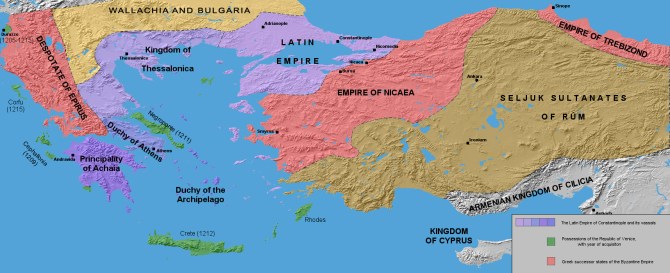
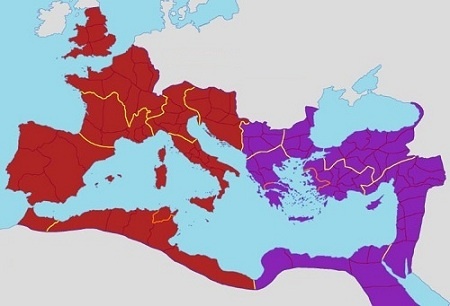
Welcome to part 2 on Foreign Lands and People according to the Byzantines from The Byzantium Blogger! As I have promised the last time, I will make a 2nd article on Foreign lands and people according to the Byzantines, in which part 2 will be about the western world, being Western Europe and its people and how the Byzantines viewed them. My last article– which was quite a long read- was basically about faraway lands as far as Ethiopia, India, and China in which the Byzantines made their mark in and basically also about how well the Byzantines knew the known world and how far they went across it, which shows they’ve travelled to very distant places even if they haven’t sailed across the oceans to discover new continents, but if the Byzantine Empire would have lived past 1453, they might have been able to sail to lands farther away such as the New World or around Africa. Anyway, back to the subject matter, the Byzantine Empire lived on for 1,100 years (330-1453) and within this millennium, the east being Byzantium have always had usually troubled relationships with Western Europe, but at times Byzantium and the west would have good relations trading with each other. The Byzantine Empire in the east however has been a world power much longer than the kingdoms of Western Europe have, as Byzantium was the continuation of the Roman Empire, which in the west ended in the 5th century. Long before the Roman Empire’s capital moved east to Constantinople, Rome basically ruled most of the known world, both east and west from Britain to Egypt, from Portugal to Iraq. In 330, the Roman emperor Constantine I the Great moved the capital of the empire east to Constantinople, and from then on, the Roman Empire paid attention to the east more while the western parts began to decline with the ongoing raids of barbarian tribes from outside the borders. In 395, the Roman Empire was fully divided between east and west; the east grew more powerful while the empire in the west gradually declined with the constant loss of territories including France to the Franks, Britain to the Saxons and other Germanic tribes, Spain to the Visigoths, and North Africa to the Vandals. By 476, the Western Roman Empire was gone as Italy fell to the Ostrogoths while the Eastern Roman Empire based in Constantinople became what was left of the Roman Empire, and at this point it had become known to most historians as the “Byzantine Empire”. It took the west a couple of centuries to progress while the Byzantine Empire in the east continued to grow in territory and culture preserving Roman and Greek culture of the past as the west lost most of its Roman heritage turning to their barbarian ways. It was only in 800 when the west became powerful again with the coronation of Charlemagne as “Roman Emperor” after unifying the Franks and other Germanic tribes into an empire. The Byzantines on the other hand had always considered the people of Western Europe- known to them as the Latins– as unsophisticated and illiterate barbarians while the west considered the Byzantines as effeminate, superstitious, and sneaky troublemakers. The Byzantines and the westerners particularly Franks, Germans, and Italians would interact a lot with each other during the period of the crusades beginning in 1096. At one point, the west got their revenge capturing Constantinople in the 4th Crusade of 1204, temporarily ending the Byzantine Empire, establishing the Latin Empire, but the Byzantines still came back for revenge in 1261 recapturing their capital from the Latins. Byzantium would last until Constantinople fell to the Ottoman Turks in 1453 while Western Europe had already rediscovered Ancient Greek and Roman knowledge kept by the Byzantines beginning the Renaissance era, thus making them as sophisticated and educated as the Byzantines were. The Byzantines have also looked down on the west for crowning a Roman emperor without having any connection to Rome as the Byzantines did being the successor of the original Roman Empire, but at the same time, the west did not consider the Byzantines as “Roman” but rather “Greek” as a way to insult them. This article will cover the many differences between the Byzantine east and the Latin west including the biggest difference of the Orthodox doctrines of the east and the Catholic doctrines of the west, the customs both had, and basically about how well the Byzantines knew the west and its people. I will begin this article with the Varangians, the people of Europe (though not overall westerners) who have always been at the service of the empire, then moving on to Byzantium’s views and stereotypes on the Franks, Germans, Venetians, and other western Latins, and then to the 4th Crusade and its aftermath featuring stories of westerners who have visited Byzantium and vice-versa. Like my previous few articles, this one is also based on the fascinating book, “A Cabinet of Byzantine Curiosities” by Anthony Kaldellis as well as a couple of chapters from “Byzantium: The Surprising Life of a Medieval Empire” by Judith Herrin and will be written in the style of different paragraphs based on categories on the different types of people according to the Byzantines with maps before a paragraph starts. Now enjoy reading the rest of the article on Byzantium’s continued cosmopolitan society, which is not complete without the westerners.

95t3yr5xvfyy
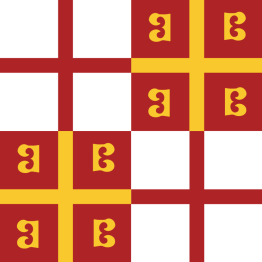
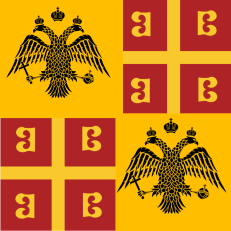
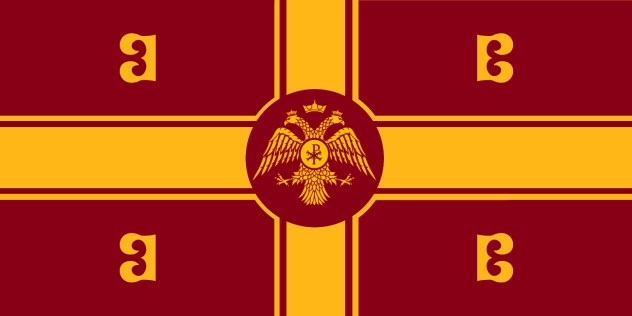
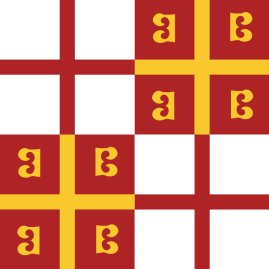
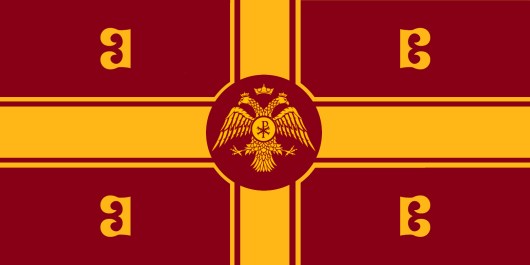
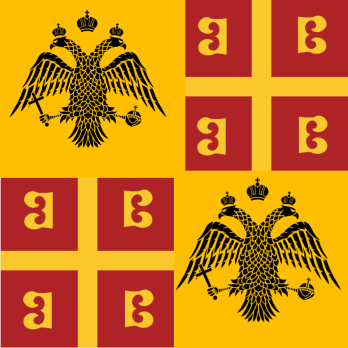
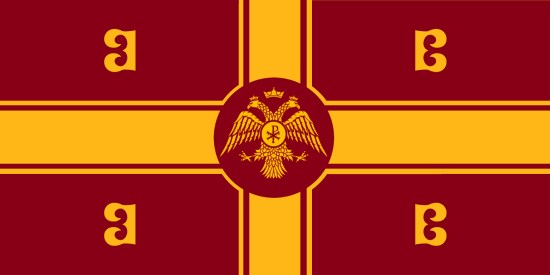
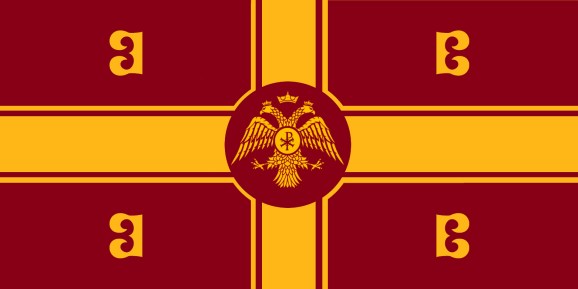
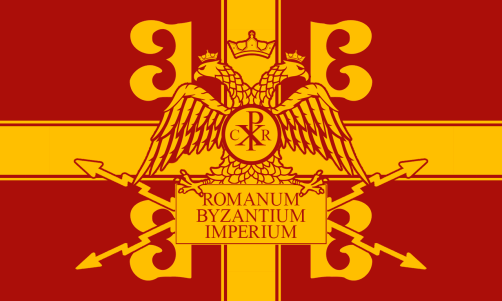
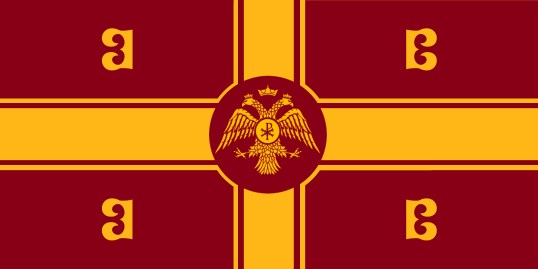
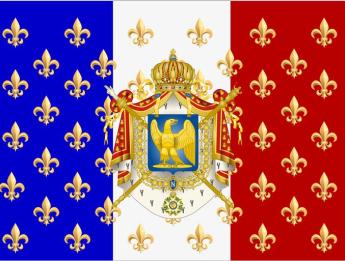
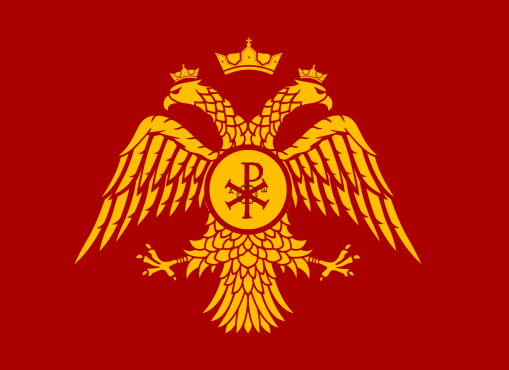
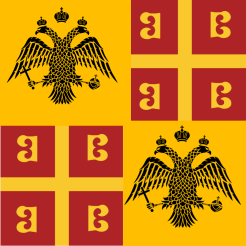
Byzantine Imperial flag and symbols
Roman_Empire_Trajan_117AD
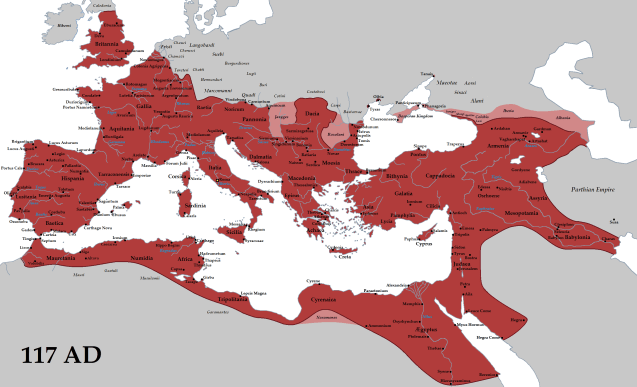
Map of the Roman Empire at its height, 117
kb7xsuk2emmy
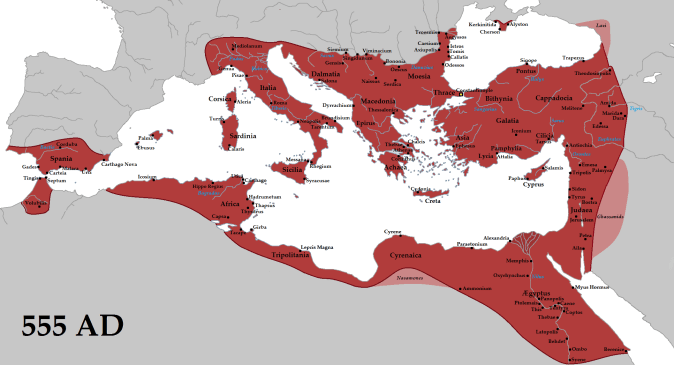
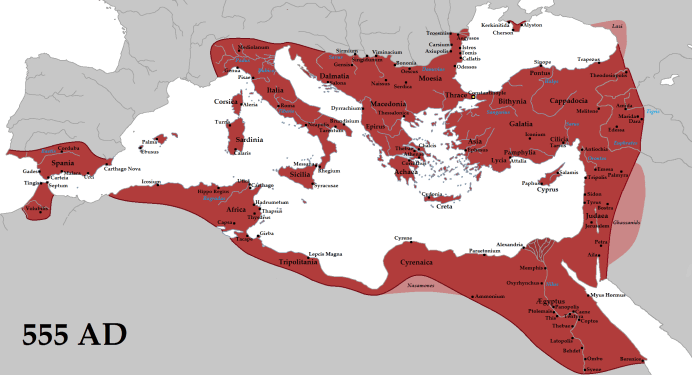
Map of the Byzantine Empire at its height, 555

Note: This article’s information comes from various Byzantine historians from the era of the Byzantine Empire (330-1453). It also contains some cultural stereotypes dating to Byzantine times, so be prepared.

Memes from: Brilliant Byzantine Memes 

WARNING: THIS IS A VERY LONG ARTICLE! 

Other Byzantine articles from the Byzantium Blogger: 

Foreign Lands and People According to the Byzantines Part1

Crime, Punishment, Heresy, and Medical Practice in Byzantium 

Byzantine Science and Technology

The 94 Emperors 

The Surprising Life of a Medieval Empire

7 Reasons to be Interested in Byzantium 

Byzantine Military Figures and Military History 

Early Middle Ages, The Basics 

t1fy3sb5ved01
A summary of Byzantium and its relations with the west


Varangians

RusVikingsMap
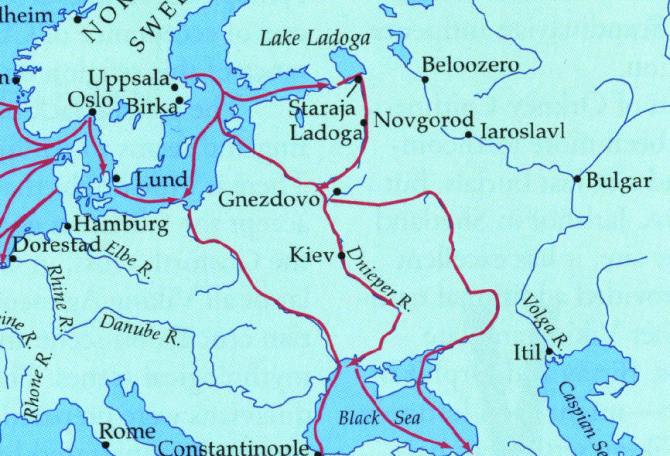
Map of the Varangians- from Scandinavia to Constantinople

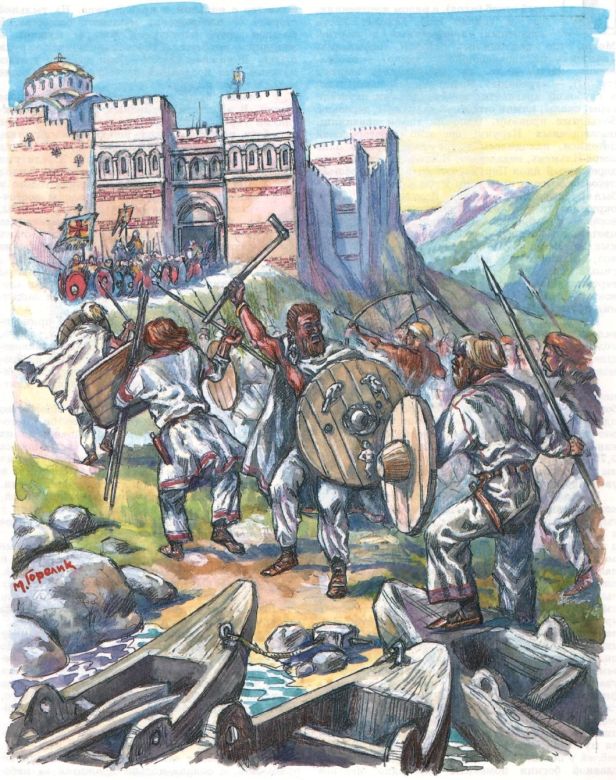
As I said in my previous article, I will continue to mention the Varangian people in detail when I have in the last time mentioned about Scandinavia and its people as they were one of the most famous foreigners in Byzantine society. The Byzantines have had early interactions with Scandinavia in the 6th century before the Norsemen or Vikings of the area began raiding and exploring Europe. Sometime in the 8th century, Scandinavia became overpopulated and farmland was scare leading to the Danish Vikings to sail west and conquer England while the Swedish Vikings travelled east inland into Russia eventually founding the city-states of Novgorod and Kiev. In 988, the Byzantine Empire under Basil II would encounter these Norsemen again as it was in a time of crisis with an ongoing civil war and enemies such as the Bulgarians threatening from the north and the Fatimid Caliphate from the south. In Kiev, the prince Vladimir (r. 978-1015) saw this as an opportunity to take Byzantium until Basil II made an alliance with him by marrying his sister Anna Porphyrogenita to Vladimir in exchange for 6,000 men to put down the civil war led by the rebel general Bardas Phokas. Anna was reluctant to leave Constantinople for what she called the “Scythian wasteland” and marry a barbarian prince thinking like if she was going to captivity but her brothers Basil II and the later emperor Constantine VIII protested that the Rus people of Kiev needed to repent, which was by accepting the faith of Christianity. Because of this marriage, the people of the Rus (mostly descendants of the Norsemen) were converted to Christianity and 6,000 men from the lands of Kiev and even from Scandinavia itself were sent over to Byzantium to serve as an elite bodyguard unit for the emperor known as the “Varangian Guard”. The Varangian Guard was first put into action when facing off Bardas Phokas and his rebels in battle, which caused Phokas to allegedly die of heart attack after seeing these massive Varangians. These Varangian guardsmen were initially used as soldiers to quell the civil wars of Byzantium but because of their bravery and strength in battle, in addition to their exotic look of being over 6ft in height, a large structure, and blond hair, the emperor made these men his personal bodyguard in charge for the palace which included guarding the bedchambers and prisons as well as accompanying the emperor in battle. The name Varangians were initially composed of Scandinavians including Danes, Swedes, Norwegians, Finns, Rus from Russia, and even Icelandic people. Because of adventure and a high pay of 200 gold coins a year, these people from the far north were driven to serve the Byzantine Empire even if it meant being away for a service of 10 years. The name “Varangian” was what the Byzantines and Russians called the Scandinavians which probably comes from the ancient Norwegian word “var” meaning “commitment” and true enough these men were committed to fight and were fiercely loyal as long as they were paid. Aside for their loyalty, these men were known to be honorable as it is seen in one story depicted in the Madrid Skylitzes of a Varangian unit stationed in Asia Minor in 1034. Here, one of them tried to abduct a local woman who killed him while he grabbed her, afterwards the other Varangians from his unit instead of fighter her back gave all the possessions of the man she killed to her and dumped his body as if he were a common criminal. After Basil II concluded the Byzantine civil wars, the Varangians became a permanent institution in the empire and in the following years, more men from Russia and Scandinavia travelled to Constantinople, known to them as Miklagardto be in this bodyguard unit; the Varangians later helped Basil II defeat the Bulgarian Empire by 1018 and for the next 3 centuries, they would serve the following emperors both in their palace and in fighting off the Arabs, Normans, Lombards, Pechenegs, and Turks in the frontlines. The Varangians however were not always effective such as in the Battle of Dyrrachion in 1081 while protecting the emperor Alexios I Komnenos, they were decimated by the Normans then when the 4thCrusade attacked Constantinople in 1204, the Varangians still courageously defeated the Latin invaders but because of the multiple shifts in Byzantine emperors, there was not enough money in the treasury to pay them, leading the Varangians to abandon their posts and flee.

The Varangian Guards are said to be identified by a ruby on their ear but also more notably by the large and heavy Nordic battle-axe they carry with them to strike fear in the enemy, while for secondary weapons they carried a round Nordic shield, a dagger, and a Scandinavian broadsword. For their armor however, they wore the Byzantine uniform of plated armor over chain mail and a conical helmet and while being in the service of the Byzantine emperor, they had to understand and speak a bit of Greek. In one story of the 11th century monk John Xiphilinos, a Varangian was thought to be deaf as he could not hear the commands or communicate with his company, although he just could not understand the language so he had to talk with nods and gestures until he saw the shrine of St. Eugenios and went to it to pray for the saint’s help and he was then cured and could clearly speak and understand Greek. Most of these men were ethnically Scandinavian until 1066 when the Anglo-Saxons in Britain were defeated by the Normans led by the Norman duke William the Conqueror at the Battle of Hastings leading the defeated Saxons to flee resulting in many of them arriving in Constantinople serving in the Varangian Guard. From that point, many of the Varangians were ethnically Anglo-Saxon from England- as well as Germans too- and when it came to fighting of the Normans in Italy, the old enemy of the Saxons, they were very driven out of revenge. Among the Nordic people who have served in the Varangian Guard, the most famous one was Harald Hardrada, king of Norway (1046-1066) who served from 1034-1042 under Emperor Michael IV. Harald after losing a battle in Scandinavia against King Cnut of Denmark was sent into exile first as a mercenary for the Kievan Rus and then to Constantinople where he would serve for a couple of years battling in Italy, Asia Minor, and even as far as Mesopotamia. Harald would later return to Scandinavia in 1042 with a massive amount of wealth and by 1046, he was able to claim the Norwegian throne. Decades after Harald Hardrada, another Norwegian king, Sigurd I (r. 1103-1130) who after the crusades in the Holy Land briefly served in the Varangian Guard with his 6,000 men in 1111 and before heading home to Norway, he left behind a gift of Viking-style long ships with gilded dragon heads included for the emperor Alexios I Komnenos (r. 1081-1118). Other than Harald Hardrada and Sigurd I of Norway, other notable Varangians Guardsmen are the two who carved runic inscriptions as a form of graffiti inside the Hagia Sophia in 2 different times; however only one of these runes can be deciphered which is the one presumably carved by someone with the name “Halfdan” meaning “Half-Dane”. Meanwhile in Scandinavia, there are about 30 surviving runic inscriptions, mostly in Sweden from the 11th century mentioning men who went to Greece known to them as “Grikkland” to serve the emperor in “Miklagard” or “The Great City” which was Constantinople, and there these men were known as Grikkfari or “Greece-farers”. The Varangians in Constantinople however did not really integrate with the locals as they came mainly to serve the emperor and return usually after 10 years with riches, and this is mentioned in the Icelandic Sagas of heroes such as Bolli Bollason from the Laxdæla saga who went to Byzantium to serve in the Varangian Guard coming home rich. Back in his native Iceland, Bolli after returning from Byzantium would only dress in silk or scarlet and use gilded weapons causing the women there to stare at his ornaments. Overall, the stories of the Varangians show that the Vikings did not only raid and attack countries but served as professional mercenaries in Byzantium returning home cultured and more civilized than they were before.

varangian_guard
Diagram of the Varangian Guards
maxresdefault
Varangians march into battle led by the emperor

Watch this for more info on the Varangian Guards. 


Franks
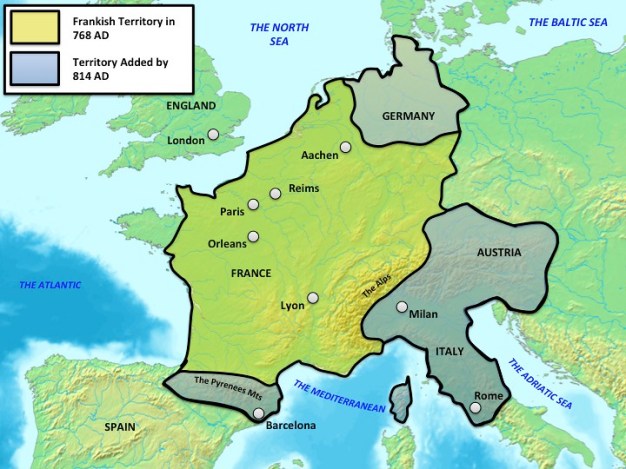
29111417525_a389c04761_b
Expansion of Frankish Territory in Western Europe

By the 6th century, Gaul (France) was conquered by a Germanic people known as the Franks, thus beginning the 1st kingdom of France under Clovis I, its first king from 481-511 establishing the first dynasty of French kings, the Merovingians; and because of these people, France got its name. Almost 3 centuries after the kingdom of France was founded, the Franks controlled almost all of Western Europe and in 800, Charlemagne, the king of the Franks was crowned the first Holy Roman Emperor by the pope for somewhat restoring the glory of the Roman Empire in the west, even if the Roman Empire continued to live as Byzantium in the east. The Franks have spread almost everywhere in Western Europe, mostly France making them the ancestors of the French and to the Byzantines, most people from Western Europe were known as Franks. The military manual called the Strategikon written in 600 attributed to the Byzantine emperor Maurice (r. 582-602) calls the Franks, Lombards, and other Germanic people of the west as the blond nations. Aside from describing the Franks as blond, the Tactica of Emperor Leo VI the Wise (r. 886-912) written by the emperor himself in 895 describes the personality of the Franks as extremely greedy and easily corrupted by money as it seen by those who come to Constantinople from Italy to immediately take up some position. Even Emperor Constantine VII (r. 913-959), the son of Leo VI says the same about the Franks and other westerners as it was written in a manual for foreign policy for his son and heir Romanos II (r. 959-963). The Macedonian dynasty emperor Constantine VII instructs his son that the Franks and particularly westerners have it in their nature to be insatiably greedy for money and ask for so much for doing so little. As emperor, Romanos II was instructed by his father that the west always ask the Byzantines for Greek Fire, imperial regalia including crowns and silk, and imperial brides and as emperor of the Romans, Romanos II should never make marriage alliances with alien people especially if they are not Christians or speak an alien language, although with the Franks it can be possible to make an alliance as they have some similarities with the Byzantines, being that there have been many marriage alliances between Byzantines and Franks before.

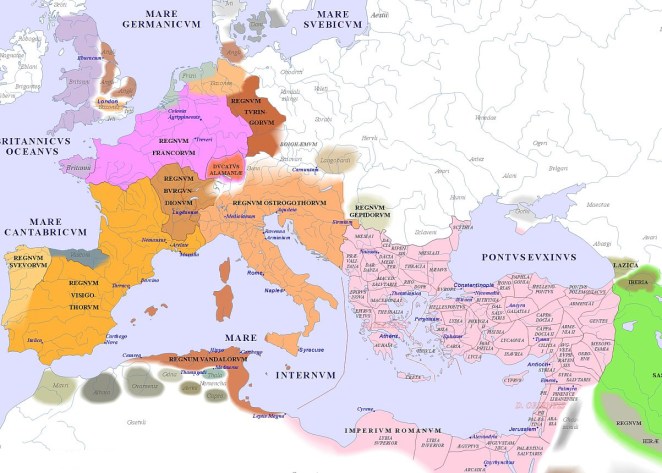
In the Middle Ages, it was believed that there could only be one Roman emperor at a time in which the westerners believed with the coronation of Charlemagne as Holy Roman Emperor in 800 being considered as “emperor of the Romans” because at the same time, the ruler of the Byzantine Empire was a woman, Irene of Athens (r. 797-802), who for the west obviously did not count as emperor; and by 802, Irene was deposed by a palace revolt led by her finance minister becoming Emperor Nikephoros I (r. 802-811). Irene was in fact supposed to marry Charlemagne but declined after finding out she had to travel all the way to Aachen in Germany to marry him. After 800, the westerners- especially working for the Holy Roman emperors and the Papacy- refused to call the Byzantines Romans but instead as “Greeks” not because of their ethnicity but as an insult. In 968, the Italian Liutprand of Cremona was sent on his 2nddiplomatic mission to Constantinople by the Holy Roman emperor Otto I (r. 962-973) which outraged the Byzantine emperor Nikephoros II Phokas (r. 963-969) and his court when the Byzantine emperor was addressed to as “emperor of the Greeks” instead of “emperor of the Romans”. Nikephoros II responded to this saying “doesn’t that idiot of a pope know, that Constantine the Great transferred the imperial capital and senate to Constantinople, and left behind in Rome only slaves, plebeians, and common types?”, Nikephoros II also addressed Otto I back as only “king” and not “emperor”. When encountering Nikephoros II, Liutprand of Cremona describes him as “a monstrosity of a man, a pygmy, fat-headed and like a mole in the smallness of his eyes, disgusting with his short, broad, and thick beard and short neck; in color like an Ethiopian, with a big belly, lean of loin, and long of hip considering his short stature; clad in a garment costly but too old, and foul-smelling and faded through age”. For the Lombards- the Germanic people of Italy on the other hand, they had the option to ally with the Byzantines to escape Charlemagne’s grip or fall under the Holy Roman Empire of Charlemagne; in this case, the Lombard duke of Benevento in Southern Italy, Arechis II in the 770s wanted to escape from Charlemagne’s grip so he planned to side with the Byzantines promising Emperor Constantine V (r. 741-775) that his people would cut their hair and dress like the Byzantines.

500b
Byzantine Empire (light pink), Frankish Kingdom (dark pink)

Watch this for more on story where Liutprand of Cremona meets Nikephoros II in 968. 


Normans

78e9d4a7e22df1672e1d4221cb93106a
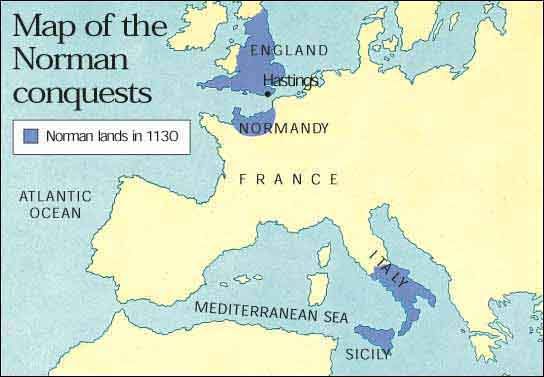
Map of the Norman conquests of France, England, and Italy

Like the Varangians, the Norman people have also originated in the Nordic countries before sailing down to the north coast of France in the 10th century permanently settling there in this part which became known as Normandy, in which they founded as their own duchy with the Viking Rollo as its first duke. When they have settled there, the race of the Normans was born after these Norsemen intermarried with the local Frankish and Gallo-Roman people of France; these people in the next centuries were famed for their martial spirit and skills in battle, Catholic piety, and impressive Romanesque architecture seen in many monasteries and cathedrals in Southern Italy and England, the most famous Norman building being the Tower of London. In 1066, the duke of Normandy William I, a descendant of Rollo set out across the English Channel to conquer England where he defeated the Anglo-Saxons and their king Harold Godwinson in the Battle of Hastings, thus William I became the first Norman king of England and gained the title “William the Conqueror”.   Some years later, the Norman adventurer Robert Guiscard, who had previously taken Sicily took all of Southern Italy from the Byzantines in 1071 and 10 years later, the Normans would cross over to the Balkans attack Byzantine territory becoming one of Byzantium’s major enemies. After the defeat of the Anglo-Saxons in England in 1066, many of them had fled to Byzantium in the thousands joining the Varangian Guard, some of them being veterans of the Battle of Hastings and a few years later, in 1081 they once again met the Normans in the Battle of Dyrrachion when Robert Guiscard decided to move his forces across the Ionian Sea from Italy to the Byzantine Empire. The Alexiad written by Anna Komnene mentions these Anglo-Saxon Varangians serving Byzantium and when fighting the Normans in Dyrrachion defending the emperor Alexios I Komnenos, they fought with such determination as it was against their old enemy, the Byzantines then held these Englishmen in great esteem, but at the end many of them were killed as the survivors fled to a church above a hill which was set on fire by the Normans. By 1086 however, Alexios I defeated the Normans from Southern Italy that had invaded Byzantium and at this time, the body of William the Conqueror’s father, Duke Robert I “the Devil” of Normandy who died in Byzantium in 1035 after returning from a pilgrimage to Jerusalem was buried in Nicaea. William the Conqueror, then already king of England ordered that his father’s body had to be moved from Nicaea in Asia Minor to the Norman held Apulia in Southern Italy; William happens to be Robert I’s illegitimate son with his mistress. Even as late as the high Middle Ages, the Normans even after taking part in the crusades were still savage in nature according to the Byzantines as seen in the capture of Thessaloniki in 1185; here the Normans plundered the city having no conception of the value of perfumed oils, distilled aromas, medicines, and for pleasure and painting that the Byzantines did, instead they used scented woods for kindling, believed spiced resins were coal, and did not understand the use of rose water; what they actually wanted were iron rings, nails, and knives.

9155a626-876d-4713-bd10-e1856062104f_r646x421
Battle of Hastings, 1066


Germans

entity_2160
12th century- Map of the Holy Roman Empire (outlined), Byzantine Empire (light pink)  

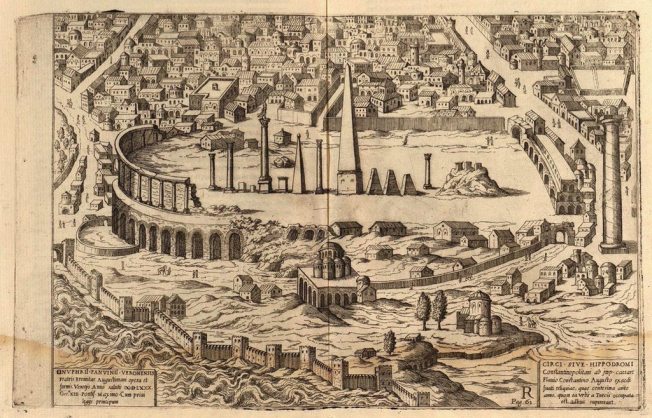
In the Middle Ages, the Germans ruled a massive empire known as the Holy Roman Empire controlling a lot of Western Europe making them have an arrogant attitude and among the westerners, the Germans were one of those who looked down on the Byzantines the most. When the first wife of Emperor Manuel I Komnenos (r. 1143-1180), the German Bertha of Sulzbach died in 1159, Basil of Ohrid praised her for her piety and humility in contrast to her people, the Germans who he says are haughty, arrogant, and simply don’t know how to yield or compromise. In the epitaph made by Basil of Ohrid for the empress he also says that “it is obvious that among all the nations between Italy and the outer Ocean, the Germans (Holy Roman Empire) rule over all the others, and cannot bear to be ruled”. When she was still alive, Empress Bertha-Eirene refused to wear any makeup and was so opinionated that her husband, the emperor Manuel I chose to sleep with other women instead, but in her funeral, he was still in great grief. In another story about Manuel I, this time revolving Hungary and his planned invasion in 1167 as told by the Histories of Niketas Choniates says that in the Forum of Constantine in Constantinople where the 2 female statues of the “Roman” and the “Hungarian” stood, the Roman one happened to fall in which Manuel saw as a terrible omen, so he ordered that the Roman statue be restored and the Hungarian taken down to reverse the outcome of war. Back to the subject of the Germans in Byzantine history, in Christmas of 1196, the Holy Roman Emperor in Germany, Heinrich VI (r. 1191-1197) forced the Byzantine emperor Alexios III Angelos (r. 1195-1203) to pay him a tribute of 5,000 pounds or face invasion. Alexios III thought of creating a tax for his subjects known as the “German tax” (To Alamanikon in Greek), but this idea was rejected, so instead the emperor resorted to plundering the tombs of the past Byzantine emperors, although Heinrich VI died before the money could paid, so the Byzantines didn’t have to pay the Germans after all.

medium_FORUM_DE_CONSTANTIN_DETAIL
Forum of Constantine, Constantinople


Venice and the 4th Crusade

8358513_orig
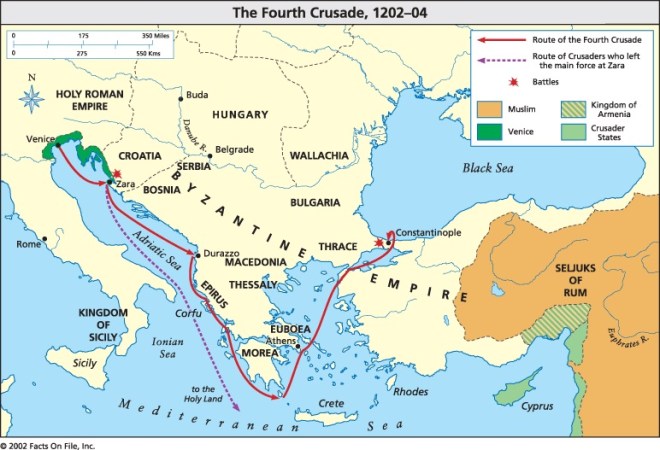
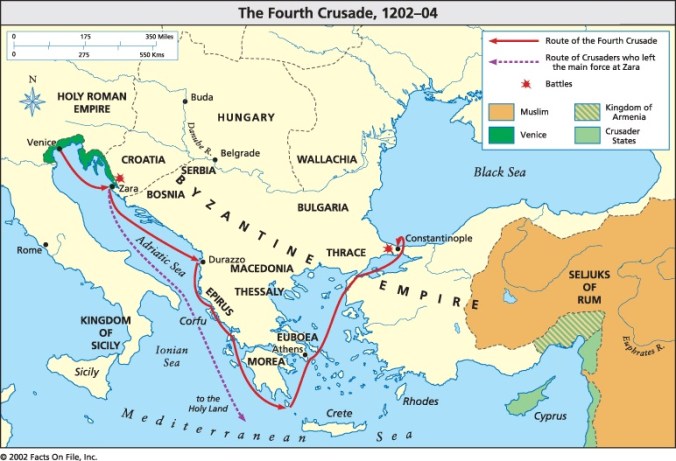
Map of the 4th Crusade, Venice to Constantinople, 1204

Since the emergence of the Republic of Venice in the late 7th century, they have become an ally of Byzantium when it came to providing the Byzantines’ ships in their conquests against the Normans and Arabs in Southern Italy. It was through Venice that the fork and other Byzantine luxuries were introduced to Western Europe, and because of the use of the fork and luxuries, the westerners- mostly bishops- were convinced to tell the people that the Byzantines have been corrupting them with their luxuries leading to growing hostilities between Byzantium and the west, according to the chapter Venice and the Fork in “Byzantium: The Surprising Life of a Medieval Empire” by Judith Herrin. In 1171, Venice would all of a sudden turn on Byzantium starting a war between 2 powers, which started after the Venetians refused to help the Byzantine emperor Manuel I Komenos in an invasion of Southern Italy. Previously, Manuel I assigned quarters to the Italian maritime traders of the Republics of Genoa, Pisa, and Venice in the Pera district across the Golden Horn in Constantinople, thought the Venetians being rivals with the Genoese and Pisans constantly fought them resulting in killing some Genoese and Pisans, thus showing disobedience to imperial order. Because of their disobedience, Manuel I considered Venice to no longer be an ally choosing Genoa instead and to put this in action, the emperor sent secret letters throughout the empire with orders to provincial governors that they should arrest all Venetians on the same day, which was March 12, 1171 and that they should all be placed in prison with their property impounded to the imperial treasury. On March 12, 1171 about 20,000 Venetians were arrested: 10,000 in the capital and 10,000 in the provinces, this though led to more war with Venice and it was here where the future Venetian doge Enrico Dandolo was blinded. In another story during the Byzantine-Venetian war according to Niketas Choniates, the Venetians captured Manuel I’s imperial barge and took an Ethiopian dressing him up like the emperor and paraded him as a way to mock Manuel I for his dark skin and for not having blond hair. The Byzantines would later win this war, but the Venetians would get their revenge in the beginning of the 13th century by orchestrating the 4th Crusade.

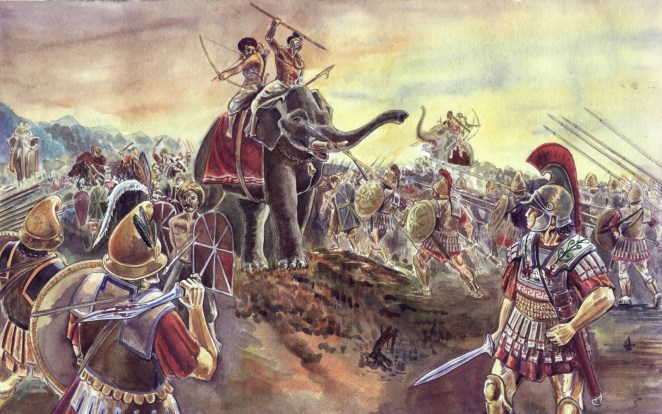
From 1202-1204, the Byzantine and western worlds would clash in the conflict known as the 4th Crusade. The original plan for this crusade was to battle the Ayyubid Sultanate of Egypt and recapture Jerusalem for the Christians but some economic and political issues diverted the crusade to the Byzantine Empire. First of all, the pro-western Byzantine prince Alexios Angelos requested the help mainly from the Frankish (Latin) crusaders to oust his uncle, Emperor Alexios III Angelos out of Constantinople to restore his deposed and blinded father, Isaac II Angelos as emperor. For the westerners (mostly Franks), attacking the Byzantines was justified because they envied Byzantium for its sophisticated culture and luxuries but also because church leaders including Pope Innocent III made attacking the Byzantines for turning against the Church of Rome a valid reason. Meanwhile because of being defeated previously by the Byzantines, the Venetians had this as their reason for starting this crusade. In 1203, the 4th Crusade made its way to Constantinople causing Alexios III to flee as the people released his younger brother Isaac II from prison and even if blind, they proclaimed him emperor again together with his son Alexios IV. Before this, according to the Chronicle of Halberstadt, when the army of the 4th Crusade arrived in the island of Corfu in Western Greece, the local bishop invited their commander to lunch where the subject became about the issue of papal supremacy, where the pope or bishop of Rome is the head of the entire Church. The local bishop did not see why the bishop of Rome was the head of the entire Church and why Rome had to rule the Church, the only reason for the Byzantines sarcastically being that it was the Roman soldiers that had crucified Christ, the Byzantines also pointed out that it was St. Peter, the first bishop of Rome that was first to deny Christ. Back in Constantinople, Alexios IV did not have the funds he promised he would pay the crusaders which was needed to pay the Venetians for their overtime use of their ships and at the same time, a revolution of the people was rising to overthrow Alexios IV and his father. In the beginning of 1204, Alexios IV was overthrown and put to death by the new emperor Alexios V while Isaac II died of shock, and by April of 1204, the Crusaders launched their attack and captured Constantinople, the “Queen of Cities”. The western crusaders did not only capture the city, they massacred half its population, desecrated holy sites and relics, and looted its relics and treasures bringing the loot they kept back to the west, mostly to Venice while in Constantinople, the Latin Empire, also known as the “Empire of Romania” was established. The ruined chapels in the capital were turned into horse stables and when sacking the cathedral of the Hagia Sophia they brought in donkeys to cart out their plunder while these donkeys urinated and defecated inside; the crusaders did not care because they believed these churches to not be those of their faith but of the faith of traitors. Apart from this, the crusaders even mocked the liturgy of the Byzantines by making a common whore pretend to conduct the Mass blessing the people present as she danced her way out and at the same time, the crusaders mocked the Byzantines as a “nation of secretaries” by dressing up in their robes and pretending to write things according to Niketas Choniates’ Histories which also says that after capturing the city, the Crusaders reveled and indulged themselves all day long. The most notable plunder taken from the 4th Crusade include the 4 bronzes in St. Mark’s Basilica in Venice still seen today (though the original ones found inside) which once stood over Constantinople’s Hippodrome; other notable loot in Venice include the elaborate Pillars of Acre, and the porphyry statue of the 4 original Roman Tetrarchs- Diocletian, Maximian, Galerius, and Constantius I embracing each other. Other relics were taken by the armies of the other leaders including the French count Louis de Blois to churches in small towns in France, Germany, Italy, and Belgium. Years later during the Florence-Ferrara Council (1438-39), the Byzantine delegation arriving in Venice once again saw the precious loot taken from Constantinople on display in Venice as they took the tour of Venice. The Venetians told the Byzantines that these icons and relics came from the Hagia Sophia, however the Byzantines read the inscriptions and found out that they were instead from the Pantokrator monastery telling the Venetians that it was only 2nd rate plunder.

Venediger-100
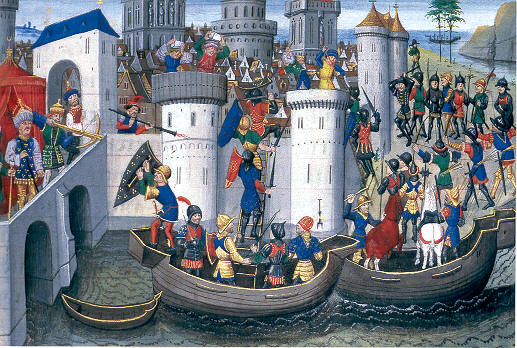
Medieval illustration of the capture of Constantinople (1204)

Watch this for more info on the Byzantines’ cooperation with the crusaders. 


Ways of the Byzantines vs the ways of the Latins

08
Division of Byzantium after the 4th Crusade, 13th century       

The more common word the Byzantines refer to the westerners as are “Latins”, this is because they were Roman Catholics and spoke Latin as the official language while the Byzantines used Greek. The Byzantines themselves thought they were the direct continuation of the Roman Empire despite speaking Greek giving a conflicted attitude to the Latin language. To the Byzantines, Latin was their “ancestral language” but they thought it to be inferior to Greek as it was hard to explain things in Latin according to the Church Fathers, the language was also too thin for the Greeks; Latin was spoken during Justinian I’s reign from 527-565 until Greek replaced it during the reign of Heraclius (610-641). The names “Catholic” for the western Church and “Orthodox” for the eastern one is actually confusing and conflicting because both claims to be Catholic meaning “found everywhere” and Orthodox meaning “traditional”. To differentiate, the Western Church became called “Roman Catholic” as it is based in Rome, to the Byzantines the western Church was known as “the Church of Latins”, but the west the Byzantine Church was “the Church of the Greeks” which the Byzantines felt offended when being called that. Through imperial marriages between western emperors and princes to Byzantine princesses such as Maria Argyra to a Venetian prince and Theophano to Holy Roman Emperor Otto II, sophisticated Byzantine way of life including the use of the fork were introduced to the west. Church leaders of the west thought that the behavior of the Byzantines using a fork to eat, using perfume, wearing silk, and lavishly taking a bath were scandalous and in fact sinful and overly materialistic. Western writers of the 12th and 13th centuries call the Byzantines “effeminate people” who have “degenerated entirely into women” as they were unwarlike and relied more on tricks than on the force arms the way the Latins did; the Byzantines too were described as soft and effeminate, tricky and talkative, cowardly and devious. The Byzantines true enough relied more on tricks and schemes to achieve their goals as well as diplomacy to solve international issues unlike the Latins who thought of war as a better solution, but this attitude of tricks show that the Byzantines are a more intellectual people. However, westerners- particularly the French- thought Byzantine women were far more beautiful than their own. The conflicts between the Latins and Byzantines worsened in 1182 when the Byzantine people of Constantinople massacred the Latins- particularly the Italian maritime traders of Venice, Genoa, and Pisa- for their growing wealth and influence. This massacre barely spared anyone and included killing Latin women, children, the sick, and wounded which would later be one of the reasons for the west to strike Byzantium in the 4th Crusade.

Meanwhile, the Byzantines believed that the Latins were so violent and bestial that they were unable to control their impulses, and this could be used against them in war. According to Nikephoros Gregoras, in a battle between the forces of the Byzantine emperor Michael VIII Palaiologos (r. 1261-1282) and Charles of Anjou, the Latin army of Charles of Anjou who were well armed with a numerical advantage charged in an uncoordinated rage but the Byzantines had long known about how the Latins would fight and engaged them with tricks. Back in the 9th century, the Byzantine emperor Michael III wrote in a letter to Pope Nicholas I referring Latin as a “barbarous and Scythian language”, the pope responded to this letter asking the emperor, “how then can you call yourself a Roman?” Since the 11th century, the Byzantines have been making lists called Errors of the Latins which was about everything the Latins (Catholics) did wrong in their daily lives and culture in contrast to the Byzantine way of life. The most entertaining of these lists was produced by Constantine Stilbes after the 4th Crusade’s sack of Constantinople in 1204. In this list, the errors of the Latins included not using actual bread the way Byzantines use for communion as Christ instructed instead using an unleavened wafer, when they elect a new pope the new one has to place the hand of the dead one on his neck considering it an anointing, and also that the pope and his clergy sell indulgences for serious crimes like murder even if it hasn’t yet been committed. Other than that, the Byzantines were shocked to see that the Latins do the sign of the cross using 5 fingers, that Latin bishops fight in wars mounted on horses and staining their hands with the blood of the men they’ve killed, bishops shave their chins and body hair making them look like women, and worse they allow dogs to enter churches during the liturgy and sometimes even bears. The Byzantines also noticed that the Latins did not honor Constantine the Great as a saint because he built New Rome that is Constantinople; also that some Latins would even bathe in their own urine and sometimes even drink it and when it came to eating, the Latins would eat animals that have drowned, were dying, that have been killed by other animals, as well as eating animal blood and offal too. Stilbes also mentions that the Latins ate bears, jackals, turtles, hedgehogs, beavers, crows, seagulls, dolphins, flies, and even filthier things and that they eat with dogs and tamed bears at the table allowing them to lick the dishes clean in order to use them for their next meals. With the Latins having the habit of shaving, the Byzantines began to wonder if they were in fact men and not women or eunuchs. In the years after 1204, when the Byzantine state was exiled to Nicaea and the Latin Empire or “Empire of Romania” ruled from Constantinople, hatred among the Latins was at its height especially because the capital was lost. The patriarch in exile Germanos II prayed that “God might arm his hands with a bow, learn to fight, and send the evil Latins packing, so that they can no longer lap up the Byzantine’s bodies like the dogs the Latins are”. The patriarch also prays that their emperor John III Doukas Vatatzes of Nicaea (r. 1222-1254) will rebaptize them in their own blood. It was probably because the hate for the Latins by the Byzantines was so high that the Byzantines began to describe the Latins in the most hostile and disgusting of ways, but in contrast to the filthy ways of life the Latins had, they shaved off their beards and facial hair.

37228650_2044100555839954_6753865381816827904_n
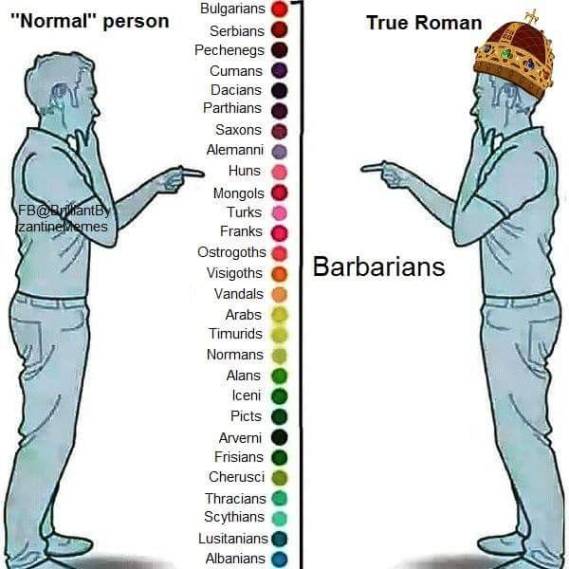
How a Byzantine (Roman) sees the rest of the world east and west vs how a normal person does


The West in the 14th and 15th centuries

europe_14th_century
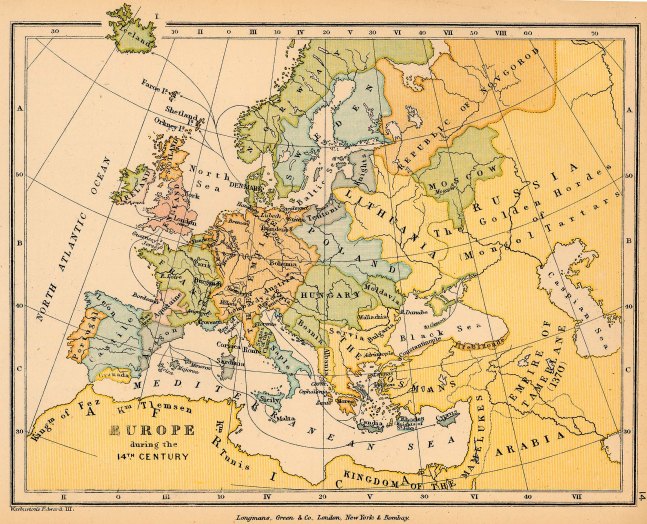
Europe in the 14th century, Byzantium surrounded by the Ottomans

After the 4th Crusade and their capture of Constantinople in 1204, the Byzantines’ hate and distrust for the west was at its peak. The Byzantines of Nicaea would eventually recapture Constantinople in 1261 followed by the coronation of Michael VIII Palaiologos as the restored Byzantine emperor destroying the Latin Empire. However, even if the Byzantines regained Constantinople, a new threat was growing in the east, this was that of the newly emerged Ottoman Turks, so in order to combat them, the Byzantines who have already been weakened in military strength needed new mercenaries to fight for them. Michael VIII’s son and successor Andronikos II Palaiologos (r. 1282-1328) once again requested for and hired an army from the west, this army was the Grand Catalan Company, which then took the place of the once renowned Varangian Guard that had ceased to exist. The Catalan Company consisting of Christian Spanish soldiers from Aragon known as the Almogavars led by the Italian general Roger de Flor arrived in Constantinople in 1302 and from then on continuously fought battles against the Turks led by the first Ottoman Sultan, Osman I (r. 1299-1324) to regain parts of Asia Minor the Byzantines have previously lost. The Catalan Company despite being poorly equipped and armored with only a few armor pads and old-fashioned javelins succeeded in defeating the Turks but unlike the Varangians, they were not as loyal to their emperor. Their leader, Roger de Flor was given the Byzantine title of Megas Doux or commander-in-chief of the army which made him grow more ambitious to the point where he had plans to overthrow the emperor. His ambitions were however stopped when Andronikos II’s son and supposed heir Michael IX had his Alan mercenaries assassinate De Flor in Adrianople in 1305, but the Catalans still fought back by plundering the regions of Macedonia and Thrace in an act known as the “Catalan Vengeance”. Out of all the westerners, the ones to remain loyal allies to the Byzantines till the end were the Genoese from the Republic of Genoa in Italy; which is seen in the final days of Byzantium in 1453 where the Genoese army led by their general Giovanni Giustiniani helped the last emperor Constantine XI Palaiologos in almost driving away the Ottoman Turks from capturing the city. At the end however, Constantinople fell to the Ottoman Turks but the Venetians who were once Byzantium’s mortal enemy still helped the Byzantines defend their capital from the final siege.

In the final days of Byzantium, trusting the westerners had grown more difficult but their assistance was needed more than ever to help their dying empire defend against the growing threat of the Turks, even though this meant the difficult task of uniting the Eastern Orthodox and Western Catholic Churches; though the end they were never formally united. Before concluding the article on the west according to the Byzantines, one people I haven’t mentioned yet that the Byzantines did encounter are the British, and surprisingly they did make contact with the British Isles. In 1400, the Byzantine emperor Manuel II Palaiologos (r. 1391-1425) made a visit to the court of King Henry IV in England among other kingdoms in Western Europe such as France, Aragon, Denmark, and the Holy Roman Empire, but his visit to England made him to first and last Byzantine emperor to ever visit England ever since Constantine the Great who was made Roman emperor in England in 306. According to the 15th century Byzantine historian Laonikos Chalkokondyles, the British dress the same way and have the same customs as their neighbors like the French but they speak a language that sounds nothing like that of the Germans or French, showing that the Byzantines had an idea what the earlier version of English- similar to Shakespeare’s English- sounded like. Other than that, it was said that the English have a rather casual attitude when it comes to women and children that the host’s wife would greet the invited friend of her husband with a kiss and in the streets the men would present their own wives to their friends. As it turns out, even if English may be hard to learn for non-English speakers nowadays, it was 10 times more difficult back then for the Byzantines thinking the medieval English was an alien language. At the same time, the presence Ottoman Turks of Anatolia, who have originated centuries ago have been threatening the Byzantines, though at times they were at good terms to the point where the Byzantine emperor John V Palaiologos (r. 1341-1376/ 1379-1391) agreed to make Byzantium a vassal state of the Ottomans. The Byzantines however found the Turks to be excellent acrobats as I have mentioned previously but when it came to Greek and Italian women, the 15th century Byzantine historian Doukas says the Turks are very sexually depraved and that they despise their own women as if they were bears or hyenas. The Byzantines at the end would rather have their empire fall to the Turks than the western Latins after the trauma they had from the desecrations of the 4th Crusade.

Entrada_de_Roger_de_Flor_en_Constantinopla_(Palacio_del_Senado_de_España)
Catalan Company of Roger de Flor arrives in Constantinople, 1302
kbsqmha2xg0z
The Siege of Constantinople, 1453
40187728_2088490381400971_2508761694050713600_n
How Byzantium faces its enemies (the Hydra)


Alright, so once again I will conclude another extremely long but hopefully interesting article. Now the 2 articles I promised on Byzantium’s cosmopolitan society have been concluded and the Byzantine cosmopolitan society isn’t that complete without mentioning the westerners in Byzantium and how well the Byzantines knew about the western world. The lifetime of the Byzantine Empire was long enough to see Western Europe emerge from the barbarians that have taken Roman territory away to become powerful kingdoms and empires of their own developing a system of trade up in the north while the trade in the Mediterranean has been taken over by the Muslim Arabs. In the beginning however, the west and eastern worlds that became the worlds of the Latins and Byzantines were one when the Roman Empire ruled over both but as the empire was divided and barbarians took over the west and began to appreciate Roman culture while in the east, people began speaking Greek more losing their old Roman traditions, differences between the east and west became so big. Where differences between the east and west could never really be settled was in religious doctrine as the Orthodox Byzantines in the east stuck to the old-school Christian traditions while the Catholic Latins in the west could not understand some of the beliefs of the east but the east also did not understand some of theirs such as the primacy of the pope as the leader of the Church in the west. While the west slowly began to grow militarily and culturally, especially after Charlemagne established the Holy Roman Empire in 800, the Byzantines have already had a strong culture and national identity which they spread to the west by introducing silks and the fork, which westerners did not understand at first. Relations between Byzantium and the west were however not always hostile since the Varangians- not entirely westerners though have been loyal protectors to the emperors while the Venetians have been great allies until a falling out happened, and Genoa had also been good allies to Byzantium. With other people of the west however such as the Spanish Catalan Company and the 4th Crusade could not be trusted while the Franks, Germans, and Normans could not be fully understood by the Byzantines. If the western Latins could not understand the effeminate, deceitful, mysterious, and overall intellectual life of the Byzantines thinking them as cowards, the Byzantines on the other hand did not also understand the somewhat barbaric and filthy way of life the west had in contrast to their clean appearances. The equally strange contrasts between Byzantium and their western counterparts show a classic “east vs west story” but at times the Byzantines and western Latins would cooperate with each other against a common enemy like the Arabs and Turks in the time of the crusades, but at the end the west could not always be trusted. After the sack of Constantinople in 1204 by the 4th Crusade, the west would forever give a bad reputation for the Byzantines that trusting the west in helping Byzantium would be hard. In the end however, the west still helped the Byzantines defend their capital against the siege of the Ottomans in 1453 even if it ended with the final end of the Roman Empire. The Byzantines though had admitted that it would be better for them to fall to the Turks rather than the west because the Ottomans at least still showed some respect for them when they passed Byzantium in their way to invade Europe while the westerners would steal Byzantium’s treasures out of greed and desecrate their holy sites, which is why the last Byzantine grand admiral Loukas Notaras said he’d rather prefer that Byzantium would rather fall under the Turkish turban than the Latin mitre. Truly, without Byzantium’s constant efforts in defending their empire, Europe would have been taken over by Islam earlier on, which is why the Byzantines deserve more recognition than they have. Because Byzantium has encountered both the eastern and western world, it was the empire where cultures from all parts of the known world met together and where some cultures in these parts were influenced from. As I have been writing both articles on Byzantium’s interactions with east and west, it turns out the Byzantines had the most interactions with the east and south (Asia and Africa) during the reign of Justinian I (527-565) but it was during the reign of Manuel I Komnenos (1143-1180) and the Komnenos emperors (1081-1185) when the Byzantines interacted most with the west, basically because this was when the west was emerging especially with the crusades. Well, this is now about it for how much the Byzantines knew about the world around them, both east and west; with the east, things were fascinating for them but with the west things were more complicated. In the last article, I have covered Byzantium’s relations and thoughts on far away lands in Africa, Asia, and Europe while this one basically sums up almost everyone in the western world and other parts including the French, Germans, Italians, Spanish, British, Scandinavians, as well as Russians (Rus), and a bit about the Hungarians and even Turks; although there is nothing much said about how the Byzantines saw other westerners such as the Portuguese, Irish, and smaller European states. For me honestly, what I like most about Byzantine history is their views on the world around them because it is interesting to know how far they made their mark in the world which I think could even be more improved if they had been able to sail across the Atlantic if they survived after 1453. Whatever I did not mention in this article, I will in an upcoming one I will write about “Turning Points in Byzantine History”. Anyway, this hell of a long article is done and I hope it was an enjoyable read- especially with the memes- so, thanks again for viewing!

tRSvdXp

Foreign Lands and People According to the Byzantines- Part1- “Where the World Meets”

Posted by Powee Celdran

You will find me a Scythian among the Scythians and a Latin among the Latins, and in general, among all other people you will find me to be one of them.” -John Tzetzes, 12th century

cDNOSmb

Welcome once again to another article by the Byzantium Blogger! Recently, I have tackled several interesting topics of Byzantine life from the emperors, to their inventions and science, and their methods of torture and punishment according to one of the most fascinating books on Byzantine life, “A Cabinet of Byzantine Curiosities” by Anthony Kaldellis. This article will once again cover a chapter- if not a set of chapters- from the same book and that part of the book covers the topic I’ve always wanted to write about. This topic is about different foreign lands, far and near including their people and how the Byzantines viewed them; which in fact was the topic I’ve always wanted to write about- basically about how well the Byzantines knew about the world around them. The Byzantine Empire (Eastern Roman Empire) lasted for 1,100 years (330-1453) which means there was a great amount of time for them to encounter all sorts of races and powers either from lands surrounding them or lands far away. The different people the Byzantines encountered throughout these 1,100 years included Jews, Persians, Arabs, Egyptians, Ethiopians, Scythians, Armenians, Huns, Vandals, Goths, Vikings, Rus, Slavs, Vlachs, and of course the Franks, Latins, and Germans (which will be my next article). The Byzantines encountered all sorts of people either by travelling to very distant places such as India, China, and Ethiopia or by those people settling in Constantinople therefore having the Byzantines have some stereotypes about them. With all these people from different parts of the world settling down in Constantinople, the capital was surely a “Cosmopolitan Society” like today’s New York, London, and Paris and also like Coruscant from Star Wars, and this fact of Byzantium’s cosmopolitan society was something I’ve always wanted to write about after reading a chapter from Judith Herrin’s “Byzantium: The Surprising Life of a Medieval Empire“. Meanwhile, some of these foreigners the Byzantines encountered have had some hostile views towards them just as the Byzantines viewed them in a hostile way but some of these foreigners looked up to the Byzantines as the successors of the Roman Empire. This topic on far away foreign lands has always been something of great interest because the Byzantines long before explorers such as Marco Polo, Vasco de Gama, and Christopher Columbus discovered distant lands had already reached the far reaches of Asia including India and China but of course the Byzantines did not go as far as building large ships that enabled them to sail around Africa to reach Asia or across the Atlantic Ocean to the New World. This article will feature descriptions of foreign lands including the people, animals, customs, food, and how the Byzantines saw them from as early as the beginnings of the Eastern Roman Empire in the 4th century up until its final days in the 15th century. This is definitely GOING TO BE A VERY LONG READ and instead of just mentioning Byzantine history like I always do, this has some zoology, geography, anthropology, and a bit of cultural stereotypes blended into it. For the Byzantines, the farthest they’ve reached and heard about east was China, to the south it was Ethiopia, and to the north it was Scandinavia but as it turns out, the people and lands the Byzantines were most fascinated about were the lands in the east which were rich in resources and exotic. Like my other articles based on the same book, this will be written in many different paragraphs categorized by the different people and lands the Byzantines encountered.  Out of the many interesting chapters in A Cabinet of Byzantine Curiosities, the one about foreign lands, people, and stereotypes was one of the best parts to read about and of course this article is not it yet as I will post a sequel to this on Byzantines vs Latins (Westerners) showing how both were different and how they viewed each other. Anyway, let’s begin with the article.

95t3yr5xvfyy
Byzantine Imperial flag and symbols
kb7xsuk2emmy
The Byzantine Empire at its greatest extent- reign of Justinian I
1024px-PtolemyWorldMap
The known world according to the Byzantines


Note: This article’s information comes from various Byzantine historians from the era of the Byzantine Empire (330-1453). It also contains some cultural stereotypes dating to Byzantine times, so be prepared.

WARNING: THIS IS A VERY LONG ARTICLE 

Other Byzantine Articles from the Byzantium Blogger: 

Crime, Punishment, Heresy, and Medical Practice in Byzantium 

Byzantine Science and Technology 

The 94 Emperors 

The Surprising Life of a Medieval Empire 

7 Reasons to be Interested in Byzantium 


Provincials (Asia Minor and Armenia)

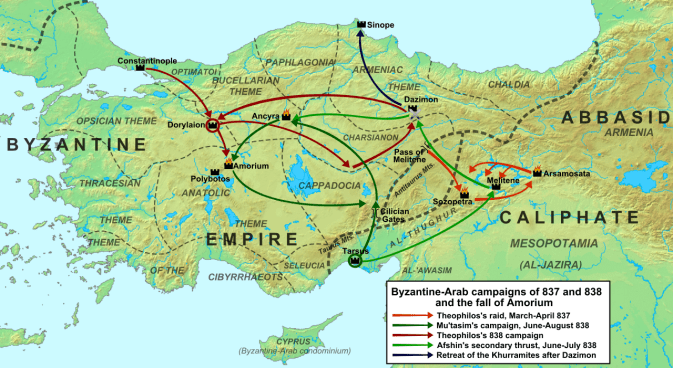
1280px-Byzantine-Arab_wars,_837-838.svg
Map of the Byzantine Themes of Asia Minor

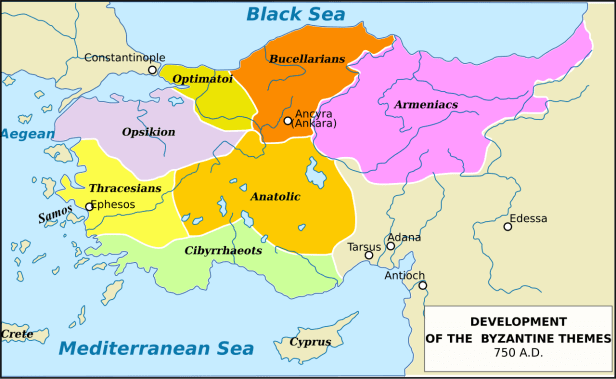
Where else to begin writing this article on the multi-ethnic Byzantine world but with provincials of the Byzantine Empire itself. These provincials of the empire include people from the Themes or provinces which were mostly in Asia Minor (Turkey) which all had their own customs and stereotypes which the Byzantines of Constantinople had towards them and in fact the people of Constantinople had some condescending views towards the provincials. One example of how the Byzantines of Constantinople viewed the provincials talks about the Cappadocians, the people from the Asia Minor region of Cappadocia: “a poisonous snake once bit a Cappadocian, and died from tasting his tainted blood” saying that the person did not die but the snake because of the Cappadocian’s blood. It was also in Cappadocia (or if not Armenia) where the conjoined twins of the 10th century came from, as I have mentioned in my previous article which are depicted in the Madrid Skylitzes. Meanwhile, the Byzantines called the Paphlagonians, the people from the region of Asia Minor of Paphlagonia as “pig-assed” (choirokoloi in Greek)  but also it was also in Paphlagonia where a certain type of cheese was made wherein cheese-makers blew air into the milk they were curdling to give it holes creating the Byzantine version of Swiss cheese. When it came to the people from the island of Cyprus, the 12th century Byzantine writer Constantine Manasses describes that one day in church, a man from Cyprus came in with a smell of wine and reeking garlic that he couldn’t stand the smell all the way to the point where he had to punch the man from Cyprus in the jaw. In the 9th century, the poet and hymnographer, St. Kassiane- who would have been the wife of the emperor Theophilos (r. 829-842)- wrote a discriminating poem on the Armenians:

The terrible race of Armenians is deceitful and extremely vile,

fanatical, deranged, and malignant, puffed up with hot air and full of slyness.

A wise man said correctly about them that Armenians are vile when they live in obscurity, even more when they become famous, and most vile in all ways when they become rich.

When they become filthy rich and honored, then to all they seem as vileness heaped upon vileness.

Apart from these hostile views towards the Armenians, they were also good and strong soldiers in the Byzantine army and many of them rose above the ranks becoming great generals, although it was said that when they become rich and famous, they become viler.

300px-15th_century_map_of_Turkey_region
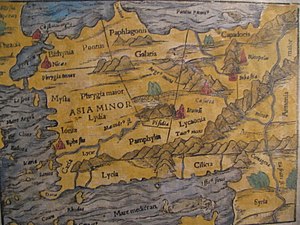
Colored map of Byzantine Asia Minor
8226527089_0ccf5107d8_k
Present day Cappadocia, Turkey


Jews

Benjamin_of_Tudela_HE
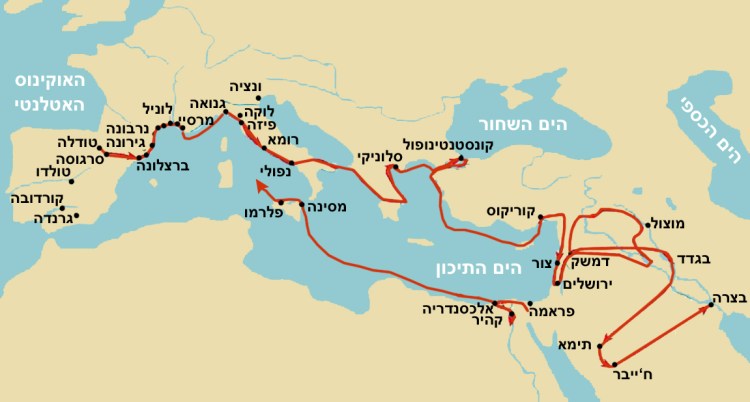
Map of the travels of the Spanish Jew, Benjamin of Tuleda, 12th century

Apparently, there was a large number of Jews that lived in Constantinople and in the Byzantine Empire ever since the early days of the Eastern Roman Empire when the Jews began to scatter around the Mediterranean and other parts of the world. The Byzantines were usually tolerant towards the Jews living in the empire but really, they found the Jews mysterious especially since they always lived beside each other and only interact with each other. According to the Jewish Spanish traveler Benjamin of Tuleda in the 12th century who visited Constantinople, the rival Jewish sects of the Rabanites (population of 2,000) and the Karaites (population of 500) were forced to live in the district of Pera across the Golden Horn despite hating each other, which meant they had to build a wall between their communities. Benjamin of Tuleda also said that the Byzantines would beat up Jews in the streets for not seeing eye to eye with each other and that Jews were not allowed to ride a horse in the city except for one, who was the physician of the emperor Manuel I Komnenos. Another thing Benjamin writes about was the wild beast show in the Hippodrome during Christmas sometime in the 1160’s which featured lions, bears, leopards, wild donkeys, and birds that would fight each other for public amusement in which Benjamin said “no entertainment like it can be found in any other land”, and here the emperor Manuel I was present as well watching the show. Meanwhile, the Byzantine poet John Tzetzes who lived during the same time as Benjamin of Tuleda has more insulting things to say about the Jews as seen in his poem on how to greet a Jew: “You blind house, full of evil magic, mouth like a gorge sucking up flies” followed by “You Jew, thick as a brick, the Lord did come, lightning upon your head”. In other words, some Byzantines insult the Jews for not accepting the Christian faith when they had the chance to and instead stuck to their old religion.

Another story the Byzantine Greeks have about the Jews takes place back in 401 in a letter of the philosopher and bishop of Cyrene, Synesios was on his way back to Cyrene from Alexandria and the captain and more than half of the ship crew were Jews believing that it was an act of piety to kill as many Greeks as possible but it turned out the captain and the crew were strict orthodox Jews and they refused to pilot the ship during a storm on the Sabbath and all the captain would do was read his scroll until an Arab soldier on the ship threatened him with a sword. More than a century later in 534, the artifacts of the Jewish Temple of Jerusalem, particularly the Menorah was recovered in Carthage once the Romans reclaimed it under Emperor Justinian I. In 70AD, the 2nd Temple of Jerusalem was destroyed when the Romans took Jerusalem and many pieces from the temple were taken to Rome as spoils of war including the menorah until 455 when Rome was captured by the Vandals under King Geiseric (r. 428-477) who took many spoils including the menorah to Carthage, which was their capital. After the Romans (Byzantines) reclaimed Carthage in 534, the general Belisarius sent the menorah to Constantinople where a Jew saw it and told Justinian that no city could keep the artifact safe but Jerusalem so Justinian shipped it to Jerusalem together with other artifacts and scattered it various churches as in that time the Jews were no longer a dominant population in the area. In 614, the Sassanid Persians captured Jerusalem taking the relics and from then they were never seen again. Overall, the Byzantines were more tolerant to the Jews compared to the Western Europeans of the middle ages even if they isolate the Jewish communities in a district in Constantinople but they allowed them to progress commercially and relied on their skills in trade, mathematics, and medicine; although only if they would cause problems, the Byzantines would take action against them.

Pera-District-view-of-the-Galata-Tower
Present day Pera district


Egyptians

aegyptus
Map of Roman Egypt (Aegyptus)

 When the Roman Empire was fully divided after the death of Emperor Theodosius I in 395, Egypt fell under the more powerful and progressive Eastern Empire based in Constantinople and up until the Muslim conquest in 641, the both fertile and mostly dessert filled Egypt remained a Roman province providing the grain supply for the empire. The Roman soldier and travel writer Ammianus Marcellinus from the 4th century describes that the Egyptians are dark and swarthy with a sad look about them, also easily animated in their gestures, quarrelsome and persistent, and are not ashamed to show any lash marks on their body from refusing to pay taxes, and at the same time any torture would not be hard enough to reveal the name of a hardened criminal from Egypt. In Constantinople, which had all sorts of races living all over, there was a type of police unit focused on catching Egyptians and Syrians who have migrated to the capital for invalid reasons, this was similar to racial profiling.

The Egyptians however have grown accustomed to Greek culture and the Greek alphabet ever since Egypt fell under Greek rule in the 4th century BC from Alexander the Great’s conquest. Hieroglyphics on the other hand were last seen in the Island of Philae along the Nile in the year 394 recording the name of the priest, date, and the god being the son of the Egyptian god Horus that was being honored. After that, hieroglyphics became totally not understandable to those who lived in the empire, including Egyptians which is seen when a monk named Jacob entered the tomb of the pharaoh Ramses IV in the Valley of Kings writing graffiti on the wall saying he could not understand the picture alphabet of the Ancient Egyptians. It was mentioned by the Ancient Greek historian Diodoros that ancient Egyptians would sacrifice the rare red-headed men to their gods; when this was found out by the reddish-haired Byzantine historian Niketas Choniates in the late 12th century, he said that he was already old when he found out about this so he wouldn’t have to worry about this custom anymore because his hair turned gray. It was also in Egypt where the Plague of Justinian in 541 was first recorded which spread all over the Mediterranean from the ports of the north coast of Egypt; the fleas on the rats that caused the plague were so small that they were invisible to the Byzantines. Fast-forward to the 11th century, Egypt was no longer under Byzantine control but a diplomatic gift of a giraffe in which the Byzantines called a “camel-leopard” was given to the emperor Constantine IX Monomachos (r. 1042-1055) which was paraded in the capital.

Alexandria-Air-Far
Alexandria from Assassin’s Creed Origins (2017)
King-Rameses-IV-Tomb-Valley-of-the-Kings-Luxor-6
Tomb of Ramses IV, Valley of Kings, Luxor
252131-782fd699e7f2ee1cb14e2ab78e7df9e5
Map of the Plague of Justinian (541-542)


Ethiopians and Nubians

ethiopia-historical-empire_0
Map of the ancient Kingdom of Axum (Ethiopia)

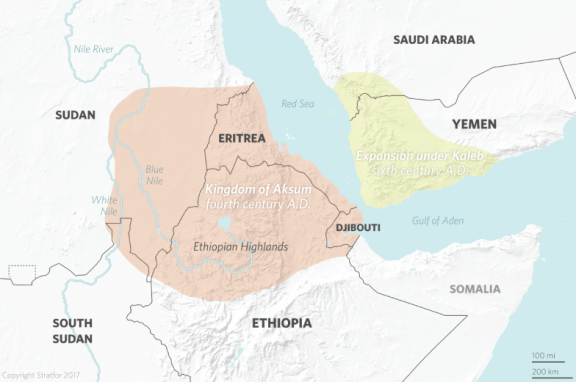
To the south of Egypt in the far reaches of the dessert was the region of Nubia (now in Southern Egypt and Northern Sudan) where its people look different from the Egyptians being darker in skin. Below Nubia farther south into Africa was the land of Ethiopia where the desserts start to fade and the land becomes elevated while one part of it is along the Red Sea. Europeans knew very little about Ethiopia up until the 19th century but the Byzantines back in the 6th century or earlier knew some things about this far away land, but not too much about it as it was very far away from Constantinople. One thing the Byzantines knew about Ethiopia was that its people had very dark skin leaving them to think they were not human beings seeing their blackness as a sign of evil. In one story, a monk named Pachon from Egypt was tormented by the memory of an Ethiopian girl he had once seen working in the fields in his younger days and in the lives of the dessert ascetics, the devil would appear to them in the form of a black man, woman, child, or beast to test them. Despite their blackness seen by the Byzantines as an omen of evil, Ethiopians were actually tolerated by the Byzantines and some even have positive views about them as exotic people. From 530-31, a Byzantine named Nonossos was sent by Emperor Justinian I on an embassy to Ethiopia and Arabia and while in the Kingdom of Axum in Ethiopia, he wrote a memorable description of their king named Ella Asbeha that he barely clothed except for gold-threaded linen hanging from his belt to his loins and decorated with jewelry all over his body including a golden torque around his neck and he stood over 4 elephants yoked together on a tall carriage adorned with gold leaves while his senate stood beneath him accompanied by flute players in the procession.

In The Conquest of Constantinople by the French knight and chronicler Robert de Clari in the 12th century, he writes that a Nubian prince was branded with a cross on his forehead went on a pilgrimage to Constantinople, the city that brought Christianity to his country in Africa many centuries ago. It is explained that the journey from Nubia to Jerusalem took about 100 days; he set out with 60 men and by the time he reached Jerusalem he was only left with 10 and when he reached Constantinople, he only had 2. Christianity possibly came to Nubia in the 6th century when the empress Theodora, the wife of Justinian I sent the missionary Julian to convert the Nubians from 537-39 but because of the heat of the dessert, Julian could not endure it so throughout these 2 years, he would lecture the people and convert them in a pool inside a cave wearing only a loincloth. The Byzantines overall mostly viewed the Africans of Nubia and Ethiopia as a rare sight not only because of their color but because they came from very distant places.

Fallen-Kingdom-connection
An overview of Ethiopia
Ancient christian wall paintings in an Ethiopian Church, Lake Tana
Byzantine inspired Ethiopian icon art
pyramids-nubian-desert_1
Nubian Desert


Arabs

arabmap
Expansion of Islam from Arabia around the Byzantine Empire (622-750)

The Arabs from the Arabian Peninsula have not become a threat to the Byzantines (Eastern Romans) up until the 7th century when Islam rose leading to the unification of the Arab tribes under the prophet Muhammad which since the 630s began invading Byzantine territory in the Middle East, first during the reign of Heraclius (610-641), who also turns out to be mentioned in the Quran. For centuries, the Byzantines went through a series of conflicts with the Arabs who began ruling most of the Middle East, but at times they would make truces. The Byzantines however never really understood the holy book of Islam or the Quran and its translation in Greek rendered a crucial term describing Allah as entirely encased in metal or entirely hammered into a ball, causing some Byzantines to have a bizarre image of the God of the Muslims, possibly because their were no images of Allah, but instead only his name written in Arabic calligraphy. To make it easier for Muslims to convert to Orthodox Christianity, the emperor Manuel I Komnenos (r. 1143-1180) planned to remove Allah from the list of Muslim beliefs they had renounce as the name just meant “God”, although this aroused fierce opposition in the Church. The 7th century writer Anastasius Sinaita questions that “why are there more maimed people, lepers, people with gout, and epileptics among the Byzantines compared to foreigners such as the Arabs?” He answers this by saying that because the Byzantines have a wetter climate, drink wine excessively, and eat heavily while the Arabs have a drier diet and drier climate in the Arabian Peninsula. The Byzantines however were not always hostile towards the Arabs; in fact, one time when the Crusaders of the 4th Crusade arrived in Constantinople in 1203 and attacked and destroyed the mosque at the Pera district, some Byzantines came to aid of the Muslims against the Crusaders as both people had a common enemy in the Crusaders.

tervel-leads-the-bulgars-on-an-attack-on-the-arab-forces-besieging-constantinople-by-vasil-goranov
2nd Arab Siege of Constantinople, 717-18


Persians

31582
Sassanid Persian Empire beside Byzantine Empire (late 6th century)

Ever since the Byzantine Empire was founded by Constantine I the Great in 330, the Sassanid Persian Empire has been a great threat to them and the Byzantines constantly defended their eastern borders from the Persian armies. Even before Constantine the Great, the Romans have always been at war with the Persians, first with the Parthians and then with the Sassanids. The conflict between the Byzantines and Persians concluded in 628 when the Sassanids were defeated by Emperor Heraclius (r. 610-641) and soon enough the Persians would fall under the rule of the Arabs. In 628, when the Byzantine army captured the Persian palace at Dastagerd outside the Sassanid capital of Ctesiphon in Iraq, they discovered over 300 Roman military standards taken by the Persians over the years of battle with the Romans, together with large quantities of aloes, silk, pepper, sugar, ginger, silks, and Persian carpets but they could not take them back as spoils of war because the quantity was too heavy to carry so instead the Byzantines burned them all.

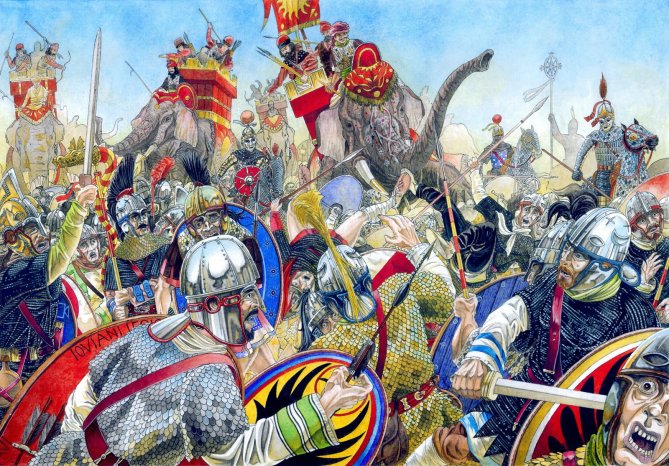
When encountering the Persians, Ammianus Marcellinus who wrote about the Egyptians describes the Persians as slender, dark-skinned, have intimidating eyes, curved eyebrows that meet in the middle, have trim beards, and long hair. It was also said that the Persians were addicted to sex having as many concubines and wives as they can afford, wear swords in public, are formidable fighters winning through craftiness rather than courage, but they still talk a lot, are arrogant, and make threats easily. Ammianus Marcellinus also describes the Persians during the Battle of Amida in Mesopotamia in 359 saying that when the sun rose, it illuminated the plain full of glittering arms, cavalry, and coats of mail showing that Persians wore shiny silver armor and their king, Shapur II rode a tall horse with helmet having a golden ram’s head. 4 years later in 363, the emperor Julian the Apostate (r. 361-63) at the Battle of Ctesiphon saw the Persian cavalry entirely cased in metal including the horses, while the riders wore steel plates fitted exactly to their limbs and masks sculpted with detailed facial features having only tiny holes for the eyes and nostrils. Next to the cavalry were the archers who had nimble fingers able to pull the bowstring all the way back to their chest and when the arrows were released, a loud hissing noise was made. Behind the archers was a row of massive war elephants like the ones the Carthaginians used several centuries earlier and these elephants also made noises that terrified the Roman horses together with the smell while the drivers of the elephants had knives to stab them in case, they lost control. It was in this battle where Julian met his end and so did the Constantinian dynasty, the first dynasty of Byzantium.

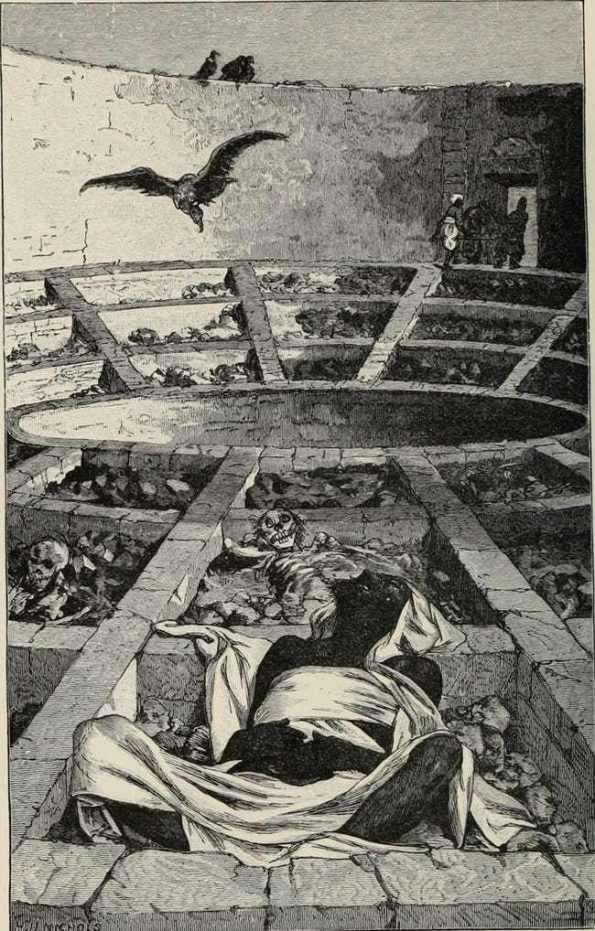
In the 6th century, the historian Agathias comments that in the Persian Zoroastrian funeral rites, dead bodies were disposed and exposed to be dismembered by birds and dogs; if the animals move fast to eat the bodies, it meant that the person was virtuous, but if the animals moved slow, then the person must have been flawed. Sometimes, the Persians had also exposed the terminally ill to be eaten and if they returned looking half-dead, then they were thought ass belonging to the underworld. After the defeat of the Persians in 528, nothing much was written about them by the Byzantines except that the sport of Polo known to the Byzantines as Tzykanisterion (Čaukan in Persian) was introduced to them by the Sassanids and in the 5th century, a polo field was built in the imperial palace by Emperor Theodosius II. This sport became popular among the Byzantine nobility and notable players of this sport included the emperor Alexander who died in 913 of stroke while playing it.

maxresdefault
Sassanid Persian shahs
battle_of_frygium_27_july_363_by_amelianvs-d620q3y
Battle of Ctesiphon, 363
traditional-zoroastrian-funerals-are-banned-almost-everywhere-due-to-the-dead-body-smell-photo-u2
Zoroastrian funeral rite by exposing the dead

Scythians and Huns

02-04_mayor_map_color_rgb_10-14-14
Location of Scythia

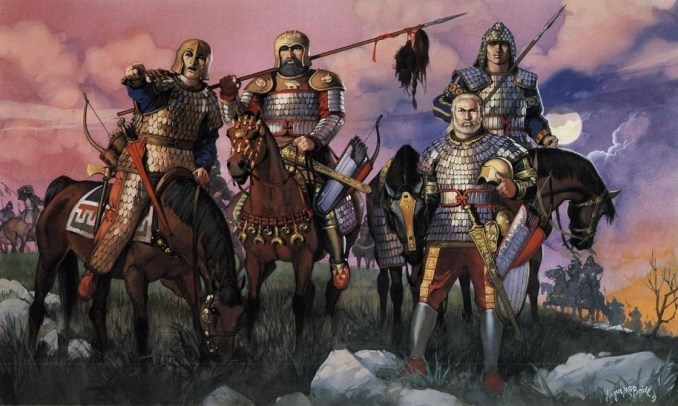
To the northeast of the Byzantine Empire lived the warlike nomadic tribes of the Steppes of Central Asia such as the Scythians, Huns, Alans, Cumans, Pechenegs, Mongols, and the Turkic tribes. Many of the Asiatic people made their way into Eastern Europe settling there as well as threatening the borders of Byzantium including the Avars, Bulgars, and Turks. The Scythians have been the people living in the area north of the Black Sea and north of Persia for the longest time that the Greek historian Herodotus back in the 5th century BC has something to write about them being horse-riding nomadic pastoralists without cities. The Huns were also similar to the Scythians by having no cities, except that the Huns came from a more distant place (possibly Mongolia) while the Scythians came from what is today Kazakhstan, Southern Russia, and Eastern Ukraine. The Byzantine soldier-writer Ammianus Marcellinus describes the Huns (and the other Asiatic nomadic tribes) being squat and ugly and that they gashed the cheeks of their children so that beard would not grow properly making them look scarier. They also ate the half-raw flesh of any animal cooking it only by rubbing it between their thighs and their horses’ back as they rode, which is possibly the origins of Steak Tartare. True enough, the now French dish of Steak Tartare originates from the Nomadic people of Central Asia who tenderized their meat placing it under their saddles as they rode long distances. These nomadic people wore clothes of linen or sewn mice skins and their shoes were not comfortable probably made of rope so they were not meant for walking, so instead they rode everywhere and in war they used lassos and extremely powerful bows in which they could fire with 2 hands while on horseback.

The Byzantine historian Priscus describes Attila, the king of the Huns (434-453) by saying he loved war but was not bad tempered and also gave good advice as well as being loyal to his allies. Attila the Hun was also described as being short but with a broad chest, a large head, small eyes, a sparse beard, flat nose, and dark skin which gives a description to what the Asiatic steppe people looked like. Before Attila’s death in 453, he tried to invade Constantinople but sometime in March 453, on the night after his wedding to Ildico- his last out of many wives- Priscus writes that Attila drank too much and, in his sleep, died from internal bleeding. Afterwards, Attila was placed in an iron coffin, placed inside a silver one, placed inside a gold one and buried in an unknown location, although it is said that he died in Hungary. If the Byzantines saw the Huns as hideous people living by roaming around having no cities, there was one group of Huns known as the Hephthalites or “White Huns” living in Central Asia that were more civilized and had cities according to the Byzantine historian Procopius. These Huns had defeated the Persians several times, had white faces and bodies, and when a rich man among them dies, up to 20 of his men who’ve shared his wealth are sealed up in a tomb to die with him.

tumblr_nu8a6rnY1E1u6oeoao1_r1_1280
Scythian horsemen


Slavs and the Balkans  

balkans750ad
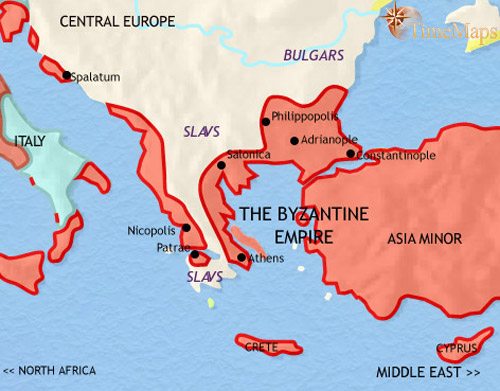
Map of the Byzantine Balkans and the raids of the Slavs, 750

 The people known as the Slavs began to appear in the Balkan territories of the Byzantine Empire north of Constantinople in the 6th century. The 2 Byzantine historians during the reign of Justinian I (527-565), Procopius and Jordanes write that in their times, Slavs have just appeared suddenly raiding their territories and yet they have no idea where they came from, although it said that the Slavs have originated somewhere in Ukraine or Poland. The Byzantines describe the Slavs as mysterious people that are not ruled by one but surprisingly live under a democracy where everything concerning their welfare is a matter of common concern among them. The Byzantines have also written about the Slavic gods, particularly Perun, the god of lightning equivalent to Zeus for the Greeks, Jupiter for the Romans, and Thor for the Norsemen; Perun was the chief god among the Slavic Pantheon and the lord of all things who the Slavs would sacrifice cattle and other victims to. The Slavs also revere rivers and nymphs as well as other spirits making sacrifices to them, at the same time they also worship their gods through totem poles as their version of icons. The Slavs though do not have good conditions of living as they live in hovels far apart from each other and in appearance they are described to be always covered in filth making it hard to notice if their skin is fair or dark and if their hair is dark or blonde, and it is also probably in their heritage that they have the habit of squatting (something I’ve noticed about the Slavs) because back then the ground they walked on was dirty. In the late 6th century, the leader of the Slavs that attacked the city of Corinth in Greece took the gilded canopy over the altar in the cathedral in order to use it as a tent to live in. The Slavs would become Christianized in the 9th century through St. Cyril and St. Methodius, Byzantine Greek missionaries sent to convert the Slavs by learning their native language and creating the Cyrillic alphabet in which most Slavic countries use up till this day including Russia, Belarus, Ukraine, Serbia, Bulgaria, and Macedonia.

At the same time the Slavs began raiding Byzantine territory in the Balkans, the Avars- people from Central Asia- did the same thing too in the Balkans. The king of the Avars or Khan was interested in the animals the Byzantine emperor Maurice (r. 582-602) had. The emperor was eager to please the Avar khan so he sent over his largest elephant but the khan sent it back to Maurice either because the elephant frightened him or he wanted to insult the emperor. Meanwhile, another group of people that lived in the Balkans were the Serbs who also spoke a Slavic language; and according to De Administrando Imperio by Emperor Constantine VII (r. 913-959), the name “Serbs” means “slaves” in Latin which is “servus” and the Serbs are called this because they used to be the slaves of the Roman emperors in the past as well as to the Eastern Roman emperors.

2da9f95dc25c6d531501a5d32c866eab
Sample Slavic settlement
13f7df6663a48b8dbf3d637502eff466
Slavs attack Byzantine territory
d1f23b3c976cb2a99f2b602d98c2ee52
Avars and Slavs attack Constantinople, 626
pl0mg7q13yp01
Modern recreation of the Slavic tribes (as Slavic countries) meeting while squatting

Watch this for more info on why Slavs squat.


Vlachs, Romanies, and Acrobats  

Carpath-7cce
Map of the Balkans, 700

 During Byzantine times, the people that lived in present day Romania were the Vlachs, who claim they are descendants of the people of the Roman province of Dacia (today in Romania) and they speak a Romance language. The Vlachs had been under the Bulgarian Empire until it was annexed to Byzantium by Emperor Basil II in 1018; from then on, the Vlachs appear in Byzantine sources, one of them by the 11th century military author Kekaumenos who calls them treacherous thieves apart from being pastoralists and descendants of the Dacians. The same Balkan pastoralists known as the Vlachs have encroached into the monastic lands of Mt. Athos in Greece going against the rules of the monastic land by bringing in women and children, although the women dressed like men to avoid giving scandal. The women however began providing dairy products for the community as well as other services but still created an ongoing scandal. The worst part for the monks however were the Vlach children in which the patriarch later complains to the emperor Alexios I Komnenos (r. 1081-1118), and the emperor responded by saying “what do you want me to do about the children? I am not King Herod!” In 1468, after the fall of the Byzantine Empire, the historian Laonikos Chalkokondyles turned out be the first writer to understand that the Vlachs spoke a language descended from Latin saying that “they speak a language similar to that of the Italians, but so corrupted and different from it that it is difficult for the Italians to understand anything they say, unless they recognize words spoken distinctly.” Meanwhile, an insult made as an ethnic slur targeting a Bulgarian candidate for the patriarchate of Constantinople in the 14th century was “Boulgaralabnitoblachos” meaning that he was a Bulgarian but allegedly a Vlach by birth and an Albanian in appearance.

If the Byzantines though of the Vlachs as treacherous thieves, they though even worse about the travelling people known as the Roma or Gypsies who were best known as thieves and practitioners of magic. The name “Gypsy” comes from the word “Egyptian” probably because these people looked like Egyptians but in reality, they’ve originated from what is today Afghanistan and speak the Romany language which is similar to the Hindi language of India. In one story, the Byzantines of Macedonia noticed the Gypsies known as “Egyptians” go around thieving and when are caught, they do not deny their action but confess it asking to be paid for their thievery; similar to ancient Egypt where the person who’s goods were stolen has to pay ¼ the value of the stolen goods to the thieves’ guild master. The Gypsies were another strange people for the Byzantines, not just because they were known to be thieves, but they practiced magic such as by wrapping snakes around their bodies in order to make predictions about the future but the Gypsies were exceptionally good at acrobatics in which the 14th century historian Nikephoros Gregoras says that these performers did not use magic to perfrom their tricks but the arduous training of their bodies. Gregoras writes that these Gypsy performers could do a headstand above a mast, cartwheel across the ropes and sometimes walk across a tightrope with a child, stand on a horse moving fast and leap from its mane to its rump by passing underneath it and again and again, and they could balance a jug of water or a small child from at the end of a tall pole standing over his head. Gregoras however adds that these entertainments were risky that 40 Gypsies set out from their native land and only 20 remained once they were finished in Byzantium before they headed west to Spain. Another type of acrobats in Byzantium were known as Kontopaiktes or “pole-players”, one of them was seen in the court banquet hosted by Emperor Constantine VII in 949 and according to the diplomat Liutprand of Cremona, there was a man who balanced a 20ft pole on his forehead without using any hands and 2 boys climbed it up performing various acrobatic maneuvers up there, although it is not said where these acrobats came from. Tightrope walking was a popular form of entertainment seen in the Hippodrome of Constantinople according to Niketas Choniates but the people who excelled in tightrope walking skills were the Turks. Laonikos Chalkokondyles writes that the Turks as he saw them in the marketplace of Adrianople could tightrope while shackled or blindfolded, could perform various tricks on them including passing through swords and twirling.


Scandinavians and Rus

7186665
Map of the different people of Scandinavia

In the 6th century, the influential historians Procopius and Jordanes during the reign of Justinian I (527-565) have a lot to mention about the barbarians living across the northern borders of the empire. Many of these barbarians were Germanic people and many of them such as the Herules originate in the far northern peninsula of Scandinavia in Northern Europe, in which the Byzantines think of as it as an island calling it Thule or Scandza. When the Herules settled near the Byzantine Empire in around 500, it was said that they perform human sacrifices to their gods and that their old and sick had to be set on a pyre, killed with a dagger, and then cremated. What is more bizarre than this is that when a man died, his wife had to hang herself by his tomb or face an evil reputation. For Jordanes who identifies himself as a Goth, he calls Scandinavia (and Northern Europe) as the homeland of his people where the sun does not set so much during summer and for him, Scandinavia which he considers an island is a hive of races and a womb of nations such as the Finns, Goths, Danes, and Herules. According to Procopius who’s never been to Scandinavia but had plans to says that the Scandinavians are depressed during winter because the perpetual darkness prevents them from mingling with each other. They would send a watchman to the tallest mountain and when he glimpses the sun he will return and report back that the light will return in 5 days and then when it returns, they celebrate a festival. True enough, it is usually dark in Scandinavia and it is only during summer when the sun is usually out and never really sets.

Procopius also mentions another tribe among the Scandinavians known as the Scrithifini– who are most possibly Finns- are mostly hunters and do not feed milk to their infants but rather the marrow of animals killed in the hunt. For Procopius, the most populous nation among the Scandinavians were the Gauti or Geats from Sweden, known to Jordanes as the Gautigoths. The Geats were the people of the legendary hero Beowulf from the Old English poem dating back to the 520s, being a contemporary of Procopius and Justinian I. As early as the reign of Justinian I and even earlier, the Byzantines already had informations about the Scandinavians and centuries later, they had interacted more with the Scandinavians and Rus who joined the Byzantine army as the Varangian mercenaries to protect the emperor (this will be mentioned more in my next article). Fast-forward to the 1440’s during the last days of Byzantium, here the writer John Kananos travels from Byzantium to the lands of the far north including Norway, Sweden, Livonia, Prussia, Slavonia, Denmark, England, and finally to Iceland which he says that all they eat is fish

The Rus meanwhile were the people of Russia descended from Scandinavian Vikings who travelled down Russia’s rivers raiding and trading and would eventually try to attack Constantinople. The 10th century Byzantine historian Leo the Deacon gives a description of the Rus by describing their king Sviatoslav of Kiev who after being defeated by the emperor John I Tzimiskes of Byzantium agreed on terms. Sviatoslav came in by a small boat to meet with the emperor and he was of medium height with thick eyebrows, gray eyes, a snub nose, shaved chin, a thick long moustache on his upper lip, a thick neck, broad chest, and a shaved head except for a thin strand of hair hanging down from one side as a mark of his nobility and like the rest of his companions, he wore all white.

The_body_of_Leo_V_is_dragged_to_the_Hippodrome_through_the_Skyla_Gate
Varangians in the Madrid Skylitzes
RusVikingsMap
Map of the Viking expansions into Russia


India

1430100957-112_India400ADGuptas
Map of Byzantine era India

If Alexander the Great and the Macedonian Empire have reached India in the 4th century BC, the Byzantines could do the same in their time. In 400, a Roman description of India says that the Brahman men or philosophers and women live on opposite banks of the River Ganges. The men cross the river to be with the women for only 40 days during July and August, which are their coldest months. After the woman has 2 children, the couple will never meet again and remain celibate thereafter but if a woman is barren, the man will try again for only 5 years. Also, in around 400, a Byzantine lawyer from Egypt travelled as far as to Taprobane– which is most probably Sri Lanka- the island south of India in the Indian Ocean. It was said that the island was so rich in magnetic rocks that ships with nails could not depart from it but drawn back to it. Procopius from the 6th century knew about it tried to explain that because of the magnetic rocks in the shore, the Indians used ropes to tie their ships together instead of nails; on the other hand, he says that the Indians did not have much iron in their lands, though later on Marco Polo explains this saying that the wood of India is too thick for nails to penetrate. Back in 500, when the lawyer tried to travel to these magnetic islands, he could not reach them as he was arrested by the Bisad people (probably in India) and since they could not understand each other, only that he thought they were accusing of something for the bloodshot color of their eyes and the grinding of their teeth. At the end, the lawyer ended up being sent to work in a bakery for 6 years, being released when the king at Taprobane learned he was a Roman (Byzantine), a nation they hugely respected. A century later, in 500, the Byzantines would encounter Taprobane again when a Byzantine merchant named Sopatros and a Persian ambassador reached the island and met with the king who asked to judge which nation was greater. Sopatros showed the shiny gold Roman solidus coin with the face of the emperor- at that time Anastasius I- while the Persian showed the silver Persian coin with the image of their Shah of Shahs. When the king compared them, he found that the Roman one outmatched its silver Persian counterpart and Sopatros was paraded around town above an elephant accompanied by music. True enough, today there is a private island in Sri Lanka with the name Taprobane.

The best known thing about India to the Byzantines was that it was full of jungles with all sorts of exotic animals including dragon-like reptiles, huge ants, scorpions, ape hybrids such as a lion-ape and bear-ape, and an amphibious creature living in the Ganges called the “Tooth-Tyrant” (Odontotyrannos) which was able to swallow a whole elephant. It was also believed that the “unicorn” which had a serpent’s head, coiled neck, a crooked horn, beard, and lion’s feet lived in India as well as the mythological Sphinx in the form of an ape creature. Ever since the Byzantine times long before the European explorers reached India, westerners have already been fascinated with its exotic wildlife.

d0b3d0b8d0b4d0b0d181d0bf_d180d0b5d0b4
Alexander the Great’s Conquest of India, 327-325BC

Read this for more info about the Magnetic Islands according to Procopius. 


China

main_image_silkroad_image_by_radio86__0
Silk Road- Byzantium to China

 In the east, the farthest recorded place the Byzantines made their mark in was China, which was known to them as Sera and Serindia if combined with India. The distance from Byzantium to China was very far and the Indian philosophers or Brahmans say that if you stretch a rope from China to Byzantium, the midpoint would be in Persia. Even before Marco Polo in the 14th century, the Byzantines had known about the Silk Road to China; here the soldier historian Ammianus Marcellinus already made a reference to China’s Great Wall saying that their land was surrounded and defined by the summits of lofty walls, meanwhile the Seres people (Chinese) in character are quiet, gentle, and unwarlike while their climate is agreeable and skies mostly clear. As early as the 4th century, the Byzantines already believed that silk (Sericum) was produced by certain trees in China that monks travelled all the way there to learn the silk making process. In the 6th century, silk was still very expensive in Byzantium until the monks explained to Emperor Justinian I how silk in China is made. Justinian responded by sending the monks back to China to smuggle the silk worm eggs and bring them back to Byzantium. From then on, the Byzantines no longer had to spend huge amounts on silks bought from the Persians as they could already produce silks themselves with the technology from China. Making silk within the empire was not only an economic benefit but something the Byzantines excelled at that Justinian I’s successor Justin II (r. 565-574) was able to impress the Turks by producing silk without having to buy them. In 643, the Tang emperor of China, Taizong received an embassy from the Byzantine emperor Constans II (r. 641-668)- known to the Chinese as Boduoli– giving the Tang emperor red glass and green gemstones, and in exchange, Taizong gave the Byzantines silk. The longest account on China from a Byzantine source is by 7th century historian Theophylaktos Simokattes who wrote about their major city known as Taygast and its governor called Taisson (probably a reference to the emperor Taizong) meaning “The Son of God” who had harem of 700 women, meanwhile the men there did not wear jewellery. If China is the world’s most populous region today, it already was back then in the 7th century, the next most populous to it was Moukri, which was possibly Korea. It is unclear whether the Byzantines went further east past China to Korea or possibly across the sea to Japan, which means China was the farthest they went to the east.

20090529_Great_Wall_8185
The Great Wall of China
Straet-Jan-van-der-Giovanni-Stradano_Two-Monks-Present-Silkworms-Smuggled-from-China-to-the-Emperor-Justinian-plate-2-from-Vermis-Sericus-The-Silkworm-engraved-by-Philip-Galle-1537-1612
Monks introduce the silk making process to Emperor Justinian I, 552

Watch this for more info on Constans II and China. 


Alright, this concludes this very long article, which is now so far one of the longest ones I’ve made! Despite being so long, I hope it was an interesting read because as I was writing it, I learned so many new things about the many different people from around the world who lived at the same time as the Byzantines. The same way I find Byzantine life very interesting, the customs and skills of all these other races are equally as fascinating, especially the way the Byzantines saw them. Overall, the Byzantines were not very hostile in viewing foreigners from different reaches of the world even if they were enemies in battle, all they did was that they told the truth about the bizarre customs and attitudes of these different people. Long before the Portuguese, Spanish, Dutch, French, and British came to explore and colonize the far parts of the world, the Byzantines as the successors of the Romans continued to explore the far parts of the world the way the Romans did before them to make their mark. The Byzantines travelled far to conquer distant lands but if they were very far away like India, China, and Ethiopia, they did not bother to conquer but to discover them and their people. If the Byzantine Empire continued after its fall in 1453, they might have even been able to sail across the Atlantic Ocean and discover the New World before Columbus did or go around Africa and explore even more distant lands. If the Byzantines had some extreme views about different people, these people must have also had extreme views towards the Byzantines but some people from foreign lands such as India had high respect for the Byzantines. The Byzantines may have had some distaste towards some foreigners such as the Ethiopians for their blackness, Slavs for their dirtiness, Scandinavians and Huns for their primitive customs and drunkenness, Persians for their arrogance and bizarre funeral customs, and Gypsies for thieving but at the end, the Byzantines tolerated and if not even respected these people allowing them to practice their customs in the imperial capital. On the other hand, the Byzantines were really fascinated over the exotic animals and skills people from faraway lands had and to some people like the Arabs, the Byzantines thought their diet was worse for being too heavy. At the end, I was also fascinated especially in the smaller details about these different people and their customs especially about how steak tartare originated with the Nomadic people of Central Asia, how the Gypsies and Turks were so exceptionally good at acrobatics, how long the journey from Nubia took to Constantinople, how the Persians had bizarre funeral customs of exposing their dead, as well as the fact that the Byzantines knew that India had exotic animals and magnetic islands and that the silk the Byzantines were well known for originated in China. What I’ve also learned when writing this was that it was during Justinian I’ reign from 527-565 when the Byzantines had the most encounters with people from faraway lands as well as these faraway lands themselves including Scandinavia, India, China, and Africa; this is mainly because it was during Justinian I’s reign when the Byzantine Empire covered the most territory but also because of chroniclers like Procopius that documented a lot about these places and people out of fascination. For months, I’ve been wanting to write an article about the Byzantine Empire and Constantinople being a “Cosmopolitan Society” after reading that chapter from Judith Herrin’s “Byzantium: The Surprising Life of a Medieval Empire”, and now I’ve done what I wanted too with more information from the very fascinating Byzantine trivia book by Anthony Kaldellis. However, this is not yet it about Byzantium’s cosmopolitan society as I have forgotten to mention about the Varangians, Latins, Franks, Germans, and other westerners in the Byzantine Empire. This then will be the next thing I will write about and the way the Byzantines viewed them, which of course was more hostile than how they viewed people from other parts of the world as I’ve mentioned in this article. To sum up this whole article, the Byzantines did not only travel to the far parts of the world, these people from the far parts of the world met in Constantinople making it a cosmopolitan society like Coruscant from Star Wars, and now this is basically almost it for how well the Byzantines knew about the world. Well, this is it for part1 on Foreign Lands and People According to the Byzantines which has been a very long piece because the Byzantines have so much to say especially about people from the east, up next would be about the difference between the Byzantines and the west in culture. This is it for now from The Byzantium Blogger… thanks for viewing!

tRSvdXp

Byzantine Life- Crime, Punishment, Heresy, and Medical Practice

Posted by Powee Celdran 

In front of the palace, the emperor ordered the criminal’s hands to be cut off and his eyes put out. I enquired why they did not put him to death, and they replied that the emperor could not order his soul to be destroyed.” -Pero Tafur, Travels Volume 17, 1437

cDNOSmb

Welcome to another Byzantine article by The Byzantium Blogger! In this article, I will heavily cover some elements of Byzantine life, particularly crime and punishment and how it was dealt with by the law. Medicine too was another important aspect of Byzantine life and in the empire, there were many doctors with sophisticated medical techniques but also the law had made some punishments for medical crimes committed by doctors. If the Byzantines were sophisticated and highly educated medieval people, they were advanced in science, mathematics, and philosophy as I have mentioned in the previous article on Byzantine science and technology but aside from science, being sophisticated and very literate meant that the Byzantines must have also had a strong code of laws and advanced and systematic ways of medical practice such as performing surgeries and developing remedies for diseases. True enough, the Byzantines did have a strong code of laws which was developed by Emperor Justinian I in 529 as he codified Roman Law and reformed it so that it could be consistently practiced throughout the empire. Aside from making a systematic code of laws, this article will also cover the more obscure and graphic aspects of Justinian I’s life and reign. Over the centuries, the laws of Byzantium have been altered by emperors either making them more just or more unjust. However, even if the Byzantines were more civilized when it came to the law, they were also brutal and quite uncivilized when it came to punishments and tortures for criminals. Byzantine criminals were often subjected to cruel and unusual public executions, severe conditions in prisons, and mutilation while prisoners of war were often blinded while heretics were usually exiled. Anyway, the subject of punishments in Byzantium is very intriguing because no matter how civilized and sophisticated their empire was, they remained barbaric and unpractical when it came to punishing enemies of the state that sometimes some of these stories of punishments in Byzantium turn out to be funny and at the same time very graphic (for those with a dark sense of humor). Almost all the information in this article is from the book “A Cabinet of Byzantine Curiosities” by Anthony Kaldellis, just like in the previous article, but this time on an all new different subject and the primary sources of all the information in this article come from several Byzantine historians during the era of their empire. This article will begin with covering crime and some unusual punishments including the punishments for heresies and heretics, and then Byzantine medicine and the law regarding it. With the topics covered from crime and punishments to medical practice, hopefully this would be a good interesting read for those who want to be lawyers, doctors, or Byzantine scholars like myself, or if you have nothing to do during the day and want something interesting and at the same time bloody and graphic to read. This article will be written in the same format as the previous one in several paragraphs and will be divided into 2 parts; first on crime and punishment, then about Byzantine medicine. Another thing though is that there are not much pictures in this article depicting surgeries and Byzantine punishments as the Byzantines have not really produced as much illustrations of their life in their time other than the Madrid Skylitzes, so if you want to know more about these unusual tortures and stories, you must read all this.

95t3yr5xvfyy
Byzantine Imperial flag and symbols

Note: This article’s information comes from various Byzantine historians in their era and has some graphic content, as if Byzantine history is the setting of a Tarantino movie. So prepare yourselves!  

Other Byzantine Articles from the Byzantium Blogger:

Byzantine Science and Technology 

The 94 Emperors 

7 Reasons to be Interested in Byzantium 

The Surprising Life of a Medieval Empire


I. Crime and Punishment

Palaiologos_Dynasty_emblem1

The laws of Byzantium, as mentioned in Justinian’s 6th century code of laws (Corpus Juris Civilis), later repealed and translated from Latin to Greek by Leo VI the Wise in the late 9th century was as simple as “an eye for an eye”. For example, men who castrated other men were to be castrated in return, men who blinded other men were to be blinded in one eye in return, and whoever falsely accuses someone else would be convicted the same way. Sometimes, criminals were subjected to humiliation either by being paraded through town or put in a show. Men who were pilloried had their heads shaven off, stripped off their clothing and dressed in rags if they were rich and in women’s clothes if they were men, according to the Histories of Niketas Choniates. According to the 7th century Sophronios of Jerusalem, sometimes, convicted criminals would be smeared in pitch to let them suffer the horrible smells, draped around with animal intestines, and made to sit facing on a donkey facing backwards having to shout out “I am an idiot!” and people watching the criminals would shout insults at them and their parents and would even throw blood or their faeces at them and sometimes even wood and stones. Worse than that, jesters would mock the convicted criminals by performing an act of the crimes they committed. One story of public humiliation takes place in 765 when Emperor Constantine V punished the monks who opposed his religious policies (possibly Iconoclast policies) by forcing them to walk around the Hippodrome of Constantinople holding women as the crowds jeered at and spat on them.

pillory
Public humiliation sample


Some punishments for certain crimes in the Byzantine world were very unusual yet were said to be “innovative”. During the reign of the first Byzantine emperor, Constantine I the Great (306-337), he increased the number of capital crimes and punishments for them such as having the hands cut off for corrupt officials as their hands symbolize their greed and if a nurse assists in seducing someone, molted lead should be poured down her mouth and throat. As a warning for others, emperors would place the amputated limbs of criminals on the streets of Constantinople and the Hippodrome; these included the limbs of Emperor Phokas who was deposed by Heraclius in 610 and the limbs of Emperor Leo V who was deposed and mutilated by the conspirators of Michael II in Christmas of 820. One emperor, Andronikos I Komnenos who was deposed in 1185 by Isaac II Angelos was slowly mutilated by the people of Constantinople until he was torn up to many pieces. Another story of an unusual punishment revolves around the Iconoclast emperor Theophilos (829-842) of the 2nd Iconoclast period in Byzantium and the brothers Theodore and Theophanes of Jerusalem who defended the veneration of icons opposing the policies of the emperor. To punish them, the emperor made a bad quality poem and had it tattooed on both of their faces making them known as the “Graptoi brothers” or “The Inscribed Ones”. The poem was later written in the Chronicles of a certain Symeon:

In that fair town whose sacred streets were trod by the pure feet of the Word of God- the city all men’s hearts desire to see- these evil vessels of perversity and superstition, working foul deeds there, were driven forth to this our city, where, persisting in their wicked and lawless ways, they are condemned, branded on the face as scoundrels, and hounded back to their native place.”

Other than that, Emperor Theophilos after hearing that the icon painter Lazaros Zographos had been painting icons in his prison cell, had hot plates be applied to Lazaros’ hands as his punishment. Lazaros died shortly after and became a saint; this scene where the emperor has the hot plates applied to Lazaros’ hands are depicted in the Madrid Skylitzes. Another unusual punishment depicted in the Madrid Skylitzes is when the admiral Niketas Ooryphas in 873 ordered that the Christian defectors he captured from the Arab fleet he defeated be skinned alive; in order to do this, he had them boiled in pitch to remove them from the baptism they have renounced. According to the 12th century Armenian historian Matthew of Edessa, the abdicated Armenian king Gagik II was offended that Markos, the bishop of Caesarea in Cappadocia named his dog “Armen” thinking it as an insult to his people. When dining with the bishop, the bishop said he named his dog that because the dog was powerful like a soldier (most of them being Armenians), though Gagik did not believe it until it was proved. In order to prove that the dog was powerful, he had the bishop and the dog placed in a bag where the dog was beaten many times causing it to maul the bishop into bits, and as a result the bishop was dead. The story of the bishop Markos being mauled by his dog may possibly be a legend, although another legend about Ignatios, the architect of the Hagia Sophia is as strange as the previous one. Emperor Justinian I feared that Ignatios would be more popular than he was, so when Ignatios was working on Justinian’s equestrian statue above the column next to the massive church he previously built, the scaffolds were removed leaving Ignatios trapped above. However, the architect had a smart plan by cutting his clothes into pieces and tying them together which he sent to his wife below who was told to dip a rope in pitch and swinging it up to let him down. The rope was then burned to show no signs of his escape and Ignatios escaped to live as a monk only to be recognized by Justinian 3 years later who then agreed to spare him for being able to brilliantly escape. On the other hand, in December 1204, after Alexios V Doukas, the last Byzantine emperor before the fall of Constantinople to the 4th Crusade in 1204 was deposed, his Latin captors debated about executing him in front of him. Alexios V had already been blinded by his rivals but to kill him off, the Latin leaders of the crusade including Enrico Dandolo, the Doge of Venice thought that the ex-emperor could not be killed as an ordinary criminal by beheading or hanging, so the best method of execution for him was to see if he could fly and they did this by throwing him off from the Column of Theodosius I in Constantinople resulting with Alexios V being smashed into pieces as he hit the ground.

250px-Death_of_andronic_I
Execution of Andronikos I, 1185
theophanes
The “Graptoi” brothers St. Theophanes and St. Theodore of Jerusalem
MadridSkylitzesTheophilosLazarosFol49v
Icon painter St. Lazaros Zographos before Emperor Theophilos, Madrid Skylitzes
40dccfa277b07e31ee68be3760dc6756
Column of Justinian I recreation


Some bloody stories of Byzantine punishments involve the mutilations of body parts such as noses and eyes; blinding as it turns out was a capital punishment for enemies of the state and mutilating an emperor would disqualify him from regaining the throne as a disabled man was not fit to be emperor. In 695, after Emperor Justinian II was overthrown by the rebellion of Leontios, his nose was ordered to be cut off to disqualify him from retaking the throne. However, 3 years later Leontios was deposed by Tiberius III who also did the same thing to Leontios by having his nose cut off as well as his tongue before sending him to a monastery. Justinian II would retake the throne in 705 ordering the same thing on Tiberius III by having his nose removed and afterwards both the deposed Leontios and Tiberius III were executed. The process of having the nose removed was known as a “rhinotomy” and with Justinian II missing a nose during his 2nd reign being replaced by a golden prosthetic; he gained the nickname “Rhinotmetos” meaning “slit-nosed”. Another person in Byzantine history who had a mutilated nose replaced by a gold prosthetic was the general Tatikios who led the Byzantine army of Emperor Alexios I Komnenos (1081-1118) in the 1st Crusade in Asia Minor. Although earlier on, the short-reigned emperor Heraklonas (641) also had his nose cut off by orders of the supporters of his nephew Constans II who was proclaimed emperor. Blinding however was a more common capital punishment in Byzantium and blinding was done through several methods including gouging out the eyes, or by using tools such as kitchen knives, tent pegs, or candelabrum, but a more merciful way to blind people was by placing red hot cups over the eyes. One emperor who was blinded was Constantine VI (780-797) who first ruled with the regency of his mother Irene of Athens but when he was old enough, he began to quarrel with his mother possibly because he supported Iconcolasm while she did not. Irene ended up overthrowing her son and having him blinded so cruelly that he shortly died from the injuries leaving Irene to be the first woman to rule the Roman Empire (797-802) temporarily restoring the veneration of icons. With the defeat of the Bulgarian army in the Battle of Kleidion Pass in 1014, the Byzantine emperor Basil II becoming known as “the Bulgar Slayer” is said to have blinded 14,000 Bulgarians leaving 1 out of every group of 100 to be blinded in only one eye so that he could lead the rest back home; upon seeing this the Bulgarian tsar Samuil allegedly died of shock causing the fall of the Bulgarian Empire 4 years later as it was incorporated into Byzantium. After being defeated by the Seljuk Turks at the Battle of Manzikert in 1071, Emperor Romanos IV Diogenes fought a civil war with the rival Doukas family from 1071-72 and lost but was promised to not be harmed, although the Doukas family violated their oaths and blinded the emperor. The blinding was done by an inexperienced Jew causing Romanos IV to die from blood loss a few weeks later. Years later in 1094, Nikephoros Diogenes, the son of Romanos IV was also blinded for plotting against the emperor Alexios I Komnenos, but even though blinded, Nikephoros was still able to learn with the help of someone reading the text for him according to the historian Anna Komnene who also said that the blind Nikephoros was interested in geometry. According to a tale by the historian Laonikos Chalkokondyles, when Byzantine Emperor Andronikos IV who deposed his father Emperor John V in 1376 was deposed by his father in 1379 retaking the throne, the latter was forced to blind his son by orders of the Ottoman sultan Murad I; John V then poured hot vinegar over his son’s eyes which did actually better to Andronikos IV making him able to see better later on. Other emperors who were blinded after being deposed included Leontios (695-698), Artavasdos (742-743), John IV Laskaris of Nicaea (1258-1261), as well as Isaac II Angelos (1185-1195) although Isaac II returned to power in 1203 being blind. Meanwhile, there is also evidence of tongues being cut off as seen with the Catholic subjects of North Africa in the 6th century conquered by the Arian Vandals and many of the victims whose tongues were cut off were holy men and despite losing their tongues they were still able to speak and were able to journey to Constantinople to display the miracle, although the historian Procopius of Caesarea adds that these people lost the ability to speak when visiting the city’s prostitutes.

64a60f0ffe29f1f1065ca664a78362e3
Justinian II Rhinotmetos with a golden prosthetic nose


For many who have committed crimes in Byzantium, being imprisoned was a common punishment but for heretics, or those who have created false teachings on religious doctrines which are against the church teachings, their punishment was usually exile or house arrest to avoid spreading their false teachings. Unlike in medieval Western Europe where heretics were often burned at the stake, the Byzantines did not deal with them this way; although once according to the Alexiad by the historian Anna Komnene, her father Emperor Alexios I Komnenos (1081-1118) threatened to burn the Bogomil heretics- who believed in one good and one evil god- at the stake. When the heretics were rounded up in front of 2 pyres- one for Christians and the others for the Bogomils- they had to decide and at the final moment those who have decided that they were Christians were spared and were given gifts by the emperor and those who stayed Bogomils were returned to prison while only their leader named Basil was burned. Now speaking about prisons in Byzantium, they were mostly very dark and prisoners could not tell if it was day or night and had to sleep without any space to move. Prisons were so dark that the 14th century writer Demetrios Kydones wrote that when prisoner were released, they were overjoyed seeing daylight and getting fresh air once again. If prisons turned out to be one of the worst places because of darkness, what more of mines? According to the Church Father and Patriarch of Constantinople St. John Chrysostom, those condemned to work in the mines are only given a lantern to avoid falling into clefts otherwise it is completely dark without the lanterns that they do not know anymore what time of day it is until the guard makes a loud noise to signal that it is time to eat. The prisoners in the mines can only be released after 10 if when they become disabled to work. Aside from mines and prisons, the monastery was another place to send criminals too, though rarely unless they’ve committed crimes with a sexual nature, which according to the laws of Justinian I, the penalty for sex crimes was to be confined in a monastery to improve the criminal’s morality. Otherwise, those who were sent to live their lives in monasteries were deposed emperors namely Michael I (811-13), Romanos I Lekapenos (920-944), the sons of Romanos I, Michael VI (1056-57), Isaac I Komnenos (1057-59), Nikephoros III (1078-1081), John IV Laskaris of Nicaea (1258-1261), Andronikos II Palaiologos (1282-1328), and John VI Kantakouzenos (1347-1354). If being sent to a monastery was the punishment for sex crimes according to Justinian I, the punishment for those who have committed homosexual acts would have their genitals completely amputated and they were paraded through the city. A later source even says that the punishments were more graphic as reeds were inserted through men’s genitals painfully. Among the victims of these punishments were bishops, meanwhile after Justinian I, these punishments were not continued by later emperors.

minecraft_prison_interior_by_mountaindude246_d8b81u4-pre
Prison mine sample from Minecraft
Image-4-a2661347
Monasteries- prisons for deposed emperor and those who have committed sex-crimes


As late as the 15th century, the Byzantines still stuck to their archaic methods of punishments including blinding but still have not developed more advanced means to torture and execute people like guillotines or electric chairs. It was mentioned by the Spanish traveler Pero Tafur (as I have mentioned in the opening quote of this article) in 1437 that one of his men was killed at sea by a Byzantine Greek so he brought the corpse and the Greek killer to the emperor John VIII Palaiologos who did justice to the killer by having his hands cut off and his eyes pulled out and the Byzantines replied that the emperor could not take the killer’s soul. Similar to Tafur, the 15th century Byzantine philosopher George Gemistos Plethon argued against the unusual Byzantine punishments of mutilations and blinding saying it is barbaric and un-Hellenic. For Plethon, punishments were meant to be for men to not commit crimes in the future, but instead of punishments, Plethon thought it would be better to just execute the criminal for maimed people would be a burden to the state. Another thing Plethon suggested to the emperor Manuel II Palaiologos and Theodore Palaiologos, the despot of Morea that condemned criminals are better off to be building the defensive wall to protect the Peloponnese from the invading Ottoman Turks. In the final days of the Byzantine Empire, they may have not been so active in doing brutal unnecessary punishments but their contemporaries such as the Ottoman Turks and the Walachians were just as brutal as them or even worse in delivering punishments. For the Ottomans, their sultan Mehmed II- who is best known for defeating the Byzantine Empire in 1453- often executed hundreds of his captives and sawing them in half slowly across the diaphragm, as said by the Greek historian Laonikos Chalkokondyles. The same historian also writes an account about how the Turks reacted to the impaled corpses of the enemies Prince of Walachia, Vlad III Dracul (1431-1477). 20,000 men, women, and children were seen impaled on spikes as the Turks marched into Walachia (today in Romania) and with the corpses being impaled for a long time, birds have already made nests in their entrails; this method of execution made Vlad III known as “the Impaler”.

00-001pero15
Constantinople, viewed by Pero Tafur in 1437


II. Medical Practice

Palaiologos_Dynasty_emblem1

Apparently in Byzantium, people would stand around a doctor as he performs surgery on a patient allowing the people to witness the bloody process that goes on. Doctors too would dissect bodies for research; according to the chronicler Theophanes the Confessor, when the Slavic chief Christianos was captured in 763 after raiding Byzantine territory, his limbs were amputated and afterwards doctors vivisected him from his genitals to his chest for medical purposes. In one story from the 940s, 2 conjoined twins who were born in Armenia came to Constantinople being an unusual sight for people to see until they were thought of as an evil omen. Around the same time Constantine VII Porphyrogennetos returned to the throne in 945, the twins returned and one died so a doctor performed a surgery to cut off the dead twin so the other one could live on; the surgery was a success but 3 days later the surviving twin died.  In a more supernatural case, the 6th century writer John Moschos documents that a mime woke up with all 4 limbs cut off after the Mother of God appeared to him in a dream tracing lines across his arms and legs for mocking her on stage, and when waking up he was a stump that could no longer move. Meanwhile, the 7th century doctor Paul of Aegina offers detailed instructions on removing kidney stones which is by using a stone cutter between the patient’s testicles and anus cutting diagonally across. For children however, Paul of Aegina says performing the surgery for kidney stones is much easier because their bodies are much softer compared to the older ones. The same doctor also made an account of how to castrate people in order to make them eunuchs; the first way is by compressing the testicles of a baby when soaking them in hot water until they disappear and the 2nd and more common and painful way is by cutting off the testicles. In one story, the emperor Alexios III Angelos (1195-1203) decided to perform the surgery by himself by burning his legs to stop the swelling but when he could not handle it, he began screaming having the doctors come in to save his life, which they did with drugs. Another story of a surgery takes place in 578 when the abdicated mad emperor Justin II was tormented by bladder stones and as the doctors operated him, the result was a failure and the emperor died 9 days later.

byzantine-medicine
Medical Practice in Byzantium
1200px-Rembrandt_-_The_Anatomy_Lesson_of_Dr_Nicolaes_Tulp
Rembrandt’s medical painting, sample of how people watched a doctor perform surgeries


All over the Byzantine Empire, there were numerous hospitals as the Byzantines invested heavily on hospitals and medicines for the well-being of their people. Many of these hospitals were associated with monasteries such as the one in Constantinople founded by Emperor John II Komnenos (1118-1143) and his wife Irene of Hungary which had 50 beds in 5 wards. In hospitals, the Byzantines already had quite advanced surgical equipment such as cauterizing irons, forceps for the teeth and many other types of forceps, a tonsil knife, tooth file, a scalpel for the eyelids, a uterine dilator, rib saw, a clyster for irrigating genital passages, tweezers, needles, and a tool known as a “skull-breaker” possible to break a dead fetus in making its extraction easier. For remedies, the Byzantines had come up with different kinds of mixtures and drugs but sometimes some diseases were only cured by supernatural ways, many of which took place when patients received a miracle after praying to St. Cosmas and St. Damian, the 3rd century early Christian martyr twins and patron saints of medicine. In one story, the relic of the True Cross was paraded around Constantinople during the month of August when everyone is usually ill and the relic was able to cleanse the air improving the health conditions. Meanwhile, the law in Byzantium punished any doctor who caused the death of a patient with exile or death especially if the doctor gave a drug that ended up killing a female patient which was supposed to be a drug for conception. When it came to matters concerning childbirth and things only women can see, the emperor Leo VI the Wise decreed in 900 that female doctors should be the ones to take care of these matters. For the Byzantines, the worst kind of doctors are dentists; as the 12th century writer Theodore Prodromos recalls, it was the worst experience ever saying that dentists being cruel executioners bring siege engines to your mouth and yet you cannot fight back. The worst part for him is that they bring so much pain with their tools and yet they expect to be paid for it, for this Prodromos calls dentists thieves as they take your body parts (teeth) and must be punished by the law. If going to the dentist today for extractions or a root canal is already a torture, what more back then in the time of the Byzantines when the technology wasn’t yet as advanced?

saints-cosmas-damian-holy-unmercenaries-byzantine-icon-9196
St. Cosmas and St. Damian, patron saints of medicine


Well, this is about it for this article and hopefully this had a lot of information on the bloody tortures and punishments the Byzantines did throughout their history. The Byzantines were surely innovative in science, medicine, philosophy, and theology but also in methods of torture and punishments for criminals. Coming up with the most brutal forms of punishments and executions such as blinding and dismembering limbs and body parts for me is one of Byzantium’s biggest mysteries. However, since the Byzantines were the descendants of the Romans and Greeks together with many influences from the near east such as Persia and Egypt, many of their brutal methods of tortures and executions found themselves in Byzantium in which the Byzantines adapted. Punishments for criminals were not the only bloody aspects of Byzantine life, medical practice and operations also carried out a lot of blood for people to see. As it turns out, war was not the only bloody part of Byzantine life because even in times of peace, executions were frequent and people enjoyed viewing them. When it comes to the law, the Byzantines were advanced in making them fair and able to serve the people but when the law required the execution of punishments, they were very severe. Surely, this article had also proved things we have not known yet about emperors like Justinian I who was possibly Byzantium’s most influential ruler but at the same time still very brutal and unpractical when it came to punishing criminals especially the types he loathed, including homosexuals showing that the Byzantines were not tolerant to different sexual orientations despite being a cosmopolitan society. Anyway, hopefully this article was in a fun way mentioned a lot of the cruel and unusual things the Byzantines did such as the blinding of the Bulgarian prisoners by Basil II and the cutting off of the noses. I personally find the stories of Byzantine surgeries and mutilations very intriguing and entertaining as they are so unnecessarily bloody, as if they were part of a Tarantino movie. Meanwhile, the unusual punishments for heretics or sex crimes seem like a medieval version of George Orwell’s “1984”, which will be a topic for another time. For my next article, I will go on about the Byzantine’s views on foreign lands and people to be followed with the cultural differences between the Byzantines and Westerners, and then to an article about heresy in Byzantium and how similar the Byzantine world is to George Orwell’s “1984”. On the other hand, sometimes things just happened supernaturally and had to do with divine intervention to heal sicknesses or punish some people. From the founding of the Byzantine Empire in 330 to its end in 1453, there was never really a time when things were not bloody. Well, this is all for now from The Byzantium Blogger, I hope you all enjoyed reading and learned more about the bloody history of Byzantium but hopefully you were also inspired especially for those who plan to be doctors, lawyers, Byzantine scholars like me, or just for those who have nothing to do and found something interesting to read… thanks for viewing!

Forgotten but Significant Byzantine Science and Technology

Posted by Powee Celdran 

The sciences were financially supported, honoured everywhere, universally pursued; they were like tall edifices supported by strong foundations.” -Al Masudi, Arab historian (896-956)

tRSvdXp

Hello everyone and once again welcome to another Byzantine article from the Byzantium Blogger! The last article was a special edition feature on the mosaics of Ravenna and stories behind them, now this time I will be tackling more interesting stories on Byzantium, this time about their science and technology. In the 1100-year existence of the Byzantine Empire, the Byzantines being a civilized and educated people have made several scientific discoveries in the fields of physics, chemistry, medicine, astronomy, geography, and even philosophy that have been a basis for modern science and have made quite crazy but very practical inventions. A lot of us remember people from the Renaissance like Leonardo Da Vinci and Galileo for their mind-blowing inventions and scientific discoveries but what a lot of us do not know is that the Byzantines who came before them have already made discoveries and inventions as significant as theirs. With the preservation of ancient Greek and Roman science, the Byzantines had studied them in order to improve them and make new discoveries, which later influenced Islamic science in the Middle Ages and Western European science in the Renaissance. Flamethrowers, hand grenades, portable sundials, musical organs, hydraulics, water cisterns, ship mills, and the fork were among the many inventions of the Byzantines. However, other than inventions, the Byzantines have already made some crazy but true scientific discoveries before the Renaissance including the theory of the earth being a sphere, time zones, and the basis for the Gregorian Calendar we use today. All the information in this article comes from the chapter on Science and Technology from the fascinating book “A Cabinet of Byzantine Curiosities” by Anthony Kaldellis which includes a lot more “strange tales and surprising facts from history’s most orthodox empire”. Some more additional information here comes from Judith Herrin’s “Byzantium: The Surprising Life of a Medieval Empire” which is another great book on the history of Byzantium. Like the great detail and amount of work that went to the art of the Ravenna mosaics, the Byzantines put this much enthusiasm to creating new theories and inventions.

Note: This information is from sources written by Byzantine historians.

95t3yr5xvfyy
Byzantine Imperial flag and symbols
61dZOFZ884L._SX332_BO1,204,203,200_
A Cabinet of Byzantine Curiosities, Anthony Kaldellis

Other Byzantine Articles from the Byzantium Blogger:

7 Reasons to be Interested in Byzantium

Byzantium: The Surprising Life of a Medieval Empire 

Byzantine Siegecraft and Naval Warfare 

The 94 Emperors

The Ravenna Mosaics and What to Expect 

Watch this video for more info on Byzantine Science and Technology 


Byzantine Inventions for War:

Palaiologos_Dynasty_emblem1

The one invention everyone would remember the Byzantines for is the war machine known as “Greek Fire”, which was a large flamethrower placed on ships dating back to the 7th century first used in protecting their capital, Constantinople from an Arab siege. The liquid fire from the flamethrower was made up of a chemical compound of flammable resins, Sulphur, and Naphtha which came possibly from the Naphtha wells in the Crimea. The formula for Greek Fire is a mystery and has remained a Byzantine state secret and this weapon could only be operated by a secret branch of the army. In the book De Ceremoniis by Emperor Constantine VII Porphyrogennetos (r. 913-959), he explains to his son, later Emperor Romanos II (r. 959-963) that Greek Fire is something the Byzantines should keep to themselves and not share to other nations because these other nations may copy their invention. Greek Fire was operated by heavy air pressure pumped into a heated sealed container to ignite the compound enabling it to release a large blast of fire to burn down ships or scare the enemy away, although Greek Fire was hard to operate as it was slow and went in its own direction, as seen while playing Assassin’s Creed Revelations (2011). Greek Fire was also used in defending the Bosporus from Viking attacks and against the Normans in Dyrrachion from 1107-8 as mentioned by the historian Anna Komnene. Some ships used the Greek fire by making it come out of the mouths of animal sculptures such as lions. However, Greek Fire was not only used in ships but on land as well as it was recorded that some Byzantine soldiers used it against the Turks besieging the inland city of Manzikert in Asia Minor against the Turks besieging it in 1054. Another version of Greek Fire was the portable Cheirosiphon said to be invented by Emperor Leo VI the Wise (r. 886-912) which was used by soldiers when besieging cities.

1200px-Greekfire-madridskylitzes1
Greek Fire, Byzantine invention (Madrid Skylitzes)


To communicate with the different Themes or military regions across the empire, the Byzantines developed a system to send a signal across Asia Minor in an hour. This system consisted of beacons all timed by a synchronized clock and were equidistant to each other starting from a fort near Tarsus in the east of Asia Minor and ending at the seaside palace in Constantinople and in 1 hour, the signal would reach the other end. This system of lighting the beacons was created by the scientist Leo the Mathematician for Emperor Theophilos (r. 829-842). With the beacons being lit, word would quickly reach the emperor in the capital to inform him usually of a threat, and usually the beacons were lit across Asia Minor when the Saracens from the east would be attack in order to inform to emperor to send reinforcements. This beacon system the Byzantines used was used in the 3rd movie of The Lord of the Rings Trilogy- The Return of the King (2003).

2000px-Byzantine_beacon_system-es.svg
Map of the Byzantine Beacons in Asia Minor


A smart invention the Byzantines made in time of war were ship mills, first made in 536 when the Goths had besieged Rome and the Byzantine Army of Emperor Justinian I under the general Belisarius was on their mission to reconquer Italy. The Goths had previously destroyed the Roman aqueducts to cut the food supply for the population of Rome and when the army of Belisarius reached Rome, they too needed food supply. Belisarius thought of a smart solution by finding the part of the Tiber River where the current was at its strongest and there he stretched 2 ropes putting ships between them with wheels attached on their sides and this way, the grain was able to be milled due to the strong current of the water, thus the population of Rome was fed. When the Goths learned of this, they responded by tossing debris down the river to jam the mills, but Belisarius countered it by hanging chains down the bridges to catch the debris and pull it up.

240px-Schiffsmuehle_verzey
Modern ship mill


The Byzantines also knew that human excrement was useful against any kind of siege engine, including interlocked shields which could distract the soldiers inside. Stirrups for horses were however not invented by the Byzantines but were first attested by them in 600 by Emperor Maurice after being brought into them by the Avars who took it from Central Asia. Stirrups then proved useful in cavalry combat to keep riders such as the Cataphracts in place, especially when firing arrows while mounted. For horses, the Byzantines have also developed a way to deploy mounted Cataphracts from ships directly to land by attaching a ramp that drops from the ship once it hits the land, therefore the mounted cataphracts immediately ride off to attack the enemy similar to the World War II D-Day Landings (1944). This ramp system on ships was used in Crete when being recaptured by the general Nikephoros Phokas in 961.


Other Byzantine Inventions: Palaiologos_Dynasty_emblem1

The Byzantines have introduced a couple of new inventions to the west, one of the being the fork which came in to the west when western princes married Byzantine princesses introducing a new method for eating. Other than the fork, it is also believed that the Byzantines introduced the musical organ to the medieval west. Unlike in the medieval west, the Byzantines did not really use organs in churches but for shows at the Hippodrome, for court receptions in the imperial palace, and even with soldiers during battle and for emperors touring the provinces. The organ was introduced to the west in 757 when Emperor Constantine V sent one as a gift to Pepin, the king of the Franks, this organ was named Big Mouth with a Loud Voice.


Like the Romans before them, the Byzantines also built aqueducts to supply water for their capital, Constantinople. The capital however was far from a large fresh water source, which was in Thrace so they had to build 3 large aqueducts spanning 592km long, which was even longer than the lengths of Rome’s 11 aqueducts combined which in total was 520km. The water brought in from the aqueducts was stored in hundreds of cisterns located around Constantinople and the notable ones that still can be seen today include the open-air Aetius Cistern, the covered Philoxenos Cistern which has 224 double columns, and of course the most famous one being the Basilica Cistern across the Hagia Sophia which can hold up to 80,000 cubic meters and has 336 columns. The large water supply in the cisterns coming in from the aqueducts was able to sustain the population of Constantinople especially during times of siege when the enemy cuts the water supply. Aside from providing a sustainable amount of water supply for the population, the cisterns also provided enough water for the many fountains in the city. The Basilica Cistern was abandoned and was covered up after the fall of Constantinople to the Ottomans in 1453 but was rediscovered in the 1540’s by the French scientist Pierre Gilles who sent on a mission by King Francois I of France to find ancient manuscripts. When Gilles went to the basement of a house, he found an opening leading to some water and took a small boat across the abandoned cistern.

DSC_2344_JPG
Aqueduct of Valens, a surviving Byzantine aqueduct bringing water supply to Constantinople


In the early Byzantine period, more accurate sundials have already been developed by the Byzantines which had latitude scales and a list of places and their latitudes, and at the same time could be adjusted when at those specific locations. The locations in these sundials with their latitudes included Constantinople which headed the list of latitudes, Rome, Bordeaux, and Merida. An early portable Byzantine sundial contained a mechanism of interlocking gears and dials the synchronized the time with the day of the week; each day of the week represented by images of the Sun (Sunday), Moon (Monday), Mars (Tuesday), Mercury (Wednesday), Jupiter (Thursday), Venus (Friday), and Saturn (Saturday) as well as with the month and phases of the moon.


One of the more trivial but interesting Byzantine inventions were the mechanisms at the throne room or Magnaura of the imperial palace. The mechanisms included hydraulics behind the 2 golden lion sculptures flanking the throne in which the sounds it made and its movements were operated by water pumps inside and beside the throne was a golden tree with mechanical birds. Although the hydraulics were not operated within the statues itself but from curtains behind it but pipes connect it to the lion statues. The mechanisms in the throne room were recorded by Liutprand, bishop of Cremona during his visit in 949 during the reign of Constantine VII. Here, he mentions that the lions moved their tails and made sounds, the birds warbled at the bronze tree, and when he bowed down he saw the throne elevated to the ceiling on it while the emperor was seated on it. Liutprand however says he was not afraid because he had been told all about the imperial throne room in advance.

900-1381719_10203015105331470_7802152913397769339_n
Byzantine imperial throne room with lion statues and mechanical birds


For the Byzantines, purple was the color only reserved for emperors as it is seen in their purple tunics and togas but one lesser known fact is that a special purple ink was made only for emperors in signing documents and no one else but they could use it, otherwise if anyone else manufactured it, the punishment is death. The only surviving specimen of early Byzantine use of the imperial ink is on a missive signed by Emperor Theodosius II (r. 408-450) to a commander in Egypt while a specimen from the late Byzantine period shows a sheet signed by Emperor Andronikos II Palaiologos (r. 1282-1328) using the purple ink. Aside from using the ink, only emperors could seal documents with the golden seal known as the Chrysoboulla or “golden bulls”.


Theories in Science and Math: 

Palaiologos_Dynasty_emblem1

In 4th century BC Ancient Greece, Aristotle already came up with a theory that heavier bodies fall faster in proportion to their weight, this theory though was refuted by Galileo in the Renaissance era. However, long before Galileo, John Philoponos, a teacher from Byzantine Alexandria in 530 had already refuted Aristotle’s theory by testing it himself. Philoponos denied Aristotle’s theory and said that if you drop two bodies of vastly different weight from the same height, there will only be small difference in the amount of time the objects will land on the ground.


Apparently, the Byzantines already did know something about solar and lunar eclipses and how they are caused and that the Sun was much bigger than the Earth, although the Church Father say the sun is the size of the earth. In the 11th century, the Byzantine scholar Symeon Seth gave some proofs in his book, “Summary of Physics” that the earth is a sphere. His first theory is that he noticed that the sun comes in from the east and sets in the west, already proving the fact about time zones. With the pattern of the sun, he concluded that when it is afternoon in Persia, it is morning in their part of the world (Greece and Asia Minor). Second, Seth could prove that the earth was round when seeing mountaintops appear from the horizon when sailing at sea, similar to seeing the top of ship’s mast first. Third, he noticed that not all stars in the night sky are visible but they change and that there are some stars that can only be seen in the north and some at south which means that the earth is not flat.

World_Time_Zones_Map
Map of Global Time Zones


When it came to numbers, the Byzantines stuck to the Greek numerical system which used numbers as combinations of Greek letters. In 1305, the scholar Maximos Planoudes wrote about how to Arabic numerals which he calls “Indian numerals”. According to him, numbers are infinite but we cannot have infinite numbers so philosophers (from the Orient) invented signs and a method for using them in a concise way. Planoudes says there are only 9 signs (numbers 1-9) and the other sign they made was called the cipher which means nothing, and this sign is 0. From then on, the Byzantines began to adapt to the Arabic/ Indian numerical system.


One Byzantine astronomer that could predict eclipses together with their year, date, time of day or night, and its extent was Nikephoros Gregoras (1295-1361) who was at the same time a theologian and historian during the late Byzantine period known as the Palaiologan Renaissance.  However, because of opposing the prevailing theology of his time, Gregoras was put under house arrest where he worked on more astronomical theories creating many books as well, including some histories of the Palaiologos imperial family. One of the things Gregoras is best known for was when he found an accurate way to calculate the date of Easter in 1324 in which he realized that the Julian calendar miscounted the length of the year by a small fraction of a day. Once he saw this mistake and fixed the calendar, he explained his findings to the emperor Andronikos II who saw that Gregoras was right but decided to not push through with changing the calendar for it might create a split in the Eastern Churches (in which it later did with the Russian Church). The calendar system Gregoras discovered was not implemented until 1582 when Pope Gregory XIII implemented the new calendar system using the one of Gregoras but only with a few changes. This calendar system is the Gregorian calendar which we use today which would have been called the Gregoran calendar if it weren’t implemented by the pope in 1582.


Successful and Failed Experiments:

Palaiologos_Dynasty_emblem1

Back in the 6th century, according to the histories of Agathias, Anthemios of Tralles, the architect of the Hagia Sophia during the reign of Justinian I (527-565) performed an experiment in steam power to scare off his neighbor, the lawyer Zenon who had blocked his view with a structure. Anthemios was unable to defeat Zenon in court so he had to create something to scare Zenon and make him leave. A part of Anthemios’ basement was underneath Zenon’s house and there he built vats connecting their sealed lids to the beams of the floor above. With the vats, Anthemios was able to make the water boil causing the floor above to shake while steam spewed out of the floor, meanwhile the steam also made the sound of thunder which very much bothered Zenon causing him to run to the street in terror thinking there was an earthquake while everyone mocked him as none felt an earthquake but him.


Sometime during the reign of Theophilos (829-842), the helmet of Justinian I’s equestrian statue above a high column next to the Hagia Sophia fell off. When this happened, no one really knew how to put it back until one worker found a way by climbing up to the roof of the Hagia Sophia, shooting an arrow with a rope attached to it to the statue. The rope was then fastened between the top of the column and the Hagia Sophia and this worker walked across the tightrope with the helmet and placed the helmet back onto the head of Justinian’s statue, and he was rewarded with 100 gold coins by the emperor.


According to the Histories of Niketas Choniates, an Arab resident in Constantinople in 1162 tried to fly off the towers at the gates of the Hippodrome by making wings. When he stood above the high gates of the Hippodrome, the people believed he could fly and at the right moment when the wind was strong, he unfurled the twisted white robe wrapped around him and jumped off. However, this experiment was a failure and instead of flying, he fell straight to the ground dead with his bones all shattered. A similar attempt was done at the Eiffel Tower in 1912 and the same result happened.

0kqodqp6w6z01
Illustration of Constantinople’s Hippodrome
the-man-who-jumped-off-the-eiffel-tower-to-his-death-on-camera-for-science-u2
Eiffel Tower Death Jump (1912)

Watch this to see the Eiffel Tower Death Jump of 1912, very much like the Constantinople Hippodrome Death Jump of 1162


Well, this is all for now on Byzantine science and technology. So far, this is about it recorded on Byzantine inventions and scientific theories, but true enough they are really influential and used up to this day. So far, this was the 1st article I wrote which is mostly about science, but still interesting as well especially since it had to do with the Byzantine Empire’s history. A lot of these inventions were brilliant ideas such as Greek Fire, ship mills, cisterns, organs, and sundials or had some crazy back story behind them like the steam boiler in the basement but more importantly, it is interesting to realize that some theories that we believe in today including the falling of objects, learning about the earth being a sphere, and about time zones because of the sun’s direction were already thought of back in the early Middle Ages when the Byzantines were at their height of power while Western Europe was still growing. For me, perhaps the most fascinating discovery from Byzantine science and astronomy was the creation of the calendar predating the Gregorian calendar by Nikephoros Gregoras, and yet none of know that the basis for the calendar we use today (the Gregorian calendar) came from an astronomer in Byzantium. As I have mentioned many times, the Byzantines are an underrated civilization everyone tends to forget about but have made so many contributions to global civilization, and a lot of them happened to be in the fields of science, math, and technology rather than in the arts. Of course, creating spectacular art such as the Ravenna mosaics needed some science and math too in order to get the exact shapes, align them together, and stick them up in high places. The continuous discoveries in science by the Byzantines show that they continued in preserving ancient Greek and Roman knowledge and continued developing them before they travelled west in the Renaissance, but also with the help of intellectual emperors the Byzantines were able to continue in developing science as well as medicine. Even before the Renaissance began, the Byzantines were already the Renaissance people being skilled in art, science, philosophy, theology, and practical inventions except that they were not as advanced enough to build massive ships and navigate the oceans the way the Portuguese did in the Renaissance. The sciences developed the Byzantines at the end ended up influencing the eastern Islamic world as well when the Arabs gained knowledge from attacking the Byzantines over the centuries just as how Byzantine scholars in the declining years of the empire went west to spread their knowledge of science and philosophy. Of course, one thing I have to mention before finishing is the author Anthony Kaldellis and how well written his book “A Cabinet of Byzantine Curiosities” is, especially with the amount of facts and crazy but true stories about the Byzantines he mentioned, which gave me inspiration to write this article. Well, this is about it for the article and next time hopefully I will post an article about more interesting facts on Byzantine medicine or perhaps crime and punishment in the Byzantine era, or as I have always wanted, an article on Byzantium’s cosmopolitan society. This is all for now on the Byzantium Blogger, thanks for viewing!
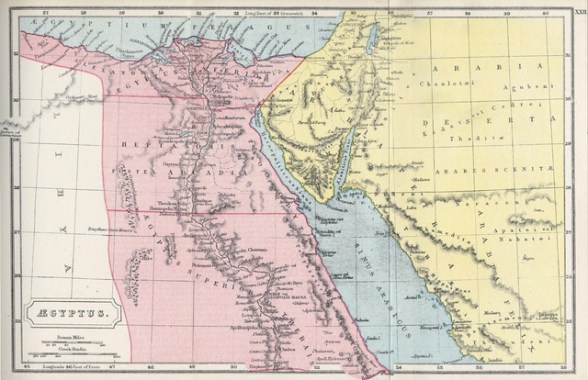
The Ravenna Mosaics and What to Expect (Special Edition Article)

Posted by Powee Celdran 

God is in the mosaics of Ravenna” -Marguerite Yourcenar (1903-1987)

Welcome to another article by the Byzantium Blogger! Alright, so this is my first travel article for this blog site; however, I already do travel articles with my other site, Far and Away, but since this is mostly about the art and mosaics of the Byzantines and will have a lot of mentions of Byzantine emperors and contemporaries, instead of a general tour of a city, I am putting this article on this site. So, as I’ve been talking about making an article about Ravenna, Italy, the real deal of this city is really its ultra-stunning mosaics and nothing more. The mosaics is what makes this city in the east coast of the Emilia-Romagna region popular and nothing else, as the churches with its exteriors look like they could be anywhere the former Roman world and the streets of the city could look like any generic Italian town. In truth, Ravenna’s city streets and atmosphere is nothing much mainly because it was bombed during World War II but miraculously its 5th– 6th century mosaics still survived and remain intact till this day. Earlier this year, I have read Judith Herrin’s “Byzantium: The Surprising Life of a Medieval Empire” and the whole of chapter 6 is dedicated to the mosaics of Ravenna and its history, and after reading it gave me a reason to travel all the way to Ravenna, which is a bit out of the way. To be fully honest, yes, the mosaics are literally impressive, all the way to the point where you will start feeling headaches from looking up at them. In Ravenna, not only one place (such as the Basilica di San Vitale) has the full set of Byzantine mosaics, almost all the main churches do and 8 landmarks in the city are considered to be UNESCO world heritage sites. Everything is walkable in the city center of Ravenna, but the churches are the only best places to stop in unless you visit the Tomb of Dante and the Mausoleum of Theodoric. In history, Ravenna has been an important trading port along the Adriatic Coast from the time of the Roman Empire to the Middle Ages with many canals coming from the sea flowing through the city- similar to Venice- up until sometime in the 15th century when the water dried up making the harbor pushed a lot farther, leaving only canal connecting the city to the Adriatic Sea. Anyways, Ravenna is I guess the only place in the world to see mosaics fully intact, more than Constantinople (which of course had more mosaics than Ravenna back in its day). It is also one of the few places on earth to see a lot of the late Roman and early Byzantine era, when Byzantium was still very much Roman before becoming very “Greek” in culture. Ravenna is also the place where different empires- Imperial Rome, Western Roman Empire, the Ostrogoth Kingdom, the Eastern Roman Empire, and the Lombards- meet over different periods leading to differences in art styles. Now, let’s begin the article!

95t3yr5xvfyy
Byzantine Imperial flag and symbols
map_of_ravenna
Map of the sites of Ravenna


Other related Byzantine articles: 

7 Reasons to be Interested in Byzantium

The Surprising Life of a Medieval Empire 

The Byzantine Emperors

An Overview of Byzantium 

Byzantine art, architecture, and fashion 

Traveling the Byzantine World (from Far and Away)

Byzantine Mosaics in Rome (from Far and Away)

Up next: Byzantine Science and Technology


Ravenna’s origins are unknown but it is said that its first settlers were the Etruscan people from Umbria as well as Thessalian Greeks. In the 1st century BC, the Roman built Ravenna as a port town becoming a municipium or city in 89BC. The original Roman city of Ravenna was a port as it was made up of several islands on the bay with small bridges connecting them and from the salt trade, it grew rich. However, today the water dried up and the port that was once the Roman port of Classe is farther from the center. Ravenna then became important in the 5th century after the Roman Empire was divided between east and west; the story here takes place when Western Roman emperor Honorius moved the capital to Ravenna in 402 as it was a strategic position along the sea compared to Rome which was more prone to attacks, and which it indeed was attacked in 410 by the Visigoths. Ravenna lasted as the western capital as Rome declined in power but at the end of the Western Empire in 476 when the last emperor Romulus Augustus was overthrown by the Germanic general Odoacer in Ravenna becoming the 1st king of Italy, who was then overthrown by the Ostrogoth Theodoric who made himself king of Italy (493-526).

Near the train station of Ravenna is something dating back to the time of the Western Roman Empire, which is now the 14th century Gothic brick church of San Giovanni Evangelista, but the original church dates back to the 5th century, built by the empress Galla Placidia. The only remains of the 5th century there is the floor while the mosaics on display date back to the 13th century as they depict the 4th Crusade and capture of Constantinople in 1204. Although near this brick church is the much more impressive Basilica di Sant’Apollinare Nuovo, dating back to the early 6th century built by the Ostrogoth king Theodoric the Great as the church of his palace found right next to it. Theodoric, an Ostrogoth barbarian was a very civilized person who built many structures and repaired the Roman aqueducts but was an Arian Christian, a follower of the Arian Heresy of Arius the 4th century theologian believing that Christ is the son of God but not divine. Theodoric was as well, founding the Ostrogoth Kingdom of Italy was one of the founding rulers of the European kingdoms, together with Clovis I of France who was his contemporary, while Byzantium was quickly rising under the reign of Emperor Anastasius I Dicorus. Part of what made King Theodoric a civilised person and an admired of Roman culture was that he was educated in Constantinople as he was sent there at a young age as a hostage to the imperial court. Being an admirer of the Romans (and Byzantines of Constantinople), Theodoric built many grand monuments and churches in Ravenna and wrote to the eastern emperor Anastasius I (the emperor with mismatched eyes), “Our royalty is an imitation of yours, a copy of the only empire; and insofar as we follow you do we excel all other nations.” The Sant’Apollinare Nuovo Basilica, which is a UNESCO world heritage site was at first an Arian church before becoming an Orthodox Christian one (then later Roman Catholic) after the Byzantine conquest of Belisarius under Emperor Justinian I in the 530s. The exterior of the church looks quite simple and so is the main nave without the mosaics lining both walls, partly because the apse and its mosaics were damaged during World War I. However, when seeing the mosaics, you will already be stunned and this not all yet on the Ravenna mosaics. Here there are layers of mosaics descending down the walls and they mostly have gold a background. The characters on the wall mosaics include early Christian saints, the 3 Magi, prophets, and 2 versions of the image of Christ- one being a young beardless man and one being older with a beard- as this was part of the Arian belief of Jesus being man and not divine. The mosaics here do not only show characters but structures as well such as Ravenna’s old port of Classe depicted with ships and the palace of Theodoric. Another image here near the entrance is a lone panel depicting the emperor Justinian of the Byzantine Empire (r. 527-565), although it said to be originally a mosaic of Theodoric but after the Byzantine conquest, the face of Justinian was overlaid showing the emperor as an old man, which is true since he lived until his 80s.

DSC06876
Streets of Ravenna
61664815_2074315959528267_1773200612775690240_n
Basilica di Sant’Apollinare Nuovo


Close to the Basilica di Sant’Apollinare Nuovo is the Arian Baptistery (Battistero degli Ariani in Italian), the proximity between these 2 UNESCO world heritage sites show that in the beginning of the 6th century, the Arian Christian community lived together apart from the Chalcedonian Orthodox Christians. The Arian Baptistery outside is also an octagonal shaped brick building and beside it is the Church of Spirito Santo, once an Arian cathedral commissioned by King Theodoric as well. The Arian Baptistery doesn’t have much inside it except for its well-preserved impressive mosaic ceiling, and before when the was water below at the baptismal font, the mosaics would reflect on it. The mosaic on the ceiling depicts Christ on the River Jordan half submerged and strangely unclothed and looking very much younger than the actual age he is usually depicted as he is seen without a beard. To the right of Christ is St. John the Baptist, to the left is an old man who is the personification of the River Jordan and above is the Holy Spirit. Surrounding the center of the ceiling are the 12 Apostles led by St. Peter and St. Paul (on opposite sides of the throne) in opposite directions. The rest of the interiors are just brick walls, but in the past, they’ve been covered with mosaics. A short walk away from this baptistery goes to the Orthodox Baptistery or the Baptistery of Neon. But before reaching this other UNESCO world heritage site, you will come across other Ravenna landmarks, which on the other hand are not world heritage sites but still important. These include the Piazza Garibaldi, the Piazza del Popolo or the main town square, and the Tomb of Dante Alighieri. It was here in Ravenna that Dante wrote the 3rd and last part of “The Divine Comedy” which is entitled “Paradise” (Paradiso in Italian) and in 1321 he died in Ravenna being exiled from Florence, his home city for writing against a powerful family there.

Now slightly to the west of it is the Baptistery of Neon (Battisterio degli Ortodosi in Italian), which was the Orthodox baptistery and the most ancient monument that remains in the city being originally a Roman bath. The Orthodox Baptistery on the other hand shows something different yet so similar to that of the Arian one. This baptistery also has an octagonal shape but its interiors are much larger and more detailed than the other one. Inside, you will see the same figure of Christ at the center of the ceiling being baptized in the River Jordan half submerged in the water with St. John the Baptist, the old man who personifies the river, and the Holy Spirit above with a gold background but here Christ is depicted in what Christians picture him, which is a much older man with a beard. Surrounding the central image is the same circle of the 12 Apostles led by St. Peter and St. Paul facing each other, but here there is not throne dividing them and the background is dark blue. Not only the ceiling here has mosaics but the base of it as well which depict the Gospels and even the arches and corners have intricately made colorful tiles as well covering every little space. Beside this Baptistery of Neon (named after the late 5th century Bishop Neon who completed it) is the Duomo or cathedral of Ravenna which was during the time of the Ostrogoth rule the cathedral for the Orthodox Christians of Ravenna, but part of it today is the Archiepiscopal Museum (Museo Arcivescovile in Italian) which holds the relics of early Christian saints, mosaics from the old cathedral of the Orthodox Christians of Ravenna, and the ivory throne of the bishop given as a gift by Emperor Justinian I from Constantinople. A part of the museum is the remains of the Cappella di San Andrea, the private chapel of the bishop of Ravenna and up to this day, the mosaics even at a curved ceiling remain intact. The mosaics here have a different touch to them as some parts depict birds but images of the saints are still seen in circles lining the arches of the narthex. The most distinct feature in the mosaics here is the image of Christ above the doorway where he is seen dressed up like a warrior in Byzantine (late Roman) style armor instead of wearing robes as he is usually depicted. This image was done this way since the bishop wanted to see Christ as the defender against the Arian heretics ready to fight them at any time.

61190094_2414069071956960_4054802397074030592_n
Ceiling mosaics of the Arian Baptistery
61596398_617280888792377_2614586376804368384_n
Ceiling mosaics of the Orthodox Baptistery
DSC06848
The Duomo beside the Orthodox Baptistery


After quite a walk from the area of the Duomo are the main highlights of Ravenna, the Mausoleum of Galla Placidia and the Church of San Vitale, known for its impressive Byzantine mosaics. The ancient but intact mausoleum and the large church are side by side with each other sharing the same courtyard. Both the church and the basilica use the Romanesque style brick architecture, and the mausoleum looks like a small cross-shaped house outside but its interiors are breathtaking. The Mausoleum of Galla Placidia (Mausoleo di Galla Placidia in Italian) is a UNESCO world heritage site that dates back to the mid-5th century built by the Empress Galla Placidia (r. 423-437) being the regent empress for her young son Valentinian III until he was old enough. Galla Placidia, the mother of Emperor Valentinian III was also the daughter of the last emperor of the full Roman Empire Theodosius I (r. 379-395) before the full east-west division after his death in 395; she was also the sister of Western emperor Honorius (r. 395-493), the half-sister of Eastern emperor Arcadius (r. 395-408), and wife of the Western Emperor Constantius III (r. 421); she died in 450 and the story goes that she had the mausoleum built for herself and family. However, you will not find her sarcophagus here as it has been moved to Rome but the tomb of her son Valentinian III (or said to be the tomb of Honorius) and of her husband Constantius III are found inside. Earlier on, the mausoleum was connected indoors to church of Sta. Croce beside it, which was also commissioned by Galla Placidia but is now in ruins. The floor of the mausoleum today is 5ft higher than it was in the time it was built as it had to be raised due to the rising levels of the Adriatic Sea. When entering the mausoleum, you will see one of the finest pieces of Byzantine mosaics, and this one is found at the 4 arched ceiling of the 4 sides, showing what happens to be a dark blue sky filled with circles which are supposed to be stars. This mosaic patterns turns out to be one of the symbols of Ravenna and one of the finest examples of Byzantine mosaics. However, this is not it as the central part has a dome with the same dark blue mosaic ceiling with gold tiles representing the stars, and at the center is a gold cross. The arches are as well lined with mosaics depicting nature with one even depicting something that looks like modern art while the semi-circle edges of the mausoleum depict images of the apostles, other saints, and another one with St. Lawrence next to a flaming grill beside a bookcase containing the 4 Gospels of the New Testament. One of the semi-circles here shows an image of Christ, this time as The Good Shepherd surrounded by a flock of sheep instead of a warrior in armor. Here, Jesus is depicted with a staff looking authoritative while his body looks realistic as it shows movement.

Meanwhile, next to the mausoleum is the Basilica of San Vitale, which I could say is the actual highlight of Ravenna. San Vitale is also one of the UNESCO world heritage sites of Ravenna and it dates back to 526 (the same year as the death of Theodoric) and finished in 547 when Ravenna was already under Byzantium after being captured by Belisarius. The story of Belisarius’ capture of Ravenna for Byzantium in 540 is written by the historian Procopius who says that while the reconquest of Italy was ongoing, Emperor Justinian I ordered him to march into Ravenna and capture the Ostrogoth monarch in power which was Vitiges and the conquest turned out to be successful. The exteriors show an example of early Byzantine architecture, having 8 sides, small arched windows, flying buttresses, and a belltower looking like the Galata Tower of Constantinople, while the church building looks a bit like the church of Hagia Eirene in Constantinople. The church is said to be erected on the site of the martyrdom of St. Vitalis but it is confused whether it was St. Vitalis of Milan or St. Vitale of Bologna who was martyred together with St. Agricola. When entering, the mosaics will already immediately stun you as you face the church’s altar area as every space is filled up with colorful mosaics. The entrance arch already shows a full set of mosaics with the image of Christ above the arch and the images of the apostles descending down the arch. The 4 corners of the mosaics in the presbytery have the images of the 4 Evangelists (St. Matthew, St. Mark, St. Luke, and St. John) and their respective symbols, while at the center of them are open arches with mosaics lining their narrow ceiling, and at the ceiling above are alternating leaf patterns with the Lamb of God at the center. Other images depicted on the mosaics are the Old Testament prophets and scenes from the Old Testament. Meanwhile, the apse shows Christ at the center dressed in the imperial purple which happens to look like brown, to his left are 2 angels and above the blue and red lines represent clouds, while below him is a sphere representing the earth which must is a possible hint to whether the Byzantines believed the earth was round. The far right figure of the apse is Bishop Ecclesius of Ravenna presenting the model of the church and to the far left is St. Vitale who Christ is going to give the crown on his hands to. Below the apse is already the windows but, in the space leading to the apse, it was maximized with 2 panels facing each other depicting the imperial court of Emperor Justinian I of Byzantium (r. 527-565) which was made after the conquest of Ravenna, but strangely the emperor never even stepped foot in the basilica or to Ravenna in his lifetime. The panel on the left shows Emperor Justinian I being the central figure dressed in purple robes that looks like brown, but the image of the Bishop Maximian of Ravenna looks larger as he was the bishop when this church was consecrated in 547, then behind Justinian and Maximian is either the image of the eunuch general Narses or the financial donor Julius Argentarius who spent 26,000 gold coins to create the mosaics of the church. Beside Justinian on his left include the general Belisarius who he places his feet over, and beside Belisarius is most likely Justinian’s court financer John the Cappadocian, and beside him are the palace guards or Excubitors with the Byzantine PX symbol on the shield (the PX being the first 2 syllables of Christ’s name in Greek “chi” and “rho”) while to the right of Maximian are clergymen. Across this panel is the panel of Empress Theodora, the wife and brains behind Justinian who was 18 years younger than him and also died 17 years before he did and together they had no children. Theodora is the tall central figure also with halo, just as Justianian is, although she has a dome also above her head while to her right is Antonia the wife of Belisarius, and to the left is most possibly the historian Procopius of Caesarea, and on the right side are other female courtiers of Constantinople. Justinian and Theodora happened to be the most influential rulers of Byzantium even though both began as commoners (Justinian being an Illyrian peasant and Theodora being a circus performer). Justinian was most famous for introducing the code of laws and during his reign Byzantium was at its largest. Both the emperor and the empress are facing each other on 2 opposite side and appear to be offering gifts to the saint this church is dedicated to. On the other hand, the rest of the basilica’s interiors have Baroque frescoes lining the dome and parts of the ceiling which date back to the 18th century. Aside from San Vitale, the other Byzantine era church in Ravenna is found a few kilometers away from the city center south at Classe. This landmark is the Church of Sant’Apollinare in Classe which has a surviving colorful Byzantine mosaic apse and a panel depicting the court of the Byzantine emperor Constantine IV (r. 668-685).

So, after the golden age of Byzantine Ravenna in the mid 6th century during the reign of Justinian I, Byzantine power eventually began to decline with the presence of the invading Lombards from the north. After 584, the Byzantine emperor Maurice (r. 582-602) changed the province of Ravenna into the Exarchate of Italy governed by an exarch with about the same power as the emperor over the army and civil services in Italy, while another exarch ruled in North Africa. Byzantine rule in Ravenna and the rest of northern Italy ended in 751 when the Lombard king Aistulf captured the city forcing the exarch to surrender, meanwhile the Byzantine emperor Constantine V in Constantinople did not send an army to help defend Ravenna. Some years later in 774, Charlemagne the Frankish king conquered Ravenna from the Lombards as part of building the Holy Roman Empire, meanwhile Ravenna was handed over to the pope by Charlemagne as part of the Papal States. Under Charlemagne and his successors, some items in Ravenna including marble columns and the equestrian statue of Theodoric were moved to Aachen, then the capital of the Holy Roman Empire. After this, Ravenna lost most of its significance but the mosaics remain in place; for the next centuries Ravenna became part of the Republic of Venice during which more buildings were built such as the fortress of  Rocca Brancaleone near the tracks across the large Mausoleum of Theodoric, another of the 8 UNESCO world heritage sites.

61278360_293121414745593_3907912531275939840_n
Exterior of the Mausoleum of Galla Placidia
61073268_957002387808232_8312370097113006080_n
Ceiling mosaics of the Mausoleum of Galla Placidia
61662072_1394529044019445_992072587074863104_n
Basilica di San Vitale Romanesque exterior
61603401_1318060065009797_5060040914337005568_n
Full view of the presbytery of San Vitale and its mosaics
DSC06860
Mosaic panel of Emperor Justinian I, Belisarius, Bishop Maximian, churchmen, and Excubitors 
DSC06865
Mosaic panel of Empress Theodora, Procopius, and courtiers
e6756ef574d3de71a95589ffbaf4e630
Byzantine exarch of Ravenna


Now as I finish this article, I still have quite a lot to say about Ravenna and what to expect. First of all, Ravenna is quite underrated despite being one of, if not the best place in the world to see Byzantine mosaics (even the street signs have mosaic replicas on them), this is surely because its location is a bit out of the way, not near the main cities of Italy such as Rome, Florence, or Venice, but if you are in Bologna it is quite near. However, even if it is out of the way it is still a must visit for the mosaics that even 19th century Austrian artist Gustav Klimt was inspired by them to create his famous works. Since Ravenna has been the capital of 3 powers: The Western Roman Empire, Ostrogoth Italy, and Byzantine Italy, there is a complete reason for the city to have breathtaking colorful mosaics (which were even more in number ack then) and even after more than a thousand years they still remain preserved well. More importantly though, without patrons such as Empress Galla Placidia, King Theodoric, the bishops, and even Emperor Justinian I, Ravenna would not have this kind of world class art it still has. The mosaics here have survived a lot including 2 world wars but today they still look as good as it was in the 6th century making it the best place in the world to see Byzantine mosaics, even more than Constantinople iconic landmarks like the Hagia Sophia. What makes Ravenna the ultimate place to see Byzantine art is that is preserved as these mosaics were spared during the Iconoclast period in Byzantium from the 8th -9th centuries as Ravenna was no longer under Byzantine control, and it also survived the fall of Byzantium in 1453 and the shift to Islam, obviously because the Ottomans never reached and over the years Ravenna’s mosaics remain in place even if the city lost its importance. On the other hand, I still have to mention the experience of seeing the mosaics and how it can affect you. At the end, it turns out seeing too much of these colors and keeping your head up all the time can result in giving you a headache. However, at the end, the memory of these mosaics will stay with you even if you have left the place. When visiting Ravenna, keep it in mind that these 8 UNESCO world heritage sites (in which I have visited only 6 of them) are the only impressive things to see as the city itself may just look like a generic Italian town if not for its rich history. When it comes to a Byzantine history lover such as myself, going to Ravenna is a must no matter how much of a hassle it is getting there because you won’t see mosaics this well preserved anywhere else as I have said so many times. Anyway, this concludes the Ravenna mosaics article and seeing these mosaics surely will teach you a lot of how the changing of powers over a short period of time changed the style of art. And this is all for now… thank you for viewing!
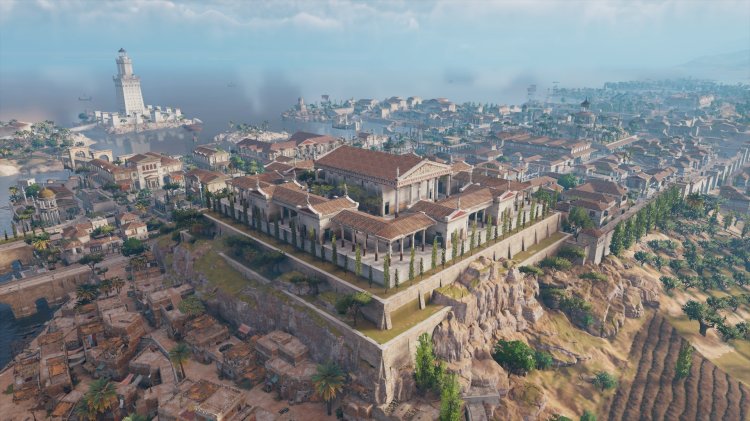
The 94 Emperors of Byzantium and their Intriguing Tales

Posted by Powee Celdran 

Glory to God who has thought me worthy to finish this work. Solomon, I have outdone you.” -Emperor Justinian I (527-565)

cDNOSmb

Hello again and welcome to another article by The Byzantium Blogger! Here is another article on the Byzantine Empire and this time about the long history of the Eastern Roman emperors from 324-1453, from Constantine I to Constantine XI and all their bizarre and inspiring stories. This article’s main source is the book, “A Cabinet of Byzantine Curiosities” by Anthony Kaldellis (2017), but of course the real source of all these stories are from various Byzantine historians from the era of their empire. The Eastern Roman Empire or Byzantine Empire lasted for 11 centuries and had a total of 94 emperors, 23 of them died violent deaths, 31 were dethroned and replaced by another regime but 8 of the dethroned emperors managed to reclaim the throne after a few years, 37 of them succeeded their fathers in the traditional way of monarchy but some did not immediately become emperor after their father’s death mainly due to their young age. Meanwhile, 10 rulers succeeded other family members while 4 were elected by the army or people, while a few others either led a rebellion or imposed themselves to become emperor, and 8 became emperor from marriage to a widow, sister, or daughter of the pervious ruler. Out of the 94 rulers, only 2 women fully ruled the empire as sole empress, these 2 being Empress Irene of Athens (ruled 797-802) and Theodora (r. 1055-1056) while 7 of them never set foot in the capital, Constantinople such as Jovian and Gratian in the 4th century, Staurakios in the 9th century, and the 4 emperors of the Nicaean period (1204-1261) when Byzantium was temporarily dead. The average reign length of a Byzantine emperor is 12 years; some ruled for only a few months while some ruled for almost half a century; the Byzantine emperor with the longest reign is Basil II the Bulgar-Slayer ruling for 49 years (976-1025) uninterrupted. However, other emperors ruled for this long as well such as John V Palaiologos (r. 1341-1391) but with 3 interruptions within those 50 years; other emperors with long reigns include Andronikos II Palaiologos (46 years), Theodosius II (42 years), Justinian I (38 years), and Alexios I Komnenos (37 years). Out of 94 emperors, 10 are official saints in the Orthodox Church while 4 of them are unclear of having the status of saint. This article will show you how violent the reigns of these emperors were especially by being dethroned by the rebellions and forced to live their lives as monks in a monastery, and some were blinded when dethroned. In most points of Byzantine history, there was instability in succession leading to civil wars and a constant change of emperors such as in the 20-year anarchy period (695-717), but there was a bit of stability with the rule of a dynasty, the longest being the Palaiologos dynasty (1261-1453) lasting for 192 years followed by the Macedonian dynasty (189 years, 867-1056). On the other hand, all these intriguing tales of the emperors, court intrigues, and succession struggles show the interesting and complex life of the Byzantine Empire. If one might think that the monarchies of England and France was full of intrigues and succession issues, take a look at Byzantium and see that it is 10 times more complicated, thus giving us the adjective “byzantine” meaning complicated and difficult to understand. Warning, THIS IS A VERY LONG POST but enjoy it as you learn the complex history of the 1,100-year succession of emperors.

95t3yr5xvfyy
Byzantine Imperial flag and symbols

Note: This information is from sources written by Byzantine historians; names of emperors are in bold letters.

Watch this video for a quick lesson on every Byzantine emperor from 306-1453 

My other Byzantine articles:

7 Reasons to be Interested in Byzantium

The Surprising Life of a Medieval Empire

Byzantine Architecture, Fashion, and Arts

Constantine-and-Justinian-lunette-mosaic
Mosaic of the emperors Justinian I (left) and Constantine I (right), Hagia Sophia


The first of the 94 Byzantine emperors was Constantine I the Great beginning his rule as Roman Emperor of the west in 306 when he was proclaimed emperor by his army in present day York in England after the death of his father, Constantius I Chlorus. Constantine like the Roman emperors of his time was not of Roman ethnicity but born in the Balkans, in his case he was born in present day Nis, Serbia, and on the other hand he had the nickname of “thick neck” due to his large neck. He was a popular and effective emperor starting out as the minor emperor or Caesar in the west later becoming the senior emperor or Augustus but to become sole ruler of the Roman Empire, he had to eliminate all his political rivals until he became full emperor in 324 moving the capital from Rome to Constantinople, the new city he founded building over the ancient Greek colony of Byzantion. Even if Constantine was a popular and effective ruler as well as a great military strategist and the emperor who made Christianity the official religion of the empire, he was worse than the Roman Emperor Nero (r. 54-68) in killing family members; in this case he ordered the deaths of his father-in-law Maximian, his brother-in-law Maxentius who he defeated in battle in 312, his other brother-in-law in 325 Licinius and his 10-year old nephew, his son Crispus in 326 for unknown reasons, then his wife Fausta who was put to death by being steamed to death in her bath; it is claimed that he converted to Christianity before his death in 337 for the forgiveness of his sins. Constantine I was succeeded by his 3 sons who were named using different versions of his name; these were Constantine II (r. 337-340), Constantius II (r. 337-361), and Constans I (r. 337-350) and out of the 3, Constantius II outlived his 2 brothers and ruled until his death in 361, he was then succeeded by his cousin Julian, who was crowned emperor in present day Paris before the death of Constantius II as a way to declare war but the civil war never took place and Julian was only emperor for 2 years. Julian was a very complex figure as he was both a philosopher and soldier but he rejected Christianity giving him the title “the Apostate” making him the last Pagan emperor, he also thought about rebuilding the Jewish temple in Jerusalem which had been destroyed centuries before, and as emperor he was a lenient judge that magistrates complained to him; he was however killed in battle against the Sassanid Persians in 363 ending the Constantinian dynasty as he was succeeded by Jovian, the captain of his guards who died before he even returned to Constantinople.

Constantine_I_Hagia_Sophia
Constantine I the Great, founder of Constantinople


After the deaths of Julian and Jovian, Valentinian I, also a commander in Julian’s army was elected emperor beginning the Valentinian dynasty in 364. As emperor, Valentinian was a cruel one who had 2 pet bears placed outside his bedroom whom he fed prisoners to. Valentinian though did not rule long and was succeeded by his younger brother Valens after his death, who only ruled for 3 years (375-78) as emperor of the east. Valens was known for constructing the large aqueduct in Constantinople still seen today but he also invented new ways to torture people saying that people had already found ways to deal with existing methods of torture. Valens was killed in the Battle of Adrianople against the Goths in 378 leaving his nephew Gratian, the son of Valentinian to be emperor, although Gratian stayed in Rome and never set foot in Constantinople, making him appoint the general and his brother-in-law as Theodosius as Emperor Theodosius I to rule the east beginning 379, and with the death of Gratian’s brother the western emperor Valentinian II in 392, Theodosius was full emperor of the Roman Empire. Theodosius I in his reign promoted Christianity as the state religion, although at one point he was excommunicated for a few months by the bishop of Milan St. Ambrose for the massacre of the people of Thessaloniki and upon his death in 395, the empire was permanently divided between east and west and his sons ruling each part. His son Arcadius inherited the east and this is when it could be said the Eastern Roman or Byzantine Empire really began; Arcadius ruled for 13 years until his death in 408, he was however a weak ruler and at his death was succeeded by his son Theodosius II who was still a boy. Theodosius II’s early reign was mostly taken care of by the commander of the imperial guard, though Theodosius lived most of his life as emperor ruling for 42 years. Theodosius II is best remembered for building the triple-layered walls of Constantinople to withstand heavy sieges from enemies on all sides, but apart from this, he was lazy and it was said that he would sign any document even without reading them, once his sister Pulcheria– later empress- placed a contract before him to sell his wife into slavery which he signed making his sister scold him for his lazy attitude. In 450, Theodosius II died in a riding accident and was succeeded by his sister Pulcheria and her husband who became Emperor Marcian (r. 450-57) who however died 7 years being followed by Leo the Thracian, a soldier who became Emperor Leo I with the help of Aspar, a Gothic commander in the army.

ceecb1a96cebf6a46d8d1f99a4de90f1
Illustration of Emperor Arcadius (left), Theodosius I (center), and Consul Flavius Felix (right)


Leo I (r. 457-474) began the short-lived Leonid dynasty, he was an ambitious ruler known as “the butcher” but was also known for issuing a law that Sunday is a full rest day which meant that even no musical instruments were to be played. After his death in 474, he was succeeded by his grandson Leo II, the son of his daughter Ariadne and the Isaurian general Zeno, however Leo II was only age 7 when he was crowned and after only 10 months, he died leaving his father Zeno (r. 474-491) who was most likely of Persian ethnicity to be next in line. 1 year into his reign, Zeno was overthrown by Leo I’s brother-in-law, the general Basiliscus, but in the next year (476), Zeno returned to power forcing Basiliscus into exile; and at the same time, the Western Roman Empire had finally come to its end when its last emperor was overthrown by the Germanic general Odovacar, who Zeno made King of Italy. Zeno died in 491 possibly from his epilepsy but it is believed that his wife Ariadne buried him alive due to his disease and after his death, Ariadne’s new husband the financial officer Anastasius I Dicorus (r. 491-518) followed Zeno as emperor; his nickname Dicorus was given to him because his heterochromia where one eye was a different color from the other. Anastasius died at a very old age in 518 without any children but at his death, Byzantium reformed its coinage system and the economy was strong. Without any heirs except for his nephews, the commander of palace guard Justin used this situation to his advantage by using the money he was given to bribe the chief chamberlain Amantios instead to be used by his men to make him emperor, thus he coming from a peasant background became Emperor Justin I (r. 518-527) beginning the Justinian dynasty.

220px-Leo_I_Louvre_Ma1012_n2
Emperor Leo I the Thracian
b2e5697e912330c3cfba5d079f85b596
Anastasius I Dicorus, with 1 green and 1 blue eye


Byzantium reached its height of power in the years of the Justinian dynasty in the 6th century but what most do not know is that this ruling family came from humble origins as Illyrian peasants from the present-day Republic of Macedonia. Justin I rose to power by being in imperial palace guard or excubitors for decades during the reigns of Zeno and Anastasius and over the years rose through the ranks until making himself emperor despite his illiteracy. He was however of old age when he was emperor and his staff had to make him use a wooden stencil to sign documents mainly because he couldn’t write, this was either due to illiteracy or his old age. With Justin’s death in 527, the throne passed down to his nephew Justinian I the Great, the most influential Byzantine ruler known as “the emperor who never sleep” as he spent his reign constantly campaigning and building things. Like his uncle, Justinian was also born a peasant but at an early age was sent to Constantinople to be educated making him become a great jurist and an officer in the imperial guard; his wife Empress Theodora also came from humble origins as a performer. As emperor, Justinian I (Iustinianus in Latin) named almost everything after himself including the famous book of laws the Codex Iustinianus, as well as many towns, and students and government officials used his name as a title. During Justinian’s reign, Byzantium went through glorious and difficult times including the large scale Nika riots of 532, the plague of 542 which even hit him but still recovered and the Constantinople earthquake in 557, but these glorious moments included the successful conquest of Italy and North Africa by the general Belisarius from the Vandals and Ostrogoths. Justinian died in 565 at age 83, 17 years after the death of his wife Theodora with the empire at its largest from Spain to Syria and was succeeded by his nephew Justin II. During the reign of Justin II (565-574), Byzantine lost parts of Italy which had been recently conquered and constant war with the Sassanid Persian Empire took place, this is probably some of the reasons that drove this emperor insane. Justin II is the only Byzantine emperor who is said to be clinically insane as he would run around the palace making the noises of wild animals, try to bite his attendants, and even tried to throw himself out of the window a few times that his wife had to put bars on his windows to avoid it. At the end, Justin II was no longer fit to rule so the throne was passed down to the commander of the palace guard (excubitors) Tiberius II Constantine in 574, and after Justin II’s death in 578, Tiberius II was full emperor and with his death in 582, his son-in-law the Cappadocian general Maurice (r. 582-602) came next and during his reign, the war with the Sassanids continued and he was the last of the Justinian dynasty, he was then deposed and executed by the rebellion leader Phokas (r. 602-610) who made himself emperor.

gettyimages-50810746-612x612
Emperor Justin I
justinian-and-theodora
Emperor Justinian I and Empress Theodora
kb7xsuk2emmy
Byzantium in Justinian I’s reign, 555


With Phokas as emperor, the Byzantine military leader in North Africa, Heraclius led another revolt which ended with overthrowing Phokas in 610 leaving Heraclius to be emperor (610-641) beginning the Heraclian dynasty. In his reign, Constantinople was besieged by the Persians, Slavs, and Avars while Heraclius was away but he still brought the war against the Sassanids to an end in 628 with the execution of their king, Chosroes II but some years later, the Arabs began to make their move into Byzantine territory beginning the spread of Islam, thus beginning the long Arab-Byzantine wars where Byzantium lost Syria. Even though Heraclius was a war hero and known for introducing Greek as the official language of the empire replacing Latin, he was so afraid of water that when having to cross the Bosporus Sea to arrive at Constantinople after the war, he had to have a bridge of logs built for him to cross without having to see the waves. At Heraclius’ death in 641, his son Constantine III succeeded him as emperor for only 3 months, in which after his death his 15-year-old half-brother Heraklonas- also the son of Heraclius- and co-emperor came next but only ruled for 4 months as he was deposed by his troops in September of 641. With pressure from the army, the son of Constantine III, Constans II (r. 641-668) who was only 11 was made emperor. During his reign, as Greece had faced invasions from the Slavs in the north and the war with the Arabs continued in the south and east, Constans II planned to move the capital to Syracuse in Sicily and probably because of this plan of his, in 668 he was assassinated in his bath by his chamberlain using a soap dish. Although during Constans II’s reign, Byzantine ambassadors were said to have reached the imperial court of China. After the murder of Constans II, the throne was passed down to his son Constantine IV (r. 668-685), nicknamed “big beard” who was best known for successfully defending Constantinople from the 1st Arab siege in (674-78) and after his death was followed by his son Justinian II in 685. Justinian II was deposed by a military revolt in 695 where his nose was cut off by the rebels before he was sent into exile whereas the rebellion leader Leontios (r. 695-98) became emperor only to be replaced by Tiberius III (r. 698-705) who was deposed in 705 with the return of Justinian II supported by the Bulgarians; after re-entering the capital by passing the aqueducts he became emperor again until 711, this time with the nickname “Rhinotmetos” or “Slit-Nosed”. However Justinian II’s 2nd reign also ended violently as he was again dethroned by the rebellion led by Philippikos Bardanes (r. 711-13) who later executed Justinian II but 2 years later was overthrown by his secretary who became Emperor Anastasius II (r.713-15), but he was also overthrown by the military rebellion of Theodosius III (r. 715-17).

1200px-Piero_della_Francesca_021
Byzantine- Sassanid Wars, 602-628
xir331770_1024x1024
Mosaic of Constantine IV in Ravenna


The years from 695-717 was marked by a period of anarchy but this troubled time was put to an end by Leo III (r. 717-741) known as “the Isaurian”, who led another rebellion in 717 and secured the throne for himself; he then began the movement of Byzantine Iconoclasm, repelled the 2nd Arab Siege of Constantinople (717-18), introduced the land system of the Themes, and after his death in 741 was succeeded by his son Constantine V (r. 741-775) beginning once again a stable line of succession. Constantine V known to some as “Kopronymos” or “dung-faced” by hostile critics- as he allegedly defecated in the baptismal font as a baby- was dethroned 1 year into his reign by the general Artavasdos (r. 742-43) but a year later, Constantine V reclaimed the throne. Constantine V was a strong supporter of Iconoclasm just as his father was, but he took it to a higher level by even issuing a law that banned the use of the word “saint” for the saints but he also sent an organ as a gift to King Pepin of the Franks, thus introducing the organ to Europe. In 775, Constantine V’s son Leo IV (r. 775-780) succeeded him as emperor after his death, he was nicknamed “the Khazar” because his mother was the Khazar princess Tzitzak, though Leo IV only ruled for 5 years and in 780 was succeeded by his son Constantine VI (r. 780-797), who was then overthrown by his mother Empress Irene of Athens (r. 797-802) who blinded and imprisoned him; Constantine died shortly after from his wounds. Irene after taking the throne from her son was the 1st sole empress of Byzantium and temporarily ended the Iconoclast movement, but in 802 she was overthrown by a palace coup and exiled as Nikephoros I (r. 802-811) took the throne.

Themata
Map of the Byzantine Themes


During the reign of Nikephoros I, Byzantium went to war with the Bulgarian Empire in the north and at the battle of Pliska in 811, the Byzantines were defeated, Nikephoros was executed, and it was said that the Bulgarian Khan Krum used Nikephoros’ skull as his drinking cup. With Nikephoros’ death, his son Staurakios (r. 811) became emperor for only 3 months without even setting foot in the capital and had to abdicate due to being paralyzed at the Battle of Pliska, leaving the throne to his brother-in-law Michael I Rangabe (r. 811-813) who then had to abdicate the throne in 813 because of the rebellion of Leo V the Armenian (r. 813-820), whereas Michael I retired and lived the rest of his life in a monastery as a monk. The Armenian general Leo V however also faced a revolt by the army officer Michael of Amorion, and during Christmas of 820, Michael of Amorion was charged for treason and imprisoned by Leo V, although during the Christmas Day Mass, the conspirators led by Michael locked Leo inside the Hagia Sophia as the Mass began and posing as the choir, they pulled out their weapons and one by one mutilated him. Leo’s mutilated body was dumped in the snow and Michael was crowned Emperor Michael II (r. 820-92) while still chained in prison as the key could not be found, although he was officially crowned by the patriarch the next day. Theophilos (r. 829-842) succeeded his father Michael II after his death and during his reign, Byzantium developed the beacons system to send a message across Anatolia within only an hour and as he began to grow bald, he ordered that no Roman (Byzantine) should grow their hair longer than the neck, though this was partly to revive the ancient Roman hairstyles. Michael III (r. 842-867), succeeded his father Theophilos even if he was still very young, which meant the earlier part of his reign was under the regency of his mother Theodora, who fully put an end to Iconoclasm in 842. Michael III was a pleasure-loving ruler earning him the nickname “the drunkard” though this led to a plot by his courtier, Basil the Macedonian to assassinate him on September 23, 867, Michael was then killed at only 27 and a new golden age for Byzantium was to begin with the start of the Macedonian dynasty.

Byzantine Emperor Theophilos (r. 829-842), surrounded by dignitaries of his court. Illustration from the Madrid Skylitzes (Fol. 42v) c. 12th century, [Public Domain] via Creative Commons
Court of Emperor Theophilos


Basil I (r. 867-886) founded the Macedonian dynasty after Michael III’s assassination in 867, and like Justinian I, Basil came from a peasant background originally from Byzantine Macedonia- although it is said that he is a descendant of the 1st century Arsacid dynasty of Armenia- but quickly rose to power by being a courtier of Michael III, though Basil who was much older rose to power by scheming but also by marrying Michael’s mistress Eudokia Ingerina so that Michael could keep her close. It was even believed that Basil’s son and eventual successor Leo VI the Wise (r. 886-912) was the son of Eudokia and Michael since he was born in the year of the “overlap” of his mother from Michael to Basil, although this could be true because Leo VI transferred the body of Michael III to the Church of the Holy Apostles where the emperors are buried in after Basil’s death in 886. Leo VI is known as the wise as he was a scholar and philosopher and was also credited for inventing the hand-held flamethrower, a portable Greek Fire. Leo was married 4 times in his life and each wife could not bear him a son until only his mistress Zoe Karbonopsina did in 905 with the birth of Constantine VII, his only son and heir (similar to the story of 16th century King Henry VIII of England), and his 4th marriage to Zoe was seen as controversial that he had to marry her in secret, but when discovered by the patriarch, Leo was excommunicated for a year. Leo VI died in 912 with his son too young to rule, so the throne was passed on to his younger brother Alexander (r. 912-13) who hated Leo and as emperor was a debauched ruler who listened to sorcerers to perform the pagan ritual to sacrifice clothes to the statues in the Hippodrome and light candles before them to cure his sickness. Alexander fired everyone from Leo’s court when becoming emperor but only ruled for a year as he died from a heart attack after playing his favorite sport, Polo and today and image of him survives at the Hagia Sophia where he is seen in a full body mosaic at a large panel, even if he is an obscure short ruling emperor. After Alexander’s death in 913, the young Constantine VII nicknamed “Porphyrogennetos” or “purple born” became emperor but under regents but in 920, his regent and father-in-law, the Armenian admiral Romanos Lekapenos seized the throne for himself becoming the senior emperor Romanos I while Constantine remained as a puppet ruler. Romanos I was another ruler from humble origins but rose to power at the imperial court and as emperor from 920-944, he was a great one ending the ongoing Byzantine-Bulgarian War, boarding up the porticoes in Constantinople to protect the homeless from the snow, and also appointed his family members to powerful positions in the court. Romanos however was overthrown by his sons Stephen and Constantine in 944 and forced to live his life as a monk in a monastery, while in 945 Constantine VII retook the throne for himself exiling the brothers to the same monastery as their father. Aside from being an emperor, Constantine VII was a scholar and prolific writer who wrote down several histories as well as an artist and sculptor but was an unsuccessful military leader and an elitist, although he promoted the Renaissance of Byzantine arts and the lavish lifestyle of the imperial court. Constantine VII’s death in 959 was said to be from poisoning but the transition of power to his son Romanos II was peaceful, Romanos however died 4 years later in 963 and it was said that he was poisoned as well, by his wife Theophano who is said to have previously poisoned his father. Romanos’ II son Basil was then still too young to rule, so Theophano married the successful Cappadocian general Nikephoros II Phokas (r. 963-69) who was best known for recapturing Crete, Cyprus, and Aleppo from the Arabs; Nikephoros was proclaimed emperor by the army in 963 and ruled for the next 6 years successfully campaigning against the Arabs and Bulgarians, although westerners including Liutprand of Cremona depict him as a “monstrosity of a man”, partly because of his mistreatment at the court. Nikephoros II was murdered in his sleep by the general and his associate John Tzimiskes on December 11, 969 whereas John became Emperor John I (r. 969-976)- similar to the play “Macbeth” where Macbeth kills the king in his sleep and is proclaimed the next ruler. John I, the husband of Romanos II’s sister Theodora was also a successful general and master horseman who was able to jump from one horse to another while the horses were galloping, but he died on his way back to Constantinople in 976 after campaigning against the Abbasids in the east. By that time, the rightful heir Basil II (r. 976-1025) was old enough to rule and he did rule for almost 50 years defeating a couple of rebellions that could have started civil wars, starting an alliance with the Rus by marrying his sister to Prince Vladimir of Kiev, forming the Varangian Guard unit made of Nordic mercenaries, and most of all best remembered for finishing the war with Bulgaria and claiming almost the entire Balkan Peninsula for Byzantium in 1018 after a 20-year-war. Before the defeat of the Bulgarian Empire, after the Battle of Kleidion in 1014, Basil II is said to have blinded the 14,000 defeated Bulgarians leaving 1 out of every group of 100 left with one eye to lead the rest back, which left the Bulgarian Tsar Samuil die from shock upon seeing this, this then gave Basil II the tile “Boulgaroktonos” or “the Bulgar Slayer”, and he ruled until his death in 1025 at the age of 67 and he surprisingly was never married and had no heirs, he was also a hero of the poor, and today a national hero in Greece but despised in Bulgaria. Since he had no heirs, Basil II was succeeded by his younger brother Constantine VIII (r. 1025-28) who was already of old age and unlike his brother was a weak ruler who then died 3 years into his reign passing the throne to his son-in-law the aged Romanos III Argyros (r. 1028-1034), Romanos III was the first husband of Constantine’s daughter Zoe Porphyrogenita (r. 1028-1050) who ruled as empress with her 3 husbands, the first one being Romanos III, then after his death with the epileptic Michael IV the Paphalagonian (r. 1034-1041) who helped Zoe kill her former husband Romanos III, then after his death with Michael’s nephew Michael V Kalaphates known as “the caulker” for only 1 year (1041-42) although he was not Zoe’s husband, then after the death of Michael V, Zoe ruled with her 3rd husband Constantine IX Monomachos (r. 1042-1055) outliving Zoe who died in 1050. After Constantine IX’s death, Zoe’s sister Theodora Porphyrogenita (r. 1055-56) became the sole empress of Byzantium claiming that she had already become empress ever since she was raised as co-ruler in 1042. Theodora was the last of the long reigning Macedonian dynasty and died without any heirs, thus beginning the 11th century crisis which took place shortly after Emperor Basil II had made Byzantium again into a world power.

c2ad0ae62a1c01452a7b1c3aab8b6351
Imperial Court of Constantine VII
main-qimg-53e840624ff9e2c7e227deb33c763572
Menologion of Basil II the Bulgar-Slayer


With the end of the Macedonian dynasty in 1056, Byzantium’s newly gained status as a dominant world power began to decline with years of civil war, this then became known as the 11th Century Crisis beginning with the reign of Michael VI Bringas (r. 1056-57), a court official appointed by Theodora as her successor but a year after coming into power, Michael VI was convinced to abdicate by the patriarch and the people when his armies were defeated by the rebel Isaac Komnenos as the patriarch replied to Michael that he will gain the Kingdom of Heaven in return for abdicating. True enough Michael VI abdicated retired to be a monk in a monastery as the general Isaac I Komnenos became emperor in 1057 but only 2 years later, after a hunt Isaac fell ill and thought he would die soon so he abdicated appointing Constantine X Doukas (r. 1059-1067) as the next emperor as Isaac retired to the Stoudios Monastery where he was raised in and lived the remainder of his life as the doorman. Constantine X began the Doukas dynasty but died in 1067 with his son and heir too young to rule leaving his wife Eudokia Makrembolitissa to marry the general Romanos IV Diogenes (r. 1068-1071). Romanos who became emperor was a successful general but still lost to the Seljuk Turks at the Battle of Manzikert in 1071, and after this heavy defeat for the Byzantines, he was captured by the Seljuk leader Alp Arslan but still released though was deposed by the supporters of the Doukas family and was executed the next year (1072). After the dethronement and death of Romanos IV, Constantine X’s son Michael VII Doukas at last became emperor (1071-78) but was said to be “naïve, ignorant, and inexperienced, that he was only fit to be a bishop” and a parsimonious person, and at the end also had to abdicate as Nikephoros Botaneiates led a rebellion against him, Michael VII then retired to a monastery and Nikephoros was made Emperor Nikephoros III (r. 1078-1081), he also married Michael’s ex-wife Maria of Alania. Nikephoros III however faced another revolt, this time by the Komnenos clan, led by Alexios, the nephew of Isaac I who then overthrew Nikephoros sending him to a monastery, whereas Alexios was proclaimed Emperor Alexios I Komnenos, the founder of the Komnenid dynasty and stability was brought back to Byzantium in 1081.

Nicephorus_III_and_Maria_of_Alania_BnF_Coislin79_fol2bis
Emperor Nikephoros III Botaneiates and Empress Maria of Alania


As Alexios I Komnenos came to throne, Byzantium faced many difficulties such as the Turks overrunning Anatolia and the Normans capturing Southern Italy from them, so to combat the Turks in the east, Alexios I asked the kingdoms of Western Europe for help, while at the same time Pope Urban II called for the 1st Crusade and when crusader armies arrived in Constantinople in 1101, the lions and leopards placed by Alexios to guard the walls attacked and mauled the crusaders, though the knights managed to kill them. When Alexios I died in 1118, he was succeeded by his son John II Komnenos (r. 1118-1143), although his older sister, the historian Anna Komnene tried to claim the throne from him as she was the first child of their father. John II died while hunting in Cilicia as he accidentally pierced his hands by the poisoned arrows meant to kill the animals, he then appointed his youngest son Manuel I (r. 1143-1180) as his heir and during his reign, Manuel I depleted the empire’s resources from his constant campaigning and upon his death in 1180, his son Alexios II (r. 1180-83) succeeded him but was only a boy and ruled until his death in 1183 at only 14. Alexios II was overthrown by his 2nd cousin Andronikos I Komnenos (r. 1183-85), the nephew of John II and a very intriguing figure; he was described as handsome, eloquent, and courageous, but was also an escape artist and troublemaker who escaped prison for plotting against his uncle John II and after his escape fled to various courts all over Europe and the Middle East for 15 years to seek refuge. In 1182 as an old man, he returned to Constantinople seizing the throne from Maria of Antioch to be the co-emperor of her son Alexios II who he later had killed. Andronikos, at already 65 was still a flamboyant man dressing up in pyramid shaped hats and he even took the 12-year-old widow of Alexios, Anna of France as his wife despite being a couple of decades older than her. Andronikos I was however an unpopular ruler and a large rebellion in 1185 led by the Angelos clan was formed against him and as the rebellion spread across the capital, Andronikos moved to arrest its leader Isaac Angelos but his lieutenant was killed by Isaac who was proclaimed Emperor Isaac II Angelos. As Andronikos and his wife tried to flee the capital, he was arrested as Isaac handed him over to the angry mob to be mutilated over the course of several hours; Andronikos was physically torn apart, boiling water was thrown on his face, his eyes, were gauged out, and his life was ended in the Hippodrome when 2 Latin soldiers pierced him with their blades. Andronikos however had a surviving son, Manuel who was not an emperor but his sons Alexios and David became the first rulers of the Empire of Trebizond in 1204.


In 1185, the Komnenid dynasty came to an end replaced by the Angelid dynasty as Isaac II Angelos led a revolt of the populace against Andronikos I. As emperor for the next 10 years, Isaac II became unpopular to the westerners as he made an alliance with the Ayyubid Sultan Saladin and his high taxes caused the Bulgarians to declare independence from Byzantium in 1185 thus forming the 2nd Bulgarian Empire under the Asen dynasty. There was one random incident at a banquet when Isaac called for salt, in Greek “alas” but the courtiers thought he called for “other women” as it sounded like “allas” which meant that, but the courtiers told him they would have to go through the women present at the court before they bring in a new batch. While encamped on the campaign against the Bulgarians in 1195, Isaac took a break to go hunting and taking advantage to the situation, his older brother used the troops to proclaim him Emperor Alexios III (r. 1195-1203), and as Isaac returned he was arrested and blinded by his brother and locked up for 8 years. By 1203, the west had called for the 4th Crusade against Byzantium and the deposed prince Alexios, the son of Isaac asked the crusaders for their help in removing Alexios III from power to place him and his blind father on the throne. This plan worked as Isaac II was restored to power in 1203 but due to his blindness, could not fully function, so it was his son Alexios IV (r. 1203-4) that was the one really in power. Alexios IV however lost the support from his crusader allies and the people revolted against him, this move then caused Isaac II to die allegedly from shock and Alexios IV was strangled to death being replaced by the leader of the coup, the court official Alexios V Doukas who only ruled from January to April of 1204, his 3 month reign was ended by the Capture of Constantinople by the 4th Crusade; Alexios V then fled Constantinople to join forces with the deposed Alexios III but was captured and executed by the crusaders in 1205 while Alexios III roamed around looking for support but died in captivity by the Nicaeans. After Constantinople fell to the 4th Crusade in 1204, the city fell under the newly created Latin Empire with Baldwin I (r. 1204-5) as its first emperor. Meanwhile, the Byzantine Empire was broken into 3 parts; first the Despotate of Epirus ruled by the Angelos dynasty, then the Empire of Trebizond ruled by the Komnenos dynasty, and the Empire of Nicaea ruled by the Laskaris dynasty. The Empire of Nicaea out of the 3 mini Byzantine Empires was the most legitimate successor of the original Byzantium as it was the strongest of the 3. The Empire of Nicaea was established by Constantine and Theodore Laskaris after they fled there before the 4th Crusade captured the capital. Constantine was not officially and emperor and was succeeded by his brother Theodore after his death in 1205, and Theodore I Laskaris (r. 1205-1222) was only officially crowned in 1208. Theodore I was succeeded after his death by his son-in-law John III Doukas Vatatzes (r. 1222-1254), who was succeeded after his death by his son Theodore II Laskaris (r. 1254-58), and after Theodore II’s death he was succeeded by his 7-year-old son John IV Laskaris (r. 1258-1261), but since he was too young John IV’s rule was mostly taken over by his regents, one of them being the ambitious politician Michael Palaiologos. Between 1204 and 1261, these 4 Nicaean emperors who substituted as Byzantine emperors never set foot in Constantinople while being emperor.  

Alexius_IV,_Alexius_V_and_Theodore_I
Emperors Alexios IV (left), Alexios V (center), Theodore I Laskaris (right)
11157545_1056291294400287_2712472995269958182_o
The 4th Crusade- Baldwin I of Flanders captures Constantinople founding the Latin Empire
08
Division of Byzantium after 1204


In the summer of 1261, while the Latins, the current rulers of Constantinople temporarily left the city with the Venetian fleet to patrol the Black Sea, the army of Nicaea under Michael Palaiologos out of chance reclaimed the capital and restored Byzantium. Michael as the hero was proclaimed Emperor Michael VIII Palaiologos, the 1st ruler of the longest and last dynasty of the empire. The young John IV however was sidelined and tricked making him blinded and imprisoned by Michael. As the ruler of the restored Byzantine Empire, Michael VIII ruled from 1261 till his death in 1282, and was succeeded by his son Andronikos II Palaiologos (r. 1282-1328) making him the 2nd longest Byzantine emperor ruling for 46 years and at one point in his reign, he made his son Michael IX co-emperor from 1295 until his death in 1320, it was said that his death was caused by grief when seeing his son Manuel shot dead by archers. Andronikos II was more of an intellectual than a warrior and neglected the army which led to the end of Byzantine rule and Anatolia and the rise of Turkish power there; since his son died ahead of him, he was succeeded by his grandson Andronikos III Palaiologos (r. 1328-1341), the son of Michael IX who seized power from his grandfather in 1328 and was crowned emperor while his grandfather Andronikos II abdicated and died as a monk in Constantinople in 1332. Andronikos III ruled as a successful emperor until his death in 1341 while left with only one son and heir, John V Palaiologos who became emperor at only 8 which meant that he had to rule under the regency of his mother Anna of Savoy and his father’s friend and associate John Kantakouzenos. Coming to the throne as a boy, John V’s early reign faced the outbreak of a civil war between his regents and the victor of it was Kantakouzenos who was crowned Emperor John VI in 1347 leaving John V sidelined but married to John VI’s daughter Helena. In 1354 however, John V deposed John VI and sent him to live the rest of his life as a monk in a monastery in Greece. John V then ruled as sole emperor but his reign was an unfortunate one as first the Black Death devastated Byzantium then the Ottoman Turks started their invasion of Europe and Byzantium was in the constant threat of being invaded so John V travelled to Italy and Hungary to ask for help but was declined. In Hungary, the king refused to help him when John sat on his horse and when asking for help from the Papal States, he had to convert to Catholicism but at the end still received no aid and was detained in Venice and captured by the Bulgarians on the way back to the capital. John V had no choice but to ally himself with Ottoman Sultan Murad I which became one of the reasons why his son Andronikos IV (r. 1376-79) deposed him. With the help of the Ottomans and his younger son Manuel, John V regained the throne in 1379 exiling his son to rule Selymbria instead, but before that he poured vinegar on his son’s eyes to blind him but instead of blinding him, it only improved his bad eyesight, Andronikos then died a few year later. John V was once again restored to the throne until another takeover in 1390, this time by his grandson John VII, the son of Andronikos IV for unknown reasons though John VII only ruled for 5 months as his grandfather was again restored in September 1390 again with the help of Manuel. John V suddenly died in February 1391 from a nervous breakdown brought by humiliation after razing down the walls which he had restored as the Ottoman Sultan Bayezid I ordered him to do it in order to release his son Manuel. Manuel II Palaiologos (r. 1391-1425) being next in line after his brother’s death came to the throne after his father’s death and during his reign as the Ottomans attempted to besiege Constantinople, Manuel being the most travelled emperor travelled across the courts of Western Europe to ask for help against the Ottomans, while his nephew the former emperor John VII was partially restored as emperor being the ruler of the capital in his uncle’s absence. Manuel went as far as England being the first Byzantine emperor to ever visit England since Constantine the Great and there he spent the Christmas of 1400 and the new Year of 1401 at the court of King Henry IV in Eltham Palace where a joust was made in Manuel’s honor. He also travelled to the court of King Charles VI of France at the Louvre where he wrote about the tapestries out of boredom, the court of Holy Roman Emperor Sigismund, of Queen Margaret I of Denmark, and of King Martin of Aragon in Spain. While Manuel was away, the Ottomans faced a heavy defeat by the Mongol army of Timur at the Battle of Ankara in 1402 while John VII reclaimed the European coast of the Marmara for Byzantium before Manuel’s return in 1403. Later in his reign, Manuel II travelled again and this time to Hungary to ask for help but came home empty handed and was later forced to sign a treaty with the Ottomans where Byzantium would have to pay tribute to them. Manuel II died in 1425 and is best remembered not only as a well-travelled emperor but as a poet and theologian; upon his death he was succeeded by his eldest son, John VIII Palaiologos (r. 1425-1448) and during his reign, Byzantium lost almost all its territories to the Ottomans except for the capital and Morea in Southern Greece. John VIII was the 2nd to the last Byzantine emperor and before his death of natural causes in 1448 appointed his younger brother Constantine XI Palaiologos as his successor since John was childless. In the beginning of 1449, Constantine XI Dragases Palaiologos was crowned the last emperor of Byzantium- strangely his name being the same as the first emperor and even stranger that his mother was named Helena same as the first emperor’s mother- and before Byzantium was finished in 1453, Constantine acknowledged the union of the Latin and Byzantine Churches but as the young Ottoman Sultan Mehmed II began the ultimate siege of Constantinople in 1453, Constantine XI refused to surrender to him and be spared, instead he chose to fight to the end as emperor of Byzantium even if the chances for survival were low. On May 29, 1453 after the 53-day siege, Constantinople finally fell to the Ottomans and Constantine XI died in battle while his body was never found. Before his eventual death, he made a powerful and emotional speech where he reminded all his soldiers on the former greatness of Byzantium, of all the emperors of the past, and that they are the descendants of the Greeks and Romans. A legend says that an angel took Constantine away from the battle and turned him into stone to one day return and retake the city. Constantine XI died as the last emperor of the Romans ever since Augustus in 27BC, while at the same the Hundred-Years’-War between France and England came to an end and the Renaissance started growing in Europe.

300734.p
Emperor John VI Kantakouzenos presiding over the 1351 Synod
ALOSIS-1024x682
1453, farewell to Byzantium


Well, this finishes off the story of 94 emperors within 1,100 years. Within these 11 centuries, emperors succeeded each other mostly by hereditary succession- which is why some names are seen alternating after each other because of the Byzantine naming system where the first son is named after his grandfather- but also by violent plotting and rebellion. The fact that people quickly rise to power from humble origins or from distant lands to become the ruler of the whole empire makes Byzantium unique in this sense. Byzantium has become unique this way because unlike most countries in Europe where the succession of monarchy was mostly predictable, but with the Byzantines it was never that predictable making them have over 15 dynasties over the centuries, some short lived and some quite long. Something also I found interesting was that the emperors were of different backgrounds and specialties wherein many were warriors but many were intellectuals such as scholars and artists as well. What is also unpredictable about the reigns of Byzantine emperors is that some ruled for almost 50 years while some only did for a few months and many rulers were removed from power or abdicated and forced into exile mostly in monasteries. Other emperors too met violent ends being executed while the last emperor, Constantine IX was one of the few who died in battle but with his remains never found, it is said he might have survived the siege. Constantine IX was not only the last of the emperors since Constantine the Great but practically the last of the Roman emperors since Augustus who came to power in 27BC. The violent and unpredictable imperial succession culture of Byzantium was one of the cultural traits of the Roman Empire kept by them till their end in 1453. The end of the empire in 1453 was a sad one but also satisfying in the way that their great history and emperors of the past were recalled by the final speech of the last emperor. This sure is a long article and I meant A REALLY LONG ONE, but I hope you all learned a lot, but before I finish off, I would like to credit the books “A Cabinet of Byzantine Curiosities” by Anthony Kaldellis and “Byzantium: The Surprising Life of a Medieval Empire” by Judith Herrin for the information, these 2 books have made me realize that Byzantium was a time capsule of the classical world in the Middle Ages. Anyway… thanks for viewing!!

Byzantium: The Surprising Life of a Medieval Empire (A review on Judith Herrin’s “Byzantium”)

Posted by Powee Celdran

In this sense, Byzantine culture embodies the French historian Fernand Braudel’s notion of the longue durée, the long term: that which survives the vicissitudes of changing governments, newfangled fashions or technological improvements, an ongoing inheritance that can both imprison and inspire.” -Judith Herrin, on Byzantium

2166088
“Byzantium” by Judith Herrin (Penguin Classics)

Hello everyone and welcome back to my articles! This one will once again be about Byzantium, but unlike my last article, this will be more on insider facts on the history of the Byzantine Empire. The title of this new article is exactly the tile of an interesting book I have finished in which I have learned so much about the 1,100-year life of the Byzantine Empire; this book is entitled “Byzantium: The Surprising Life of a Medieval Empire” by Judith Herrin, published in 2007. And as I have mentioned, last February I published an article on “7 Reasons to be Interested in Byzantium”, which was more on general knowledge of the empire’s history and their greatest contributions to history, this time, this article will be more on smaller details about the Byzantine Empire. Judith Herrin’s “Byzantium” explains in detail all the intriguing facts of the Byzantine Empire making it one of history’s most colorful empires. As I have mentioned 2 articles ago, the Byzantine Empire lasted from 330-1453 and was one of the most advanced societies of the Middle Ages compared to the kingdoms of Western Europe as they had a strong legal and educational system, innovated inventions and philosophies, sophisticated architecture, and advanced siege weapons including Greek Fire, but the only problem is that they are not as well remembered today. As my previous Byzantine article featured the more commonly known facts of the empire not so commonly known, this time I will focus more on the lesser known facts of the empire which is already less known today. These lesser known facts may have influenced history in many ways, but some of them may be very trivial as well; these include the Byzantine imperial court, the economy, the inventions they’ve made, and even facts about their history including their role in the 1st and 4th crusades and their role as a cosmopolitan melting pot between east and west. As a blogger, it is my part to give life to the history of Byzantium which has been forgotten over time by many including those I know who have little to no idea about its name and existence. Now here are the 10 surprising facts about Byzantium.

95t3yr5xvfyy
Byzantine Imperial flag and symbols

Read my previous articles for more about Byzantium:

7 Reasons to be Interested in Byzantium

Byzantine Siegecraft and naval warfare 

The Byzantine Army 

Byzantine art, architecture, fashion


I. Byzantine Empire- Its Name?

Nazistbyzantineflag
Roman-Byzantine Empire mash-up flag
live-breaking-news-constantine-announces-rome-ii-15-57-emperor-of-34269246
News on Constantine I moving Rome’s capital
Constantinople
Constantinople as the “New Rome”
main-qimg-1207e60efad4f914f04b428713f97d89
Division of the Roman Empire- Western Empire (red), Eastern Empire or Byzantium (purple)

First of all, let’s start with the empire’s name. Most of us know that the Byzantine Empire was the eastern half of the Roman Empire that survived throughout the Middle Ages, but what we don’t know here is that it was never called the “Byzantine Empire” or “Byzantium” until the 18th and 19th centuries when western historians gave it that name. In reality, the Byzantine Empire in its 1,100-year existence was called the “Eastern Roman Empire” or even just the “Roman Empire” even without having Rome as its capital or even controlling Rome. The inhabitants of Byzantium called themselves “Romans” (Romaioi in Greek) but were mostly Greek by ethnicity and used Greek starting in the 7th century as the empire’s official language replacing Latin, but still called themselves Romans as they were the continuation of the old Roman Empire which controlled a much larger part of the known world. The name “Byzantine” came from the original name of its capital, Constantinople which was “Byzantium” named after the Greek colonist Byzas of Megara who founded the settlement at the narrow strait of the Bosporus between Europe and Asia in the 7th century BC. When Roman Emperor Constantine I the Great moved the empire’s capital from Rome to the settlement of Byzantium (Byzantion in Greek) in 330, he renamed it “Constantinople” after himself. Shortly after the capital was moved, Constantinople grew into a large metropolis like Rome except much more impressive and strategic in location, which also gained it its nickname “Nova Roma” or “New Rome”. Even being mostly Greek, the Byzantine people kept a lot of their old Roman traditions and practices including the laws, architecture, and military structure, but Orthodox Christianity was its official religion replacing the old Roman Paganism. The difference between Rome and Byzantium was that the Romans controlled a massive empire twice the size of Byzantium at their height of power, although the Byzantine Empire probably had a lot more inhabitants as the population doubled in their era while the Roman Empire controlled parts of the empire that were barely populated.

Watch this for a summary on Byzantium:  


II. Byzantine Economy and the “Themes”

Themata
Map of the Byzantine Themes
1280px-Byzantine_Empire_Themata-750-en.svg-1
Detailed map of the Themes in Anatolia

In the 6th century, Byzantium was at their height of power during the reign of its most influential emperor, Justinian I the Great, when the empire controlled almost the whole Mediterranean including Italy, North Africa, and Southern Spain but in the next century all these lands were lost due to constant invasions. Most of Italy was lost to the Lombards while the Sassanid Persians took most of the eastern lands including Egypt which cut off the empire’s free bread supply, making the Byzantines rely on Thrace (present day Bulgaria and Northern Greece) for bread supply which was no longer free. As the empire was downsizing in the 7th and 8th centuries due to a new threat, the Arabs, its economy began to decline so the emperor, Leo III reorganized the imperial provincial structure by creating Themes (Themata in Greek) or military districts controlled by a general (strategos in Greek) and each theme recruited soldiers locally who joined the army in exchange for land in their theme. As mentioned in the chapter of the book about the Byzantine economy, the themes or military districts were found all over Anatolia (Turkey) and Greece and were named after the military units recruited in each of them. This was a semi-feudal system but not like in Western Europe because in Byzantium, these themes were not controlled by land lords but by generals who answered directly to the emperor, although this system was effective in sustaining the Byzantine economy and recruiting and training enough soldiers to defend the empire and the capital against Arab and Slavic invasions. Aside from land themes, there were naval themes which had control over the waters of the Eastern Mediterranean recruiting locals to the navy. The military themes of Byzantium also helped in growing the army by training farmer-soldiers to be the elite cavalry force or the Cataphracts and the armor and weapons of the soldiers were all made centrally in each theme. With the themes in function, the Byzantines created a signalling system with beacons equidistant to each other, and in time of conflict such as when an invader approaches, the beacons are lit to ask for help from the next theme. The system of the themes was in use all the way to the end of the empire in 1453 even as the empire gradually downsized. This beacon lighting system of the Byzantines is very much like the one seen in the 3rd Lord of the Rings movie “The Return of the King” (2003).

Watch this for more info on the Byzantine economy and the themes: 


III. Byzantine Imperial Court and the Purple Room

900-1381719_10203015105331470_7802152913397769339_n
Byzantine imperial throne

The Byzantine Empire may have faced economic problems several times, but this did not stop the highly luxurious imperial court life in the Magnaura and later the Blachernae palaces at Constantinople. In the chapter of the book about the imperial court, the author describes in detail how foreign ambassadors were received and their impressions of the court life. The imperial throne room was lavishly decorated with mosaics, arches, and marble tiles while the emperor’s throne was elevated and was even pushed up by hydraulics to make the emperor look divine, meanwhile the throne was flanked by 2 golden lions inspired by the Persian imperial throne. The imperial court received all sorts of foreign ambassadors including Arabs, Turks, Italians, Slavs, the Rus’ (Nordic blood Russians), and Franks and all had exceptional impressions of the court and of the Hagia Sophia, the largest church in the world during the Middle Ages with an extraordinary dome that high that it looked like it was hanging from heaven. Court affairs and events were managed by the Eunuchs, which shows that events management and organization was one of the skills possessed by the Byzantines. One of documented visits to the imperial court was by Liutprand of Cremona, an Italian bishop and diplomat who described his 1st visit to Constantinople in 949 in the court of Emperor Constantine VII Porphyrogennetos in a positive way as he was treated with respect. Meanwhile, he describes his 2nd visit in 968 at the court of Emperor Nikephoros II Phokas negatively because he was humiliated by eating not the same food as the emperor and his guests at the far end of the table. Other notable guests at the imperial court included Princess Olga of Kiev in the 10th century and Harald Hardrada in the 11th century who later became king of Norway. Apart from the luxurious life of the court, the imperial palace at Constantinople had a purple room where the imperial children were born to legitimize their claim to the throne. In the ancient days, purple was the royal color as it only came from expensive materials such as the murex shell and the dyeing process was expensive, which made purple silks only restricted to emperors and high-ranking officials. Meanwhile, the purple room wasn’t only made purple from silks but from its purple walls made from porphyry, a rare and expensive purple stone. In the chapter of the book about the purple room, almost all the emperors from the Macedonian, Komnenos, and Palaiologos dynasties were born in it; the male heirs born in it had the tile “Porphyrogennetos” meaning “born in the purple”, this included Constantine VII while female heirs born in it like the historian princess Anna Komnene had the title “Porphyrogenita”. The practice of the children born in the purple room to secure their legitimacy to the throne from rivals was kept until the empire’s end in the 15th century. The Byzantine court life was nothing compared to the courts of the Medieval European kingdoms in terms of opulence, that it became the inspiration for the court of Louis XIV at the Versailles in the 17th century.


IV. Icons and Iconoclasm

I235
Byzantine mosaic icon depicting Christ Pantokrator with Emperor Constantine IX and Empress Zoe

You cannot simply go on talking about Byzantium without mentioning the Greek Orthodox religion and their iconic works of art for worship or icons; it is like talking about Medieval Western Europe without mentioning the role of the Catholic Church, or modern Japanese culture without mentioning anime, or Star Wars without any mention of The Force. In Judith Herrin’s “Byzantium”, several chapters were dedicated to the Greek Orthodox faith and how it played a role in shaping the empire; these chapters included how the Byzantine Empire made Orthodoxy grow in Eastern Europe not just by setting up churches and monasteries but by converting the Slavs with missionaries such as St. Cyril and St. Methodios, also there is a chapter on the church of Hagia Sophia, the monasteries of Mt. Athos, the unstable relations between the Churches of Rome and Constantinople, and of course about the veneration of icons and the movement of Iconoclasm that went against the icons. The art form of icons dates back to the early days of Christianity even before the Byzantine Empire, and in fact the 8th century Byzantines identify St. Luke the Evangelist in the 1st century as the 1st icon painter. The icons (eikon in Greek, meaning “image”) were in fact a tradition dating back to the Pagan ancient Greeks and Roman who used images of their gods and prayed to them. As Christianity spread around the Mediterranean during the era of the Roman Empire, early Christians mixed Christian traditions with their old Pagan beliefs including venerating saints through painted images, which were icons. Many icons show detailed and impressive images while the even more impressively made ones are the mosaics found at churches, although some churches use detailed and darkly colored frescoes. These icons were not just impressive art to look at but helped people visualize when they prayed. Even if icons remained a vital part of Byzantine life, they were not always respected as we think they are because there was one long period of time from 726-842 when the Byzantines literally had a war on icons called the Iconoclast movement. It began with Emperor Leo III in 726; he and his army were originally from Anatolia which had been attacked several times by the Muslim Arabs who forbade the use of human images, this probably influenced these Byzantines to impose it on their faith and culture. For years, the Byzantines destroyed the images of Christ, the Virgin Mary (Theotokos in Greek), and the saints justifying their actions by following one of the commandments in the 10 Commandments that prohibits the worship of images as it is considered idolatry. However, the movement of Iconoclasm did not go on forever; in 842, Empress Theodora, the wife of the late emperor Theophilos ended the movement by having the icons restored, and in the next years, the Iconoclast movement never returned.


V. Greek Fire- A Secret Weapon

Unknown
Greek Fire, operated by Byzantine soldiers
1200px-Greekfire-madridskylitzes1
Greek Fire, Byzantine invention (Madrid Skylitzes)

As I have mentioned before in previous articles, one thing that made the Byzantine Empire strong in defending itself against enemies was a secret artillery weapon kept only to themselves- and died with them- which was “Greek Fire” or “Sea Fire” (Pyr Thalássion in Greek). Greek Fire was a mysterious incendiary weapon- a flamethrower long before the 20th century- used for naval combat blowing out liquid fire to burn enemy ships. Its power wasn’t only to burn ships and enemy troops but the fire it blew out could even float on water and scare the enemies away. The liquid fire was based on a compound of naphtha and quicklime as well as pine resin, sulfur, and saltpeter, but what remains a mystery is how the weapon was manufactured as well as the hydraulic mechanisms (the naphtha material came from the Crimea above the Black Sea, which was also part of Byzantine territory). The only Byzantine era depiction of Greek fire is found at the 11th century chronicles of John Skylitzes, now found at the National Library in Madrid, which shows that Greek fire came out of siphon from an artillery weapon in which air was pumped to release the fire. If Greek Fire was already a technologically advanced weapon back then, the Byzantines even had something more unbelievable, which was a handheld version of Greek Fire used for sieging cities, this was known as a Cheirosiphon. The ancient flamethrower was invented in around 672, possibly by a man named Kallinikos before the first long Arab siege of Constantinople in which the Byzantines successfully defended their capital with the use of Greek Fire, and again from 717-18 it successfully defended the capital from the 2nd Arab siege. Constantinople already had triple-layered impregnable walls, but when enemies came from the sea, Greek Fire was the most powerful weapon to drive away invaders, not just the Arabs but the Rus’ as well who have raided the Bosporus in the 10th century. Since Greek Fire was the weapon that other kingdoms and empires at that time wanted from the Byzantines, Emperor Constantine VII kept it a state secret to not be shared to anyone else but the Byzantines; he also warns his son, who would be Emperor Romanos II to not reveal the secrets of the weapon to anyone as rulers of foreign lands always ask the Byzantines for Greek Fire and imperial brides. A chapter in Judith Herrin’s “Byzantium” is dedicated to Greek Fire as an imperial secret, although it also mentions that in 2006, the historian John Haldon tried to recreate Greek Fire. In the video game “Assassin’s Creed: Revelations” (2011), you can actually get to operate Greek Fire in a mission, although while playing it, it gives you the impression that Greek Fire was hard to operate and with the wind, the fire’s direction cannot really be controlled, it was also slow to move, heavy, and could easily explode on its user.

Watch this to see how Greek Fire is operated:


VI. A Literate and Articulate Society

Byz1_001
Manuscript of the Byzantine University at Constantinople

As mentioned in one chapter in the book, the Byzantine Empire was an advanced medieval society mainly being a literate and articulate one. Unlike in Medieval Western Europe where education was only reserved for those wanting a career in the church, in Byzantium it was open to any boys to train them for their future careers whether in the church, civil administrations, or in the army. Part of the Byzantine educational system was the preservation of Ancient Greek and Roman philosophies, literature, and sciences which were taught to Byzantine boys that attended to school in order to learn about their past and apply it to their lives. Learning centers were found in towns and cities all over the empire, but the best ones were at the capital where boys would learn from professionals in the empire; although monasteries provided basic education as well as to teach the common people to read and write. Education began with primary school for boys ages 8-10 where they would learn basic vocabulary and writing in Greek, then for secondary education they would learn the trivium of grammar, rhetoric and logic as well as the quadrivium of arithmetic, geometry, astronomy, and music. The best universities in the empire were found in certain cities for specific courses; for philosophy the best schools were in Athens, then for law it was at Berytus (Beirut) when it was still under Byzantium in the earlier history of the empire, then Constantinople had the best schools for theology and philosophy. The rulers of Byzantium valued educations and literacy highly, which meant that scholars also preserved the notable Ancient Greek and Roman works including the philosophies of Plato and Aristotle, the literature of Homer and Virgil, the histories of Herodotus and Thucydides, and the geography of Ptolemy. The Byzantines were also innovative in language by making Greek the official language replacing Latin during the reign of Emperor Heraclius in the 7th century which meant that they later developed a new form of Greek language for the common people known as Demotic Greek instead of using the sophisticated tongue of Attic Greek, although Demotic Greek was still confusing and redundant. The high literacy rate and scholarly culture made Byzantium a sophisticated civilization but this made them be criticized by the West for being cowards and not strong warriors like the westerners such as the Franks.


VII. A Cosmopolitan Society

Basil-II
Varangian Guards in battle with Emperor Basil II
00-001pero15
Illustration of Constantinople with the Pera district (right)
taxcollectors
Jews in Byzantium

Being located in the intersection of Europe, Asia, and Africa and at the Silk Route, the Byzantine Empire and particularly its capital, Constantinople had a cosmopolitan society with different races and traditions seen side by side with each other. Like London and New York today or Coruscant in Star Wars, Constantinople had a rich mix of cultures and races which meant a melting pot of different cuisines, customs, goods, outfits, and faiths; this mix of people included Varangians including Russians and Norsemen, Persians, Arabs, Turks, Khazars, Armenians and Georgians, Scythians, Italians, and Jews. The most notable group of foreigners found in the capital were the Varangians, which were a mix of large blonde Nordic and Russian men in the service of the emperor as his bodyguards. The Varangian Guard unit was formed by Emperor Basil II the Bulgar Slayer in 988 as his elite warrior force in which he asked for from Prince Vladimir of Kiev in exchange for marriage to his sister, Anna Porphyrogenita. The Varangians settled within the city carrying their large Nordic battleaxes but wearing the plated Byzantine armor, but they looked different from the rest of the Greek population by being large in size with blonde hair and beards in which the emperors found exotic; most of these Norsemen however served for a period of 10 years in the army before returning to their northern lands instead of settling down and marrying in Byzantium. The Varangians were determined to serve the imperial court particularly because they would be paid a lot and when they returned, they came home rich with silks and gems from Byzantium; notable people who served the Byzantine Empire in the Varangian Guard were Harald Hardrada and Sigurd who later became kings of Norway. Apart from the Norsemen who came to Constantinople via the rivers of Eastern Europe into the Black Sea in long ships, another large group of foreign settlers in the capital were Italian merchants which included Genoese, Venetians, and Pisans. The Genoese were a strong ally of the Byzantines living in the district of Pera in the north of the Golden Horn, in fact the Genoese even helped in the final defence of the city in 1453. Meanwhile, the Venetians were once allies of the Byzantines supplying their ships when the Byzantines fought the Normans in Southern Italy during the 11th century, however in 1171 with Venice growing as a large naval power in the Mediterranean, the Byzantine Emperor Manuel I Komnenos ordered the Venetians kicked out of the capital together with destroying their ships and imprisoning merchants which led to Venice’s embitterment towards the empire and their reason to attack Constantinople in 1204. Georgians and Armenians were another large population within the empire and most of them became commanders in the army and gained their fortune there one of the notable ones include Emperor Romanos I Lekapenos (920-944) who was an Armenian; meanwhile Arabs were also living in the empire practicing their Islamic faith since there were also times when the Arabs and Byzantines were at peace with each other. Lastly, another large group of people that lived within the empire were Jews in which the proud Christian Byzantines were not too hostile towards but they would still discriminate and shout insults at them or throw the dirty tanning water at them for not accepting Christianity and sticking to their ancient religion. In truth, the Byzantines mostly found the Jews to be very mysterious and suspicious for sticking only to each other and living near their synagogues when they could live anywhere. Even after the fall of the empire in 1453, Constantinople still remained a cosmopolitan city under the Ottomans, and till now modern day Istanbul still displays a melting pot of cultures. Out of the many chapters in the book, the one about the Byzantine cosmopolitan society is one of my favorites as it shows that Byzantium was not only a Greek empire but incorporated many cultures into it, which means that this is one thing I would do an article on in the future.


VIII. The Crusades and the Temporary Death of Byzantium

9023
Map of the route of the 1st Crusade
8358513_orig
Map of the route of the 4th Crusade
08
Division of Byzantium after the 4th Crusade of 1204
f2b1815d1ad570624a3e5aa2b1ef0ca6
Michael VIII Palaiologos re-enters Constantinople restoring Byzantium in 1261

A few chapters in the book are dedicated to the story of the crusades and the role of Byzantium in taking part in starting the 1st crusade in 1096 and the attack of the capital in 1204 which nearly ended the empire, which eventually resumed in 1261. First of all, in 1071 the Byzantine army suffered a heavy defeat by the Seljuk Turks at Manzikert leaving the Seljuks to take over almost the whole of Anatolia eventually heading south capturing Jerusalem to make their way into Egypt. The Byzantines were short of troops which meant that Emperor Alexios I Komnenos asked for help from the west for armies to fight the Seljuks leading Pope Urban II in 1095 to call for the 1st crusade movement in Clermont, France. In 1096, the people’s crusade began and many travelling by foot passed through Constantinople before heading to Antioch and Palestine, and in Constantinople many westerners (known as the Latins) settled and became advisers in the imperial court. During the time of the crusades in the 12th century, the west started having negative feelings towards Byzantium characterizing them as cowards for making peace deals with their enemy, the Islamic Caliphates of the east and for asking too much help from the without offering much in return. In 1203, Alexios Angelos, a deposed Byzantine prince made a deal with the French and Venetian crusaders to capture Constantinople and place him on the throne, but by 1204 the crusaders were not paid and Alexios himself was deposed by the people, leading to the sacking of the city. The crusaders in truth wanted all the wealth of the Byzantines and did not care much about its culture, art, and literature so when they planned to head over to Jerusalem, the shortage of funds and using the ships of Venice led them to attack Constantinople, but also, they justified their actions in attacking the city by taking revenge on the Byzantines for separating from the Church of Rome in 1054. Within only 9 days in April of 1204, Constantinople was captured and looted with its population massacred by the crusaders; with the help of the Doge of Venice, Enrico Dandolo, the crusaders found the weak spot to enter which was at the back of the Golden Horn and afterwards, the Byzantine government was sent to exile with the Latin Empire replacing it having Constantinople as its capital and Baldwin of Flanders elected emperor. With the temporary 57-year death of Byzantium, 3 mini-Byzantine Empires sprang up: 1 based in Epirus in Western Greece, 1 in Trebizond at the southeast corner of the Black Sea in Northeast Anatolia, and the other in Nicaea which was less than a day away from Constantinople which was the seat of the Latin Empire. Progress was stagnant with the Latins at Constantinople while the 3 mini empires continued to grow Byzantine culture but in 1261, with the forces of the Latin Empire and the Venetian fleet away on an expedition in the Black Sea, the Byzantines at Nicaea quickly marched back to the capital retaking it and installing Michael Palaiologos as Emperor Michael VIII, although Trebizond and Epirus never reunited with Byzantium. The Byzantine Empire once again returned but was no longer a world power as it was before, but rather a small state focused on arts, culture, and trade.


IX. Byzantium’s Role in Starting the Renaissance

louvre_italian_painting_wedding_at_cana_veronese_louvre
The Italian Renaissance, partially influenced by Byzantium
8db24392a56ca0c23a8f74fcfe15c4fe-mystras
Mystras in Southern Greece, once a center for Byzantine culture and learning

We all know the Renaissance brought back classical art, architecture, and literature to Europe and also it brought new scientific discoveries including the printing press and gunpowder and also began the Age of Exploration where explorers sailed across the Atlantic and beyond, but what we don’t know is that the Byzantines helped in making the Renaissance happen. As I mentioned, the Byzantine Empire had a literate and articulate society that has preserved classical knowledge of the Ancient Greeks and Romans and after the sacking of Constantinople by the Crusaders in 1204, Byzantine scholars fled to Italy and other parts of Europe bringing their work with them. Between 1204 and 1453, Greek scholars mostly went to Italy and introduced Classic philosophy which then gave birth to the ideas of Renaissance Humanism in Italy. The Byzantines were a society of intellectuals such as historians including Procopius who documented the reign of Emperor Justinian I (527-565), then there was Anna Komnene who documented Byzantine court politics and the 1st Crusade during the reign of her father Alexios I, and then there was Niketas Choniates who documented in detail the 4th Crusade and the bloody attack on the capital. The Byzantines had several philosophers as well during the 15th century before the end of the empire such as John Argyropolous, Cardinal Bessarion of Trebizond, and the most notable one being George Gemistos Plethon from the Byzantine city of Mystras is Southern Greece, he was known for reintroducing the works of Plato to Italy and Western Europe and also convinced Cosimo de Medici of Florence to found an academy for philosophy. After the recovery of Byzantium in 1261, the Byzantines could no longer focus on expanding their empire due to the lack of troops and funds and because Venice had already controlled trade in most parts of the Mediterranean, so the Byzantines instead focused on investing their money on the arts and culture. At this time between the recovery of Constantinople in 1261 and its fall in 1453, the Byzantines often refused to ask the west for help unless in dire times like when the Ottomans were already laying siege to their capital. The Byzantines, knowing their end was near preferred to be ruled over by the Muslim Turks rather than the Catholic west, and in fact the last Grand Admiral of Constantinople, Loukas Notaras said “Better the Turkish Turban than the Papal Tiara” seeing that the Turks will tolerate them more than the westerners would. As I have mentioned in a previous article that one of the best contributions of the Byzantines was introducing the fork to the western world, but a bigger contribution of theirs was helping in starting the Renaissance movement which quickly spread across Europe freeing it from the Middle Ages by promoting humanism and bringing back knowledge of the past.


X. Why Byzantium is Forgotten?

280px-Eastern_Mediterranean_1450.svg
Byzantium in 1450 (purple)
247794406
Ottoman super cannon, “The Imperial” breaches the walls of Constantinople (1453)
IMG_7087
The Hagia Sophia, the greatest surviving legacy of Byzantine architecture

By the 15th century, Byzantium was reduced only to Constantinople and its surroundings and the part of Southern Greece of Mystras without any land connecting both parts as the capital had been surrounded by the Ottomans who have already made their way into the Balkans. In 1453, after so many years of attempting to capture Constantinople, the Ottomans finally captured the city with the use of a powerful cannon made by a Hungarian engineer named Janos Orban originally made for the Byzantines to drive away the Ottoman invaders until the Byzantines had no money to fund the engineer. It was the invention of gunpowder and the cannon that brought the end of Byzantium, and also revolutionized warfare. On May 29, 1453 the last emperor, Constantine XI Palaiologos was killed and his body was never found while Ottoman Sultan Mehmed II the Conqueror marched into the city making it the new capital of the Ottoman Empire but still keeping the Byzantine architecture despite replacing the churches with mosques and many of its citizens were spared including the scholar works of the empire. However, the question about why Byzantium remains mostly forgotten in history is not mainly because the Ottomans captured Constantinople and ended Byzantium after 1,100 years but rather because of the views of the west on Byzantium. Judith Herrin’s “Byzantium” mentions in one chapter that the west has been introduced to luxuries and luxurious life brought in by Byzantine brides into the courts of France and the Holy Roman Empire in which priests and clerics thought these ideas were corrupting their society making the Western Europeans believe that the Byzantines were poisoning their society. Later on, during the time of the crusades, the Western Crusaders saw the Byzantines as cowards and effeminate for choosing diplomacy and trade with the enemy, the Arabs instead of war, which the westerners were known for. After Byzantium was gone in 1453, Western European kingdoms such as France, England, Spain, and Portugal grew to become world powers and became the writers of history and with the west being the writers of history, the often discredited the Byzantines for their contributions mainly because they separated from the Church of Rome and were not considered one of them by western writers. Western historians such as Edward Gibbon depict the Byzantine Empire as nothing better than plotting and murders- hence the word “Byzantine”, meaning complicated came from the intrigues of the imperial court. However, the Byzantine Empire was more than plots and murders but the preservation of ancient philosophies which helped start the Renaissance, colorful and detailed art, a great number of intellectuals and a highly literate society, the use of a systematic legal system, impressive architecture, sophisticated siege weapons like Greek Fire, and most of all Byzantium helped in protecting the rest of Medieval Europe from being invaded by the Muslim forces of the Arabs and Turks up until the 15th century. In the medieval world, we all know there was Western Europe in the west with the Islamic powers in the east and the Chinese Empire in the far east, but what remains lesser known is that there was a 4th power that stood between east and west, this was Byzantium. The Byzantines began powerful as the Western Roman Empire gradually collapsed and started out as the continuation of the Roman Empire with the Latin language and the same systems and imperial traditions but as centuries went by, Greek influences shaped the empire together with Eastern traditions and aesthetics making Byzantium more unfamiliar to the west. Byzantium happens to be quite an obscure civilization that there is not much pop culture depicting Byzantium today- except for Assassin’s Creed Revelations– also there are no Hollywood productions about it, nor any play written by Shakespeare set in Byzantium. But to think about it, if not for the Byzantines, we probably not be using the fork to eat or the Renaissance may not have taken place, or more importantly the knowledge of the Ancient Greeks and Romans would have been lost.

images


By Reading “Byzantium: The Surprising Life of a Medieval Empire” by Judith Herrin, my eyes were completely opened to the life of the Byzantine Empire which I haven’t really know about. Before that, I only knew the basic facts about Byzantium such as their works of architecture like the Hagia Sophia, about the Greek Orthodox Church, the rise and fall of the empire, and of course about the army and its units. However, by reading this book I have learned more about their interesting imperial stories including the complex history of the Macedonian emperors (867-1056), the story of how people of humble origins such as Justinian I and Basil I became emperors, how a marriage introduced the fork to the west, and how an empire could stand for 1,100 years despite constant invasions, civil wars, economic difficulties, and religious conflicts with the west. Herrin’s novel on Byzantium shows that Byzantium went through a history of constant expanding and downsizing but also it began strong while Western Rome gradually collapsed, though in its last years the same gradual loss Western Rome faced happened to Byzantium, showing that history repeats itself. After reading the book, I have realized that the Byzantines’ characteristic was staying true to their beliefs, traditions, and inventions such as Greek fire which they would not share to anyone else. This trait helped Byzantium shape its identity as a proud and confident empire, although it made them mysterious to others as well creating distrust from others, especially the west. Nowadays, Byzantium remains a big mystery that some of my classmates think it is a medicine of football club, while one of my teachers even thought it was something related to football by seeing a sticker of the Byzantine imperial flag, although some others in school actually knew what it was but are not overall familiar with it; although on the other hand, a Roman-Byzantine history Facebook group which I am a member of has a few other members who are strongly devoted to Byzantine history, which means Byzantium is still not completely forgotten. How I got into Byzantium is an interesting story, because before, I did not have any clue about them until hearing about them in “Assassin’s Creed: Revelations”, which made me want to study them more and in 3rd year high school, Byzantium was part of my history subject but not explained in detail, so I ended up reading more about them for the next few years till I got so interested in the history of the empire. Now that I’m in college, and taking up Entrepreneurship, which is very far from my Byzantine interests, I still use my free time to study more on the Byzantines and always remember them whenever I eat with a fork or in rare occasions when I take part in running an event, I remember the Byzantines and their invention of the fork and skill in running events. Anyway, as a blogger, it is my task to raise awareness of the interesting history of the empire no one really remembers but has been around for more than a thousand years surpassing other kingdoms and empires within its timeline. Anyway, this is it for now… thanks for viewing!


10 Greatest Special Forces in History

Posted by Powee Celdran

Welcome back to another article by the Byzantium Blogger! Now this time, I will return to one of my most talked about subjects… historical warfare. More than 5000 years of history was dominated by warfare which led to the formation and fall of kingdoms and empires. History has been decided on the battlefield and what determines victories and defeats of various armies are their numbers, military tactics, weaponry, morale of the soldiers, and critical thinking of commanders. However, another factor to victories of many historical armies were their elite forces, the best equipped and trained units in the army. Most of history’s special military forces are trained soldiers from an early age, large in physical size or number of soldiers, or just heavily equipped with weapons and armor. This article will make a list of history’s Top 10 special forces from the ancient days of Greece and Persia to the early 19th century. Many of these special forces are still well remembered up to this day such as the Greek Hoplites, Roman Legionnaires, Medieval Knights, and Japanese Samurai but some are underrated and have a lot to be discovered about such as the Byzantine Cataphracts and Swedish heavy infantry. Other than these 10, there will be 5 honorable mentions of other historical special forces. What really interests me most about these warriors of the past is not only their tactics and strength but the variety of their weapons and colorful (sometimes ornate) designs of their armor and uniforms.


I. Hoplites- Ancient Greece

 One of the best remembered figures of Ancient Greece, sometimes seen on brand or team logos is a helmet with an opening only for the eyes and a plume above it. This helmet is known as the Kranos and was worn by the elite soldiers of the armies of the Ancient Greek City States known as the Hoplites. Since the 8th century BC, Greek civilization rose up as several city states with their own governments and each city state to defend itself against invaders or against each other when war would rise between them needed a strong army, and to create a powerful army, the Greek created a heavily armed force known as the Hoplites. As the elite warriors of Ancient Greece, the hoplites created a distinct battle formation known as the Phalanx where they would line themselves up into rows with their long spears in ascending order from front to back. The name of this elite force unit comes from the large round Greek shield known as a Hoplon which weighed up to 15lbs made of an outer layer of bronze with an interior of wood and leather. A hoplite, aside from the helmet wore a thickly layered white leather armor called a Linothorax which was reinforced with metal scales, to protect their waist they wore strips of leather called Pteruges, for their arms they usually wore bracers for protection, and for their legs they wore bronze greaves called Knemides. Majority of Greek hoplites wore the white leather armor, though the Spartans would usually wear a fully bronze chest plate armor; and aside from this the Spartan Hoplites were professionally trained soldiers since childhood. The helmets with the horsehair plume were usually worn by officers including the captains known as Polemarchs and general or Strategoi, while the rest just wore the helmet as is; most hoplite wore a long cape as well called a Tribon, and the color of it depended on the city states they came from, the Spartans wore red capes while the Athenians wore blue capes to distinguish each other. For weaponry, the hoplites had a complete selection but their basic weapon was a 2-4m spear known as a Dory which was used for thrusting the enemy while staying in the phalanx formation. The secondary weapon of a hoplite was a sword kept on his left side; they either carried a double-edged straight blade known as a Xiphos or a single-edged curved blade known as a Kopis; on the other hand, they seldomly carried bows and javelins as these weapons were left to the lighter infantry known as the Psiloi and Peltasts for archery and javelin throwing. Symbols found on the hoplites’ shield are the symbols of their city states such as the white owl over a blue background for Athens and the Lambda (Greek “L”) for Sparta. The hoplites were the major land forces during the Battles of Marathon (490BC) and Thermopylae (480BC) where only 300 Spartan hoplites fought against thousands of Persians soldiers during the Greek-Persian Wars. These special forces were also at the frontlines during the Peloponnesian War (431-404BC) between Athens and Sparta, as well as later during Xenophon’s Persian Expedition, and during Alexander the Great’s campaigns in the east (334-23BC). Hoplites were not only used as the elite forces of the Greek Cities but also of the Macedonian Empire of Alexander the Great and after his death in 323BC by his successor kingdoms, the Egyptian Ptolemaic Empire and the Syrian Seleucid Empire; other Mediterranean powers such as Carthage fought using hoplites as well. The armies of the Greek cities barely used cavalry and it was only during Alexander’s period and afterwards when the Greeks began using a heavy cavalry and war chariots, so this means that ancient Greek soldiers relied heavily on their physical strength and agility to fight battles. Other than strength and a powerful grip on their heavy spears and shields, agility was a major skill for hoplites since they sometimes needed to use a power kick on enemies at close combat and the ability to run and jump as well since the Greeks usually fought on rocky land and on beaches more than they did with siege warfare.

Read one of my previous articles for more info about Ancient Greek Warfare

as well as this

Hoplite01
Greek Hoplite in full armor
assassins-creed-odyssey
Hoplites in battle (AC Odyssey)
Amazing_Facts_Macedonian_phalanx-770x437
Macedonian Hoplites in Phalanx formation
SCAN0226
Set of Ancient Greek weapons
SCAN0222
2 types of Greek Hoplites
Unknown
Greek Hoplite diagram


II. Immortals- Persian Empire

th-1
Achaemenid Persian Empire flag

 In 560BC, a powerful empire quickly rose from nothing, this was the Achaemenid Persian Empire, founded by King Cyrus the Great. The Persian Empire was massive covering land all the way from Western China to Egypt, from the Balkan shores of the Black Sea to the Arabian Peninsula, and with this vast territory, they could get up to hundreds of thousands in their army. The Persian army was multinational and multiracial which means different units depending on what part of the empire they came from used their own native tactics and weapons. A time when the whole empire came together to fight was in their 2 invasions of Greece, first in 490BC led by King Darius I then in 480BC by King Xerxes I but in both invasions, the Persians were defeated by the Greek City States combined and forced back to Persia. However, in both invasions of Greece, the Persians had a mixed unit army of Persians, Medes, Elamites, Babylonians, Assyrians, Arabs, Jews, Sogdians, Bactrians, Phrygians, Armenians, Lydians, Egyptians, and Thracians and each could be distinguished not by their features but by their different uniforms and weapons. Most of the army units of the Persian army were however disorganized and not very skilled or equipped with weapons and armor, except for the archers who came in thousands; this was mainly because most of the army were slaves or peasants without much training, but one particular unit that stood out in the Persian army were the 10,000 Immortals. These special forces were called “Immortals” because they had to be maintained at a number of 10,000 and if one dies or is injured he is immediately replaced. Aside from being elite forces of the army, they were also the king’s bodyguard and the reserve army used for heavy attacks; they were effectively used during the Persian invasion of Egypt in 525BC, the wars against Scythia in 520 and 513BC, and later in the defeat of the 300 Spartans at Thermopylae in 480BC. The Immortals instead of wearing full armor and helmets like the Greek Hoplites wore hoods over their heads and scarves to protect their mouth possibly from the hot sun and dusty sands of Persia, and for armor they did not wear much except for a scale armor coat worn under long robes and over a long-sleeved tunic, at the bottom they usually have a beaded metal waistband and for their legs they wore pants and boots to give them better agility in combat. In equipment, the Immortals had a wide selection and had to carry all of them in battle including a spear shorter than that of the Greeks, a short sword for close combat called an Acinaces and sometimes they would use a small axe called a Sagaris, other than that they even carried a bow and arrows with them, and a round or rectangular shield made of wicker and covered with leather. In battle, the Immortals needed to be agile and have the ability to carry so many weapons as well as quick thinking to ready different weapons when needed, although while holding so many weapons they did not move as fast in battle. The Persian army was also made up of cavalry units with horse archers and javelin throwers, as well as war elephants and chariots, but the Immortals were still their most well trained and equipped force all the way until the defeat of the Achaemenid Empire by Alexander the Great in 330BC.

Read one of my articles for more info about Ancient Persian and Eastern Warfare

AchaemenidSoldiers
Artwork of Persian Immortal variants
3075577-4480411273-Persi
Persian Immortal in full armor and weapons set
SCAN0235
My sketch of Persian warriors
2
Persian Immortals frieze at Babylon


III. Legionnaires- Roman Empire

th-4
Roman Empire Flag

The legions and its legionnaires are one of the most memorable things of the Roman civilization other than their impressive works of architecture and gladiator fights. The legions are very much remembered up to this day for their massive numbers in battle, tight and orderly formations with large rectangular shields, and brave and disciplined fighting abilities. Over years (even centuries) Rome grew into an empire controlling the whole Mediterranean, most of Europe, the Middle East, and North Africa and what maintained the empire for hundreds of years defending its borders and conquering new lands was the massive Roman Army and the heart of it that made the army powerful were the elite forces known as the Legionnaires. At the beginning when Rome was a republic, the army wasn’t yet professionalized, in fact during the Punic Wars between Rome and Carthage (264-146BC), the Roman army was not as organized and very basic in weapons and tactics. It was only in 107BC after the reforms of the consul Gaius Marius that the Roman army was professionalized and the legions were created. A legion itself was made up of thousands of soldiers but were divided into 107 cohorts or divisions of the legionnaire special forces which were divided into 6 centuries made up of 80 men including their commander the centurion, a standard bearer called the signifer, and a trumpet officer to send the signals called the cornicen; each of them went to battle in an organized formation and all had uniforms and weapons made from a central armory, soldiers of the same rank had equal pay, and the weapons they used weren’t that much lethal but what was lethal about the army was their number, combined strength, and discipline. The legionnaire was the basic unit in a century and during the Roman Empire era (beginning 27BC), the legionnaires were at the height of the empire wore a metal plated armor known as Lorica Segmentata which were fastened by leather straps attached to brass hooks, for the head they used a helmet with cheek and neck protection called a Galea while the helmets with a vertical or horizontal plume were reserved for officers such as the centurions and cavalry officers known as the decurion, for the waist the legionnaires had a belt with bronze studs, underneath their armor they wore wool tunics which came in red, blue, white, and green, depending on their legion, and for their feet they only wore leather sandals called Caligae. For their weaponry, legionnaires first charge at the enemy throwing their tall javelins or Pilums which was strong enough to pierce through armor, then after throwing they all gather up covering themselves with their shields in all sides into the formation known as the Testudo or tortoise which was effective both during siege and in the field. Their secondary weapons, but primary weapons while during Testudo formation was the famous Roman short sword or Gladius while the dagger or Pugio was their alternative close combat weapon, and what all legionnaires needed was their large wooden rectangular shield or Scutum which had print on them to identify their legion and at the center of it was an iron dome to thrust on enemies. The color on the legionnaire’s shield usually matched the color of his tunic and so did with the rest of the legionnaires in a cohort, this was part of their effective system in the army. It is commonly thought that all legionnaires wore the same iron plated armor, but in fact not all but only the most elite of them found at the frontlines of battle did, the other legionnaires in the centuries found behind wore a simpler chain mail armor suit known as Lorica Hamata which were also worn by auxiliaries or the light infantry that made up a legion as well as by the trumpeter and standard bearer. As the legionnaires consisted of professional soldiers enlisted to 25 years of service therefore training at all times while at the camp, the auxiliaries on the other hand were made up mostly of non-Roman citizen foreigners and younger recruits unlike the legionnaires which were Roman citizens; auxiliaries consisted of the archers, spearmen, and the Roman cavalry. To be a legionnaire, one needed to be fit, well trained, move quickly, and be disciplined since it required a lot of weight to be carried, and continuous marching for hundreds of kilometers to the next camp, this means the legionnaires had to adapt to different landscapes and climates of the different parts of the empire. To be a legionnaire, one also needed to strictly follow orders from the general or centurion as well as had to be able to commit in building public works such as roads, aqueducts, and forts. The legionnaires have brought victory to Rome several times such as during Julius Caesar’s conquest of Gaul (58-51BC), the conquest of Britain (43AD), and in defeating the Jewish rebel army at Masada (73AD), but the legions have suffered heavy defeats as well such as in Teutoburg Forest (9AD) against the Germanic tribes. At the height of the empire in 117AD, the legions were the primary army but as the empire declined starting in the late 3rd century, the Roman army began to minimize in size and the old system of the legions were discontinued.

Read one of my previous articles for more info on Ancient Roman warfare:

soldato_legionario-600x840
Roman Legionnaire weapons and armor set
lowpoly-roman-legionnaire-3d-model-low-poly-obj-fbx-c4d-tbscene
Legionnaire in Lorica Segmentata
201817-stranger
Romans vs Gauls in battle (Battle of Alesia, 52BC)


IV. Cataphracts- Byzantine Empire

95t3yr5xvfyy
Byzantine Imperial flag and symbols

 The Roman Empire did not completely fall as the Middle Ages began in the 5th century, rather it was the western half that fell and became divided into different kingdoms founded by the Barbarians while the eastern half of it, based in Constantinople survived as the Eastern Roman Empire, commonly known as Byzantium. The Byzantine Empire survived as the last remnant of the old Rome throughout the Middle Ages, even if not based in Rome, meanwhile they survived for 1,100 years but always under constant enemy threats and having to fight wars at all times to defend their borders. Unlike the Roman Empire previously, Byzantium was not known for a powerful army and endless conquests, they only had to fight wars when needed and to make themselves more powerful, they focused on building alliances with other kingdoms near them. Even if the Byzantine Army was not that powerful and in fact outdated as they still used old Roman tactics during the Middle Ages, they still found ways to improve their armies by creating highly skilled military units to help defend their borders. One particular elite force unit of the Byzantines were the Cataphracts (Kataphraktoi in Greek), which were a heavy cavalry unit, heavily armored, and with a large selection of weapons mounted on armored horses. The cataphracts were in use ever since the 6th century when the Byzantine army under General Belisarius during the reign of Emperor Justinian I conquered North Africa and Italy to regain the lands the Romans lost and claim it back for them. Over the next centuries, Byzantium’s military strength declined, so did their borders but it did not stop them from improving their army. During the reign of Emperor Nikephoros II Phokas (963-69), the cataphract cavalry was upgraded with new tactics such as the design where the cavalry charges in a wedge formation. The cataphracts formed Byzantium’s professional army and special force units and were in many ways similar to the knights of Western Europe since they were heavily armored and on horses. A Byzantine cataphract was equipped with 3 layers of armor, first was chain mail, over it was the classic Byzantine plated armor or Klibania, and over it a padded coat or Epilorikon which was worn underneath the armor sometimes. Aside from this, they also wore a conical helmet attached to a piece of chain mail that covered the rest of their head and neck leaving only the eyes visible; meanwhile their horses were armored too with the same plated armor and a crest was worn under their chins to identify their tagma or cavalry unit. The weapons the cataphracts carried were numerous including their primary weapon which was the kontos or 3.5m long spear for thrusting while mounted, then if the spear fell off or was thrusted straight into the enemy the cataphracts used their secondary weapons or their long sword called a spathion or their short sword called a paramerion, then for close combat, they would use a mace known as a bardoukion; bows however were seldomly used but they would usually carry it with them behind their backs to shoot the enemies from afar, meanwhile carrying a shield was very rare for them. Byzantine cataphracts had to be strong enough to carry all these weapons and had to be skilled in riding horses which required a lot of training for them, and in battle they had to be able to charge while wearing heavy armor which was however not as heavy as that of medieval knights, but being mounted made it easier for them. Also, what gave the cataphracts together with other Byzantine military units their strength and confidence to fight was that they kept it in heart and mind that they were the defenders of the Orthodox Christian faith and would go to war for it. Like the Roman legionnaires, the cataphracts too were professional soldiers being Byzantines themselves rather than mercenaries like the other Byzantine army units such as the Varangian Guards, and their armor and weapons were all provided by the state as well from a central armory. The cataphracts were effective in many battles including the reconquests of Syria by Nikephoros Phokas (961) and at the Battle of Kleidion (1014) where Emperor Basil II defeated the Bulgarian Empire. However, the cataphracts were not overall invincible, especially because they suffered a heavy defeat at the hands of the Seljuk Turks at the Battle of Manzikert (1071), which started the long-term decline of Byzantium and the start of Turkish dominance in Anatolia.

Read one of my previous articles for more info on Byzantine warfare

feebc0a3d2b95b46697a0a398f8a540e
Byzantine Cataphract rides to battle
byzantine-cataphracts-from-byzantine-armies-886-1118-by-osprey
Cataphract in Epilorikon (outer coat) mounted on armored horses
1452463196853
Byzantine Cataphract armor and weapons set (in Greek)
Battle of Manzikert
Battle of Manzikert: Byzantines vs Seljuks (1071)


V. Horsemen- Mongol Empire

1092776B414FA5D70281CCFC3B7F3454A3544647
Mongol Empire flag

During the Middle Ages, as the Byzantine Empire controlled the Eastern Mediterranean and the kingdoms of Western Europe were growing powerful, there was one power in the eastern part of the world that would rapidly grow to be larger than the Byzantine Empire and the western kingdoms combined, this new power was the Mongol Empire founded in 1206 by Genghis Khan originating in the steppes of Central Asia after uniting the tribes of the area. In order to build an empire, a strong army was created which unlike other armies which were made of infantrymen, the one of the Mongols consisted of thousands of cavalrymen, both heavy and light. The Mongols focused more on a strong cavalry mainly because there were a lot of horses in Central Asia and to move around the vast plains, the best way was by riding. As nomadic people, the Mongols together travelled across the land conquering cities and in only a few years, the Mongols stretched their empire all the way as far as China to the east to Central Europe in the west. What made the Mongols a powerful army was that they were great in number but also, they were fast and skilled horsemen with the ability to shoot arrows while riding quickly without falling off. The light cavalrymen making up 60% of the army travelled light wearing leather armor and wool or leather armor, and usually they wore fur for protection from the cold climate of the steppes. The heavy cavalry making up 40% of the army was more fully armored with scale armor similar to that of the Byzantines but still usually wore leather helmets, sometimes they had metal ones as well. For weapons, Mongol horsemen used 2 types of bows as their primary weapon, the longer one for shooting up to 300m and the shorter one for close combat, the arrows they used kept with them in a large quiver had the special whistling feature to make a signaling sound and sometimes the horse archers would set their arrows on fire to shock the enemy, then for melee weapons they used a long curved saber as their sword when charging at the enemy in close combat. The Mongol horsemen had to be agile and skilled riders which means they had to be trained in this skill from an early age and when riding, they had to be able to keep their balance as both hands are released from the horse as they shoot arrows, and in order to do this they secured their feet on stirrups attached to the horse, meanwhile underneath the saddle was raw meat for food supply. When shooting arrows, the Mongols had a firm grip on the bowstring and to shock the enemy, they would rain arrows by forming a spinning circle of horsemen. With an army of hundreds of thousands of horsemen, the Mongols were able to defeat the Indians, Persians, Arabs, Russians, Poles, and Hungarians all within the early 13th century. One critical battle was at Mohi in Hungary (1241) where the Mongols crushed the Hungarian army not just with their horsemen but with their siege weapons too including a new one using gunpowder from China, afterwards they made their way into Central Europe but with the death of their emperor, Ogedei Khan, they were forced to retreat back to the east. Not only the Mongols, but other tribes and forces originating from Central Asia like the Seljuk Turks, Huns, and Scythians used the war tactic of horse archers.

mongol_horseman_by_medievalcommunity_dhkggd-350t
Mongol Horse-Archer in the Steppes
mongol_cavalry_elites_by_happymorningstar-d2zfb0h
Mongol Horsemen in Oriental art
4bd186f2be70eb3ee111833a4c18003e
Mongol heavy cavalry armor and weapons set
eid_102_12_battle-of-mohi
Battle of Mohi: Mongols vs Hungarians (1241)


VI. Knights- Western Europe

When hearing about the Middle Ages, knights and their heroic acts in battle are the first thing that comes into people’s minds. In reality, the knights of Western Europe have a long and complicated history but have remained the elite warrior force- as warfare had decreased to a smaller scale in the Middle Ages- of many kingdoms including England, France, and the Holy Roman Empire, usually they come from the nobility and are there to protect the king and their feudal lords but other knights were part of religious orders such as Templars and Teutonic Knights with the mission to fight for the Christian faith. During the Crusades (11th-13th centuries), knights formed orders such as the Templar Order while other kingdoms sent their knights as the special military force to reclaim the Holy Land (Israel-Palestine) from the Muslim Arabs, while in Northern Europe the German Teutonic Knights conquered the lands around the Baltic Sea from the last remaining Pagan Baltic tribes, and in Spain knights fought in the Reconquista to reclaim the Iberian Peninsula from the Moors (North African Arab Muslims). When the knights rose to become an elite force in the 11th century, they weren’t that much equipped as they only wore a coat of chain mail with a tunic and cape over it, a helmet, greaves and bracers and usually carried a shield and a sword, axe, or mace for fighting. The tunic over the knights’ chain mail armor usually had the symbol of their order or kingdom; the Templars has a red cross over a white background, the Teutonic Order had a black cross over a white background, while French knights wore a blue tunic over their armor with their royal symbol, the fleur-de-lis. What made someone a knight, aside from noble birth was that they had to own a horse and the tactic knights used in battle was to make a heavy charge with a lance while mounted on an armored horse. Knights were most effective while mounted on horses but if they were knocked off from it, they would be defenseless as their heavy armor made it slow for them to move, while their weapons were slow and heavy as well but when fighting they were extremely potent. By the 14th century, knights went to battle in a full set of armor covering all parts of the body with different armor sets attached to each other by leather straps fastened into hooks; overall the armor including the chain mail inside weighed up to 50kg. There could be up 250 metal parts in a knight’s armor which means a squire was needed to assist the knight in wearing his armor, meanwhile the squires would sometimes assist the knights in battle but did not use heavy weapons, rather they fired crossbows like the common soldiers in medieval warfare. 14th century knights carried long and heavy steel swords aside from lances and spears, sometimes they would use a shield, and helmets came in different designs including the bucket shape, pointed face, or the simple Corinthian helmet with a hinged visor; meanwhile most armor types looked the same, except that the style of the shoulder guards (spaulders) varied in size. Knights had to be fit and have a strong build especially since they had to fight wearing 50kg of armor while swinging heavy weapons, and this made them effective fighting against other knights. During the Hundred-Years-War (1337-1453) between England and France, knights fought in the full set of heavy armor but lost their effectiveness after the Battle of Crecy (1346) when the heavily armored French knights were heavily crushed by the lightly armored peasant English bowmen; then when guns and gunpowder came a century later, the use of heavy armor was no longer necessary.

knight_plate_armor_blank_labeled
Medieval Knight’s armor diagram
sergeant_02
Templar Knight diagram
60ab7d8a73005ef2ef08ff9dd7acf6e3--knights-templar-medieval
Medieval knight variants


VII. Janissaries- Ottoman Empire

images
Ottoman Empire flag

From the 15th to 19th centuries, the Ottoman Empire was one of the largest and most powerful empires in history and a part of what made them a strong empire was a strong army with an advanced system of weapons, artillery, and an elite force known as the Janissaries. The Janissary unit began in the early days of the Ottoman Empire in the 14th century, formed by Sultan Murad I by recruiting captured male slaves and prisoners of war from their enemies, and as the Ottomans conquered the lands in the Balkan Peninsula from the Byzantines in the early 15th century, young mostly Slavic boys were captured and recruited to be trained as janissaries in the Ottoman court in the ways of fighting and with an Islamic cultural education. During the formation of the Turkish Ottoman Empire in the 15th century, the janissary force only consisted of 1,000 men but they were still the strongest in the army being tall and fearless warriors able to carry multiple weapons in battle. Janissaries had a uniform consisting of a tall felt hat with a short veil called a bork, and instead of wearing full armor like the European knights or Byzantine soldiers, the janissaries wore silk robes in the sultan’s red and green colors with a layer of chain mail underneath it, a fabric belt around the waist to hold their weapons, then for their feet they wore comfortable leather boots. The janissaries carried a set of weapons sometimes including a long and heavy poleaxe, though this was usually reserved for palace guards, which means that most janissaries carried either an axe, mace, or a curved sword called a Kilij or more preferably the long sword or Yatagan, and for close combat they used a deadly long dagger, sometimes they would use a small round shield, and for range combat they used a short bow which was both fast and effective. However, by the late 15th century, firearms were introduced and the Ottoman Janissaries were one of the first military units to use the musket, blunderbuss, and harquebus with gunpowder and ammunition, this then led to the shield and bow to go out of use, although they still used the same uniforms. For the Ottomans, another elite force they used was the heavy cavalry known as the Sipahi but they were not as fearless and disciplined as the janissaries, these horsemen were on the other hand more like the knights of Europe but not in a very heavy set of armor, rather they wore a set of lighter plate armor over chain mail and fought in battle by making a cavalry charge at the enemy using their long curved blade or Kilij. The janissaries helped bring the Ottoman Empire to many victories such as in conquering Egypt, defeating the Hungarians at the Battle of Mohacs (1526), conquering Egypt (1517), and in capturing Constantinople (1453) ending the Byzantine Empire. The Ottoman army including the janissaries and Sipahi fought on both borders of the empire from Austria on the west to Persia on the east. For a very long time, the janissaries were an influential force being fearless soldiers with a strong motivation to fight but in by the 19th century they have grown too strong in political power that they rebelled against the sultan who suppressed and executed them.

Read one of my previous articles for more info on Ottoman warfare

875852b160fee8890118b33d63fad8a4
Ottoman Janissary in full armor and uniform


VIII. Samurai- Japan

image
Edo (Tokugawa) Shogunate flag

If medieval Europe had knights, castles, and feudal lords, medieval Japan had the same thing too except their knights known as the Samurai wore lighter armor but functioned the same way as knights protecting their feudal lord known as a Daimyo in Japan who was under the military commander, later ruler of Japan known as the Shogun. Like the knights, samurai were warriors who followed a code of loyalty and honor and for them, if it was broken they would have to commit suicide in the ritual of hara-kiri. The samurai emerged in the 10th century in Kyoto, back then the seat of the Japanese imperial court and as Japan was rocked by civil wars in the Middle Ages, the samurai grew to become an elite force and the strongest in the Japanese armies. Originally, the samurai were horse archers who used the technique of placing the arrow at 1/3 of the length of the Yumi bow before firing, but as time evolved they began to master sword combat. The basic weapon of a samurai was the Katana or long sword which was as long as 60cm and used rapidly in one strike against the enemy, in fact it could even cut through several enemies with its sharpness if it were swung very rapidly. Their secondary weapon was a shorter Katana or Wakizashi and sometimes they would use a short spear called a Yari which were shorter than the ones used by the infantry and had a katana-like blade at the top, while on the other hand the samurai never really used shields and for long distance combat they still used their Yumi bows; although when firearms were introduced to Japan in the 16th century, samurai sometimes used them. For armor, the Samurai used the same full set or Yoroi for centuries made up of several iron and leather plates fastened together by ropes, it however did not cover as much parts as the armor of the European knights, and the samurai did not have any chain mail beneath it, rather this armor was their only protection and underneath it was just their robes. The armor set included protection for the chest or the Do, the skirt protecting the thigh or Kusazuri and underneath it the Haidate and above it was a fabric waist belt holding the 2 swords, then for the arms and legs there was a protective layer as well; meanwhile they wore a large iron helmet called a Kabuto which had all sorts of elaborate designs including horns in front and a face mask or Mempo sometimes with a moustache and fake teeth for intimidation. Meditation and the practice of Zen gave the Samurai their strength and with their strength in battle, they were an effective military force for centuries including during the Tokugawa Shogunate period of Japan (1603-1867), although when the Shogunate was dissolved and the power returned to the emperor, the samurai were outdated.

pic_jpn_armour01
Samurai armor diagram
samurai-armor-3d-model-low-poly-obj-mtl-3ds-fbx-dae-X-x3d
Samurai armor variants
a143e6dc208818fc3699de120dc93c29
Samurai with dual Katana blades
220992619
Samurai armor detailed diagram
battle-samurai
Samurai warriors in battle


IX. Heavy Infantry- Sweden

Flag_of_Sweden_(Atomic_Winter)
Swedish Empire flag

In the Renaissance period of Europe, armies developed new tactics, grew larger in size, and gave up the use of armor as firearms were introduced and became primary weapons. In the 17th century, a powerful but underrated military force was the Kingdom of Sweden, which had a professional citizen army that won them a couple of battles in the 30-Years-War (1618-48) between the Protestant kingdoms and the Catholic Holy Roman Empire. TO begin with, Sweden did not have much of an army and when King Gustav II Adolf (Gustavus Adolphus) came into power in 1612, Sweden had multiple enemies and what was needed to fight back was the creation of a strong army. Gustav II created this army by recruiting citizens through the church which gave them a religious motivation to fight for their Protestant faith against the Catholics and in battle they were divided into regiments, which were divided into companies. The units of the Swedish army consisted of pikemen holding long weapons or pikes in a Phalanx formation while the elite forces were the musketeers which used the rifle known as a flintlock musket as their primary weapon. As the elite fighting force, the musketeers carried a set of weapons including their musket or a shorter gun called a carbine as an alternative, then they would use a longsword or rapier for close combat, a dagger would also be kept, and sometimes they would carry a Bardiche or poleaxe or a pole with a fork at the top to support their rifle’s aim. Meanwhile, the cavalry of the Swedish army was strong as well as they charged with broadswords and used 2 flintlock pistols for their firearms, although the Swedes did not master artillery warfare. The uniform of the Swedish musketeers consisted of a lose blue outer coat like the French Musketeers, although inside it the Swedes wore a yellow tunic as both colors represented the royal colors of Sweden. Over the coat, these soldiers wore a sash containing vials of gunpowder and ammunition, over their head they wore a large brown leather hat rather than a helmet, and underneath they wore a special kind of water-resistant boots. During the 30-Year’s-War, the Swedish army had the same weapons as the armies of the Holy Roman Empire and Austria, although what made them different was their strict discipline in battle and motivation to fight for their king and faith, also they were tall in height and had great strength like their ancestors, the Vikings; these assets of theirs helped them win battles like the Battle of Lützen (1632) even with Gustav II killed in that battle. By the end of the 17th century, the Swedish army was reformed once more by King Karl XI creating the Carolean Army, which were much more disciplined for religious purposes but still used the same war tactics. The Swedish Empire’s army began to decline when Sweden lost to the Russian Empire in the Great Northern War (1700-21), which began the era of Russian imperial dominance.

592fd597e3a7629dbf7bf9d11276387b
17th century Swedish army


X. Cuirassiers- French Empire

HTB1rcR4f63z9KJjy0Fmq6xiwXXav
French Empire flag

As for this article’s final elite force, the French Cuirassier is the most modern in the list even if they have been active 200 years ago, but by that time in the early 19th century, warfare changed with faster firearms and more units on the battlefield. In the early 19th century, a master of warfare and strategy was Napoleon Bonaparte, a French general who became the 1st emperor of France and over a decade he continuously won in the battlefield leading to the conquest of most of Europe. The army of Napoleon was best known as the Grande Armée (Great Army) and his original intention for it was to invade England after its creation in 1805, although this plan never happened, but instead this formidable armed force swept across Europe having already conquered Italy and Egypt and later defeating the Austrian and Prussian Empires in battles such as Austerlitz (1805), but in 1812 it was defeated by the army of the Russian Empire in Napoleon’s invasion of Russia, and afterwards the Grande Armée suffered more heavy defeats until Napoleon’s final defeat at Waterloo (1815) mainly by the British and Prussian armies. What made the Grand Armée unique was not their weapons since they practically used the same weapons as the other armies did, not much their size even though they came in the hundred thousands, but rather it was the fact that they were a citizen army and were divided into divisions each behaving independently but all in the same uniforms. The French army was still divided into the infantry, cavalry, and artillery each being powerful forces moving quickly in battle. The infantry consisted of the riflemen and as well as the Imperial Guard, the elite force of most experienced soldiers armed with a caliber musket fixed with a bayonet, but wearing the same red, white, and blue uniform but with a tall hat made of bearskin. Meanwhile, Napoleon’s army had a powerful cavalry as well, in fact some of the imperial guards made up the cavalry, but another deadly force in the French cavalry were the Cuirassiers, in which their name comes from the chest armor piece they wore known as a Cuirass. The cuirassiers wore the same army uniform consisting of a blue coat with red lining and a white piece in front symbolizing the French national colors; although over their uniform was the piece of armor only for the chest and back used for hand to hand combat and over it a white sash, then on their head they wore a metal helmet with horsehair looking similar to a Greek or Roman helmet instead of a hat, and underneath the coat was cut short in front extending lower behind, while they wore while gloves for the hands and high-cut boots which were more comfortable for riding than marching. For weapons, the cuirassiers used a saber as their main weapon for cavalry charges which was kept in a sheath, then they also carried 2 flintlock pistols and a short gun or carbine. The cuirassiers were not the only cavalry units in the army, others included the light cavalry Hussars as well as soldiers of allied countries like Italy, Poland, Bavaria, as well as Egypt as the Egyptian units known as the Mamelukes wore a distinct uniform. On the other hand, French troops wore the same type of uniforms and carried the same types of weapons but their discipline in battle and motivation to fight for the republican ideals of France (liberty, equality, fraternity) made them the formidable army they are known for today. Before the French Revolution of 1789, the French did not have much of a powerful army but after the army was reformed in 1793 they became a more disciplined force replacing the old royal army in both members and in uniform as the previous white coats with blue interiors were replaced by the national French tricolor.

d955ae8f50f614a79ecda1fc797d3559
French Cuirassier armor and weapons set
s-l640
Mounted French Imperial Cuirassier
Picture3_ZVD-8037-4
Cuirassiers’ cavalry charge
29afcee42afb9f3e4be8583e475a9006
Cuirassier armor and helmet variants
the-battle-of-jena-grenadiers-of-the-french-imperial-guard-ron-embleton
French imperial guards in battle


Honorable Mentions- Historical Special Forces:

Bowmen- England 

Tercios- Spanish Empire 

Hussars- Poland 

Grenadiers- Prussia 


Well, this finishes this over 6000-word article! But before I finish, I would like to say that these 10 elite forces including the 5 honorable mentions are my all-time favorite fighting forces and possible the most powerful army units of all time excluding the modern ones. Of course, in the modern age there have been even more powerful special forces including the World War II Paratroopers ad US Navy Seals but their strength and abilities would be way too far for these historical soldiers. Discussing the abilities and weapons of modern special forces would be a topic for another time, but also, I have a much larger interest for the lesser known, which includes warfare, weapons, and uniforms of the past. Anyway, I hope you learned a lot from this article because I’ve also learned a lot from writing this including the skills each special forces needed in history to be great and smart soldiers, which is not just a great sense of discipline but the ability to strategize battles and known the terrain which were the skills the French Grande Armée needed. Meanwhile, other soldiers such as the knights, cataphracts, and Swedish infantry gained their strength to fight from the motivation to fight for their faith while the samurai on the other hand followed a code of honor and loyalty as well as gained their strength from meditation. What was also interesting to know is that as early as ancient times, the Greek hoplites and Roman legionnaires were already an advanced force in battle. In the course of history, battle tactics from period influenced the tactics of the next period and were innovated up to this day when warfare has grown to be very technological. Anyway, this is all for now on my historical elite forces article… thanks for viewing!

7 Reasons to be Interested in Byzantium

Posted by Powee Celdran 

Hello everyone and welcome back to my personal blog site! It’s been more than 3 years since I last published something here, but now I’m back. For now, the topic will not be so much like the usual military history analyses, my bathroom art, or historical figures collection. This time, I am back to discuss my favorite topic, Byzantium and why I write about the history of it and why to be interested in it. A lot of people in present day happen to have an interest for ancient and medieval history and there are several books published about Ancient Greece and Rome, as well as Medieval and Renaissance Western Europe, but one particular part of medieval history does not get much attention, this is the history of the Byzantine Empire (Eastern Roman Empire) which has been around for more than a thousand years spanning the whole middle ages and encountering a variety of different empires, cultures, and races. With the lack of popular books, movies, and TV series about the history of Byzantium, Byzantine history and culture happens to be underrated, but still there are so many interesting things about this era and this empire that has ruled the busiest part of the world back then, the Eastern Mediterranean and till this day has left behind a great cultural legacy especially in the arts and religion. For me, I have always been into Greek, Roman, and Medieval history but the time period and empire I have always been fascinated with was Byzantium after discovering it from old and new books. Now here are 7 reasons to be interested in Byzantine history.

95t3yr5xvfyy
Byzantine Imperial flag and symbols


I. More than a Thousand Years of History Encountering Everyone

Justinianus-Retake-Rome-690x460
Byzantine Empire at its height (565)
DVhhttMXkAEmCZ_
Byzantine Constantinople


The Byzantine Empire, also known as the Eastern Roman Empire is basically the continuation of the original Roman Empire in the Middle Ages. Ever since the capital of the Roman Empire was moved to Constantinople in 330AD by Emperor Constantine I, although the city itself has been around since the 7th century BC founded by Greek colonists. Even if Byzantium is culturally more Greek with the use of the Greek language, they were still considered the successors of the once powerful Roman Empire and in the early part of the Middle Ages, Byzantium was the powerful empire while the rest of Europe was at the Dark Ages as the medieval kingdoms of France, England, Spain, and Germany were forming. Although the Byzantine Empire lasted for more than a thousand years (330-1453), it was only in its first few centuries when they were at their height of power, particularly during the reign of Emperor Justinian I (527-65) when they possessed a large amount of territories covering parts of the old Roman world. As the Byzantines have ruled over the Eastern Mediterranean and parts of Europe, the Middle East, and Africa for this long period of time, they have encountered so many different types of peoples from empires to tribes to traders and naval powers. The many different type of cultures and people the Byzantines encountered from outside include the Sassanid Persians, Vandals, Goths, Huns, Ostrogoths, Avars, Slavs, Alans, the Kievan Rus’, Arabs, Bulgars, Serbs, Venetians, Crusaders, Genoese, and the Seljuk and Ottoman Turks. Even people such as the Vikings, Ethiopians, Mongols, and Chinese have traded and interacted with the Byzantines with the Vikings even serving as the imperial bodyguard known as the Varangian guards; on the other hand, it is said that some Byzantine traders and priests have reached China after being taken into the Mongol lands. Many of these people have been allies with the Byzantines at times but at times their enemies against other enemies. The Rus’ and Bulgars have at some points been allies to Byzantium but Byzantium’s biggest mortal enemies have been the Sassanid Persians, Arabs, Crusaders, and of course the Ottoman Turks who fully defeated the Byzantine Empire in 1453 after the capture of Constantinople. The reason for why Byzantium has encountered all these people is not so much that they have been around for 1000+ years but mostly because of their empire’s location, situated between Europe and Asia.

Read this for a more general overview of Byzantium


II. The Legacy of the Roman Empire

032118-32-Byzantine-Byzantium-Rome-Roman-History
Mosaic of Emperor Justinian I and his entourage

The Byzantine Empire to understand it fully was the continuation of the Roman Empire that lasted throughout the Middle Ages for 1,100 years. The Roman Empire at its height in the 2nd century covered almost all of the known world spanning from Britain to the north, Egypt to the south, the Atlantic coast of Portugal to the west, and the Persian Gulf to the east. However, in the end of the 3rd century, the empire was divided between east and west and in 330, the capital was moved to Constantinople and the east grew more powerful as the west declined from Barbarian invasions. After the death of Emperor Theodosius I in 395, the empire was fully divided with Constantinople as the powerful capital of the Eastern Empire and Rome losing its significance as the Western Empire was on the decline and by 455, Rome was taken over by the Vandals leading to the full collapse of the Western Roman Empire and the transition of Italy into the Ostrogothic Kingdom, while France fell to the Franks, Britain to the Saxons, Spain to Visigoths, and North Africa to the Vandals. Meanwhile, the east remained strong and with Justinian I as emperor (527-65), his mission was to reclaim the west from the Barbarians and restore Roman rule from Constantinople. As emperor, Justinian did not only recapture Italy and North Africa by the conquests of his general Belisarius, as emperor he built the cathedral of Hagia Sophia, the largest church in the Middle Ages and to continue the Roman legacy in Byzantium, he codified all the previous laws of the past Roman emperors into a book of 4,652 laws known as “Corpus Juris Civilis” or “Body of Civil Laws” to make the laws more consistent and up to this day, his laws are used as a model for the laws of most countries. In the codified version, the previous Roman laws were retained but reformed in the way that it was made easier to free slaves and sell land but also made crimes out of heresy and seduction. Other than the laws, Byzantium continued the Roman legacy with its impressive works of architecture including the domes and arches of the churches and palaces, roads, aqueducts, movable mills, and bridges. The Byzantines also kept a lot of Roman traditions such as the sport of racing at the Hippodromes such as the grand Hippodrome of Constantinople but they also improved Roman architecture by creating cisterns. In language, the Byzantines mostly used Greek as most of the empire’s inhabitants were either Greek or spoke it but Latin was used for official purposes. What they changed from Rome was the Christian religion or Orthodoxy and other practices used by them were adopted from the east including the use of silk robes and jewelled crowns by the emperors. On the other hand, the Byzantines still used the imperial symbol of Rome, which was a gold eagle except changing the design by using 2 heads and instead of the SPQR standard, they replaced it with PX but the colors of gold and red were unchanged. Another Roman system the Byzantines used was the division of land into military regions which the Byzantines called themes found all over their empire. Overall, Byzantium was an integration of Greek, Roman, Eastern, and Christian traditions. More or less, the Byzantines were the descendants of Rome but were not entirely Romans because they did not rule from Rome, although the inhabitants of Constantinople and the empire considered themselves Roman.


III. Richness of Art and Architecture

f0159-03
Sample, Byzantine style church

Till this day, everyone will remember Byzantium for its art and architecture which has a distinct look. For architecture, the best example of it is the former Church of Hagia Sophia in Constantinople (Istanbul) which was built in 537 and back then, they could already build a large dome that high. Other forms of Byzantine architecture include several other former churches in Istanbul including the Chora monastery and the monasteries of Greece and Bulgaria, as well as the architectural style of red bricks and protruding 2nd floors. In Eastern Europe, the architectural style of their churches was based on the Byzantine style of several small domes and arched windows and entryways. Other than churches, the Byzantines built impressive fortifications that could even go uphill like the walls of Constantinople and Thessaloniki. With the richness of its architecture, Byzantium was even more renowned for its imperial art consisting of colorful mosaics, frescoes, and ivory carvings. In some Byzantine churches like the Hagia Sophia and San Vitale in Ravenna, mosaics made of thousands of tiles, mostly gold for the backgrounds decorate its walls and ceilings. Byzantine art is in many ways distinct as it usually portrays religious subjects and are painted in a way that it looks colorful with a background of darkness and expressionless characters but at the same time full of life. Many works of Byzantine art are done using mosaics but these were very laborious in the making as some consisted of thousands of tiles. The more common form of Byzantine art were frescoes such as those seen in the church of Chora, several in Greece, and the ones in the town of Ohrid in Macedonia. Another ornate form the Byzantines did art in was in the form of ivory carvings as well as engravings on gold with jewelry forming objects like crosses, boxes, and frames. Till this day, the Byzantines have left behind a great legacy in the arts and in the Middle Ages it has fascinated western ambassadors from France and the Holy Roman Empire which inspired them to use Byzantine art as a model for Gothic and later Renaissance art in Europe.

Read this for more about Byzantine art and architecture


IV. A History of Trade and Luxuries

Being around for more than a thousand years, the Byzantine Empire maintained its wealth and power through trade and diplomacy. As the empire was at the center of the known world and its capital in a strategic position, it grew rich from trade with most of the world as many trade routes passed the Byzantine Empire. From within the empire during its apex in the 6th century, grain to make bread given away for free to citizens came from Egypt, furs came from Scythia in the north of the Black Sea, and jewels, sugar, and silks came from the east and south. Meanwhile the west did not have much to offer for trade except for wine and furs but since Byzantium was at the center of trade routes between east and west, north and south, the Byzantines had access to all these goods. The Silk Route even passed the empire which means that they even had access to the silk and other rare materials from China. With all these goods passing the empire, the Byzantines made good use of them using jewels and gold for their art and churches and silks for the clothing of the emperors and nobility. The Byzantine nobility had a high sense of fashion by using expensive silk and wearing layers of them while the Byzantine empresses dressed up with lots of jewelry. With the influences from eastern powers like Sassanid Persia, the Byzantine imperial court enjoyed a life of luxury with fine food, expensive clothes, and playing Polo (called Tzykanion in Greek) which was adopted from Persia. Even with the Byzantine Empire slowly losing its territory, it still retained its wealth through trade and merchants but this source of wealth was still looked down upon by the senators and nobles of the empire who preferred the feudal system for their wealth. In later centuries, as the empire was losing its influence and Venice gaining theirs, the Byzantines still valued luxury goods but when it came to trading they would never export the expensive purple silks reserved for the imperial court and the powerful weapon known as Greek Fire. Although because of too much luxury, this is became one of the causes of Byzantium’s downfall.


V. The Byzantine Army and Navy

1a-khelandion
Dromon warship

Several times before, the Byzantine Army was a subject of my articles and this is because their army has an interesting story of adopting both eastern and western military tactics, armor, and weaponry.  At the beginning, even when their empire was at its height, their army was not as powerful as the Romans before them or the Persian armies but they were still many in numbers and had great strategic generals like Belisarius who managed to reconquer North Africa and Italy as well as defeat the Persians several times. By the 7th century, the Byzantines had lost all the lands they have reconquered mainly because their war tactics were outdated as they still used the same tactics the Romans used and their enemies such as the Lombards, Persians, and Arabs came in large numbers with a strong cavalry. Over the next years, the Byzantines developed new tactics and military units including a heavy armored cavalry known as the Cataphracts and using Nordic mercenaries for the imperial bodyguard known as the Varangian Guards. The Byzantines used armor that did not look very much like Medieval European armor but rather with more eastern influences such as the use of the plated lamellar armor which were also used by the Arab, Mongol, and Chinese armies. For weapons, the Byzantines mostly used western swords, axes, spears, and maces but archery and defensive strategies was something they were skilled at such as when they defended Constantinople from the simultaneous invasion of the Avars, Slavs, and Persians in 626. The Byzantine Army would later decline after their defeat by the Seljuk Turks at Manzikert in 1071 and from then, they would suffer more humiliating defeats such as the capture of Constantinople by the crusaders in 1204 but later Byzantium was still restored, but in its last decades reduced in territory as the Ottomans surrounded Constantinople until the capital fell in 1453 becoming the new capital of the Ottoman Empire. With already a strong army, the Byzantine Navy was equally powerful as well as they were a naval empire that controlled the Eastern Mediterranean and Black Sea. The navy was not powerful because of having a large fleet of Dromon ships but because of a powerful siege weapon known as Greek Fire that was used as a flamethrower against enemy ships. The formula for this weapon has disappeared as the Byzantine emperors kept it confidential to them and its formula later died with the empire but it still was an effective weapon against the Kievan Rus’ invaders who jumped into the sea in fear of the fire. Siege weapons other than Greek Fire including the counterweight trebuchet, clay grenades, and a portable flame thrower were all invented by the Byzantines.

Read this for more about the Byzantine Army

and this for more about the Byzantine Navy 


VI. Interesting Imperial Intrigues and Inspirational Stories

191e8943fcd7f50c64dac3ffa2f8a714
Manuscript of John Skylitzes, found in Madrid

The word “Byzantine” is now used for something meaning complicated in political terms and true enough this word comes from the Byzantine Empire which had very complex political situations. Several plots took place in the imperial court especially in overthrowing emperors or removing someone in court. Ever since Byzantium began in the 4th century, plots within the court have already been taking place and over the centuries many emperors were assassinated and died very violent ways when someone plots to take over the throne. One of the emperors who died a violent death was Leo V being stabbed and mutilated during the Christmas Mass service; then there was Emperor Nikephoros II who was assassinated by his wife’s orders in his bedroom; and then there was Andronicus I who was tortured for days before being stabbed to death. Other emperors were either stabbed, blinded, or poisoned while the last emperor, Constantine XI died when the city fell to the Ottomans in 1453 but few of them such as Justinian I died a peaceful death. Other than all the violent intrigues, there are a lot of inspirational stories from the Byzantine emperors and their rise to power. Unlike in Western Europe where the kings are succeeded by their children, things were different in Byzantium, although it was intended to be a hereditary monarchy, except that plots always happened and the emperors had favorites in their courts and before dying would appoint these favorites as their successors. One of these stories includes Emperor Basil I who started out as a Macedonian peasant but moved to Constantinople and joined the imperial court becoming a favorite of Emperor Michael III, although Basil plotted the assassination of Michael making himself emperor. Justinian I also had an interesting story of rising to power, although it came with the help of his uncle who became Emperor Justin I who came from a peasant background originally from Macedonia. The young Justinian grew up as a Macedonian peasant but when his uncle became a captain of the imperial guard to Emperor Anastasius I, Justinian was taken into Constantinople to be educated and later became a member of the imperial guard as well. When Anastasius I died, there was a debate on who to succeed him and with the help of a young Justinian, his uncle Justin became emperor for the next 10 years leaving the throne to him after his death. Even coming from a commoner background, Justinian became the greatest emperor of Byzantium, and at the same time his wife, Empress Theodora began as a stage performer until marrying Justinian when he was a member of the senate, later they would rule the empire and Theodora would be her husband’s advisor and was very effective in shaping the empire.


VII. Inventions and Ideas that Changed Europe

Saints_Cyril_and_Methodius_Hand-Painted_Orthodox_Icon_1
Sts. Cyril and Methodios

The Byzantines would be best remembered for Orthodox Christianity and influencing Eastern Europe with it beginning with the Byzantine Greek missionaries St. Cyril and St. Methodios being sent to convert the Slavs of modern-day Yugoslavian countries up to Czechia and Poland by teaching the faith to them in their Slavic tongues. Not only did these missionaries convert the Slavs to Christianity, they invented the Cyrillic Alphabet based on the Greek one which became the official alphabet used in Serbia, Bulgaria and later in Ukraine and Russia as Christianity reached those parts. Because of this, Byzantine art and architecture inspired the architecture and art of the churches of Slavic countries. Within the empire, the Byzantines safeguarded the knowledge found in ancient Greek texts including history, literature, and philosophy as they had control of Greece and during its existence, Byzantium made sure these texts were not lost otherwise the world would later have no idea of Greek knowledge. Because of this, scholars from Byzantium later fled to Western Europe, particularly Italy when Byzantium was slowly falling to the Ottomans. This then gave birth to the Renaissance when scholars of Italy and other parts of Western Europe rediscovered classical knowledge from the texts kept by the Byzantines adapting it to their society through art, architecture, and philosophy. Other than big ideas of law, philosophy, and religion, the Byzantines have also contributed smaller inventions to the rest of Europe, one of them being the simple utensil of the fork. It is unclear if the Byzantines were first to use the fork or if it has already been used in the eastern world, but Europe in the Middle Ages never knew about using a fork for eating and instead used their fingers. One Byzantine princess, Maria Agyropoulina who was to marry a Venetian prince in the early 11th century was seen using a utensil with 2 points for eating, which the Venetians found strange but after this, Europeans began using the fork. When other Byzantine princesses married into European royalty, silks, art, and jewelry were brought into Europe. Aside from all their ideas and inventions, the Byzantines helped Europe a lot by being its bulwark against Islamic invaders such as the Arabs and the Turks, without the existence of Byzantium or their army, Eastern and Central Europe would fall under Middle Eastern control. However, even with the Byzantines, the Arabs still made their way into Europe through Spain establishing the Moorish kingdoms but it was only present in the Iberian Peninsula. On the other hand, Byzantium still fell to the Muslim Ottomans who still conquered parts of Europe but at the same time gave introduced new cultural influences.


Flag_of_the_Eastern_Roman_Empire


As this article concludes, there are some things I have to say about Byzantium and their rich history. First of all, this civilization is underrated and not given much attention to as well as being not as remembered as the Roman Empire, Renaissance Italy, Medieval Europe, and the history of England and France. Byzantium has an equally fascinating history as those mentioned earlier and despite its obscurity, it has influenced European culture in many ways such as in the arts, architecture, law, and even in being the catalyst of the Renaissance and bringing in new ideas such as the fork. In literature, many authors including J.R.R. Tolkien used the Byzantine Empire as the inspiration for Gondor in the Lord of the Rings novels as it made allies and enemies with its surrounding realms like Byzantium. Byzantine culture integrated Greek, Roman, and Eastern traditions and kept it for the next 1,100 years and even after its fall in 1453 and by being the successor of the Romans, Byzantium was formally called the Eastern Roman Empire during the Middle Ages, and the name “Byzantine Empire” was a term used by westerners to not legitimize them as the Romans as for them the Holy Roman Empire of Germany was considered the new Rome but for the Arabs and Turks, the Byzantines were considered Romans. The strange thing today is that even with a lot of Byzantine influence in culture, many western countries do not care much about Byzantium and haven’t really published a lot of books or made movies or series about it despite its rich history. Before I finish, I would like to say that Byzantine history is the most interesting field in history I have read about and learning about their culture and inventions is very surprising as it has not really been talked about. In reality, I am a person who is majoring in the business field of Entrepreneurship as a backup but in another reality, I would be a full scholar of Byzantine studies. But even while studying my current course, I think Byzantine history has an important role especially in the business side of the empire on how it handled its economy, traded with the east and west, and managed businesses. Well, this is all for now and hope this was an interesting read… thanks for viewing!

Foodprints Christmas Special 2015

This year, Foodprints on Lifestyle channel once again will release a 2nd set Christmas special with 2 episodes. These 2 episodes airs in TV on December 14 and 22, 2015 on Lifestyle channel. This time, it is a whole lot difference from last year’s Christmas special. This time, Foodprints’ host, Sandy Daza travels around the National Capital Region of the Philippines (NCR), which includes Pateros, Marikina, Malabon, Quezon City, and Antipolo City in Rizal province to sample and feature local Christmas-time food give aways. These food products from all over the Metro will sure be very exotic but interesting delicacies to give away and serve during Christmas. The 2nd episode, which airs on December 22 will be a more sophisticated Christmas dining episode featuring places to order high-end Christmas food such as Paella, Wild Boar, desserts, Prime Rib, and Private dining within the Metro. These 2 episodes shall once again bring Christmas into us by the means of food.

images

The first episode of the Christmas special featured local delicacies from some far destinations within Metro Manila. This episode featured all sorts of interesting and very local insider places to by Christmas food products in Metro Manila. The cities of the NCR that will air on this episode are Pateros, Marikina City, Malabon City, Quezon City, and Antipolo City and each has local food surprises and places for sightseeing as well. From Pateros, the local delicacy Foodprints will feature is the Balut Egg; Pateros is found at the eastern part of the Metro, east of Makati City, north of Taguig City, and south of Pasig City, Pateros is best known for making Balut eggs, in fact it this egg snack containing a duck embryo inside is well known all over the Philippines, and also sold in other parts of the world, in fact Vietnam has their version of it, but the origin of Balut is the town of Pateros in the Metro. Pateros, once a duck farm and rich agricultural land and river port has developed different kinds of snacks throughout the years; another snack from Pateros is Inutak, a sweet sticky cake either eaten hot or cold but goes best with ice cream, Pateros is also known for a other egg based snacks like Penoy, a dry boiled duck egg and Bibingka Abnoy, an omelette made from rotten eggs, the Alfombra slippers are from Pateros too, all this including the slipper will be featured in Foodprints X-mas special part1. Next stop in the Metro is Marikina, located int he north-east part, east of Quezon City, north of Pasig, and west of Rizal province, it is best known for its low river lands and some interesting yet to be discovered food products. The food products of Marikina include the assorted coloured puto, mini rice-cakes the Marikina version, also a grilled and stuffed Bangus fish, and Everlasting, a sweet Christmas meat loaf. Marikina has exotic food samples but has old sites and buildings dating back to the Spanish era in the Philippines, the food here has a long cultural history too. Next after Marikina is Malabon City, found at the north-western side of the Metro, north of Manila City, West of Caloocan and Valenzuela cities, and east of Navotas City, and south of Bulacan province as well. Malabon is basically a lowland port city with rivers and streams from the sea making its way through the city making the city a wet one having more seafood products. The most famous seafood product of Malabon is the really tasty Pancit Malabon, a rice noodle dish cooked it crab fat and oyster sauce and topped with cabbage, eggs, shrimps, squid, and more seafood sometimes, it comes with a yellow sauce and was invented in Malabon back in the early 20th century. Other food products found in the watery, Venice-like city of Malabon include a famous rice cake platter, often called Kakanin, made with assorted colours of rice cakes with a pattern. After Malabon is down to Quezon City, and in particular, one part of Quezon City, and Banawe street, home to several Chinese eateries and Chinese Christmas food. Banawe street is the alternative to Manila’s Chinatown and is a street where you can find many Chinese eateries selling and serving roast duck, dumplings, rice meals, and Chinese delicacies and while eating, you can have your car or motorcycle fixed. The final stop of the episode is Antipolo City, found at the east of the Metro above the hills of Rizal province and is the provincial capital of Rizal too. Antipolo is well known for its miraculous church but outside, local food products are sold. The food products of Antipolo are basically desserts and sweet delicacies, the well-known ones are Suman, a thin sticky rice cake, mangoes, and Casoy or cashew nuts, apparently all 3 go perfect with each other. That’s all for now on the local food products episode of the Christmas special, the order of sequence of the cities and products may not be in chronological order as the episode will show them but these cities and food products are exactly what will be featured on this episode.

11925911_1694317157448159_1356900066_n
Roast duck from Tuen Mun, Banawe, Quezon City

The second episode of the Christmas special of Foodprints season 3 features the fine classy food to have to give away during Christmas but even more, food that can be served at Christmas parties. The 2nd episode features Christmas ham on a bone from Mr. Delicious together with pandesal bread from Balai Pandesal and in which it is best partnered with Cheese Pimiento spread made from Queso de Bola cheese, the classic Filipino Christmas cheese, which will also appear in the second episode. The 2nd episode of the Christmas special will mainly focus on take out suggestions for potluck parties, and aside from the ham, pandesal, and cheese-pimiento spread, there will be more fine food suggestions fit for Christmas parties. One of the best suggestions for Christmas party food this episode will feature is Wild Boar from Mr. Cochinillo, and this time Mr. Cochinillo will be featured once more, but unlike in last year’s Christmas special where it was the Cochinillo or roast baby pig, this time it is his new brick-oven roasted wild boar. As an alternative to Cochnillo, wild boar is a great sample of a main course dish, being described as a tougher and gamier version of the soft Cochinilllo, but of course the one place to get wild boar is from Mr. Cochinillo. To the wild boar or cochinillo, there is its best paired partner of course, a type of paella called “Fideua”, which is a seafood paella dish, but aside from Mr. Cochinillo’s Fideua, this episode will feature a place to get Paella as the main course rice dish for Christmas parties, and of course the perfect partner for wild boar or cochinillo. The paella of this Christmas special comes from Casa Medillano, a perfect place where you can order fine home-made Paella for Christmas parties. From Casa Medillano, you can order a mixed Paella or any dish fit for potluck parties, most of them are in fact Spanish dishes. Afterwards, this episode will show something quite different but interesting, a private dining place located in Quezon city to have Christmas parties. This private dining place is called Pio’s kitchen, and it mostly serves Spanish dishes, to eat here, you need to make a reservation, it is located at Sct. Reyes St. cor. Sct. Fuentebella St. in Quezon City. What this episode will feature of Pio’s kitchen is its 2 types of Paella, one is the regular yellow paella but with a unique topping found in it, the Ilocano Bagnet, it comes with an eggplant Chimichurri sauce, the other paella of Pio’s kitchen that will be featured is the Paella Negra (black paella) with Saffron Aioli. Pio’s Kitchen has a country house look with farmhouse furniture, which makes it a unique interesting place in the middle of Quezon City, and the best part is that it serves really good private dining Spanish dishes, most especially the Paella. Now on to the desserts, as it is an episode for food suggestions for Christmas parties, of course the desserts have to be included as the Christmas parties are not complete without the desserts. This episode will show the making process of 3 desserts; a chocolate cake, a sticky toffee pudding, and an apple cheesecake. And finally, the highlight of the episode would be featured last, which is the Canadian prime rib steak, cooked by Sandy, the host himself. The beef prime rib is the highlight of the potluck, and is one dish that is considered to be the highlight main course of a Christmas party or dinner.

Well, this Christmas shall be a great one now that Foodprints has showed where to find the best food suggestions to take out for Christmas parties and local snacks for Christmas give aways. Don’t miss Foodprints on Lifestyle Channel on Mondays, December 14 and 21 to see the best food samples for Christmas… thanks for viewing, Merry Christmas!!