
Posted by Powee Celdran
Part2: Around the World in the Byzantine Era (1000-1461)
WARNING: THIS IS A VERY LONG ARTICLE BUT ENJOY!!
So, welcome back to another article by the Byzantium Blogger! It’s been quite a while since I last posted something, so here’s something again. Previously over the past months I have done articles that involve both Ancient Roman and Byzantine societies followed by an extremely long one on No Budget Films’ most recent 13th century Byzantine Lego epic War of the Sicilian Vespers, but now here’s another one I’ve always wanted to write about and again it will be focusing on the 1,100 year history of the Byzantine Empire covering all its 12 centuries but unlike another one I wrote a long time ago which mainly focused on the events happening within the Byzantine Empire, this will focus on both the events within the empire but put side-by-side with what was happening around the rest of the world while Byzantium was existing. However since it would be too long to cover all 12 centuries in one article, it will be a 2-part series wherein this one as the first part will cover Byzantine history from its beginnings in the 4th century ending in the year 1000 while next part will go on from 1000 to the end of the Byzantine Empire in 1453 and the events after. This article will be divided in two sections per century, the first section discussing what is going on in Byzantium and the next one on what is happening in different places around the world, but of course this article would only focus on the key events in these centuries as it would go on forever to talk about what happened each year but will still come to highlight not just important events but some interesting trivia like inventions and discoveries happening between the 4th and 15th centuries around the world. In this article, the final division of the Western and Eastern Roman Empires in 395 then from the 5th century onwards, the Eastern Roman Empire which is Byzantium would be on its own paragraph while the western part of the Roman Empire which would be dissolved in 476 would be in the other paragraph with the events happening all over the world and speaking of events all over the world, this article will talk about what was going on in Europe, Africa, the Middle East, China, India, the rest of Asia, and even in the Americas all while the Byzantine Empire was existing for 1,100 years. Also take not here that the part on the 5th century will be divided in 3 sections with one on Byzantium or the Eastern Roman Empire, the next on the Western Roman Empire and Western Europe, and the last on the rest of the world. This article as you read it would be your chance to travel around the world over the centuries with Byzantium as your base where you would from there in each century travel around the world by knowing what is happening in each part of the world, what powers are rising and falling, and what new inventions are being made. In this article, such key events that will be brought up here would include the same turning points in Byzantine history over the 7 centuries but other bigger events around the world like the expansion of the Arabs in 7th century, the rise of the kingdoms in Europe together with the Holy Roman Empire, and changes of dynasties in China. Now when reading this please forgive me if I’m getting some facts wrong since the happenings around the world from the 4th to 11th centuries outside Byzantium is some new information to me in which I had mostly discovered when writing this article which especially includes dates of the formations and declines of various empires and kingdoms around the world. This article though will not go all the way back to Rome’s founding in 753BC, or to the time of the Roman Republic or imperial age known as the Principate, rather its main focus would be more on the story of the Eastern Roman Empire or Byzantium which begins in the 4th century and this article will be starting around the year 300AD with the exception of events before that such as the transformation of the Roman Empire into the Tetrarchy which laid the foundations for Byzantium while this article will end in the year 1000 when the Byzantium turns again into a powerful force and the rest of Europe too becomes stronger entering the High Middle Ages right before the age of the Crusades. Of course, this article too will not forget to mention the names of all the Byzantine emperors through the centuries to show also who was ruling Byzantium while such events were happening around the world. It is plain and simple that in the 1,100 years the Byzantine Empire existed, several others kingdoms and empire rose and fell; Byzantium then had seen its western half disappear in 476 following with the rise of kingdoms in Europe including England, France, and the Holy Roman Empire, the rise and expansion of the Arabs from the 7th century onwards, the rise and fall of their neighboring Bulgarian Empire twice (7th-11th and 12th-14th centuries), the beginning and end of the Crusades, the rise and fall of the massive Mongol Empire, as well as the rise and fall of the Seljuks, and also several changes of dynasties in China, the whole Viking age, the slow rise of Russia, and the unexpected rise of the Ottomans all while Byzantium within itself saw 15 changes of dynasties, civil wars, political reforms, and countless enemies threatening its borders. To put it short, the Byzantine Empire lived from the time of the Roman Empire all the way to the start of the Renaissance, meaning Byzantium survived the entire Middle Ages though not very steadily as Byzantium went though many ups and downs throughout the centuries but despite its civil, military, and cultural changes, Byzantium still stayed the same empire with one emperor under one God even if several break-away Byzantine Empires happened and by being one empire, Byzantium despite becoming very different from Ancient Rome culturally and especially in language from going from Latin to Greek and after a time not having Rome, it still stayed the “Roman Empire” or Romania in name and all its emperors still being Roman emperors, but while all of Europe was transforming over the centuries of the Middle Ages, Byzantium would remain the advanced and sophisticated empire of the Middle Ages as the remnant of Imperial Rome before them, although in Byzantium’s last years it was obviously no longer a powerful world empire but a regional power as the west had already surpassed Byzantium in power and influence, although Byzantium despite having grown weak with age would still be the powerful empire symbolically as its capital was Constantinople which was for a long time known as the “Queen of Cities” and one of the most advanced cities of the Middle Ages. Now this article would not really go so deep to analyze the turn of events throughout the centuries, but instead will try to focus more on facts, dates, and key events to keep it simple, but obviously this will be a very long article since Byzantium’s existence surpassed a thousand years.
Now for all of you reading, please do also like and follow The History of Byzantium and listen to their podcasts as this article I’m doing is something similar to it. Also like their Facebook page.
Credits to AMELIANVS for some of the art.


Related articles from The Byzantium Blogger:
12 Turning Points in Byzantine History
The Complete Genealogy of the Byzantine emperors and dynasties
Foreign Lands and People According to the Byzantines Part1
Foreign Lands and People According to the Byzantines Part2
Constantinople: The Queen of Cities and its Byzantine Secrets
The Ravenna Mosaics and What to Expect
Byzantine Science and Technology
The Art of War in the Byzantine World
A Guide to the Byzantine Empire’s Themes
15 Byzantine Related States Outside Byzantium Part1 (1-7)
15 Byzantine Related States Outside Byzantium Part2 (8-15)
Byzantine Imperial Personalities Part1
Byzantine Imperial Personalities Part2
Natural Disasters in Byzantine History
Ethnic Origins of the Byzantine emperors
The Story of 3 Plagues across centuries
Roman and Byzantine Imperial Systems Compared
Roman and Byzantine Imperial Cultures Compared
Imperial Women in the Roman and Byzantine Empires
Related Videos:
Rulers of Europe every year, 400BC-2017 (from Cottereau)
History of the Byzantine Empire Part1 (from Fire of Learning).
History of the Byzantine Empire Part2 (from Fire of Learning).
History of the World every year (from Ollie Bye).
The 4th Century

In Byzantium (Roman Empire):
Before beginning, historians of the Roman Empire do not really mean only the 300s AD when referring to the 4th century, rather they use the term “Long 4th Century” which begins with the accession of Diocletian as Roman emperor in 284 and end in in the year 450, though here in this article, the 4th century would instead go from 300-399. So basically, before the 4th century began, the Roman Empire faced the turbulent times of the Crisis of the 3rd century (235-284) which saw the Roman Empire have a succession crisis with several change of emperor usually every other year, foreign invasions north by barbarians and east by the new Sassanid Persian Empire, several plagues, economic crisis, and an empire broken apart with 2 break-away states (260-274), though the crisis would be resolved with the emperor Aurelian (r. 270-275) reuniting the empire, the emperor Probus (r. 276-282) securing all its borders, and in 284 the army officer Diocles being proclaimed Emperor Diocletian who would transform the imperial system from the Principate to the Dominate with the emperor now having more divine authority, though Diocletian also began power sharing to make the empire easier in order to avoid usurpers which was the problem of the 3rd century so in 286 the Roman Empire was split east and west with Diocletian in control of the east from Nicomedia and Maximian in control of the west based in Milan forming the Diarchy which would then evolve into the Tetrarchy in 293 with the empire now split into 4 parts with Diocletian as the senior emperor or Augustus of the east with Galerius as his junior emperor or Caesar while Maximian would be the western Augustus and Constantius I his Caesar, and all 4 rulers would have their own provinces to govern with their own capitals whereas the Caesar Galerius ruled from Sirmium and Constantius I from Trier and Rome at this point no longer the imperial capital and in the year 300 this was the situation with the Roman Empire, and a quick mention in the year 301 the Christian monk St. Marinus from Dalmatia heads across the Adriatic and founds a monastery in Italy in what would be the country of San Marino today. In the year 303, Diocletian as Eastern Augustus and Galerius as Eastern Caesar begin the great persecution of the Christians in the Roman Empire while Western Augustus Maximian also follows though Western Caesar Constantius I was instead not active in it rather protecting the Christians. In the next year (304), Diocletian visits Rome for the first time to celebrate 20 years in power but in the next year (305) he announces his abdication and retires to his palace in today’s Split Croatia while Maximian too is forced to retire as Augustus in the west making Galerius the new Eastern Augustus and Constantius I the Augustus in the west with Galerius’ nephew Daia as the new Eastern Caesar and friend Valerius Severus as the Western Caesar, although in 306, Constantius I dies of sickness in Britain while his son Constantine is proclaimed Augustus for a short time by the army until Galerius makes Western Caesar Valerius Severus the new Augustus and Constantine demoted to Caesar. Although the retired former Augustus of the west Maximian in 307 tries to take back power from Valerius Severus executing him and shortly after Maximian’s son Maxentius usurps power in Italy though in 308 this issue is resolved by the retired Diocletian making Maximian retire again, Maxentius not legitimized as emperor and Constantine as western Caesar and Galerius’ friend Licinius as the new Western Augustus though Maximian would still want to return to power but fails as he is executed by Constantine in 310 and in the following year (311) Galerius dies ending the Christian persecution making Daia the new Eastern Augustus with Licinius heading east to challenge him and later that year Diocletian dies seeing his dream of a stable empire fall into chaos. In 312, Constantine as Caesar of the west marches into Rome and defeats the usurper Maxentius at the Milvian Bridge after receiving a vision of the cross in which afterwards Constantine becomes the self-proclaimed Western Augustus then in the following year (313) Licinius defeats Daia and becomes sole Eastern Augustus and together Constantine and Licinius as Western and Eastern Augusti issue the Edit of Milan which would now tolerate all religions particularly allowing Christianity to come out of hiding and be acceptable in Roman society. The peace in the empire though would not come to last as Constantine and Licinius would turn on each other leading into another civil war which Constantine defeated Licinius first in a naval battle in 323 and finally in 324 in Thrace making Constantine I the Great now the sole ruler of the Roman Empire; then in the following year (325) Licinius is executed by Constantine I who then organizes the First Christian Church Council of Nicaea that settles the doctrine of Orthodox/ Catholic Christianity in a meeting of several bishops all over the empire that lasts for months therefore declaring Arianism a heresy, then the following year (326) Constantine orders the death of his wife Fausta by suffocating in a hot bath. Not so long after, on May 11, 330 Constantine I turns the port of Byzantium in Thrace into the Roman Empire’s new capital in which it would be for the next 1,100 years therefore making the port of Byzantium into a metropolis naming it “Constantinople” after himself while at the same time his mother St. Helena recovers the true cross of Christ from Judea dying shortly after; meanwhile the original structure of St. Peter’s Basilica in Rome and the original Hagia Sophia of Constantinople begins construction. In 337, Constantine I the Great is baptized a Christian though by an Arian bishop being the first Roman emperor to do so right before his death which left the empire once again in chaos. Following Constantine I’s death the empire was split among his 3 sons; the eldest Constantine II having the least important western provinces of Britain, Gaul, and Spain while the youngest Constans I having the biggest part including Italy, the Balkans, Greece, and North Africa while the Middle son Constantius II ruling from Constantinople had the east including Egypt though the brothers Constantine II and Constans I fought each other ending with Constantine II dead in 340 and Constans I in charge of the whole west, though in 350 Constans I was usurped by the general Magnentius and killed starting a war against the legitimate emperor Constantius II who defeats Magnentius in 353. Constantius II is then sole emperor but has to constantly fight off the Sassanid Persians in the east making his last surviving male cousin Julian as Caesar of the west in 355 and as Caesar Julian successfully halts a Frankish invasion into Gaul at the Battle of Strasbourg in 357 then is made Augustus by his army in 360 causing Constantius II to be outraged but before facing off Julian in battle, Constantius II dies in 361 naming Julian his successor, therefore Julian becomes the sole ruler of the Roman Empire and as a Pagan tries to return to the Pagan past. Julian however does not rule long enough as in 363 when leading a massive campaign against the Sassanid Persians he is killed at the Battle of Ctesiphon and with the Romans defeated, all their territories gained recently in the east is ceded back to the Persian king of kings Shapur II while the Romans with the commander Jovian elected as their new emperor return to Constantinople, though in 364 Jovian suddenly dies suffocating from sleeping beside a newly painted wall somewhere in Asia Minor making the soldiers proclaim the nearby general Valentinian as their new emperor but right when Valentinian I is made emperor he splits the empire with his younger brother Valens who is given the east while the older Valentinian takes the west to fight off several barbarian Germanic invasions from across the Rhine. With the brothers in charge of the empire, the future does not seem bright as in 365 a massive earthquake causes destruction in Crete, Greece, Egypt, Libya, Cyprus, and Sicily while at the same time Julian’s cousin Procopius usurps power in the east but is defeated and executed by Valens in 366, and in 367 a great conspiracy erupts in Britain in which the disloyal Romans plot to overthrow Roman rule with the help of the native Celts including the Picts of Scotland and Hibernians of Ireland as well as the Germanic Franks and Saxons from across the English Channel but in the next year (368), the western emperor Valentinian I through his general the Roman-Spanish Count Theodosius the Elder crushes the conspiracy and pacifies Britain once more. Valentinian continued his reign in the west fighting against Germanic raids from across the Rhine and Danube while Valens would focus on the problem of the Persian king Shapur II in the east, though after losing his patience in negotiating with the Germanic tribes of the Danube in 375 Valentinian I dies of a stroke caused by his own anger leaving the west to be ruled by his two young sons Gratian and Valentinian II while in the next year (376) Count Theodosius after quelling a Moorish rebellion in North Africa is executed for treason against the new emperors of the west and a new branch of the Goths known as the Visigoths emerge across the Danube borders of the east in the hundreds of thousands trying to seek refuge within Roman borders as their homeland north of the Danube is under attack by the nomadic Huns of Central Asia who have already captured and destroyed the Roman client Bosporan Kingdom in Scythia north of the Black Sea in 370. Rather than invading the east, the Visigoths led by their king Fritigern are let inside Roman borders but prove too hard to feed and manage that the Goths had to sell their children fo dog meat while some Gothic leaders were tricked and executed leading them to turn against the Romans causing the eastern emperor Valens to declare war on the Visigoths leading to his own downfall at the Battle of Adrianople in 378 where Valens is outnumbered, defeated, and killed leaving Constantinople without an emperor and open for an attack, the following year (379) the Persian king Shapur II who had ruled since birth dies. With Valens dead his nephew Gratian ruling the west sends the young Theodosius, son of Count Theodosius to rule the east from Constantinople in 379 and as eastern emperor Theodosius I begins a crusade against Paganism in order to make Nicene Christianity now the official religion of the Roman world at the First Council of Constantinople in 381 in which the Christian doctrine of the Trinity is added as well. In his reign, Theodosius I settles the Visigoth issue by making peace with Fritigern and integrating them in the Roman army as the Federated troops or Foederati in exchange for land to settle in and in such a short time these barbarians in the Roman army would rise up to powerful positions like generals; at the same time the western emperor Gratian is assassinated in 383 by the usurper in Britain Magnus Maximus leaving the west to his younger brother Valentinian II while Theodosius I defeats Magnus Maximus in Italy in 388, then in 390, the people of Thessalonica rebel against the Goth army in the city killing making Theodosius I punish the people by having a Gothic horde attack the city and kill them making him guilty which the bishop of Milan St. Ambrose has Theodosius begin to make decrees banning Paganism and destroying temples. In 392 Valentinian II is found mysteriously dead as his Frankish general Arbogast had chosen a new emperor for the west named Eugenius and in 394 Theodosius I defeats Eugenius and Arbogast at the Battle of Frigidus in today’s Slovenia while in the same year abolishes several Pagan institutions including the Olympics in Greece and the Vestal Virgins in Rome all before he meets his end in January of the next year. In 395, Theodosius I died in Milan as the last ruler of a complete Roman Empire and with his death, the empire was now to be formally divided east and west as separate empires whereas the older son Arcadius took the east ruling from Constantinople and the younger son Honorius took the west ruling from Milan, though both due to their young age would be under regents, Arcadius under the general Rufinus and Honorius under the half-Roman half-Vandal Flavius Stilicho who wanted a untied empire making him assassinate Rufinus in 395 though the Western Empire will not have much longer to live and the east would continue on for the next thousand years.


Watch this to learn more about the unbiased history of Constantine the Great (from Dovahhatty).
The Rest of the World:
Now in the wider world first of all just outside Roman borders, the Kingdom of Armenia in 301 adopts Christianity as their official state religion before Rome even tolerated it and made it their official religion. While the Sassanid Persian Empire was fighting constant wars against Rome, in 350 while at war with Constantius II, the Sassanids’ northeastern borders in today’s Iran or Afghanistan were beginning to be under attack by the Huns.
Back in 325 when Constantine I the Great settled official Christian doctrine at the Council of Nicaea, the Kingdom of Aksum in Ethiopia too adopts Christianity as their official religion and by 350, Aksum had conquered the Kingdom of Kush in Nubia (Sudan).
In the Gothic homeland north of the Danube (Poland, Belarus, Ukraine, Romania) before they came into Roman territory in 376, the Greek missionary Ulfilas born into Gothic captivity in 311 later converts the Goths to Arian Christianity also translating the Bible into Gothic. The Goths are pushed into Roman territory from the Danube by the expansion of the Huns from Central Asia into Europe.
In India on the other hand, the Gupta Empire expands across the north and east under their ruler Samudragupta from 335 to 375 while at the same time the ancient Sanskrit text on sexuality known as Kama Sutra was published in India.
Meanwhile the empire in China in the 4th century was also facing a great crisis which was known as the 16 Kingdoms which emerged in Northern China by barbarian tribes in 304 that would fracture the empire ruled by the Jin Dynasty forcing the Jin court to flee south across the Yangtze River, and this issue though would only be resolved in 439. Also, in China in the year 383 the Battle of the Fei River was fought between the current Jin Empire against a revival of the former Qin Empire resulting in the Jin being victorious. Now as a result of the chaotic 16 Kingdoms in Northern China, in 395 the same year Theodosius I died and the Roman Empire fully split in halves, the two Northern Chinese kingdoms of Later Yan and Northern Wei clashed in the Battle of Canhe Slope resulting in the Northern Wei victorious, also in China in around 322 the stirrups were first invented and would later travel west.
In Japan, the Kofun Era would begin in around 300 and continue until 538 and this was the period where Japanese history was first recorded while in Korea sometime within the century the 3 kingdoms of Baekje, Goguryeo, and Silla would come to exist.
Meanwhile in the American Continent, the Mayan Empire of Central America continues to expand when the warlord Siyaj K’ak’ conquers Waka, Tikal, and Uaxactun all in 378, the same year the Visigoths heavily defeat the Romans at the Battle of Adrianople.


The 5th Century
In Byzantium (Eastern Roman Empire):
The death of Emperor Theodosius I in 395 was the fateful event that forever split the Roman world between east and west and the older 18-year-old son Arcadius got the east ruling from Constantinople but was a weak ruler dominated by his advisors and generals who were once his father’s though his 10-year-old younger brother Honorius now ruling the west was much worse and did not seem to care much on imperial duties, rather his general Flavius Stilicho ran the show and all while the west was already falling apart which will be discussed later. Anyway in the eastern empire or Byzantium ruled from Constantinople, the Goth general Gainas who assassinated Rufinus back in 395 is banished from Constantinople in 400 for growing fear of his influence and when chased out, he flees across the Danube to get the Huns and attack Constantinople only to be killed by them. The Visigoths meanwhile serve as the Federate troops settling in Greece rebel under their leader Alaric I who previously served in Theodosius I’s army and makes himself king in 395 within Byzantine territory but instead turns west to invade Italy at the beginning of the 5th century and in 410 sacks Rome. Arcadius was under the influence of his wife Aelia Eudoxia until her death in 404, afterwards he would be dominated by the city prefect the general Anthemius, though Arcadius died at only 31 in 408 and was succeeded by his son Theodosius II who was only 7 years old so instead he was ruling under the regency of the city prefect Anthemius who would be responsible for Constantinople famous triple layered Walls of Theodosius II which was named after the reigning emperor and built with the purpose to keep any invader way and yet it protected the city for over a thousand more years, though Anthemius would disappear from history in 414 and instead the emperor’s sister Pulcheria would very much dominate his reign. In Theodosius II’s long reign, he compiled laws of the Roman emperors since Constantine I and merged it with Christian morality having compiled the Theodosian Code of Laws in 429 which took effect in both Eastern and Western Empires in 439, in 431 he also organized the Council of Ephesus in which the emperor and his sister headed it and here the idea of Mary as the Theotokos or “Mother of God” is set up as Christian doctrine, and in 425 he founded the University of Constantinople. Theodosius II would then rule quite a peaceful empire choosing to pay tribute to their enemy, Attila the Hun who had raided Byzantine Thrace in 1443 and 1447 in order to prevent war; Theodosius II would die in 450 caused by a horse riding accident and without children he was succeeded by his sister Pulcheria as a regent until she married the officer Marcian later that year who was put into power by Aspar, a powerful Goth general in the Byzantine court. During Marcian’s reign he and his wife Empress Pulcheria organized the Church Council of Chalcedon in 451 which ruled against the Monophysite heresy declaring that Christ is one divine person in two natures, while in 452 as Attila the Hun was invading Italy, Marcian ordered the Byzantine army to attack the Huns’ homeland in Hungary to protect Italy by sending Attila back who then died the next year (453) same year as Pulcheria died while Marcian ruled until his death in 457 dying without any heir. Since Marcian was childless, the general Aspar who unable to be emperor because of his Goth origins named his Thracian soldier friend Leo Marcellus as the new emperor of Byzantium who would then be crowned Emperor Leo I and his wife as Empress Verina. Leo I’s rule was successful except for the reconquest of North Africa from the Vandals in 468 when the Eastern Roman forces led by Leo I’s brother-in-law Basiliscus joined the Western forces of the Western emperor Anthemius who Leo I appointed as western emperor which led to a defeat at the Battle of Cape Bon, although Leo I finally got rid of the Germanic influence in the Byzantine court by assassinating Aspar in 471, replaced the Gothic armies with Isaurians from within the empire with the Isaurian Tarasis Kodisa renamed Zeno as their general; securing his own dynasty, Leo I then died in 474 and was succeeded by his 7-year-old grandson Leo II who died later that year and was succeeded by his father the general Zeno who was married to Leo I’s daughter Ariadne. Because of his Isaurian origins seen as barbaric, Zeno was deposed by Leo I’s brother-in-law Basiliscus the next year but in the next year (476), Zeno coming back from exile in his native Isauria returned to power and overthrew Basiliscus and returning to power at the same time the last Western Roman Emperor Romulus Augustus was deposed by the barbarian general Odoacer in Ravenna, Zeno would now be the sole Roman ruler receiving the crown of the last western emperor. Zeno’s reign though was unstable and usurpers would come in every now and then to rebel such as Marcian’s grandson in 479 and the other Isaurian general Illus from 484-488, but the bigger threat Zeno faced was the Ostrogoths who were settled as the Federate troops in the Balkans and were turning their eye on Constantinople but instead in 486 when the Ostrogoth’s king Theodoric attempted to attack Constantinople, Zeno asked him to turn west and invade Italy which Theodoric did and in 493 captured Ravenna and executed its current ruler Odoacer who became king in 476 after ending the western empire. Also, in Zeno’s reign in 482, the future Byzantine emperor Justinian I was born to a peasant family in Illyria and Zeno had died in 491 leaving his wife Ariadne to marry the experienced Roman-Illyrian senator and finance minister Anastasius Dicorus (known for having mismatched eyes) who would then become emperor Anastasius I ruling a now stable Byzantium for 27 more years.


In the Western Roman Empire/ Western Europe:
Now in the Western Roman Empire which like the eats had also formed from the original empire in 395, things already went downhill since the start with a series of weak emperors already beginning with the first western emperor Honorius who in 402 moves the western empire’s capital from Milan to Ravenna to be safe from attacks and at the same year the Visigoths led by their king Alaric I first invaded Italy from the east as Honorius’ general Flavius Stilicho was away in the northern border defending it against a Vandal invasion. On December 31 406, the eastern borders of the Western Roman Empire in Germany collapse as waves of barbarian Germanic tribes of the Suevi, Alans, and Vandals cross the frozen Rhine into Gaul while at the same in Gaul though, the first instance of a metal horseshoe was found. In 407, the Western Roman armies practically withdraw from and abandon Britain under the usurper emperor Constantine III who was however recognized by Honorius as his co-emperor settling in Arelate (Arles, France) though Constantine III is later executed in 411. In 408, Honorius has his general and regent Stilicho executed being suspected for making a deal with the Visigoths and in the next year (409) the Alans, Vandals, and Suevi cross from Gaul into Hispania while in Italy Alaric I plans to invade again. In 410, Alaric and his army turn on Rome which however was not the capital but brutally sack in anyway being the first time the city of Rome was invaded and sacked after 800 years ago when the Gauls attacked it, and when hearing about it Honorius thought his chicken named Rome died but when finding out Rome had fallen and his chicken was still alive he was relieved, though Alaric dies later that year and is succeeded as king by his brother-in-law Athaulf who is defeated and driven into Spain from Gaul in 414 by Honorius’ new master general or Magister Militum Constantius who rescues Honorius’ sister Galla Placidia from Athaulf’s captivity though Athaulf when taking Galla Placidia to Gaul had married her but when rescued she was married to Constantius while at the same time the empire begins to lose Spain as the Visigoths establish their kingdom there while in 411 the Suevi too had established their own kingdom in northwestern Spain being the first independent Christian kingdom in Western Europe and so did the Burgundians establish their kingdom in France that year (411) all while in North Africa in 413 the theologian and Bishop of Hippo St. Augustine writes The City of God which was his response to the fall of Rome to these barbarian invasions but defends Christianity saying it had nothing to do with it. Honorius then died in 423 without an heir making one of his ministers Joannes be proclaimed emperor until he was defeated and executed 2 years later (425) by Honorius’ nephew Valentinian III who is then named emperor of the west by his cousin the eastern emperor Theodosius II. In 439, Valentinian III issues the code of laws made by his contemporary eastern emperor Theodosius II for the Western Empire but also in 439, the Western Roman Empire loses North Africa as the Vandals and Alans from Spain led by the Vandal king Gaiseric invade it and make Carthage their capital where they would build a navy to invade Rome while in Ravenna the emperor Valentinian III would be nothing more but a puppet of his Goth general Flavius Aetius, while at the same time the Nomadic Huns from the steppes of Central Asia led by their king Attila have already invaded Eastern Europe and start to raid into eastern and western Roman territory; it was also in Valentinian III’s early reign when his mother Galla Placidia had built the famous landmarks of Ravenna known for its mosaics that are still around. In 451, the Western Romans under the general Aetius who knew the fighting skills of the Huns and the Visigoths of Gaul and Spain combined forces and defeat the hordes of Attila’s Huns at the Battle of Chalons in today’s France while in the next year after Attila destroys the city of Aquileia in Italy in order to march into Rome, the people of Northern Italy flee to a lagoon by the sea soon to establish Venice and Pope Leo I persuades Attila at the Mincio River to back off from Italy while a Byzantine invasion of Attila’s base in Hungary forces him back there, and in the next year (453) Attila dies from a nosebleed possibly from overdose of alcohol after his wedding leaving the Huns’ empire fragmented and their short-lived threat that could have fully ended the Roman world over as the Huns’ empire is divided between the two sons of Attila and in 454 at the Battle of Nedao the Germanic tribes of the Gepids, Heruli, Rugii, Scirii, and Suevi once more defeat the Huns heavily in Pannonia ending the Hunnic domination there. Back in Ravenna, the western emperor Valentinian III growing suspicious of his general Aetius’ rising influence due to his victory of over the Huns kills Aetius himself in 454 wanting to be rid of Germanic influence but in the next year (455) Valentinian III himself is assassinated by Aetius’ Scythian followers ordered by the senator Petronius Maximus who is then proclaimed emperor but only rules for 2 months in 455 as his unpopularity causes him to be stoned to death by a mob in Rome right before the Vandal navy from Carthage arrives in Italy in June and once again sack Rome, however Pope Leo I again this time persuaded the Vandals’ king Gaiseric that they can loot and damage the city but spare its people and the Vandals honor their word and spared the people, and following the sack of Rome by the Vandals the general Avitus is proclaimed the new western emperor. In 457 the Roman general Majorian deposed Avitus and became emperor and spent his reign reviving the empire taking back most of Gaul from the Burgundians and Visigoths and Spain from the Visigoths returning the Visigoths and Burgundians independent kingdoms to federate status under the empire though Majorian would not end up recapturing North Africa from Vandals though he had support from the eastern empire but when losing the support of the Germanic general Ricimer, Majorian was executed in 461 turning the federate status barbarians into their own kingdoms again and making Ricimer appoint Libius Severus as the new western emperor who also lost the support of Ricimer who poisoned him in 465 leaving no emperor in the west for 2 years (465-467) until Anthemius is appointed western emperor by the eastern emperor Leo I but also with the consent of Ricimer while at this time both Eastern and Western Romans empires attempt to take back Carthage from the Vandals in 468 to punish them for sacking Rome but end up failing as the eastern and western Roman armies fail to cooperate and Ricimer again ends up executing Anthemius in 472 making Olybrius the new emperor but dies the same year of natural causes while Ricimer too died around this time but was succeeded in his position by his nephew Gundobad who in 473 becomes the king of the new Burgundian kingdom in Gaul but also appoints Glycerius as the new western emperor in the same year though the eastern empire makes their ally Julius Nepos emperor of the west deposing and making Glycerius the bishop of Salona in 474. Julius Nepos however in 475 is deposed in Italy by his barbarian general Orestes who makes his son Romulus emperor in Ravenna while Nepos rules as exiled emperor in Ravenna as he was the support of the eastern emperor Zeno while Romulus did not. In 476, the young emperor of the west Romulus Augustus who is his father’s puppet ruler is deposed by the barbarian general Odoacer who kills the emperor’s father Orestes in battle and on September 4, 476 Romulus surrenders to Odoacer and is exiled while Odoacer instead of choosing to make himself emperor instead chooses to end Roman rule in the west making Italy his own kingdom with him as king while Julius Nepos as the last acting emperor is assassinated by Odoacer’s orders in 480. Meanwhile in Gaul, Roman control disintegrates as most of it is under the Visigoths and the Western Franks have now occupied the northeast and in 481 begin their own independent kingdom with Clovis I as their king founding the Merovingian Dynasty and in 486 Clovis I defeats the last Western Roman territory in northwest Gaul under the general Syagrius annexing it to the Frankish kingdom, then in 491 Clovis defeats and subjugates the Kingdom of Thuringia in Germany, then in 496 conquers the Germanic Alamanni people and is baptized a Catholic Christian in Reims with Northern Gaul now all united under one kingdom which would be the predecessor to the medieval Kingdom of France. Meanwhile back in Italy the barbarian general Odoacer rules as king until 493 when the Ostrogoth king Theodoric by the urging of the eastern emperor Zeno attacks Ravenna, kills Odoacer, and takes over as king establishing the Kingdom of the Ostrogoths in Italy while Britain now being abandoned by the Romans survives independently with Roman-Britons and Celts living side-by-side though according to legend it is in 490 when the Battle of Mt. Badon happened in which the Roman-British and Celt forces led by the legendary King Arthur defeat the invading Saxons; yet is also said that by 450 the Old English language had formed around this time and so was the Anglo-Saxon rune alphabet introduced to Britain around this time as some time after 440, the Anglo-Saxons begin to settle in Britain and traditions says the king there named Vortigern invited them there. In the Britain that has been abandoned by the Romans in the 5th century, one particularly famous Roman-British Christian person was St. Patrick who was brought as a slave to Ireland but instead ended up converting Pagan Hibernians or natives of Ireland to Christianity.


Watch this for more info on the Western Roman emperor Majorian (from Eastern Roman History).
Watch this to learn more about the Battle of Chalons of 451 (from Kings and Generals).
In the Rest of the World:
In the wider world outside the Eastern and Western Roman empires, first of all in neighboring Armenia, 36 out of 38 letters are developed into their alphabet in 405 by Mesrop Mashtots while in nearby Georgia the city Tbilisi which is its capital today is founded though the founding date is unclear but it was founded by the king of Iberia Vakhtang I (r. 447-502) and in 451 while Attila had invaded the Western Roman Empire, the Sassanid Persian Empire declares war on Armenia.
The Hunnic Empire that reached its peak during Attila’s reign (434-453) comes to an end in 469 when the last Hunnic khan Dengizich, the son of Attila dies. In India, the 5th century begins with the golden age of the Gupta Empire under the reign of Chandragupta II (380-415) who is succeeded by his son Kumaragupta I who rules a long reign (415-455) although his son Skandagupta (r. 455-467) rules as the last great Gupta emperor of India as by the end of the 5th century, the same nomadic Huns from Central Asia that invaded Europe invade India from the north, although the Indians refer to the Huns as the Huna people.
Meanwhile in China, the unstable period of the 16 Kingdoms in the north formed by barbarian tribes continue to exist until 439 when the north is reunited by the Northern Wei Empire while in the south the Jin Dynasty ends in 420 when the general Liu Yu consolidates power and forces the last Jin emperor Gong to abdicate therefore founding the Liu Song Dynasty which lasts until 479 ruling the south of China, though China will be divided into the Northern and Southern Dynasties until 589 while in Japan the Kofun Era continues. At the beginning of the century starting 399 and ending in 415, the Chinese Buddhist monk Faxian sails through the Indian Ocean to gather Buddhist scriptures in both India and Sri Lanka while at same time Buddhism flourishes in Asia with the Chan Buddhists in China establishing the Shaolin Monastery in Mt. Song in either 477 or 495 and Buddhism too reaches both Burma and the islands which are Indonesia, also around this time the horse collar was invented in China.
In the Hindu kingdoms in Java, Indonesia in around 450 several stone edicts were made for the rest of island to see which shows the decrees issued by their king Purnavarman while in this century as well though the year or years not mentioned, African and Indonesian settlers reach Madagascar in the Indian Ocean.
Back in Europe in 482, the territory of what is Ukraine is established around Kiev which was inhabited by the Slavic tribes at that time and at this point, the heavy plough was said to be first put into use by the Slavs.
Meanwhile in the Americas, the Mayan civilization of Central America continues to flourish with the North Acropolis of the city of Tikal in Guatemala built at the beginning of the century although the eruption of the Ilopango volcano in 430 in today’s El Salvador goes as far as to devastate nearby Mayan cities, although in 455 which was the same year the Vandals sacked Rome, the Mayans build one of their largest cities being Chichen Itza in today’s Mexico, then in North America the Hopewell culture of the Native Americans is said to have ended sometime in the 5th century.


Watch this to learn more about the origins of the Huns (from Kings and Generals).
The 6th Century
In Byzantium (Eastern Roman Empire):
As the 6th century begins, the Byzantine Empire ruled from Constantinople is now in a time of stability under Emperor Anastasius I although in his reign many old Roman pagan traditions are ended but the economy of the empire is reformed as Anastasius I reforms the tax system by devaluing the currency so that everyone can pay taxes, the Byzantine here at this point controls the Balkans, Greece, Asia Minor, Syria, and Egypt but from 502-505 the Byzantines are engaged in war with the Sassanid Persians in a war known as the Anastasian War named after the Byzantine emperor which ends with a treaty wherein Anastasius I pays gold in exchange for taking back the city of Amida but more fortifications such as the city of Dara are built to strengthen Byzantium’s eastern front from Persian attacks, while in Byzantium’s northern frontiers across the Danube the nomadic Bulgars begin to raid and for further protection against the new threat, Anastasius I has the Anastasian Wall or “Great Wall of Thrace” constructed between 507 and 512 stretching 70km from the Sea of Marmara to the Black Sea. As the 6th century had begun, the Romans had already lost control of the west, the Ostrogoth king Theodoric rules Italy, the Visigoths ruling in Spain, and the Franks under their king Clovis I secure their control over Gaul (France) and in 507, Clovis I defeats the Visigoth king Alaric II in battle annexing Visigoth controlled Southwest France into the Frankish kingdom, and in return Byzantine emperor Anastasius I gives Clovis the honorary title of Roman consul, Clovis then dies in 511 in Paris. Anastasius I’s wife Empress Ariadne married to Emperor Zeno previously died in 515, then Anastasius himself died in 518 at age 87 after a 27-year reign and without any heirs the commander of his palace guard (Excubitors) Justin I is crowned emperor despite originating as an Illyrian peasant, his nephew Flavius Petrus Sabbatius later known as Justinian at this point would already be the intellectual power behind his uncle. In his reign, Justin I maintains good relations between Byzantium and the Papacy in Rome all while conflict between Byzantium and the Sassanid Persians continue, and in 526 a massive earthquake strikes Antioch killing about 250,000 people while at the same year King Theodoric of Ostrogoth Italy dies and also in Justin I’s reign probably in 522, Byzantines begin to learn silkworm cultivation after obtaining Chinese silkworms. In 527, Justin I dies and is succeeded by his nephew who is crowned Emperor Justinian I together with his wife who becomes Empress Theodora beginning Byzantium’s golden age known as the Rennovatio Imperii and in 529 Justinian I’s code of laws compiled by the lawmaker Tribonian known as the Corpus Juris Civilis is compiled and published as the Byzantium’s official book of laws and in 530 the Byzantine army under their general Belisarius and their Germanic and Arab Ghassanid allies win over the Sassanid Persians and their Arab Lakhmid allies in the Battle of Dara. In 532, the chariot races in Constantinople break out into the events known as the Nika Riots in which the blue and green factions of the Constantinople Byzantines turn on Justinian I seeking to overthrow him and replace him with Anastasius I’s nephew Hypatius, the riots then go as far as burning parts of the city and the original Hagia Sophia cathedral but due to Empress Theodora’s urging the riots are put down when the army massacres 30,000 rioters in the Hippodrome, afterwards Justinian I rebuilds the ruined Hagia Sophia into what would be the world’s grandest cathedral with the largest dome at that time in which Justinian had his architects Anthemius of Tralles and Isidore of Miletus build. In 533, Justinian I begins war with the Vandal kingdom in North Africa to begin his dream to rebuild the Roman Empire and his general Belisarius sets sail for Carthage, then in 534 the whole Vandal Kingdom in North Africa including Sardinia and Corsica are annexed to the Byzantine Empire with the Vandal king Gelimer brought before Justinian although allowed to retire peacefully after. Right after the Vandal War, the Gothic War between the Byzantines and Ostrogoths of Italy begins in 535 to take back Italy for the Romans with Belisarius again leading the Eastern Roman (Byzantine) army coming from the south and invading from Sicily and this long war included the 1 year siege of Rome (537-538) which ended with the Byzantines taking back Rome all while the structure of the Hagia Sophia in Constantinople was completed (December 537), a Burgundian intervention which ended up sacking Milan in 538 though a Frankish invasion of Italy too came to help the Byzantines in 539, and in 540 the Byzantines were able to take back the Goth’s capital and former Western Roman capital of Ravenna although the Sassanid king Khosrow I attack Byzantium’s east again by the urging of the Ostrogoths making Khosrow I sack Byzantine Antioch, though the Ostrogoth king Vitiges is brought to Constantinople as a captive but Belisarius is for a time dismissed from command due to fear that he would usurp Justinian. In 541 the bubonic plague first breaks out in the Port of Pelusium in Egypt and by 542 it becomes a pandemic that kills most of Byzantium’s population including 5,000-10,000 a day in Constantinople but also spreads all over Europe and devastates the Sassanid Empire even more therefore stopping their war with Byzantium that had just resumed. This plague had then weakened the Byzantine economy and became known as the Plague of Justinian wherein the emperor too had it but recovered though with the war in Italy put on hold, the Ostrogoths begin to reemerge to take back Italy making Justinian who had recovered from the plague send Belisarius back to Italy in 544 though in 546 the new Gothic king in Italy Totila took back Rome which was taken back by Belisarius in 547, and in 548 in Constantinople Empress Theodora dies. In 551, the Byzantine army under the old general Narses assists Belisarius in taking back Italy and in the Battle of Taginae in 552, the Byzantines defeat the Ostrogoths and kill their king Totila in battle then in 553, Narses finally defeats the Goths at the Battle of Mons Lactarius killing their last king Teia and by 554 all of Italy is reunified under Byzantine rule; and with Italy under the Byzantines construction of the impressive cathedral mosaics of San Vitale in Ravenna would begin while in Constantinople in 553 Justinian I holds the 2nd Council of Constantinople which would be the 5th Church Council while a year before that silkworms smuggled from China were bought to Justinian in Constantinople by travelling Byzantine monks therefore beginning silk production in Byzantium. Also, back in 552, the people in Spain had revolted against their Arian Visigoth rulers giving Justinian I a reason to invade it to defend Orthodoxy but also to set a base for further conquests into Spain and in 555 the south and west coasts of Spain are annexed into the Byzantine province of Spania. In 557, an earthquake hits Constantinople at midnight partially damaging the dome of the Hagia Sophia but barely killing anyone and in 559 the Bulgar hordes come close to attacking Constantinople but Belisarius comes back to battle one last time to stop them, though in 562 Belisarius is tried for corruption, jailed, but pardoned by Justinian while in 565 Belisarius dies and in November of that year Justinian dies as well at age 83 without any children but before death the last structure he had built was the Monastery of St. Catherine in Sinai, Egypt. At Justinian I’s death in 565, the Mediterranean was again under Roman control though the full extent of the Roman Empire it once was in 395 was never restored; Justinian I was succeeded by his nephew Justin II who stops paying tribute to the Sassanid Persians resuming the war against Khosrow I again while after such hard work to put Italy back in Byzantine control, the Lombards led by their king Alboin from the northeast invade in 568 while in the Balkans Byzantine rule starts to collapse along the Danube when Slavs begin to make raids in around 574, Justin II in 573 stats showing signs of madness and in 574 he abdicates making his friend and palace guard commander Tiberius rule for him as Caesar together with Justin II’s wife empress Sophia and with Justin II dead in 578, Tiberius II becomes Augustus or Byzantine emperor through adoption by Justin II. The reign of Tiberius II is focused on war against Persia which ends up with the Kingdom of Iberia in today’s Georgia to be dissolved and split between the Byzantines and Sassanids in 580, many too are recruited into the army despite the funds starting to run out, but his death comes suddenly in 582, he is then succeeded by his son-in-law the general Maurice who ruled an eventful 20 years establishing 2 Byzantine semi-autonomous regions under the empire known as the Exarchates first with the Exarchate of Italy based in Ravenna in 584 and the Exarchate of Africa based in Carthage in 590. In 591, Maurice concludes the war with the Sassanids by making his Persian ally Khosrow II son of the former Sassanid Persian king Hormizd IV the new Persian king, and in 599 Maurice campaigns against the raiding Avars in the Danube and pushes them back across the river. Also, in the 590s, Emperor Maurice’s project of the military manual called the Strategikon on how to fight the different enemies of Byzantium is completed.


Watch this to learn more about Justinian I’s Byzantine Restoration Project (from Khan Academy).
In the Rest of the World:
In the wider world outside Byzantium, first of all in Rome in 525 when still under the Ostrogoths before being under Byzantium, the Scythian monk Dionysius Exiguus invents the Anno Domini calendar we still use today which is based on the estimated birth year of Jesus Christ then in 529 in Italy, the monk St. Benedict of Nursia establishes the monastery of Monte Cassino, then in 590 Pope Gregory the Great becomes pope who in 595 sends Roman monks led by St. Augustine to England to convert the Saxons to Christianity. Basically, the 6th century was when many Christian missionary activities happened in the far parts of Europe like Britain to convert the barbarians to Christianity.
In France, the first Frankish king Clovis I of the Merovingian Dynasty dies in 511 and his kingdom is divided into 4 parts among his 4 sons Theuderic I, Chlodomer, Childebert I, and Chlothar I and by 560 the Thuringian, Burgundian, Saxon, and Frisian people were incorporated into the Frankish rule making Frankish territory extend deep into Germany and the Netherlands.
In Spain, Visigoth rule continues to solidify despite the Byzantine conquest in the south but in 585, the Visigoths crush and annex the Suevi kingdom in Northwest Spain then in 587 the Visigoth Spanish king Reccared I converts from Ariansim to Catholicism, and in 589 the Council of Toledo in Spain is held adding the Filioque clause to the Nicene Creed.
Now in Britain, the Scots and Irish would invade and colonize Caledonia which would be today’s Scotland with the Monastery of Iona established off the coast of Scotland in 563 by St. Columba, the Irish missionary who converted the Scots and Picts of Scotland to Christianity while the Saxons from across the North Sea had already been starting to take over what is England and according to legend the Battle of Camlann which was King Arthur’s final battle took place in 537, the same year Justinian I in Byzantium completed the Hagia Sophia, while another contemporary of Justinian I was the hero and king of the Geats Beowulf from Sweden though it is not said what years of the 6th century he was alive.
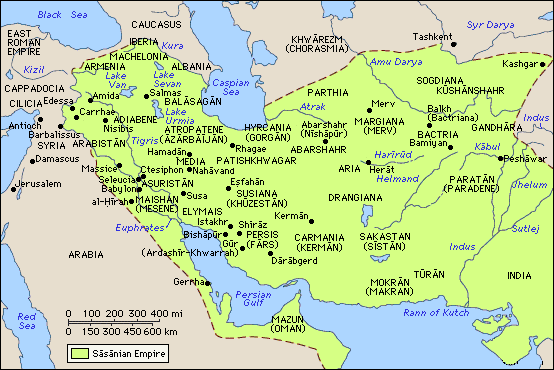
Right to the east of Byzantium, the Sassanid Persian Empire enters a golden age under their emperor Khosrow I (r. 531-579) while Byzantium too was entering its golden age under Emperor Justinian I and in his reign Khosrow I founds the first academy in Iran, the Buddhist Jataka stories are translated into the Persian language, while Chess from India is introduced to Persia and the game of Backgammon too is invented in Khosrow I’s Persia and although Persia went through a golden age the plague of 542 hit it hard which stopped its war with the Byzantines. Khosrow I died in 579 and is succeeded by his son Hormizd IV who’s army was defeated by Byzantine emperor Maurice and these defeats caused the Persian general Bahram Chobin to overthrow him in 590 but Hormizd IV’s son Khosrow II is put into the Persian throne by Maurice in 591 ending the Byzantine-Persian war since 572.
In the northeast of Sassanid lands, the Gokturk Khaganate in the Steppes of Central Asia is established in 551 by Bumin Khagan and from 588-89, the Sassanids and Gokturks fight a war, meanwhile by 576 the Gokturk Empire was at their greatest extent of territory in one straight line from Northern China to the Azov Sea in Ukraine.
Back in 520s when Byzantium and Persia were at war with each other, they too had a proxy war in the south where the Sassanid Persians supported the Kingdom of Himyar in Yemen ruled by a Jewish king while the Byzantine emperor Justin I supported the Christian Kingdom of Aksum in Ethiopia, however in 525 Aksum defeated the Himyarite Kingdom that had existed since 110BC and annexed the whole kingdom making Yemen across the Red Sea to the Ethiopian kingdom, meanwhile in the Arabian Peninsula north of Yemen in 570 the Islamic Prophet Muhammad is born in Mecca in today’s Saudi Arabia.
In Africa 3 Nubian kingdoms in today’s Sudan convert to Christianity brought to them by Byzantine missionaries first being the Kingdom of Nobatia in 545, then the kingdoms of Alodia and Makuria in 569.
In India, invasions of the Huna or Huns from the north bought the Gupta Empire to its knees dissolving it in 543 into several smaller kingdoms although in the early 6th century the Indian arts and sciences textbooks of Shilpa Shastras was written, however after the collapse of the Gupta Empire in 543 one of the major structures built in India was the Elephanta and Jogeshwari Caves. Meanwhile from 561-592 a Buddhist monk named Jnanagupta from today’s Pakistan translates 39 sutras from Sanskrit to Chinese and the Bengali Calendar used in Bengal region of India begins in the year 594, while also in 6th century India the astronomer and mathematician Aryabhata discovers the number 0 though the year is not said, he too made a discovery that the earth revolves around the sun.
China meanwhile for most of the 6th century was still divided between the Northern and Southern Dynasties though in 502 Chinese annals mention the existence of Buddhist kingdoms in today’s South Sumatra in Indonesia while in China itself the short-lived Chen Dynasty in Southern China (557-589) invents matches in 577; however in 589, China is reunited once more under the Sui Dynasty which although lives only until 618 to be replaced by the Tang Dynasty in which its founder Li Yuan was born in 566, also 589 was when the Chinese scholar Yan Zhitui makes the first reference to the use of toilet paper in history.
In Japan meanwhile, the Kofun Era ends with Asuka Period beginning in 538 and it is in this period when Buddhism is introduced to Japan from the Kingdom of Baekje in Korea in 552 while in the early 6th century Zen Buddhism is introduced to Vietnam from China, and the Kingdom of Funan in today’s Vietnam, Cambodia, and Thailand which had been around since around 50AD dies out in around 550.
In the Americas the 6th century had seen the golden age of the Maya Civilization of Central America with the city of Uxmal founded in today’s Mexico in the early part of the century while in the South America the Tiwanaku Empire based in the area of Lake Titicaca between Bolivia and Peru starts in 550. Lastly one of the biggest events of the 6th century was the Extreme Weather Events from 535-536 when temperatures had dropped and it was said to have been caused by a chain reaction of volcanic eruptions in Central America, Iceland, Indonesia, and the Pacific which in return caused famines in the Northern Hemisphere.




Watch this to learn more about the story of the Gokturk Empire (from Kings and Generals).
The 7th Century
In Byzantium (Eastern Roman Empire):
As the 7th century begins, the Classical Era fades away into the Middle Ages not only in Europe but in Byzantium as well. In 600, the emperor Maurice rules Byzantium and fights constant wars to keep the Avars and Slavs away from the Danube frontiers but because of too much war funds run out and the soldiers are forced to camp out in the winter of 602 across the Danube with their payment cut off causing them to rebel against Maurice. The army in the Danube meanwhile proclaim the centurion Phocas their emperor and march to Constantinople to dethrone Maurice who escapes with his family but when caught on November of 602, he watches all his 6 sons executed before Maurice himself is beheaded and as Phocas usurps the throne, the Sassanid Persian emperor Khosrow II who was put in power by Maurice in 591 declares war on Phocas for the execution of his friend once again resuming the Persian war. Phocas though would be an ally to Pope Gregory I in Rome and succeeding popes but the army of Byzantium became overwhelmed as the Persians had invaded in massive numbers leaving the Danube undefended for the Slavs and Avars to raid again. By 607, the Persian armies have already invaded Syria and Asia Minor coming close to Constantinople making the Byzantines displeased with their emperor Phocas’ brutality and incompetence making the Exarch of North Africa Heraclius the Elder based in Carthage to rise up in rebellion against Phocas cutting the grain supply to Constantinople in 608. In 610 Exarch Heraclius’ son also named Heraclius arrives in Constantinople by ship from Carthage and deposes and executes Phocas and is crowned Byzantine emperor and turns his attention to deal with the Persian threat, but also in one of his first acts changes the empire’s official language from Latin to Greek which would be the official language from then on. In 615, the Sassanids capture and sack Jerusalem stealing the relic of the True Cross and in 616 the Sassanids march south and invade Byzantine Egypt cutting Constantinople’s grain supply. Only after raising a large army in 622 does Heraclius turn on the Persians by marching into the Sassanid heartland of Mesopotamia and Iran while in 626 the Sassanid Persians joining together with the Avars and Slavs besiege Constantinople while Heraclius is away although fail to take the city due to strength of its land and sea wall. Back in Persia, Heraclius pays off the Turkic Khazar tribes north of the Sassanid Empire in Central Asia to fight against the Sassanids as well as turning the Sassanid general Shahrbaraz against Khosrow II to weaken the Sassanids and in 627 at the Battle of Nineveh in today’s Iraq, Heraclius wins a heavy victory against the Sassanids ending not just this war but the entire Roman-Persian War that began all the way back in 53BC when the Persian Parthian Empire defeated the Roman Republic at the Battle Carrhae, Khosrow II is then deposed and executed by the Persian nobility in 628 and with the True Cross recovered from Persia, Heraclius returns it to Jerusalem in 629 while all lands the Persians took from Byzantium since 602 including Egypt and Syria were returned to the Byzantines, however also in 629 the Arabs now taking the religion of Islam being the followers of the Prophet Muhammad begin making raids in the southern territories of Byzantium (today’s Jordan). Just when the Byzantium concluded their war with the Persians, a new enemy came out of the Arabian deserts, the Arab armies of the Rashidun Caliphate fighting under their new religion of Islam and in 636 the Arabs won a major victory over the Byzantines at the Battle of Yarmouk in 636 before capturing Jerusalem in 637 but before it Heraclius was able to take back the True Cross from there and return it to Constantinople. In 640, the Arab Rashidun Caliphate at this time ruled by Caliph Umar invades Byzantine Egypt and in 641 Heraclius dies having lost both Egypt and Syria once again but this time to the Arabs while the Byzantine province of Spania in Spain had been brought back to the Visigoths and most of the Balkans down to Greece was lost to the Avars and Slavs. Following Heraclius’ death a succession dispute in his family broke out known as the “Year of the 4 Emperors” (641) with his son Constantine III succeeding but dying after 3 months to be succeeded by his half-brother Heraclius and Empress Martina’s son Heraklonas who was deposed also in the same year with his mother with Constantine III’s 11-year-old son Constans II made the new emperor and as child he ruled under the regency of the senate and his generals. In 645, the Byzantine navy briefly retakes Alexandria but lose it again when the Caliph Uthman takes it back in 646 when it was said he had the library destroyed and abandoning the city moving his capital to what would be Cairo in the Nile Delta and by 647 the Arabs began their conquest of Byzantine North Africa. In 654, the Arabs come close to taking Asia Minor when defeating the Byzantine navy at the Battle of the Masts in the Mediterranean coast of Asia Minor where the Byzantine emperor Constans II defeated flees with his life but a civil war breaks out among the Arabs in 656 and in 661 the Rashidun Caliphate is replaced by the Umayyads making Damascus their capital. Constans II as emperor reorganizes the Byzantine governing system from provinces into smaller military provinces called Themes creating 4 of them in Asia Minor and fearing Constantinople would be attacked by the Arabs leaves the city for good in 663 heading to Italy to defend its major cities still under Byzantine control from the Lombards but in 668 while in Syracuse, Sicily Constans II is assassinated in his bath and afterwards usurped in Sicily by the general Mizizios though in 669, Constans II’s son defeats Mizizios and becomes Emperor Constantine IV. In 670 the Umayyad Arabs begin conquering the rest of Byzantine North Africa and by 674 their fleet arrives outside Constantinople to besiege it but Emperor Constantine IV has the invention of Greek Fire approved and made which in 677 fatally destroys the attacking Arab fleeing forcing them to abandon their siege in 678. From 680-681, Constantine IV organizes the 6th Church Council at Constantinople which solves the Miaphysite Heresy his father failed to solve all while the Bulgar hordes led by their king Asparukh invade Byzantium from the north and in 680 the Bulgars defeat the Byzantines at the Battle of Ongal near the Danube Delta in today’s Romania and in 681 Constantine IV recognizes the Bulgarians’ independence by ceding Byzantine territory in what is today’s Bulgaria to them. Constantine IV dies in 685 and is succeeded by his son Justinian II who spends his reign energetically fighting wars against the Arabs and Bulgars to return Byzantium to its greatness which he comes close to doing so after defeating the Bulgars in 688 but his unrealistic imperial ambitions and tyrannical rule gets him overthrown by the senate, army, people, and Church in 695 being exiled to the remote Byzantine Theme of Cherson north of the Black Sea with his nose mutilated, he is then replaced by the Isaurian general Leontios and at this time Carthage had fallen to the Arabs but the Byzantines reclaim it in 697 though in 698 the Arab fleet returns and defeat the Byzantines and to avoid the anger of the emperor Leontios, the Byzantine army turns on Leontios, deposing him, and replacing him with the army commander of Germanic descent Tiberius III Apsimar who did not attempt to retake Africa anymore while at around the same time just next to Byzantium to the northeast its neighboring small kingdom of Lazica in Georgia had ended (697).


Watch this to learn more about the Byzantine-Sassanid War from 602-628 (from Kings and Generals).
In the Rest of the World:
Now for the rest of the world, due to wars, plagues, and many disasters the world’s population in the 7th century shrinks to about 208 million people and at the beginning of the century in 600 smallpox spreads from India into Europe. For the Sassanid Persians their wars with Byzantium beginning in 602 makes them each their height of territory in the 620s under Shah Khosrow II with an empire stretching all the way from Asia Minor to Pakistan from the Caucasus mountains down to Egypt and Oman while Yemen which the Ethiopian Kingdom of Aksum conquered in the previous century from the old Himyarite Kingdom too had been annexed to the Sassanid Empire but in 628 all land taken from Byzantium is returned to Byzantium while the Sassanids too had been fighting wars with the Turkic tribes at the north. However, the long war not only affected Byzantium but the Persians as well and by 636 they were no match to the invading forces of the Arab Rashidun Caliphate who defeated the Sassanids at the Battle of Al-Qadisiyah in Iraq beginning the Arab conquest of Persia and in 651 Iran and the Sassanid Empire was absorbed into the Rashidun Caliphate and the Sassanid Dynasty over after the murder of the last Sassanid emperor Yazdegerd III.
The main highlight of the 7th century though would be the sudden expansion of the Arabs from the Arabian deserts and the rise of Islam which all begins in 622 also the year the Islamic calendar begins as it was here when the Prophet Muhammad fled from Mecca to Medina with his first followers and would later take back Mecca in 630 while his armies now fighting under the religion of Islam would conquer the rest of the Arabian Peninsula down to Yemen and east to the Persian Gulf resulting into uniting the tribes of Arabia but also defeating the Ghassanid and Lakhmid tribes that lived the Arabian borders of the Byzantine and Sassanid Empires, while the Quran would first be written and documented at this time. The Prophet Muhammad died in 632 beginning the Muslim conquests out of Arabia into the Middle East and Byzantium as well as the start of the Rashidun Caliphate under Caliph Abu Bakr, a close friend and follower of Muhammad who sent armies to invade Byzantium and Persia. In the 640s the Arab Rashidun Caliphate had already taken all of Egypt converting its people to Islam as well as beginning their conquests on Armenia conquering the Kingdom of Caucasian Albania in today’s Azerbaijan which was then under the Sassanids before falling to the Arabs and in 650 engaged in a war with the Khazar Khaganate in the Steppes along the Caspian Sea right after the Arabs had defeated the Persians. In 656 however instability broke out in the Rashidun Caliphate in what would be known as the First Fitnah following the assassination of Caliph Uthman the same year by the rebels leading to a war between them and Uthman’s successors Ali and Hasan which ends with the rebellion winning in 661 and Muawiyah I as the new Caliph beginning the Umayyad Caliphate making Damascus his capital and the new Caliphate expands even further capturing the city of Kabul in Afghanistan for Islam in 664, North Africa in the 670s wherein Arab explorers would go as far as south to Lake Chad, and at the same laying siege but failing to take Constantinople from 674-678 however from 683-685 the Second Fitnah broke out with different factions rebelling against the Umayyads though ended with the Umayyads winning and crushing the rebellions and becomes even more successful almost ready to take Spain.
In the rest of Europe things in the 7th century remain almost the same as in the end of the end of the 6th as France and Western Germany is still ruled by the 4 Frankish kingdoms of Nuestria, Aquitaine, Burgundy, and Austrasia all under the Merovingian Dynasty; Italy is split between Lombard and Byzantine rule; all of Spain is now under the Visigoth kingdom, the rest of Germany is divided into the territories of Alamannia, Bavaria, Thuringia, and the Saxons; Scandinavia is made up the kingdoms of the Angles, Danes, Jutes, and Swedes; and everything east of Germany was home to several tribes.
At the beginning of the 7th century the Avar Khaganate above Byzantium was in its extent of territory from the Eurasian steppes to Hungary but the Avars are later downsized when fighting the Slavs as in 623 the Slavs get their first ruler which is a Frankish merchant named Samo who helps the Slavic tribes defeat the Avars. In the Balkans, the Slavs quickly occupy land in it including Serbia and Croatia and in an unknown date in this century, the Slavs already form the Duchy of Croatia in today’s Croatia and also some time in the 7th century a Slav leader known as the Unknown Archon settles in Byzantine Serbia with his people becoming the first Serbs, though also later on in the 7th century the Slavs raid into Byzantine Greece all the way down to the Gulf of Corinth.
By the early 7th century the Anglo-Saxons now ruling England convert to Catholic Christianity while England is divided into the 7 Kingdoms of East Anglia, Essex, Kent, Mercia, Northumbria, Sussex, and Wessex known as the Anglo-Saxon Heptarchy while Wales, Ireland, and Scotland remain independent though the Welsh are defeated by Northumbria in battle in 616; the earliest form of English poetry too is attested at this time.
In Central Asia, the massive empire of the Gokturk Khaganate is destroyed from 629-630 when the new Chinese Tang Empire launches military campaigns against them, which splits the Turkic Khaganate between east west, then in 657 the western Khaganate is defeated by China, although in 682 the old Turkic Khaganate has a revival as Ilterish Khagan and Tonyukuk revive it.
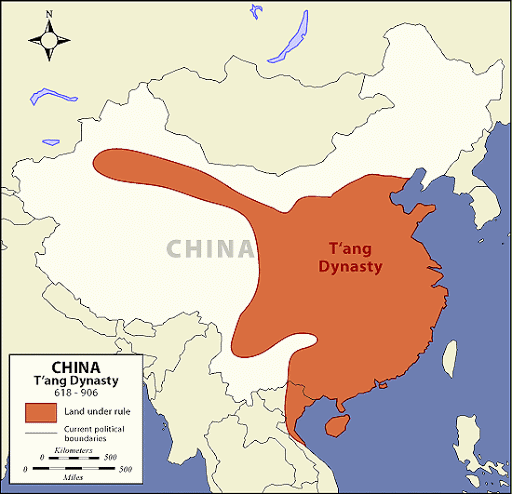
Other than the Arabs, the 7th century too was a big one for China as the short-lived Sui Dynasty that brought stability and unity back to China in 589 comes to an end in 618 being replaced by the Tang Dynasty founded Li Yuan or Gaozu, and this dynasty of imperial China expands their rule in Asia very quickly setting up military bases from Korea to Central Asia going as far as to already having contact with Islam and as early as 618, the city of Guangzhou in Southern China becomes a major international seaport already receiving merchants and travellers from Egypt, East Africa, Arabia, Persia, India, Sri Lanka, Southeast Asia, and even Nestorian Christians while already as early as the 630s a close follower of Muhammad named Sa’d Ibn Abi Waqqas after sailing from Ethiopia establishes the first Islamic mosque in China which is in Guangzhou also introducing the Quran to China. In 643, the Tang emperor of China Taizong had received Byzantine ambassadors from the young Byzantine emperor Constans II while Taizong’s son and successor Emperor Gaozong (r. 649-683) in 638 issues and edict of universal toleration for all religions in China and permits the establishments of Christian monasteries in China as the Nestorian Christian missionaries from Persia have arrived in China sometime between 635 and 649, it is also Gaozong who defeats the Western Turkic Khaganate in 657. In 663, the combined forces of Chinese Tang Empire and expanding kingdom of Silla in Korea defeat the combined forces of the Korean kingdom of Baekje and the Japanese Yamato Empire at the naval Battle of Baekgang resulting in Baekje annexed to the Silla Kingdom and the Japanese to withdraw from Korea and 5 years later (668), the Gorguryeo-Tang War ends when the combined Tang and Silla Kingdom forces defeat the Korean kingdom of Gorguryeo which is annexed into the unified Kingdom of Silla. In 677, the last crowned prince of the Sassanid Persian Empire after losing the empire flees to the Tang court of Gaozong and in 690 7 years after Gaozong’s death, Gaozong’s wife Wu Zetian becomes empress by seizing power over China who in 691 makes Buddhism the state religion of China while in 698 an active but unofficial anti-Christian persecution begins in China and at the same year as the Christian persecutions in China begin, the north and south of Korea into the Kingdom of Silla in the south and Balhae in the north which consists of North Korea, Northern China, and Far East Russia. In China paper money is first used in 650 and 2 large impressive pagoda structures still standing today are built within the 7th century first being the Xumi Pagoda of Zhengding in 636 and the Giant Wild Goose Pagoda of Xi’an in 652; also by 602 which was the same year Byzantium’s Justinian Dynasty ended with Emperor Maurice’s execution, the Chinese come to dominate Vietnam for the 3rd time after the Vietnamese Ly Dynasty collapses while in Southern Vietnam the old Funan kingdom is absorbed by the new Chenla Kingdom in 618 which consists of Vietnam, Cambodia, Laos, and Thailand. In Tang Dynasty China, the chronicler I-Tsing mentions several kingdoms in Indonesia including the Kingdom of Holing in Java in 664, Srivijaya and Malayu in Sumatra as well as Kedah in the Malay Peninsula and Nalanda in India all in 671; by 683 the Buddhist Kingdom of Srivijaya in Sumatra gains control over most the area and becomes a naval power in the region of the Malacca and Sunda straits.
In Japan, the religion of Shugendo in the mountains starts which evolved from Buddhism, Taoism, and Shinto while in 607 the Horyu-ji Temple of Ikaruga in Japan was believed to be completed, and in 658 2 Chinese monks Zhi-Yu and Zhi-You reconstruct a 3rd century compass which is given to Emperor Tenji of Japan, this time in Japan is known as the Asuka Period.
Meanwhile in India and the area around it, Buddhist rule in the Sindh which is in Pakistan ends while the Dharmaraja Ratha of Mamallapuram in Tamil Nadu, India is built in the mid-7th century in which this part being the south of India was under the Pallava Dynasty, but in Northern India with the fall of the Gupta Empire in the previous century, many of the divided states under different Maharajahs are united again into the empire of the Vardhana Dynasty under the emperor Harsha (r. 606-647).
In Central America the city of Teotihuacan is sacked by unnamed invaders in an unknown date in the 7th century while Pakal the Great becomes the king of the Mayan city-state of Palenque in Southern Mexico in 615 and rules all the way until his death at age in 80 in 683.




Watch this to learn more about the 7th century expansion of Islam (from Kings and Generals).
Watch this to learn more about the rise of the Tang Dynasty of China (from Kings and Generals).
The 8th Century
In Byzantium (and the Bulgarian Empire):
As the 8th century begins, what remains of Byzantium descends into anarchy with both the Umayyad Caliphate Arabs and Bulgarians surrounding them and their emperor Tiberius III who came to power in 698 is overthrown and executed together with the previous usurping emperor Leontios in 705 by the exiled former emperor Justinian II with a mutilated nose who returns to power with the help of the Bulgarian king Tervel who in exchange for his help is made a Caesar by Justinian II and Byzantium starts to pay tribute to the Bulgarians although the truce is broken in 708 by Justinian II who declares war on Bulgaria but is defeated in battle. In December of 711, Justinian II is overthrown again by the rebel general Bardanes but this time Justinian II is beheaded and his young son killed as well making Bardanes become the new emperor changing his name to Philippikos but only 2 years later (713) he is deposed by the army and replaced by his secretary Artemios who becomes Emperor Anastasius II who in 715 is overthrown by the army and replaced by an unwilling tax official who becomes Emperor Theodosius III. In 717, the two Byzantine generals the Isaurian Konon and Armenian Artavasdos rebel and force Theodosius III while Konon becomes Emperor Leo III and establishes the Isaurian Dynasty, but also that year the Umayyad Arabs once again besiege Constantinople with a massive navy and army but the winter gives the Arabs difficulty as their food supply runs out and the cold they are not used to freezes them, also the use of Greek Fire saves the Byzantines by burning the enemy fleet and in 718 the Bulgarian king Tervel marches south to help Byzantium sending the Arab forces fleeing for their lives ending the siege that could have destroyed Byzantium, afterwards the Arabs swore to never invade Constantinople again. Leo III now rules restoring order to the empire after 22 years of anarchy since Justinian II was first overthrown in 695, though in 726 the volcano in the Aegean island of Thera erupts which makes Leo III initiate the movement of Iconoclasm which aimed to destroy all religious icons in the Byzantine Empire as a means of saving it from divine destruction, and because of Leo III’s new Iconoclast policies the Republic of Venice in the Venetian Lagoon in Italy where people from the mainland fled to in the 5th century because of the Huns is born declaring independence from Byzantium by electing Orso Ipato as their first leader of Doge but is still recognized an ally by Leo III. In 740, Leo III wins against the Arabs in the Battle of Akronion in Western Asia Minor and dies the following year (741) succeeded by his son Constantine V who in the next year (742) is deposed by his father’s general Artavasdos who is emperor till the next year (743) as Constantine V returns blinding and exiling Artavasdos. Constantine V spends the next 32 years of his reign continuing his father’s Iconoclasm even more throughout the empire but also reforming the army by creating the emperor’s personal army or the Tagmata and constantly fighting wars against both the Arabs and Bulgars taking back some of the lost Byzantine territories but neglects Italy leaving the Lombard king Liutprand (r. 712-744) to conquer almost all Byzantine territory in Italy except for Rome, Ravenna, Naples, Puglia, and Sicily and in 751 the Byzantine capital of Italy which is Ravenna surrenders to the Lombards leaving only Southern Italy under Byzantium. Constantine V died in Bulgarian territory while in campaign in 775 and was succeeded by his eldest son Leo IV the Khazar (who’s mother was a Khazar princess) who only rules for 5 years but in 778 raids into Arab controlled Syria and takes back parts of Southern Asia Minor from the Arabs while also the Kingdom of Abkhazia just outside Byzantium in today’s Georgia is born (778), but in 780 dies of tuberculosis left with his 9-year-old son Constantine VI succeeding him who rules under the regency of his mother Irene of Athens, also in 780 to the north of Byzantium, Serbia which was occupied by the Slavic people united to form the Principality of Serbia. In 787, Empress Irene and Constantine VI organize the 2nd Council of Nicaea being the 7th Church Council which settles the issue of Iconoclasm and ends it temporarily, although in 792 the Byzantine army led by Constantine VI is defeated by the Bulgarian king Kardam in Southern Bulgaria, and in 797 Irene usurps the throne from her son blinding him and becoming the sole empress of Byzantium. Now back in the earlier parts of the 8th century in the Byzantine world, the story of the life of Buddha is translated into Greek by the Syrian monk St. John of Damascus (675-749) who however was living in the Umayyad capital of Damascus although the Christians would refer to it as the story of Barlaam and Josaphat and in the beginning of the century the first Serbian state in the Balkans is formed within what was once Byzantine territory.


Watch this to learn more about the 717-718 Arab Siege of Constantinople (from Kings and Generals).
In the Rest of the World:
Now in the wider world outside Byzantium, the Arab Umayyad Caliphate reaches their height of power at the early part of the century expanding all the way to the Sindh region of Pakistan as well as to Central Asia in around 708 while the Buddhist Jataka stories are translated into Arabic and Syriac at this time. In 711, the same year Justinian II is executed the Umayyad Arab armies led by the Berber commander Tariq ibn Ziyad crosses the Strait of Gibraltar from North Africa into Spain defeating the Visigoth Kingdom and by 721 the Muslims are already in position of almost the entire Spain ending the Visigoth Kingdom that had been there since the 5th century pushing the remaining Christians to the north of Spain to form the Kingdom of Asturias. In the 720s, the Umayyad Caliphate’s empire is at its largest extent from Spain and Portugal in the west to the Steppes of Central Asia and the Indus River in the east and from 712-740 the Umayyads begin campaigning against India. The Umayyads though fail to take Constantinople in the siege of 717-718 so instead attempt to invade the Frankish Kingdom in France but at the Battle of Tours in 732, the Frankish general Charles Martel defeats the Umayyad army of the governor of Cordoba stopping the advance of Islam into Western Europe. The Umayyad Caliphate however back in 718 received a letter from the king of Srivijaya in Indonesia though the Umayyad Caliphate does not last long enough as in 750, the last Umayyad Caliph Marwan II is overthrown and executed by Abu al-Abbas as-Saffa who establishes the Arab Abbasid Caliphate moving the capital from Damascus to Baghdad in Iraq later becoming a center of culture to rival Constantinople though Umayyad rule still lasts in Spain as its own Umayyad emirate.
Back to France, the Merovingian Dynasty ends in 751 with Childeric III as its last king who is succeeded by Charles Martel’s son Pepin the Short founding France’s Carolingian Dynasty, Pepin then dies in 768 dividing the Frankish Kingdom between his sons Charles I who later becomes Charlemagne and Carloman I though with Carloman I’s sudden death in 771 his kingdom is passed on to his older brother Charles I beginning his Frankish conquests into Germany by 772 in which he focuses on battling the Saxons in the northwest, begins campaigning against the Frisians in 793, also Charles would start expanding east into Bavaria and Austria and south into Italy and Spain and in this time before the year 800 the country of Andorra between France and Spain was said to have been founded by Charlemagne.
In Britain, the chronicler St. Bede the Venerable completes the book Ecclesiastical History of the English People in 731, in 757 King Offa of Mercia (r. 757-793) becomes the dominant king of the 7 Kingdoms of Anglo-Saxon England, and in 793 the Norsemen from Scandinavia known as the Vikings raid England in 793 with their first documented attack on the Monastery of Lindisfarne in the northeast coast of England; meanwhile sometime in the 8th century the first European triangular harp is designed by the Picts of Scotland.
Eastern Europe in the 8th century was still mostly dominated by Slavic tribes except for the Finnish people occupying Northwest Russia, the Jewish Khazar Khaganate in the Steppes between the Black and Caspian Seas, the Magyars at Ukraine, the Bulgarian Empire now occupying what was once Byzantine territory in today’s Bulgaria, and the part of Central Asia where Kazakhstan is under the Oguz Turks, although by 770 the iron horseshoe comes into common use in most of the world.
By 700, trade links between India and China are further established through wet-field rice cultivation and at some point, though the year not exactly stated, the Pala Empire is founded in Bengal in India replacing the Vardhana Dynasty’s empire while papermaking from China is introduced to the Arabs. Now in China the first and only sole empress Wu Zetian is overthrown in 705 and the Tang Dynasty reestablished under her son Emperor Zhongzong, in 712 the Metropolitan See of the Nestorian Christian Church is established at the Tang Empire’s capital Xi’an. Also in 712, Xuanzong Tang becomes Emperor of China ruling until 756 wherein the Tang Empire would be at its peak, it is at this time in 742 when the municipal census of the capital Xi’an part of the Book of Tang is made documenting a population of nearly 2 million people in the imperial capital, however in 751 the armies of the new Arab Abbasid Caliphate defeat the Tang Chinese armies at the Battle of Talas in today’s Kyrgyzstan conquering the eastern part of Central Asia, then from 755-763 the Ani Shi Rebellion devastates Tang China, and in 758 Arab and Persian pirates burn and loot the international port of Guangzhou in Southern China leading to the imperial authorities shutting the port down for the next 5 decades. In 785, the Tang Dynasty begins launching maritime missions all the way to the coast of East Africa to cut off the trade of Arab sea merchants and it is here when the Chinese geographer Jia Dan describes large lighthouse pillars built in the Persian Gulf.
In Japan, their imperial law code known as the Taiho Code is enacted in 701 while in 710 the empress ruling Japan Genmei moves the capital to Heijo-Kyo which is now Nara beginning the Nara Period, though near the end of the century in 794 the emperor Kanmu moves Japan’s imperial capital from Nara to Heian-Kyo which is now Kyoto ending the Nara Period and beginning the Heian Period all while Korea was still divided between the Kingdom of Silla in the south and Kingdom of Balhae in the north.
In the 8th century, the maritime Kingdom of Srivijaya remains the dominant power in the area of Indonesia though other kingdoms start to form in the island of Java such as the Hindu Sanjaya Dynasty in 732 while the Hindu Medang Kingdom of Java declines in 752 though at this time many impressive landmarks in Java are constructed including the Temple of Borobudur in 760, the Kalasan Temple in 778, and the Sewu Temple in 792; also in the 770s the navy from Java launches raids all the way into the coasts of Cambodia and Vietnam capturing port cities controlled by the Chenla Kingdom.
Meanwhile in the Americas, the Mayan civilization of Central America begins to decline as the city of Palenque is captured by the Tonina people in 711 and in 738 the Mayan city of Quirigua in Guatemala declares independence from their rule from Copan and the Edziza Volcanic Complex in today’s British Columbia, Canada erupts back in 700 and by 750 the Ghana Empire begins to exist in West Africa.
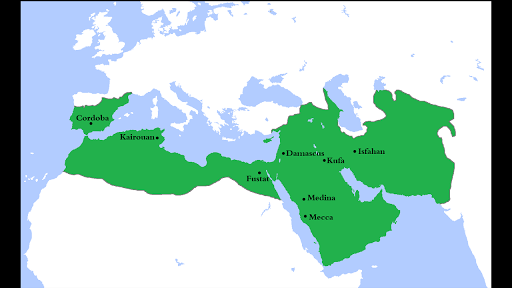


Watch this to learn more about the history of the Khazar Khaganate (from Kings and Generals).
The 9th Century
In Byzantium (and the Bulgarian Empire):
As the 9th century begins, the Byzantine Empire is ruled by its first sole empress Irene of Athens while in the west the Frankish king Charles I better known as Charlemagne or Charles the Great had built the Frankish Empire which in 800 had all of France except Brittany leaving it independent, almost all of Germany up to Southern Denmark in the north and Hungary in the east, and down to the north of Spain and north of Italy in the south, though in the year 800 an Arab fleet goes as far as to sailing up the Tiber River near Rome, though on Christmas Day of that year Charlemagne is crowned the first Holy Roman emperor by Pope Leo III in Rome making a Roman emperor once again return to the west after nearly 4 centuries. The west needed Charlemagne as their “Roman emperor” not only because he defeated several barbarian nations and uniting them into one empire but because the legitimate Roman emperor ruling at Byzantium could not be taken seriously as she was a woman though Empress Irene of Byzantium had agreed to marry Charlemagne to unite their empires but the people of Byzantium opposed it leading to a rebellion in Constantinople against Irene and in 802 Irene was deposed and exiled to Lesbos making her replaced by her finance minister who became Emperor Nikephoros I founding a short-lived dynasty in 802 and only now with a male ruler back in Byzantium would Charlemagne acknowledge the authority of the Byzantine emperor but Nikephoros I instead chose to ignore Charlemagne and to never speak of him in Byzantium causing Charlemagne to invade Byzantine coastal territory in Croatia. Nikephoros I however turned his attention to destroy the Bulgarian Empire north of Byzantium for good leading to war in 809 but in 811 Nikephoros I is killed at the Battle of Pliska in Bulgaria and his army defeated by the Bulgar king Krum who turns Nikephoros’ skull into his drinking cup, though back in Byzantium Nikephoros I’s son Staurakios succeeds his father as emperor for only 2 months in 811 but is forced to abdicate due to his injuries and is replaced by his brother-in-law Michael I Rangabe who attacks the Bulgars again in 813 but is defeated again by Krum at the Battle of Versinikia making Michael I abdicate the same year and replaced by the general Leo V the Armenian. In 814, the Bulgarians led by Krum besiege Constantinople but fail as Krum dies leaving his son the new Bulgar king Omurtag to sign a peace treaty with Byzantine emperor Leo V in 815, the same year Leo V returns Iconoclasm to Byzantium which had ended back in 787. On Christmas Eve of 820, Leo V’s general Michael the Amorian plots to have him assassinated and succeeds with Leo V killed in the Christmas Mass while on Christmas Day Michael the Amorian quickly is crowned Emperor Michael II founding the Amorian Dynasty. In Michael II’s reign, he faces the long and lethal rebellion of the general Thomas the Slav who tries to usurp power but his rebellion is crushed in 823, then in 824 exiled Arabs from the Umayyad Emirate in Spain sail to Crete and capture it, and in 827 the new Muslim Dynasty of the Aghlabids based in Tunis which had begun back in 800 begin to invade and colonize Byzantine Sicily. Michael II dies in 829 and is succeeded by his son Theophilos who in 831 personally leads the army in a long war against the Abbasid Arabs to push them out of Asia Minor, also Theophilos ordered the creation of the Byzantine beacon system across the Themes of Asia Minor so that one Theme can send reinforcements to the other which would be in equidistant placements from the mountains of Cilicia to the Palace of Constantinople, and also Theophilos resumed war with the Bulgarians allying himself with the new Principality of Serbia ruled by Prince Vlastimir though the Byzantine-Serbian alliance ended in 842 with the death of Theophilos. Following the death of Theophilos, his young son Michael III succeeds him but rules under the regency of his mother Empress Theodora and in 843 Theodora leads a Church Council in Constantinople that finally puts an end to Iconoclasm- just like Irene did back in 787- and beginning a renaissance for Byzantine art. In 856, Michael III had overthrown the regency of his mother and rules alone but strongly guided by his uncles (his mother’s brothers) Bardas who runs the state and the general Petronas who campaigns deep into Asia Minor retaking almost all of it from the Arabs that have invaded it 2 centuries back. In 858, Bardas appoints Photios I as Patriarch of Constantinople and in 860 an unknown Nordic people’s fleet which would be known later as the Rus raid the Bosporus and almost come close to attacking Constantinople, Patriarch Photios I then responds to the Rus’ attack by converting these people as well as the Slavs north of Byzantium to Orthodox Christianity and in 863 the Greek missionary brothers St. Cyril (originally named Constantine) and St. Methodius to convert the people of the newly formed Slavic Kingdom of Moravia (formed in 833) based in Czech Republic which turns out successful since they had converted to Christianity through their native Slavic language instead of learning Greek, though also in 863 a Schism would begin between the Eastern and Western Churches known as the Photian Schism named after Patriarch Photios I, yet 863 was also the same year Michael III’s uncle Petronas crushed the Arab army at the Battle of Lalakaon and returned to Constantinople with a triumph. In 864, the Bulgarian king Boris I converts himself and Bulgaria to Orthodox Christianity fearing Michael III and Bardas would lead a Byzantine invasion on Bulgaria, however by this time Michael III has a new favorite courtier being the Macedonian peasant Basil who lies about Bardas’ plot having Bardas assassinated in 866, therefore Basil is made co-emperor but in 867 Basil has Michael III assassinated and becomes Emperor Basil I founding the Macedonian Dynasty starting a revival of Byzantine culture now as a Greek Empire and no longer the Roman Empire it was and also beginning a revival of a Byzantine superpower in Eastern Europe. While Basil I spent his reign campaigning more against the Abbasid Arabs in Asia Minor and rebuilding the glory of Constantinople, the Serbs begin to be Christianized in 870 with St. Methodius still alive to convert them as his younger brother St. Cyril had died in 869, and in 885 Cyril and Methodius’ disciples St. Clement of Ohrid and St. Naum of Preslav develop the Cyrillic Alphabet in Bulgaria named after St. Cyril who started working on it, based on Slavic and Greek letters, and would be the alphabet many Slavic countries use today. Basil I dies in 886 said to be from a hunting accident and is succeeded by his son Leo VI the Wise who was also said to have arranged his father’s murder and claiming to be Michael III’s illegitimate son has the long dead Michael III given a proper burial. In 893, Bulgaria is declared an empire when Simeon I comes to the throne and declares himself Tsar or emperor moving the capital from Pliska to Preslav and expelling the Byzantine clergy with a Bulgarian one triggering a war with Byzantium in 894 in which Byzantium loses making Leo VI bribe the Magyar people north of Bulgaria attack the Bulgarians in which the Bulgarians win anyway resulting in the Bulgarians taking more Byzantine land expanding their empire west to Bosnia and Serbia and south into Greece.
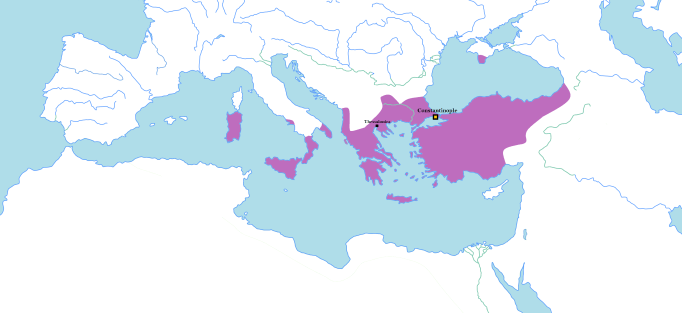


In the Rest of the World:
Europe in the 9th century had 3 major empires the first two being the Byzantine Empire in the Eastern Mediterranean and the Bulgarian Empire in the Balkans which both their stories in the 9th century were already mentioned earlier, now the 3rd empire which was also the largest empire in Europe at that time was the Frankish Empire of Charlemagne also known as the Carolingian Empire and Charlemagne as the first restored Roman Augustus of the west better known as the Holy Roman emperor, a cultural Renaissance took place in his empire, and with the formation of France and Germany under his empire, Charlemagne would be remembered as the “Father of Europe”. At Charlemagne’s death in his capital of Aachen, Germany in 814 his empire covered the whole France except for Brittany, Belgium, the Netherlands, Switzerland, most of Germany except for the east, Austria, Southern Denmark, all of Northern Italy, and the north of Spain up to where Barcelona is; Charlemagne was then succeeded by his son Louis I both as Holy Roman emperor and King of the Franks inheriting this large empire. In Italy meanwhile since Charlemagne conquered most of it from the Lombards, the area of Rome and beyond was made an autonomous state under the pope which became the Papal States while the Lombards were pushed south and Byzantine territory only remaining in Puglia, Calabria, and Sicily but as early as the 820s the Arab Aghlabids of North Africa would begin invading it, then later on in the century some Italian cities like Forli in 899 become free republics the same way Venice made itself in the previous century. The Arabs at the 9th century still control most of Spain but since the Umayyad Caliphate that had conquered Spain back in 711 died out in 750 to be replaced by the Abbasid Caliphate, Spain was still under Umayyad rule but now having its own emirate based in Cordoba and exiles from the Caliphate of Cordoba would sail to Crete and establish their own emirate there in 827. Back in the Frankish Empire, Louis I dies in 840 and is succeeded by his eldest son Lothair I who in 843 at the Treaty of Verdun splits the empire into 3 with his brothers Louis II and Charles II the same way the Roman Empire was split among Constantine the Great’s 3 sons back in 337; here Lothair I gets the middle part of the Empire which would be the Kingdom of Middle Francia stretching from the Netherlands to Italy with Aachen as its capital, East Francia consisting of Germany and Austria given to Louis II the German, and West Francia which would later become the medieval Kingdom of France given to Charles II the Bald. Out of the 3 Frankish Kingdoms, Middle Francia dies out very quickly with Lothair I’s death in 855 further splitting among his 3 sons Louis II who takes Italy, Lothair II who takes the land known as Lotharingia between France and Germany, and Charles taking the area in Southern France which would be the Kingdom of Provence while France and Germany survive as their own Frankish Kingdoms. The Frankish Empire though declines at the end of the century when the King of West and East Francia as well as Holy Roman emperor Charles III, son of Charles II dies in 888.
Now if not for the Carolingians and the Frankish Empire story, the big story in 9th century Europe was the Viking expansion as the Norsemen of Scandinavia search for better land to settle in as their frozen northern homeland grows overpopulated with not enough to feed them and where they constantly attack to gain territory is Britain still under the 7 Kingdoms of the Anglo-Saxon Heptarchy which is in England, the most powerful of the 7 being Mercia at the beginning of the century, however the Kingdom of Wessex defeats Mercia in battle in 825 and its king Egbert becomes the dominant ruler of England. At the same time the Vikings continue sailing out of Scandinavia and raid the coasts of Scotland in the 830s and in 841 arrive in Ireland to settle establishing Dublin. In 865, the Vikings known as the Danes from Denmark arrive in England invading the Kingdom of East Anglia conquering it, later defeating the Kingdom of Northumbria and establishing their own kingdom there known as Jorvik with York as its capital. The only Anglo-Saxon kingdom left in England to stand against the Danish Vikings is Wessex and in 871 Alfred the Great becomes its king pushing out the Viking invaders, wins a decisive victory over them in 878 though afterwards making an agreement with the Vikings settling them in the part of northeast England known as the Danelaw, and in 886 he becomes the King of the Anglo-Saxons, he then died in 899. The Vikings though did not only raid and threaten England but Ireland as well that the native Irish had to assemble themselves into small kingdoms that would have elect a dominant ruler among them called the “High King”; the Viking that had raided Ireland and Scotland too would begin to settle in the uninhabited island known as Iceland in the far north by 850.
The Vikings of the 9th century however did not only make raids into the British Isles but down to France and even as far as the Mediterranean too coming into contact with the Arabs as well but another group of Vikings coming from Sweden this time known as the Varangians instead of heading west would turn east, sail down the Baltic Sea and arrive in what is now Russia, and in 862 the Varangian prince Rurik would establish the soon to be empire of the Kievan Rus’ based in Kiev and would be controlling what is now Ukraine, Belarus, and Russia from the Baltic to Black Sea; also these Varangian Norsemen known as the Rus were also the same people that raided into the Bosporus outside Constantinople in 860. Back in the Norse homeland of Norway, the king Harald Fairhair unites Norway into one kingdom sometime between 872 and 900.
In Central Europe, the Slavic tribes would end up uniting to form the Kingdom of Moravia based in Czech Republic in 833 later converting to Christianity through the Byzantine missionaries St. Cyril and St. Methodius, and in 870 the castle in Prague is founded in their kingdom while to the south of it the nomadic Magyars from the east form their kingdom in what is now Hungary; however the rest of Eastern Europe like in Poland and the Baltics would still be home to a confederation of several Slavic and Baltic tribes in which some by the end of the century would come under the rule of the Rus and back in Western Europe the Romance languages spoken in France, Italy, Spain, and Portugal begin to develop from Vulgar Latin. Over in the north of Spain, a new kingdom better known as the Kingdom of Navarre in the Basque region was to have been founded in 824.
Now in the Arab World under the Abbasid Caliphate based in Baghdad continues to flourish under the Caliph Al-Ma’mun who establishes the grand library or House of Wisdom in Baghdad bringing in all past knowledge from the Greeks, Persians, and Indians and 10 years earlier (820) the Persian scholar Al-Khwaizmi had his treatise wherein Algebra is first documented and in 830 he completes his book on algebra for the grand library. On the other hand, just to the east of Byzantium and west of the Abbasid Caliphate, the Bagratuni Dynasty of medieval Armenia begins with King Ashot I in 862. The Abbasid Caliphate’s rule however does not turn out to be so stable as in 800 the west of North Africa or the Maghreb breaks away forming their own kingdom of the Aghlabids and in 868 a soldier named Ibn Tulun in Egypt breaks away from the Abbasids creating the Tulunid Dynasty ruling Egypt and Syria becoming the first Mamluk state of Egypt and in Iran and Central Asia, the new Islamic Persian Samanid Empire forms in 819 breaking away from the Abbasids. Among the Arab states, the Aghlabids of North Africa based in Tunisia happen to expand aggressively not only by taking Sicily by 827 but by sending an army of 11,000 and a fleet to attack Rome in 846 resulting in desecrating their churches which makes Pope Leo IV in 848 have another wall built to defend Rome also annexing the west bank of Tiber or Trastevere into the city as a response to future attacks. The 9th century Muslim Arabs too start exploring further going as far as settling in Madagascar at some point within the century and in 851 the Arab merchant Suleiman Al-Tajir visits the now reopened international seaport of Guangzhou in Southern China observing porcelain making.
Deep in Africa itself, the Ghana or Wagadu Empire of West Africa located between Mauritania and Mali begins to exist by around 830 while below them, the Tukolor people begin to settle in the Senegal River Valley while in East Africa Samaale the chief of the Hashiyah Clan begins his conquests of Somalia in 842 displacing the native Cushite Somalians; then in 863 the Chinese make contact with the Somalians as the author Duan Chengshi describes the slave, ivory, and ambergris trade of Somalia. By the end of the century in Africa, the Christian Nubian Kingdom in Sudan reaches its peak of prosperity and military power.
In the 9th century, not much happens in India except that the Pallava Dynasty ruling the south comes to and end late into the century and also Balaputra the ruler of Srivijaya in Sumatra, Indonesia is given land in India by King Devapaladeva and in 860 Balaputra constructs a Buddhist temple and monastery in Nalanda, Northeast India. Now in Java itself the large impressive temple of Borobudur is completed in 825 and the Prambanan Hindu temple in Java completed in 856, same year as the Srivijaya ruler Balaputra is defeated in Battle by the ruler of the Javanese Sanjaya Dynasty Rakai Pikatan forcing Balaputra to flee to India. Back in 802 the same year Empress Irene of Byzantium was deposed, the Angkor Dynasty or the Khmer Empire is established in Cambodia by Jayavarman II and in around 822, the Philippines first appears in history with the Laguna Copperplate made which first documents the Kavi script although it was only found in the Philippines recently making it unclear where it was made in as it is also said to have been made in Java.
Now 9th century China is still ruled by the Tang Dynasty which constructs the Leshan Giant Buddha carved out of a cliff in 803, from 805-820 Tang China is under the rule of Emperor Xianzong in which China is reunited in 813, and in 835 a plot known as the Sweet Dew Incident devised by Emperor Wenzong to kill the powerful court eunuchs fail. In 845, Buddhism begins to be banned an persecuted in China under Emperor Wuzong, and his successor Emperor Xuanzong II rules as the last capable ruler of Tang China from 846-859 as later on from 874-884 Huang Chao leads an unsuccessful rebellion against the Tang Dynasty but it is also in 9th century China when gunpowder was first invented as well as the first known printed book the Diamond Sutra printed in China in 868 using woodblock, and in Tibet the Tibetan script had its 3rd and last orthographical reform.
Now in Japan, the 9th century was the golden age of the Heian Period with Kyoto as the imperial capital wherein Chess from China reaches Japan and so does the Kana syllabaries in the Japanese Kanji alphabet that developed from simplified Chinese characters, though in 869 an earthquake and tsunami struck Japan’s eastern coast killing 1,000 people. In the area of Korea, in an unknown date within the 9th century the Kingdom of Silla in the south is split into 3 with Silla remaining only in the southeast as Hubaekje forms in the west and Taebong in the north while the northern Balhae Kingdom still survives.
In the Americas not much happens except that an unknown event causes the Mayan Civilization to decline, but on the other hand the end of the 9th century would begin what would be known as the Medieval Warm Period.


Watch this to learn more about the Vikings in England and the Danelaw (from Kings and Generals).
The 10th Century
In Byzantium (and the Bulgarian Empire):
The 10th century would mark the beginning of a new golden age for the Byzantine Empire not anymore as the Roman Empire reborn but as a medieval Greek Empire as in this century Byzantium would turn the tide of war against the Arabs by now fighting not on the defensive but on the offensive while within the empire, an age of a cultural renaissance begins known as the Macedonian Renaissance. Although as Byzantium grows to be a Mediterranean power, the Bulgarian Empire too becomes a power in the Balkans to rival Byzantium. Byzantium at the turn of the 10th century is ruled by the 2nd Macedonian emperor Leo VI the Wise who back in 892 had completed the new code of laws for Byzantium known as the Basilika which his father the dynasty’s founder Basil I (r. 867-886) started working on and this would be the translation of Justinian I’s 6th century code of laws from Latin to Greek. In addition, the scholarly Leo VI had also compiled a military manual called Tactica completed in 908, though in 907 Leo VI witnessed Constantinople attacked by the Rus fleet of the Kievan Rus’ state which did not succeed. The rest of Leo VI’s reign in the early 10th century had mixed results in terms of war as he won a victory over the Emirate of Tarsus in Asia Minor in 900 but in 902 Byzantine Sicily completely fell to the Aghlabid Arabs with the capture of Taormina, the city of Thessalonica in Greece was sacked by Arab pirates in 904, and a Byzantine expedition to take back Crete from the Arabs from 911-912 failed. Leo VI died in 912 but instead of being succeeded by his son Constantine VII who was made co-emperor, he was succeeded by his younger brother Alexander who in his 1-year reign provoked another war with the Bulgarian tsar Simeon I by refusing to pay tribute, although in 913 Alexander died after a game of polo and was succeeded by his young nephew Constantine VII who began his reign with such instability under the regency of his mother Empress Zoe Karbonopsina and the Patriarch of Constantinople Nikolaos Mystikos while the war with Bulgaria continued with the Byzantines losing a crushing defeat to the Bulgarians at Anchialos along the Black Sea coast in 917. At this point, the Bulgarian Empire was at its greatest territorial extent from the Black to Adriatic Seas and even down to Greece and up to the Danube River while in Byzantium, the Armenian admiral Romanos Lekapenos seized power from the young Constantine VII in 920 to protect him from the growing instability though Romanos I becomes the actual Emperor of Byzantium and Constantine VII just a figurehead. In his reign, Romanos I finished the war with Bulgaria after Tsar Simeon I’s death in 927 ending the war with Romanos I making peace with the new Bulgarian tsar Peter I which is also the same year the Bulgarian Church is recognized as an independent Patriarchate and before that in 926 began his ambitious campaigns against the Abbasid Arabs in Eastern Asia Minor by sending his general John Kourkouas to campaign against them which resulted in the capture of Melitene in Eastern Asia Minor turning the tide of war against the Arabs after 3 centuries of fighting on the defensive. In 941, the Kievan Rus’ fleet raided into the Bosporus for the 3rd time but was defeated by Byzantine Greek Fire and the Rus’ army escaping through Asia Minor were slaughtered by John Kourkouas and his forces, following this Kourkouas launched an invasion into Arab controlled Northern Mesopotamia in 943 and in 944 going as far as taking back Edessa from the Arabs. Also, in 944 Romanos I was overthrown and send to a monastery by his sons Stephen and Constantine but in early 945 both brothers are exiled to the same monastery as their father as the now adult Constantine VII returns to power as sole emperor. Constantine VII as emperor from 945 to his death in 959 had a larger impact on growing Byzantine art and culture in the empire and was known to have written 4 books on the Byzantine Empire, its history, and court life and in 949 impressed the Lombard Italian bishop and ambassador Liutprand of Cremona sent by the Frankish king of Italy Berengar II with the Byzantine court but it was also in 949 when Constantine VII’s naval expedition to retake Crete from the Arabs once again failed as it did with his father back in 911. Constantine VII died in 959 and was succeeded by his son Romanos II who wasn’t so effective as but his generals like Nikephoros Phokas brought Byzantium back to its greatness as in 961 he took back Crete from the Arabs ending the Emirate of Crete and in 962, Nikephoros Phokas marched east as far as to Cilicia and Aleppo in Syria taking it back from the Arab Emirate of Sayf Al-Dawla based in Aleppo but in 963 Nikephoros Phokas has to return to Constantinople when hearing of Romanos II’s sudden death. With Romanos II’ sons too young to rule, Nikephoros Phokas becomes emperor to rule in their place and as emperor Nikephoros II continued winning more victories against the Arabs by taking the whole Cyprus back for the Byzantines which fell to Arab hands back in the 7th century however things in the west were not as successful as Sicily completely fell to Muslim rule and in north was unsuccessful in fighting the Bulgarians, although Nikephoros II at least paid off the Kievan Rus to attack the Bulgarians from the north and defeat the Bulgarians at the Battle of Silistra in 968 occupying northern Bulgaria; other than that, the monastic community of Mt. Athos in Northern Greece was founded in Nikephoros II’s reign. In December of 969, Nikephoros II was assassinated in his sleep in Constantinople by his nephew John Tzimiskes who becomes emperor acting again as the emperor ruling in the place of Romanos II’s sons and as emperor John I turns on the Rus invading Bulgaria defeating them in 971 ending with a peace treaty which annexed part of Bulgaria into the Byzantine Empire and in 972, John I turns eat for further conquests against the Abbasid Arabs in the Levant resulting in the Byzantines taking back parts of Syria, Lebanon, and all the way down to Lake Tiberias in today’s Northern Israel by 975 but failed to take back Jerusalem. John I Tzimiskes died mysteriously early in 976 before arriving back in Constantinople and this point Romanos II’s eldest son Basil II finally came to the throne as the real emperor with his younger brother Constantine VIII as his co-emperor. Basil II like Nikephoros II and John I before him was another strong soldier emperor but his early reign was faced with the difficulties of rebellions by the powerful generals Bardas Skleros and Bardas Phokas who made themselves emperors too and in Constantinople by corrupt politicians like Basil Lekapenos who in 985 was exiled by Basil II confiscating all his properties as well for being accused of conspiring with the rebels. Basil II’s early reign too was faced with war against the new Arab Fatimid Caliphate ruling North Africa but was settled with a truce from 987-988 as Basil II had to deal with the Bulgarians in the north returning to power and with the rebel generals. In 988, Basil II turned to the Kievan Rus’ prince Vladimir I for an alliance in which Basil II married off his sister Anna to Vladimir in exchange for 6,000 Varangian Rus mercenaries which would then be the famous Byzantine Varangian Guard, also in 988 when marrying Anna Vladimir converted to Orthodox Christianity and so did his people marking this as the event when the Russians would convert to Christianity. In 989 with the help of the Varangian Guard Basil II defeats Bardas Phokas’ rebellion and in 991 defeats Bardas Skleros’ rebellion and in the late 990s, Basil II continues to focus on the war against the Fatimids in the Levant and again ends with a truce when the millennium turns.


Watch “The Rise of Phokas”, story of Nikephoros II Phokas (from No Budget Films).
Watch “Killing a Byzantine Emperor”, Nikephoros II’s death (from No Budget Films).
Watch this to learn more about Byzantium’s Macedonian Dynasty (from Porphyra).
In the Rest of the World:
The 10th century would later be known as the “Iron Century” which probably refers to Byzantium and its return to power but not only does Byzantium face a revival in this century but their neighboring Bulgarian Empire as well and so does the remnant of Charlemagne’s Frankish Empire in Germany known as East Francia which had been uniting all German tribes including the Kingdom of Italy and Lotharingia into one kingdom, and in 962 the king of East Francia Otto I now having a unified Germany is crowned Holy Roman emperor by Pope John XII in Rome, and although Charlemagne was first to be crowned that title in 800 the succession of Holy Roman emperors wasn’t linear, it would then be Otto I the Great that would start the actual Holy Roman Empire we all know that is based in Germany and from him on the succession of Holy Roman emperors would be linear. A year later (963), the Count of Ardennes in the Holy Roman Empire purchases the fort and hill of Luxembourg now between Germany and France beginning the foundations of the county and as emperor Otto I focused not only on Germany but on his rule in Italy making him spend time in Rome in order to plan further southern conquests making him improve relations with the Byzantine Empire under Nikephoros II and John I and to do this, Otto I married off his son the future emperor Otto II to Nikephoros II and John I’s relative Theophano in 972 which introduces the fork from Byzantium to Western Europe, Otto I then dies in 973 succeeded by his son Otto II who battles against the last of the Lombards in Southern Italy as well as against the Byzantines there but dies in 983, in 996 by his young half-German half-Byzantine son Otto III becomes Holy Roman emperor wherein political crisis would break out in the Holy Roman Empire.
If the Vikings had been at their height in terms of raiding and attacking the coasts of Europe in the previous century, the Vikings of Scandinavia in the 10th century began settling and making their own states within Europe; first of all in 907 they overrun the long independent Kingdom of Brittany in the northwest tip of France that had long been independent making their court flee to England until 936 when the exiled Breton heir Alan II with the help of the Anglo-Saxon king of England Athelstan retake Brittany from the Vikings which they did in 937, although instead of being a king Alan II became its duke paying tribute to the Frankish kings. However the bigger Viking story in France is that at the beginning of the 10th century the Norsemen possibly from Norway become known to the people of West Francia (France) as the Normans and after the Viking warrior Rollo from Scandinavia and his men help the king of West Francia Charles III take back the city of Chartres from the Danish Vikings in 911, Rollo is given land in the north of France known as Rouen which would then be Normandy becoming the first Count of Rouen and by 996 the now Catholic and French speaking County of Rouen would become the Duchy of Normandy, though also in 911 the monastic order of Cluny later becoming the Cistercian Order and the Cluny Abbey in Eastern France is founded.
The Frankish Kingdom of Western Francia would then eventually become the medieval Kingdom of France that we know of in 987 when the last Carolingian king Louis V dies childless making the French noble Hugh Capet, a descendant of Charlemagne be elected as king founding the Capetian Dynasty and the medieval Kingdom of France.
In England, the grandson of King Alfred the Great Athelstan becomes king of the Anglo-Saxons in 924 and in 927 conquers the last Viking Kingdom of York (Jorvik) becoming the first king of a united England, he later wins victories over the Vikings and Scots and dies in 939 and also in 10th century Britain reindeers and bears become extinct. Over in Viking Denmark, Gorm the Old becomes its first recognized king founding the Danish Monarchy which exists till today.
In Spain, the Emirate of Cordoba is at its golden age in the 10th century with Cordoba as a cultural center with the impressive arches being built, the famous ruler of this golden age in Cordoba would be Almanzor (r. 978-1002), the De facto ruler of the emirate; also the Byzantine emperor Constantine VII in his reign (945-959) sends ambassadors to build relations with the Caliph of Cordoba also helping in the construction of the arches by sending Byzantine engineers to design them, although as most of Spain and Portugal is in the golden age of the Cordoba Caliphate, the Christian resistance kingdom of the Asturias in the north continues to grow by forming the Kingdom of Leon in 910 to fight against the Caliphate.
In Central Europe, the territory of the Magyars stretch large at the beginning of the century, also back in 895 the Magyars establish the Kingdom of Hungary with Arpad as their first king, and it also Arpad who at the end of the 9th century helps Byzantine emperor Leo VI fight off the Bulgars, Arpad though dies in 907. Between 899 and 970, the Magyars of Hungary make 47 cavalry raids into Italy, France, and Germany but in 955 Otto I when still king of Germany wins a decisive victory over the Magyars near Augsburg in Bavaria. Also, in 907 the short-lived Slavic kingdom of Moravia in Central Europe which had begun in the previous century when they converted from Slavic Paganism to Christianity had collapsed dissolving into what would be the Principality of Hungary and the Duchy of Bohemia wherein the latter would fall under the Holy Roman Empire later on. Poland in 960 which had been a collection of Slavic tribes finally becomes an organized state with Mieszko I as the first Grand Duke and in 966 he is baptized a Christian; Poland would then start converting to Catholic Christianity. Croatia found between the Byzantine and Holy Roman Empires was already a Slavic duchy since the 7th century but in 925 Duke Tomislav becomes the first king of Croatia and in his short 3-year reign he allies with the Byzantines against the Bulgarian tsar Simeon I.
Before the Kievan Rus’ Principality in Eastern Europe converts to Byzantine Christianity in 988, its empire had expanded all the way down to the Black Sea as to the north it stretched to the Baltic, the Rus too have been fighting off and subjugating the Pecheneg tribes of Ukraine and in 969 Rus prince Sviatoslav I destroys the Jewish Khazar Khaganate in the Steppes of Russia between the Black and Caspian Seas. Back to the Vikings in Scandinavia, Norway had been united since 872 by King Harald Fairhair who dies in 933, although at this point some Norwegians and Icelandic Vikings set sail west across the Atlantic Ocean accidentally earlier on in the century accidentally discovering what would be Greenland though in 978 the Icelandic Viking Snaebjorn Galti becomes the first Norseman to intentionally navigate Greenland, and in in 982 the Norwegian Viking Erik the Red is first to land in Greenland though back in Europe lions become extinct in the 10th century with the last ones to die out in the Caucasus.
In Egypt, the short-lived Tulunid Dynasty that had been established in 868 is dissolved in 905 when taken back by the Abbasid Caliphate and to the west in the Maghreb the Aghlabid Dynasty that had been there since 800 is overthrown in 909 and is replaced by a new Islamic empire in North Africa which would be the Fatimid Caliphate arises with the Kutama Berber tribe in Kabylie, Algeria and before 1000 it had already conquered Morocco, Algeria, Tunisia, Sicily, Egypt, the Levant, and parts of the Arabian Peninsula already coming into conflict with Byzantium, while the reason for the Caliphate to rise up was to spread the Shia sect of Islam and its capital would be Cairo. Below Fatimid territory deep in Africa, the Nri Kingdom in Southeast Nigeria starts in 948 while the Ghana Empire in West Africa still stands, and the Christian Kingdom of Nubia in Sudan is still at its peak of prosperity and military power. Meanwhile the ancient Aksum Kingdom of Ethiopia had dissolved in 940 and in the Middle East, the rise of Fatimid Caliphate weakened the power of the Abbasid Caliphate of Iraq making Arabia return to being a series of Bedouin tribes as it was before the rise of Islam in the 7th century.
In Northern Iran, a new power breaks free from the Abbasid Caliphate in 928 becoming the Ziyarid Dynasty, while in 934 the Persian Buyid Dynasty rises in Central Iran fighting against the existing Samanid Empire in Iran and Abbasid Caliphate of Iraq, then in 975 the Persian-Turkic dynasty of the Ghaznavids becoming the first Turkic Sultanate is established in Central Asia and in 999 conquers the Samanid Empire of Iran.
To the east in India, Parantaka I Chola becomes king of the Chola Kingdom in Tamil Nadu, southern India in 907 and in 910 invades and conquers the Pandya Kingdom at the southern tip of India forcing them to flee to Sri Lanka which he eventually conquers before he dies in 955, also in Chola Southern India the Brihadeeswaar Temple is constructed.
Meanwhile a lot has been happening again in the area of Indonesia during the 10th century; first the Sumbing Volcano in Java erupts in 907 according to the Rukam inscription which is also the same year when the king of Medang in Java Balitung creates the Mantyasih inscription containing the list of Medang kings while in the island of Bali the Warmadewa Dynasty begins to rule in 914. In 928, another volcano in Java which is Mt. Merapi erupts possibly causing the devastation of the Medang Kingdom’s capital of Mataram making the seat of power of Medang to move east to East Java in 929 creating the Isyana Dynasty, although the capital moves possibly because of another invasion by the Maritime Kingdom of Srivijaya in Sumatra. At some time in the 980s, the princess Mahendradatta of the Javanese Isyanas and King Udayana of the Balinese Warmadewas marry creating an alliance between Java and Bali, then in 990 the Isyana king in Java Dharmawangsa who is Mahendradatta’s brother launches a naval expedition on Palembang in Sumatra turning out to be a failed attempt to conquer the Srivijaya Kingdom, though in 996 Dharmawangsa has the Indian Sanskrit epic Mahabharata translated into Javanese. Possibly in the 980s the first Malay kingdoms are recorded with coastal cities first seen in the Malay Peninsula and sometime within the century, the Buddhist temples of Bagan, Burma begin construction.
Over in China, the Tang Dynasty comes to an end with its last emperor Ai deposed by the warlord Zu Quanzhong in 907 founding the Liang Dynasty as its first emperor ruling the north as China is divided again into 5 dynasties and 10 kingdoms and at a naval battle in the Yangtze River in 919 the Chinese state of Wuyue defeats the Wu fleet using gunpowder for the first time in a flamethrower to destroy the Wu fleet. In 960 the general Zhao Kuangyin overthrows the Zhou Dynasty in Northern China that had been around since 907 and establishes the Song Dynasty which in 979 ends the instability of the 5 dynasties and 10 kingdoms reuniting China again. Another thing about China in the 10th century is that the pound lock is invented by the Song Dynasty engineer Qiao Weiyo and so are fire arrows; also under the new Song Dynasty 3 of the 4 Books of Song are published containing millions of Chinese characters, and at this time liquid mercury is first used to power a mechanism in China.
In Japan, the empire is still in the Heian Period with Kyoto as its capital but in Korea the king of the northern kingdom of the 3 kingdoms Taejo reunites the 3 kingdoms of Silla, Hubaekje, and Taebong as well as the northern kingdom of Balhae into the one Kingdom of Goryeo in 936, and back in Central Asia the Nomadic Seljuk Turk people in the steppes of Turkmenistan convert to Islam by 960.
In the Americas, the central lowland Mayan Civilization collapses within the century leaving to the rise of the Post-Classic Maya Period wherein Chichen Itza becomes the regional capital of the Yucatan Peninsula, then in 987 the Mayan ruler Ah Mekat Tutul Xiu unifies the cities of Uxmal, Mayapan, and Chichen Itza founding the League of Mayapan in the Yucatan Peninsula while the new civilization of the Toltecs rise in Mexico, this also the same time low-wax casting is first mentioned in Mexico. Up north the Ancestral Puebloans in the southwest of today’s United States are at their golden age while the Mississippian culture begins in Southern USA; then in the middle of the Pacific the island of empire of Tu’i Tonga is founded in Tonga as well as the Tonga Dynasty some point within the century; and another thing that is mentioned in the 10th century is hops in connection with beer brewing.
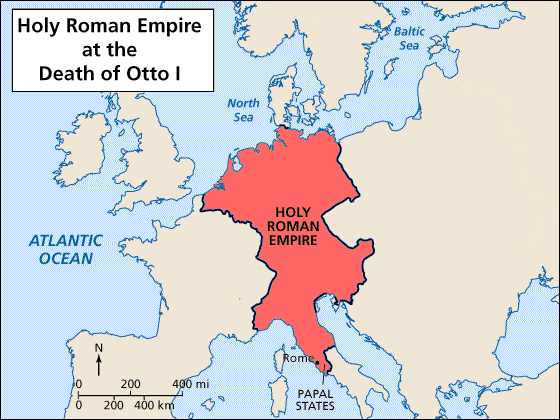


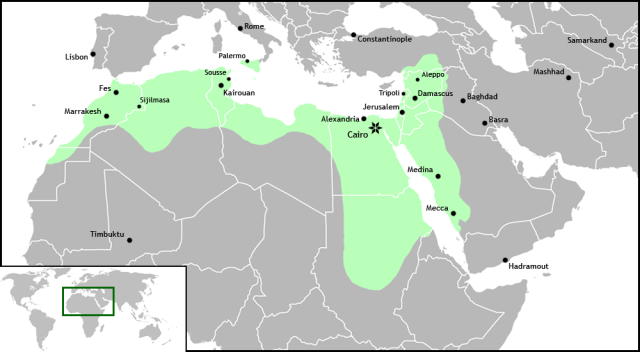


Watch this to learn more about the expansion of the Kievan Rus’ (from Kings and Generals).
Watch this to learn about why the Mayan civilization collapsed (from Kings and Generals).
And now we’ve come to the end of this very long but hopefully very informative article. True enough this article had ended with a cliffhanger in the year 1000 which is not yet the end of the Byzantine story as we are only half way and in the next 5 centuries to come, more exciting and tragic stories are to take place but of course the rest of the story cannot continue here but in another article as it would make it far too long when this article may be so long already. Anyway, where this article leaves off in the year 1000, the story of the Byzantine Empire had gone through a tough roller coaster from a the powerful empire of the Mediterranean and the restored Rome under Justinian I in the 6th century, to being weakened by an endless war with the Sassanid Persians, to facing defeat to the new rising power of the Arabs making the powerful Byzantium downsize into a militarized empire. For 300 years between the 7th and 10th centuries, Byzantium entered its dark ages having to fight on the defensive position against the expanding Arabs in the east and Bulgars in the north but with the passing of time, Byzantium grew stronger again to fight now on the offensive. Where this article leaves off during the reign of Emperor Basil II, Byzantium is now once again a powerful empire, though this time a Greek speaking empire powerful in a cultural sense as their culture and religion had spread to the people of Eastern Europe but their empire would no longer the Roman Mediterranean power it was before. In the 7 centuries this article covered, Byzantium lived through many kingdoms and empires around them rise and fall such as the Western Roman Empire, the Ostrogoths and Visigoths, Sassanid Empire, 3 Arab Caliphates, the Frankish Kingdom, the Khazars, and far away many other kingdoms and empires too had grown and fallen like those in India, Indonesia, Korea, and China which between the 4th and 11th centuries was under 3 major dynasties while in the Americas, the Mayan civilization too reached its peak and fall. Now by the year 1000, the world around Byzantium was beginning to take shape as the Holy Roman Empire and Kingdom of France had been established and so was the Kievan Rus’ State and these new powers would continue to rule with stability leading to the foundations of modern Germany, France, and Russia. By 1000, the Arabs were no longer so much a threat to Byzantium anymore as they were in the past centuries and now their focus was to finally their neighbor and long time enemy, the Bulgarian Empire as the Arabs would now be focused on their rule in the Middle East, Mediterranean, and Spain. However by as the 10th century ends and the 11th begins, a new story is about to unfold and would change the course of not just Byzantine but world history as where this article leaves off, the Normans have permanently settled in France beginning their adventures and conquests, the Seljuk Turks of Central Asia have converted to Islam and would start expanding and soon enough to come in contact with Byzantium, and lastly the powers of Europe have started to grow thus founding the kingdoms of medieval Europe which would soon come to surpass Byzantium in power. Now in part 2 of this series, you will see the story of Byzantium continue with more conflicts to face including the Seljuks, Normans, Crusades, and Ottomans the formation of the permanent kingdoms of Europe like England, France, Spain, and more, and the rise of one powerful but deadly force coming out of nowhere to take over almost the entire known world, the Mongols. Anyway, this is all for now for part1 of around the world in the history of Byzantium… stay tuned for part2 and thanks for viewing!!
 The Byzantium Blogger
6 thoughts on “Around the World in the Byzantine Era- Part1 (300-1000AD)”