
Posted by Powee Celdran
WARNING: THIS IS AN EXTREMELY LONG ARTICLE, BUT ENJOY!!
Part1: Around the World in the Byzantine Era (300-1000)

Welcome now to part2 of the Around the World in the Byzantine Era article! In the previous article I have discussed the events in the Byzantine Empire from the 4th to 10th centuries, how the empire was formed and how it survived all those years with all the constant wars, invasions, plagues, and political crisis but other than it had focused on what was going on in the rest of the world as the Byzantine Empire was existing. Basically, we all know now the Byzantine Empire was born out of the original Roman Empire that had been divided but in 324 it was reunited and by 330 it got a new capital, Constantinople and this would mark the start of Byzantine history. However, the real event that marked the start of Byzantium or the Eastern Roman Empire was in the year 395 when the empire was fully divided east and west as separate independent empires, the west though had fallen in 476 and the rest of Europe that was under its control formed into several kingdoms formed by the barbarian tribes that had settled in the empire such as the Visigoths establishing their kingdom in Spain, the Vandals in North Africa, Ostrogoths in Italy, the Franks in France, and Saxons in England. Meanwhile, Byzantium had stayed strong as the west fell and in the 6th century it retook parts of the west that had fallen such as Italy from the Ostrogoths and North Africa from the Vandals but in the east Byzantium was in an on and off perpetual war with the Sassanid Persian Empire but winning it in the 7th century only to enter a new perpetual war with an unexpected force that rose from the south, the Arabs wherein Byzantium would permanently lose Egypt and Syria to them then in the north another new force would attack and form another new force to war with Byzantium, the Bulgarians who at the 9th century would create an empire to rival Byzantium forcing Byzantium to change from being a Roman world power in the Mediterranean to a downsized militarized Greek Empire. In Western Europe, everything is unstable until the 8th century when the Franks conquer the surviving Germanic tribes and in 800 form an empire, yet another one to rival Byzantium which was the Frankish Empire and in the 10th century had evolved into the Holy Roman Empire in Germany, a new Roman empire in the west while France which once part of the Frankish kingdom becomes the medieval Kingdom of France in 987. In the rest of Europe as Byzantium rules as one empire, several Germanic, Slavic, and Baltic tribes still live in the northeast and only become united to form their own kingdoms by the 9th and 10th centuries but in the north, the biggest story would be the Norsemen known as the Vikings who come in at the end of the 8th century, become a threat in the 9th, and start settling in forming their own states in the 10th such as the Norman state in Northern France and the Kievan Rus in Eastern Europe which had though been born in the 9th century. In Britain ever since it had been abandoned by the Romans in the early 5th century, Saxons from across the North Sea begin to settle and form their own kingdoms but end up uniting against Viking invasions in the 9th and 10th centuries while Scotland and Ireland still remain as smaller and less united. While Europe forms between the 5th and 10th centuries and Byzantium rules as one empire, in the south and east the new force known as the Arabs unexpectedly rise from the Arabian deserts in the 7th century and rapidly grow an empire defeating Byzantium and destroying the Sassanid Persian Empire and the territorial extent of the Arabs extends all the way to Spain in the west and to Central Asia in the east but power is not stable among them and between 632 and 909, the Arabs have had 4 large empires or Caliphates: the Rashidun, Umayyad, Abbasid, and Fatimid. As the Arabs conquer vast amounts of territory, they spread their religion of Islam with them while the Byzantines too spread Christianity to Europe, although they become in conflict over the Christian faith with the pope in Rome but it still Christianity that had turned Europe from scattered tribes to unified states. Between the 4th and 10th centuries, Byzantium may have been the only empire that had been standing all this time as all others around it have risen and fallen but in the far east like Byzantium, China was its parallel as it stayed as the same empire throughout Byzantium’s entire existence except having different names for its empire due to the many changes of dynasties, although Byzantium between 330 and 1000 had been ruled by 10 dynasties and several usurpers but still the same empire, but like China and Byzantium the other empire that had been constantly existing the whole time was Japan. In the rest of Asia like in India and Indonesia between the 4th and 11th centuries, the story was confusing as kingdoms kept on rising and falling the same way ancient kingdoms and empire rise and soon enough fall to another one, though in Central Asia Nomadic people like the Huns, Turks, Avars, and Magyars spread quickly going as far west into Europe as well as east all the way to China and south to India. In the Americas on the other hand, progress moves slow as for all these centuries the Mayans of Central America still remain the dominant force but would soon enough fade out, though there is not much recorded evidence on the events in the Americas between the 4th and 11th centuries. Now this article being part of this 2-part article on around the world in the existence of Byzantium will focus on the Byzantium from the 11th to 15th centuries and the happenings around the worlds within this time and as the 11th century begins so does the 2nd millennium AD, the Byzantine Empire has returned as a dominant force winning over their neighbor the Bulgarians becoming once again the power it was in the 6th century although no longer a Roman Mediterranean force but an eastern Greek empire. In Western Europe, the German Holy Roman Empire is now the major empire that extends all the way down to Italy while France too rises as a powerful kingdom and England is a united Anglo-Saxon kingdom. Meanwhile in the Arab world, the Abbasid Caliphate of Baghdad is weakened with many new Islamic forces rising like the Turkic Ghaznavid Empire in Iran and the Fatimid Caliphate in North Africa while in Spain the Christians at the north grow stronger to fight the Islamic caliphate in the south. In Asia, China is now united under the Song Dynasty and Korea under the Goryeo Dynasty and this is the situation of the world where we left off in part one of this series, and now part 2 of it begins this way. Although as the 11the century progresses, Byzantium which had reached its height of power once again will once again rapidly decline as the Normans rise in the west and the Seljuk Turks in the east crushing the Byzantines heavily at Manzikert in 1071 marking the start of a new decline, and at the end of the century the era of the Crusades begin. In the next 5 centuries, Byzantium will see the Crusades rising and going on until eventually dying out, the Arab empires weaken and the Nomadic Turks rise forming powerful states, the unknown Mongols rapidly rising and building an empire almost conquering the entire world, and Western Europe evolving into powerful kingdoms even surpassing Byzantium in power. At the beginning of the 13th century Byzantium sees its temporary fall to the Crusaders in 1204 resulting in new separate Byzantine states to form like Trebizond but its return 57 years later in 1261 but from here on, its future is no longer bright as the new Turkish power of the Ottomans rise in Asia Minor which would later on bring the end of Byzantium capturing Constantinople in 1453 and the last Byzantine state of Trebizond in 1461; now if 1453 is when Byzantium ended it is just the end of Byzantine Constantinople while the real end of the Byzantine story would be the fall of the separate breakaway Byzantine Empire of Trebizond to the Ottomans in 1461, and in other words, if Byzantium was a movie 1453 would be its end while 1461 would be the post-credits ending. This here will be the second and last part of this series and will begin with Byzantium as a powerful empire in 1000 under Emperor Basil II of the Macedonian Dynasty and will end at the middle of the 15th century. Now, in this article I will try my best to explain the history of every part of the world even if I do not know them as well as I know Byzantine history as this article will cover a time in history where so much is already happening around the world wherein there is so much information about and so much happening in so little time such as the rapid expansion of the Mongols in the 13th century, the Spanish Reconquista, the whole story of the Crusades, the Hundred-Years’-War between France and England, the rise of the Russian states, and the happenings and political tensions in England, France, Italy, and the Holy Roman Empire which will be one of the biggest stories from the 11th to 15th centuries. On the other hand as this article will be divided into 2 sections per century, the first section will be all on Byzantium and its surroundings including the Seljuk Empire, Bulgaria, Serbia, and the Ottoman Empire then in the 12th century part the section on Byzantium will be on both the happenings in the Byzantine Empire and the new Crusader states and the same for the 13th century wherein the Byzantium section will be on the happenings in the Balkans and Asia Minor as in most of the century Byzantium disappeared, while the last parts which will be on the 14th and 15th century the section of Byzantium will focus on the story of the Ottomans as well while the second section will focus on the rest of the world.
Now for all of you reading, please do also like and follow The History of Byzantium and listen to their podcasts as this article I’m doing is similar to it. Also like their Facebook page.
Also, in the time period of this article (13th century), this is where No Budget Films’ most recent Lego epic War of the Sicilian Vespers is set in, please watch it too!


Related Articles from The Byzantium Blogger:
War of the Sicilian Vespers: A Byzantine Epic
12 Turning Points in Byzantine History
The Complete Genealogy of the Byzantine emperors and dynasties
Foreign Lands and People According to the Byzantines Part1
Foreign Lands and People According to the Byzantines Part2
Constantinople: The Queen of Cities and its Byzantine Secrets
The Ravenna Mosaics and What to Expect
Byzantine Science and Technology
The Art of War in the Byzantine World
A Guide to the Byzantine Empire’s Themes
15 Byzantine Related States Outside Byzantium Part1 (1-7)
15 Byzantine Related States Outside Byzantium Part2 (8-15)
Byzantine Imperial Personalities Part2
Byzantine Imperial Personalities Part3
Natural Disasters in Byzantine History
Ethnic Origins of the Byzantine emperors
The Story of 3 Plagues across centuries
Roman and Byzantine Imperial Systems Compared
Roman and Byzantine Imperial Cultures Compared
Imperial Women in the Roman and Byzantine Empires
Related Videos on World History and Byzantium:
Rulers of Europe Every Year (from Cottereau).
History of the World Every Year (from Ollie Bye).
History of the Byzantine Empire Part2 (from Fire of Learning).
The 11th Century

In the Byzantium:
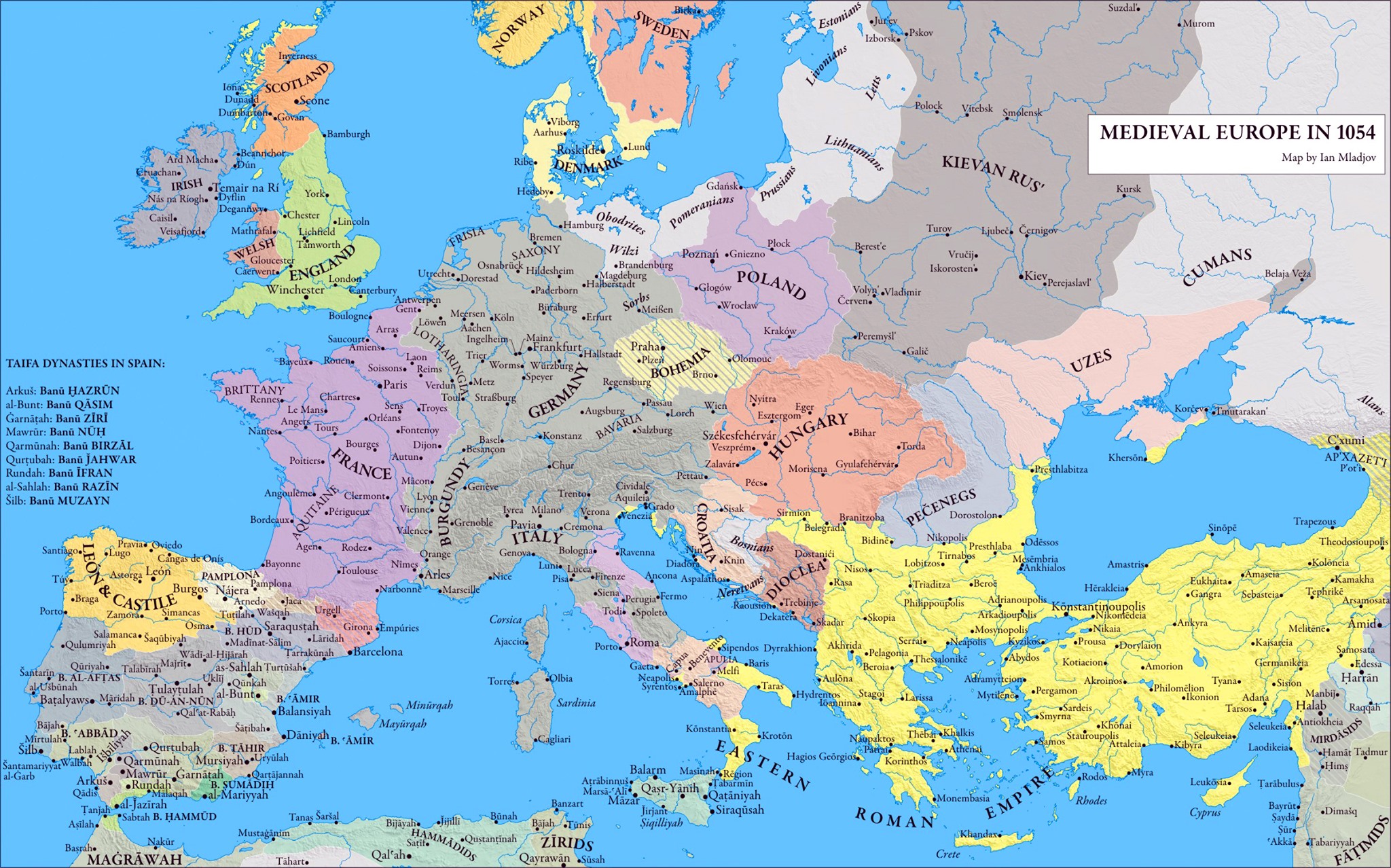
In the Byzantine Empire as the 2nd millennium begins, Emperor Basil II concludes a truce with the Fatimid Caliphate in order to resume his war with the Bulgarian Empire north now ruled by Tsar Samuil which Basil II failed in the previous years loosing heavily to them in 986 although in 1009 in Byzantine Southern Italy, a Lombard lord revolts against the Byzantines but is defeated and killed in battle in 1010. In 1014, Basil II leading the Byzantine army himself with the help of his new Varangian Guard mercenaries win a large victory over the Bulgarian army at the Battle of Kleidion, here Basil II has the defeated Bulgarians blinded with 1 out of every 100 men left with one eye to lead them home, and in the same year Tsar Samuil dies seeing his men blinded. By 1018, the Bulgarian Empire was wiped off the map with the whole Balkans except for Croatia annexed to the Byzantine Empire although Basil II now called the “Bulgar-Slayer” keeps taxes for the Bulgarians low to integrate them. At this time as well, the Georgian Kingdom of Abkhazia at the northeast border of Byzantium dies as its unified with other kingdoms in the area forming the Kingdom of Georgia in 1008, then by 1020 Basil II had annexed the Armenian sub-kingdoms of this area into Byzantium not by force but by having their kings adopt him as their successor making him inherit their kingdoms after their deaths. Basil II too thought of launching a campaign to take back Sicily for Byzantium from the Arabs but dies in 1025 before he is able to do so, though at his death the Byzantine Empire is at its largest extent again spanning west to east from Italy to Armenia and north to south from the Crimea in Ukraine and the Danube River to the Levant. Basil II ruling for almost 50 years as the senior emperor spent most of his reign in the battlefield therefore having never been married and no children, he was then succeeded by his brother and long-time co-emperor Constantine VIII and at this point it all goes downhill for Byzantium, and with no sons Constantine VIII marries his daughter Zoe to the senator Romanos Argyros; Constantine VIII dies in 1028 succeeded by Romanos III Argyros who tries to ambitiously restore the Byzantium of Justinian I’s days in the 6th century but his reign begins military failure for Byzantium with a failed siege on Arab controlled Aleppo in 1030. In 1034, Romanos III’s wife Zoe plots with her lover Michael the Paphlagonian and assassinates Romanos III making Michael the new emperor. With Michael IV as emperor, the Byzantines have practically taken back Sicily from the Arabs in 1038 but their general George Maniakes faces a rebellion from his troops and he is recalled to Constantinople being charged for treason; also in 1040 the Serbs and Bulgarians in the Balkans rebel but their rebellion is crushed by Michael IV with the help of the Varangian Guards including the future King of Norway Harald Hardrada, Michael IV however dies of epilepsy in 1041 and is succeeded by his nephew Michael V. In the next year (1042) the people rebel and overthrow Michael V putting Michael IV’s widow Empress Zoe back in power for a few months until marrying the senator Constantine Monomachos who becomes Emperor Constantine IX. As emperor Constantine IX defeats the same rebel general George Maniakes in battle in 1043, defeats an invading Kievan Rus’ fleet in the Black Sea in the same year and marries off is daughter to the Kievan Rus prince Vsevolod I of Kiev and their son who later became Prince Vladimir II of Kiev had the title of “Monomakh” named after his grandfather Constantine IX; in 1045 Constantine IX annexes the Armenian Kingdom of Ani to Byzantium, and in 1047 crushes the rebellion of the general Leo Tornikios. The biggest event in Constantine IX reign though happens to be the Great Schism of 1054 wherein he saw the Byzantine Orthodox Church and Roman Catholic Church formally split and now permanently as the Pope in Rome and the Patriarch of Constantinople excommunicate each other, he then dies the next year (1055) while his wife Zoe had died back in 1050; Constantine IX is succeeded by Zoe’s younger sister Theodora being the 2nd sole empress Byzantium had after Empress Irene (r. 797-802). Theodora dies the following year (1056) being the last of the Macedonian Dynasty founded by Basil I in 867 and without any children, she appoints her secretary Michael VI Bringas the next emperor but in 1057 the general Isaac Komnenos being disappointed with the new emperor rebels and overthrows Michael VI in a military takeover becoming Emperor Isaac I, the first emperor of the Komnenos Dynasty. As emperor Isaac I tries to restore the effectiveness of the Byzantine army to how it was under Basil II by raising taxes but after falling ill in 1059 abdicates passing the throne to his friend who becomes Emperor Constantine X Doukas. The reign of Constantine X would be one of the most disastrous for Byzantium as he disbands most of the army in the worst times to do so as Norman adventurers from France begin their conquests in Italy in 1061 and the newly converted Muslim Seljuk Turks led by their sultan Alp Arslan for the first time come out of their homeland in Central Asia invading Georgia for the first time in 1065 coming closer to Byzantine territory. Constantine X dies in 1067 without naming a successor so his wife Eudokia marries the general Romanos Diogenes who becomes Emperor Romanos IV in 1068, the same year Alp Arslan and the Seljuks attack Georgia for the second time, although the Seljuks’ intentions were to invade the Arab Abbasid and Fatimid Caliphates. In 1071, Romanos IV leads a large Byzantine army confronting Seljuk Sultan Alp Arslan’s forces at Manzikert in Eastern Asia Minor and here the Byzantines lose a crushing defeat with Romanos IV captured by Alp Arslan but immediately released finding out he lost the throne to Constantine X and Eudokia’s son Michael VII Doukas leading to a civil war between them in which Romanos IV is defeated and executed in 1072. Also in 1071, the Byzantines face another great defeat as all their territory in Italy falls to the Norman adventurers. In Michael VII’s reign, the Seljuks freely invade Byzantine territory in Asia Minor freely destroying the Byzantine Themes or military provinces that had been there since the 7th century, and in 1073 go as far as capturing Ankara from the Byzantines, while in 1074 the Seljuks capture Jerusalem blocking off pilgrims. In 1078 the general Nikephoros Bryennios and Nikephoros Botaneiates rebel against Michael VII and force him to abdicate with Botaneiates becoming Emperor Nikephoros III, although before abdicating Michael VII sent an embassy to the Song Empire of China; Michael VII later becomes the bishop of Ephesus and dies in 1090. In 1081, the young general Alexios Komnenos, nephew of the former emperor Isaac I Komnenos leads a rebellion against Nikephoros III capturing Constantinople and becomes Emperor Alexios I Komnenos restoring the Komnenos Dynasty and sending Nikephoros III to a monastery while at the same year, the Normans from Italy invade Byzantine Albania leading to the Battle of Dyrrhachion (1081) where the Normans led by the Norman duke of Italy Robert Guiscard and Alexios I leading the Byzantine army with Varangian Guards this time being Anglo-Saxons from England defeated by the Normans in 1066 meet in battle, although here in 1081 the Normans beat the Byzantines and occupy Albania although Robert Guiscard has to return to Italy to deal with a rebellion while Alexios I allies himself with the Italian maritime Republic of Venice and in 1083 defeats the Normans in Greece driving them away from Byzantine territory, here Venice once again comes into the picture and becomes an ally to Byzantium. As the Norman problem is taken care of, Alexios I turns to the problem of the invading Pecheneg tribes in the Danube frontier by allying with the Cuman tribes; the Pecheneg hordes however go as far south as Thrace but at the Battle of Levounion in 1091, Alexios I leading the allied Byzantine and Cuman armies defeat the Pechenegs with a genocide but completely taking care of the Pecheneg threat. Alexios I then turns to taking back Asia Minor from the Seljuks but in 1095, Pope Urban II organizes the Council of Clermont in France beginning the First Crusade not to help Byzantium against the Seljuks but to take Jerusalem back and the first wave of Crusaders that arrive in Byzantium is a disorganized army of peasants in 1096. In 1097, the army of Crusaders knights from Western Europe Alexios I asked for arrives in Constantinople and besiege the Seljuk held city of Nicaea although as Byzantine forces come in, they take it back for the empire. As the Crusaders travel south, they besiege Antioch from the Seljuks in 1098 and capture it with the Norman prince Bohemond, the son of Robert Guiscard becoming its ruler. The remaining Crusaders head further south in 1099 succeed in taking back Jerusalem from the Seljuks wherein they kill its inhabitants, the Crusader general Godfrey of Bouillon becomes its ruler and the Christian Kingdom of Jerusalem is established. Also in 1099, the Kingdom of Georgia which had been paying tribute to the Seljuks to stay alive stops paying it as they have gained strength while the Byzantines take back most of what was lost in Asia Minor, on the other hand the Byzantine illustration set in which many scenes of it are shown in this article known as the Madrid Skylitzes was made by John Skylitzes in Alexios I’s court in Constantinople.


Watch this to learn more about Emperor Basil II (from Tooky History).
Watch this to learn more about the Great Schism of Christianity (from Kings and Generals).
Watch this to learn more about the Byzantine-Norman War of 1081 (from Kings and Generals).
In the Rest of the World:
The 11th century was not only a big one for Byzantium seeing its height of military power and rapid decline but a very eventful one for the wider world as well and at the turn of the millennium in the rest of Europe, Bulgaria outside Byzantium is still a large empire until its ultimate defeat to Byzantium in 1018 while Croatia remains its own kingdom and so does Hungary which had evolved from the territory of the Magyar hordes as in 1000 St. Stephen I the Great of the Arpad Dynasty becomes the first King of Hungary. Poland which had already converted to Christianity in the previous century meanwhile evolves from a duchy to a kingdom in 1025 when Duke Boleslaw I the Brave becomes its first king, though dies that same year.
The Kievan Rus ruling Russia, Ukraine, and Belarus are at their height of power in the 11th century under Grand Prince Yaroslav the Wise (r. 1019-1054) but after his death, the Kievan Rus Empire begins to fragment, then in 1093 the Kievan Rus lose against the Nomadic Kypchaks in Ukraine while the southern territories of the Kievan Rus in Russia and Ukraine are lost to the Cumans.
Germany as well as Austria, the Netherlands, and Northern Italy is under the Holy Roman Empire in 1000 ruled by Otto III who dies in 1002 and is succeeded by his cousin Henry II or Heinrich II who stabilizes the empire and its relations to the Catholic Church, he then dies in 1024 and later becomes St. Henry. After Henry II’s death without any children, the Holy Roman Empire changes hands to the Salian dynasty under Conrad II (r. 1024-1039), and his son and successor Henry III defeats the Kingdom of Hungary in battle in 1044 making Hungary a vassal of the Holy Roman Empire. Later in the 1090s, a number of dukes and counts of the states within the Holy Roman Empire join the Crusades and head to Byzantium, and to the Middle East.
France at 1000 is already the medieval Kingdom of France we know of ruled by the Capetian Dynasty and in 1003 King Robert II of France attempts to annex the Duchy of Burgundy (Kingdom of Arles) but fails, though in 1016 succeeds with the help of the Catholic Church, in the 1030s Southern France experiences a 3-year famine, and at the end of the century (1090s) many French nobles support the First Crusade and join it. Among the powers in Western Europe, it is the Normans who had settled in Northern France since 911 coming from Scandinavia that have a major moment in 11th century being adventurers and knights looking for land and wealth and in the 1035 the Norman adventurer William Hauteville known as “Iron Arm” from France looking for more land comes into Italy beginning to conquer land in the south from the Lombards and Byzantines and in 1053 defeat the Lombard and Papal armies at the Battle of Civitate ending the last Lombard Duchy of Benevento in Southern Italy and making the Normans begin their major conquests of Italy making the pope acknowledge the Normans’ holding of Southern Italy and making Robert Guiscard its duke; in 1063 the Normans proceeded to conquer Arab held Sicily and all of Byzantine Italy in 1071 and in 1081, Robert Guiscard confronts the Byzantine forces of Alexios I when invading Albania but dies in 1085 as the Normans are defeated by Byzantium and Venice, at this point the Republic of Venice too starts expanding in the Adriatic Sea while their main cathedral St. Marks is rebuilt in 1063 based on Byzantine style and back in 1005 Genoa in Northwest Italy becomes its own self-governing commune declaring independence from the Holy Roman Empire becoming the Republic of Genoa and in 1087 Genoa with the other Italian Republic of Pisa and the Papacy join forces in the Mahdia Campaign against an Islamic state in North Africa.
Also in 11th century Italy, the astrolabe is introduced to Europe by Pope Sylvester II before his death in 1003, the University of Bologna in the city of Bologna in the Papal States is established in 1088 being Europe’s oldest university though the biggest events for the Catholic Church in the 11th century was the final split with the Byzantine Church in 1054- same year in which a large supernova is observed by astronomers- and in 1075 the Investiture Controversy sparked by Pope Gregory VII resulting in civil war within the Holy Roman Empire.
Most of Spain at the beginning of the 11th century is still under the last remnant of the Umayyad Caliphate or Caliphate of Cordoba except for the north which starts growing as the Christian Kingdom of Leon stating the Reconquista to take back the rest of Spain from the Muslims. In 1035, the northeast of Spain forms the Kingdom of Aragon and in 1037, Ferdinand I becomes King of Leon and conquers its neighboring small Kingdom of Galicia in Northwest Spain and since he had also inherited the County of Castile, in 1056 he is the first and only Spanish king to be crowned “Emperor of Spain” as he rules both Castile and Leon, this event now marks the beginning of Castile and Leon as a united kingdom that would campaign against the caliphate in the south. However, in 1065 Castile and Leon was split between Ferdinand I’s sons upon his death and Galicia which includes what is Northern Portugal separates from Leon making their own state that would later evolve into the Kingdom of Portugal but as for Leon they start growing powerful defeating the Caliphate several times in battle including in 1085 when their king Alfonso VI captures Toledo from the Caliphate; at this point the south of Spain shifts hands from the Caliphate of Cordoba or Al-Andalus to the new power of the Islamic Almoravid Dynasty that had begun in Morocco in 1040 and in 1086 Al-Andalus integrates into it in order to protect itself from the growing powers of Castile and Leon in which the Almoravids defeat in a battle in 1086. In that time one warrior that won many victories for the Christian Spanish was the general Rodrigo Diaz de Vivar known to the Moors (Muslims) as “El Cid” or “El Cid Campeador”- who had also fought for the Moors against the Christian Spanish at times- but he captured Valencia from the Moors in 1094, he then died in 1099, also back in 1075 the Cathedral of Santiago de Compostela in Galicia (northwest Spain) begins construction.
Meanwhile England by 1000 is united and the Vikings pushed away however Ireland is unstable with civil wars ongoing while in the Kingdom of Scotland founded 2 centuries earlier, the king Duncan I is slain in battle in 1040 and is succeeded by the nobleman Macbeth who reigns a peaceful reign until the English invade in 1054 and in 1057 Macbeth is slain in battle by the forces of the English and Duncan I’s son who becomes King Malcolm III in 1058. England however returns to Viking rule in 1016 when the Christian Danish prince Cnut, son of the King of Denmark Sweyn Forkbeard (r. 986-1014) wins the English throne and as he succeeds his brother Harald II as King of Denmark in 1018, Cnut becomes king of both England and Denmark and in 1028 takes the throne of Norway forming a short-lived North Sea Empire and would be known as Cnut the Great but with his death in 1035 his empire is split as his son Harthacnut rules Denmark and Harold I rules England while Norway returns to its rightful ruler Magnus the Good of the previous dynasty. In Norway, the king Olav I Tryggvason (r. 995-1000) had started Norway’s conversion from the old Viking Pagan religion to Christianity but dies in battle against the Danish and Swedish Vikings at the Battle of Svolder in 1000; Denmark and Sweden too by 1000 had been starting to convert to Christianity which was a chaotic process and in 1030 this led to the king of Norway Olav II to be killed in battle by his Pagan vassals making him become St. Olaf. In 1042, the king of Norway Magnus, the son of St. Olaf becomes King of Denmark following the death of Harthacnut and the Saxons’ rule England again as Edward the Confessor becomes king also in 1042 and rules until his death in 1066 succeeded by his brother-in-law Harold II Godwinson who defeats a rival claimant to England, the King of Norway and former Varangian Guard under Byzantine emperor Michael IV, Harald III Hardrada at the Battle of Stamford Bridge on September of that year, this event would mark the end of the Viking Age. Although after Harold II was successful in defeating his brother Tostig and Harald III of Norway in October of 1066, the Norman duke of Normandy in France William the Conqueror at the Battle of Hastings where Harold II is killed making this a major turning point in English history as the Anglo-Saxon rule ends and the Normans come in starting the medieval Kingdom of England; Duke William is then crowned King William I of England following the battle and the surviving Anglo-Saxon army flees England finding themselves in Byzantium to serve in the Varangian Guard under Emperor Alexios I. As the first Norman king of England, William I sees the Canterbury Cathedral completed in 1077, the Tower of London complete in 1078, and compiles the Domesday Book in 1086 which a census documenting every property to England so that they could be taxed and in 1087 William I dies succeeded by his son William II who faces a revolt in 1088 and defeats the same Scottish king who took over from Macbeth Malcolm III in battle in 1093 while William I’s other son Robert II remains Duke of Normandy and takes part in the First Crusade as an important commander.
Down in Egypt, the power of the Fatimid Caliphate grows stronger and in 1008 relations between the Fatimids and Song China is solidified as the Egyptian captain Domiyat travels to Shandong in China to give gifts to the emperor and between 1011 and 1021, the Iraqi scientist Ibn al-Haytham who was living in Fatimid Egypt wrote his influential Book of Optics while under house arrest and at the same time as he wrote that, his contemporary the Persian scholar Avicenna or Ibn Sina living in Iran wrote the Book of Healing (1014-1020) and the Canon of Medicine afterwards. In 1021 in Fatimid Egypt, the caliph Al-Hakim bi-Amr Allah disappears suddenly making the Islamic sect of the Druze people believe he will return as their savior then in 1045, the Berbers of Morocco and Algeria break away from the Fatimids creating their own Zirid dynasty acknowledging the Abbasids in Baghdad as the true Caliphate, in 1057 the Banu Hilal tribes of the Sahara invade and destroy the city of Kairouan in Tunisia under the Zirids reducing them to small Bedouin emirates, and in 1094 the death of the Fatimid Caliph Ma’ad al-Mustansir Billah sparks a rebellion leading to the split and creation of the Nizari religious branch of Islam, in which the Fidai or Assassin’s Order of Masyaf and Alamut was part of.
In Iraq the Buyid Dynasty rules the southern part but in 1055 as the Seljuk Empire from Central Asia that had recently converted to Islam begins to expand, they capture the Buyid emir Al-Malik al-Rahim and capture Baghdad too in that year, in 1062 the Buyid Dynasty’s territory falls to the Seljuks who later take over Iran and in 1079, the Seljuk sultan Malik Shah I, the son of Sultan Alp Arslan reforms the Iranian calendar. Though the Seljuk Empire conquers a vast amount of territory, it destabilizes very quickly and breaks a part with the Seljuks that had taken over Byzantine Asia Minor after the Battle of Manzikert in 1071 creating the Seljuk Sultanate of Rum in Asia Minor with Nicaea as their capital until the Byzantines take it back in 1097 moving the Seljuk capital to Konya while also in 1077 the Seljuk territories of Iran and Central Asia form into the Khwarazmian Empire and back in Asia Minor another group of Seljuks form smaller Turkish states or Beyliks including the Danishmends in Northern Asia Minor while also within Asia Minor, the Armenians after losing their homeland to the Seljuks establish their kingdom in the southern coast of Asia Minor known as Cilicia in 1080 which would be known as the Kingdom of Cilician Armenia.
In Africa, the Kingdom of Nri in what is now Nigeria was said to have started in 1043 while the Ghana Empire of West Africa is invaded by the Almoravids of North Africa in 1076 with their capital Koumbi Saleh sacked; also within the century the Kanem-Bornu Empire of Chad that had been existing since 700 expands southwards to Nigeria while in Nigeria itself the first of the 7 Hausa city-states is founded though year not mentioned.
To the east in India, Muslims from the state of Ghazni in Afghanistan begin raiding into Northern India in 1001 while in Southern India, the Chola Empire of Tamil Nadu continues expanding making expeditions down to Indonesia defeating the Srivijaya maritime empire in 1025 making it a vassal, the Cholas then conquer parts of Sumatra and the Malay Peninsula including Thailand. In Western India, the Western Chalukya Empire that had been around since 973 faces a civil war from 1075 to 1076 between its king Someshvara II and his bother Vikramaditya though Someshvara II who allied with their enemy the Chola Empire of the south is defeated and imprisoned by his brother who becomes King Vikramaditya VI who in 1093 defeats the Chola army.
Meanwhile in the area of Indonesia, King Dharmawangsa’s kingdom of Medang in Java falls under the invasion of the Srivijaya ally of the Java Kingdom of Lwaram though in 1019 the prince Airlangga of Bali, nephew of King Dharmawangsa of Medang establishes the Kingdom of Kahuripan in Java being its only king as in 1041 he abdicates and divides his kingdom into the smaller states of Janggala and Kediri. Since the maritime Srivijaya kingdom in Sumatra had become a vassal of the Indian Chola Empire, their king appeals to the Chinese Song Empire for help to liberate them from the Cholas in 1028, then in 1030 the Kingdom of Sunda in Java and its sacred forest is first mentioned.
Over in Vietnam, the Le Dynasty is overthrown in 1009 by Ly Thai To beginning the Ly Dynasty also known as the Kingdom of Dai Viet which fights a border war with Song China from 1075-1077 resulting with the Song Chinese to ally with the Vietnamese Champa kingdom in the south and the Cambodian Chenla kingdom to attack the Ly capital of Hanoi but in a peace treaty in 1082 territories between the Ly and Song China are exchanged while in Myanmar, the king of the Bagan kingdom Anawrahta coquers the city of Thaton in 1057 uniting the country into one empire, also he makes a pilgrimage to Ceylon (Sri Lanka) which makes him convert his empire to Theravada Buddhism.
In Song Dynasty China, the Baitoushan volcano at the border erupts in 1001, in 1005 the Treaty of Shanyuan is signed between the Song and the Khitan Liao Dynasty giving the north to the Khitan Liao, between 1041 and 1048 the Chinese artisan Bi Sheng invents the ceramic moveable style printing machine, then between 1069 and 1076, the court chancellor Wang Anshi with the support of the emperor Shenzong introduces new policies on economic reform for the empire which includes government monopoly on tea, salt, wine, and Sulphur so that merchants won’t sell it to their enemies, and in 1075 the rightful border lines are set between he Song Empire and the Liao Dynasty at the north. Between 1080 and 1081, the Song Empire goes to war with the neighboring state of Xia at the west putting the scientist Shen Kuo in charge of the army which halts the Xia invasion but the campaign becomes a failure because an officer disobeys imperial orders although in 1088 Shen Kuo made the world’s first reference to a magnetic compass in his book Dream Pool Essays while in the south the seaport of Quanzhou in Fujian, China opens in 1087 wherein goods from Africa, Arabia, India, Sri Lanka, Persia, and Southeast Asia come in to China. At the end of the century in China, war is resumed with the enemy, the Tibetan Tangut led Western Xia state in 1093 and the astronomical clock tower of Kaifeng is completed in 1094. Meanwhile in the north in China’s border with the Goryeo Kingdom of Korea, war breaks out between Goryeo and the Northern Chinese Khitan Liao Dynasty in 1010 in which the Goryeo king has to abandon the capital of Kaesong until beating the Liao forces in 1011, then in 1018 the war resumes but this time Goryeo pushes the Liao forces out of Korea afterwards signing a peace treaty.
Japan in the 11th century is still in the Heian period with Kyoto as its capital and between 1001 and 1008 the female writer Murasaki Shikibu writes the Tale of Genji although the emperors of Japan in this century came to be dominated by the Fujiwara that had dominated central politics.
Meanwhile in the Americas, the Mayan civilization is in decline but the Toltec and Mixtec civilizations of Central America begin to flourish and so does the Mississippian culture of North America while the Tiwanaku Empire in South America found around Lake Titicaca in Peru and Bolivia collapses in the middle of the 11th century but perhaps the biggest turning point in the history of the Americas happened early on in the 11th century when the Vikings from Greenland led by Leif Erikson, son of the Norwegian Erik the Red who happened to be a Christian sails west across the Atlantic from Greenland in 1000 and in 1001 tries to establish a settlement in Vinland which is today’s Newfoundland in Canada but eventually fail although they would be the first Europeans to discover the Americas.


Watch this to learn more about the 11th century Norman conquests of Italy (from Kings and Generals).
Watch this to learn more about the Norman conquest of Sicily in 1063 (from Kings and Generals).
Watch this to get to know about the world in 1066 (from Kings and Generals).
The 12th Century
In Byzantium (and the Crusader States of Outremer):
The 12th century would be better known in Europe as the “High Middle Ages” and “Age of the Cistercians” and this was when the kingdoms of Europe had be emerging and the Crusades in the Levant at its height, and as the century began the Crusades have already successfully taken back most of the Levant which they called Outremer including Antioch and Jerusalem from Muslim rule while Byzantium regains strength under Emperor Alexios I Komnenos. In 1100 the Crusader conqueror of Jerusalem Godfrey of Bouillon dies and his brother Baldwin of Bouillon becomes King Baldwin I of Jerusalem, the first king of Crusader Jerusalem which would be the stongest of the new Crusader kingdoms expanding all the way down to the Red Sea while the Crusader prince of Antioch the Norman Bohemond plans on attacking Alexios I’s Byzantium, however Alexios I makes Bohemond submit to Byzantium as a vassal in the Treaty of Devol in 1108, then in 1109 the Crusader Count Bertrand of Toulouse captures Tripoli in Lebanon from the Fatimid Caliphate establishing the County of Tripoli. Ruling Byzantium, Alexios I continues fighting the Seljuk Sultanate of Rum in Asia Minor and in 1116 he defeats the Turks at the Battle of Philomelion before his death comes in 1118, though before he dies his wife Irene plots to make their daughter Anna Komnene succeeded him but instead Alexios I makes his son John become emperor who exiles his older sister Anna to a monastery where she would write the biography of her father known as the Alexiad. In 1119 while John II rules Byzantium, the Knights Templar Order is established to protect pilgrims on their way to Jerusalem and in 1122 John II defeats the Pechenegs at the Battle of Beroia in Bulgaria wiping out the Pechenegs completely from the map, he would then spend the most of his reign at war against the Seljuks, Crusaders, and the Kingdom of Hungary all while starting hostilities between Byzantium and the Republic of Venice, though back in Constantinople one of his achievements was the construction of the Pantokrator Monastery. In Asia Minor, John II pushed east reconquering Byzantine territory lost to the Turks then in 1137 he captured Tarsus, Adana, and Mopsusestia in Cilicia from the Armenian Kingdom in order to make his way to conquer Antioch from the Crusaders but in 1143 before launching an invasion on Antioch, John II the Good died in Cilicia during a hunt by stabbing himself with a poisoned arrow and was succeeded by his youngest son Manuel I inheriting an empire from Serbia up north down to the Levant, though he cancelled the Antioch campaign to secure his position but with the help of his father’s general and closest advisor John Axouch, Manuel was quickly made emperor. One of the earliest events Manuel I faces as emperor is the loss of the Crusaders’ County of Edessa that had been established in 1098 to the Seljuk Empire’s successor Turkic Zengid Dynasty in 1144, this leads to Western Europe launching the 2nd Crusade in 1145 which ends up a failure in 1148 wherein Manuel I is blamed by the west for it by having the Turks attack the Crusaders; the Second Crusade however was not only fought in Outremer as 2 other crusades happened at the same time in Europe, one in Poland and one in Spain. In 1153, Holy Roman emperor Frederick I Barbarossa and Pope Eugene III signed an alliance to prevent Manuel I from invading Italy although being an energetic ruler Manuel I attempted to invade Norman Sicily and in 1159 he put Norman Antioch under Byzantine protection by making Antioch’s prince Reynald de Chatillon submit to him making Byzantium the major power in the Crusader States of Outremer and in 1161 the Seljuk sultan of Rum Kilij Arslan II makes peace with Byzantium recognizing Manuel I as his superior. In 1169, Manuel I allying himself with the Crusader Kingdom of Jerusalem launches an invasion of Fatimid Egypt but does not succeed due to lack of cooperation between the Byzantines and Crusaders at the Siege of the port of Damietta then in 1171 Byzantium cuts ties with their ally Venice leading to a short war between them. At this point time back in Constantinople, Manuel I began to host joust tournaments as a practice borrowed from the Latin Crusaders of the west but at this time as well (1166) the state of Raska in Serbia becomes its own principality within Byzantium with Stefan Nemanja as its first Grand Prince and in 1176 after the peace with the Seljuk sultan Kilij Arslan II is broken, Manuel I’s Byzantine army loses to the Seljuks at the Battle of Myriokephalon ending Byzantium’s reconquests of Asia Minor from the Seljuks, Manuel I dies in 1180 with the Byzantine Empire for the last time at its largest and is succeeded by his young son Alexios II. In 1182, the Byzantines of Constantinople revolt and massacre the Latins particularly Italian inhabitants of the city and make Manuel I’s cousin Andronikos I Komnenos co-emperor also making the Republic of Venice angry, then in 1183 Andronikos I executes Alexios II by strangling becoming the sole emperor while in 1185 the Normans of Sicily invade Byzantium and sack Thessaloniki coming close to invading Constantinople. At the same time the Normans have invaded the Byzantine Empire, Andronikos I is deposed and beaten to death by the same people that put him in power in 1182 making Andronikos I’s second cousin Isaac II Angelos their new emperor who takes care of the Norman problem driving the Normans away but at the same time, the Bulgarians rebel and with Isaac II unable to solve the conflict, the Bulgarians led by the Asen brothers Theodore, Ivan, and Kaloyan in the same year declare independence from Byzantium establishing the 2nd Bulgarian Empire also known as the Vlach-Bulgarian Empire making Theodore Asen renamed Peter its ruler, and once again Bulgaria is its own empire after almost 200 years under Byzantium since it was conquered by Basil II in 1018. While Isaac II rules Byzantium, the Crusader army of the Kingdom of Jerusalem is defeated by the sultan of the new Ayyubid Dynasty Saladin at the Battle of Hattin in 1187 afterwards Jerusalem itself falls to Saladin leading to Western Europe to launch the 3rd Crusade in 1189 to take back Jerusalem and this time 3 kings of Europe head to the Levant which include King Richard I of England, Philippe II of France, and Holy Roman emperor Frederick I Barbarossa. However when heading for Jerusalem, Emperor Frederick I who was at odds with Isaac II drowns in a river in Asia Minor part of Byzantine territory which puts the blame on Byzantium as Isaac II even allied himself with Saladin while Richard I captures Byzantine Cyprus in 1191 before he defeats Saladin in the Battle of Arsuf in 1191 and at the Battle of Jaffa in 1192 taking back the coast of today’s Israel for the Crusaders but fails to take back Jerusalem while Cyprus in 1192 is passed to the rule of Guy de Lusignan the former Crusader king of Jerusalem. Back in Byzantium in 1195, while Isaac II was out hunting during a military campaign against the Bulgarians, his older brother Alexios suddenly usurps the title of emperor, blinds and imprisons Isaac II and becomes Emperor Alexios III Angelos who faces a near invasion of Byzantium by Holy Roman emperor Henry VI the son of Frederick I in 1197 which fails as Henry VI dies that same year while in 1198 the Crusader Knights Hospitaller in charge of the hospital in the Crusader port city of Acre in Outremer from the German order of knights or the Teutonic Knights. At the end of the 12th century, Byzantium at least remains intact but Bulgaria had already separated from it but still a small kingdom though ready to expand if ever Byzantium would collapse and in only a few years it would.


Watch this to learn more about Anna Komnene and Alexios I of Byzantium (from Overly Sarcastic Productions).
Watch this to learn the full story of the 3rd Crusade from 1189-1192 (from Kings and Generals).
In the Rest of the World:
Outside Byzantium, the Kingdom of Georgia under King David IV the Builder (r. 1089-1125) grows defeating the Seljuk army in 1104, liberates the rest of Georgia from the Muslims in 1115, and in 1121 wins the greatest battle in Georgian history with only a few Georgians and French Crusaders against 400,000 Seljuks then makes Tbilisi Georgia’s capital in 1122.
Croatia is then united into the Hungarian Crown by the Hungarian king Coloman 1102 making the Croatian king a vassal. For the Kingdom of Poland, in 1109 they defeat the Pomeranian tribes in battle and establish access to the Black Sea at the same time defeating the armies of the German Holy Roman Empire stopping them from expanding eastwards, then in 1147 the Holy Roman Empire launched the Wendish Crusade against the Pagan Pomeranian Slavs or Wends in Northern Germany and Poland as part of the 2nd Crusade- as the German nobility of the Holy Roman Empire wanted to annex the northern tribes along the Baltic Sea and convert them to Catholicism- which succeeds and those Slavs converted. The 12th century in Europe saw the Papacy and the Holy Roman Empire in conflict with each other at some points and this includes the long-time political conflict in Italy between the faction of the Guelphs supporting the pope and the Ghibellines supporting the Holy Roman emperor which starts in 1125 when the Duke of Saxony Lothair III is elected Holy Roman emperor and between 1130 and 1138 a Papal Schism broke out between Pope Innocent II and Antipope Anacletus II resulting from a double election following the death of Pope Honorius II in 1130, the antipope on the other hand is the one to crown the Norman king of Sicily in 1130 and the schism only solved with the Second Lateran Council 1139 and even if crowned by the antipope, Roger II of Sicily is still acknowledged king by the real pope Innocent II; later on in 1173 a big moment happens for the Catholic Church when the Christian definition of Purgatory is defined. In 1155, Frederick I Barbarossa of the Hohenstaufen Dynasty becomes Holy Roman emperor with the intention to rule over all of Italy including the Papacy but in 1176 he is defeated at the Battle of Legano by the Italian Lombard League supported by the pope making Frederick I acknowledge the pope’s rule over the Papal states and in 1183 the Peace of Constance is signed in which makes the Papacy, Frederick I, and the Lombard cities of Northern Italy allies, yet it so happens that Frederick I was still Holy Roman emperor when the 3rd Crusade was launched in 1189 which he joined but died drowning in Byzantine territory, his son and successor Henry VI in 1194 conquers the Norman kingdom of Sicily making Sicily part of the Holy Roman Empire due to his claim to Sicily being married to its former Norman king Roger II’s daughter Constance.
Among the republics in Italy, Venice becomes the most influential in the 12th century and because of the Crusades need for ships to be transported from Europe to Outremer, Venice becomes rich; in 1104 the Venice Arsenal was founded employing 16,000 people for the mass production of ships in large assembly lines long before the Industrial Revolution.
In 12th century France under the Capetian Dynasty, the first Piedfort coins are minted, in 1121 the German bishop St. Norbert and 29 companions make their solemn vows in Premontre, France establishing the Premonstratensian religious order, then in 1136 the Abbey of St. Denis which houses the tombs of the French kings outside Paris is rebuilt making it the first major building using Gothic architecture, and in 1137 Louis VII of the Capetian House marries the duchess Eleanor of Aquitaine and becomes King of France in which in his reign France becomes a European superpower next to the Holy Roman Empire at the time of the Crusades and at his death in 1180 he is succeeded by his son Philippe II Auguste who leads the French armies in the 3rd Crusade.
Meanwhile the kingdom in Europe that has a major moment in the 12th century is England now under the Normans; in 1100 the king William II son of the Norman conqueror William I is killed hunting in the New Forest and is succeeded by his younger brother Henry I who gets into conflict with his older brother the Duke of Normandy in France Robert II who had taken part in the 1st Crusade but Henry I’s forces win at the Battle of Tinchebray in Normandy and Robert II is imprisoned in Cardiff Castle while Normandy is fully absorbed into England; however in 1120 Henry I’s only legitimate son William dies in the White Ship disaster in the English Channel beginning a succession crisis after Henry I’s death in 1135 and this succession crisis would be known as “The Anarchy” which was a civil war from 1135 to 1154 between Henry I’s daughter known as Empress Maude and his nephew Stephen of Blois who takes the throne as King of England till he dies in 1154 which results in Stephen losing and having to proclaim Maude’s son Henry Plantagenet as his successor and with Stephen’s death in 1154, Henry II is crowned King of England beginning the Plantagenet Dynasty wherein England rules the Angevin Empire having not only England but Henry II’s lands in Western France as well. In Henry II’s reign, the Normans of France invade Ireland in 1169 to help the exiled Irish chief Dermot MacMurrough recover his Kingdom of Leinster which is successful although in 1175 Henry II of England and the Irish high king Roderic O’Connor sign the Treaty of Windsor that sets the new layout of Ireland in which also Henry II uses to claim lordship over Ireland and back in 1174 he defeated and captured the Scottish king William I making him acknowledge Henry II’s feudal overlordship over Scotland. In 1189, Henry II dies now most of Ireland and half of France under his Angevin Empire and is succeeded by his son Richard I the Lionheart who immediately began his reign setting off for the 3rd Crusade and after taking back the coast of the Levant from Saladin in 1192 he heads back to Europe where he escapes a conflict with Byzantine emperor Isaac II but is captured in Austria by orders of the Holy Roman emperor Henry VI though is released in 1194 with the payment of a large ransom but in 1199 he is killed in battle in France when fighting a war against his former ally, Philippe II of France; Richard I is then succeeded by his brother John; also it was in the 12th century when the Middle English language in England was developed and that people in Europe outside the Church had started become more literate.
Meanwhile Spain in the 12th century too was the story of the century as the Christians kingdoms of Castile, Leon, and Aragon in the north fought their own Crusade known as the Reconquista against the Muslim Almoravids in the south and before the century began the Christian general El Cid who had captured Valencia from the Moors in 1094 dies in 1099 leaving his wife Doña Jimena Diaz in charge of Valencia until the Almoravid Moors take in back in 1102 although if Castile, Leon, and Aragon was not fighting the Moors, a county under them known as Portugal first found in northwest Spain rebelled against them and won at a battle in 1128 gaining their independence, and in 1139 the independent Portugal led by their count Afonso Henriques defeated the Almoravids led by the governor of Cordoba at the Battle of Ourique in today’s Southern Portugal and here Afonso I Henriques is made the first king of Portugal by his soldiers, then only in 1143 do the other kingdoms of Spain recognize Portugal as a kingdom. In 1147 as part of the 2nd Crusade, King Afonso I of Portugal with his army aided by English Crusader knights capture the port city of Lisbon from the Almoravids making it the capital of Portugal while the kingdoms of Castile and Leon still fight between each other until it is settled with the Treaty of Sahagun in 1158 which in 1170 the Kingdom of Aragon joins the treaty as well and in 1179 Castile and Aragon make an agreement to divide Andalusia (Southern Spain) when taking it back from the Moors whereas Portugal in 1180 defeats a Moorish fleet continuing their reconquests from the Moors, their king Afonso I dies in 1185 succeeded by his son Sancho I. The south of Spain known as Andalusia for most of the 12th century was still under the Almoravid Dynasty which also ruled North Africa including Morocco and Algeria until a new Berber dynasty rises in Morocco in 1121 known as the Almohads which in 1147 takes Marrakesh making it their capital building the Kasbah, city gate, and Koutoubia Mosque then in 1172 had already conquered all of Almoravid territory in Southern Spain.
Over in Scandinavia Denmark, Sweden, and Norway from Vikings have already turned to Christian kingdoms before the Baltic states of Europe had converted and in Norway their king Sigurd I becomes the first king of Norway to join the Crusades in 1107 even passing by the court of Alexios I in Constantinople before returning to Norway in 1111 and his death in 1130 brings Norway into civil war which would alter lead to the Law of Succession of Norway to be enacted in 1163 which ruled that succession in Norway is only done by primogeniture while in the Kingdom of Denmark its king Valdemar I conquers the Pagan stronghold island of Rugen in 1168; and in Sweden on the other hand the first university in Northern Europe is established in Lund in 1185 but their royal and commercial capital of Sigtuna is attacked by raiders from Karelia in Russia or Curonia in the Baltics in 1187, though also the blast furnace for smelting cast iron imported from China first appeared in Sweden by 1150, then in Iceland within the 12th century the first outbreak of influenza occurs and so does the first fire and plague insurance become available while at the same time the first merchant guilds are introduced in Europe.
Christian missionaries from Europe too start coveting the last Pagans in Karelia, Estonia, and Finland while in Russia the grand principality or the empire of the Kievan Rus’ breaks apart into smaller principalities including the Principlaity of Kiev formed in 1132 formed the ruins of the Kievan Rus’ Empire, the Novgorod Republic in the north formed in 1136 which rebelled against Kiev, and the Grand Duchy of Vladimir in 1157 in which Moscow was part of while the south of Russia would be under the Cuman Khanate; also in 1185, windmills were first recorded.
Back in the Middle East, the Fatimid Caliphate that had been around since 909 ends when the general Saladin deposes the last Fatimid caliph Al-Adid in 1171 making Saladin establish his own Ayyubid dynasty with him as its sultan ruling Egypt, the Levant, and Syria and it is he who captures Jerusalem from the Crusaders in 1187 but when losing the coast of Outremer including Acre to Richard I of England, Saladin keeps Jerusalem but has to allow the pilgrim transit, he then died in 1193. The Abbasid Caliphate on the other hand was in fact actually still alive in the 12th century except holding very little territory in Iraq as the Great Seljuk Empire had taken over its surroundings in the previous centuries although the remains of the Great Seljuk Turkic Empire which was ruling Iran and Iraq declined in 1140s and in 1194 it had completely fallen to and was replaced by the Turkic Khwarazmian Empire.
Sub-Saharan Africa in 12th century hadn’t really undergone much changes from the previous century except there had been more discoveries on faraway places in Africa like the Indian Ocean island of Madagascar which the Chinese customs officer Zhou Qufei documents in 1178 saying that Arab merchants purchase slaves there.
In India, the Western Chalukya Empire that had been around since 973 had ended in 1189 dissolving into 3 smaller kingdoms including the Hoysala Kingdom which develops their architecture at this time, the Chola Empire in Tamil Nadu begins to decline, and the Muslim Ghurid Sultanate, which was previously Buddhist a century earlier expands in the north expanding into Northern India after defeating the kingdom of Prithviraj Chauhan in 1192. Just nearby in what is now Cambodia the Khmer Empire expands and in 1113 King Suryavarman II is crowned, it is he who expands the empire and has the large temple complex of Angkor Wat constructed during his reign (1113-1145), he too establishes relations with Song China.
Down in Java, the Kingdoms of Kediri and Janggala have united in 1115 with Janggala falling under Kediri domination which also controlled neighboring islands like Bali while the Sumatra naval empire of Srivijaya continues to exist in the 12th century with the Malay Peninsula and parts of Thailand under its control.
Most of China in the 12th century is still under the Song Empire except for the north which is under the control of the Liao Dynasty which dissolves in 1125 as the rebel dynasty of the Jin or Jurchen which had emerged in 1115 takes over the Liao Dynasty and when having taken over the Liao Dynasty in 1125, the Jurchens force the Kingdom of Goryeo (Korea) to acknowledge them as their overlords and declare war on the Song Empire which leads in the Northern Song to lose power to the Jurchens in 1127 though in 1141 the Song and Jurchens sign a peace treaty forcing the Song to renounce all their territories north of the Huai River giving it to the Jurchens. As for the Southern Song Empire due to facing conflict with the Jurchens in the north, they establish China’s first permanent standing navy in 1132 making the port of Dinghai as the main admiral’s main office though back in 1107 the Chinese engineer of the Song Empire Wu Deren combines a mechanical compass with the distance measuring odometer device and in 1111 the Donglin Academy of Wuxi is founded, then in 1165 the Liuhe Pagoda of Hangzhou is built. For the Song Chinese navy, by 1183 a total of 52,000 marine soldiers have been recruited stationed in 20 different squadrons with hundreds of treadmill paddle wheel crafts assembled for the navy and with a navy this powerful back in 1161 it was able to defeat a massive Jurchen navy at the Battles of Tangdao off the coast of China and Caishi on the Yangtze River by launching gunpowder bombs from trebuchets attached to the Song ships.
Now in Japan, for most of the century the Heian Period continues with Kyoto still as the capital and at this time in 1175 Honen Shonin also known as Genku founds the Jodo Shu sect of Buddhism but between 1180 and 1185 the clans of Taira and Minamoto clash in a civil war known as the Genpei War in which the Minamoto clan win and claim their authority over all of Japan making the emperor a puppet thus establishing the Kamakura Shogunate, the first Shogunate of Japan where the military or Samurai have control of the country whereas the emperor is puppet and here in 1185 the Heian Period ends while in 1192 the general Minamoto Yoritomo become the first shogun or military dictator of Japan. Northeast Asia at this time where Mongolia is located was still inhabited by a series of tribes but in 1162 the future leader Temujin who would later unite the tribes becoming Genghis Khan was born somewhere in Mongolia while Central Asia itself was already organized into the Uyghur and Khitai Khaganates.
In Oceania the Tu’i Tonga Empire continues to expand across the Pacific Islands and as for the Americas there is not much recorded for this century except that the area of which is now Southwest USA experiences a 50-year drought (1130-1180) while the Mayan Civilization of Central America was on its decline still.


Watch this to learn more about the 12th century Anarchy of England (from Jabzy).
Watch this to learn more about the 2nd Crusade (from Jabzy).
The 13th Century
In Byzantium (Latin Empire, Nicaea, Trebizond, Seljuk Sultanate, and the Balkans):
If there would be one century that was very crucial in world history, it was the 13th century and yet it was at the same very crucial for the existence of Byzantium as this was the beginning of their end while this century also saw the Balkans rise through Bulgaria and Serbia as well as Venice but also saw the decline of Asia Minor’s Seljuk Empire as in 1202 the forces of the Kingdom of Georgia’s ruler Queen Tamar the Great defeats the Seljuk Sultanate of Rum at the Battle of Basian. Byzantium in 1200 was ruled by Alexios III Angelos who had overthrown his younger brother Isaac II in 1195 keeping him a prisoner but in 1201, Isaac II’s son Alexios was smuggled out of prison finding himself in Venice in 1202 wherein he asks the Doge of Venice Enrico Dandolo to assist him in taking power back for him and his blinded father which leads to the 4th Crusade being launched. Previously in the 1190s the 3rd Crusade failed in taking back Jerusalem which fell to Saladin’s Ayyubid Sultanate in 1187 making Pope Innocent III in Rome to call for another Crusade against the Ayubbids in control of Egypt and Syria but because of the Byzantine prince Alexios Angelos intervening, the 95-year-old Enrico Dandolo changed the Crusade’s objective to attacking Constantinople out of revenge for the Venetians being chased out of the Byzantine Empire by Emperor Manuel I in the 1170s wherein Dandolo was blinded. In 1202, several counts of Europe including Louis I of Blois and Baldwin IX of Flanders with his brother Henry come to Venice ready for a Crusade but Dandolo only agrees to provide them ships if they attack the port of Zara in Croatia belonging to the Kingdom of Hungary in which the Crusaders do and capture it for Venice, the following year the Venetian fleet carrying Crusader French, Venetian, and German armies set off to Constantinople with the young prince Alexios Angelos with them. Also within 1203, the Venetian fleet arrives outside Constantinople besieging it causing the emperor Alexios III to flee with the treasury and without an emperor, the Crusaders install the young Byzantine prince with them as Emperor Alexios IV while his father Isaac II is released from prison and made co-emperor with his son. Alexios IV however is only emperor because he promised to pay off the Crusaders 200,000 silver marks and army for their Crusade against Egypt as well as for the Byzantine Church to submit to the pope so as Alexios IV rules from Constantinople, the Crusader army was camped outside for months waiting for their pay and without reaching that amount, Alexios IV orders religious icons melted down to mint coins which makes the people of the city rebel. One of Alexios IV’s court advisors named Mourtzouphlos convinces Alexios IV to give up on the large sum but as the people were heading to the palace to depose the co-emperors, both father and son barricaded themselves while Mourtzouphlos betrayed them by bribing the Varangian Guards to his side and in one night in January of 1204, Mourtzouphlos dragged Alexios IV to prison executing him there while his blind father Isaac II died shortly after hearing of his son’s death, and now Mourtzouphlos was made Emperor Alexios V. On the same day Alexios IV was killed, Alexios V headed out to negotiate with Dandolo to cancel the payment offered by Alexios IV but Dandolo ordered an attack on Alexios V beginning the Crusaders’ siege on the city in which in so little time, Alexios V ordered the city’s defences to be strengthened but on April 12 of 1204, the army sent by the Crusaders had severely outnumbered the few Byzantines defending the city causing Alexios V to flee leaving only a few brave Byzantines including Varangian Guards to make their last stand until they were completely defeated by the Crusaders who proceeded to loot the city including the Hagia Sophia and the tomb of Justinian I, kill its inhabitants, destroy buildings, and all while the attack had happened, a nobleman named Constantine Laskaris was unofficially crowned in the Hagia Sophia but without any support he also fled the next day. On April 13, the Crusaders had captured Constantinople while Constantine’s brother Theodore Laskaris led the people out establishing themselves in Nicaea making it their base in order to take back Constantinople; now in Constantinople, territory around it including Thrace fell under control of the new Latin Empire based in Constantinople with Baldwin of Flanders elected as the first Latin emperor Baldwin I, Crete then fell to Venice, Thessaloniki and its surroundings to Montferrat, Southern Greece or the Peloponnese to the new Latin Principality of Achaea, Athens to the new Latin Duchy of Athens, and the Aegean islands to the Latin Duchy of the Archipelago, and all these new Latin territories in the former Byzantine Empire would be known as the Frankokratia. Also in 1204, the grandsons of the former emperor Andronikos I Komnenos, Alexios I and David who were also nephews of Queen Tamar of Georgia established the breakaway Byzantine Empire based in Trebizond in the southeast corner of the Black Sea wherein their empire included those regions and the remaining Byzantine territory in the Crimea above the Black Sea as Constantinople was lost and in 1205 Theodore I Laskaris was proclaimed Emperor of Nicaea, the first Byzantine emperor in exile while in Western Greece the unofficial rebel Byzantine state of Epirus was established with Isaac II and Alexios III’s cousin Michael I Angelos as its ruler or despot who ended up assassinated in 1215 and succeeded by his half-brother Theodore while the former emperor of Byzantium that fled in 1203 Alexios III was still out there in Thrace as a renegade plotting to take back the throne, though the other former emperor Alexios V was captured by the Crusaders and executed in December of 1204 being thrown off a column in Constantinople. In addition, 1205 was the same year the 97 year old Doge of Venice Enrico Dandolo died and the Latin Empire only being around for a year faced a rebellion by local Greeks supported by the Bulgarian tsar Kaloyan and when Baldwin I led his forces to battle against the Bulgarians they were severely defeated by the new Bulgarian Empire under Tsar Kaloyan at the Battle of Adrianople wherein the general Count Louis I de Blois was killed and Latin emperor Baldwin I was captured and later executed leaving no emperor in Constantinople for a year until his brother Henry who took part in besieging Constantinople in 1204 is crowned emperor in 1206. The former emperor Alexios III however still remained alive and turned out to be Theodore I of Nicaea’s father-in-law and wanting to claim the exiled empire at Nicaea, he made a deal with the Seljuk sultan Kaykhusraw I and Latin emperor Henry while Theodore allied with the Bulgarian tsar Boril who succeeded his uncle Kaloyan in 1207 and in 1211 Theodore I’s forces met with the Seljuks at the Battle of Antioch on the Meander in which Theodore I though almost killed is victorious as his forces kill the Seljuk sultan in battle and afterwards Theodore I and the new Seljuk sultan Kykaus I signed a peace treaty, although Henry tried to attack the Nicaean Empire but without enough troops Henry was forced to sign a peace treaty with Nicaea or be beaten back, although this gave the Latins possession of the Troad region in Asia Minor. Also in 1214, Theodore I with his Seljuk allies captured the Black Sea coast region of Paphlagonia from the Byzantines of Trebizond, then in 1216 Latin emperor Henry died suddenly on his way to launch an attack on Byzantine Epirus making the Latin barons of the empire elect Henry’s brother-in-law Peter Courtenay as their new emperor who was in France at that time but before reaching Constantinople he was captured in Greece by the despot of Epirus Theodore in 1217 and imprisoned wherein he died in 1219 leaving Constantinople with no ruler but his wife who was Henry and Baldwin I’s sister Yolande as regent until her sudden death in 1219 with her son Robert still in France only coming to Constantinople in 1221 while the younger son Baldwin who was still a young child was left alone for 2 years with both parents dead and his brother not there yet making a French Crusader general and then an Italian cardinal the acting rulers of the empire within the 2 years, at the same year (1221) Theodore I also died in Nicaea leaving behind an empire from the Black Sea down to the Aegean leaving the part of Asia Minor along the Marmara still under the Latins. Now to the north of Byzantine Epirus and the Latin Empire, the absence of Byzantine rule gave the opportunity to expand and Serbia takes advantage of the situation by becoming a kingdom in 1217 with their grand prince Stefan Nemanjic crowned its first king. The Latin Empire without a legitimate ruler until 1221 put the empire in chaos while Theodore I’s death left Nicaea in a succession crisis and small civil war between his brothers and son-in-law the successful general John Vatatzes in which the latter won exiling the brothers and became Emperor John III Doukas Vatatzes in 1222 who in 1224 won a major victory against the Latins and Theodore I’s brothers at the Battle of Poimanenon in which most of the Latins’ territories in Asia Minor were ceded to Nicaea changing the tide of war on the side of Nicaea putting them on the road to take back Constantinople. It also happened that in 1224, the Latin held Kingdom of Thessaloniki in Northern Greece fell to the Byzantines of Epirus and in 1225 Adrianople was captured by John III of Nicaea, and the Latin emperor Robert Courtenay traveled to Rome to get help from the pope but failed and when returning to Constantinople, he died in 1228 in the Morea (Southern Greece) and was succeeded by his 11-year-old brother Baldwin II who ruled under the regency of the Crusader general Jean of Brienne, the former king of Jerusalem (1210-1225) based in Acre. Also back in 1218, Bulgarian tsar Boril died and was succeeded by his cousin Ivan Asen II who in 1235 concluded an alliance with John III of Nicaea who by this time had already annexed the Nicaean Empire into Europe surrounding Constantinople therefore being strong enough to bring the end of Latin rule especially with the Bulgarians as his ally, then to seal the alliance John III’s son Theodore and Ivan II’s daughter Elena were married also in 1235 the same year both Nicaean Byzantines and Bulgarians tried to besiege Constantinople which failed as a Venetian fleet arrived to defend Constantinople, the Bulgarians then gave up making John III have to abandon the siege without any means to break open the walls. If not for almost coming to take back Constantinople from the Latins, John III used the death of Ivan II of Bulgaria in 1241 to return Thessaloniki- which fell under the Latins, Epirus, and then Bulgaria- back to Byzantine rule in 1242 to focus on crushing the rebel Byzantines of Epirus even making Epirus’ allies like the Albanian nobleman Golem defect to him while back in Constantinople the regent emperor Jean retired in 1237 making the legitimate emperor Baldwin II rule alone. At home in Nicaea, John III succeeded in maintaining peace and economic stability that Nicaea could sustain itself without having to import anything, he then died in 1254 due to his epilepsy and was succeeded by his only son the philosophical Theodore II Laskaris who like his father was also an energetic ruler having expanded the army, made an alliance with the Seljuk sultan Kykaus II to push the Mongols out of Asia Minor, stopped a Bulgarian invasion of Bulgaria’s new emperor Konstantin Tih Asen (1257) in Thrace, and reconquered territory from Epirus and Serbia all the way to the Ionian Sea. Meanwhile in Constantinople, Baldwin II was left with just the city and completely short of funds that he had to keep travelling to Europe to seek help that he even had to sell off the relic of the Crown of Thorns in Constantinople to France. However, back in Nicaea civil instability rose due to Theodore II’s unstable temper caused by epilepsy and appointment of commoners into powerful positions threatening the Byzantine elite causing the nobleman Michael Palaiologos his childhood friend and long-time rival to hatch a plot on the emperor and in 1258 Theodore II suddenly died either due to having chronic epilepsy like his father or by being poisoned by Michael Palaiologos, but either way Michael Palaiologos quickly usurped power in 1258 by assassinating Theodore II’s named successor the commoner George Mouzalon assigned to Theodore II’s young son John IV Laskaris during Theodore II’s funeral. The boy emperor John IV Laskaris was then only a puppet emperor to his regent general and co-emperor Michael Palaiologos in 1259 who led ambitious campaigns against the Latins as in 1259 his army led by his brother John and the general Alexios Strategopoulos defeated the rebel Byzantine Despotate of Epirus and pushed the Latins out of Greece at the Battle of Pelagonia taking back most of Greece which would be the last time the Varangian Guard appeared in battle then in 1260 Michael himself led an attack to take back Constantinople which did not succeed again, so instead Michael had his men in 1261 survey the area to see a possible way to take back the city but unexpectedly the Latin emperor Baldwin II sent most of his army out on a naval raid leaving the city exposed for Michael’s army led by Alexios Strategopoulos to quickly sneak in and drive the Latins away from Constantinople liberating it on July 25, 1261 forcing Baldwin II to flee leaving behind his crown and sword and Michael was then crowned Emperor Michael VIII Palaiologos and his young son Andronikos as his co-emperor with Constantinople falling back to Byzantine hands ending the 57 year existence of the Latin Empire and later that year Michael VIII secured his claim by deposing, blinding, and imprisoning the young John IV, and as the restored emperor Michael VIII rebuilt Constantinople from the ruin the 4th Crusade brought which had brought the population down to only 35,000 and seals a permanent alliance with the Italian Republic of Genoa. Although Constantinople and most of Greece fell back to Byzantine hands, Crete was still under Venice, most of the Aegean islands and Athens still under the Latins, and the separatist Byzantine states of Trebizond in the eastern edge of the Black Sea and Epirus now controlling the region of Thessaly in Greece refused to unite with the empire but the biggest threat Michael VIII had to face was from the west as in 1266 the French ruler Charles of Anjou captured Sicily from the Holy Roman Empire with the intention of taking Byzantium back for the Latins but without much of an army to fight of Charles, Michael VIII had to turn to diplomacy by signing a union with the Catholic Church in 1273 at the Council of Lyon promising to submit Byzantium to the pope which angered the people who began to threaten to depose Michael VIII. Now Charles of Anjou in 1281 invades Byzantine Albania from Sicily but his army is stopped and defeated by Byzantine forces, although this still did not stop Charles from wanting to take back Constantinople and restore the Byzantine Empire so in 1282 Michael VIII turned to diplomacy again this time bribing the rebellious people of Sicily and making an alliance with King Peter III of Aragon in the event known as the “Sicilian Vespers” which succeeds and also in 1282 Aragon acquires Sicily from Charles of Anjou’s Angevin French kingdom though 1282 was also the same year Michael VIII died somewhere in Thrace leaving the Byzantine Empire once and for all safe from the western Latin threat but leaving Byzantine Asia Minor exposed to raids by the Turkish states known as Beyliks. After Michael VIII’s death, it’s all downhill for Byzantium with his son Andronikos II as emperor who decides to dismantle the Byzantine navy and instead hire ships when needed to cut costs though at least he decided to turn Byzantium’s focus east to deal with the Turks, then in 1287 he receives diplomats from China, in 1290 he releases the former blinded emperor John IV Laskaris from prison, in 1295 the Italian adventurer Marco Polo had passed Constantinople, but in 1299 the end for Byzantium begins as the Turkish Beylik lord in Asia Minor Osman declared the birth of a new empire, the Ottoman Empire.


Watch this for the full story of the 4th Crusade (from Kings and Generals).
In the rest of the world:
In Europe itself the 13th century was as crucial for them as it was for Byzantium for some of its kingdoms would face near extinction as the Mongol Empire was founded in 1206 as a leader named Temujin united the Mongol tribes establishing an empire with himself as its emperor known as Genghis Khan but it would takes years before he would reach Europe. Of course the major event most of Europe went through in the 13th century was the Crusades which at this time was failing as most of what they had in the Levant or Outremer was lost falling back to Muslim control and from 1202-1204 the Crusade launched by Western Europe was in a way a failure as it resulted in temporarily destroying the Byzantine Empire and not attacking the Ayyubid Sultanate in Egypt and Syria. In 1204, the same year Constantinople fell to the 4th Crusade and the Latin Empire established, the Duchy of Normandy in Northern France that was established by Vikings in 911 which at this time was under the English completely fell to the Kingdom of France ruled by Philippe II Auguste of the Capetian Dynasty, the same king who led the French in the 3rd Crusade. As king of France, Philippe II ruled energetically fighting wars on all sides including taking part in the Albigensian Crusade of 1209 against the Cathar heretics based in the Occitan region of Southern France that have originated as the Bogomil heretics in the Byzantine Balkans during the reign of Alexios I (r. 1081-1118); and as part of this Crusade Philippe II won a victory against the Aragonese and Cathars in 1213 at the Battle of Muret which annexed the Occitan region to France, then in 1214 he defeated the Holy Roman Empire and the English at the Battle of Bouvines, and in 1217 he helped his former enemy the Holy Roman Empire, together with Hungary, and the Papal States in the 5th Crusade which was launched to complete the initial objective of the 4th Crusade to capture Egypt from the Ayyubid Sultanate which succeeded as the Crusades took the Egyptian port of Damietta but the Crusade was a failure when failing to capture Cairo in 1221. Philippe II died in 1223 leaving the Albigensian Crusade unresolved in which his son and successor Louis VIII continued fighting and almost succeeding in crushing it although this Crusade was finished off in 1229 when Louis VIII’s son Louis IX was already King of France since his father’s death in 1226 and as king Louis IX’s main focus was on the main Crusades against the Muslim states like the Ayyubids. However in the 6th Crusade was not led by Louis IX of France but by the Teutonic knights and Holy Roman emperor Frederick II who was at odds with the pope, although the 6th Crusade from 1228-1229 against the Ayyubids resulted in getting Jerusalem back to Crusader hands through Frederick II’s diplomacy in 1229. While the Crusades still went on, 2 major Catholic religious orders were formed in Europe first the Franciscans or Order of Friars formed in 1209 by the Italian St. Francis of Assisi and the Dominicans or Order of Preachers in 1216 by the Spanish St. Dominic de Guzman and one of the most famous members of the Dominican Order the priest, philosopher, and theologian St. Thomas Aquinas also lived in this century in Italy who in 1265 wrote his famous work Summa Theologica but also when mentioning Italy, the famous arithmetic manuscript Liber Abaci was made by the Pisan Leonardo Fibonacci back in 1202.
Back to the Crusades, since the Mongol Empire displaced the Khwarezmian Empire of Iran back in 1231, the Khwarezmians lost their home and allied with the Ayyubid Sultanate and in 1244 both forces defeated the Crusaders at the Battle of La Forbie and captured Jerusalem from the Crusaders and razed the city pushing the Crusaders back to Acre which led to King Louis IX of France to launch the 7th Crusade in 1248 together with the Templar Knights against the Ayyubids and their Mamluk allies but this Crusade was a long one fought in Egypt which only led to Louis IX being captured by the Ayyubids in Egypt in 1250 but when released with a large ransom, Louis IX allied with the Mamluk people turning them against the Ayyubids and with the Crusade over in 1254 as a failure for Louis IX who had to return to France, the Mamluks in 1260 after pushing the Mongols out of Syria overthrew the Ayyubid Sultanate founded by Saladin 1171 and established the Mamluk Sultanate that would hold both Egypt and Syria. In the western side of North Africa, the new dynasty of the Hafsids overthrew the current rule of the Almohad Dynasty there back in 1229 but in 1270 Louis IX of France launched the 8th Crusade against the Hafsids to protect the Christians of North Africa however like the 7th the 8th Crusade was a failure and in the same year it was launched it ended as Louis IX died from the outbreak of a dysentery plague in Tunis that also affected his army, he then later became St. Louis IX. Louis IX though ambitiously fighting the Crusades against the Muslims responded to the return of the Byzantine Empire in 1261 more fairly than all other Latin rulers of Europe did and instead of planning to launch a Crusade against it, Louis IX instead promised its emperor Michael VIII that Byzantium will be left untouched but with Louis IX’s death in 1270 realizing the Crusades was a failure, his younger brother Charles of Anjou who had ruled Sicily since 1266 used his brother’s death as the moment to take back Byzantium since no one was there to stop him. Charles of Anjou however never made it to take back Byzantium as his rule in Sicily ended in 1282 with the Sicilian Vespers and he died in 1285 in Italy, same year Louis IX’s son and successor Philippe III of France died. Charles of Anjou though after Louis IX’s death in 1270 joined the future king Edward I of England in the 9th Crusade of 1271 in Acre against the Mamluks which never really resulted in anything, although Charles’ intention for the 9th Crusade was to reconquer Byzantium for the Latins. The Crusades on the other hand never really succeeded as the Principality of Antioch that had been vassalized by the Byzantines and Cilician Armenia fell to the Mamluks in 1268, the Crusader County of Tripoli in Lebanon that had been around since 1109 also fell to the Mamluks in 1289, and in 1291 the Mamluks capture Acre the last Crusader stronghold in Outremer ending the Kingdom of Jerusalem once and for all which marked the end of the Crusader age. The remaining Hospitaller Knights of Acre later found themselves in Rhodes establishing their base there.
Now in the 12th century the Crusades did not only mean the movement of the Europeans to fight the Muslims in the Levant or North Africa but other Christian holy wars in Europe most notably the Reconquista of Spain to drive away the Muslim Moors and restore Christian rule and this was the reason why the Spanish kingdoms of Aragon, Castile, and Leon did not join the Crusades as they fought their own war against the Muslims in Spain. This conflict known as the Reconquista had existed ever since the Muslim Umayyad Caliphate conquered Christian Visigoth Spain in 711 in which the Christian Spanish kingdoms began with defeat but in 1212 the Battle of Las Navas de Tolosa in Andalusia (Southern Spain) marks the beginning of the rapid Christian reconquest of the south as the Christian kingdoms of Castile, Leon, and Aragon turn the tide of war and beat the Almohad Moors in which their Almohad Empire based in North Africa had disintegrated in 1269. In 1230 Christian Spain became even more powerful with Castile and Leon fully uniting when the King of Castile Ferdinand III, the son of Queen Berengaria of Castile and King Alfonso IX of Leon inherited Leon after his father’s death and it was Ferdinand III also known as St. Ferdinand who pushed Castile-Leon’s territory further south taking back the longtime capital of the Moors Cordoba in 1236 and Seville in 1248 leaving the Moors only to control Granada and its surroundings under the Nasrid Kingdom. To the west, the new kingdom of Portugal was also focused on their Reconquista against the Moors to grow the Portuguese kingdom and in 1249 the Portuguese Reconquista concludes when their king Afonso III conquered the Algarve region fully setting the territory of Portugal while the Kingdom of Aragon in Eastern Spain also rises especially after taking over Sicily from the French in 1282 in an alliance with the Byzantines.
Other than in the Levant and Spain, the Crusades also operated in Northern Europe which was known as the Livonian Crusade of the 13th century against the last Pagan tribes of Europe in the Baltics; here the German Teutonic Knights Order (Livonian Order) established in Acre back in 1198 establish their own territory known as the Terra Mariana or Livonia in today’s Latvia and Estonia and allied with the Danish and Swedish, the Crusader knights subjugate the Estonian people to German rule in 1227 converting them to Christianity however it is not only the Pagans that they were against but the Novgorod Republic of Russia, a successor of the Kievan Rus’ Empire. In 1240, the Swedish Kingdom attempts to invade Novgorod Russia but at the Battle of the Neva the Novgorod prince Alexander Nevsky defeats the Swedish and again in 1242 Alexander Nevsky repels the Teutonic Knights’ invasion of Russia at the Battle of the Ice in Lake Peipus between Russia and Estonia. Iceland meanwhile falls under the rule of Norway in 1262 in the agreement called the Old Covenant and in Sweden, the city of Stockholm is founded by the duke Birger Jarl in 1252 which would become Sweden’s capital at this point.
Back in the Germany and Italy, the Holy Roman Empire for most of the century was ruled by Emperor Frederick II of the Hohenstaufen Dynasty (1220-1250) who was the same emperor that led the 5th and 6th Crusades who was also king of Sicily but was at many times in conflict with pope again part of the chronic Guelph vs Ghibelline wars of Italy wherein cities and states on the side of the Guelphs allied with the pope and the Ghibellines with Frederick II but in 1266 the Hohenstaufen Dynasty loses Sicily to Charles of Anjou who since allied with the pope was a Guelph but with his forces driven out of Sicily in 1282. Within the Holy Roman Empire, the Habsburg family first gains their rulership as the dukes of Austria in 1282 which they held until 1918 while in 1291 the Swiss Confederation of the cantons of Uri, Schwyz, and Unterwalden forms. Among the republics of Italy, it is Venice that becomes at its height of power in the 13th century as not only did it help destroy and weaken the Byzantine Empire and take Crete but in 1221 it signed a trade treaty with the Mongol Empire, got its governing council or Signoria in 1223, become rivals with the Republic of Genoa which was a Byzantine ally, yet also the Venetians invented eyeglasses in 1280, and within the century Venetian traders due to their trade alliance with the Mongols travelled the Silk Road all the way to Mongol held China one of these traders and explorers being Marco Polo as well as his father and uncle Niccolò and Maffeo and between 1271 and 1295 Marco Polo travelled the Silk Road to China to meet with its ruler Kublai Khan and within that time had even visited faraway places including Vietnam, Burma, Sumatra, Sri Lanka, and India before returning to Constantinople and Italy having documented all the exotic finds such as plants and animals in Asia while the whole Sicilian Vespers conflict happened the whole time he was away, he would then be the first European to have first seen places like Vietnam and Indonesia.
Now in the Kingdom of England which controlled the Angevin Empire consisting of the eastern half of Ireland and parts of France, throughout the 13th century it was ruled by the Angevin or Plantagenet kings which began with Henry II in the previous century and by 1200 England was under his son John “Lackland” who saw England lose Normandy to the French in 1204, the barons rebel against him in 1214 leading him to sign the Magna Carta in 1215 to give power to Barons and establish the Parliament, then in 1216 he died and was succeeded by his son Henry III who was only 9-years-old, this time the Baron’s War broke out supporting the French prince and future King of France Louis VIII as King of England, although the war ended in 1217 with the rebel barons defeated and Louis driven out of England then years later in 1259 Henry III signed the peace treaty of Paris with King Louis IX of France but in 1264 a second baron’s war broke out against Henry III in which the baron Simon de Montfort took over the country from 1264-65 but at the end the king won the war in 1267. Henry III being one of the longest ruling English kings died in 1272 succeeded by his son Edward I who in is reign saw Oxford University in England established in 1284, then in 1290 he ordered all Jews to leave England and in 1296 invaded a chaotic Scotland leading to the First Scottish War of independence to break out that same year.
Now the biggest story of the 13th century if not the Crusades, the fall and restoration of the Byzantine Empire and the explorations of Marco Polo in Asia, was the unexpected but quick expansion of the Mongol Empire coming from some unknown tribes in Mongolia but since the leader Temujin in 1206 was proclaimed emperor or “Great Khan” with the title Genghis Khan after uniting the Mongol tribes, their cavalry skills, brute force, and discipline helped them grow an empire so large and during his lifetime he led his armies with hi sons in which he divided into division led by respective commanders; he then besieged Beijing in 1215, conquered the Chinese Western Liao Dynasty’s territories in 1218, defeated the Turkic Khwarezmian Empire of Iran by 1221 committing genocide on the empire’s inhabitants, had crushed the Cuman’s Khanate in Southern Russia in 1223 defeating many Russian principalities as well at the Battle of the Kalka River in Ukraine but in the same year the Volga Bulgars defeated the Mongols at Samara Bend, then in 1227 Genghis Khan died with his empire spanning from the Pacific Ocean in the east to the Caspian Sea in Russia to the west. Though Genghis Khan died, his successors would continue Mongol expansion which may have brought ruin to many existing kingdoms and empires but it still established a power that would protect the silk road trade between Europe and China which is why the Venetians signed an agreement with the Mongols; Genghis Khan after bis death at first was initially succeeded by his son Tolui as regent until his other son Ogedei was elected the 2nd great khan who’s forces captured Kaifeng, the capital of the Northern Chinese Jin or Jurchen Empire in 1232 and by 1234 had conquered the Jurchen Empire, then in 1236 the Mongol division in the west invaded the Kingdom of Georgia in 1236 and into Russia in 1237 attacking the remaining Kievan Rus’ state fully conquering it in 1240, and in 1241 the Mongols’ division under Genghis Khan’s grandson Batu Khan reached Hungary defeating the Hungarian Kingdom at the Battle of Mohi and Batu’s brother Orda reached Poland defeating the Polish Kingdom at the Battle of Legnica though not conquering Poland and Hungary but leaving them in ruins; 1242 the western half of the Mongol Empire which includes Russia and Ukraine becomes the Golden Horde with the Russian principalities including Novgorod ruled by Alexander Nevsky submitting to Batu Khan’s Golden Horde, however the Golden Horde was divided into the Blue Horde under Batu Khan and the White Horde under his brother Orda while the Mongol homeland in the east was under the Great Khanate ruled by Genghis Khan’s son Ogedei who died in 1241 while his successors were his son Guyuk Khan (r. 1246-1248) and nephew Mongke Khan (r. 1251-1259) and it is the army of Mongke Khan led by his brother Hulagu Khan that attacks Baghdad in 1258 destroying the Abbasid Caliphate that had been there since 750 although the Abbasid caliph re-establishes himself in the Mamluk capital of Cairo but only symbolically without any political power; the Mongols in the Middle East (Iran and Iraq) would then make this division the Ilkhanate under Hulagu and would then move west into Asia Minor in 1259 but did not continue further as the Seljuk Sultanate of Rum ended up becoming a vassal of the Ilkhanate and so did the Kingdom of Cilician Armenia and Georgia, then in 1275 the Mongol invasions result in the Assassin Order of Masyaf in Syria and Alamut in Iran founded in the late 11th century to be destroyed. Earlier on when the Mongols had conquered the Persian Khwarezmian Empire in 1231, one of its inhabitants fled from his Persian homeland to the Seljuk Sultanate of Rum in Asia Minor where he became the poet known as Rumi. Between 1260 and 1264, the Mongol Empire in its homeland fell into a civil war between who will rule among Genghis Khan’s grandsons Kublai and Ariq Boke, the sons of Genghis Khan’s son Tolui Khan (died in 1232) and brothers of Mongke and Hulagu, this war ended with Kublai Khan victorious in 1264 imprisoning his younger brother Ariq Boke thus Kublai Khan was the sole ruler of the empire. In 1270 he had the Kingdom of Goryeo (Korea) swear their allegiance to him, then in 1271 Kublai since the Mongols have already conquered Northern China back in Kublai Khan’s grandfather Genghis Khan’s rule, he established the Yuan Dynasty of China becoming China’s first Mongol ruler ruling in the Chinese style, in 1274 Kublai Khan’s Mongol navy tried to invade Japan which was under the Kamakura Shogunate but had failed due to the strong winds the counter attack of the Samurai and again in 1281 the Mongols of China tried to invade Japan but failed again; back at the naval Battle of Yamen in 1279 in Southern China, the Yuan Mongols fully defeat the Chinese Song Empire founded in 960 while the last Song emperor Zhao Bing after the defeat of his fleet jumps off his ship committing suicide by drowning. For the Mongols in the west, in 1285 the Mongol general of the Golden Horde Nogai Khan leads another Mongol raid into the Kingdom of Hungary which had been rebuilt from the first Mongol invasion in 1241 by their king Bela IV who had died in 1270. Back in Mongol China, Kublai Khan as ruler of China based in Beijing had previously met the Venetian explorer Marco Polo who even worked for him as a diplomat and in 1294 Kublai Khan had died at age 78 leaving the Mongols to continue ruling China. China before being under Mongol rule in 1279 though when still under the Song Dynasty had begun using the first rockets, landmines, and handguns in battle and had adopted the use of the windmill from the Islamic world though with China under the Mongols the first wooden movable type printing press was invented in 1298 while the university cities of Italy at this time had only still invented the Pecia system for reproducing books. Whatever the information is on the Mongols in this article is not all as there is more to the story of how the Mongols quickly expanded to an empire that conquered almost the entire world in the 13th century but why they expanded so fast was because Genghis Khan back in the 1220s divided his armies to conquer all parts of the world under his sons. Before his death in 1226 the Mongol Empire was to be divided in 4 parts like how Diocletian divided the Roman Empire in to 4 parts almost a thousand years earlier, and like in Diocletian’s Tetrarchy wherein his eastern division of the empire was the superior power of all 4 divisions, the Mongol Empire’s eastern division known as the Great Khanate that controlled China, Korea, and Mongolia by 1279 was the dominant division of the others in the empire; the other 3 divisions by 1279 included the Ilkhanate that controlled most of the Middle East including Iran, Iraq, Georgia, and Armenia, the Golden Horde controlling Russia, and the lesser known Chagatai Khanate which controlled Central Asia. To know more about the complete story of the Mongols of the 13th century, watch this video from Kings and Generals.
While most of Asia, and the Middle East was facing the threat of the Mongols, India was facing the rapid growth of Islam as the Ghurid Sultanate in the north which in 1204, the same year Constantinople fell to the 4th Crusade, conquered the regions of Bihar and Bengal extending their territory down to the Bay of Bengal bringing Islam to what is now Bangladesh thus suppressing Buddhism in East India then in 1206 the Ghurid Sultanate was replaced by the Sultanate of Delhi still controlling the same area as the Ghurids while in Hindu Western India in around 1290 the poet Sant Dnyaneshwar writes his famous commentary on the Hindu scripture epic Bhagavad Gita. Other than Eastern India in which Islam rapidly spreads in, the northern islands of Indonesia above Java like Celebes and Maluku had somewhat converted to Islam as in 1257 the Sultanate of Ternate is established which would rule those islands from then onwards.
In Java, the Buddhist-Hindu Kingdom of Kediri ruled by the Isyana Dynasty is defeated in 1233 at the Battle of Ganter by the new Rajasa Dynasty under Ken Arok establishing the new Singhasari Kingdom of East Java which is the same kingdom in Java which their king Kertanegara launches a military expedition to conquer the Buddhist Melayu Kingdom in Sumatra in 1275 which succeeds in conquering it in 1292 while in 1284 the Singhasari Kingdom too had conquered Bali. Kertanegara had also refused to pay tribute to the Mongols provoking the Mongol ruler of China Kublai Khan to invade Java in 1293 after insulting the Mongol envoy although when the Mongols landed in Java in 1293 Kertanegara had died the previous year killed by the rebel duke Jayakatwang while his son-in-law Raden Vijaya at first allied with the Mongols to defeating Jayakatwang before suddenly turning against them driving them off from Java that same year (1293) proclaiming a new dynasty and kingdom that would rule Java known as the Majapahit Kingdom.
In Thailand on the other hand, the Sukhothai Kingdom is born in 1238 and in West Africa the Mali Empire is formed in 1235 as the Mandinka tribes unite in which in 1280 conquer the Takrur state.
In the Americas meanwhile there is not much recorded for the Central American Mayan civilization but in Mexico, the Mexica people which were the predecessors of the Aztecs are given permission by the Tepanec people to settle in the islet known as the “eagle’s place between the clouds” in 1274.


Watch this to learn more about the Livonian Crusade of the 13th century (from Jabzy).
Watch this to learn more about the Cathar Crusade (from Jabzy).
Watch this to learn more about the Crusader Novgorod War of the 13th century (from Jabzy).
Watch this to learn more about the Mongol conquest of Song China in 1279 (from Kings and Generals).
The 14th Century
In Byzantium (the Ottoman Empire and the Balkans):
In 1299 before the turn of the century, a new Turkish dynasty and future empire known as the Ottomans was born in Asia Minor with the Turkish lord (Bey) Osman of his own Beylik beside the Byzantine border as its first sultan and by 1300 he would already start attacking Byzantine territory in Asia Minor that had been left unprotected by the emperor Michael VIII Palaiologos (r. 1261-1282). In 1300, Byzantium from a once powerful empire not too long ago is now one of the 3 major states in the Balkans next to their neighbors the 2nd Bulgarian Empire and the Serbian kingdom with Byzantium as the Greek power, Serbia as the Slavic power, and Bulgaria as the Bulgar power; in the Byzantine throne is Michael VIII’s son and successor Andronikos II Palaiologos who responds to the growing threat of Osman by calling his father’s old ally the Aragonese for their help in 1302 as the Byzantines had lost a battle to the Ottomans in Asia Minor, the Aragonese respond sending the mercenary army known as the “Catalan Grand Company” consisting of 6,500 Catalan Spanish mercenaries or Almogavars in which their general the Italian Roger de Flor happened to be a former Templar knight but was also an untrustworthy pirate and rogue. As the Catalans head into Asia Minor they beat the Ottomans in battle in 1303 and continued winning battles until Roger de Flor was recalled to Constantinople in 1305 wherein he demanded for his payment which Andronikos II delayed but since Andronikos II did not trust Roger de Flor, he had his son the co-emperor Michael IX assassinate De Flor in 1305 leading the Catalans to have revenge on the Byzantines for De Flor’s murder causing them to burn and loot Byzantine farms in Thrace as well as sack the monasteries of Mt. Athos in Greece also in 1305 which led the monks of Mt. Athos to put a ban on any Catalan citizen from entering. Michael IX in 1305 confronted the Catalans in battle but was defeated and badly injured while the Catalans would end up capturing the Latin held Duchy of Athens in 1311 to rule over it. As for the emperor Andronikos II he had a son Theodore with his second wife who was from the Northern Italian state of Montferrat and when her brother the margrave or ruler of Montferrat which was a state in the Holy Roman Empire that had been around since 961 died in 1305 without an heir, the emperor’s half-Italian son Theodore inherited his uncle’s territory and headed off there in 1306 to rule it though not under the Byzantine Empire but as margrave under the Holy Roman Empire, although Montferrat would still be a possession of the Palaiologos Dynasty. Many years later in 1320, Andronikos II’s son and heir Michael IX suddenly died said to be from a heart attack caused by his son Manuel’s death which was blamed on Michael IX’s older son Andronikos which made the grandfather emperor Andronikos II angry removing this grandson from the succession making the grandson declare a civil war against his grandfather in 1321 in which the emperor allied with the Serbian Kingdom and his grandson with the 2nd Bulgarian Empire while at this time Osman had died in 1324 and the Byzantine city of Prusa in Asia Minor fell to the Ottomans in 1326 who made it their capital calling it Bursa. In 1328, the grandson Andronikos won the civil war, stormed the imperial palace in Constantinople, and overthrew his grandfather sending him to a monastery; Andronikos III Palaiologos then became emperor starting the last revival of the Byzantine Empire while his grandfather Andronikos II died in 1332 as a monk, although a lasting legacy his grandfather Andronikos II had was the Chora Church and its art in Constantinople. The first Ottoman sultan Osman after his death in 1324 was succeeded by his son Orhan while also in 1308 the Sultanate of Rum in Asia Minor had collapsed which led its eventual conquest by the new Ottomans, but back in Byzantium Andronikos III in 1329 resumed war with the Ottomans by leading the army himself together with his close friend and general John Kantakouzenos to battle them which was defeated at the Battle of Pelekanon and in 1331 the Ottomans captured Nicaea which was too weak to defend itself. Andronikos III though in 1329 reformed the justice system of the empire creating 4 universal judges for it in order to reform the corrupt justice system of his grandfather’s reign, he also happened to be Byzantium’s millennial emperor being emperor in the year 1330, 1,000 years since Constantinople and the Byzantine Empire was founded by Constantine the Great but no celebration was recorded that year as the emperor focused his attention on war. Despite being defeated by the Ottomans, Andronikos III revived the Byzantine navy using it to take back a couple of Greek islands from the Latins that have ruled it since 1204, in 1303 he regained the region of Thessaly in Greece, and in 1337 he defeated the rebel Byzantine state of Epirus that had formed in 1205 and annexed it to the empire. In his reign, the Berber explorer Ibn Batuta visited the court of Constantinople meeting the emperor in 1332 though Andronikos III’s short reign was remembered for restoring stability to the empire one last time, however he died too soon in 1341 from malaria naming no successor so conflict immediately broke out between his 9-year-old son John V and his general and close friend John Kantakouzenos leading to another civil war. This civil war between 1341 and 1347 was far more disastrous than the one between 1321 and 1328; in this one the young John V and his mother Anna of Savoy backed by the lower class Byzantines allied with Bulgaria while the opposing force of John Kantakouzenos allied with the Serbian king Stefan IV Dusan who ended up switching sides allying himself with the young emperor. While this civil war went on, anti-aristocratic rebels took over Thessaloniki in 1342 and in Serbia its king Stefan IV Dusan crowned himself emperor or Tsar of Serbia declaring the Serbian Empire in 1346 but at the end, John Kantakouzenos won the war by allying himself with the Ottoman sultan Orhan promising to give the sultan young Greek men to serve as the sultan’s new Janissary army also marrying off his daughter to the sultan and in 1347, John VI Kantakouzenos was crowned Byzantine emperor. At the same year John VI became Byzantine emperor, the plague known as Black Death being the second pandemic in Byzantine history- the first one being the Plague of Justinian in the 540s- this one brought in from Genoese merchant ships from the Crimea that arrived in Constantinople killing most of the population in the capital and in what remained in the Byzantine Empire and with Byzantium weakened from the plague, Serbia which was less affected used it to their advantage and in that same year Emperor Stefan IV Dusan of Serbia invaded and annexed Byzantine Epirus and Albania expanding his empire from the Danube River all the way down to the Gulf of Corinth with the intention of making Serbia the replacement and restoration of the Byzantine Empire which he saw was weak and dying. Meanwhile in the 2nd Bulgarian Empire north of Byzantium and east of Serbia, two new principalities formed breaking away from both the Bulgarian Empire and Hungarian Kingdom, first was the new Principality of Wallachia in Romania established in 1330 by Prince Basarab I and the next was Moldavia founded in 1346. John VI’s rule turned out to be disastrous as conflict between Byzantium and their ally Genoa break out causing him to ally with Venice instead, leading to the 1350 war between Venice and Genoa then in 1354 John VI to seal his alliance with the Ottomans allowed them to establish their hold over Gallipoli after an earthquake which caused its Byzantine Greek inhabitants to flee which was the first territory the Ottomans got hold of in Europe. Also in 1354, John VI was overthrown and exiled to a monastery- where he would died in 1383 at age 91- by the young John V who had been in the Aegean island of Tenedos returned to power with the help of his new ally, the Genoese pirate Francesco Gattilusio who was given the island of Lesbos in exchange for helping John V return to power, making the Gattilusio family pay tribute to Byzantium. In 1355, Emperor Dusan of Serbia dies passing the empire to his son Stefan Uros V while John V back in power focused on seeking alliances against the growing Ottoman threat which made him travel to King Louis the Great of Hungary in 1366 but when John V did not get off his horse when meeting King Louis in Hungary, Louis refused to help Byzantium unless John V converted to Catholicism which John V did in 1369 to get the pope’s support which however did not succeed in anything and also within that year he was imprisoned in Venice as a debtor but when released he was captured by the Bulgarians and when released again he had no choice but to submit to the Ottoman sultan Murad I in 1371 making Byzantium a vassal of the Ottomans which causes his son Andronikos to rebel against him in 1373 in which he ends up imprisoned by his father but in 1376, the Genoese release Andronikos and install him as Emperor Andronikos IV while John V was imprisoned this time for the next 3 years until the Ottoman help John V depose his son Andronikos IV in 1379, Andronikos IV then ends up given is own domain which was the town of Selymbria near Constantinople so he wouldn’t rebel then in 1385 he died. Back in Serbia, the short-lived empire of Dusan disintegrated into 6 districts ruled by their own magnate after the death of Dusan’s son Uros V in 1371 and with Serbia weakened and Byzantium a vassal of the Ottomans, the Ottoman armies marched deeper into the Balkans taking the Byzantine city of Adrianople (Edirne) in either 1362 or 1369 making it their new capital and in 1389, the Ottoman army led by the sultan Murad I himself met the Serbian forces at the Battle of Kosovo, here the Serbians were defeated but the Murad I was assassinated as well by a Serbian but after the battle Serbia fell under the Ottoman Empire with the districts becoming Ottoman vassals. To the west of Serbia, the new Kingdom of Bosnia was born in 1377 with its local lord (Ban) Tvrtko I as its first king, at first Bosnia was at war with Serbia but in 1389 they helped the Serbians against the Ottomans in Kosovo. In 1390, John V was briefly overthrown for 5 months by his grandson, Andronikos IV’s son John VII but with the help of the new Ottoman sultan Murad I’s son Bayezid I who was also present at the Battle of Kosovo in 1389, John V returns to power once again but is forced to comply with the sultan’s orders which asked John V to make his son Manuel a hostage to the Ottomans and to reduce the Golden Gate in the walls of Constantinople he had repaired or else Manuel will be blinded, in addition Manuel when serving under Bayezid I took part in capturing the last Byzantine stronghold of Philadelphia in Asia Minor for the Ottomans and John V Palaiologos who complied with the order to tear down the golden gate ended up dead in 1391 either due to stress and humiliation or from suicide. Manuel II then came to the throne in 1391 refusing to pay tribute to the Ottoman sultan Bayezid I who responds by blockading Constantinople in 1394 laying siege to it while at the same time the Ottomans began attacking the weakened 2nd Bulgarian Empire and captured its capital of Nicopolis in 1393 which started the Ottoman advance deeper into Europe although the Ottomans were defeated by Wallachia at the Battle of Rovine in 1395 but a new crusade in 1394 organized by the Kingdom of Hungary and at the Battle of Nicopolis in 1396 the allied Crusader forces of the Hungarians, Holy Roman Empire, Bulgarians, Wallachians, and French clashed with the Ottoman imperial army which defeated the allied Crusader army heavily, and by 1396 the 2nd Bulgarian Empire completely fell being annexed to the Ottoman Empire which now surrounded Constantinople. In 1399, Manuel II left Constantinople and headed west seeking help from the kingdoms of western Europe leaving his nephew the former emperor John VII in charge of Constantinople. By 1400 the Byzantine Empire was only left with Constantinople and its surroundings in Thrace, Thessaloniki and its surroundings and the southwest of Peloponnesian Greece known as the Morea as the rest of the Peloponnese was still under the Latin state of Achaea which formed after 1204, while Athens fell to the Catalans, and Trebizond along the Black Sea was still its own Byzantine Empire with a different emperor.


Watch this to learn more about the Byzantine civil wars of 1321-1328 and 1341-1347 (from Jabzy).
Watch this to learn more about Black Death in Byzantium (from Eastern Roman History).
In the Rest of the World:
For the rest of the world the 14th century saw the transition from the Medieval Warm Period to the Little Ice Age, also this century was the transition from the High Middle Ages to the Late Middle Ages though in Italy it is said the Renaissance had already begun in this century and living 14th century Italy was the Florentine poet Francesco Petrarch (1304-1374) who coined the term “Dark Ages” at this time which he describes as the 900 years from the fall of the Western Roman Empire in 476 up to his day in the 14th century. In the 14th century, Florence was already a growing Italian Republic which had been around since 1115 though not a dominant power in Italy but as the conflict between the Holy Roman Empire and Papacy over control of Italy known as the war between the Guelphs and Ghibellines continued, Florence was torn between both factions and in 1304 the conflict caused a great fire in the city though within the century Florence was already home to famous poets including Petrarch, Dante Alighieri (1265-1321) who wrote the Divine Comedy between 1308 and 1320, and Giovanni Boccaccio (1313-1375) who were the first to start writing in Italian rather than Latin and also within the century the Campanile or bell tower of Florence was constructed by Giotto (1267-1337) who was also an artist known for introducing the first realistic style paintings which showed perspective. Later in the century in Florence, the bloody Ciompi Revolt of Florence’s artisans and working class broke in 1378 out against the ruling class which ended in 1382 but other than Florence, the Republic of Venice was growing richer and more powerful through trade in this century, and so was the Republic of Genoa while in the south Sicily was consolidated under the rule of Aragon which claimed it in 1282 while Sardinia too fell under Aragon. One of the biggest events in the earlier part of the century happened to be the shift of the Papacy from Rome to Avignon in France when Pope Clement V in 1309 transferred his seat of power to Avignon beginning the Avignon Papacy though in 1378 this led to the conflict known as the Great Schism of the West where there happened to be two popes at the same time. The biggest event though not only for Italy or Europe but for the rest of the known world in the 14th century was the Black Death or bubonic plague that was brought into Italy in 1347 from Genoese merchant ships from the port of Kaffa in the Crimea which was previously besieged by an infected Mongol Golden Horde, though before arriving in the ports of Messina and Genoa in Italy, it had already reached Constantinople and killed many inhabitants of the Byzantine Empire but out of all the countries hit by it, Italy was one of the worst and while the plague went on in Italy in 1348, a massive earthquake in Friuli, Northern Italy struck which was felt all over Europe. The plague spread all over Europe including Germany, France, Spain, Britain, Scandinavia, Hungary, and even Russia between 1348 and 1351 at the end killing 1/3 of Europe’s population bringing an end to the old feudal systems making peasants leave their land to travel around looking for work, and also because of millions dead, more trees began to grow across Europe.
The Holy Roman Empire of Germany for most of the 14th century was still in the same state with the same borders as it was in the previous century consisting of Germany and Austria as its heartland though one significant event for Germany in this time was the Imperial Diet of 1356 wherein the Holy Roman emperor Charles IV who previously was the King of Bohemia- the kingdom which is now Czech Republic that was under the Holy Roman Empire- issued a Golden Bull that established various constitutional aspects of the empire including an electorate college to elect future emperors and also in the same year (1356) the loose alliance of trading port cities in Northern Europe known as the Hanseatic League was established at the port city of Lubeck which would be part of the alliance together with London, Bruges, Cologne, Hamburg, Danzig, Visby, Riga, and Novgorod.
Also in Spain like in the Holy Roman Empire its kingdoms’ borders were already fixed with Castile and Leon now being one kingdom, Aragon occupying the east, Navarre being a small kingdom in the north, and the last of the Moors reduced to the south in the small Nasrid Kingdom or Emirate of Granada based in Granada though the Christian Castile kingdom would be continuing the Reconquista against them. Beside the Spanish Kingdoms, Portugal in the 14th century already had almost the same borders it still has up to this day and without having to fight the Moors in order to establish their country anymore, the Spanish Kingdom of Castile threatened to invade them as a result of a succession crisis in Portugal when their king Ferdinand I died without an heir in 1383 so in 1385 Castile invaded Portugal to claim it but at the Battle of Aljubarrota, the Portuguese army led by Nuno Alvares Pereira and Joao of Alviz with their English allies defeated the Castilian army and Joao I became King of Portugal establishing the Alviz Dynasty maintaining independence from Spain, though the one thing Spain and Portugal had in common was intolerance to Jews as in 1391 both Spanish Kingdoms and Portugal had massacred their Jewish inhabitants.
In England, the 14th century begins with Edward I as its king engaged in a war against Scotland’s king Robert I the Bruce fighting for Scottish independence which was the same war the Scottish knight and hero William Wallace (from Braveheart) fought in though in 1305 he was executed by the English but the war still continued even after Edward I’s death in 1307 leaving his son Edward II to continue the war which ended in 1328 with Scotland still maintaining independence from England. In 1327, Edward II was deposed and later murdered replaced by his young son Edward III who in 1337 laid his claim to the French throne as the last Capetian French king Charles IV died in 1328 leaving the throne to his cousin Philippe VI of Valois beginning the Valois Dynasty which Edward III of England claimed was not legitimate and that he was the legitimate heir to France as he was the grandson of the Capetian king Philippe IV which led to the Hundred-Years’-War to break out in 1337.
Before France entered the Hundred-Years’-War, the Capetian Dynasty was still in power at the beginning of the century France was ruled by King Philippe IV the Fair who in 1306 expelled Jews from France, in 1307 with Pope Clement V abolished and annihilated the Templar Order burning its leaders including their grand master Jacques de Molay alive, and in 1309 helped in the transfer of Pope Clement V from Rome to Avignon which was in France therefore making the state of Avignon under Papal control; Philippe IV then died in 1314 succeeded by his sons Louis X (1314-1316) who when becoming king had already added Navarre into France following the death of his mother Queen Joan I of Navarre back in 1305, however he died in 1316 succeeded by his brother Philippe V who died in 1322 also without an heir succeeded by his brother Charles IV who also died without an heir in 1328, thus the Capetian Dynasty of France had ended and was replaced by the Valois Dynasty under the 3 brothers’ cousin Philippe VI. Since the Valois Dynasty was ruling France in 1337, the Hundred-Years’-War broke out with Edward III putting his claim to the French throne which resulted with Edward III defeating the French at the naval battle of Sluys in 1340 and again crushing the French at the Battle of Crecy in 1346 with the use of the longbow but because Black Death came to France in 1348, the war was stopped yet the plague came to England too and with a weakened army the Scottish invaded England in 1348 only to bring the plague back with them to Scotland, although the war with Scotland again had ended in 1357 with the Scottish supported by France victorious as part of the Hundred-Years’-War while Ireland in the 14th century was party under England leaving the west still under the Irish. The war between England and France still resumed and in 1356 the English forces led by Edward III’s son and heir Edward the Black Prince defeated the French at Poitiers which led to a treaty signed with King Jean II of France signed in 1360 that gave the English possession of the French regions of Poitou, Aquitaine, and Gascony making Edward III give up his claim to the French throne, although Edward the Black Prince died in 1376 before his father died in 1377 so Edward III was succeeded by his grandson and the Black Prince’s son Richard II. In Richard II’s reign, the philosopher from Oxford University John Wycliffe was dismissed for criticizing the Catholic Church in 1381 though his ideologies would lead to the start of the Protestant Reformation 2 centuries later, though the Lollardy Protestant movement of John Wycliffe and the Peasants’ Revolt of Wat Tyler also broke out in 1381 which ended up failing as Wat Tyler was executed. Richard II’s reign though was also known for the poet Geoffrey Chaucer who wrote his famous Canterbury Tales (1387-1400), however Richard II’s reign ended in failure as in 1399 he was deposed by his exiled cousin Henry Bolingbroke of Lancaster who took the throne becoming King Henry IV establishing the Lancaster branch of the Plantagenet Dynasty. Back in France, the Valois king Charles V (r. 1364-1380) built the palace of the Louvre in Paris moving the royal court there from the old palace at the Ile de la Cite while his son and successor Charles VI (r. 1380-1422) would suffer from insanity as the Hundred-Years’-War continued, on the other hand the Notre Dame in Paris was completed back in 1345 making it one of the greatest samples of the 14th century’s Gothic architecture, though its construction began back in 1163.
Hungary on the other hand during the 14th century reached its height of power under King Louis I the Great (r. 1342-1382), the same Hungarian king Byzantine emperor John V visited in 1366 who other than ruling Hungary inherited the Kingdom of Poland in 1370 becoming its king though before becoming King Poland the University of Krakow had been founded in 1364, after his death his daughter Jadwiga inherited Poland becoming its queen who had married the Grand Duke of Lithuania Wladyslaw II Jagiello who would become king of Poland uniting Poland and Lithuania into one kingdom with the Treaty of Krewo in 1385. Before 1385, Lithuania was its own state since 1236 and was not fully Christianized being the last part of Europe to still remain Pagan but because of the union of Lithuania with Catholic Poland, the Lithuanian people would finally convert to Catholic Christianity by 1387 all while the Baltic territories where Estonia and Latvia were was still under the German Teutonic Knights.
In Scandinavia its 3 kingdoms Sweden, Denmark, and Norway continued to exist until 1397 when the queen of Denmark Margrete I formed the Kalmar Union uniting Denmark, Sweden which included Finland, and Norway which had Iceland into one kingdom while in the Netherlands in 1373 which was under the Holy Roman Empire, the first pound lock of Europe was built.
In Russia, the Mongol Empire’s division of the Golden Horde in the 13th century had conquered most of Russia vassalizing the existing principalities that had formed out of the previous Kievan Rus’ Empire but in 1327 the Principality of Vladimir rises up against its Mongol overlords in the Tver Uprising but the Golden Horde Mongols assisted by their Russian vassals Muscovy and Suzdal defeat them; Muscovy at this time was a new Russian Grand Duchy founded as the small city of Moscow in 1283 by Alexander Nevsky’s youngest son Daniil eventually became an enemy of the Mongols beating them at the Battle of the Vozha River in 1378 and in 1380 at the Kulikovo field near the Don River, Muscovy leads several Russian states against the Mongols defeating them which made Moscow secure its position as a grand duchy and the victorious prince Dmitry with the victorious title “Donskoy” as the Grand Duke of Moscow but this did not stop the Mongols from expanding as in 1382 the Golden Horde had a new khan, Tokhtamysh who captured and burned Moscow that year forcing Grand Duke Dmitry to make Moscow a Mongol vassal again.
Meanwhile most of the Middle East especially Iran and Iraq was still ruled by the Mongol Ilkhanate at the beginning of the 14th century although the death of their ruler Abu Said in 1335 began the decline of its rule in Persia with the empire broken into several Mongol states in Persia and Central Asia, though the disintegration of the Ilkhanate led to the Kingdom of Georgia to rise again and because of Black Death, Mongol states formed from the Ilkhanate suffered hard as well. With the dissolution of the Ilkhanate of Persia and Chagatai Khanate of Central Asia, the chaos led to a new Turco-Mongol empire to emerge in Central Asia in 1370 founded by the outlaw warlord Timur envisioning the old Mongol Empire of Genghis Khan restored, and this new empire would be the Timurid Empire named after its founder Timur also known as Tamerlane (Timur the Lame) who in his reign would conquer Persia, Iraq, and weaken the Golden Horde’s hold over Russia by fighting a war against the Golden Horde’s khan Tohktamysh; although Timur was of Mongol origin, he was also of Turkic origin and a Muslim and the empire he built would be an Islamic Mongol power with his capital of Samarkand in Uzbekistan as a cultural center in which his empire a Renaissance of learning would emerge. In 1398, Timur and his army headed south and attacked the Sultanate Delhi without warning and razed the city looting it and killing its inhabitants then installing a new dynasty in power, the Sayyid Dynasty making Delhi a vassal to Timur’s empire. Although scholars and engineers from Delhi were spared and taken to Samarkand to improve the capital.
Egypt and Syria in the 14th century continued to remain under the rule of the Mamluk Sultanate which in 1375 had conquered the small Armenian kingdom in Cilicia in Asia Minor which had formed there back in 1080 though in 1382 there was a shift in the ruling dynasty of the Mamluks as the Circassian Mamluk Burji Dynasty came to power. In Northwest Africa (Maghreb) the Almohad Dynasty ruling it had dissolved in the previous century into the Marinid Dynasty ruling Morocco, the Zayyanids ruling Alegeria, and the Hafsids ruling Tunisia and Libya all experiencing economic growth and living in the Hafsid state was the father of historiography, sociology, economics, and demography Ibn Khladun (1332-1406) and in Marinid Morocco lived the famous Berber explorer Ibn Battuta (1304-1365) who from 1325 to 1354 had travelled almost the entire Africa all the way down to Tanzania, almost all of Arabia and the Middle East, Central Asia, India, Sri Lanka, Indonesia, Vietnam, and China covering more land than Marco Polo did in the previous century and within this time of his travels Ibn Battuta had also visited the court of Byzantine emperor Andronikos III Palaiologos in Constantinople.
Within Africa, the leading power of the 14th century was the Mali Empire consisting of Mali, Mauritania, and Guinea which had converted to Islam and in the reign of its king Mansa Musa (1312-1337), the Mali Empire due to its gold mines made it a global leader of gold production making it reach its golden age of wealth while Mansa Musa was said to be the richest person in medieval times because of it.
In India on the other hand the Delhi Sultanate still ruled most of the north in the 14th century while its eastern part separated from it in 1352 becoming the Bengal Sultanate then in Southern India a new power rose in 1336 which was the Hindu Vijayanagara Empire based in the Deccan Plateau. In 1398, the Delhi was attacked, burned, and looted with its people massacred by the army of Timur’s new Mongol empire who installed a new the dynasty in power to rule over Delhi, the Sayyid Dynasty making Delhi a vassal to Timur.
In Indonesia the rising power of the century was the Majapahit Empire of Java founded in 1293 and in 1209 its founder Raden Vijaya had died though at this point their empire would start expanding in the area particularly under the reign of his daughter Dyah Gitarja (1328-1350) and between 1318 and 1330, the Italian Franciscan friar Odorico Mattiussi had documented the Majapahit Empire as part of his visits to Sumatra, Java, Borneo, China, and India within this time making him the next European after Marco Polo to set foot in the islands of Indonesia and speaking of Marco Polo, he died in 1324 back in his home city of Venice. In Sumatra on the other hand the long existing Srivijaya naval empire that had control of what is now Indonesia, Malaysia, Singapore, and Thailand had dissolved in 1377 as before that in 1347 a new kingdom in west Sumatra called Malayapura or Pagaruyung was established and by 1350 Majapahit had become the dominant power of Indonesia already covering almost all of its islands and part of the Majapahit campaigns included the conquest of the Sunda Kingdom in 1357 defeating Sunda at the Battle of Bubat in which the Sunda royal family was massacred, then in 1377 the Srivijaya Empire as well as the Palembang Kingdom of Sumatra is conquered by Majapahit. The Prince of Palembang Parameswara meanwhile fled and found himself across the sea in Malacca establishing a major international port there. By 1300, Islam possibly from India or Arabia had already reached the northern point of Sumatra known as Aceh as well as in the Malay Peninsula and with the fall of Srivijaya Empire in 1377, many new states in the Malay Peninsula including Singapura or Singapore which was said to have emerged as a fortified city and trading port at this time.
Up until 1368, all of China was ruled by the Mongol Yuan Dynasty but in 1363 a Chinese rebel group from the south won a naval battle at Lake Poyang against Mongol allies and these victorious rebels known as the Ming defeated the Mongol Yuan forces in 1368 overthrowing them and establishing the Ming Dynasty restoring Han Chinese rule to China with Zhu Yuanzhang (Hongwu Emperor) as its first emperor and with Nanjing used as the capital. Now in 14th century Ming China, a famous work written was the military treatise Huolongjing by Jiao Yu which describes fire lances, rockets, rocket launchers, land mines, naval mines, bombards, cannons, and hollow cast iron cannonballs filled with gunpowder.
Japan in the 14th century was still under the Kamakura Shogunate wherein the emperor was a puppet ruler to the Samurai and the Shogun while Korea remained under the Goryeo Dynasty until it was overthrown in 1392 by Yi Seong-Ge founding the new Joseon Dynasty with himself as its new king renamed Taejo and the Joseon Dynasty would Korea for the next 5 centuries.
In the Americas, the Aztec people forced out of previous locations found the city of Tenochtitlan in 1325 and the Aztec Empire of Mexico was founded in 1376 with Acamapichtli as its first ruler (tlatoani). In the Pacific, another record is mentioned about the Tu’i Tonga Empire in 1323 as its ruler Malietoafaiga ordered cannibalism to be abolished in the Island of Tutuila now known as American Samoa.


Watch this to learn more about the 1st Scottish War of Independence (from Jabzy).
Watch this for a quick intro to the Hundred-Years’-War of 1337 to 1453 (from Jabzy).
Watch this to learn more about the story of Timur and the Timurid Empire (from Epimetheus).
The 15th Century
In Byzantium (the Balkans, and Ottoman Empire):
Now we’re on to the last century or at least half a century of the Byzantine Empire and in the year 1400 the Ottoman sultan Bayezid I was laying siege to Constantinople which was protected by the emperor’s nephew the former emperor John VII Palaiologos (r. 1390) while his uncle the emperor Manuel II Palaiologos was away in Western Europe looking for assistance. In the year 1400 he arrived in Italy, then to France, and then to England where in the Christmas of 1400 as well as in New Years’, he visited the court of King Henry IV in London being the first Roman emperor in over a thousand years since Constantine the Great in the 4th century to set foot in Britain, in addition Manuel II also visited the court of Aragon in its capital Zaragoza in Spain, the court of the King of Hungary Sigismund, and also to the royal court of Denmark in Roskilde which was then ruled by Margrete I, now not only Queen of Denmark but of the Kalmar Union of Denmark, Sweden, and Norway. Where Manuel II then happened to spend most of the time in during his travel was in France staying in its king Charles VI’s palace, the Louvre in Paris, Manuel II returned to Constantinople in 1403 discovering that the Ottomans lifted the siege as their sultan was deposed and captured by a new enemy and the Ottoman Empire that had been expanding so rapidly for the past 100 years had broken falling into a civil war while in Southern Asia Minor, the new power of the Karamanid Beylik rose up due to the chaos becoming its own emirate. Back in 1402, the ruler of the new Mongol Timurid Empire Timur or Tamerlane had invaded Asia Minor ruled by the Ottomans and at the Battle of Ankara the Ottomans lost to the Mongols and the sultan Bayezid I was captured and brought to Timur’s capital Samarkand and without a sultan the Ottoman Empire fell into a civil war in 1403 between Bayezid I’s sons Mehmed, Isa, Musa, Suleiman, and Mustafa although Mehmed was named the heir by Timur, this Ottoman civil war even involved a siege of Constantinople in 1411 by one of the princes which was Musa although Manuel II supported the crowned prince Mehmed and with Mehmed’s help drove away Musa’s forces and in 1413, Mehmed defeated Musa’s forces in Bulgaria killing Musa and Mehmed I now became the sultan restoring order to the Ottoman Empire. Now the Ottoman Empire had completely surrounded Constantinople leaving Byzantium a little more than just a city-state consisting of Constantinople, Thessaloniki, some Aegean islands, and Southern Greece known as the Morea while the Greek region of Thessaly, the 2nd Bulgarian Empire was already completely annexed to the Ottomans and the Serbian states were made vassals but the Ottoman Empire in chaos between 1403 and 1413 gave some time for the Byzantine Empire to recover under Manuel II but at this point it could no longer be a military power, instead Manuel II focused on making Constantinople a center for learning creating a Byzantine renaissance of academics which would later influence the Renaissance in Italy. Manuel II with his wife the Serbian Helena Dragas had 3 sons now helping their father run the empire, the eldest one John was his co-emperor since 1416, Theodore was made governor of the Morea, and Andronikos was governor of Thessaloniki who in 1423 being unable to continue controlling the city sold it to the Republic of Venice all while Manuel II and the Ottoman sultan Mehmed I remained on friendly terms with each other although Mehmed I died in 1421 succeeded by his son Murad II who truly wanted to capture Constantinople. In 1422, Murad II marched an army to Constantinople besieging it but failed as Murad II’s younger brother Mustafa started a rebellion back in Asia Minor which Murad had to crush ending up capturing and executing Mustafa. Due to the siege Byzantium was weakened again so Manuel II had to travel again to King Sigismund in Hungary asking for help but Sigismund refused as the crusade against the Ottomans he launched back in 1396 failed and at this time since Sigismund became Holy Roman emperor he had to face the religious conflict of the Hussite War in Bohemia while France and England resumed the Hundred-Years’-War with each other therefore they could not send soldiers to help Byzantium. Manuel returned to Constantinople without any aid and died in 1425 at age 75, he would then be succeeded by his co-emperor John VIII Palaiologos who back in 1422 led the defence against the Ottomans in Constantinople and as emperor John VIII continued what his father had done which was to continue the academic renaissance in Constantinople and look for more allies in the west against the Ottomans as the sultan Murad II was certainly aiming to finally conquer Constantinople. While John VIII was emperor a Church Council started in Basel in 1431 moving to Ferrara in 1437 and to Florence in 1438 to settle the issues of the Papal Schism and the Hussite religious wars though in 1439 John VIII decided to join the council to again solve the religious schism with Byzantium hoping to reunite the Latin Catholic and Byzantine Orthodox Churches. Back in 1437, John VIII left Constantinople for Italy leaving his younger brother Constantine in charge of Constantinople while he was away, and when in Florence John VIII with the Byzantine scholars he brought had possibly led to the start of Florence’s academic renaissance as at that time Florence was under Cosimo de Medici who promoted a revival of learning in Florence in which the Byzantines possibly helped him in. The main objective of John VIII however was to unite with the pope and in 1439 he and the Patriarch of Constantinople Joseph II joining him finally signed the union joining the Churches together but when returning to Constantinople later that year, the union failed as the Constantinople people rebelled against it by rioting in the streets. Also back in 1430, Thessaloniki which was sold to Venice fell to the Ottomans but also in that same year in Southern Greece John VIII’s brothers Constantine and Theodore who were joint rulers of the Morea captured the city of Patras, the last stronghold of the Latin territory of Achaea established in 1204 returning it to Byzantine rule and in 1432 the Latin Principality of Achaea had been dissolved. Constantine’s victory over the Latins on the other hand angered the Ottoman sultan Murad II who sent an army to invade the Morea breaching the Haxamilion Wall in the Isthmus of Corinth in 1431 though Constantine defeated the Ottoman invasion and restored the wall in 1444, though in 1443 Theodore died leaving his brother Constantine solely in charge of the Morea. Another event in either 1438 or 1439 was that a Byzantine chronicler named Laskaris Kananos travelled as far as Iceland which at that time was under the Kalmar Union. For the Ottomans, in 1439 Murad II had annexed Serbia leading to the Serbians to ally with Hungary, the Holy Roman Empire, Poland, and the Karamanid Emirate of Asia Minor to launch a crusade against the Ottomans led by the Hungarian general John Hunyadi although in 1444 Murad II defeated this crusade at the Battle of Varna. Although Murad II was victorious he suddenly decided to abdicate in 1444 leaving the throne to his young son Mehmed II who was only sultan for 2 years as a revolt of Murad’s Janissary army forced him to come back to power in 1446. Also in 1444 at the same time as the Battle of Varna, the Albanians conquered by the Ottomans after the Battle of Kosovo in 1389 rebel against Ottoman rule declaring their own state called the Albanian League electing the Albanian lord George Kastrioti known as Skanderbeg, a former Ottoman janissary as its leader. In 1448, the Hungarian John Hunyadi with his Polish and Wallachian allies launch another war against the Ottomans but at the same battlefield of Kosovo where the Ottomans defeated the Serbians back in 1389, here Murad II defeats Hunyadi’s army driving them back to Hungary and afterwards Murad II marched into Asia Minor to severely punish the Karamanid Emirate for allying with the Christians. It so happened as well that John VIII had died in 1448 and though being married 3 times had no children to pass the throne too leading to a quick succession crisis in the now weakened Byzantium among John VIII’s younger brothers Demetrios and Constantine in which Demetrios put his claim to the throne but their mother Helena Dragas who was still alive immediately named Constantine the governor of the Morea as the heir and with Murad II’s approval, Constantine XI Palaiologos who at this point was unmarried without any children was first crowned emperor in January of 1449 in the Morea’s capital Mystras before heading to Constantinople having to use a Catalan ship as Byzantium no longer had a fleet while his younger brother Demetrios who would have taken the throne was instead made co-ruler of the Morea with their youngest brother Thomas, their mother Helena then died in 1450. In 1451 Murad II died and his son Mehmed II returned to power once again and this time permanently and like his father, his main objective was to finally capture Constantinople which he first had the Rumeli Fortress along the Bosporus which was within Byzantine territory repaired so that Constantinople will be blockaded from any reinforcements coming north while Constantine XI was busy looking for allies from the west for help against the Ottomans. To get the full support of the west, Constantine XI had to continue his brother John VIII’s proposal for Church which finally was signed in December of 1452 except that again the people rioted in the streets making the union unofficial while Mehmed II based in the Ottoman capital of Adrianople just nearby was preparing for a massive siege assembling an army of over 80,000 while at the same time a Hungarian engineer came to him offering his invention of a massive cannon which he tried to sell to Constantine XI who had to decline the offer due to lack of funds. In Adrianople, the massive cannon was forged and in the spring of 1453, Mehmed II marched to Constantinople with his 80,000 men, navy, and the cannon dragged through the Thracian countryside while Constantine XI only ended up with 8,000 men including Venetian archers from Crete and Genoese knights commanded by the general Giovanni Giustiniani. First of all Mehmed II gave an offer to Constantine to easily surrender Constantinople to the Ottomans and leave peacefully but he refused wanting a war to end Byzantium in a spectacular way so Mehmed II laid siege to Constantinople on April 6, 1453 which lasted for almost 2 months. The walls of Constantinople built back in the 5th century under Emperor Theodosius II which had never failed to protect the city was no match for the Ottoman cannon but despite the wall being broken apart, the defenders kept repairing it at midnight and with the Byzantine and Venetian navies crushing the Ottoman fleet, Mehmed planned a surprise attack by dragging the small Ottoman ships across the land from the Bosporus to the Golden Horn and send his other men to dig beneath the walls to make it collapse. Eventually the Byzantines and defenders were outnumbered and through an undefended part of the wall, the Ottomans broke through, took over the walls, and stormed the city on May 29, 1453 and here Constantine XI making his last stand died disappearing in the battlefield not only as the last Byzantine emperor but the last Roman emperor while the Genoese general Giustiniani being injured had fled dying shortly after. Mehmed II then marched into the city as its new ruler making Constantinople now the Ottoman Empire’s capital, turning the Hagia Sophia into a mosque, and establishing his new palace at Topkapi. Seeing Constantinople left in ruin ever since the Crusaders took it in 1204 and without much funds for the Byzantines to fully repair it, Mehmed II focused on making Constantinople a great metropolis again as well as repopulating it. With Constantinople taken, Mehmed II turned out fully annexing the Balkans but in 1456 he was defeated by the Hungarians at Belgrade by John Hunyadi again so instead he turned to Greece to finish the last of the Byzantine strongholds in particular the Morea still held by Constantine XI’s younger brothers Demetrios and Thomas who being too troubled with Ottoman attacks failed to help Constantine in 1453. On May 29, 1460 exactly 7 years after Constantinople fell to the Ottomans, Mehmed II conquered the Despotate of Morea fully annexing it to his empire while Demetrios was taken as a prisoner to Adrianople where he died in 1470 while Thomas fled to Rome. Although the Palaiologos brothers were defeated and Morea annexed, a few Byzantine strongholds there still resisted but were quickly taken by Mehmed and in July of 1461, Salmeniko Castle which was the last Byzantine stronghold of Greece surrendered making the whole of mainland Greece now under the Ottomans. Meanwhile the breakaway Byzantine Empire of Trebizond at the eastern edge of the Black Sea founded in 1204 had still survived but in 1460 Mehmed II also laid siege to it and by August 15, 1461 the last emperor of Trebizond David Komnenos- unlike Constantine XI who bravely fought to the death despite being outnumbered- was left with no choice to but surrender Trebizond and here the Byzantine age had ended as the Empire of with David taken as a prisoner to Constantinople where he was executed in 1463 and all remaining Byzantine territories in the southeast corner of the Black Sea as well as in the Crimea north of the Black Sea fell into Ottoman hands. With Constantinople, the Morea, and Trebizond annexed to the Ottoman Empire, the territory of the Gattilusio family in Lesbos given to them by the Byzantine emperor John V in 1355 still hadn’t fallen but 1462 Mehmed II attacked Lesbos and conquered Lesbos capturing its last ruler Niccolò Gattilusio executing him in Constantinople, though in that same year (1462) Mehmed II launched an invasion on the Principality of Wallachia in Romania as the Wallachian Prince Vlad III known as Dracula refused to pay Mehmed II tribute and impaled the Ottoman agents he sent as a warning so when Mehmed II tried to invade Wallachia, Vlad III defeated the Ottomans in the night attack but failed to assassinate Mehmed II; Vlad III later turned to Hungary for assistance but was imprisoned . In 1463, Mehmed II continued his conquest of the Balkans and invaded the small kingdom of Bosnia successfully defeating it that same year, executing its last king Stephen II and annexing Bosnia as an Ottoman province establishing the city of Sarajevo as its capital. The last part of the Balkans still resisting the Ottoman conquest was Albania led by Skanderbeg in which Mehmed II between 1466 and 1478 while also fighting a war with Venice and with the Romanian principalities of Wallachia and Moldavia tried to conquer but the Albanian resistance was strong, Skanderbeg died in 1468 with Albania still unconquered and only in 1479 did Mehmed II fully defeat Albania after the 1-year siege of Shkodra and at this point all the conquests of Mehmed II was fulfilled as previously in 1477 Vlad III also died in battle against the Ottomans, although Mehmed II still continued conquering a few more independent Turkish Beyliks in Asia Minor but failed to capture the island stronghold of Rhodes from the Crusader Hospitaller Knights in 1480 and in 1481 he died and was succeeded by his son Bayezid II (r. 1481-1512) who continued his father’s work in growing and consolidating the empire, it was also in his reign in 1487 when the Karamanid Emirate was fully annexed to the Ottoman Empire.
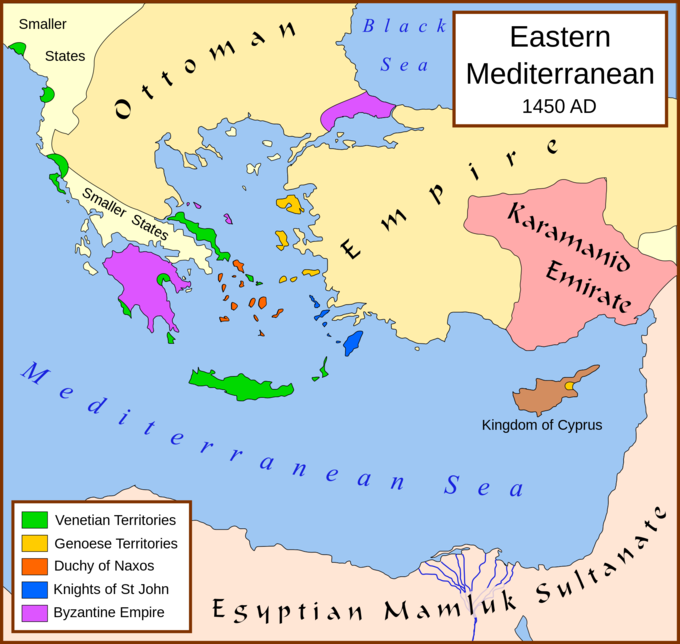


Watch this to learn more about the further conquests of Mehmed II (from Kings and Generals).
In the Rest of the World:
In the entire history of the world and not only in Byzantium, the 15th century was a major turning point especially in its second half as this century was the transition from the Late Middle Ages to the Renaissance and the shift of the intellectual world from the Arab and Byzantine worlds to Western Europe as this was when the art of the Renaissance grew in Italy, new sciences began to be discovered as well as the first psychiatric hospitals would be established in Europe, and when Spain and Portugal began the age of exploration, though the fall of the Byzantine Empire to the Ottoman conquests resulted in bringing the knowledge of Classical Greece and Rome back to the west as Byzantine scholars particularly fled to Italy. In Italy, Florence in particular after their capture of the port of Pisa in 1406 was a rising power especially in a cultural way becoming like a new Constantinople though still not a major European political power though between 1420 and 1461 with Florence growing rich being under the Medici family, the architect Filippo Brunelleschi had worked on the legendary dome of the Florence Cathedral Santa Maria del Fiore and in 1434, Cosimo de Medici became the city’s ruler establishing the rule of the Medici family over Florence who would bring about a strong cultural renaissance which was also assisted by Byzantine scholars brought to Florence when the emperor John VIII visited in 1439. Other than Florence, Venice and Genoa continued being maritime powers in the 15th century being in control of the trade in the Mediterranean though Spain and Portugal were growing their navies to explore oceans. In addition, Monaco had become a country in 1419 when the Genoese Grimaldi family purchased the Rock of Monaco in Southern France which belonged to the Spanish Aragon Kingdom at that time as back in 1297 the Genoese Francesco Grimaldi first arrived in Monaco capturing the Rock of Monaco.
In the Papacy however, the Great Western Schism since the past century still occurred wherein at one point there were 3 simultaneous popes however the Council of Constance in Germany was summoned in 1414 to solve the issue and the schism was finally resolved in 1418 with the pope returning to Rome, though another matter that was bought up in the council earlier on was the rise of rebels against the Catholic Church in the farther parts of Europe such as the movement of John Wycliffe in England some decades earlier but in the early 15th century it was the influence of a heretic in the region of Bohemia in the Holy Roman Empire, a Czech named Jan Hus who’s movement was an early version of the Protestant Reformation as he saw that the Catholic Church was in trouble and needed to change particularly because of the Papal Schism, also he was influenced by the previous English Church reformist John Wycliffe but in 1415 the council including the 3 popes in conflict with each other condemned Jan Hus as a heretic and ordered him to be burned at the stake in Constance (Konstanz, Germany). The news of Hus’ death however led to a rebellion to break out in Bohemia with his faction known as the Hussites and in 1419 this led to a war between the Hussites supported by various powers including Poland against the Crusade of the Holy Roman Empire and Papacy combined which at first seemed like a small war which ended up becoming a massive conflict taking year to be resolved as the Hussite army was strong under the command of the Czech general Jan Zizka who was a follower of Jan Hus and only in 1434 was it resolved with the Catholic empire and Papacy victorious, though the Hussite movement was not fully suppressed and the Hussites movement became their own Church being the first Protestant Church separate from the Papacy.
In the beginning of the 15th century, Hungary which was a powerful kingdom was busy turning its attention to the Ottoman threat and being ruled by their ambitious king Sigismund who after being defeated by the Ottomans in Bulgaria in 1396, founded the Order of the Dragon which was an order of knights in 1408 and addition to being King of Hungary, he was also King of Bohemia, and in his last years Holy Roman emperor from 1433 to his death in 1437, he too was responsible for the Council of Constance to solve the issue of the Papacy but his largest problem later on in life was the Hussite Wars.
On the other hand, Poland and the Grand Duchy of Lithuania united making Poland from a small landlocked territory centuries ago into an empire untied with Lithuania which stretched north from near the Baltic coast and down to Ukraine even including parts of Ukraine, Belarus, and Romania in their empire and they succeeded in pushing out the Teutonic Knights from their lands in the Baltic coast in the Polish-Lithuanian-Teutonic Wars beginning in 1409, and in 1410 the Polish-Lithuanian forces led by the King of Poland Wladyslaw II Jagiello and his cousin the Grand Duke of Lithuania Vytautas the Great defeat the Teutonic Knights at the Battle of Grunwald leading to the Teutonic Order’s downfall, thus this allowed Poland to have access to the Baltic Sea. The Grand Duchy of Lithuania eventually betrayed their partner Poland as Vytautas died in 1430 and was succeeded by his cousin and rival Svitrigaila who in 1431 signed the Peace Treaty of Christmemel with the Teutonic Knights creating an anti-Polish alliance leading to a second Polish-Teutonic War from 1431 to 1435 ending with the Polish again victorious and the Teutonic Knights’ power to decline leaving them with only the area along the Baltic known as Prussia.
As for England and France, the century begins with both at a period of peace though in 1413, the King of England Henry IV who was visited by Byzantine emperor Manuel II in 1400 died and his son Henry V becomes king who ends up failing to negotiate with the French king Charles VI leading to the war to resume at the Battle of Agincourt in 1415 in Northern France which Henry V fights in hand-to-hand combat himself but the French with a massive army of fully armored knights are suddenly defeated by the English army again with their use of the longbow, this then results in the English temporarily taking back Normandy from France. In 1422, both Henry V of England and the mentally insane Charles VI of France died; Henry V was succeeded by his infant son Henry VI and Charles VI was succeeded by his son Charles VII who’s reign saw the tide of the war turn to the French particularly when the English besieged Orleans in 1429 and unexpectedly a peasant girl named Jeanne D’arc (Joan of Arc) arming herself as a knight led the French forces into the city attacking and beating the English army, later the English forces were driven away. In 1430, the English and their Burgundian allies besieged the city of Compiegne and in a battle outside between the French and Burgundians, Joan of Arc is captured by the Burgundians though the French still win and drive the besiegers away. A year later (1431), with the English occupying France Joan of Arc is put on trial for heresy and is sentenced to death by burning at the stake while later that year the 10-year-old King Henry VI of England is crowned King of France in Paris. Although Charles VII still ruled France, Henry VI was King of France in title and back in England, he had founded Eton College in 1440 while in Scotland St. Andrew’s University was founded in 1413. The Hundred-Years’-War finally came to an end ironically in 1453, the same year the Byzantine Empire ended and just how Constantinople fell because of the Ottomans’ artillery, the English lost to the French at the Battle of Castillon in the region of Gascony in Western France due to the French’s use of cannons; as the English lost, all English territory in France including Gascony, Poitou, and Aquitaine returned to France leaving the English only with the port of Calais in Northern France and King Henry VI gave up his title as King of France.
In Spain on the other hand, the Moors of the Nasrid Kingdom were at their last stronghold of Granada while the Kingdom of Castile began to dominate the region even more by colonizing the Canary Islands off the coast of Morocco in 1402 beginning the age of the Spanish Empire. For Portugal, like Spain it was the beginning of a golden age and ready to explore the unknown under King Joao I, founder of the Alviz Dynasty who in 1415 with his sons including Prince Henry the Navigator, the port of Ceuta in Morocco held by Moorish pirates is captured by the Portuguese marking the start of the Portuguese Empire, Henry is then made governor of the southern region of Portugal known as the Algarve by his father in 1419 and here Henry begins setting up exploration missions while his older brother Duarte became King of Portugal in 1433 following their father’s death. At this time, Portugal developed fast sailing ships known as caravels that could sail across oceans as by 1418, the Portuguese had sailed across the open sea and discovered the island of Madeira in which they settled in 1420 in response to the Spanish already colonizing the Canary Islands in 1402. Henry the Navigator’s main purpose for the explorations was however directed to Africa to find the mysterious wealthy Christian kingdom of Prester John which was most likely Ethiopia to trade with them but also to find Christian allies against the Moors, although in 1427 the Portuguese explorer Diogo de Silves instead sailed west across the ocean discovering the archipelago known as the Azores which the Portuguese would settle in afterwards; in 1431 Portugal and Castile signed a treaty so that both kingdoms will no longer clash with each other. For the Europeans, the southernmost point of Africa they knew was Cape Bojador in today’s Western Sahara but in 1434, the Portuguese explorer Gil Eanes went passed Cape Bojador enabling further Portuguese explorations further into the African coast, and in 1444 they had reached the Senegal River and the islands of Cape Verde, though as a result of the discovery of new African lands, the Portuguese established the African slave trade in 1441 shipping slaves from West Africa directly to Portugal.
In the Low Countries (Belgium and Netherlands) which was under the Holy Empire, the economy grew due to the North Sea trade with many cities there including in Germany part of the trading Hanseatic League, though the area known as Flanders (Belgium), would see a renaissance in art during this age with painters like Jan Van Eyck (1395-1441) while in Scandinavia, the Kalmar Union that united Sweden, Denmark, and Norway continued to rule.
Now in Russia, many of the successor states of the Kievan Rus’ Empire continued to survive although weakened by the power of the Mongol Golden Horde however because of the growing power of the Islamic Mongol Timurid Empire of Central Asia based in Samarkand, the Golden Horde Mongol Empie of Russia which was direct successor of Genghis Khan’s empire began to collapse beginning 1399 when the Golden Horde khan Tokhtamysh was at war with Timur forcing Tokhtamysh to flee further east to Siberia and in the 1440s the Golden Horde collapsed being broken up into the Siberia Khanate across the Ural Mountains, the Tatar Khanate of Kazan at the area of the Volga River, the Astrakhan Khanate along the Caspian Sea, the Crimean Khanate in Ukraine, and lastly the Great Horde which was direct successor of the Golden Horde. Among all the 5 Mongol powers of Russia, it was the Kazan Khanate that terrorized the Russian states and at the Battle of Suzdal in 1445 Kazan defeated the army of the Grand Duchy of Moscow capturing and blinding its ruler Vasily II who returned to power in Moscow in 1450 while a civil war happened in Moscow, it was also him who was ruling Moscow when Constantinople fell to the Ottomans in 1453 though before the fall of Byzantium, Russia with Vasily II as Grand Prince of Moscow declared the independence of the Russian Orthodox Church from the Church of Constantinople establishing the Patriarchate of Moscow.
In the Syria and Egypt, the Mamluk Sultanate continued to rule while in the Middle East particularly in Persia and Iraq the Timurid Empire of Samarkand was at its golden age at the early 15th century with Samarkand in Uzbekistan as a cultural capital with an academic renaissance particularly in the reign of its astronomer and mathematician ruler Ulgh Begh (1447-1449). At the early part of the century, Timur after beating the Ottomans at the Battle of Ankara in 1402 headed straight east for China to take it back for the Mongols from the Ming Dynasty but in 1405 he died before his conquest was achieved but his empire back home continued to grow.
In India, the Delhi Sultanate ruling much of the north remained one of the world’s richest powers making many Europeans want to travel to India to trade with them, though despite the Delhi Sultanate remaining powerful, other new powers broke away from it such as the Malwa Sultanate of Central India founded by Dilawar Khan in 1401 and in Delhi itself, the sultanate was not invincible as back in 1398 Timur himself sacked Delhi but kept the Delhi Sultanate in power though appointing the Sayyid Dynasty to take over Delhi as its governor and in 1414, the Sayyid governor Khizr Khan made himself the new sultan of Delhi establishing the Sayyid Dynasty ruling Delhi, although in 1451 the Sayyid Dynasty was overthrown and replaced by the Pashtun Lodhi Dynasty. While Northern India was ruled by the Delhi Sultanate, the south remained under the Hindu Vijayanagara Empire founded in the previous century.
For China, the 15th century was a golden age under the Ming Dynasty which overthrew Mongol rule in 1378, and in 1402 Zhu Di becomes its emperor known as Yongle Emperor and moved the capital from Nanjing to Beijing, he too commissioned the over 22,000 volume Yongle Encyclopedia, orders the construction of Beijing’s Forbidden City in 1406 which is completed in 1420, and sends the admiral and court eunuch Zheng He into 7 naval expeditions known as the “Treasure Voyages” between 1405 and 1433 with a large treasure fleet to discover new lands and take back its treasures and tribute paid by them in exchange for Chinese goods. In these 7 naval expeditions, Zheng He went as far as the islands of Indonesia and the Malay Peninsula, Ceylon (Sri Lanka), India, the Indian Ocean, Persia, the Arabian Peninsula, and East Africa; 6 of these voyages took place in Emperor Yongle’s reign and the last took place in his successor Emperor Xuande (r. 1425-1435). In 1449, China is attacked again from the Mongols and at the Battle of Tumu fortress that year, the Ming Chinese lose and their emperor Zhengtong is captured and taken prisoner by the Mongols making his younger brother Jingtai take over for the meantime until Zhengtong returns to power in 1457. By the late 15th century, the Ming Empire decided to stop on the naval expeditions as it had drained the treasury which the empire would rather spend on the army.
In Java, the Majapahit Empire continues to rule the area and the other Indonesian islands though a civil war of succession known as the Paregreg War breaks out between 1404 and 1406 and since the old Srivijaya Empire of Sumatra had dissolved in the previous century, many new powers rise in the area particularly the Sultanate of Malacca founded by Parameswara in 1402, the former prince of Palembang in Sumatra who became Rajah of Singapura between 1389 and 1398, though Singapura was dissolved and later added to his Malacca Sultanate.
Meanwhile in Korea now under the Joseon Dynasty, their king Sejong the Great in 1443 publishes the Hangul, the native phonetic alphabet system of the Korean language. In West Africa, the Mali Empire continues ruling as a dominant power but in 1440 the new Benin Empire is founded when Euware takes over the city of Benin in a coup and turns the city into an empire.
Over in the Americas, the Inca Empire of Peru that will come to rule the western areas of South America was founded 1438 by Pachacuti, the king of the small kingdom of Cusco and with the new Inca Empire, the city of Machu Picchu begins construction in the 1450s. To the north of them in Mexico, the Aztec Empire comes to dominate the area under the reign of their emperor Moctezuma I (1440-1469) while to the south of them, the Mayapan league or league of Mayan cities in Central America breaks out into a civil war in 1441 which would lead to the disintegration of the league.


Watch this to learn more about the story of Zheng He’s Treasure Fleet (from Kings and Generals).
Watch this to learn about the Battle of Grunwald in 1410 (from Kings and Generals).
Watch this to learn more about the Hussite Wars from 1419-1434 (from Kings and Generals).
Watch this to learn more about the story of the Aztec Empire (from Kings and Generals).
Watch this to learn about the story of the Inca Empire (from Kings and Generals).
The World After 1453:
The rest after the fall of Constantinople in 1453 and Trebizond in 1461 is all history and has so much to be discussed though here I will only go through these events around the world very quickly as the rest of it will be a story for another time. For the rest of the world after Constantinople fell to the Ottomans in 1453, the Hundred-Years’-War between France England also ended that year France victorious leaving France to continue growing powerful entering the age of the Renaissance as well while England just after the war in 1455 would fall into a civil war known as the War of the Roses. Here, Henry VI of the Lancaster House would battle the forces of a rival claimant, the House of York and in 1461 Henry VI is deposed as his forces are defeated making the York duke Edward become King Edward IV of England however a revolt broke out in 1470 and put Henry VI back in power but a year later, Henry VI is deposed again, imprisoned in the Tower of London and killed as Edward IV returns to power ruling a period of peace until his death in 1483 but with his son Edward V still a child, Edward IV’s younger brother Richard III becomes king but in 1485 the War of the Roses continues and here the Lancaster supporter, the Welsh Henry Tudor defeats and kills Richard III at the Battle of Bosworth Field ending the war and becoming King Henry VII of England establishing the Tudor Dynasty wherein the English Renaissance and Age of Exploration and colonization would begin and so would the modern English language evolve from Middle English. In Spain the Kingdoms of Castile and Aragon would finally unite into one Spanish Kingdom and later the Spanish Empire when the Aragonese prince Ferdinand II and the Castilian princess Isabella I marry in 1469 later becoming the rulers of a united Spain and in their rule, the Spanish Inquisition had begun in 1481, the last Moorish kingdom in Spain based in Granada would fall in 1492 when its last ruler Muhammad XII Boabdil surrendered to the Christian Spanish, and issue the Alhambra Decree expelling Muslims and Jews from Spain in which many would flee to the Ottoman Empire. Also in 1492 the Genoese Christopher Columbus working under the united Spain sailed across the Atlantic and landed in the Americas being the second European in the American continent since the Viking Leif Erikson almost 500 years before although Columbus thought he reached Asia, now this began the Spanish colonization of the Americas as Columbus again returned to the Americas in 1493 and 1498. If Spain had already discovered and began claiming the Americas, Portugal would be busy with their explorations of Africa as in the 1480s the Portuguese explorer Diogo Cao went as far as rounding west Africa reaching the Congo River and in 1488 the other Portuguese explorer Bartolomeu Dias reached the Cape of Good Hope and the southern edge of Africa sailing around it proving there was a way to reach Asia from there which enabled another Portuguese explorer, Vasco de Gama between 1497 and 1498 to sail around the Cape of Good Hope and actually reach India and return to Portugal using the same route. With both Spain and Portugal exploring the Oceans, the pope Alexander VI (Rodrigo Borgia) issues the Treaty of Tordesillas signed by the joint rulers of Spain Ferdinand II of Aragon and Isabella I of Castile and King Joao II of Portugal in 1494 dividing the world giving everything west of the Atlantic (the Americas) to Spain, and everything east (Africa and Asia) to Portugal. Meanwhile the harpsichord piano had been invented in this century and in 1455 in Germany, the inventor Johannes Gutenberg created the mechanical printing press which would also spark the Renaissance in Europe educating more people on science and philosophy in their native languages. In the second half of the century in Italy, while Venice would be busy fighting was with the Ottomans in the Balkans, Florence would continue growing as a cultural power under its ruler Lorenzo de Medici known as “the Magnificent’ and at in the late 15th century Florence would be known for the famous artists of the Renaissance including Leonardo da Vinci, Michelangelo Buonarroti, and Sandro Botticelli. Mehmed II’s Ottoman conquest of Constantinople may have blocked off the Silk Route and the trade with China and India but this had late led to Spain and Portugal to discover alternate routes to arrive in Asia and discovering America in the process but as the Ottomans conquered the Balkans they wouldn’t push into Europe any further as the King of Hungary Matthias I Corvinus (r. 1458-1490), the son of the general John Hunyadi would continuously stop the advancements of the Ottomans. Meanwhile the Teutonic Knights in the Baltic coast would eventually lose to the Polish in 1466 with the Teutonic Order’s last territory of Royal Prussia along the Baltic becoming fully annexed into the Kingdom of Poland. As for Russia, since Constantinople had fallen, the Grand Duchy of Moscow would grow strong enough to call themselves the new Byzantium as Moscow under its Grand Duke Ivan III the Great (r. 1462-1505) would expand Moscow’s territory to unite Russia by conquering the Republic of Novgorod in 1478 expanding Moscow’s territory all the way to the northern Arctic coast and in 1480 finally defeating the Mongols of the Great Horde at the Ugra River making Moscow gain full independence from them. In addition, Ivan III had married a surviving member of the Byzantine imperial Palaiologos family, Zoe the daughter of the last governor of the Morea Thomas Palaiologos and niece of the last emperor Constantine XI, this then would legitimize Moscow and all of Russia as Byzantium’s successor and here Byzantine scholars and Italian artists would come to Russia bringing the renaissance; Ivan III in his reign would begin the process of uniting Russia and his son Vasily III and grandson Ivan IV would continue the bloodline of the Palaiologos family as well in the next decades leading to the defeat of the Mongols in Russia and the foundation of the Russian Empire. In the Middle East, most it would be still under the Mamluk Sultanate based in Egypt while the eastern part most particularly Persia would still remain under the Timurid Empire. On the other side of the world, the new religion of Sikhism would be born in India, Islam would reach as far as Java with its first mosque built in 1478, a new bronze metal moveable printing press would be invented in Ming Dynasty China in 1490, and in Japan the Edo Castle of Tokyo would be constructed in 1457 but in 1467 Japan would fall into the Sengoku Period which would be a time of civil war lasting more than a century. In Africa despite the Mali and Benin Empires existing, the new power of the Songhai Empire of West Africa would be born in 1462 in the area of the Niger River. Now across the Atlantic Ocean in the Americas, the Aztec Empire in Mexico and Inca Empire in Peru would reach their height of power though not for long as by the end of the century, the Spanish had already arrived in the Americas beginning with Christopher Columbus in 1492 and very soon enough they would reach the mainland and conquer both empires and the new age of colonization would soon begin.


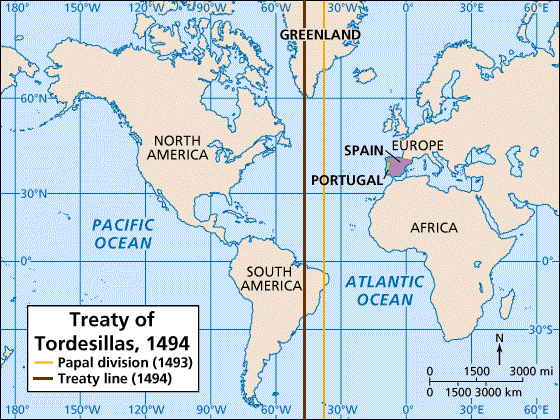
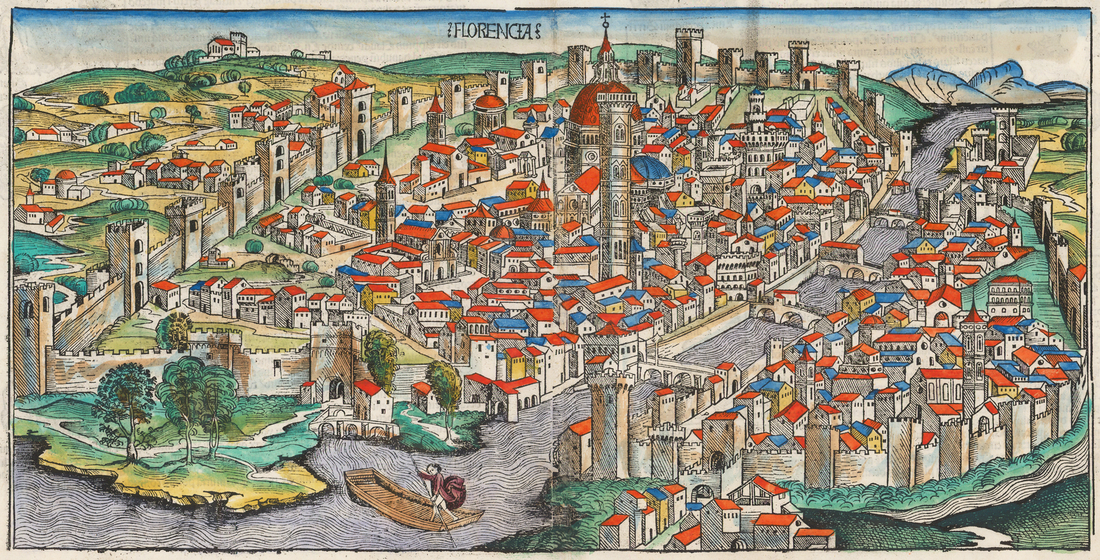


 The Byzantium Blogger
6 thoughts on “Around the World in the Byzantine Era Part2 (1000-1461)”